多益閱讀文法 - Present, Past, Future Simple, and Future in the Past Tense
Tense is a crucial aspect of English grammar. Understanding it thoroughly allows for accurate comprehension of English dialogues and pieces of writing. In simplified terms, English tenses are divided into four categories: simple, continuous, perfect, and perfect continuous. Each category can further be broken down into three time frames: present, past, and future, totaling to 12 tense variations. In this lesson, we will focus on the first category, the 'simple tense', which includes the present simple tense, past simple tense, and future simple tense. We will also cover the concept of "future in the past tense," a frequently used concept in everyday English conversation that many students struggle with.
目錄
Present Simple
|
Key Points |
|
The present simple is mainly used to express the following
situations:
(3) personal preferences |
In the present simple tense, “be” verbs can be “am/is/are” depending on the subject.
|
First-person |
Second-person |
Third-person |
|
|
Singular |
I am a doctor. |
You are a doctor. |
He/she/ is a doctor. |
|
Plural |
We are doctors. |
They are doctors. |
In the present simple tense, most regular verbs use the root form, except in the third-person singular (which ends in "s"). The following table uses the verb “write” to illustrate different usages of the present simple tense.
|
First-person |
Second-person |
Third-person |
|
|
Singular |
I write. |
You write. |
He/she/it write s. (Note the "s".) |
|
Plural |
We write |
They write. |
For a few verbs, the third-person singular ends with es instead of s.
Typically, these are verbs whose root form ends in "o", "ch", 'sh”,
“th”, “ss”, “gh”, or ”z”. For example:
He/she/it goes. (Note the "es".)
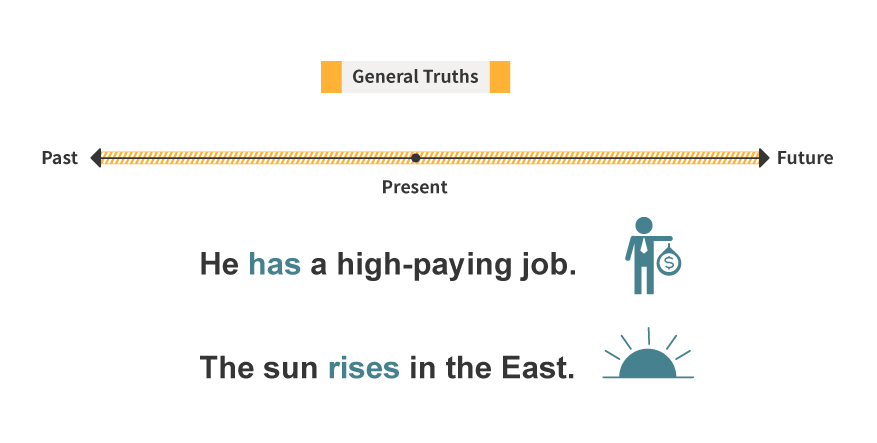
✦ Expressing a fact or a general truth
The present simple can express a fact, or a truth generally accepted
by the world.
|
I
speak English well. |
She
looks like Jessica. |
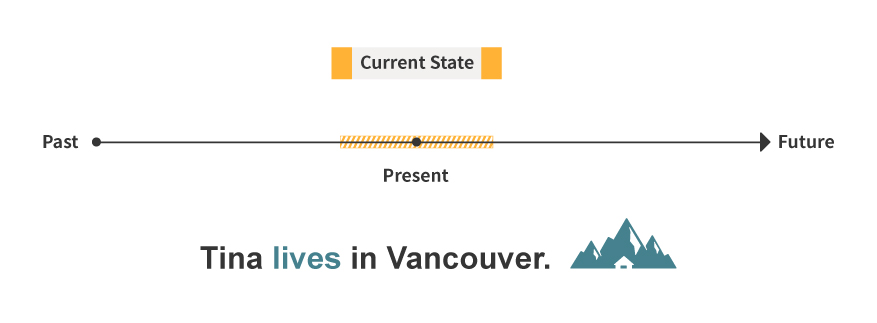
✦ Expressing the current state
The present simple can express the current state.
|
I
have lots of friends. |
I
work in a tech company now. |
Ladies and gentlemen, welcome onboard Flight 4 C 7 with service from
London to Singapore. We
are currently third in line for take-off and
are expected to be in the air in about seven minutes.
TOEIC Example: The two films
____ currently the highest-grossing movies of all time at the
worldwide box office.
(A) are
(B) will be
(C) were
(D) will have been
The correct answer is (A) are.
(B) "will be" is incorrect because it is in the future tense. This would mean that the two films are not yet the highest-grossing, but will become so in the future. This contradicts the word "currently" in the sentence.
(C) "were" is incorrect because it is in the past tense. This would mean that the two films were the highest-grossing in the past, but are not anymore. This also contradicts the word "currently" in the sentence.
(D) "will have been" is incorrect because it is in the future perfect tense. This would mean that at some point in the future, it will be true that the films had been the highest-grossing. This makes no sense because we are talking about the current status of the films, not a future hypothetical scenario.
The sentence is talking about the present status of the two films, so we need to use the present tense of the verb "to be", which is "are". When we say "The two films are currently the highest-grossing movies of all time at the worldwide box office", we are stating a fact that is true at the present time.
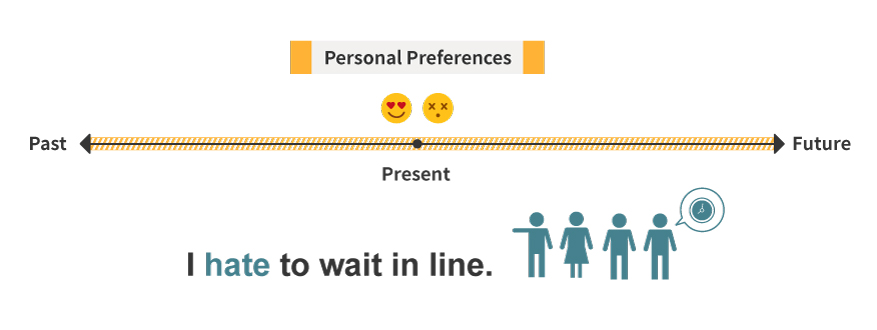
✦ Expressing a person's preference
The present tense can express a person's preference.
|
I really
like the weather today. |
I
don't like
rainy days. |
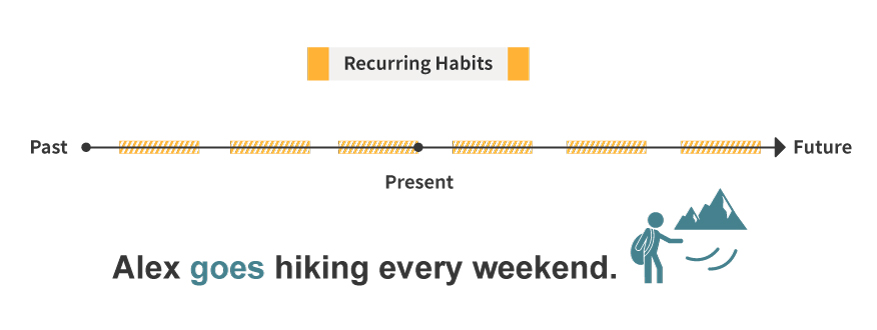
✦ Expressing habitual things and repeated events
The present simple can express habitual things and repeated
events. This is often used together with adverbs of frequency and
adverbs of time, for example: always, usually, often, sometimes, every
day, etc.
|
He
drinks coffee every morning.
|
He always works overtime on weekdays. |
I sometimes go to bed late, and
oversleep the next morning.
My brother rarely gets up early, and often stays up late.
If you want to talk about a current habit, you can use the phrase "be used to + Ving / noun". Note that “to” in this phrase is a preposition, so a noun or gerund must be added after it. For example:
I
am already used to my new job.
I'm used to working out after
work.
I'm used to reading a book
before I go to bed.
✦ Talking about future events that have been planned, and general
facts that will occur in the future
We
have an early meeting tomorrow morning.
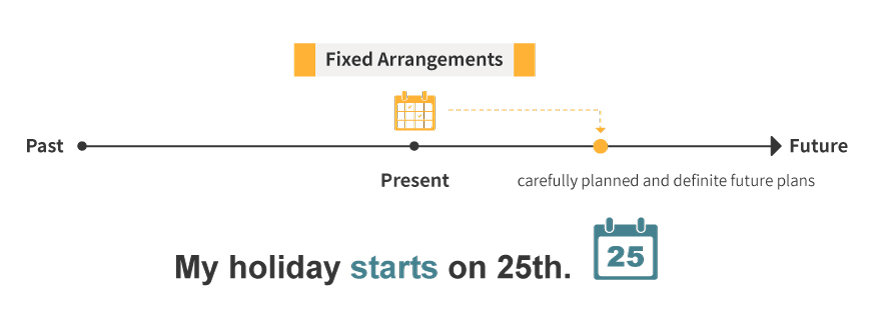
The final exam
comes next week.
I
have an appointment with Dr. Lee next Monday.
I
have lunch with Joe next Monday.
In addition to the arranged future plans, the present simple can also express general facts that will happen in the future. For example:
The last flight
leaves at 10 p. m.
The train
arrives at 10 p. m. tonight.
The lockdown
begins tomorrow.
The bank
opens late tomorrow because it is the weekend.
✦ "Present tense" in the first conditional clause
In the first conditional (expressing a conditional situation in the present or future), the structure is: if/when + present simple,.... will + base form. Notice that we use the present tense to depict the future in the conditional clause. However, we use the future tense in the main clause. Here are example sentences:
If you
work hard, your manager will give
you a raise.
In case our company
goes bankrupt, you and I
will have to find
a new job.
I will call you when I get home.
TOEIC Example: The bank will contact us once we ____ the enclosed form.
(A) submit
(B) submits
(C) will submit
(D) submitted
The correct answer is (A) submit.
(B) submits is incorrect because the verb "submit" doesn't agree with the subject "we". The verb should be in its base form.
(C) will submit is incorrect because in conditional clauses, we don't use "will" after "if" or "once".
(D) submitted is incorrect because the past tense suggests that the action has already happened, but in this case, the action is expected to happen in the future. so, the present simple tense should be used.
The correct answer is based on the grammar rule of "conditional clause". In the first conditional (real possibility), the structure is: if/when + present simple,.... will + base form. Here, "once" can take the place of "when" as a connector of time. Thus, "once we submit" is correct.
Past Simple
|
Key Points |
|
The past simple tense is ubiquitous in everyday conversation
and is mainly used to express the following two
situations: |
In the past simple tense, “be” verbs can be “was/were” depending on the subject.
|
First-person |
Second-person |
Third-person |
|
|
Singular |
I was a student. |
You were a student. |
He/she/ was a student. |
|
Plural |
We were students. |
They were students. |
In the past simple tense, regular verbs, add “–ed” to the root form of
the verb (or just “–d” if the root form ends in an “e”). For
example:
Play→Played
Ask→Asked
Listen→Listened
Love→Loved
Some past tense of some irregular verbs looks exactly like the root
form. For example:
Put→Put
Cut→Cut
Set→Set
Cost→Cost
Hit→Hit
For other irregular verbs, the simple past forms are more erratic. For
example:
Write→Wrote
See→Saw
Build→Built
Go→Went
Do→Did
Rise→Rose
✦ Expressing past actions and states that have ended
"Past tense" indicates past actions and states that have ended,
and there are usually adverbs representing past time in sentences,
such as yesterday, last month, last year, ago, etc.
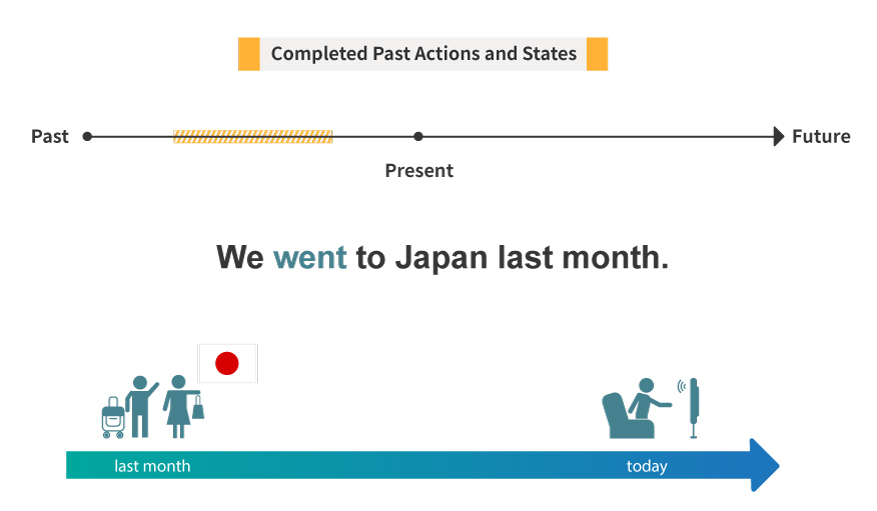
I
had a
really bad day.
I
fell asleep on my couch last night.
It
was really cold last winter.
I
went to
the ATM to withdraw some money.
The Nasdaq Composite
dropped
57 points today.
I
didn't bring
my cell phone today.
In the past simple tense, adverbial clauses are often used. The
following structures are commonly used:
(1) when/while + subject + verb
(2) Before + subject + verb
(3) After + subject + verb
In the follow-up "Advanced English Sentence Patterns - Using English
Adverb Clauses", we will show more about what adverb clauses are.
I
was
really full after I
had a
buffet lunch.
When my alarm
went off
this morning, I
woke up
immediately.
I
was
totally exhausted after I
ran 3
miles.
I
had a
meeting with Jessica before she
took
maternity leave.
TOEIC Example: Governor Mary Simon spoke at length about the issue of the public education system when it _____ during a debate on education held at Edmonton Town City Hall yesterday.
(A) were brought up
(B) brings up
(C) will be brought up
(D) was brought up
The correct answer is (D) was brought up.
(A) "were brought up" is incorrect because "were" is used for plural subjects, but the subject here is the singular issue, so the singular "was" should be used.
(B) "brings up" is incorrect because it is in the present tense, while the action happened in the past.
(C) "will be brought up" is incorrect because it is in the future tense, showing an action that has not yet happened, while the action in this sentence happened in the past.
In this sentence, the action of bringing up the issue happened in the past, so we need a verb form in the past tense. It was singular, so the singular form "was" should be used. Thus, "was brought up" correctly communicates the action that happened in the past.
✦ Expressing past habits
The past simple tense can also express a "past habit".
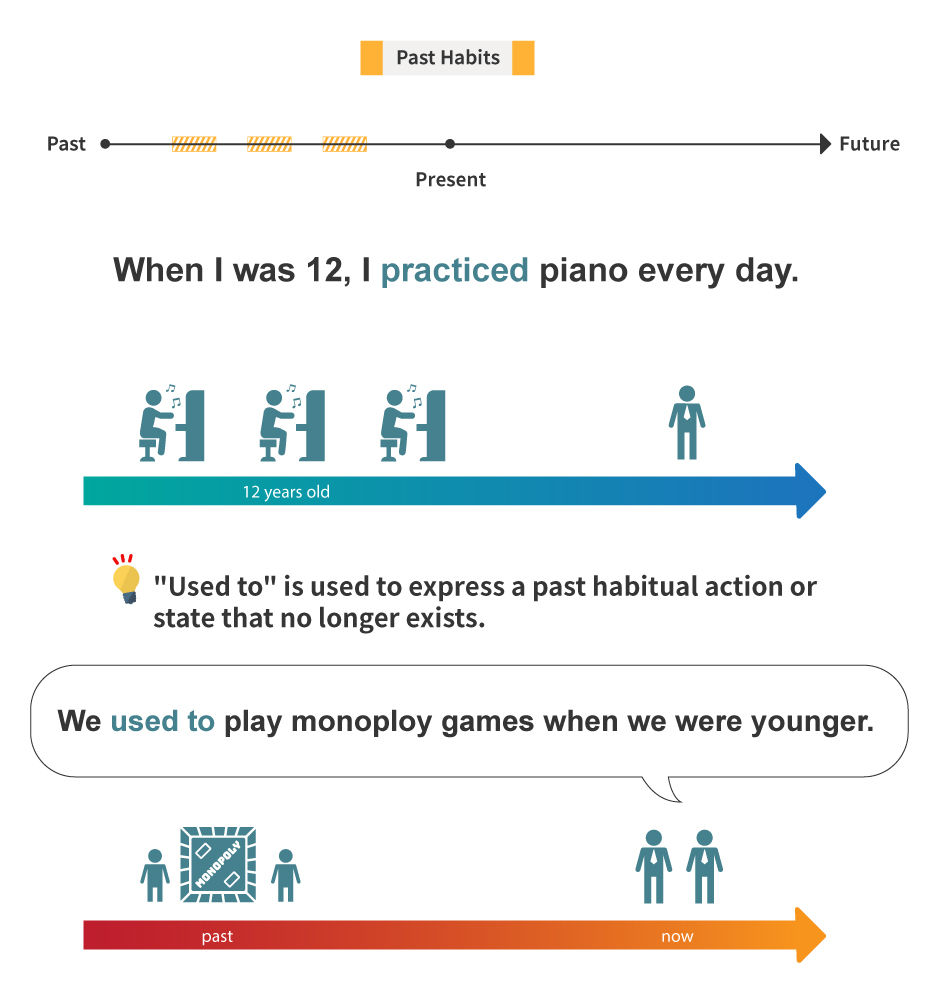
When I
was in
high school, I
went to cram school every day.
When my dad
was young. He
worked overtime every day to raise our family.
Would is the past tense of will, which can express the future tense in the past tense.
When I
was young, my family
would go
skiing once a year.
When I
was little, we
would go
for a picnic every weekend.
When we
were in college, we
would ride
scooters to different places every weekend.
“Used to” means "I used to do something often, but now I don't do it anymore". For example:
I
used to go
swimming every day, but now I'm too busy.
They
used to go to
nightclubs when they were in college.
We
used to play
Monopoly games when we were younger.
We
used to
live
in Taiwan before we moved to Vancouver.
John
used to eat
meat, but now he’s a vegetarian.
I
didn't use to
believe
in gods.
I
didn't use to enjoy
coffee, but now I can't start my day without it.
I
didn't used to think
speaking English is possible until I moved to the U. S. and lived
there.
Future Simple
|
Key Points |
|
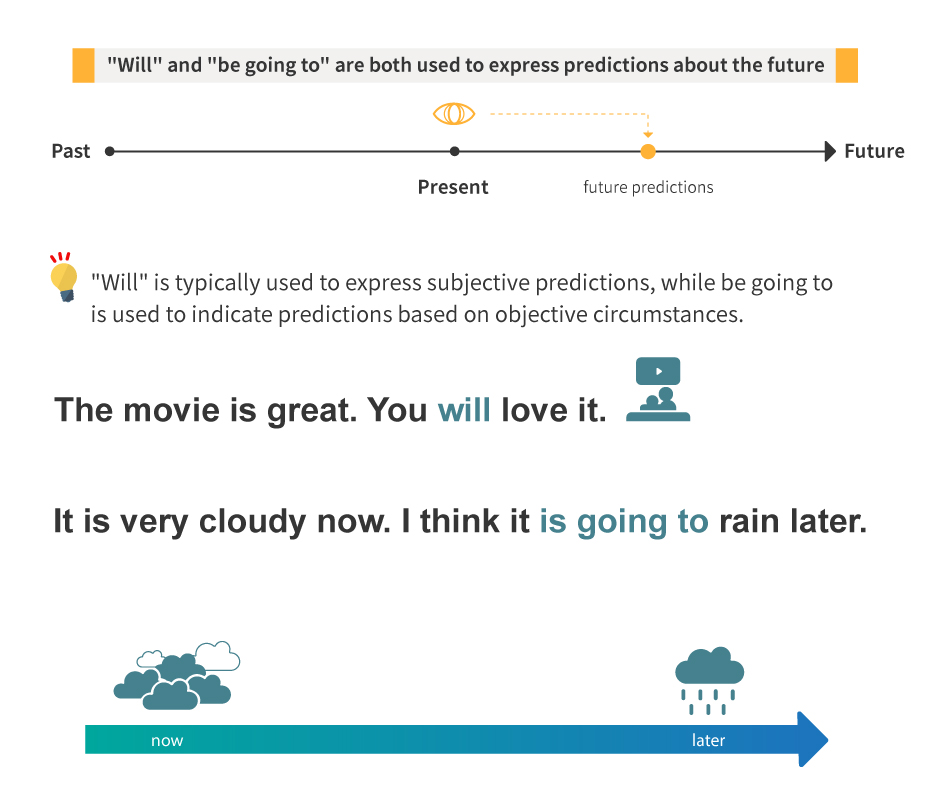
The formula for the simple future is “will + root form of verb” or “be verb[am/is/are] going to + root form of verb”. We use future simple tense to express what will happen in the future and to describe things in the future, or speculate about the future. The future simple has two different types, namely "will" and "be going to". Although these two types are sometimes used interchangeably, they are different. |
✦ Both “will” and “be going to” can express things that will be
done in the future
"Will" is mostly used to talk about spontaneous decisions,
promises, offers, predictions, and assumptions about the future, while
"be going to" is used to talk about plans or intentions that are
decided before the moment of speaking, and sure predictions based on
present evidence.
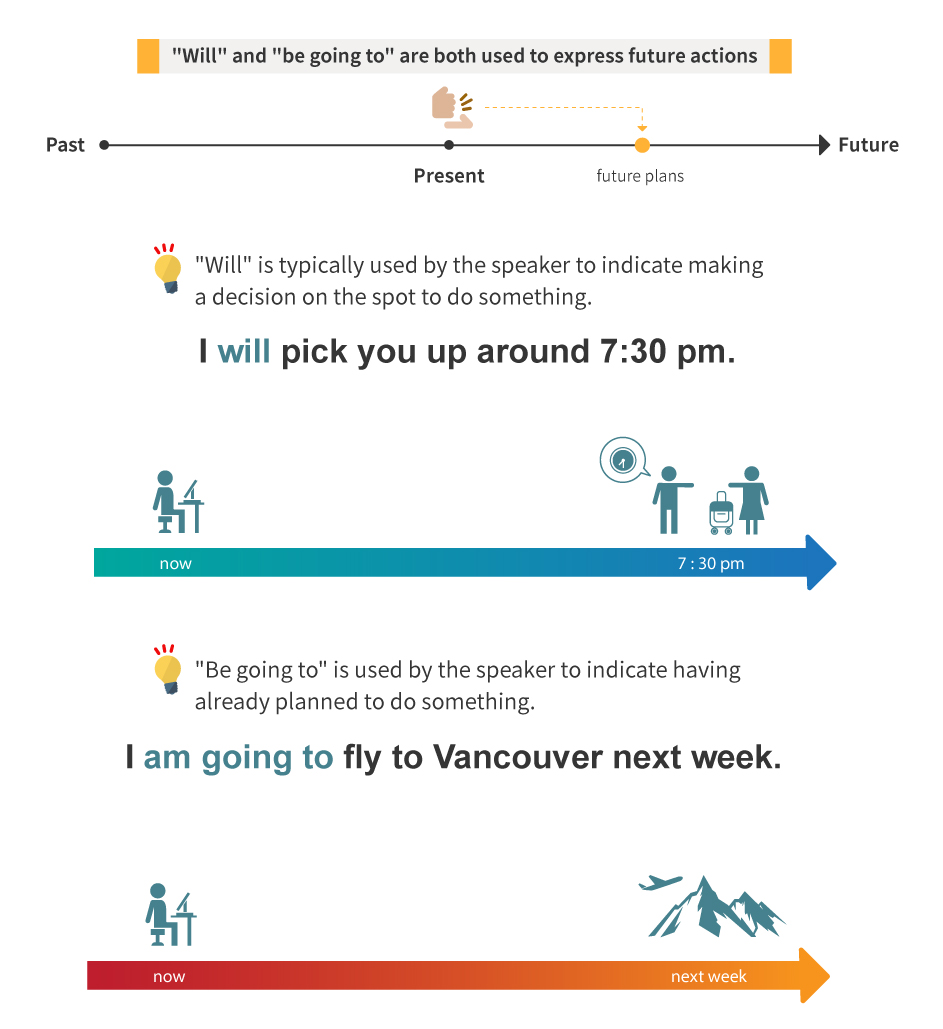
I
will meet you at the bus stop later.
Don't worry. I
will give you a ride home.
I'll
stop by
after work to drop off the paperwork.
I
will get back
to you soon.
I
will swing by
the supermarket on my way home.
You look tired. I
will get
you some coffee.
We
are going to have
a barbecue tonight.
I am going to take
a few graduate courses next semester even though I am just an
undergraduate.
I'm going to be an
actor when I grow up.
They
are going to drive
all the way to Kenting.
She
is going to
be at
the wedding tonight.
When native speakers say ‘going to”, they often simplify it to
“gonna”.
✦ “Will” can also be used to express willingness or promise to do
something
"Will" is also used for the speaker’s "willing or promising to
do something", we often use will to respond to other people's
requests. Likewise, we can use “will not” or “won't to express
unwillingness to do something. For example:
I
will
cover
your shift next week.
My boss
will give
me a promotion next month.
My boss
won’t
give
me a raise.
My professor
won’t
let me hand in assignments late.
✦ “Will” can also be used to describe something that will happen in the future
Mr. White
will be
on a business trip to Japan until the end of this week.
Our representative
will
contact
you regarding the business proposal within the next few weeks.
James
will
go to
graduate school next year.
Sally
will be
on maternity leave starting next month.
A typhoon
will
make landfall in Taiwan tomorrow morning.
TOEIC Example: We are planning to relocate two factories in California to Los Angeles. To expedite job placement, employment training workshops ____ next week in Los Angeles.
(A) are held
(B) will be held
(C) were held
(D) will have been held
The correct answer is (B) will be held.
(A) "are held" is incorrect because it is in the present tense. This would suggest that the workshops take place regularly or constantly, which does not align with the context of the sentence.
(C) "were held" is incorrect because it is in the past tense. This would suggest that the workshops have already taken place, which again does not align with the context of the sentence.
(D) "will have been held" is also incorrect because it is in the future perfect tense. This would suggest that the workshops will be completed at some point in the future before another action. There is no other future action indicated in the sentence that these workshops should precede, making this choice incorrect.
The sentence is in the future tense as it indicates an event that is going to happen, not something that is happening now or that has happened in the past. "Will be held" describes a future event, which in this case is the employment training workshops. This matches the context of the sentence since we are talking about a future event, relocating the factories.
✦ Both “will” and “be going to” can be used for future
predictions
Some people think the S&P 500
will
go up tomorrow.
It
will
rain tomorrow.
This mall
will be
busy tomorrow afternoon, and the parking lot
will be
packed.
Experts predict that oil production
will
decline after 2025.
He doesn't look good. He
is going to
puke
pretty soon.
It is cloudy now. I think it
is going to
rain
later.
They are down by 25 points. They
are not going to
win
the game.
The traffic is really bad now. I
am going to be late for work.
✦ "Future tense" in the first conditional clause
In the first conditional (expressing a conditional situation in
the present or future), the structure is:
if/when + present simple,.... will + base form. Notice that we use the present tense to depict the future in the
conditional clause. However, we use the future tense in the main
clause. Here are example sentences:
If you come home this weekend, I
will
cook
for you.
I
will
call
you when I get home.
The realtor
will
contact
you if the seller
accepts your offer.
TOEIC Example: If the new incentive program for sales personnel _____, salespeople will be eligible for a 10 percent commission on orders totaling more than US $1000, starting September 1.
(A) will be approved
(B) will approve
(C) is approved
(D) approves
The correct answer is (C) is approved.
(A) "will be approved" is incorrect because it is in the future tense. In a type 1 conditional clause, the clause that comes after "if" should be in the present simple tense, not the future tense.
(B) "will approve" is incorrect for the same reason as (A). It is in the future tense, which is not correct in a type 1 conditional clause.
(D) "approves" is incorrect because the subject "incentive program" is not the one performing the action of approval. It is the object that will be approved, not the approver. So, the verb "approve" should be in the passive form "is approved", not the active form "approves".
The first part of the sentence "If the new incentive program for sales personnel ___," is a conditional clause. Conditional clauses always begin with "if" and express a condition that must be met for something else to happen. This is a type 1 conditional clause which is used to refer to future situations that are likely or possible. The structure for a type 1 conditional clause is: If + present simple tense, future simple tense. Here, the present simple tense "is approved" is used and it is followed by the future simple tense "will be eligible". So, in this context, (C) "is approved" makes the sentence grammatically correct.
Future in the Past Tense
|
Key Points |
|
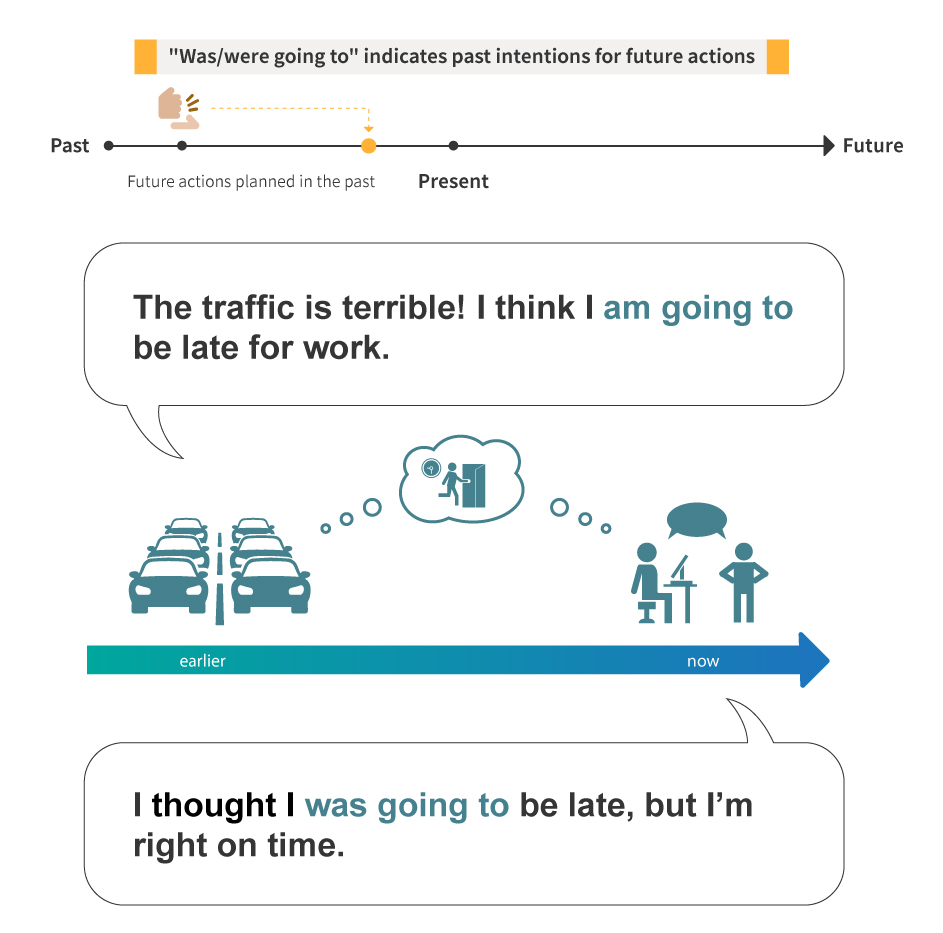
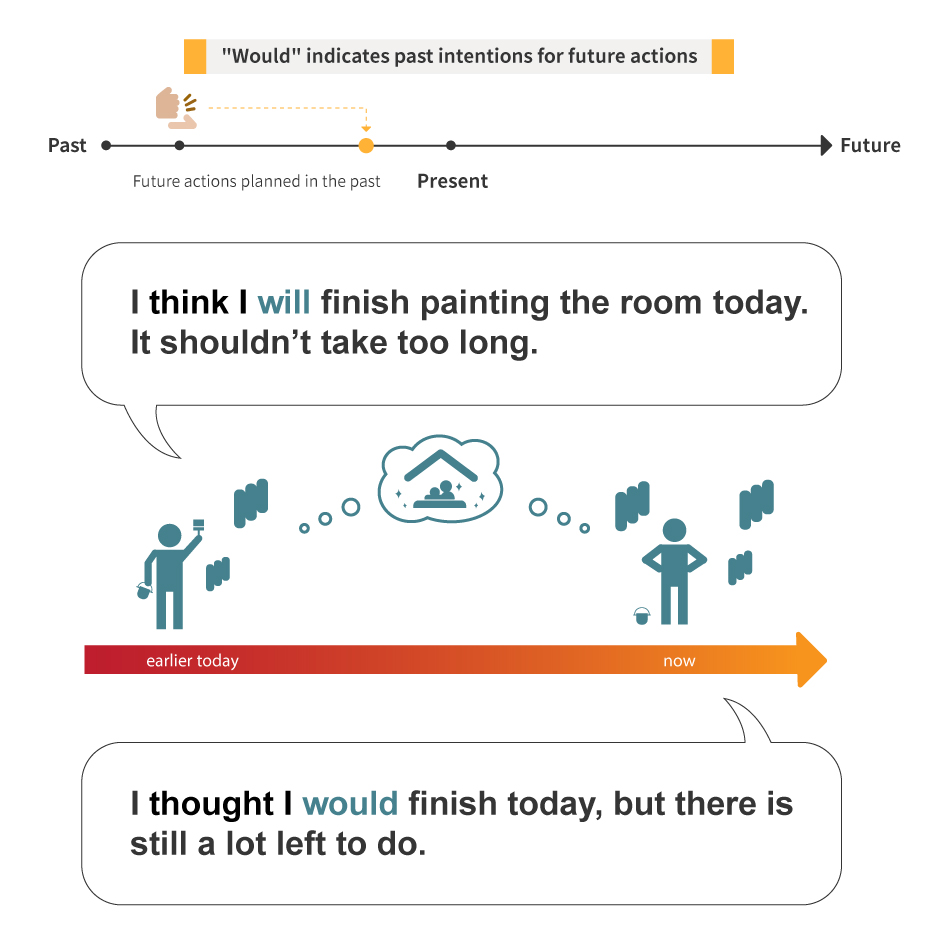
When we want to refer to the future from the perspective of some point in the past, we can use the future in the past tense. For example: I told him I was going to the party yesterday. |
We know that the simple future tense has two different forms: “will +
base verb” and “is/are going to + base verb”. Hence, the two different
forms of the
future in the past are the past
tenses of “will + base verb” and “is/are going to + base verb”, which
are “would + base verb” and “was/were going to + base verb”. Below are
sentences in the future tense and their corresponding past tense
forms.
|
✦ “will” and “would” |
|
|
The speaker is describing and predicting future events |
The speaker is describing a point in the past that the speaker believes will happen in the future |
|
Will
We think he will win the election. |
Would
We thought he would win the election. |
|
✦ am/is/are going to and was/were going to |
|
|
The speaker is describing and predicting future events |
The speaker is describing a point in the past that the speaker believes will happen in the future |
|
am/is/are going to
They
are going to drive all
the way to Kenting. They have filled up the gas tank
already. |
was/were going to
They
were going to drive
all the way to Kenting, but the car broke down on the
freeway. |