Lesson Introduction
-
Video Lesson
- IELTS Listening - Form Completion
Rész 1
In this lesson, we will cover the Form Completion question type. In a form completion question, you'll be given a form, and you will need to fill in the missing information based on the listening passage. Normally the answers will be one, two. or three words long and will be factual information, such as phone numbers, dates and times. Form completion questions usually appear in the section 1 of the listening test.
This type of question often asks you to write down a credit card number, telephone number, name, address, postal code, and date, so you should familiarise yourself with how numbers, letters, addresses, and dates sound in British English. Make sure you practice listening to these types of information and learn how to write them down correctly. Let's look at some tips.
Telephone numbers are often tricky. Firstly, native speakers often say "oh" instead of "zero" and they may also group numbers together by saying "double" or "triple" in front of it. So 0668880711 would sound like "oh, double six, triple eight, oh, seven, double one.".
Additionally, when discussing measurements, “zero” can also be said by saying the word “nought”. For example, the number 0.9 could be said as “nought point nine” or “zero point nine”.
Dates in Form Completion Questions
When you need to write out dates as an answer, you actually have quite a bit of flexibility and a plethora of options. Let’s look at a specific example:
“September sixth”:
- September 6th → In this case, you can write out the whole month with the ordinal number (using th)
- Sept 6th → In this case, you can abbreviate the month and write the ordinal number.
- 6th of September → In this case, you can put the ordinal number first, as long as you put “of” in between the number and the month.
- 6th of Sept → This follows the same rule, with an abbreviated month.
- 06/09 → This format follows the UK rule of placing the number before the month.
- 09/06 → This format follows the US rule of placing the month before the number.
It is important to keep all of these possibilities in mind, but do not forget about the accuracy of the ordinal numbers. Our chart includes the irregular ordinal numbers in red. Let’s review them quickly:
|
1st - first 2nd - second 4th - fourth 5th - fifth 6th - sixth 8th - eighth 9th - ninth |
11th - eleventh 12th - twelfth 13th - thirteenth 14th - fourteenth 15th - fifteenth 16th - sixteenth 17th - seventeenth 18th - eighteenth 19th - nineteenth |
21st - twenty-first 23rd - twenty-third 24th - twenty-fourth 25th - twenty-fifth 26th - twenty-sixth 27th - twenty-seventh 28th - twenty-eighth 29th - twenty-ninth 30th - thirtieth |
Be on the lookout for various ways in which currency can be described in the listening section of the exam. For example, you can hear and say the total £/$ 8.80 in a few ways:
£ 8.80 → Eight pounds eighty (quite informal)
£ 8.80 → Eight pounds and eighty pence (neutral/more formal)
$ 8.80 → Eight dollars and eighty cents (neutral/more formal)
$ 8.80 →Eight eighty (quite informal)
When it comes to writing out currency, you have a couple of options. You can choose to write out the entire word, or you can write the currency in symbols. Let’s use the example, £/$ 8.80:
£ 8.80 or Eight dollars and eighty pence
$ 8.80 or Eight dollars and eighty cents
Measurements in Form Completion Questions
Expect to see a range of measurements, including but not limited to, centimetres (centimeters), kilometres (kilometers), and kilograms. You are more than welcome
to use both the UK or US spellings. We would only suggest that consistency is kept throughout the exam. Additionally, you are more than welcome to abbreviate
these measurements as necessary.In fact, you should abbreviate when you are able to. Why? This way, you eliminate any possibility of misspelling the word and losing any points.
Let’s look at an example! (Note:
We have used the US spelling in our example, but the UK spelling would also be acceptable).
“Ninety kilometers” → 90 kilometers, 90 km, 90 kms
Now, let's look at strategies for this question type.
Note that Steps 1 and 2 will be done prior to listening. Think of these as the “prep work” that will be done before the listening prompt is played. The rest of the steps will be done while the listening prompt is playing. Remember: you should practice your multitasking skills beforehand, so that you are prepared to take notes and listen at the same time without losing focus!
1. First, Read the Information - Reading the information will always be the first step in any listening prompt. Why? You do not want to listen blindly and hear key words for the first time. Instead, you should be preparing yourself and reading the points in the form or table given to you before the listening prompt is played. Generally, you will have about 20 seconds to do this. Reading the information will also allow you to become familiar with the topic, which is particularly helpful for the more abstract and educational topics (Sections 3 and 4).
2. Underline Key Words - With time and practice, you can combine Steps 1 and 2. Thus, this step can be done while you are reading the sentences or afterwards. We suggest trying to combine the first two steps, as you will only have around 20 seconds to read the information prior to listening to the prompts. For the Note/Form/Table Completion activity, you will most likely only need to underline one or two key words at a time. Is it still worth it to underline one word at a time? Definitely--count it as reading it twice and understanding it twice as well!
3. Take Notes on Key Information - Now, it’s time to listen to the listening prompt. Use your test booklet and questions to your advantage. No one will judge your score based on the notes you take, so make sure it is understandable to you. Using proper grammar and correct spelling is not necessary in this case.
Remember: information will come in order for this question type. If you get side-tracked and miss information, continue right where you left off.
4. Be Accurate - Last of all, be sure to be accurate. While this may seem like common sense, many candidates make silly errors that cost them valuable points in the scoring process. It is extremely important to be accurate when writing out your answers, and especially when transferring them to the answer sheet (for paper-based candidates). Remember that someone else will be reading (and judging) your written answers. For this reason, it is best to write in all CAPITAL LETTERS in order to ensure neatness and legibility, especially in this question type. The directions will always tell you up to how many words you can write, so make sure to pay attention to this.
Using these tips, let’s look at an example of a Section 1 listening prompt featuring only the Form Completion question type.
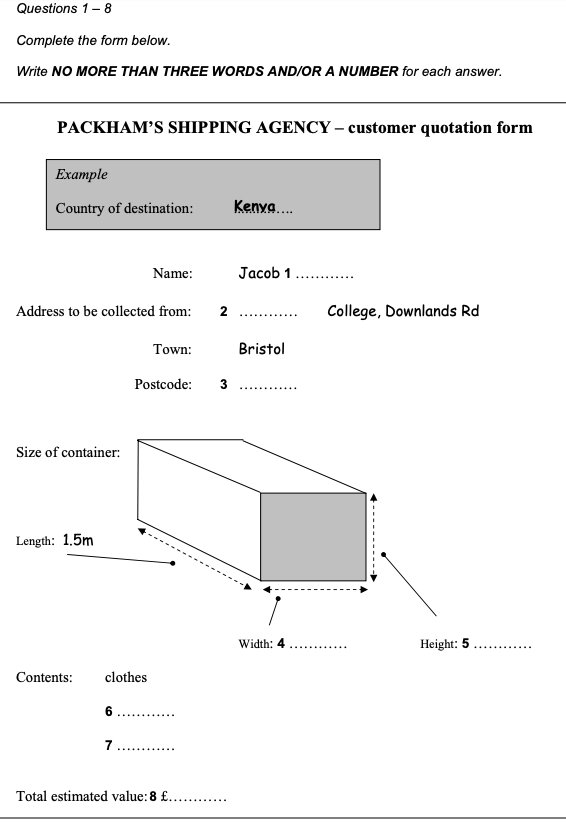
Before we even listen to the prompt, take time to quickly read the words and information. Try to combine this step with the second step, in order to save on time and focus some time on understanding the parts of speech of the missing words.
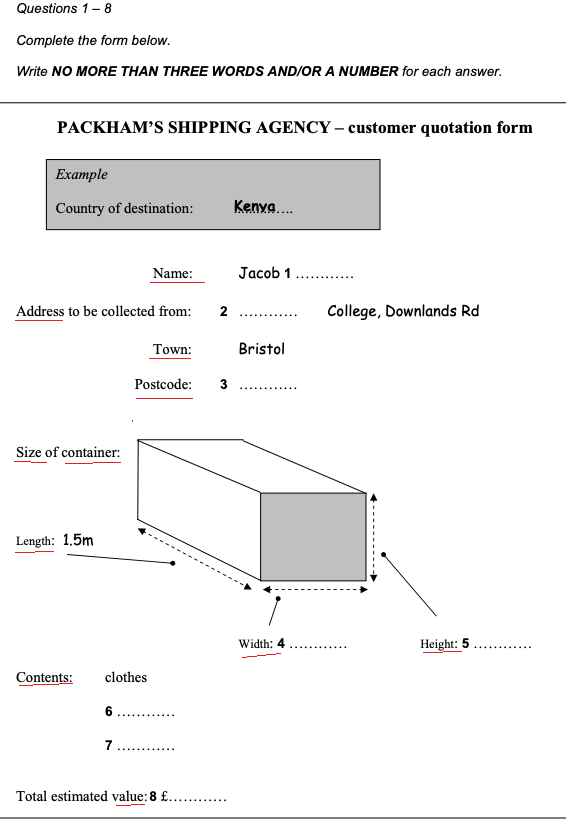
After you have quickly read (or while you are reading), underline the key words. What are key words? They are important words that will call out your attention while you listen to the prompt. Generally, you will want to avoid underlining adverbs, pronouns, or basic adjectives.
Quick Tip! - This question type will not contain long, drawn-out sentences similar to other question types. Instead, you will see only a few words, which will be key words. Do not be deterred if you find that you are underlining most of the words. That’s fine--underlining is great for your understanding of the words.
Let’s take a look at how we have underlined the key words below.
Show keywords
1.
2.
3.
4.
5.
6.
7.
8.
After this step, you should notice a few things:
1.This is Section 1, so we can expect two speakers. However, we are just looking for specific information, and it is not too important who says what.
2.The topic of the recording will involve shipping and the transmission of basic information. Do you see how you will need to collect only the first half of an address, along with other basic information? You can expect these answers to be a surname, a postcode (numbers), numbers for width, height, and total estimated value, and a few words for contents.
Have a look at our notes in the form below.
Show Notes
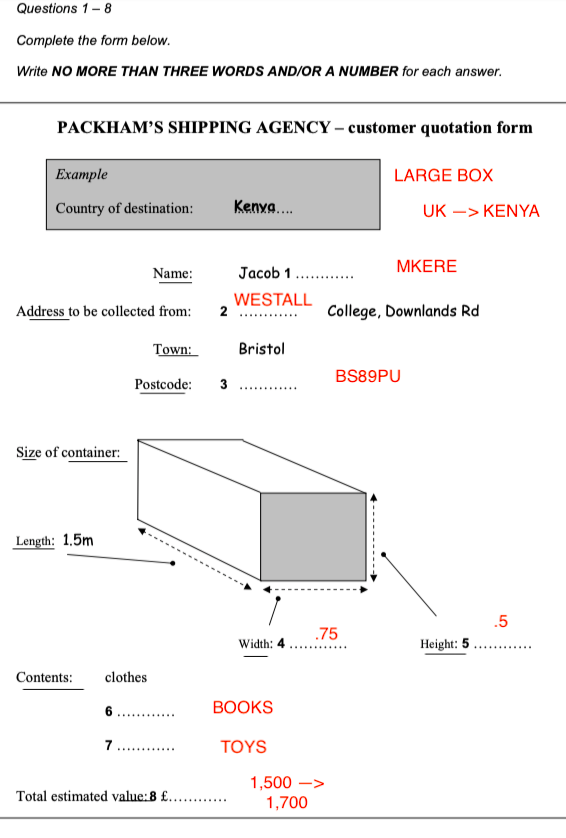
Have you noticed that our “notes” were actually the answers? This is common for this question type, since it is very straightforward and clear. Try this for yourself--do your notes also serve as the answers? Take a look at the explanations below.
Show Answers
1.
2.
3.
4.
5.
6.
7.
8.
Answer Key and Explanation
1. Mkere - The statements, “A Can you spell your surname, please? B Yes, it’s M-K-E-R-E. A Is that ‘M’ for mother? B Yes. ” prove that this is correct. When it comes to spelling names, cities, and postcodes, you can almost always expect a speaker to spell out the information for you. This is because these are not traditional English words. Therefore, they should be spelled in order for everyone to have a fair chance at spelling them out.
2. Westall - The statements, A Yes, of course. I’ll take down the address now. B It’s Westall College. A Is that W-E-S-T-A-L-L? B Yes, ... college.” show that this is the correct answer. Again, since this is a proper noun of a place, you can expect the speakers to spell this out for you. This only means that you must be quick to write down the letters!
3. BS8 9PU - The statements, “A Oh yes, I know it. And the postcode? B It’s BS8 9PU.” prove that this is correct.
4. (0).75 m/metre(s)/meter(s) (wide) / three(-)quarter(s) (of) (a) metre/meter (wide) / ¾ m (wide) / 75 cm(s) (wide) - The statement, “B 0.75m wide ... ” shows that this is the correct answer. Note how the word ‘wide’ is used instead of ‘width’. This is a common trick in the listening exam, since these are synonyms. Even if you are not familiar with the synonym, you can follow along with the form and use it as the most logical option, since the words are similar.
5. (0).5 m/metre(s)/meter(s) (high/deep) / (a) half (a) metre/meter (high/deep) / ½ m (high/deep) / 50 cm(s) (high/deep) - The statement, “And it’s 0.5m high or deep.” proves that this is correct. Note how the word ‘high/deep’ is used instead of ‘height’. This is a common trick in the listening exam, since these are synonyms. Even if you are not familiar with the synonym, you can follow along with the form and use it as the most logical option, since the words are similar.
(Answers 6 & 7 can come in either order)
(some) books - The statement, “B Yes there’s mostly clothes.” proves that this is correct. Note how the word “some” is optional. Why? It does not necessarily change the significance of the answer, and is irrelevant. Adding it in, however, still fits within the word guidelines.
(some) toys - The statement, “B Yes, there’s also some toys.”, proves that this is correct. Note how the word “some” is optional. Note how the word “some” is optional. Why? It does not necessarily change the significance of the answer, and is irrelevant. Adding it in, however, still fits within the word guidelines.
8. 1,700 - The statement,
“B ...they’ll be about £1500 but then the toys are about another two hundred – so I’d put down £1700.”
proves that this is correct. This is a common trick in the listening exam, in that the speaker gives an initial price (1500), but then adds or subtracts something from that price for the correct answer. In this case, the final price of 1700 is correct. Notice how we wrote both prices in our notes, but only one was used--this will come along with writing quick notes and multitasking listening and writing. Something else to keep in mind is that the price symbol is already included in the answer on the form. Therefore, only the number is required and correct for this question!
Using these tips, let’s look at an example of a Section 2 listening prompt featuring both the Note and Table Completion question type.
You've completed the lesson: IELTS Listening - Form Completion
What would you like to do next?
Select a different lesson.