Lesson Introduction
-
Video Lesson
- IELTS Academic Writing Task 1 Lesson 12 - Process Diagrams
భాగం 1
Hello! Welcome to lesson 12 in our IELTS Academic Writing Task 1 series. In this lesson, we are going to look at how to analyse and write about process diagrams.
Process diagrams sometimes appear in IELTS Academic Writing Task 1, and you are required to describe how something works or how something is made. The essay structure for this type of question is straightforward:
- Introduction: Paraphrase the question and state the key details
- Body paragraph 1: Describe the first half of the process
- Body paragraph 2: Describe the second half of the process
Grammar plays an essential role here. To describe each stage, you need to use the present simple passive and the active voice. You will also need sequencers such as “firstly,” “subsequently,” “next,” “following this,” “after that,” “then,” and “finally” to clearly show a step-by-step process. Another helpful structure for linking steps is the present perfect passive.
Let’s explore these forms before we look at an example question.
Present Simple Passive
object + to be + past participle: Used to describe processes where the person is not important — ideal for production stages.
- Waste is separated into its different types.
- Two separate cells are taken from two female sheep.
Present Simple Active
object + verb: Used to describe natural or biological processes.
- In a traditional hydroelectric power plant, river water rises behind a dam until it is high enough to enter an intake pipe near the top.
- At the start, lake water passes through intake screens to remove large pieces of waste that might block the pipe.
- Initially, the female moth deposits her eggs on a mulberry leaf.
Present Perfect Passive
object + has/have been + past participle: Used with “once” or “when” to connect stages of a process.
- Once the milk has been transferred to a tanker, it is subsequently delivered to the dairy.
- When the milk has been delivered to the dairy, it is then put through a pasteurisation process.
- As soon as the milk and dairy products have been processed and packaged, they are then sent out to supermarkets for sale.
Sequencers
At the start / first of all / to begin with / in the first stage
then / after that / following this / after which / the next step is … / subsequently
Finally / the final step is / the final stage is …
- At the start, waste is separated into its different types. Subsequently, the plastic is transported to a factory for processing. Following sorting, it is chopped into small pieces.
- To begin with, lake water passes through intake screens to remove waste. After that, pumps push it into a flash-mix chamber where additives are blended in.
- In the first stage, cows graze in fields. After that, they are milked twice a day. Following this, the milk is refrigerated, after which it is transferred to a tanker. Subsequently, it is pasteurised, processed, and made into cheese. The final step is distributing the dairy products to supermarkets.
Now, let’s look at a process diagram question and a model essay.
Model Essay
Important functional words are highlighted in red
Sequencers are highlighted in green
Synonyms and topic vocabulary are highlighted in blue
Introduction
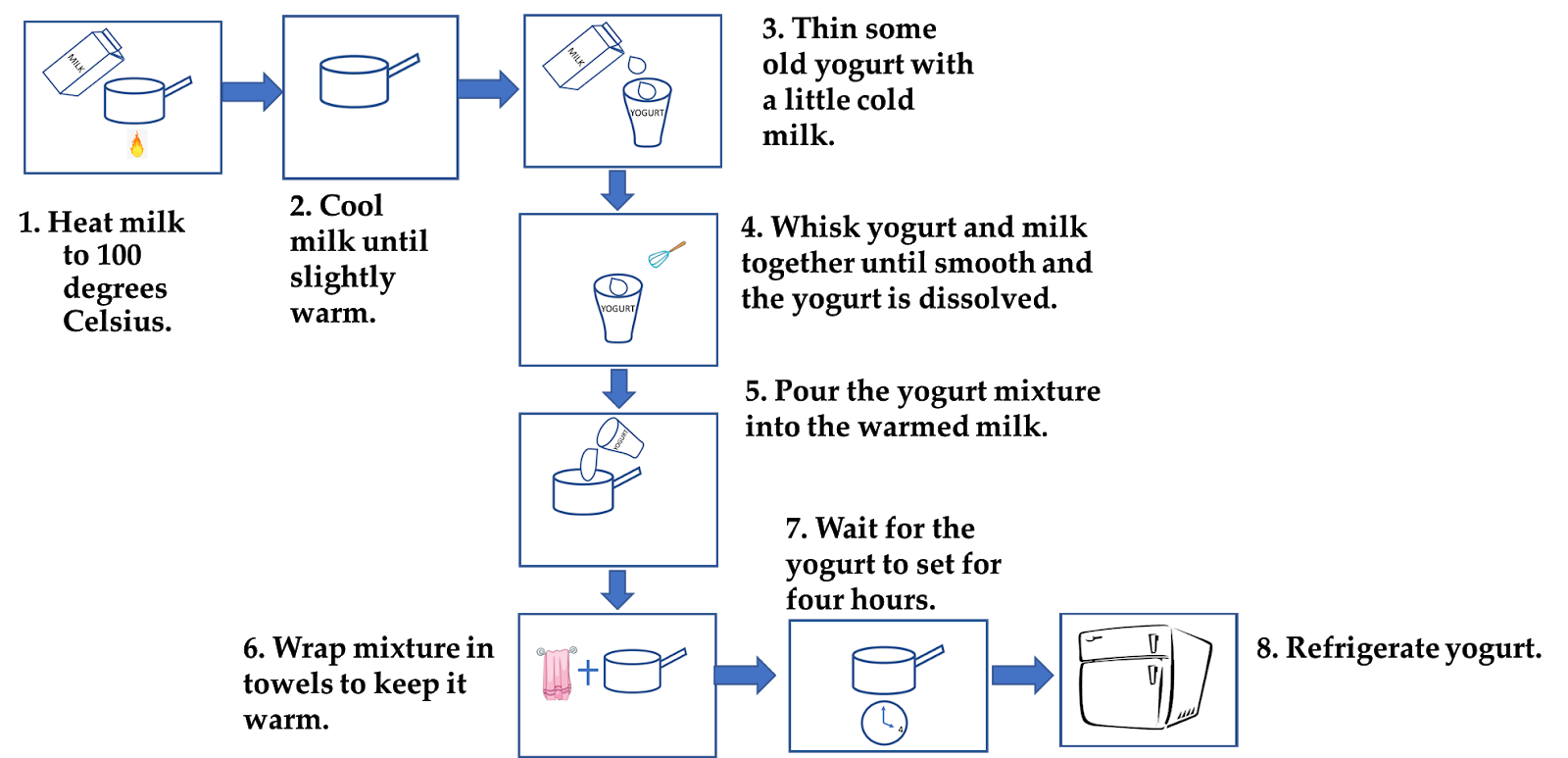
The flow chart illustrates the process of making yogurt. Overall, the process consists of eight steps, which can be grouped into three main stages: preparing the milk, mixing the ingredients, and setting the yogurt.
Body paragraph 1
In terms of preparing the milk, it is first heated to 100°C on the stove. Following this, it is removed from the heat and allowed to cool to a moderately warm temperature. In the next stage, mixing the ingredients, a small amount of cold milk is added to some old yogurt to thin it, after which the mixture is whisked until smooth. Subsequently, this mixture is poured into the warm milk.
Body paragraph 2
The final stage is setting the yogurt. After the yogurt has been left to set for four hours, it is wrapped in towels to retain warmth. Lastly, it is stored in a refrigerator to maintain freshness.
భాగం 2
Sometimes you might be asked to describe two processes. In that case, your body paragraph 1 should describe the first process and your body paragraph 2 will describe the second.
Let’s have a look at an example of a two-process diagram.
Model Essay
Important functional words are highlighted in red
Sequencers are highlighted in green
Synonyms and topic vocabulary are highlighted in blue
Introduction
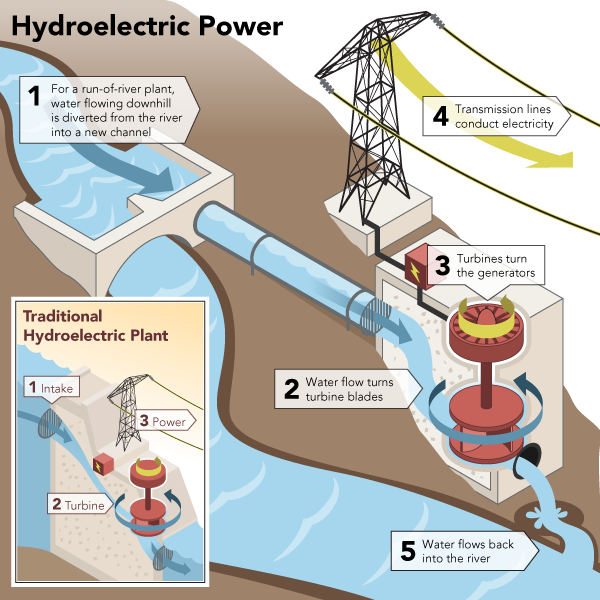
The diagram compares the process by which electricity is generated in two types of hydroelectric power station. Overall, the traditional plant uses three main stages, whereas the run-of-river design uses five.
Body paragraph 1
In a traditional hydroelectric power plant, river water rises behind a dam until it is high enough to enter an intake pipe near the top. Once it enters, the water flows down into a much lower turbine chamber, where it causes the machine’s blades to rotate, thus generating electricity. This power is then sent via transmission lines to customers’ homes.
Body paragraph 2
On the other hand, in a run-of-river hydroelectric plant, the natural downhill flow of water is harnessed to turn the turbine blades. Initially, water is channeled away from the river’s main course down a pipe into a turbine building further down the hill. Upon entering the building, the water rotates the turbine blades, which in turn spin a generator that produces electricity. This power is then carried by transmission lines above the plant to where it is needed. Surplus water then exits the plant and rejoins the river to resume its original course.
You've completed the lesson: IELTS Academic Writing Task 1 Lesson 12 - Process Diagrams
What would you like to do next?
Select a different lesson.