Lesson Introduction
-
Video Lesson
- Listening Overview and Strategy
Bolum 1
In this lesson, we will go over all you need to know about the Listening portion of the IELTS exam. First, we’ll start with a helpful overview, as well as look at information regarding the timing and scoring. The last section of this lesson will be devoted to the various question types associated with this section and some general strategies that should be followed, both before and during the exam.
General Information and Timing
Whether you are taking the Academic or General version of the IELTS exam, rest assured that you will have the same listening portion of the exam. Remember: both the Listening and Speaking sections of the IELTS exam are the same for each of its two versions.
Quick Tip → Since both academic and general test-takers will have the same version, you can expect the topics presented in this section to vary in subject matter and perhaps even difficulty. Let’s take a look at the sections in order to get a better idea of how this works.
There are 4 sections of the Listening portion of the exam, totaling 40 questions.
Section One - Here, you can expect to listen to a conversation regarding a typical “everyday subject matter”. What does this mean? Think of things you do daily or in your free time. You might be thinking of: booking tickets for a museum, organizing a trip with a travel agency, asking for information in an airport, or buying train tickets. The options are truly endless here, but be prepared for something that would fit typical social situations. This section will not feature abstract or academic topics, and it will include conversations between two people.
Section Two - This section will also feature a social context, but will feature a monologue. What does this mean? A monologue is a piece of writing (or, in this case, listening) that features just one person speaking. We will discuss this in more detail in the strategy section, but be aware that you will have to listen to one person offering key details and explaining something related to a social context.
Section Three - By this section, you can start preparing for the more educational and abstract contexts. Here, you will listen to a conversation with up to 4 speakers, set in an educational context. What does this mean? Usually, conversations will include a professor with students, or even a college counselor with prospective students. Some conversations could also discuss career options post-graduation. In any case, there is a lot to listen for in this section, and it is important to keep speakers and details in order without getting confused.
Section Four - The last section is notorious for its abstract content and difficulty. Don’t worry, though! With practice, you are bound to improve in the last section of the listening portion. This section will feature another monologue. This time, however, it will be aligned with an academic subject matter. More often than not, this section is a university-style lecture read by a professor. Perhaps the most difficult portion of this section is following along with the content and knowing when to take notes during the monologue. Again, we will cover all of this in the strategy section!
All in all, you can expect this portion of the exam to take around 30 minutes of active listening and answering the questions. If you are taking the paper-based test, you will have an extra 10 minutes to transfer your answers to your separate answer sheet at the end of the listening prompts.
If you are taking the computer-based test, you will have 2 minutes for checking your answers. Even with this extra time, though, keep in mind that you should be writing out your answers in your text booklet. In fact, it’s an excellent idea to take notes, underline, and make marks in your test booklet!
We will go more into detail regarding this in the Strategies section, but be prepared to multitask during this section: writing and strategizing while listening can make all the difference.
In general, this can be a tricky section of the exam. Why?
First off, you will only hear the listening once. Although you will have some time to read the questions before hearing the information, you will not have any second chances in listening or repeating what you’ve heard. This means that your comprehension must be in great shape before expecting a top score.
Secondly, most candidates automatically assume that listening is the easiest portion, perhaps because they associate it with leisure activities, like watching films and listening to podcasts in one’s free time. While these are excellent ways to prepare for this section, you must remember that active listening is the key to achieve a great score in this section. Speaking of scores, let’s discuss the next session!
Continue to next part:
Bolum 2
Scoring
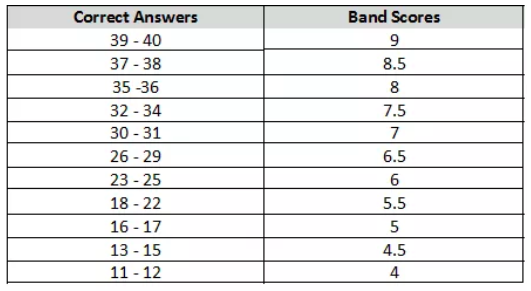
Like the rest of the IELTS exam, your score is calculated by the number of correct answers you have out of the 40 questions. Remember: you never lose points for incorrect answers, so it does not hurt to take a guess if you are not sure of the answer! Here’s a table that shows how Band Scores correlate with the number of correct answers.
Question Types
Not only does this section require you to understand the various tips and tricks for each section, but it also provides you with a plethora of different question types! Each question type will have its own lesson with dedicated strategy, tips, and tricks. For now, we will list the various questions with brief descriptions. You may be familiar with some of these question types from the Reading Section, but keep in mind that strategy in approaching them will be different for the Listening Section. Lastly, it is not uncommon to see various question types included in one section. For example, Section One may contain Multiple Choice and Sentence Completion Questions, instead of just one question type.
This is a wide array of completion question types, but they all require the same strategy. For this question type, you will be presented with information that will be given in the listening prompt, and you will have to fill in the missing information. You will be given specific instructions on how many words to write. Often, you will see instructions like “Write NO MORE THAN THREE WORDS for each answer.” It is absolutely imperative that you follow this rule. If, for example, you write more than the designated number of words, you will not receive points. Additionally, your writing must be clear and organized in order for the examiner to read it. We will detail this information in our Strategy section below.
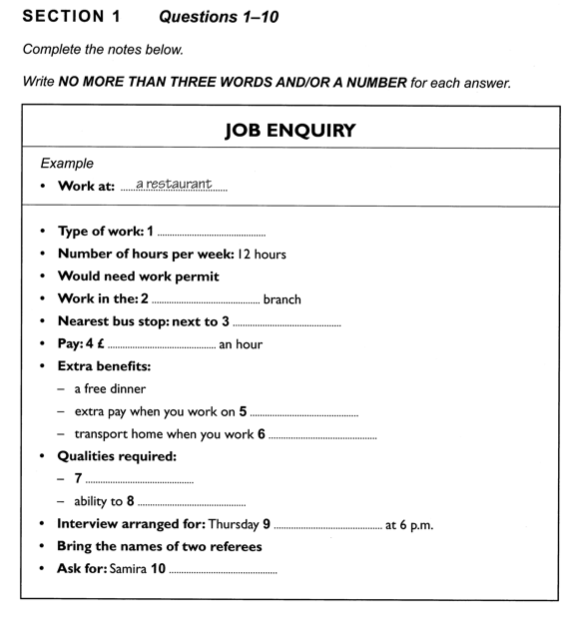
A common example of a Notes Completion question
Most people are probably the most familiar with this question type, due to its prevalence in academic settings. Here, you will need to read the question and select the appropriate answer from a series of options (A-D or A-E). In some cases, you may be asked to select two correct answers.
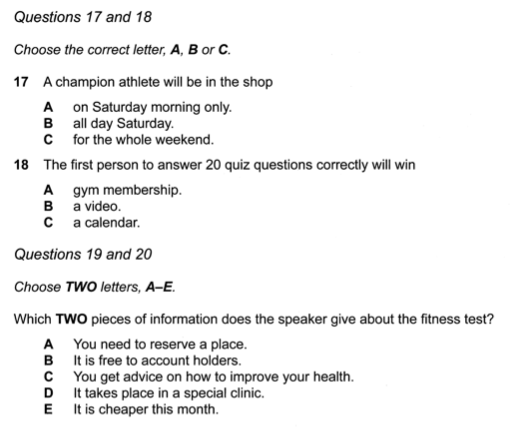
An example of a Multiple Choice question - note how the last question contains two answers.
In this question type, candidates will be asked to label or provide details regarding a plan, map, or diagram. This is the most visual of the question types, and you will usually have to imagine the layout of something. For example, the speaker could be discussing how to get around a museum, or providing instructions on how to plant flowers in a garden. Since you will be writing out words in this section, it is important to keep the number of words in mind.
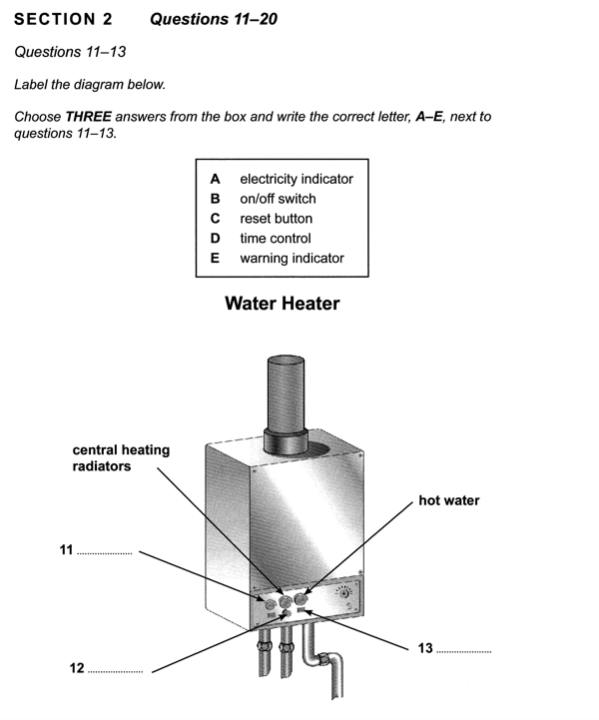
A common example of a Diagram question
In this question type, you will be given a question to answer, following a set number of words (with instructions such as “Write NO MORE THAN THREE WORDS for each answer.”) Many students find this difficult as they are not given choices, but must write them out. Keep in mind that all of the words used in your answer will be in the text, though!
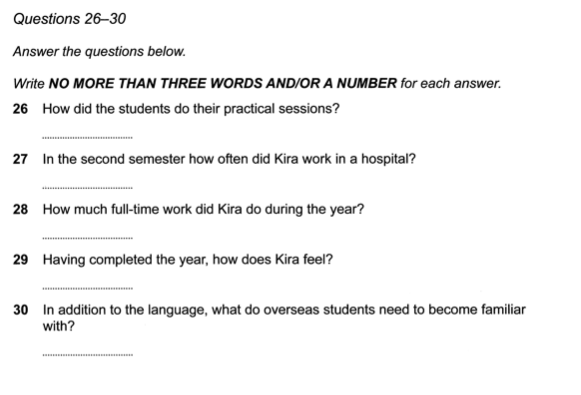
An example of a Short Answer question
Similar to the Short Answer question type, this requires you to fill in a sentence with a gap. Most students find this a bit easier, since you are given the context regarding the missing word in the question. Of course, since you will be writing, be sure to follow the instructions, which will be similar to the “Write NO MORE THAN THREE WORDS for each answer.” examples.
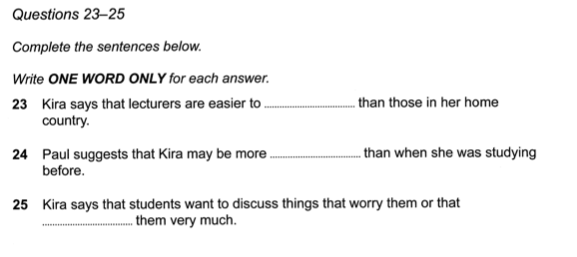
An example of a Sentence Completion question - note how the last question contains two answers.
Some candidates get confused when they hear the word “Matching” as a question type, because they assume that it a typical exercise with matching vocabulary to definitions. Think of this question type as something similar to the “Matching Information” or “Matching Features” section in the Reading portion of the exam. You will be given a list of answers to match to various features or questions.
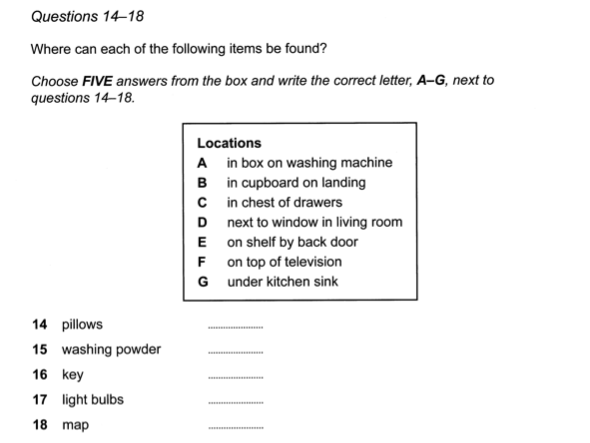
An example of a Matching question
Each question type category will have its own lesson, where we will go over the best strategies to tackle them. For now, look through these general strategies to prepare yourself for the Listening section.
Continue to next part:
Bolum 3
Strategies
Prepare - One of the best things you can do to improve your listening skills lies in preparation before test day. In addition to reading anything you can get your hands on, practice your active listening skills.
What is active listening? Basically, it is listening that involves note-taking and listening for a specific goal. Imagine you are listening to a podcast about literature. Passive listening would allow you to listen while doing some other type of activity, such as cleaning your house or doing your homework. Active listening, on the other hand, means that you are listening for specific information. After active listening, you should be able to produce an in-depth summary of what you have just listened to, by writing or speaking about it. Although passive listening will not do you any harm, it will not produce results in terms of preparation as quickly as active listening.
What can you listen to to improve your active listening skills? Anything, really! The best things to focus on, however, would be podcasts, audiobooks, and even films. Beware, though--watching a film with English subtitles is not the best option in this case, since you will not be able to read the text in the listening section! These are great ways to prepare yourself before the exam, since you will get into the mindset of listening and taking notes simultaneously, a necessary skill for the Listening section of the exam.
Use Time Wisely - As mentioned previously, you will only hear each section once. This means you must use your time wisely, both before and during the listening prompts. You will have a few seconds to read and understand the questions before listening to the prompt. Most students do not utilize this time as they should, resulting in a scattered listening process and a chaotic note-taking process. Our strategies will help you avoid this. For now, keep in mind that you should be utilizing every second of the Listening section, whether it is reading, underlining, or listening.
Multitask Efficiently - Do you like multitasking? If not, you’ll need to improve this skill before the exam. The more efficient notes you take while listening to the prompt, the better. By taking notes during the listening prompt, you will be able to reference key information after it is played, thus helping you improve your chances at answering the questions correctly.
Keep Your Ears Open - Of course, you’ll need to listen attentively during the exam, but this step is more for your preparation before test-day. Going along with our first strategy, try to immerse yourself in an English-speaking environment as often as you can while studying for the exam. This will allow you to pick up on conversational tones, phrases, and fluency speed of native speakers.
Steps
Although each question type has specific strategies for listening, be prepared to follow this general guideline of steps when approaching each of the four sections on the Listening section.
1. Read the Questions - As with most questions in the IELTS exam, you will need to read the questions quickly and thoroughly in order to understand the purpose of the activity. This step should always be done before the listening prompt is played!
2. Underline Key Words - With time and practice, this step can be combined with the first step. As you read the questions, underline key words that you should be listening for in your prompts. Key words are the important words in the question, including nouns, dates, and verbs. You will hardly ever need to focus on adjectives, pronouns, or adverbs. Remember: you never want to listen passively and hope to hear the information you’ll need for the answer. Be proactive and know what information you need by actively listening!
3. Take Notes on Key Information - Unfortunately, you can’t just sit back and relax while the listening prompts are being played! As you listen, it’s important to take notes in your test booklet. This will help you reference points needed to answer your questions after the listening prompt is finished. This is always the most difficult part for students, since it requires writing quickly and keeping up with the listening. Don’t worry--we’ll practice all of this and more!
Monologues (Sections Two & Four) - In order to keep all of the information presented by the speaker clear, it is best to take notes in an orderly, outlined fashion. This will help you organize what the speaker is saying without missing anything important. Although you will have to experiment and understand what works best for you, imagine using an outline similar to the one below:
Museum Booking Information
- Times
- Weekends are closed
- Mornings open at noon
Conversations (Sections One & Three) - Without a doubt, the best way to keep things organized for conversations is to make various columns in your test booklet. Each speaker should have a designated column where you can write key ideas, notes, or phrases that will help you tackle the questions. Usually, names of speakers are given in the beginning of the prompts, casually inserted into conversation. If names are not given, be prepared to use labels such as “Student 1” or “Speaker 1” to keep their ideas organized. Remember, you’ll want to maximize your time, so you won’t need perfect grammar or spelling for the information in your test booklet! Think of organizing each speaker into a table that looks something like this:
|
Student 1 |
Student 2 |
Student 3 |
4. Be Accurate - This last step can either make or break your test-taking experience. It is extremely important to be accurate when writing out your answers, and especially when transferring them to the answer sheet (for paper-based candidates). Remember that someone else will be reading (and judging) your written answers. For this reason, it is best to write in all CAPITAL LETTERS in order to ensure neatness and legibility. Additionally, always read your instructions and be aware of just how many words you need to write, if any. If you write over this limit or spell words incorrectly, you will not receive any points for that specific question.
Hopefully this overview and introduction to the IELTS Listening Section has answered some of your common questions and has you ready to tackle the various question types! Be sure to check out our specific lessons on each question type and perfect your strategy!
You've completed the lesson: Listening Overview and Strategy
What would you like to do next?
Select a different lesson.
Start the next lesson: IELTS Listening - Sentence Completion
Some mobile devices have a security feature that prevents audio from playing automatically.
Please click the 'Continue' button below to enable auto play on your device.
Note: It'll take a few seconds for the audio to start playing.