
keyboard_return Exit
keyboard_arrow_left

IELTSAcademic ReadingOefenen71

settings  Instellingen
close
De IELTS-cursussen van BestMyTest zijn ontwikkeld door gecertificeerde docenten van over de hele wereld. Als je vragen hebt over je lessen of over Engels, helpt ons team je hier graag verder.

Krijg vandaag 5 Ask-vragen gratis

 
schedule20:00

This reading practice simulates one part of the IELTS General Reading test. You should spend about twenty minutes on it. Read the passage and answer questions 15-30.

Subscribe to take the test

lock_open Start free trial
A river delta is a landform that forms from the deposition of sediment that is carried by a river as the flow leaves its mouth and enters slower-moving or stagnant water. This often occurs when a river enters an ocean. The river builds them up. The sea wears them down; their outlines are always chan...
Subscribe to unlock all academic-reading content

lock_open Start free trial
Questions 15-20
Look at the following List of descriptions (Questions 15-20) and Statements below.

Match statements with the appropriate descriptions

Write the correct number A-C in boxes Questions 15-20 on your answer sheet.

NB You may use any letter more than once.
Statements
  1. Chek Lap Kok airport only
  2. Kansai airport only
  3. Both airports

15. developed using traditional methods of reclamation

16. developed by reclaiming land

17. developed on a man-made island

18. developed with an area over 1000 hectares

19. developed in a river delta

20. developed in the open sea

The answer is B. The description 'developed using traditional methods of reclamation' applies only to Kansai airport. As stated in the paragraph, 'The conventional way to reclaim land is to pile sand rock on to the seabed.' Then, it is specifically mentioned, 'Kansai took the first approach; Chek Lap Kok is taking the second.' This shows that Kansai airport was developed using traditional reclamation methods, while Chek Lap Kok used a different, more aggressive approach. Therefore, the correct answer is Kansai airport only.

Associated Text:
The conventional way to reclaim land is to pile sand rock on to the seabed. ... Kansai took the first approach; Chek Lap Kok is taking the second.

The answer is C. The description 'developed by reclaiming land' applies to both Chek Lap Kok and Kansai airports. The passage states that Chek Lap Kok was created by land reclamation: 'Chek Lap Kok was assimilated via land reclamation into the 12.48 square kilometres island for the current Hong Kong International Airport.' It also describes Kansai as an artificial island built in Osaka Bay, which required traditional land reclamation techniques. Thus, both airports fit this statement.

Associated Text:
Chek Lap Kok was assimilated via land reclamation into the 12.48 square kilometres island for the current Hong Kong International Airport. ... This is a 520-hectare island built in Osaka Bay, Japan, that serves as the platform for the new Kansai airport.

The answer is C. The statement 'developed on a man-made island' applies to both Chek Lap Kok and Kansai. The passage describes Chek Lap Kok: 'An island six kilometres long with an area of 1248 hectares called Chek Lap Kok is being created there,' and for Kansai: 'This is a 520-hectare island built in Osaka Bay, Japan, that serves as the platform for the new Kansai airport.' Both airport sites were constructed as artificial islands.

Associated Text:
An island six kilometres long with an area of 1248 hectares called Chek Lap Kok is being created there. ... This is a 520-hectare island built in Osaka Bay, Japan, that serves as the platform for the new Kansai airport.

The answer is A. The description 'developed with an area over 1000 hectares' applies only to Chek Lap Kok airport. The passage specifies, 'An island six kilometres long with an area of 1248 hectares called Chek Lap Kok is being created there.' Therefore, Chek Lap Kok is over 1000 hectares, but Kansai is stated as being 520 hectares.

Associated Text:
An island six kilometres long with an area of 1248 hectares called Chek Lap Kok is being created there. ... This is a 520-hectare island built in Osaka Bay, Japan, that serves as the platform for the new Kansai airport.

The answer is A. The statement 'developed in a river delta' refers only to Chek Lap Kok. The very first paragraph clarifies, 'The changes in China's Pearl River delta, however, are more dramatic than these natural fluctuations. An island six kilometres long with an area of 1248 hectares called Chek Lap Kok is being created there.' Kansai is developed in Osaka Bay, not a river delta.

Associated Text:
The changes in China's Pearl River delta, however, are more dramatic than these natural fluctuations. An island six kilometres long with an area of 1248 hectares called Chek Lap Kok is being created there. ... This is a 520-hectare island built in Osaka Bay, Japan, that serves as the platform for the new Kansai airport.

The answer is B. The description 'developed in the open sea' applies only to Kansai airport. In the passage, it mentions: 'Kansai was supposed to be built just one kilometre offshore ... the site was shifted a further five kilometres. That put it in deeper water (around 20 metres) and above a seabed that consisted of 20 metres of soft alluvial silt and mud deposits.' This means Kansai was constructed far from land, in open sea, while Chek Lap Kok was in a river delta near small islets.

Associated Text:
Kansai was supposed to be built just one kilometre offshore, where the seabed is quite solid. Fishermen protested, and the site was shifted a further five kilometres. That put it in deeper water (around 20 metres) and above a seabed that consisted of 20 metres of soft alluvial silt and mud deposits.

Questions 21-23
Complete the summary below.

Choose NO MORE THAN TWO WORDS from the passage for each answer.

Write your answers in 21-23 on your answer sheet.

The Chek Lap Kok island will be partially protected from storms by Lantau island and and also by . Further settlement caused by will be prevented by the use of .

The answer is sea walls. The summary states that the Chek Lap Kok island will be protected from storms by Lantau island and also by something else. The passage specifically explains, 'the new coastline is being bolstered with a formidable twelve kilometres of sea defences,' and further clarifies, 'the sea walls should guard against the rest.' This shows sea walls are the answer.

Associated Text:
To protect it, the new coastline is being bolstered with a formidable twelve kilometres of sea defences. The brunt of a typhoon will be deflected by the neighbouring island of Lantau; the sea walls should guard against the rest.

The answer is rainfall. The summary refers to a risk of further settlement being prevented. The passage says, 'Gentler but more persistent bad weather - the rainfall of the summer monsoon - is also being taken into account.' This indicates that rainfall is the particular weather concern here.

Associated Text:
Gentler but more persistent bad weather - the rainfall of the summer monsoon - is also being taken into account.

The answer is geotextile. Where the summary refers to the prevention of further settlement, the passage explains: 'A mat-like material called geotextile is being laid across the island to separate the rock and sand layers. That will stop sand particles from being washed into the rock voids, and so causing further settlement.' Thus, geotextile is used for this purpose.

Associated Text:
A mat-like material called geotextile is being laid across the island to separate the rock and sand layers. That will stop sand particles from being washed into the rock voids, and so causing further settlement.

Questions 24-28
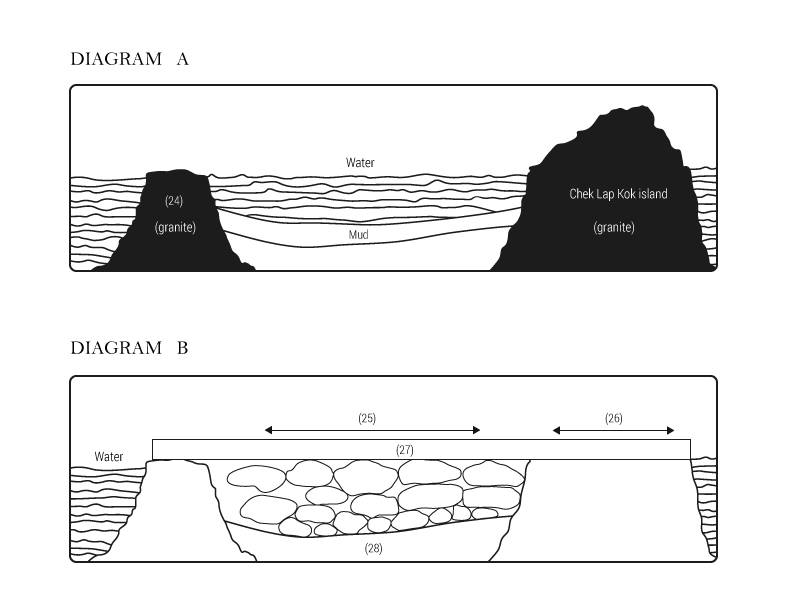
Diagram A is the cross-section of the original area around Chek Lap Kok before work began. Diagram B is the cross-section of the area around Chek Lap Kok after work. Complete the labels on Diagram A and B below.


  1. runways and taxiways
  2. Lam Chau
  3. sand
  4. stiff clay
  5. terminal building site

24

25

26

27

28

Questions 29-30
Choose two letters A-E.

Write your answers in boxes 29-30 on your answer sheet.

Which TWO of the following are stated about Kansai?
  1. It was built one kilometre offshore.
  2. It was built in a Osaka Bay.
  3. Sea defenses were placed above it.
  4. Below it was a fragile glacial deposit.
  5. It was built using a untraditional way of land reclamation

29

30

B. It was built in Osaka Bay. The passage explicitly says Kansai airport is “a 520-hectare island built in Osaka Bay, Japan.” D. Below it was a fragile glacial deposit. The text states that beneath the seabed there was “a not-very-firm glacial deposit hundreds of metres thick.”

Associated Text:
This is a 520-hectare island built in Osaka Bay, Japan, that serves as the platform for the new Kansai airport.

B. It was built in Osaka Bay. The passage explicitly says Kansai airport is “a 520-hectare island built in Osaka Bay, Japan.” D. Below it was a fragile glacial deposit. The text states that beneath the seabed there was “a not-very-firm glacial deposit hundreds of metres thick.”

Associated Text:
So buildings, pipes, roads and so on tend to buckle and crack. You can engineer around these problems, or you can engineer them out. Kansai took the first approach; Chek Lap Kok is taking the second.

Answer Sheet
1
N/A
2
N/A
3
N/A
4
N/A
5
N/A
6
N/A
7
N/A
8
N/A
9
N/A
10
N/A
11
N/A
12
N/A
13
N/A
14
N/A
15
16
17
18
19
20
21
22
23
24
25
26
27
28
29
30
31
N/A
32
N/A
33
N/A
34
N/A
35
N/A
36
N/A
37
N/A
38
N/A
39
N/A
40
N/A
Scoreoverzicht
0 / 1
Multiple Choice
Matching Sentence Endings
Note Completion
Table Completion
Flow Chart Completion
Summary Completion
Multiple Selection
Short Answer
Matching Headings
Matching Features
Matching Information
Identifying Information
Identifying Viewer Claims
Sentence Completion
Diagram Labelling
Hello!   :)

Submit your academic reading answers to auto generate this report.
Trefwoorden in de oefening
Er is geen woordenschat gekoppeld aan deze oefening
IELTS reading LessonsCompleted: 0 / 73
Tips to improve your reading speed
To get a high score on the IELTS reading section, you need to have a fast reading speed. To have a fast reading speed, you need to improve your vocabulary and practice dissecting sentences. One strategy to dissect a sentence is to look for the subject and verb of the sentence. Finding the subject and verb will help you better understand the main idea of said sentence. Keep in mind, a common feature of a IELTS reading passage is to join strings of ideas to form long compound sentences. This produces large chunks that students have a hard time absorbing. Do not get overwhelmed by its length, just look for the subject and verb, the rest of the ideas will flow.

Keep in mind, having a slow reading speed makes skimming or scanning a reading passage more difficult. The process of quickly skimming through a reading passage for specific keywords or main ideas is a requirement for you to employ successful reading strategies to improve your IELTS reading score. In other words, skimming and scanning are critical skills to ensure you complete all questions in the allotted time frame.
IELTS Reading Strategies
Once you can read and comprehend a passage with a rate of, at least, 220 words per minute, you'll be ready to start implementing our strategies. All too often, students spend too much time reading the passages and not enough time answering the questions. Here is a step by step guide for tackling the reading section.

  1. Step 1: Read questions first

    One of the most common mistakes that candidates make when approaching the reading exam is reading every single word of the passages. Although you can practice for the exam by reading for pleasure, "reading blindly" (reading without any sense of what the questions will ask) will not do you any favors in the exam. Instead, it will hurt your chances for effectively managing your time and getting the best score.

    The main reason to read the questions first is because the type of question may determine what you read in the passage or how you read it. For example, some question types will call for the "skimming" technique, while others may call for the "scanning" technique.

    It is important to answer a set of questions that are of the same question type. You'll need to determine which question type you want to tackle first. A good strategy would be to start with the easier question type and move on to more difficult question types later. The Easiest question types are the ones where you spend less time reading. For example, the Matching Heading question type is an easier one because you only need to find the heading that best describes the main idea of a paragraph. An example of a difficult question type would be Identifying Information. For this question type, you'll need to read each paragraph to find out if each statement is TRUE, FALSE, or NOT GIVEN according to the passage.

    Here is a table that lists the difficulty levels for each question type. Use this table as a reference when choosing which question type you want to tackle first.

    Difficulty level Question Type
    Easy Sentence Completion
    Short answer
    Medium Matching Features
    Multiple choice
    Matching Headings
    Summary, Table, Flow-Chart Completion
    Difficult Matching Sentence Endings
    Matching Information
    Identifying Information (TRUE/FALSE/NOT GIVEN)
    Identifying Viewer's claims (YES/NO/NOT GIVEN)

  2. Step 2: Read for an objective

    After you've read the questions for the passage, you will be able to read for an objective. What does this mean? For example, if you come across a question that includes the year "1896", you can make a note of when this year comes up in the text, using it to answer the question later on. There are two reading techniques that will help you stay on track with reading for an objective. The first one, skimming, is best defined as reading fast in order to get the "gist", or general idea, or a passage. With this technique, you are not stopping for any unfamiliar words or looking for specific details. The second technique, scanning, is best defined as reading for specific information. With this technique, you are not reading for the overall gist, but rather, specific information. Notice how each of these techniques has a specific objective in mind. This will help you find information more quickly.

  3. Step 3: Take notes

    As you're reading for an objective, you should also be making notes on the margins of the passage, placing stars next to key information, or underlining things that you believe will help you answer the various questions. This will make it easier for you to check back when you are asked certain things in the questions. Choose whichever note-taking system is right for you - just make sure you do it!

  4. Step 4: Answer wisely

    After you've read the questions, read the passage, and have taken any appropriate notes, you you should have located the part of the text where you where you need to read carefully. Then just read carefully and think critically to determine the correct answer.

IELTS Reading Question Types
 
close