Lesson Introduction
-
Video Lesson
- IELTS Reading - Summary Completion
Bolum 1
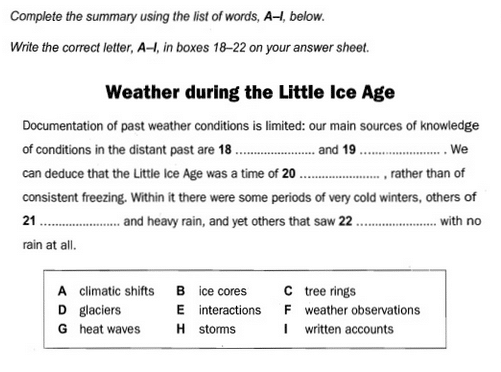
Now, you may think that a word bank makes it easier to find the correct answer. However, keep in mind that a common "trick " for this section is to include an exact word from the passage in the word bank, which is actually the incorrect answer. Since most correct answers will be synonyms rather than an exact word from the text, don't always assume that options that are exact words from the passage are automatically correct.
Let's look at the next type.
Here are some general rules for spelling and word choice:
- Numbers can be written using figures or words (ex: 12 or twelve)
- Contracted words are not tested. Therefore, you would see and write "cannot" instead of "can't".
- Hyphenated words count as single words (ex: "open-minded" counts as one word, not two).
Grammar and spelling are also important here, as you will have to write out the words in order to fit with the paragraph used in the question. Do not be surprised if the answers take on different forms than what is presented in the passage. For example, you may see "dinosaur" in the passage, but the question type may require you to write "dinosaurs" in the plural form, in order to make sense with the rest of the paragraph or sentence. Lastly, keep in mind that the texts associated with this question type will be descriptive in nature, and will require you to be precise when writing out your answers.
Now let's look at some tips of how to approach this section and what not to do when approaching this type of question on the exam.
1. Read the Question Paragraph and Underline Key Words – It's a good idea to read the paragraph question or flow-chart first, so that you are able to recognize the main theme. This will later help you identify which section of the passage contains the information for the gap fill. At the same time, underline key words that call your attention.
2. Identify Grammar (and Analyze Word Bank) - Now that you've understood the theme of the passage, think about the parts of speech for the missing words. Does the gap fill require a noun, verb, adjective, or adverb? You can make brief notes for yourself in the gap fill, which will help you later on, when you need to write the missing word. This step is important because you will not receive a point if the spelling or grammar of the word(s) are incorrect.
(This step is to be done if a Word Bank is included). As you are identifying grammar, look at your options in the word bank. If you see that an answer must be a verb, you can effectively eliminate the options that are not verbs. Not only will this save you time in the long-run, but you are further understanding the theme of the passage and the available options.
3. Scan the Passage - Next, scan the Passage. Remembering the theme you found in the first step, scan the passage. When you've found a section that has a similar theme, you can start scanning for information. Instead of looking for words that directly match the phrases in the summary question, look for synonyms. It's a good idea to block off the section of the text that relates to the summary paragraph, so that you have a reference to go back to once you start answering your questions.
After you've done this, start answering your questions. Remember to go back to the reference section in the passage if need be.
Let's briefly discuss what not to do when answering the Summary Completion question type. Do not read the entire passage. As a general rule for the Reading section, it is not necessary and actually time-restrictive to read the entire passage, word for word. Be sure to use the scanning technique, first and foremost, for this section. Since the summary completion pertains to one section of the text, you will want to focus your attention on just that section.
Do not get confused if the text includes synonyms of the information that is originally presented in the questions. Remember: a trick in this section is to deliberately place the exact words in a word bank. Therefore, a good tip is to be wary of exact words used in the passage when located in the word bank.
Do not misspell words or use incorrect grammar. Remember: you will receive an incorrect mark if this happens.
Using these tips, let's look at an examples with this specific question type. Since this question type comes in different forms, we have included the following:
- Summary Completion with a word bank
- Summary Completion without a word bank
- Flow Chart Example
We will first look at a summary completion question with a word bank.

Summary Completion
Learn how to answer these questions in a step-by-step interactive exercise
Bolum 2
Next! let's look at a summary completion question without a word bank.
See what you can gather from reading the summary paragraph. Underline key words that call your attention and check out what we’ve underlined below.
Show Keywords
Questions 24-26
Complete the summary below.
Choose ONE WORD ONLY from the passage for each answer.
Write your answers in boxes 24-26 on your answer sheet.
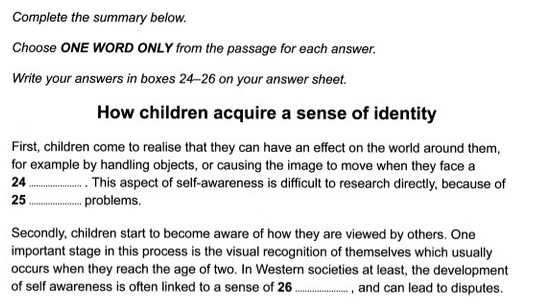
First, children come to realise that they can have an effect on the world around them, for example by handling objects,
or causing the image to move when they face a
.
This aspect of self-awareness is difficult to research directly, because of
problems.
Secondly, children start to become aware of how they are viewed by others. One important stage in this process is
the visual recognition of themselves which usually occurs when they reach the age of two.
In Western societies at least, the development of self awareness is often linked to a sense of
,
and can lead to disputes.
Skim through the summary paragraph and make notes regarding the parts of speech that could possibly follow the words before the gap fill.
Show Grammar
Questions 24-26
Complete the summary below.
Choose ONE WORD ONLY from the passage for each answer.
Write your answers in boxes 24-26 on your answer sheet.
First, children come to realise that they can have an effect on the world around them, for example by handling objects,
or causing the image to move when they face a .
This aspect of self-awareness is difficult to research directly, because of
problems.
Secondly, children start to become aware of how they are viewed by others. One important stage in this process is
the visual recognition of themselves which usually occurs when they reach the age of two.
In Western societies at least, the development of self awareness is often linked to a sense of
,
and can lead to disputes.
25. Adjective – This is an adjective.
26. Noun – This is a noun, and most likely a subject or thing, rather than a person.
Now, let's scan the passage and find the area that includes information regarding the information we found in the question paragraph, which are:
24. image, move
25. difficult to research
26. Western societies, self-awareness, disputes
Now it's time for you to answer the questions!
Questions 24-26
Complete the summary below.
Choose ONE WORD ONLY from the passage for each answer.
Write your answers in boxes 24-26 on your answer sheet.
First, children come to realise that they can have an effect on the world around them, for example by handling objects,
or causing the image to move when they face a
.
This aspect of self-awareness is difficult to research directly, because of
problems.
Secondly, children start to become aware of how they are viewed by others. One important stage in this process is
the visual recognition of themselves which usually occurs when they reach the age of two.
In Western societies at least, the development of self awareness is often linked to a sense of
,
and can lead to disputes.
Show Answers
SECTION 3
Young children's sense of identity
A sense of self develops in young children by degrees. The process can usefully be thought of in terms of the gradual emergence of two somewhat separate features: the self as a subject, and the self as an object. William James introduced the distinction in 1892, and contemporaries of his, such as Charles Cooley, added to the developing debate. Ever since then psychologists have continued building on the theory.
According to James, a child's first step on the road to self-understanding can be seen as the recognition that he or she exists. This is an aspect of the self that he labelled 'self-as-subject', and he gave it various elements. These included an awareness of one's own agency (i.e. one's power to act), and an awareness of one's distinctiveness from other people. These features gradually emerge as infants explore their world and interact with caregivers. Cooley (1902) suggested that a sense of the self-as-subject was primarily concerned with being able to exercise power. He proposed that the earliest examples of this are an infant's attempts to control physical objects, such as toys or his or her own limbs. This is followed by attempts to affect the behaviour of other people. For example, infants learn that when they cry or smile someone responds to them.
Another powerful source of information for infants about the effects they can have on the world around them is provided when others mimic them. Many parents spend a lot of time, particularly in the early months, copying their infant's vocalizations and expressions. [#24] In addition, young children enjoy looking in mirrors, where the movements they can see are dependent upon their own movements. This is not to say that infants recognize the reflection as their own image (a later development). However, Lewis and Brooks-Gunn (1979) suggest that infants' developing understanding that the movements they see in the mirror are contingent on their own, leads to a growing awareness that they are distinct from other people. This is because they, and only they, can change the reflection in the mirror.
This understanding that children gain of themselves as active agents continues to develop in their attempts to co-operate with others in play. Dunn (1988) points out that it is in such day-to-day relationships and interactions that the child's understanding of his- or herself emerges. [#25] Empirical investigations of the self-as-subject in young children are, however, rather scarce because of difficulties of communication: even if young infants can reflect on their experience, they certainly cannot express this aspect of the self directly.
Once children have acquired a certain level of self-awareness, they begin to place themselves in a whole series of categories, which together play such an important part in defining them uniquely as 'themselves'. This second step in the development of a full sense of self is what James called the 'self-as-object'. This has been seen by many to be the aspect of the self which is most influenced by social elements, since it is made up of social roles (such as student, brother, colleague) and characteristics which derive their meaning from comparison or interaction with other people (such as trustworthiness, shyness, sporting ability).
Cooley and other researchers suggested a close connection between a person's own understanding of their identity and other people's understanding of it. Cooley believed that people build up their sense of identity from the reactions of others to them, and from the view they believe others have of them. He called the self-as-object the 'looking-glass self', since people come to see themselves as they are reflected in others. Mead (1934) went even further, and saw the self and the social world as inextricably bound together: 'The self is essentially a social structure, and it arises in social experience ... it is impossible to conceive of a self arising outside of social experience.'
Lewis and Brooks-Gunn argued that an important developmental milestone is reached when children become able to recognize themselves visually without the support of seeing contingent movement. This recognition occurs around their second birthday. In one experiment, Lewis and Brooks-Gunn (1979) dabbed some red powder on the noses of children who were playing in front of a mirror, and then observed how often they touched their noses. The psychologists reasoned that if the children knew what they usually looked like, they would be surprised by the unusual red mark and would start touching it. On the other hand, they found that children of 15 to 18 months are generally not able to recognize themselves unless other cues such as movement are present.
Finally, perhaps the most graphic expressions of self-awareness in general can be seen in the displays of rage which are most common from 18 months to 3 years of age. In a longitudinal study of groups of three or four children, Bronson (1975) found that the intensity of the frustration and anger in their disagreements increased sharply between the ages of 1 and 2 years. Often, the children's disagreements involved a struggle over a toy that none of them had played with before or after the tug-of-war: the children seemed to be disputing ownership rather than wanting to play with it. [#26] Although it may be less marked in other societies, the link between the sense of 'self' and of 'ownership' is a notable feature of childhood in Western societies.
In this case, the answers were not confined to just one section, which makes this example a difficult one. If this happens during your IELTS exam, make sure that you follow your key words and scan effectively in the passage
Key words were helpful in this example. Make sure to identify key words from the question paragraph by looking for words surrounding the gap.
Bolum 3
Next! let's look at a flow chart question.
See what you can gather from reading the flow chart. Underline key words that call your attention and check out what we’ve underlined below.
Show Keywords
Choose NO MORE THAN TWO WORDS AND/OR A NUMBER from the passage for each answer.
Write your answers in boxes 34-36 on your answer sheet.
|
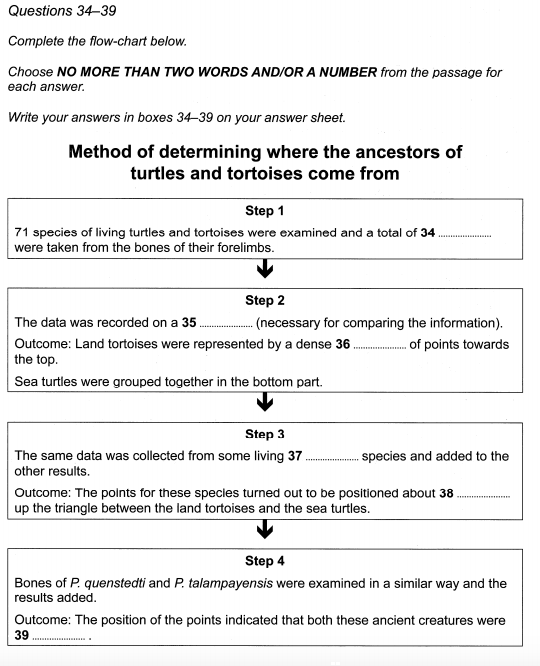
Step 1 71 species of living turtles and tortoises were examined and a total of were taken from the bones of their forelimbs. |
⇩ |
|
Step 2 The data was recorded on a (necessary for comparing the information). Outcome: Land tortoises were represented by a dense of points towards the top. Sea turtles were grouped together in the bottom part. |
⇩ |
|
Step 3 The same data was collected from some living species and added to the other results. Outcome: The points for these species turned out to be positioned about up the triangle between the land tortoises and the sea turtles. |
⇩ |
|
Step 4 Bones of P quenstedti and P. talampayensis were examined in a similar way and the results added. Outcome: The position of the points indicated that both these ancient creatures were |
34. 71 – This is a simple key word since it is a number. This will make it easier to look for the designated area.
35. Data, comparing the information
36. Tortoises, points
37. Species, added
38. Triangle
39. P. quenstedti, P. talampayensis
Choose NO MORE THAN TWO WORDS from the passage for each answer.
Write your answers in boxes 15-21 on your answer sheet.
|
Candidates submit an initial application through the |
⇩ |
|
Candidates will receive an if they have advanced to the interview round. |
⇩ |
|
The interview will take place at the in Dallas, Texas. |
⇩ |
|
Candidates can be expected to partake in , which mimic potential situations with customers, during the interview session. |
⇩ |
|
Successful applicants will participate in a fully-paid during the summer. |
⇩ |
|
For the first six months of employment, new employees will be matched with a . |
⇩ |
|
New employees are required to fill out an anonymous regarding their hiring experiences. |
Skim through the summary paragraph and make notes regarding the parts of speech that could possibly follow the words before the gap fill.
Show Grammar
Choose NO MORE THAN TWO WORDS AND/OR A NUMBER from the passage for each answer.
Write your answers in boxes 34-36 on your answer sheet.
|
Step 1 71 species of living turtles and tortoises were examined and a total of were taken from the bones of their forelimbs. |
⇩ |
|
Step 2 The data was recorded on a (necessary for comparing the information). Outcome: Land tortoises were represented by a dense of points towards the top. Sea turtles were grouped together in the bottom part. |
⇩ |
|
Step 3 The same data was collected from some living species and added to the other results. Outcome: The points for these species turned out to be positioned about up the triangle between the land tortoises and the sea turtles. |
⇩ |
|
Step 4 Bones of P quenstedti and P. talampayensis were examined in a similar way and the results added. Outcome: The position of the points indicated that both these ancient creatures were |
35. Noun – This is likely to be a noun and something that keeps track of information.
36. Noun – This is likely to be another noun that can be used when talking about "points".
37. Adjective – This is likely to be something that describes 'species'.
38. Noun/Adjective – This is likely to be something that can describe a position.
Choose NO MORE THAN TWO WORDS from the passage for each answer.
Write your answers in boxes 15-21 on your answer sheet.
|
Candidates submit an initial application through the |
⇩ |
|
Candidates will receive an if they have advanced to the interview round. |
⇩ |
|
The interview will take place at the in Dallas, Texas. |
⇩ |
|
Candidates can be expected to partake in , which mimic potential situations with customers, during the interview session. |
⇩ |
|
Successful applicants will participate in a fully-paid during the summer. |
⇩ |
|
For the first six months of employment, new employees will be matched with a . |
⇩ |
|
New employees are required to fill out an anonymous regarding their hiring experiences. |
15. NOUN (METHOD)- This will most likely be a noun that shows where or how potential applicants can submit their applications.
16. NOUN (SOMETHING) - This will most likely be something the candidates receive (such as a letter or call) if advanced to the next round.
17. NOUN (PLACE) - This will most likely be the place where the interview is held.
18. NOUN (SOMETHING) - This will be something the candidates are required to do.
19. NOUN (SOMETHING) - This will be something in which candidates will participate.
20. NOUN (PERSON) - Based on the grammar of the sentence, this is most likely someone the candidates will be matched with in the company.
21. NOUN (SOMETHING) - This will most likely be something similar to a survey or poll, based on the grammar of the sentence.
34. 71 – This is a simple key word since it is a number. This will make it easier to look for the designated area.
35. Data, compare
36. Tortoises, points
37. Species, added
38. Triangle
39. P. quenstedti, P. talampayensis
Remember: you will most likely see synonyms for the information in the question paragraph.
Now it's time for you to answer the questions!
Choose NO MORE THAN TWO WORDS AND/OR A NUMBER from the passage for each answer.
Write your answers in boxes 34-36 on your answer sheet.
|
Step 1 71 species of living turtles and tortoises were examined and a total of were taken from the bones of their forelimbs. |
⇩ |
|
Step 2 The data was recorded on a (necessary for comparing the information). Outcome: Land tortoises were represented by a dense of points towards the top. Sea turtles were grouped together in the bottom part. |
⇩ |
|
Step 3 The same data was collected from some living species and added to the other results. Outcome: The points for these species turned out to be positioned about up the triangle between the land tortoises and the sea turtles. |
⇩ |
|
Step 4 Bones of P quenstedti and P. talampayensis were examined in a similar way and the results added. Outcome: The position of the points indicated that both these ancient creatures were |
Choose NO MORE THAN TWO WORDS from the passage for each answer.
Write your answers in boxes 15-21 on your answer sheet.
|
Candidates submit an initial application through the |
⇩ |
|
Candidates will receive an if they have advanced to the interview round. |
⇩ |
|
The interview will take place at the in Dallas, Texas. |
⇩ |
|
Candidates can be expected to partake in , which mimic potential situations with customers, during the interview session. |
⇩ |
|
Successful applicants will participate in a fully-paid during the summer. |
⇩ |
|
For the first six months of employment, new employees will be matched with a . |
⇩ |
|
New employees are required to fill out an anonymous regarding their hiring experiences. |
Show Answers
The history of the tortoise
If you go back far enough, everything lived in the sea. At various points in evolutionary history, enterprising individuals within many different animal groups moved out onto the land, sometimes even to the most parched deserts, taking their own private seawater with them in blood and cellular fluids. In addition to the reptiles, birds, mammals and insects which we see all around us, other groups that have succeeded out of water include scorpions, snails, crustaceans such as woodlice and land crabs, millipedes and centipedes, spiders and various worms. And we mustn’t forget the plants, without whose prior invasion of the land none of the other migrations could have happened.
Moving from water to land involved a major redesign of every aspect of life, including breathing and reproduction. Nevertheless, a good number of thoroughgoing land animals later turned around, abandoned their hard-earned terrestrial re-tooling, and returned to the water again. Seals have only gone part way back. They show us what the intermediates might have been like, on the way to extreme cases such as whales and dugongs. Whales (including the small whales we call dolphins) and dugongs, with their close cousins the manatees, ceased to be land creatures altogether and reverted to the full marine habits of their remote ancestors. They don’t even come ashore to breed. They do, however, still breathe air, having never developed anything equivalent to the gills of their earlier marine incarnation. Turtles went back to the sea a very long time ago and, like all vertebrate returnees to the water, they breathe air. However, they are, in one respect, less fully given back to the water than whales or dugongs, for turtles still lay their eggs on beaches.
There is evidence that all modem turtles are descended from a terrestrial ancestor which lived before most of the dinosaurs. There are two key fossils called Proganochelys quenstedti and Palaeochersis talampayensis dating from early dinosaur times, which appear to be close to the ancestry of all modem turtles and tortoises. You might wonder how we can tell whether fossil animals lived on land or in water, especially if only fragments are found. Sometimes it’s obvious. Ichthyosaurs were reptilian contemporaries of the dinosaurs, with fins and streamlined bodies. The fossils look like dolphins and they surely lived like dolphins, in the water. With turtles it is a little less obvious. One way to tell is by measuring the bones of their forelimbs.
[#34] Walter Joyce and Jacques Gauthier, at Yale University, obtained three measurements in these particular bones of 71 species of living turtles and tortoises. [#35] They used a kind of triangular graph paper to plot the three measurements against one another. [#36] All the land tortoise species formed a tight cluster of points in the upper part of the triangle; all the water turtles cluster in the lower part of the triangular graph. There was no overlap, except when they added some species that spend time both in water and on land. [#37] Sure enough, these amphibious species show up on the triangular graph approximately [#38] half way between the ‘wet cluster’ of sea turtles and the ‘dry cluster’ of land tortoises. The next step was to determine where the fossils fell. The bones of P quenstedti and JR talampayensis leave us in no doubt. [#39] Their points on the graph are right in the thick of the dry cluster. Both these fossils were dry-land tortoises. They come from the era before our turtles returned to the water.
34. 3 measurements / (Our Key Words were: 71) - In the passage, this information in the end of the sentence is presented
first. The statement "Walter Joyce and Jacques Gauthier, at Yale University, obtained three measurements in these
particular bones of 71 species of living turtles and tortoises". Since we were aware that the answer would contain a
number, it is clear that "three measurements" is the correct answer.
35. (triangular) graph / (Our Key Words were: data, compare) - Shortly after the statement used to answer Question 34,
you will see the statement "They used a kind of triangular graph paper to plot the three measurements against one
another". The phrase "against one another" is a clue that it was used for comparing two things.
36. cluster / (Our Key Words were: tortoises, points) - Continuing on in the passage, you will see the statement "All the
land tortoise species formed a tight cluster of points in the upper part of the triangle". Thus, the word "points" is used in
both the flow-chart and the passage.
37. amphibious / (Our Key Words were: species, added) - The sentence: "There was no overlap, except when they added
some species that spend time in both water and land. Sure enough, these amphibious species show up on the triangular
graph..." shows that the adjective to describe the species is "amphibious". Knowing that the required word is an adjective
as well as understanding the word "amphibious" shows that it is the correct answer.
38. half way / (Our Key Words were: Triangle) - The sentence "…these amphibious species show up half way between the
'wet cluster' of sea turtles and the 'dry cluster' of land tortoises" highlights the position of the species as "half way".
39. dry-land tortoises / (Our Key Words were: P. quenstedti, P. talampayensis) - At the end of the section, you will see the
sentence "Both these fossils were dry-land tortoises.", located after the key words: P. quenstedti, P. talampayensis.
Knowing that the answer was about creatures, "dry-land tortoises" makes the most sense.
If you need an idea for a Christmas present then think about the Rubik's Cube which is the best selling puzzle toy in the World.
You might think, therefore, that modem land tortoises have probably stayed on land ever since those early terrestrial times, as most mammals did after a few of them went back to the sea. But apparently not. If you draw out the family tree of all modem turtles and tortoises, nearly all the branches are aquatic. Today’s land tortoises constitute a single branch, deeply nested among branches consisting of aquatic turtles. This suggests that modem land tortoises have not stayed on land continuously since the time of P. quenstedti and P talampayensis. Rather, their ancestors were among those who went back to the water, and they then re-emerged back onto the land in (relatively) more recent times.
Tortoises therefore represent a remarkable double return. In common with all mammals, reptiles and birds, their remote ancestors were marine fish and before that various more or less worm-like creatures stretching back, still in the sea, to the primeval bacteria. Later ancestors lived on land and stayed there for a very large number of generations. Later ancestors still evolved back into the water and became sea turtles. And finally they returned yet again to the land as tortoises, some of which now live in the driest of deserts.
Section 2
Careers with Delion Air
Customer Service Representatives - Recruitment and Training Process
Recruitment: Getting to Know YOU!
Being a Customer Service Representative with Delion Air requires a large amount of responsibility and diligence. Additionally, it's a prestigious position that comes with many perks in the travel industry. Hiring takes place according to the operational demands of Delion Air, and while there are moments where no new talent is required, we always welcome applications.
[#15] When you submit your initial application through our online database, the Delion Air HR Services Team will evaluate the details and information. [#16] If you are a candidate that matches up with what we are looking for, you will be invited to an interview round via email.
15. online database - When scanning for key words, “initial application”, you should be directed to the statement, “When you submit your initial application through our online database, the Delion Air HR Services Team will evaluate the details and information.”. The phrase “online database” is the perfect fit here, and goes along with our prediction of a noun.
16. email - When scanning for key words, “candidates” and “interview”, you should be directed to the statement, “If you are a candidate that matches up with what we are looking for, you will be invited to an interview round via email.”
The word “email” is the perfect fit here, and goes along with our prediction of a noun that can be received.
[#17] The interview will be held in Dallas, Texas, where our corporate headquarters are located. Interviewees will be issued a complimentary ticket if they are flying in from a different state. [#18] During our interactive interview session, candidates will be asked to participate in various mock calls with potential customers and use critical thinking skills. Successful applicants will be notified one week after the completion of their interviews.
17. corporate headquarters - When scanning for key words, “interview” and “Dallas”, you should find the statement, “The interview will be held in Dallas, Texas, where our corporate headquarters are located.”. Thus, “corporate headquarters” is the correct answer.
18. mock calls - When scanning for key words, “candidates” and “customers”, you should be led to the statement, “During our interactive interview session, candidates will be asked to participate in various mock calls with potential customers and use critical thinking skills.”. This shows that “mock calls” is the correct answer.
You're Hired: Getting to Know US!
Training will take place across three weeks in the summer months, which is Delion Air's busiest time of year. This will allow our trainees to be fully immersed in the complex problem-solving situations that are part of any customer service position. [#19] The fully-paid training will also allow trainees to meet with Delion Air executives and pilots.
19. training - When scanning for key word “fully-paid” should bring you to the statement, “The fully-paid training will also allow trainees to meet with Delion Air executives and pilots.”. This shows that “training” is the correct answer.
Once the training is over, you will be ready to start your career with Delion Air. Don't worry, though-- [#20] for the first six months of employment, you will be paired up with a seasoned employee that you can refer to for any questions or doubts regarding your role.
20. seasoned employee - When scanning for the key word “six months”, you should be led to the statement, “...for the first six months of employment, you will be paired up with a seasoned employee that you can refer to for any questions or doubts regarding your role.”. This shows that “seasoned employee” is correct, since “paired up” is a synonym for “matched with”
Follow-Up
At Delion Air, we strive to be different. For this reason, we offer our new employees the opportunity to follow up with our HR recruiters in regards to their hiring process. [#21]We require new employees to fill out anonymous questionnaires regarding their experiences with recruiters and the employee with whom they matched. After all, improvement starts from within, and we value the opinions of our employees!
21. questionnaire - When scanning for the key word “fill out” and “anonymous”, you should be led to the statement, “We require new employees to fill out anonymous questionnaires regarding their experiences with recruiters and the employee with whom they matched.”. “Questionnaire” is a perfect fit for this question.
In this case, the answers were confined to one particular section, which can make it easier to find the answers in this exercise. If this happens during your IELTS exam, do not be surprised if you find two answers in one sentence, similar to this exercise.
Key words were helpful in this example. Make sure to identify key words from the question paragraph by looking for words surrounding the gap.
Pay close attention to numbers and key words that include specific names, such as chemicals or words in italics. This will make it easier to scan for information.
You've completed the lesson: IELTS Reading - Summary Completion
What would you like to do next?
Select a different lesson.