
Σε αυτόν τον οδηγό μπορείτε να ξεκινήσετε την εξάσκησή σας στο IELTS Reading συμμετέχοντας σε ένα δωρεάν τεστ IELTS Reading. Ωστόσο, υπάρχουν δύο εκδόσεις του τεστ: το IELTS general reading και το IELTS academic reading. Θα μάθετε ποια έκδοση είναι κατάλληλη για εσάς και πώς να αντιμετωπίσετε κάθε τύπο ερωτήσεων ανάγνωσης χρησιμοποιώντας το υλικό μας IELTS Reading.
Αποκτήστε δωρεάν αναλύσεις βαθμολογίας IELTS reading και εξατομικευμένο πλάνο μελέτης αφού ολοκληρώσετε ένα δωρεάν τεστ εξάσκησης IELTS reading.
| Τεστ IELTS General Reading | Τεστ IELTS Academic Reading |
|---|---|
Παρακάτω βρίσκεται η πλήρης λίστα με τις ερωτήσεις IELTS reading και τις απαντήσεις τους. Σημείωση: Οι κόκκινοι σύνδεσμοι είναι οι πιο δημοφιλείς και προτεινόμενες ερωτήσεις reading σύμφωνα με τις αξιολογήσεις των μαθητών μας και μπορείτε να τις εξασκήσετε δωρεάν όποτε θέλετε.
Ερωτήσεις τεστ εξάσκησης IELTS General Reading 1 - 135
Short everyday texts, workplace texts, and one longer passage
Ερωτήσεις τεστ εξάσκησης IELTS Academic Reading 1 - 171
Three long passages from books, journals, magazines, and newspapers
Οδηγός εξάσκησης για το τεστ IELTS Reading
Στο υπόλοιπο αυτού του οδηγού θα μάθετε τα πάντα για το τεστ IELTS Reading τόσο για το general training όσο και για το academic reading τεστ. Θα μάθετε πώς υπολογίζεται η βαθμολογία στο reading, πώς να απαντάτε με επιτυχία σε κάθε τύπο ερώτησης reading, να βελτιώσετε το reading σας με υλικό κειμένων IELTS, και να κατακτήσετε τις 3 στρατηγικές μας για επιτυχημένη εξάσκηση στο IELTS reading.
Πίνακας Περιεχομένων
- Πληροφορίες για το τεστ IELTS Reading
- Δείγματα ερωτήσεων IELTS Reading
- Πληροφορίες για το τεστ IELTS General Reading
- Πληροφορίες για το τεστ IELTS Academic Reading
- Υπολογιστής βαθμολογίας IELTS Reading
- Πώς να απαντήσετε και στους 11 τύπους ερωτήσεων IELTS Reading
- Πώς να βελτιώσετε το band score σας στο IELTS Reading
- 3 στρατηγικές για το IELTS Reading
- Δωρεάν λήψη PDF δοκιμαστικού IELTS Reading με απαντήσεις
Πληροφορίες για το τεστ IELTS Reading
Το τεστ IELTS Reading αποτελείται από 3 ενότητες και συνολικά 40 ερωτήσεις. Γενικά, θα απαντήσετε σε 12-14 ερωτήσεις σε κάθε ενότητα και σας δίνονται ακριβώς 60 λεπτά για να ολοκληρώσετε την εξέταση reading. Κάθε ενότητα περιέχει 1-3 κείμενα ανάλογα με το τεστ που δίνετε. Αν γνωρίζετε ποιο τεστ δίνετε, μπορείτε να παραλείψετε τις επόμενες δύο ενότητες. Αν δεν το γνωρίζετε, είναι σημαντικό να μάθετε για κάθε τεστ και πώς να προετοιμαστείτε για αυτά.
Ποιο τεστ IELTS Reading είναι το κατάλληλο για εμένα;
Το τεστ IELTS Reading έχει δύο εκδόσεις: το IELTS General Reading και το IELTS Academic Reading. Θα δώσετε General Reading αν αναζητάτε μετανάστευση ή εγγραφή στο γυμνάσιο/λύκειο. Θα δώσετε Academic Reading αν αναζητάτε ανώτερη εκπαίδευση. Η μεγαλύτερη διαφορά μεταξύ general reading και academic reading είναι η δυσκολία στα κείμενα IELTS reading. Όπως υποδηλώνει το όνομα, το academic τεστ χρησιμοποιεί υλικό IELTS reading από ακαδημαϊκές πηγές, ενώ το general τεστ χρησιμοποιεί υλικό από την καθημερινή ζωή.
Και τα δύο τεστ περιέχουν 3 ενότητες, 40 ερωτήσεις και 11 τύπους ερωτήσεων. Μπορείτε να διαβάσετε αναλυτικά για κάθε ενότητα και για τα δύο τεστ στον παρακάτω πίνακα.
| Ενότητα | Τεστ IELTS Academic Reading | Τεστ IELTS General Reading |
|---|---|---|
| 1 | Ένα μακροσκελές ακαδημαϊκό κείμενο που εκτείνεται από το περιγραφικό και τεκμηριωμένο μέχρι το συζητητικό και αναλυτικό. Το κείμενο θα έχει
ληφθεί από βιβλία, περιοδικά, εφημερίδες κ.λπ. 12-14 ερωτήσεις |
Δύο ή τρία σύντομα τεκμηριωμένα κείμενα.
Τα θέματα είναι σχετικά με την καθημερινή ζωή σε μια αγγλόφωνη χώρα.
12-14 ερωτήσεις |
| 2 | Ένα μακροσκελές ακαδημαϊκό κείμενο που εκτείνεται από το περιγραφικό και τεκμηριωμένο μέχρι το συζητητικό και αναλυτικό. Το κείμενο θα έχει
ληφθεί από βιβλία, περιοδικά, εφημερίδες κ.λπ. 10-14 ερωτήσεις |
Δύο σύντομα τεκμηριωμένα κείμενα που επικεντρώνονται σε εργασιακά θέματα (π.χ. αιτήσεις για θέσεις εργασίας, πολιτικές εταιρείας, αμοιβές και συνθήκες).
12-14 ερωτήσεις |
| 3 | Ένα μακροσκελές ακαδημαϊκό κείμενο που εκτείνεται από το περιγραφικό και τεκμηριωμένο μέχρι το συζητητικό και αναλυτικό. Το κείμενο θα έχει
ληφθεί από βιβλία, περιοδικά, εφημερίδες κ.λπ. 12-14 ερωτήσεις |
Ένα μεγαλύτερο, πιο σύνθετο κείμενο σε ένα θέμα γενικού ενδιαφέροντος.
Τα κείμενα είναι αυθεντικά και προέρχονται από ανακοινώσεις, διαφημίσεις, εγχειρίδια εταιρειών, βιβλία, περιοδικά και εφημερίδες.
12-14 ερωτήσεις |
Τώρα που είστε εξοικειωμένοι με τη δομή του τεστ IELTS Reading και τόσο με το IELTS general reading όσο και με το IELTS academic reading, είναι ώρα να μάθετε αν σας συμφέρει να δώσετε το paper-based τεστ ή το computer-based τεστ.
IELTS Paper-based Test (PBT) VS IELTS Computer-based Test (CBT)
Στο PBT, θα σας δοθεί ένα Φυλλάδιο Ερωτήσεων (Question Booklet) και ένα Φύλλο Απαντήσεων (Answer Sheet). Στο Φυλλάδιο Ερωτήσεων θα δείτε όλες τις ερωτήσεις που πρέπει να απαντήσετε. Στο Φύλλο Απαντήσεων θα γράψετε τις τελικές σας απαντήσεις για βαθμολόγηση. Μπορείτε να δείτε το επίσημο PDF του φύλλου απαντήσεων IELTS εδώ
Σημείωση: Σε αντίθεση με το τεστ IELTS Listening, δεν θα σας δοθεί επιπλέον χρόνος για να μεταφέρετε τις απαντήσεις σας από το φυλλάδιο στο φύλλο απαντήσεων, οπότε φροντίστε να γράφετε κάθε ερώτηση του τεστ IELTS Reading στο φύλλο απαντήσεων καθώς τις απαντάτε.
Στο CBT, θα απαντάτε σε ερωτήσεις στον υπολογιστή. Τα κείμενά σας θα βρίσκονται στην αριστερή πλευρά και οι ερωτήσεις σας στη δεξιά πλευρά. Θα μπορείτε επίσης να επισημαίνετε κείμενο και να χρησιμοποιείτε λειτουργίες ελέγχου για αντιγραφή και επικόλληση απαντήσεων. Για περισσότερες πληροφορίες σχετικά με το PBT και το CBT, δείτε τον Οδηγό για το IELTS Computer Based Test.
Μπορείτε να εξασκηθείτε σε οποιαδήποτε από τις δύο εκδόσεις όποτε θέλετε με το δωρεάν δοκιμαστικό μας IELTS Reading. Μπορείτε να βρείτε συνδέσμους για όλο το υλικό IELTS Reading μας στην κορυφή της σελίδας.
Δείγματα ερωτήσεων IELTS Reading
Ορίστε δύο δωρεάν ασκήσεις IELTS Academic Reading. Δοκιμάστε την καθεμία μόνοι σας και μετά ανοίξτε τις απαντήσεις. Ο οδηγός τύποι ερωτήσεων IELTS Reading εξηγεί κάθε τύπο και δίνει περισσότερα δείγματα.
Match each item with the period of time it best corresponds with
NB You may use any letter more than once.
- The Palaeolithic era
- The Bronze age
- The Iron age
- The Medieval era
- The Mesolithic age
- Roman times
-
spellcheck Answers1. FALSE
2. FALSE
3. NOT GIVEN
4. FALSE
5. TRUE
6. FALSE
7. FALSE
8. TRUE
9. FALSE
10. F
11. C
12. A
13. B
14. D
The climate in Britain has been arctic for the last several million years, punctuated by relatively warm timespans, or interglacials of thousands of years, one of which we are in as of now. Since the last glaciation, British woodland history is considered quite short in terms of geological time spans, and is also closely related to the human civilization developing.
At the peak of the last glaciation (100,000 – 12,000 BC), the majority of Britain would have had no trees. Birch and willow scrub may have grown along the lower reaches of the ice, with pine in some areas. It’s possible that remnants of pre-glacial flora were sheltered along the western bays of Great Britain and Ireland’s coasts, but as far as the southern parts of England, the ice kept any land barren. Information regarding the development of Britain’s flora following glaciation can be found by studying the deposits of pollen and seed in peat, as well as by the use of radiocarbon dating. Tundra and moorland followed the retreating ice, which lead to phases of different tree species spreading from the south. First came birch, aspen and sallow, followed by pine and hazel continuing to spread north as of 8500 BC, replacing birch to make it less commonly found for the next few thousand years. Oak and alder came after pine, then lime, elm, beech, and maple, all spreading northwards one after the other. From the moment lime arrived, in about 7300, to about 4500 BC the climate remained stable for a length of time known as the Atlantic Period, a time in which numerous species grew to form a series of wildwood or wilderness types.
What did the wilderness or wildwood look like, before man started interfering with it? One theory holds that Britain and Western Europe in Palaeolithic times was covered from coast to coast in a wildwood of continuous trees. However, a modern theory proposed by Francis Vera holds that Western Europe wilderness was a combination of grassland, scrub, and clusters or groves of trees. It was not a dense, impassable wildwood, but instead, an area similar to a park, kept up by wild herbivores eating the plants and grass. Throughout earlier interglacial periods, this may also have been the case in Britain, as creatures of the Palaeolithic era needed to roam large areas of grassland to survive. A variety of grassland plants continued to live there in the last interglacial, as according to pollen records. However, since the last glaciation, the bison, elk and other large herbivores which persisted on mainland Europe were extinct in Britain, so Vera’s theory may not apply so well to Britain.
Meanwhile, throughout the period since it’s spread northwards after the last glaciation, the sustained growth of oak in Britain demonstrates that the wildwood was not as continual as once believed. Oak is a pioneer species, which requires vacant space to generate more of itself. Grazing animals are also present to keep areas open, so Oak regenerates in the thorny brush as a protective measure from their grazing. Archaeological evidence indicates that red deer, who graze on grass as well as browse from trees, were essential to the economy in Mesolithic Britain, with people utilizing them for meat, skins, antlers and bones.
As the Mesolithic (10,000-3000 BC) era ended, evidence of the beginnings of agriculture emerges. Agricultural weeds, such as plantain and stinging nettle, were also increasing in number. Nearly all the wildwood was cut down as the population increased rapidly. However, the falling elm population around 4,000 BC all across Europe has been attributed not to the clearing of trees, but to what’s referred to as Elm disease.
Throughout the Bronze Age (2400-750 BC), people were cutting down trees more than ever before, until the prevalence of the practice “coppicing” peaked, likely at some point during the early Iron Age. Oliver Rackham (1990) theorizes that nearly 50% of land throughout England was no longer wildwood by 500 BC. The regrowth from a stump grows more readily than the original tree, and Neolithic man had discovered this practice, known as coppicing. Much of the remaining woods were maintained by way of this method during the Bronze Age.
The Celtic peoples living in the Iron Age were able to master woodworking as an artform. Today, Celtic woodworking can be seen in houses, boats, wheels and other artifacts of the time. Coppicing as a means to manage woodland was of massive importance throughout two millennia that followed. Buildings, roads, fences, carts, and the fuel for heating, cooking, metalworking and pottery were all made possible due to wood materials gained from the vital practice of coppicing.
A clear divide has existed between wooded and non-wooded regions of Britain since the time of the Romans. As evidenced by The Domesday Book (1086), all the wood in England had an economic value and was the property of either an individual or community owner. Woods were the territories, or ‘exclaves’ of communities who lived some miles away. Even though it had to be transported over long distances, the materials which woodlands produced were of obvious value, and their ownership was long before established. Merely around 15% of land in England was represented by woodland or wood- pasture in the year 1086.
English woodlands produced mostly underwood used as fuel along with other things, with small oaks being used to construct buildings. The average wood-framed houses of the Medieval era mostly used oaks shorter than 18” in diameter. Longer pieces of timber were hard to come by, and kept only for elaborate buildings intended for the Church. Imported boards of thin oak or wainscot from Central Europe were brought in for the purpose of domestic building. Woodland cover was as low as 15% in 1086, and continued to decline from as a result of an ever- growing population to 10% by 1350. This stopped suddenly with the plague of the Black Death of 1349 wiping out some of the human population. Woods which had persisted up to 1350 mostly prospered over the next 500 years.
Match each description with the correct psychologist
NB You may use any letter more than once.
- Clark Hull
- Howard and Tracy Kendler
- Michael Cole and colleagues
- Simon Hewson
-
spellcheck Answers1. D
2. C
3. D
4. A
5. C
6. B
7. C
8. D
9. TRUE
10. FALSE
11. TRUE
12. FALSE
Could it be that the very essence of reasoning itself is found in the way we behave? Clark Hull, an acclaimed American psychologist, theorized that it was, describing that reasoning is achieved by the way two “behavior segments” are combined in new ways to achieve goals. Howard and Tracey Kendler, who were two of Hull’s followers, used Hull’s principle ideas to design a reasoning test for children. In this test, children needed to learn how to use a machine in a two-step process. The children learned each of the two steps individually, with the first being to correctly choose and press one of two buttons, and the second to place a marble into a small opening. If both steps were completed successfully, a toy would be released as rewards to the children.
From this test, the Kendlers learned that although the children were able to learn each step, they were not able to “integrate” the two tasks without intervention. In other words, the children could not successfully perform the first step, pushing the button, and then proceed to the second step, inserting the marble into the hole, by themselves. This failure to independently integrate the steps led the Kendlers to believe that children of this age were not able to use deductive reasoning.
According the the work of psychologist and professor Michael Cole and his associates, some adults from specific African tribes are also unable to successfully complete the Kendlers' two-step test of deductive reasoning. However, this finding remains questionable in light of the findings of a similar test to the Kenders’, which revealed that the African tribes people were, in fact, able to complete the test.
In this test, Cole substituted a locked box for the machine with the buttons, and then used two matchboxes of different colors. One of the matchboxes held a key for the locked box. Just like with the Kendlers’ test, Cole’s test also involved two behavior segments, these being to first open the right match-box to get the key, and second to use the key to open the box. However, Cole’s test differs quite a bit psychologically. Instead of subjects being presented with a strange machine, they are given familiar objects in a simpler context. Cole found the difficulty of 'integration' was greatly reduced here.
It seems that the same truth which Cole discovered can be extended to explain the deductive reasoning skills of young children. Psychologist Simon Hewson believes that perhaps the task’s difficulty is not in inferential processes themselves, but is instead tied to confusing features of the test apparatus, such as the button machine, as well as the context of the procedure being tested. When these factors are adjusted in order to prevent the inferential nature of the problem being affected, five-year-old children are able to successfully complete these tests as well as college students did in the Kendlers' test.
Hewson made two essential changes to the test in order to build on this idea. First, he replaced the button-pressing mechanism with drawers that a child could slide open and shut. This removed confusion on what to do with the original button apparatus from the first stage of training. Secondly, Hewson made sure that children understood that there was nothing special or magical about the marble which was used to successfully complete the second step of the task and get the reward.
This is important because a child cannot easily comprehend a mechanism in which a marble put into a hole can open a little door. It would then be safe to say that the child will not assume that different marbles of identical size could be used the same way. But, to solve the problem, this assumption must be made. Hewson clearly demonstrated the functional equivalence of different marbles to the children by playing a 'swapping game.” Hewson's two modifications to the experiment led to a rise in success rates from 30 percent to 90 percent for five-year old children and from 35 percent to 72.5 per cent for four-year-olds. Strangely enough for three-year olds, Hewson’s changes did not lead to any improvement, and instead there was a slight drop in performance from the change. Hewson's experiments showed that children faced with the Kendler apparatus experienced difficulty not related to reasoning, but to the nature of the tasks themselves, and that difficulty cannot be taken as proof that they are incapable of deductive reasoning.
Τεστ General IELTS Reading
Στο general τεστ, τα κείμενα IELTS reading λαμβάνονται από βιβλία, περιοδικά, εφημερίδες, ανακοινώσεις, διαφημίσεις, εγχειρίδια εταιρειών και οδηγίες που βρίσκονται σε υλικό που θα συναντούσατε σε καθημερινή βάση σε ένα αγγλόφωνο περιβάλλον. Όπως και στο academic reading τεστ, υπάρχουν 3 ενότητες, ωστόσο σε ένα τεστ IELTS general reading, κάθε ενότητα είναι λίγο διαφορετική από τις άλλες.
Εισαγωγικό βίντεο για το IELTS General Reading
-
Ενότητα 1: Περιέχει δύο ή τρία σύντομα κείμενα ή αρκετά μικρότερα κείμενα
Αυτή η ενότητα ονομάζεται Social Survival και περιέχει κείμενα σχετικά με τη βασική γλωσσική επιβίωση στα Αγγλικά με ασκήσεις κυρίως σχετικά με την ανάκτηση και παροχή γενικών τεκμηριωμένων πληροφοριών, για παράδειγμα, ανακοινώσεις, διαφημίσεις και χρονοδιαγράμματα. -
Ενότητα 2: Περιλαμβάνει δύο κείμενα
Αυτή η ενότητα ονομάζεται Workplace Survival και επικεντρώνεται στο εργασιακό πλαίσιο, για παράδειγμα, περιγραφές εργασίας, συμβάσεις και υλικό ανάπτυξης και εκπαίδευσης προσωπικού. -
Ενότητα 3: Είναι ένα μακροσκελές κείμενο
Αυτή η ενότητα ονομάζεται General Reading και περιλαμβάνει την ανάγνωση πιο εκτενούς πεζού λόγου με μια πιο σύνθετη δομή. Η εστίαση είναι σε περιγραφικά και διδακτικά κείμενα αντί για επιχειρηματολογικά.
Ελπίζω να μη νιώθετε υπερβολικά πιεσμένοι. Το τεστ reading δεν είναι τόσο δύσκολο όσο φαίνεται. Όσο ακολουθείτε τις συμβουλές μας για το IELTS reading και αξιοποιείτε τις δωρεάν ερωτήσεις εξάσκησης IELTS reading μας, θα είστε έτοιμοι να αντιμετωπίσετε οποιοδήποτε κείμενο reading και να επιτύχετε τη βαθμολογία-στόχο σας στο IELTS Reading. Παρεμπιπτόντως, το academic reading τεστ βαθμολογείται ελαφρώς διαφορετικά από το general reading τεστ. Στη συνέχεια, θα περάσουμε από το reading band score και πώς υπολογίζονται.
Τεστ Academic IELTS Reading
Στο academic τεστ, τα κείμενα IELTS reading λαμβάνονται από βιβλία, περιοδικά, εφημερίδες και επιστημονικές εκδόσεις από ακαδημαϊκές πηγές που θα ήταν κατάλληλες για φοιτητές πανεπιστημίου. Κάθε κείμενο είναι μακροσκελές, ίσως 6 - 10 παράγραφοι, μπορεί να είναι γραμμένο σε διάφορα στιλ όπως αφηγηματικό ή περιγραφικό, και καλύπτει ένα ευρύ φάσμα ακαδημαϊκών θεμάτων όπως ανθρωπολογία, ιστορία, επιστήμη, βιολογία, τέχνη, εκπαίδευση, γλωσσολογία κ.λπ. Τα κείμενα μερικές φορές περιλαμβάνουν τεχνικούς όρους ή ακόμη και οπτικό υλικό όπως διαγράμματα και γραφήματα. Μπορείτε να εξασκηθείτε σε αυτά τα θέματα και πολλά άλλα με τις ερωτήσεις εξάσκησης για το τεστ IELTS reading.
Εισαγωγικό βίντεο για το IELTS Academic Reading
Ποια ακαδημαϊκά θέματα εμφανίζονται περισσότερο στο επίσημο τεστ IELTS Academic Reading;
Το 2022-2024 και το 2024-2026, το πιο συνηθισμένο ακαδημαϊκό θέμα reading ήταν η ιστορία. Ακολούθησε η βιολογία και μετά η ψυχολογία και οι κοινωνικές επιστήμες, που περιλαμβάνουν πολιτισμό, εκπαίδευση, γλωσσολογία και κοινωνιολογία.
Το παρακάτω γράφημα δείχνει διαφορετικά θέματα που εξετάστηκαν στα τεστ academic IELTS reading το 2022-2024 και το 2024-2026.
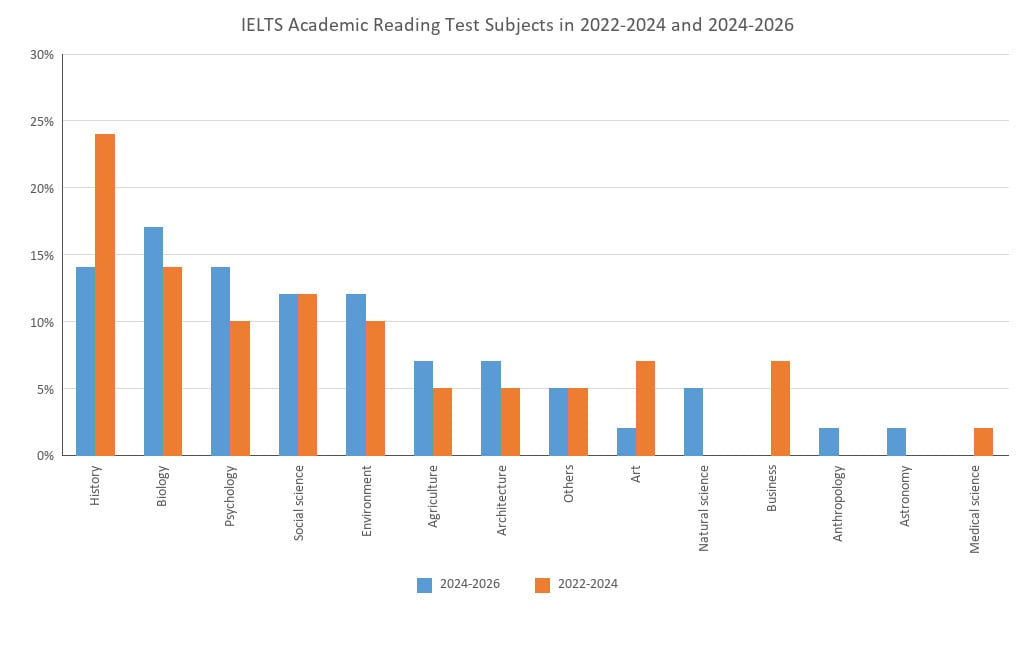
Λόγω αυτών των τάσεων, φροντίσαμε ώστε τα δοκιμαστικά μας τεστ IELTS reading να καλύπτουν αυτά τα θέματα. Έχουμε επίσης προσθέσει δείγματα reading από λιγότερο χρησιμοποιούμενα θέματα, για κάθε περίπτωση. Είναι σημαντικό να προετοιμαστείτε για όλες τις καταστάσεις, επειδή ποτέ δεν ξέρετε ποιο θέμα IELTS reading θα σας δοθεί.
Πώς υπολογίζεται η βαθμολογία σας στο IELTS Reading
Κάθε ερώτηση IELTS reading αξίζει 1 βαθμό, οπότε μπορείτε να επιτύχετε «ακατέργαστη» βαθμολογία (raw score) έως και 40 βαθμούς. Στη συνέχεια, η ακατέργαστη βαθμολογία σας μετατρέπεται στο band score σας. Οι παρακάτω πίνακες σας δίνουν μια γενική ιδέα του πώς οι ακατέργαστες βαθμολογίες IELTS reading μετατρέπονται σε band scores για κάθε τεστ.
Βαθμολογία IELTS General Reading VS Βαθμολογία IELTS Academic Reading
| Ακατέργαστη βαθμολογία: Academic | Band score: Academic | Ακατέργαστη βαθμολογία: General | Band score: General |
|---|---|---|---|
| 39-40 | 9 | 40 | 9 |
| 37-38 | 8.5 | 39 | 8.5 |
| 35-36 | 8 | 37-38 | 8 |
| 33-34 | 7.5 | 36 | 7.5 |
| 30-32 | 7 | 34-35 | 7 |
| 27-29 | 6.5 | 32-33 | 6.5 |
| 23-26 | 6 | 30-31 | 6 |
| 19-22 | 5.5 | 27-29 | 5.5 |
| 15-18 | 5 | 23-26 | 5 |
| 13-14 | 4.5 | 19-22 | 4.5 |
| 10-12 | 4 | 15-18 | 4 |
| 8-9 | 3.5 | 12-14 | 3.5 |
| 6-7 | 3 | 9-11 | 3 |
| 4-5 | 2.5 | 6-8 | 2.5 |
| 1-3 | 2 | 1-5 | 2 |
Ωστόσο, να έχετε υπόψη ότι κάθε εκδοχή του τεστ IELTS reading είναι ελαφρώς διαφορετική και η βαθμολογία που απαιτείται για να επιτύχετε ένα συγκεκριμένο band αλλάζει ανάλογα με το πώς τα πήγαν όλοι όσοι έδωσαν εκείνο το τεστ τη συγκεκριμένη ημέρα. Επομένως, ο αριθμός των σωστών απαντήσεων που χρειάζεται για ένα band score θα διαφέρει ελαφρώς από εξέταση σε εξέταση, αλλά γενικά θα πρέπει να στοχεύετε σε περίπου 30 σωστές απαντήσεις στις 40 αν θέλετε να επιτύχετε band 7.
Κάτι άλλο που θέλουμε να σας υπενθυμίσουμε είναι ότι οι πιο δύσκολες ερωτήσεις και οι πιο εύκολες ερωτήσεις μετράνε εξίσου για την τελική σας βαθμολογία reading, οπότε φροντίστε να μη χάνετε εύκολους βαθμούς κολλώντας σε δύσκολες ερωτήσεις. Στη συνέχεια θα καλύψουμε μερικές συμβουλές και στρατηγικές για το IELTS reading σχετικά με το πώς να απαντάτε σε κάθε ερώτηση του τεστ reading.
Συμβουλές IELTS Reading - Πώς να απαντήσετε στους 11 τύπους ερωτήσεων Reading
Υπάρχουν 11 διαφορετικοί τύποι ερωτήσεων στο τεστ reading και όλοι απαιτούν διαφορετική στρατηγική.
Κάθε τύπος έχει ένα παράδειγμα και την απάντηση στον οδηγό τύποι ερωτήσεων IELTS Reading.
- Τύπος ερώτησης 1 – Matching Information
- Τύπος ερώτησης 2 – Matching Headings
- Τύπος ερώτησης 3 – Matching Features
- Τύπος ερώτησης 4 – Identifying Information
- Τύπος ερώτησης 5 – Identifying Writer's Views/claims
- Τύπος ερώτησης 6 – Multiple Choice
- Τύπος ερώτησης 7 – Matching Sentence Endings
- Τύπος ερώτησης 8 – Sentence Completion
- Τύπος ερώτησης 9 – Summary, Note, Table, Flow-chart Completion
- Τύπος ερώτησης 10 – Diagram Label Completion
- Τύπος ερώτησης 11 – Short Answer Questions
- Πώς οι τάσεις σας βοηθούν να προετοιμαστείτε για το τεστ IELTS Reading
Πώς οι τάσεις σας βοηθούν να προετοιμαστείτε για το τεστ IELTS Reading
Ποιοι τύποι ερωτήσεων κατανόησης γραπτού λόγου δυσκολεύουν περισσότερο τους εκπαιδευόμενούς μας
Οι εκπαιδευόμενοι του BestMyTest έχουν απαντήσει σε ένα εκατομμύριο ερωτήσεις κατανόησης γραπτού λόγου της ακαδημαϊκής εξέτασης (Academic Reading) και σε 600.000 ερωτήσεις κατανόησης γραπτού λόγου της εξέτασης γενικής κατάρτισης (General Training Reading) στα τεστ εξάσκησής μας. Το ποσοστό δείχνει πόσο συχνά απαντήθηκε σωστά κάθε τύπος ερώτησης.
| Τύπος ερώτησης | Ακαδημαϊκή εξέταση | Εξέταση γενικής κατάρτισης |
|---|---|---|
| Αντιστοίχιση πληροφοριών (Matching information) | 34% | 72% |
| Σωστό / Λάθος / Δεν δίνεται (True / False / Not Given) | 39% | 60% |
| Πολλαπλή επιλογή (Multiple choice) | 43% | 48% |
| Αντιστοίχιση χαρακτηριστικών (Matching features) | 48% | 74% |
| Συμπλήρωση προτάσεων (Sentence completion) | 49% | 75% |
| Αντιστοίχιση επικεφαλίδων (Matching headings) | 53% | 40% |
| Ναι / Όχι / Δεν δίνεται (Yes / No / Not Given) | 55% | 57% |
| Συμπλήρωση περίληψης (Summary completion) | 59% | 46% |
| Σύντομη απάντηση (Short answer) | 54% | 75% |
- Στην κατανόηση γραπτού λόγου της ακαδημαϊκής εξέτασης οι δύο τύποι με τη χαμηλότερη επίδοση είναι η αντιστοίχιση πληροφοριών και το Σωστό/Λάθος/Δεν δίνεται, και οι δύο με ποσοστό κάτω από 40%. Και οι δύο απαιτούν να εντοπίσετε μια ιδέα διατυπωμένη με διαφορετικά λόγια και όχι μια ίδια λέξη-κλειδί.
- Στην εξέταση γενικής κατάρτισης η εικόνα αντιστρέφεται: η αντιστοίχιση επικεφαλίδων είναι ο τύπος με τη χαμηλότερη επίδοση, στο 40%, ενώ οι ερωτήσεις εντοπισμού πληροφοριών απαντώνται σωστά τρεις στις τέσσερις φορές, επειδή τα κείμενα είναι συντομότερα και η διατύπωσή τους πιο κυριολεκτική.
- Στα κείμενα της ακαδημαϊκής εξέτασης το ποσοστό σωστών απαντήσεων είναι κατά μέσο όρο 46% και στα κείμενα της εξέτασης γενικής κατάρτισης 59%. Οι μισές προσπάθειες απάντησης σε ερωτήσεις κειμένων της ακαδημαϊκής εξέτασης συγκεντρώνουν βαθμολογία 40% ή χαμηλότερη.
- Σε 43.711 πλήρη τεστ εξάσκησης κατανόησης γραπτού λόγου που έκαναν 38.534 εκπαιδευόμενοι, η μέση βαθμολογία ήταν 5.4. Το 36% έφτασε στη βαθμολογία 6.0 και το 14% στη βαθμολογία 7.0.
- Πρέπει και πάλι να προετοιμαστείτε για κάθε τύπο ερώτησης, αλλά αν ο χρόνος σας είναι περιορισμένος, ο πίνακας δείχνει πού αξίζει περισσότερο να τον αφιερώσετε.
Τα στοιχεία προέρχονται από δεδομένα τεστ εξάσκησης και αξιολογήσεων του BestMyTest έως τον Οκτώβριο του 2026. Τα ποσοστά ανά τύπο ερώτησης είναι ποσοστά σωστών απαντήσεων στο σύνολο των προσπαθειών· τα στοιχεία ανά κριτήριο είναι βαθμολογίες από καθηγητές ή τεχνητή νοημοσύνη, όπως αναφέρεται στις αντίστοιχες ενδείξεις. Τελευταία ενημέρωση: 5 Οκτωβρίου 2026.
Στη συνέχεια θα περάσουμε από τις συμβουλές και τις στρατηγικές IELTS reading που είναι απαραίτητες για μια υψηλή βαθμολογία reading.
Συμβουλές IELTS Reading - Πώς να βελτιώσετε το Band Score σας στο Reading
Οι περισσότεροι υποψήφιοι αποτυγχάνουν στην ενότητα reading για τους εξής τρεις λόγους
- Αργή ταχύτητα ανάγνωσης
- Φτωχό λεξιλόγιο
- Ελάχιστη ή μηδενική προετοιμασία
Βελτίωση της ταχύτητας ανάγνωσής σας
Αρχικά, ας πούμε το προφανές. Για να βελτιώσετε την ταχύτητα ανάγνωσής σας, χρειάζεται πραγματικά να εξασκείστε στην ανάγνωση και να το κάνετε με συνέπεια.
Τώρα ας δούμε μια λιγότερο προφανή στρατηγική που θα σας βοηθήσει να κατανοήσετε τη σημασία μεγάλων κομματιών προτάσεων. Ξεκινήστε αναλύοντας την πρόταση. Κάντε το αναζητώντας το υποκείμενο και το ρήμα της πρότασης. Η εύρεση του υποκειμένου και του ρήματος θα σας βοηθήσει να κατανοήσετε τη σημασία της πρότασης. Ένας λόγος για τον οποίο τα ακαδημαϊκά κείμενα reading μπορεί να είναι δύσκολο να κατανοηθούν είναι επειδή ενώνουν αλυσίδες ιδεών για να σχηματίσουν μακροσκελείς σύνθετες προτάσεις. Αυτό παράγει μεγάλα κομμάτια προτάσεων που είναι δυσκολότερο να αφομοιωθούν, οπότε η χρήση του υποκειμένου και του ρήματος ως οδηγού για την κατανόηση ολόκληρου του κομματιού είναι ένα εξαιρετικό εργαλείο που μπορείτε να χρησιμοποιήσετε κατά την εξέταση IELTS reading σας.
Βελτίωση του λεξιλογίου σας
Πολλοί άνθρωποι πιστεύουν ότι το να απαντάτε σε ερωτήσεις reading είναι τόσο απλό όσο η σάρωση της παραγράφου για λέξεις-κλειδιά και πληροφορίες... Δυστυχώς, δεν είναι τόσο απλό. Οι ερωτήσεις reading είναι συνήθως παραφρασμένες, που σημαίνει ότι οι λέξεις έχουν αλλάξει για να χρησιμοποιήσουν συνώνυμα λέξεων από το κείμενο IELTS reading. Αυτό γίνεται για να αυξηθεί η δυσκολία, διαφορετικά το τεστ θα ήταν πολύ εύκολο. Λόγω αυτού, πρέπει να βελτιώσετε το λεξιλόγιό σας για να γνωρίζετε τα πολλά διαφορετικά συνώνυμα μιας λέξης.
Καθώς προετοιμάζεστε για το τεστ reading και συναντάτε μια λέξη που δεν γνωρίζετε, αποκτήστε τη συνήθεια είτε να σταματάτε και να την ψάχνετε είτε τουλάχιστον να την σημειώνετε και να την ψάχνετε αργότερα. Είναι λίγο κουραστικό, αλλά είναι εξαιρετικά αποτελεσματικό. Ο στόχος σας πρέπει να είναι, αλλά δεν περιορίζεται σε, η μελέτη 15 έως 20 νέων ακαδημαϊκών λέξεων κάθε μέρα.
Γνωρίζοντας σε ποιους τύπους ερωτήσεων οι απαντήσεις είναι/δεν είναι σε σειρά
Είναι σημαντικό να γνωρίζετε ότι για ορισμένους τύπους ερωτήσεων, οι απαντήσεις είναι συνήθως (σχεδόν πάντα) με την ίδια σειρά όπως το κείμενο IELTS reading. Για άλλους τύπους ερωτήσεων, οι απαντήσεις σπάνια είναι με την ίδια σειρά όπως το κείμενο reading. Έχουμε ολοκληρώσει έναν πίνακα για τους τύπους ερωτήσεων που ακολουθούν αυτή τη σειρά και αυτούς που δεν την ακολουθούν. Παρακαλώ έχετε υπόψη.
| Οι απαντήσεις είναι συνήθως (σχεδόν πάντα) με την ίδια σειρά όπως το κείμενο | Οι απαντήσεις σπάνια είναι με την ίδια σειρά όπως το κείμενο. |
|---|---|
|
|
Εύρεση της καλύτερης στρατηγικής reading για εσάς
Η μεγαλύτερη πρόκληση που αντιμετωπίζουν οι περισσότεροι άνθρωποι στην εξέταση IELTS reading είναι η ολοκλήρωση όλων των ερωτήσεων reading πριν τελειώσει ο χρόνος. Στην επόμενη ενότητα, θα μάθετε τρεις στρατηγικές και θα εξαρτηθεί από εσάς να βρείτε ποια σας ταιριάζει καλύτερα. Αυτό θα το κάνετε χρησιμοποιώντας τις δωρεάν εξασκήσεις reading μας.
3 στρατηγικές IELTS Reading
Στρατηγική 1: Διαβάζοντας ολόκληρο το κείμενο και έπειτα απαντώντας στις ερωτήσεις.
Αρχικά, αυτή δεν είναι και τόσο στρατηγική. Είναι κάτι που κάνουν οι άνθρωποι όταν δεν προετοιμάζονται σωστά για την εξέταση reading. Ωστόσο, την έχουμε συμπεριλάβει ως στρατηγική επειδή, τεχνικά, αν μπορείτε να συγκρατήσετε τις πληροφορίες από το κείμενο στην πρώτη ανάγνωση και είστε σε θέση να απαντήσετε στις ερωτήσεις, τότε δεν θα χρειαστείτε τη στρατηγική 2.
Αυτή η στρατηγική, αν δεν έχετε καλύτερη μνήμη από τον μέσο όρο, είναι αναποτελεσματική. Θα καταλήξετε να ξεμένετε από χρόνο πριν να μπορέσετε να απαντήσετε σε όλες τις ερωτήσεις. Πολλοί άνθρωποι κάνουν αυτό το λάθος. Ωστόσο, υπάρχουν μερικές ερωτήσεις που δεν απαιτούν μεγάλη προσπάθεια και θα ωφεληθούν από αυτή τη στρατηγική όπως αν η ερώτηση είναι «Yes» ή «No», τότε θα μπορέσετε να σαρώσετε γρήγορα και να βρείτε γρήγορα την απάντηση, αλλά δεν υπάρχουν αρκετές από αυτές τις ερωτήσεις, οπότε δεν συνιστάται η χρήση αυτής της στρατηγικής εκτός αν μπορείτε να τη χειριστείτε.
Στρατηγική 2: Διαβάστε πρώτα τις ερωτήσεις, διαβάστε με στόχο και κρατήστε σημειώσεις, και έπειτα απαντήστε στις ερωτήσεις σοφά
Αυτή είναι η συνιστώμενη στρατηγική μας. Θα σας βοηθήσει να επιτύχετε υψηλότερη βαθμολογία IELTS reading. Σκεφτείτε αυτό ως έναν σαφή χάρτη του πώς γενικά να προσεγγίσετε την εξέταση:
Ένα από τα πιο συνηθισμένα λάθη που κάνουν οι υποψήφιοι όταν
προσεγγίζουν την εξέταση reading είναι να διαβάζουν κάθε λέξη των κειμένων IELTS reading. Παρόλο που μπορείτε
να εξασκείστε για την εξέταση διαβάζοντας για ευχαρίστηση, η «τυφλή ανάγνωση» (ανάγνωση χωρίς αίσθηση
του τι θα ρωτήσουν οι ερωτήσεις) δεν θα σας κάνει χάρες στην εξέταση. Αντίθετα, θα βλάψει τις
πιθανότητές σας για αποτελεσματική διαχείριση του χρόνου σας και επίτευξη της καλύτερης βαθμολογίας.
Ο κύριος λόγος για να διαβάσετε πρώτα τις ερωτήσεις είναι επειδή ο τύπος της ερώτησης μπορεί να καθορίσει τι
διαβάζετε στο κείμενο ή πώς το διαβάζετε. Για παράδειγμα, ορισμένοι τύποι ερωτήσεων θα απαιτούν την
τεχνική του «skimming», ενώ άλλοι μπορεί να απαιτούν την τεχνική του «scanning».
Είναι σημαντικό να αντιμετωπίζετε ένα σύνολο ερωτήσεων που είναι του ίδιου τύπου ερώτησης.
Θα χρειαστεί να καθορίσετε ποιον τύπο ερώτησης θέλετε να αντιμετωπίσετε πρώτα.
Μια καλή στρατηγική θα ήταν να ξεκινήσετε με τον ευκολότερο τύπο ερώτησης και να προχωρήσετε σε δυσκολότερους τύπους ερωτήσεων αργότερα.
Οι ευκολότεροι τύποι ερωτήσεων είναι αυτοί στους οποίους ξοδεύετε λιγότερο χρόνο στην ανάγνωση.
Για παράδειγμα, ο τύπος ερώτησης Matching Heading είναι ευκολότερος επειδή
χρειάζεται μόνο να βρείτε την επικεφαλίδα που περιγράφει καλύτερα την κύρια ιδέα μιας παραγράφου.
Ένα παράδειγμα δύσκολου τύπου ερώτησης θα ήταν το Identifying Information. Για αυτόν τον τύπο ερώτησης,
θα χρειαστεί να διαβάσετε κάθε παράγραφο για να βρείτε αν κάθε δήλωση είναι TRUE, FALSE ή NOT GIVEN σύμφωνα με το κείμενο.
Παρακάτω είναι ένας πίνακας που παραθέτει τα επίπεδα δυσκολίας για κάθε τύπο ερώτησης. Χρησιμοποιήστε αυτόν τον πίνακα ως αναφορά όταν επιλέγετε ποιον τύπο
ερώτησης θέλετε να αντιμετωπίσετε πρώτα.
| Επίπεδο δυσκολίας | Τύπος ερώτησης |
|---|---|
| Εύκολο | Match Headings Short answer |
| Μέτριο |
Matching Sentence Endings Matching Features Multiple choice Sentence Completion Diagram Label, Summary, Note, Table, Flow-Chart Completion |
| Δύσκολο |
Match Information Identifying Information (TRUE/FALSE/NOT GIVEN) Identifying Viewer's claims (YES/NO/NOT GIVEN) |
Αφού διαβάσετε τις ερωτήσεις από το κείμενο IELTS, θα μπορείτε να διαβάσετε με στόχο. Τι σημαίνει αυτό; Για παράδειγμα, αν συναντήσετε μια ερώτηση που περιλαμβάνει το έτος «1896», μπορείτε να σημειώσετε πότε εμφανίζεται αυτό το έτος στο κείμενο, χρησιμοποιώντας το για να απαντήσετε στην ερώτηση αργότερα.
Υπάρχουν δύο τεχνικές ανάγνωσης που θα σας βοηθήσουν να μείνετε σε καλό δρόμο διαβάζοντας με στόχο. Η πρώτη, το skimming, ορίζεται καλύτερα ως γρήγορη ανάγνωση για να αποκτήσετε την «ουσία» ή τη γενική ιδέα ενός κειμένου. Με αυτή την τεχνική, δεν σταματάτε για άγνωστες λέξεις ή για να ψάξετε για συγκεκριμένες λεπτομέρειες. Η δεύτερη τεχνική, το scanning, ορίζεται καλύτερα ως ανάγνωση για συγκεκριμένες πληροφορίες. Με αυτή την τεχνική, δεν διαβάζετε για τη συνολική ουσία, αλλά μάλλον για συγκεκριμένες πληροφορίες. Παρατηρήστε πώς κάθε μία από αυτές τις τεχνικές έχει έναν συγκεκριμένο στόχο στο μυαλό. Αυτό θα σας βοηθήσει να βρείτε πληροφορίες πιο γρήγορα.
Καθώς διαβάζετε με στόχο, θα πρέπει επίσης να κρατάτε σημειώσεις στα περιθώρια του κειμένου, τοποθετώντας αστερίσκους δίπλα σε βασικές πληροφορίες ή υπογραμμίζοντας πράγματα που πιστεύετε ότι θα σας βοηθήσουν να απαντήσετε στις διάφορες ερωτήσεις. Αυτό θα διευκολύνει τον έλεγχο όταν σας ερωτηθούν συγκεκριμένα πράγματα στις ερωτήσεις. Επιλέξτε όποιο σύστημα σημειώσεων είναι κατάλληλο για εσάς—απλώς βεβαιωθείτε ότι το κάνετε!
Αφού διαβάσετε τις ερωτήσεις, διαβάσετε το κείμενο και κρατήσετε τις κατάλληλες σημειώσεις, θα έπρεπε να έχετε εντοπίσει το μέρος του κειμένου όπου χρειάζεται να διαβάσετε προσεκτικά. Στη συνέχεια απλώς διαβάστε προσεκτικά και σκεφτείτε κριτικά για να καθορίσετε τη σωστή απάντηση.
Στρατηγική 3: Skimming, σημειώσεις & τύποι ερωτήσεων.
Αυτή είναι μια άλλη στρατηγική που χρησιμοποιείται από πολλούς υποψηφίους του τεστ IELTS. Θα σας βοηθήσει να επιτύχετε υψηλότερη βαθμολογία reading. Η στρατηγική αποτελείται από 4 βήματα:
- Σαρώστε με skim κάθε παράγραφο για να αποκτήσετε τη γενική ιδέα κάθε παραγράφου. Η κύρια ιδέα μιας παραγράφου βρίσκεται συνήθως στις πρώτες προτάσεις, οπότε εστιάστε λίγο περισσότερο σε αυτές τις προτάσεις. Οι επόμενες προτάσεις μπορούν να σαρωθούν γρήγορα, υπογραμμίζοντας ονόματα/λέξεις/φράσεις που ξεχωρίζουν.
- Αφού σαρώσετε κάθε παράγραφο, γράψτε σύντομες σημειώσεις (2-5 λέξεις) δίπλα σε κάθε παράγραφο με την καλύτερη πρόβλεψή σας για την κύρια ιδέα αυτής της παραγράφου.
- Στη συνέχεια, απαντήστε σε ένα σύνολο ερωτήσεων που είναι του ίδιου τύπου ερώτησης.
- Τέλος, απαντήστε σε ένα σύνολο ερωτήσεων αποτελεσματικά και σωστά.
Είναι σημαντικό να μην ξοδέψετε περισσότερο από 3-5 λεπτά στα Βήματα 1 και 2. Η υπερβολική δαπάνη χρόνου σε αυτά τα βήματα θα σπαταλήσει πολύ χρόνο και θα καταλήξετε να ξεμείνετε από αυτόν.
Βήματα 1 & 2Ο στόχος εδώ είναι να δημιουργήσετε μια αποτελεσματική μέθοδο για την εύρεση απαντήσεων στο κείμενο. Γράφοντας τη γενική ιδέα κάθε παραγράφου, θα ξέρετε ποια παράγραφος περιέχει την απάντηση σε κάθε ερώτηση. Αυτό θα σας εξοικονομήσει πολύ χρόνο γιατί αν δεν την είχατε γράψει, πιθανότατα θα έπρεπε να σαρώσετε κάθε παράγραφο για τη γενική ιδέα της ερώτησης, στη συνέχεια θα έπρεπε να σαρώσετε προσεκτικά την παράγραφο για την απάντηση. Σημειώνοντας την κύρια ιδέα κάθε παραγράφου, παρακάμπτετε το πρώτο βήμα της σάρωσης κάθε παραγράφου και ξεκινάτε τη σάρωση για την απάντηση.
Βήμα 3
Αφού σαρώσετε διεξοδικά το κείμενο και γράψετε μερικές σημειώσεις, είστε έτοιμοι για το Βήμα 3.
Σε αυτό το βήμα, θα πρέπει να καθορίσετε ποιον τύπο ερώτησης θέλετε να αντιμετωπίσετε πρώτα.
Μια καλή στρατηγική θα ήταν να ξεκινήσετε με τον ευκολότερο τύπο ερώτησης και να προχωρήσετε σε δυσκολότερους τύπους ερωτήσεων αργότερα.
Οι ευκολότεροι τύποι ερωτήσεων είναι αυτοί στους οποίους ξοδεύετε λιγότερο χρόνο στην ανάγνωση.
Για παράδειγμα, ο τύπος ερώτησης Matching Heading είναι ευκολότερος επειδή
χρειάζεται μόνο να βρείτε την επικεφαλίδα που περιγράφει καλύτερα την κύρια ιδέα μιας παραγράφου, οπότε τεχνικά χρειάζεστε μόνο τα Βήματα 1 και 2 για να απαντήσετε σε αυτόν τον τύπο ερώτησης.
Ένα παράδειγμα δύσκολου τύπου ερώτησης θα ήταν το Identifying Information. Για αυτόν τον τύπο ερώτησης,
θα χρειαστεί να διαβάσετε κάθε παράγραφο για να βρείτε αν κάθε δήλωση είναι TRUE, FALSE ή NOT GIVEN σύμφωνα με το κείμενο.
Παρακάτω είναι ένας πίνακας που παραθέτει τα επίπεδα δυσκολίας για κάθε τύπο ερώτησης. Χρησιμοποιήστε αυτόν τον πίνακα ως αναφορά όταν επιλέγετε ποιον τύπο ερώτησης θέλετε να αντιμετωπίσετε πρώτα.
| Επίπεδο δυσκολίας | Τύπος ερώτησης |
|---|---|
| Εύκολο | Match Headings Short answer |
| Μέτριο |
Matching Sentence Endings Matching Features Multiple choice Sentence Completion Diagram Label, Summary, Note, Table, Flow-Chart Completion |
| Δύσκολο |
Match Information Identifying Information (TRUE/FALSE/NOT GIVEN) Identifying Viewer's claims (YES/NO/NOT GIVEN) |
Τώρα που βρήκατε ποιο σύνολο ερωτήσεων θα απαντήσετε πρώτα, είναι ώρα να τις απαντήσετε πραγματικά :( Μην ανησυχείτε! Παρόλο που κάθε τύπος ερώτησης είναι διαφορετικός, η στρατηγική για να τους απαντήσετε σωστά ισχύει για όλους. Η βασική αρχή είναι απλή, απλώς ακολουθήστε τα παρακάτω βήματα:
- Διαβάστε προσεκτικά την ερώτηση και εντοπίστε σημαντικές λέξεις-κλειδιά.
- Βρείτε την παράγραφο που περιέχει τις πληροφορίες που χρειάζονται για να απαντήσετε στην ερώτηση. (Ας ελπίσουμε ότι έχετε ήδη γράψει τις γενικές ιδέες για κάθε παράγραφο, οπότε μπορείτε να το βρείτε εύκολα.)
- Σαρώστε την παράγραφο για τις σημαντικές λέξεις-κλειδιά (Είναι πιθανότατα συνώνυμα!) μέχρι να εντοπίσετε το μέρος του κειμένου όπου χρειάζεται να διαβάσετε προσεκτικά.
- Τέλος, διαβάστε προσεκτικά και σκεφτείτε κριτικά για να καθορίσετε τη σωστή απάντηση.
Δωρεάν λήψεις δειγμάτων IELTS Reading σε PDF με απαντήσεις
Παρακάτω είναι μερικά δωρεάν δείγματα reading από το British Council (τους δημιουργούς της εξέτασης IELTS). Δοκιμάστε να απαντήσετε στις ερωτήσεις και δείτε πώς τα πάτε!