How to Ace the TOEFL Listening Test: 8 TOEFL Listening Tips for Success
If you’re looking for a guide to help you prepare for the TOEFL listening section, you are in the right place. This guide will help you with your TOEFL listening practice by walking you through the entire listening section, tell you exactly how you should listen to improve your listening score, give you a list of test-taking tips to help you avoid some common mistakes, and show you a proven study method to improve your TOEFL score.
Table Of Contents
TOEFL Listening Test Overview
First things first! You need to know what to expect in the TOEFL listening section. In this section, we will explain the listening's structure and test content. Before we begin, we recommend you take a TOEFL Listening practice test to help you understand exactly what we are talking about. If you want to keep reading that’s fine too! You can always take the practice test and re-read this article later on. Take a listening mock test
The listening section is the second section of the TOEFL iBT test. It contains 2-3 tasks. Each task contains the 1 conversation and 2 lectures. Each conversation lasts about 3 minutes and is followed by 5 questions, and each lecture lasts about 4-6 minutes and is followed by 6 questions. So each task contains 17 questions and there are a total of 34-51 questions in the entire TOEFL listening section. The entire listening section (including time spent listening) will take you between 60 - 90 minutes to complete. This table below breaks down the basics of the TOEFL listening test.
| Recording type | Number | Question | Time |
|---|---|---|---|
| Conversation | 2-3 | 5 | 2-3 min |
| Lecture | 4-6 | 6 | 4-6 min |
| Total | 6-9 | 34-51 | 60-90 min |
On the listening test, once you submit your answer, you CANNOT go back to it like you can on the reading test. Therefore, you cannot skip questions like on the reading test, so you may need to guess an answer if you get stuck. You cannot afford to spend too much time on one question as you may run out of time and potentially miss easy questions, so if you DO get stuck, unfortunately, you HAVE TO move on.
Now you understand the structure. Let’s examine conversations and lectures in a deeper look.
TOEFL Listening Test: Conversations
Conversations are dialogues between two people. One person is always a student. The other person can vary between a student, professor, teaching assistant, librarian, university administrator, and so on. These conversations take place on a college campus usually in a dormitory, cafeteria, classroom, or a professor's office. Typically, the conversation deals with situations related to university life. Conversations are between 2-3 minutes in length. Here is a sample TOEFL listening conversation with 5 questions from ETS:
1. Why does the man go to see the professor?
- To hand in a late assignment
- To find out about jobs in the department
- To discuss Dean Adams’ current research
- To volunteer to help organize an event
2. How did the man learn about Dean Adams’ retirement?
- He read about it in an e-mail message.
- It was posted on a bulletin board.
- He heard other students discussing it.
- Dean Adams announced it in her class.
3. Why does the professor refuse the man’s offer to help with a party? Choose 2 answers.
- Two people are already working on it.
- She prefers that he spend his time on another project.
- The party does not require much preparation.
- Dean Adams is not permanently leaving the department.
4. Why does the professor talk about speciation?
- To describe the main focus of the work she needs help with
- To tell the man about a new research area in ethnology
- To explain what Dean Adams chose to work on in Indonesia
- To demonstrate how varied Dean Adams’ research has been
5. Directions: Listen to Track 2
- To express doubt about the man’s qualifications for the project
- To ask the man if he would be willing to work on the project
- To ask the man to recommend someone for the project
- To apologize for not being able to offer the project to the man
1. D
2. C
3. A, C
4. D
5. B
TOEFL Listening Test: Lectures
Lectures take place in a classroom. Lectures may be monologues(one speaker) or academic discussions involving the professor and one or more students. Lectures involve a wide variety of academic subjects: biology, astronomy, history, literature, earth science, psychology, anthropology, archaeology, botany, art history, and so on. Lectures are between 4-6 minutes in length. Here is a sample TOEFL listening lecture with 6 questions from ETS:
1. What is the lecture mainly about?
- Different kinds of trees ussed for building canoes
- Various methods of Native American transportation
- The value of birch trees to some Native American groups
- The trading of birch wood products by Europeans in North America
2. According to the professor, what characteristics of birch bark made it useful to Native Americans? Choose 2 answers.
- It repels water.
- It can be eaten.
- It is easy to fold.
- It has a rough texture.
3. According to the professor, why was the canoe important to some Native American groups? Choose 2 answers.
- There was a network of waterways where they lived.
- Snowy winters made land travel too difficult.
- Some Native American groups sold their canoes to other groups.
- Canoe travel helped form relationships between groups of Native Americans.
4. Why does the professor mention French traders who arrived in the Iroquois region?
- To illustrate how far news of the Iroquois canoe design had traveled
- To explain the kinds of objects the Iroquois received in exchange for their canoes
- To support her point about how efficient the Iroquois canoe design was
- To emphasize that the Iroquois were the first settlers in that region
5. Listen to Track 4
- To share what he knows about birch wood
- To point out a misprint in the textbook
- To bring up a point from a previous lecture
- To request more explanation from the professor
6. Listen to Track 2
- To show how slow canoe travel was
- To illustrate the size of a geographic area
- To compare different means of travel
- To describe how waterways change over time
1. C
2. A, C
3. A, D
4. C
5. D
6. B
8 TOEFL Listening Tips for Success
When you listen to a TOEFL listening recording, there are a few tips that will help you answer questions correctly.
TOEFL Listening Tip 1: Listen for the main idea
You can expect that the first question after almost every lecture is the main idea (gist) question. They are very popular, so it is important to listen for the main idea. At the beginning of the listening passages, the professor usually mentions what the main topic of the lecture will be about, but sometimes the topic might be branched into something more specific. Pay attention to the main idea of the lecture at the beginning and be mindful when the topic changes. For example, you might see a question like this:
Q. What is the lecture mainly about?
- A comparison of two types of detective novels
- Ways in which detective novels have changed over time
- The Moonstone as a model for later detective novels
- Flaws that can be found in the plot of The Moonstone
TOEFL Listening Tip 2: Listen to speaker’s tone of voice
Sometimes you will encounter questions that are about the speaker’s attitude or opinion. To answer these questions correctly, you need to pay attention to the speaker’s tone of voice. For example, does the speaker sounds excited, confused, or sad? Take a look at this question:
Q. What can be inferred about the professor when he says this: “Uh, it’s hard at this juncture to read this novel and realize that no one had ever done that before, because it all seems so strikingly familiar.”
- He is impressed by the novel’s originality.
- He is concerned that students may find the novel difficult to read.
- He is bored by the novel’s descriptions of ordinary events.
- He is eager to write a book about a less familiar subject.
TOEFL Listening Tip 3: Listen to how ideas are connected throughout the lecture.
When listening to a lecture, make note of the way the ideas in the lecture are connected. In other words, how the professor organized the lecture. When you encounter a question asking you about how the lecture is organized, you can refer back to your notes. Some of the main relations between ideas include cause/effect, compare/contrast, and steps in a process.
TOEFL Listening Tip 4: Listen to the key point not specific details
TOEFL listening questions will not test you on small details. For example, you won’t see questions that are about a specific year, name, or location. Instead, questions will test your understanding of key points mentioned in the lecture. Here are two examples:
Q. In what way is The Moonstone different from earlier works featuring a detective?
- In its unusual ending
- In its unique characters
- In its focus on a serious crime
- In its greater length
Q. According to the professor, what do roses in The Moonstone represent?
- A key clue that leads to the solving of the mystery
- A relief and comfort to the detective
- Romance between the main characters
- Brilliant ideas that occur to the detective
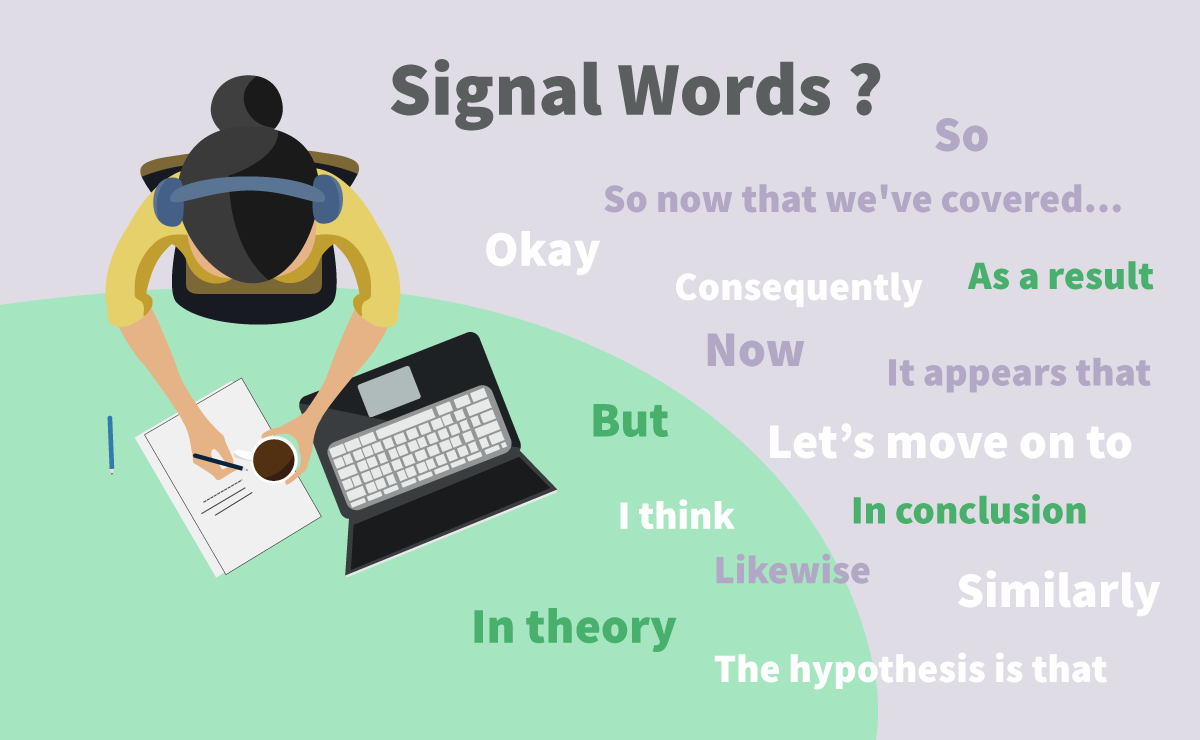
TOEFL Listening Tip 5: Listen for signal words that indicate different parts of the lecture
To help you capture key points in the lecture, you need to learn to listen for signal words or transition words. These words are like the road signs that tell you what is coming next. Signal words can tell you the beginning or the end of a topic. They can also help you move through the middle of the lecture by introducing topics.
Check out this article to learn more about how to listen for signal words
TOEFL Listening Tip 6: Make an educated guess on questions you are unsure of
When you don’t know the answer, do not give up. Try to figure out which choice is most consistent with the main idea of the conversation or lecture. Another way is to eliminate obvious wrong answers.
TOEFL Listening Tip 7: Don’t skip questions
The questions in the listening section must be answered in the order they are presented. If you skip a question, you will not be able to go back and answer it.
TOEFL Listening Tip 8: Don’t take more than two minutes to answer a question.
If you spend more than two minutes on a question, you might run out of time. It is not worth it. Leave time for other questions that you have more confidence on. It’s better to have an educated guess and move on than it is to miss out on potential easy questions because you ran out of time.
Nature of TOEFL listening recordings
So far we have gone over listening tips for the TOEFL listening section and talked about things to avoid during the exam. If you apply these tips to our TOEFL listening test, you will see your TOEFL score increase.
However, all these tips are useless if your English listening skills are poor. How can you answer questions when you have no clue what the speaker is talking about?
If your listening skills are bad, there is no quick fix. You have to spend time working on it. Don’t worry! We will tell you what you should do to improve your listening skills in later parts of this article. Understanding the nature of TOEFL listening recordings will help you have a better idea of how to choose your listening preparation material.
Natural speech
The TOEFL listening section is designed to determine if a student can handle university life in an English speaking country. Thus, the recording in the listening section is similar to a real-world situation. For example, you will hear informal language such as idioms, phrases, and transition words like “umms” and “wells”. If you’re not living in an english-speaking country, you might not be used to this kind of speech.
Academic lectures are long
As we mentioned earlier, a lecture is about 4-6 minutes long, so it is very easy to get lost while you are listening. You might get wrapped up in the subject matter of a recording and forget to pay attention to the big picture.
Full of academic vocabulary
In TOEFL Listening lectures, you’ll often hear words you don’t usually use. For example, you might not be familiar with academic words related to biology if your major is business and finance.
Different accents
The TOEFL Listening test sometimes includes English accents besides accents from North America. These accents will come from the U.K., Australia, or New Zealand, so to fully prepare yourself, you should try listening to news clips, tv shows from these countries. BestMyTest also includes audio from people all over the globe.
Proven study methods to improve TOEFL listening score
Many teachers will tell you to listen to spoken English from multiple sources such as English TV channels/radios as much as possible. This is not the most efficient way to study TOEFL listening! The type of material in the TOEFL® iBT is academic. The conversations and lectures in the Listening section are of academic nature. When it comes to passing TOEFL, you will not benefit much from watching movies and listening to music in English. Therefore, the most effective way to prepare for the TOEFL listening is to listen to the types of material that you’ll encounter on the official TOEFL listening test.
Once you have TOEFL listening practice materials at hand, you’ll need a systematic studying method. In the next post, we will show you how to do that.