
Ebben az útmutatóban egy ingyenes IELTS Reading teszttel kezdheted meg az IELTS olvasás gyakorlását. A tesztnek azonban két változata van: IELTS general reading és IELTS academic reading. Megtudhatod, melyik változat a megfelelő számodra, és IELTS Reading anyagaink segítségével megtanulhatod, hogyan oldhatod meg az olvasás minden kérdéstípusát.
Egy ingyenes IELTS reading gyakorlóteszt elvégzése után kapj ingyenes IELTS reading pontszámelemzést és személyre szabott tanulási tervet.
| IELTS General Reading teszt | IELTS Academic Reading teszt |
|---|---|
Az alábbiakban az összes IELTS reading kérdésünket megtalálod válaszokkal. Megjegyzés: a piros linkek a diákjaink által legnépszerűbbnek és leginkább ajánlottnak értékelt reading kérdések, amelyeket bármikor ingyen gyakorolhatsz.
General IELTS Reading gyakorlóteszt kérdések 1 - 135
Short everyday texts, workplace texts, and one longer passage
Academic IELTS Reading gyakorlóteszt kérdések 1 - 171
Three long passages from books, journals, magazines, and newspapers
Útmutató az IELTS Reading gyakorló teszthez
Ennek az útmutatónak a hátralévő része mindent megtanít az IELTS Reading tesztről, mind a General Training, mind az Academic Reading teszt esetében. Megtanulhatja, hogyan számítják ki a Reading pontszámot, hogyan válaszoljon helyesen az egyes Reading kérdéstípusokra, hogyan fejlessze az olvasását IELTS szövegekkel, és hogyan sajátítsa el a 3 stratégiánkat az IELTS Reading gyakorlati sikeréhez.
Tartalomjegyzék
- Információk az IELTS Reading tesztről
- IELTS Reading mintakérdések
- Információk az IELTS General Reading tesztről
- Információk az IELTS Academic Reading tesztről
- IELTS Reading pontszámkalkulátor
- Hogyan válaszoljon mind a 11 IELTS Reading kérdéstípusra
- Hogyan javítsa az IELTS Reading band score-ját
- 3 IELTS Reading stratégia
- Ingyenes IELTS Reading gyakorló teszt PDF letöltése válaszokkal
Információk az IELTS Reading tesztről
Az IELTS Reading teszt 3 részből és összesen 40 kérdésből áll. Általánosságban részenként 12-14 kérdésre kell válaszolnia, és pontosan 60 perc áll rendelkezésére a Reading vizsga teljesítésére. Mindegyik rész 1-3 szöveget tartalmaz attól függően, hogy melyik tesztet teszi le. Ha tudja, melyik tesztet teszi le, kihagyhatja a következő néhány szakaszt. Ha nem, fontos, hogy megismerje mindkét tesztet, és hogyan készüljön fel rájuk.
Melyik IELTS Reading teszt a megfelelő számomra?
Az IELTS Reading tesztnek két változata van: IELTS General Reading és IELTS Academic Reading. A General Reading tesztet akkor teszi le, ha bevándorolni szeretne, vagy középiskolába beiratkozni. Az Academic Reading tesztet akkor teszi le, ha felsőoktatásban szeretne tovább tanulni. A General Reading és az Academic Reading közötti legnagyobb különbség az IELTS reading szövegek nehézségében rejlik. Ahogy a neve is sugallja, az Academic teszt akadémiai forrásokból származó IELTS reading anyagokat használ, míg a General teszt a mindennapi életből származó anyagokat.
Mindkét teszt 3 részt, 40 kérdést és 11 kérdéstípust tartalmaz. Az alábbi táblázatban részletesen olvashat mindkét teszt egyes szakaszairól.
| Rész | IELTS Academic Reading teszt | IELTS General Reading teszt |
|---|---|---|
| 1 | Egy hosszú akadémiai szöveg, amely a leírótól a tényszerűig, valamint az érvelőtől az elemzőig terjedhet. A szöveget
könyvekből, folyóiratokból, magazinokból és újságokból veszik. 12-14 kérdés |
Két vagy három rövid tényszerű szöveg.
A témák egy angol anyanyelvű országban folytatott mindennapi élethez kapcsolódnak.
12-14 kérdés |
| 2 | Egy hosszú akadémiai szöveg, amely a leírótól a tényszerűig, valamint az érvelőtől az elemzőig terjedhet. A szöveget
könyvekből, folyóiratokból, magazinokból és újságokból veszik. 10-14 kérdés |
Két rövid tényszerű szöveg munkahelyi kérdésekre összpontosítva (pl. álláspályázat, vállalati irányelvek, bérezés és feltételek).
12-14 kérdés |
| 3 | Egy hosszú akadémiai szöveg, amely a leírótól a tényszerűig, valamint az érvelőtől az elemzőig terjedhet. A szöveget
könyvekből, folyóiratokból, magazinokból és újságokból veszik. 12-14 kérdés |
Egy hosszabb, összetettebb szöveg egy általános érdeklődésre számot tartó témáról.
A szövegek hitelesek, és felhívásokból, hirdetésekből, céges kézikönyvekből, könyvekből, magazinokból és újságokból származnak.
12-14 kérdés |
Most, hogy megismerte az IELTS Reading teszt szerkezetét és mind az IELTS General Reading, mind az IELTS Academic Reading tesztet, itt az ideje megtudni, hogy a papír alapú vagy a számítógépes teszt-e jobb az Ön számára.
IELTS papír alapú teszt (PBT) VS IELTS számítógépes teszt (CBT)
A PBT-ben egy kérdéses füzetet (Question Booklet) és egy válaszlapot (Answer Sheet) kap. A kérdéses füzetben látja az összes kérdést, amelyre válaszolnia kell. A válaszlapra írja a végleges válaszait, amelyeket értékelni fognak. Megtekintheti a hivatalos IELTS válaszlap PDF-et itt
Megjegyzés: Ellentétben az IELTS Listening teszttel, nem kap plusz időt arra, hogy a válaszait a füzetről átírja a válaszlapra, ezért győződjön meg róla, hogy minden IELTS Reading teszt kérdést hozzáad a válaszlaphoz ahogy megválaszolja azokat.
A CBT-ben számítógépen válaszol a kérdésekre. A szövegei a bal oldalon, a kérdései pedig a jobb oldalon lesznek. Lehetősége lesz továbbá szöveg kiemelésére, valamint a vezérlőfunkciók használatára a válaszok másolásához és beillesztéséhez. A PBT-ről és a CBT-ről további információkért tekintse meg az IELTS számítógépes teszt útmutatót.
Bármelyik változatot bármikor gyakorolhatja az ingyenes IELTS Reading gyakorló tesztünkkel. Az oldal tetején megtalálja az összes IELTS Reading anyagunkra mutató linket.
IELTS Reading mintakérdések
Itt van két ingyenes IELTS Academic Reading gyakorlat. Oldd meg mindegyiket, majd nyisd meg a válaszokat az ellenőrzéshez. A IELTS Reading kérdéstípusok útmutató bemutatja az egyes típusokat, és további mintakérdéseket ad.
Match each item with the period of time it best corresponds with
NB You may use any letter more than once.
- The Palaeolithic era
- The Bronze age
- The Iron age
- The Medieval era
- The Mesolithic age
- Roman times
-
spellcheck Answers1. FALSE
2. FALSE
3. NOT GIVEN
4. FALSE
5. TRUE
6. FALSE
7. FALSE
8. TRUE
9. FALSE
10. F
11. C
12. A
13. B
14. D
The climate in Britain has been arctic for the last several million years, punctuated by relatively warm timespans, or interglacials of thousands of years, one of which we are in as of now. Since the last glaciation, British woodland history is considered quite short in terms of geological time spans, and is also closely related to the human civilization developing.
At the peak of the last glaciation (100,000 – 12,000 BC), the majority of Britain would have had no trees. Birch and willow scrub may have grown along the lower reaches of the ice, with pine in some areas. It’s possible that remnants of pre-glacial flora were sheltered along the western bays of Great Britain and Ireland’s coasts, but as far as the southern parts of England, the ice kept any land barren. Information regarding the development of Britain’s flora following glaciation can be found by studying the deposits of pollen and seed in peat, as well as by the use of radiocarbon dating. Tundra and moorland followed the retreating ice, which lead to phases of different tree species spreading from the south. First came birch, aspen and sallow, followed by pine and hazel continuing to spread north as of 8500 BC, replacing birch to make it less commonly found for the next few thousand years. Oak and alder came after pine, then lime, elm, beech, and maple, all spreading northwards one after the other. From the moment lime arrived, in about 7300, to about 4500 BC the climate remained stable for a length of time known as the Atlantic Period, a time in which numerous species grew to form a series of wildwood or wilderness types.
What did the wilderness or wildwood look like, before man started interfering with it? One theory holds that Britain and Western Europe in Palaeolithic times was covered from coast to coast in a wildwood of continuous trees. However, a modern theory proposed by Francis Vera holds that Western Europe wilderness was a combination of grassland, scrub, and clusters or groves of trees. It was not a dense, impassable wildwood, but instead, an area similar to a park, kept up by wild herbivores eating the plants and grass. Throughout earlier interglacial periods, this may also have been the case in Britain, as creatures of the Palaeolithic era needed to roam large areas of grassland to survive. A variety of grassland plants continued to live there in the last interglacial, as according to pollen records. However, since the last glaciation, the bison, elk and other large herbivores which persisted on mainland Europe were extinct in Britain, so Vera’s theory may not apply so well to Britain.
Meanwhile, throughout the period since it’s spread northwards after the last glaciation, the sustained growth of oak in Britain demonstrates that the wildwood was not as continual as once believed. Oak is a pioneer species, which requires vacant space to generate more of itself. Grazing animals are also present to keep areas open, so Oak regenerates in the thorny brush as a protective measure from their grazing. Archaeological evidence indicates that red deer, who graze on grass as well as browse from trees, were essential to the economy in Mesolithic Britain, with people utilizing them for meat, skins, antlers and bones.
As the Mesolithic (10,000-3000 BC) era ended, evidence of the beginnings of agriculture emerges. Agricultural weeds, such as plantain and stinging nettle, were also increasing in number. Nearly all the wildwood was cut down as the population increased rapidly. However, the falling elm population around 4,000 BC all across Europe has been attributed not to the clearing of trees, but to what’s referred to as Elm disease.
Throughout the Bronze Age (2400-750 BC), people were cutting down trees more than ever before, until the prevalence of the practice “coppicing” peaked, likely at some point during the early Iron Age. Oliver Rackham (1990) theorizes that nearly 50% of land throughout England was no longer wildwood by 500 BC. The regrowth from a stump grows more readily than the original tree, and Neolithic man had discovered this practice, known as coppicing. Much of the remaining woods were maintained by way of this method during the Bronze Age.
The Celtic peoples living in the Iron Age were able to master woodworking as an artform. Today, Celtic woodworking can be seen in houses, boats, wheels and other artifacts of the time. Coppicing as a means to manage woodland was of massive importance throughout two millennia that followed. Buildings, roads, fences, carts, and the fuel for heating, cooking, metalworking and pottery were all made possible due to wood materials gained from the vital practice of coppicing.
A clear divide has existed between wooded and non-wooded regions of Britain since the time of the Romans. As evidenced by The Domesday Book (1086), all the wood in England had an economic value and was the property of either an individual or community owner. Woods were the territories, or ‘exclaves’ of communities who lived some miles away. Even though it had to be transported over long distances, the materials which woodlands produced were of obvious value, and their ownership was long before established. Merely around 15% of land in England was represented by woodland or wood- pasture in the year 1086.
English woodlands produced mostly underwood used as fuel along with other things, with small oaks being used to construct buildings. The average wood-framed houses of the Medieval era mostly used oaks shorter than 18” in diameter. Longer pieces of timber were hard to come by, and kept only for elaborate buildings intended for the Church. Imported boards of thin oak or wainscot from Central Europe were brought in for the purpose of domestic building. Woodland cover was as low as 15% in 1086, and continued to decline from as a result of an ever- growing population to 10% by 1350. This stopped suddenly with the plague of the Black Death of 1349 wiping out some of the human population. Woods which had persisted up to 1350 mostly prospered over the next 500 years.
Match each description with the correct psychologist
NB You may use any letter more than once.
- Clark Hull
- Howard and Tracy Kendler
- Michael Cole and colleagues
- Simon Hewson
-
spellcheck Answers1. D
2. C
3. D
4. A
5. C
6. B
7. C
8. D
9. TRUE
10. FALSE
11. TRUE
12. FALSE
Could it be that the very essence of reasoning itself is found in the way we behave? Clark Hull, an acclaimed American psychologist, theorized that it was, describing that reasoning is achieved by the way two “behavior segments” are combined in new ways to achieve goals. Howard and Tracey Kendler, who were two of Hull’s followers, used Hull’s principle ideas to design a reasoning test for children. In this test, children needed to learn how to use a machine in a two-step process. The children learned each of the two steps individually, with the first being to correctly choose and press one of two buttons, and the second to place a marble into a small opening. If both steps were completed successfully, a toy would be released as rewards to the children.
From this test, the Kendlers learned that although the children were able to learn each step, they were not able to “integrate” the two tasks without intervention. In other words, the children could not successfully perform the first step, pushing the button, and then proceed to the second step, inserting the marble into the hole, by themselves. This failure to independently integrate the steps led the Kendlers to believe that children of this age were not able to use deductive reasoning.
According the the work of psychologist and professor Michael Cole and his associates, some adults from specific African tribes are also unable to successfully complete the Kendlers' two-step test of deductive reasoning. However, this finding remains questionable in light of the findings of a similar test to the Kenders’, which revealed that the African tribes people were, in fact, able to complete the test.
In this test, Cole substituted a locked box for the machine with the buttons, and then used two matchboxes of different colors. One of the matchboxes held a key for the locked box. Just like with the Kendlers’ test, Cole’s test also involved two behavior segments, these being to first open the right match-box to get the key, and second to use the key to open the box. However, Cole’s test differs quite a bit psychologically. Instead of subjects being presented with a strange machine, they are given familiar objects in a simpler context. Cole found the difficulty of 'integration' was greatly reduced here.
It seems that the same truth which Cole discovered can be extended to explain the deductive reasoning skills of young children. Psychologist Simon Hewson believes that perhaps the task’s difficulty is not in inferential processes themselves, but is instead tied to confusing features of the test apparatus, such as the button machine, as well as the context of the procedure being tested. When these factors are adjusted in order to prevent the inferential nature of the problem being affected, five-year-old children are able to successfully complete these tests as well as college students did in the Kendlers' test.
Hewson made two essential changes to the test in order to build on this idea. First, he replaced the button-pressing mechanism with drawers that a child could slide open and shut. This removed confusion on what to do with the original button apparatus from the first stage of training. Secondly, Hewson made sure that children understood that there was nothing special or magical about the marble which was used to successfully complete the second step of the task and get the reward.
This is important because a child cannot easily comprehend a mechanism in which a marble put into a hole can open a little door. It would then be safe to say that the child will not assume that different marbles of identical size could be used the same way. But, to solve the problem, this assumption must be made. Hewson clearly demonstrated the functional equivalence of different marbles to the children by playing a 'swapping game.” Hewson's two modifications to the experiment led to a rise in success rates from 30 percent to 90 percent for five-year old children and from 35 percent to 72.5 per cent for four-year-olds. Strangely enough for three-year olds, Hewson’s changes did not lead to any improvement, and instead there was a slight drop in performance from the change. Hewson's experiments showed that children faced with the Kendler apparatus experienced difficulty not related to reasoning, but to the nature of the tasks themselves, and that difficulty cannot be taken as proof that they are incapable of deductive reasoning.
IELTS General Reading teszt
A General tesztben az IELTS Reading szövegeket könyvekből, magazinokból, újságokból, közleményekből, hirdetésekből, céges kézikönyvekből és irányelvekből veszik, olyan anyagokból, amelyekkel napi szinten találkozhat egy angol nyelvű környezetben. Csakúgy, mint az Academic Reading tesztben, itt is 3 rész van, azonban egy IELTS General Reading tesztben az egyes részek kissé eltérnek egymástól.
IELTS General Reading bemutató videó
-
1. rész: Két vagy három rövid szöveget, vagy több rövidebb szöveget tartalmaz
Ez a rész a Social Survival (társadalmi túlélés) nevet viseli, és az angol nyelvi alapszintű túléléshez kapcsolódó szövegeket tartalmaz, főként általános tényszerű információk visszakeresésére és megadására vonatkozó feladatokkal, például közlemények, hirdetések és menetrendek. -
2. rész: Két szöveget foglal magában
Ez a rész a Workplace Survival (munkahelyi túlélés) nevet viseli, és a munkahelyi kontextusra összpontosít, például munkaköri leírásokra, szerződésekre, valamint munkatársak fejlesztésére és képzési anyagokra. -
3. rész: Egy hosszú szöveg
Ez a rész a General Reading (általános olvasás) nevet viseli, és összetettebb szerkezetű, kiterjedtebb prózai szövegek olvasását foglalja magában. A hangsúly a leíró és magyarázó szövegeken van, nem pedig az érvelő szövegeken.
Remélem, nem érzi túl megterhelőnek. A Reading teszt nem olyan nehéz, mint amilyennek látszik. Amíg követi az IELTS Reading tippeinket, és kihasználja az ingyenes IELTS Reading gyakorló kérdéseinket, készen áll arra, hogy bármilyen Reading szöveget kezeljen, és elérje a célzott IELTS Reading pontszámát. Egyébként az Academic Reading tesztet kissé eltérően pontozzák, mint a General Reading tesztet. Ezután a Reading band score-ról és annak kiszámításáról fogunk beszélni.
IELTS Academic Reading teszt
Az Academic tesztben az IELTS Reading szövegeket akadémiai forrásokból származó könyvekből, folyóiratokból, magazinokból és újságokból veszik, amelyek megfelelnek az egyetemi hallgatóknak. Minden szöveg hosszú, talán 6-10 bekezdés, többféle stílusban (például elbeszélő vagy leíró) lehet megírva, és széles körű akadémiai témákat fed le, mint például antropológia, történelem, tudomány, biológia, művészet, oktatás, nyelvészet stb. A szövegek időnként szakkifejezéseket vagy akár vizuális anyagokat, például diagramokat és grafikonokat is tartalmazhatnak. Ezeket a témákat és még többet gyakorolhatja az IELTS Reading gyakorló teszt kérdéseinkkel.
IELTS Academic Reading bemutató videó
Tehát melyik akadémiai téma jelenik meg a leggyakrabban a hivatalos IELTS Academic Reading teszten?
Nos, 2022-2024-ben és 2024-2026-ban a leggyakoribb akadémiai reading téma a történelem volt. Utána a biológia következett, majd a pszichológia és a társadalomtudományok, amelyek magukban foglalják a kultúrát, az oktatást, a nyelvészetet és a szociológiát.
Az alábbi diagram a 2022-2024-es és 2024-2026-os akadémiai IELTS Reading tesztekben tesztelt különböző tantárgyakat mutatja.
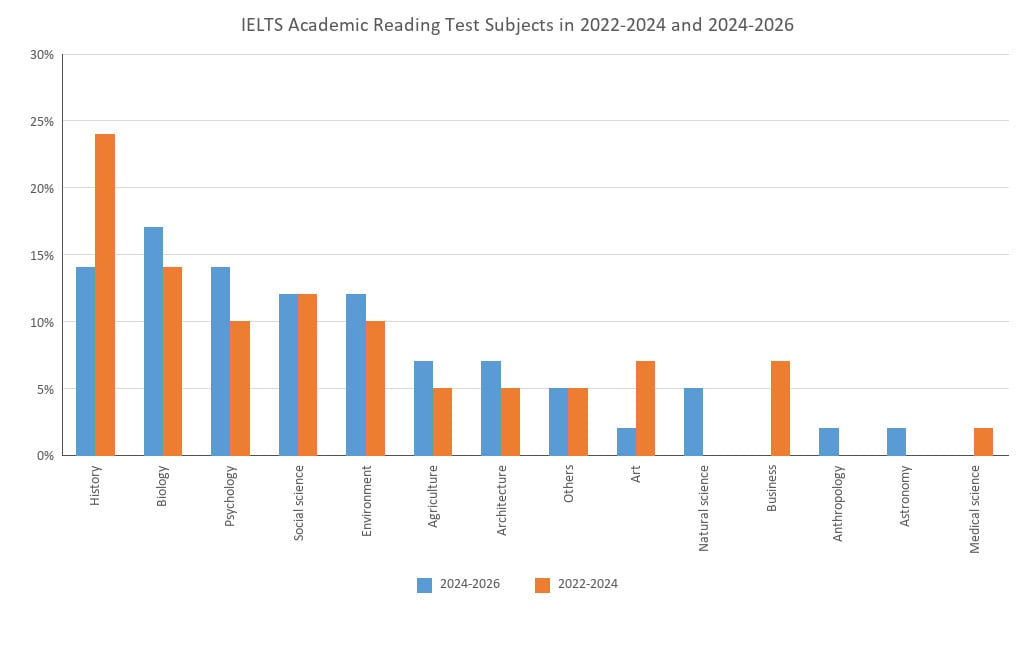
Ezen trendek miatt gondoskodtunk arról, hogy az IELTS Reading gyakorló tesztjeink lefedjék ezeket a témákat. A kevésbé használt témákból is hozzáadtunk reading mintákat, biztos, ami biztos. Fontos, hogy minden helyzetre felkészüljön, mert sosem tudhatja, milyen IELTS Reading témát fog kapni.
Hogyan számítják ki az IELTS Reading pontszámát
Minden IELTS Reading kérdés 1 pontot ér, így legfeljebb 40 pontos „nyers" pontszámot szerezhet. Ezután a nyers pontszámot átalakítják band score-rá. Az alábbi táblázatok általános képet nyújtanak arról, hogyan alakítják át a nyers IELTS Reading pontszámokat band score-rá az egyes tesztek esetében.
IELTS General Reading pontszám vs IELTS Academic Reading pontszám
| Nyers pontszám: Academic | Band score: Academic | Nyers pontszám: General | Band score: General |
|---|---|---|---|
| 39-40 | 9 | 40 | 9 |
| 37-38 | 8.5 | 39 | 8.5 |
| 35-36 | 8 | 37-38 | 8 |
| 33-34 | 7.5 | 36 | 7.5 |
| 30-32 | 7 | 34-35 | 7 |
| 27-29 | 6.5 | 32-33 | 6.5 |
| 23-26 | 6 | 30-31 | 6 |
| 19-22 | 5.5 | 27-29 | 5.5 |
| 15-18 | 5 | 23-26 | 5 |
| 13-14 | 4.5 | 19-22 | 4.5 |
| 10-12 | 4 | 15-18 | 4 |
| 8-9 | 3.5 | 12-14 | 3.5 |
| 6-7 | 3 | 9-11 | 3 |
| 4-5 | 2.5 | 6-8 | 2.5 |
| 1-3 | 2 | 1-5 | 2 |
Azonban ne feledje, hogy az IELTS Reading teszt minden változata kissé eltér, és az adott band score eléréséhez szükséges pontszám az aznapi vizsgázók teljesítményétől függően változik. Ezért a band score eléréséhez szükséges helyes válaszok száma vizsgáról vizsgára kissé eltérhet, de általában 40-ből körülbelül 30 helyes válaszra kell törekednie, ha 7-es band score-t szeretne elérni.
Egy másik dolog, amit szeretnénk emlékeztetni, hogy a legnehezebb és a legkönnyebb kérdések ugyanúgy számítanak a végső Reading pontszámba, ezért győződjön meg róla, hogy nem veszít könnyebb pontokat azzal, hogy elakad nehezebb kérdéseken. Ezután néhány IELTS Reading tippet és stratégiát mutatunk be arra vonatkozóan, hogyan válaszoljon az egyes Reading teszt kérdésekre.
IELTS Reading tippek – Hogyan válaszoljon a 11 Reading kérdéstípusra
A Reading teszten 11 különböző kérdéstípus van, és mindegyikhez más stratégia szükséges.
Minden típusnak van példája és válasza a IELTS Reading kérdéstípusok útmutatóban.
- 1. kérdéstípus – Matching Information (információ párosítása)
- 2. kérdéstípus – Matching Headings (címek párosítása)
- 3. kérdéstípus – Matching Features (jellemzők párosítása)
- 4. kérdéstípus – Identifying Information (információ azonosítása)
- 5. kérdéstípus – Identifying Writer's Views/claims (a szerző nézeteinek/állításainak azonosítása)
- 6. kérdéstípus – Multiple Choice (feleletválasztós)
- 7. kérdéstípus – Matching Sentence Endings (mondatvégek párosítása)
- 8. kérdéstípus – Sentence Completion (mondatkiegészítés)
- 9. kérdéstípus – Summary, Note, Table, Flow-chart Completion (összefoglaló, jegyzet, táblázat, folyamatábra kiegészítése)
- 10. kérdéstípus – Diagram Label Completion (ábra címkék kiegészítése)
- 11. kérdéstípus – Short Answer Questions (rövid válaszú kérdések)
- Hogyan segítenek a trendek felkészülni az IELTS Reading tesztre
Hogyan segítenek a trendek felkészülni az IELTS Reading tesztre
Mely olvasásértési kérdéstípusokat találják tanulóink a legnehezebbnek?
A BestMyTest tanulói egymillió Academic olvasásértési kérdésre és 600 000 General Training olvasásértési kérdésre válaszoltak a gyakorlótesztjeinken. A százalékos érték azt mutatja, hogy az egyes kérdéstípusokra milyen arányban adtak helyes választ.
| Kérdéstípus | Academic | General Training |
|---|---|---|
| Információk párosítása | 34% | 72% |
| Igaz / Hamis / Nincs megadva | 39% | 60% |
| Feleletválasztás | 43% | 48% |
| Jellemzők párosítása | 48% | 74% |
| Mondatok kiegészítése | 49% | 75% |
| Címsorok párosítása | 53% | 40% |
| Igen / Nem / Nincs megadva | 55% | 57% |
| Összefoglaló kiegészítése | 59% | 46% |
| Rövid válasz | 54% | 75% |
- Az Academic olvasásértési részben az információk párosítása és az Igaz/Hamis/Nincs megadva típusú kérdések eredményei a leggyengébbek, mindkettő 40% alatti. Mindkettőnél egy más szavakkal megfogalmazott gondolatot kell megtalálnod, nem pedig egy azonos kulcsszót.
- A General Training esetében fordított a kép: a címsorok párosítása a leggyengébb típus 40%-kal, míg az információkereső típusokra négyből háromszor helyes válasz születik, mert a szövegek rövidebbek, és megfogalmazásuk közvetlenebb.
- Az Academic szövegekhez tartozó kérdésekre átlagosan 46%-ban, a General Training szövegekhez tartozókra pedig 59%-ban adnak helyes választ. Az Academic szövegekhez kapcsolódó feladatsorok kitöltéseinek fele 40%-os vagy annál alacsonyabb eredménnyel zárul.
- A 43 711 teljes olvasásértési gyakorlóteszten, amelyet 38 534 tanuló töltött ki, az átlagos sávpontszám 5.4 volt. 36% érte el a 6.0-s, 14% pedig a 7.0-s sávpontszámot.
- Továbbra is minden típusra fel kell készülnöd, de ha kevés az időd, a táblázat megmutatja, mire érdemes leginkább fordítanod.
Az adatok a BestMyTest gyakorlótesztjeiből és értékeléseiből származnak, 2026. októberig bezárólag. A kérdéstípusok százalékos értékei az összes próbálkozásra vetített helyesválasz-arányokat mutatják; az értékelési szempontokhoz tartozó értékek a jelölésnek megfelelően tanári vagy AI-pontszámok. Utolsó frissítés: 2026. október 5.
Most következnek az IELTS Reading tippek és stratégiák, amelyek szükségesek a magas Reading pontszámhoz.
IELTS Reading tippek – Hogyan javítsa a Reading band score-ját
A legtöbb diák a következő három okból bukja meg a Reading részt:
- Lassú olvasási sebesség
- Szegényes szókincs
- Kevés vagy semmi felkészülés
Az olvasási sebesség javítása
Először is, lássuk a nyilvánvalót. Az olvasási sebesség javításához ténylegesen gyakorolnia kell az olvasást, és következetesen kell tennie.
Most pedig nézzünk egy kevésbé nyilvánvaló stratégiát, amely segít megérteni a hosszabb mondatok jelentését. Kezdje a mondat bontásával. Tegye ezt úgy, hogy megkeresi a mondat alanyát és állítmányát. Az alany és az állítmány megtalálása segít a mondat jelentésének megértésében. Az egyik ok, amiért az akadémiai reading szövegek nehezen érthetők, hogy gondolatláncokat fűznek össze, hosszú összetett mondatokat alkotva. Ez nagy mondatdarabokat eredményez, amelyeket nehezebb felfogni, ezért az alany és az állítmány használata egy egész szakasz megértésének vezérfonalaként nagyszerű eszköz, amelyet használhat az IELTS Reading vizsga során.
A szókincs javítása
Sokan azt gondolják, hogy a reading kérdések megválaszolása olyan egyszerű, mint kulcsszavakat és információkat keresni a bekezdésben... Nos, sajnos nem ennyire egyszerű. A reading kérdéseket általában átfogalmazzák, vagyis a szavakat megváltoztatták, hogy az IELTS Reading szövegből vett szavak szinonimáit használják. Ezt a nehézség növelése érdekében teszik, máskülönben túl könnyű lenne a teszt. Emiatt fejlesztenie kell a szókincsét, hogy ismerje egy szó számos különböző szinonimáját.
Ahogy felkészül a Reading tesztre, és olyan szóval találkozik, amelyet nem ismer, alakítsa ki azt a szokást, hogy vagy megáll, és utánanéz, vagy legalább leírja, és később utánanéz. Ez kissé fárasztó, de rendkívül hatékony. A célja az legyen, hogy napi 15-20 új akadémiai szót tanuljon meg, de ez nem korlátozza Önt.
Annak ismerete, hogy mely kérdéstípusokban vannak/nincsenek a válaszok sorrendben
Fontos tudni, hogy egyes kérdéstípusoknál a válaszok általában (szinte mindig) ugyanabban a sorrendben vannak, mint az IELTS Reading szöveg. Más kérdéstípusoknál a válaszok ritkán vannak ugyanabban a sorrendben, mint a reading szöveg. Készítettünk egy táblázatot azokról a kérdéstípusokról, amelyek követik ezt a sorrendet, és azokról, amelyek nem. Kérjük, ezt vegye figyelembe.
| A válaszok általában (szinte mindig) ugyanabban a sorrendben vannak, mint a szöveg | A válaszok ritkán vannak ugyanabban a sorrendben, mint a szöveg. |
|---|---|
|
|
Az Ön számára legjobb reading stratégia megtalálása
A legtöbb ember számára a legnagyobb kihívás az IELTS Reading vizsgán az, hogy az idő lejárta előtt befejezzenek minden reading kérdést. A következő szakaszban három stratégiát tanul meg, és Önön múlik, hogy melyik a legjobb az Ön számára. Ezt az ingyenes reading gyakorlatainkkal teheti meg.
3 IELTS Reading stratégia
1. stratégia: A teljes szöveg elolvasása, majd a kérdések megválaszolása.
Először is, ez nem igazán stratégia. Ez az, amit az emberek akkor tesznek, amikor nem készülnek fel megfelelően a Reading vizsgára. Mindazonáltal stratégiaként tüntettük fel, mert technikailag, ha első olvasásra meg tudja jegyezni a szöveg információit, és képes megválaszolni a kérdéseket, akkor nem lesz szüksége a 2. stratégiára.
Ez a stratégia, ha nem rendelkezik az átlagosnál jobb memóriával, nem hatékony. Mire minden kérdésre tudna válaszolni, kifut az időből. Sokan elkövetik ezt a hibát. Vannak azonban olyan kérdések, amelyek nem igényelnek sok erőfeszítést, és előnyt jelenthet ez a stratégia, mint például ha a kérdés „Yes" vagy „No" válaszú, akkor gyorsan átfuthatja a szöveget, és gyorsan megtalálhatja a választ, de nincs elég ilyen típusú kérdés, ezért nem ajánlott ezt a stratégiát használni, hacsak nem boldogul vele.
2. stratégia: Először a kérdéseket olvassa el, célzottan olvasson és jegyzeteljen, majd okosan válaszoljon a kérdésekre
Ez az általunk ajánlott stratégia. Segít magasabb IELTS Reading pontszámot elérni. Gondoljon erre úgy, mint egy tiszta térképre arról, hogyan közelítse meg általában a vizsgát:
Az egyik leggyakoribb hiba, amit a vizsgázók elkövetnek, amikor
megközelítik a Reading vizsgát, hogy minden egyes szót elolvasnak az IELTS Reading szövegekből. Bár örömből olvasva
gyakorolhat a vizsgára, a „vakon olvasás" (anélkül olvasni, hogy értelme lenne annak,
mit kérdeznek majd) nem fog Önnek kedvezni a vizsgán. Ehelyett rontja az
esélyeit, hogy hatékonyan tudja beosztani az idejét, és a legjobb pontszámot szerezze.
A fő ok, amiért először a kérdéseket kell elolvasni, az, hogy a kérdés típusa meghatározhatja, mit
olvas a szövegben, vagy hogyan olvassa azt. Például egyes kérdéstípusok a
„skimming" technikát igénylik, míg mások a „scanning" technikát.
Fontos, hogy azonos kérdéstípusú kérdéscsoportot kezeljen egyszerre.
Meg kell határoznia, melyik kérdéstípust szeretné először megoldani.
Jó stratégia a könnyebb kérdéstípussal kezdeni, és később áttérni a nehezebb kérdéstípusokra.
A legkönnyebb kérdéstípusok azok, ahol kevesebb időt tölt olvasással.
Például a Matching Heading kérdéstípus könnyebb, mert
csak meg kell találnia azt a címet, amely a legjobban leírja a bekezdés fő gondolatát.
Egy nehéz kérdéstípusra példa az Identifying Information. Ehhez a kérdéstípushoz
minden bekezdést el kell olvasnia, hogy kiderítse, az egyes állítások TRUE, FALSE vagy NOT GIVEN a szöveg szerint.
Itt egy táblázat, amely felsorolja az egyes kérdéstípusok nehézségi szintjét. Használja ezt a táblázatot referenciaként, amikor kiválasztja, melyik kérdéstípust
szeretné először megoldani.
| Nehézségi szint | Kérdéstípus |
|---|---|
| Könnyű | Match Headings Short answer |
| Közepes |
Matching Sentence Endings Matching Features Multiple choice Sentence Completion Diagram Label, Summary, Note, Table, Flow-Chart Completion |
| Nehéz |
Match Information Identifying Information (TRUE/FALSE/NOT GIVEN) Identifying Viewer's claims (YES/NO/NOT GIVEN) |
Miután elolvasta a kérdéseket az IELTS szövegből, képes lesz célzottan olvasni. Mit jelent ez? Például, ha olyan kérdéssel találkozik, amely tartalmazza az „1896" évszámot, jegyezze fel, mikor szerepel ez az évszám a szövegben, hogy később ennek segítségével válaszoljon a kérdésre.
Két olvasási technika segít abban, hogy a célzott olvasás során a helyes úton maradjon. Az első, a skimming, legjobban úgy határozható meg, mint gyors olvasás, hogy megértsük a „lényeget" vagy általános elképzelést egy szövegből. Ezzel a technikával nem áll meg ismeretlen szavaknál, és nem keres konkrét részleteket. A második technika, a scanning, legjobban úgy határozható meg, mint konkrét információ keresése. Ezzel a technikával nem az átfogó értelemért olvas, hanem konkrét információért. Vegye észre, hogy mindegyik technikának van egy konkrét célja. Ez segít gyorsabban megtalálni az információt.
Miközben célzottan olvas, készítsen jegyzeteket is a szöveg margóin, helyezzen csillagokat a kulcsfontosságú információk mellé, vagy húzza alá azokat a dolgokat, amelyekről úgy gondolja, segítenek megválaszolni a különböző kérdéseket. Ez megkönnyíti, hogy később visszanézzen, amikor bizonyos dolgokra kérdeznek rá. Válassza ki azt a jegyzetelési rendszert, amely az Ön számára megfelelő – csak ügyeljen rá, hogy tényleg csinálja!
Miután elolvasta a kérdéseket, elolvasta a szöveget, és megfelelő jegyzeteket készített, meg kellett volna találnia a szöveg azon részét, ahol alaposan kell olvasnia. Aztán csak olvasson alaposan, és gondolkodjon kritikusan, hogy megállapítsa a helyes választ.
3. stratégia: Skimming, jegyzetelés és kérdéstípusok.
Ezt egy másik stratégia, amelyet sok IELTS vizsgázó használ. Segít magasabb Reading pontszámot elérni. A stratégia 4 lépésből áll:
- Futólag olvassa át (skim) az egyes bekezdéseket, hogy megértse mindegyik általános gondolatát. A bekezdés fő gondolata általában az első néhány mondatban található, ezért ezekre a mondatokra fókuszáljon kicsit jobban. A következő mondatokat gyorsan átfuthatja, aláhúzva a kiemelkedő neveket/szavakat/kifejezéseket.
- Miután futólag átolvasott minden bekezdést, írjon rövid jegyzeteket (2-5 szó) minden bekezdés mellé a legjobb tippjével a bekezdés fő gondolatáról.
- Ezután válaszoljon meg egy azonos kérdéstípusú kérdéscsoportot.
- Végül egy kérdéscsoportot hatékonyan és helyesen válaszoljon meg.
Fontos, hogy ne töltsön 3-5 percnél többet az 1. és 2. lépéssel. Ha túl sok időt tölt ezekkel a lépésekkel, túl sok időt veszít, és a végén kifut az időből.
1. és 2. lépésA cél itt egy hatékony módszer kialakítása a válaszok megtalálására a szövegben. Azzal, hogy leírja az egyes bekezdések általános gondolatát, tudni fogja, melyik bekezdés tartalmazza az egyes kérdésekre adott választ. Ez sok időt megtakarít, mert ha nem írta volna le, valószínűleg minden bekezdést futólag át kellene olvasnia a kérdés általános gondolatáért, majd alaposan kellene végigpásztáznia a bekezdést a válaszért. Azzal, hogy minden bekezdés fő gondolatát feljegyzi, kihagyhatja az első lépést (minden bekezdés futólagos átolvasása), és elkezdheti a válasz keresését.
3. lépés
Miután alaposan átfutotta a szöveget, és lejegyzett néhány jegyzetet, készen áll a 3. lépésre.
Ebben a lépésben meg kell határoznia, melyik kérdéstípust szeretné először megoldani.
Jó stratégia a könnyebb kérdéstípussal kezdeni, és később áttérni a nehezebb kérdéstípusokra.
A legkönnyebb kérdéstípusok azok, ahol kevesebb időt tölt olvasással.
Például a Matching Heading kérdéstípus könnyebb, mert
csak meg kell találnia azt a címet, amely a legjobban leírja a bekezdés fő gondolatát, így technikailag csak az 1. és 2. lépésre van szüksége e kérdéstípus megválaszolásához.
Egy nehéz kérdéstípusra példa az Identifying Information. Ehhez a kérdéstípushoz
minden bekezdést el kell olvasnia, hogy kiderítse, az egyes állítások TRUE, FALSE vagy NOT GIVEN a szöveg szerint.
Itt egy táblázat, amely felsorolja az egyes kérdéstípusok nehézségi szintjét. Használja ezt a táblázatot referenciaként, amikor kiválasztja, melyik kérdéstípust szeretné először megoldani.
| Nehézségi szint | Kérdéstípus |
|---|---|
| Könnyű | Match Headings Short answer |
| Közepes |
Matching Sentence Endings Matching Features Multiple choice Sentence Completion Diagram Label, Summary, Note, Table, Flow-Chart Completion |
| Nehéz |
Match Information Identifying Information (TRUE/FALSE/NOT GIVEN) Identifying Viewer's claims (YES/NO/NOT GIVEN) |
Most, hogy kitalálta, melyik kérdéscsoportot fogja először megválaszolni, itt az ideje, hogy valóban megválaszolja őket :( Ne aggódjon! Bár minden kérdéstípus eltérő, a helyes megválaszolás stratégiája mindegyikre vonatkozik. Az alapelv egyszerű, csak kövesse az alábbi lépéseket:
- Olvassa el alaposan a kérdést, és azonosítsa a fontos kulcsszavakat.
- Keresse meg a bekezdést, amely tartalmazza a kérdés megválaszolásához szükséges információt. (Remélhetőleg már leírta az egyes bekezdések általános gondolatait, így ezt könnyen ki tudja deríteni.)
- Pásztázza végig a bekezdést a fontos kulcsszavakért (nagy valószínűséggel szinonimák!) amíg meg nem találja a szöveg azon részét, ahol alaposan kell olvasnia.
- Végül olvasson alaposan, és gondolkodjon kritikusan, hogy megállapítsa a helyes választ.
Ingyenes IELTS Reading minta PDF letöltése válaszokkal
Az alábbiakban néhány ingyenes Reading mintát talál a British Council-tól (az IELTS vizsga megalkotójától). Próbálja meg megválaszolni a kérdéseket, és nézze meg, hogyan teljesít!