
Neste guia pode começar a sua prática de reading IELTS realizando um teste de reading IELTS gratuito. Existem, no entanto, duas versões do exame: IELTS general reading e IELTS academic reading. Vai aprender qual a versão mais adequada para si e como abordar cada tipo de pergunta de reading utilizando o nosso material de leitura IELTS.
Receba uma análise gratuita da sua pontuação de reading do IELTS e um plano de estudos personalizado após concluir um teste prático gratuito de reading do IELTS.
| Teste de General Reading do IELTS | Teste de Academic Reading do IELTS |
|---|---|
Abaixo está nossa lista completa de perguntas de reading do IELTS com respostas. Observação: os links em vermelho são nossas perguntas de reading mais populares e recomendadas, avaliadas por nossos alunos, e você pode praticá-las gratuitamente a qualquer momento.
Perguntas práticas de reading do IELTS General 1 - 135
Short everyday texts, workplace texts, and one longer passage
Perguntas práticas de reading do IELTS Academic 1 - 171
Three long passages from books, journals, magazines, and newspapers
Guia de prática do IELTS Reading
O restante deste guia vai ensinar-te tudo sobre o exame do IELTS Reading, tanto na versão general training como na versão académica. Vais aprender como é calculada a pontuação de Reading, como responder com sucesso a cada tipo de pergunta, a melhorar a tua leitura com material em inglês e a dominar as nossas 3 estratégias para teres sucesso na prática do IELTS Reading.
Índice
- Informação sobre o exame do IELTS Reading
- Perguntas de exemplo de IELTS Reading
- Informação sobre o IELTS General Reading
- Informação sobre o IELTS Academic Reading
- Calculadora de pontuação do IELTS Reading
- Como responder aos 11 tipos de perguntas do IELTS Reading
- Como melhorar a tua band score no IELTS Reading
- 3 estratégias para o IELTS Reading
- Descarrega gratuitamente o PDF de prática do IELTS Reading com respostas
Informação sobre o exame do IELTS Reading
O exame do IELTS Reading é constituído por 3 secções e um total de 40 perguntas. Em geral, irás responder a 12-14 perguntas em cada secção e dispões de exatamente 60 minutos para concluir o exame. Cada secção contém 1 a 3 textos, dependendo da versão do exame que estás a fazer. Se já sabes qual a versão que vais realizar, podes saltar as próximas secções. Caso contrário, é importante conheceres cada exame e saberes como te preparar.
Qual o exame do IELTS Reading certo para mim?
O exame do IELTS Reading tem duas versões: IELTS General Reading e IELTS Academic Reading. Farás o General Reading se pretendes emigrar ou ingressar no ensino secundário. Farás o Academic Reading se pretendes prosseguir estudos superiores. A maior diferença entre o general e o academic está na dificuldade dos textos do IELTS Reading. Como o nome indica, o exame académico usa material de fontes académicas, enquanto o general utiliza material do quotidiano.
Ambos os exames têm 3 secções, 40 perguntas e 11 tipos de perguntas. Podes ler em detalhe cada secção de ambos os exames na tabela em baixo.
| Secção | Exame IELTS Academic Reading | Exame IELTS General Reading |
|---|---|---|
| 1 | Um texto académico longo, que vai do descritivo e factual ao discursivo e analítico. O texto será
retirado de livros, revistas científicas, revistas e jornais. 12 a 14 perguntas |
Dois ou três textos factuais curtos.
Os temas estão relacionados com a vida quotidiana num país de língua inglesa.
12 a 14 perguntas |
| 2 | Um texto académico longo, que vai do descritivo e factual ao discursivo e analítico. O texto será
retirado de livros, revistas científicas, revistas e jornais. 10 a 14 perguntas |
Dois textos factuais curtos centrados em questões relacionadas com o trabalho (p. ex., candidaturas a emprego, políticas da empresa, salários e condições).
12 a 14 perguntas |
| 3 | Um texto académico longo, que vai do descritivo e factual ao discursivo e analítico. O texto será
retirado de livros, revistas científicas, revistas e jornais. 12 a 14 perguntas |
Um texto mais longo e complexo sobre um tema de interesse geral.
Os textos são autênticos e provêm de anúncios, avisos, manuais de empresa, livros, revistas e jornais.
12 a 14 perguntas |
Agora que estás familiarizado com a estrutura do exame do IELTS Reading e com ambas as versões general e academic, é altura de descobrires se te convém mais o exame em papel ou o exame por computador.
IELTS em papel (PBT) vs. IELTS por computador (CBT)
No PBT, ser-te-á entregue um Caderno de Perguntas e uma Folha de Respostas. O Caderno de Perguntas é onde verás todas as perguntas a que tens de responder. A Folha de Respostas é onde escreverás as tuas respostas definitivas para classificação. Podes consultar a folha oficial de respostas do IELTS em PDF aqui
Nota: Ao contrário do exame de IELTS Listening, não te será concedido tempo adicional para transferires as respostas do caderno para a folha de respostas, por isso certifica-te de que vais passando cada resposta para a folha à medida que vais respondendo às perguntas.
No CBT, irás responder às perguntas no computador. Os textos aparecem do lado esquerdo e as perguntas do lado direito. Também poderás destacar texto e usar funções de controlo para copiar e colar respostas. Para mais informação sobre o PBT e o CBT, consulta o guia do IELTS por computador.
Podes praticar qualquer uma das versões sempre que quiseres com o nosso exame de prática gratuito do IELTS Reading. Encontras as ligações para todo o nosso material de IELTS Reading no topo da página.
Perguntas de exemplo de IELTS Reading
Aqui estão duas práticas gratuitas de IELTS Academic Reading. Resolva cada uma e depois abra as respostas para conferir. O guia de tipos de pergunta IELTS Reading explica cada tipo e traz mais perguntas de exemplo.
Match each item with the period of time it best corresponds with
NB You may use any letter more than once.
- The Palaeolithic era
- The Bronze age
- The Iron age
- The Medieval era
- The Mesolithic age
- Roman times
-
spellcheck Answers1. FALSE
2. FALSE
3. NOT GIVEN
4. FALSE
5. TRUE
6. FALSE
7. FALSE
8. TRUE
9. FALSE
10. F
11. C
12. A
13. B
14. D
The climate in Britain has been arctic for the last several million years, punctuated by relatively warm timespans, or interglacials of thousands of years, one of which we are in as of now. Since the last glaciation, British woodland history is considered quite short in terms of geological time spans, and is also closely related to the human civilization developing.
At the peak of the last glaciation (100,000 – 12,000 BC), the majority of Britain would have had no trees. Birch and willow scrub may have grown along the lower reaches of the ice, with pine in some areas. It’s possible that remnants of pre-glacial flora were sheltered along the western bays of Great Britain and Ireland’s coasts, but as far as the southern parts of England, the ice kept any land barren. Information regarding the development of Britain’s flora following glaciation can be found by studying the deposits of pollen and seed in peat, as well as by the use of radiocarbon dating. Tundra and moorland followed the retreating ice, which lead to phases of different tree species spreading from the south. First came birch, aspen and sallow, followed by pine and hazel continuing to spread north as of 8500 BC, replacing birch to make it less commonly found for the next few thousand years. Oak and alder came after pine, then lime, elm, beech, and maple, all spreading northwards one after the other. From the moment lime arrived, in about 7300, to about 4500 BC the climate remained stable for a length of time known as the Atlantic Period, a time in which numerous species grew to form a series of wildwood or wilderness types.
What did the wilderness or wildwood look like, before man started interfering with it? One theory holds that Britain and Western Europe in Palaeolithic times was covered from coast to coast in a wildwood of continuous trees. However, a modern theory proposed by Francis Vera holds that Western Europe wilderness was a combination of grassland, scrub, and clusters or groves of trees. It was not a dense, impassable wildwood, but instead, an area similar to a park, kept up by wild herbivores eating the plants and grass. Throughout earlier interglacial periods, this may also have been the case in Britain, as creatures of the Palaeolithic era needed to roam large areas of grassland to survive. A variety of grassland plants continued to live there in the last interglacial, as according to pollen records. However, since the last glaciation, the bison, elk and other large herbivores which persisted on mainland Europe were extinct in Britain, so Vera’s theory may not apply so well to Britain.
Meanwhile, throughout the period since it’s spread northwards after the last glaciation, the sustained growth of oak in Britain demonstrates that the wildwood was not as continual as once believed. Oak is a pioneer species, which requires vacant space to generate more of itself. Grazing animals are also present to keep areas open, so Oak regenerates in the thorny brush as a protective measure from their grazing. Archaeological evidence indicates that red deer, who graze on grass as well as browse from trees, were essential to the economy in Mesolithic Britain, with people utilizing them for meat, skins, antlers and bones.
As the Mesolithic (10,000-3000 BC) era ended, evidence of the beginnings of agriculture emerges. Agricultural weeds, such as plantain and stinging nettle, were also increasing in number. Nearly all the wildwood was cut down as the population increased rapidly. However, the falling elm population around 4,000 BC all across Europe has been attributed not to the clearing of trees, but to what’s referred to as Elm disease.
Throughout the Bronze Age (2400-750 BC), people were cutting down trees more than ever before, until the prevalence of the practice “coppicing” peaked, likely at some point during the early Iron Age. Oliver Rackham (1990) theorizes that nearly 50% of land throughout England was no longer wildwood by 500 BC. The regrowth from a stump grows more readily than the original tree, and Neolithic man had discovered this practice, known as coppicing. Much of the remaining woods were maintained by way of this method during the Bronze Age.
The Celtic peoples living in the Iron Age were able to master woodworking as an artform. Today, Celtic woodworking can be seen in houses, boats, wheels and other artifacts of the time. Coppicing as a means to manage woodland was of massive importance throughout two millennia that followed. Buildings, roads, fences, carts, and the fuel for heating, cooking, metalworking and pottery were all made possible due to wood materials gained from the vital practice of coppicing.
A clear divide has existed between wooded and non-wooded regions of Britain since the time of the Romans. As evidenced by The Domesday Book (1086), all the wood in England had an economic value and was the property of either an individual or community owner. Woods were the territories, or ‘exclaves’ of communities who lived some miles away. Even though it had to be transported over long distances, the materials which woodlands produced were of obvious value, and their ownership was long before established. Merely around 15% of land in England was represented by woodland or wood- pasture in the year 1086.
English woodlands produced mostly underwood used as fuel along with other things, with small oaks being used to construct buildings. The average wood-framed houses of the Medieval era mostly used oaks shorter than 18” in diameter. Longer pieces of timber were hard to come by, and kept only for elaborate buildings intended for the Church. Imported boards of thin oak or wainscot from Central Europe were brought in for the purpose of domestic building. Woodland cover was as low as 15% in 1086, and continued to decline from as a result of an ever- growing population to 10% by 1350. This stopped suddenly with the plague of the Black Death of 1349 wiping out some of the human population. Woods which had persisted up to 1350 mostly prospered over the next 500 years.
Match each description with the correct psychologist
NB You may use any letter more than once.
- Clark Hull
- Howard and Tracy Kendler
- Michael Cole and colleagues
- Simon Hewson
-
spellcheck Answers1. D
2. C
3. D
4. A
5. C
6. B
7. C
8. D
9. TRUE
10. FALSE
11. TRUE
12. FALSE
Could it be that the very essence of reasoning itself is found in the way we behave? Clark Hull, an acclaimed American psychologist, theorized that it was, describing that reasoning is achieved by the way two “behavior segments” are combined in new ways to achieve goals. Howard and Tracey Kendler, who were two of Hull’s followers, used Hull’s principle ideas to design a reasoning test for children. In this test, children needed to learn how to use a machine in a two-step process. The children learned each of the two steps individually, with the first being to correctly choose and press one of two buttons, and the second to place a marble into a small opening. If both steps were completed successfully, a toy would be released as rewards to the children.
From this test, the Kendlers learned that although the children were able to learn each step, they were not able to “integrate” the two tasks without intervention. In other words, the children could not successfully perform the first step, pushing the button, and then proceed to the second step, inserting the marble into the hole, by themselves. This failure to independently integrate the steps led the Kendlers to believe that children of this age were not able to use deductive reasoning.
According the the work of psychologist and professor Michael Cole and his associates, some adults from specific African tribes are also unable to successfully complete the Kendlers' two-step test of deductive reasoning. However, this finding remains questionable in light of the findings of a similar test to the Kenders’, which revealed that the African tribes people were, in fact, able to complete the test.
In this test, Cole substituted a locked box for the machine with the buttons, and then used two matchboxes of different colors. One of the matchboxes held a key for the locked box. Just like with the Kendlers’ test, Cole’s test also involved two behavior segments, these being to first open the right match-box to get the key, and second to use the key to open the box. However, Cole’s test differs quite a bit psychologically. Instead of subjects being presented with a strange machine, they are given familiar objects in a simpler context. Cole found the difficulty of 'integration' was greatly reduced here.
It seems that the same truth which Cole discovered can be extended to explain the deductive reasoning skills of young children. Psychologist Simon Hewson believes that perhaps the task’s difficulty is not in inferential processes themselves, but is instead tied to confusing features of the test apparatus, such as the button machine, as well as the context of the procedure being tested. When these factors are adjusted in order to prevent the inferential nature of the problem being affected, five-year-old children are able to successfully complete these tests as well as college students did in the Kendlers' test.
Hewson made two essential changes to the test in order to build on this idea. First, he replaced the button-pressing mechanism with drawers that a child could slide open and shut. This removed confusion on what to do with the original button apparatus from the first stage of training. Secondly, Hewson made sure that children understood that there was nothing special or magical about the marble which was used to successfully complete the second step of the task and get the reward.
This is important because a child cannot easily comprehend a mechanism in which a marble put into a hole can open a little door. It would then be safe to say that the child will not assume that different marbles of identical size could be used the same way. But, to solve the problem, this assumption must be made. Hewson clearly demonstrated the functional equivalence of different marbles to the children by playing a 'swapping game.” Hewson's two modifications to the experiment led to a rise in success rates from 30 percent to 90 percent for five-year old children and from 35 percent to 72.5 per cent for four-year-olds. Strangely enough for three-year olds, Hewson’s changes did not lead to any improvement, and instead there was a slight drop in performance from the change. Hewson's experiments showed that children faced with the Kendler apparatus experienced difficulty not related to reasoning, but to the nature of the tasks themselves, and that difficulty cannot be taken as proof that they are incapable of deductive reasoning.
IELTS General Reading
No exame general, os textos do IELTS Reading são retirados de livros, revistas, jornais, anúncios, avisos, manuais de empresa e orientações que poderias encontrar no dia a dia num ambiente de língua inglesa. Tal como no exame académico, existem 3 secções, contudo, no IELTS General Reading, cada secção difere ligeiramente das restantes.
Vídeo de introdução ao IELTS General Reading
-
Secção 1: contém dois ou três textos curtos ou vários textos breves
Esta secção chama-se Social Survival e contém textos relacionados com a sobrevivência linguística básica em inglês, com tarefas centradas sobretudo em obter e fornecer informação factual geral, por exemplo: avisos, anúncios e horários. -
Secção 2: inclui dois textos
Esta secção chama-se Workplace Survival e foca-se em contextos profissionais, por exemplo, descrições de funções, contratos e materiais de desenvolvimento profissional e de formação. -
Secção 3: é um único texto longo
Esta secção chama-se General Reading e envolve a leitura de prosa mais extensa, com uma estrutura mais complexa. O foco é em textos descritivos e instrutivos, em vez de argumentativos.
Esperamos que não te sintas demasiado sobrecarregado. O exame de Reading não é tão difícil quanto parece. Desde que sigas as nossas dicas de IELTS Reading e utilizes as nossas perguntas de prática gratuitas, estarás pronto para lidar com qualquer texto e atingir a tua band score pretendida. A propósito, o exame académico de Reading é pontuado de forma ligeiramente diferente do general reading. A seguir, iremos abordar as band scores de Reading e como são calculadas.
IELTS Academic Reading
No exame académico, os textos do IELTS Reading são retirados de livros, revistas científicas, revistas e jornais de fontes académicas adequadas a estudantes universitários. Cada texto é longo — entre 6 e 10 parágrafos —, pode estar escrito em vários estilos, como o narrativo ou o descritivo, e cobre uma vasta gama de temas académicos como antropologia, história, ciência, biologia, arte, educação, linguística, etc. Os textos incluirão, por vezes, termos técnicos ou mesmo material visual, como tabelas e gráficos. Podes praticar estes e outros temas com as nossas perguntas de prática do IELTS Reading.
Vídeo de introdução ao IELTS Academic Reading
Que temas académicos aparecem com maior frequência no exame oficial do IELTS Academic Reading?
Em 2022-2024 e 2024-2026, o tema de leitura académica mais frequente foi história. A seguir veio biologia, depois psicologia e ciências sociais, o que inclui cultura, educação, linguística e sociologia.
O gráfico abaixo mostra os diferentes temas avaliados nos exames académicos do IELTS Reading em 2022-2024 e 2024-2026.
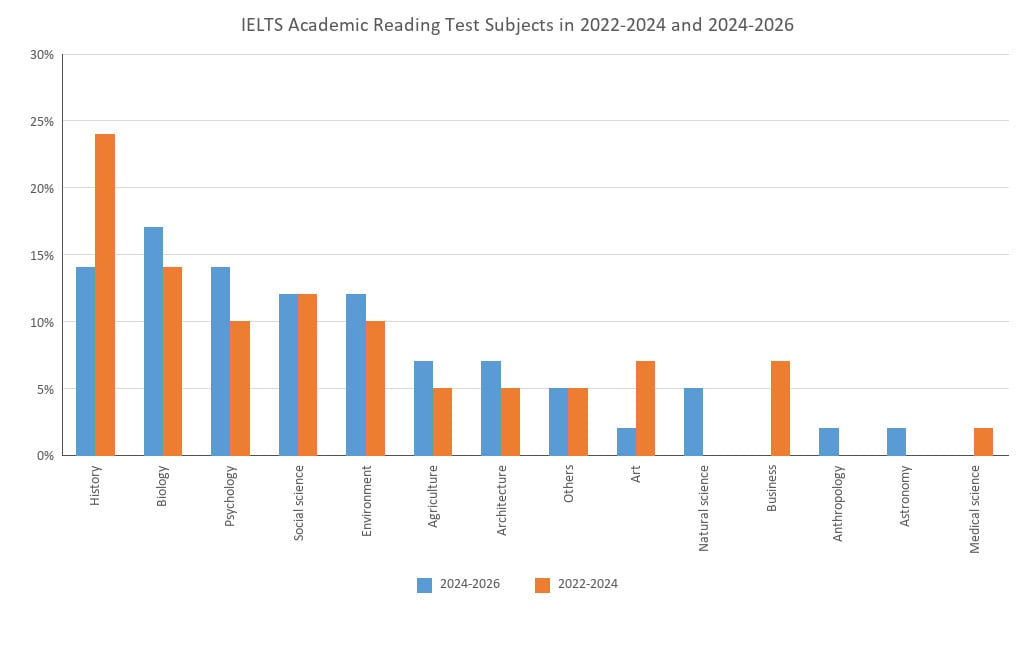
Devido a estas tendências, certificámo-nos de que os nossos exames de prática do IELTS Reading abordam estes temas. Também acrescentámos leituras sobre temas menos frequentes, para garantir. É importante que te prepares para todas as situações, porque nunca se sabe que tema te poderá sair no exame.
Como é calculada a tua pontuação do IELTS Reading
Cada pergunta do IELTS Reading vale 1 ponto, pelo que podes obter uma pontuação «bruta» de até 40 pontos. Depois, a tua pontuação bruta é convertida na tua band score. As tabelas abaixo dão-te uma ideia geral de como as pontuações brutas são convertidas em band scores em cada exame.
Pontuação do IELTS General Reading vs. IELTS Academic Reading
| Pontuação bruta: Academic | Band score: Academic | Pontuação bruta: General | Band score: General |
|---|---|---|---|
| 39-40 | 9 | 40 | 9 |
| 37-38 | 8.5 | 39 | 8.5 |
| 35-36 | 8 | 37-38 | 8 |
| 33-34 | 7.5 | 36 | 7.5 |
| 30-32 | 7 | 34-35 | 7 |
| 27-29 | 6.5 | 32-33 | 6.5 |
| 23-26 | 6 | 30-31 | 6 |
| 19-22 | 5.5 | 27-29 | 5.5 |
| 15-18 | 5 | 23-26 | 5 |
| 13-14 | 4.5 | 19-22 | 4.5 |
| 10-12 | 4 | 15-18 | 4 |
| 8-9 | 3.5 | 12-14 | 3.5 |
| 6-7 | 3 | 9-11 | 3 |
| 4-5 | 2.5 | 6-8 | 2.5 |
| 1-3 | 2 | 1-5 | 2 |
No entanto, tem em conta que cada versão do exame do IELTS Reading é ligeiramente diferente e a pontuação necessária para atingir uma determinada banda muda consoante o desempenho de todos os candidatos que fizeram o exame nesse dia. Por isso, o número de respostas corretas necessário para obter uma band score varia ligeiramente de exame para exame, mas, em geral, deverás procurar acertar cerca de 30 em 40 perguntas se quiseres uma band score de 7.
Outra coisa a relembrar: as perguntas mais difíceis e as mais fáceis contam da mesma forma para a tua pontuação final de Reading, portanto, certifica-te de que não estás a perder pontos fáceis por ficares preso em perguntas difíceis. A seguir, abordaremos algumas dicas e estratégias do IELTS Reading sobre como responder a cada tipo de pergunta.
Dicas para o IELTS Reading – Como responder aos 11 tipos de perguntas
Existem 11 tipos diferentes de perguntas no exame de Reading e todos exigem uma estratégia diferente.
Cada tipo tem um exemplo e a resposta no guia de tipos de pergunta IELTS Reading.
- Tipo de pergunta 1 – Correspondência de informação
- Tipo de pergunta 2 – Correspondência de títulos
- Tipo de pergunta 3 – Correspondência de características
- Tipo de pergunta 4 – Identificação de informação
- Tipo de pergunta 5 – Identificação das opiniões/afirmações do autor
- Tipo de pergunta 6 – Escolha múltipla
- Tipo de pergunta 7 – Correspondência de finais de frase
- Tipo de pergunta 8 – Completar frases
- Tipo de pergunta 9 – Completar resumos, notas, tabelas e diagramas de fluxo
- Tipo de pergunta 10 – Completar legendas de diagramas
- Tipo de pergunta 11 – Perguntas de resposta curta
- Como as tendências te ajudam a preparares-te para o IELTS Reading
Como as tendências te ajudam a preparares-te para o IELTS Reading
Quais tipos de questões de leitura nossos alunos consideram mais difíceis
Os alunos do BestMyTest responderam a um milhão de questões de leitura da modalidade acadêmica e a 600.000 questões de leitura da modalidade de treinamento geral em nossos simulados. A porcentagem indica a frequência com que cada tipo de questão foi respondido corretamente.
| Tipo de questão | Acadêmico | Treinamento geral |
|---|---|---|
| Associação de informações | 34% | 72% |
| Verdadeiro / Falso / Não informado | 39% | 60% |
| Múltipla escolha | 43% | 48% |
| Associação de características | 48% | 74% |
| Preenchimento de frases | 49% | 75% |
| Associação de títulos | 53% | 40% |
| Sim / Não / Não informado | 55% | 57% |
| Preenchimento de resumos | 59% | 46% |
| Resposta curta | 54% | 75% |
- Na leitura da modalidade acadêmica, os dois tipos com menor taxa de acerto são associação de informações e Verdadeiro/Falso/Não informado, ambos abaixo de 40%. Ambos exigem que você localize uma ideia parafraseada, em vez de uma palavra-chave idêntica.
- Na modalidade de treinamento geral, o cenário se inverte: associação de títulos é o tipo com menor taxa de acerto, com 40%, enquanto os tipos que exigem localizar informações são respondidos corretamente três em cada quatro vezes, porque os textos são mais curtos e mais literais.
- As questões sobre textos acadêmicos têm, em média, 46% de acerto, e as questões sobre textos de treinamento geral, 59%. Metade das tentativas de responder às questões de um texto acadêmico tem pontuação de 40% ou menos.
- Em 43.711 simulados completos de leitura realizados por 38.534 alunos, a nota média foi 5.4. 36% alcançaram a nota 6.0 e 14% alcançaram a nota 7.0.
- Você ainda precisa se preparar para todos os tipos, mas, se tiver pouco tempo, a tabela mostra onde ele rende mais.
Os números são provenientes de dados de simulados e revisões do BestMyTest até outubro de 2026. As porcentagens por tipo de questão são taxas de acerto considerando todas as tentativas; os valores por critério são notas atribuídas por tutores ou IA, conforme indicado. Última atualização em 5 de outubro de 2026.
A seguir, abordaremos as dicas e estratégias do IELTS Reading necessárias para uma pontuação elevada.
Dicas do IELTS Reading – Como melhorar a tua band score
A maioria dos candidatos não passa na secção de Reading pelas três razões seguintes:
- Velocidade de leitura lenta
- Vocabulário fraco
- Pouca ou nenhuma preparação
Como melhorar a tua velocidade de leitura
Comecemos pelo óbvio: para melhorar a tua velocidade de leitura, tens efetivamente de praticar a leitura e fazê-lo de forma consistente.
Agora vejamos uma estratégia menos óbvia que te ajudará a compreender o significado de grandes blocos de frases. Começa por dissecar a frase. Para isso, procura o sujeito e o verbo da frase. Encontrar o sujeito e o verbo ajudar-te-á a compreender o significado da frase. Uma razão pela qual os textos académicos podem ser difíceis de compreender é porque encadeiam várias ideias em frases compostas longas. Isto produz blocos longos de texto difíceis de absorver, por isso, usar o sujeito e o verbo como guia para entender o bloco inteiro é uma ferramenta excelente para usares no exame do IELTS Reading.
Como melhorar o teu vocabulário
Muita gente pensa que responder a perguntas de Reading é tão simples como percorrer o parágrafo à procura de palavras-chave e informação... infelizmente, não é assim tão simples. As perguntas de Reading estão geralmente parafraseadas, ou seja, as palavras foram alteradas para usar sinónimos das palavras do texto do IELTS. Isto é feito para aumentar a dificuldade; caso contrário, o exame seria demasiado fácil. Por isso, deves melhorar o teu vocabulário para conheceres os vários sinónimos de uma palavra.
Enquanto te preparas para o exame de Reading e te deparas com uma palavra que não conheces, ganha o hábito de a procurar de imediato ou, pelo menos, de a anotar para a procurares depois. É um pouco maçador, mas extremamente eficaz. O teu objetivo deve ser, entre outros, estudar 15 a 20 palavras académicas novas por dia.
Saber em que tipos de pergunta as respostas seguem ou não a ordem do texto
É importante saber que, em alguns tipos de pergunta, as respostas surgem normalmente (quase sempre) pela mesma ordem do texto. Noutros tipos, as respostas raramente seguem a ordem do texto. Preparámos uma tabela com os tipos que seguem a ordem e os que não seguem. Tem em conta o que se segue.
| As respostas costumam seguir (quase sempre) a ordem do texto | As respostas raramente seguem a ordem do texto |
|---|---|
|
|
Encontrar a melhor estratégia de leitura para ti
O maior desafio que a maioria dos candidatos enfrenta no IELTS Reading é concluir todas as perguntas antes de o tempo terminar. Na próxima secção aprenderás três estratégias e cabe-te a ti descobrir qual a que melhor se adequa a ti. Fá-lo-ás com as nossas práticas de leitura gratuitas.
3 estratégias para o IELTS Reading
Estratégia 1: Ler o texto inteiro e depois responder às perguntas.
Na verdade, isto não é bem uma estratégia. É o que as pessoas fazem quando não se preparam adequadamente para o exame de Reading. Ainda assim, incluímo-la como estratégia porque, tecnicamente, se conseguires reter a informação do texto numa primeira leitura e responder às perguntas, não precisarás da estratégia 2.
Esta estratégia, se não tiveres uma memória acima da média, é ineficiente. Vais acabar por ficar sem tempo antes de conseguir responder a todas as perguntas. Muita gente comete este erro. Contudo, há algumas perguntas que não exigem muito esforço e beneficiam desta estratégia, como por exemplo perguntas de resposta «sim» ou «não», em que podes percorrer o texto rapidamente e encontrar a resposta de imediato. Mas não há perguntas suficientes deste tipo, por isso não é aconselhável usar esta estratégia, salvo se conseguires geri-la.
Estratégia 2: Ler primeiro as perguntas, ler com um objetivo, tirar notas e responder com critério
Esta é a nossa estratégia recomendada. Vai ajudar-te a obter uma band score mais alta no IELTS Reading. Pensa nisto como um mapa claro de como abordar o exame em geral:
Um dos erros mais comuns que os candidatos cometem ao abordar
o exame de Reading é lerem cada palavra dos textos do IELTS. Embora possas
praticar para o exame lendo por prazer, «ler às cegas» (ler sem qualquer noção
do que as perguntas irão pedir) não te trará vantagens no exame. Pelo contrário, prejudicará
as tuas hipóteses de gerir eficazmente o tempo e obter a melhor pontuação.
A principal razão para ler primeiro as perguntas é que o tipo de pergunta pode determinar o que
lês no texto ou como o lês. Por exemplo, alguns tipos de pergunta exigem a técnica
«skimming», enquanto outros exigem «scanning».
É importante abordar um conjunto de perguntas do mesmo tipo.
Tens de decidir qual o tipo de pergunta que vais resolver primeiro.
Uma boa estratégia é começar pelo tipo mais fácil e passar para os tipos mais difíceis depois.
Os tipos mais fáceis são aqueles em que dedicas menos tempo à leitura.
Por exemplo, o tipo Correspondência de Títulos é mais fácil porque
só precisas de encontrar o título que melhor descreve a ideia principal de um parágrafo.
Um exemplo de tipo difícil é Identificação de Informação. Neste tipo,
tens de ler cada parágrafo para determinar se cada afirmação é TRUE, FALSE ou NOT GIVEN, de acordo com o texto.
Aqui tens uma tabela com os níveis de dificuldade para cada tipo de pergunta. Usa esta tabela como referência para decidires qual abordar primeiro.
| Nível de dificuldade | Tipo de pergunta |
|---|---|
| Fácil | Correspondência de títulos Resposta curta |
| Médio |
Correspondência de finais de frase Correspondência de características Escolha múltipla Completar frases Completar legendas de diagramas, resumos, notas, tabelas e diagramas de fluxo |
| Difícil |
Correspondência de informação Identificação de informação (TRUE/FALSE/NOT GIVEN) Identificação de afirmações do autor (YES/NO/NOT GIVEN) |
Depois de leres as perguntas, conseguirás ler com um objetivo. O que é que isto significa? Por exemplo, se te deparas com uma pergunta que inclui o ano «1896», podes anotar onde esse ano aparece no texto e usá-lo depois para responder à pergunta.
Existem duas técnicas de leitura que te ajudarão a manter o foco quando leres com um objetivo. A primeira, skimming, é leres rapidamente para captar a ideia geral de um texto. Com esta técnica, não pares em palavras desconhecidas nem procures detalhes específicos. A segunda técnica, scanning, é leres em busca de informação específica. Com esta técnica, não estás a ler para a ideia geral, mas sim para informação concreta. Repara que cada uma destas técnicas tem um objetivo específico. Isto ajudar-te-á a encontrar a informação mais depressa.
Enquanto lês com um objetivo, deves também tirar notas nas margens do texto, colocando estrelas junto à informação-chave ou sublinhando coisas que achas que te ajudarão a responder às várias perguntas. Isto facilitar-te-á a tarefa de voltar atrás quando te forem feitas certas perguntas. Escolhe o sistema de notas que melhor funciona para ti — apenas certifica-te de que o usas.
Depois de leres as perguntas, leres o texto e tirares as notas adequadas, já deves ter localizado a parte do texto onde precisas de ler com atenção. Depois, basta ler com cuidado e pensar de forma crítica para determinar a resposta correta.
Estratégia 3: Skimming, tirar notas e tipos de pergunta.
Esta é outra estratégia usada por muitos candidatos ao IELTS. Ajudar-te-á a obter uma melhor band score em Reading. A estratégia tem 4 passos:
- Faz skimming a cada parágrafo para captar a ideia geral de cada um. A ideia principal de um parágrafo encontra-se normalmente nas primeiras frases, por isso concentra-te um pouco mais nelas. As frases seguintes podem ser lidas rapidamente, sublinhando nomes, palavras ou expressões que se destaquem.
- Depois de fazeres skimming a cada parágrafo, escreve notas curtas (2 a 5 palavras) ao lado de cada parágrafo, com a tua melhor estimativa para a ideia principal desse parágrafo.
- A seguir, responde a um conjunto de perguntas do mesmo tipo.
- Por último, responde de forma eficiente e correta a um conjunto de perguntas.
É importante não dedicares mais do que 3 a 5 minutos aos passos 1 e 2. Passar demasiado tempo neles desperdiça muito tempo e acabarás por ficar sem ele.
Passos 1 e 2O objetivo é montar um método eficiente para encontrar respostas no texto. Ao anotares a ideia geral de cada parágrafo, saberás qual o parágrafo que contém a resposta a cada pergunta. Isto poupa-te muito tempo, porque, se não tivesses anotado, provavelmente terias de fazer skimming a cada parágrafo para captar a ideia geral e depois scanning cuidadoso para encontrar a resposta. Ao anotares a ideia principal de cada parágrafo, saltas o primeiro passo de skimming e começas logo a fazer scanning à procura da resposta.
Passo 3
Depois de teres feito skimming ao texto e de teres tomado notas, estás pronto para o passo 3.
Neste passo, tens de decidir qual o tipo de pergunta que vais resolver primeiro.
Uma boa estratégia é começar pelo tipo mais fácil e passar aos tipos mais difíceis depois.
Os tipos mais fáceis são aqueles em que se dedica menos tempo à leitura.
Por exemplo, o tipo Correspondência de Títulos é mais fácil porque
só precisas de encontrar o título que melhor descreve a ideia principal de um parágrafo, pelo que tecnicamente apenas necessitas dos passos 1 e 2 para responder a este tipo.
Um exemplo de tipo difícil é Identificação de Informação. Neste tipo,
tens de ler cada parágrafo para determinar se cada afirmação é TRUE, FALSE ou NOT GIVEN, de acordo com o texto.
Aqui tens uma tabela com os níveis de dificuldade para cada tipo de pergunta. Usa-a como referência para decidires qual abordar primeiro.
| Nível de dificuldade | Tipo de pergunta |
|---|---|
| Fácil | Correspondência de títulos Resposta curta |
| Médio |
Correspondência de finais de frase Correspondência de características Escolha múltipla Completar frases Completar legendas de diagramas, resumos, notas, tabelas e diagramas de fluxo |
| Difícil |
Correspondência de informação Identificação de informação (TRUE/FALSE/NOT GIVEN) Identificação de afirmações do autor (YES/NO/NOT GIVEN) |
Agora que já sabes qual o conjunto de perguntas que vais resolver primeiro, chegou a altura de as responderes :( Não te preocupes! Embora cada tipo de pergunta seja diferente, a estratégia para as responder corretamente aplica-se a todas. O princípio básico é simples — basta seguires os passos abaixo:
- Lê a pergunta com atenção e identifica as palavras-chave importantes.
- Encontra o parágrafo que contém a informação necessária para responder à pergunta. (Se já tens as ideias gerais de cada parágrafo anotadas, podes descobri-lo facilmente.)
- Faz scanning ao parágrafo à procura das palavras-chave importantes (é muito provável que sejam sinónimos!) até localizares a parte do texto onde tens de ler com atenção.
- Por fim, lê com atenção e pensa de forma crítica para determinares a resposta correta.
Descargas gratuitas de amostras do IELTS Reading em PDF com respostas
Abaixo tens algumas amostras gratuitas de leitura do British Council (os criadores do exame IELTS). Tenta responder às perguntas e vê como te sais!