
Neste guia fará um teste de listening IELTS gratuito e obterá uma análise completa da sua pontuação de IELTS Listening. Vai preparar-se com mais de 125 testes de prática de IELTS Listening, lições, dicas e explicações em vídeo das respostas. Seguindo o nosso plano de estudo personalizado, alcançará a pontuação de banda IELTS Listening que pretende.
Receba uma análise gratuita da sua pontuação de listening do IELTS e um plano de estudos personalizado após concluir um teste prático gratuito de listening do IELTS.
play_circle_outline Começar teste prático de listening do IELTSAbaixo está nossa lista completa de perguntas de listening do IELTS com respostas. Observação: os links em vermelho são nossas perguntas de listening mais populares e recomendadas, avaliadas por nossos alunos, e você pode praticá-las gratuitamente a qualquer momento.
Perguntas de teste prático da Seção 1 de compreensão auditiva do IELTS 1 - 59
A conversation between two people in an everyday situation
Perguntas de teste prático da Seção 2 de compreensão auditiva do IELTS 1 - 75
A talk by one speaker about an everyday topic
Perguntas de teste prático da Seção 3 de compreensão auditiva do IELTS 1 - 65
A conversation between up to four people about studies or training
Perguntas de teste prático da Seção 4 de compreensão auditiva do IELTS 1 - 62
A talk by one speaker on an academic subject
Guia de prática do IELTS Listening
O restante deste guia irá ensinar-lhe tudo sobre o exame de IELTS Listening. Vai aprender como é calculada a pontuação de Listening, como responder com êxito a cada tipo de pergunta para melhorar a sua band score no IELTS Listening, e ficar a conhecer o nosso processo testado em 3 passos para se preparar para o IELTS Listening online.
Índice
Informação sobre o exame de IELTS Listening
O exame de IELTS Listening está dividido em 4 secções. Em cada secção, irá ouvir um ou mais falantes nativos de inglês e, em seguida, responder a cerca de 10 perguntas relacionadas com o que acabou de ouvir. No total, a secção de IELTS Listening contém 40 perguntas. Em geral, as gravações começam mais fáceis e tornam-se progressivamente mais difíceis ao longo do exame. Cada gravação é ouvida apenas uma vez e inclui vários sotaques, incluindo britânico, australiano, neozelandês, americano e canadiano.
- Secção 1 – uma conversa entre duas pessoas num contexto social do dia-a-dia. Por exemplo, pode ouvir uma conversa para confirmar dados de uma reserva ou para fazer uma encomenda por telefone.
- Secção 2 - um monólogo num contexto social do dia-a-dia. Por exemplo, pode ouvir um discurso sobre instalações locais, alguém a dar indicações ou a apresentar informação básica sobre um evento.
- Secção 3 – uma conversa entre até quatro pessoas num contexto educativo ou de formação. Por exemplo, pode ouvir um tutor universitário e um aluno a discutir um trabalho, ou alguns alunos a comentar algo da aula.
- Secção 4 - um monólogo sobre um tema académico. Por exemplo, irá ouvir uma aula universitária dada por um professor. Para a maioria dos estudantes, esta é a gravação mais difícil do exame de Listening.
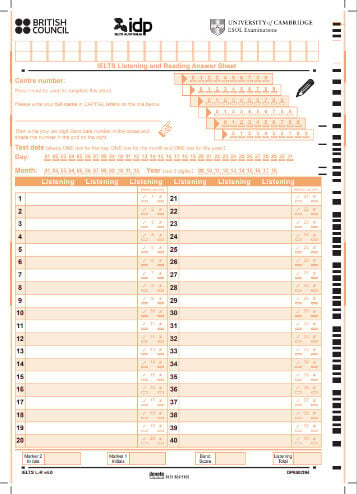
O exame de IELTS Listening dura cerca de 40 minutos. Irá passar 30 minutos a ouvir as gravações e a responder às perguntas. Ser-lhe-á entregue um Caderno de Perguntas e uma Folha de Respostas. No Caderno de Perguntas irá ver todas as perguntas a que precisa de responder. Na Folha de Respostas irá escrever as suas respostas finais para correção.
Pode consultar a folha oficial de respostas do IELTS Listening em PDF aqui ou simplesmente ver a imagem abaixo :)
No final da secção de Listening, dispõe de 10 minutos para transferir as respostas do Caderno de Perguntas para a Folha de Respostas.
IMPORTANTE!
Os erros de ortografia e os erros gramaticais são considerados INCORRETOS, por isso utilize estes 10 minutos para rever a ortografia e a gramática.
Como se calcula a pontuação do IELTS Listening
Na secção de Listening, cada pergunta vale 1 ponto, pelo que pode obter uma pontuação «bruta» máxima de 40 pontos. Depois, a sua pontuação bruta é convertida na sua band score. Lembre-se! Não perde pontos por respostas incorretas. A tabela abaixo dá-lhe uma ideia geral de como as pontuações brutas são convertidas em band scores.
| Pontuação bruta | Band score |
|---|---|
| 39-40 | 9 |
| 37-38 | 8.5 |
| 35-36 | 8 |
| 32-34 | 7.5 |
| 30-31 | 7 |
| 26-29 | 6.5 |
| 23-25 | 6 |
| 18-22 | 5.5 |
| 16-17 | 5 |
| 13-15 | 4.5 |
| 11-12 | 4 |
Como cada versão do IELTS é ligeiramente diferente, a pontuação bruta necessária para atingir uma determinada band score varia em função do desempenho de todas as pessoas que fizeram o exame nesse dia. Assim, o número de respostas corretas necessárias para obter uma band score varia ligeiramente de exame para exame, mas, em geral, deve tentar acertar cerca de 30 em 40 perguntas se quiser conseguir uma band score de 7.
Como referido acima, as secções tornam-se cada vez mais difíceis à medida que avança no exame de IELTS Listening. No entanto, todas as perguntas valem o mesmo número de pontos. Por isso, certifique-se de que não perde pontos fáceis por ficar preso em perguntas mais difíceis.
Descarregue gratuitamente um PDF de exemplo do IELTS Listening com respostas
Aqui ficam alguns exemplos gratuitos do IELTS Listening em formato PDF com respostas do British Council (os criadores do exame IELTS). Abaixo das ligações, também pode fazer gratuitamente um teste de IELTS Listening com áudio e respostas da BestMyTest. Tem as quatro secções, e cada secção mostra o guião do áudio com as respostas. Tente responder às perguntas e veja como se sai!
- IELTS Listening Practice Test 1- questions (Online Examples)
- IELTS Listening Practice Test 1- answers (PDF)
- IELTS Listening Practice Test 1- answer sheet (PDF)
Listen to the recording and answer questions 1 to 10. The answers and the audio script are in the box below the questions.
Questions 1-10
Complete the notes below.
Write ONE WORD AND/OR A NUMBER for each answer.
This can provide the carer with:
• time for other duties
• a 1
Assessment of aunt's needs
This may involve discussing:
• how much 2 is spent caring
Daily tasks discussed:
• help with dressing
• helping her take a 3
• shopping
• helping with meals
• managing 4
• any parts of caring that are particularly hard, e.g.
• loss of 5
• 6 her
• avoiding a 7
Types of support that may be provided for carers
• transport costs, e.g. cost of a 8
• vehicle-related costs, e.g. fuel and 9
• help with housework
• support to lower 10
-
spellcheck Answers
1. Break
Break is correct because this detail is stated in the recording at the point where the question is answered.2. Time
Time is correct because this detail is stated in the recording at the point where the question is answered.3. Shower
Shower is correct because this detail is stated in the recording at the point where the question is answered.4. Money
Money is correct because this detail is stated in the recording at the point where the question is answered.5. Memory
Memory is correct because this detail is stated in the recording at the point where the question is answered.6. Lifting
Lifting is correct because this detail is stated in the recording at the point where the question is answered.7. Fall
Fall is correct because this detail is stated in the recording at the point where the question is answered.8. Minicab
Minicab is correct because this detail is stated in the recording at the point where the question is answered.9. Parking
Parking is correct because this detail is stated in the recording at the point where the question is answered.10. Anxiety
Anxiety is correct because this detail is stated in the recording at the point where the question is answered.
Audio ScriptNora: It's really good to see you, Marcus. Since I had to give up work, I feel I'm losing touch with my friends and colleagues.
Marcus: We really miss you in the office. We were all so sorry you had to leave. But you must be relieved to have more time to look after your aunt. How is she?
Nora: Well, she's very cheerful, but she needs a lot of help.
Marcus: Have you tried to get any support from the local council?
Nora: No. I didn't know I could.
Marcus: Yes. But for different kinds of practical support, they realise that carers sometimes need time for all the other responsibilities they have, apart from the person they're caring for, and also that they sometimes need a break.
Nora: Absolutely. OK, so tell me more, how do I go about getting this support?
Marcus: Well, you'd have to have an assessment of your aunt's needs. That means someone would come round and talk to you about the situation and what you need. So for a start, they'd want to know the amount of time you spend looking after your aunt every day.
Nora: OK.
Marcus: Then they'll probably ask you what sorts of tasks you do for your aunt during the day. Things like if she needs help with getting dressed, for example.
Nora: Right. I help her with that. And also I help her get into the shower in the morning.
Marcus: Yes. That sort of thing. They'll probably ask you if you do the shopping for her, and help her at meal times, and whether she can cope using money.
Nora: Yes. That's becoming a bit of a problem. She used to be very good at it, but not anymore.
Before you hear the rest of the conversation, you have some time to look at questions 5 to 10. [20 seconds] Now listen, and answer questions 5 to 10.Marcus: And be ready to tell them about anything you find particularly difficult about caring for your aunt.
Nora: So recently I've noticed she started to have quite bad problems with her memory. If I wasn't there, I think she'd forget to eat, for example. And often she doesn't seem quite sure what day it is.
Marcus: Yes. Tell them about that. And are there any physical difficulties you have caring for her? Lifting her, for example.
Nora: Yes. She's quite heavy, and I'm afraid of hurting my back. I'd be in real trouble if that happened.
Marcus: They can give you advice about that, and also about how to avoid the possibility of your aunt having a fall.
Nora: Great. So, once they've done this assessment, if I'm eligible, what happens next?
Marcus: Well, they might support you financially. So they might help you with travel costs, like if you have to get a minicab to take your aunt for an appointment, for example.
Nora: I usually drive her myself, actually. So could I claim for the petrol?
Marcus: You could. And you can claim for the parking, too.
Nora: Oh, right.
Marcus: And if you need help with the housework, they can arrange for someone to come along once or twice a week. And one other thing. I hope you don't mind me saying this, but it's important you look after yourself. And it seems to me you're dealing with quite a bit of anxiety.
Nora: I am, yes.
Marcus: Well, tell the council, because they may be able to give you some advice on how to minimise it.
Nora: Really? Though, actually, I feel so much better having talked to you. I'll get in touch with the council straight away. Now, shall we go for coffee, or something?
Listen to the recording and answer questions 11 to 20. The answers and the audio script are in the box below the questions.
Questions 11-14
Choose the correct letter, A, B or C.
11. Who began turning the unused Whitfield site into a planted space?
- city council officials.
- nearby residents.
- a gardening charity.
12. What was Lillian Hartley trying to achieve through public campaigning?
- preventing a housing sale
- blocking army exercises
- winning maintenance funding
13. Why was the park rejected as a place for troop exercises?
- council permission was refused.
- too little usable space.
- a better site was chosen.
14. How does the speaker describe the latest redesign plans?
- 2013 plan used unchanged.
- 2013 plan revised pre-work.
- 2015 plan finished in 2016.
Questions 15-20
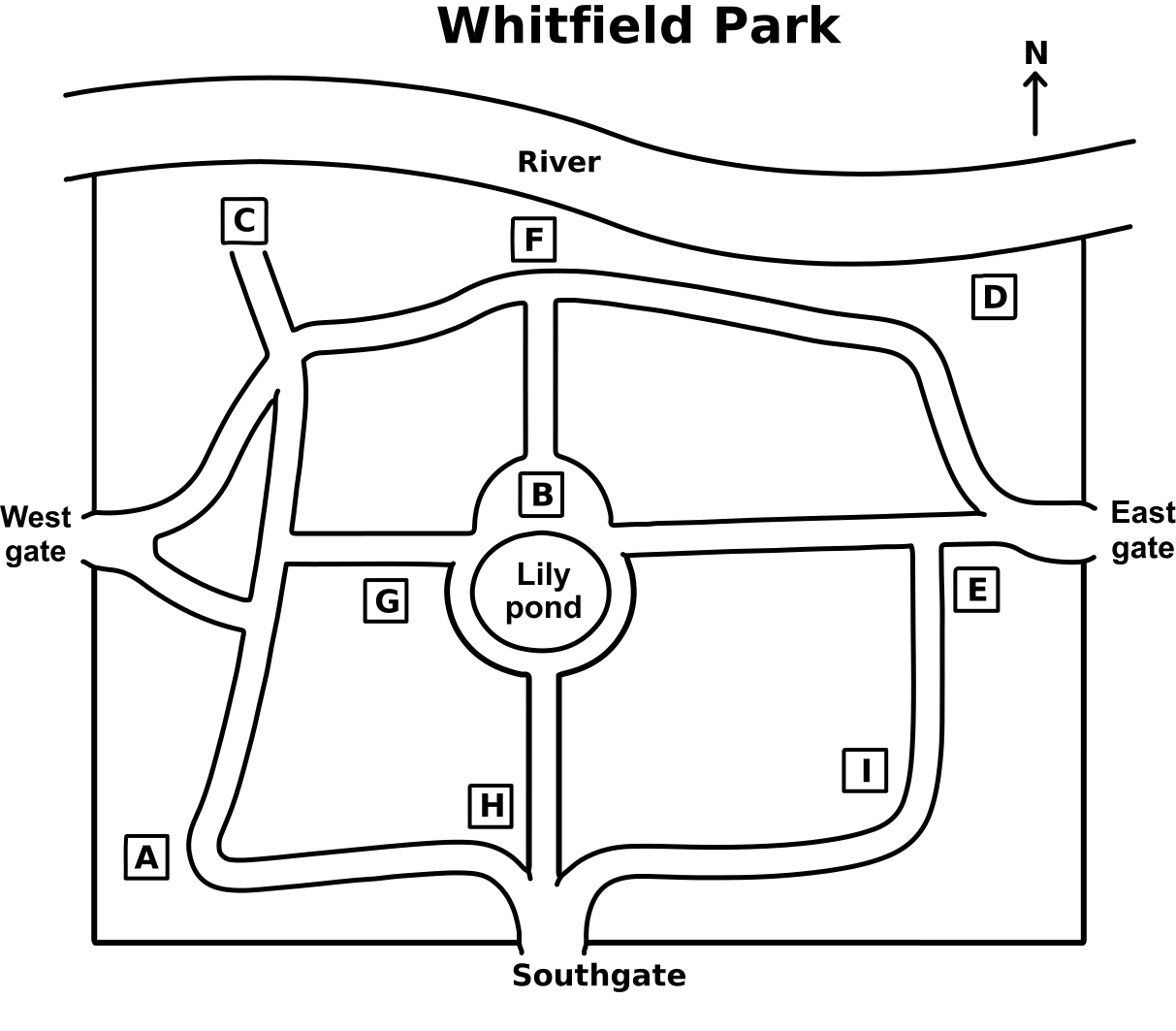
Label the plan of Whitfield Park below.
Write the correct letter, A-I, next to questions 15-20.
- statue of Lillian Hartley
- wooden sculptures
- playground
- maze
- tennis courts
- fitness area
-
spellcheck Answers
11. B
(A) is incorrect. The council took ownership later.(B) is correct. The initial planting was done by residents from nearby streets.
(C) is incorrect. The recording does not support this option: a gardening charity.
12. A
(A) is correct. Hartley organised public pressure so the council would keep the land as a park rather than sell it for housing.(B) is incorrect. The recording does not support this option: blocking army exercises.
(C) is incorrect. The recording does not support this option: winning maintenance funding.
13. B
(A) is incorrect. The recording does not support this option: council permission was refused.(B) is correct. , after inspection, the army concluded that the park was too small for practical use.
(C) is incorrect. The recording does not support this option: a better site was chosen.
14. B
(A) is incorrect. The recording does not support this option: 2013 plan used unchanged.(B) is correct. The plans dated from 2013 but were revised in 2015 before work began.
(C) is incorrect. The recording does not support this option: 2015 plan finished in 2016.
15. B
The correct answer is B because the statue of Lillian Hartley is now immediately north of the lily pond near the centre of the park, and that position is labelled B.16. D
The correct answer is D because the wooden sculptures are on the riverbank where the path from the East Gate makes a sharp bend, which corresponds to D.17. F
The correct answer is F because the playground is between the river and the path from the lily pond to the river, and that location is marked F.18. C
The correct answer is C because the maze is found by entering from the West Gate, walking north, and turning left, which places it at C.19. A
The correct answer is A because the tennis courts remain in the southern corner where the perimeter path makes a right-angled bend, labelled A.20. G
The correct answer is G because the fitness area is beside the lily pond on the same side as the West Gate, matching G on the plan.
Audio ScriptI'm delighted this evening to introduce our guest speaker, Sarah Holloway, who is going to talk to us about the recent transformation of Whitfield Park. Over to you, Sarah. Thank you very much. I'm sure you all know Whitfield Park well, it has been one of the city's landmarks for well over a century, and the city council has been responsible for it for most of that time. What perhaps fewer of you will know is how the park actually began.
Unlike many city centre parks, which started life as the private gardens of a large house, Whitfield was originally just an unused patch of waste ground. The first flowers there were actually planted by a small group of local residents who lived in the surrounding streets. They began work on the site in 1892. At that point nobody was entirely sure who legally owned the land, and it was a full twenty years later before the city council finally took it into public ownership. Some of you will have seen the statue near one of the gates. That figure is Lillian Hartley, who played a really important role in the early history of the park.
Once the council legally owned the land, its first instinct was to sell it off as building plots for housing. A great many local residents, however, wanted the park to stay open as a place where everyone could enjoy fresh air and green space, bear in mind that this is a very densely built up residential district. Lillian Hartley was at the heart of that campaign, and it was she who organised the petitions and the public demonstrations which, in the end, persuaded the council to drop the sale and keep the land as a park.
Soon afterwards, in 1914, the First World War broke out, and most of the park was dug up and used to grow vegetables, which were sold to local residents. At one point the army did look into taking over the park as a site for troop exercises. They actually wrote to the city council about it, but when they inspected it they concluded that the park was simply too small to be of any practical use to them, so the idea was dropped. The only military activity in the park during the war was the occasional public meeting held on a small area of grass that had been kept clear of vegetable plots.
After the war, the park was largely returned to the way it had been before 1914, and from then on it remained almost unchanged for decades. New plans for transforming the park were drawn up several times over the years; the most recent version dates from 2013, but those plans were then revised in 2015, well before any actual work had got under way. Work on the ground finally began in 2016 and was completed, on schedule, last year.
Before you hear the rest of the talk, you have some time to look at questions 15 to 20. [20 seconds] Now listen and answer questions 15 to 20.All right, I'd like to describe some of the more important changes that have been made, and one or two things that have deliberately been left as they were. If you take a quick look at the map you've been handed, you'll see the familiar outline of Whitfield Park. The river forms the northern boundary, and there is a gate in each of the three other walls.
From there, follow the path up towards the river and the enlarged children's playground sits between that path and the river itself. If you keep your eye on the riverbank, over towards the East Gate side, the new wooden sculptures are at the point where the path coming up from that gate makes a sharp bend.
Back near the West Gate side of the park, there is a maze, a circular pattern of paths separated by low hedges. Head in from the West Gate, walk north towards the river, and then turn left to find it. Close to the same central lily pond, on the side facing the West Gate, you'll also find the new outdoor fitness area.
Down in the southern corner, where the perimeter path makes that distinct right angled bend, the tennis courts are still in their familiar position, though we have now doubled them from four to eight. Now, since you are all keen gardeners, I'm sure you'll want to hear about the plants that have been chosen for the new beds.
Listen to the recording and answer questions 21 to 30. The answers and the audio script are in the box below the questions.
Questions 21-25
Choose the correct letter, A, B or C.
21. Nina and Owen were surprised to learn that coastal cities
- are home to just under half of all people.
- account for many of the largest cities.
- are expanding at double the rate of inland cities.
22. According to Owen, building coastal cities near to rivers
- can carry contamination back towards urban areas.
- can leave too little land for farming upstream.
- can cause factories to damage rural scenery.
23. What mistake was made when building water drainage channels in Port Selby in the 1950s?
- The system did not include enough channels.
- The builders selected the wrong construction materials.
- The design failed to anticipate rising sea levels.
24. What do Nina and Owen think that the authorities in Port Selby should do immediately?
- take measures to restore coastal ecosystems
- pay for a new flood prevention system
- stop disposing of waste materials into the ocean
25. What do they agree should be the priority for international action?
- greater coordination of activities
- more sharing of information
- agreement on shared policies
Questions 26-30
What decision do the students make about each of the following parts of their presentation?
Write the correct letter, A-G, next to questions 26-30.
- use visuals
- keep it short
- involve other students
- check the information is accurate
- provide a handout
- focus on one example
- do online research
- Historical background
- Geographical factors
- Past mistakes
- Future risks
- International implications
-
spellcheck Answers
21. B
(A) is incorrect. The recording does not support this option: are home to just under half of all people.(B) is correct. Nina says most of the biggest cities are built by the sea.
(C) is incorrect. The recording does not support this option: are expanding at double the rate of inland cities.
22. A
(A) is correct. Owen says pollutants from inland agriculture and industry travel down rivers to cities.(B) is incorrect. The recording does not support this option: can leave too little land for farming upstream.
(C) is incorrect. The recording does not support this option: can cause factories to damage rural scenery.
23. C
(A) is incorrect. The recording does not support this option: The system did not include enough channels.(B) is incorrect. The recording does not support this option: The builders selected the wrong construction materials.
(C) is correct. Port Selby's drainage channels were built without allowing for global warming and rising sea levels.
24. B
(A) is incorrect. The recording does not support this option: take measures to restore coastal ecosystems.(B) is correct. Nina says they need money to replace the drainage channels for flood protection now.
(C) is incorrect. The recording does not support this option: stop disposing of waste materials into the ocean.
25. A
(A) is correct. They say coastal cities must act together internationally.(B) is incorrect. The recording does not support this option: more sharing of information.
(C) is incorrect. The recording does not support this option: agreement on shared policies.
26. B
B is correct because they decide not to spend too long on historical background, so they will keep it short.27. A
A is correct because they decide to use slides with maps showing geographical factors.28. F
F is correct because they choose the Meriton case study as the basis for past mistakes, focusing on one example.29. G
G is correct because they need to look at websites for future risks, so online research is required.30. C
C is correct because they plan to ask audience members from different places, involving other students.
Audio ScriptTutor: OK, so what I'd like you to do now is to talk to your partner about your presentations on environmental planning. You should have done most of the reading now, so I'd like you to share your ideas and talk about the structure of your presentation and what you need to do next.
Nina: OK, Owen, I'm glad we chose quite a specific topic: coastal cities. It made it much easier to find relevant information.
Owen: Yeah, and cities are growing so quickly. I mean, we know that more than half the world's population lives in cities now.
Nina: Yeah, though that's all cities, not just coastal ones. But most of the biggest cities are actually built by the sea. I'd not realised that before.
Owen: Nor me. And what's more, a lot of them are built at places where rivers come out into the sea. But apparently this can be a problem.
Nina: Why?
Owen: Well, as the city expands, agriculture and industry tend to spread further inland along the rivers. And so agriculture moves even further inland up the river. That's not necessarily a problem, except it means more and more pollutants are discharged into the rivers.
Nina: That's a serious problem.
Owen: Right.
Nina: Did you read that article about Port Selby on the south coast?
Owen: No.
Nina: Well, apparently back in the 1950s, they built channels to drain away the water in case of flooding.
Owen: Sounds sensible.
Nina: Yeah, they spent quite a lot of money on them. But what they didn't take into account was global warming. So they built the drainage channels too close to sea level. And now sea levels are rising, they're more or less useless. If there's a lot of rain, the water can't run away. There's nowhere for it to go.
Owen: So they did not help much in the end.
Nina: So what are the authorities doing about it now?
Owen: I don't know. I did read that they're aiming to stop disposing of waste water into the ocean over the next 10 years. But that won't help with flood prevention now, will it?
Nina: No, really, they just need to find the money for something to replace the drainage channels in order to protect against flooding now. But in the long term, they need to consider the whole ecosystem.
Owen: Right.
Nina: Really though, coastal cities can't deal with their problems on their own, can they? I mean, they've got to start acting together at an international level instead of just doing their own thing.
Owen: Absolutely. The thing is, everyone knows what the problems are and environmental planners have a pretty good idea of what we should be doing about them. So they should be able to work together to some extent.
Nina: But it's going to be a long time before countries come to a decision on what principles they're prepared to abide by.
Owen: Yeah, if they ever do.
Before you hear the rest of the conversation, you have some time to look at questions 26 to 30. [20 seconds] Now listen and answer questions 26 to 30.Nina: So I think we've probably got enough for our presentation. It's only 15 minutes.
Owen: OK, so I suppose we'll begin with some general historical background about why coastal cities were established. But we don't want to spend too long on that. The other students will already know a bit about it.
Nina: It's all to do with communications and so on.
Owen: Yes, we should mention some geographical factors, things like wetlands and river estuaries and coastal erosion and so on.
Nina: We could have some maps of different cities with these features marked.
Owen: On a handout, you mean, or some slides everyone can see.
Nina: Yeah, that'd be better.
Owen: It'd be good to go into past mistakes in a bit more detail. Did you read that case study of the problems there were in Meriton with flooding a few years ago?
Nina: Yes, we could use that as the basis for that part of the talk. I don't think the other students will have read it, but they'll remember hearing about the flooding at the time.
Owen: Hmm, OK. So that's probably enough background. So then we'll go on to talk about what actions have been taken to deal with the problems of coastal cities.
Nina: OK, what else do we need to talk about? Maybe something on future risks looking more at the long term if populations continue to grow?
Owen: Yeah, we'll need to do a bit of work there. I haven't got much information, have you?
Nina: No, we'll need to look at some websites. Shouldn't take too long.
Owen: OK. And I think we should end by talking about international implications. Maybe we could ask people in the audience. We've got people from quite a lot of different places.
Nina: That'd be interesting if we have time, yes. So now should we go on?
Listen to the recording and answer questions 31 to 40. The answers and the audio script are in the box below the questions.
Questions 31-36
What point does the lecturer make about each item?
Write the correct letter, A-K, next to questions 31-36.
- changes drainage
- protects animals
- increases nutrients
- kills germs
- affects many species
- creates dense shade
- alters the soil
- supports farming
- reduces competition
- attracts bell-miners
- helps recovery
- Eucalyptus woodland
- Damage to eucalyptus woodland
- Oil from eucalyptus leaves
- Lime used in construction
- Direct iron supply
- Moderate bushfires
Questions 37-40
Complete the notes below.
Write ONE WORD ONLY for each answer.
Bell-miner associated dieback:
• The process starts with insects feeding on eucalyptus 37
• A sweet liquid containing 38 attracts bell-miners
Fire patterns:
• If fires happen too often, 39 becomes the main vegetation
• When fires are almost absent, thick growth gives bell-miners protected 40 sites
-
spellcheck Answers
31. B
B is correct because eucalyptus woodland provides nesting places and shelter for birds, bats and small mammals.32. E
E is correct because damage to eucalyptus woodland affects a wider community of species, not only the trees themselves.33. D
D is correct because oil from eucalyptus leaves is used in disinfectant, where it can kill certain germs.34. G
G is correct because lime from road construction was washed into the soil and interfered with tree roots.35. K
K is correct because affected trees recovered surprisingly quickly when iron was supplied directly.36. I
I is correct because occasional fire removes fast-growing competitors that would otherwise use water needed by eucalyptus trees.37. leaves
The correct answer is leaves. The lecturer says the process begins when insects settle on eucalyptus leaves and feed on them.38. sugar
The correct answer is sugar. The lecturer says the insects produce a sweet liquid containing sugar, which attracts bell-miners.39. grass
The correct answer is grass. The lecturer says grass tends to dominate afterwards if fires occur too often.40. nesting
The correct answer is nesting. The lecturer says dense growth creates protected nesting sites for bell-miners when fire is suppressed.
Audio ScriptGood morning. Today I want to focus on the eucalyptus tree, one of the best known features of the Australian landscape. Many people call it a gum tree, but the name eucalyptus actually covers hundreds of related species, from small scrubby trees to very tall forest giants.
Now, eucalyptus trees are important in several ways. Ecologically, they provide nesting places and shelter for birds, bats and small mammals. Their flowers also produce nectar, which is an important food source for insects and birds. So when eucalyptus woodland is damaged, the effect is felt across a much wider community of species.
As for their value to people, the trees are also useful. Oil from eucalyptus leaves has long been used in cleaning products, and one common use is in disinfectant, because the oil can kill certain germs. Eucalyptus timber is also used in building and fencing, although that is not really the main focus of today's lecture.
So, these trees can live for centuries, and some individuals survive for four hundred years or more. That is why researchers became concerned when large numbers began dying much earlier than expected in different parts of Australia.
Now, one disease that attracted attention was Mundulla Yellows. The leaves of affected trees slowly turned yellow and then, over time, the whole tree declined. For years the cause was unclear. Eventually, researchers discovered that lime, or calcium hydroxide, had been used in road construction nearby. Rain washed the lime into the surrounding soil, where it interfered with the roots of eucalyptus trees. The trees were still surrounded by nutrients, but they could no longer absorb the iron they needed for healthy growth. When iron was supplied directly to affected trees, they recovered surprisingly quickly.
However, Mundulla Yellows affected only a limited number of places. A much wider problem on the east coast was Bell miner associated dieback. Now, bell miners are small native birds, but they are not the direct cause of the damage. The process begins when insects settle on eucalyptus leaves and feed on them. While feeding, these insects produce a sweet liquid containing sugar. Bell miners are attracted to that liquid, and they aggressively chase away other birds and insects that might otherwise reduce the insect population. As a result, the insects multiply, the leaves are badly damaged, and the trees gradually lose their ability to survive.
But some scientists think fire history is also part of the explanation. An influential theory, first proposed by the ecologist William Jackson, links the type of vegetation in a region to the frequency of bushfires. If fires occur too often, grass tends to dominate the area afterwards. If fires occur at moderate intervals, eucalyptus forest is more likely to persist. This is because occasional fire removes fast growing competitors which would otherwise take up the water eucalyptus trees need. And it also helps maintain the soil by preventing dense undergrowth from changing the soil structure and removing nutrients.
At the other extreme, if fires are almost completely suppressed, a different ecosystem can develop. Scientists sometimes call this dry rainforest. Now, the name sounds contradictory, because we usually associate rainforest with wet tropical conditions. But in this case it means a dense, shaded vegetation system with relatively few species. It can create excellent conditions for bell miners, because the thick growth gives them protected nesting sites while excluding many of the species that would normally compete with them.
What this tells us is that before European settlement, Aboriginal communities used controlled burning over long periods, and this probably created a more balanced pattern of vegetation. Since European settlement, fire has often been suppressed, roads and farms have altered drainage, and some local ecosystems have shifted away from eucalyptus woodland. The decline of eucalyptus trees, then, is not caused by one single factor. It is the result of disease, insects, birds, soil chemistry and fire management interacting with one another.

Completion - Part 1
Learn how to answer these questions in a step-by-step interactive exercise
Completion - Part 1
Uma lacuna pode pedir um horário ou uma frequência. O falante geralmente diz o mesmo período com outras palavras, então relacione o significado à lacuna em vez de esperar as palavras da página.
Depois, confira o limite de palavras antes de enviar. Releia a linha inteira com sua resposta na lacuna e retire qualquer palavra que a linha já traz. Uma resposta com o significado certo, mas longa demais, não vale ponto.
Clique em reproduzir para ouvir o áudio
As anotações usam um verbo simples como must provide ou need to bring. O falante raramente diz esse verbo; em vez disso, usa um sinônimo ou descreve a ação, então preste atenção ao que é realmente exigido.
Os falantes muitas vezes mencionam itens extras primeiro e depois os descartam. Se você perder uma lacuna, deixe-a e passe para a próxima, porque as respostas seguem a ordem da gravação, e uma lacuna perdida pode custar as seguintes.
Clique em reproduzir para ouvir o áudio
Como se saiu nas perguntas de exemplo do IELTS Listening acima? Achou alguma das perguntas difícil? Se sim, poderá ser-lhe útil analisar com mais atenção os 6 tipos de tarefas do IELTS Listening. Quanto melhor compreender um tipo de tarefa, menos esforço terá de fazer para perceber o que tem de fazer e mais tempo terá para descobrir a resposta.
Os 6 tipos de tarefas do IELTS Listening
No exame de IELTS Listening existem 6 tipos diferentes de perguntas. É importante que pratique cada tipo de tarefa para aprender a melhor forma de a abordar e conseguir uma band score elevada no IELTS Listening.
Quais tipos de tarefa de compreensão oral nossos alunos consideram mais difíceis
Veja o que mostram 2.22 milhões de respostas de IELTS Listening de alunos do BestMyTest. A tabela abaixo mostra a porcentagem de cada tipo de tarefa que nossos alunos responderam corretamente, para você ver logo onde os pontos se perdem.
| Tipo de tarefa | Acertos |
|---|---|
| Note completion | 33% |
| Table completion | 34% |
| Sentence completion | 45% |
| Short answer | 48% |
| Multiple choice | 50% |
| Multiple selection | 52% |
| Plan, map, diagram labelling | 55% |
| Form completion | 73% |
| Matching | 85% |
- É nas tarefas de preenchimento que se perdem pontos. Entre as tarefas de preenchimento, Note completion é respondida corretamente em 33% das vezes, enquanto Form completion, que exige a mesma habilidade em outro formato, chega a 73%. Toda tarefa de preenchimento pede que você escreva uma palavra que ouve, então a ortografia, a forma da palavra e o limite de palavras contam, e tudo isso pode ser praticado.
- Em 61.104 simulados completos de compreensão oral realizados por 54.523 alunos, a pontuação média foi de 5.6. 41% dos testes atingiram a pontuação 6.0 e 12% atingiram a pontuação 7.0.
- Nas seções individuais de compreensão oral, 31% das tentativas tiveram pontuação de 40% ou menos e 30% tiveram pontuação de 80% ou mais. As seções 3 e 4 são as partes acadêmicas do teste, então pratique-as separadamente e também dentro dos simulados completos.
Embora cada tipo de pergunta de Listening tenha uma forma diferente, a abordagem básica para cada um é a mesma. Mais adiante neste artigo, vamos mostrar-lhe a estratégia básica para abordar os 6 tipos de perguntas. Cada tipo tem um áudio de exemplo e a resposta no guia de tipos de pergunta IELTS Listening.
- Tipo de tarefa 1 – Completar frases
- Tipo de tarefa 2 – Correspondência (Matching)
- Tipo de tarefa 3 – Legendagem de plantas, mapas e diagramas
- Tipo de tarefa 4 – Completar formulários, notas, tabelas, fluxogramas e resumos
- Tipo de tarefa 5 – Escolha múltipla
- Tipo de tarefa 6 – Perguntas de resposta curta
3 passos para uma preparação eficaz do IELTS Listening online
Embora cada tipo de pergunta (tarefa) do IELTS Listening seja diferente, a abordagem básica a cada um é a mesma. Pode abordar todos os tipos de tarefas com uma única estratégia simples, passo a passo. Aqui ficam os três passos que recomendamos para enfrentar os tipos de perguntas de Listening:
- Examine as perguntas com atenção para encontrar informação-chave
- Antecipe possíveis respostas antes de ouvir
- Acompanhe a gravação para relacionar as perguntas com o conteúdo à medida que escuta
Passo 1: Examine as perguntas
Na secção de IELTS Listening, dispõe de um breve tempo de preparação (30 a 40 segundos) antes do início da gravação. Esta é a sua oportunidade para analisar as perguntas a que terá de responder e é precisamente disso que trata o primeiro passo desta estratégia. Em vez de aproveitar este tempo para descansar ou rever as respostas, deve concentrar-se em aprender o máximo possível sobre as perguntas seguintes. Este passo é importante para evitar o erro de fazer várias coisas ao mesmo tempo: ouvir o falante e tentar ler as perguntas pela primeira vez.
Quando o tempo de preparação começar, aproveite-o ao máximo examinando as perguntas para obter mais informação sobre elas. Estes são alguns dos elementos que deve procurar ao examinar cada uma das perguntas do IELTS Listening:
- De que tipo de pergunta se trata?
- Qual será o aspeto da resposta? (por exemplo: uma data, um número, um nome)
- Quais são as expressões e palavras mais importantes — as palavras-chave — das perguntas?
Um exemplo poderá ser uma pergunta do tipo «Note Completion», como esta:
Complete the notes below.
Write NO MORE THAN THREE WORDS for each answer.
Primeiro, pode sublinhar algumas das palavras-chave da pergunta.
Two reasons for the new approach to pricing are changes in (27) ______ and (28) _________ programs.
Neste exemplo, escutar atentamente a expressão-chave «two reasons», que tinha sublinhado, permite-lhe
começar a prestar atenção no momento certo. Aqui fica a parte do guião do áudio que revela a resposta:
Mark: Well, there seem to be two basic reasons. Firstly, because the law has changed recently to allow companies to behave like this. In the past, they weren't allowed to change the prices of the tickets. And secondly, we now have computer programs that do the calculations so that prices can be changed very quickly and accurately.
Depois de ter examinado as perguntas, saberia que «the law» e «computer» eram as respostas corretas aqui, com base em algumas palavras-chave e no conhecimento do tipo de pergunta.
Passo 2: Antecipe possíveis respostas
O segundo passo desta estratégia para ter sucesso na secção de IELTS Listening está intimamente ligado ao primeiro. Na verdade, deve tentar completar ambos os passos nos mesmos 20 segundos de tempo de preparação antes de a gravação começar. Embora possa parecer uma tarefa difícil de realizar em tão pouco tempo, lembre-se de que estes passos estão interligados.
Para antecipar possíveis respostas às perguntas de Listening, terá primeiro de ter concluído o passo 1, analisando as perguntas com atenção. Nesta altura, já deverá saber a que tipo de pergunta se está a referir, qual o aspeto das possíveis respostas e que palavras-chave o ajudarão a localizar rapidamente as respostas. Para antecipar respostas, irá combinar toda esta informação e fazer uma suposição sobre o tipo de resposta que espera ouvir.
Voltemos ao mesmo exemplo de pergunta de Note Completion acima.
Two reasons for the new approach to pricing are changes in (27) and (28) programs.
Basta olhar para a gramática desta frase para identificar a que classe gramatical pertencerá a resposta. Neste caso, a preposição «in» precede ambas as possíveis respostas. Gramaticalmente, só os substantivos ou sintagmas nominais podem ser usados desta forma em locuções preposicionais. Não só pode prever, com acerto, que a resposta será um substantivo ou sintagma nominal, como também poderá antecipar que a resposta poderá estar relacionada com políticas ou com o governo (law) e ser uma palavra que possa aparecer junto a «programs» (computer) tendo em conta o contexto.
Embora seja impossível adivinhar a resposta exata apenas com base em previsões, ao tentar imaginar qual poderá ser a resposta é mais provável que esteja atento à informação relevante e ignore a irrelevante. Antecipar possíveis respostas antes de a gravação começar irá preparar o seu ouvido, aproximando-o um passo da resposta correta.
Agora experimente combinar o passo 1 (examinar as perguntas) e o passo 2 (antecipar possíveis respostas) num exemplo de pergunta de escolha múltipla um pouco mais difícil.
Choose the correct letter, A, B, C or D.
- are for weekend shows
- are booked well in advance
- are non-refundable
- are booked for groups
Embora não seja possível saber com certeza as respostas a estas perguntas, pode ainda assim usar a informação presente nas próprias perguntas para antecipar respostas possíveis e orientar a sua escuta. Por exemplo, a pergunta 24 refere-se à razão pela qual os bilhetes de teatro serão mais baratos, por isso deve estar atento a qualquer uma das razões mencionadas. Tenha em conta que poderá ser mencionada mais do que uma. Veja o guião abaixo para perceber como a antecipação o pode ajudar a eliminar respostas erradas.
Repare que três das possíveis respostas são mencionadas: «booked for groups», «are for weekend shows» e «are non-refundable». No entanto, a resposta correta é C «are non-refundable», porque é mencionada como sendo mais barata, em separado das outras duas, que aparecem apenas listadas em conjunto.
Passo 3: Acompanhe a gravação
Assim que a gravação começar e a parte de escuta propriamente dita do exame tiver início, deve acompanhá-la para completar o terceiro passo desta estratégia para a secção de IELTS Listening. Acompanhar a gravação implica concentrar-se atentamente no que está a ouvir e, ao mesmo tempo, ter presente a que pergunta o conteúdo poderá estar a responder.
As perguntas da secção de IELTS Listening surgem habitualmente pela mesma ordem pela qual as respostas podem ser encontradas no conteúdo da gravação. Isto dá-lhe uma vantagem no exame, porque significa que assim que ouvir a resposta a uma pergunta, deverá imediatamente concentrar-se na pergunta seguinte. Se conseguir acompanhar a gravação com sucesso, fazendo a correspondência entre o contexto das perguntas e o que está a ouvir, irá manter-se no caminho certo e evitará perder informação fundamental para responder a cada uma das perguntas.
No entanto, fazer isto é mais fácil de dizer do que de fazer. Terá de gerir várias tarefas em simultâneo: ouvir e, ao mesmo tempo, ter um olho na pergunta seguinte. Se, ainda assim, perder a resposta a uma pergunta, dar-se-á conta quando ouvir a resposta a uma pergunta posterior. Embora isto possa ser confuso e até frustrante, falhar uma resposta e estar consciente disso é melhor do que perder-se completamente no conteúdo e falhar muitas outras. Se perder uma pergunta, deixe-a simplesmente e siga para a seguinte. No fim, terá de arriscar com o seu melhor palpite para a pergunta que falhou. No entanto, o lado positivo é que ouvir a gravação na íntegra pode fornecer-lhe outras pistas contextuais que lhe permitam responder com mais precisão a quaisquer perguntas que tenha falhado.
Recursos gratuitos de prática do IELTS Listening
Vai precisar de boas competências de compreensão auditiva para conseguir uma band score elevada no IELTS Listening. Por isso, é importante que treine de forma consistente todos os dias até ao dia do exame.
Em baixo encontra alguns recursos que pode utilizar para treinar e manter diariamente as suas competências de compreensão auditiva.
- YouTube - https://www.youtube.com
- BBC Learning English - http://www.bbc.co.uk/learningenglish
- TED - https://www.ted.com/
- BBC radio - https://www.bbc.co.uk/worldserviceradio
- ABC news in Australia - https://www.abc.net.au/listen/live/news
Os números desta página vêm dos dados de desempenho dos alunos IELTS da BestMyTest, a prática de IELTS feita na BestMyTest até outubro de 2026. Essa página explica como medimos cada número. Última atualização: 15 de outubro de 2026.