Neste guia vai realizar um teste de speaking IELTS gratuito e praticar com os temas de perguntas de IELTS Speaking mais frequentes, acompanhados das respostas. Vai aprender como responder às perguntas do teste de speaking IELTS para as partes 1, 2 e 3 utilizando os nossos modelos de speaking totalmente testados.
Receba respostas de exemplo gratuitas de speaking do IELTS após concluir um teste prático de speaking do IELTS.
play_circle_outline Começar teste prático de speaking do IELTSAbaixo está nossa lista completa de perguntas de speaking do IELTS com respostas de exemplo. Observação: os links em vermelho são nossas perguntas de speaking mais populares e recomendadas, avaliadas por nossos alunos, e você pode praticá-las gratuitamente a qualquer momento.
Perguntas de IELTS Speaking Part 1 1 - 96
Short questions about familiar topics like your home, work, and hobbies
Perguntas de IELTS Speaking Part 2 1 - 83
Cue cards where you speak for 1 to 2 minutes about one topic
Perguntas de IELTS Speaking Part 3 1 - 97
Discussion questions linked to the Part 2 topic
Guia para ter sucesso no IELTS Speaking
Bem-vindo ao guia oficial do BestMyTest para o exame de IELTS Speaking. O restante deste guia foca-se em conhecer os temas mais frequentes do IELTS Speaking para as partes 1 a 3, em ouvir respostas-modelo de banda 9 e em aprender dicas e recursos importantes para o seu sucesso. Utilize o índice abaixo para encontrar rapidamente o que procura.
Índice
- Introdução ao exame de IELTS Speaking
- Temas de IELTS Speaking para a parte 1
- Temas de IELTS Speaking para as partes 2 e 3
- Como abordar a parte 1 do IELTS Speaking
- Como abordar a parte 2 do IELTS Speaking
- Como abordar a parte 3 do IELTS Speaking
- Praticar para ter sucesso no IELTS Speaking
- Como são classificadas as perguntas do IELTS Speaking
- Recursos gratuitos para o IELTS Speaking
Exame de IELTS Speaking
O exame de IELTS Speaking pode parecer um pouco intimidante ao início, sobretudo porque será avaliado em direto frente a um examinador. Devido a este formato em direto, pode ser difícil encontrar temas gratuitos com respostas-modelo, mas não se preocupe — nós tratamos disso. Antes de praticar com os nossos temas de IELTS Speaking, vamos analisar rapidamente como funciona o exame.
Formato do exame de Speaking
O exame de Speaking dura cerca de 11 a 15 minutos e é composto por 3 partes. Tenha em conta que os temas das partes Greeting e Parte 1 são os mesmos, pelo que são consideradas uma única parte, mas, para sua comodidade, separámo-las aqui.
- Saudação inicial do IELTS Speaking
- Parte 1 do IELTS Speaking
- Parte 2 do IELTS Speaking
- Parte 3 do IELTS Speaking
A saudação inicial
Quando faz o exame de IELTS Speaking e entra na sala de exame, o examinador não começa por perguntas difíceis do IELTS Speaking; em vez disso, começa de forma calma com cumprimentos. Note que SERÁ avaliado pela sua capacidade de saudar, por isso é importante estar preparado. Dito isto, vejamos rapidamente uma saudação simples e uma resposta tipo.
- O examinador apresenta-se e pergunta como se chama. Deve responder «My name's _______».
- De seguida, será perguntado «What can I call you?», ao que pode responder «You can call me _______». Aqui pode utilizar o seu nome em inglês, se tiver um. Pode parecer estranho, mas algumas pessoas não conseguem pronunciar bem o seu próprio nome em inglês. Isto NÃO É ACEITÁVEL. Se não conseguir pronunciá-lo, é melhor não o utilizar.
- Depois do nome, irão perguntar-lhe de onde é. Basta dizer «I'm from _____». Já chega. Não precisa de dar informação extra sobre as suas respostas nesta fase.
- Por fim, ser-lhe-á pedido um documento de identificação. Após mostrá-lo, o exame começa.
Parte 1 do IELTS Speaking
A parte 1 do IELTS Speaking dura entre 4 a 5 minutos, inclui cerca de 8 a 10 perguntas e cerca de 2 a 3 temas familiares, como o seu trabalho, os seus estudos, a sua família, a sua cidade de origem, o seu alojamento, etc. Estes temas são mais fáceis do que os da parte 2 do IELTS Speaking. Abaixo encontra alguns exemplos do que lhe poderá ser perguntado.
Where is your hometown?
What do you like about it?
What do you not like about it?
How important is your hometown to you?
Let's move on to talk about accommodation:
Tell me about the kind of accommodation you live in?
Does the place you live in have many amenities?
Is there anything you would like to change about the place you live in?
Do you plan to live there for a long time?
As perguntas da parte 1 podem ser descritas como perguntas que imitam uma conversa de circunstância entre dois desconhecidos ou conhecidos. Não são muito aprofundadas, mas não se deixe enganar: também terá de se preparar para elas. Um pouco de preparação faz muita diferença e vai agradecer-nos por insistirmos nesse ponto! Mais à frente neste artigo encontrará algumas dicas para se preparar para as perguntas da parte 1.
Parte 2 do IELTS Speaking
Na parte 2 irá falar sobre um determinado tema do IELTS Speaking. O tema é escolhido pelo examinador e ser-lhe-á entregue num cartão (Candidate Task Card). Terá 1 minuto para preparar a resposta e, depois, um máximo de 2 minutos para falar. Ser-lhe-ão fornecidos papel e lápis para tomar notas. Abaixo encontra um exemplo de pergunta da parte 2 do IELTS Speaking:
Describe a useful electronic device you would like to own.
You should say:
- What it is
- How it would help your life
- If it would be expensive to buy
And explain why you would like it.
Terminados os dois minutos de fala, é possível que o examinador conclua esta parte fazendo-lhe duas ou três perguntas simples relacionadas com a sua resposta da parte 2.
Estas perguntas são por vezes designadas rounding off questions,
uma vez que ajudam a «encerrar» a conversa. Vejamos algumas perguntas do IELTS Speaking que poderiam ser feitas.
Por exemplo, suponha que o tema da parte 2 foi «Describe your favorite form of public transport».
O examinador pode encerrar a conversa perguntando:
- Are the buses cheap in your city?
- Did you travel to the test today by bus?
Normalmente, estas perguntas de encerramento são simples, pelo que basta responder com respostas curtas.
Não são necessárias respostas longas e complexas, pois o examinador estará prestes a passar à parte 3.
Por exemplo, pode responder a uma rounding off question com algo curto como:
- Yes, about 2 dollars for a single journey.
- No, actually I came by taxi.
Por outro lado, há casos em que o examinador salta totalmente as perguntas de encerramento e passa diretamente à parte 3. Se for esse o caso no seu exame de IELTS Speaking, não se preocupe: significa que a sua resposta da parte 2 foi suficientemente longa e que os 3 minutos de tempo de fala da parte 2 já se esgotaram.
Parte 3 do IELTS Speaking
Na parte 3 ser-lhe-ão feitas mais 4 a 8 perguntas relacionadas com os temas discutidos na parte 2. O examinador também lhe fará algumas perguntas com base nas suas respostas, pelo que toda a parte 3 é uma conversa bidirecional com o examinador, com uma duração de 4 a 5 minutos. Aqui ficam algumas perguntas de carácter geral que o examinador poderia fazer com base nos temas da parte 2 acima:
What devices do you think will be popular in the future?
Do you think people spend too much money on electronic devices?
In what ways can electronic devices make our lives harder?
What would the world be like without computers?
Should children be taught to use computers at school?
Temas do IELTS Speaking
Agora que já tem uma ideia de como funciona o exame de IELTS Speaking, percebe que pode haver qualquer número de temas. É importante familiarizar-se com alguns dos temas mais frequentes. Criámos uma lista exaustiva e cada tema inclui uma resposta-modelo do IELTS Speaking.
O gráfico de barras abaixo mostra as categorias de temas mais comuns do IELTS Speaking partes 2 e 3 em 2025 e 2026. O eixo horizontal (eixo x) lista sete categorias de temas e o eixo vertical (eixo y) mostra a percentagem de temas em cada categoria. As barras azuis representam 2025 e as barras laranja representam 2026.
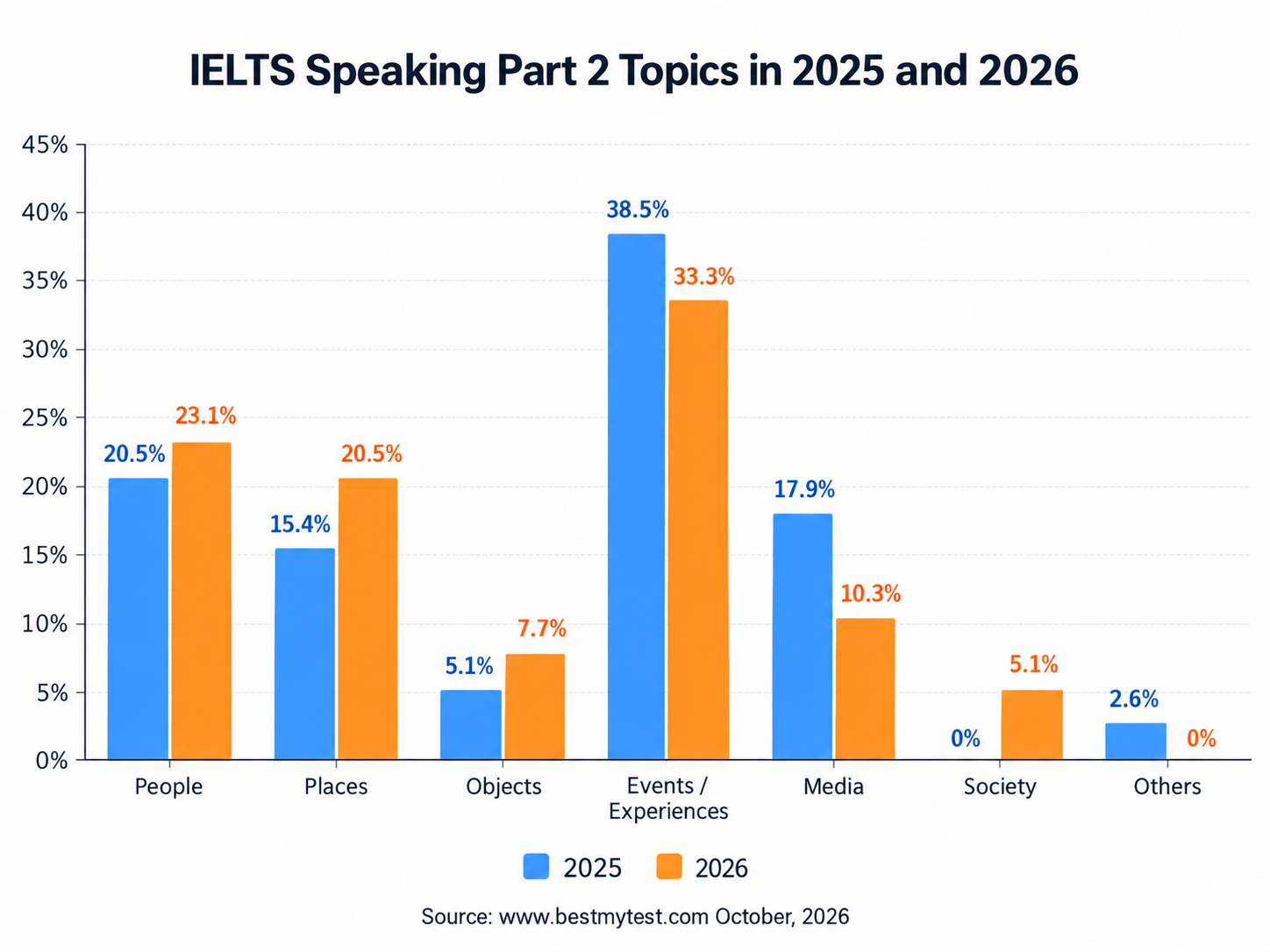
Como podes ver, eventos e experiências são a maior categoria nos dois anos, com 38,5% dos temas em 2025 e 33,3% em 2026. Estas perguntas pedem normalmente que descrevas algo que fizeste ou viveste, como uma viagem memorável, uma celebração especial ou uma altura em que ajudaste alguém.
Pessoas e lugares também são categorias importantes. Juntas, representam 43,6% dos temas em 2026. Podem pedir-te que descrevas alguém que admiras, uma pessoa que te influenciou, um lugar de que gostas de visitar ou um sítio que gostarias de explorar.
Outras categorias, incluindo objetos, média e sociedade, aparecem com menos frequência nesta amostra. Mesmo assim, deves praticá-las, porque as perguntas do IELTS Speaking podem abranger uma grande variedade de assuntos do dia a dia.
O que é que isto significa para a tua preparação para o IELTS? Começa por praticar perguntas sobre as tuas experiências pessoais, as pessoas que conheces e os lugares que visitaste. Estes temas representam uma grande parte das perguntas do gráfico. Prepara algumas histórias e exemplos flexíveis que possas adaptar a perguntas diferentes, em vez de memorizares respostas completas.
Temas do IELTS Speaking — Parte 1
A lista abaixo contém mais do que perguntas: mostra também os temas de Speaking que os examinadores costumam abordar com os candidatos. Uma boa dica é responder a estas perguntas da parte 1 frente a um espelho ou com um amigo. A tabela abaixo apresenta a frequência com que cada tema é utilizado:
| Temas | Frequência |
|---|---|
| Cidade de origem / Alojamento / País | Elevada |
| Amigos / Família / Tarefas domésticas / Filhos | Elevada |
| TV / Leitura / Música / Jornais e revistas / Filmes | Elevada |
| Tecnologia / Computadores / Internet | Elevada |
| Trabalho / Profissões / Planeamento de carreira / Voluntariado | Elevada |
| Áreas de estudo / Escola secundária | Média |
| Desporto / Atividades ao ar livre / Atividades em espaços interiores | Média |
| Viagens / Estilo de vida | Média |
| Estações do ano / Chuva / Dias soalheiros / Tempo meteorológico | Média |
| Moda / Calçado / Malas / Roupa | Média |
| Transportes / Barcos / Autocarros / Táxis | Média |
| Celebridades / Publicidade / Meios de comunicação | Média |
| Fotografias / Fotografia / Cores / Arte | Baixa |
| Ruído / Paciência / Cortesia | Baixa |
| Espelhos / Presentes | Baixa |
Question 1
-
spellcheck TranscriptDo you enjoy going out in your free time? Why or why not?
-
Sample Response
Yeah, I usually enjoy going out in my free time because it helps me relax and meet new people. Honestly, it’s a great way to take a break from daily routine and clear my mind a little.
Watch the video question, then click to record your answer.
Practice speaking questions in our appQuestion 2
-
spellcheck TranscriptWhat kind of places do you usually go to when you go out?
-
Sample Response
Well, when I go out, I often like to visit cafes or parks. Sometimes, I also enjoy going to the cinema or shopping malls because those places are lively and fun to hang out in, you know.
Watch the video question, then click to record your answer.
Practice speaking questions in our appQuestion 3
-
spellcheck TranscriptWho do you prefer to go out with, friends or family? Why?
-
Sample Response
I think I prefer going out with friends, actually, because we share similar interests. However, sometimes I also enjoy spending time with my family. It really depends on the occasion, to be honest.
Watch the video question, then click to record your answer.
Practice speaking questions in our appQuestion 4
-
spellcheck TranscriptHow often do you go out in the evenings?
-
Sample Response
To be fair, I don’t go out every evening. I guess maybe two or three times a week, depending on my schedule. If I’m tired or busy, I usually just stay at home and relax.
Watch the video question, then click to record your answer.
Practice speaking questions in our appQuestion 5
-
spellcheck TranscriptHas the way you go out changed compared to when you were younger?
-
Sample Response
Yes, the way I go out has definitely changed since I was younger. I used to go out more often and stay out late. Now, I prefer quieter places and I’m a bit more careful with my time.
Watch the video question, then click to record your answer.
Practice speaking questions in our appQuestion 6
-
spellcheck TranscriptLet's move on to talk about goals. Do you have any specific goals for this year?
-
Sample Response
Let’s see, this year my main goal is to improve my English and maybe learn a new skill. I also want to travel to at least one new country if possible, just to experience something different.
Watch the video question, then click to record your answer.
Practice speaking questions in our appQuestion 7
-
spellcheck TranscriptWhy is it important for people to set goals?
-
Sample Response
I believe setting goals is really important because it gives us direction and motivation. Without goals, it’s easy to lose focus and just drift through life without achieving anything meaningful, don’t you think?
Watch the video question, then click to record your answer.
Practice speaking questions in our appQuestion 8
-
spellcheck TranscriptHave you ever achieved a goal that was difficult for you?
-
Sample Response
Actually, yes, I once had a goal to run a half marathon. It was really difficult for me because I’m not a natural runner. But after a lot of training, I finally managed to do it and I felt so proud.
Watch the video question, then click to record your answer.
Practice speaking questions in our appQuestion 9
-
spellcheck TranscriptHow do you keep track of your progress towards your goals?
-
Sample Response
To be honest, I usually write my goals down in a notebook or on my phone. I try to check in regularly, maybe once a week, to see how I’m doing and make any changes if needed.
Watch the video question, then click to record your answer.
Practice speaking questions in our appQuestion 10
-
spellcheck TranscriptDid you have any goals when you were a child?
-
Sample Response
When I was a child, I definitely had some goals, like becoming a teacher or learning to play the piano. Even though I didn’t achieve all of them, some childhood dreams still motivate me today.
Watch the video question, then click to record your answer.
Practice speaking questions in our app
Task Achievement — IELTS Speaking 1
Learn how to answer these questions in a step-by-step interactive exercise
Task Achievement — IELTS Speaking 1
O primeiro passo para responder a uma questão do IELTS Speaking Part 1 é dar uma resposta direta e depois desenvolvê-la com um pouco mais de detalhe.
Uma estrutura de resposta simples ajuda você a saber o que dizer em seguida, para responder rápido e continuar falando com naturalidade, sem deixar a resposta longa demais. Em vez de parar depois de uma frase curta, siga a estrutura um passo de cada vez.
Nesta etapa, você vai aprender a usar essa estrutura para montar respostas claras e naturais no IELTS Speaking Part 1.
Vamos trabalhar a questão 1.
Primeiro, identifique o padrão da pergunta. Pergunte a si mesmo: O que esta pergunta está pedindo que eu faça? Assim que reconhecer o padrão, use a estrutura de resposta correspondente para guiar sua resposta.
Nesta questão, o padrão é Direct Answer, então siga esta estrutura:
Answer + Reason → Example or Detail → Result or Extra Detail
Enquanto fala, use expressões de preenchimento controladas, como Well, Actually, For example, What I mean by that is e So overall. Essas expressões deixam sua resposta mais fluida e dão um pouco mais de tempo para pensar se você esquecer por um instante o que dizer em seguida. Use-as com naturalidade, não em todas as frases. Aqui está a lista de expressões de preenchimento controladas.
Do you enjoy going out in your free time? Why or why not?
Vamos trabalhar a questão 2.
Primeiro, identifique o padrão da pergunta. Pergunte a si mesmo: O que esta pergunta está pedindo que eu faça? Assim que reconhecer o padrão, use a estrutura de resposta correspondente para guiar sua resposta.
Nesta questão, o padrão é Direct Answer, então siga esta estrutura:
Answer + Reason → Example or Detail → Result or Extra Detail
Enquanto fala, use expressões de preenchimento controladas, como Well, Actually, For example, What I mean by that is e So overall. Essas expressões deixam sua resposta mais fluida e dão um pouco mais de tempo para pensar se você esquecer por um instante o que dizer em seguida. Use-as com naturalidade, não em todas as frases. Aqui está a lista de expressões de preenchimento controladas.
What kind of places do you usually go to when you go out?
Vamos trabalhar a questão 3.
Primeiro, identifique o padrão da pergunta. Pergunte a si mesmo: O que esta pergunta está pedindo que eu faça? Assim que reconhecer o padrão, use a estrutura de resposta correspondente para guiar sua resposta.
Nesta questão, o padrão é Direct Answer, então siga esta estrutura:
Answer + Reason → Example or Detail → Result or Extra Detail
Enquanto fala, use expressões de preenchimento controladas, como Well, Actually, For example, What I mean by that is e So overall. Essas expressões deixam sua resposta mais fluida e dão um pouco mais de tempo para pensar se você esquecer por um instante o que dizer em seguida. Use-as com naturalidade, não em todas as frases. Aqui está a lista de expressões de preenchimento controladas.
Who do you prefer to go out with, friends or family? Why?
Vamos trabalhar a questão 4.
Primeiro, identifique o padrão da pergunta. Pergunte a si mesmo: O que esta pergunta está pedindo que eu faça? Assim que reconhecer o padrão, use a estrutura de resposta correspondente para guiar sua resposta.
Nesta questão, o padrão é Direct Answer, então siga esta estrutura:
Answer + Reason → Example or Detail → Result or Extra Detail
Enquanto fala, use expressões de preenchimento controladas, como Well, Actually, For example, What I mean by that is e So overall. Essas expressões deixam sua resposta mais fluida e dão um pouco mais de tempo para pensar se você esquecer por um instante o que dizer em seguida. Use-as com naturalidade, não em todas as frases. Aqui está a lista de expressões de preenchimento controladas.
How often do you go out in the evenings?
Vamos trabalhar a questão 5.
Primeiro, identifique o padrão da pergunta. Pergunte a si mesmo: O que esta pergunta está pedindo que eu faça? Assim que reconhecer o padrão, use a estrutura de resposta correspondente para guiar sua resposta.
Nesta questão, o padrão é Direct Answer, então siga esta estrutura:
Answer + Reason → Example or Detail → Result or Extra Detail
Enquanto fala, use expressões de preenchimento controladas, como Well, Actually, For example, What I mean by that is e So overall. Essas expressões deixam sua resposta mais fluida e dão um pouco mais de tempo para pensar se você esquecer por um instante o que dizer em seguida. Use-as com naturalidade, não em todas as frases. Aqui está a lista de expressões de preenchimento controladas.
Has the way you go out changed compared to when you were younger?
Vamos trabalhar a questão 6.
Primeiro, identifique o padrão da pergunta. Pergunte a si mesmo: O que esta pergunta está pedindo que eu faça? Assim que reconhecer o padrão, use a estrutura de resposta correspondente para guiar sua resposta.
Nesta questão, o padrão é Direct Answer, então siga esta estrutura:
Answer + Reason → Example or Detail → Result or Extra Detail
Enquanto fala, use expressões de preenchimento controladas, como Well, Actually, For example, What I mean by that is e So overall. Essas expressões deixam sua resposta mais fluida e dão um pouco mais de tempo para pensar se você esquecer por um instante o que dizer em seguida. Use-as com naturalidade, não em todas as frases. Aqui está a lista de expressões de preenchimento controladas.
Let's move on to talk about goals. Do you have any specific goals for this year?
Vamos trabalhar a questão 7.
Primeiro, identifique o padrão da pergunta. Pergunte a si mesmo: O que esta pergunta está pedindo que eu faça? Assim que reconhecer o padrão, use a estrutura de resposta correspondente para guiar sua resposta.
Nesta questão, o padrão é Direct Answer, então siga esta estrutura:
Answer + Reason → Example or Detail → Result or Extra Detail
Enquanto fala, use expressões de preenchimento controladas, como Well, Actually, For example, What I mean by that is e So overall. Essas expressões deixam sua resposta mais fluida e dão um pouco mais de tempo para pensar se você esquecer por um instante o que dizer em seguida. Use-as com naturalidade, não em todas as frases. Aqui está a lista de expressões de preenchimento controladas.
Why is it important for people to set goals?
Vamos trabalhar a questão 8.
Primeiro, identifique o padrão da pergunta. Pergunte a si mesmo: O que esta pergunta está pedindo que eu faça? Assim que reconhecer o padrão, use a estrutura de resposta correspondente para guiar sua resposta.
Nesta questão, o padrão é Direct Answer, então siga esta estrutura:
Answer + Reason → Example or Detail → Result or Extra Detail
Enquanto fala, use expressões de preenchimento controladas, como Well, Actually, For example, What I mean by that is e So overall. Essas expressões deixam sua resposta mais fluida e dão um pouco mais de tempo para pensar se você esquecer por um instante o que dizer em seguida. Use-as com naturalidade, não em todas as frases. Aqui está a lista de expressões de preenchimento controladas.
Have you ever achieved a goal that was difficult for you?
Vamos trabalhar a questão 9.
Primeiro, identifique o padrão da pergunta. Pergunte a si mesmo: O que esta pergunta está pedindo que eu faça? Assim que reconhecer o padrão, use a estrutura de resposta correspondente para guiar sua resposta.
Nesta questão, o padrão é Direct Answer, então siga esta estrutura:
Answer + Reason → Example or Detail → Result or Extra Detail
Enquanto fala, use expressões de preenchimento controladas, como Well, Actually, For example, What I mean by that is e So overall. Essas expressões deixam sua resposta mais fluida e dão um pouco mais de tempo para pensar se você esquecer por um instante o que dizer em seguida. Use-as com naturalidade, não em todas as frases. Aqui está a lista de expressões de preenchimento controladas.
How do you keep track of your progress towards your goals?
Vamos trabalhar a questão 10.
Primeiro, identifique o padrão da pergunta. Pergunte a si mesmo: O que esta pergunta está pedindo que eu faça? Assim que reconhecer o padrão, use a estrutura de resposta correspondente para guiar sua resposta.
Nesta questão, o padrão é Direct Answer, então siga esta estrutura:
Answer + Reason → Example or Detail → Result or Extra Detail
Enquanto fala, use expressões de preenchimento controladas, como Well, Actually, For example, What I mean by that is e So overall. Essas expressões deixam sua resposta mais fluida e dão um pouco mais de tempo para pensar se você esquecer por um instante o que dizer em seguida. Use-as com naturalidade, não em todas as frases. Aqui está a lista de expressões de preenchimento controladas.
Did you have any goals when you were a child?
Quer ver a nossa lista completa de temas do IELTS Speaking? Consulte aqui: ver a lista completa de temas de speaking
Procura exemplos do IELTS Speaking com respostas? Pode começar a praticar gratuitamente clicando no botão abaixo.
Simulação gratuita do IELTS Speaking — Parte 1
Temas do IELTS Speaking — Partes 2 e 3
Vai agora conhecer alguns dos temas mais comuns das partes 2 e 3 do Speaking e analisar algumas perguntas relacionadas com esses temas (cada pergunta inclui uma resposta-modelo).
| Categoria geral | IELTS Speaking — Partes 2 e 3 |
|---|---|
| Meios de comunicação e entretenimento | Publicidade / Arte / Livros / Internet / Notícias / TV |
| Objetos | Vestuário / Aparelhos eletrónicos / Comida / Mobiliário / Presentes Máquinas / Dinheiro / Instrumentos musicais / Produtos tradicionais / Legumes |
| Pessoas | Professor / Família / Amigos / Pessoas influentes / Bons pais |
| Lugares | Cidade / Empresa / Escola / Museus / Festa / Locais de compras |
| Eventos | Uma mudança de vida / Decisão / Experiências emocionantes / Férias / Experiências de doença Ajudar pessoas / Experiências memoráveis / Uma situação em que se atrasou / Experiências de viagem |
| Sociedade | Ambiente / Código da estrada / Sociedade / Transportes |
| Outros | Atividades de lazer / Línguas / Desporto |
As partes 2 e 3 do Speaking avaliam temas semelhantes, por isso o tema trabalho abaixo inclui exemplos de perguntas e respostas para ambas as partes.
candidate task card
Describe your dream job.
You should say:
What kind of things you would do in that job
What the working conditions would be like
What kind of workplace you would work in
And say if you think you will be able to get a job like that or not, and why
-
Sample Response
My dream job is to be a freelance writer, and today I’ll explain a little bit about what it means to be a freelance writer, as well as why it interests me.
If I were a writer, I would use my computer to write things for different clients. A freelance employee does not have to work at an office, or at any specific company. My ideal workplace if I were a freelance writer would be at a home office. I would like to set up a comfortable desk in a quiet space at home for an environment that keeps me focused.
So, as a freelance writer, I would be able to do my writing from any place I choose, while also having some control over my work schedule. However, most writers will need complete assignments by a specific date, so there would still be some time constraints. I would probably have some stress over meeting deadlines on time, but I think I could handle it.
As far as finding a job as freelance writer is concerned, I think it may be possible in the future. First, I’ll need more experience writing, so that reputable companies will want to hire me. And most importantly, I’ll need to be financially stable enough that I can handle working less hours in the beginning.
Becoming a freelance writer would allow me independence, while doing something I enjoy. I believe with skill and patience, my dream of being a freelance writer will come true someday.
Read the cue card, then click to record your answer.
Practice speaking questions in our appTask Achievement — IELTS Speaking 2
Learn how to answer this question in a step-by-step interactive exercise
Task Achievement — IELTS Speaking 2
No **IELTS Speaking Part 2**, você tem **1 minuto para se preparar** antes de falar por **1 a 2 minutos**. O examinador entrega a você um **cartão de tópicos**, um **lápis** e uma **folha de papel** para anotações.
Use bem esse tempo de preparação. Primeiro, leia o cartão de tópicos antes de planejar sua resposta.
Você ainda não precisa escrever nem falar. Apenas confirme que entendeu o que cada tópico pede. Na próxima etapa, você vai escrever **uma ideia curta para cada tópico**.
Agora, decida o que você quer dizer em cada tópico do cartão. Escreva só **uma ideia principal curta** para cada tópico.
Sua ideia rápida deve ter só **algumas palavras ou uma expressão curta**, **não** uma **frase completa nem uma resposta oral inteira**. **Uma linha curta** para cada tópico é suficiente.
Nas próximas etapas, você vai desenvolver cada ideia acrescentando um **detalhe de apoio** e uma **reação pessoal, decisão ou resultado**.
No primeiro **tópico do cartão**, mantenha a ideia rápida que você já escreveu e acrescente **um ou dois detalhes de apoio**.
**Não** tente escrever tudo o que você pretende dizer. Durante o 1 minuto de preparação, escreva só **4 a 5 palavras rápidas ou expressões curtas** para os tópicos do cartão, na ordem em que você quer falar sobre eles.
Use a **segunda linha** para acrescentar um detalhe útil, como **quem, o quê, onde, quando, por quê, um exemplo ou uma descrição curta**.
Use a **terceira linha** para acrescentar algo pessoal, como **como você se sentiu, o que decidiu ou o que aconteceu depois**. Você não precisa incluir tudo isso. Escolha o que se encaixa melhor.
Se precisar de ajuda para começar, clique em **Show an Idea** para preencher a segunda e a terceira linhas.
Os outros tópicos do cartão ficam fechados durante esta etapa.
No segundo **tópico do cartão**, mantenha a ideia rápida que você já escreveu e acrescente **um ou dois detalhes de apoio**.
**Não** tente escrever tudo o que você pretende dizer. Durante o 1 minuto de preparação, escreva só **4 a 5 palavras rápidas ou expressões curtas** para os tópicos do cartão, na ordem em que você quer falar sobre eles.
Use a **segunda linha** para acrescentar um detalhe útil, como **quem, o quê, onde, quando, por quê, um exemplo ou uma descrição curta**.
Use a **terceira linha** para acrescentar algo pessoal, como **como você se sentiu, o que decidiu ou o que aconteceu depois**. Você não precisa incluir tudo isso. Escolha o que se encaixa melhor.
Se precisar de ajuda para começar, clique em **Show an Idea** para preencher a segunda e a terceira linhas.
Os outros tópicos do cartão ficam fechados durante esta etapa.
No terceiro **tópico do cartão**, mantenha a ideia rápida que você já escreveu e acrescente **um ou dois detalhes de apoio**.
**Não** tente escrever tudo o que você pretende dizer. Durante o 1 minuto de preparação, escreva só **4 a 5 palavras rápidas ou expressões curtas** para os tópicos do cartão, na ordem em que você quer falar sobre eles.
Use a **segunda linha** para acrescentar um detalhe útil, como **quem, o quê, onde, quando, por quê, um exemplo ou uma descrição curta**.
Use a **terceira linha** para acrescentar algo pessoal, como **como você se sentiu, o que decidiu ou o que aconteceu depois**. Você não precisa incluir tudo isso. Escolha o que se encaixa melhor.
Se precisar de ajuda para começar, clique em **Show an Idea** para preencher a segunda e a terceira linhas.
Os outros tópicos do cartão ficam fechados durante esta etapa.
No quarto **tópico do cartão**, mantenha a ideia rápida que você já escreveu e acrescente **um ou dois detalhes de apoio**.
**Não** tente escrever tudo o que você pretende dizer. Durante o 1 minuto de preparação, escreva só **4 a 5 palavras rápidas ou expressões curtas** para os tópicos do cartão, na ordem em que você quer falar sobre eles.
Use a **segunda linha** para acrescentar um detalhe útil, como **quem, o quê, onde, quando, por quê, um exemplo ou uma descrição curta**.
Use a **terceira linha** para acrescentar algo pessoal, como **como você se sentiu, o que decidiu ou o que aconteceu depois**. Você não precisa incluir tudo isso. Escolha o que se encaixa melhor.
Se precisar de ajuda para começar, clique em **Show an Idea** para preencher a segunda e a terceira linhas.
Os outros tópicos do cartão ficam fechados durante esta etapa.
Agora use suas anotações para dar sua resposta completa. Fale de um a dois minutos e aborde todos os tópicos do cartão.
Siga as anotações do primeiro ao último tópico. Ligue a ideia, o detalhe e a reação pessoal em um trecho curto de fala para cada tópico. Você não precisa decorar as palavras. Continue falando até abordar os quatro tópicos.
Question 1
-
spellcheck TranscriptDo you think job satisfaction is more important than your salary when choosing a job?
-
Sample Response
Yes, overall I think that job satisfaction outweighs salary in importance when someone chooses a job. Even though the job’s salary is important to survive and pay the bills, with enough money, it becomes more important to be happy at work. After all, most people spend the majority of their time outside of the home working, so they might as well be content, or even excited about their jobs. For people like me, I think being satisfied at work is a more important component when choosing a job than the salary.
Watch the video question, then click to record your answer.
Practice speaking questions in our appQuestion 2
-
spellcheck TranscriptWhat skills do you think are needed to get a good job these days?
-
Sample Response
These days I think having a variety of skills is important in the workplace, but there are a few that are essential to getting a good job. First, most employees today need to be able to communicate effectively with a variety of people. Speaking a second or even third language is one way to communicate well with many others. Another important skill to get a good job is being able to use a computer well, as in, typing, word processing, and using the internet. Without these skills, finding a job will be difficult for most people in today’s world.
Watch the video question, then click to record your answer.
Practice speaking questions in our appQuestion 3
-
spellcheck TranscriptDo you think that women should be able to do the same jobs as men?
-
Sample Response
Yes, as a woman I think that I should be allowed to do the same kind of jobs that men do. In the past, women were limited to very few lines of work, such as nursing and teaching. These days, we see women in all different jobs, and they make important contributions to the fields they work in, such as female scientists, doctors, and lawyers. Even though women and men are different in some ways, they should both still be equally able to find employment in a variety of jobs.
Watch the video question, then click to record your answer.
Practice speaking questions in our appQuestion 4
-
spellcheck TranscriptWhat’s the difference between white collar and blue collar jobs?
-
Sample Response
To me, there are two main differences between white collar and blue collar jobs. The first big difference is work environment. Blue collar workers tend to work on specific job sites, like construction sites, factories, or kitchens, while white collar workers are almost all in offices. Another big difference between these two types of jobs is the level of respect people give them socially. White collar workers tend to be seen as more successful, even if that’s not necessarily true. Blue collar workers are seen as more low-class by many, even if they are highly-skilled. So, those are the two ways I think blue and white collar jobs are different.
Watch the video question, then click to record your answer.
Practice speaking questions in our appQuestion 5
-
spellcheck TranscriptWhat jobs do you think are most valuable to society?
-
Sample Response
That’s a somewhat difficult question, because there are so many important jobs, but I would say that in today’s world, the most important jobs are those that provide us with stability, and those that promote progress. An example of a job that provides stability would be something like an electrician. This type of job keeps our houses and businesses powered, so we can live our lives without inconvenience. On the other hand, a type of job that promotes progress would be something like a scientist, who does research that may help us cure diseases or create new technology. Those are the two types of job I think matter most.
Watch the video question, then click to record your answer.
Practice speaking questions in our appTask Achievement — IELTS Speaking 3
Learn how to answer these questions in a step-by-step interactive exercise
Task Achievement — IELTS Speaking 3
O primeiro passo para responder a uma questão do IELTS Speaking Part 3 é identificar o padrão da pergunta. Assim que você reconhece o padrão, pode usar rapidamente, de cabeça, a estrutura de resposta correspondente.
Isso deixa claro o que dizer em seguida, para que você desenvolva a resposta com fluidez e não trave. Em vez de tentar planejar a resposta inteira antes de falar, basta seguir a estrutura um passo de cada vez.
Nesta etapa, você vai aprender os 8 padrões de pergunta mais comuns do IELTS Speaking Part 3 e a estrutura de resposta de cada um. Clique na aba de cada padrão para ver como ele funciona.
Vamos trabalhar a questão 1.
Primeiro, identifique o padrão da pergunta. Pergunte a si mesmo: O que esta pergunta está pedindo que eu faça? Assim que reconhecer o padrão, use a estrutura de resposta correspondente para guiar sua resposta.
Nesta questão, o padrão é Opinion / View, então siga esta estrutura:
Answer → Reason → Explain → Example → Result → Second Point or Contrast → Conclusion
Enquanto fala, use expressões de preenchimento controladas, como Well, Actually, For example, What I mean by that is e So overall. Essas expressões deixam sua resposta mais fluida e dão um pouco mais de tempo para pensar se você esquecer por um instante o que dizer em seguida. Use-as com naturalidade, não em todas as frases. Aqui está a lista de expressões de preenchimento controladas.
Do you think job satisfaction is more important than your salary when choosing a job?
Vamos trabalhar a questão 2.
Primeiro, identifique o padrão da pergunta. Pergunte a si mesmo: O que esta pergunta está pedindo que eu faça? Assim que reconhecer o padrão, use a estrutura de resposta correspondente para guiar sua resposta.
Nesta questão, o padrão é Descriptive / Types, então siga esta estrutura:
Main Type → Explain → Example → Second Type → Explain or Compare → Overall View
Enquanto fala, use expressões de preenchimento controladas, como Well, Actually, For example, What I mean by that is e So overall. Essas expressões deixam sua resposta mais fluida e dão um pouco mais de tempo para pensar se você esquecer por um instante o que dizer em seguida. Use-as com naturalidade, não em todas as frases. Aqui está a lista de expressões de preenchimento controladas.
What skills do you think are needed to get a good job these days?
Vamos trabalhar a questão 3.
Primeiro, identifique o padrão da pergunta. Pergunte a si mesmo: O que esta pergunta está pedindo que eu faça? Assim que reconhecer o padrão, use a estrutura de resposta correspondente para guiar sua resposta.
Nesta questão, o padrão é Opinion / View, então siga esta estrutura:
Answer → Reason → Explain → Example → Result → Second Point or Contrast → Conclusion
Enquanto fala, use expressões de preenchimento controladas, como Well, Actually, For example, What I mean by that is e So overall. Essas expressões deixam sua resposta mais fluida e dão um pouco mais de tempo para pensar se você esquecer por um instante o que dizer em seguida. Use-as com naturalidade, não em todas as frases. Aqui está a lista de expressões de preenchimento controladas.
Do you think that women should be able to do the same jobs as men?
Vamos trabalhar a questão 4.
Primeiro, identifique o padrão da pergunta. Pergunte a si mesmo: O que esta pergunta está pedindo que eu faça? Assim que reconhecer o padrão, use a estrutura de resposta correspondente para guiar sua resposta.
Nesta questão, o padrão é Compare / Contrast, então siga esta estrutura:
Main Difference → Explain → Example → Second Difference → Contrast → Overall Comparison
Enquanto fala, use expressões de preenchimento controladas, como Well, Actually, For example, What I mean by that is e So overall. Essas expressões deixam sua resposta mais fluida e dão um pouco mais de tempo para pensar se você esquecer por um instante o que dizer em seguida. Use-as com naturalidade, não em todas as frases. Aqui está a lista de expressões de preenchimento controladas.
What’s the difference between white collar and blue collar jobs?
Vamos trabalhar a questão 5.
Primeiro, identifique o padrão da pergunta. Pergunte a si mesmo: O que esta pergunta está pedindo que eu faça? Assim que reconhecer o padrão, use a estrutura de resposta correspondente para guiar sua resposta.
Nesta questão, o padrão é Descriptive / Types, então siga esta estrutura:
Main Type → Explain → Example → Second Type → Explain or Compare → Overall View
Enquanto fala, use expressões de preenchimento controladas, como Well, Actually, For example, What I mean by that is e So overall. Essas expressões deixam sua resposta mais fluida e dão um pouco mais de tempo para pensar se você esquecer por um instante o que dizer em seguida. Use-as com naturalidade, não em todas as frases. Aqui está a lista de expressões de preenchimento controladas.
What jobs do you think are most valuable to society?
Quer ver a nossa lista completa de temas do IELTS Speaking? Consulte aqui: ver a lista completa de temas de speaking
Procura exemplos do IELTS Speaking com respostas? Pode começar a praticar gratuitamente clicando no botão abaixo.
Simulação gratuita do IELTS Speaking — Parte 2
Como abordar a parte 1 do IELTS Speaking
Como referido anteriormente, as perguntas da parte 1 do exame de IELTS Speaking são como conversas do dia-a-dia com falantes nativos. Se está à vontade em conversas básicas com um falante nativo de inglês, a parte 1 não deverá ser muito complicada; no entanto, deve mesmo assim preparar-se.
Quando responder a temas da parte 1, a resposta não deve ser nem demasiado curta nem demasiado longa. Por exemplo, se lhe perguntarem «Do you like sports?», responder «No. I don't like sports.» não é uma resposta suficientemente boa. Lembre-se sempre de que está ali para demonstrar que sabe falar inglês, pelo que precisa de dar ao examinador respostas mais longas para que ele o possa avaliar. Uma resposta aceitável seria: «I understand the benefits of being in sports and the entertainment of watching it, but even as a child, I could never get into sports. I prefer to sit down and read an engaging book.». Como regra geral, uma resposta da parte 1 deve ter entre 3 e 4 frases.
Felizmente, existem formas simples de prolongar naturalmente as suas respostas, sem o risco de utilizar gramática difícil ou desconhecida. Aqui ficam 5 formas fáceis, com exemplos, de prolongar eficazmente as suas respostas na parte 1 do IELTS Speaking.
| 1. Apresentar razões | |
|---|---|
|
What do you like to do in your spare time? I am really into swimming, so I like to swim in my free time. I suppose this is thanks to the influence of my parents who both like swimming. |
|
|
What kind of programme do you like to watch on TV? My favorite TV programmes are dramas, since I don't have to think too much when I watch them. They're a little over dramatic at times, but that's part of the fun. |
|
|
Do you usually watch films alone or with others? I like watching films with my family and friends, because afterwards we can talk about our favorite parts and figure out what we think the plot was about. |
|
|
Who do you get on best within your family? It's hard to say, since we're all so close. I guess I probably get on best with my mother, as we are the most alike. We're both very chatty and warm people. |
|
| 2. Dar exemplos | |
|---|---|
|
Do you like to keep fit? Yes! I like to keep fit. I am keen on sports! For instance, I play basketball every week and use the gym whenever I have the chance |
|
|
Do you like learning a new language? Yes! I really do! Take learning English as example. I love reading English magazines and listening to English podcasts. |
|
|
Is there anything you would change about your hometown? Well.. my least favorite thing about it is that there aren't too many fun things to do or see. A case in point is that shopping centres and restaurants close too early. |
|
| 3. Dar pormenores | |
|---|---|
|
Tell me about your hometown? My hometown, Delhi, is the second largest in India. The capital of the country, New Delhi, is also there. There is an international airport in Delhi, so it's easy to travel in and out of the country from there. |
|
|
Tell me about the kind of accommodation you live in? I live in a rented room in a paying guest accommodation. It is a superb building equipped with all the facilities. Round-the-clock security, access to free Wi-Fi, medical room and a common room all are made available to the guests living in the building. Every major part of the city is accessible from our building. |
|
|
Tell me about the favorite shop you often go to? It is a book shop near where I live. It's on the main street. I often go in there to browse and have a look through all the books they have. |
|
| 4. Falar sobre o passado ou o futuro | |
|---|---|
|
Where do you live in your country now? I am currently living in Delhi, which is the second most populated city in India. I've lived there for a couple of years, but I used to live in Bangalore, which is also a big city in southern India. |
|
|
Are you working at the moment? No! Not at the moment. I am unemployed now, but I am planning to apply for some internship positions this summer. Hopefully things will change soon. |
|
|
Have you ever been to a concert before? No. I've never been to a concert before, but I think I will. Concerts are always happening around where I live, so I will try to go check them out when I can. |
|
| 5. Fazer especulações | |
|---|---|
|
Do you think you'll ever live in another country? I suppose I'd be happy to leave my country if I was offered a job abroad that was interesting. |
|
|
What would be your ideal holiday destination? Hmm.. I'd doubt whether I'll ever go there, but I'd love to go to Africa to see the wild nature. Right now I don't have money for vacation. If I had more money, I would probably go with my girlfriend. |
|
|
What would be your ideal job? You know..that's a tricky one. It would probably be working as a software engineer in Google if I managed to pass Google's interview. |
|
Ao falar no exame, tente soar natural, como se estivesse a conversar com um bom amigo. Quando se sente nervoso ou stressado, é comum baixar o olhar, falar num tom monocórdico, falar baixo, dar respostas curtas de uma só palavra ou até franzir o sobrolho. Estes hábitos fazem com que as suas respostas pareçam menos confiantes e podem afetar negativamente a sua pontuação, pelo que deve evitá-los.
Em vez disso, concentre-se em criar uma impressão forte e positiva. Estabeleça contacto visual natural com o examinador, fale com energia e entusiasmo e projete a voz para que seja fácil ouvi-lo. Dê respostas descritivas e desenvolvidas em vez de respostas curtas e lembre-se de sorrir. Uma atitude simpática e confiante torna o seu discurso muito mais cativante e eficaz.
Como abordar a parte 2 do IELTS Speaking
A parte 2 do IELTS Speaking exige que fale durante 2 minutos seguidos e que, potencialmente, aborde um tema com o qual não está familiarizado. Muitos candidatos ficam nervosos e stressados durante o discurso e acabam por ficar sem coisas para dizer. Para ajudar a ultrapassar estes problemas, reunimos 4 dicas para o IELTS Speaking que o ajudarão a sentir-se confiante e descontraído durante o discurso.
1. Fale de todos os tópicos do cartão da parte 2 do IELTS Speaking
O cartão dá-lhe um tema e quatro tópicos para abordar. Fale de todos os tópicos, pela ordem em que aparecem no cartão. Os tópicos são o seu plano, por isso sabe sempre o que dizer a seguir. Se um tópico for difícil, dê uma ideia curta sobre ele e passe ao tópico seguinte. Mantenha-se no tema do cartão durante toda a resposta.
2. Planeie a resposta durante o minuto de preparação
Terá um minuto para se preparar antes de começar a falar. Durante este minuto, deve esboçar a estrutura da sua resposta e anotar algumas palavras-chave para o ajudar a lembrar-se do que quer dizer durante o discurso.
3. Não se preocupe em cometer erros
A última dica para o IELTS Speaking é não se preocupar em cometer erros. Toda a gente que faz o exame de IELTS Speaking comete erros de gramática e vocabulário. Os examinadores até esperam que cometa alguns erros. O importante é conseguir transmitir a mensagem; alguns pequenos erros não prejudicam a sua mensagem global. O que prejudica é ficar a pensar no erro, porque irá perder o fio à meada, e isso é muito perigoso. Se conseguir corrigir-se imediatamente, ótimo; mas se tiver dificuldade ou demorar algum tempo a pensar na correção, esqueça e siga em frente.
4. Prepare uma estrutura para planear a sua resposta
Não há nada pior do que ter uma ideia em mente e não a conseguir dizer com clareza. Uma estrutura ajuda-o a falar com clareza e ajuda o examinador a acompanhá-lo. Aqui fica uma estrutura para a sua resposta na parte 2 do IELTS Speaking: desenvolva cada tópico do cartão em três linhas curtas.
Estrutura da parte 2 do IELTS Speaking: um tópico de cada vez
Use o minuto de preparação para escrever três linhas curtas para cada tópico do cartão. Escreva palavras e expressões curtas, não frases completas.
Ideia rápida:
Escreva uma ideia principal curta para o tópico, em poucas palavras. Por exemplo, para «what it is», pode escrever «My HP laptop».
Pormenor de apoio:
Acrescente um pormenor útil sobre a ideia. Pense em «who», «what», «where», «when» ou «why», num exemplo ou numa descrição curta.
Reação pessoal:
Acrescente algo pessoal: como se sentiu, o que decidiu ou o que aconteceu depois. Escolha o que encaixar melhor.
Fale a partir das notas:
Quando o examinador lhe pedir para começar, percorra os tópicos por ordem. Em cada tópico, ligue a ideia, o pormenor e a reação em algumas frases. Continue a falar até ter abordado os quatro tópicos. Se ainda tiver tempo depois do último tópico, pode acrescentar uma frase sobre como se sente em geral, como «Overall, I feel ...».
You should say:
- what it is
- what you used it for
- how long you have used it
- and describe why it is important to you
What I use it for: Study and entertainment / Notes, songs, Netflix / Faster than notes by hand
How long I have used it: About one year / Old laptop for five years / Wanted the latest software
Why it is important: Essential part of my life / Movies, music, blog, games / Will keep it if broken
-
Sample Response
This is an interesting topic. My immediate thought is that I find much electronic equipment useful, but I am going to talk about the laptop I have.
This is a laptop computer which is manufactured by HP. This laptop has a good configuration and it supports most of the latest software. It came with the Windows 8 operating system and a warranty for three years. I remembered my mom bought it for me as a present. We bought it at BestBuy. I remember it was black friday so the price is discounted.
As for what I used it for, I’d say it is useful in virtually all aspects of my life, including study, and entertainment. For instance, I use my laptop to take notes. I remember I used to take notes by hand in highschool. It was extremely time-consuming. Now with my laptop, I can type my notes directly into a document. It is just much faster and much more flexible. I also use my laptop for entertainment purposes. For example, When I get back home from school, I play songs on the laptop. On weekends, I like watching my favorite TV shows on Netflix. If I didn’t have my laptop, I would have to use my phone to watch videos, and I think the phone’s screen would be too small for me to really enjoy the program.
With regards to how long I have used it, well. I used to have a laptop for more than 5 years but I bought this current one a year ago because this one has the latest software.
Finally, I want to talk about why it is important to me. As I said earlier, this laptop has become an essential piece of equipment for me in every aspect of my life. I use it to watch movies and listen to music. I also use it to take notes. I even use it to write a blog, and play games occasionally.
Overall, I feel I am a bit emotionally attached to this laptop as it has become part of my life. I think in the future, I will continue to use it until it is broken. Even it is broken, I will still keep it and treat it as a valuable item.
Read the cue card, then click to record your answer.
Practice speaking questions in our appTask Achievement — IELTS Speaking 2
Learn how to answer this question in a step-by-step interactive exercise
Task Achievement — IELTS Speaking 2
No **IELTS Speaking Part 2**, você tem **1 minuto para se preparar** antes de falar por **1 a 2 minutos**. O examinador entrega a você um **cartão de tópicos**, um **lápis** e uma **folha de papel** para anotações.
Use bem esse tempo de preparação. Primeiro, leia o cartão de tópicos antes de planejar sua resposta.
Você ainda não precisa escrever nem falar. Apenas confirme que entendeu o que cada tópico pede. Na próxima etapa, você vai escrever **uma ideia curta para cada tópico**.
Agora, decida o que você quer dizer em cada tópico do cartão. Escreva só **uma ideia principal curta** para cada tópico.
Sua ideia rápida deve ter só **algumas palavras ou uma expressão curta**, **não** uma **frase completa nem uma resposta oral inteira**. **Uma linha curta** para cada tópico é suficiente.
Nas próximas etapas, você vai desenvolver cada ideia acrescentando um **detalhe de apoio** e uma **reação pessoal, decisão ou resultado**.
No primeiro **tópico do cartão**, mantenha a ideia rápida que você já escreveu e acrescente **um ou dois detalhes de apoio**.
**Não** tente escrever tudo o que você pretende dizer. Durante o 1 minuto de preparação, escreva só **4 a 5 palavras rápidas ou expressões curtas** para os tópicos do cartão, na ordem em que você quer falar sobre eles.
Use a **segunda linha** para acrescentar um detalhe útil, como **quem, o quê, onde, quando, por quê, um exemplo ou uma descrição curta**.
Use a **terceira linha** para acrescentar algo pessoal, como **como você se sentiu, o que decidiu ou o que aconteceu depois**. Você não precisa incluir tudo isso. Escolha o que se encaixa melhor.
Se precisar de ajuda para começar, clique em **Show an Idea** para preencher a segunda e a terceira linhas.
Os outros tópicos do cartão ficam fechados durante esta etapa.
No segundo **tópico do cartão**, mantenha a ideia rápida que você já escreveu e acrescente **um ou dois detalhes de apoio**.
**Não** tente escrever tudo o que você pretende dizer. Durante o 1 minuto de preparação, escreva só **4 a 5 palavras rápidas ou expressões curtas** para os tópicos do cartão, na ordem em que você quer falar sobre eles.
Use a **segunda linha** para acrescentar um detalhe útil, como **quem, o quê, onde, quando, por quê, um exemplo ou uma descrição curta**.
Use a **terceira linha** para acrescentar algo pessoal, como **como você se sentiu, o que decidiu ou o que aconteceu depois**. Você não precisa incluir tudo isso. Escolha o que se encaixa melhor.
Se precisar de ajuda para começar, clique em **Show an Idea** para preencher a segunda e a terceira linhas.
Os outros tópicos do cartão ficam fechados durante esta etapa.
No terceiro **tópico do cartão**, mantenha a ideia rápida que você já escreveu e acrescente **um ou dois detalhes de apoio**.
**Não** tente escrever tudo o que você pretende dizer. Durante o 1 minuto de preparação, escreva só **4 a 5 palavras rápidas ou expressões curtas** para os tópicos do cartão, na ordem em que você quer falar sobre eles.
Use a **segunda linha** para acrescentar um detalhe útil, como **quem, o quê, onde, quando, por quê, um exemplo ou uma descrição curta**.
Use a **terceira linha** para acrescentar algo pessoal, como **como você se sentiu, o que decidiu ou o que aconteceu depois**. Você não precisa incluir tudo isso. Escolha o que se encaixa melhor.
Se precisar de ajuda para começar, clique em **Show an Idea** para preencher a segunda e a terceira linhas.
Os outros tópicos do cartão ficam fechados durante esta etapa.
No quarto **tópico do cartão**, mantenha a ideia rápida que você já escreveu e acrescente **um ou dois detalhes de apoio**.
**Não** tente escrever tudo o que você pretende dizer. Durante o 1 minuto de preparação, escreva só **4 a 5 palavras rápidas ou expressões curtas** para os tópicos do cartão, na ordem em que você quer falar sobre eles.
Use a **segunda linha** para acrescentar um detalhe útil, como **quem, o quê, onde, quando, por quê, um exemplo ou uma descrição curta**.
Use a **terceira linha** para acrescentar algo pessoal, como **como você se sentiu, o que decidiu ou o que aconteceu depois**. Você não precisa incluir tudo isso. Escolha o que se encaixa melhor.
Se precisar de ajuda para começar, clique em **Show an Idea** para preencher a segunda e a terceira linhas.
Os outros tópicos do cartão ficam fechados durante esta etapa.
Agora use suas anotações para dar sua resposta completa. Fale de um a dois minutos e aborde todos os tópicos do cartão.
Siga as anotações do primeiro ao último tópico. Ligue a ideia, o detalhe e a reação pessoal em um trecho curto de fala para cada tópico. Você não precisa decorar as palavras. Continue falando até abordar os quatro tópicos.
- Who they are
- How you met them
- Why you think they are good parents
- And explain what it requires to be good parents.
How I met them: Through Delilah, at fourteen / Moved from another country / Always chatted with me
Why they are good parents: Respect and attention / Gave us our space / I respect and admire them
What good parents need: Clear rules and some freedom / Their own hobbies and interests / Support a child's interests
-
Sample Response
Although I’ve met many great parents throughout my life, I think some of the people I know who best exemplify good parenting are my best friend from high school’s parents.
My friend Delilah and I met when I was about 14 years old. Her parents moved to the country where I grew up from a different country, so their cultural background was a little different than my family’s. When I would go to her house, her parents would always make a point to have a short conversation with me. They genuinely seemed interested in our lives.
I think the reason why I respect and admire Delilah’s parents so much is that they always treated us with respect, gave us our space, and yet seemed very attentive to us at the same time. With their own daughter Delilah, they had established clear boundaries as far as what was expected from her, but they also gave her quite a bit of freedom. The most important reason why I think they are good examples as parents is that they had their own hobbies and interests, and helped Delilah to do the same. When she expressed interest in something, they gave her as many opportunities as possible to do it.
Read the cue card, then click to record your answer.
Practice speaking questions in our appTask Achievement — IELTS Speaking 2
Learn how to answer this question in a step-by-step interactive exercise
Task Achievement — IELTS Speaking 2
No **IELTS Speaking Part 2**, você tem **1 minuto para se preparar** antes de falar por **1 a 2 minutos**. O examinador entrega a você um **cartão de tópicos**, um **lápis** e uma **folha de papel** para anotações.
Use bem esse tempo de preparação. Primeiro, leia o cartão de tópicos antes de planejar sua resposta.
Você ainda não precisa escrever nem falar. Apenas confirme que entendeu o que cada tópico pede. Na próxima etapa, você vai escrever **uma ideia curta para cada tópico**.
Agora, decida o que você quer dizer em cada tópico do cartão. Escreva só **uma ideia principal curta** para cada tópico.
Sua ideia rápida deve ter só **algumas palavras ou uma expressão curta**, **não** uma **frase completa nem uma resposta oral inteira**. **Uma linha curta** para cada tópico é suficiente.
Nas próximas etapas, você vai desenvolver cada ideia acrescentando um **detalhe de apoio** e uma **reação pessoal, decisão ou resultado**.
No primeiro **tópico do cartão**, mantenha a ideia rápida que você já escreveu e acrescente **um ou dois detalhes de apoio**.
**Não** tente escrever tudo o que você pretende dizer. Durante o 1 minuto de preparação, escreva só **4 a 5 palavras rápidas ou expressões curtas** para os tópicos do cartão, na ordem em que você quer falar sobre eles.
Use a **segunda linha** para acrescentar um detalhe útil, como **quem, o quê, onde, quando, por quê, um exemplo ou uma descrição curta**.
Use a **terceira linha** para acrescentar algo pessoal, como **como você se sentiu, o que decidiu ou o que aconteceu depois**. Você não precisa incluir tudo isso. Escolha o que se encaixa melhor.
Se precisar de ajuda para começar, clique em **Show an Idea** para preencher a segunda e a terceira linhas.
Os outros tópicos do cartão ficam fechados durante esta etapa.
No segundo **tópico do cartão**, mantenha a ideia rápida que você já escreveu e acrescente **um ou dois detalhes de apoio**.
**Não** tente escrever tudo o que você pretende dizer. Durante o 1 minuto de preparação, escreva só **4 a 5 palavras rápidas ou expressões curtas** para os tópicos do cartão, na ordem em que você quer falar sobre eles.
Use a **segunda linha** para acrescentar um detalhe útil, como **quem, o quê, onde, quando, por quê, um exemplo ou uma descrição curta**.
Use a **terceira linha** para acrescentar algo pessoal, como **como você se sentiu, o que decidiu ou o que aconteceu depois**. Você não precisa incluir tudo isso. Escolha o que se encaixa melhor.
Se precisar de ajuda para começar, clique em **Show an Idea** para preencher a segunda e a terceira linhas.
Os outros tópicos do cartão ficam fechados durante esta etapa.
No terceiro **tópico do cartão**, mantenha a ideia rápida que você já escreveu e acrescente **um ou dois detalhes de apoio**.
**Não** tente escrever tudo o que você pretende dizer. Durante o 1 minuto de preparação, escreva só **4 a 5 palavras rápidas ou expressões curtas** para os tópicos do cartão, na ordem em que você quer falar sobre eles.
Use a **segunda linha** para acrescentar um detalhe útil, como **quem, o quê, onde, quando, por quê, um exemplo ou uma descrição curta**.
Use a **terceira linha** para acrescentar algo pessoal, como **como você se sentiu, o que decidiu ou o que aconteceu depois**. Você não precisa incluir tudo isso. Escolha o que se encaixa melhor.
Se precisar de ajuda para começar, clique em **Show an Idea** para preencher a segunda e a terceira linhas.
Os outros tópicos do cartão ficam fechados durante esta etapa.
No quarto **tópico do cartão**, mantenha a ideia rápida que você já escreveu e acrescente **um ou dois detalhes de apoio**.
**Não** tente escrever tudo o que você pretende dizer. Durante o 1 minuto de preparação, escreva só **4 a 5 palavras rápidas ou expressões curtas** para os tópicos do cartão, na ordem em que você quer falar sobre eles.
Use a **segunda linha** para acrescentar um detalhe útil, como **quem, o quê, onde, quando, por quê, um exemplo ou uma descrição curta**.
Use a **terceira linha** para acrescentar algo pessoal, como **como você se sentiu, o que decidiu ou o que aconteceu depois**. Você não precisa incluir tudo isso. Escolha o que se encaixa melhor.
Se precisar de ajuda para começar, clique em **Show an Idea** para preencher a segunda e a terceira linhas.
Os outros tópicos do cartão ficam fechados durante esta etapa.
Agora use suas anotações para dar sua resposta completa. Fale de um a dois minutos e aborde todos os tópicos do cartão.
Siga as anotações do primeiro ao último tópico. Ligue a ideia, o detalhe e a reação pessoal em um trecho curto de fala para cada tópico. Você não precisa decorar as palavras. Continue falando até abordar os quatro tópicos.
Como abordar a parte 3 do IELTS Speaking
Na parte 3 do exame de IELTS Speaking, o examinador faz uma variedade mais ampla de perguntas, baseadas nos temas abordados na parte 2. Estas perguntas são mais gerais e exigem que desenvolva mais a sua resposta, com explicações e exemplos.
Se já pesquisou sobre as perguntas da parte 3 do IELTS Speaking, pode pensar que são imprevisíveis, o que torna difícil preparar-se para elas. Contudo, se olhar com atenção, é possível identificar padrões. Em geral, as perguntas da parte 3 do IELTS Speaking pedem-lhe que:
- dê a sua opinião sobre um tema
- expresse uma preferência sobre um tema
- compare e contraste duas coisas
- faça uma previsão sobre algo no futuro
- faça uma comparação com o passado
- fale de uma situação hipotética
- fale das suas ideias sobre as pessoas na sociedade
- fale de causas e efeitos
- apresente soluções para um problema
| Tipos de pergunta da parte 3 do IELTS Speaking | |
|---|---|
Dar a sua opinião sobre um tema
|
|
Expressar uma preferência
|
|
Falar de pessoas ou coisas do seu país
|
|
Falar de causas e efeitos
|
|
Comparar e contrastar duas coisas
|
|
Fazer uma previsão sobre algo no futuro
|
|
Fazer uma comparação com o passado
|
|
Falar de uma situação hipotética
|
|
Apresentar soluções para um problema
|
|
Se está preocupado com o facto de ter de dizer tantas frases, não está sozinho. Até falantes nativos teriam de praticar com perguntas do IELTS Speaking para conseguir uma resposta de 5 a 8 frases de elevada pontuação. No entanto, existem alguns modelos de resposta para o IELTS Speaking que tornam tudo mais fácil. Desde que pratique perguntas suficientes, conheça os nossos temas de Speaking e siga a nossa estrutura, sentir-se-á mais confiante e o seu discurso melhorará.
Vejamos agora como estruturar a sua resposta consoante o estilo de pergunta do IELTS Speaking. Tenha em conta que as estruturas servem apenas para o ajudar a ter uma ideia clara do que quer dizer e para se manter organizado. No entanto, não tem necessariamente de as seguir, desde que a sua resposta esteja dentro do tema e demonstre a sua proficiência em inglês.
Vejamos como prolongar e estruturar a sua resposta consoante o estilo da pergunta.
| Fazer uma previsão sobre algo no futuro | |
|---|---|
| Estrutura |
|
| Pergunta de IELTS Speaking | What do you think cities will be like in 50 years time? |
| Resposta-modelo e análise: | |
|
Descrever a previsão:
I think cities in the future will be more densely populated. At the same time, people will still require transportation, so I think the transportation in future cities will be more modern, fast, and convenient. Descrever a tendência atual e dizer que essa tendência provavelmente continuará: In fact, I think there is a growing trend across the world of futuristic cities emerging where transportation is becoming more convenient to meet the growing demands of population. This trend will probably continue going forward. Descrever o que sente em relação a esta previsão: I personally like this trend as more futuristic cities will emerge. A good example of a futuristic city is I think I will say it is Tokyo, where people have access to clean transportation, and live in compact spaces, like high-rises. |
|
| Fazer uma comparação com o passado | |
|---|---|
| Estrutura |
|
| Pergunta de IELTS Speaking | How has teaching changed in your country over the past few decades? |
| Resposta-modelo e análise: | |
|
Afirmar que houve mudanças nas últimas décadas:
In the past few decades, there have definitely been some noticeable changes in education through generations. Descrever a primeira comparação: I mean ..most notably, students today can no longer be punished physically by teachers, while in the past, that was pretty common. Descrever a segunda comparação: Another way that education has changed is teacher student interaction. Today, it’s more normal to see students answering questions and having discussions, while in the past, the teacher simply lectured, and the students listened silently. Descrever o que sente em relação a esta mudança: Overall, I think education is making progress in my country. |
|
| Comparar e contrastar duas coisas | |
|---|---|
| Estrutura |
|
| Pergunta de IELTS Speaking | What are the differences between living in the city and the countryside? |
| Resposta-modelo e análise: | |
|
Afirmar que há algumas diferenças entre duas coisas:
For me, there are quite a few differences between life in the city and life in the country. Life in the city and in the country is vastly different. Descrever a primeira comparação: First of all, the way people interact with each other is different. For example, in a small town, people usually wave to say hello, and notice strangers in town. But in a big city, most people ignore each other and try to give each other space in public. Descrever a segunda comparação: Another big difference between the two is the amount of noise, which is higher in cities, and lower in small towns. Apresentar uma breve conclusão: Overall, life in both places varies. |
|
| Apresentar soluções para um problema | |
|---|---|
| Estrutura |
|
| Pergunta de IELTS Speaking | How can we stop violence on TV? |
| Resposta-modelo e análise: | |
|
Falar brevemente sobre o problema:
I think violence on TV is the most problematic for children, but there isn’t really a simple way to make it stop, because there is a demand for action, horror, and excitement on TV. Falar da primeira solução: The way I see it, there are two possible ways to deal with violent TV shows. The first is to make policies that actually ban that kind of programming altogether, although that would likely not be popular. Falar da segunda solução: The second way could be to educate people on why violent TV shows are problematic, and see if they will stop watching the shows to lower the demand for them. Descrever o que sente em relação ao problema e às soluções: I mean either way, I think this problem probably isn’t going to disappear with just one simple solution. |
|
| Falar das causas ou dos efeitos de um fenómeno | |
|---|---|
| Estrutura |
|
| Pergunta de IELTS Speaking | What are some of the causes of water pollution? |
| Resposta-modelo e análise: | |
|
Falar brevemente sobre o fenómeno:
Water pollution definitely has more disastrous effects on our health Indicar a causa ou o efeito: From what I understand, water pollution is caused mostly by human activity, so it seems like the likely sources of water pollution would be factories, runoff from farms, and sewage from cities. Dar um exemplo da causa ou do efeito: For instance, I’ve seen a few studies recently that declared the Australian Great Barrier Reef to be dead due to man-made pollutants and garbage in the water. Descrever o que sente em relação ao fenómeno: I think it’s quite sad, as that probably could have been prevented if people paid more attention to the effects big industry has on the environment. |
|
| Falar de pessoas ou coisas do seu país | |
|---|---|
| Estrutura |
|
| Pergunta de IELTS Speaking | How popular is watching television in your country? |
| Resposta-modelo e análise: | |
|
Responder à pergunta:
As far as I know, watching TV is probably one of the most popular pastimes for people in my country. Dar exemplos da forma como a maioria das pessoas faz as coisas: For example, in the evening, almost every home I pass has the TV in the living room switched on, and families will be sitting around together watching shows. I think most people like watching the news, or watching dramas. Dar exemplos da forma como faz as coisas: As for me, I also watch quite a bit of TV when I’m at home. For instance, I watch sitcoms on Friday nights after work.I guess other people in my country probably do the same thing as I do. |
|
| Dar a sua opinião sobre um tema | |
|---|---|
| Pergunta de IELTS Speaking | Do you think people spend too much money on electronic devices? |
| Resposta-modelo e análise: | |
|
Responder à pergunta:
If you ask me, yes, I think that some people spend too much money trying to keep up with the latest trends in technology. Explicar o motivo: However, I can understand why they do it, because these days devices become obsolete almost immediately after they are purchased. Dar exemplos que sustentem os seus motivos: For example, a new smartphone might have some great new camera today, but tomorrow, another one will appear with an even better camera. Then, everyone will want to upgrade to the new device. As for me, I am satisfied with using a slightly outdated device in order to save money until I really need a new one. |
|
| Expressar uma preferência | |
|---|---|
| Pergunta de IELTS Speaking | Do you generally read a lot of books or do you prefer watching T.V? |
| Resposta-modelo e análise: | |
|
Responder à pergunta:
Even though I love to read, the reality is I spend quite a bit more time watching TV. Explicar o motivo: I think the main reason I watch more TV is because it’s lazier, which is unfortunate. But at the same time, there are some great shows to choose from. Dar exemplos que sustentem os seus motivos: For instance, one of my favorite shows is “Dexter”, which has great writing, an interesting plot, and well-developed characters, just like a book. I think in the age we live in now, TV is just going to keep getting better and better, so I am going to probably continue watching more TV. |
|
| Falar de uma situação hipotética | |
|---|---|
| Pergunta de IELTS Speaking | If you could influence or had the power to change the world with your writings what would you want to change? |
| Resposta-modelo e análise: | |
|
Responder à pergunta:
If I could change the world with my writings, my biggest priority would probably be to educate people about how and why they need to make changes to what they buy, what they eat, and consume to help save the environment. Explicar o motivo: The main reason is that people nowadays are using so much disposable plastic and products. This has led to many environmental problems. If my writing could change our consumption habits, that would have a drastic effect on our environmental footprint. Dar exemplos que sustentem os seus motivos: For example, I’ve seen a few studies recently predicting that, by 2050, the mass of plastic in the world’s oceans will exceed the mass of all the fish that live there. If that happens, the entire food chain will be severely damaged. |
|
Praticar para ter sucesso no IELTS Speaking
O BestMyTest é um curso online de preparação para o IELTS pensado para a sua comodidade. As nossas perguntas do exame de IELTS Speaking foram concebidas para ter um aspeto e uma sensação idênticos aos do exame oficial (fizemos o possível por simular um cenário semelhante ao de uma entrevista). Garantimos que tudo é igual, incluindo a dificuldade, o formato e mesmo o funcionamento do exame. Oferecemos 4 simulações do IELTS com perguntas nunca antes vistas e uma amostra totalmente gratuita do exame de Speaking. Pode começar a praticar agora: Prática 1 da parte 1 do IELTS Speaking
Estes temas do IELTS Speaking foram criados com base nos temas mais recentes, pelo que as nossas respostas-modelo são relevantes para a sua preparação para o IELTS Speaking! Certifique-se de que os pratica todos e conseguirá uma band score elevada no IELTS Speaking.
O que vem a seguir
Inscreva-se no período de teste gratuito de 7 dias para aceder às nossas aulas e perguntas do IELTS Speaking e iniciar a sua preparação.
Período de teste gratuito de 7 diasComo são classificadas as perguntas do IELTS Speaking
O que 56.000 gravações de expressão oral do IELTS nos revelam
Até outubro de 2026, o BestMyTest avaliou 56.534 gravações de expressão oral do IELTS de 2.564 alunos, e os nossos tutores analisaram mais 3.900 respostas e testes completos de expressão oral. O padrão é o mesmo em todos os conjuntos de dados: o critério de gramática é o mais fraco e o de pronúncia, o mais forte.
- O critério de gramática determina a faixa de pontuação. O critério de gramática teve a menor pontuação entre os quatro em 71% das gravações da Part 1, 81% da Part 2 e 84% da Part 3. Os nossos tutores concordaram: atribuíram a menor pontuação a esse critério em 79% das respostas da Part 1 que analisaram, 85% da Part 2 e 86% da Part 3.
- O critério de pronúncia raramente é decisivo. O critério de pronúncia teve a menor pontuação em 4% das gravações da Part 1, 3% da Part 2 e 3% da Part 3. Por isso, o critério de pronúncia é o que tem menos probabilidade de travar a sua faixa. O critério de gramática é o que tem mais probabilidade de a travar.
- Médias atribuídas pelos tutores a respostas individuais: Part 1: variedade e precisão gramatical 5.2, recurso lexical 5.7, fluência e coerência 6.0 e pronúncia 7.1. A Part 2 é a parte mais difícil no critério de variedade e precisão gramatical, com 4.9, porque a resposta longa deixa mais espaço para deslizes.
- A velocidade distingue as faixas de pontuação, não o número de pausas. Os alunos avaliados na faixa 5 produziram 57 palavras corretas por minuto e ficaram em silêncio durante 39% do tempo. Os alunos da faixa 8 produziram 116 palavras por minuto e ficaram em silêncio durante 23% do tempo. O número de pausas por minuto foi de 45 a 47 nas várias faixas, ou seja, quem fala melhor faz pausas com a mesma frequência que quem fala pior. Os alunos da faixa 8 passaram menos tempo em silêncio.
- Onde os alunos bloqueiam. 21% das gravações da Part 3 não continham fala que pudesse ser avaliada, 17% das gravações da Part 2, contra 5% na Part 1. Por isso, praticar as perguntas abstratas da Part 3 com um cronómetro é mais importante do que praticar a Part 1.
- Extensão típica das respostas segundo os nossos dados: da mais curta para a mais longa, Part 1: cerca de 50 palavras em 30 segundos, Part 3: cerca de 69 palavras em 41 segundos e Part 2: cerca de 169 palavras em 99 segundos. Use estes valores como meta aproximada quando praticar com um cronómetro.
- As palavras que os nossos alunos mais pronunciam incorretamente, num total de 12.43 milhões de tentativas de pronúncia de palavras avaliadas na prática de expressão oral do TOEFL e do IELTS: bears, alternatively, northern, path, uncomfortable, advertisements, offer, perspective, decisions e hotel. Três hábitos ajudam com palavras como estas: pronuncie o final de cada palavra, para não haver omissão de sons finais (-s, -ed); aprenda que letras mudas uma palavra tem; e confirme num dicionário a sílaba tónica de uma palavra longa, para não haver acentuação da sílaba errada.
No exame de IELTS Speaking, a sua capacidade oral é classificada em quatro categorias, conhecidas como Fluency and coherence, Lexical resource, Grammatical range and accuracy e Pronunciation. Continue a ler para conhecer melhor cada uma destas categorias. Para mais informações, consulte também estes descritores de banda que os examinadores do IELTS utilizam para classificar a secção de Speaking. Vejamos agora estas quatro categorias em detalhe.
Fluency & Coherence
Consegue expor as suas ideias de forma clara e lógica? A fluência refere-se à sua capacidade de transmitir as ideias de forma racional, e a coerência refere-se à medida em que os outros conseguem compreender essas ideias. Para obter uma pontuação de banda 9 na categoria Fluency and Coherence, deve ser capaz de falar continuamente, sem parar para procurar palavras ou estruturas gramaticais, ao mesmo tempo que constrói uma resposta completa e prática às perguntas do IELTS Speaking.
Se hesitar com frequência para construir uma resposta gramaticalmente correta, a sua fluência será prejudicada. Deve concentrar-se em usar o inglês para comunicar eficazmente o conteúdo da sua mensagem em todos os momentos, e não em encontrar as palavras certas. Para obter uma boa pontuação na área da coerência, as suas ideias têm de fluir de forma articulada para o ouvinte. Pode utilizar recursos coesivos, como conectores e marcadores discursivos comuns, para melhorar a coesão e também ganhar mais algum tempo para pensar na melhor resposta.
Lexical Resource
O seu recurso lexical diz respeito à capacidade de aceder eficazmente ao seu «dicionário mental» ou léxico. Se tende a falar com um vocabulário vasto e variado, certamente terá um bom desempenho na categoria Lexical Resource. Note que aqui são avaliadas tanto a adequação como a precisão das suas escolhas de vocabulário, pelo que tem de escolher a palavra correta, tanto em significado como no contexto em que aparece.
Por outro lado, se tem um vocabulário limitado ou pouca experiência em encontrar o contexto adequado para algumas palavras, talvez precise de mais prática nesta área. Lembre-se: saber o «significado» de uma palavra em inglês não garante que a esteja a usar corretamente, uma vez que as palavras inglesas têm muitas vezes conotações que não constam no dicionário. A propósito, irá compreender melhor a que nos referimos à medida que utilizar os nossos exemplos do IELTS Speaking. Continuando, repetir constantemente as mesmas palavras com que se sente à vontade é outro erro comum a evitar, pois indica ao examinador que os seus recursos lexicais são limitados. Por fim, o examinador esperará que consiga parafrasear corretamente as perguntas do IELTS Speaking, usando palavras suas. Por isso, ouvir e compreender a forma como as perguntas são formuladas também é importante.
Grammatical Range
Sem surpresa, a sua gramática também será considerada na sua pontuação do IELTS Speaking. Para conseguir o seu melhor nesta categoria, deve familiarizar-se com o maior número possível de temas do IELTS Speaking, para se poder concentrar mais na gramática e tentar demonstrar a sua amplitude gramatical da forma mais natural possível. Evitar erros não será suficiente para obter uma pontuação elevada nesta área, pois o examinador precisa de oportunidades suficientes para o ouvir a utilizar estruturas e características gramaticais mais complexas ou difíceis. O seu objetivo deve ser demonstrar o seu conhecimento gramatical, mantendo-se à vontade com uma variedade de construções frásicas e tempos verbais. Nas avaliações dos nossos tutores às respostas da Part 1, a gramática teve média de 5.2, contra 7.1 na pronúncia, por isso fica 1.9 faixas abaixo da pronúncia, e é o mais baixo dos quatro critérios, o que determina a faixa.
No entanto, como muitos falantes de inglês como segunda língua sabem, isto é mais fácil dizer do que fazer. Se tem dúvidas sobre como usar determinados pontos gramaticais ou não sabe se está a cometer erros enquanto fala, considere gravar as suas respostas da próxima vez que praticar perguntas do IELTS Speaking. Ao ouvir-se, pode descobrir que está a cometer erros sem se aperceber. Identificá-los permitir-lhe-á perceber como romper com maus hábitos ANTES de o examinador o ouvir a cometê-los no exame. Se possível, peça a um falante nativo, a um professor ou a um amigo com bom domínio do inglês para o ajudar a corrigir erros e a explicar regras gramaticais. Não se esqueça também de rever, mesmo as aulas mais básicas de gramática.
Pronunciation
Por último, mas não menos importante, os examinadores avaliam a sua pronúncia. Quem obtém as melhores pontuações nesta categoria pronuncia as palavras de forma suficientemente clara para que os falantes nativos as compreendam perfeitamente em todos os momentos. Problemas de pronúncia que limitem a sua capacidade de ser entendido reduzem a sua pontuação.
É importante lembrar que a pronúncia inglesa envolve mais do que apenas os sons das palavras. Os falantes nativos também estão atentos ao tom, à acentuação e à fluidez das palavras, bem como das frases. Quando os candidatos não estão familiarizados com o ritmo e a entoação naturais do inglês, a única forma garantida de melhorar é ouvir e usar o máximo de inglês falado possível ao longo do dia. Pode falar inglês e ouvir as suas respostas todos os dias aqui no BestMyTest, através das nossas perguntas de prática do IELTS Speaking.
Realisticamente, fazer isto pode não ser possível para todos. Ainda assim, pode tirar o máximo partido do seu tempo limitado ouvindo gravações de falantes nativos. Para melhorar a sua pronúncia, terá de canalizar o seu lado «papagaio». Tente parar a gravação e repetir pequenos excertos exatamente como os ouviu, algumas vezes. Esteja atento à entoação ascendente e descendente, às pausas e até à emoção do orador. Fazê-lo permitir-lhe-á desenvolver a sua própria pronúncia em diferentes contextos, bem como treinar-se para ouvir e reproduzir os sons reais de um inglês próximo do nativo.
Recursos gratuitos para o IELTS Speaking
Melhorar as suas competências orais com recursos gratuitos é um pouco mais desafiante do que nas outras três secções do IELTS. É verdade que falar em inglês ajuda a melhorar, mas o que realmente faz a diferença é manter conversas com um falante fluente de inglês. Alguém que possa ajudar a corrigir os seus erros. Como nem sempre temos um falante fluente disponível, vamos passar à melhor alternativa: recursos gratuitos para o IELTS Speaking.
Perguntas do IELTS Speaking
Para ter uma ideia de como é o exame de IELTS Speaking em cada parte, pode ver gratuitamente os vídeos oficiais do IELTS no YouTube abaixo. Contêm imensa informação útil e exemplos do IELTS Speaking.
- YouTube Video: IELTS Speaking 1 (Kenn, Band 8.5)
- YouTube Video: IELTS Speaking 2 (Tina, Band 5)
- YouTube Video: IELTS Speaking 3 (Kopi, Band 8)
Abaixo encontra alguns recursos gratuitos excelentes que pode utilizar para treinar e manter as suas competências de IELTS Speaking.
1. Google Speech-to-Text
Esta é uma excelente ferramenta para se ensinar a falar a um bom ritmo e a pronunciar corretamente. Vai notar que, se errar, a API da Google escreve aquilo que pensa que disse. Temos algo semelhante na nossa secção de perguntas do IELTS Speaking, no separador «SAMPLE», mas é necessário usar o Google Chrome em computador para o utilizar.
2. YouTube
O YouTube tem imensos recursos gratuitos relacionados com a prática do IELTS Speaking. Alguns vídeos oferecem mesmo exemplos do IELTS Speaking com respostas.
3. Google Play Store
Existem imensas aplicações gratuitas para falar inglês com fluência na Google Play Store. Vale realmente a pena experimentar estas aplicações gratuitas. Basta descarregá-las e começar. Com a aplicação certa, conseguirá, no mínimo, melhorar um pouco as suas competências de IELTS Speaking.
Os números desta página vêm dos dados de desempenho dos alunos IELTS da BestMyTest, a prática de IELTS feita na BestMyTest até outubro de 2026. Essa página explica como medimos cada número. Última atualização: 15 de outubro de 2026.