
Sa gabay na ito, maaari mong simulan ang iyong IELTS reading practice sa pamamagitan ng pagkuha ng libreng IELTS reading test. Gayunpaman, may dalawang bersyon ng pagsusulit: IELTS general reading at IELTS academic reading. Matututuhan mo kung aling bersyon ang tama para sa iyo at kung paano harapin ang bawat uri ng tanong sa reading gamit ang aming mga materyales sa IELTS reading.
Makakuha ng libreng pagsusuri ng IELTS reading score at personalized na study plan matapos mong matapos ang libreng IELTS reading practice test.
| Test sa IELTS General Reading | Test sa IELTS Academic Reading |
|---|---|
Nasa ibaba ang aming kumpletong listahan ng IELTS reading questions na may mga sagot. Tandaan: Ang mga pulang link ang aming pinakapopular at pinakairekomendang reading questions ayon sa aming mga estudyante, at maaari mo silang i-practice nang libre kahit kailan.
Mga tanong sa practice test ng IELTS General Reading 1 - 135
Short everyday texts, workplace texts, and one longer passage
Mga tanong sa practice test ng IELTS Academic Reading 1 - 171
Three long passages from books, journals, magazines, and newspapers
Gabay sa IELTS Reading Practice Test
Ang natitirang bahagi ng gabay na ito ay magtuturo sa iyo ng lahat tungkol sa IELTS reading test para sa parehong general training at academic reading test. Matututunan mo kung paano kinakalkula ang reading score, matututunan kung paano sagutin nang matagumpay ang bawat uri ng reading question, mapabuti ang iyong pagbasa gamit ang IELTS text material, at matutugunan ang aming 3 estratehiya para sa tagumpay ng iyong IELTS reading practice.
Talaan ng Nilalaman
- Impormasyon sa IELTS Reading Test
- Mga Sample na Tanong sa IELTS Reading
- Impormasyon sa IELTS General Reading Test
- Impormasyon sa IELTS Academic Reading Test
- IELTS Reading Score Calculator
- Paano Sagutin ang Lahat ng 11 Uri ng IELTS Reading Question
- Paano Pahusayin ang iyong IELTS Reading Band Score
- 3 Estratehiya sa IELTS Reading
- Libreng IELTS Reading Practice Test PDF Download na may mga Sagot
Impormasyon sa IELTS Reading Test
Ang IELTS Reading Test ay binubuo ng 3 seksyon at kabuuang 40 tanong. Sa pangkalahatan, sasagot ka ng 12-14 na tanong para sa bawat seksyon at bibigyan ng eksaktong 60 minuto upang kumpletuhin ang iyong reading exam. Bawat seksyon ay naglalaman ng 1-3 passages depende sa kung anong test ang iyong kinukuha. Kung alam mo na ang test na iyong kinukuha, maaari mong laktawan ang sumusunod na ilang seksyon. Kung hindi, mahalagang matutunan mo ang tungkol sa bawat test at kung paano maghanda para dito.
Aling IELTS Reading Test ang Tamang Para sa Akin?
Ang IELTS reading test ay may dalawang bersyon: IELTS General Reading at IELTS Academic Reading. Kukuhain mo ang General Reading kung ikaw ay nagnanais na lumipat ng bansa o pumasok sa high school. Kukuhain mo ang Academic Reading kung ikaw ay naghahanap ng mas mataas na edukasyon. Ang pinakamalaking pagkakaiba sa pagitan ng general reading at academic reading ay ang kahirapan sa mga IELTS reading passage. Tulad ng ipinahihiwatig ng pangalan, ang academic test ay gumagamit ng IELTS reading material mula sa academic resources, habang ang general test ay gumagamit ng material mula sa pang-araw-araw na buhay.
Parehong test ay may 3 seksyon, 40 tanong, at 11 uri ng tanong. Mababasa mo ang tungkol sa bawat seksyon nang detalyado para sa parehong test sa talahanayan sa ibaba.
| Seksyon | IELTS Academic Reading Test | IELTS General Reading Test |
|---|---|---|
| 1 | Isang mahabang akademikong teksto na sumasaklaw mula sa naglalarawan at batay sa katotohanan hanggang sa diskurso at analitikal. Ang teksto ay kukunin
mula sa mga libro, journal, magazine, at pahayagan. 12-14 tanong |
Dalawa o tatlong maikling teksto na batay sa katotohanan.
Ang mga paksa ay may kaugnayan sa pang-araw-araw na buhay sa isang bansang nagsasalita ng Ingles.
12-14 tanong |
| 2 | Isang mahabang akademikong teksto na sumasaklaw mula sa naglalarawan at batay sa katotohanan hanggang sa diskurso at analitikal. Ang teksto ay kukunin
mula sa mga libro, journal, magazine, at pahayagan. 10-14 tanong |
Dalawang maikling teksto na batay sa katotohanan na nakatuon sa mga isyung may kaugnayan sa trabaho (hal. pag-aaplay para sa mga trabaho, mga patakaran ng kompanya, sahod at mga kondisyon).
12-14 tanong |
| 3 | Isang mahabang akademikong teksto na sumasaklaw mula sa naglalarawan at batay sa katotohanan hanggang sa diskurso at analitikal. Ang teksto ay kukunin
mula sa mga libro, journal, magazine, at pahayagan. 12-14 tanong |
Isang mas mahaba, mas kumplikadong teksto sa isang paksa ng pangkalahatang interes.
Ang mga teksto ay tunay at kinukuha mula sa mga notice, advertisement, company handbooks, libro, magazine, at pahayagan.
12-14 tanong |
Ngayong pamilyar ka na sa istraktura ng IELTS reading test at sa parehong IELTS general reading at IELTS academic reading, panahon nang matutunan kung mas mainam para sa iyo ang paper-based test o ang computer-based test.
IELTS Paper-based Test (PBT) VS IELTS Computer-based Test (CBT)
Sa PBT, bibigyan ka ng Question Booklet at Answer Sheet. Ang Question Booklet ay kung saan mo makikita ang lahat ng mga tanong na kailangan mong sagutin. Ang Answer Sheet ay kung saan mo isusulat ang iyong mga pinal na sagot para sa pagmamarka. Maaari mong tingnan ang opisyal na IELTS answer sheet pdf dito
Tandaan: Hindi tulad sa IELTS listening test, hindi ka bibigyan ng dagdag na oras upang ilipat ang iyong mga sagot mula sa booklet patungo sa answer sheet, kaya tiyaking idagdag mo ang bawat tanong sa IELTS reading test sa answer sheet habang sinasagot mo ang mga ito.
Sa CBT, sasagutin mo ang mga tanong sa kompyuter. Ang iyong mga passage ay nasa kaliwang bahagi at ang iyong mga tanong ay nasa kanang bahagi. Makakaya mo ring mag-highlight ng text at gamitin ang mga control function upang kopyahin at i-paste ang mga sagot. Para sa karagdagang impormasyon tungkol sa PBT at CBT, tingnan ang The IELTS Computer Based Test Guide.
Maaari mong sanayin ang alinmang bersyon anumang oras kung gusto mo gamit ang aming libreng IELTS reading practice test. Makikita mo ang mga link sa lahat ng aming IELTS reading material sa itaas ng pahina.
Mga Sample na Tanong sa IELTS Reading
Narito ang dalawang libreng practice ng IELTS Academic Reading. Sagutan muna ang bawat isa, tapos buksan ang mga sagot para tingnan. Ipinapaliwanag ng gabay na mga uri ng tanong sa IELTS Reading ang bawat uri at nagbibigay pa ng mga sample na tanong.
Match each item with the period of time it best corresponds with
NB You may use any letter more than once.
- The Palaeolithic era
- The Bronze age
- The Iron age
- The Medieval era
- The Mesolithic age
- Roman times
-
spellcheck Answers1. FALSE
2. FALSE
3. NOT GIVEN
4. FALSE
5. TRUE
6. FALSE
7. FALSE
8. TRUE
9. FALSE
10. F
11. C
12. A
13. B
14. D
The climate in Britain has been arctic for the last several million years, punctuated by relatively warm timespans, or interglacials of thousands of years, one of which we are in as of now. Since the last glaciation, British woodland history is considered quite short in terms of geological time spans, and is also closely related to the human civilization developing.
At the peak of the last glaciation (100,000 – 12,000 BC), the majority of Britain would have had no trees. Birch and willow scrub may have grown along the lower reaches of the ice, with pine in some areas. It’s possible that remnants of pre-glacial flora were sheltered along the western bays of Great Britain and Ireland’s coasts, but as far as the southern parts of England, the ice kept any land barren. Information regarding the development of Britain’s flora following glaciation can be found by studying the deposits of pollen and seed in peat, as well as by the use of radiocarbon dating. Tundra and moorland followed the retreating ice, which lead to phases of different tree species spreading from the south. First came birch, aspen and sallow, followed by pine and hazel continuing to spread north as of 8500 BC, replacing birch to make it less commonly found for the next few thousand years. Oak and alder came after pine, then lime, elm, beech, and maple, all spreading northwards one after the other. From the moment lime arrived, in about 7300, to about 4500 BC the climate remained stable for a length of time known as the Atlantic Period, a time in which numerous species grew to form a series of wildwood or wilderness types.
What did the wilderness or wildwood look like, before man started interfering with it? One theory holds that Britain and Western Europe in Palaeolithic times was covered from coast to coast in a wildwood of continuous trees. However, a modern theory proposed by Francis Vera holds that Western Europe wilderness was a combination of grassland, scrub, and clusters or groves of trees. It was not a dense, impassable wildwood, but instead, an area similar to a park, kept up by wild herbivores eating the plants and grass. Throughout earlier interglacial periods, this may also have been the case in Britain, as creatures of the Palaeolithic era needed to roam large areas of grassland to survive. A variety of grassland plants continued to live there in the last interglacial, as according to pollen records. However, since the last glaciation, the bison, elk and other large herbivores which persisted on mainland Europe were extinct in Britain, so Vera’s theory may not apply so well to Britain.
Meanwhile, throughout the period since it’s spread northwards after the last glaciation, the sustained growth of oak in Britain demonstrates that the wildwood was not as continual as once believed. Oak is a pioneer species, which requires vacant space to generate more of itself. Grazing animals are also present to keep areas open, so Oak regenerates in the thorny brush as a protective measure from their grazing. Archaeological evidence indicates that red deer, who graze on grass as well as browse from trees, were essential to the economy in Mesolithic Britain, with people utilizing them for meat, skins, antlers and bones.
As the Mesolithic (10,000-3000 BC) era ended, evidence of the beginnings of agriculture emerges. Agricultural weeds, such as plantain and stinging nettle, were also increasing in number. Nearly all the wildwood was cut down as the population increased rapidly. However, the falling elm population around 4,000 BC all across Europe has been attributed not to the clearing of trees, but to what’s referred to as Elm disease.
Throughout the Bronze Age (2400-750 BC), people were cutting down trees more than ever before, until the prevalence of the practice “coppicing” peaked, likely at some point during the early Iron Age. Oliver Rackham (1990) theorizes that nearly 50% of land throughout England was no longer wildwood by 500 BC. The regrowth from a stump grows more readily than the original tree, and Neolithic man had discovered this practice, known as coppicing. Much of the remaining woods were maintained by way of this method during the Bronze Age.
The Celtic peoples living in the Iron Age were able to master woodworking as an artform. Today, Celtic woodworking can be seen in houses, boats, wheels and other artifacts of the time. Coppicing as a means to manage woodland was of massive importance throughout two millennia that followed. Buildings, roads, fences, carts, and the fuel for heating, cooking, metalworking and pottery were all made possible due to wood materials gained from the vital practice of coppicing.
A clear divide has existed between wooded and non-wooded regions of Britain since the time of the Romans. As evidenced by The Domesday Book (1086), all the wood in England had an economic value and was the property of either an individual or community owner. Woods were the territories, or ‘exclaves’ of communities who lived some miles away. Even though it had to be transported over long distances, the materials which woodlands produced were of obvious value, and their ownership was long before established. Merely around 15% of land in England was represented by woodland or wood- pasture in the year 1086.
English woodlands produced mostly underwood used as fuel along with other things, with small oaks being used to construct buildings. The average wood-framed houses of the Medieval era mostly used oaks shorter than 18” in diameter. Longer pieces of timber were hard to come by, and kept only for elaborate buildings intended for the Church. Imported boards of thin oak or wainscot from Central Europe were brought in for the purpose of domestic building. Woodland cover was as low as 15% in 1086, and continued to decline from as a result of an ever- growing population to 10% by 1350. This stopped suddenly with the plague of the Black Death of 1349 wiping out some of the human population. Woods which had persisted up to 1350 mostly prospered over the next 500 years.
Match each description with the correct psychologist
NB You may use any letter more than once.
- Clark Hull
- Howard and Tracy Kendler
- Michael Cole and colleagues
- Simon Hewson
-
spellcheck Answers1. D
2. C
3. D
4. A
5. C
6. B
7. C
8. D
9. TRUE
10. FALSE
11. TRUE
12. FALSE
Could it be that the very essence of reasoning itself is found in the way we behave? Clark Hull, an acclaimed American psychologist, theorized that it was, describing that reasoning is achieved by the way two “behavior segments” are combined in new ways to achieve goals. Howard and Tracey Kendler, who were two of Hull’s followers, used Hull’s principle ideas to design a reasoning test for children. In this test, children needed to learn how to use a machine in a two-step process. The children learned each of the two steps individually, with the first being to correctly choose and press one of two buttons, and the second to place a marble into a small opening. If both steps were completed successfully, a toy would be released as rewards to the children.
From this test, the Kendlers learned that although the children were able to learn each step, they were not able to “integrate” the two tasks without intervention. In other words, the children could not successfully perform the first step, pushing the button, and then proceed to the second step, inserting the marble into the hole, by themselves. This failure to independently integrate the steps led the Kendlers to believe that children of this age were not able to use deductive reasoning.
According the the work of psychologist and professor Michael Cole and his associates, some adults from specific African tribes are also unable to successfully complete the Kendlers' two-step test of deductive reasoning. However, this finding remains questionable in light of the findings of a similar test to the Kenders’, which revealed that the African tribes people were, in fact, able to complete the test.
In this test, Cole substituted a locked box for the machine with the buttons, and then used two matchboxes of different colors. One of the matchboxes held a key for the locked box. Just like with the Kendlers’ test, Cole’s test also involved two behavior segments, these being to first open the right match-box to get the key, and second to use the key to open the box. However, Cole’s test differs quite a bit psychologically. Instead of subjects being presented with a strange machine, they are given familiar objects in a simpler context. Cole found the difficulty of 'integration' was greatly reduced here.
It seems that the same truth which Cole discovered can be extended to explain the deductive reasoning skills of young children. Psychologist Simon Hewson believes that perhaps the task’s difficulty is not in inferential processes themselves, but is instead tied to confusing features of the test apparatus, such as the button machine, as well as the context of the procedure being tested. When these factors are adjusted in order to prevent the inferential nature of the problem being affected, five-year-old children are able to successfully complete these tests as well as college students did in the Kendlers' test.
Hewson made two essential changes to the test in order to build on this idea. First, he replaced the button-pressing mechanism with drawers that a child could slide open and shut. This removed confusion on what to do with the original button apparatus from the first stage of training. Secondly, Hewson made sure that children understood that there was nothing special or magical about the marble which was used to successfully complete the second step of the task and get the reward.
This is important because a child cannot easily comprehend a mechanism in which a marble put into a hole can open a little door. It would then be safe to say that the child will not assume that different marbles of identical size could be used the same way. But, to solve the problem, this assumption must be made. Hewson clearly demonstrated the functional equivalence of different marbles to the children by playing a 'swapping game.” Hewson's two modifications to the experiment led to a rise in success rates from 30 percent to 90 percent for five-year old children and from 35 percent to 72.5 per cent for four-year-olds. Strangely enough for three-year olds, Hewson’s changes did not lead to any improvement, and instead there was a slight drop in performance from the change. Hewson's experiments showed that children faced with the Kendler apparatus experienced difficulty not related to reasoning, but to the nature of the tasks themselves, and that difficulty cannot be taken as proof that they are incapable of deductive reasoning.
General IELTS Reading Test
Sa general test, ang mga IELTS reading passage ay kinukuha mula sa mga libro, magazine, pahayagan, notice, advertisement, company handbook at mga gabay na matatagpuan mula sa materyal na maaari mong matagpuan sa pang-araw-araw na batayan sa isang nagsasalita ng Ingles na kapaligiran. Katulad ng sa academic reading test, may 3 seksyon, gayunpaman sa isang IELTS general reading test, ang bawat seksyon ay medyo iba mula sa isa't isa.
IELTS General Reading Introduction Video
-
Section 1: Naglalaman ng dalawa o tatlong maikling teksto o ilang mas maiikling teksto
Ang seksyong ito ay tinatawag na Social Survival at naglalaman ito ng mga teksto na may kaugnayan sa pangunahing pangwikang kaligtasan sa Ingles na may mga gawaing pangunahing tungkol sa pagkuha at pagbibigay ng pangkalahatang impormasyong batay sa katotohanan, halimbawa, mga notice, advertisement, at timetable. -
Section 2: Binubuo ng dalawang teksto
Ang seksyong ito ay tinatawag na Workplace Survival at nakatuon sa konteksto ng lugar ng trabaho, halimbawa, mga paglalarawan ng trabaho, kontrata at mga materyal sa pagsasanay at pagpapaunlad ng tauhan. -
Section 3: Isang mahabang teksto
Ang seksyong ito ay tinatawag na General Reading at kinasasangkutan ng pagbasa ng mas mahabang prose na may mas kumplikadong istraktura. Ang pokus ay sa naglalarawan at nagtuturo sa halip na mapanagutang teksto.
Sana hindi ka masyadong nakakaramdam ng panghihina. Ang reading test ay hindi kasing-hirap ng tila ito. Hangga't sinusunod mo ang aming mga IELTS reading tips at ginagamit ang aming libreng IELTS reading practice questions, magiging handa kang harapin ang anumang reading passage at makamit ang iyong target na IELTS reading score. Nga pala, ang academic reading test ay binibigyan ng iskor ng bahagyang naiiba sa general reading test. Sunod, lalampasan natin ang reading band score at kung paano kinakalkula ang mga ito.
Academic IELTS Reading Test
Sa academic test, ang mga IELTS reading passage ay kinukuha mula sa mga libro, journal, magazine, at pahayagan mula sa akademikong mapagkukunan na angkop para sa mga estudyante sa unibersidad. Bawat passage ay mahaba, marahil 6 - 10 talata, maaaring nakasulat sa iba't ibang istilo tulad ng pasalaysay o naglalarawan, at sumasaklaw sa malawak na hanay ng mga akademikong paksa tulad ng antropolohiya, kasaysayan, agham, biology, sining, edukasyon, lingguwistika, atbp. Ang mga passage ay minsan ay may kasamang mga teknikal na termino o kahit visual material tulad ng mga chart at graph. Maaari mong sanayin ang mga paksang ito at higit pa sa aming IELTS reading practice test questions.
IELTS Academic Reading Introduction Video
Kaya aling akademikong paksa ang pinaka-madalas na lumilitaw sa opisyal na IELTS Academic Reading Test?
Sa 2022-2024 at 2024-2026, ang pinaka-karaniwang paksa sa academic reading ay kasaysayan. Sumunod ang biology, pagkatapos ang sikolohiya at agham panlipunan, na kinabibilangan ng kultura, edukasyon, lingguwistika, at sosyolohiya.
Ang chart sa ibaba ay nagpapakita ng iba't ibang paksang sinusubok sa academic IELTS reading tests noong 2022-2024 at 2024-2026.
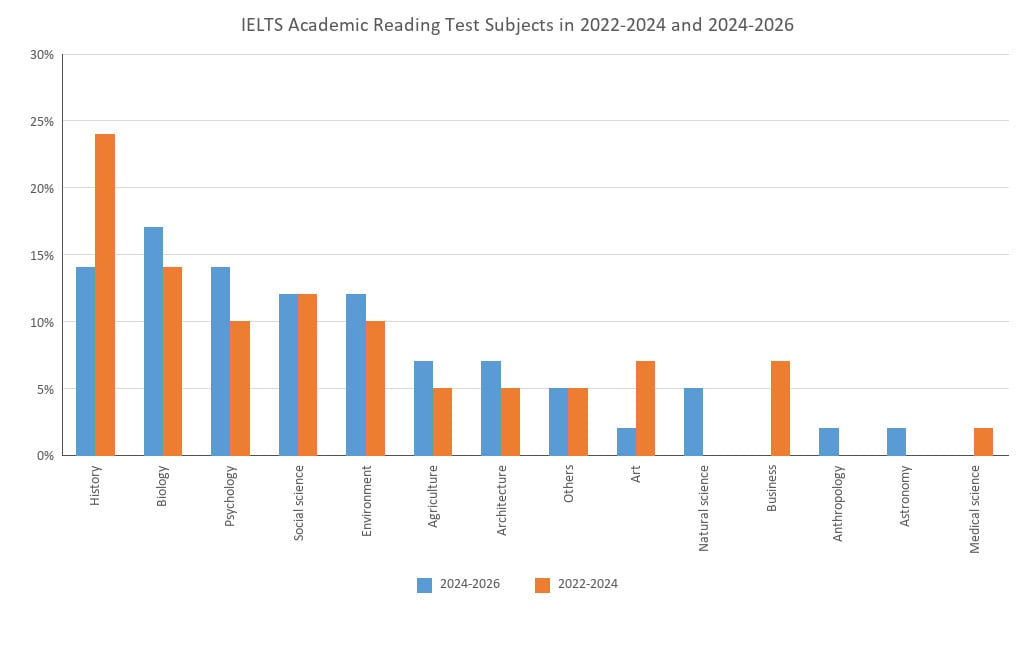
Dahil sa mga trend na ito, tiniyak naming sinasaklaw ng aming mga IELTS reading practice test ang mga paksang ito. Nagdagdag rin kami ng reading samples mula sa hindi gaanong ginagamit na mga paksa, sakaling kailanganin. Mahalaga na maghanda ka para sa lahat ng sitwasyon, dahil hindi mo alam kung anong IELTS reading topic ang iyong makukuha.
Paano Kinakalkula ang iyong IELTS Reading Score
Bawat IELTS reading question ay nagkakahalaga ng 1 puntos, kaya makakakuha ka ng "raw" score na hanggang 40 puntos. Pagkatapos, ang iyong raw score ay iko-convert sa iyong band score. Ang mga talahanayan sa ibaba ay maaaring magbigay sa iyo ng pangkalahatang ideya tungkol sa kung paano kino-convert ang raw IELTS reading scores sa band scores para sa bawat test.
IELTS General Reading Score VS IELTS Academic Reading Score
| Raw Scores: Academic | Band Scores: Academic | Raw Scores: General | Band Scores: General |
|---|---|---|---|
| 39-40 | 9 | 40 | 9 |
| 37-38 | 8.5 | 39 | 8.5 |
| 35-36 | 8 | 37-38 | 8 |
| 33-34 | 7.5 | 36 | 7.5 |
| 30-32 | 7 | 34-35 | 7 |
| 27-29 | 6.5 | 32-33 | 6.5 |
| 23-26 | 6 | 30-31 | 6 |
| 19-22 | 5.5 | 27-29 | 5.5 |
| 15-18 | 5 | 23-26 | 5 |
| 13-14 | 4.5 | 19-22 | 4.5 |
| 10-12 | 4 | 15-18 | 4 |
| 8-9 | 3.5 | 12-14 | 3.5 |
| 6-7 | 3 | 9-11 | 3 |
| 4-5 | 2.5 | 6-8 | 2.5 |
| 1-3 | 2 | 1-5 | 2 |
Gayunpaman, tandaan na bawat bersyon ng IELTS reading test ay bahagyang naiiba at ang iskor na kinakailangan upang makamit ang isang partikular na band ay nagbabago depende sa kung paano nagperform ang lahat ng kumuha ng test sa araw na iyon. Samakatuwid, ang bilang ng mga tamang sagot na kailangan upang makakuha ng band score ay magkakaiba nang bahagya sa bawat test, ngunit sa pangkalahatan dapat mong layunin na makakuha ng halos 30 sa 40 kung gusto mong makakuha ng band 7 score.
Isa pang bagay na gusto naming ipaalala sa iyo ay na ang pinakamahirap at pinakamadaling mga tanong ay pantay na binibigyan ng halaga sa iyong huling reading score, kaya tiyaking hindi ka nawawalan ng mas madaling puntos dahil naipit ka sa mas mahirap na mga tanong. Sunod ay sasakupin namin ang ilang IELTS reading tips at estratehiya kung paano sagutin ang bawat reading test question.
IELTS Reading Tips - Paano Sagutin ang 11 Uri ng Reading Question
May 11 na magkakaibang uri ng tanong sa reading test at lahat ng mga ito ay nangangailangan ng iba't ibang estratehiya.
May halimbawa at sagot ang bawat uri sa gabay na mga uri ng tanong sa IELTS Reading.
- Question Type 1 – Matching Information
- Question Type 2 – Matching Headings
- Question Type 3 – Matching Features
- Question Type 4 – Identifying Information
- Question Type 5 – Identifying Writer's Views/claims
- Question Type 6 – Multiple Choice
- Question Type 7 – Matching Sentence Endings
- Question Type 8 – Sentence Completion
- Question Type 9 – Summary, Note, Table, Flow-chart Completion
- Question Type 10 – Diagram Label Completion
- Question Type 11 – Short Answer Questions
- Paano Makakatulong sa Iyo ang mga Trend na Maghanda para sa IELTS Reading Test
Paano Makakatulong sa Iyo ang mga Trend na Maghanda para sa IELTS Reading Test
Aling mga uri ng tanong sa pagbasa ang pinakamahirap para sa aming mga mag-aaral
Nakasagot na ang mga mag-aaral ng BestMyTest ng isang milyong tanong sa Academic Reading at 600,000 tanong sa General Training Reading sa aming mga pagsusulit sa pagsasanay. Ipinapakita ng porsiyento kung gaano kadalas nasasagot nang tama ang bawat uri ng tanong.
| Uri ng tanong | Academic | General Training |
|---|---|---|
| Pagtutugma ng impormasyon | 34% | 72% |
| Tama / Mali / Hindi Binanggit | 39% | 60% |
| Pagpili ng tamang sagot | 43% | 48% |
| Pagtutugma ng mga katangian | 48% | 74% |
| Pagkumpleto ng pangungusap | 49% | 75% |
| Pagtutugma ng mga pamagat | 53% | 40% |
| Oo / Hindi / Hindi Binanggit | 55% | 57% |
| Pagkumpleto ng buod | 59% | 46% |
| Maikling sagot | 54% | 75% |
- Sa Academic Reading ang dalawang uri na may pinakamababang porsiyento ng tamang sagot ay pagtutugma ng impormasyon at Tama/Mali/Hindi Binanggit, na parehong mas mababa sa 40%. Parehong nangangailangan ng paghahanap ng ideyang ipinahayag sa ibang pananalita sa halip na ng kaparehong susing salita.
- Sa General Training baligtad ang sitwasyon: ang pagtutugma ng mga pamagat ang may pinakamababang porsiyento ng tamang sagot na 40%, samantalang ang mga uri ng tanong na nangangailangan ng paghahanap ng impormasyon ay nasasagot nang tama sa tatlo sa bawat apat na pagkakataon dahil mas maikli at mas literal ang mga teksto.
- Ang mga tanong tungkol sa mga teksto sa Academic ay nasasagot nang tama sa average na 46%, at ang mga tanong tungkol sa mga teksto sa General Training ay 59%. Kalahati ng mga pagtatangkang sagutin ang mga tanong tungkol sa mga teksto sa Academic ay nakakakuha ng iskor na 40% o mas mababa.
- Sa 43,711 buong pagsusulit sa pagsasanay sa pagbasa na kinuha ng 38,534 mag-aaral, ang average na band score ay 5.4. Umabot sa band 6.0 ang 36% at umabot sa band 7.0 ang 14%.
- Kailangan mo pa ring maghanda para sa bawat uri, pero kung limitado ang oras mo, ipinapakita ng talahanayan kung saan mo ito pinakamainam na magagamit.
Ang mga bilang ay mula sa datos ng mga pagsusulit sa pagsasanay at pagrerepaso sa BestMyTest hanggang Oktubre 2026. Ang mga porsiyento para sa bawat uri ng tanong ay ang mga antas ng tamang sagot sa lahat ng pagtatangka; ang mga bilang para sa pamantayan ay mga iskor mula sa tutor o AI ayon sa nakasaad sa label. Huling na-update noong 5 Oktubre 2026.
Susunod ay lalampasan namin ang IELTS reading tips at estratehiya na kinakailangan para sa mataas na reading score.
IELTS Reading Tips - Paano Pahusayin ang iyong Reading Band Score
Karamihan sa mga estudyante ay nabibigo sa reading section dahil sa sumusunod na tatlong dahilan
- Mabagal na bilis ng pagbasa
- Mahinang bokabularyo
- Kakaunti o walang paghahanda
Pagpapahusay sa iyong bilis ng pagbasa
Una, alisin natin ang halatang bagay. Upang pahusayin ang iyong bilis ng pagbasa, kailangan mong aktwal na sanayin ang pagbasa at gawin ito nang tuluy-tuloy.
Ngayon ay tingnan natin ang isang hindi gaanong halatang estratehiya na makakatulong sa iyong maunawaan ang kahulugan ng malalaking piraso ng pangungusap. Magsimula sa pamamagitan ng pag-aanalisa ng pangungusap. Gawin ito sa pamamagitan ng paghahanap sa simuno at panaguri ng pangungusap. Ang paghanap sa simuno at panaguri ay makakatulong sa iyong maunawaan ang kahulugan ng pangungusap. Isang dahilan kung bakit ang mga academic reading passage ay maaaring mahirap maunawaan ay dahil pinagsasama nila ang mga sunud-sunod na ideya upang bumuo ng mahabang pinagsamang pangungusap. Ito ay gumagawa ng malalaking piraso ng pangungusap na mas mahirap matunaw, kaya ang paggamit ng simuno at panaguri bilang iyong gabay sa pag-unawa sa buong piraso ay isang mahusay na tool na maaari mong gamitin sa panahon ng iyong IELTS reading exam.
Pagpapahusay sa iyong bokabularyo
Maraming tao ang nag-aakalang ang pagsagot sa mga reading question ay kasing simple ng pagtingin sa talata para sa mga keyword at impormasyon...Buweno, sa kasamaang-palad, hindi ganoon kasimple. Ang mga reading question ay karaniwang paraphrased, ibig sabihin, ang mga salita ay binago upang gamitin ang mga synonym ng mga salita mula sa IELTS reading passage. Ginagawa ito upang dagdagan ang kahirapan, kung hindi, ang test ay magiging napakadali. Dahil dito, kailangan mong pahusayin ang iyong bokabularyo upang malaman ang maraming iba't ibang synonyms ng isang salita.
Habang naghahanda ka para sa reading test at nakatagpo ka ng salita na hindi mo alam, gawing kaugalian ang alinman sa pagtigil at paghahanap nito o hindi bababa sa pagsulat nito at paghahanap nito mamaya. Medyo nakakapagod ito, ngunit napakaepektibo. Ang iyong layunin ay dapat, ngunit hindi limitado sa, pag-aaral ng 15 hanggang 20 bagong akademikong salita araw-araw.
Pag-alam kung saang uri ng tanong ang mga sagot ay nasa/hindi nasa pagkakasunud-sunod
Mahalagang malaman na para sa ilang uri ng tanong, ang mga sagot ay karaniwang (halos palaging) nasa parehong pagkakasunud-sunod tulad ng IELTS reading passage. Para sa iba pang mga uri ng tanong, ang mga sagot ay bihirang nasa parehong pagkakasunud-sunod tulad ng reading passage. Nakumpleto namin ang isang talahanayan para sa mga uri ng tanong na sumusunod at ang mga hindi. Pakitandaan.
| Ang mga sagot ay karaniwang (halos palaging) nasa parehong pagkakasunud-sunod tulad ng passage | Ang mga sagot ay bihirang nasa parehong pagkakasunud-sunod tulad ng passage. |
|---|---|
|
|
Paghahanap ng pinakamahusay na reading strategy para sa iyo
Ang pinakamalaking hamon na kinakaharap ng karamihan sa mga tao sa IELTS reading exam ay ang pagkumpleto ng lahat ng reading question bago maubos ang oras. Sa susunod na seksyon, matututunan mo ang tatlong estratehiya at nasa iyo ang malaman kung alin ang pinakaangkop sa iyo. Gagawin mo iyon gamit ang aming libreng reading practice.
3 Estratehiya sa IELTS Reading
Estratehiya 1: Pagbasa ng buong passage tapos sasagutin ang mga tanong.
Una sa lahat, hindi ito gaanong isang estratehiya. Ito ay isang bagay na ginagawa ng mga tao kapag hindi sila maayos na naghahanda para sa reading exam. Gayunpaman, isinama namin ito bilang isang estratehiya dahil, sa teknikal na pakahulugan, kung makakapanatili ka ng impormasyon mula sa passage sa iyong unang pagbasa at makakasagot sa mga tanong, hindi mo kakailanganin ang estratehiya 2.
Ang estratehiyang ito, kung wala kang mas mahusay kaysa sa karaniwang memorya, ay hindi epektibo. Maaaring maubusan ka ng oras bago mo masagot ang lahat ng mga tanong. Maraming tao ang gumagawa ng pagkakamaling ito. Gayunpaman, may ilang mga tanong na hindi nangangailangan ng malaking pagsisikap at makikinabang sa estratehiyang ito tulad ng Kung ang tanong ay isang "Yes" o "No" na sagot, sa gayon ay maaari kang mag-skim nang mabilis at hanapin ang sagot nang mabilis, ngunit walang sapat na mga uri ng tanong na ito, kaya hindi ito ipinapayong gamitin ang estratehiyang ito maliban kung kaya mo ito.
Estratehiya 2: Pagbasa muna ng mga tanong, basahin para sa isang layunin at kumuha ng mga note, at pagkatapos ay sagutin ang mga tanong nang matalino
Ito ang aming inirerekomendang estratehiya. Makakatulong ito sa iyong makakuha ng mas mataas na IELTS reading score. Isipin ito bilang isang malinaw na mapa kung paano sa pangkalahatan ay lapitan ang exam:
Isa sa mga pinaka-karaniwang pagkakamali na ginagawa ng mga kandidato kapag
nilalapitan ang reading exam ay pagbasa ng bawat salita ng IELTS reading passages. Bagama't maaari mong
sanayin para sa exam sa pamamagitan ng pagbasa para sa kasiyahan, ang "blindly reading" (pagbasa nang walang anumang ideya
kung ano ang itatanong ng mga tanong) ay hindi makatutulong sa iyo sa exam. Sa halip, ito ay makakasama sa iyong
pagkakataon na epektibong pamahalaan ang iyong oras at makuha ang pinakamahusay na iskor.
Ang pangunahing dahilan upang basahin muna ang mga tanong ay dahil ang uri ng tanong ay maaaring
tukuyin kung ano ang babasahin mo sa passage o kung paano mo ito basahin. Halimbawa, ang ilang uri ng tanong ay tatawag para sa
"skimming" na teknika, habang ang iba ay maaaring tumawag para sa "scanning" na teknika.
Mahalagang harapin ang isang set ng mga tanong na nasa parehong uri ng tanong.
Kakailanganin mong tukuyin kung aling uri ng tanong ang gusto mong harapin muna.
Magandang estratehiya na magsimula sa mas madaling uri ng tanong at lumipat sa mas mahirap na uri ng tanong sa bandang huli.
Ang pinakamadaling uri ng tanong ay ang mga isa kung saan gumugugol ka ng mas kaunting oras sa pagbasa.
Halimbawa, ang uri ng tanong na Matching Heading ay isang mas madali dahil
kailangan mo lang hanapin ang heading na pinakamahusay na naglalarawan sa pangunahing ideya ng isang talata.
Ang isang halimbawa ng mahirap na uri ng tanong ay Identifying Information. Para sa uri ng tanong na ito,
kakailanganin mong basahin ang bawat talata upang malaman kung bawat pahayag ay TRUE, FALSE, o NOT GIVEN ayon sa passage.
Narito ang isang talahanayan na naglilista ng mga antas ng kahirapan para sa bawat uri ng tanong. Gamitin ang talahanayang ito bilang sanggunian kapag pumipili kung aling uri
ng tanong ang gusto mong harapin muna.
| Antas ng Kahirapan | Uri ng Tanong |
|---|---|
| Madali | Match Headings Short answer |
| Katamtaman |
Matching Sentence Endings Matching Features Multiple choice Sentence Completion Diagram Label, Summary, Note, Table, Flow-Chart Completion |
| Mahirap |
Match Information Identifying Information (TRUE/FALSE/NOT GIVEN) Identifying Viewer's claims (YES/NO/NOT GIVEN) |
Pagkatapos mong basahin ang mga tanong mula sa IELTS text, magagawa mong magbasa para sa isang layunin. Ano ang ibig sabihin nito? Halimbawa, kung makakatagpo ka ng isang tanong na kasama ang taong "1896", maaari kang gumawa ng note kung kailan lumitaw ang taong ito sa teksto, gamit ito upang sagutin ang tanong sa bandang huli.
May dalawang teknik sa pagbasa na makakatulong sa iyong manatili sa tamang landas sa pagbasa para sa isang layunin. Ang una, skimming, ay pinakamahusay na nailalarawan bilang pagbasa nang mabilis upang makuha ang "gist", o pangkalahatang ideya, o ng isang passage. Sa teknik na ito, hindi ka humihinto para sa anumang hindi pamilyar na salita o naghahanap ng mga partikular na detalye. Ang ikalawang teknik, scanning, ay pinakamahusay na nailalarawan bilang pagbasa para sa partikular na impormasyon. Sa teknik na ito, hindi ka nagbabasa para sa kabuuang ideya, kundi sa partikular na impormasyon. Pansinin kung paano ang bawat isa sa mga teknik na ito ay may partikular na layunin sa isip. Ito ang makakatulong sa iyong makahanap ng impormasyon nang mas mabilis.
Habang nagbabasa ka para sa isang layunin, dapat ka rin gumawa ng mga note sa mga margin ng passage, naglalagay ng mga bituin sa tabi ng mahalagang impormasyon, o salungguhitan ang mga bagay na sa palagay mo ay makakatulong sa iyong sagutin ang iba't ibang mga tanong. Ito ay magpapadali sa iyong magbalik kapag tinatanong ka tungkol sa ilang bagay sa mga tanong. Pumili ng anumang note-taking system na tama para sa iyo—siguraduhing gagawin mo lang ito!
Pagkatapos mong basahin ang mga tanong, basahin ang passage, at kumuha ng anumang angkop na mga note, dapat ay natagpuan mo na ang bahagi ng teksto kung saan kailangan mong magbasa nang mabuti. Pagkatapos ay basahin ng maigi at mag-isip nang kritikal upang matukoy ang tamang sagot.
Estratehiya 3: Skimming, paggawa ng note, at mga uri ng tanong.
Ito ay isa pang estratehiya na ginagamit ng maraming IELTS test taker. Makakatulong ito sa iyong makakuha ng mas mataas na reading score. Ang estratehiya ay binubuo ng 4 na hakbang:
- I-skim ang bawat talata upang makuha ang pangkalahatang ideya ng bawat talata. Ang pangunahing ideya ng isang talata ay karaniwang matatagpuan sa unang ilang pangungusap kaya mag-focus ng kaunti pa sa mga pangungusap na iyon. Ang mga sumusunod na pangungusap ay maaaring i-skim nang mabilis, sinasalungguhitan ang mga pangalan/salita/parirala na lumilitaw.
- Pagkatapos i-skim ang bawat talata, magsulat ng maikling note (2-5 salita) sa tabi ng bawat talata na may iyong pinakamahusay na hula tungkol sa pangunahing ideya ng talatang iyon.
- Sunod, sagutin ang isang set ng mga tanong na nasa parehong uri ng tanong.
- Sa wakas, sagutin ng mahusay at tama ang isang set ng mga tanong.
Mahalaga na hindi ka gumugol ng higit sa 3-5 minuto sa Hakbang 1 at 2. Ang paggugol ng masyadong maraming oras sa mga hakbang na ito ay masasayang ng masyadong maraming oras at maaaring maubusan ka ng oras.
Hakbang 1 & 2Ang layunin dito ay upang mag-set up ng isang epektibong paraan upang makahanap ng mga sagot sa passage. Sa pamamagitan ng pagsulat ng pangkalahatang ideya ng bawat talata, malalaman mo kung aling talata ang naglalaman ng sagot sa bawat tanong. Ito ay makakatipid ng maraming oras dahil kung hindi mo ito isinulat, malamang ay kakailanganin mong i-skim ang bawat talata para sa pangkalahatang ideya ng tanong, pagkatapos ay kakailanganin mong maingat na i-scan ang talata para sa sagot. Sa pamamagitan ng pagsulat sa pangunahing ideya ng bawat talata, maaari mong laktawan ang unang hakbang ng skimming sa bawat talata at simulan ang pag-scan para sa sagot.
Hakbang 3
Pagkatapos mong masusing i-skim ang teksto at nakapagsulat ng ilang mga note, handa ka na para sa Hakbang 3.
Sa hakbang na ito, kakailanganin mong tukuyin kung aling uri ng tanong ang gusto mong harapin muna.
Magandang estratehiya na magsimula sa mas madaling uri ng tanong at lumipat sa mas mahirap na uri ng tanong sa bandang huli.
Ang pinakamadaling uri ng tanong ay ang mga isa kung saan gumugugol ka ng mas kaunting oras sa pagbasa.
Halimbawa, ang uri ng tanong na Matching Heading ay isang mas madali dahil
kailangan mo lang hanapin ang heading na pinakamahusay na naglalarawan sa pangunahing ideya ng isang talata, kaya sa teknikal kailangan mo lang ang Hakbang 1 at 2 upang sagutin ang uri ng tanong na ito.
Ang isang halimbawa ng mahirap na uri ng tanong ay Identifying Information. Para sa uri ng tanong na ito,
kakailanganin mong basahin ang bawat talata upang malaman kung bawat pahayag ay TRUE, FALSE, o NOT GIVEN ayon sa passage.
Narito ang isang talahanayan na naglilista ng mga antas ng kahirapan para sa bawat uri ng tanong. Gamitin ang talahanayang ito bilang sanggunian kapag pumipili kung aling uri ng tanong ang gusto mong harapin muna.
| Antas ng Kahirapan | Uri ng Tanong |
|---|---|
| Madali | Match Headings Short answer |
| Katamtaman |
Matching Sentence Endings Matching Features Multiple choice Sentence Completion Diagram Label, Summary, Note, Table, Flow-Chart Completion |
| Mahirap |
Match Information Identifying Information (TRUE/FALSE/NOT GIVEN) Identifying Viewer's claims (YES/NO/NOT GIVEN) |
Ngayong nalaman mo na kung aling set ng mga tanong ang sasagutin mo muna, panahon na para aktwal na sagutin ang mga ito :( Huwag mag-alala! Bagama't ang bawat uri ng tanong ay magkakaiba, ang estratehiya upang sagutin ang mga ito nang tama ay nalalapat sa lahat ng mga ito. Ang pangunahing prinsipyo ay simple, sundan lang ang mga hakbang sa ibaba:
- Basahin ang tanong nang mabuti at tukuyin ang mahahalagang keyword.
- Hanapin ang talata na naglalaman ng impormasyong kailangan upang sagutin ang tanong. (Sana ay isinulat mo na ang mga pangkalahatang ideya para sa bawat talata, kaya madali mong matutukoy ito.)
- I-scan ang talata para sa mahahalagang keyword (Malamang sila ay mga synonyms!) hanggang sa mahanap mo ang bahagi ng teksto kung saan kailangan mong maingat na magbasa.
- Sa wakas, basahin ng maigi at mag-isip nang kritikal upang matukoy ang tamang sagot.
Libreng IELTS Reading Sample PDF Downloads na may mga Sagot
Sa ibaba ay ilang libreng reading samples mula sa British Council (ang gumagawa ng IELTS exam). Subukang sagutin ang mga tanong at tingnan kung paano ka nagperform!