
Sa gabay na ito, kukuha ka ng libreng IELTS listening test at makakatanggap ng kumpletong pagsusuri ng iyong IELTS listening score. Maghahanda ka gamit ang mahigit 125 IELTS listening practice tests, mga aralin, mga tip, at mga video na paliwanag ng sagot. Sa pagsunod sa aming personalisadong study plan, makakamit mo ang target mong IELTS listening band score.
Makakuha ng libreng pagsusuri ng IELTS listening score at personalized na study plan matapos mong matapos ang libreng IELTS listening practice test.
play_circle_outline Simulan ang IELTS Listening Practice TestNasa ibaba ang aming kumpletong listahan ng IELTS listening questions na may mga sagot. Tandaan: Ang mga pulang link ang aming pinakapopular at pinakairekomendang listening questions ayon sa aming mga estudyante, at maaari mo silang i-practice nang libre kahit kailan.
Mga Tanong sa Practice Test ng IELTS Listening Section 1 1 - 59
A conversation between two people in an everyday situation
Mga Tanong sa Practice Test ng IELTS Listening Section 2 1 - 75
A talk by one speaker about an everyday topic
Mga Tanong sa Practice Test ng IELTS Listening Section 3 1 - 65
A conversation between up to four people about studies or training
Mga Tanong sa Practice Test ng IELTS Listening Section 4 1 - 62
A talk by one speaker on an academic subject
Gabay sa IELTS Listening Practice Test
Ang natitirang bahagi ng gabay na ito ay magtuturo sa iyo ng lahat tungkol sa IELTS listening test. Matututunan mo kung paano kinakalkula ang listening score, matututunan kung paano sagutin nang matagumpay ang bawat uri ng listening question upang mapabuti ang iyong IELTS listening band score, at matututunan ang aming nasubok na 3-hakbang na proseso upang tulungan kang mag-aral ng IELTS listening tests online.
Talaan ng Nilalaman
Impormasyon sa IELTS Listening Test
Ang IELTS Listening Test ay nahahati sa 4 na seksyon. Sa bawat seksyon, makikinig ka sa isa o higit pang katutubong nagsasalita ng Ingles pagkatapos ay sasagot ng mga 10 na tanong na may kaugnayan sa kung ano ang kararinig mo. Ang buong IELTS listening section ay naglalaman ng kabuuang 40 tanong. Sa pangkalahatan, ang mga listening recording ay nagsisimulang mas madali at nagiging mas mahirap habang umuusad ka sa exam. Ang bawat recording ay maririnig nang isang beses lamang at may kasamang iba't ibang accent, kasama ang British, Australian, New Zealand, American, at Canadian.
- Section 1 – isang pag-uusap sa pagitan ng dalawang tao sa konteksto ng pang-araw-araw na panlipunan. Halimbawa, maaaring marinig mo ang isang pag-uusap tungkol sa pagkumpirma ng mga detalye para sa reservation, o paglalagay ng order sa telepono.
- Section 2 - isang monologue sa konteksto ng pang-araw-araw na panlipunan. Halimbawa, maaaring marinig mo ang isang talumpati tungkol sa mga lokal na pasilidad, o isang taong nagbibigay ng direksyon, o nagpapakita ng pangunahing impormasyon tungkol sa isang kaganapan.
- Section 3 – isang pag-uusap sa pagitan ng hanggang apat na tao sa konteksto ng edukasyon o pagsasanay. Halimbawa, maaaring marinig mo ang isang university tutor at isang estudyante na nag-uusap tungkol sa isang assignment, o ilang estudyanteng nag-uusap tungkol sa isang bagay mula sa klase.
- Section 4 - isang monologue tungkol sa isang akademikong paksa. Halimbawa, maririnig mo ang isang university lecture mula sa isang propesor. Ito ang pinakamahirap na recording sa Listening exam para sa karamihan ng mga estudyante.
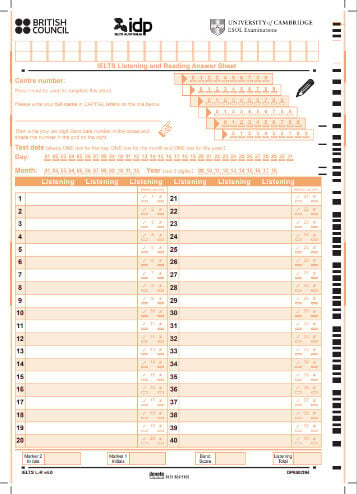
Ang IELTS Listening Test ay tumatagal ng mga 40 minuto. Gumugol ka ng 30 minuto sa pakikinig sa mga recording at pagsagot ng mga tanong. Bibigyan ka ng Question Booklet at Answer Sheet. Ang Question Booklet ay kung saan mo makikita ang lahat ng mga tanong na kailangan mong sagutin. Ang Answer Sheet ay kung saan mo isusulat ang iyong mga pinal na sagot para sa pagmamarka.
Maaari mong tingnan ang opisyal na IELTS listening answer sheet pdf dito o tingnan lang ang larawan sa ibaba :)
Sa pagtatapos ng listening section, bibigyan ka ng 10 minuto upang ilipat ang mga sagot mula sa iyong Question Booklet patungo sa iyong Answer Sheet.
MAHALAGA!
Ang mga maling baybay at maling gramatika ay minamarkahan na MALI, kaya gamitin ang 10 minuto upang dobleng suriin ang iyong baybay at gramatika.
Pagkalkula ng IELTS Listening Score
Sa Listening section, ang bawat tanong ay nagkakahalaga ng 1 puntos, kaya makakakuha ka ng "raw" score na hanggang 40 puntos. Pagkatapos, ang iyong raw score ay iko-convert sa iyong band score. Tandaan! Hindi ka mawawalan ng puntos para sa mga maling sagot. Ang talahanayan sa ibaba ay maaaring magbigay sa iyo ng pangkalahatang ideya tungkol sa kung paano kino-convert ang raw scores sa band scores.
| Raw scores | Band scores |
|---|---|
| 39-40 | 9 |
| 37-38 | 8.5 |
| 35-36 | 8 |
| 32-34 | 7.5 |
| 30-31 | 7 |
| 26-29 | 6.5 |
| 23-25 | 6 |
| 18-22 | 5.5 |
| 16-17 | 5 |
| 13-15 | 4.5 |
| 11-12 | 4 |
Dahil bawat bersyon ng IELTS ay bahagyang naiiba, ang raw score na kinakailangan upang makakuha ng partikular na band score ay nag-iiba depende sa kung paano nagperform ang lahat ng kumuha ng test sa araw na iyon. Kaya, ang bilang ng mga tamang sagot na kailangan upang makakuha ng band score ay magkakaiba nang bahagya mula sa test patungo sa test, ngunit sa pangkalahatan dapat mong layunin na makakuha ng halos 30 sa 40 kung gusto mong makakuha ng band score na 7.
Tulad ng nabanggit sa itaas, ang mga seksyon ay lalong nagiging mahirap habang sumusulong ka sa IELTS listening test. Gayunpaman, bawat tanong ay nagkakahalaga ng parehong bilang ng puntos. Samakatuwid, tiyakin na hindi ka nawawalan ng mas madaling puntos dahil naipit ka sa mahirap na mga tanong.
Libreng IELTS Listening Sample PDF Download na may mga Sagot
Narito ang ilang libreng IELTS listening samples sa PDF format na may mga sagot mula sa British Council (ang gumawa ng IELTS exam). Sa ibaba ng mga link, puwede mo ring sagutan nang libre ang isang IELTS listening test na may audio at mga sagot mula sa BestMyTest. Kumpleto ito sa apat na section, at bawat section ay nagpapakita ng audio script kasama ang mga sagot. Subukang sagutin ang mga tanong at tingnan kung paano ka nagperform!
- IELTS Listening Practice Test 1- questions (Online Examples)
- IELTS Listening Practice Test 1- answers (PDF)
- IELTS Listening Practice Test 1- answer sheet (PDF)
Listen to the recording and answer questions 1 to 10. The answers and the audio script are in the box below the questions.
Questions 1-10
Complete the notes below.
Write ONE WORD AND/OR A NUMBER for each answer.
This can provide the carer with:
• time for other duties
• a 1
Assessment of aunt's needs
This may involve discussing:
• how much 2 is spent caring
Daily tasks discussed:
• help with dressing
• helping her take a 3
• shopping
• helping with meals
• managing 4
• any parts of caring that are particularly hard, e.g.
• loss of 5
• 6 her
• avoiding a 7
Types of support that may be provided for carers
• transport costs, e.g. cost of a 8
• vehicle-related costs, e.g. fuel and 9
• help with housework
• support to lower 10
-
spellcheck Mga Sagot
1. Break
Break is correct because this detail is stated in the recording at the point where the question is answered.2. Time
Time is correct because this detail is stated in the recording at the point where the question is answered.3. Shower
Shower is correct because this detail is stated in the recording at the point where the question is answered.4. Money
Money is correct because this detail is stated in the recording at the point where the question is answered.5. Memory
Memory is correct because this detail is stated in the recording at the point where the question is answered.6. Lifting
Lifting is correct because this detail is stated in the recording at the point where the question is answered.7. Fall
Fall is correct because this detail is stated in the recording at the point where the question is answered.8. Minicab
Minicab is correct because this detail is stated in the recording at the point where the question is answered.9. Parking
Parking is correct because this detail is stated in the recording at the point where the question is answered.10. Anxiety
Anxiety is correct because this detail is stated in the recording at the point where the question is answered.
Audio ScriptNora: It's really good to see you, Marcus. Since I had to give up work, I feel I'm losing touch with my friends and colleagues.
Marcus: We really miss you in the office. We were all so sorry you had to leave. But you must be relieved to have more time to look after your aunt. How is she?
Nora: Well, she's very cheerful, but she needs a lot of help.
Marcus: Have you tried to get any support from the local council?
Nora: No. I didn't know I could.
Marcus: Yes. But for different kinds of practical support, they realise that carers sometimes need time for all the other responsibilities they have, apart from the person they're caring for, and also that they sometimes need a break.
Nora: Absolutely. OK, so tell me more, how do I go about getting this support?
Marcus: Well, you'd have to have an assessment of your aunt's needs. That means someone would come round and talk to you about the situation and what you need. So for a start, they'd want to know the amount of time you spend looking after your aunt every day.
Nora: OK.
Marcus: Then they'll probably ask you what sorts of tasks you do for your aunt during the day. Things like if she needs help with getting dressed, for example.
Nora: Right. I help her with that. And also I help her get into the shower in the morning.
Marcus: Yes. That sort of thing. They'll probably ask you if you do the shopping for her, and help her at meal times, and whether she can cope using money.
Nora: Yes. That's becoming a bit of a problem. She used to be very good at it, but not anymore.
Before you hear the rest of the conversation, you have some time to look at questions 5 to 10. [20 seconds] Now listen, and answer questions 5 to 10.Marcus: And be ready to tell them about anything you find particularly difficult about caring for your aunt.
Nora: So recently I've noticed she started to have quite bad problems with her memory. If I wasn't there, I think she'd forget to eat, for example. And often she doesn't seem quite sure what day it is.
Marcus: Yes. Tell them about that. And are there any physical difficulties you have caring for her? Lifting her, for example.
Nora: Yes. She's quite heavy, and I'm afraid of hurting my back. I'd be in real trouble if that happened.
Marcus: They can give you advice about that, and also about how to avoid the possibility of your aunt having a fall.
Nora: Great. So, once they've done this assessment, if I'm eligible, what happens next?
Marcus: Well, they might support you financially. So they might help you with travel costs, like if you have to get a minicab to take your aunt for an appointment, for example.
Nora: I usually drive her myself, actually. So could I claim for the petrol?
Marcus: You could. And you can claim for the parking, too.
Nora: Oh, right.
Marcus: And if you need help with the housework, they can arrange for someone to come along once or twice a week. And one other thing. I hope you don't mind me saying this, but it's important you look after yourself. And it seems to me you're dealing with quite a bit of anxiety.
Nora: I am, yes.
Marcus: Well, tell the council, because they may be able to give you some advice on how to minimise it.
Nora: Really? Though, actually, I feel so much better having talked to you. I'll get in touch with the council straight away. Now, shall we go for coffee, or something?
Listen to the recording and answer questions 11 to 20. The answers and the audio script are in the box below the questions.
Questions 11-14
Choose the correct letter, A, B or C.
11. Who began turning the unused Whitfield site into a planted space?
- city council officials.
- nearby residents.
- a gardening charity.
12. What was Lillian Hartley trying to achieve through public campaigning?
- preventing a housing sale
- blocking army exercises
- winning maintenance funding
13. Why was the park rejected as a place for troop exercises?
- council permission was refused.
- too little usable space.
- a better site was chosen.
14. How does the speaker describe the latest redesign plans?
- 2013 plan used unchanged.
- 2013 plan revised pre-work.
- 2015 plan finished in 2016.
Questions 15-20
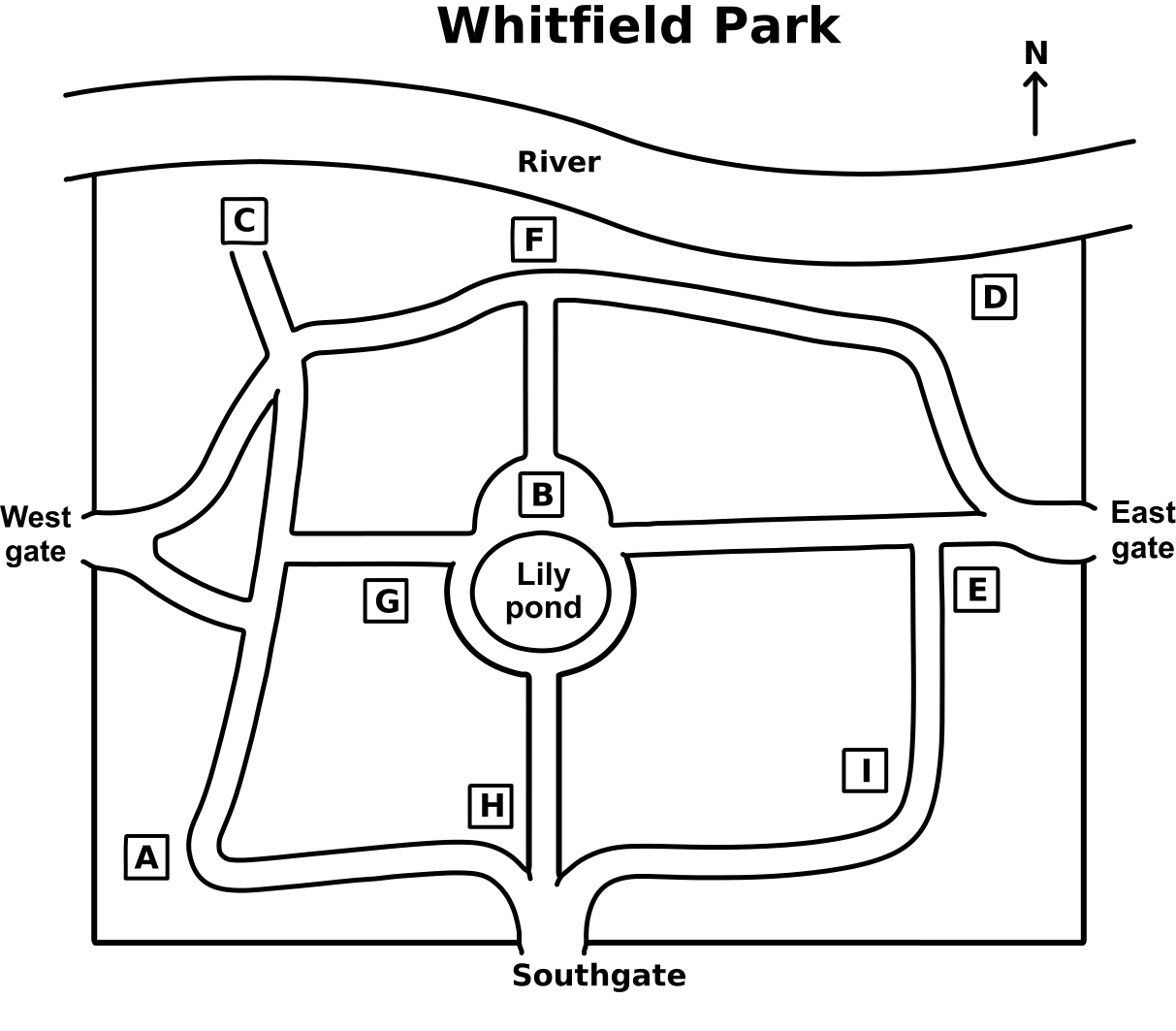
Label the plan of Whitfield Park below.
Write the correct letter, A-I, next to questions 15-20.
- statue of Lillian Hartley
- wooden sculptures
- playground
- maze
- tennis courts
- fitness area
-
spellcheck Mga Sagot
11. B
(A) is incorrect. The council took ownership later.(B) is correct. The initial planting was done by residents from nearby streets.
(C) is incorrect. The recording does not support this option: a gardening charity.
12. A
(A) is correct. Hartley organised public pressure so the council would keep the land as a park rather than sell it for housing.(B) is incorrect. The recording does not support this option: blocking army exercises.
(C) is incorrect. The recording does not support this option: winning maintenance funding.
13. B
(A) is incorrect. The recording does not support this option: council permission was refused.(B) is correct. , after inspection, the army concluded that the park was too small for practical use.
(C) is incorrect. The recording does not support this option: a better site was chosen.
14. B
(A) is incorrect. The recording does not support this option: 2013 plan used unchanged.(B) is correct. The plans dated from 2013 but were revised in 2015 before work began.
(C) is incorrect. The recording does not support this option: 2015 plan finished in 2016.
15. B
The correct answer is B because the statue of Lillian Hartley is now immediately north of the lily pond near the centre of the park, and that position is labelled B.16. D
The correct answer is D because the wooden sculptures are on the riverbank where the path from the East Gate makes a sharp bend, which corresponds to D.17. F
The correct answer is F because the playground is between the river and the path from the lily pond to the river, and that location is marked F.18. C
The correct answer is C because the maze is found by entering from the West Gate, walking north, and turning left, which places it at C.19. A
The correct answer is A because the tennis courts remain in the southern corner where the perimeter path makes a right-angled bend, labelled A.20. G
The correct answer is G because the fitness area is beside the lily pond on the same side as the West Gate, matching G on the plan.
Audio ScriptI'm delighted this evening to introduce our guest speaker, Sarah Holloway, who is going to talk to us about the recent transformation of Whitfield Park. Over to you, Sarah. Thank you very much. I'm sure you all know Whitfield Park well, it has been one of the city's landmarks for well over a century, and the city council has been responsible for it for most of that time. What perhaps fewer of you will know is how the park actually began.
Unlike many city centre parks, which started life as the private gardens of a large house, Whitfield was originally just an unused patch of waste ground. The first flowers there were actually planted by a small group of local residents who lived in the surrounding streets. They began work on the site in 1892. At that point nobody was entirely sure who legally owned the land, and it was a full twenty years later before the city council finally took it into public ownership. Some of you will have seen the statue near one of the gates. That figure is Lillian Hartley, who played a really important role in the early history of the park.
Once the council legally owned the land, its first instinct was to sell it off as building plots for housing. A great many local residents, however, wanted the park to stay open as a place where everyone could enjoy fresh air and green space, bear in mind that this is a very densely built up residential district. Lillian Hartley was at the heart of that campaign, and it was she who organised the petitions and the public demonstrations which, in the end, persuaded the council to drop the sale and keep the land as a park.
Soon afterwards, in 1914, the First World War broke out, and most of the park was dug up and used to grow vegetables, which were sold to local residents. At one point the army did look into taking over the park as a site for troop exercises. They actually wrote to the city council about it, but when they inspected it they concluded that the park was simply too small to be of any practical use to them, so the idea was dropped. The only military activity in the park during the war was the occasional public meeting held on a small area of grass that had been kept clear of vegetable plots.
After the war, the park was largely returned to the way it had been before 1914, and from then on it remained almost unchanged for decades. New plans for transforming the park were drawn up several times over the years; the most recent version dates from 2013, but those plans were then revised in 2015, well before any actual work had got under way. Work on the ground finally began in 2016 and was completed, on schedule, last year.
Before you hear the rest of the talk, you have some time to look at questions 15 to 20. [20 seconds] Now listen and answer questions 15 to 20.All right, I'd like to describe some of the more important changes that have been made, and one or two things that have deliberately been left as they were. If you take a quick look at the map you've been handed, you'll see the familiar outline of Whitfield Park. The river forms the northern boundary, and there is a gate in each of the three other walls.
From there, follow the path up towards the river and the enlarged children's playground sits between that path and the river itself. If you keep your eye on the riverbank, over towards the East Gate side, the new wooden sculptures are at the point where the path coming up from that gate makes a sharp bend.
Back near the West Gate side of the park, there is a maze, a circular pattern of paths separated by low hedges. Head in from the West Gate, walk north towards the river, and then turn left to find it. Close to the same central lily pond, on the side facing the West Gate, you'll also find the new outdoor fitness area.
Down in the southern corner, where the perimeter path makes that distinct right angled bend, the tennis courts are still in their familiar position, though we have now doubled them from four to eight. Now, since you are all keen gardeners, I'm sure you'll want to hear about the plants that have been chosen for the new beds.
Listen to the recording and answer questions 21 to 30. The answers and the audio script are in the box below the questions.
Questions 21-25
Choose the correct letter, A, B or C.
21. Nina and Owen were surprised to learn that coastal cities
- are home to just under half of all people.
- account for many of the largest cities.
- are expanding at double the rate of inland cities.
22. According to Owen, building coastal cities near to rivers
- can carry contamination back towards urban areas.
- can leave too little land for farming upstream.
- can cause factories to damage rural scenery.
23. What mistake was made when building water drainage channels in Port Selby in the 1950s?
- The system did not include enough channels.
- The builders selected the wrong construction materials.
- The design failed to anticipate rising sea levels.
24. What do Nina and Owen think that the authorities in Port Selby should do immediately?
- take measures to restore coastal ecosystems
- pay for a new flood prevention system
- stop disposing of waste materials into the ocean
25. What do they agree should be the priority for international action?
- greater coordination of activities
- more sharing of information
- agreement on shared policies
Questions 26-30
What decision do the students make about each of the following parts of their presentation?
Write the correct letter, A-G, next to questions 26-30.
- use visuals
- keep it short
- involve other students
- check the information is accurate
- provide a handout
- focus on one example
- do online research
- Historical background
- Geographical factors
- Past mistakes
- Future risks
- International implications
-
spellcheck Mga Sagot
21. B
(A) is incorrect. The recording does not support this option: are home to just under half of all people.(B) is correct. Nina says most of the biggest cities are built by the sea.
(C) is incorrect. The recording does not support this option: are expanding at double the rate of inland cities.
22. A
(A) is correct. Owen says pollutants from inland agriculture and industry travel down rivers to cities.(B) is incorrect. The recording does not support this option: can leave too little land for farming upstream.
(C) is incorrect. The recording does not support this option: can cause factories to damage rural scenery.
23. C
(A) is incorrect. The recording does not support this option: The system did not include enough channels.(B) is incorrect. The recording does not support this option: The builders selected the wrong construction materials.
(C) is correct. Port Selby's drainage channels were built without allowing for global warming and rising sea levels.
24. B
(A) is incorrect. The recording does not support this option: take measures to restore coastal ecosystems.(B) is correct. Nina says they need money to replace the drainage channels for flood protection now.
(C) is incorrect. The recording does not support this option: stop disposing of waste materials into the ocean.
25. A
(A) is correct. They say coastal cities must act together internationally.(B) is incorrect. The recording does not support this option: more sharing of information.
(C) is incorrect. The recording does not support this option: agreement on shared policies.
26. B
B is correct because they decide not to spend too long on historical background, so they will keep it short.27. A
A is correct because they decide to use slides with maps showing geographical factors.28. F
F is correct because they choose the Meriton case study as the basis for past mistakes, focusing on one example.29. G
G is correct because they need to look at websites for future risks, so online research is required.30. C
C is correct because they plan to ask audience members from different places, involving other students.
Audio ScriptTutor: OK, so what I'd like you to do now is to talk to your partner about your presentations on environmental planning. You should have done most of the reading now, so I'd like you to share your ideas and talk about the structure of your presentation and what you need to do next.
Nina: OK, Owen, I'm glad we chose quite a specific topic: coastal cities. It made it much easier to find relevant information.
Owen: Yeah, and cities are growing so quickly. I mean, we know that more than half the world's population lives in cities now.
Nina: Yeah, though that's all cities, not just coastal ones. But most of the biggest cities are actually built by the sea. I'd not realised that before.
Owen: Nor me. And what's more, a lot of them are built at places where rivers come out into the sea. But apparently this can be a problem.
Nina: Why?
Owen: Well, as the city expands, agriculture and industry tend to spread further inland along the rivers. And so agriculture moves even further inland up the river. That's not necessarily a problem, except it means more and more pollutants are discharged into the rivers.
Nina: That's a serious problem.
Owen: Right.
Nina: Did you read that article about Port Selby on the south coast?
Owen: No.
Nina: Well, apparently back in the 1950s, they built channels to drain away the water in case of flooding.
Owen: Sounds sensible.
Nina: Yeah, they spent quite a lot of money on them. But what they didn't take into account was global warming. So they built the drainage channels too close to sea level. And now sea levels are rising, they're more or less useless. If there's a lot of rain, the water can't run away. There's nowhere for it to go.
Owen: So they did not help much in the end.
Nina: So what are the authorities doing about it now?
Owen: I don't know. I did read that they're aiming to stop disposing of waste water into the ocean over the next 10 years. But that won't help with flood prevention now, will it?
Nina: No, really, they just need to find the money for something to replace the drainage channels in order to protect against flooding now. But in the long term, they need to consider the whole ecosystem.
Owen: Right.
Nina: Really though, coastal cities can't deal with their problems on their own, can they? I mean, they've got to start acting together at an international level instead of just doing their own thing.
Owen: Absolutely. The thing is, everyone knows what the problems are and environmental planners have a pretty good idea of what we should be doing about them. So they should be able to work together to some extent.
Nina: But it's going to be a long time before countries come to a decision on what principles they're prepared to abide by.
Owen: Yeah, if they ever do.
Before you hear the rest of the conversation, you have some time to look at questions 26 to 30. [20 seconds] Now listen and answer questions 26 to 30.Nina: So I think we've probably got enough for our presentation. It's only 15 minutes.
Owen: OK, so I suppose we'll begin with some general historical background about why coastal cities were established. But we don't want to spend too long on that. The other students will already know a bit about it.
Nina: It's all to do with communications and so on.
Owen: Yes, we should mention some geographical factors, things like wetlands and river estuaries and coastal erosion and so on.
Nina: We could have some maps of different cities with these features marked.
Owen: On a handout, you mean, or some slides everyone can see.
Nina: Yeah, that'd be better.
Owen: It'd be good to go into past mistakes in a bit more detail. Did you read that case study of the problems there were in Meriton with flooding a few years ago?
Nina: Yes, we could use that as the basis for that part of the talk. I don't think the other students will have read it, but they'll remember hearing about the flooding at the time.
Owen: Hmm, OK. So that's probably enough background. So then we'll go on to talk about what actions have been taken to deal with the problems of coastal cities.
Nina: OK, what else do we need to talk about? Maybe something on future risks looking more at the long term if populations continue to grow?
Owen: Yeah, we'll need to do a bit of work there. I haven't got much information, have you?
Nina: No, we'll need to look at some websites. Shouldn't take too long.
Owen: OK. And I think we should end by talking about international implications. Maybe we could ask people in the audience. We've got people from quite a lot of different places.
Nina: That'd be interesting if we have time, yes. So now should we go on?
Listen to the recording and answer questions 31 to 40. The answers and the audio script are in the box below the questions.
Questions 31-36
What point does the lecturer make about each item?
Write the correct letter, A-K, next to questions 31-36.
- changes drainage
- protects animals
- increases nutrients
- kills germs
- affects many species
- creates dense shade
- alters the soil
- supports farming
- reduces competition
- attracts bell-miners
- helps recovery
- Eucalyptus woodland
- Damage to eucalyptus woodland
- Oil from eucalyptus leaves
- Lime used in construction
- Direct iron supply
- Moderate bushfires
Questions 37-40
Complete the notes below.
Write ONE WORD ONLY for each answer.
Bell-miner associated dieback:
• The process starts with insects feeding on eucalyptus 37
• A sweet liquid containing 38 attracts bell-miners
Fire patterns:
• If fires happen too often, 39 becomes the main vegetation
• When fires are almost absent, thick growth gives bell-miners protected 40 sites
-
spellcheck Mga Sagot
31. B
B is correct because eucalyptus woodland provides nesting places and shelter for birds, bats and small mammals.32. E
E is correct because damage to eucalyptus woodland affects a wider community of species, not only the trees themselves.33. D
D is correct because oil from eucalyptus leaves is used in disinfectant, where it can kill certain germs.34. G
G is correct because lime from road construction was washed into the soil and interfered with tree roots.35. K
K is correct because affected trees recovered surprisingly quickly when iron was supplied directly.36. I
I is correct because occasional fire removes fast-growing competitors that would otherwise use water needed by eucalyptus trees.37. leaves
The correct answer is leaves. The lecturer says the process begins when insects settle on eucalyptus leaves and feed on them.38. sugar
The correct answer is sugar. The lecturer says the insects produce a sweet liquid containing sugar, which attracts bell-miners.39. grass
The correct answer is grass. The lecturer says grass tends to dominate afterwards if fires occur too often.40. nesting
The correct answer is nesting. The lecturer says dense growth creates protected nesting sites for bell-miners when fire is suppressed.
Audio ScriptGood morning. Today I want to focus on the eucalyptus tree, one of the best known features of the Australian landscape. Many people call it a gum tree, but the name eucalyptus actually covers hundreds of related species, from small scrubby trees to very tall forest giants.
Now, eucalyptus trees are important in several ways. Ecologically, they provide nesting places and shelter for birds, bats and small mammals. Their flowers also produce nectar, which is an important food source for insects and birds. So when eucalyptus woodland is damaged, the effect is felt across a much wider community of species.
As for their value to people, the trees are also useful. Oil from eucalyptus leaves has long been used in cleaning products, and one common use is in disinfectant, because the oil can kill certain germs. Eucalyptus timber is also used in building and fencing, although that is not really the main focus of today's lecture.
So, these trees can live for centuries, and some individuals survive for four hundred years or more. That is why researchers became concerned when large numbers began dying much earlier than expected in different parts of Australia.
Now, one disease that attracted attention was Mundulla Yellows. The leaves of affected trees slowly turned yellow and then, over time, the whole tree declined. For years the cause was unclear. Eventually, researchers discovered that lime, or calcium hydroxide, had been used in road construction nearby. Rain washed the lime into the surrounding soil, where it interfered with the roots of eucalyptus trees. The trees were still surrounded by nutrients, but they could no longer absorb the iron they needed for healthy growth. When iron was supplied directly to affected trees, they recovered surprisingly quickly.
However, Mundulla Yellows affected only a limited number of places. A much wider problem on the east coast was Bell miner associated dieback. Now, bell miners are small native birds, but they are not the direct cause of the damage. The process begins when insects settle on eucalyptus leaves and feed on them. While feeding, these insects produce a sweet liquid containing sugar. Bell miners are attracted to that liquid, and they aggressively chase away other birds and insects that might otherwise reduce the insect population. As a result, the insects multiply, the leaves are badly damaged, and the trees gradually lose their ability to survive.
But some scientists think fire history is also part of the explanation. An influential theory, first proposed by the ecologist William Jackson, links the type of vegetation in a region to the frequency of bushfires. If fires occur too often, grass tends to dominate the area afterwards. If fires occur at moderate intervals, eucalyptus forest is more likely to persist. This is because occasional fire removes fast growing competitors which would otherwise take up the water eucalyptus trees need. And it also helps maintain the soil by preventing dense undergrowth from changing the soil structure and removing nutrients.
At the other extreme, if fires are almost completely suppressed, a different ecosystem can develop. Scientists sometimes call this dry rainforest. Now, the name sounds contradictory, because we usually associate rainforest with wet tropical conditions. But in this case it means a dense, shaded vegetation system with relatively few species. It can create excellent conditions for bell miners, because the thick growth gives them protected nesting sites while excluding many of the species that would normally compete with them.
What this tells us is that before European settlement, Aboriginal communities used controlled burning over long periods, and this probably created a more balanced pattern of vegetation. Since European settlement, fire has often been suppressed, roads and farms have altered drainage, and some local ecosystems have shifted away from eucalyptus woodland. The decline of eucalyptus trees, then, is not caused by one single factor. It is the result of disease, insects, birds, soil chemistry and fire management interacting with one another.

Completion - Part 1
Learn how to answer these questions in a step-by-step interactive exercise
Completion - Part 1
Maaaring humingi ang isang patlang ng oras o dalas. Karaniwang binabanggit ng nagsasalita ang parehong panahon sa ibang mga salita, kaya itugma ang kahulugan sa patlang sa halip na hintayin ang mga salitang nasa pahina.
Pagkatapos, suriin ang limitasyon sa bilang ng salita bago ka magsumite. Basahin muli ang buong linya kasama ang iyong sagot sa patlang at tanggalin ang anumang salitang ibinibigay na ng linya. Walang puntos ang sagot na tama ang kahulugan pero masyadong mahaba.
I-click ang i-play para pakinggan ang audio
Gumagamit ang mga tala ng simpleng pandiwa gaya ng must provide o need to bring. Bihirang sabihin ng nagsasalita ang pandiwang iyon; sa halip, gumagamit siya ng kasingkahulugan o inilalarawan ang kilos, kaya pakinggan kung ano talaga ang kinakailangan.
Madalas munang banggitin ng mga nagsasalita ang mga dagdag na item at saka ito aalisin. Kung may patlang kang nalampasan, iwan ito at lumipat sa susunod, dahil sinusunod ng mga sagot ang pagkakasunod-sunod ng recording at ang isang nawalang patlang ay puwedeng magpawala rin sa mga kasunod nito.
I-click ang i-play para pakinggan ang audio
Kumusta ang ginawa mo sa pagsagot ng mga IELTS listening sample questions sa itaas? Nahirapan ka ba sa alinman sa mga tanong? Kung oo, makikinabang kang tingnan nang mabuti ang lahat ng 6 na uri ng IELTS listening task. Habang mas naiintindihan mo ang isang uri ng task, mas kakaunti ang pagsisikap na kailanganin mong gawin upang malaman kung ano ang kailangan mong gawin at mas marami ang panahong magkakaroon ka upang malaman ang sagot.
Ang 6 na Uri ng IELTS Listening Task
May 6 na magkakaibang uri ng tanong sa IELTS listening test. Mahalagang sanayin mo ang bawat uri ng task upang matutunan ang pinakamabuting paraan upang harapin ang bawat isa para sa mataas na IELTS listening score.
Aling mga uri ng gawain sa pakikinig ang pinakamahirap para sa aming mga mag-aaral
Sa halip na isang trend noong 2017, narito ang ipinapakita ng 2.25 milyong sagot sa IELTS Listening mula sa mga mag-aaral ng BestMyTest. Ipinapakita ng porsiyento kung gaano kadalas nasagot nang tama ng aming mga mag-aaral ang ganoong uri ng gawain.
| Uri ng gawain | Tamang sagot |
|---|---|
| Pagkumpleto ng mga tala | 33% |
| Pagkumpleto ng talahanayan | 34% |
| Pagkumpleto ng pangungusap | 45% |
| Maikling sagot | 48% |
| Pagpili ng isang tamang sagot | 50% |
| Pagpili ng maraming tamang sagot | 51% |
| Paglalagay ng label sa plano, mapa, at dayagram | 55% |
| Pagkumpleto ng form | 73% |
| Pagtutugma | 85% |
- Sa mga gawaing pagkumpleto nawawala ang mga puntos. Isa lamang sa bawat tatlong sagot sa pagkumpleto ng mga tala at talahanayan ang tama, samantalang umaabot sa 73% ang pagkumpleto ng form, na gumagamit ng parehong kasanayan sa mas simpleng pagkakaayos. Ang pagkakaiba ay nasa pagbabaybay, anyo ng salita at limitasyon sa bilang ng mga salita habang naghahabol sa oras, hindi sa pag-unawa.
- Sa kabuuang 61,964 na buong pagsusulit sa pagsasanay sa pakikinig na kinuha ng 55,296 mag-aaral, ang karaniwang band score ay 5.5. Umabot sa band 6.0 ang 41% ng mga pagsusulit at sa band 7.0 ang 12%.
- Sa mga indibidwal na seksiyon sa pakikinig, isang-katlo ng mga pagsubok ang nakakuha ng 40% o mas mababa at 30% ang nakakuha ng 80% o mas mataas. Karamihan sa mga mag-aaral ay may isa o dalawang seksiyon kung saan bumabagsak ang kanilang marka sa halip na pare-parehong mababa ang marka sa lahat, kaya kapaki-pakinabang na pagsanayan nang hiwalay ang mga seksiyon 3 at 4.
Ang mga bilang ay mula sa datos ng mga pagsusulit sa pagsasanay at pagrerepaso sa BestMyTest hanggang Oktubre 2026. Ang mga porsiyento ayon sa uri ng tanong ay ang bahagdan ng mga tamang sagot sa lahat ng pagsubok; ang mga bilang para sa pamantayan ay mga markang ibinigay ng tutor o AI ayon sa nakasaad na label. Huling na-update noong 5 Oktubre 2026.
Kahit na ang bawat uri ng listening question ay magkakaiba ang itsura, ang pangunahing diskarte sa bawat isa ay pareho. Sa kasunod ng post na ito, ipapakita namin sa iyo ang pangunahing estratehiya upang harapin ang lahat ng 6 na uri ng tanong. May audio sample at sagot ang bawat uri sa gabay na mga uri ng tanong sa IELTS Listening.
3-hakbang para sa Epektibong Paghahanda sa IELTS Listening Test Online
Bagama't ang bawat uri ng IELTS listening question (task) ay magkakaiba, ang pangunahing diskarte sa bawat isa ay pareho. Maaari mong harapin ang lahat ng uri ng task gamit ang isang simple, sunud-sunod na estratehiya. Narito ang tatlong hakbang na inirerekomenda naming gamitin mo upang lapitan ang Listening question types:
- Suriin nang mabuti ang mga tanong upang hanapin ang pangunahing impormasyon
- Hulaan ang mga potensyal na sagot bago makinig
- Sundan upang itugma ang mga tanong sa nilalaman habang nakikinig sila
Hakbang 1: Suriin ang mga Tanong
Sa IELTS Listening section, bibigyan ka ng maikling panahon ng paghahanda (30-40 segundo) bago magsimula ang recording. Ito ang iyong pagkakataon upang tingnan ang mga tanong na kailangan mong sagutin, na siyang pinaka-unang hakbang sa estratehiya na ito. Sa halip na gamitin ang panahong ito upang magpahinga, o suriin ang iyong mga sagot, ikaw ay magtutuon sa pag-aaral ng pinakamaraming maaari mong matutunan tungkol sa mga paparating na tanong. Mahalaga ang paggawa ng hakbang na ito upang maiwasan ang pagkakamali ng multitasking habang nakikinig sa nagsasalita at sinusubukang basahin ang mga tanong sa unang pagkakataon.
Kapag nagsimula ang iyong panahon ng paghahanda, gawing pinakamainam ang oras na ito sa pamamagitan ng pagsusuri sa mga tanong upang malaman pa ang tungkol sa kanila. Ito ang ilan sa mga piraso ng impormasyon na dapat mong hanapin kapag sinusuri ang bawat isa sa mga IELTS Listening questions:
- Anong uri ng tanong ito?
- Ano ang itsura ng sagot? (halimbawa: petsa, numero, pangalan)
- Ano ang mga pinakamahalagang parirala at salita, o keywords, sa mga tanong?
Isang halimbawa ay maaaring isang Note Completion question type, tulad nito:
Complete the notes below.
Write NO MORE THAN THREE WORDS for each answer.
Una, maaari mong salungguhitan ang ilan sa mga keyword sa tanong.
Two reasons for the new approach to pricing are changes in (27) ______ and (28) _________ programs.
Sa halimbawang ito, ang pakikinig para sa key phrase na "two reasons" na nasalungguhitan mo na ay nagpapahintulot sa iyo
na magsimulang magbigay ng masusing pansin sa tamang oras. Narito ang bahagi ng audio script na nagbubunyag ng sagot:
Mark: Well, there seem to be two basic reasons. Firstly, because the law has changed recently to allow companies to behave like this. In the past, they weren't allowed to change the prices of the tickets. And secondly, we now have computer programs that do the calculations so that prices can be changed very quickly and accurately.
Pagkatapos suriin ang mga tanong, malalaman mo na ang "the law" at "computer" ang tamang tugon dito batay sa ilang keyword at sa pag-alam ng uri ng tanong.
Hakbang 2: Hulaan ang mga Potensyal na Sagot
Ang ikalawang hakbang sa estratehiyang ito upang magtagumpay sa IELTS Listening section ay malapit na konektado sa una. Sa katunayan, dapat mong subukang kumpletuhin ang dalawang hakbang na ito sa loob ng parehong 20 segundo na panahon ng paghahanda bago magsimula ang recording. Bagama't maaaring mukhang mahirap na gawain ito sa ganoong kaikling panahon, tandaan na ang mga hakbang na ito ay aktwal na konektado sa isa't isa.
Upang mahulaan ang mga potensyal na sagot sa mga Listening questions, kakailanganin mo munang makumpleto ang unang hakbang sa pamamagitan ng pagsusuri ng mga tanong nang mabuti. Sa puntong ito, dapat mong alam kung anong uri ng tanong ang iyong tinitingnan, kung ano ang itsura ng mga potensyal na sagot, gayundin kung anong mga keyword ang tutulong sa paghanap ng mga sagot nang mabilis. Upang mahulaan ang mga sagot, pagsasamahin mo ang lahat ng impormasyong ito at gumawa ng hula tungkol sa kung anong uri ng sagot ang iyong inaasahang marinig.
Balikan natin ang parehong Note Completion example question mula sa itaas.
Two reasons for the new approach to pricing are changes in (27) and (28) programs.
Sa pagtingin lamang sa gramatika ng pangungusap na ito ay pinapayagan kang tukuyin kung anong bahagi ng pananalita ang magiging sagot. Sa kasong ito, ang pang-ukol na "in" ay nauuna sa parehong potensyal na sagot. Sa gramatika, tanging mga pangngalan o pangngalan na parirala lamang ang maaaring gamitin sa ganitong paraan sa prepositional phrases. Hindi lamang mahuhulaan mo nang tama na ang sagot ay magiging isang pangngalan o pangngalan na parirala, ngunit posible ring mahulaan na ang sagot ay maaaring isang bagay na may kaugnayan sa patakaran o gobyerno (law), at isang salita na maaaring lumitaw sa programs (computer) batay sa konteksto.
Bagama't imposibleng hulaan ang eksaktong tamang sagot batay sa hula lamang, sa pamamagitan ng pagsubok na maisip kung ano ang maaaring maging sagot, mas malamang kang makinig para sa mga may kaugnayang impormasyon habang binabalewala ang mga walang kaugnayang impormasyon. Ang paghula sa mga potensyal na sagot bago magsimula ang recording ay maghahanda sa iyong tainga, na magdadala sa iyo ng isang hakbang na mas malapit sa tamang sagot.
Ngayon, subukang pagsamahin ang Hakbang 1 (suriin ang mga tanong) at Hakbang 2 (hulaan ang mga potensyal na sagot) sa isang mas mahirap na multiple choice example question.
Choose the correct letter, A, B, C or D.
- are for weekend shows
- are booked well in advance
- are non-refundable
- are booked for groups
Bagama't walang paraan upang malaman ang mga sagot sa mga tanong na ito nang tiyak, maaari mo pa ring gamitin ang impormasyong matatagpuan sa mga tanong na ito upang mahulaan ang mga potensyal na sagot at i-target ang iyong pakikinig. Halimbawa, ang tanong 24 ay tungkol sa dahilan kung bakit ang mga presyo ng theatre tickets ay pinakamababa, kaya gusto mong makinig nang mabuti para sa anumang sa mga dahilang iyon na binanggit. Tandaan, posible na higit sa isa ang banggitin. Tingnan ang script sa ibaba upang makita kung paano makakatulong sa iyo ang paghula na maalis ang mga maling sagot.
Pansinin kung paano nabanggit ang tatlo sa mga potensyal na sagot, "booked for groups", "are for weekend shows" at "are non-refundable." Gayunpaman, ang tamang sagot ay C "are non-refundable" dahil binanggit ito bilang mas mura nang hiwalay mula sa iba pang dalawa, na binanggit lamang nang magkasama.
Hakbang 3: Sundan
Kapag nagsimula ang recording at ang aktwal na bahagi ng pakikinig ng test ay nagsimula, dapat mong sundan upang kumpletuhin ang ikatlong hakbang ng IELTS Listening section strategy na ito. Ang pagsunod ay nangangailangan sa iyo na magtutuon nang mabuti sa kung ano ang iyong naririnig, habang sabay na sinusubaybayan kung aling tanong ang maaaring tinatanong ng nilalaman.
Ang mga tanong sa IELTS Listening exam section ay karaniwang lumilitaw sa pagkakasunud-sunod kung saan matatagpuan ang kanilang mga sagot sa nilalaman ng recording. Nagbibigay ito sa iyo ng kalamangan sa test, dahil ibig sabihin kapag narinig mo na ang sagot sa isang tanong, agad mong ibabaling ang iyong pansin sa susunod na nasa pagkakasunud-sunod. Kung magagawa mong sumunod nang matagumpay sa pamamagitan ng pagtutugma ng konteksto mula sa mga tanong sa kung ano ang iyong naririnig sa recording, mananatili kang nasa tamang landas at maiiwasang makaligtaan ang mahalagang impormasyon na kinakailangan upang sagutin ang bawat isa sa mga tanong.
Mas madaling sabihin kaysa gawin ito, gayunpaman. Kakailanganin mong mag-multitask sa pamamagitan ng pakikinig habang sabay na tinatanaw ang susunod na tanong. Kung sa katunayan, nakaligtaan mo ang sagot sa isang tanong, malalaman mo kapag narinig mo ang sagot sa isang susunod. Kahit na ito ay maaaring nakakalito at kahit nakakabigo, ang pagkalimot ng isang sagot at pagkakaroon ng kaalaman dito ay mas mainam kaysa sa lubos na pagkalito sa nilalaman at pagkalimot ng higit pa sa mga sagot. Sa sitwasyon ng pagkalimot sa isang tanong, dapat mo lamang itong iwanan, at magpatuloy sa susunod. Sa huli, kailangan mong gawin ang iyong pinakamahusay na hula tungkol sa tanong na nakaligtaan mo. Gayunpaman, sa positibong panig, posible na ang pakikinig sa buong recording ay maaaring magbigay sa iyo ng iba pang konteksto na mga pahiwatig at payagan kang sagutin nang mas tumpak ang anumang mga tanong na nakaligtaan mo.
Mga Libreng Resources para sa IELTS Listening Practice
Kakailanganin mo ng malakas na kasanayan sa pakikinig upang makakuha ng mataas na band IELTS listening score. Dahil dito, mahalagang sanayin mo ang iyong sarili nang tuluy-tuloy araw-araw hanggang sa araw ng pagsusulit.
Sa ibaba ay ilang mga resources na maaari mong gamitin upang sanayin at panatilihin ang iyong kasanayan sa pakikinig araw-araw.
- YouTube - https://www.youtube.com
- BBC Learning English - http://www.bbc.co.uk/learningenglish
- TED - https://www.ted.com/
- BBC radio - https://www.bbc.co.uk/worldserviceradio
- ABC news in Australia - https://www.abc.net.au/listen/live/news