
歡迎來到IELTS 聽力測驗指南, 在這邊你可以找到所有關於雅思聽力測驗考試的內容、考題資訊、 以及超過1000題的雅思聽力題庫。 本頁面中列出20回完整雅思聽力測驗以及本站所有的聽力模擬試題,想練習的同學請瀏覽並點擊下方的考題。
点下方连结即可使用免费的雅思听力测验,还可获得专业的成绩分析与量身打造的学习计划。
play_circle_outline 开始雅思听力测验下方列出是我们完整的 IELTS 听力题库与答案。你可以随时免费练习。
IELTS 听力第 1 部分练习测试题 1 - 59
A conversation between two people in an everyday situation
IELTS 听力第 2 部分练习测试题 1 - 75
A talk by one speaker about an everyday topic
IELTS 听力第 3 部分练习测试题 1 - 65
A conversation between up to four people about studies or training
IELTS 听力第 4 部分练习测试题 1 - 62
A talk by one speaker on an academic subject
IELTS 聽力練習測驗指南
接下來我們會帶你完整認識 IELTS 聽力測驗:從聽力分數怎麼計算、各種題型要怎麼作答才能拉高分數,到一步一步實際可用的 3 大備考流程,幫助你在線上有效練習,穩定提升 IELTS 聽力成績。
文章目錄
IELTS 聽力測驗資訊
IELTS 聽力測驗分為 4 個部分。在每個部分中,您將聽到一位或多位英語母語者的錄音,然後回答大約 10 題與內容相關的問題。整個 IELTS 聽力測驗共有 40 題。 一般而言,錄音會從較簡單開始,並在測驗進行中逐漸變難。每段錄音僅播放一次,並包含多種口音,例如英式、澳洲、紐西蘭、美式及加拿大口音。
- 第 1 部分 – 兩人在日常社交情境中的對話。例如:確認預訂細節、電話下訂單等情況。
- 第 2 部分 – 日常社交情境中的獨白。例如:介紹當地設施、提供方向指引、解說某活動的基本資訊。
- 第 3 部分 – 最多四人在教育或訓練情境中的對話。例如:大學導師與學生討論作業、學生之間討論課堂內容等。
- 第 4 部分 – 學術主題的獨白,例如教授的講課。對多數學生而言,這是聽力測驗中最具挑戰性的部分。
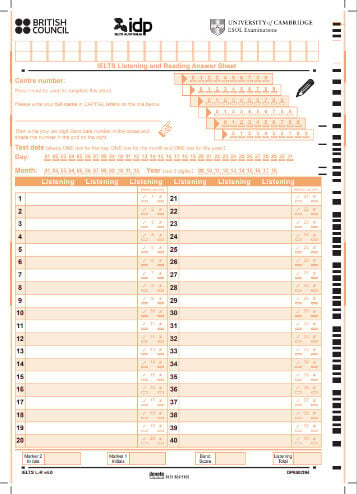
IELTS 聽力測驗大約需要 40 分鐘。 您將花 30 分鐘聆聽錄音並回答問題。 您會拿到 Question Booklet(試題冊) 和 Answer Sheet(答案紙)。 試題冊上會顯示所有問題,而答案紙則是您最後作答、提交評分的地方。
您可以查看 官方 IELTS 聽力答案紙 PDF,或參考下方圖片 :)
在聽力測驗結束後,您會有 10 分鐘時間將答案從試題冊轉寫到答案紙上。
重要提醒!
拼字錯誤與文法錯誤都會被判定為 錯誤,因此請利用這 10 分鐘仔細檢查拼字與文法。
IELTS 聽力分數換算方式
在聽力部分,每題皆為 1 分,因此最高可獲得 40 分的「原始分數」。接著,原始分會轉換成您的 band score。 請記住!答錯不會倒扣分。 下表提供原始分數轉換為 band score 的大致參考。
| 原始分數 | Band 分數 |
|---|---|
| 39-40 | 9 |
| 37-38 | 8.5 |
| 35-36 | 8 |
| 32-34 | 7.5 |
| 30-31 | 7 |
| 26-29 | 6.5 |
| 23-25 | 6 |
| 18-22 | 5.5 |
| 16-17 | 5 |
| 13-15 | 4.5 |
| 11-12 | 4 |
由於每份 IELTS 測驗的難度略有不同,因此達到某個 band 分數所需的原始分數會因整體考生表現而有所變動。 換言之,各場測驗間所需的正確題數可能略有差異,但通常若想達到 band 7,建議目標為 40 題中答對約 30 題。
如上所述,IELTS 聽力測驗的題目會隨部分逐漸變難, 但每一題的分值相同。 因此,請確保不要因為卡在較難的題目而錯失較容易的分數。
免費 IELTS 聽力範例 PDF(含答案)下載
以下是由 IELTS 主辦單位 British Council 所提供的免費 IELTS 聽力範例 PDF(含答案)。在連結下方,你也可以免費做一份 BestMyTest 的含音檔與答案的 IELTS 聽力測驗。測驗包含全部四個部分,每個部分都會在答案中附上音檔逐字稿。 試著回答問題看看自己的表現如何!
- IELTS Listening Practice Test 1 - questions(線上範例)
- IELTS Listening Practice Test 1 - answers(PDF)
- IELTS Listening Practice Test 1 - answer sheet(PDF)
Listen to the recording and answer questions 1 to 10. The answers and the audio script are in the box below the questions.
Questions 1-10
Complete the notes below.
Write ONE WORD AND/OR A NUMBER for each answer.
This can provide the carer with:
• time for other duties
• a 1
Assessment of aunt's needs
This may involve discussing:
• how much 2 is spent caring
Daily tasks discussed:
• help with dressing
• helping her take a 3
• shopping
• helping with meals
• managing 4
• any parts of caring that are particularly hard, e.g.
• loss of 5
• 6 her
• avoiding a 7
Types of support that may be provided for carers
• transport costs, e.g. cost of a 8
• vehicle-related costs, e.g. fuel and 9
• help with housework
• support to lower 10
-
spellcheck Answers
1. Break
Break is correct because this detail is stated in the recording at the point where the question is answered.2. Time
Time is correct because this detail is stated in the recording at the point where the question is answered.3. Shower
Shower is correct because this detail is stated in the recording at the point where the question is answered.4. Money
Money is correct because this detail is stated in the recording at the point where the question is answered.5. Memory
Memory is correct because this detail is stated in the recording at the point where the question is answered.6. Lifting
Lifting is correct because this detail is stated in the recording at the point where the question is answered.7. Fall
Fall is correct because this detail is stated in the recording at the point where the question is answered.8. Minicab
Minicab is correct because this detail is stated in the recording at the point where the question is answered.9. Parking
Parking is correct because this detail is stated in the recording at the point where the question is answered.10. Anxiety
Anxiety is correct because this detail is stated in the recording at the point where the question is answered.
Audio ScriptNora: It's really good to see you, Marcus. Since I had to give up work, I feel I'm losing touch with my friends and colleagues.
Marcus: We really miss you in the office. We were all so sorry you had to leave. But you must be relieved to have more time to look after your aunt. How is she?
Nora: Well, she's very cheerful, but she needs a lot of help.
Marcus: Have you tried to get any support from the local council?
Nora: No. I didn't know I could.
Marcus: Yes. But for different kinds of practical support, they realise that carers sometimes need time for all the other responsibilities they have, apart from the person they're caring for, and also that they sometimes need a break.
Nora: Absolutely. OK, so tell me more, how do I go about getting this support?
Marcus: Well, you'd have to have an assessment of your aunt's needs. That means someone would come round and talk to you about the situation and what you need. So for a start, they'd want to know the amount of time you spend looking after your aunt every day.
Nora: OK.
Marcus: Then they'll probably ask you what sorts of tasks you do for your aunt during the day. Things like if she needs help with getting dressed, for example.
Nora: Right. I help her with that. And also I help her get into the shower in the morning.
Marcus: Yes. That sort of thing. They'll probably ask you if you do the shopping for her, and help her at meal times, and whether she can cope using money.
Nora: Yes. That's becoming a bit of a problem. She used to be very good at it, but not anymore.
Before you hear the rest of the conversation, you have some time to look at questions 5 to 10. [20 seconds] Now listen, and answer questions 5 to 10.Marcus: And be ready to tell them about anything you find particularly difficult about caring for your aunt.
Nora: So recently I've noticed she started to have quite bad problems with her memory. If I wasn't there, I think she'd forget to eat, for example. And often she doesn't seem quite sure what day it is.
Marcus: Yes. Tell them about that. And are there any physical difficulties you have caring for her? Lifting her, for example.
Nora: Yes. She's quite heavy, and I'm afraid of hurting my back. I'd be in real trouble if that happened.
Marcus: They can give you advice about that, and also about how to avoid the possibility of your aunt having a fall.
Nora: Great. So, once they've done this assessment, if I'm eligible, what happens next?
Marcus: Well, they might support you financially. So they might help you with travel costs, like if you have to get a minicab to take your aunt for an appointment, for example.
Nora: I usually drive her myself, actually. So could I claim for the petrol?
Marcus: You could. And you can claim for the parking, too.
Nora: Oh, right.
Marcus: And if you need help with the housework, they can arrange for someone to come along once or twice a week. And one other thing. I hope you don't mind me saying this, but it's important you look after yourself. And it seems to me you're dealing with quite a bit of anxiety.
Nora: I am, yes.
Marcus: Well, tell the council, because they may be able to give you some advice on how to minimise it.
Nora: Really? Though, actually, I feel so much better having talked to you. I'll get in touch with the council straight away. Now, shall we go for coffee, or something?
Listen to the recording and answer questions 11 to 20. The answers and the audio script are in the box below the questions.
Questions 11-14
Choose the correct letter, A, B or C.
11. Who began turning the unused Whitfield site into a planted space?
- city council officials.
- nearby residents.
- a gardening charity.
12. What was Lillian Hartley trying to achieve through public campaigning?
- preventing a housing sale
- blocking army exercises
- winning maintenance funding
13. Why was the park rejected as a place for troop exercises?
- council permission was refused.
- too little usable space.
- a better site was chosen.
14. How does the speaker describe the latest redesign plans?
- 2013 plan used unchanged.
- 2013 plan revised pre-work.
- 2015 plan finished in 2016.
Questions 15-20
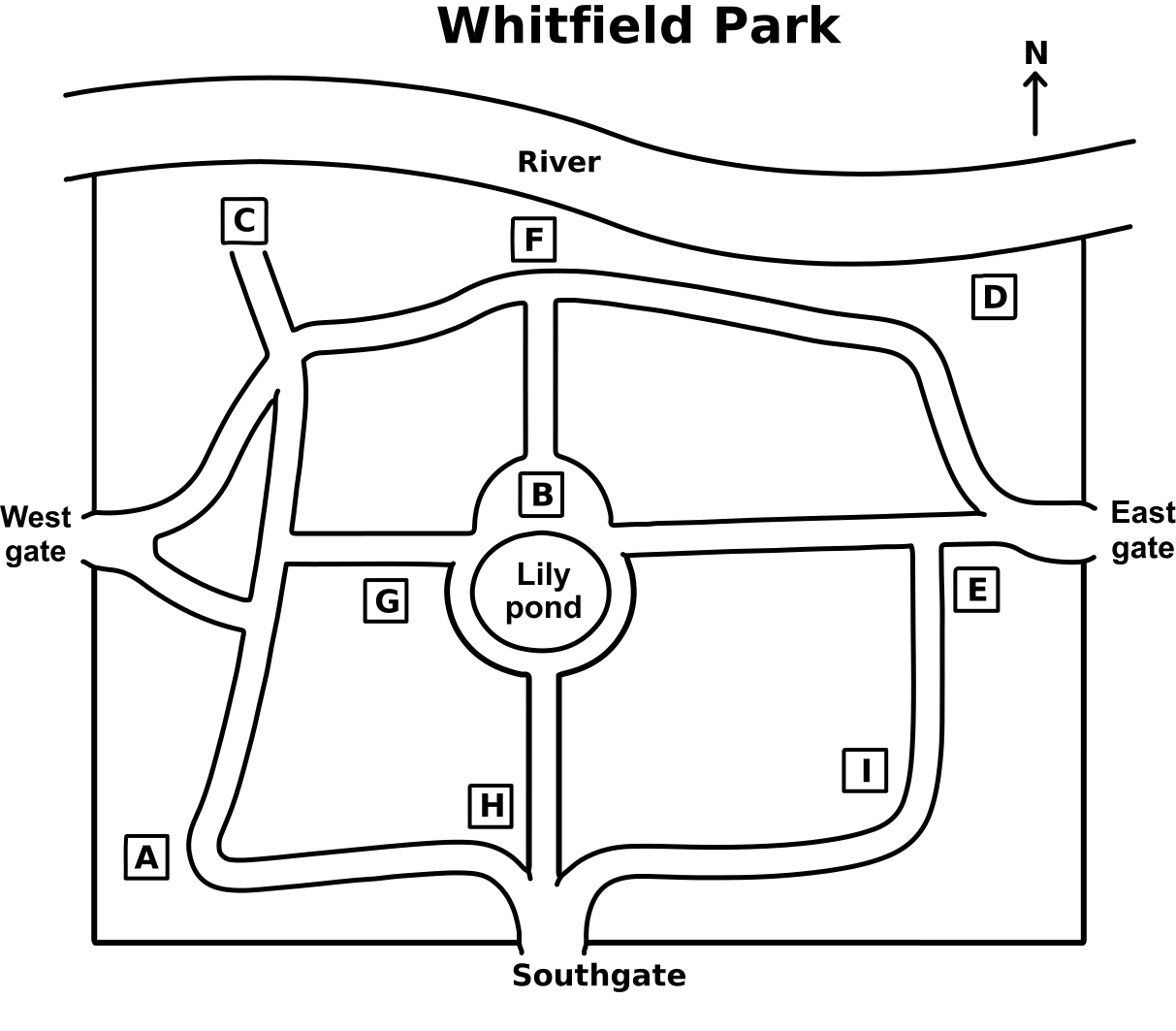
Label the plan of Whitfield Park below.
Write the correct letter, A-I, next to questions 15-20.
- statue of Lillian Hartley
- wooden sculptures
- playground
- maze
- tennis courts
- fitness area
-
spellcheck Answers
11. B
(A) is incorrect. The council took ownership later.(B) is correct. The initial planting was done by residents from nearby streets.
(C) is incorrect. The recording does not support this option: a gardening charity.
12. A
(A) is correct. Hartley organised public pressure so the council would keep the land as a park rather than sell it for housing.(B) is incorrect. The recording does not support this option: blocking army exercises.
(C) is incorrect. The recording does not support this option: winning maintenance funding.
13. B
(A) is incorrect. The recording does not support this option: council permission was refused.(B) is correct. , after inspection, the army concluded that the park was too small for practical use.
(C) is incorrect. The recording does not support this option: a better site was chosen.
14. B
(A) is incorrect. The recording does not support this option: 2013 plan used unchanged.(B) is correct. The plans dated from 2013 but were revised in 2015 before work began.
(C) is incorrect. The recording does not support this option: 2015 plan finished in 2016.
15. B
The correct answer is B because the statue of Lillian Hartley is now immediately north of the lily pond near the centre of the park, and that position is labelled B.16. D
The correct answer is D because the wooden sculptures are on the riverbank where the path from the East Gate makes a sharp bend, which corresponds to D.17. F
The correct answer is F because the playground is between the river and the path from the lily pond to the river, and that location is marked F.18. C
The correct answer is C because the maze is found by entering from the West Gate, walking north, and turning left, which places it at C.19. A
The correct answer is A because the tennis courts remain in the southern corner where the perimeter path makes a right-angled bend, labelled A.20. G
The correct answer is G because the fitness area is beside the lily pond on the same side as the West Gate, matching G on the plan.
Audio ScriptI'm delighted this evening to introduce our guest speaker, Sarah Holloway, who is going to talk to us about the recent transformation of Whitfield Park. Over to you, Sarah. Thank you very much. I'm sure you all know Whitfield Park well, it has been one of the city's landmarks for well over a century, and the city council has been responsible for it for most of that time. What perhaps fewer of you will know is how the park actually began.
Unlike many city centre parks, which started life as the private gardens of a large house, Whitfield was originally just an unused patch of waste ground. The first flowers there were actually planted by a small group of local residents who lived in the surrounding streets. They began work on the site in 1892. At that point nobody was entirely sure who legally owned the land, and it was a full twenty years later before the city council finally took it into public ownership. Some of you will have seen the statue near one of the gates. That figure is Lillian Hartley, who played a really important role in the early history of the park.
Once the council legally owned the land, its first instinct was to sell it off as building plots for housing. A great many local residents, however, wanted the park to stay open as a place where everyone could enjoy fresh air and green space, bear in mind that this is a very densely built up residential district. Lillian Hartley was at the heart of that campaign, and it was she who organised the petitions and the public demonstrations which, in the end, persuaded the council to drop the sale and keep the land as a park.
Soon afterwards, in 1914, the First World War broke out, and most of the park was dug up and used to grow vegetables, which were sold to local residents. At one point the army did look into taking over the park as a site for troop exercises. They actually wrote to the city council about it, but when they inspected it they concluded that the park was simply too small to be of any practical use to them, so the idea was dropped. The only military activity in the park during the war was the occasional public meeting held on a small area of grass that had been kept clear of vegetable plots.
After the war, the park was largely returned to the way it had been before 1914, and from then on it remained almost unchanged for decades. New plans for transforming the park were drawn up several times over the years; the most recent version dates from 2013, but those plans were then revised in 2015, well before any actual work had got under way. Work on the ground finally began in 2016 and was completed, on schedule, last year.
Before you hear the rest of the talk, you have some time to look at questions 15 to 20. [20 seconds] Now listen and answer questions 15 to 20.All right, I'd like to describe some of the more important changes that have been made, and one or two things that have deliberately been left as they were. If you take a quick look at the map you've been handed, you'll see the familiar outline of Whitfield Park. The river forms the northern boundary, and there is a gate in each of the three other walls.
From there, follow the path up towards the river and the enlarged children's playground sits between that path and the river itself. If you keep your eye on the riverbank, over towards the East Gate side, the new wooden sculptures are at the point where the path coming up from that gate makes a sharp bend.
Back near the West Gate side of the park, there is a maze, a circular pattern of paths separated by low hedges. Head in from the West Gate, walk north towards the river, and then turn left to find it. Close to the same central lily pond, on the side facing the West Gate, you'll also find the new outdoor fitness area.
Down in the southern corner, where the perimeter path makes that distinct right angled bend, the tennis courts are still in their familiar position, though we have now doubled them from four to eight. Now, since you are all keen gardeners, I'm sure you'll want to hear about the plants that have been chosen for the new beds.
Listen to the recording and answer questions 21 to 30. The answers and the audio script are in the box below the questions.
Questions 21-25
Choose the correct letter, A, B or C.
21. Nina and Owen were surprised to learn that coastal cities
- are home to just under half of all people.
- account for many of the largest cities.
- are expanding at double the rate of inland cities.
22. According to Owen, building coastal cities near to rivers
- can carry contamination back towards urban areas.
- can leave too little land for farming upstream.
- can cause factories to damage rural scenery.
23. What mistake was made when building water drainage channels in Port Selby in the 1950s?
- The system did not include enough channels.
- The builders selected the wrong construction materials.
- The design failed to anticipate rising sea levels.
24. What do Nina and Owen think that the authorities in Port Selby should do immediately?
- take measures to restore coastal ecosystems
- pay for a new flood prevention system
- stop disposing of waste materials into the ocean
25. What do they agree should be the priority for international action?
- greater coordination of activities
- more sharing of information
- agreement on shared policies
Questions 26-30
What decision do the students make about each of the following parts of their presentation?
Write the correct letter, A-G, next to questions 26-30.
- use visuals
- keep it short
- involve other students
- check the information is accurate
- provide a handout
- focus on one example
- do online research
- Historical background
- Geographical factors
- Past mistakes
- Future risks
- International implications
-
spellcheck Answers
21. B
(A) is incorrect. The recording does not support this option: are home to just under half of all people.(B) is correct. Nina says most of the biggest cities are built by the sea.
(C) is incorrect. The recording does not support this option: are expanding at double the rate of inland cities.
22. A
(A) is correct. Owen says pollutants from inland agriculture and industry travel down rivers to cities.(B) is incorrect. The recording does not support this option: can leave too little land for farming upstream.
(C) is incorrect. The recording does not support this option: can cause factories to damage rural scenery.
23. C
(A) is incorrect. The recording does not support this option: The system did not include enough channels.(B) is incorrect. The recording does not support this option: The builders selected the wrong construction materials.
(C) is correct. Port Selby's drainage channels were built without allowing for global warming and rising sea levels.
24. B
(A) is incorrect. The recording does not support this option: take measures to restore coastal ecosystems.(B) is correct. Nina says they need money to replace the drainage channels for flood protection now.
(C) is incorrect. The recording does not support this option: stop disposing of waste materials into the ocean.
25. A
(A) is correct. They say coastal cities must act together internationally.(B) is incorrect. The recording does not support this option: more sharing of information.
(C) is incorrect. The recording does not support this option: agreement on shared policies.
26. B
B is correct because they decide not to spend too long on historical background, so they will keep it short.27. A
A is correct because they decide to use slides with maps showing geographical factors.28. F
F is correct because they choose the Meriton case study as the basis for past mistakes, focusing on one example.29. G
G is correct because they need to look at websites for future risks, so online research is required.30. C
C is correct because they plan to ask audience members from different places, involving other students.
Audio ScriptTutor: OK, so what I'd like you to do now is to talk to your partner about your presentations on environmental planning. You should have done most of the reading now, so I'd like you to share your ideas and talk about the structure of your presentation and what you need to do next.
Nina: OK, Owen, I'm glad we chose quite a specific topic: coastal cities. It made it much easier to find relevant information.
Owen: Yeah, and cities are growing so quickly. I mean, we know that more than half the world's population lives in cities now.
Nina: Yeah, though that's all cities, not just coastal ones. But most of the biggest cities are actually built by the sea. I'd not realised that before.
Owen: Nor me. And what's more, a lot of them are built at places where rivers come out into the sea. But apparently this can be a problem.
Nina: Why?
Owen: Well, as the city expands, agriculture and industry tend to spread further inland along the rivers. And so agriculture moves even further inland up the river. That's not necessarily a problem, except it means more and more pollutants are discharged into the rivers.
Nina: That's a serious problem.
Owen: Right.
Nina: Did you read that article about Port Selby on the south coast?
Owen: No.
Nina: Well, apparently back in the 1950s, they built channels to drain away the water in case of flooding.
Owen: Sounds sensible.
Nina: Yeah, they spent quite a lot of money on them. But what they didn't take into account was global warming. So they built the drainage channels too close to sea level. And now sea levels are rising, they're more or less useless. If there's a lot of rain, the water can't run away. There's nowhere for it to go.
Owen: So they did not help much in the end.
Nina: So what are the authorities doing about it now?
Owen: I don't know. I did read that they're aiming to stop disposing of waste water into the ocean over the next 10 years. But that won't help with flood prevention now, will it?
Nina: No, really, they just need to find the money for something to replace the drainage channels in order to protect against flooding now. But in the long term, they need to consider the whole ecosystem.
Owen: Right.
Nina: Really though, coastal cities can't deal with their problems on their own, can they? I mean, they've got to start acting together at an international level instead of just doing their own thing.
Owen: Absolutely. The thing is, everyone knows what the problems are and environmental planners have a pretty good idea of what we should be doing about them. So they should be able to work together to some extent.
Nina: But it's going to be a long time before countries come to a decision on what principles they're prepared to abide by.
Owen: Yeah, if they ever do.
Before you hear the rest of the conversation, you have some time to look at questions 26 to 30. [20 seconds] Now listen and answer questions 26 to 30.Nina: So I think we've probably got enough for our presentation. It's only 15 minutes.
Owen: OK, so I suppose we'll begin with some general historical background about why coastal cities were established. But we don't want to spend too long on that. The other students will already know a bit about it.
Nina: It's all to do with communications and so on.
Owen: Yes, we should mention some geographical factors, things like wetlands and river estuaries and coastal erosion and so on.
Nina: We could have some maps of different cities with these features marked.
Owen: On a handout, you mean, or some slides everyone can see.
Nina: Yeah, that'd be better.
Owen: It'd be good to go into past mistakes in a bit more detail. Did you read that case study of the problems there were in Meriton with flooding a few years ago?
Nina: Yes, we could use that as the basis for that part of the talk. I don't think the other students will have read it, but they'll remember hearing about the flooding at the time.
Owen: Hmm, OK. So that's probably enough background. So then we'll go on to talk about what actions have been taken to deal with the problems of coastal cities.
Nina: OK, what else do we need to talk about? Maybe something on future risks looking more at the long term if populations continue to grow?
Owen: Yeah, we'll need to do a bit of work there. I haven't got much information, have you?
Nina: No, we'll need to look at some websites. Shouldn't take too long.
Owen: OK. And I think we should end by talking about international implications. Maybe we could ask people in the audience. We've got people from quite a lot of different places.
Nina: That'd be interesting if we have time, yes. So now should we go on?
Listen to the recording and answer questions 31 to 40. The answers and the audio script are in the box below the questions.
Questions 31-36
What point does the lecturer make about each item?
Write the correct letter, A-K, next to questions 31-36.
- changes drainage
- protects animals
- increases nutrients
- kills germs
- affects many species
- creates dense shade
- alters the soil
- supports farming
- reduces competition
- attracts bell-miners
- helps recovery
- Eucalyptus woodland
- Damage to eucalyptus woodland
- Oil from eucalyptus leaves
- Lime used in construction
- Direct iron supply
- Moderate bushfires
Questions 37-40
Complete the notes below.
Write ONE WORD ONLY for each answer.
Bell-miner associated dieback:
• The process starts with insects feeding on eucalyptus 37
• A sweet liquid containing 38 attracts bell-miners
Fire patterns:
• If fires happen too often, 39 becomes the main vegetation
• When fires are almost absent, thick growth gives bell-miners protected 40 sites
-
spellcheck Answers
31. B
B is correct because eucalyptus woodland provides nesting places and shelter for birds, bats and small mammals.32. E
E is correct because damage to eucalyptus woodland affects a wider community of species, not only the trees themselves.33. D
D is correct because oil from eucalyptus leaves is used in disinfectant, where it can kill certain germs.34. G
G is correct because lime from road construction was washed into the soil and interfered with tree roots.35. K
K is correct because affected trees recovered surprisingly quickly when iron was supplied directly.36. I
I is correct because occasional fire removes fast-growing competitors that would otherwise use water needed by eucalyptus trees.37. leaves
The correct answer is leaves. The lecturer says the process begins when insects settle on eucalyptus leaves and feed on them.38. sugar
The correct answer is sugar. The lecturer says the insects produce a sweet liquid containing sugar, which attracts bell-miners.39. grass
The correct answer is grass. The lecturer says grass tends to dominate afterwards if fires occur too often.40. nesting
The correct answer is nesting. The lecturer says dense growth creates protected nesting sites for bell-miners when fire is suppressed.
Audio ScriptGood morning. Today I want to focus on the eucalyptus tree, one of the best known features of the Australian landscape. Many people call it a gum tree, but the name eucalyptus actually covers hundreds of related species, from small scrubby trees to very tall forest giants.
Now, eucalyptus trees are important in several ways. Ecologically, they provide nesting places and shelter for birds, bats and small mammals. Their flowers also produce nectar, which is an important food source for insects and birds. So when eucalyptus woodland is damaged, the effect is felt across a much wider community of species.
As for their value to people, the trees are also useful. Oil from eucalyptus leaves has long been used in cleaning products, and one common use is in disinfectant, because the oil can kill certain germs. Eucalyptus timber is also used in building and fencing, although that is not really the main focus of today's lecture.
So, these trees can live for centuries, and some individuals survive for four hundred years or more. That is why researchers became concerned when large numbers began dying much earlier than expected in different parts of Australia.
Now, one disease that attracted attention was Mundulla Yellows. The leaves of affected trees slowly turned yellow and then, over time, the whole tree declined. For years the cause was unclear. Eventually, researchers discovered that lime, or calcium hydroxide, had been used in road construction nearby. Rain washed the lime into the surrounding soil, where it interfered with the roots of eucalyptus trees. The trees were still surrounded by nutrients, but they could no longer absorb the iron they needed for healthy growth. When iron was supplied directly to affected trees, they recovered surprisingly quickly.
However, Mundulla Yellows affected only a limited number of places. A much wider problem on the east coast was Bell miner associated dieback. Now, bell miners are small native birds, but they are not the direct cause of the damage. The process begins when insects settle on eucalyptus leaves and feed on them. While feeding, these insects produce a sweet liquid containing sugar. Bell miners are attracted to that liquid, and they aggressively chase away other birds and insects that might otherwise reduce the insect population. As a result, the insects multiply, the leaves are badly damaged, and the trees gradually lose their ability to survive.
But some scientists think fire history is also part of the explanation. An influential theory, first proposed by the ecologist William Jackson, links the type of vegetation in a region to the frequency of bushfires. If fires occur too often, grass tends to dominate the area afterwards. If fires occur at moderate intervals, eucalyptus forest is more likely to persist. This is because occasional fire removes fast growing competitors which would otherwise take up the water eucalyptus trees need. And it also helps maintain the soil by preventing dense undergrowth from changing the soil structure and removing nutrients.
At the other extreme, if fires are almost completely suppressed, a different ecosystem can develop. Scientists sometimes call this dry rainforest. Now, the name sounds contradictory, because we usually associate rainforest with wet tropical conditions. But in this case it means a dense, shaded vegetation system with relatively few species. It can create excellent conditions for bell miners, because the thick growth gives them protected nesting sites while excluding many of the species that would normally compete with them.
What this tells us is that before European settlement, Aboriginal communities used controlled burning over long periods, and this probably created a more balanced pattern of vegetation. Since European settlement, fire has often been suppressed, roads and farms have altered drainage, and some local ecosystems have shifted away from eucalyptus woodland. The decline of eucalyptus trees, then, is not caused by one single factor. It is the result of disease, insects, birds, soil chemistry and fire management interacting with one another.

Completion - Part 1
Learn how to answer these questions in a step-by-step interactive exercise
Completion - Part 1
空格可能要求填写一个时间或频率。说话者通常会用别的说法表达同一个时间段,所以要把意思与空格对应起来,而不是等页面上的原词出现。
提交前再检查字数限制。把答案放进空格里,把整行通读一遍,删掉这一行已经有的词。意思对但字数超出的答案得不到分。
点击“播放”收听音频
笔记中常用 must provide 或 need to bring 这类简单的动词。说话者很少直接说出这个动词,而是用同义词或描述这个动作,所以要听清真正要求的是什么。
说话者常常先提到一些多余的物品,然后再把它们排除。如果漏掉了一个空格,就先放下它,去听下一个,因为答案是按录音顺序出现的,丢掉一个空格可能会让你连后面的几个也错过。
点击“播放”收听音频
您在上面的 IELTS 聽力範例題表現如何呢?有沒有遇到比較困難的題目? 如果有,建議您深入了解所有 6 種 IELTS 聽力題型。 對題型理解越透徹,就能減少花在理解題意的時間,把更多心力用在找出正確答案。
6 種 IELTS 聽力題型
IELTS 聽力測驗一共有 6 種不同題型。要拿高分,你需要針對每一種題型反覆練習,熟悉最有效的解題方式。
我们的学员觉得哪些听力题型最难
这里展示的不是 2017 年的趋势,而是 BestMyTest 学员的 2.25 百万条 IELTS 听力答题记录所反映的情况。百分比表示我们的学员在该题型上的答题正确率。
| 题型 | 正确率 |
|---|---|
| 笔记填空(Note completion) | 33% |
| 表格填空(Table completion) | 34% |
| 句子填空(Sentence completion) | 45% |
| 简答题(Short answer) | 48% |
| 单项选择(Multiple choice) | 50% |
| 多项选择(Multiple selection) | 51% |
| 平面图、地图、示意图标注(Plan, map, diagram labelling) | 55% |
| 表单填空(Form completion) | 73% |
| 匹配题(Matching) | 85% |
- 填空题是主要的失分点。 笔记填空和表格填空的正确率仅为三分之一,而考查相同技能、但版式更简单的表单填空,正确率却达到 73%。差距在于时间压力下的拼写、词形和字数限制,而不是理解能力。
- 在 61,964 次完整听力模拟测试中,参与的 55,296 名学员的平均分为 5.5 分。41% 的测试成绩达到 6.0 分,12% 达到 7.0 分。
- 就单个听力部分而言,三分之一的作答得分率为 40% 或以下,30% 的作答得分率为 80% 或以上。大多数学员是在一两个部分表现失常,而不是各部分得分都低,这也是单独练习第 3 和第 4 部分能见效的原因。
数据来自 BestMyTest 截至 2026 年 10 月的模拟测试和复习记录。各题型的百分比为所有作答的正确率;各评分标准的数据为教师或 AI 评分,具体以标注为准。最后更新于 2026 年 10 月 5 日。
雖然每一種題型在題目外觀上都不太一樣,但整體解題思路其實有共通原則。 在文章後半段,我們會示範一套可以套用在 6 種題型上的基本策略。 每一種題型的音檔範例與解答都在IELTS 聽力題型指南。
有效準備 IELTS 聽力的 3 大步驟
雖然每種 IELTS 聽力題型都有些差異,但其實解題的核心方法是一樣的。 你只需要依照一組簡單、循序的策略,就能應付所有題型。 以下是我們建議你在聽力測驗中使用的三個步驟:
- 仔細閱讀題目,找出關鍵資訊
- 在播放音檔前預測可能的答案
- 一邊聽一邊對照題目,確保跟上內容
Step 1:仔細閱讀題目
在 IELTS 聽力測驗中,錄音開始前你通常會有 30~40 秒的準備時間。 這段時間非常關鍵,你必須用來快速預覽即將作答的題目。 這個步驄的目的,就是讓你避免在邊聽邊第一次閱讀題目時手忙腳亂。
當準備時間開始時,請盡可能有效率地閱讀題目,並找出以下資訊:
- 這是哪一種類型的題目?
- 答案會是什麼形式?(例如:日期、數字、姓名等)
- 題目中最重要的單字或片語是什麼?
以下是一個 Note Completion(筆記填空)的例子:
Complete the notes below.
Write NO MORE THAN THREE WORDS for each answer.
Two reasons for the new approach to pricing are changes in (27) and (28) programs.
接著,你可以將題目中的關鍵字畫線,例如:
Two reasons for the new approach to pricing are changes in (27) ______ and (28) ______ programs.
在聽音檔時,只要聽到「two reasons」就應該提高注意力。
以下是揭示答案的錄音原文:
Mark: Well, there seem to be two basic reasons. Firstly, because the law has changed recently … And secondly, we now have computer programs …
仔細分析題目後,你就能知道正確答案分別是 law 和 computer。
Step 2:預測可能的答案
第二步和第一步密切相關,而且最好在同樣的 20 秒內同時完成。 雖然聽起來困難,但只要掌握題目形式、答案可能的格式,以及關鍵字, 就能有效預測答案的大方向。
回到剛才的例子:
Two reasons for the new approach to pricing are changes in (27) ____ and (28) ____ programs.
只看題目的語法,你就能推測答案必定是名詞或名詞片語,因為它們位於介系詞 in 之後。 此外,由內容推測,答案可能和政策(law)、科技(computer)有關。
雖然你不可能完全猜出正確答案,但有預測就能讓你在聽力時更專注於相關資訊,提升作答效率。
以下是另一個較難的選擇題例子,讓你把步驟 1 和步驟 2 一起練習:
Choose the correct letter, A, B, C or D.
- are for weekend shows
- are booked well in advance
- are non-refundable
- are booked for groups
雖然無法事先知道正確答案,但你可以預測「哪些情況可能影響票價」, 並在聽力時針對相關資訊提高注意力。
雖然三個選項都有被提到,但只有 C. are non-refundable 被明確指出「比較便宜」,因此是正確答案。
Step 3:跟著內容走(Follow Along)
錄音開始後,你必須一邊聽、一邊對照題目,確保在正確的題目位置上。
聽力的題目通常會依照錄音內容的順序排列, 也就是說,當你聽到某題的答案時,下一題也會緊接著出現。 因此,只要你能跟上內容,就不容易迷失方向。
若你不小心錯過某一題,最好的做法就是略過它,繼續往下寫。 等錄音結束後,你再回來用推理方式填上最佳猜測。 這樣至少能確保你不會因為卡在一題而錯過後面的答案。
IELTS 聽力練習免費資源
要拿到高分,你需要長期累積強大的聽力能力。因此,請在考試前每天維持聽力訓練。
以下是一些能每天使用的免費聽力練習資源:
- YouTube - https://www.youtube.com
- BBC Learning English - http://www.bbc.co.uk/learningenglish
- TED - https://www.ted.com/
- BBC Radio - https://www.bbc.co.uk/worldserviceradio
- ABC News (Australia) - https://www.abc.net.au/listen/live/news