
V tomto průvodci můžete začít cvičit čtení IELTS absolvováním bezplatného testu IELTS Reading. Existují však dvě verze testu: IELTS general reading a IELTS academic reading. Dozvíte se, která verze je pro vás vhodná, a jak zvládnout každý typ otázek ze čtení s pomocí našich materiálů IELTS Reading.
Po dokončení bezplatného cvičného testu IELTS Reading získejte bezplatnou analýzu skóre IELTS Reading a personalizovaný studijní plán.
| Test IELTS General Reading | Test IELTS Academic Reading |
|---|---|
Níže je náš úplný seznam otázek IELTS Reading s odpověďmi. Poznámka: červené odkazy jsou naše nejoblíbenější a nejdoporučovanější otázky readingu podle hodnocení studentů a můžete je kdykoli zdarma procvičovat.
Otázky ke cvičnému testu IELTS General Reading 1 - 135
Short everyday texts, workplace texts, and one longer passage
Otázky ke cvičnému testu IELTS Academic Reading 1 - 171
Three long passages from books, journals, magazines, and newspapers
Průvodce procvičovacím testem IELTS Reading
Zbytek tohoto průvodce vás naučí vše o testu IELTS Reading pro variantu General Training i Academic. Dozvíte se, jak se počítá skóre čtení, jak úspěšně odpovídat na jednotlivé typy otázek, jak zlepšit své čtení s materiály IELTS a osvojíte si naše 3 strategie pro úspěch při procvičování IELTS Reading.
Obsah
- Informace o testu IELTS Reading
- Ukázkové otázky IELTS Reading
- Informace o testu IELTS General Reading
- Informace o testu IELTS Academic Reading
- Kalkulačka skóre IELTS Reading
- Jak odpovídat na všech 11 typů otázek IELTS Reading
- Jak zlepšit své band score v IELTS Reading
- 3 strategie pro IELTS Reading
- Bezplatné stažení procvičovacího testu IELTS Reading v PDF s odpověďmi
Informace o testu IELTS Reading
Test IELTS Reading se skládá ze 3 částí a má celkem 40 otázek. Obecně v každé části odpovíte na 12–14 otázek a na dokončení testu čtení máte přesně 60 minut. Každá část obsahuje 1–3 pasáže v závislosti na tom, který test absolvujete. Pokud víte, který test absolvujete, můžete následujících několik sekcí přeskočit. Pokud ne, je důležité se o každém testu dozvědět a zjistit, jak se na něj připravit.
Který test IELTS Reading je pro mě ten pravý?
Test IELTS Reading má dvě verze: IELTS General Reading a IELTS Academic Reading. General Reading budete absolvovat, pokud plánujete emigraci nebo nástup na střední školu. Academic Reading budete absolvovat, pokud usilujete o vyšší vzdělání. Největší rozdíl mezi General Reading a Academic Reading je obtížnost pasáží IELTS Reading. Jak název napovídá, akademický test používá materiály IELTS Reading z akademických zdrojů, zatímco obecný test používá materiály z každodenního života.
Oba testy obsahují 3 části, 40 otázek a 11 typů otázek. Podrobné informace o každé části pro oba testy najdete v tabulce níže.
| Část | Test IELTS Academic Reading | Test IELTS General Reading |
|---|---|---|
| 1 | Jeden dlouhý akademický text, který může být popisný, faktografický, diskurzivní nebo analytický. Text bude
převzat z knih, časopisů, magazínů a novin. 12–14 otázek |
Dva nebo tři krátké faktografické texty.
Témata jsou relevantní pro každodenní život v anglicky mluvící zemi.
12–14 otázek |
| 2 | Jeden dlouhý akademický text, který může být popisný, faktografický, diskurzivní nebo analytický. Text bude
převzat z knih, časopisů, magazínů a novin. 10–14 otázek |
Dva krátké faktografické texty zaměřené na pracovní otázky (např. žádost o zaměstnání, firemní zásady, mzdové a pracovní podmínky).
12–14 otázek |
| 3 | Jeden dlouhý akademický text, který může být popisný, faktografický, diskurzivní nebo analytický. Text bude
převzat z knih, časopisů, magazínů a novin. 12–14 otázek |
Jeden delší a složitější text na téma obecného zájmu.
Texty jsou autentické a převzaté z oznámení, inzerátů, firemních příruček, knih, časopisů a novin.
12–14 otázek |
Nyní, když jste se seznámili se strukturou testu IELTS Reading a s testy IELTS General Reading i IELTS Academic Reading, je čas zjistit, zda je pro vás lepší absolvovat papírový test, nebo počítačový test.
IELTS papírový test (PBT) VS IELTS počítačový test (CBT)
U PBT dostanete Question Booklet (sešit s otázkami) a Answer Sheet (odpovědní arch). Question Booklet je místo, kde uvidíte všechny otázky, na které musíte odpovědět. Answer Sheet je místo, kam zapíšete své finální odpovědi pro hodnocení. Můžete si prohlédnout oficiální PDF s odpovědním archem IELTS zde
Pozn.: Na rozdíl od testu IELTS Listening vám nebude poskytnut dodatečný čas na přenos odpovědí ze sešitu na odpovědní arch, takže se ujistěte, že každou otázku IELTS Reading zaznamenáváte do odpovědního archu hned, jak na ni odpovíte.
U CBT budete odpovídat na otázky na počítači. Vaše pasáže budou na levé straně a otázky na pravé straně. Budete také moci zvýrazňovat text a používat ovládací funkce pro kopírování a vkládání odpovědí. Pro více informací o PBT a CBT se podívejte na Průvodce počítačovým testem IELTS.
Obě verze si můžete kdykoli procvičit s naším bezplatným procvičovacím testem IELTS Reading. Odkazy na všechny materiály IELTS Reading najdete v horní části stránky.
Ukázkové otázky IELTS Reading
Tady jsou dvě bezplatná cvičení IELTS Academic Reading. Každé si nejdřív vyřešte sami a pak otevřete odpovědi ke kontrole. Průvodce typy otázek IELTS Reading vysvětluje každý typ a nabízí další ukázkové otázky.
Match each item with the period of time it best corresponds with
NB You may use any letter more than once.
- The Palaeolithic era
- The Bronze age
- The Iron age
- The Medieval era
- The Mesolithic age
- Roman times
-
spellcheck Answers1. FALSE
2. FALSE
3. NOT GIVEN
4. FALSE
5. TRUE
6. FALSE
7. FALSE
8. TRUE
9. FALSE
10. F
11. C
12. A
13. B
14. D
The climate in Britain has been arctic for the last several million years, punctuated by relatively warm timespans, or interglacials of thousands of years, one of which we are in as of now. Since the last glaciation, British woodland history is considered quite short in terms of geological time spans, and is also closely related to the human civilization developing.
At the peak of the last glaciation (100,000 – 12,000 BC), the majority of Britain would have had no trees. Birch and willow scrub may have grown along the lower reaches of the ice, with pine in some areas. It’s possible that remnants of pre-glacial flora were sheltered along the western bays of Great Britain and Ireland’s coasts, but as far as the southern parts of England, the ice kept any land barren. Information regarding the development of Britain’s flora following glaciation can be found by studying the deposits of pollen and seed in peat, as well as by the use of radiocarbon dating. Tundra and moorland followed the retreating ice, which lead to phases of different tree species spreading from the south. First came birch, aspen and sallow, followed by pine and hazel continuing to spread north as of 8500 BC, replacing birch to make it less commonly found for the next few thousand years. Oak and alder came after pine, then lime, elm, beech, and maple, all spreading northwards one after the other. From the moment lime arrived, in about 7300, to about 4500 BC the climate remained stable for a length of time known as the Atlantic Period, a time in which numerous species grew to form a series of wildwood or wilderness types.
What did the wilderness or wildwood look like, before man started interfering with it? One theory holds that Britain and Western Europe in Palaeolithic times was covered from coast to coast in a wildwood of continuous trees. However, a modern theory proposed by Francis Vera holds that Western Europe wilderness was a combination of grassland, scrub, and clusters or groves of trees. It was not a dense, impassable wildwood, but instead, an area similar to a park, kept up by wild herbivores eating the plants and grass. Throughout earlier interglacial periods, this may also have been the case in Britain, as creatures of the Palaeolithic era needed to roam large areas of grassland to survive. A variety of grassland plants continued to live there in the last interglacial, as according to pollen records. However, since the last glaciation, the bison, elk and other large herbivores which persisted on mainland Europe were extinct in Britain, so Vera’s theory may not apply so well to Britain.
Meanwhile, throughout the period since it’s spread northwards after the last glaciation, the sustained growth of oak in Britain demonstrates that the wildwood was not as continual as once believed. Oak is a pioneer species, which requires vacant space to generate more of itself. Grazing animals are also present to keep areas open, so Oak regenerates in the thorny brush as a protective measure from their grazing. Archaeological evidence indicates that red deer, who graze on grass as well as browse from trees, were essential to the economy in Mesolithic Britain, with people utilizing them for meat, skins, antlers and bones.
As the Mesolithic (10,000-3000 BC) era ended, evidence of the beginnings of agriculture emerges. Agricultural weeds, such as plantain and stinging nettle, were also increasing in number. Nearly all the wildwood was cut down as the population increased rapidly. However, the falling elm population around 4,000 BC all across Europe has been attributed not to the clearing of trees, but to what’s referred to as Elm disease.
Throughout the Bronze Age (2400-750 BC), people were cutting down trees more than ever before, until the prevalence of the practice “coppicing” peaked, likely at some point during the early Iron Age. Oliver Rackham (1990) theorizes that nearly 50% of land throughout England was no longer wildwood by 500 BC. The regrowth from a stump grows more readily than the original tree, and Neolithic man had discovered this practice, known as coppicing. Much of the remaining woods were maintained by way of this method during the Bronze Age.
The Celtic peoples living in the Iron Age were able to master woodworking as an artform. Today, Celtic woodworking can be seen in houses, boats, wheels and other artifacts of the time. Coppicing as a means to manage woodland was of massive importance throughout two millennia that followed. Buildings, roads, fences, carts, and the fuel for heating, cooking, metalworking and pottery were all made possible due to wood materials gained from the vital practice of coppicing.
A clear divide has existed between wooded and non-wooded regions of Britain since the time of the Romans. As evidenced by The Domesday Book (1086), all the wood in England had an economic value and was the property of either an individual or community owner. Woods were the territories, or ‘exclaves’ of communities who lived some miles away. Even though it had to be transported over long distances, the materials which woodlands produced were of obvious value, and their ownership was long before established. Merely around 15% of land in England was represented by woodland or wood- pasture in the year 1086.
English woodlands produced mostly underwood used as fuel along with other things, with small oaks being used to construct buildings. The average wood-framed houses of the Medieval era mostly used oaks shorter than 18” in diameter. Longer pieces of timber were hard to come by, and kept only for elaborate buildings intended for the Church. Imported boards of thin oak or wainscot from Central Europe were brought in for the purpose of domestic building. Woodland cover was as low as 15% in 1086, and continued to decline from as a result of an ever- growing population to 10% by 1350. This stopped suddenly with the plague of the Black Death of 1349 wiping out some of the human population. Woods which had persisted up to 1350 mostly prospered over the next 500 years.
Match each description with the correct psychologist
NB You may use any letter more than once.
- Clark Hull
- Howard and Tracy Kendler
- Michael Cole and colleagues
- Simon Hewson
-
spellcheck Answers1. D
2. C
3. D
4. A
5. C
6. B
7. C
8. D
9. TRUE
10. FALSE
11. TRUE
12. FALSE
Could it be that the very essence of reasoning itself is found in the way we behave? Clark Hull, an acclaimed American psychologist, theorized that it was, describing that reasoning is achieved by the way two “behavior segments” are combined in new ways to achieve goals. Howard and Tracey Kendler, who were two of Hull’s followers, used Hull’s principle ideas to design a reasoning test for children. In this test, children needed to learn how to use a machine in a two-step process. The children learned each of the two steps individually, with the first being to correctly choose and press one of two buttons, and the second to place a marble into a small opening. If both steps were completed successfully, a toy would be released as rewards to the children.
From this test, the Kendlers learned that although the children were able to learn each step, they were not able to “integrate” the two tasks without intervention. In other words, the children could not successfully perform the first step, pushing the button, and then proceed to the second step, inserting the marble into the hole, by themselves. This failure to independently integrate the steps led the Kendlers to believe that children of this age were not able to use deductive reasoning.
According the the work of psychologist and professor Michael Cole and his associates, some adults from specific African tribes are also unable to successfully complete the Kendlers' two-step test of deductive reasoning. However, this finding remains questionable in light of the findings of a similar test to the Kenders’, which revealed that the African tribes people were, in fact, able to complete the test.
In this test, Cole substituted a locked box for the machine with the buttons, and then used two matchboxes of different colors. One of the matchboxes held a key for the locked box. Just like with the Kendlers’ test, Cole’s test also involved two behavior segments, these being to first open the right match-box to get the key, and second to use the key to open the box. However, Cole’s test differs quite a bit psychologically. Instead of subjects being presented with a strange machine, they are given familiar objects in a simpler context. Cole found the difficulty of 'integration' was greatly reduced here.
It seems that the same truth which Cole discovered can be extended to explain the deductive reasoning skills of young children. Psychologist Simon Hewson believes that perhaps the task’s difficulty is not in inferential processes themselves, but is instead tied to confusing features of the test apparatus, such as the button machine, as well as the context of the procedure being tested. When these factors are adjusted in order to prevent the inferential nature of the problem being affected, five-year-old children are able to successfully complete these tests as well as college students did in the Kendlers' test.
Hewson made two essential changes to the test in order to build on this idea. First, he replaced the button-pressing mechanism with drawers that a child could slide open and shut. This removed confusion on what to do with the original button apparatus from the first stage of training. Secondly, Hewson made sure that children understood that there was nothing special or magical about the marble which was used to successfully complete the second step of the task and get the reward.
This is important because a child cannot easily comprehend a mechanism in which a marble put into a hole can open a little door. It would then be safe to say that the child will not assume that different marbles of identical size could be used the same way. But, to solve the problem, this assumption must be made. Hewson clearly demonstrated the functional equivalence of different marbles to the children by playing a 'swapping game.” Hewson's two modifications to the experiment led to a rise in success rates from 30 percent to 90 percent for five-year old children and from 35 percent to 72.5 per cent for four-year-olds. Strangely enough for three-year olds, Hewson’s changes did not lead to any improvement, and instead there was a slight drop in performance from the change. Hewson's experiments showed that children faced with the Kendler apparatus experienced difficulty not related to reasoning, but to the nature of the tasks themselves, and that difficulty cannot be taken as proof that they are incapable of deductive reasoning.
General test IELTS Reading
V general testu jsou pasáže IELTS Reading převzaty z knih, časopisů, novin, oznámení, inzerátů, firemních příruček a směrnic z materiálů, se kterými se setkáte na denní bázi v anglicky mluvícím prostředí. Stejně jako v testu Academic Reading jsou zde 3 části, avšak v testu IELTS General Reading se jednotlivé části od sebe trochu liší.
Úvodní video k IELTS General Reading
-
Část 1: Obsahuje dva nebo tři krátké texty nebo několik kratších textů
Tato část se nazývá Social Survival a obsahuje texty relevantní pro základní jazykové přežití v angličtině s úkoly hlavně o vyhledávání a poskytování obecných faktografických informací, například oznámení, inzeráty a jízdní řády. -
Část 2: Skládá se ze dvou textů
Tato část se nazývá Workplace Survival a zaměřuje se na pracovní kontext, například popisy pracovních pozic, smlouvy a materiály pro rozvoj a školení zaměstnanců. -
Část 3: Je jeden dlouhý text
Tato část se nazývá General Reading a zahrnuje čtení rozsáhlejší prózy se složitější strukturou. Důraz je kladen na popisné a instruktivní texty namísto argumentativních.
Doufám, že se necítíte příliš zahlceni. Test čtení není tak obtížný, jak se zdá. Pokud se budete řídit našimi tipy pro IELTS Reading a využijete naše bezplatné procvičovací otázky IELTS Reading, budete připraveni zvládnout jakoukoli pasáž a dosáhnout svého cílového skóre IELTS Reading. Mimochodem, test Academic Reading se hodnotí mírně odlišně od testu General Reading. Dále si rozebereme band score čtení a jak se počítá.
Academic test IELTS Reading
V academic testu jsou pasáže IELTS Reading převzaty z knih, časopisů, magazínů a novin z akademických zdrojů, které by byly vhodné pro vysokoškolské studenty. Každá pasáž je dlouhá, přibližně 6–10 odstavců, může být napsána v různých stylech, jako je vyprávěcí nebo popisný, a pokrývá širokou škálu akademických témat, jako jsou antropologie, historie, věda, biologie, umění, vzdělávání, lingvistika atd. Pasáže budou někdy obsahovat technické termíny nebo dokonce vizuální materiál, jako jsou grafy a schémata. Tato témata a další si můžete procvičit s našimi procvičovacími otázkami IELTS Reading.
Úvodní video k IELTS Academic Reading
Která akademická témata se v oficiálním testu IELTS Academic Reading objevují nejčastěji?
V letech 2022-2024 a 2024-2026 bylo nejčastějším tématem akademického čtení historie. Následovala biologie a poté psychologie a společenské vědy, které zahrnují kulturu, vzdělávání, lingvistiku a sociologii.
Graf níže ukazuje různé předměty testované v akademických testech IELTS Reading v letech 2022-2024 a 2024-2026.
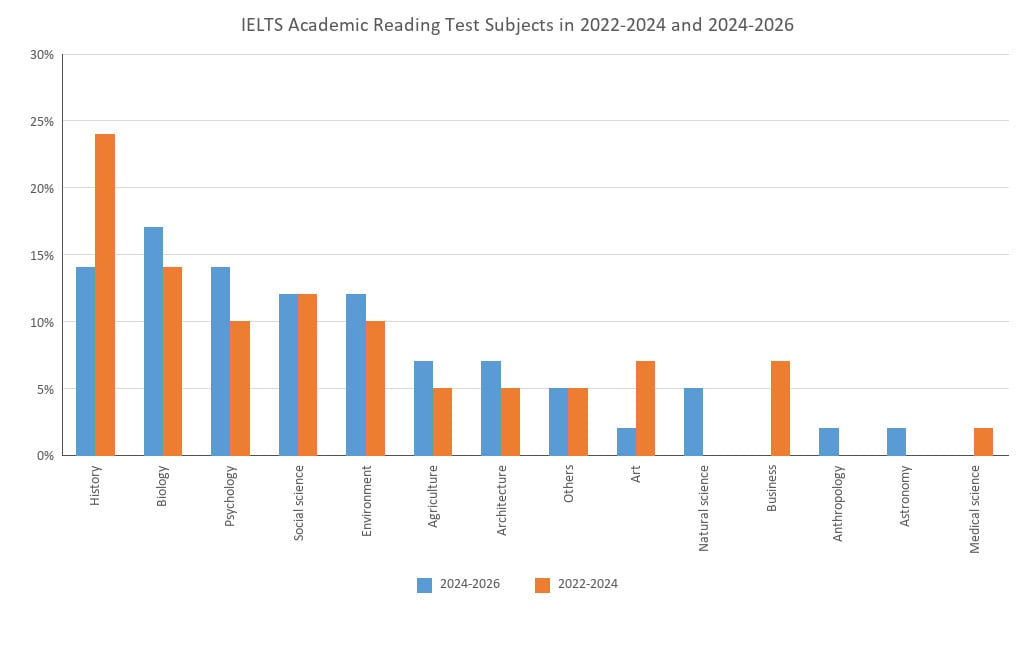
Vzhledem k těmto trendům jsme se ujistili, že naše procvičovací testy IELTS Reading tato témata pokrývají. Přidali jsme také ukázky čtení z méně používaných témat, pro každý případ. Je důležité, abyste se připravili na všechny situace, protože nikdy nevíte, jaké téma IELTS Reading vám padne.
Jak se vypočítá vaše skóre IELTS Reading
Každá otázka IELTS Reading má hodnotu 1 bodu, takže můžete získat „hrubé“ skóre až 40 bodů. Vaše hrubé skóre se poté převede na band score. Tabulky níže vám poskytnou obecnou představu o tom, jak se hrubé skóre IELTS Reading převádí na band score pro každý test.
Skóre IELTS General Reading VS skóre IELTS Academic Reading
| Hrubé skóre: Academic | Band score: Academic | Hrubé skóre: General | Band score: General |
|---|---|---|---|
| 39-40 | 9 | 40 | 9 |
| 37-38 | 8.5 | 39 | 8.5 |
| 35-36 | 8 | 37-38 | 8 |
| 33-34 | 7.5 | 36 | 7.5 |
| 30-32 | 7 | 34-35 | 7 |
| 27-29 | 6.5 | 32-33 | 6.5 |
| 23-26 | 6 | 30-31 | 6 |
| 19-22 | 5.5 | 27-29 | 5.5 |
| 15-18 | 5 | 23-26 | 5 |
| 13-14 | 4.5 | 19-22 | 4.5 |
| 10-12 | 4 | 15-18 | 4 |
| 8-9 | 3.5 | 12-14 | 3.5 |
| 6-7 | 3 | 9-11 | 3 |
| 4-5 | 2.5 | 6-8 | 2.5 |
| 1-3 | 2 | 1-5 | 2 |
Mějte však na paměti, že každá verze testu IELTS Reading je mírně odlišná a skóre potřebné k dosažení určitého bandu se mění v závislosti na tom, jak si v daný den vedli všichni, kdo daný test absolvovali. Počet správných odpovědí potřebných k dosažení band score se proto bude od testu k testu mírně lišit, ale obecně byste měli usilovat o přibližně 30 ze 40, pokud chcete dosáhnout band score 7.
Další věc, kterou vám chceme připomenout, je, že nejtěžší a nejlehčí otázky se počítají rovnocenně do vašeho konečného skóre čtení, takže se ujistěte, že nepřicházíte o snadnější body tím, že se zaseknete na obtížnějších otázkách. Dále se budeme zabývat tipy a strategiemi pro IELTS Reading, jak odpovídat na jednotlivé otázky testu čtení.
Tipy pro IELTS Reading – Jak odpovídat na 11 typů otázek čtení
V testu čtení existuje 11 různých typů otázek a každý z nich vyžaduje jinou strategii.
Každý typ má ukázku a odpověď v průvodci typy otázek IELTS Reading.
- Typ otázky 1 – Matching Information (přiřazování informací)
- Typ otázky 2 – Matching Headings (přiřazování nadpisů)
- Typ otázky 3 – Matching Features (přiřazování charakteristik)
- Typ otázky 4 – Identifying Information (identifikace informací)
- Typ otázky 5 – Identifying Writer's Views/claims (identifikace názorů/tvrzení autora)
- Typ otázky 6 – Multiple Choice (výběr z více možností)
- Typ otázky 7 – Matching Sentence Endings (přiřazování konců vět)
- Typ otázky 8 – Sentence Completion (doplňování vět)
- Typ otázky 9 – Summary, Note, Table, Flow-chart Completion (doplňování shrnutí, poznámek, tabulky, vývojového diagramu)
- Typ otázky 10 – Diagram Label Completion (popisování diagramu)
- Typ otázky 11 – Short Answer Questions (krátké odpovědi)
- Jak vám trendy pomohou připravit se na test IELTS Reading
Jak vám trendy pomohou připravit se na test IELTS Reading
Které typy otázek ve čtení jsou pro naše studenty nejtěžší
Studenti BestMyTest v našich cvičných testech zodpověděli jeden milion otázek ze čtení v modulu Academic a 600 000 otázek ze čtení v modulu General Training. Procenta udávají, jak často studenti na jednotlivé typy otázek odpověděli správně.
| Typ otázky | Academic | General Training |
|---|---|---|
| Přiřazování informací | 34% | 72% |
| Pravda / Nepravda / Neuvedeno | 39% | 60% |
| Výběr z možností | 43% | 48% |
| Přiřazování charakteristik | 48% | 74% |
| Doplňování vět | 49% | 75% |
| Přiřazování nadpisů | 53% | 40% |
| Ano / Ne / Neuvedeno | 55% | 57% |
| Doplňování shrnutí | 59% | 46% |
| Krátká odpověď | 54% | 75% |
- Ve čtení v modulu Academic mají studenti nejnižší úspěšnost u přiřazování informací a otázek Pravda/Nepravda/Neuvedeno, v obou případech pod 40%. Oba typy vyžadují, abyste našli myšlenku vyjádřenou jinými slovy, nikoli shodné klíčové slovo.
- V modulu General Training je situace opačná: nejnižší úspěšnost má přiřazování nadpisů se 40%, zatímco u typů zaměřených na vyhledávání informací jsou odpovědi správné ve třech případech ze čtyř, protože texty jsou kratší a informace jsou v nich vyjádřeny přímočařeji.
- U textů v modulu Academic dosahuje průměrná úspěšnost odpovědí 46% a u textů v modulu General Training 59%. Polovina pokusů o zodpovězení otázek k textům v modulu Academic končí s úspěšností 40% nebo méně.
- Ve 43 711 kompletních cvičných testech ze čtení, které absolvovalo 38 534 studentů, bylo průměrné skóre 5.4. Skóre 6.0 dosáhlo 36% studentů a skóre 7.0 dosáhlo 14% studentů.
- Stále je třeba připravit se na každý typ, ale pokud máte málo času, tabulka vám ukáže, kde se vám příprava nejvíce vyplatí.
Údaje pocházejí z dat cvičných testů a hodnocení BestMyTest do října 2026. Procenta u jednotlivých typů otázek udávají podíl správných odpovědí ze všech pokusů; údaje u kritérií představují skóre udělená lektorem nebo AI podle příslušného označení. Poslední aktualizace 5. října 2026.
Dále si probereme tipy a strategie pro IELTS Reading nezbytné pro vysoké skóre čtení.
Tipy pro IELTS Reading – Jak zlepšit své band score čtení
Většina studentů neuspěje v sekci čtení ze tří následujících důvodů
- Pomalá rychlost čtení
- Špatná slovní zásoba
- Malá nebo žádná příprava
Zlepšení rychlosti čtení
Nejprve to nejjasnější. Abyste zlepšili rychlost čtení, musíte ve skutečnosti procvičovat čtení a dělat to konzistentně.
Nyní se podívejme na méně zřejmou strategii, která vám pomůže pochopit význam velkých částí vět. Začněte tím, že větu rozeberete. Udělejte to tak, že budete hledat podmět a sloveso věty. Nalezení podmětu a slovesa vám pomůže pochopit význam věty. Jedním z důvodů, proč mohou být akademické pasáže obtížně srozumitelné, je to, že spojují řetězce myšlenek a tvoří dlouhé souvětí. To produkuje velké části vět, které jsou obtížněji zachytitelné, takže používání podmětu a slovesa jako vodítka pro pochopení celé části je skvělý nástroj, který můžete během své zkoušky IELTS Reading použít.
Zlepšení slovní zásoby
Mnoho lidí si myslí, že odpovídání na otázky čtení je tak jednoduché, jako prohledat odstavec na klíčová slova a informace... No, bohužel, není to tak jednoduché. Otázky čtení jsou obvykle parafrázovány, což znamená, že slova byla změněna na synonyma slov z pasáže IELTS Reading. To se dělá pro zvýšení obtížnosti, jinak by byl test příliš snadný. Z tohoto důvodu si musíte zlepšit slovní zásobu, abyste znali mnoho různých synonym slova.
Když se připravujete na test čtení a narazíte na slovo, které neznáte, vytvořte si návyk buď se zastavit a vyhledat ho, nebo si ho alespoň zapsat a vyhledat ho později. Je to trochu únavné, ale extrémně účinné. Vaším cílem by mělo být, ale ne omezeno na, studium 15 až 20 nových akademických slov každý den.
Vědět, u kterých typů otázek jsou/nejsou odpovědi v pořadí
Je důležité vědět, že u některých typů otázek jsou odpovědi obvykle (téměř vždy) ve stejném pořadí jako pasáž IELTS Reading. U jiných typů otázek jsou odpovědi jen zřídka ve stejném pořadí jako pasáž. Vyplnili jsme tabulku pro typy otázek, které toto pravidlo dodržují, a ty, které ne. Mějte to prosím na paměti.
| Odpovědi jsou obvykle (téměř vždy) ve stejném pořadí jako pasáž | Odpovědi jsou jen zřídka ve stejném pořadí jako pasáž. |
|---|---|
|
|
Najít nejlepší strategii čtení pro vás
Největší výzvou, které většina lidí ve zkoušce IELTS Reading čelí, je dokončit všechny otázky čtení dříve, než vyprší čas. V další sekci se naučíte tři strategie a bude na vás, abyste zjistili, která vám nejvíce vyhovuje. Uděláte to pomocí našich bezplatných procvičování čtení.
3 strategie pro IELTS Reading
Strategie 1: Přečtení celé pasáže a poté zodpovězení otázek.
Za prvé, tohle ani moc není strategie. Je to to, co lidé dělají, když se na zkoušku čtení řádně nepřipraví. Zařadili jsme ji jako strategii, protože technicky vzato, pokud si dokážete zapamatovat informace z pasáže při prvním přečtení a jste schopni odpovědět na otázky, pak strategii 2 nebudete potřebovat.
Tato strategie, pokud nemáte lepší než průměrnou paměť, je neefektivní. Skončíte tak, že vám dojde čas dříve, než budete moci odpovědět na všechny otázky. Mnoho lidí tuto chybu dělá. Existují však některé otázky, které nevyžadují mnoho úsilí a budou z této strategie těžit, jako například pokud je otázka „Ano“ nebo „Ne“, pak budete moci rychle skenovat a najít odpověď rychle, ale takových typů otázek není dost, takže není vhodné tuto strategii používat, pokud ji nezvládáte.
Strategie 2: Čtení otázek jako první, čtení s cílem a zápis poznámek a poté moudré odpovídání na otázky
Toto je naše doporučená strategie. Pomůže vám získat vyšší skóre IELTS Reading. Berte to jako jasnou mapu, jak obecně přistupovat ke zkoušce:
Jednou z nejčastějších chyb, které kandidáti dělají při
přístupu ke zkoušce čtení, je čtení každého jednoho slova pasáží IELTS Reading. Ačkoli můžete
procvičovat na zkoušku čtením pro radost, „čtení naslepo“ (čtení bez jakékoli představy,
na co se otázky budou ptát) vám u zkoušky neudělá žádnou laskavost. Místo toho vám to ztíží
šance na efektivní řízení času a získání nejlepšího skóre.
Hlavním důvodem, proč si nejprve přečíst otázky, je, protože typ otázky může určit, co
v pasáži čtete a jak to čtete. Některé typy otázek například vyžadují
techniku „skimming“, zatímco jiné mohou vyžadovat techniku „scanning“.
Je důležité zaměřit se na sadu otázek, které jsou stejného typu.
Budete muset určit, který typ otázky chcete řešit jako první.
Dobrou strategií by bylo začít s jednodušším typem otázky a přejít k obtížnějším typům otázek později.
Nejjednoduššími typy otázek jsou ty, u kterých strávíte méně času čtením.
Například typ otázky Matching Heading je jednodušší, protože
potřebujete pouze najít nadpis, který nejlépe popisuje hlavní myšlenku odstavce.
Příkladem obtížného typu otázky by bylo Identifying Information. U tohoto typu otázky
budete muset přečíst každý odstavec, abyste zjistili, zda je každé tvrzení TRUE, FALSE nebo NOT GIVEN podle pasáže.
Zde je tabulka, která uvádí úrovně obtížnosti pro každý typ otázky. Použijte tuto tabulku jako referenci při výběru typu otázky,
který chcete řešit jako první.
| Úroveň obtížnosti | Typ otázky |
|---|---|
| Snadná | Match Headings Short answer |
| Střední |
Matching Sentence Endings Matching Features Multiple choice Sentence Completion Diagram Label, Summary, Note, Table, Flow-Chart Completion |
| Obtížná |
Match Information Identifying Information (TRUE/FALSE/NOT GIVEN) Identifying Viewer's claims (YES/NO/NOT GIVEN) |
Poté, co jste si přečetli otázky z textu IELTS, budete moci číst s cílem. Co to znamená? Pokud například narazíte na otázku, která obsahuje rok „1896“, můžete si poznamenat, kdy tento rok v textu zazní, a použít to k pozdějšímu zodpovězení otázky.
Existují dvě techniky čtení, které vám pomohou zůstat na správné cestě při čtení s cílem. První, skimming, je nejlépe definována jako rychlé čtení s cílem získat „gist“ neboli obecnou představu pasáže. Při této technice se nezastavujete u žádných neznámých slov ani nehledáte konkrétní detaily. Druhá technika, scanning, je nejlépe definována jako čtení s cílem získat konkrétní informace. Při této technice nečtete pro celkový smysl, ale spíše pro konkrétní informace. Všimněte si, jak má každá z těchto technik na mysli konkrétní cíl. To vám pomůže najít informace rychleji.
Když čtete s cílem, měli byste si také dělat poznámky na okrajích pasáže, dělat hvězdičky vedle klíčových informací nebo podtrhávat věci, o kterých si myslíte, že vám pomohou odpovědět na různé otázky. Usnadní vám to vrátit se zpět, když se vás v otázkách na určité věci zeptají. Vyberte si jakýkoli systém zápisu poznámek, který je pro vás správný – jen se ujistěte, že to děláte!
Poté, co jste si přečetli otázky, přečetli pasáž a udělali si všechny příslušné poznámky, byste měli mít lokalizovánu část textu, kde potřebujete číst pečlivě. Pak prostě pečlivě čtěte a kriticky přemýšlejte, abyste určili správnou odpověď.
Strategie 3: Skimming, dělání poznámek a typy otázek.
Toto je další strategie používaná mnoha účastníky testu IELTS. Pomůže vám získat vyšší skóre čtení. Strategie se skládá ze 4 kroků:
- Skimming každého odstavce pro získání obecné představy o každém odstavci. Hlavní myšlenka odstavce se obvykle nachází v prvních několika větách, takže se na ně zaměřte trochu více. Následující věty lze rychle proběhnout pomocí skimming, podtrhněte si jména/slova/fráze, které se vám zdají důležité.
- Po skimming každého odstavce napište krátké poznámky (2–5 slov) vedle každého odstavce s vaším nejlepším odhadem hlavní myšlenky tohoto odstavce.
- Dále odpovězte na sadu otázek, které jsou stejného typu.
- Nakonec efektivně a správně odpovězte na sadu otázek.
Je důležité, abyste na krocích 1 a 2 strávili maximálně 3–5 minut. Strávení příliš mnoho času na těchto krocích způsobí, že ztratíte příliš mnoho času a nakonec vám čas dojde.
Kroky 1 a 2Cílem zde je nastavit efektivní metodu pro hledání odpovědí v pasáži. Zapsáním obecné myšlenky každého odstavce budete vědět, který odstavec obsahuje odpověď na každou otázku. To vám ušetří spoustu času, protože pokud byste si to nezapsali, museli byste pravděpodobně každý odstavec proběhnout pomocí skimming pro získání obecné myšlenky otázky a poté byste museli pečlivě skenovat odstavec pro odpověď. Tím, že si poznamenáte hlavní myšlenku každého odstavce, můžete přeskočit první krok skimming každého odstavce a začít skenovat pro odpověď.
Krok 3
Poté, co jste důkladně proběhli text pomocí skimming a zapsali si poznámky, jste připraveni na krok 3.
V tomto kroku budete muset určit, který typ otázky chcete řešit jako první.
Dobrou strategií by bylo začít s jednodušším typem otázky a přejít k obtížnějším typům otázek později.
Nejjednoduššími typy otázek jsou ty, u kterých strávíte méně času čtením.
Například typ otázky Matching Heading je jednodušší, protože
potřebujete pouze najít nadpis, který nejlépe popisuje hlavní myšlenku odstavce, takže technicky vzato potřebujete pouze kroky 1 a 2 pro odpověď na tento typ otázky.
Příkladem obtížného typu otázky by bylo Identifying Information. U tohoto typu otázky
budete muset přečíst každý odstavec, abyste zjistili, zda je každé tvrzení TRUE, FALSE nebo NOT GIVEN podle pasáže.
Zde je tabulka, která uvádí úrovně obtížnosti pro každý typ otázky. Použijte tuto tabulku jako referenci při výběru typu otázky, který chcete řešit jako první.
| Úroveň obtížnosti | Typ otázky |
|---|---|
| Snadná | Match Headings Short answer |
| Střední |
Matching Sentence Endings Matching Features Multiple choice Sentence Completion Diagram Label, Summary, Note, Table, Flow-Chart Completion |
| Obtížná |
Match Information Identifying Information (TRUE/FALSE/NOT GIVEN) Identifying Viewer's claims (YES/NO/NOT GIVEN) |
Nyní, když jste zjistili, kterou sadu otázek budete odpovídat jako první, je čas na ně skutečně odpovědět :( Nebojte se! Ačkoli je každý typ otázky jiný, strategie, jak na ně odpovědět správně, se vztahuje na všechny. Základní princip je jednoduchý, jen postupujte podle kroků níže:
- Pozorně si přečtěte otázku a identifikujte důležitá klíčová slova.
- Najděte odstavec, který obsahuje informace potřebné k zodpovězení otázky. (Doufejme, že už máte zapsané obecné myšlenky pro každý odstavec, takže to můžete snadno zjistit.)
- Skenujte odstavec pro důležitá klíčová slova (pravděpodobně to budou synonyma!), dokud nelokalizujete část textu, kde potřebujete číst pečlivě.
- Nakonec pečlivě čtěte a kriticky přemýšlejte, abyste určili správnou odpověď.
Bezplatné stažení vzorových PDF testů IELTS Reading s odpověďmi
Níže jsou některé bezplatné vzorové testy čtení od British Council (autorů zkoušky IELTS). Zkuste odpovědět na otázky a uvidíte, jak si povedete!