
V tomto průvodci si vyzkoušíte bezplatný test IELTS Listening a získáte úplnou analýzu svého skóre v poslechu IELTS. Budete se připravovat s více než 125 cvičnými testy IELTS Listening, lekcemi, tipy a videovysvětleními odpovědí. Podle našeho personalizovaného studijního plánu dosáhnete cílového skóre v poslechu IELTS.
Po dokončení bezplatného cvičného testu IELTS Listening získejte bezplatnou analýzu skóre IELTS Listening a personalizovaný studijní plán.
play_circle_outline Začít cvičný test IELTS ListeningNíže je náš úplný seznam otázek IELTS Listening s odpověďmi. Poznámka: červené odkazy jsou naše nejoblíbenější a nejdoporučovanější otázky listeningu podle hodnocení studentů a můžete je kdykoli zdarma procvičovat.
IELTS Poslech – cvičné testové otázky pro část 1 1 - 59
A conversation between two people in an everyday situation
IELTS Poslech – cvičné testové otázky pro část 2 1 - 75
A talk by one speaker about an everyday topic
IELTS Poslech – cvičné testové otázky pro část 3 1 - 65
A conversation between up to four people about studies or training
IELTS Poslech – cvičné testové otázky pro část 4 1 - 62
A talk by one speaker on an academic subject
Průvodce procvičovacím testem IELTS Listening
Zbytek tohoto průvodce vás naučí vše o testu IELTS Listening. Dozvíte se, jak se počítá skóre poslechu, jak úspěšně odpovídat na jednotlivé typy poslechových otázek, abyste si zlepšili své IELTS Listening band score, a poznáte náš ověřený třístupňový postup, který vám pomůže studovat testy IELTS Listening online.
Obsah
Informace o testu IELTS Listening
Test IELTS Listening je rozdělen do 4 částí. V každé části si poslechnete jednoho nebo více rodilých mluvčích angličtiny a poté odpovíte přibližně na 10 otázek souvisejících s tím, co jste právě slyšeli. Celá sekce IELTS Listening obsahuje celkem 40 otázek. Obecně platí, že poslechové nahrávky začínají snadnějšími úkoly a v průběhu testu se obtížnost zvyšuje. Každá nahrávka se přehrává pouze jednou a obsahuje různé přízvuky, včetně britského, australského, novozélandského, amerického a kanadského.
- Část 1 – rozhovor mezi dvěma lidmi v každodenním společenském kontextu. Můžete například slyšet rozhovor o potvrzení detailů rezervace nebo o zadání objednávky po telefonu.
- Část 2 – monolog v každodenním společenském kontextu. Můžete například slyšet projev o místních zařízeních, někoho, kdo udává směr, nebo představuje základní informace o nějaké akci.
- Část 3 – rozhovor mezi až čtyřmi lidmi ve vzdělávacím nebo školicím kontextu. Můžete například slyšet vysokoškolského lektora a studenta diskutujícího o úkolu nebo dvojici studentů, kteří probírají něco z hodiny.
- Část 4 – monolog na akademické téma. Uslyšíte například univerzitní přednášku profesora. Pro většinu studentů je to nejnáročnější nahrávka v testu poslechu.
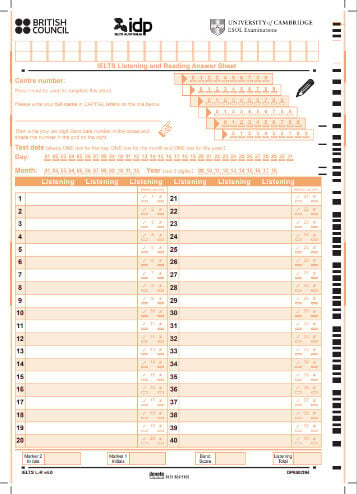
Test IELTS Listening trvá přibližně 40 minut. 30 minut strávíte posloucháním nahrávek a odpovídáním na otázky. Dostanete Question Booklet (sešit s otázkami) a Answer Sheet (odpovědní arch). Question Booklet je místo, kde uvidíte všechny otázky, na které musíte odpovědět. Answer Sheet je místo, kam zapíšete své finální odpovědi pro hodnocení.
Můžete si prohlédnout oficiální PDF s odpovědním archem IELTS Listening zde nebo se prostě podívejte na obrázek níže :)
Na konci poslechové sekce máte 10 minut na to, abyste přenesli odpovědi z Question Booklet na svůj Answer Sheet.
DŮLEŽITÉ!
Pravopisné chyby a nesprávná gramatika jsou hodnoceny jako NESPRÁVNĚ, takže těchto 10 minut využijte k důkladné kontrole pravopisu a gramatiky.
Výpočet skóre IELTS Listening
V poslechové sekci má každá otázka hodnotu 1 bod, takže můžete získat „hrubé“ skóre až 40 bodů. Vaše hrubé skóre se poté převede na band score. Pamatujte! Za nesprávné odpovědi se body neodečítají. Tabulka níže vám poskytne obecnou představu o tom, jak se hrubé skóre převádí na band score.
| Hrubé skóre | Band score |
|---|---|
| 39-40 | 9 |
| 37-38 | 8.5 |
| 35-36 | 8 |
| 32-34 | 7.5 |
| 30-31 | 7 |
| 26-29 | 6.5 |
| 23-25 | 6 |
| 18-22 | 5.5 |
| 16-17 | 5 |
| 13-15 | 4.5 |
| 11-12 | 4 |
Protože každá verze testu IELTS je mírně odlišná, hrubé skóre potřebné k dosažení určitého band score se liší podle toho, jak se v daný den dařilo všem, kdo test absolvovali. Počet správných odpovědí potřebných k dosažení určitého band score se proto bude mírně lišit od testu k testu, ale obecně byste měli usilovat o přibližně 30 ze 40, pokud chcete dosáhnout band score 7.
Jak je uvedeno výše, jednotlivé části testu IELTS Listening jsou postupně náročnější. Každá otázka má však stejnou hodnotu bodů. Ujistěte se proto, že nepřicházíte o snadné body kvůli tomu, že se zaseknete na obtížných otázkách.
Bezplatné stažení vzorového PDF testu IELTS Listening s odpověďmi
Zde najdete několik bezplatných vzorových testů IELTS Listening ve formátu PDF s odpověďmi od British Council (autorů zkoušky IELTS). Pod odkazy si také můžete zdarma vyzkoušet test IELTS Listening s nahrávkou a odpověďmi od BestMyTest. Obsahuje všechny čtyři části a u každé části najdete s odpověďmi i přepis nahrávky. Zkuste odpovědět na otázky a uvidíte, jak si povedete!
- IELTS Listening Practice Test 1 – questions (online ukázka)
- IELTS Listening Practice Test 1 – answers (PDF)
- IELTS Listening Practice Test 1 – answer sheet (PDF)
Listen to the recording and answer questions 1 to 10. The answers and the audio script are in the box below the questions.
Questions 1-10
Complete the notes below.
Write ONE WORD AND/OR A NUMBER for each answer.
This can provide the carer with:
• time for other duties
• a 1
Assessment of aunt's needs
This may involve discussing:
• how much 2 is spent caring
Daily tasks discussed:
• help with dressing
• helping her take a 3
• shopping
• helping with meals
• managing 4
• any parts of caring that are particularly hard, e.g.
• loss of 5
• 6 her
• avoiding a 7
Types of support that may be provided for carers
• transport costs, e.g. cost of a 8
• vehicle-related costs, e.g. fuel and 9
• help with housework
• support to lower 10
-
spellcheck Answers
1. Break
Break is correct because this detail is stated in the recording at the point where the question is answered.2. Time
Time is correct because this detail is stated in the recording at the point where the question is answered.3. Shower
Shower is correct because this detail is stated in the recording at the point where the question is answered.4. Money
Money is correct because this detail is stated in the recording at the point where the question is answered.5. Memory
Memory is correct because this detail is stated in the recording at the point where the question is answered.6. Lifting
Lifting is correct because this detail is stated in the recording at the point where the question is answered.7. Fall
Fall is correct because this detail is stated in the recording at the point where the question is answered.8. Minicab
Minicab is correct because this detail is stated in the recording at the point where the question is answered.9. Parking
Parking is correct because this detail is stated in the recording at the point where the question is answered.10. Anxiety
Anxiety is correct because this detail is stated in the recording at the point where the question is answered.
Audio ScriptNora: It's really good to see you, Marcus. Since I had to give up work, I feel I'm losing touch with my friends and colleagues.
Marcus: We really miss you in the office. We were all so sorry you had to leave. But you must be relieved to have more time to look after your aunt. How is she?
Nora: Well, she's very cheerful, but she needs a lot of help.
Marcus: Have you tried to get any support from the local council?
Nora: No. I didn't know I could.
Marcus: Yes. But for different kinds of practical support, they realise that carers sometimes need time for all the other responsibilities they have, apart from the person they're caring for, and also that they sometimes need a break.
Nora: Absolutely. OK, so tell me more, how do I go about getting this support?
Marcus: Well, you'd have to have an assessment of your aunt's needs. That means someone would come round and talk to you about the situation and what you need. So for a start, they'd want to know the amount of time you spend looking after your aunt every day.
Nora: OK.
Marcus: Then they'll probably ask you what sorts of tasks you do for your aunt during the day. Things like if she needs help with getting dressed, for example.
Nora: Right. I help her with that. And also I help her get into the shower in the morning.
Marcus: Yes. That sort of thing. They'll probably ask you if you do the shopping for her, and help her at meal times, and whether she can cope using money.
Nora: Yes. That's becoming a bit of a problem. She used to be very good at it, but not anymore.
Before you hear the rest of the conversation, you have some time to look at questions 5 to 10. [20 seconds] Now listen, and answer questions 5 to 10.Marcus: And be ready to tell them about anything you find particularly difficult about caring for your aunt.
Nora: So recently I've noticed she started to have quite bad problems with her memory. If I wasn't there, I think she'd forget to eat, for example. And often she doesn't seem quite sure what day it is.
Marcus: Yes. Tell them about that. And are there any physical difficulties you have caring for her? Lifting her, for example.
Nora: Yes. She's quite heavy, and I'm afraid of hurting my back. I'd be in real trouble if that happened.
Marcus: They can give you advice about that, and also about how to avoid the possibility of your aunt having a fall.
Nora: Great. So, once they've done this assessment, if I'm eligible, what happens next?
Marcus: Well, they might support you financially. So they might help you with travel costs, like if you have to get a minicab to take your aunt for an appointment, for example.
Nora: I usually drive her myself, actually. So could I claim for the petrol?
Marcus: You could. And you can claim for the parking, too.
Nora: Oh, right.
Marcus: And if you need help with the housework, they can arrange for someone to come along once or twice a week. And one other thing. I hope you don't mind me saying this, but it's important you look after yourself. And it seems to me you're dealing with quite a bit of anxiety.
Nora: I am, yes.
Marcus: Well, tell the council, because they may be able to give you some advice on how to minimise it.
Nora: Really? Though, actually, I feel so much better having talked to you. I'll get in touch with the council straight away. Now, shall we go for coffee, or something?
Listen to the recording and answer questions 11 to 20. The answers and the audio script are in the box below the questions.
Questions 11-14
Choose the correct letter, A, B or C.
11. Who began turning the unused Whitfield site into a planted space?
- city council officials.
- nearby residents.
- a gardening charity.
12. What was Lillian Hartley trying to achieve through public campaigning?
- preventing a housing sale
- blocking army exercises
- winning maintenance funding
13. Why was the park rejected as a place for troop exercises?
- council permission was refused.
- too little usable space.
- a better site was chosen.
14. How does the speaker describe the latest redesign plans?
- 2013 plan used unchanged.
- 2013 plan revised pre-work.
- 2015 plan finished in 2016.
Questions 15-20
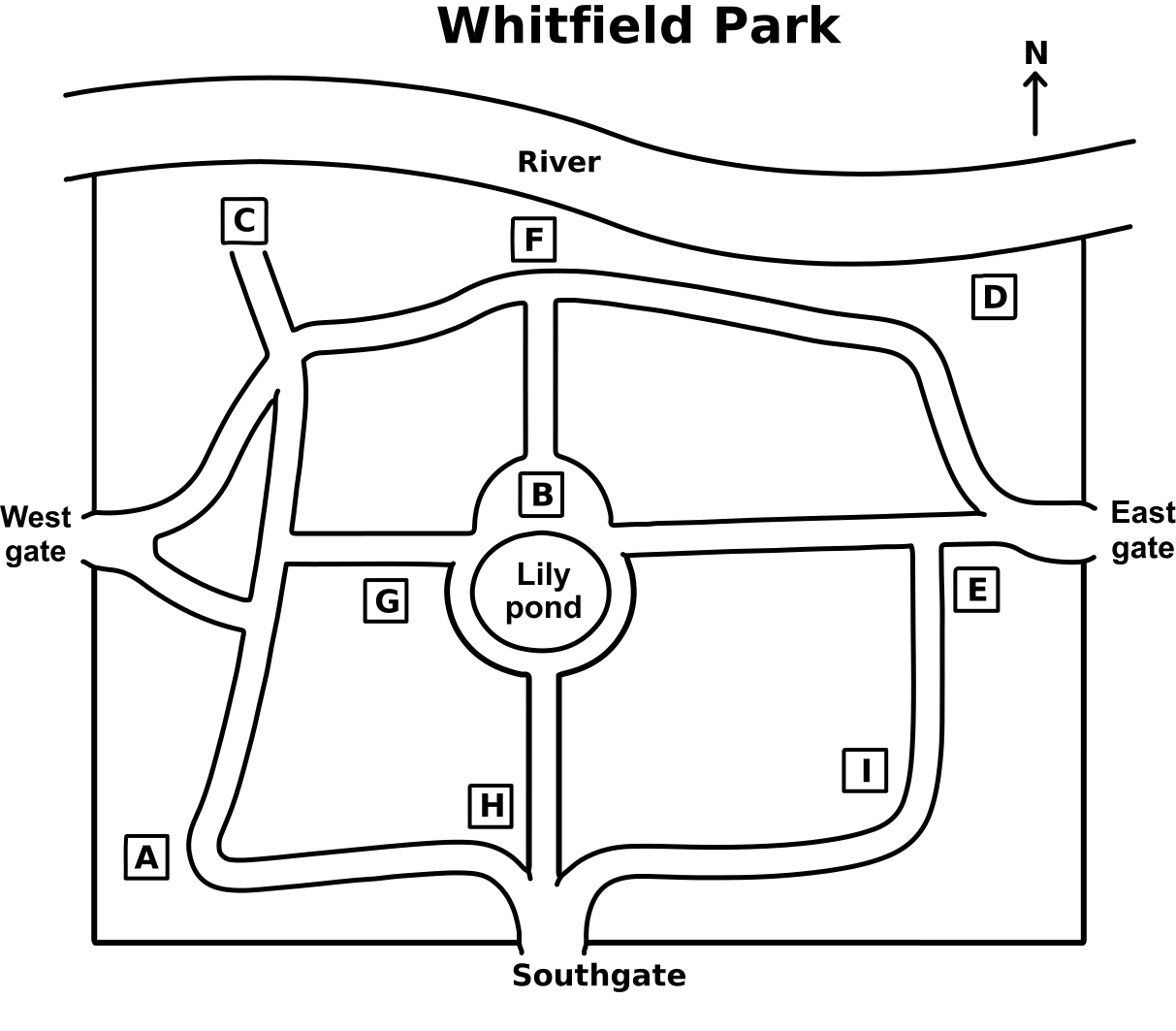
Label the plan of Whitfield Park below.
Write the correct letter, A-I, next to questions 15-20.
- statue of Lillian Hartley
- wooden sculptures
- playground
- maze
- tennis courts
- fitness area
-
spellcheck Answers
11. B
(A) is incorrect. The council took ownership later.(B) is correct. The initial planting was done by residents from nearby streets.
(C) is incorrect. The recording does not support this option: a gardening charity.
12. A
(A) is correct. Hartley organised public pressure so the council would keep the land as a park rather than sell it for housing.(B) is incorrect. The recording does not support this option: blocking army exercises.
(C) is incorrect. The recording does not support this option: winning maintenance funding.
13. B
(A) is incorrect. The recording does not support this option: council permission was refused.(B) is correct. , after inspection, the army concluded that the park was too small for practical use.
(C) is incorrect. The recording does not support this option: a better site was chosen.
14. B
(A) is incorrect. The recording does not support this option: 2013 plan used unchanged.(B) is correct. The plans dated from 2013 but were revised in 2015 before work began.
(C) is incorrect. The recording does not support this option: 2015 plan finished in 2016.
15. B
The correct answer is B because the statue of Lillian Hartley is now immediately north of the lily pond near the centre of the park, and that position is labelled B.16. D
The correct answer is D because the wooden sculptures are on the riverbank where the path from the East Gate makes a sharp bend, which corresponds to D.17. F
The correct answer is F because the playground is between the river and the path from the lily pond to the river, and that location is marked F.18. C
The correct answer is C because the maze is found by entering from the West Gate, walking north, and turning left, which places it at C.19. A
The correct answer is A because the tennis courts remain in the southern corner where the perimeter path makes a right-angled bend, labelled A.20. G
The correct answer is G because the fitness area is beside the lily pond on the same side as the West Gate, matching G on the plan.
Audio ScriptI'm delighted this evening to introduce our guest speaker, Sarah Holloway, who is going to talk to us about the recent transformation of Whitfield Park. Over to you, Sarah. Thank you very much. I'm sure you all know Whitfield Park well, it has been one of the city's landmarks for well over a century, and the city council has been responsible for it for most of that time. What perhaps fewer of you will know is how the park actually began.
Unlike many city centre parks, which started life as the private gardens of a large house, Whitfield was originally just an unused patch of waste ground. The first flowers there were actually planted by a small group of local residents who lived in the surrounding streets. They began work on the site in 1892. At that point nobody was entirely sure who legally owned the land, and it was a full twenty years later before the city council finally took it into public ownership. Some of you will have seen the statue near one of the gates. That figure is Lillian Hartley, who played a really important role in the early history of the park.
Once the council legally owned the land, its first instinct was to sell it off as building plots for housing. A great many local residents, however, wanted the park to stay open as a place where everyone could enjoy fresh air and green space, bear in mind that this is a very densely built up residential district. Lillian Hartley was at the heart of that campaign, and it was she who organised the petitions and the public demonstrations which, in the end, persuaded the council to drop the sale and keep the land as a park.
Soon afterwards, in 1914, the First World War broke out, and most of the park was dug up and used to grow vegetables, which were sold to local residents. At one point the army did look into taking over the park as a site for troop exercises. They actually wrote to the city council about it, but when they inspected it they concluded that the park was simply too small to be of any practical use to them, so the idea was dropped. The only military activity in the park during the war was the occasional public meeting held on a small area of grass that had been kept clear of vegetable plots.
After the war, the park was largely returned to the way it had been before 1914, and from then on it remained almost unchanged for decades. New plans for transforming the park were drawn up several times over the years; the most recent version dates from 2013, but those plans were then revised in 2015, well before any actual work had got under way. Work on the ground finally began in 2016 and was completed, on schedule, last year.
Before you hear the rest of the talk, you have some time to look at questions 15 to 20. [20 seconds] Now listen and answer questions 15 to 20.All right, I'd like to describe some of the more important changes that have been made, and one or two things that have deliberately been left as they were. If you take a quick look at the map you've been handed, you'll see the familiar outline of Whitfield Park. The river forms the northern boundary, and there is a gate in each of the three other walls.
From there, follow the path up towards the river and the enlarged children's playground sits between that path and the river itself. If you keep your eye on the riverbank, over towards the East Gate side, the new wooden sculptures are at the point where the path coming up from that gate makes a sharp bend.
Back near the West Gate side of the park, there is a maze, a circular pattern of paths separated by low hedges. Head in from the West Gate, walk north towards the river, and then turn left to find it. Close to the same central lily pond, on the side facing the West Gate, you'll also find the new outdoor fitness area.
Down in the southern corner, where the perimeter path makes that distinct right angled bend, the tennis courts are still in their familiar position, though we have now doubled them from four to eight. Now, since you are all keen gardeners, I'm sure you'll want to hear about the plants that have been chosen for the new beds.
Listen to the recording and answer questions 21 to 30. The answers and the audio script are in the box below the questions.
Questions 21-25
Choose the correct letter, A, B or C.
21. Nina and Owen were surprised to learn that coastal cities
- are home to just under half of all people.
- account for many of the largest cities.
- are expanding at double the rate of inland cities.
22. According to Owen, building coastal cities near to rivers
- can carry contamination back towards urban areas.
- can leave too little land for farming upstream.
- can cause factories to damage rural scenery.
23. What mistake was made when building water drainage channels in Port Selby in the 1950s?
- The system did not include enough channels.
- The builders selected the wrong construction materials.
- The design failed to anticipate rising sea levels.
24. What do Nina and Owen think that the authorities in Port Selby should do immediately?
- take measures to restore coastal ecosystems
- pay for a new flood prevention system
- stop disposing of waste materials into the ocean
25. What do they agree should be the priority for international action?
- greater coordination of activities
- more sharing of information
- agreement on shared policies
Questions 26-30
What decision do the students make about each of the following parts of their presentation?
Write the correct letter, A-G, next to questions 26-30.
- use visuals
- keep it short
- involve other students
- check the information is accurate
- provide a handout
- focus on one example
- do online research
- Historical background
- Geographical factors
- Past mistakes
- Future risks
- International implications
-
spellcheck Answers
21. B
(A) is incorrect. The recording does not support this option: are home to just under half of all people.(B) is correct. Nina says most of the biggest cities are built by the sea.
(C) is incorrect. The recording does not support this option: are expanding at double the rate of inland cities.
22. A
(A) is correct. Owen says pollutants from inland agriculture and industry travel down rivers to cities.(B) is incorrect. The recording does not support this option: can leave too little land for farming upstream.
(C) is incorrect. The recording does not support this option: can cause factories to damage rural scenery.
23. C
(A) is incorrect. The recording does not support this option: The system did not include enough channels.(B) is incorrect. The recording does not support this option: The builders selected the wrong construction materials.
(C) is correct. Port Selby's drainage channels were built without allowing for global warming and rising sea levels.
24. B
(A) is incorrect. The recording does not support this option: take measures to restore coastal ecosystems.(B) is correct. Nina says they need money to replace the drainage channels for flood protection now.
(C) is incorrect. The recording does not support this option: stop disposing of waste materials into the ocean.
25. A
(A) is correct. They say coastal cities must act together internationally.(B) is incorrect. The recording does not support this option: more sharing of information.
(C) is incorrect. The recording does not support this option: agreement on shared policies.
26. B
B is correct because they decide not to spend too long on historical background, so they will keep it short.27. A
A is correct because they decide to use slides with maps showing geographical factors.28. F
F is correct because they choose the Meriton case study as the basis for past mistakes, focusing on one example.29. G
G is correct because they need to look at websites for future risks, so online research is required.30. C
C is correct because they plan to ask audience members from different places, involving other students.
Audio ScriptTutor: OK, so what I'd like you to do now is to talk to your partner about your presentations on environmental planning. You should have done most of the reading now, so I'd like you to share your ideas and talk about the structure of your presentation and what you need to do next.
Nina: OK, Owen, I'm glad we chose quite a specific topic: coastal cities. It made it much easier to find relevant information.
Owen: Yeah, and cities are growing so quickly. I mean, we know that more than half the world's population lives in cities now.
Nina: Yeah, though that's all cities, not just coastal ones. But most of the biggest cities are actually built by the sea. I'd not realised that before.
Owen: Nor me. And what's more, a lot of them are built at places where rivers come out into the sea. But apparently this can be a problem.
Nina: Why?
Owen: Well, as the city expands, agriculture and industry tend to spread further inland along the rivers. And so agriculture moves even further inland up the river. That's not necessarily a problem, except it means more and more pollutants are discharged into the rivers.
Nina: That's a serious problem.
Owen: Right.
Nina: Did you read that article about Port Selby on the south coast?
Owen: No.
Nina: Well, apparently back in the 1950s, they built channels to drain away the water in case of flooding.
Owen: Sounds sensible.
Nina: Yeah, they spent quite a lot of money on them. But what they didn't take into account was global warming. So they built the drainage channels too close to sea level. And now sea levels are rising, they're more or less useless. If there's a lot of rain, the water can't run away. There's nowhere for it to go.
Owen: So they did not help much in the end.
Nina: So what are the authorities doing about it now?
Owen: I don't know. I did read that they're aiming to stop disposing of waste water into the ocean over the next 10 years. But that won't help with flood prevention now, will it?
Nina: No, really, they just need to find the money for something to replace the drainage channels in order to protect against flooding now. But in the long term, they need to consider the whole ecosystem.
Owen: Right.
Nina: Really though, coastal cities can't deal with their problems on their own, can they? I mean, they've got to start acting together at an international level instead of just doing their own thing.
Owen: Absolutely. The thing is, everyone knows what the problems are and environmental planners have a pretty good idea of what we should be doing about them. So they should be able to work together to some extent.
Nina: But it's going to be a long time before countries come to a decision on what principles they're prepared to abide by.
Owen: Yeah, if they ever do.
Before you hear the rest of the conversation, you have some time to look at questions 26 to 30. [20 seconds] Now listen and answer questions 26 to 30.Nina: So I think we've probably got enough for our presentation. It's only 15 minutes.
Owen: OK, so I suppose we'll begin with some general historical background about why coastal cities were established. But we don't want to spend too long on that. The other students will already know a bit about it.
Nina: It's all to do with communications and so on.
Owen: Yes, we should mention some geographical factors, things like wetlands and river estuaries and coastal erosion and so on.
Nina: We could have some maps of different cities with these features marked.
Owen: On a handout, you mean, or some slides everyone can see.
Nina: Yeah, that'd be better.
Owen: It'd be good to go into past mistakes in a bit more detail. Did you read that case study of the problems there were in Meriton with flooding a few years ago?
Nina: Yes, we could use that as the basis for that part of the talk. I don't think the other students will have read it, but they'll remember hearing about the flooding at the time.
Owen: Hmm, OK. So that's probably enough background. So then we'll go on to talk about what actions have been taken to deal with the problems of coastal cities.
Nina: OK, what else do we need to talk about? Maybe something on future risks looking more at the long term if populations continue to grow?
Owen: Yeah, we'll need to do a bit of work there. I haven't got much information, have you?
Nina: No, we'll need to look at some websites. Shouldn't take too long.
Owen: OK. And I think we should end by talking about international implications. Maybe we could ask people in the audience. We've got people from quite a lot of different places.
Nina: That'd be interesting if we have time, yes. So now should we go on?
Listen to the recording and answer questions 31 to 40. The answers and the audio script are in the box below the questions.
Questions 31-36
What point does the lecturer make about each item?
Write the correct letter, A-K, next to questions 31-36.
- changes drainage
- protects animals
- increases nutrients
- kills germs
- affects many species
- creates dense shade
- alters the soil
- supports farming
- reduces competition
- attracts bell-miners
- helps recovery
- Eucalyptus woodland
- Damage to eucalyptus woodland
- Oil from eucalyptus leaves
- Lime used in construction
- Direct iron supply
- Moderate bushfires
Questions 37-40
Complete the notes below.
Write ONE WORD ONLY for each answer.
Bell-miner associated dieback:
• The process starts with insects feeding on eucalyptus 37
• A sweet liquid containing 38 attracts bell-miners
Fire patterns:
• If fires happen too often, 39 becomes the main vegetation
• When fires are almost absent, thick growth gives bell-miners protected 40 sites
-
spellcheck Answers
31. B
B is correct because eucalyptus woodland provides nesting places and shelter for birds, bats and small mammals.32. E
E is correct because damage to eucalyptus woodland affects a wider community of species, not only the trees themselves.33. D
D is correct because oil from eucalyptus leaves is used in disinfectant, where it can kill certain germs.34. G
G is correct because lime from road construction was washed into the soil and interfered with tree roots.35. K
K is correct because affected trees recovered surprisingly quickly when iron was supplied directly.36. I
I is correct because occasional fire removes fast-growing competitors that would otherwise use water needed by eucalyptus trees.37. leaves
The correct answer is leaves. The lecturer says the process begins when insects settle on eucalyptus leaves and feed on them.38. sugar
The correct answer is sugar. The lecturer says the insects produce a sweet liquid containing sugar, which attracts bell-miners.39. grass
The correct answer is grass. The lecturer says grass tends to dominate afterwards if fires occur too often.40. nesting
The correct answer is nesting. The lecturer says dense growth creates protected nesting sites for bell-miners when fire is suppressed.
Audio ScriptGood morning. Today I want to focus on the eucalyptus tree, one of the best known features of the Australian landscape. Many people call it a gum tree, but the name eucalyptus actually covers hundreds of related species, from small scrubby trees to very tall forest giants.
Now, eucalyptus trees are important in several ways. Ecologically, they provide nesting places and shelter for birds, bats and small mammals. Their flowers also produce nectar, which is an important food source for insects and birds. So when eucalyptus woodland is damaged, the effect is felt across a much wider community of species.
As for their value to people, the trees are also useful. Oil from eucalyptus leaves has long been used in cleaning products, and one common use is in disinfectant, because the oil can kill certain germs. Eucalyptus timber is also used in building and fencing, although that is not really the main focus of today's lecture.
So, these trees can live for centuries, and some individuals survive for four hundred years or more. That is why researchers became concerned when large numbers began dying much earlier than expected in different parts of Australia.
Now, one disease that attracted attention was Mundulla Yellows. The leaves of affected trees slowly turned yellow and then, over time, the whole tree declined. For years the cause was unclear. Eventually, researchers discovered that lime, or calcium hydroxide, had been used in road construction nearby. Rain washed the lime into the surrounding soil, where it interfered with the roots of eucalyptus trees. The trees were still surrounded by nutrients, but they could no longer absorb the iron they needed for healthy growth. When iron was supplied directly to affected trees, they recovered surprisingly quickly.
However, Mundulla Yellows affected only a limited number of places. A much wider problem on the east coast was Bell miner associated dieback. Now, bell miners are small native birds, but they are not the direct cause of the damage. The process begins when insects settle on eucalyptus leaves and feed on them. While feeding, these insects produce a sweet liquid containing sugar. Bell miners are attracted to that liquid, and they aggressively chase away other birds and insects that might otherwise reduce the insect population. As a result, the insects multiply, the leaves are badly damaged, and the trees gradually lose their ability to survive.
But some scientists think fire history is also part of the explanation. An influential theory, first proposed by the ecologist William Jackson, links the type of vegetation in a region to the frequency of bushfires. If fires occur too often, grass tends to dominate the area afterwards. If fires occur at moderate intervals, eucalyptus forest is more likely to persist. This is because occasional fire removes fast growing competitors which would otherwise take up the water eucalyptus trees need. And it also helps maintain the soil by preventing dense undergrowth from changing the soil structure and removing nutrients.
At the other extreme, if fires are almost completely suppressed, a different ecosystem can develop. Scientists sometimes call this dry rainforest. Now, the name sounds contradictory, because we usually associate rainforest with wet tropical conditions. But in this case it means a dense, shaded vegetation system with relatively few species. It can create excellent conditions for bell miners, because the thick growth gives them protected nesting sites while excluding many of the species that would normally compete with them.
What this tells us is that before European settlement, Aboriginal communities used controlled burning over long periods, and this probably created a more balanced pattern of vegetation. Since European settlement, fire has often been suppressed, roads and farms have altered drainage, and some local ecosystems have shifted away from eucalyptus woodland. The decline of eucalyptus trees, then, is not caused by one single factor. It is the result of disease, insects, birds, soil chemistry and fire management interacting with one another.

Completion - Part 1
Learn how to answer these questions in a step-by-step interactive exercise
Completion - Part 1
Mezera se může ptát na čas nebo četnost. Mluvčí obvykle pojmenuje stejné období jinými slovy, takže k mezeře přiřaďte význam a nečekejte na formulaci ze stránky.
Před odesláním pak zkontrolujte limit slov. Přečtěte si celý řádek znovu s odpovědí v mezeře a odstraňte každé slovo, které už řádek obsahuje. Odpověď, která je významově správně, ale je příliš dlouhá, nezíská žádný bod.
Klikněte na přehrát a poslechněte si audio
Poznámky používají jednoduché sloveso, například must provide nebo need to bring. Mluvčí toto sloveso řekne jen zřídka, místo toho použije synonymum nebo činnost popíše, takže poslouchejte, co je skutečně požadováno.
Mluvčí často nejdřív zmíní další položky a pak je vyloučí. Když mezeru propásnete, nechte ji být a přejděte k další, protože odpovědi jdou v pořadí nahrávky a jedna ztracená mezera vás může připravit i o ty následující.
Klikněte na přehrát a poslechněte si audio
Jak se vám dařilo při odpovídání na výše uvedené vzorové otázky IELTS Listening? Připadaly vám některé otázky obtížné? Pokud ano, mohlo by vám prospět, kdybyste si blíže prohlédli všech 6 typů úloh IELTS Listening. Čím lépe danému typu úlohy rozumíte, tím méně úsilí budete potřebovat na zjišťování, co máte dělat, a tím více času budete mít na nalezení odpovědi.
6 typů úloh IELTS Listening
V testu IELTS Listening existuje 6 různých typů otázek. Je důležité procvičovat každý typ úlohy, abyste se naučili nejlepší způsob, jak ke každé přistupovat, a dosáhli tak vysokého skóre IELTS Listening.
Které typy poslechových úloh jsou pro naše studenty nejtěžší
Místo trendu z roku 2017 zde uvádíme, co ukazuje 2.25 milionu odpovědí studentů BestMyTest v poslechové části IELTS. Procenta udávají, jak často naši studenti daný typ úlohy zodpověděli správně.
| Typ úlohy | Správně |
|---|---|
| Doplňování poznámek | 33% |
| Doplňování tabulky | 34% |
| Doplňování vět | 45% |
| Krátká odpověď | 48% |
| Výběr jedné odpovědi | 50% |
| Výběr více odpovědí | 51% |
| Popisování plánu, mapy či diagramu | 55% |
| Doplňování formuláře | 73% |
| Přiřazování | 85% |
- Právě v doplňovacích úlohách se ztrácejí body. U doplňování poznámek a tabulek jsou odpovědi správné jen v jednom případě ze tří, zatímco u doplňování formulářů, které vyžaduje stejnou dovednost v jednodušším uspořádání, dosahuje úspěšnost 73%. Rozdíl spočívá v pravopisu, tvaru slov a dodržování slovních limitů pod časovým tlakem, nikoli v porozumění.
- V celkem 61 964 úplných cvičných poslechových testech, které absolvovalo 55 296 studentů, bylo průměrné skóre 5.5. V 41% testů bylo dosaženo skóre 6.0 a ve 12% skóre 7.0.
- V jednotlivých poslechových oddílech dosáhla třetina pokusů úspěšnosti 40% nebo méně a 30% pokusů úspěšnosti 80% nebo více. Většina studentů výrazně selhává v jednom či dvou oddílech, místo aby měla rovnoměrně nízké skóre, a proto se vyplatí procvičovat oddíly 3 a 4 samostatně.
Údaje pocházejí z dat cvičných testů a hodnocení BestMyTest do října 2026. Procenta u typů úloh vyjadřují podíl správných odpovědí ze všech pokusů; údaje u hodnoticích kritérií představují skóre udělená lektorem nebo AI podle uvedeného označení. Poslední aktualizace 5. října 2026.
Ačkoli každý typ poslechové otázky vypadá jinak, základní přístup ke každému z nich je stejný. Později v tomto článku vám ukážeme základní strategii, jak zvládnout všech 6 typů otázek. Každý typ má zvukovou ukázku a odpověď v průvodci typy otázek IELTS Listening.
- Typ úlohy 1 – Sentence Completion (doplňování vět)
- Typ úlohy 2 – Matching (přiřazování)
- Typ úlohy 3 – Plan, Map, Diagram Labelling (popisování plánů, map, diagramů)
- Typ úlohy 4 – Form, Note, Table, Flow-Chart, Summary Completion (doplňování formuláře, poznámek, tabulky, vývojového diagramu, shrnutí)
- Typ úlohy 5 – Multiple Choice (výběr z více možností)
- Typ úlohy 6 – Short Answer Questions (krátké odpovědi)
3 kroky k efektivní online přípravě na test IELTS Listening
Ačkoli je každý typ otázky (úlohy) IELTS Listening jiný, základní přístup ke každému z nich je stejný. Všechny typy úloh můžete zvládnout jednou jednoduchou strategií krok za krokem. Zde jsou tři kroky, které doporučujeme používat při řešení typů poslechových otázek:
- Pozorně prozkoumejte otázky a najděte klíčové informace
- Předpovězte potenciální odpovědi před poslechem
- Sledujte průběh nahrávky a přiřazujte otázky k obsahu
Krok 1: Prozkoumejte otázky
V poslechové sekci IELTS dostanete krátký čas na přípravu (30–40 sekund) před začátkem nahrávky. Toto je vaše příležitost prohlédnout si otázky, na které budete muset odpovědět, a právě o tom je první krok této strategie. Místo toho, abyste tento čas využili k odpočinku nebo ke kontrole svých odpovědí, se zaměříte na to, abyste se o nadcházejících otázkách dozvěděli co nejvíce. Tento krok je důležitý, abyste se vyhnuli chybě, kdy se snažíte poslouchat mluvčího a zároveň poprvé číst otázky.
Když začne váš čas na přípravu, nejprve tento čas co nejlépe využijte tím, že prozkoumáte otázky, abyste o nich zjistili více. Toto jsou některé informace, které byste měli při zkoumání každé otázky IELTS Listening hledat:
- O jaký typ otázky se jedná?
- Jak bude odpověď vypadat? (například: datum, číslo, jméno)
- Které jsou nejdůležitější fráze a slova, neboli klíčová slova, v otázkách?
Jedním příkladem může být typ otázky Note Completion, například:
Complete the notes below.
Write NO MORE THAN THREE WORDS for each answer.
Nejprve můžete v otázce podtrhnout některá klíčová slova.
Two reasons for the new approach to pricing are changes in (27) ______ and (28) _________ programs.
V tomto příkladu vám poslech klíčové fráze „two reasons“, kterou jste si již podtrhli, umožní
začít věnovat pečlivou pozornost ve správnou chvíli. Zde je část přepisu, která odhaluje odpověď:
Mark: Well, there seem to be two basic reasons. Firstly, because the law has changed recently to allow companies to behave like this. In the past, they weren't allowed to change the prices of the tickets. And secondly, we now have computer programs that do the calculations so that prices can be changed very quickly and accurately.
Po prozkoumání otázek byste věděli, že „the law“ a „computer“ jsou správné odpovědi na základě některých klíčových slov a znalosti typu otázky.
Krok 2: Předpovězte potenciální odpovědi
Druhý krok této strategie pro úspěch v poslechové sekci IELTS velmi úzce souvisí s prvním. Ve skutečnosti byste se měli pokusit dokončit oba tyto kroky během stejného 20sekundového přípravného času před začátkem nahrávky. I když se to může zdát jako obtížný úkol v tak krátkém čase, pamatujte, že tyto kroky jsou ve skutečnosti vzájemně propojeny.
Abyste mohli předpovídat potenciální odpovědi na poslechové otázky, budete nejprve muset dokončit krok jedna pečlivým prozkoumáním otázek. V tomto okamžiku byste měli vědět, na jaký typ otázky se díváte, jak budou potenciální odpovědi vypadat a která klíčová slova vám pomohou rychle odpovědi najít. K předpovídání odpovědí všechny tyto informace zkombinujete a uděláte odhad o tom, jaký typ odpovědi očekáváte uslyšet.
Vraťme se k téže ukázkové otázce typu Note Completion z výše uvedeného příkladu.
Two reasons for the new approach to pricing are changes in (27) and (28) programs.
Pouhým pohledem na gramatiku této věty můžete určit, jakým slovním druhem bude odpověď. V tomto případě předložka „in“ předchází oběma potenciálním odpovědím. Gramaticky lze takto v předložkových frázích použít pouze podstatná jména nebo jmenné fráze. Nejenže můžete správně předpovědět, že odpověď bude podstatné jméno nebo jmenná fráze, ale bylo by také možné předpovědět, že odpověď by mohla být něco souvisejícího s politikou nebo vládou (zákonem) a slovo, které se může objevit s programy (počítač) na základě kontextu.
Ačkoli je nemožné uhodnout přesnou správnou odpověď pouze na základě předpovědí, snahou představit si, jak by odpověď mohla vypadat, je pravděpodobnější, že budete poslouchat relevantní informace a ignorovat ty irelevantní. Předpovídání potenciálních odpovědí před začátkem nahrávky vám připraví sluch a přiblíží vás o krok ke správné odpovědi.
Nyní zkuste spojit Krok 1 (prozkoumání otázek) a Krok 2 (předpověď potenciálních odpovědí) dohromady ve složitější vzorové otázce typu multiple choice.
Choose the correct letter, A, B, C or D.
- are for weekend shows
- are booked well in advance
- are non-refundable
- are booked for groups
Ačkoli neexistuje způsob, jak odpovědi na tyto otázky znát s jistotou, stále můžete použít informace nalezené v těchto otázkách k předpovědi potenciálních odpovědí a k zacílení svého poslechu. Například otázka 24 se týká důvodu, proč budou ceny vstupenek do divadla nejnižší, takže budete chtít pozorně poslouchat všechny tyto důvody, které mohou být zmíněny. Mějte na paměti, že je možné, že bude zmíněno více než jeden důvod. Podívejte se na přepis níže, abyste viděli, jak vám předpověď může pomoci vyloučit nesprávné odpovědi.
Všimněte si, že jsou zmíněny tři z potenciálních odpovědí: „booked for groups“, „are for weekend shows“ a „are non-refundable“. Správná odpověď je však C „are non-refundable“, protože je zmíněna jako levnější odděleně od ostatních dvou, které jsou jednoduše uvedeny společně.
Krok 3: Sledujte průběh
Jakmile nahrávka začne a zahájí se vlastní poslechová část testu, měli byste pokračovat ve sledování průběhu, abyste dokončili třetí krok této strategie pro poslechovou sekci IELTS. Sledování průběhu vyžaduje, abyste se soustředili na to, co slyšíte, a zároveň sledovali, které otázce se obsah pravděpodobně věnuje.
Otázky v poslechové sekci IELTS se obvykle objevují v pořadí, ve kterém lze jejich odpovědi najít v obsahu nahrávky. To vám v testu poskytuje výhodu, protože to znamená, že jakmile uslyšíte odpověď na jednu otázku, okamžitě obrátíte svou pozornost na další v pořadí. Pokud se vám podaří úspěšně sledovat průběh tím, že přiřazujete kontext z otázek k tomu, co slyšíte v nahrávce, zůstanete na správné cestě a vyhnete se zmeškání klíčových informací nezbytných k zodpovězení každé z otázek.
Snazší řečeno než uděláno. Budete muset multitaskovat – poslouchat a zároveň sledovat další otázku. Pokud vám ve skutečnosti odpověď na otázku unikne, dozvíte se to, když uslyšíte odpověď na pozdější otázku. I když to může být matoucí a dokonce frustrující, vynechat jednu odpověď a být si toho vědom je stále lepší než se v obsahu úplně ztratit a zmeškat ještě více odpovědí. V případě, že vám otázka unikne, byste ji měli jednoduše opustit a pokračovat na další. Na konci budete muset udělat nejlepší odhad ohledně otázky, kterou jste zmeškali. Avšak na pozitivní straně je možné, že poslech nahrávky v její celistvosti vám poskytne další kontextová vodítka a umožní vám přesněji odpovědět na otázky, které jste zmeškali.
Bezplatné zdroje pro procvičení testu IELTS Listening
K dosažení vysokého band score v IELTS Listening budete potřebovat silné poslechové dovednosti. Z tohoto důvodu je důležité, abyste trénovali konzistentně každý den až do dne testu.
Níže jsou některé zdroje, které můžete použít k tréninku a udržování svých poslechových dovedností denně.
- YouTube - https://www.youtube.com
- BBC Learning English - http://www.bbc.co.uk/learningenglish
- TED - https://www.ted.com/
- BBC radio - https://www.bbc.co.uk/worldserviceradio
- ABC news in Australia - https://www.abc.net.au/listen/live/news