V tomto průvodci si vyzkoušíte bezplatný test IELTS Speaking a procvičíte si nejčastěji používaná témata otázek IELTS Speaking s odpověďmi. Naučíte se odpovídat na otázky testu IELTS Speaking pro části 1, 2 a 3 pomocí našich plně otestovaných šablon mluvených odpovědí.
Po dokončení cvičného testu IELTS Speaking získejte bezplatné ukázkové odpovědi IELTS Speaking.
play_circle_outline Začít cvičný test IELTS SpeakingNíže je náš úplný seznam otázek IELTS Speaking s ukázkovými odpověďmi. Poznámka: červené odkazy jsou naše nejoblíbenější a nejdoporučovanější otázky speakingu podle hodnocení studentů a můžete je kdykoli zdarma procvičovat.
Otázky IELTS Speaking část 1 1 - 96
Short questions about familiar topics like your home, work, and hobbies
Otázky IELTS Speaking část 2 1 - 83
Cue cards where you speak for 1 to 2 minutes about one topic
Otázky IELTS Speaking část 3 1 - 97
Discussion questions linked to the Part 2 topic
Průvodce k úspěchu v testu IELTS Speaking
Vítejte v oficiálním průvodci BestMyTest k testu IELTS Speaking. Zbytek tohoto průvodce se zaměří na nejčastěji používaná témata IELTS Speaking pro části 1–3, na poslech vzorových odpovědí na úrovni band 9 a na důležité tipy a zdroje k testu IELTS Speaking, které vám pomohou k úspěchu. Pro rychlé nalezení informací použijte obsah níže.
Obsah
- Úvod do testu IELTS Speaking
- Témata IELTS Speaking pro část 1
- Témata IELTS Speaking pro části 2 a 3
- Jak zvládnout IELTS Speaking část 1
- Jak zvládnout IELTS Speaking část 2
- Jak zvládnout IELTS Speaking část 3
- Procvičování IELTS Speaking pro váš úspěch
- Jak se otázky IELTS Speaking hodnotí
- Bezplatné zdroje pro test IELTS Speaking
Test IELTS Speaking
Test IELTS Speaking může zpočátku působit trochu zastrašujícím dojmem, zejména proto, že budete testováni naživo před zkoušejícím. Vzhledem k tomuto živému formátu může být obtížné najít bezplatná témata k mluvení se vzorovými odpověďmi, ale nebojte, máme to pro vás připravené. Než si začneme procvičovat naše témata IELTS Speaking, podívejme se krátce na test mluvení a na to, jak funguje.
Formát testu Speaking
Test mluvení trvá přibližně 11–15 minut a skládá se ze 3 částí. Vezměte prosím na vědomí, že témata mluvení pro Greeting (pozdrav) a část 1 jsou stejná, takže jsou považována pouze za 1 část, ale pro vaše pohodlí jsme je oddělili.
- Greeting v testu IELTS Speaking
- IELTS Speaking – část 1
- IELTS Speaking – část 2
- IELTS Speaking – část 3
Greeting
Když absolvujete test IELTS Speaking a vejdete do zkušební místnosti, zkoušející nezačne hned obtížnými otázkami z IELTS Speaking, naopak začne pomalu pozdravy. Vezměte prosím na vědomí, že BUDETE hodnoceni za svou schopnost pozdravit, proto je důležité být na to připraven. Pojďme se krátce podívat na jednoduchý pozdrav a odpověď.
- Zkoušející se vám představí a zeptá se, jak se jmenujete. Odpovíte „My name's _______“.
- Dále se vás zeptá „What can I call you?“, na což můžete odpovědět „You can call me _______“. Zde můžete použít své anglické jméno, pokud nějaké máte. Může to znít zvláštně, ale někteří lidé nedokážou vyslovit své vlastní anglické jméno. To je NEPŘIJATELNÉ. Pokud jej neumíte vyslovit, raději jej nepoužívejte.
- Po vašem jménu se vás zeptá, odkud jste. Stačí říct „I'm from _______“. To je dostačující. V této fázi nemusíte k odpovědím přidávat žádné další informace.
- Nakonec budete požádáni o doklad totožnosti. Po jeho předložení test začnete.
IELTS Speaking – část 1
IELTS Speaking část 1 trvá 4–5 minut, obsahuje přibližně 8–10 otázek IELTS Speaking a asi 2–3 známá témata IELTS Speaking, jako jsou vaše práce, vaše studium, vaše rodina, vaše rodné město, vaše bydlení atd. Tato témata jsou jednodušší než témata z IELTS Speaking části 2. Níže jsou některé příklady toho, na co se vás mohou zeptat.
Where is your hometown?
What do you like about it?
What do you not like about it?
How important is your hometown to you?
Let's move on to talk about accommodation:
Tell me about the kind of accommodation you live in?
Does the place you live in have many amenities?
Is there anything you would like to change about the place you live in?
Do you plan to live there for a long time?
Otázky v části 1 lze nejlépe popsat jako otázky, které napodobují small talk mezi dvěma neznámými nebo známými lidmi. Nejsou příliš do hloubky, ale nenechte se tím zmást a nemyslete si, že se na ně nemusíte připravovat. I malá příprava vám může hodně pomoci a budete nám děkovat, že jsme vás k ní přinutili! Později v tomto článku najdete také několik tipů, jak se na otázky části 1 připravit.
IELTS Speaking – část 2
V části 2 budete mluvit o konkrétním tématu IELTS Speaking. Téma je pro vás vybráno a bude vám dáno na kartě (Candidate Task Card). Poté budete mít 1 minutu na přípravu odpovědi a maximálně 2 minuty na mluvení. Budou vám poskytnuty tužka a papír na zápisky. Níže je příklad otázky pro IELTS Speaking část 2:
Describe a useful electronic device you would like to own.
You should say:
- What it is
- How it would help your life
- If it would be expensive to buy
And explain why you would like it.
Jakmile vyprší vaše dvouminutová doba na mluvení, je možné, že zkoušející tuto část testu ukončí tím, že vám položí několik jednoduchých otázek souvisejících s vaší odpovědí v části 2.
Někdy se jim říká rounding off questions (zaokrouhlovací otázky),
protože pomáhají „zaokrouhlit“ neboli dokončit váš rozhovor. Pojďme se podívat na některé otázky IELTS Speaking, které by mohly zaznít.
Předpokládejme například, že tématem IELTS Speaking, o kterém jste mluvili v části 2, bylo „Describe your favorite form of public transport“.
Zkoušející může váš rozhovor zaokrouhlit tím, že se zeptá:
- Are the buses cheap in your city?
- Did you travel to the test today by bus?
Tyto zaokrouhlovací otázky jsou obvykle jednoduché, takže vám stačí odpovědět jednoduchými odpověďmi.
Dlouhé a složité odpovědi zde nejsou nutné, protože zkoušející se bude pravděpodobně chystat přejít k části 3.
Můžete například odpovědět na zaokrouhlovací otázku krátce takto:
- Yes, about 2 dollars for a single journey.
- No, actually I came by taxi.
Na druhou stranu existují případy, kdy zkoušející může zaokrouhlovací otázky úplně vynechat a místo toho přejít přímo k části 3. Pokud se to stane během vašeho testu IELTS Speaking, nebojte se. Znamená to, že vaše odpověď v části 2 byla dostatečně dlouhá a že vaše 3 minuty na mluvení v části 2 již vypršely.
IELTS Speaking – část 3
V části 3 vám bude položeno přibližně 4–8 dalších otázek IELTS Speaking, které souvisí s tématy IELTS Speaking probíranými v části 2. Zkoušející vám také položí několik otázek na základě vašich odpovědí, takže celá část 3 je obousměrnou diskusí se zkoušejícím a trvá 4–5 minut. Zde jsou některé obecné otázky k mluvení, které vám zkoušející může položit na základě výše uvedených témat IELTS Speaking části 2:
What devices do you think will be popular in the future?
Do you think people spend too much money on electronic devices?
In what ways can electronic devices make our lives harder?
What would the world be like without computers?
Should children be taught to use computers at school?
Témata IELTS Speaking
Nyní, když jste se seznámili s tím, jak funguje test IELTS Speaking, vidíte, že vám mohou být položeny otázky na nejrůznější témata. Je důležité, abyste se seznámili s některými z častěji používaných témat IELTS Speaking. Vytvořili jsme nejen komplexní seznam, ale ke každému tématu jsme přidali také vzorovou odpověď IELTS Speaking.
Sloupcový graf níže ukazuje nejčastější kategorie témat IELTS Speaking část 2 a 3 v letech 2025 a 2026. Vodorovná osa (osa x) uvádí sedm kategorií témat a svislá osa (osa y) ukazuje procento témat v každé kategorii. Modré sloupce představují rok 2025 a oranžové sloupce rok 2026.
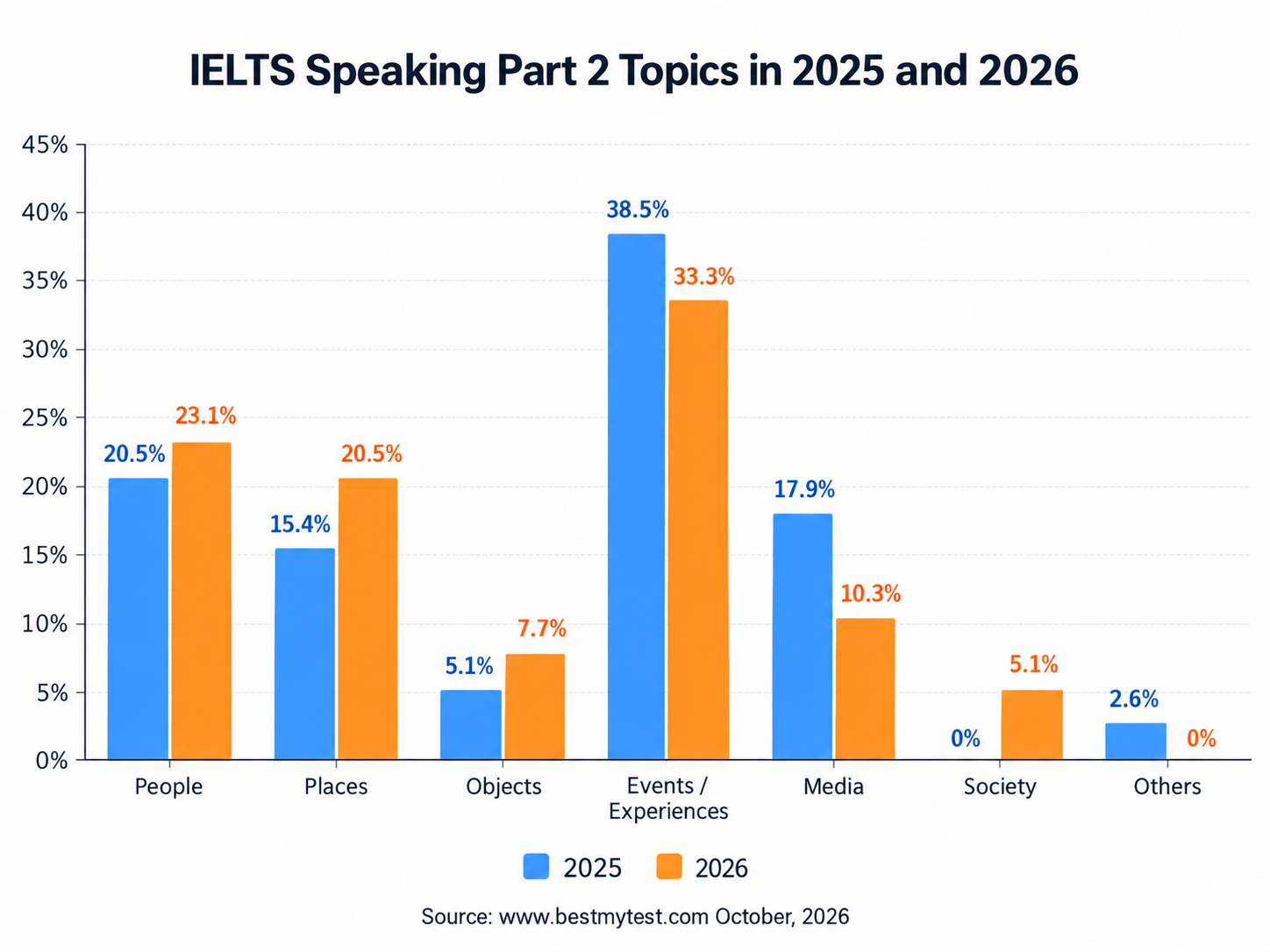
Jak je vidět, události a zážitky jsou v obou letech největší kategorií a tvoří 38,5 % témat v roce 2025 a 33,3 % v roce 2026. Tyto otázky vás obvykle žádají, abyste popsali něco, co jste udělali nebo zažili, například nezapomenutelný výlet, zvláštní oslavu nebo chvíli, kdy jste někomu pomohli.
Lidé a místa jsou také důležité kategorie. Dohromady tvoří 43,6 % témat v roce 2026. Můžete být požádáni, abyste popsali někoho, koho obdivujete, člověka, který vás ovlivnil, místo, které rádi navštěvujete, nebo lokalitu, kterou byste chtěli prozkoumat.
Ostatní kategorie, včetně předmětů, médií a společnosti, se v tomto vzorku objevují méně často. Přesto je dobré je procvičit, protože otázky IELTS Speaking mohou pokrývat širokou škálu každodenních témat.
Co to znamená pro vaši přípravu na IELTS? Začněte procvičováním otázek o vašich osobních zážitcích, lidech, které znáte, a místech, která jste navštívili. Tato témata tvoří velkou část otázek v grafu. Připravte si několik pružných příběhů a příkladů, které dokážete přizpůsobit různým otázkám, místo abyste se učili celé odpovědi nazpaměť.
Témata IELTS Speaking – část 1
Seznam níže obsahuje více než jen otázky, ukazuje také témata mluvení, na která se zkoušející ptali lidí v minulosti. Skvělým tipem je odpovídat na tyto otázky IELTS Speaking části 1 do zrcadla nebo s kamarádem. Tabulka níže ukazuje četnost použití jednotlivých témat:
| Téma | Četnost |
|---|---|
| Hometown/Accommodation/Country | Vysoká |
| Friends/Family/Housework/Children | Vysoká |
| TV/Reading/Music/Newspapers & Magazines/Films | Vysoká |
| Technology/Computers/Internet | Vysoká |
| Work/Jobs/Career Planning/Volunteer Work | Vysoká |
| School majors/High School | Střední |
| Sports/Outdoor Activities/Indoor Activities | Střední |
| Travel/Lifestyle | Střední |
| Season/Rain/Sunny Days/Weather | Střední |
| Fashion/Shoes/Bags/Clothes | Střední |
| Transportation/Boats/Buses/Taxis | Střední |
| Celebrities/Advertisements/Media | Střední |
| Photos/Photography/Colors/Art | Nízká |
| Noise/Patience/Politeness | Nízká |
| Mirrors/Gifts | Nízká |
Question 1
-
spellcheck TranscriptDo you enjoy going out in your free time? Why or why not?
-
Sample Response
Yeah, I usually enjoy going out in my free time because it helps me relax and meet new people. Honestly, it’s a great way to take a break from daily routine and clear my mind a little.
Watch the video question, then click to record your answer.
Practice speaking questions in our appQuestion 2
-
spellcheck TranscriptWhat kind of places do you usually go to when you go out?
-
Sample Response
Well, when I go out, I often like to visit cafes or parks. Sometimes, I also enjoy going to the cinema or shopping malls because those places are lively and fun to hang out in, you know.
Watch the video question, then click to record your answer.
Practice speaking questions in our appQuestion 3
-
spellcheck TranscriptWho do you prefer to go out with, friends or family? Why?
-
Sample Response
I think I prefer going out with friends, actually, because we share similar interests. However, sometimes I also enjoy spending time with my family. It really depends on the occasion, to be honest.
Watch the video question, then click to record your answer.
Practice speaking questions in our appQuestion 4
-
spellcheck TranscriptHow often do you go out in the evenings?
-
Sample Response
To be fair, I don’t go out every evening. I guess maybe two or three times a week, depending on my schedule. If I’m tired or busy, I usually just stay at home and relax.
Watch the video question, then click to record your answer.
Practice speaking questions in our appQuestion 5
-
spellcheck TranscriptHas the way you go out changed compared to when you were younger?
-
Sample Response
Yes, the way I go out has definitely changed since I was younger. I used to go out more often and stay out late. Now, I prefer quieter places and I’m a bit more careful with my time.
Watch the video question, then click to record your answer.
Practice speaking questions in our appQuestion 6
-
spellcheck TranscriptLet's move on to talk about goals. Do you have any specific goals for this year?
-
Sample Response
Let’s see, this year my main goal is to improve my English and maybe learn a new skill. I also want to travel to at least one new country if possible, just to experience something different.
Watch the video question, then click to record your answer.
Practice speaking questions in our appQuestion 7
-
spellcheck TranscriptWhy is it important for people to set goals?
-
Sample Response
I believe setting goals is really important because it gives us direction and motivation. Without goals, it’s easy to lose focus and just drift through life without achieving anything meaningful, don’t you think?
Watch the video question, then click to record your answer.
Practice speaking questions in our appQuestion 8
-
spellcheck TranscriptHave you ever achieved a goal that was difficult for you?
-
Sample Response
Actually, yes, I once had a goal to run a half marathon. It was really difficult for me because I’m not a natural runner. But after a lot of training, I finally managed to do it and I felt so proud.
Watch the video question, then click to record your answer.
Practice speaking questions in our appQuestion 9
-
spellcheck TranscriptHow do you keep track of your progress towards your goals?
-
Sample Response
To be honest, I usually write my goals down in a notebook or on my phone. I try to check in regularly, maybe once a week, to see how I’m doing and make any changes if needed.
Watch the video question, then click to record your answer.
Practice speaking questions in our appQuestion 10
-
spellcheck TranscriptDid you have any goals when you were a child?
-
Sample Response
When I was a child, I definitely had some goals, like becoming a teacher or learning to play the piano. Even though I didn’t achieve all of them, some childhood dreams still motivate me today.
Watch the video question, then click to record your answer.
Practice speaking questions in our app
Task Achievement — IELTS Speaking 1
Learn how to answer these questions in a step-by-step interactive exercise
Task Achievement — IELTS Speaking 1
Prvním krokem při odpovídání na otázku v IELTS Speaking Part 1 je dát přímou odpověď a pak ji rozvést o něco podrobněji.
Jednoduchá struktura odpovědi vám pomůže vědět, co říct dál, takže odpovíte rychle, budete mluvit přirozeně a odpověď nebude příliš dlouhá. Nezastavujte se po jedné krátké větě, ale postupujte podle struktury krok za krokem.
V tomto kroku se naučíte, jak pomocí této struktury sestavit jasné a přirozené odpovědi v IELTS Speaking Part 1.
Pojďme na otázku 1.
Nejprve určete typ otázky. Zeptejte se sami sebe: Co po mně tato otázka chce? Jakmile typ poznáte, řiďte se při odpovědi odpovídající strukturou.
Tato otázka je typu Direct Answer, takže postupujte podle této struktury:
Answer + Reason → Example or Detail → Result or Extra Detail
Při mluvení používejte řízené výplňové fráze, například Well, Actually, For example, What I mean by that is a So overall. Díky nim bude vaše odpověď znít plynuleji a získáte chvilku navíc na přemýšlení, když na okamžik zapomenete, co říct dál. Používejte je přirozeně, ne v každé větě. Tady je seznam řízených výplňových frází.
Do you enjoy going out in your free time? Why or why not?
Pojďme na otázku 2.
Nejprve určete typ otázky. Zeptejte se sami sebe: Co po mně tato otázka chce? Jakmile typ poznáte, řiďte se při odpovědi odpovídající strukturou.
Tato otázka je typu Direct Answer, takže postupujte podle této struktury:
Answer + Reason → Example or Detail → Result or Extra Detail
Při mluvení používejte řízené výplňové fráze, například Well, Actually, For example, What I mean by that is a So overall. Díky nim bude vaše odpověď znít plynuleji a získáte chvilku navíc na přemýšlení, když na okamžik zapomenete, co říct dál. Používejte je přirozeně, ne v každé větě. Tady je seznam řízených výplňových frází.
What kind of places do you usually go to when you go out?
Pojďme na otázku 3.
Nejprve určete typ otázky. Zeptejte se sami sebe: Co po mně tato otázka chce? Jakmile typ poznáte, řiďte se při odpovědi odpovídající strukturou.
Tato otázka je typu Direct Answer, takže postupujte podle této struktury:
Answer + Reason → Example or Detail → Result or Extra Detail
Při mluvení používejte řízené výplňové fráze, například Well, Actually, For example, What I mean by that is a So overall. Díky nim bude vaše odpověď znít plynuleji a získáte chvilku navíc na přemýšlení, když na okamžik zapomenete, co říct dál. Používejte je přirozeně, ne v každé větě. Tady je seznam řízených výplňových frází.
Who do you prefer to go out with, friends or family? Why?
Pojďme na otázku 4.
Nejprve určete typ otázky. Zeptejte se sami sebe: Co po mně tato otázka chce? Jakmile typ poznáte, řiďte se při odpovědi odpovídající strukturou.
Tato otázka je typu Direct Answer, takže postupujte podle této struktury:
Answer + Reason → Example or Detail → Result or Extra Detail
Při mluvení používejte řízené výplňové fráze, například Well, Actually, For example, What I mean by that is a So overall. Díky nim bude vaše odpověď znít plynuleji a získáte chvilku navíc na přemýšlení, když na okamžik zapomenete, co říct dál. Používejte je přirozeně, ne v každé větě. Tady je seznam řízených výplňových frází.
How often do you go out in the evenings?
Pojďme na otázku 5.
Nejprve určete typ otázky. Zeptejte se sami sebe: Co po mně tato otázka chce? Jakmile typ poznáte, řiďte se při odpovědi odpovídající strukturou.
Tato otázka je typu Direct Answer, takže postupujte podle této struktury:
Answer + Reason → Example or Detail → Result or Extra Detail
Při mluvení používejte řízené výplňové fráze, například Well, Actually, For example, What I mean by that is a So overall. Díky nim bude vaše odpověď znít plynuleji a získáte chvilku navíc na přemýšlení, když na okamžik zapomenete, co říct dál. Používejte je přirozeně, ne v každé větě. Tady je seznam řízených výplňových frází.
Has the way you go out changed compared to when you were younger?
Pojďme na otázku 6.
Nejprve určete typ otázky. Zeptejte se sami sebe: Co po mně tato otázka chce? Jakmile typ poznáte, řiďte se při odpovědi odpovídající strukturou.
Tato otázka je typu Direct Answer, takže postupujte podle této struktury:
Answer + Reason → Example or Detail → Result or Extra Detail
Při mluvení používejte řízené výplňové fráze, například Well, Actually, For example, What I mean by that is a So overall. Díky nim bude vaše odpověď znít plynuleji a získáte chvilku navíc na přemýšlení, když na okamžik zapomenete, co říct dál. Používejte je přirozeně, ne v každé větě. Tady je seznam řízených výplňových frází.
Let's move on to talk about goals. Do you have any specific goals for this year?
Pojďme na otázku 7.
Nejprve určete typ otázky. Zeptejte se sami sebe: Co po mně tato otázka chce? Jakmile typ poznáte, řiďte se při odpovědi odpovídající strukturou.
Tato otázka je typu Direct Answer, takže postupujte podle této struktury:
Answer + Reason → Example or Detail → Result or Extra Detail
Při mluvení používejte řízené výplňové fráze, například Well, Actually, For example, What I mean by that is a So overall. Díky nim bude vaše odpověď znít plynuleji a získáte chvilku navíc na přemýšlení, když na okamžik zapomenete, co říct dál. Používejte je přirozeně, ne v každé větě. Tady je seznam řízených výplňových frází.
Why is it important for people to set goals?
Pojďme na otázku 8.
Nejprve určete typ otázky. Zeptejte se sami sebe: Co po mně tato otázka chce? Jakmile typ poznáte, řiďte se při odpovědi odpovídající strukturou.
Tato otázka je typu Direct Answer, takže postupujte podle této struktury:
Answer + Reason → Example or Detail → Result or Extra Detail
Při mluvení používejte řízené výplňové fráze, například Well, Actually, For example, What I mean by that is a So overall. Díky nim bude vaše odpověď znít plynuleji a získáte chvilku navíc na přemýšlení, když na okamžik zapomenete, co říct dál. Používejte je přirozeně, ne v každé větě. Tady je seznam řízených výplňových frází.
Have you ever achieved a goal that was difficult for you?
Pojďme na otázku 9.
Nejprve určete typ otázky. Zeptejte se sami sebe: Co po mně tato otázka chce? Jakmile typ poznáte, řiďte se při odpovědi odpovídající strukturou.
Tato otázka je typu Direct Answer, takže postupujte podle této struktury:
Answer + Reason → Example or Detail → Result or Extra Detail
Při mluvení používejte řízené výplňové fráze, například Well, Actually, For example, What I mean by that is a So overall. Díky nim bude vaše odpověď znít plynuleji a získáte chvilku navíc na přemýšlení, když na okamžik zapomenete, co říct dál. Používejte je přirozeně, ne v každé větě. Tady je seznam řízených výplňových frází.
How do you keep track of your progress towards your goals?
Pojďme na otázku 10.
Nejprve určete typ otázky. Zeptejte se sami sebe: Co po mně tato otázka chce? Jakmile typ poznáte, řiďte se při odpovědi odpovídající strukturou.
Tato otázka je typu Direct Answer, takže postupujte podle této struktury:
Answer + Reason → Example or Detail → Result or Extra Detail
Při mluvení používejte řízené výplňové fráze, například Well, Actually, For example, What I mean by that is a So overall. Díky nim bude vaše odpověď znít plynuleji a získáte chvilku navíc na přemýšlení, když na okamžik zapomenete, co říct dál. Používejte je přirozeně, ne v každé větě. Tady je seznam řízených výplňových frází.
Did you have any goals when you were a child?
Chcete vidět náš kompletní seznam témat IELTS Speaking? Můžete si je prohlédnout zde: Zobrazit kompletní seznam témat mluvení
Hledáte vzorové otázky IELTS Speaking s odpověďmi? Začněte zdarma cvičit kliknutím na tlačítko níže.
Bezplatný cvičný test IELTS Speaking – část 1
Témata IELTS Speaking – části 2 a 3
Nyní se seznámíte s některými z častěji používaných témat z částí 2 a 3 a projdete několik otázek mluvení souvisejících s tématy (ke každé otázce je přiložena vzorová odpověď).
| Široká kategorie | IELTS Speaking – části 2 a 3 |
|---|---|
| Média a zábava | Advertisements/Art/Books/Internet/News/TV |
| Objekt | Clothing/Electronic Devices/Food/Furniture/Gifts Machine/Money/Musical Instruments/Traditional Products/Vegetables |
| Lidé | Teacher/Family/Friends/Influential People/Good Parents |
| Místo | City/Company/School/Museums/party/Shopping Places |
| Události | A change in life/Decision/Exciting Experiences/Holiday/Illness Experiences Helping People/Memorable Experiences/An Experience of Being Late/Travel Experiences |
| Společnost | Environment/Traffic Rule/Society/Transportation |
| Ostatní | Leisure Activities/Language/Sports |
Části Speaking 2 a 3 vás budou testovat na podobných tématech, takže téma work níže obsahuje vzorové otázky a odpovědi pro obě části.
candidate task card
Describe your dream job.
You should say:
What kind of things you would do in that job
What the working conditions would be like
What kind of workplace you would work in
And say if you think you will be able to get a job like that or not, and why
-
Sample Response
My dream job is to be a freelance writer, and today I’ll explain a little bit about what it means to be a freelance writer, as well as why it interests me.
If I were a writer, I would use my computer to write things for different clients. A freelance employee does not have to work at an office, or at any specific company. My ideal workplace if I were a freelance writer would be at a home office. I would like to set up a comfortable desk in a quiet space at home for an environment that keeps me focused.
So, as a freelance writer, I would be able to do my writing from any place I choose, while also having some control over my work schedule. However, most writers will need complete assignments by a specific date, so there would still be some time constraints. I would probably have some stress over meeting deadlines on time, but I think I could handle it.
As far as finding a job as freelance writer is concerned, I think it may be possible in the future. First, I’ll need more experience writing, so that reputable companies will want to hire me. And most importantly, I’ll need to be financially stable enough that I can handle working less hours in the beginning.
Becoming a freelance writer would allow me independence, while doing something I enjoy. I believe with skill and patience, my dream of being a freelance writer will come true someday.
Read the cue card, then click to record your answer.
Practice speaking questions in our appTask Achievement — IELTS Speaking 2
Learn how to answer this question in a step-by-step interactive exercise
Task Achievement — IELTS Speaking 2
V **IELTS Speaking Part 2** máte **1 minutu na přípravu**, než budete mluvit **1–2 minuty**. Examinátor vám dá **kartičku se zadáním**, **tužku** a **kus papíru** na poznámky.
Tento čas na přípravu využijte s rozmyslem. Než začnete plánovat odpověď, přečtěte si nejdřív kartičku se zadáním.
Zatím nemusíte nic psát ani říkat. Jen se ujistěte, že rozumíte, na co se jednotlivé body ptají. V dalším kroku napíšete **ke každému bodu jeden krátký nápad**.
Teď se rozhodněte, co chcete ke každému bodu z kartičky říct. Ke každému bodu napište jen **jednu krátkou hlavní myšlenku**.
Váš rychlý nápad by měl mít jen **pár slov nebo krátkou frázi**, **ne** **celou větu ani hotovou mluvenou odpověď**. **Jeden krátký řádek** ke každému bodu stačí.
V dalších krocích budete každý nápad rozvíjet: přidáte **podpůrný detail** a **osobní reakci, rozhodnutí nebo výsledek**.
U prvního **bodu z kartičky** si ponechte rychlý nápad, který už jste napsali, a přidejte **jeden nebo dva podpůrné detaily**.
**Nesnažte se** vypsat všechno, co chcete říct. Během minuty na přípravu si k bodům z kartičky zapište jen **4–5 rychlých slov nebo krátkých frází**, v pořadí, v jakém o nich chcete mluvit.
Na **druhý řádek** přidejte užitečný detail, například **kdo, co, kde, kdy, proč, příklad nebo krátký popis**.
Na **třetí řádek** přidejte něco osobního, například **jak jste se cítili, jak jste se rozhodli nebo co se stalo potom**. Nemusíte uvést všechno. Vyberte to, co sedí nejlépe.
Pokud potřebujete pomoct se začátkem, klikněte na **Show an Idea** a druhý a třetí řádek se vyplní.
Ostatní body z kartičky zůstanou během tohoto kroku zavřené.
U druhého **bodu z kartičky** si ponechte rychlý nápad, který už jste napsali, a přidejte **jeden nebo dva podpůrné detaily**.
**Nesnažte se** vypsat všechno, co chcete říct. Během minuty na přípravu si k bodům z kartičky zapište jen **4–5 rychlých slov nebo krátkých frází**, v pořadí, v jakém o nich chcete mluvit.
Na **druhý řádek** přidejte užitečný detail, například **kdo, co, kde, kdy, proč, příklad nebo krátký popis**.
Na **třetí řádek** přidejte něco osobního, například **jak jste se cítili, jak jste se rozhodli nebo co se stalo potom**. Nemusíte uvést všechno. Vyberte to, co sedí nejlépe.
Pokud potřebujete pomoct se začátkem, klikněte na **Show an Idea** a druhý a třetí řádek se vyplní.
Ostatní body z kartičky zůstanou během tohoto kroku zavřené.
U třetího **bodu z kartičky** si ponechte rychlý nápad, který už jste napsali, a přidejte **jeden nebo dva podpůrné detaily**.
**Nesnažte se** vypsat všechno, co chcete říct. Během minuty na přípravu si k bodům z kartičky zapište jen **4–5 rychlých slov nebo krátkých frází**, v pořadí, v jakém o nich chcete mluvit.
Na **druhý řádek** přidejte užitečný detail, například **kdo, co, kde, kdy, proč, příklad nebo krátký popis**.
Na **třetí řádek** přidejte něco osobního, například **jak jste se cítili, jak jste se rozhodli nebo co se stalo potom**. Nemusíte uvést všechno. Vyberte to, co sedí nejlépe.
Pokud potřebujete pomoct se začátkem, klikněte na **Show an Idea** a druhý a třetí řádek se vyplní.
Ostatní body z kartičky zůstanou během tohoto kroku zavřené.
U čtvrtého **bodu z kartičky** si ponechte rychlý nápad, který už jste napsali, a přidejte **jeden nebo dva podpůrné detaily**.
**Nesnažte se** vypsat všechno, co chcete říct. Během minuty na přípravu si k bodům z kartičky zapište jen **4–5 rychlých slov nebo krátkých frází**, v pořadí, v jakém o nich chcete mluvit.
Na **druhý řádek** přidejte užitečný detail, například **kdo, co, kde, kdy, proč, příklad nebo krátký popis**.
Na **třetí řádek** přidejte něco osobního, například **jak jste se cítili, jak jste se rozhodli nebo co se stalo potom**. Nemusíte uvést všechno. Vyberte to, co sedí nejlépe.
Pokud potřebujete pomoct se začátkem, klikněte na **Show an Idea** a druhý a třetí řádek se vyplní.
Ostatní body z kartičky zůstanou během tohoto kroku zavřené.
Teď podle svých poznámek řekněte celou odpověď. Mluvte jednu až dvě minuty a pokryjte všechny body z kartičky.
Postupujte podle poznámek od prvního bodu k poslednímu. U každého bodu propojte nápad, detail a osobní reakci do jednoho krátkého souvislého úseku řeči. Formulace se nemusíte učit nazpaměť. Mluvte, dokud nepokryjete všechny čtyři body.
Question 1
-
spellcheck TranscriptDo you think job satisfaction is more important than your salary when choosing a job?
-
Sample Response
Yes, overall I think that job satisfaction outweighs salary in importance when someone chooses a job. Even though the job’s salary is important to survive and pay the bills, with enough money, it becomes more important to be happy at work. After all, most people spend the majority of their time outside of the home working, so they might as well be content, or even excited about their jobs. For people like me, I think being satisfied at work is a more important component when choosing a job than the salary.
Watch the video question, then click to record your answer.
Practice speaking questions in our appQuestion 2
-
spellcheck TranscriptWhat skills do you think are needed to get a good job these days?
-
Sample Response
These days I think having a variety of skills is important in the workplace, but there are a few that are essential to getting a good job. First, most employees today need to be able to communicate effectively with a variety of people. Speaking a second or even third language is one way to communicate well with many others. Another important skill to get a good job is being able to use a computer well, as in, typing, word processing, and using the internet. Without these skills, finding a job will be difficult for most people in today’s world.
Watch the video question, then click to record your answer.
Practice speaking questions in our appQuestion 3
-
spellcheck TranscriptDo you think that women should be able to do the same jobs as men?
-
Sample Response
Yes, as a woman I think that I should be allowed to do the same kind of jobs that men do. In the past, women were limited to very few lines of work, such as nursing and teaching. These days, we see women in all different jobs, and they make important contributions to the fields they work in, such as female scientists, doctors, and lawyers. Even though women and men are different in some ways, they should both still be equally able to find employment in a variety of jobs.
Watch the video question, then click to record your answer.
Practice speaking questions in our appQuestion 4
-
spellcheck TranscriptWhat’s the difference between white collar and blue collar jobs?
-
Sample Response
To me, there are two main differences between white collar and blue collar jobs. The first big difference is work environment. Blue collar workers tend to work on specific job sites, like construction sites, factories, or kitchens, while white collar workers are almost all in offices. Another big difference between these two types of jobs is the level of respect people give them socially. White collar workers tend to be seen as more successful, even if that’s not necessarily true. Blue collar workers are seen as more low-class by many, even if they are highly-skilled. So, those are the two ways I think blue and white collar jobs are different.
Watch the video question, then click to record your answer.
Practice speaking questions in our appQuestion 5
-
spellcheck TranscriptWhat jobs do you think are most valuable to society?
-
Sample Response
That’s a somewhat difficult question, because there are so many important jobs, but I would say that in today’s world, the most important jobs are those that provide us with stability, and those that promote progress. An example of a job that provides stability would be something like an electrician. This type of job keeps our houses and businesses powered, so we can live our lives without inconvenience. On the other hand, a type of job that promotes progress would be something like a scientist, who does research that may help us cure diseases or create new technology. Those are the two types of job I think matter most.
Watch the video question, then click to record your answer.
Practice speaking questions in our appTask Achievement — IELTS Speaking 3
Learn how to answer these questions in a step-by-step interactive exercise
Task Achievement — IELTS Speaking 3
Prvním krokem při odpovídání na otázku v IELTS Speaking Part 3 je rozpoznat typ otázky. Jakmile typ poznáte, můžete si v duchu rychle vybavit odpovídající strukturu odpovědi.
Díky tomu budete jasně vědět, co říct dál, takže odpověď plynule rozvinete a nezaseknete se. Nesnažte se naplánovat celou odpověď dřív, než začnete mluvit. Jednoduše postupujte podle struktury krok za krokem.
V tomto kroku se naučíte 8 běžných typů otázek v IELTS Speaking Part 3 a strukturu odpovědi pro každý z nich. Klikněte na kartu každého typu a podívejte se, jak funguje.
Pojďme na otázku 1.
Nejprve určete typ otázky. Zeptejte se sami sebe: Co po mně tato otázka chce? Jakmile typ poznáte, řiďte se při odpovědi odpovídající strukturou.
Tato otázka je typu Opinion / View, takže postupujte podle této struktury:
Answer → Reason → Explain → Example → Result → Second Point or Contrast → Conclusion
Při mluvení používejte řízené výplňové fráze, například Well, Actually, For example, What I mean by that is a So overall. Díky nim bude vaše odpověď znít plynuleji a získáte chvilku navíc na přemýšlení, když na okamžik zapomenete, co říct dál. Používejte je přirozeně, ne v každé větě. Tady je seznam řízených výplňových frází.
Do you think job satisfaction is more important than your salary when choosing a job?
Pojďme na otázku 2.
Nejprve určete typ otázky. Zeptejte se sami sebe: Co po mně tato otázka chce? Jakmile typ poznáte, řiďte se při odpovědi odpovídající strukturou.
Tato otázka je typu Descriptive / Types, takže postupujte podle této struktury:
Main Type → Explain → Example → Second Type → Explain or Compare → Overall View
Při mluvení používejte řízené výplňové fráze, například Well, Actually, For example, What I mean by that is a So overall. Díky nim bude vaše odpověď znít plynuleji a získáte chvilku navíc na přemýšlení, když na okamžik zapomenete, co říct dál. Používejte je přirozeně, ne v každé větě. Tady je seznam řízených výplňových frází.
What skills do you think are needed to get a good job these days?
Pojďme na otázku 3.
Nejprve určete typ otázky. Zeptejte se sami sebe: Co po mně tato otázka chce? Jakmile typ poznáte, řiďte se při odpovědi odpovídající strukturou.
Tato otázka je typu Opinion / View, takže postupujte podle této struktury:
Answer → Reason → Explain → Example → Result → Second Point or Contrast → Conclusion
Při mluvení používejte řízené výplňové fráze, například Well, Actually, For example, What I mean by that is a So overall. Díky nim bude vaše odpověď znít plynuleji a získáte chvilku navíc na přemýšlení, když na okamžik zapomenete, co říct dál. Používejte je přirozeně, ne v každé větě. Tady je seznam řízených výplňových frází.
Do you think that women should be able to do the same jobs as men?
Pojďme na otázku 4.
Nejprve určete typ otázky. Zeptejte se sami sebe: Co po mně tato otázka chce? Jakmile typ poznáte, řiďte se při odpovědi odpovídající strukturou.
Tato otázka je typu Compare / Contrast, takže postupujte podle této struktury:
Main Difference → Explain → Example → Second Difference → Contrast → Overall Comparison
Při mluvení používejte řízené výplňové fráze, například Well, Actually, For example, What I mean by that is a So overall. Díky nim bude vaše odpověď znít plynuleji a získáte chvilku navíc na přemýšlení, když na okamžik zapomenete, co říct dál. Používejte je přirozeně, ne v každé větě. Tady je seznam řízených výplňových frází.
What’s the difference between white collar and blue collar jobs?
Pojďme na otázku 5.
Nejprve určete typ otázky. Zeptejte se sami sebe: Co po mně tato otázka chce? Jakmile typ poznáte, řiďte se při odpovědi odpovídající strukturou.
Tato otázka je typu Descriptive / Types, takže postupujte podle této struktury:
Main Type → Explain → Example → Second Type → Explain or Compare → Overall View
Při mluvení používejte řízené výplňové fráze, například Well, Actually, For example, What I mean by that is a So overall. Díky nim bude vaše odpověď znít plynuleji a získáte chvilku navíc na přemýšlení, když na okamžik zapomenete, co říct dál. Používejte je přirozeně, ne v každé větě. Tady je seznam řízených výplňových frází.
What jobs do you think are most valuable to society?
Chcete vidět náš kompletní seznam témat IELTS Speaking? Můžete si je prohlédnout zde: Zobrazit kompletní seznam témat mluvení
Hledáte vzorové otázky IELTS Speaking s odpověďmi? Začněte zdarma cvičit kliknutím na tlačítko níže.
Bezplatný cvičný test IELTS Speaking – část 2
Jak zvládnout IELTS Speaking část 1
Jak již bylo zmíněno, otázky v části 1 testu IELTS Speaking jsou jako každodenní rozhovory s rodilými mluvčími. Pokud se cítíte komfortně při základních rozhovorech s rodilým mluvčím angličtiny, část 1 by neměla být příliš velký problém, ale stejně byste se na ni měli připravit.
Při odpovídání na témata IELTS Speaking z části 1 by vaše odpověď neměla být ani příliš krátká, ani příliš dlouhá.. Pokud se vás například zeptají „Do you like sports?“, odpovědět „No. I don't like sports.“ není dostatečně dobrá odpověď. Vždy si pamatujte, že jste zde, abyste prokázali, že umíte mluvit anglicky, takže zkoušejícímu musíte poskytnout delší odpovědi, aby vás mohl ohodnotit. Přijatelná odpověď by byla „I understand the benefits of being in sports and the entertainment of watching it, but even as a child, I could never get into sports. I prefer to sit down and read an engaging book.“. Obecným pravidlem je, že odpověď v části 1 by měla mít přibližně 3–4 věty.
Naštěstí existují některé jednoduché způsoby, jak přirozeně prodloužit své odpovědi v IELTS Speaking, aniž byste riskovali použití obtížné nebo neznámé gramatiky. Zde najdete 5 jednoduchých způsobů spolu s příklady, jak efektivně prodloužit své odpovědi v IELTS Speaking části 1.
| 1. Providing Reasons | |
|---|---|
|
What do you like to do in your spare time? I am really into swimming, so I like to swim in my free time. I suppose this is thanks to the influence of my parents who both like swimming. |
|
|
What kind of programme do you like to watch on TV? My favorite TV programmes are dramas, since I don't have to think too much when I watch them. They're a little over dramatic at times, but that's part of the fun. |
|
|
Do you usually watch films alone or with others? I like watching films with my family and friends, because afterwards we can talk about our favorite parts and figure out what we think the plot was about. |
|
|
Who do you get on best within your family? It's hard to say, since we're all so close. I guess I probably get on best with my mother, as we are the most alike. We're both very chatty and warm people. |
|
| 2. Providing Examples | |
|---|---|
|
Do you like to keep fit? Yes! I like to keep fit. I am keen on sports! For instance, I play basketball every week and use the gym whenever I have the chance |
|
|
Do you like learning a new language? Yes! I really do! Take learning English as example. I love reading English magazines and listening to English podcasts. |
|
|
Is there anything you would change about your hometown? Well.. my least favorite thing about it is that there aren't too many fun things to do or see. A case in point is that shopping centres and restaurants close too early. |
|
| 3. Providing Details | |
|---|---|
|
Tell me about your hometown? My hometown, Delhi, is the second largest in India. The capital of the country, New Delhi, is also there. There is an international airport in Delhi, so it's easy to travel in and out of the country from there. |
|
|
Tell me about the kind of accommodation you live in? I live in a rented room in a paying guest accommodation. It is a superb building equipped with all the facilities. Round-the-clock security, access to free Wi-Fi, medical room and a common room all are made available to the guests living in the building. Every major part of the city is accessible from our building. |
|
|
Tell me about the favorite shop you often go to? It is a book shop near where I live. It's on the main street. I often go in there to browse and have a look through all the books they have. |
|
| 4. Talking About the Past or the Future | |
|---|---|
|
Where do you live in your country now? I am currently living in Delhi, which is the second most populated city in India. I've lived there for a couple of years, but I used to live in Bangalore, which is also a big city in southern India. |
|
|
Are you working at the moment? No! Not at the moment. I am unemployed now, but I am planning to apply for some internship positions this summer. Hopefully things will change soon. |
|
|
Have you ever been to a concert before? No. I've never been to a concert before, but I think I will. Concerts are always happening around where I live, so I will try to go check them out when I can. |
|
| 5. Making Speculations | |
|---|---|
|
Do you think you'll ever live in another country? I suppose I'd be happy to leave my country if I was offered a job abroad that was interesting. |
|
|
What would be your ideal holiday destination? Hmm.. I'd doubt whether I'll ever go there, but I'd love to go to Africa to see the wild nature. Right now I don't have money for vacation. If I had more money, I would probably go with my girlfriend. |
|
|
What would be your ideal job? You know..that's a tricky one. It would probably be working as a software engineer in Google if I managed to pass Google's interview. |
|
Při mluvení v testu se snažte znít přirozeně – jako byste mluvili s dobrým přítelem. Když se cítíte nervózní nebo ve stresu, je běžné dívat se dolů, mluvit monotónním hlasem, mluvit příliš tiše, dávat krátké jednoslovné odpovědi nebo dokonce se mračit. Tyto návyky způsobují, že vaše odpovědi zní méně sebevědomě, a mohou negativně ovlivnit vaše skóre, takže se jim musíte vyhnout.
Místo toho se zaměřte na věci, které vytvářejí silný, pozitivní dojem. Navazujte přirozený oční kontakt se zkoušejícím, mluvte s energií a nadšením a hlas projektujte tak, aby vás bylo dobře slyšet. Dávejte popisné, rozvinuté odpovědi spíše než krátké a nezapomeňte se usmívat. Přátelský, sebevědomý přístup činí vaši řeč mnohem poutavější a efektivnější.
Jak zvládnout IELTS Speaking část 2
IELTS Speaking část 2 od vás vyžaduje, abyste mluvili 2 minuty v kuse, a potenciálně mluvili o neznámém tématu. Mnoho studentů IELTS bývá nervózních a ve stresu během své řeči a dojdou jim slova. Abychom vám pomohli překonat tyto problémy, vymysleli jsme 4 tipy pro IELTS Speaking, které vám pomohou cítit se během řeči sebevědomě a uvolněně.
1. Pokryjte každý bod na zadávací kartě IELTS Speaking část 2
Zadávací karta vám dává téma a čtyři body, o kterých máte mluvit. Mluvte o každém bodu v pořadí, v jakém jsou na kartě. Body jsou váš plán, takže vždy víte, co říct dál. Pokud je některý bod těžký, řekněte k němu jeden krátký nápad a přejděte k dalšímu bodu. Celou odpověď zůstaňte u tématu karty.
2. Naplánujte si odpověď během 1 minuty na přípravu
Před začátkem mluvení budete mít jednu minutu na přípravu. Během této 1 minuty byste si měli rozvrhnout strukturu své odpovědi a zapsat si některá klíčová slova, která vám pomohou si zapamatovat, o čem chcete během své řeči mluvit.
3. Nebojte se dělat chyby
Posledním tipem pro IELTS Speaking je nebát se dělat chyby. Každý, kdo absolvuje test IELTS Speaking, dělá chyby v gramatice i slovní zásobě. Zkoušející ve skutečnosti očekávají, že nějaké chyby uděláte. Důležité je předat sdělení; několik malých chyb nepoškodí vaše celkové sdělení. Co poškodí vaše sdělení, je přemýšlení o chybě, protože ztratíte nit a to je velmi nebezpečné. Pokud ji můžete okamžitě opravit, pak je v pořádku ji opravit, ale pokud se trápíte nebo vám trvá chvíli, než si vzpomenete na opravu, tak na ni zapomeňte a pokračujte dál.
4. Připravte si strukturu pro plánování své odpovědi
Není nic horšího než mít v hlavě nápad, ale neumět ho jasně říct. Struktura vám pomůže mluvit jasně a zkoušejícímu pomůže vás sledovat. Tady je jedna struktura pro vaši odpověď v IELTS Speaking část 2: každý bod ze zadávací karty si připravte ve třech krátkých řádcích.
Struktura IELTS Speaking část 2: jeden bod po druhém
Využijte jednu minutu na přípravu a ke každému bodu ze zadávací karty si napište tři krátké řádky. Pište slova a krátké fráze, ne celé věty.
Rychlý nápad:
Napište k bodu jeden krátký hlavní nápad v několika slovech. Například k bodu „what it is“ můžete napsat „My HP laptop“.
Podpůrný detail:
Přidejte k nápadu jeden užitečný detail. Myslete na „who“, „what“, „where“, „when“ nebo „why“, na příklad nebo na krátký popis.
Osobní reakce:
Přidejte něco osobního: jak jste se cítili, co jste se rozhodli udělat, nebo co se stalo potom. Vyberte to, co se hodí nejlépe.
Mluvte podle poznámek:
Když vás zkoušející požádá, abyste začali, projděte body po pořadí. U každého bodu spojte nápad, detail a reakci do několika vět. Mluvte, dokud neprojdete všechny čtyři body. Pokud vám po posledním bodu ještě zbývá čas, můžete přidat jednu větu o tom, jak se celkově cítíte, například „Overall, I feel ...“.
You should say:
- what it is
- what you used it for
- how long you have used it
- and describe why it is important to you
What I use it for: Study and entertainment / Notes, songs, Netflix / Faster than notes by hand
How long I have used it: About one year / Old laptop for five years / Wanted the latest software
Why it is important: Essential part of my life / Movies, music, blog, games / Will keep it if broken
-
Sample Response
This is an interesting topic. My immediate thought is that I find much electronic equipment useful, but I am going to talk about the laptop I have.
This is a laptop computer which is manufactured by HP. This laptop has a good configuration and it supports most of the latest software. It came with the Windows 8 operating system and a warranty for three years. I remembered my mom bought it for me as a present. We bought it at BestBuy. I remember it was black friday so the price is discounted.
As for what I used it for, I’d say it is useful in virtually all aspects of my life, including study, and entertainment. For instance, I use my laptop to take notes. I remember I used to take notes by hand in highschool. It was extremely time-consuming. Now with my laptop, I can type my notes directly into a document. It is just much faster and much more flexible. I also use my laptop for entertainment purposes. For example, When I get back home from school, I play songs on the laptop. On weekends, I like watching my favorite TV shows on Netflix. If I didn’t have my laptop, I would have to use my phone to watch videos, and I think the phone’s screen would be too small for me to really enjoy the program.
With regards to how long I have used it, well. I used to have a laptop for more than 5 years but I bought this current one a year ago because this one has the latest software.
Finally, I want to talk about why it is important to me. As I said earlier, this laptop has become an essential piece of equipment for me in every aspect of my life. I use it to watch movies and listen to music. I also use it to take notes. I even use it to write a blog, and play games occasionally.
Overall, I feel I am a bit emotionally attached to this laptop as it has become part of my life. I think in the future, I will continue to use it until it is broken. Even it is broken, I will still keep it and treat it as a valuable item.
Read the cue card, then click to record your answer.
Practice speaking questions in our appTask Achievement — IELTS Speaking 2
Learn how to answer this question in a step-by-step interactive exercise
Task Achievement — IELTS Speaking 2
V **IELTS Speaking Part 2** máte **1 minutu na přípravu**, než budete mluvit **1–2 minuty**. Examinátor vám dá **kartičku se zadáním**, **tužku** a **kus papíru** na poznámky.
Tento čas na přípravu využijte s rozmyslem. Než začnete plánovat odpověď, přečtěte si nejdřív kartičku se zadáním.
Zatím nemusíte nic psát ani říkat. Jen se ujistěte, že rozumíte, na co se jednotlivé body ptají. V dalším kroku napíšete **ke každému bodu jeden krátký nápad**.
Teď se rozhodněte, co chcete ke každému bodu z kartičky říct. Ke každému bodu napište jen **jednu krátkou hlavní myšlenku**.
Váš rychlý nápad by měl mít jen **pár slov nebo krátkou frázi**, **ne** **celou větu ani hotovou mluvenou odpověď**. **Jeden krátký řádek** ke každému bodu stačí.
V dalších krocích budete každý nápad rozvíjet: přidáte **podpůrný detail** a **osobní reakci, rozhodnutí nebo výsledek**.
U prvního **bodu z kartičky** si ponechte rychlý nápad, který už jste napsali, a přidejte **jeden nebo dva podpůrné detaily**.
**Nesnažte se** vypsat všechno, co chcete říct. Během minuty na přípravu si k bodům z kartičky zapište jen **4–5 rychlých slov nebo krátkých frází**, v pořadí, v jakém o nich chcete mluvit.
Na **druhý řádek** přidejte užitečný detail, například **kdo, co, kde, kdy, proč, příklad nebo krátký popis**.
Na **třetí řádek** přidejte něco osobního, například **jak jste se cítili, jak jste se rozhodli nebo co se stalo potom**. Nemusíte uvést všechno. Vyberte to, co sedí nejlépe.
Pokud potřebujete pomoct se začátkem, klikněte na **Show an Idea** a druhý a třetí řádek se vyplní.
Ostatní body z kartičky zůstanou během tohoto kroku zavřené.
U druhého **bodu z kartičky** si ponechte rychlý nápad, který už jste napsali, a přidejte **jeden nebo dva podpůrné detaily**.
**Nesnažte se** vypsat všechno, co chcete říct. Během minuty na přípravu si k bodům z kartičky zapište jen **4–5 rychlých slov nebo krátkých frází**, v pořadí, v jakém o nich chcete mluvit.
Na **druhý řádek** přidejte užitečný detail, například **kdo, co, kde, kdy, proč, příklad nebo krátký popis**.
Na **třetí řádek** přidejte něco osobního, například **jak jste se cítili, jak jste se rozhodli nebo co se stalo potom**. Nemusíte uvést všechno. Vyberte to, co sedí nejlépe.
Pokud potřebujete pomoct se začátkem, klikněte na **Show an Idea** a druhý a třetí řádek se vyplní.
Ostatní body z kartičky zůstanou během tohoto kroku zavřené.
U třetího **bodu z kartičky** si ponechte rychlý nápad, který už jste napsali, a přidejte **jeden nebo dva podpůrné detaily**.
**Nesnažte se** vypsat všechno, co chcete říct. Během minuty na přípravu si k bodům z kartičky zapište jen **4–5 rychlých slov nebo krátkých frází**, v pořadí, v jakém o nich chcete mluvit.
Na **druhý řádek** přidejte užitečný detail, například **kdo, co, kde, kdy, proč, příklad nebo krátký popis**.
Na **třetí řádek** přidejte něco osobního, například **jak jste se cítili, jak jste se rozhodli nebo co se stalo potom**. Nemusíte uvést všechno. Vyberte to, co sedí nejlépe.
Pokud potřebujete pomoct se začátkem, klikněte na **Show an Idea** a druhý a třetí řádek se vyplní.
Ostatní body z kartičky zůstanou během tohoto kroku zavřené.
U čtvrtého **bodu z kartičky** si ponechte rychlý nápad, který už jste napsali, a přidejte **jeden nebo dva podpůrné detaily**.
**Nesnažte se** vypsat všechno, co chcete říct. Během minuty na přípravu si k bodům z kartičky zapište jen **4–5 rychlých slov nebo krátkých frází**, v pořadí, v jakém o nich chcete mluvit.
Na **druhý řádek** přidejte užitečný detail, například **kdo, co, kde, kdy, proč, příklad nebo krátký popis**.
Na **třetí řádek** přidejte něco osobního, například **jak jste se cítili, jak jste se rozhodli nebo co se stalo potom**. Nemusíte uvést všechno. Vyberte to, co sedí nejlépe.
Pokud potřebujete pomoct se začátkem, klikněte na **Show an Idea** a druhý a třetí řádek se vyplní.
Ostatní body z kartičky zůstanou během tohoto kroku zavřené.
Teď podle svých poznámek řekněte celou odpověď. Mluvte jednu až dvě minuty a pokryjte všechny body z kartičky.
Postupujte podle poznámek od prvního bodu k poslednímu. U každého bodu propojte nápad, detail a osobní reakci do jednoho krátkého souvislého úseku řeči. Formulace se nemusíte učit nazpaměť. Mluvte, dokud nepokryjete všechny čtyři body.
- Who they are
- How you met them
- Why you think they are good parents
- And explain what it requires to be good parents.
How I met them: Through Delilah, at fourteen / Moved from another country / Always chatted with me
Why they are good parents: Respect and attention / Gave us our space / I respect and admire them
What good parents need: Clear rules and some freedom / Their own hobbies and interests / Support a child's interests
-
Sample Response
Although I’ve met many great parents throughout my life, I think some of the people I know who best exemplify good parenting are my best friend from high school’s parents.
My friend Delilah and I met when I was about 14 years old. Her parents moved to the country where I grew up from a different country, so their cultural background was a little different than my family’s. When I would go to her house, her parents would always make a point to have a short conversation with me. They genuinely seemed interested in our lives.
I think the reason why I respect and admire Delilah’s parents so much is that they always treated us with respect, gave us our space, and yet seemed very attentive to us at the same time. With their own daughter Delilah, they had established clear boundaries as far as what was expected from her, but they also gave her quite a bit of freedom. The most important reason why I think they are good examples as parents is that they had their own hobbies and interests, and helped Delilah to do the same. When she expressed interest in something, they gave her as many opportunities as possible to do it.
Read the cue card, then click to record your answer.
Practice speaking questions in our appTask Achievement — IELTS Speaking 2
Learn how to answer this question in a step-by-step interactive exercise
Task Achievement — IELTS Speaking 2
V **IELTS Speaking Part 2** máte **1 minutu na přípravu**, než budete mluvit **1–2 minuty**. Examinátor vám dá **kartičku se zadáním**, **tužku** a **kus papíru** na poznámky.
Tento čas na přípravu využijte s rozmyslem. Než začnete plánovat odpověď, přečtěte si nejdřív kartičku se zadáním.
Zatím nemusíte nic psát ani říkat. Jen se ujistěte, že rozumíte, na co se jednotlivé body ptají. V dalším kroku napíšete **ke každému bodu jeden krátký nápad**.
Teď se rozhodněte, co chcete ke každému bodu z kartičky říct. Ke každému bodu napište jen **jednu krátkou hlavní myšlenku**.
Váš rychlý nápad by měl mít jen **pár slov nebo krátkou frázi**, **ne** **celou větu ani hotovou mluvenou odpověď**. **Jeden krátký řádek** ke každému bodu stačí.
V dalších krocích budete každý nápad rozvíjet: přidáte **podpůrný detail** a **osobní reakci, rozhodnutí nebo výsledek**.
U prvního **bodu z kartičky** si ponechte rychlý nápad, který už jste napsali, a přidejte **jeden nebo dva podpůrné detaily**.
**Nesnažte se** vypsat všechno, co chcete říct. Během minuty na přípravu si k bodům z kartičky zapište jen **4–5 rychlých slov nebo krátkých frází**, v pořadí, v jakém o nich chcete mluvit.
Na **druhý řádek** přidejte užitečný detail, například **kdo, co, kde, kdy, proč, příklad nebo krátký popis**.
Na **třetí řádek** přidejte něco osobního, například **jak jste se cítili, jak jste se rozhodli nebo co se stalo potom**. Nemusíte uvést všechno. Vyberte to, co sedí nejlépe.
Pokud potřebujete pomoct se začátkem, klikněte na **Show an Idea** a druhý a třetí řádek se vyplní.
Ostatní body z kartičky zůstanou během tohoto kroku zavřené.
U druhého **bodu z kartičky** si ponechte rychlý nápad, který už jste napsali, a přidejte **jeden nebo dva podpůrné detaily**.
**Nesnažte se** vypsat všechno, co chcete říct. Během minuty na přípravu si k bodům z kartičky zapište jen **4–5 rychlých slov nebo krátkých frází**, v pořadí, v jakém o nich chcete mluvit.
Na **druhý řádek** přidejte užitečný detail, například **kdo, co, kde, kdy, proč, příklad nebo krátký popis**.
Na **třetí řádek** přidejte něco osobního, například **jak jste se cítili, jak jste se rozhodli nebo co se stalo potom**. Nemusíte uvést všechno. Vyberte to, co sedí nejlépe.
Pokud potřebujete pomoct se začátkem, klikněte na **Show an Idea** a druhý a třetí řádek se vyplní.
Ostatní body z kartičky zůstanou během tohoto kroku zavřené.
U třetího **bodu z kartičky** si ponechte rychlý nápad, který už jste napsali, a přidejte **jeden nebo dva podpůrné detaily**.
**Nesnažte se** vypsat všechno, co chcete říct. Během minuty na přípravu si k bodům z kartičky zapište jen **4–5 rychlých slov nebo krátkých frází**, v pořadí, v jakém o nich chcete mluvit.
Na **druhý řádek** přidejte užitečný detail, například **kdo, co, kde, kdy, proč, příklad nebo krátký popis**.
Na **třetí řádek** přidejte něco osobního, například **jak jste se cítili, jak jste se rozhodli nebo co se stalo potom**. Nemusíte uvést všechno. Vyberte to, co sedí nejlépe.
Pokud potřebujete pomoct se začátkem, klikněte na **Show an Idea** a druhý a třetí řádek se vyplní.
Ostatní body z kartičky zůstanou během tohoto kroku zavřené.
U čtvrtého **bodu z kartičky** si ponechte rychlý nápad, který už jste napsali, a přidejte **jeden nebo dva podpůrné detaily**.
**Nesnažte se** vypsat všechno, co chcete říct. Během minuty na přípravu si k bodům z kartičky zapište jen **4–5 rychlých slov nebo krátkých frází**, v pořadí, v jakém o nich chcete mluvit.
Na **druhý řádek** přidejte užitečný detail, například **kdo, co, kde, kdy, proč, příklad nebo krátký popis**.
Na **třetí řádek** přidejte něco osobního, například **jak jste se cítili, jak jste se rozhodli nebo co se stalo potom**. Nemusíte uvést všechno. Vyberte to, co sedí nejlépe.
Pokud potřebujete pomoct se začátkem, klikněte na **Show an Idea** a druhý a třetí řádek se vyplní.
Ostatní body z kartičky zůstanou během tohoto kroku zavřené.
Teď podle svých poznámek řekněte celou odpověď. Mluvte jednu až dvě minuty a pokryjte všechny body z kartičky.
Postupujte podle poznámek od prvního bodu k poslednímu. U každého bodu propojte nápad, detail a osobní reakci do jednoho krátkého souvislého úseku řeči. Formulace se nemusíte učit nazpaměť. Mluvte, dokud nepokryjete všechny čtyři body.
Jak zvládnout IELTS Speaking část 3
V části 3 testu IELTS Speaking se zkoušející bude ptát na širší škálu otázek, které jsou založeny na tématech probíraných v části 2. Tyto otázky jsou obecnější a vyžadují, abyste svou odpověď dále rozvíjeli vysvětleními a příklady.
Pokud jste si udělali nějaký průzkum o otázkách IELTS Speaking pro část 3, možná si myslíte, že jsou nepředvídatelné a obtížně se na ně připravuje. Pokud se na ně však podíváte zblízka, můžete v otázkách rozeznat vzorce. Obecně řečeno, otázky v IELTS Speaking části 3 vás žádají, abyste
- vyjádřili svůj názor na téma
- vyjádřili svou preferenci k tématu
- porovnali a postavili proti sobě dvě věci
- učinili předpověď o něčem v budoucnosti
- učinili srovnání s minulostí
- mluvili o hypotetické situaci
- mluvili o svých představách o lidech ve společnosti
- mluvili o příčinách a důsledcích
- poskytli řešení problému
| Typy otázek IELTS Speaking části 3 | |
|---|---|
Give your opinion on a topic
|
|
Express your preference
|
|
Talk about people or things in your country
|
|
Talk about causes and effects
|
|
Compare and contrast two things
|
|
Make a prediction on something in the future
|
|
Make a comparison with the past
|
|
Talk about a hypothetical situation
|
|
Provide solutions to a problem
|
|
Pokud se obáváte, že byste měli mluvit tolika větami, nejste sami. I rodilí mluvčí by potřebovali procvičovat otázky IELTS Speaking, aby dali odpověď v 5–8 větách s vysokým skóre. Existují však některé vzorové šablony IELTS Speaking, které vám usnadní život. Pokud procvičíte dostatečný počet otázek, naučíte se naše témata IELTS Speaking a budete se řídit naší strukturou mluvení, budete se cítit sebevědoměji a vaše řeč se zlepší.
Nyní se podívejme, jak strukturovat odpověď podle stylu otázky IELTS Speaking. Mějte na paměti, že struktury odpovědí jsou pouze proto, aby vám pomohly mít jasnou představu o tom, co chcete říct, a pomohly vám zůstat organizovanými. Nemusíte se jich nutně držet, pokud je vaše odpověď na téma a může předvést vaši znalost angličtiny.
Pojďme se podívat, jak rozšířit a strukturovat odpověď podle stylu otázky.
| Make a prediction on something in the future | |
|---|---|
| Struktura |
|
| Otázka IELTS Speaking | What do you think cities will be like in 50 years time? |
| Vzorová odpověď a analýza: | |
|
Describe the prediction:
I think cities in the future will be more densely populated. At the same time, people will still require transportation, so I think the transportation in future cities will be more modern, fast, and convenient. Describe the current trend and say this trend will probably continue: In fact, I think there is a growing trend across the world of futuristic cities emerging where transportation is becoming more convenient to meet the growing demands of population. This trend will probably continue going forward. Describe how you feel about this prediction: I personally like this trend as more futuristic cities will emerge. A good example of a futuristic city is I think I will say it is Tokyo, where people have access to clean transportation, and live in compact spaces, like high-rises. |
|
| Make a comparison with the past | |
|---|---|
| Struktura |
|
| Otázka IELTS Speaking | How has teaching changed in your country over the past few decades? |
| Vzorová odpověď a analýza: | |
|
State that there have been changes over the past decade:
In the past few decades, there have definitely been some noticeable changes in education through generations. Describe the first comparison: I mean ..most notably, students today can no longer be punished physically by teachers, while in the past, that was pretty common. Describe the second comparison: Another way that education has changed is teacher student interaction. Today, it’s more normal to see students answering questions and having discussions, while in the past, the teacher simply lectured, and the students listened silently. Describe how you feel about this change: Overall, I think education is making progress in my country. |
|
| Compare and contrast two things | |
|---|---|
| Struktura |
|
| Otázka IELTS Speaking | What are the differences between living in the city and the countryside? |
| Vzorová odpověď a analýza: | |
|
State that there are a few differences between two things:
For me, there are quite a few differences between life in the city and life in the country. Life in the city and in the country is vastly different. Describe the first comparison: First of all, the way people interact with each other is different. For example, in a small town, people usually wave to say hello, and notice strangers in town. But in a big city, most people ignore each other and try to give each other space in public. Describe the second comparison: Another big difference between the two is the amount of noise, which is higher in cities, and lower in small towns. Give a short conclusion: Overall, life in both places varies. |
|
| Provide solutions to a problem | |
|---|---|
| Struktura |
|
| Otázka IELTS Speaking | How can we stop violence on TV? |
| Vzorová odpověď a analýza: | |
|
Briefly talk about the problem:
I think violence on TV is the most problematic for children, but there isn’t really a simple way to make it stop, because there is a demand for action, horror, and excitement on TV. Talk about the first solution: The way I see it, there are two possible ways to deal with violent TV shows. The first is to make policies that actually ban that kind of programming altogether, although that would likely not be popular. Talk about the second solution: The second way could be to educate people on why violent TV shows are problematic, and see if they will stop watching the shows to lower the demand for them. Describe how you feel about the problem and the solutions: I mean either way, I think this problem probably isn’t going to disappear with just one simple solution. |
|
| Talk about causes or effects of a phenomenon | |
|---|---|
| Struktura |
|
| Otázka IELTS Speaking | What are some of the causes of water pollution? |
| Vzorová odpověď a analýza: | |
|
Briefly talk about the phenomenon:
Water pollution definitely has more disastrous effects on our health Point out the cause or effect: From what I understand, water pollution is caused mostly by human activity, so it seems like the likely sources of water pollution would be factories, runoff from farms, and sewage from cities. Provide an example of the cause or effect: For instance, I’ve seen a few studies recently that declared the Australian Great Barrier Reef to be dead due to man-made pollutants and garbage in the water. Describe how you feel about the phenomenon: I think it’s quite sad, as that probably could have been prevented if people paid more attention to the effects big industry has on the environment. |
|
| Talk about people or things in your country | |
|---|---|
| Struktura |
|
| Otázka IELTS Speaking | How popular is watching television in your country? |
| Vzorová odpověď a analýza: | |
|
Answer the IELTS speaking question:
As far as I know, watching TV is probably one of the most popular pastimes for people in my country. Give examples of how most people do things: For example, in the evening, almost every home I pass has the TV in the living room switched on, and families will be sitting around together watching shows. I think most people like watching the news, or watching dramas. Give examples of how you do things: As for me, I also watch quite a bit of TV when I’m at home. For instance, I watch sitcoms on Friday nights after work.I guess other people in my country probably do the same thing as I do. |
|
| Give your opinion on a topic | |
|---|---|
| Otázka IELTS Speaking | Do you think people spend too much money on electronic devices? |
| Vzorová odpověď a analýza: | |
|
Answer the question:
If you ask me, yes, I think that some people spend too much money trying to keep up with the latest trends in technology. Explain the reason: However, I can understand why they do it, because these days devices become obsolete almost immediately after they are purchased. Give examples to support your reasons: For example, a new smartphone might have some great new camera today, but tomorrow, another one will appear with an even better camera. Then, everyone will want to upgrade to the new device. As for me, I am satisfied with using a slightly outdated device in order to save money until I really need a new one. |
|
| Express your preference | |
|---|---|
| Otázka IELTS Speaking | Do you generally read a lot of books or do you prefer watching T.V? |
| Vzorová odpověď a analýza: | |
|
Answer the question:
Even though I love to read, the reality is I spend quite a bit more time watching TV. Explain the reason: I think the main reason I watch more TV is because it’s lazier, which is unfortunate. But at the same time, there are some great shows to choose from. Give examples to support your reasons: For instance, one of my favorite shows is “Dexter”, which has great writing, an interesting plot, and well-developed characters, just like a book. I think in the age we live in now, TV is just going to keep getting better and better, so I am going to probably continue watching more TV. |
|
| Talk about a hypothetical situation | |
|---|---|
| Otázka IELTS Speaking | If you could influence or had the power to change the world with your writings what would you want to change? |
| Vzorová odpověď a analýza: | |
|
Answer the question:
If I could change the world with my writings, my biggest priority would probably be to educate people about how and why they need to make changes to what they buy, what they eat, and consume to help save the environment. Explain the reason: The main reason is that people nowadays are using so much disposable plastic and products. This has led to many environmental problems. If my writing could change our consumption habits, that would have a drastic effect on our environmental footprint. Give examples to support your reasons: For example, I’ve seen a few studies recently predicting that, by 2050, the mass of plastic in the world’s oceans will exceed the mass of all the fish that live there. If that happens, the entire food chain will be severely damaged. |
|
Procvičování IELTS Speaking pro váš úspěch
BestMyTest je online přípravný kurz IELTS vytvořený pro vaše pohodlí. Naše otázky IELTS Speaking byly navrženy tak, aby vypadaly a působily stejně jako oficiální test IELTS Speaking (snažili jsme se pro vás co nejlépe simulovat scénář pohovoru). Ujistili jsme se, že je vše stejné, včetně obtížnosti, formátování a dokonce i způsobu, jakým test funguje. Vezměte prosím na vědomí, že nabízíme 4 simulované testy IELTS s nikdy předtím nezveřejněnými otázkami a zcela bezplatnou ukázku testu IELTS Speaking. Můžete začít cvičit nyní: IELTS Speaking Practice 1 – část 1
Tato témata IELTS Speaking byla vytvořena s tématy z posledních let, takže naše ukázky IELTS Speaking jsou relevantní pro vaši přípravu na IELTS Speaking! Ujistěte se, že všechny dokončíte, a získáte vysoké band score v IELTS Speaking.
Co dál
Zaregistrujte se na 7denní bezplatnou zkušební verzi, abyste získali přístup k lekcím a otázkám IELTS Speaking a zahájili svou přípravu na IELTS.
7denní zkušební verze zdarmaJak se otázky IELTS Speaking hodnotí
Co nám říká 52 000 nahrávek ústní části zkoušky IELTS
V letech 2023 až 2026 BestMyTest ohodnotil 52 043 nahrávek ústní části zkoušky IELTS od 2 557 studentů a naši lektoři posoudili dalších 3 600 odpovědí a kompletních ústních testů. Ve všech souborech dat se opakuje stejný vzorec: gramatika je nejslabším kritériem a výslovnost nejsilnějším.
- O výsledném pásmu rozhoduje gramatika. Gramatický rozsah a správnost byly nejhůře hodnoceným ze čtyř kritérií u 71% nahrávek Part 1, 81% nahrávek Part 2 a 83% nahrávek Part 3. Naši lektoři toto kritérium hodnotili nejníže u 79%, 85% a 86% posuzovaných odpovědí.
- Výslovnost rozhoduje jen zřídka. Výslovnost byla nejhůře hodnoceným kritériem u méně než 4% nahrávek. Pokud jste v pásmu 6, váš přízvuk téměř nikdy není tím, co vás brzdí.
- Průměrná hodnocení jednotlivých odpovědí od lektorů: V Part 1 gramatika 5.2, slovní zásoba 5.7, plynulost a soudržnost 6.0, výslovnost 7.1. Z hlediska gramatiky je nejtěžší Part 3 s hodnocením 5.0.
- Jednotlivá pásma odlišuje rychlost, nikoli počet pauz. Studenti hodnocení v pásmu 5 vyslovili 57 správných slov za minutu a mlčeli 39% času. Studenti v pásmu 7 vyslovili 107 slov za minutu a mlčeli 23% času. Počet pauz za minutu byl v každém pásmu přibližně 45, takže zdatní mluvčí dělají pauzy stejně často, ale krátké.
- Mnoho studentů se zasekne. 18% nahrávek Part 2 a 22% nahrávek Part 3 neobsahovalo žádný hodnotitelný mluvený projev, oproti 5% v Part 1. Procvičování delšího samostatného projevu a abstraktních otázek v Part 3 s časomírou je důležitější než procvičování Part 1.
- Typické délky odpovědí podle našich dat: Part 1 přibližně 55 slov za 30 sekund, Part 3 přibližně 75 slov za 40 sekund, Part 2 přibližně 180 slov za 100 sekund.
- Slova, která naši studenti nejčastěji vyslovují chybně, na základě 2.16 milionu hodnocených pokusů o vyslovení slov při procvičování ústní části zkoušek TOEFL a IELTS: calm, meals, decisions, offer, energy, wanted, bears, moments, culture a uncomfortable. Společnými problémy jsou vynechávání koncových hlásek (-s, -ed), nevyslovovaná písmena (calm) a nesprávně umístěný slovní přízvuk (energy, culture, museum).
Údaje pocházejí z dat cvičných testů a hodnocení BestMyTest do října 2026. Procenta u typů otázek vyjadřují podíl správných odpovědí ze všech pokusů; údaje u kritérií představují hodnocení lektorů nebo AI podle uvedeného označení. Poslední aktualizace 5. října 2026.
V testu IELTS Speaking se vaše schopnost mluvení hodnotí na základě čtyř kategorií. Ty jsou známy jako Fluency and coherence, Lexical resource, Grammatical range and accuracy a Pronunciation. Pokračujte ve čtení a získejte příležitost lépe se seznámit s každou z těchto kategorií. Pro více informací můžete také odkázat na tyto popisy úrovní (band descriptors), které zkoušející IELTS používají k hodnocení sekce Speaking. Nyní se podívejme na tyto čtyři kategorie podrobně.
Fluency & Coherence
Dokážete diskutovat o svých myšlenkách jasným a logickým způsobem? Fluency (plynulost) označuje vaši schopnost racionálně sdělit své myšlenky a coherence (koherence) označuje, do jaké míry ostatní mohou vašim myšlenkám porozumět. Abyste získali skóre band 9 v kategorii Fluency and Coherence, měli byste umět mluvit nepřetržitě bez zastavování kvůli vybavování slov nebo gramatiky a zároveň rozvíjet úplnou, praktickou odpověď na otázky IELTS Speaking.
Pokud často váháte se sestavením gramaticky správné odpovědi, vaše plynulost bude negativně ovlivněna. Měli byste se neustále zaměřovat na používání angličtiny k efektivní komunikaci obsahu vašeho sdělení, nikoli na hledání správných slov samotných. Abyste dobře skórovali v oblasti koherence, vaše myšlenky musí pro posluchače logicky plynout dohromady. Můžete využít kohezivních prvků, jako jsou přechody a běžné diskurzní značky, abyste zlepšili svou kohezi a také si vykoupili trochu času na zamyšlení nad nejlepší odpovědí.
Lexical Resource
Lexical resource (slovní zásoba) se týká vaší schopnosti efektivně čerpat z vašeho „mentálního slovníku“ neboli lexikonu. Pokud máte tendenci mluvit s rozsáhlou a pestrou slovní zásobou, určitě si v kategorii lexical resource povedete dobře. Vezměte na vědomí, že se zde posuzuje jak vhodnost, tak přesnost vaší volby slov, takže si musíte být jisti, že volíte správné slovo jak z hlediska jeho významu, TAK z hlediska kontextu, v němž se objevuje.
Naproti tomu, pokud máte omezenou slovní zásobu nebo nemáte zkušenosti s hledáním správného kontextu pro některá slova, mohli byste v této oblasti potřebovat další procvičování. Pamatujte, že pouze znalost toho, co anglické slovo „znamená“, nezaručuje, že je používáte správně, protože anglická slova často mají konotace, které nemusí být nutně uvedeny ve slovníku. Mimochodem, lépe pochopíte, o čem mluvíme, až projdete naše ukázky IELTS Speaking. Pokračujme. Opakování stejných slov, která se vám pohodlně používají, znovu a znovu je další běžnou chybou, které je třeba se vyhnout, protože zkoušejícímu to ukazuje, že vaše lexical resources jsou omezené. Nakonec zkoušející od vás bude očekávat, že umíte správně parafrázovat otázky IELTS Speaking a používat vlastní slova k jejich zopakování. To znamená, že je důležitý i poslech a porozumění formulaci otázek.
Grammatical Range
Pro většinu nepřekvapivě, vaše gramatika se také bude posuzovat jako součást vašeho skóre IELTS Speaking. Pro nejlepší výkon v této kategorii byste se měli seznámit s co největším počtem témat IELTS Speaking, abyste se mohli více soustředit na gramatiku a co nejpřirozeněji prokázat svou gramatickou schopnost a rozsah. Pro získání vysokého skóre v této oblasti nestačí jen vyhýbat se chybám, protože zkoušející potřebuje dostatek příležitostí, aby vás slyšel používat složitější nebo obtížnější gramatické struktury a prvky. Vaším cílem by mělo být ukázat své gramatické znalosti, přičemž se musíte cítit komfortně při používání různých větných konstrukcí a slovesných časů. V hodnoceních našich lektorů je právě toto kritérium rozhodující pro výsledné pásmo: u typického studenta BestMyTest je o celé pásmo níže než výslovnost.
Jak však mnozí mluvčí druhého jazyka vědí, je to snazší řečeno než uděláno. Pokud nemáte jistotu, jak používat některé gramatické body, nebo si nejste jisti, zda při mluvení neděláte chyby, zvažte nahrávání svých mluvených odpovědí při příštím procvičování otázek testu IELTS Speaking. Při poslechu můžete zjistit, že děláte některé chyby, o kterých jste ani nevěděli. Jejich objevení vám umožní zjistit, jak se zbavit špatných návyků DŘÍVE, než vás bude zkoušející při testu slyšet, jak je děláte. Pokud je to možné, požádejte rodilého mluvčího, instruktora nebo kamaráda s dobrou angličtinou, aby vám pomohl opravit chyby a vysvětlit gramatická pravidla. Nezapomeňte se vrátit a zopakovat si i ty nejzákladnější lekce gramatiky.
Pronunciation
V neposlední řadě budou zkoušející hodnotit vaši výslovnost. Ti, kteří v této kategorii dosáhnou nejvyššího skóre, vyslovují slova dostatečně dobře, aby jim rodilí mluvčí dokonale porozuměli ve všech situacích. Problémy s výslovností, které omezují vaši schopnost být porozuměn při mluvení, sníží vaše skóre.
Je důležité si pamatovat, že anglická výslovnost zahrnuje více než jen zvuky slov. Rodilí mluvčí budou také poslouchat správný tón, přízvuk a plynulost ve vašich slovech i v rámci vět. Když test-takeři nejsou obeznámeni s přirozeným rytmem a intonačními vzory angličtiny, jediným spolehlivým způsobem, jak se zlepšit, je slyšet a používat během dne co nejvíce mluvené angličtiny. Můžete mluvit anglicky a poslouchat svou odpověď každý den přímo zde na BestMyTest s našimi procvičovacími otázkami IELTS Speaking.
Realisticky vzato, to nemusí být možné pro každého. I přesto však můžete co nejlépe využít svůj omezený čas posloucháním nahrávek rodilých mluvčích. Abyste si procvičili zlepšování výslovnosti, budete muset zapojit svého vnitřního papouška. Zkuste nahrávku zastavit a několikrát zopakovat krátké úseky přesně tak, jak jste je slyšeli. Naslouchejte stoupajícím a klesajícím tónům, pauzám a dokonce i emocím mluvčího. To vám umožní rozvíjet vlastní výslovnost v různých kontextech a také se naučit slyšet a napodobit skutečné zvuky angličtiny podobné rodilým mluvčím.
Bezplatné zdroje pro test IELTS Speaking
Zlepšování dovedností mluvení s bezplatnými zdroji je o něco náročnější než ostatní tři sekce IELTS. Je pravda, že mluvení anglicky vám může pomoci se zlepšit, ale co skutečně pomáhá, jsou rozhovory s plynulým mluvčím angličtiny. Někým, kdo vám může pomoci opravovat chyby. Plynulý mluvčí angličtiny samozřejmě není vždy k dispozici, takže se obrátíme k další nejlepší možnosti. Bezplatné zdroje pro IELTS Speaking.
Otázky IELTS Speaking
Abyste získali představu, jak vypadá test IELTS Speaking pro každou část, můžete si zdarma prohlédnout oficiální videa IELTS na YouTube níže. Obsahují spoustu užitečných informací a ukázek IELTS Speaking.
- Video na YouTube: IELTS Speaking 1 (Kenn, Band 8.5)
- Video na YouTube: IELTS Speaking 2 (Tina, Band 5)
- Video na YouTube: IELTS Speaking 3 (Kopi, Band 8)
Níže je několik úžasných bezplatných zdrojů, které můžete použít k tréninku a udržování svých dovedností v IELTS Speaking.
1. Google Speech-to-Text
Toto je skvělý nástroj, jak se naučit mluvit dobrým tempem a správně vyslovovat. Všimnete si, že pokud uděláte chybu, Google API zapíše, co si myslí, že jste řekli. Něco podobného máme i v naší sekci otázek IELTS Speaking pod záložkou „SAMPLE“, ale k jeho použití budete potřebovat Google Chrome na desktopu.
2. YouTube
YouTube má spoustu bezplatných zdrojů souvisejících s procvičováním testu IELTS Speaking. Některá videa dokonce nabízejí ukázky IELTS Speaking s odpověďmi.
3. Google Play Store
Na Google Play Store je spousta bezplatných aplikací pro plynulou angličtinu. S těmito bezplatnými aplikacemi nemůžete udělat chybu. Stačí si je stáhnout a začít. Se správnou aplikací byste měli být schopni své dovednosti v IELTS Speaking alespoň trochu zlepšit.