
In diesem Leitfaden absolvieren Sie einen kostenlosen IELTS Listening Test und erhalten eine vollständige Auswertung Ihres IELTS Listening Ergebnisses. Sie bereiten sich mit über 125 IELTS Listening Übungstests, Lektionen, Tipps und Video-Antworterklärungen vor. Wenn Sie unserem persönlichen Lernplan folgen, erreichen Sie Ihre Ziel-Bandpunktzahl im IELTS Listening.
Erhalten Sie nach dem Abschluss eines kostenlosen IELTS-Listening-Übungstests eine kostenlose IELTS-Listening-Punktzahlanalyse und einen personalisierten Lernplan.
play_circle_outline IELTS-Listening-Übungstest startenUnten finden Sie unsere vollständige Liste der IELTS-Listening-Fragen mit Antworten. Hinweis: Die roten Links sind die beliebtesten und am meisten empfohlenen Listening-Fragen laut unseren Lernenden, und Sie können sie jederzeit kostenlos üben.
IELTS Hörverstehen – Übungstestfragen für Abschnitt 1 1 - 59
A conversation between two people in an everyday situation
IELTS Hörverstehen – Übungstestfragen für Abschnitt 2 1 - 75
A talk by one speaker about an everyday topic
IELTS Hörverstehen – Übungstestfragen für Abschnitt 3 1 - 65
A conversation between up to four people about studies or training
IELTS Hörverstehen – Übungstestfragen für Abschnitt 4 1 - 62
A talk by one speaker on an academic subject
IELTS Listening Übungstest-Leitfaden
Der Rest dieses Leitfadens vermittelt Ihnen alles über den IELTS Listening Test. Sie erfahren, wie die Listening-Punktzahl berechnet wird, lernen, wie Sie jeden Listening-Fragetyp erfolgreich beantworten, um Ihre IELTS Listening Bandpunktzahl zu verbessern, und lernen unseren erprobten 3-Schritte-Prozess kennen, der Ihnen beim Online-Lernen für IELTS Listening Tests hilft.
Inhaltsverzeichnis
IELTS Listening Test Informationen
Der IELTS Listening Test ist in 4 Abschnitte unterteilt. In jedem Abschnitt hören Sie einem oder mehreren englischen Muttersprachlern zu und beantworten dann etwa 10 Fragen zu dem soeben Gehörten. Der gesamte IELTS Listening Abschnitt enthält insgesamt 40 Fragen. Im Allgemeinen beginnen die Hörverständnisaufnahmen einfacher und werden im Laufe der Prüfung schwieriger. Jede Aufnahme wird nur einmal gehört und umfasst eine Reihe von Akzenten, darunter britischer, australischer, neuseeländischer, amerikanischer und kanadischer Akzent.
- Abschnitt 1 – ein Gespräch zwischen zwei Personen in einem alltäglichen sozialen Kontext. Zum Beispiel könnten Sie ein Gespräch über die Bestätigung von Reservierungsdetails oder die Aufgabe einer Bestellung am Telefon hören.
- Abschnitt 2 – ein Monolog in einem alltäglichen sozialen Kontext. Zum Beispiel könnten Sie eine Rede über lokale Einrichtungen hören oder jemanden, der Wegbeschreibungen gibt oder grundlegende Informationen über eine Veranstaltung präsentiert.
- Abschnitt 3 – ein Gespräch zwischen bis zu vier Personen in einem Bildungs- oder Schulungskontext. Zum Beispiel könnten Sie einen Universitätsdozenten und einen Studierenden hören, die eine Aufgabe besprechen, oder ein paar Studierende, die etwas aus dem Unterricht besprechen.
- Abschnitt 4 – ein Monolog zu einem akademischen Thema. Zum Beispiel werden Sie eine Universitätsvorlesung von einem Professor hören. Dies ist für die meisten Lernenden die schwierigste Aufnahme in der Listening-Prüfung.
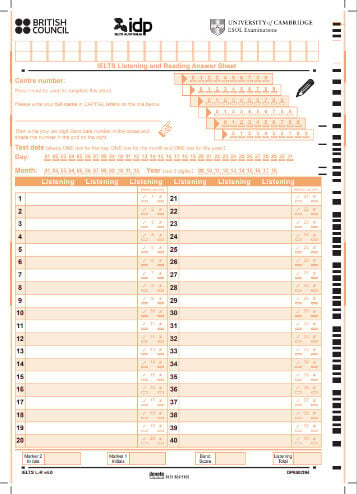
Der IELTS Listening Test dauert etwa 40 Minuten. Sie verbringen 30 Minuten damit, Aufnahmen zu hören und Fragen zu beantworten. Sie erhalten ein Fragenheft und einen Antwortbogen. Im Fragenheft sehen Sie alle Fragen, die Sie beantworten müssen. Auf den Antwortbogen schreiben Sie Ihre endgültigen Antworten zur Bewertung.
Sie können sich das offizielle IELTS Listening Antwortbogen-PDF hier ansehen oder einfach das Bild unten anschauen :)
Am Ende des Listening-Abschnitts haben Sie 10 Minuten Zeit, um die Antworten von Ihrem Fragenheft auf Ihren Antwortbogen zu übertragen.
WICHTIG!
Rechtschreibfehler und falsche Grammatik werden als FALSCH bewertet, also nutzen Sie die 10 Minuten, um Ihre Rechtschreibung und Grammatik doppelt zu überprüfen.
Berechnung der IELTS Listening Punktzahl
Im Listening-Abschnitt ist jede Frage 1 Punkt wert, sodass Sie eine „Rohpunktzahl“ von bis zu 40 Punkten erreichen können. Anschließend wird Ihre Rohpunktzahl in Ihre Bandpunktzahl umgerechnet. Denken Sie daran! Sie verlieren keine Punkte für falsche Antworten. Die folgende Tabelle gibt Ihnen einen allgemeinen Überblick darüber, wie Rohpunktzahlen in Bandpunktzahlen umgerechnet werden.
| Rohpunktzahl | Bandpunktzahl |
|---|---|
| 39-40 | 9 |
| 37-38 | 8.5 |
| 35-36 | 8 |
| 32-34 | 7.5 |
| 30-31 | 7 |
| 26-29 | 6.5 |
| 23-25 | 6 |
| 18-22 | 5.5 |
| 16-17 | 5 |
| 13-15 | 4.5 |
| 11-12 | 4 |
Da jede Version des IELTS leicht unterschiedlich ist, hängt die für eine bestimmte Bandpunktzahl erforderliche Rohpunktzahl davon ab, wie alle Personen, die den Test an diesem Tag absolviert haben, abgeschnitten haben. Daher variiert die Anzahl der korrekten Antworten, die für eine Bandpunktzahl erforderlich ist, leicht von Test zu Test, aber im Allgemeinen sollten Sie etwa 30 von 40 erreichen wollen, wenn Sie eine Bandpunktzahl von 7 erzielen möchten.
Wie oben erwähnt, werden die Abschnitte im IELTS Listening Test im Verlauf immer schwieriger. Jede Frage ist jedoch die gleiche Anzahl von Punkten wert. Stellen Sie daher sicher, dass Sie keine einfachen Punkte verlieren, weil Sie an schwierigen Fragen hängen bleiben.
Kostenloser IELTS Listening Beispiel-PDF-Download mit Antworten
Hier sind einige kostenlose IELTS Listening Beispiele im PDF-Format mit Antworten vom British Council (den Machern der IELTS-Prüfung). Unter den Links können Sie außerdem einen kostenlosen IELTS Listening Test mit Audio und Antworten von BestMyTest machen. Er enthält alle vier Abschnitte, und jeder Abschnitt zeigt sein Audio-Skript zusammen mit den Antworten. Versuchen Sie, die Fragen zu beantworten und sehen Sie, wie Sie abschneiden!
- IELTS Listening Übungstest 1 - Fragen (Online-Beispiele)
- IELTS Listening Übungstest 1 - Antworten (PDF)
- IELTS Listening Übungstest 1 - Antwortbogen (PDF)
Hören Sie sich die Aufnahme an und beantworten Sie die Fragen 1 bis 10. Die Antworten und das Audio-Skript finden Sie im Feld unter den Fragen.
Questions 1-10
Complete the notes below.
Write ONE WORD AND/OR A NUMBER for each answer.
This can provide the carer with:
• time for other duties
• a 1
Assessment of aunt's needs
This may involve discussing:
• how much 2 is spent caring
Daily tasks discussed:
• help with dressing
• helping her take a 3
• shopping
• helping with meals
• managing 4
• any parts of caring that are particularly hard, e.g.
• loss of 5
• 6 her
• avoiding a 7
Types of support that may be provided for carers
• transport costs, e.g. cost of a 8
• vehicle-related costs, e.g. fuel and 9
• help with housework
• support to lower 10
-
spellcheck Antworten
1. Break
Break is correct because this detail is stated in the recording at the point where the question is answered.2. Time
Time is correct because this detail is stated in the recording at the point where the question is answered.3. Shower
Shower is correct because this detail is stated in the recording at the point where the question is answered.4. Money
Money is correct because this detail is stated in the recording at the point where the question is answered.5. Memory
Memory is correct because this detail is stated in the recording at the point where the question is answered.6. Lifting
Lifting is correct because this detail is stated in the recording at the point where the question is answered.7. Fall
Fall is correct because this detail is stated in the recording at the point where the question is answered.8. Minicab
Minicab is correct because this detail is stated in the recording at the point where the question is answered.9. Parking
Parking is correct because this detail is stated in the recording at the point where the question is answered.10. Anxiety
Anxiety is correct because this detail is stated in the recording at the point where the question is answered.
Audio ScriptNora: It's really good to see you, Marcus. Since I had to give up work, I feel I'm losing touch with my friends and colleagues.
Marcus: We really miss you in the office. We were all so sorry you had to leave. But you must be relieved to have more time to look after your aunt. How is she?
Nora: Well, she's very cheerful, but she needs a lot of help.
Marcus: Have you tried to get any support from the local council?
Nora: No. I didn't know I could.
Marcus: Yes. But for different kinds of practical support, they realise that carers sometimes need time for all the other responsibilities they have, apart from the person they're caring for, and also that they sometimes need a break.
Nora: Absolutely. OK, so tell me more, how do I go about getting this support?
Marcus: Well, you'd have to have an assessment of your aunt's needs. That means someone would come round and talk to you about the situation and what you need. So for a start, they'd want to know the amount of time you spend looking after your aunt every day.
Nora: OK.
Marcus: Then they'll probably ask you what sorts of tasks you do for your aunt during the day. Things like if she needs help with getting dressed, for example.
Nora: Right. I help her with that. And also I help her get into the shower in the morning.
Marcus: Yes. That sort of thing. They'll probably ask you if you do the shopping for her, and help her at meal times, and whether she can cope using money.
Nora: Yes. That's becoming a bit of a problem. She used to be very good at it, but not anymore.
Before you hear the rest of the conversation, you have some time to look at questions 5 to 10. [20 seconds] Now listen, and answer questions 5 to 10.Marcus: And be ready to tell them about anything you find particularly difficult about caring for your aunt.
Nora: So recently I've noticed she started to have quite bad problems with her memory. If I wasn't there, I think she'd forget to eat, for example. And often she doesn't seem quite sure what day it is.
Marcus: Yes. Tell them about that. And are there any physical difficulties you have caring for her? Lifting her, for example.
Nora: Yes. She's quite heavy, and I'm afraid of hurting my back. I'd be in real trouble if that happened.
Marcus: They can give you advice about that, and also about how to avoid the possibility of your aunt having a fall.
Nora: Great. So, once they've done this assessment, if I'm eligible, what happens next?
Marcus: Well, they might support you financially. So they might help you with travel costs, like if you have to get a minicab to take your aunt for an appointment, for example.
Nora: I usually drive her myself, actually. So could I claim for the petrol?
Marcus: You could. And you can claim for the parking, too.
Nora: Oh, right.
Marcus: And if you need help with the housework, they can arrange for someone to come along once or twice a week. And one other thing. I hope you don't mind me saying this, but it's important you look after yourself. And it seems to me you're dealing with quite a bit of anxiety.
Nora: I am, yes.
Marcus: Well, tell the council, because they may be able to give you some advice on how to minimise it.
Nora: Really? Though, actually, I feel so much better having talked to you. I'll get in touch with the council straight away. Now, shall we go for coffee, or something?
Hören Sie sich die Aufnahme an und beantworten Sie die Fragen 11 bis 20. Die Antworten und das Audio-Skript finden Sie im Feld unter den Fragen.
Questions 11-14
Choose the correct letter, A, B or C.
11. Who began turning the unused Whitfield site into a planted space?
- city council officials.
- nearby residents.
- a gardening charity.
12. What was Lillian Hartley trying to achieve through public campaigning?
- preventing a housing sale
- blocking army exercises
- winning maintenance funding
13. Why was the park rejected as a place for troop exercises?
- council permission was refused.
- too little usable space.
- a better site was chosen.
14. How does the speaker describe the latest redesign plans?
- 2013 plan used unchanged.
- 2013 plan revised pre-work.
- 2015 plan finished in 2016.
Questions 15-20
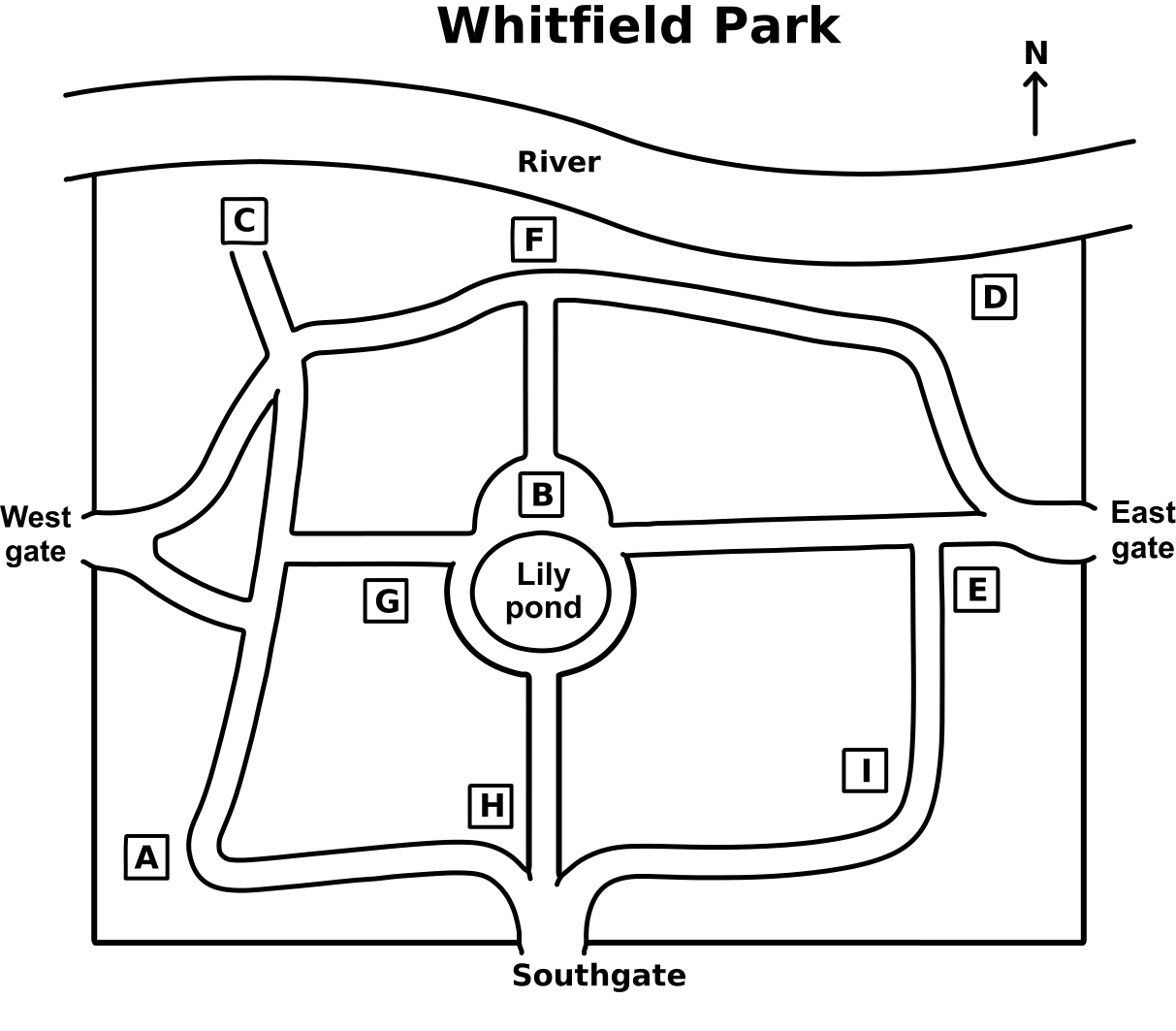
Label the plan of Whitfield Park below.
Write the correct letter, A-I, next to questions 15-20.
- statue of Lillian Hartley
- wooden sculptures
- playground
- maze
- tennis courts
- fitness area
-
spellcheck Antworten
11. B
(A) is incorrect. The council took ownership later.(B) is correct. The initial planting was done by residents from nearby streets.
(C) is incorrect. The recording does not support this option: a gardening charity.
12. A
(A) is correct. Hartley organised public pressure so the council would keep the land as a park rather than sell it for housing.(B) is incorrect. The recording does not support this option: blocking army exercises.
(C) is incorrect. The recording does not support this option: winning maintenance funding.
13. B
(A) is incorrect. The recording does not support this option: council permission was refused.(B) is correct. , after inspection, the army concluded that the park was too small for practical use.
(C) is incorrect. The recording does not support this option: a better site was chosen.
14. B
(A) is incorrect. The recording does not support this option: 2013 plan used unchanged.(B) is correct. The plans dated from 2013 but were revised in 2015 before work began.
(C) is incorrect. The recording does not support this option: 2015 plan finished in 2016.
15. B
The correct answer is B because the statue of Lillian Hartley is now immediately north of the lily pond near the centre of the park, and that position is labelled B.16. D
The correct answer is D because the wooden sculptures are on the riverbank where the path from the East Gate makes a sharp bend, which corresponds to D.17. F
The correct answer is F because the playground is between the river and the path from the lily pond to the river, and that location is marked F.18. C
The correct answer is C because the maze is found by entering from the West Gate, walking north, and turning left, which places it at C.19. A
The correct answer is A because the tennis courts remain in the southern corner where the perimeter path makes a right-angled bend, labelled A.20. G
The correct answer is G because the fitness area is beside the lily pond on the same side as the West Gate, matching G on the plan.
Audio ScriptI'm delighted this evening to introduce our guest speaker, Sarah Holloway, who is going to talk to us about the recent transformation of Whitfield Park. Over to you, Sarah. Thank you very much. I'm sure you all know Whitfield Park well, it has been one of the city's landmarks for well over a century, and the city council has been responsible for it for most of that time. What perhaps fewer of you will know is how the park actually began.
Unlike many city centre parks, which started life as the private gardens of a large house, Whitfield was originally just an unused patch of waste ground. The first flowers there were actually planted by a small group of local residents who lived in the surrounding streets. They began work on the site in 1892. At that point nobody was entirely sure who legally owned the land, and it was a full twenty years later before the city council finally took it into public ownership. Some of you will have seen the statue near one of the gates. That figure is Lillian Hartley, who played a really important role in the early history of the park.
Once the council legally owned the land, its first instinct was to sell it off as building plots for housing. A great many local residents, however, wanted the park to stay open as a place where everyone could enjoy fresh air and green space, bear in mind that this is a very densely built up residential district. Lillian Hartley was at the heart of that campaign, and it was she who organised the petitions and the public demonstrations which, in the end, persuaded the council to drop the sale and keep the land as a park.
Soon afterwards, in 1914, the First World War broke out, and most of the park was dug up and used to grow vegetables, which were sold to local residents. At one point the army did look into taking over the park as a site for troop exercises. They actually wrote to the city council about it, but when they inspected it they concluded that the park was simply too small to be of any practical use to them, so the idea was dropped. The only military activity in the park during the war was the occasional public meeting held on a small area of grass that had been kept clear of vegetable plots.
After the war, the park was largely returned to the way it had been before 1914, and from then on it remained almost unchanged for decades. New plans for transforming the park were drawn up several times over the years; the most recent version dates from 2013, but those plans were then revised in 2015, well before any actual work had got under way. Work on the ground finally began in 2016 and was completed, on schedule, last year.
Before you hear the rest of the talk, you have some time to look at questions 15 to 20. [20 seconds] Now listen and answer questions 15 to 20.All right, I'd like to describe some of the more important changes that have been made, and one or two things that have deliberately been left as they were. If you take a quick look at the map you've been handed, you'll see the familiar outline of Whitfield Park. The river forms the northern boundary, and there is a gate in each of the three other walls.
From there, follow the path up towards the river and the enlarged children's playground sits between that path and the river itself. If you keep your eye on the riverbank, over towards the East Gate side, the new wooden sculptures are at the point where the path coming up from that gate makes a sharp bend.
Back near the West Gate side of the park, there is a maze, a circular pattern of paths separated by low hedges. Head in from the West Gate, walk north towards the river, and then turn left to find it. Close to the same central lily pond, on the side facing the West Gate, you'll also find the new outdoor fitness area.
Down in the southern corner, where the perimeter path makes that distinct right angled bend, the tennis courts are still in their familiar position, though we have now doubled them from four to eight. Now, since you are all keen gardeners, I'm sure you'll want to hear about the plants that have been chosen for the new beds.
Hören Sie sich die Aufnahme an und beantworten Sie die Fragen 21 bis 30. Die Antworten und das Audio-Skript finden Sie im Feld unter den Fragen.
Questions 21-25
Choose the correct letter, A, B or C.
21. Nina and Owen were surprised to learn that coastal cities
- are home to just under half of all people.
- account for many of the largest cities.
- are expanding at double the rate of inland cities.
22. According to Owen, building coastal cities near to rivers
- can carry contamination back towards urban areas.
- can leave too little land for farming upstream.
- can cause factories to damage rural scenery.
23. What mistake was made when building water drainage channels in Port Selby in the 1950s?
- The system did not include enough channels.
- The builders selected the wrong construction materials.
- The design failed to anticipate rising sea levels.
24. What do Nina and Owen think that the authorities in Port Selby should do immediately?
- take measures to restore coastal ecosystems
- pay for a new flood prevention system
- stop disposing of waste materials into the ocean
25. What do they agree should be the priority for international action?
- greater coordination of activities
- more sharing of information
- agreement on shared policies
Questions 26-30
What decision do the students make about each of the following parts of their presentation?
Write the correct letter, A-G, next to questions 26-30.
- use visuals
- keep it short
- involve other students
- check the information is accurate
- provide a handout
- focus on one example
- do online research
- Historical background
- Geographical factors
- Past mistakes
- Future risks
- International implications
-
spellcheck Antworten
21. B
(A) is incorrect. The recording does not support this option: are home to just under half of all people.(B) is correct. Nina says most of the biggest cities are built by the sea.
(C) is incorrect. The recording does not support this option: are expanding at double the rate of inland cities.
22. A
(A) is correct. Owen says pollutants from inland agriculture and industry travel down rivers to cities.(B) is incorrect. The recording does not support this option: can leave too little land for farming upstream.
(C) is incorrect. The recording does not support this option: can cause factories to damage rural scenery.
23. C
(A) is incorrect. The recording does not support this option: The system did not include enough channels.(B) is incorrect. The recording does not support this option: The builders selected the wrong construction materials.
(C) is correct. Port Selby's drainage channels were built without allowing for global warming and rising sea levels.
24. B
(A) is incorrect. The recording does not support this option: take measures to restore coastal ecosystems.(B) is correct. Nina says they need money to replace the drainage channels for flood protection now.
(C) is incorrect. The recording does not support this option: stop disposing of waste materials into the ocean.
25. A
(A) is correct. They say coastal cities must act together internationally.(B) is incorrect. The recording does not support this option: more sharing of information.
(C) is incorrect. The recording does not support this option: agreement on shared policies.
26. B
B is correct because they decide not to spend too long on historical background, so they will keep it short.27. A
A is correct because they decide to use slides with maps showing geographical factors.28. F
F is correct because they choose the Meriton case study as the basis for past mistakes, focusing on one example.29. G
G is correct because they need to look at websites for future risks, so online research is required.30. C
C is correct because they plan to ask audience members from different places, involving other students.
Audio ScriptTutor: OK, so what I'd like you to do now is to talk to your partner about your presentations on environmental planning. You should have done most of the reading now, so I'd like you to share your ideas and talk about the structure of your presentation and what you need to do next.
Nina: OK, Owen, I'm glad we chose quite a specific topic: coastal cities. It made it much easier to find relevant information.
Owen: Yeah, and cities are growing so quickly. I mean, we know that more than half the world's population lives in cities now.
Nina: Yeah, though that's all cities, not just coastal ones. But most of the biggest cities are actually built by the sea. I'd not realised that before.
Owen: Nor me. And what's more, a lot of them are built at places where rivers come out into the sea. But apparently this can be a problem.
Nina: Why?
Owen: Well, as the city expands, agriculture and industry tend to spread further inland along the rivers. And so agriculture moves even further inland up the river. That's not necessarily a problem, except it means more and more pollutants are discharged into the rivers.
Nina: That's a serious problem.
Owen: Right.
Nina: Did you read that article about Port Selby on the south coast?
Owen: No.
Nina: Well, apparently back in the 1950s, they built channels to drain away the water in case of flooding.
Owen: Sounds sensible.
Nina: Yeah, they spent quite a lot of money on them. But what they didn't take into account was global warming. So they built the drainage channels too close to sea level. And now sea levels are rising, they're more or less useless. If there's a lot of rain, the water can't run away. There's nowhere for it to go.
Owen: So they did not help much in the end.
Nina: So what are the authorities doing about it now?
Owen: I don't know. I did read that they're aiming to stop disposing of waste water into the ocean over the next 10 years. But that won't help with flood prevention now, will it?
Nina: No, really, they just need to find the money for something to replace the drainage channels in order to protect against flooding now. But in the long term, they need to consider the whole ecosystem.
Owen: Right.
Nina: Really though, coastal cities can't deal with their problems on their own, can they? I mean, they've got to start acting together at an international level instead of just doing their own thing.
Owen: Absolutely. The thing is, everyone knows what the problems are and environmental planners have a pretty good idea of what we should be doing about them. So they should be able to work together to some extent.
Nina: But it's going to be a long time before countries come to a decision on what principles they're prepared to abide by.
Owen: Yeah, if they ever do.
Before you hear the rest of the conversation, you have some time to look at questions 26 to 30. [20 seconds] Now listen and answer questions 26 to 30.Nina: So I think we've probably got enough for our presentation. It's only 15 minutes.
Owen: OK, so I suppose we'll begin with some general historical background about why coastal cities were established. But we don't want to spend too long on that. The other students will already know a bit about it.
Nina: It's all to do with communications and so on.
Owen: Yes, we should mention some geographical factors, things like wetlands and river estuaries and coastal erosion and so on.
Nina: We could have some maps of different cities with these features marked.
Owen: On a handout, you mean, or some slides everyone can see.
Nina: Yeah, that'd be better.
Owen: It'd be good to go into past mistakes in a bit more detail. Did you read that case study of the problems there were in Meriton with flooding a few years ago?
Nina: Yes, we could use that as the basis for that part of the talk. I don't think the other students will have read it, but they'll remember hearing about the flooding at the time.
Owen: Hmm, OK. So that's probably enough background. So then we'll go on to talk about what actions have been taken to deal with the problems of coastal cities.
Nina: OK, what else do we need to talk about? Maybe something on future risks looking more at the long term if populations continue to grow?
Owen: Yeah, we'll need to do a bit of work there. I haven't got much information, have you?
Nina: No, we'll need to look at some websites. Shouldn't take too long.
Owen: OK. And I think we should end by talking about international implications. Maybe we could ask people in the audience. We've got people from quite a lot of different places.
Nina: That'd be interesting if we have time, yes. So now should we go on?
Hören Sie sich die Aufnahme an und beantworten Sie die Fragen 31 bis 40. Die Antworten und das Audio-Skript finden Sie im Feld unter den Fragen.
Questions 31-36
What point does the lecturer make about each item?
Write the correct letter, A-K, next to questions 31-36.
- changes drainage
- protects animals
- increases nutrients
- kills germs
- affects many species
- creates dense shade
- alters the soil
- supports farming
- reduces competition
- attracts bell-miners
- helps recovery
- Eucalyptus woodland
- Damage to eucalyptus woodland
- Oil from eucalyptus leaves
- Lime used in construction
- Direct iron supply
- Moderate bushfires
Questions 37-40
Complete the notes below.
Write ONE WORD ONLY for each answer.
Bell-miner associated dieback:
• The process starts with insects feeding on eucalyptus 37
• A sweet liquid containing 38 attracts bell-miners
Fire patterns:
• If fires happen too often, 39 becomes the main vegetation
• When fires are almost absent, thick growth gives bell-miners protected 40 sites
-
spellcheck Antworten
31. B
B is correct because eucalyptus woodland provides nesting places and shelter for birds, bats and small mammals.32. E
E is correct because damage to eucalyptus woodland affects a wider community of species, not only the trees themselves.33. D
D is correct because oil from eucalyptus leaves is used in disinfectant, where it can kill certain germs.34. G
G is correct because lime from road construction was washed into the soil and interfered with tree roots.35. K
K is correct because affected trees recovered surprisingly quickly when iron was supplied directly.36. I
I is correct because occasional fire removes fast-growing competitors that would otherwise use water needed by eucalyptus trees.37. leaves
The correct answer is leaves. The lecturer says the process begins when insects settle on eucalyptus leaves and feed on them.38. sugar
The correct answer is sugar. The lecturer says the insects produce a sweet liquid containing sugar, which attracts bell-miners.39. grass
The correct answer is grass. The lecturer says grass tends to dominate afterwards if fires occur too often.40. nesting
The correct answer is nesting. The lecturer says dense growth creates protected nesting sites for bell-miners when fire is suppressed.
Audio ScriptGood morning. Today I want to focus on the eucalyptus tree, one of the best known features of the Australian landscape. Many people call it a gum tree, but the name eucalyptus actually covers hundreds of related species, from small scrubby trees to very tall forest giants.
Now, eucalyptus trees are important in several ways. Ecologically, they provide nesting places and shelter for birds, bats and small mammals. Their flowers also produce nectar, which is an important food source for insects and birds. So when eucalyptus woodland is damaged, the effect is felt across a much wider community of species.
As for their value to people, the trees are also useful. Oil from eucalyptus leaves has long been used in cleaning products, and one common use is in disinfectant, because the oil can kill certain germs. Eucalyptus timber is also used in building and fencing, although that is not really the main focus of today's lecture.
So, these trees can live for centuries, and some individuals survive for four hundred years or more. That is why researchers became concerned when large numbers began dying much earlier than expected in different parts of Australia.
Now, one disease that attracted attention was Mundulla Yellows. The leaves of affected trees slowly turned yellow and then, over time, the whole tree declined. For years the cause was unclear. Eventually, researchers discovered that lime, or calcium hydroxide, had been used in road construction nearby. Rain washed the lime into the surrounding soil, where it interfered with the roots of eucalyptus trees. The trees were still surrounded by nutrients, but they could no longer absorb the iron they needed for healthy growth. When iron was supplied directly to affected trees, they recovered surprisingly quickly.
However, Mundulla Yellows affected only a limited number of places. A much wider problem on the east coast was Bell miner associated dieback. Now, bell miners are small native birds, but they are not the direct cause of the damage. The process begins when insects settle on eucalyptus leaves and feed on them. While feeding, these insects produce a sweet liquid containing sugar. Bell miners are attracted to that liquid, and they aggressively chase away other birds and insects that might otherwise reduce the insect population. As a result, the insects multiply, the leaves are badly damaged, and the trees gradually lose their ability to survive.
But some scientists think fire history is also part of the explanation. An influential theory, first proposed by the ecologist William Jackson, links the type of vegetation in a region to the frequency of bushfires. If fires occur too often, grass tends to dominate the area afterwards. If fires occur at moderate intervals, eucalyptus forest is more likely to persist. This is because occasional fire removes fast growing competitors which would otherwise take up the water eucalyptus trees need. And it also helps maintain the soil by preventing dense undergrowth from changing the soil structure and removing nutrients.
At the other extreme, if fires are almost completely suppressed, a different ecosystem can develop. Scientists sometimes call this dry rainforest. Now, the name sounds contradictory, because we usually associate rainforest with wet tropical conditions. But in this case it means a dense, shaded vegetation system with relatively few species. It can create excellent conditions for bell miners, because the thick growth gives them protected nesting sites while excluding many of the species that would normally compete with them.
What this tells us is that before European settlement, Aboriginal communities used controlled burning over long periods, and this probably created a more balanced pattern of vegetation. Since European settlement, fire has often been suppressed, roads and farms have altered drainage, and some local ecosystems have shifted away from eucalyptus woodland. The decline of eucalyptus trees, then, is not caused by one single factor. It is the result of disease, insects, birds, soil chemistry and fire management interacting with one another.

Completion - Part 1
Learn how to answer these questions in a step-by-step interactive exercise
Completion - Part 1
Eine Lücke kann nach einer Zeit oder einer Häufigkeit fragen. Der Sprecher nennt denselben Zeitraum meist mit anderen Worten. Ordnen Sie also die Bedeutung der Lücke zu, statt auf den Wortlaut auf dem Blatt zu warten.
Prüfen Sie dann vor dem Absenden das Wortlimit. Lesen Sie die ganze Zeile mit Ihrer Antwort in der Lücke noch einmal und streichen Sie jedes Wort, das die Zeile bereits enthält. Eine Antwort, die inhaltlich richtig, aber zu lang ist, bringt keinen Punkt.
Klicken Sie auf „Abspielen“, um das Audio anzuhören
Notizen verwenden ein einfaches Verb wie must provide oder need to bring. Der Sprecher sagt dieses Verb selten, sondern verwendet ein Synonym oder beschreibt die Handlung. Achten Sie also darauf, was tatsächlich verlangt wird.
Sprecher erwähnen oft zuerst zusätzliche Dinge und schließen sie dann aus. Wenn Sie eine Lücke verpassen, lassen Sie sie frei und gehen Sie zur nächsten, denn die Antworten folgen der Reihenfolge der Aufnahme, und eine verpasste Lücke kann Sie die folgenden kosten.
Klicken Sie auf „Abspielen“, um das Audio anzuhören
Wie haben Sie bei der Beantwortung der oben aufgeführten IELTS Listening Beispielfragen abgeschnitten? Fanden Sie einige der Fragen schwierig? Wenn ja, könnte es Ihnen nützen, sich alle 6 IELTS Listening Aufgabentypen genauer anzusehen. Je besser Sie einen Aufgabentyp verstehen, desto weniger Aufwand werden Sie brauchen, um herauszufinden, was Sie tun müssen, und desto mehr Zeit haben Sie, die Antwort zu finden.
Die 6 IELTS Listening Aufgabentypen
Es gibt 6 verschiedene Fragetypen im IELTS Listening Test. Es ist wichtig, dass Sie jeden Aufgabentyp üben, um den besten Weg zu lernen, jeden einzelnen für eine hohe IELTS Listening Punktzahl anzugehen.
Welche Aufgabentypen im Hörverstehen unseren Lernenden am schwersten fallen
Hier sehen Sie, was 2.22 Millionen Antworten von BestMyTest-Lernenden im IELTS-Hörverstehen zeigen. Der Prozentsatz gibt an, wie oft unsere Lernenden den jeweiligen Aufgabentyp richtig beantwortet haben. So sehen Sie sofort, wo die Punkte verloren gehen.
| Aufgabentyp | Richtig |
|---|---|
| Note completion | 33% |
| Table completion | 34% |
| Sentence completion | 45% |
| Short answer | 48% |
| Multiple choice | 50% |
| Multiple selection | 52% |
| Plan, map, diagram labelling | 55% |
| Form completion | 73% |
| Matching | 85% |
- Bei Ergänzungsaufgaben gehen Punkte verloren. Unter den Ergänzungsaufgaben wird Note completion in 33% der Fälle richtig beantwortet, während Form completion, das dieselbe Fähigkeit in einer anderen Darstellung erfordert, 73% erreicht. Bei jeder Ergänzungsaufgabe schreiben Sie ein Wort, das Sie hören. Rechtschreibung, Wortform und Wortbegrenzung zählen also mit, und all das können Sie üben.
- Insgesamt wurden 61.104 vollständige Übungstests zum Hörverstehen von 54.523 Lernenden absolviert, wobei die durchschnittliche Bandpunktzahl bei 5.6 lag. 41% der Tests erreichten Band 6.0 und 12% erreichten Band 7.0.
- In einzelnen Abschnitten zum Hörverstehen wurden bei 31% der Versuche 40% oder weniger und bei 30% der Versuche 80% oder mehr erreicht. Die Abschnitte 3 und 4 sind die akademischen Teile des Tests. Üben Sie sie also einzeln und auch in vollständigen Tests.
Obwohl jeder Listening-Fragetyp anders aussieht, ist der grundlegende Ansatz für jeden derselbe. Später in diesem Beitrag zeigen wir Ihnen die grundlegende Strategie, alle 6 Fragetypen anzugehen. Jedes Audio-Beispiel mit Antwort steht in unserem Guide zu den IELTS Listening-Fragetypen.
3 Schritte für eine effektive Online-Vorbereitung auf den IELTS Listening Test
Obwohl jeder IELTS Listening Fragetyp (Aufgabentyp) anders ist, ist der grundlegende Ansatz für jeden derselbe. Sie können alle Aufgabentypen mit einer einfachen, schrittweisen Strategie angehen. Hier sind die drei Schritte, die wir Ihnen empfehlen, um Listening-Fragetypen anzugehen:
- Untersuchen Sie die Fragen genau, um Schlüsselinformationen zu finden
- Sagen Sie potenzielle Antworten vor dem Hören voraus
- Verfolgen Sie mit, um Fragen mit dem Inhalt abzugleichen, während Sie zuhören
Schritt 1: Fragen untersuchen
Im IELTS Listening Abschnitt erhalten Sie eine kurze Vorbereitungszeit (30-40 Sekunden), bevor die Aufnahme beginnt. Dies ist Ihre Gelegenheit, sich die Fragen anzusehen, die Sie beantworten müssen, was genau das ist, worum es im ersten Schritt dieser Strategie geht. Anstatt diese Zeit zu nutzen, um eine Pause zu machen oder Ihre Antworten zu überprüfen, werden Sie sich darauf konzentrieren, so viel wie möglich über die kommenden Fragen zu erfahren. Diesen Schritt zu unternehmen ist wichtig, um den Fehler des Multitaskings zu vermeiden, während Sie dem Sprecher zuhören und versuchen, die Fragen zum ersten Mal zu lesen.
Wenn Ihre Vorbereitungszeit beginnt, nutzen Sie diese Zeit zunächst optimal, indem Sie die Fragen untersuchen, um mehr über sie zu erfahren. Dies sind einige der Informationen, nach denen Sie suchen sollten, wenn Sie jede der IELTS Listening Fragen untersuchen:
- Welche Art von Frage ist dies?
- Wie wird die Antwort aussehen? (Beispiel: ein Datum, eine Zahl, ein Name)
- Was sind die wichtigsten Phrasen und Wörter oder Schlüsselwörter in den Fragen?
Ein Beispiel könnte ein Fragetyp Notizvervollständigung sein, wie dieser:
Vervollständigen Sie die folgenden Notizen.
Schreiben Sie NICHT MEHR ALS DREI WÖRTER für jede Antwort.
Zunächst können Sie einige der Schlüsselwörter in der Frage unterstreichen.
Zwei Gründe für den neuen Ansatz bei der Preisgestaltung sind Änderungen in (27) ______ und (28) _________ Programmen.
In diesem Beispiel ermöglicht es Ihnen das Hören der Schlüsselphrase „zwei Gründe“, die Sie bereits unterstrichen hatten,
im richtigen Moment genau aufzupassen. Hier ist der Teil des Audio-Skripts, der die Antwort enthüllt:
Mark: Well, there seem to be two basic reasons. Firstly, because the law has changed recently to allow companies to behave like this. In the past, they weren't allowed to change the prices of the tickets. And secondly, we now have computer programs that do the calculations so that prices can be changed very quickly and accurately.
Nachdem Sie die Fragen untersucht haben, würden Sie wissen, dass „das Gesetz“ und „Computer“ hier die richtige Antwort waren, basierend auf einigen Schlüsselwörtern und dem Wissen über den Fragetyp.
Schritt 2: Potenzielle Antworten vorhersagen
Der zweite Schritt in dieser Strategie zum Erfolg im IELTS Listening Abschnitt ist sehr eng mit dem ersten verbunden. Tatsächlich sollten Sie versuchen, beide Schritte innerhalb derselben 20-Sekunden-Vorbereitungszeit abzuschließen, bevor die Aufnahme beginnt. Während dies in einer so kurzen Zeit eine schwierige Aufgabe zu sein scheint, denken Sie daran, dass diese Schritte tatsächlich miteinander verbunden sind.
Um potenzielle Antworten auf die Listening-Fragen vorherzusagen, müssen Sie zunächst Schritt eins abgeschlossen haben, indem Sie die Fragen genau untersucht haben. An diesem Punkt sollten Sie wissen, welche Art von Frage Sie betrachten, wie potenzielle Antworten aussehen werden und welche Schlüsselwörter beim schnellen Auffinden der Antworten hilfreich sein werden. Um Antworten vorherzusagen, kombinieren Sie all diese Informationen und vermuten, welche Art von Antwort Sie erwarten zu hören.
Lassen Sie uns dieselbe Beispielfrage zur Notizvervollständigung von oben noch einmal betrachten.
Zwei Gründe für den neuen Ansatz bei der Preisgestaltung sind Änderungen in (27) und (28) Programmen.
Allein durch das Betrachten der Grammatik dieses Satzes können Sie identifizieren, welche Wortart die Antwort sein wird. In diesem Fall steht die Präposition „in“ vor beiden potenziellen Antworten. Grammatikalisch können nur Substantive oder Substantivphrasen auf diese Weise in Präpositionalphrasen verwendet werden. Sie können nicht nur korrekt vorhersagen, dass die Antwort ein Substantiv oder eine Substantivphrase sein wird, sondern es wäre auch möglich vorherzusagen, dass die Antwort etwas im Zusammenhang mit Politik oder Regierung (Gesetz) und ein Wort sein könnte, das mit Programmen (Computer) basierend auf dem Kontext erscheinen kann.
Obwohl es unmöglich ist, die genaue richtige Antwort allein aufgrund von Vorhersagen zu erraten, sind Sie eher in der Lage, auf relevante Informationen zu hören und irrelevante Informationen zu ignorieren, indem Sie versuchen sich vorzustellen, wie die Antwort aussehen könnte. Das Vorhersagen potenzieller Antworten vor dem Beginn der Aufnahme bereitet Ihr Ohr vor und bringt Sie einen Schritt näher an die richtige Antwort.
Versuchen Sie nun, Schritt 1 (Fragen untersuchen) und Schritt 2 (potenzielle Antworten vorhersagen) in einer schwierigeren Multiple-Choice-Beispielfrage zusammenzuführen.
Wählen Sie den richtigen Buchstaben, A, B, C oder D.
- für Wochenendvorstellungen sind
- weit im Voraus gebucht werden
- nicht erstattungsfähig sind
- für Gruppen gebucht werden
Obwohl es keine Möglichkeit gibt, die Antworten auf diese Fragen mit Sicherheit zu kennen, können Sie dennoch die in diesen Fragen gefundenen Informationen verwenden, um potenzielle Antworten vorherzusagen und Ihr Hören gezielt zu lenken. Beispielsweise betrifft Frage 24 den Grund, warum Theaterkartenpreise am niedrigsten sein werden, sodass Sie genau auf alle erwähnten Gründe hören möchten. Beachten Sie, dass möglicherweise mehr als ein Grund erwähnt wird. Schauen Sie sich das Skript unten an, um zu sehen, wie die Vorhersage Ihnen helfen kann, falsche Antworten zu eliminieren.
Beachten Sie, wie drei der potenziellen Antworten erwähnt werden, „für Gruppen gebucht“, „für Wochenendvorstellungen“ und „nicht erstattungsfähig“. Die richtige Antwort ist jedoch C „nicht erstattungsfähig“, weil sie als günstiger separat von den anderen beiden erwähnt wird, die einfach zusammen aufgelistet werden.
Schritt 3: Mitverfolgen
Sobald die Aufnahme beginnt und der eigentliche Hörteil des Tests beginnt, sollten Sie mitverfolgen, um Schritt drei dieser IELTS Listening Abschnittsstrategie abzuschließen. Mitverfolgen erfordert, dass Sie sich genau auf das konzentrieren, was Sie hören, während Sie gleichzeitig im Auge behalten, welche Frage der Inhalt möglicherweise behandelt.
Die Fragen im IELTS Listening Prüfungsabschnitt erscheinen in der Regel in der Reihenfolge, in der ihre Antworten im Inhalt der Aufnahme zu finden sind. Dies gibt Ihnen einen Vorteil im Test, denn es bedeutet, dass Sie, sobald Sie die Antwort auf eine Frage gehört haben, Ihre Aufmerksamkeit sofort der nächsten zuwenden werden. Wenn Sie in der Lage sind, erfolgreich mitzuverfolgen, indem Sie den Kontext aus den Fragen mit dem abgleichen, was Sie in der Aufnahme hören, bleiben Sie auf Kurs und vermeiden, wichtige Informationen zu verpassen, die zur Beantwortung jeder Frage notwendig sind.
Dies zu tun, ist jedoch leichter gesagt als getan. Sie müssen Multitasking betreiben, indem Sie zuhören und gleichzeitig die nächste Frage im Auge behalten. Wenn Sie tatsächlich die Antwort auf eine Frage verpassen, werden Sie es wissen, wenn Sie die Antwort auf eine spätere hören. Auch wenn dies verwirrend und sogar frustrierend sein kann, ist das Verpassen einer Antwort und das Bewusstsein darüber immer noch besser, als sich vollständig im Inhalt zu verlieren und noch mehr Antworten zu verpassen. Im Szenario des Verpassens einer Frage sollten Sie sie einfach lassen und mit der nächsten fortfahren. Am Ende müssen Sie Ihre beste Vermutung über die Frage abgeben, die Sie verpasst haben. Auf der positiven Seite ist es jedoch möglich, dass das Hören der gesamten Aufnahme Ihnen weitere Kontexthinweise liefert und es Ihnen ermöglicht, alle verpassten Fragen genauer zu beantworten.
Kostenlose Ressourcen für die IELTS Listening Übung
Sie benötigen starke Hörfähigkeiten, um eine hohe IELTS Listening Bandpunktzahl zu erreichen. Aus diesem Grund ist es wichtig, dass Sie bis zum Testtag jeden Tag konsistent trainieren.
Nachfolgend finden Sie einige Ressourcen, die Sie nutzen können, um Ihre Hörfähigkeiten täglich zu trainieren und zu pflegen.
- YouTube - https://www.youtube.com
- BBC Learning English - http://www.bbc.co.uk/learningenglish
- TED - https://www.ted.com/
- BBC radio - https://www.bbc.co.uk/worldserviceradio
- ABC news in Australia - https://www.abc.net.au/listen/live/news
Die Zahlen auf dieser Seite stammen aus den BestMyTest-Daten zur Leistung der IELTS-Lernenden, unseren Aufzeichnungen der IELTS-Übungen auf BestMyTest bis Oktober 2026. Auf jener Seite erklären wir, wie wir jede Zahl ermitteln. Zuletzt aktualisiert am 15. Oktober 2026.