
Cada tipo de abajo tiene un ejemplo y su respuesta. El resto de la guía de reading está en el test IELTS Reading.
- Tipo de pregunta 1 – Emparejar información
- Tipo de pregunta 2 – Emparejar títulos
- Tipo de pregunta 3 – Emparejar características
- Tipo de pregunta 4 – Identificar información
- Tipo de pregunta 5 – Identificar opiniones o afirmaciones del autor
- Tipo de pregunta 6 – Opción múltiple
- Tipo de pregunta 7 – Emparejar finales de frase
- Tipo de pregunta 8 – Completar oraciones
- Tipo de pregunta 9 – Completar resúmenes, notas, tablas y diagramas de flujo
- Tipo de pregunta 10 – Completar etiquetas de diagramas
- Tipo de pregunta 11 – Preguntas de respuesta corta
Tipo de pregunta 1 – Emparejar información
En este tipo de pregunta tienes que relacionar afirmaciones con párrafos del texto de lectura. Las afirmaciones pueden ser razones, descripciones, resúmenes, definiciones, hechos o explicaciones. Debes encontrar la información concreta en el párrafo y emparejarla con una de las afirmaciones. La respuesta suele estar contenida en una frase u oración completa, no en una sola palabra. A continuación se muestra una pregunta de muestra de emparejamiento de información del IELTS Academic Reading.
Consulta nuestra aula completa de IELTS Reading sobre cómo responder a las preguntas de emparejamiento de información. Incluye vídeos para ambas versiones del examen y explicaciones detalladas con preguntas de muestra.
Questions 27-31
The reading passage has seven paragraphs labelled A-G. Which paragraph contains the following information? Write the correct letter, A-G.
NB You may use any letter more than once.
- One example of how one predator has been protected by the introduction of livestock guard dogs
- An optimistic suggestion about the possible positive developments in the use of livestock guard dogs
- An account of how the methods used by livestock guard dogs help to keep predators away
- Claims by different academics that the use of livestock guard dogs is a successful way of protecting farmers' herds
- A mention of how livestock guard dogs gain their skills
-
spellcheck Answers
27. D
Choose paragraph D because this paragraph contains the information requested in "One example of how one predator has been protected by the introduction of livestock guard dogs". The supporting sentence is: "After guard dogs were introduced, more than 90 per cent of farmers reported a major fall in livestock losses and said they were therefore less likely to kill predators.". This sentence matches the meaning of the prompt, so paragraph D is the best location.28. G
Choose paragraph G because this paragraph contains the information requested in "An optimistic suggestion about the possible positive developments in the use of livestock guard dogs". The supporting sentence is: "If this can be done well, there may be a bright future for guard dogs in encouraging peaceful coexistence between humans and wildlife.". This sentence matches the meaning of the prompt, so paragraph G is the best location.29. B
Choose paragraph B because this paragraph contains the information requested in "An account of how the methods used by livestock guard dogs help to keep predators away". The supporting sentence is: "The dogs stand between the livestock and any danger and bark loudly; if required, they chase predators away, although their presence alone is often enough.". This sentence matches the meaning of the prompt, so paragraph B is the best location.30. C
Choose paragraph C because this paragraph contains the information requested in "Claims by different academics that the use of livestock guard dogs is a successful way of protecting farmers' herds". The supporting evidence is that Silvia Ribeiro found over 90 per cent of farmers rated the dogs very good or excellent, while Linda van Bommel and Chris Johnson found that more than 65 per cent said predation stopped completely. These academic findings make paragraph C the best location.31. B
Choose paragraph B because this paragraph contains the information requested in "A mention of how livestock guard dogs gain their skills". The supporting sentence is: "From puppyhood, the dogs are raised with the animals they will later guard, so those animals eventually become the dog's family.". This sentence matches the meaning of the prompt, so paragraph B is the best location.
A new role for livestock guard dogs
Livestock guard dogs have long been used to defend farm animals against predators, but they are now also helping to protect the predators themselves.
A For millennia, shepherds relied on livestock guard dogs to keep sheep, goats and cattle safe from animals such as wolves and bears. In the nineteenth and twentieth centuries, however, many of these predators were almost eliminated, and most guard dogs were no longer needed. More recently, stronger efforts to conserve wild animals have allowed predators to spread again. Farmers consequently need protection for their herds once more, and guard dogs have returned to work in an unexpected revival.
B About 50 breeds of guard dog are currently working in different regions of the world. From puppyhood, the dogs are raised with the animals they will later guard, so those animals eventually become the dog's family. The dogs stand between the livestock and any danger and bark loudly; if required, they chase predators away, although their presence alone is often enough. Dan Macon, a shepherd with three guard dogs, says their early training teaches them that livestock will be their whole life. A fluffy white puppy may be enjoyable company, he explains, but too much human affection produces a good front-porch guard rather than a good livestock guard dog.
C Research evidence shows that guard dogs can be extremely effective. In Portugal, biologist Silvia Ribeiro found that over 90 per cent of farmers in a programme using trained guard dogs to protect herds from wolves rated the dogs' performance as very good or excellent. An Australian study by Linda van Bommel and Chris Johnson at the University of Tasmania found that more than 65 per cent of herders said predation stopped completely after they obtained dogs, while almost all the others reported fewer attacks. Van Bommel says that if they are managed and used properly, livestock guard dogs are the most efficient control method available in terms of the livestock they save from predation.
D Today's guard dogs also serve a newer purpose: helping to preserve predators. If farmers lose fewer animals, it is hoped that they will tolerate predators more readily and be less inclined to kill them. In Namibia, more than 90 per cent of cheetahs live outside protected reserves, close to people who raise livestock. Because cheetahs are often blamed for livestock losses, large numbers have been killed by farmers. After guard dogs were introduced, more than 90 per cent of farmers reported a major fall in livestock losses and said they were therefore less likely to kill predators. Julie Young of Utah State University believes the result has wider relevance. She says there is common ground from the livestock perspective and from the conservation perspective: if ranchers do not have a dead cow, they will not request permission to kill a wolf.
E Bethany Smith of Nottingham Trent University reviewed the published evidence and found that as many as 88 per cent of farmers said they stopped killing predators after using dogs. However, she warns that such self-reported results must be taken with a pinch of salt. It is also possible that livestock guard dogs simply push predators towards neighbouring properties that have no dogs, where what happens to the predators is not recorded. Ribeiro says that in some regions nearly every farmer works with her programme, but elsewhere only one or two have dogs. If we are not working with everybody, we are shifting the pressure from wolves onto the neighbour's herd, and that neighbour may use poison and kill an entire wolf pack.
F A further concern is that guard dogs may bring unintended ecological effects. Studies suggest that lowering deaths among one predator species can harm other species. The scale of this issue is not fully known, but the effects are clear in Namibia. Cheetahs are not the only animals that attack sheep and goats there; other predators also take livestock. In 2015, researchers reported that although farmers with guard dogs affected cheetahs positively, the number of jackals killed by dogs and people actually increased. Guard dogs have other ecological impacts as well. They have been found to spread diseases to wild animals, including endangered Ethiopian wolves. They may also compete with other carnivores for food. In addition, their mere presence can create a landscape of fear and alter the behaviour of prey species.
G So far, though, the evidence suggests that these consequences are not always harmful. Guard dogs may bring unexpected advantages by protecting vulnerable wildlife from predators. For instance, their presence has been found to protect ground-nesting birds in fields, where foxes would normally raid the nests. Australian researchers are now using dogs to improve biodiversity and create refuges for species threatened by predation. If this can be done well, there may be a bright future for guard dogs in encouraging peaceful coexistence between humans and wildlife.

Matching Information
Learn how to answer these questions in a step-by-step interactive exercise
Matching Information
Una pregunta Matching Information te pregunta qué párrafo contiene una información concreta. Esa información puede estar en cualquier parte del párrafo, y las afirmaciones no siguen el orden del texto.
Echa un vistazo a la pregunta y luego haz clic en Siguiente para continuar.
Echar un vistazo a la pregunta
NB You may use any letter more than once.
| A | B | C | D | E | F | G | |
|---|---|---|---|---|---|---|---|
| 1. One example of how one predator has been protected by the introduction of livestock guard dogs | |||||||
| 2. An optimistic suggestion about the possible positive developments in the use of livestock guard dogs | |||||||
| 3. An account of how the methods used by livestock guard dogs help to keep predators away | |||||||
| 4. Claims by different academics that the use of livestock guard dogs is a successful way of protecting farmers' herds | |||||||
| 5. A mention of how livestock guard dogs gain their skills |
Lee cada afirmación y marca las palabras de contenido que vas a buscar, incluida la acción que describe la afirmación. Las fórmulas de envoltura como a mention of, an example of, details of y an explanation of no aparecerán en el texto. Haz esto con cada afirmación antes de escanear.
Haz clic en las palabras clave de cada afirmación.
Seleccionar las palabras clave
Haz clic en las palabras clave de cada afirmación.
1. One example of how one predator has been protected by the introduction of livestock guard dogs
2. An optimistic suggestion about the possible positive developments in the use of livestock guard dogs
3. An account of how the methods used by livestock guard dogs help to keep predators away
4. Claims by different academics that the use of livestock guard dogs is a successful way of protecting farmers herds
5. A mention of how livestock guard dogs gain their skills
Ahora toma una afirmación cada vez. Marca las palabras clave y luego escanea los párrafos en busca de versiones parafraseadas de esas mismas ideas. Un párrafo que contiene solo una de las ideas no es la respuesta.
Haz clic en el párrafo que contiene la información.
Pregunta 1
| A | B | C | D | E | F | G | |
|---|---|---|---|---|---|---|---|
| 1. One example of how one predator has been protected by the introduction of livestock guard dogs |
Indicación: One example of — Example markers: In Namibia, for instance, one case, such as
Haz clic en el párrafo que contiene la información.
A For millennia, shepherds relied on livestock guard dogs to keep sheep, goats and cattle safe from animals such as wolves and bears.
D Because cheetahs are often blamed for livestock losses, large numbers have been killed by farmers. After guard dogs were introduced, more than 90 per cent of farmers reported a major fall in livestock losses and said they were therefore less likely to kill predators.
E Bethany Smith of Nottingham Trent University reviewed the published evidence and found that as many as 88 per cent of farmers said they stopped killing predators after using dogs.
F In 2015, researchers reported that although farmers with guard dogs affected cheetahs positively, the number of jackals killed by dogs and people actually increased.
G Guard dogs may bring unexpected advantages by protecting vulnerable wildlife from predators.
Escanear significa recorrer rápidamente los párrafos con la vista buscando la idea, sin leer cada oración para entenderla. El texto rara vez usa las palabras de la afirmación, así que acepta una paráfrasis y descarta un párrafo que repite una palabra pero dice otra cosa.
Haz clic en el párrafo que contiene la información.
Pregunta 2
| A | B | C | D | E | F | G | |
|---|---|---|---|---|---|---|---|
| 2. An optimistic suggestion about the possible positive developments in the use of livestock guard dogs |
Indicación: An optimistic suggestion about — Hope language: may, could, if this can be done, a bright future
Haz clic en el párrafo que contiene la información.
A Farmers consequently need protection for their herds once more, and guard dogs have returned to work in an unexpected revival.
C Research evidence shows that guard dogs can be extremely effective.
D Today's guard dogs also serve a newer purpose: helping to preserve predators.
E However, she warns that such self-reported results must be taken with a pinch of salt.
F A further concern is that guard dogs may bring unintended ecological effects.
G If this can be done well, there may be a bright future for guard dogs in encouraging peaceful coexistence between humans and wildlife.
La información que necesitas suele estar repartida en dos oraciones en lugar de concentrada en una. Lee un poco más allá de la oración que primero te llama la atención, porque la siguiente puede completar la idea que describe la afirmación.
Haz clic en el párrafo que contiene la información.
Pregunta 3
| A | B | C | D | E | F | G | |
|---|---|---|---|---|---|---|---|
| 3. An account of how the methods used by livestock guard dogs help to keep predators away |
Indicación: An account of how — Action language: stand, bark, chase, if required
Haz clic en el párrafo que contiene la información.
A For millennia, shepherds relied on livestock guard dogs to keep sheep, goats and cattle safe from animals such as wolves and bears.
B The dogs stand between the livestock and any danger and bark loudly; if required, they chase predators away, although their presence alone is often enough.
C Van Bommel says that if they are managed and used properly, livestock guard dogs are the most efficient control method available in terms of the livestock they save from predation.
E It is also possible that livestock guard dogs simply push predators towards neighbouring properties that have no dogs, where what happens to the predators is not recorded.
F In addition, their mere presence can create a landscape of fear and alter the behaviour of prey species.
G For instance, their presence has been found to protect ground-nesting birds in fields, where foxes would normally raid the nests.
Vuelve a revisar las instrucciones antes de la última afirmación. Cuando un número de párrafo puede usarse más de una vez, un párrafo que ya elegiste puede seguir siendo la respuesta, y algunos párrafos no responden a nada. Decide por la información, no por los números que quedan libres.
Haz clic en el párrafo que contiene la información.
Pregunta 4
| A | B | C | D | E | F | G | |
|---|---|---|---|---|---|---|---|
| 4. Claims by different academics that the use of livestock guard dogs is a successful way of protecting farmers' herds |
Indicación: Claims by different academics that — Research language: found, study, biologist, University
Haz clic en el párrafo que contiene la información.
C In Portugal, biologist Silvia Ribeiro found that over 90 per cent of farmers in a programme using trained guard dogs to protect herds from wolves rated the dogs' performance as very good or excellent. An Australian study by Linda van Bommel and Chris Johnson at the University of Tasmania found that more than 65 per cent of herders said predation stopped completely after they obtained dogs, while almost all the others reported fewer attacks.
D After guard dogs were introduced, more than 90 per cent of farmers reported a major fall in livestock losses and said they were therefore less likely to kill predators.
E Bethany Smith of Nottingham Trent University reviewed the published evidence and found that as many as 88 per cent of farmers said they stopped killing predators after using dogs.
F In 2015, researchers reported that although farmers with guard dogs affected cheetahs positively, the number of jackals killed by dogs and people actually increased.
G Australian researchers are now using dogs to improve biodiversity and create refuges for species threatened by predation.
Vuelve a revisar las instrucciones antes de la última afirmación. Cuando un número de párrafo puede usarse más de una vez, un párrafo que ya elegiste puede seguir siendo la respuesta, y algunos párrafos no responden a nada. Decide por la información, no por los números que quedan libres.
Haz clic en el párrafo que contiene la información.
Question 5
| A | B | C | D | E | F | G | |
|---|---|---|---|---|---|---|---|
| 5. A mention of how livestock guard dogs gain their skills |
Indicación: A mention of how — Learning language: from puppyhood, raised, training, teaches
Haz clic en el párrafo que contiene la información.
A For millennia, shepherds relied on livestock guard dogs to keep sheep, goats and cattle safe from animals such as wolves and bears.
B From puppyhood, the dogs are raised with the animals they will later guard, so those animals eventually become the dog's family.
C Research evidence shows that guard dogs can be extremely effective.
D Today's guard dogs also serve a newer purpose: helping to preserve predators.
F They have been found to spread diseases to wild animals, including endangered Ethiopian wolves.
G Australian researchers are now using dogs to improve biodiversity and create refuges for species threatened by predation.
Tipo de pregunta 2 – Emparejar títulos
Este tipo de pregunta evalúa tu capacidad para entender la idea principal de cada párrafo. Te darán entre 5 y 7 títulos y tendrás que emparejar cada párrafo del texto con un título. Un título es una frase corta que resume la información de un párrafo. Siempre hay más títulos que párrafos.
Consulta nuestra aula completa sobre cómo responder a las preguntas de emparejamiento de títulos. Incluye vídeos para ambas versiones del examen y explicaciones detalladas con preguntas de muestra.
Questions 14-19
The reading passage has six sections, A-F. Choose the correct heading for each section from the list of headings below. Write the correct number, i-vii.
- Tried and tested solutions
- Cooperation beneath the waves
- Working to lessen the problems
- Disagreement about the accuracy of a certain phrase
- Two clear educational goals
- Promoting hope
- A warning of further trouble ahead
- Section A
- Section B
- Section C
- Section D
- Section E
- Section F
-
spellcheck Answers
14. v
Choose heading v because Section A gives two clear educational goals: "First, it is intended to show visitors how extraordinary coral reefs are" and "Second, it draws attention to the research and conservation work now being undertaken to protect reefs from global warming."15. ii
Choose heading ii because Section B describes cooperation between coral polyps and algae: "The algae receive protection there, while their photosynthesis supplies nutrients to the polyps."16. iv
Choose heading iv because Section C reports disagreement about the phrase "rainforests of the sea": "reefs are often called the rainforests of the sea, although some naturalists, among them David Attenborough, reject the comparison."17. vii
Choose heading vii because it gives the main idea of the paragraph. The supporting evidence is: "Large areas, including major parts of Australia's Great Barrier Reef, have already been lost, and researchers warn that more than 90 percent of reefs could disappear by 2050 unless greenhouse gas emissions and global heating are addressed rapidly.". This sentence shows what the paragraph is mainly about, rather than just mentioning a small detail.18. iii
Choose heading iii because it gives the main idea of the paragraph. The supporting evidence is: "When the oceans begin to deteriorate, he says, corals are among the first organisms to respond, and their present decline is a warning that the planet itself is in trouble.". This sentence shows what the paragraph is mainly about, rather than just mentioning a small detail.19. vi
Choose heading vi because it gives the main idea of the paragraph. The supporting evidence is: "Pearce-Kelly argues that the key value of the project is public hope: if visitors can see progress in making coral more able to survive a warmer world, they may believe that action can still save the planet's reefs.". This sentence shows what the paragraph is mainly about, rather than just mentioning a small detail.
Can the planet's coral reefs be saved?
Section A
At the Zoological Society of London, better known as London Zoo, conservationists have completed a large artificial reef that they have been constructing for display. The tank now contains examples of some of the world's most striking corals, including vivid green branching coral, yellow scroll and blue ridge, as well as fish such as blue tang and clownfish that flourish around reefs. This display stands in Tiny Giants, the zoo's new gallery devoted to the tiny invertebrates that help maintain life on Earth, and its seven-metre viewing window is the exhibition's centrepiece.
Paul Pearce-Kelly, the society's senior curator of invertebrates and fish, says the display has two aims. First, it is intended to show visitors how extraordinary coral reefs are, since they are the most diverse ecosystems on the planet. Second, it draws attention to the research and conservation work now being undertaken to protect reefs from global warming, so that the public can see practical efforts to save them.
Section B
Corals consist of small animals called polyps, which use tentacles to catch tiny marine creatures from seawater. Although the polyps themselves are transparent, they appear in bright shades of pink, orange, blue and green because algae live inside them. The algae receive protection there, while their photosynthesis supplies nutrients to the polyps. This mutually beneficial relationship has produced reefs that occupy only 0.1 percent of the ocean floor but provide habitat for more than a quarter of marine species, including fish, molluscs, sponges and shellfish.
Section C
Because of this richness, reefs are often called the rainforests of the sea, although some naturalists, among them David Attenborough, reject the comparison. Attenborough has argued that rainforests are not necessarily more impressive: visitors often wonder where the birds and animals are because they are hidden in the trees. By contrast, he says, anyone who wants beauty and wildlife should put on a mask and look beneath the water at a coral reef, where the spectacle is overwhelming.
Section D
These remarkable environments are now facing severe danger, and the most urgent pressure is thermal stress. As ocean temperatures rise, bleaching events remove the colour from reefs and can ultimately kill them. Further threats include ocean acidification, rising sea levels, pollution by humans, deoxygenation and changes in ocean currents, while the climate crisis is also worsening habitat destruction. Large areas, including major parts of Australia's Great Barrier Reef, have already been lost, and researchers warn that more than 90 percent of reefs could disappear by 2050 unless greenhouse gas emissions and global heating are addressed rapidly.
Pearce-Kelly notes that corals already endure difficult conditions such as wave erosion. When the oceans begin to deteriorate, he says, corals are among the first organisms to respond, and their present decline is a warning that the planet itself is in trouble.
Section E
Despite this, scientists are searching for robust corals that may be able to withstand overheated seas, and London Zoo will contribute to this work. Laboratories have been built behind the reef tank so researchers can study coral species closely. One goal is to identify species that tolerate warm, acidic waters particularly well. Another is to increase coral breeding rates. Pearce-Kelly explains that corals normally spawn only once a year, but aquarium research has already made artificial spawning possible in some corals, which could help restoration. If that success could be extended across species, coral-spawning programmes might be run several times each year, greatly assisting damaged reefs.
Section F
Similar research is being carried out in laboratories worldwide, and the London Zoo centre is connected to that international network. Findings from one centre can be tested in others, and the young coral produced by the work can later be shown in the Tiny Giants tank. Pearce-Kelly argues that the key value of the project is public hope: if visitors can see progress in making coral more able to survive a warmer world, they may believe that action can still save the planet's reefs. Preserving coral reefs, he says, has become an urgent ecological priority.

Matching Headings
Learn how to answer these questions in a step-by-step interactive exercise
Matching Headings
Una pregunta Matching Headings te da una lista de encabezados y te pregunta cuál corresponde a cada párrafo. Normalmente hay más encabezados que párrafos, así que algunos encabezados no se usan nunca.
Echa un vistazo a la pregunta y luego haz clic en Siguiente para continuar.
Echar un vistazo a la pregunta
NB There are more headings than paragraphs.
- Tried and tested solutions
- Cooperation beneath the waves
- Working to lessen the problems
- Disagreement about the accuracy of a certain phrase
- Two clear educational goals
- Promoting hope
- A warning of further trouble ahead
1. Sección A
2. Sección B
3. Sección C
4. Sección D
5. Sección E
6. Sección F
Para elegir un encabezado, primero necesitas identificar la idea principal del párrafo. Lee el párrafo completo y céntrate en el significado esencial de cada oración: el sujeto, el verbo principal y el objeto o complemento. Omite los detalles menos importantes, como ejemplos, frases descriptivas, oraciones de relativo y otra información de apoyo. Continúa hasta que la idea principal del párrafo quede clara.
Cuando completes correctamente una oración, se añadirá automáticamente una nota simplificada a Notas, así que pasa a la siguiente oración hasta que la idea principal esté clara.
Haz clic en el sujeto, el verbo principal y el objeto o complemento de cada oración que ayude a revelar la idea principal del párrafo.
Pregunta 1
At the Zoological Society of London, better known as London Zoo, conservationists have completed a large artificial reef that they have been constructing for display. The tank now contains examples of some of the world's most striking corals, including vivid green branching coral, yellow scroll and blue ridge, as well as fish such as blue tang and clownfish that flourish around reefs. This display stands in Tiny Giants, the zoo's new gallery devoted to the tiny invertebrates that help maintain life on Earth, and its seven-metre viewing window is the exhibition's centrepiece. Paul Pearce-Kelly, the society's senior curator of invertebrates and fish, says the display has two aims. First, it is intended to show visitors how extraordinary coral reefs are, since they are the most diverse ecosystems on the planet. Second, it draws attention to the research and conservation work now being undertaken to protect reefs from global warming, so that the public can see practical efforts to save them.
Usa el mismo método en el siguiente párrafo. Quédate con el sujeto, el verbo y el objeto o complemento, y deja fuera la descripción extra. No mires todavía la lista de encabezados, porque un encabezado que acabas de leer puede arrastrar tus notas hacia él.
Haz clic en el sujeto, el verbo principal y el objeto o complemento de cada oración que ayude a revelar la idea principal del párrafo.
Pregunta 2
Corals consist of small animals called polyps, which use tentacles to catch tiny marine creatures from seawater. Although the polyps themselves are transparent, they appear in bright shades of pink, orange, blue and green because algae live inside them. The algae receive protection there, while their photosynthesis supplies nutrients to the polyps. This mutually beneficial relationship has produced reefs that occupy only 0.1 percent of the ocean floor but provide habitat for more than a quarter of marine species, including fish, molluscs, sponges and shellfish.
Mantén tus notas cortas. Una nota que contiene una oración entera es difícil de comparar con un encabezado, mientras que una nota de pocas palabras muestra la idea al instante. Sigue leyendo hasta que las notas, en conjunto, dejen clara la idea principal.
Haz clic en el sujeto, el verbo principal y el objeto o complemento de cada oración que ayude a revelar la idea principal del párrafo.
Pregunta 3
Because of this richness, reefs are often called the rainforests of the sea, although some naturalists, among them David Attenborough, reject the comparison. Attenborough has argued that rainforests are not necessarily more impressive: visitors often wonder where the birds and animals are because they are hidden in the trees. By contrast, he says, anyone who wants beauty and wildlife should put on a mask and look beneath the water at a coral reef, where the spectacle is overwhelming.
Este es el último párrafo, así que trabaja al mismo ritmo que antes. Mantén cada nota corta, porque una nota breve sigue siendo más fácil de emparejar que una oración completa.
Haz clic en el sujeto, el verbo principal y el objeto o complemento de cada oración que ayude a revelar la idea principal del párrafo.
Pregunta 4
These remarkable environments are now facing severe danger, and the most urgent pressure is thermal stress. As ocean temperatures rise, bleaching events remove the colour from reefs and can ultimately kill them. Further threats include ocean acidification, rising sea levels, pollution by humans, deoxygenation and changes in ocean currents, while the climate crisis is also worsening habitat destruction. Large areas, including major parts of Australia's Great Barrier Reef, have already been lost, and researchers warn that more than 90 percent of reefs could disappear by 2050 unless greenhouse gas emissions and global heating are addressed rapidly. Pearce-Kelly notes that corals already endure difficult conditions such as wave erosion. When the oceans begin to deteriorate, he says, corals are among the first organisms to respond, and their present decline is a warning that the planet itself is in trouble.
Este es el último párrafo, así que trabaja al mismo ritmo que antes. Mantén cada nota corta, porque una nota breve sigue siendo más fácil de emparejar que una oración completa.
Haz clic en el sujeto, el verbo principal y el objeto o complemento de cada oración que ayude a revelar la idea principal del párrafo.
Question 5
Despite this, scientists are searching for robust corals that may be able to withstand overheated seas, and London Zoo will contribute to this work. Laboratories have been built behind the reef tank so researchers can study coral species closely. One goal is to identify species that tolerate warm, acidic waters particularly well. Another is to increase coral breeding rates. Pearce-Kelly explains that corals normally spawn only once a year, but aquarium research has already made artificial spawning possible in some corals, which could help restoration. If that success could be extended across species, coral-spawning programmes might be run several times each year, greatly assisting damaged reefs.
Este es el último párrafo, así que trabaja al mismo ritmo que antes. Mantén cada nota corta, porque una nota breve sigue siendo más fácil de emparejar que una oración completa.
Haz clic en el sujeto, el verbo principal y el objeto o complemento de cada oración que ayude a revelar la idea principal del párrafo.
Question 6
Similar research is being carried out in laboratories worldwide, and the London Zoo centre is connected to that international network. Findings from one centre can be tested in others, and the young coral produced by the work can later be shown in the Tiny Giants tank. Pearce-Kelly argues that the key value of the project is public hope: if visitors can see progress in making coral more able to survive a warmer world, they may believe that action can still save the planet's reefs. Preserving coral reefs, he says, has become an urgent ecological priority.
Tipo de pregunta 3 – Emparejar características
En este tipo de pregunta tienes que emparejar una lista de opciones con un conjunto de afirmaciones.
Las opciones son un grupo de características extraídas del texto del IELTS y están identificadas con letras.
Por ejemplo, puede que tengas que emparejar distintos resultados de investigación con una lista de investigadores,
características con grupos de edad, acontecimientos con periodos históricos, etc.
Ten en cuenta que algunas opciones pueden no usarse y que otras pueden usarse más de una vez.
Las instrucciones te indicarán si las opciones pueden utilizarse varias veces.
Consulta nuestra aula completa sobre cómo responder a las preguntas de emparejamiento de características. Incluye vídeos para ambas versiones del examen y explicaciones detalladas con preguntas de muestra.
Questions 23-26
Look at the following statements and the list of people below. Match each statement with the correct option, A-E.
NB You may use any letter more than once.
- Yanira Pineda
- Susanna Toi
- Elizabeth English
- Raisa Chowdhury
- Greg Spotts
- It is vital to adopt strategies which involve and help residents of the region.
- Interventions which lower heat are absolutely vital for our survival in this location.
- More work will need to be done in future decades to deal with the impact of rising water levels.
- The number of places requiring action to adapt to flooding has grown in recent years.
-
spellcheck Answers
23. B
Choose B because the passage connects this feature or person with the information in the question. The supporting evidence is: "For long-term success, it is critical to move towards multifunctional approaches that embed natural processes and engage and benefit communities and local decision-makers.". This evidence identifies the correct match and rules out choices that are not linked to this detail.24. E
Choose E because the passage connects this feature or person with the information in the question. The supporting evidence is: "Spotts says urban cooling is literally a matter of life and death for the future of LA.". This evidence identifies the correct match and rules out choices that are not linked to this detail.25. A
Choose A because the passage connects this feature or person with the information in the question. The supporting evidence is: "She argues that they are essential and that the work is continuing: "We know that in 20, 30, 40 years, we'll need to go back in there and adjust to the changing environment.". This evidence identifies the correct match and rules out choices that are not linked to this detail.26. C
Choose C because the passage connects this feature or person with the information in the question. The supporting evidence is: "Its founder, Elizabeth English, says that when she began, climate change was not widely discussed, but the technology is now becoming necessary in places that did not previously need it.". This evidence identifies the correct match and rules out choices that are not linked to this detail.
Adapting to the effects of climate change
A Countries across the globe are no longer simply discussing climate change; they are preparing for it and adjusting to its consequences. Even if every CO2 emission ended tomorrow, the gases already released since the industrial era would continue to have effects, and scientists expect global warming to continue for around 40 years. During that period, ice caps would still melt and sea levels would keep rising. The most severe consequences will not be evenly distributed, and the places facing the greatest pressure are often those where the most inventive responses are appearing.
B In Miami Beach, Florida, seawater is not only coming over the island city's defences but also rising through the ground beneath it. The city therefore has little choice but to raise vulnerable areas above sea level. Work began in the lowest neighbourhoods, where some roads have been lifted by as much as 61 centimetres as part of a large and necessary stormwater-management programme. Alongside these road changes, the city has installed powerful new pumps able to remove up to 75,000 litres of water every minute. Yanira Pineda, a senior sustainability coordinator, says flood planning has often paid too little attention to climate-mitigation measures. She argues that they are essential and that the work is continuing: "We know that in 20, 30, 40 years, we'll need to go back in there and adjust to the changing environment."
C Many coastal settlements rely on seawalls, but on the soft, muddy northern coast of Java in Indonesia these barriers often collapse and make erosion worse. Attempts have also been made to restore coastal mangroves, which are ecosystems of trees and shrubs that protect the shore by catching sediment in their net-like roots, raising the seabed and reducing the force of waves and tidal currents. Susanna Toi of Wetlands International, a not-for-profit organisation, says most mangrove-planting schemes fail despite their popularity. Her organisation therefore began differently, building semi-permeable dams from bamboo poles and brushwood to imitate mangrove roots and create conditions in which mangroves could return naturally. The scheme has achieved moderate success, especially where land subsidence is less serious. Toi argues that traditional infrastructure too often addresses only one problem. For long-term success, it is critical to move towards multifunctional approaches that embed natural processes and engage and benefit communities and local decision-makers.
D When floodwater rose across rice fields in Vietnam's Mekong Delta in September 2018, four small houses rose with it. Houses in the area are usually constructed on stilts, but these had been altered so that they could float. The changes were carried out by the Buoyant Foundation Project, a not-for-profit body that has researched and retrofitted amphibious housing since 2006. Its founder, Elizabeth English, says that when she began, climate change was not widely discussed, but the technology is now becoming necessary in places that did not previously need it. She adds that the approach is much cheaper than permanently raising houses, costing about a third of the price of replacing a building's foundations. It also avoids the extra wind risk faced by taller buildings. A further advantage is that amphibious structures can be adapted with sensitivity to local cultural needs and can resemble the types of houses already found in a community.
E Bangladesh is highly exposed to climate change: most of the country lies less than one metre above sea level, and 80 per cent of its land is on floodplains. Raisa Chowdhury of the international development organisation ICCO Cooperation says about 35 million people on Bangladesh's coastal belt are already affected by salty soil and water. Instead of opposing the salinity directly, one project is helping communities live with it. ICCO Cooperation has worked with 10,000 farmers in Bangladesh to grow naturally salt-tolerant crops in the region. Varieties of carrot, potato, kohlrabi, cabbage and beetroot have proved better suited to saline soil than the rice and wheat normally grown there. Chowdhury says the contrast is visible, comparing barren land with a "beautiful, lush green vegetable garden" nearby. Since the project began, farmers trained in saline agriculture have reported two to three additional harvests each year.
F In Los Angeles, Greg Spotts is the chief sustainability officer in the city's street services department and leads Cool Streets LA. The programme consists of pilot projects that include planting more trees and applying a "cool pavement" surface, both intended to help the city lower its average temperature by 1.5 degrees C. Spotts says urban cooling is literally a matter of life and death for the future of LA. Using a Geographic Information System data mapping tool, the programme identified streets with little tree-canopy cover in three neighbourhoods. These streets were coated with a light-grey reflective material that had already been shown in Los Angeles to reduce road-surface temperature by 6 degrees C. Spotts notes that one treated street in Winnetka, in the San Fernando Valley, now appears from the International Space Station as a pale crescent, the only cool area on an otherwise red thermal image.

Matching Features
Learn how to answer these questions in a step-by-step interactive exercise
Matching Features
Una pregunta Matching Features te da una lista de nombres, teorías o categorías y te pregunta a cuál corresponde cada afirmación. Cuando las instrucciones lo permiten, la misma letra puede usarse más de una vez, y puede que algunas letras no se usen.
Echa un vistazo a la pregunta y luego haz clic en Siguiente para continuar.
Echar un vistazo a la pregunta
NB You may use any letter more than once.
- Yanira Pineda
- Susanna Toi
- Elizabeth English
- Raisa Chowdhury
- Greg Spotts
1. It is vital to adopt strategies which involve and help residents of the region.
2. Interventions which lower heat are absolutely vital for our survival in this location.
3. More work will need to be done in future decades to deal with the impact of rising water levels.
4. The number of places requiring action to adapt to flooding has grown in recent years.
Antes de leer las afirmaciones, escanea todo el texto en busca de los nombres de la lista. Un nombre se ve con facilidad, así que este escaneo es rápido y convierte un texto largo en unos pocos lugares que leer.
La misma persona suele aparecer más de una vez, y una mención posterior puede dar solo el apellido.
List of Features
- Yanira Pineda
- Susanna Toi
- Elizabeth English
- Raisa Chowdhury
- Greg Spotts
Haz clic en cada nombre del texto, incluidas las menciones solo con el apellido.
Encontrar los nombres
Countries across the globe are no longer simply discussing climate change; they are preparing for it and adjusting to its consequences. Even if every CO2 emission ended tomorrow, the gases already released since the industrial era would continue to have effects, and scientists expect global warming to continue for around 40 years. During that period, ice caps would still melt and sea levels would keep rising. The most severe consequences will not be evenly distributed, and the places facing the greatest pressure are often those where the most inventive responses are appearing.
In Miami Beach, Florida, seawater is not only coming over the island city's defences but also rising through the ground beneath it. The city therefore has little choice but to raise vulnerable areas above sea level. Work began in the lowest neighbourhoods, where some roads have been lifted by as much as 61 centimetres as part of a large and necessary stormwater-management programme. Alongside these road changes, the city has installed powerful new pumps able to remove up to 75,000 litres of water every minute. Yanira Pineda, a senior sustainability coordinator, says flood planning has often paid too little attention to climate-mitigation measures. She argues that they are essential and that the work is continuing: "We know that in 20, 30, 40 years, we'll need to go back in there and adjust to the changing environment."
Many coastal settlements rely on seawalls, but on the soft, muddy northern coast of Java in Indonesia these barriers often collapse and make erosion worse. Attempts have also been made to restore coastal mangroves, which are ecosystems of trees and shrubs that protect the shore by catching sediment in their net-like roots, raising the seabed and reducing the force of waves and tidal currents. Susanna Toi of Wetlands International, a not-for-profit organisation, says most mangrove-planting schemes fail despite their popularity. Her organisation therefore began differently, building semi-permeable dams from bamboo poles and brushwood to imitate mangrove roots and create conditions in which mangroves could return naturally. The scheme has achieved moderate success, especially where land subsidence is less serious. Toi argues that traditional infrastructure too often addresses only one problem. For long-term success, it is critical to move towards multifunctional approaches that embed natural processes and engage and benefit communities and local decision-makers.
When floodwater rose across rice fields in Vietnam's Mekong Delta in September 2018, four small houses rose with it. Houses in the area are usually constructed on stilts, but these had been altered so that they could float. The changes were carried out by the Buoyant Foundation Project, a not-for-profit body that has researched and retrofitted amphibious housing since 2006. Its founder, Elizabeth English, says that when she began, climate change was not widely discussed, but the technology is now becoming necessary in places that did not previously need it. She adds that the approach is much cheaper than permanently raising houses, costing about a third of the price of replacing a building's foundations. It also avoids the extra wind risk faced by taller buildings. A further advantage is that amphibious structures can be adapted with sensitivity to local cultural needs and can resemble the types of houses already found in a community.
Bangladesh is highly exposed to climate change: most of the country lies less than one metre above sea level, and 80 per cent of its land is on floodplains. Raisa Chowdhury of the international development organisation ICCO Cooperation says about 35 million people on Bangladesh's coastal belt are already affected by salty soil and water. Instead of opposing the salinity directly, one project is helping communities live with it. ICCO Cooperation has worked with 10,000 farmers in Bangladesh to grow naturally salt-tolerant crops in the region. Varieties of carrot, potato, kohlrabi, cabbage and beetroot have proved better suited to saline soil than the rice and wheat normally grown there. Chowdhury says the contrast is visible, comparing barren land with a "beautiful, lush green vegetable garden" nearby. Since the project began, farmers trained in saline agriculture have reported two to three additional harvests each year.
In Los Angeles, Greg Spotts is the chief sustainability officer in the city's street services department and leads Cool Streets LA. The programme consists of pilot projects that include planting more trees and applying a "cool pavement" surface, both intended to help the city lower its average temperature by 1.5 degrees C. Spotts says urban cooling is literally a matter of life and death for the future of LA. Using a Geographic Information System data mapping tool, the programme identified streets with little tree-canopy cover in three neighbourhoods. These streets were coated with a light-grey reflective material that had already been shown in Los Angeles to reduce road-surface temperature by 6 degrees C. Spotts notes that one treated street in Winnetka, in the San Fernando Valley, now appears from the International Space Station as a pale crescent, the only cool area on an otherwise red thermal image.
Ahora marca las palabras clave de cada afirmación. Empieza por el verbo de reporte y la idea que lo sigue, porque eso es lo que tienes que encontrar. Sáltate palabras de relleno como that, the y of.
Haz clic en las palabras clave de cada afirmación.
Seleccionar las palabras clave
Haz clic en las palabras clave de cada afirmación.
1. It is vital to adopt strategies which involve and help residents of the region
2. Interventions which lower heat are absolutely vital for our survival in this location
3. More work will need to be done in future decades to deal with the impact of rising water levels
4. The number of places requiring action to adapt to flooding has grown in recent years
Ahora trabaja una afirmación cada vez. Empieza por el verbo de reporte y la idea que lo sigue, porque eso es lo que tienes que encontrar. El texto casi nunca repite la afirmación palabra por palabra, así que busca una oración que diga lo mismo con otras palabras.
Haz clic en el párrafo que expresa la misma idea que la pregunta.
Pregunta 1
1. It is vital to adopt strategies which involve and help residents of the region.
Haz clic en el párrafo que expresa la misma idea que la pregunta.
For long-term success, it is critical to move towards multifunctional approaches that embed natural processes and engage and benefit communities and local decision-makers.
No te alejes de los nombres que marcaste. Lee la oración que acompaña a un nombre y pregúntate si expresa la idea de la afirmación, no si comparte una palabra con ella. Una oración que repite una palabra de la afirmación pero dice algo distinto es una trampa.
Haz clic en el párrafo que expresa la misma idea que la pregunta.
Pregunta 2
2. Interventions which lower heat are absolutely vital for our survival in this location.
Haz clic en el párrafo que expresa la misma idea que la pregunta.
Spotts says urban cooling is literally a matter of life and death for the future of LA.
Algunas personas aparecen en más de un lugar, así que la primera mención de un nombre no siempre es la que necesitas. Comprueba dos cosas antes de responder: que la oración expresa la idea de la afirmación y que la persona nombrada es quien la dice o informa.
Haz clic en el párrafo que expresa la misma idea que la pregunta.
Pregunta 3
3. More work will need to be done in future decades to deal with the impact of rising water levels.
Haz clic en el párrafo que expresa la misma idea que la pregunta.
She argues that they are essential and that the work is continuing: "We know that in 20, 30, 40 years, we'll need to go back in there and adjust to the changing environment."
Vuelve a leer las instrucciones antes de la última afirmación. Cuando una letra puede usarse más de una vez, un nombre que ya elegiste puede seguir siendo la respuesta, y puede que un nombre que no has usado no sea la respuesta de nada. Decide por el significado, no por las letras que quedan libres.
Haz clic en el párrafo que expresa la misma idea que la pregunta.
Pregunta 4
4. The number of places requiring action to adapt to flooding has grown in recent years.
Haz clic en el párrafo que expresa la misma idea que la pregunta.
Its founder, Elizabeth English, says that when she began, climate change was not widely discussed, but the technology is now becoming necessary in places that did not previously need it.
Tipo de pregunta 4 – Identificar información (TRUE/FALSE/NOT GIVEN)
En este tipo de pregunta se te darán afirmaciones relacionadas con el pasaje y tu trabajo será indicar si la afirmación es verdadera, falsa o no se proporciona. Es uno de los tipos de pregunta más difíciles del IELTS Reading, porque hay que aplicar una lógica rigurosa para responder correctamente. Es fundamental que los candidatos entiendan la diferencia entre «FALSE» y «NOT GIVEN».
Si la respuesta es «FALSE», significa que el pasaje contiene información que demuestra que la afirmación es incorrecta.
Si la respuesta es «NOT GIVEN», significa que el pasaje no incluye la información de la afirmación y no la confirma ni la contradice.
Consulta nuestra aula completa sobre cómo responder a las preguntas de identificación de información (TRUE/FALSE/NOT GIVEN). Incluye vídeos para ambas versiones del examen y explicaciones detalladas con preguntas de muestra.
Questions 8-13
Do the following statements agree with the information in the reading passage? Write
TRUE if the statement agrees with the information
FALSE if the statement contradicts the information
NOT GIVEN if there is no information on this
- Georgia O'Keeffe's style was greatly influenced by the shifting fashions in art over the seven decades of her career.
- When O'Keeffe finished high school, she had already decided about the career that she wanted.
- Alfred Stieglitz first found O'Keeffe's work when she sent some abstract drawings to his gallery in New York City.
- O'Keeffe was the subject of Stieglitz's photography for many years.
- O'Keeffe's paintings of the patio of her house in Abiquiu were among the artist's preferred works.
- O'Keeffe produced a larger quantity of work during the 1950s to 1970s than at any other time in her life.
-
spellcheck Answers
8. FALSE
The answer is FALSE because the statement contradicts the passage. The key evidence is: "What was striking about her career was that she did not attach herself to changing art fashions; instead, she continued to follow a personal vision that sought the essential abstract forms found in nature.". This evidence gives a different meaning from the question statement, so the statement is not correct.9. TRUE
The answer is TRUE because the statement agrees with the passage. The key evidence is: "She grew up on the family farm with six brothers and sisters, and by the time she left high school in 1905, she had decided to become an artist.". This evidence says the same thing as the question statement, so the statement is supported.10. FALSE
The answer is FALSE because the statement contradicts the passage. The key evidence is: "She sent some of the drawings to a friend in New York, who then showed them to the art collector and photographer Alfred Stieglitz in January 1916.". This evidence gives a different meaning from the question statement, so the statement is not correct.11. TRUE
The answer is TRUE because the statement agrees with the passage. The key evidence is: "They married in 1924, and the changing course of their private and professional relationship was recorded in Stieglitz's famous black-and-white portraits of O'Keeffe, made over a period of twenty years from 1917 to 1937.". This evidence says the same thing as the question statement, so the statement is supported.12. NOT GIVEN
The answer is NOT GIVEN because the passage does not give enough information to confirm the statement. The closest relevant evidence is: "Both places supplied rich imagery for her paintings, but the Abiquiu house's walled patio and black door proved especially important.". This may discuss a related idea, but it does not prove the statement in the question.13. NOT GIVEN
The answer is NOT GIVEN because the passage does not give enough information to confirm the statement. The closest relevant evidence is: "From the 1950s to the 1970s, O'Keeffe travelled widely through Asia, the Middle East and Europe.". This may discuss a related idea, but it does not prove the statement in the question.
Georgia O'Keeffe
For seventy years Georgia O'Keeffe (1887-1986) occupied a central place in American art. What was striking about her career was that she did not attach herself to changing art fashions; instead, she continued to follow a personal vision that sought the essential abstract forms found in nature. Her unusually sharp observation and refined handling of paint enabled her to capture delicate changes in colour, form and light, qualities that gave her paintings vitality and brought them a large public audience.
O'Keeffe was born in 1887 near Sun Prairie, Wisconsin, to Francis and Ida O'Keeffe, who raised cattle. She grew up on the family farm with six brothers and sisters, and by the time she left high school in 1905, she had decided to become an artist. She learned traditional painting methods at the School of the Art Institute of Chicago in 1905 and at the Art Students League of New York in 1907-08. After university and training college, she worked as an art teacher in elementary schools, high schools and colleges in Virginia, Texas and South Carolina from 1911 to 1918.
During these years, O'Keeffe started experimenting with abstract compositions in charcoal and created a set of original drawings that moved her art in a fresh direction. She sent some of the drawings to a friend in New York, who then showed them to the art collector and photographer Alfred Stieglitz in January 1916.
Stieglitz admired the drawings and displayed them later that year in his Fifth Avenue gallery in New York City, a space where many avant-garde artists and photographers were introduced to American viewers. Encouraged by Stieglitz and supported by his promise of financial help, O'Keeffe moved to New York in June 1918 to pursue art professionally. Over the following three decades he energetically promoted her work through twenty-two solo shows and many group exhibitions. They married in 1924, and the changing course of their private and professional relationship was recorded in Stieglitz's famous black-and-white portraits of O'Keeffe, made over a period of twenty years from 1917 to 1937.
By the middle of the 1920s, O'Keeffe had become one of the most recognised and successful artists in the United States, especially known for architectural pictures that powerfully presented the soaring skyscrapers of New York. Yet her most frequent subjects were botanical ones, inspired by yearly visits to the Stieglitz family summer house. In the enlarged images of flowers that she began in 1924, O'Keeffe drew the viewer into the picture's space.
By expanding minute details until they covered a canvas about a metre wide, she stressed their lines and shapes and made them seem abstract. These bold compositions helped secure her reputation as an inventive modernist. In 1929 O'Keeffe made her first long visit to New Mexico, a journey that changed her life and immediately affected her art. For the next twenty years she went there almost every year, sometimes staying for six months, painting in relative isolation before returning each winter to New York to show the new work at Stieglitz's gallery. She kept this rhythm until 1949, when she settled permanently in New Mexico.
In New Mexico, O'Keeffe encountered new sources of inspiration. At first, the numerous sun-bleached bones scattered across the rugged landscape stirred her imagination. Two of her earliest and best-known Southwestern works carefully recreate the weathered surfaces, sharp edges and uneven openings of a cow skull. Later she returned to similar ideas in a large group of Pelvis paintings, exploring contrasts between curved outward and inward surfaces and between solid areas and open spaces.
Even so, it was the region's spectacular landscape, marked by unusual geological formations, vivid colour, clear light and unfamiliar vegetation, that held her attention for more than four decades. As she had done with flowers, she often painted rocks, cliffs and mountains in dramatic close-up. O'Keeffe eventually owned two New Mexico homes: a summer retreat at Ghost Ranch below 200-metre cliffs, and a winter house in the small town of Abiquiu. Both places supplied rich imagery for her paintings, but the Abiquiu house's walled patio and black door proved especially important. In more than thirty works between 1946 and 1960, she transformed the patio into an abstract arrangement of geometric forms. From the 1950s to the 1970s, O'Keeffe travelled widely through Asia, the Middle East and Europe. Air travel inspired her final two major series: aerial views of rivers and large paintings of the sky as seen just above the clouds. In these works she enlarged her canvases, sometimes to mural scale, perhaps reflecting her expanded view of the world. In 1965, with help from assistants, she successfully turned one of her cloud motifs into a six-metre canvas, a demanding achievement for an artist approaching eighty.
O'Keeffe's final twenty years were less productive, as poor health and blindness limited her ability to paint. She died in 1986 at the age of ninety-eight, but her legacy of roughly 900 paintings continues to attract later generations of artists and art lovers, who find inspiration in these distinctively American images.
Identifying Information
Learn how to answer these questions in a step-by-step interactive exercise
Identifying Information
Una pregunta Identifying Information te da tres afirmaciones y te pregunta qué relación tiene cada una con el texto. Respondes TRUE, FALSE o NOT GIVEN en lugar de elegir una letra.
Echa un vistazo a las tres afirmaciones y luego haz clic en Siguiente para continuar.
Echar un vistazo a la pregunta
-
1. Georgia O'Keeffe's style was greatly influenced by the shifting fashions in art over the seven decades of her career.
-
2. When O'Keeffe finished high school, she had already decided about the career that she wanted.
-
3. Alfred Stieglitz first found O'Keeffe's work when she sent some abstract drawings to his gallery in New York City.
-
4. O'Keeffe was the subject of Stieglitz's photography for many years.
-
5. O'Keeffe's paintings of the patio of her house in Abiquiu were among the artist's preferred works.
-
6. O'Keeffe produced a larger quantity of work during the 1950s to 1970s than at any other time in her life.
Para encontrar la parte correcta del texto, primero identifica las palabras clave de cada afirmación. Las palabras clave suelen ser nombres, fechas, sustantivos académicos o verbos de acción importantes. Aquí importan igual otros dos tipos de palabras. Las palabras de alcance, como “all”, “every” o “some”, dicen cuánto se afirma, y las palabras de certeza, como “will”, “may” o “must”, dicen qué tan segura es la afirmación. Esos dos tipos de palabras a menudo deciden la respuesta por sí solos.
Haz esto con cada afirmación de la lista antes de escanear el texto.
Haz clic en las palabras clave de cada afirmación.
Seleccionar las palabras clave
Haz clic en las palabras clave de cada afirmación.
Ahora que tienes las palabras clave, escanea el texto en busca de esas mismas palabras o de sus sinónimos. Escanear significa recorrer rápidamente el texto con la vista buscando solo esas palabras, sin leer cada oración para entenderla. Detente en cuanto las encuentres. El texto rara vez repite las palabras de la afirmación, así que espera una paráfrasis, no una copia.
Todavía no vas a elegir TRUE, FALSE o NOT GIVEN.
Selecciona la oración que da la evidencia para la afirmación.
Pregunta 1
-
1. Georgia O'Keeffe's style was greatly influenced by the shifting fashions in art over the seven decades of her career.
Selecciona la oración que da la evidencia para la afirmación.
For seventy years Georgia O'Keeffe (1887-1986) occupied a central place in American art. What was striking about her career was that she did not attach herself to changing art fashions; instead, she continued to follow a personal vision that sought the essential abstract forms found in nature. Her unusually sharp observation and refined handling of paint enabled her to capture delicate changes in colour, form and light, qualities that gave her paintings vitality and brought them a large public audience.
O'Keeffe was born in 1887 near Sun Prairie, Wisconsin, to Francis and Ida O'Keeffe, who raised cattle. She grew up on the family farm with six brothers and sisters, and by the time she left high school in 1905, she had decided to become an artist. She learned traditional painting methods at the School of the Art Institute of Chicago in 1905 and at the Art Students League of New York in 1907-08. After university and training college, she worked as an art teacher in elementary schools, high schools and colleges in Virginia, Texas and South Carolina from 1911 to 1918.
During these years, O'Keeffe started experimenting with abstract compositions in charcoal and created a set of original drawings that moved her art in a fresh direction. She sent some of the drawings to a friend in New York, who then showed them to the art collector and photographer Alfred Stieglitz in January 1916.
Stieglitz admired the drawings and displayed them later that year in his Fifth Avenue gallery in New York City, a space where many avant-garde artists and photographers were introduced to American viewers. Encouraged by Stieglitz and supported by his promise of financial help, O'Keeffe moved to New York in June 1918 to pursue art professionally. Over the following three decades he energetically promoted her work through twenty-two solo shows and many group exhibitions. They married in 1924, and the changing course of their private and professional relationship was recorded in Stieglitz's famous black-and-white portraits of O'Keeffe, made over a period of twenty years from 1917 to 1937.
By the middle of the 1920s, O'Keeffe had become one of the most recognised and successful artists in the United States, especially known for architectural pictures that powerfully presented the soaring skyscrapers of New York. Yet her most frequent subjects were botanical ones, inspired by yearly visits to the Stieglitz family summer house. In the enlarged images of flowers that she began in 1924, O'Keeffe drew the viewer into the picture's space.
By expanding minute details until they covered a canvas about a metre wide, she stressed their lines and shapes and made them seem abstract. These bold compositions helped secure her reputation as an inventive modernist. In 1929 O'Keeffe made her first long visit to New Mexico, a journey that changed her life and immediately affected her art. For the next twenty years she went there almost every year, sometimes staying for six months, painting in relative isolation before returning each winter to New York to show the new work at Stieglitz's gallery. She kept this rhythm until 1949, when she settled permanently in New Mexico.
In New Mexico, O'Keeffe encountered new sources of inspiration. At first, the numerous sun-bleached bones scattered across the rugged landscape stirred her imagination. Two of her earliest and best-known Southwestern works carefully recreate the weathered surfaces, sharp edges and uneven openings of a cow skull. Later she returned to similar ideas in a large group of Pelvis paintings, exploring contrasts between curved outward and inward surfaces and between solid areas and open spaces.
Even so, it was the region's spectacular landscape, marked by unusual geological formations, vivid colour, clear light and unfamiliar vegetation, that held her attention for more than four decades. As she had done with flowers, she often painted rocks, cliffs and mountains in dramatic close-up. O'Keeffe eventually owned two New Mexico homes: a summer retreat at Ghost Ranch below 200-metre cliffs, and a winter house in the small town of Abiquiu. Both places supplied rich imagery for her paintings, but the Abiquiu house's walled patio and black door proved especially important. In more than thirty works between 1946 and 1960, she transformed the patio into an abstract arrangement of geometric forms. From the 1950s to the 1970s, O'Keeffe travelled widely through Asia, the Middle East and Europe. Air travel inspired her final two major series: aerial views of rivers and large paintings of the sky as seen just above the clouds. In these works she enlarged her canvases, sometimes to mural scale, perhaps reflecting her expanded view of the world. In 1965, with help from assistants, she successfully turned one of her cloud motifs into a six-metre canvas, a demanding achievement for an artist approaching eighty.
O'Keeffe's final twenty years were less productive, as poor health and blindness limited her ability to paint. She died in 1986 at the age of ninety-eight, but her legacy of roughly 900 paintings continues to attract later generations of artists and art lovers, who find inspiration in these distinctively American images.
Ahora que tienes las palabras clave, escanea el texto en busca de esas mismas palabras o de sus sinónimos. Escanear significa recorrer rápidamente el texto con la vista buscando solo esas palabras, sin leer cada oración para entenderla. Detente en cuanto las encuentres. El texto rara vez repite las palabras de la afirmación, así que espera una paráfrasis, no una copia.
Todavía no vas a elegir TRUE, FALSE o NOT GIVEN.
Selecciona la oración que da la evidencia para la afirmación.
Pregunta 2
-
2. When O'Keeffe finished high school, she had already decided about the career that she wanted.
Selecciona la oración que da la evidencia para la afirmación.
For seventy years Georgia O'Keeffe (1887-1986) occupied a central place in American art. What was striking about her career was that she did not attach herself to changing art fashions; instead, she continued to follow a personal vision that sought the essential abstract forms found in nature. Her unusually sharp observation and refined handling of paint enabled her to capture delicate changes in colour, form and light, qualities that gave her paintings vitality and brought them a large public audience.
O'Keeffe was born in 1887 near Sun Prairie, Wisconsin, to Francis and Ida O'Keeffe, who raised cattle. She grew up on the family farm with six brothers and sisters, and by the time she left high school in 1905, she had decided to become an artist. She learned traditional painting methods at the School of the Art Institute of Chicago in 1905 and at the Art Students League of New York in 1907-08. After university and training college, she worked as an art teacher in elementary schools, high schools and colleges in Virginia, Texas and South Carolina from 1911 to 1918.
During these years, O'Keeffe started experimenting with abstract compositions in charcoal and created a set of original drawings that moved her art in a fresh direction. She sent some of the drawings to a friend in New York, who then showed them to the art collector and photographer Alfred Stieglitz in January 1916.
Stieglitz admired the drawings and displayed them later that year in his Fifth Avenue gallery in New York City, a space where many avant-garde artists and photographers were introduced to American viewers. Encouraged by Stieglitz and supported by his promise of financial help, O'Keeffe moved to New York in June 1918 to pursue art professionally. Over the following three decades he energetically promoted her work through twenty-two solo shows and many group exhibitions. They married in 1924, and the changing course of their private and professional relationship was recorded in Stieglitz's famous black-and-white portraits of O'Keeffe, made over a period of twenty years from 1917 to 1937.
By the middle of the 1920s, O'Keeffe had become one of the most recognised and successful artists in the United States, especially known for architectural pictures that powerfully presented the soaring skyscrapers of New York. Yet her most frequent subjects were botanical ones, inspired by yearly visits to the Stieglitz family summer house. In the enlarged images of flowers that she began in 1924, O'Keeffe drew the viewer into the picture's space.
By expanding minute details until they covered a canvas about a metre wide, she stressed their lines and shapes and made them seem abstract. These bold compositions helped secure her reputation as an inventive modernist. In 1929 O'Keeffe made her first long visit to New Mexico, a journey that changed her life and immediately affected her art. For the next twenty years she went there almost every year, sometimes staying for six months, painting in relative isolation before returning each winter to New York to show the new work at Stieglitz's gallery. She kept this rhythm until 1949, when she settled permanently in New Mexico.
In New Mexico, O'Keeffe encountered new sources of inspiration. At first, the numerous sun-bleached bones scattered across the rugged landscape stirred her imagination. Two of her earliest and best-known Southwestern works carefully recreate the weathered surfaces, sharp edges and uneven openings of a cow skull. Later she returned to similar ideas in a large group of Pelvis paintings, exploring contrasts between curved outward and inward surfaces and between solid areas and open spaces.
Even so, it was the region's spectacular landscape, marked by unusual geological formations, vivid colour, clear light and unfamiliar vegetation, that held her attention for more than four decades. As she had done with flowers, she often painted rocks, cliffs and mountains in dramatic close-up. O'Keeffe eventually owned two New Mexico homes: a summer retreat at Ghost Ranch below 200-metre cliffs, and a winter house in the small town of Abiquiu. Both places supplied rich imagery for her paintings, but the Abiquiu house's walled patio and black door proved especially important. In more than thirty works between 1946 and 1960, she transformed the patio into an abstract arrangement of geometric forms. From the 1950s to the 1970s, O'Keeffe travelled widely through Asia, the Middle East and Europe. Air travel inspired her final two major series: aerial views of rivers and large paintings of the sky as seen just above the clouds. In these works she enlarged her canvases, sometimes to mural scale, perhaps reflecting her expanded view of the world. In 1965, with help from assistants, she successfully turned one of her cloud motifs into a six-metre canvas, a demanding achievement for an artist approaching eighty.
O'Keeffe's final twenty years were less productive, as poor health and blindness limited her ability to paint. She died in 1986 at the age of ninety-eight, but her legacy of roughly 900 paintings continues to attract later generations of artists and art lovers, who find inspiration in these distinctively American images.
Ahora que tienes las palabras clave, escanea el texto en busca de esas mismas palabras o de sus sinónimos. Escanear significa recorrer rápidamente el texto con la vista buscando solo esas palabras, sin leer cada oración para entenderla. Detente en cuanto las encuentres. El texto rara vez repite las palabras de la afirmación, así que espera una paráfrasis, no una copia.
Todavía no vas a elegir TRUE, FALSE o NOT GIVEN.
Selecciona la oración que da la evidencia para la afirmación.
Pregunta 3
-
3. Alfred Stieglitz first found O'Keeffe's work when she sent some abstract drawings to his gallery in New York City.
Selecciona la oración que da la evidencia para la afirmación.
For seventy years Georgia O'Keeffe (1887-1986) occupied a central place in American art. What was striking about her career was that she did not attach herself to changing art fashions; instead, she continued to follow a personal vision that sought the essential abstract forms found in nature. Her unusually sharp observation and refined handling of paint enabled her to capture delicate changes in colour, form and light, qualities that gave her paintings vitality and brought them a large public audience.
O'Keeffe was born in 1887 near Sun Prairie, Wisconsin, to Francis and Ida O'Keeffe, who raised cattle. She grew up on the family farm with six brothers and sisters, and by the time she left high school in 1905, she had decided to become an artist. She learned traditional painting methods at the School of the Art Institute of Chicago in 1905 and at the Art Students League of New York in 1907-08. After university and training college, she worked as an art teacher in elementary schools, high schools and colleges in Virginia, Texas and South Carolina from 1911 to 1918.
During these years, O'Keeffe started experimenting with abstract compositions in charcoal and created a set of original drawings that moved her art in a fresh direction. She sent some of the drawings to a friend in New York, who then showed them to the art collector and photographer Alfred Stieglitz in January 1916.
Stieglitz admired the drawings and displayed them later that year in his Fifth Avenue gallery in New York City, a space where many avant-garde artists and photographers were introduced to American viewers. Encouraged by Stieglitz and supported by his promise of financial help, O'Keeffe moved to New York in June 1918 to pursue art professionally. Over the following three decades he energetically promoted her work through twenty-two solo shows and many group exhibitions. They married in 1924, and the changing course of their private and professional relationship was recorded in Stieglitz's famous black-and-white portraits of O'Keeffe, made over a period of twenty years from 1917 to 1937.
By the middle of the 1920s, O'Keeffe had become one of the most recognised and successful artists in the United States, especially known for architectural pictures that powerfully presented the soaring skyscrapers of New York. Yet her most frequent subjects were botanical ones, inspired by yearly visits to the Stieglitz family summer house. In the enlarged images of flowers that she began in 1924, O'Keeffe drew the viewer into the picture's space.
By expanding minute details until they covered a canvas about a metre wide, she stressed their lines and shapes and made them seem abstract. These bold compositions helped secure her reputation as an inventive modernist. In 1929 O'Keeffe made her first long visit to New Mexico, a journey that changed her life and immediately affected her art. For the next twenty years she went there almost every year, sometimes staying for six months, painting in relative isolation before returning each winter to New York to show the new work at Stieglitz's gallery. She kept this rhythm until 1949, when she settled permanently in New Mexico.
In New Mexico, O'Keeffe encountered new sources of inspiration. At first, the numerous sun-bleached bones scattered across the rugged landscape stirred her imagination. Two of her earliest and best-known Southwestern works carefully recreate the weathered surfaces, sharp edges and uneven openings of a cow skull. Later she returned to similar ideas in a large group of Pelvis paintings, exploring contrasts between curved outward and inward surfaces and between solid areas and open spaces.
Even so, it was the region's spectacular landscape, marked by unusual geological formations, vivid colour, clear light and unfamiliar vegetation, that held her attention for more than four decades. As she had done with flowers, she often painted rocks, cliffs and mountains in dramatic close-up. O'Keeffe eventually owned two New Mexico homes: a summer retreat at Ghost Ranch below 200-metre cliffs, and a winter house in the small town of Abiquiu. Both places supplied rich imagery for her paintings, but the Abiquiu house's walled patio and black door proved especially important. In more than thirty works between 1946 and 1960, she transformed the patio into an abstract arrangement of geometric forms. From the 1950s to the 1970s, O'Keeffe travelled widely through Asia, the Middle East and Europe. Air travel inspired her final two major series: aerial views of rivers and large paintings of the sky as seen just above the clouds. In these works she enlarged her canvases, sometimes to mural scale, perhaps reflecting her expanded view of the world. In 1965, with help from assistants, she successfully turned one of her cloud motifs into a six-metre canvas, a demanding achievement for an artist approaching eighty.
O'Keeffe's final twenty years were less productive, as poor health and blindness limited her ability to paint. She died in 1986 at the age of ninety-eight, but her legacy of roughly 900 paintings continues to attract later generations of artists and art lovers, who find inspiration in these distinctively American images.
Ahora que tienes las palabras clave, escanea el texto en busca de esas mismas palabras o de sus sinónimos. Escanear significa recorrer rápidamente el texto con la vista buscando solo esas palabras, sin leer cada oración para entenderla. Detente en cuanto las encuentres. El texto rara vez repite las palabras de la afirmación, así que espera una paráfrasis, no una copia.
Todavía no vas a elegir TRUE, FALSE o NOT GIVEN.
Selecciona la oración que da la evidencia para la afirmación.
Question 4
-
4. O'Keeffe was the subject of Stieglitz's photography for many years.
Selecciona la oración que da la evidencia para la afirmación.
For seventy years Georgia O'Keeffe (1887-1986) occupied a central place in American art. What was striking about her career was that she did not attach herself to changing art fashions; instead, she continued to follow a personal vision that sought the essential abstract forms found in nature. Her unusually sharp observation and refined handling of paint enabled her to capture delicate changes in colour, form and light, qualities that gave her paintings vitality and brought them a large public audience.
O'Keeffe was born in 1887 near Sun Prairie, Wisconsin, to Francis and Ida O'Keeffe, who raised cattle. She grew up on the family farm with six brothers and sisters, and by the time she left high school in 1905, she had decided to become an artist. She learned traditional painting methods at the School of the Art Institute of Chicago in 1905 and at the Art Students League of New York in 1907-08. After university and training college, she worked as an art teacher in elementary schools, high schools and colleges in Virginia, Texas and South Carolina from 1911 to 1918.
During these years, O'Keeffe started experimenting with abstract compositions in charcoal and created a set of original drawings that moved her art in a fresh direction. She sent some of the drawings to a friend in New York, who then showed them to the art collector and photographer Alfred Stieglitz in January 1916.
Stieglitz admired the drawings and displayed them later that year in his Fifth Avenue gallery in New York City, a space where many avant-garde artists and photographers were introduced to American viewers. Encouraged by Stieglitz and supported by his promise of financial help, O'Keeffe moved to New York in June 1918 to pursue art professionally. Over the following three decades he energetically promoted her work through twenty-two solo shows and many group exhibitions. They married in 1924, and the changing course of their private and professional relationship was recorded in Stieglitz's famous black-and-white portraits of O'Keeffe, made over a period of twenty years from 1917 to 1937.
By the middle of the 1920s, O'Keeffe had become one of the most recognised and successful artists in the United States, especially known for architectural pictures that powerfully presented the soaring skyscrapers of New York. Yet her most frequent subjects were botanical ones, inspired by yearly visits to the Stieglitz family summer house. In the enlarged images of flowers that she began in 1924, O'Keeffe drew the viewer into the picture's space.
By expanding minute details until they covered a canvas about a metre wide, she stressed their lines and shapes and made them seem abstract. These bold compositions helped secure her reputation as an inventive modernist. In 1929 O'Keeffe made her first long visit to New Mexico, a journey that changed her life and immediately affected her art. For the next twenty years she went there almost every year, sometimes staying for six months, painting in relative isolation before returning each winter to New York to show the new work at Stieglitz's gallery. She kept this rhythm until 1949, when she settled permanently in New Mexico.
In New Mexico, O'Keeffe encountered new sources of inspiration. At first, the numerous sun-bleached bones scattered across the rugged landscape stirred her imagination. Two of her earliest and best-known Southwestern works carefully recreate the weathered surfaces, sharp edges and uneven openings of a cow skull. Later she returned to similar ideas in a large group of Pelvis paintings, exploring contrasts between curved outward and inward surfaces and between solid areas and open spaces.
Even so, it was the region's spectacular landscape, marked by unusual geological formations, vivid colour, clear light and unfamiliar vegetation, that held her attention for more than four decades. As she had done with flowers, she often painted rocks, cliffs and mountains in dramatic close-up. O'Keeffe eventually owned two New Mexico homes: a summer retreat at Ghost Ranch below 200-metre cliffs, and a winter house in the small town of Abiquiu. Both places supplied rich imagery for her paintings, but the Abiquiu house's walled patio and black door proved especially important. In more than thirty works between 1946 and 1960, she transformed the patio into an abstract arrangement of geometric forms. From the 1950s to the 1970s, O'Keeffe travelled widely through Asia, the Middle East and Europe. Air travel inspired her final two major series: aerial views of rivers and large paintings of the sky as seen just above the clouds. In these works she enlarged her canvases, sometimes to mural scale, perhaps reflecting her expanded view of the world. In 1965, with help from assistants, she successfully turned one of her cloud motifs into a six-metre canvas, a demanding achievement for an artist approaching eighty.
O'Keeffe's final twenty years were less productive, as poor health and blindness limited her ability to paint. She died in 1986 at the age of ninety-eight, but her legacy of roughly 900 paintings continues to attract later generations of artists and art lovers, who find inspiration in these distinctively American images.
Ahora que tienes las palabras clave, escanea el texto en busca de esas mismas palabras o de sus sinónimos. Escanear significa recorrer rápidamente el texto con la vista buscando solo esas palabras, sin leer cada oración para entenderla. Detente en cuanto las encuentres. El texto rara vez repite las palabras de la afirmación, así que espera una paráfrasis, no una copia.
Todavía no vas a elegir TRUE, FALSE o NOT GIVEN.
Selecciona la oración que da la evidencia para la afirmación.
Question 5
-
5. O'Keeffe's paintings of the patio of her house in Abiquiu were among the artist's preferred works.
Selecciona la oración que da la evidencia para la afirmación.
For seventy years Georgia O'Keeffe (1887-1986) occupied a central place in American art. What was striking about her career was that she did not attach herself to changing art fashions; instead, she continued to follow a personal vision that sought the essential abstract forms found in nature. Her unusually sharp observation and refined handling of paint enabled her to capture delicate changes in colour, form and light, qualities that gave her paintings vitality and brought them a large public audience.
O'Keeffe was born in 1887 near Sun Prairie, Wisconsin, to Francis and Ida O'Keeffe, who raised cattle. She grew up on the family farm with six brothers and sisters, and by the time she left high school in 1905, she had decided to become an artist. She learned traditional painting methods at the School of the Art Institute of Chicago in 1905 and at the Art Students League of New York in 1907-08. After university and training college, she worked as an art teacher in elementary schools, high schools and colleges in Virginia, Texas and South Carolina from 1911 to 1918.
During these years, O'Keeffe started experimenting with abstract compositions in charcoal and created a set of original drawings that moved her art in a fresh direction. She sent some of the drawings to a friend in New York, who then showed them to the art collector and photographer Alfred Stieglitz in January 1916.
Stieglitz admired the drawings and displayed them later that year in his Fifth Avenue gallery in New York City, a space where many avant-garde artists and photographers were introduced to American viewers. Encouraged by Stieglitz and supported by his promise of financial help, O'Keeffe moved to New York in June 1918 to pursue art professionally. Over the following three decades he energetically promoted her work through twenty-two solo shows and many group exhibitions. They married in 1924, and the changing course of their private and professional relationship was recorded in Stieglitz's famous black-and-white portraits of O'Keeffe, made over a period of twenty years from 1917 to 1937.
By the middle of the 1920s, O'Keeffe had become one of the most recognised and successful artists in the United States, especially known for architectural pictures that powerfully presented the soaring skyscrapers of New York. Yet her most frequent subjects were botanical ones, inspired by yearly visits to the Stieglitz family summer house. In the enlarged images of flowers that she began in 1924, O'Keeffe drew the viewer into the picture's space.
By expanding minute details until they covered a canvas about a metre wide, she stressed their lines and shapes and made them seem abstract. These bold compositions helped secure her reputation as an inventive modernist. In 1929 O'Keeffe made her first long visit to New Mexico, a journey that changed her life and immediately affected her art. For the next twenty years she went there almost every year, sometimes staying for six months, painting in relative isolation before returning each winter to New York to show the new work at Stieglitz's gallery. She kept this rhythm until 1949, when she settled permanently in New Mexico.
In New Mexico, O'Keeffe encountered new sources of inspiration. At first, the numerous sun-bleached bones scattered across the rugged landscape stirred her imagination. Two of her earliest and best-known Southwestern works carefully recreate the weathered surfaces, sharp edges and uneven openings of a cow skull. Later she returned to similar ideas in a large group of Pelvis paintings, exploring contrasts between curved outward and inward surfaces and between solid areas and open spaces.
Even so, it was the region's spectacular landscape, marked by unusual geological formations, vivid colour, clear light and unfamiliar vegetation, that held her attention for more than four decades. As she had done with flowers, she often painted rocks, cliffs and mountains in dramatic close-up. O'Keeffe eventually owned two New Mexico homes: a summer retreat at Ghost Ranch below 200-metre cliffs, and a winter house in the small town of Abiquiu. Both places supplied rich imagery for her paintings, but the Abiquiu house's walled patio and black door proved especially important. In more than thirty works between 1946 and 1960, she transformed the patio into an abstract arrangement of geometric forms. From the 1950s to the 1970s, O'Keeffe travelled widely through Asia, the Middle East and Europe. Air travel inspired her final two major series: aerial views of rivers and large paintings of the sky as seen just above the clouds. In these works she enlarged her canvases, sometimes to mural scale, perhaps reflecting her expanded view of the world. In 1965, with help from assistants, she successfully turned one of her cloud motifs into a six-metre canvas, a demanding achievement for an artist approaching eighty.
O'Keeffe's final twenty years were less productive, as poor health and blindness limited her ability to paint. She died in 1986 at the age of ninety-eight, but her legacy of roughly 900 paintings continues to attract later generations of artists and art lovers, who find inspiration in these distinctively American images.
Ahora que tienes las palabras clave, escanea el texto en busca de esas mismas palabras o de sus sinónimos. Escanear significa recorrer rápidamente el texto con la vista buscando solo esas palabras, sin leer cada oración para entenderla. Detente en cuanto las encuentres. El texto rara vez repite las palabras de la afirmación, así que espera una paráfrasis, no una copia.
Todavía no vas a elegir TRUE, FALSE o NOT GIVEN.
Selecciona la oración que da la evidencia para la afirmación.
Question 6
-
6. O'Keeffe produced a larger quantity of work during the 1950s to 1970s than at any other time in her life.
Selecciona la oración que da la evidencia para la afirmación.
For seventy years Georgia O'Keeffe (1887-1986) occupied a central place in American art. What was striking about her career was that she did not attach herself to changing art fashions; instead, she continued to follow a personal vision that sought the essential abstract forms found in nature. Her unusually sharp observation and refined handling of paint enabled her to capture delicate changes in colour, form and light, qualities that gave her paintings vitality and brought them a large public audience.
O'Keeffe was born in 1887 near Sun Prairie, Wisconsin, to Francis and Ida O'Keeffe, who raised cattle. She grew up on the family farm with six brothers and sisters, and by the time she left high school in 1905, she had decided to become an artist. She learned traditional painting methods at the School of the Art Institute of Chicago in 1905 and at the Art Students League of New York in 1907-08. After university and training college, she worked as an art teacher in elementary schools, high schools and colleges in Virginia, Texas and South Carolina from 1911 to 1918.
During these years, O'Keeffe started experimenting with abstract compositions in charcoal and created a set of original drawings that moved her art in a fresh direction. She sent some of the drawings to a friend in New York, who then showed them to the art collector and photographer Alfred Stieglitz in January 1916.
Stieglitz admired the drawings and displayed them later that year in his Fifth Avenue gallery in New York City, a space where many avant-garde artists and photographers were introduced to American viewers. Encouraged by Stieglitz and supported by his promise of financial help, O'Keeffe moved to New York in June 1918 to pursue art professionally. Over the following three decades he energetically promoted her work through twenty-two solo shows and many group exhibitions. They married in 1924, and the changing course of their private and professional relationship was recorded in Stieglitz's famous black-and-white portraits of O'Keeffe, made over a period of twenty years from 1917 to 1937.
By the middle of the 1920s, O'Keeffe had become one of the most recognised and successful artists in the United States, especially known for architectural pictures that powerfully presented the soaring skyscrapers of New York. Yet her most frequent subjects were botanical ones, inspired by yearly visits to the Stieglitz family summer house. In the enlarged images of flowers that she began in 1924, O'Keeffe drew the viewer into the picture's space.
By expanding minute details until they covered a canvas about a metre wide, she stressed their lines and shapes and made them seem abstract. These bold compositions helped secure her reputation as an inventive modernist. In 1929 O'Keeffe made her first long visit to New Mexico, a journey that changed her life and immediately affected her art. For the next twenty years she went there almost every year, sometimes staying for six months, painting in relative isolation before returning each winter to New York to show the new work at Stieglitz's gallery. She kept this rhythm until 1949, when she settled permanently in New Mexico.
In New Mexico, O'Keeffe encountered new sources of inspiration. At first, the numerous sun-bleached bones scattered across the rugged landscape stirred her imagination. Two of her earliest and best-known Southwestern works carefully recreate the weathered surfaces, sharp edges and uneven openings of a cow skull. Later she returned to similar ideas in a large group of Pelvis paintings, exploring contrasts between curved outward and inward surfaces and between solid areas and open spaces.
Even so, it was the region's spectacular landscape, marked by unusual geological formations, vivid colour, clear light and unfamiliar vegetation, that held her attention for more than four decades. As she had done with flowers, she often painted rocks, cliffs and mountains in dramatic close-up. O'Keeffe eventually owned two New Mexico homes: a summer retreat at Ghost Ranch below 200-metre cliffs, and a winter house in the small town of Abiquiu. Both places supplied rich imagery for her paintings, but the Abiquiu house's walled patio and black door proved especially important. In more than thirty works between 1946 and 1960, she transformed the patio into an abstract arrangement of geometric forms. From the 1950s to the 1970s, O'Keeffe travelled widely through Asia, the Middle East and Europe. Air travel inspired her final two major series: aerial views of rivers and large paintings of the sky as seen just above the clouds. In these works she enlarged her canvases, sometimes to mural scale, perhaps reflecting her expanded view of the world. In 1965, with help from assistants, she successfully turned one of her cloud motifs into a six-metre canvas, a demanding achievement for an artist approaching eighty.
O'Keeffe's final twenty years were less productive, as poor health and blindness limited her ability to paint. She died in 1986 at the age of ninety-eight, but her legacy of roughly 900 paintings continues to attract later generations of artists and art lovers, who find inspiration in these distinctively American images.
Tipo de pregunta 5 – Identificar opiniones o afirmaciones del autor
En este tipo de pregunta se te darán una serie de afirmaciones y se te preguntará:
¿Coinciden las siguientes afirmaciones con las opiniones o afirmaciones del autor?
Debes escribir YES, NO o NOT GIVEN en las casillas de la hoja de respuestas.
NO significa que las opiniones o afirmaciones del autor contradicen explícitamente la afirmación.
NOT GIVEN significa que la opinión o afirmación ni se confirma ni se contradice en el texto.
Consulta nuestra aula completa sobre cómo responder a las preguntas de identificación de opiniones o afirmaciones del autor. Incluye vídeos para ambas versiones del examen y explicaciones detalladas con preguntas de muestra.
Questions 27-32
Do the following statements agree with the claims of the writer in the reading passage? Write
YES if the statement agrees with the claims of the writer
NO if the statement contradicts the claims of the writer
NOT GIVEN if it is impossible to say what the writer thinks about this
- When DeJesus first worked with ABS, he shared decision-making about strikes with it.
- MLB considered it necessary to change the size of the strike zone when criticisms were received from players.
- MLB is eager to justify the money spent on improving the accuracy of ABS's calculations.
- The hundred-mile-an-hour fastball produced a more exciting style of play.
- The different proposals for alterations to the baseball bat led to fierce debate on Sword's team.
- ABS makes alterations to the shape of the strike zone feasible.
-
spellcheck Answers
27. NO
The answer is NO because the statement contradicts the passage. The key evidence is: "Rather than decide for himself whether a pitch was a strike*, DeJesus received the decision through an earpiece linked to a modified missile-tracking system.". This evidence gives a different meaning from the question statement, so the statement is not correct.28. YES
The answer is YES because the statement agrees with the passage. The key evidence is: "Players complained about some unusual calls during the first season with robo-umpires. MLB responded by adjusting the dimensions of the zone.". This directly links player criticism to the change in strike-zone size.29. NOT GIVEN
The answer is NOT GIVEN because the passage does not give enough information to confirm the statement. The closest relevant evidence is: "MLB responded by adjusting the dimensions of the zone, and in the next year there was general agreement that ABS was highly consistent.". This may discuss a related idea, but it does not prove the statement in the question.30. NO
The answer is NO because the statement contradicts the passage. The key evidence is: "It reduced the game to strikeouts, walks and home runs, a pattern with little action.". This evidence gives a different meaning from the question statement, so the statement is not correct.31. NOT GIVEN
The answer is NOT GIVEN because the passage does not give enough information to confirm the statement. The closest relevant evidence is: "As baseball changes over time, ABS makes changes to the shape of the strike zone feasible.". This may discuss a related idea, but it does not prove the statement in the question.32. YES
The answer is YES because the statement agrees with the passage. The key evidence is: "As baseball changes over time, ABS makes changes to the shape of the strike zone feasible.". This evidence says the same thing as the question statement, so the statement is supported.
Invasion of the Robot Umpires
A few years ago, Fred DeJesus of Brooklyn, New York, became the first umpire in a minor-league baseball game to work with the Automated Ball-Strike System (ABS), commonly called the robo-umpire. Rather than decide for himself whether a pitch was a strike*, DeJesus received the decision through an earpiece linked to a modified missile-tracking system. The machine, fixed above the press stand, resembled a large black pizza box with one glowing green eye.
Major League Baseball (MLB), which had ordered the system, still wanted human umpires to announce the calls, just as they had done in their former roles. On the first pitch, a recorded voice informed DeJesus that it was a strike. Before this, calling a strike had required a subjective assessment by the umpire. If the batter did not hit the ball, a pitch passing through the strike zone - a perceived area about seventeen inches wide from the batter's knees to the middle of the chest - counted as a strike. In that first game, after DeJesus made the calls, there was no heckling and no shouted objection. The response was total silence.
For roughly 150 years, the strike zone has been one of baseball's driving forces, producing numerous disputes between managers and umpires about its limits and whether a ball had travelled through it. The rules of behaviour have changed over time. Today, everyone understands that a manager may shout disagreement directly at an umpire, but must not use personal abuse or make physical contact. When robo-umpires arrived, however, those arguments disappeared.
Players complained about some unusual calls during the first season with robo-umpires. MLB responded by adjusting the dimensions of the zone, and in the next year there was general agreement that ABS was highly consistent. According to MLB, the device is almost perfect and accurate to within tiny fractions of an inch. Rob Manfred, the MLB Commissioner, says it will reduce controversy and benefit the game. The issue, however, is whether reducing controversy is desirable or whether controversy reveals the presence of a human hand.
A person, at least, can shout back. Frank Viola, a coach for a North Carolina team, told me that ABS performs as intended, but that it is also unforgiving and excessively exact, almost like a legal code. Viola pointed out that Manfred is a lawyer. Some pitchers say the robot's strike zone feels too precise compared with a human one. Viola, formerly a major-league player, explained that umpires used to reward skill when he was pitching: if the pitcher put the ball where he intended, it could be called a strike even one or two inches outside the zone. There was a dialogue between pitcher and umpire.
The MLB executive responsible for the experiment is Morgan Sword, head of baseball operations. Sword says ABS formed part of a wider attempt to make baseball more exciting because executives fear losing younger fans, as horse racing and boxing have done. The process began by asking fans what kind of baseball they found most exciting. Their answers favoured more action: more hits, more defence and more baserunning. That style has largely been absent since the 1960s, when the hundred-mile-an-hour fastball, hard to hit and hard to control, entered the sport. It reduced the game to strikeouts, walks and home runs, a pattern with little action.
Sword's group considered possible remedies. They discussed changing almost any existing rule, from the bats to the shape of the field. Those ideas were rejected as solutions, but ABS was viewed as an ideal way to make change possible. Sword argues that once the technology works, any strike zone can be entered into the system. It could be a triangle, a blob or even a shape like Texas. As baseball changes over time, ABS makes changes to the shape of the strike zone feasible.
Over the past two decades, sport has moved away from judgement calls. Soccer uses Video Assistant Referees for decisions such as offside, tennis uses Hawk-Eye for line calls, and baseball has used instant replay on the bases for nearly ten years. Fans generally like these systems, although their precision can sometimes create difficulties. These examples deal with physical things: bases, lines and goals. Their boundaries are exact, like piano keys. ABS and the strike zone are different. In baseball, a degree of discretion has traditionally been valued. I emailed Alva Noe, a professor at Berkeley University and a baseball supporter, to ask for his opinion. He replied that hardly a day passed without him thinking through why robo-umpires were such a bad idea. Later he told me that this was part of a broader movement to use algorithms to remove life's difficult choices. He may be right. We watch baseball to pass time, not to maximise it. Some players I have met also object to the robots because they believe accuracy is not the answer. Joe Russo, who plays for a New Jersey team, says technology makes people want everything perfect, but that is not reality. In his view, perfection would be strange: teams always winning, work always going well, money always available and cars never breaking down. What, he asks, would there be to talk about?
* A strike occurs when the batter swings at a ball and misses, or when the batter does not swing at a ball that passes through the strike zone.
Identifying Writer's Claims
Learn how to answer these questions in a step-by-step interactive exercise
Identifying Writer's Claims
Una pregunta Identifying Writer's Claims te da tres afirmaciones y te pregunta si cada una coincide con la opinión del propio autor. Respondes YES, NO o NOT GIVEN en lugar de elegir una letra.
Este tipo de pregunta trata de opiniones, no de hechos. Un resultado que el texto informa no es la opinión del autor, a menos que el autor tome partido sobre él.
Echa un vistazo a las tres afirmaciones y luego haz clic en Siguiente para continuar.
Echar un vistazo a la pregunta
-
1. When DeJesus first worked with ABS, he shared decision-making about strikes with it.
-
2. MLB considered it necessary to change the size of the strike zone when criticisms were received from players.
-
3. MLB is eager to justify the money spent on improving the accuracy of ABS's calculations.
-
4. The hundred-mile-an-hour fastball produced a more exciting style of play.
-
5. The different proposals for alterations to the baseball bat led to fierce debate on Sword's team.
-
6. ABS makes alterations to the shape of the strike zone feasible.
Para encontrar la parte correcta del texto, primero identifica las palabras clave de cada afirmación. Las palabras clave suelen ser nombres, sustantivos académicos o verbos de acción importantes. Aquí importan igual otros dos tipos de palabras. Las palabras de opinión, como “favours”, “argues” o “doubts”, dicen qué postura se afirma, y las palabras de contraste, como “not”, “rather than” o “instead of”, dicen qué idea se pone por encima de otra. Esos dos tipos de palabras a menudo deciden la respuesta por sí solos.
Haz esto con cada afirmación de la lista antes de escanear el texto.
Haz clic en las palabras clave de cada afirmación.
Seleccionar las palabras clave
Haz clic en las palabras clave de cada afirmación.
Ahora que tienes las palabras clave, escanea el texto en busca de esas mismas palabras o de sus sinónimos. Escanear significa recorrer rápidamente el texto con la vista buscando solo esas palabras, sin leer cada oración para entenderla. Como este tipo de pregunta trata del autor, detente donde el autor habla con su propia voz, por ejemplo después de una expresión como “in my view” o de una palabra como “should”. Las investigaciones citadas y los comentarios de otras personas no son la opinión del autor.
Todavía no vas a elegir YES, NO o NOT GIVEN.
Selecciona la oración que da la opinión del autor sobre la afirmación.
Pregunta 1
-
1. When DeJesus first worked with ABS, he shared decision-making about strikes with it.
Selecciona la oración que da la opinión del autor sobre la afirmación.
A few years ago, Fred DeJesus of Brooklyn, New York, became the first umpire in a minor-league baseball game to work with the Automated Ball-Strike System (ABS), commonly called the robo-umpire. Rather than decide for himself whether a pitch was a strike*, DeJesus received the decision through an earpiece linked to a modified missile-tracking system. The machine, fixed above the press stand, resembled a large black pizza box with one glowing green eye.
Major League Baseball (MLB), which had ordered the system, still wanted human umpires to announce the calls, just as they had done in their former roles. On the first pitch, a recorded voice informed DeJesus that it was a strike. Before this, calling a strike had required a subjective assessment by the umpire. If the batter did not hit the ball, a pitch passing through the strike zone - a perceived area about seventeen inches wide from the batter's knees to the middle of the chest - counted as a strike. In that first game, after DeJesus made the calls, there was no heckling and no shouted objection. The response was total silence.
For roughly 150 years, the strike zone has been one of baseball's driving forces, producing numerous disputes between managers and umpires about its limits and whether a ball had travelled through it. The rules of behaviour have changed over time. Today, everyone understands that a manager may shout disagreement directly at an umpire, but must not use personal abuse or make physical contact. When robo-umpires arrived, however, those arguments disappeared.
Players complained about some unusual calls during the first season with robo-umpires. MLB responded by adjusting the dimensions of the zone, and in the next year there was general agreement that ABS was highly consistent. According to MLB, the device is almost perfect and accurate to within tiny fractions of an inch. Rob Manfred, the MLB Commissioner, says it will reduce controversy and benefit the game. The issue, however, is whether reducing controversy is desirable or whether controversy reveals the presence of a human hand.
A person, at least, can shout back. Frank Viola, a coach for a North Carolina team, told me that ABS performs as intended, but that it is also unforgiving and excessively exact, almost like a legal code. Viola pointed out that Manfred is a lawyer. Some pitchers say the robot's strike zone feels too precise compared with a human one. Viola, formerly a major-league player, explained that umpires used to reward skill when he was pitching: if the pitcher put the ball where he intended, it could be called a strike even one or two inches outside the zone. There was a dialogue between pitcher and umpire.
The MLB executive responsible for the experiment is Morgan Sword, head of baseball operations. Sword says ABS formed part of a wider attempt to make baseball more exciting because executives fear losing younger fans, as horse racing and boxing have done. The process began by asking fans what kind of baseball they found most exciting. Their answers favoured more action: more hits, more defence and more baserunning. That style has largely been absent since the 1960s, when the hundred-mile-an-hour fastball, hard to hit and hard to control, entered the sport. It reduced the game to strikeouts, walks and home runs, a pattern with little action.
Sword's group considered possible remedies. They discussed changing almost any existing rule, from the bats to the shape of the field. Those ideas were rejected as solutions, but ABS was viewed as an ideal way to make change possible. Sword argues that once the technology works, any strike zone can be entered into the system. It could be a triangle, a blob or even a shape like Texas. As baseball changes over time, ABS makes changes to the shape of the strike zone feasible.
Over the past two decades, sport has moved away from judgement calls. Soccer uses Video Assistant Referees for decisions such as offside, tennis uses Hawk-Eye for line calls, and baseball has used instant replay on the bases for nearly ten years. Fans generally like these systems, although their precision can sometimes create difficulties. These examples deal with physical things: bases, lines and goals. Their boundaries are exact, like piano keys. ABS and the strike zone are different. In baseball, a degree of discretion has traditionally been valued. I emailed Alva Noe, a professor at Berkeley University and a baseball supporter, to ask for his opinion. He replied that hardly a day passed without him thinking through why robo-umpires were such a bad idea. Later he told me that this was part of a broader movement to use algorithms to remove life's difficult choices. He may be right. We watch baseball to pass time, not to maximise it. Some players I have met also object to the robots because they believe accuracy is not the answer. Joe Russo, who plays for a New Jersey team, says technology makes people want everything perfect, but that is not reality. In his view, perfection would be strange: teams always winning, work always going well, money always available and cars never breaking down. What, he asks, would there be to talk about?
Ahora que tienes las palabras clave, escanea el texto en busca de esas mismas palabras o de sus sinónimos. Escanear significa recorrer rápidamente el texto con la vista buscando solo esas palabras, sin leer cada oración para entenderla. Como este tipo de pregunta trata del autor, detente donde el autor habla con su propia voz, por ejemplo después de una expresión como “in my view” o de una palabra como “should”. Las investigaciones citadas y los comentarios de otras personas no son la opinión del autor.
Todavía no vas a elegir YES, NO o NOT GIVEN.
Selecciona la oración que da la opinión del autor sobre la afirmación.
Pregunta 2
-
2. MLB considered it necessary to change the size of the strike zone when criticisms were received from players.
Selecciona la oración que da la opinión del autor sobre la afirmación.
A few years ago, Fred DeJesus of Brooklyn, New York, became the first umpire in a minor-league baseball game to work with the Automated Ball-Strike System (ABS), commonly called the robo-umpire. Rather than decide for himself whether a pitch was a strike*, DeJesus received the decision through an earpiece linked to a modified missile-tracking system. The machine, fixed above the press stand, resembled a large black pizza box with one glowing green eye.
Major League Baseball (MLB), which had ordered the system, still wanted human umpires to announce the calls, just as they had done in their former roles. On the first pitch, a recorded voice informed DeJesus that it was a strike. Before this, calling a strike had required a subjective assessment by the umpire. If the batter did not hit the ball, a pitch passing through the strike zone - a perceived area about seventeen inches wide from the batter's knees to the middle of the chest - counted as a strike. In that first game, after DeJesus made the calls, there was no heckling and no shouted objection. The response was total silence.
For roughly 150 years, the strike zone has been one of baseball's driving forces, producing numerous disputes between managers and umpires about its limits and whether a ball had travelled through it. The rules of behaviour have changed over time. Today, everyone understands that a manager may shout disagreement directly at an umpire, but must not use personal abuse or make physical contact. When robo-umpires arrived, however, those arguments disappeared.
Players complained about some unusual calls during the first season with robo-umpires. MLB responded by adjusting the dimensions of the zone, and in the next year there was general agreement that ABS was highly consistent. According to MLB, the device is almost perfect and accurate to within tiny fractions of an inch. Rob Manfred, the MLB Commissioner, says it will reduce controversy and benefit the game. The issue, however, is whether reducing controversy is desirable or whether controversy reveals the presence of a human hand.
A person, at least, can shout back. Frank Viola, a coach for a North Carolina team, told me that ABS performs as intended, but that it is also unforgiving and excessively exact, almost like a legal code. Viola pointed out that Manfred is a lawyer. Some pitchers say the robot's strike zone feels too precise compared with a human one. Viola, formerly a major-league player, explained that umpires used to reward skill when he was pitching: if the pitcher put the ball where he intended, it could be called a strike even one or two inches outside the zone. There was a dialogue between pitcher and umpire.
The MLB executive responsible for the experiment is Morgan Sword, head of baseball operations. Sword says ABS formed part of a wider attempt to make baseball more exciting because executives fear losing younger fans, as horse racing and boxing have done. The process began by asking fans what kind of baseball they found most exciting. Their answers favoured more action: more hits, more defence and more baserunning. That style has largely been absent since the 1960s, when the hundred-mile-an-hour fastball, hard to hit and hard to control, entered the sport. It reduced the game to strikeouts, walks and home runs, a pattern with little action.
Sword's group considered possible remedies. They discussed changing almost any existing rule, from the bats to the shape of the field. Those ideas were rejected as solutions, but ABS was viewed as an ideal way to make change possible. Sword argues that once the technology works, any strike zone can be entered into the system. It could be a triangle, a blob or even a shape like Texas. As baseball changes over time, ABS makes changes to the shape of the strike zone feasible.
Over the past two decades, sport has moved away from judgement calls. Soccer uses Video Assistant Referees for decisions such as offside, tennis uses Hawk-Eye for line calls, and baseball has used instant replay on the bases for nearly ten years. Fans generally like these systems, although their precision can sometimes create difficulties. These examples deal with physical things: bases, lines and goals. Their boundaries are exact, like piano keys. ABS and the strike zone are different. In baseball, a degree of discretion has traditionally been valued. I emailed Alva Noe, a professor at Berkeley University and a baseball supporter, to ask for his opinion. He replied that hardly a day passed without him thinking through why robo-umpires were such a bad idea. Later he told me that this was part of a broader movement to use algorithms to remove life's difficult choices. He may be right. We watch baseball to pass time, not to maximise it. Some players I have met also object to the robots because they believe accuracy is not the answer. Joe Russo, who plays for a New Jersey team, says technology makes people want everything perfect, but that is not reality. In his view, perfection would be strange: teams always winning, work always going well, money always available and cars never breaking down. What, he asks, would there be to talk about?
Ahora que tienes las palabras clave, escanea el texto en busca de esas mismas palabras o de sus sinónimos. Escanear significa recorrer rápidamente el texto con la vista buscando solo esas palabras, sin leer cada oración para entenderla. Como este tipo de pregunta trata del autor, detente donde el autor habla con su propia voz, por ejemplo después de una expresión como “in my view” o de una palabra como “should”. Las investigaciones citadas y los comentarios de otras personas no son la opinión del autor.
Todavía no vas a elegir YES, NO o NOT GIVEN.
Selecciona la oración que da la opinión del autor sobre la afirmación.
Pregunta 3
-
3. MLB is eager to justify the money spent on improving the accuracy of ABS's calculations.
Selecciona la oración que da la opinión del autor sobre la afirmación.
A few years ago, Fred DeJesus of Brooklyn, New York, became the first umpire in a minor-league baseball game to work with the Automated Ball-Strike System (ABS), commonly called the robo-umpire. Rather than decide for himself whether a pitch was a strike*, DeJesus received the decision through an earpiece linked to a modified missile-tracking system. The machine, fixed above the press stand, resembled a large black pizza box with one glowing green eye.
Major League Baseball (MLB), which had ordered the system, still wanted human umpires to announce the calls, just as they had done in their former roles. On the first pitch, a recorded voice informed DeJesus that it was a strike. Before this, calling a strike had required a subjective assessment by the umpire. If the batter did not hit the ball, a pitch passing through the strike zone - a perceived area about seventeen inches wide from the batter's knees to the middle of the chest - counted as a strike. In that first game, after DeJesus made the calls, there was no heckling and no shouted objection. The response was total silence.
For roughly 150 years, the strike zone has been one of baseball's driving forces, producing numerous disputes between managers and umpires about its limits and whether a ball had travelled through it. The rules of behaviour have changed over time. Today, everyone understands that a manager may shout disagreement directly at an umpire, but must not use personal abuse or make physical contact. When robo-umpires arrived, however, those arguments disappeared.
Players complained about some unusual calls during the first season with robo-umpires. MLB responded by adjusting the dimensions of the zone, and in the next year there was general agreement that ABS was highly consistent. According to MLB, the device is almost perfect and accurate to within tiny fractions of an inch. Rob Manfred, the MLB Commissioner, says it will reduce controversy and benefit the game. The issue, however, is whether reducing controversy is desirable or whether controversy reveals the presence of a human hand.
A person, at least, can shout back. Frank Viola, a coach for a North Carolina team, told me that ABS performs as intended, but that it is also unforgiving and excessively exact, almost like a legal code. Viola pointed out that Manfred is a lawyer. Some pitchers say the robot's strike zone feels too precise compared with a human one. Viola, formerly a major-league player, explained that umpires used to reward skill when he was pitching: if the pitcher put the ball where he intended, it could be called a strike even one or two inches outside the zone. There was a dialogue between pitcher and umpire.
The MLB executive responsible for the experiment is Morgan Sword, head of baseball operations. Sword says ABS formed part of a wider attempt to make baseball more exciting because executives fear losing younger fans, as horse racing and boxing have done. The process began by asking fans what kind of baseball they found most exciting. Their answers favoured more action: more hits, more defence and more baserunning. That style has largely been absent since the 1960s, when the hundred-mile-an-hour fastball, hard to hit and hard to control, entered the sport. It reduced the game to strikeouts, walks and home runs, a pattern with little action.
Sword's group considered possible remedies. They discussed changing almost any existing rule, from the bats to the shape of the field. Those ideas were rejected as solutions, but ABS was viewed as an ideal way to make change possible. Sword argues that once the technology works, any strike zone can be entered into the system. It could be a triangle, a blob or even a shape like Texas. As baseball changes over time, ABS makes changes to the shape of the strike zone feasible.
Over the past two decades, sport has moved away from judgement calls. Soccer uses Video Assistant Referees for decisions such as offside, tennis uses Hawk-Eye for line calls, and baseball has used instant replay on the bases for nearly ten years. Fans generally like these systems, although their precision can sometimes create difficulties. These examples deal with physical things: bases, lines and goals. Their boundaries are exact, like piano keys. ABS and the strike zone are different. In baseball, a degree of discretion has traditionally been valued. I emailed Alva Noe, a professor at Berkeley University and a baseball supporter, to ask for his opinion. He replied that hardly a day passed without him thinking through why robo-umpires were such a bad idea. Later he told me that this was part of a broader movement to use algorithms to remove life's difficult choices. He may be right. We watch baseball to pass time, not to maximise it. Some players I have met also object to the robots because they believe accuracy is not the answer. Joe Russo, who plays for a New Jersey team, says technology makes people want everything perfect, but that is not reality. In his view, perfection would be strange: teams always winning, work always going well, money always available and cars never breaking down. What, he asks, would there be to talk about?
Ahora que tienes las palabras clave, escanea el texto en busca de esas mismas palabras o de sus sinónimos. Escanear significa recorrer rápidamente el texto con la vista buscando solo esas palabras, sin leer cada oración para entenderla. Como este tipo de pregunta trata del autor, detente donde el autor habla con su propia voz, por ejemplo después de una expresión como “in my view” o de una palabra como “should”. Las investigaciones citadas y los comentarios de otras personas no son la opinión del autor.
Todavía no vas a elegir YES, NO o NOT GIVEN.
Selecciona la oración que da la opinión del autor sobre la afirmación.
Question 4
-
4. The hundred-mile-an-hour fastball produced a more exciting style of play.
Selecciona la oración que da la opinión del autor sobre la afirmación.
A few years ago, Fred DeJesus of Brooklyn, New York, became the first umpire in a minor-league baseball game to work with the Automated Ball-Strike System (ABS), commonly called the robo-umpire. Rather than decide for himself whether a pitch was a strike*, DeJesus received the decision through an earpiece linked to a modified missile-tracking system. The machine, fixed above the press stand, resembled a large black pizza box with one glowing green eye.
Major League Baseball (MLB), which had ordered the system, still wanted human umpires to announce the calls, just as they had done in their former roles. On the first pitch, a recorded voice informed DeJesus that it was a strike. Before this, calling a strike had required a subjective assessment by the umpire. If the batter did not hit the ball, a pitch passing through the strike zone - a perceived area about seventeen inches wide from the batter's knees to the middle of the chest - counted as a strike. In that first game, after DeJesus made the calls, there was no heckling and no shouted objection. The response was total silence.
For roughly 150 years, the strike zone has been one of baseball's driving forces, producing numerous disputes between managers and umpires about its limits and whether a ball had travelled through it. The rules of behaviour have changed over time. Today, everyone understands that a manager may shout disagreement directly at an umpire, but must not use personal abuse or make physical contact. When robo-umpires arrived, however, those arguments disappeared.
Players complained about some unusual calls during the first season with robo-umpires. MLB responded by adjusting the dimensions of the zone, and in the next year there was general agreement that ABS was highly consistent. According to MLB, the device is almost perfect and accurate to within tiny fractions of an inch. Rob Manfred, the MLB Commissioner, says it will reduce controversy and benefit the game. The issue, however, is whether reducing controversy is desirable or whether controversy reveals the presence of a human hand.
A person, at least, can shout back. Frank Viola, a coach for a North Carolina team, told me that ABS performs as intended, but that it is also unforgiving and excessively exact, almost like a legal code. Viola pointed out that Manfred is a lawyer. Some pitchers say the robot's strike zone feels too precise compared with a human one. Viola, formerly a major-league player, explained that umpires used to reward skill when he was pitching: if the pitcher put the ball where he intended, it could be called a strike even one or two inches outside the zone. There was a dialogue between pitcher and umpire.
The MLB executive responsible for the experiment is Morgan Sword, head of baseball operations. Sword says ABS formed part of a wider attempt to make baseball more exciting because executives fear losing younger fans, as horse racing and boxing have done. The process began by asking fans what kind of baseball they found most exciting. Their answers favoured more action: more hits, more defence and more baserunning. That style has largely been absent since the 1960s, when the hundred-mile-an-hour fastball, hard to hit and hard to control, entered the sport. It reduced the game to strikeouts, walks and home runs, a pattern with little action.
Sword's group considered possible remedies. They discussed changing almost any existing rule, from the bats to the shape of the field. Those ideas were rejected as solutions, but ABS was viewed as an ideal way to make change possible. Sword argues that once the technology works, any strike zone can be entered into the system. It could be a triangle, a blob or even a shape like Texas. As baseball changes over time, ABS makes changes to the shape of the strike zone feasible.
Over the past two decades, sport has moved away from judgement calls. Soccer uses Video Assistant Referees for decisions such as offside, tennis uses Hawk-Eye for line calls, and baseball has used instant replay on the bases for nearly ten years. Fans generally like these systems, although their precision can sometimes create difficulties. These examples deal with physical things: bases, lines and goals. Their boundaries are exact, like piano keys. ABS and the strike zone are different. In baseball, a degree of discretion has traditionally been valued. I emailed Alva Noe, a professor at Berkeley University and a baseball supporter, to ask for his opinion. He replied that hardly a day passed without him thinking through why robo-umpires were such a bad idea. Later he told me that this was part of a broader movement to use algorithms to remove life's difficult choices. He may be right. We watch baseball to pass time, not to maximise it. Some players I have met also object to the robots because they believe accuracy is not the answer. Joe Russo, who plays for a New Jersey team, says technology makes people want everything perfect, but that is not reality. In his view, perfection would be strange: teams always winning, work always going well, money always available and cars never breaking down. What, he asks, would there be to talk about?
Ahora que tienes las palabras clave, escanea el texto en busca de esas mismas palabras o de sus sinónimos. Escanear significa recorrer rápidamente el texto con la vista buscando solo esas palabras, sin leer cada oración para entenderla. Como este tipo de pregunta trata del autor, detente donde el autor habla con su propia voz, por ejemplo después de una expresión como “in my view” o de una palabra como “should”. Las investigaciones citadas y los comentarios de otras personas no son la opinión del autor.
Todavía no vas a elegir YES, NO o NOT GIVEN.
Selecciona la oración que da la opinión del autor sobre la afirmación.
Question 5
-
5. The different proposals for alterations to the baseball bat led to fierce debate on Sword's team.
Selecciona la oración que da la opinión del autor sobre la afirmación.
A few years ago, Fred DeJesus of Brooklyn, New York, became the first umpire in a minor-league baseball game to work with the Automated Ball-Strike System (ABS), commonly called the robo-umpire. Rather than decide for himself whether a pitch was a strike*, DeJesus received the decision through an earpiece linked to a modified missile-tracking system. The machine, fixed above the press stand, resembled a large black pizza box with one glowing green eye.
Major League Baseball (MLB), which had ordered the system, still wanted human umpires to announce the calls, just as they had done in their former roles. On the first pitch, a recorded voice informed DeJesus that it was a strike. Before this, calling a strike had required a subjective assessment by the umpire. If the batter did not hit the ball, a pitch passing through the strike zone - a perceived area about seventeen inches wide from the batter's knees to the middle of the chest - counted as a strike. In that first game, after DeJesus made the calls, there was no heckling and no shouted objection. The response was total silence.
For roughly 150 years, the strike zone has been one of baseball's driving forces, producing numerous disputes between managers and umpires about its limits and whether a ball had travelled through it. The rules of behaviour have changed over time. Today, everyone understands that a manager may shout disagreement directly at an umpire, but must not use personal abuse or make physical contact. When robo-umpires arrived, however, those arguments disappeared.
Players complained about some unusual calls during the first season with robo-umpires. MLB responded by adjusting the dimensions of the zone, and in the next year there was general agreement that ABS was highly consistent. According to MLB, the device is almost perfect and accurate to within tiny fractions of an inch. Rob Manfred, the MLB Commissioner, says it will reduce controversy and benefit the game. The issue, however, is whether reducing controversy is desirable or whether controversy reveals the presence of a human hand.
A person, at least, can shout back. Frank Viola, a coach for a North Carolina team, told me that ABS performs as intended, but that it is also unforgiving and excessively exact, almost like a legal code. Viola pointed out that Manfred is a lawyer. Some pitchers say the robot's strike zone feels too precise compared with a human one. Viola, formerly a major-league player, explained that umpires used to reward skill when he was pitching: if the pitcher put the ball where he intended, it could be called a strike even one or two inches outside the zone. There was a dialogue between pitcher and umpire.
The MLB executive responsible for the experiment is Morgan Sword, head of baseball operations. Sword says ABS formed part of a wider attempt to make baseball more exciting because executives fear losing younger fans, as horse racing and boxing have done. The process began by asking fans what kind of baseball they found most exciting. Their answers favoured more action: more hits, more defence and more baserunning. That style has largely been absent since the 1960s, when the hundred-mile-an-hour fastball, hard to hit and hard to control, entered the sport. It reduced the game to strikeouts, walks and home runs, a pattern with little action.
Sword's group considered possible remedies. They discussed changing almost any existing rule, from the bats to the shape of the field. Those ideas were rejected as solutions, but ABS was viewed as an ideal way to make change possible. Sword argues that once the technology works, any strike zone can be entered into the system. It could be a triangle, a blob or even a shape like Texas. As baseball changes over time, ABS makes changes to the shape of the strike zone feasible.
Over the past two decades, sport has moved away from judgement calls. Soccer uses Video Assistant Referees for decisions such as offside, tennis uses Hawk-Eye for line calls, and baseball has used instant replay on the bases for nearly ten years. Fans generally like these systems, although their precision can sometimes create difficulties. These examples deal with physical things: bases, lines and goals. Their boundaries are exact, like piano keys. ABS and the strike zone are different. In baseball, a degree of discretion has traditionally been valued. I emailed Alva Noe, a professor at Berkeley University and a baseball supporter, to ask for his opinion. He replied that hardly a day passed without him thinking through why robo-umpires were such a bad idea. Later he told me that this was part of a broader movement to use algorithms to remove life's difficult choices. He may be right. We watch baseball to pass time, not to maximise it. Some players I have met also object to the robots because they believe accuracy is not the answer. Joe Russo, who plays for a New Jersey team, says technology makes people want everything perfect, but that is not reality. In his view, perfection would be strange: teams always winning, work always going well, money always available and cars never breaking down. What, he asks, would there be to talk about?
Ahora que tienes las palabras clave, escanea el texto en busca de esas mismas palabras o de sus sinónimos. Escanear significa recorrer rápidamente el texto con la vista buscando solo esas palabras, sin leer cada oración para entenderla. Como este tipo de pregunta trata del autor, detente donde el autor habla con su propia voz, por ejemplo después de una expresión como “in my view” o de una palabra como “should”. Las investigaciones citadas y los comentarios de otras personas no son la opinión del autor.
Todavía no vas a elegir YES, NO o NOT GIVEN.
Selecciona la oración que da la opinión del autor sobre la afirmación.
Question 6
-
6. ABS makes alterations to the shape of the strike zone feasible.
Selecciona la oración que da la opinión del autor sobre la afirmación.
A few years ago, Fred DeJesus of Brooklyn, New York, became the first umpire in a minor-league baseball game to work with the Automated Ball-Strike System (ABS), commonly called the robo-umpire. Rather than decide for himself whether a pitch was a strike*, DeJesus received the decision through an earpiece linked to a modified missile-tracking system. The machine, fixed above the press stand, resembled a large black pizza box with one glowing green eye.
Major League Baseball (MLB), which had ordered the system, still wanted human umpires to announce the calls, just as they had done in their former roles. On the first pitch, a recorded voice informed DeJesus that it was a strike. Before this, calling a strike had required a subjective assessment by the umpire. If the batter did not hit the ball, a pitch passing through the strike zone - a perceived area about seventeen inches wide from the batter's knees to the middle of the chest - counted as a strike. In that first game, after DeJesus made the calls, there was no heckling and no shouted objection. The response was total silence.
For roughly 150 years, the strike zone has been one of baseball's driving forces, producing numerous disputes between managers and umpires about its limits and whether a ball had travelled through it. The rules of behaviour have changed over time. Today, everyone understands that a manager may shout disagreement directly at an umpire, but must not use personal abuse or make physical contact. When robo-umpires arrived, however, those arguments disappeared.
Players complained about some unusual calls during the first season with robo-umpires. MLB responded by adjusting the dimensions of the zone, and in the next year there was general agreement that ABS was highly consistent. According to MLB, the device is almost perfect and accurate to within tiny fractions of an inch. Rob Manfred, the MLB Commissioner, says it will reduce controversy and benefit the game. The issue, however, is whether reducing controversy is desirable or whether controversy reveals the presence of a human hand.
A person, at least, can shout back. Frank Viola, a coach for a North Carolina team, told me that ABS performs as intended, but that it is also unforgiving and excessively exact, almost like a legal code. Viola pointed out that Manfred is a lawyer. Some pitchers say the robot's strike zone feels too precise compared with a human one. Viola, formerly a major-league player, explained that umpires used to reward skill when he was pitching: if the pitcher put the ball where he intended, it could be called a strike even one or two inches outside the zone. There was a dialogue between pitcher and umpire.
The MLB executive responsible for the experiment is Morgan Sword, head of baseball operations. Sword says ABS formed part of a wider attempt to make baseball more exciting because executives fear losing younger fans, as horse racing and boxing have done. The process began by asking fans what kind of baseball they found most exciting. Their answers favoured more action: more hits, more defence and more baserunning. That style has largely been absent since the 1960s, when the hundred-mile-an-hour fastball, hard to hit and hard to control, entered the sport. It reduced the game to strikeouts, walks and home runs, a pattern with little action.
Sword's group considered possible remedies. They discussed changing almost any existing rule, from the bats to the shape of the field. Those ideas were rejected as solutions, but ABS was viewed as an ideal way to make change possible. Sword argues that once the technology works, any strike zone can be entered into the system. It could be a triangle, a blob or even a shape like Texas. As baseball changes over time, ABS makes changes to the shape of the strike zone feasible.
Over the past two decades, sport has moved away from judgement calls. Soccer uses Video Assistant Referees for decisions such as offside, tennis uses Hawk-Eye for line calls, and baseball has used instant replay on the bases for nearly ten years. Fans generally like these systems, although their precision can sometimes create difficulties. These examples deal with physical things: bases, lines and goals. Their boundaries are exact, like piano keys. ABS and the strike zone are different. In baseball, a degree of discretion has traditionally been valued. I emailed Alva Noe, a professor at Berkeley University and a baseball supporter, to ask for his opinion. He replied that hardly a day passed without him thinking through why robo-umpires were such a bad idea. Later he told me that this was part of a broader movement to use algorithms to remove life's difficult choices. He may be right. We watch baseball to pass time, not to maximise it. Some players I have met also object to the robots because they believe accuracy is not the answer. Joe Russo, who plays for a New Jersey team, says technology makes people want everything perfect, but that is not reality. In his view, perfection would be strange: teams always winning, work always going well, money always available and cars never breaking down. What, he asks, would there be to talk about?
Tipo de pregunta 6 – Opción múltiple
Tanto en el IELTS Academic Reading como en el IELTS General Reading tendrás que responder preguntas de opción múltiple. Cada pregunta varía en cuanto al número de opciones que debes elegir y al tipo de pregunta que se plantea.
Distintos números de opciones de respuesta
- Elegir una respuesta entre cuatro opciones (la más habitual)
- Elegir dos respuestas entre cinco opciones
- Elegir tres respuestas entre seis opciones
Tipos de pregunta
- Completar una oración
- Responder a una pregunta
Consulta nuestra aula completa sobre cómo responder a las preguntas de opción múltiple. Incluye vídeos para ambas versiones del examen y explicaciones detalladas con preguntas de muestra.
Questions 37-40
Choose the correct letter, A, B, C or D.
37. What point does Richardson make about fear of machines?
- It has increased alongside the development of ever more advanced robots.
- It results from our tendency to attribute human characteristics to non-human entities.
- It has its roots in basic misunderstandings about how inanimate objects function.
- It shows a key difference between human intelligence and machine intelligence.
38. What potential advance does Rees see as a cause for concern?
- Robots becoming more numerous than people.
- Robots having abilities which humans lack.
- Artificial intelligence developing independent thinking.
- Artificial intelligence taking control of every aspect of our lives.
39. What does Wolpert emphasise in his response to the question about science fiction?
- How science fiction shapes our attitudes to robots.
- How central robots are to the science fiction genre.
- How the image of robots in science fiction has altered over time.
- How responses to similar portrayals of robots in science fiction may vary.
40. What is Richardson doing in her comment about reality and fantasy?
- Warning people not to mix up one with the other.
- Outlining ways in which one has affected the other.
- Recommending a change in approach to how people view them.
- Explaining why scientists view them differently from other people.
-
spellcheck Answers
37. B
(A) is incorrect. Choice A says "It has increased alongside the development of ever more advanced robots.", but the passage evidence for the correct answer is "Humans tend to personify inanimate objects: they build machines in their own image, imagine that machines think and act as humans do, and then regard them as autonomous threats.". Because Choice A does not express that same idea, it should not be chosen.(B) is correct. Choice B matches the question because "It results from our tendency to attribute human characteristics to non-human entities." is the idea supported by the passage evidence: "Humans tend to personify inanimate objects: they build machines in their own image, imagine that machines think and act as humans do, and then regard them as autonomous threats.". The wording may be paraphrased, but it points to the same meaning.
(C) is incorrect. Choice C says "It has its roots in basic misunderstandings about how inanimate objects function.", but the passage evidence for the correct answer is "Humans tend to personify inanimate objects: they build machines in their own image, imagine that machines think and act as humans do, and then regard them as autonomous threats.". Because Choice C does not express that same idea, it should not be chosen.
(D) is incorrect. Choice D says "It shows a key difference between human intelligence and machine intelligence.", but the passage evidence for the correct answer is "Humans tend to personify inanimate objects: they build machines in their own image, imagine that machines think and act as humans do, and then regard them as autonomous threats.". Because Choice D does not express that same idea, it should not be chosen.
38. C
(A) is incorrect. Choice A says "Robots becoming more numerous than people.", but the passage evidence for the correct answer is "A further concern, he added, is our growing dependence on computer networks, which might behave like a single brain with a mind of its own and goals opposed to human welfare.". Because Choice A does not express that same idea, it should not be chosen.(B) is incorrect. Choice B says "Robots having abilities which humans lack.", but the passage evidence for the correct answer is "A further concern, he added, is our growing dependence on computer networks, which might behave like a single brain with a mind of its own and goals opposed to human welfare.". Because Choice B does not express that same idea, it should not be chosen.
(C) is correct. Choice C matches the question because "Artificial intelligence developing independent thinking." is the idea supported by the passage evidence: "A further concern, he added, is our growing dependence on computer networks, which might behave like a single brain with a mind of its own and goals opposed to human welfare.". The wording may be paraphrased, but it points to the same meaning.
(D) is incorrect. Choice D says "Artificial intelligence taking control of every aspect of our lives.", but the passage evidence for the correct answer is "A further concern, he added, is our growing dependence on computer networks, which might behave like a single brain with a mind of its own and goals opposed to human welfare.". Because Choice D does not express that same idea, it should not be chosen.
39. B
(A) is incorrect. Choice A says "How science fiction shapes our attitudes to robots.", but the passage evidence for the correct answer is "It has imagined a wide range of possibilities, from charming, helpful robots to dystopian robot societies, but almost no science fiction envisages a future without robots.". Because Choice A does not express that same idea, it should not be chosen.(B) is correct. Choice B matches the question because "How central robots are to the science fiction genre." is the idea supported by the passage evidence: "It has imagined a wide range of possibilities, from charming, helpful robots to dystopian robot societies, but almost no science fiction envisages a future without robots.". The wording may be paraphrased, but it points to the same meaning.
(C) is incorrect. Choice C says "How the image of robots in science fiction has altered over time.", but the passage evidence for the correct answer is "It has imagined a wide range of possibilities, from charming, helpful robots to dystopian robot societies, but almost no science fiction envisages a future without robots.". Because Choice C does not express that same idea, it should not be chosen.
(D) is incorrect. Choice D says "How responses to similar portrayals of robots in science fiction may vary.", but the passage evidence for the correct answer is "It has imagined a wide range of possibilities, from charming, helpful robots to dystopian robot societies, but almost no science fiction envisages a future without robots.". Because Choice D does not express that same idea, it should not be chosen.
40. C
(A) is incorrect. Choice A says "Warning people not to mix up one with the other.", but the passage evidence for the correct answer is "In some cases, she argued, different understandings must be brought together to create a fuller perspective.". Because Choice A does not express that same idea, it should not be chosen.(B) is incorrect. Choice B says "Outlining ways in which one has affected the other.", but the passage evidence for the correct answer is "In some cases, she argued, different understandings must be brought together to create a fuller perspective.". Because Choice B does not express that same idea, it should not be chosen.
(C) is correct. Choice C matches the question because "Recommending a change in approach to how people view them." is the idea supported by the passage evidence: "In some cases, she argued, different understandings must be brought together to create a fuller perspective.". The wording may be paraphrased, but it points to the same meaning.
(D) is incorrect. Choice D says "Explaining why scientists view them differently from other people.", but the passage evidence for the correct answer is "In some cases, she argued, different understandings must be brought together to create a fuller perspective.". Because Choice D does not express that same idea, it should not be chosen.
Robots and us
Three specialists give their views on how human beings may live and work with robots.
Asked whether robots should be used to colonise other planets and extract mineral resources, engineering professor Daniel Wolpert said he saw no urgent reason to settle other worlds unless their resources could be brought back to Earth. Since so much of our own planet remains beyond human reach, he argued, using robotic tools to gather resources nearer to home would be a more sensible priority.
Anthropology professor Kathleen Richardson approached the same issue as an ethical one. To her, the language of colonisation sounded morally questionable. Whether humans act on Earth or Mars, she said, they should proceed out of genuine curiosity about "the Other", not by forcing one model on it but by trying to encounter it on its own terms.
Cosmology and astrophysics professor Martin Rees offered a different emphasis. He expected robotic craft to map the solar system by the end of this century, followed by asteroid mining that would make it possible to build large structures in space without transporting every raw material from Earth. In his view, that was more realistic and benign than the wholesale terraforming of planets. Any worlds that humans colonise, he added, should be protected with a status comparable to Antarctica on Earth.
On the question of whether machine intelligence will overtake human intelligence, Wolpert said that, in limited ways, it already has. Machines can navigate, remember and search for items far better than people. However, no machine can yet identify visual objects or speech with the reliability and flexibility of humans. Expecting a machine close to the creative intelligence of a human within the next 50 years would be highly ambitious.
Rees also considered future machine intelligence, noting that some robots can already defeat humans at chess. Yet he stressed that robots still struggle to sense and interact with their environment: they cannot recognise and move pieces on a physical chessboard as skilfully as a child can. Later this century, more advanced successors may deal with surroundings and people as adeptly as humans do. Moral questions then arise: should we feel guilty about exploiting sophisticated robots, or worry if they are underemployed, frustrated or bored?
Richardson argued that anxiety about machines becoming too powerful says more about people than about machines. Humans tend to personify inanimate objects: they build machines in their own image, imagine that machines think and act as humans do, and then regard them as autonomous threats. One result, she suggested, is that when people assume the problem lies with machines, they imagine machines as stronger and more capable than they really are.
When asked whether advances in artificial intelligence should frighten us, Rees said that the people most likely to worry are futurologists who believe in the so-called singularity. A further concern, he added, is our growing dependence on computer networks, which might behave like a single brain with a mind of its own and goals opposed to human welfare. He believed robots should remain no more than "idiot savants", lacking the capacity to outwit humans even if they become far better at calculation and information processing.
Wolpert answered the same question by pointing to computer viruses as one damaging form of artificial intelligence. Even there, he said, the real intelligence belongs to the malicious human designer. The advantages of computers still outweigh the harm caused by viruses, and he expected the same pattern with robotics: although robots may be misused in the near future, their benefits are likely to be greater than the negative aspects.
Richardson, however, asked why fears about artificial intelligence and robots persist at all, since no robots have risen up and challenged human supremacy. Because robots have not proved to be a danger to people, she thought it unlikely that they ever would. She added that not everyone fears robots; many people welcome machine intelligence.
Asked what science fiction can tell us about robotics, Rees said he sometimes advises students to read first-rate science fiction before second-rate science, because it is more stimulating and may be no more likely to be wrong. Wolpert said science fiction has often been strikingly successful in predicting the future. It has imagined a wide range of possibilities, from charming, helpful robots to dystopian robot societies, but almost no science fiction envisages a future without robots.
Richardson's final response concerned the boundary between reality and fantasy. Modern society, she said, often treats reality as one thing and fiction or fantasy as another. That split was not always present; scientists and technologists helped create it because they wanted to define the sphere of their own work. But the divide is not clear cut, and the worlds sometimes collide. In some cases, she argued, different understandings must be brought together to create a fuller perspective. Perhaps then people would be less afraid that something made as a copy of ourselves might become a threat to us. * terraforming: modifying a planet's atmosphere to suit human needs ** singularity: the point when robots will be able to start creating ever more sophisticated versions of themselves

Multiple Choice
Learn how to answer question 37 in a step-by-step interactive exercise
Multiple Choice
Una pregunta de opción múltiple evalúa información que aparece de forma explícita en una parte del texto. Eliges una letra: A, B, C o D.
Echa un vistazo a la pregunta y luego haz clic en Siguiente para continuar.
Echar un vistazo a la pregunta
- It has increased alongside the development of ever more advanced robots.
- It results from our tendency to attribute human characteristics to non-human entities.
- It has its roots in basic misunderstandings about how inanimate objects function.
- It shows a key difference between human intelligence and machine intelligence.
Read the question carefully. Before searching the passage, make sure you understand exactly what the question is asking.
Some questions ask about specific information, while others ask about reasons, conclusions, the writer's purpose, or relationships between ideas.
Choose the description that best explains what you need to find in the passage.
Understand the Question
Choose the description that best explains what you need to find in the passage.
- The way robots have changed since they were first built
- The cause that Richardson gives for people's fear of machines
- The dangers that Richardson sees in powerful machines
- The number of people who welcome machine intelligence
Now, find the part of the passage that helps answer the question.
If the question mentions a specific paragraph number, go directly to that paragraph and read it carefully.
If the question does not mention a paragraph number, identify keywords in the question, such as names, dates, places, or specific terms. Scan the passage to locate these keywords or their synonyms and paraphrases. Once you find a likely match, read the surrounding sentences to determine whether they contain the relevant information.
Pay attention to explanations, comparisons, contrasts, causes, and reasons. The answer may be supported by more than one sentence, so do not rely on a single matching keyword.
Select the sentence or sentences that provide the strongest evidence for answering the question. Make sure the evidence addresses what the question actually asks, not just words that appear in it.
Select sentences that reveal the cause that Richardson gives for people's fear of machines.
Locate the Relevant Evidence
Select sentences that reveal the cause that Richardson gives for people's fear of machines.
Three specialists give their views on how human beings may live and work with robots.
Asked whether robots should be used to colonise other planets and extract mineral resources, engineering professor Daniel Wolpert said he saw no urgent reason to settle other worlds unless their resources could be brought back to Earth. Since so much of our own planet remains beyond human reach, he argued, using robotic tools to gather resources nearer to home would be a more sensible priority.
Anthropology professor Kathleen Richardson approached the same issue as an ethical one. To her, the language of colonisation sounded morally questionable. Whether humans act on Earth or Mars, she said, they should proceed out of genuine curiosity about "the Other", not by forcing one model on it but by trying to encounter it on its own terms.
Cosmology and astrophysics professor Martin Rees offered a different emphasis. He expected robotic craft to map the solar system by the end of this century, followed by asteroid mining that would make it possible to build large structures in space without transporting every raw material from Earth. In his view, that was more realistic and benign than the wholesale terraforming of planets. Any worlds that humans colonise, he added, should be protected with a status comparable to Antarctica on Earth.
On the question of whether machine intelligence will overtake human intelligence, Wolpert said that, in limited ways, it already has. Machines can navigate, remember and search for items far better than people. However, no machine can yet identify visual objects or speech with the reliability and flexibility of humans. Expecting a machine close to the creative intelligence of a human within the next 50 years would be highly ambitious.
Rees also considered future machine intelligence, noting that some robots can already defeat humans at chess. Yet he stressed that robots still struggle to sense and interact with their environment: they cannot recognise and move pieces on a physical chessboard as skilfully as a child can. Later this century, more advanced successors may deal with surroundings and people as adeptly as humans do. Moral questions then arise: should we feel guilty about exploiting sophisticated robots, or worry if they are underemployed, frustrated or bored?
Richardson argued that anxiety about machines becoming too powerful says more about people than about machines. Humans tend to personify inanimate objects: they build machines in their own image, imagine that machines think and act as humans do, and then regard them as autonomous threats. One result, she suggested, is that when people assume the problem lies with machines, they imagine machines as stronger and more capable than they really are.
When asked whether advances in artificial intelligence should frighten us, Rees said that the people most likely to worry are futurologists who believe in the so-called singularity. A further concern, he added, is our growing dependence on computer networks, which might behave like a single brain with a mind of its own and goals opposed to human welfare. He believed robots should remain no more than "idiot savants", lacking the capacity to outwit humans even if they become far better at calculation and information processing.
Wolpert answered the same question by pointing to computer viruses as one damaging form of artificial intelligence. Even there, he said, the real intelligence belongs to the malicious human designer. The advantages of computers still outweigh the harm caused by viruses, and he expected the same pattern with robotics: although robots may be misused in the near future, their benefits are likely to be greater than the negative aspects.
Richardson, however, asked why fears about artificial intelligence and robots persist at all, since no robots have risen up and challenged human supremacy. Because robots have not proved to be a danger to people, she thought it unlikely that they ever would. She added that not everyone fears robots; many people welcome machine intelligence.
Asked what science fiction can tell us about robotics, Rees said he sometimes advises students to read first-rate science fiction before second-rate science, because it is more stimulating and may be no more likely to be wrong. Wolpert said science fiction has often been strikingly successful in predicting the future. It has imagined a wide range of possibilities, from charming, helpful robots to dystopian robot societies, but almost no science fiction envisages a future without robots.
Richardson's final response concerned the boundary between reality and fantasy. Modern society, she said, often treats reality as one thing and fiction or fantasy as another. That split was not always present; scientists and technologists helped create it because they wanted to define the sphere of their own work. But the divide is not clear cut, and the worlds sometimes collide. In some cases, she argued, different understandings must be brought together to create a fuller perspective. Perhaps then people would be less afraid that something made as a copy of ourselves might become a threat to us.
Read the answer choices and cross out any answer that is obviously incorrect. An obviously wrong choice either contradicts the question itself or contains an idea never mentioned in the relevant evidence.
A choice that relates to the evidence but changes its meaning slightly is not obviously wrong. Leave it for closer examination in the next step.
Remember, only use Process of Elimination when you are stuck. You will usually identify the correct answer, or reject incorrect choices naturally as you read. Focus on eliminating choices only when you are struggling to determine the answer.
Cross out at least one obviously incorrect answer.
Cross Out Obviously Wrong Answers
F Richardson argued that anxiety about machines becoming too powerful says more about people than about machines. Humans tend to personify inanimate objects: they build machines in their own image, imagine that machines think and act as humans do, and then regard them as autonomous threats. One result, she suggested, is that when people assume the problem lies with machines, they imagine machines as stronger and more capable than they really are.
Cross out at least one obviously incorrect answer.
- It has increased alongside the development of ever more advanced robots.
- It results from our tendency to attribute human characteristics to non-human entities.
- It has its roots in basic misunderstandings about how inanimate objects function.
- It shows a key difference between human intelligence and machine intelligence.
Now, examine the remaining answer choices and compare them carefully with the supporting evidence.
Look for paraphrases and synonyms rather than exact word matches. Check whether the complete meaning of each option is supported by the passage.
Pay particular attention to words that change or exaggerate the meaning, such as all, only, always, never, or most.
Choose the answer that best answers the question, then verify it using the evidence.
Three specialists give their views on how human beings may live and work with robots.
Asked whether robots should be used to colonise other planets and extract mineral resources, engineering professor Daniel Wolpert said he saw no urgent reason to settle other worlds unless their resources could be brought back to Earth. Since so much of our own planet remains beyond human reach, he argued, using robotic tools to gather resources nearer to home would be a more sensible priority.
Anthropology professor Kathleen Richardson approached the same issue as an ethical one. To her, the language of colonisation sounded morally questionable. Whether humans act on Earth or Mars, she said, they should proceed out of genuine curiosity about "the Other", not by forcing one model on it but by trying to encounter it on its own terms.
Cosmology and astrophysics professor Martin Rees offered a different emphasis. He expected robotic craft to map the solar system by the end of this century, followed by asteroid mining that would make it possible to build large structures in space without transporting every raw material from Earth. In his view, that was more realistic and benign than the wholesale terraforming of planets. Any worlds that humans colonise, he added, should be protected with a status comparable to Antarctica on Earth.
On the question of whether machine intelligence will overtake human intelligence, Wolpert said that, in limited ways, it already has. Machines can navigate, remember and search for items far better than people. However, no machine can yet identify visual objects or speech with the reliability and flexibility of humans. Expecting a machine close to the creative intelligence of a human within the next 50 years would be highly ambitious.
Rees also considered future machine intelligence, noting that some robots can already defeat humans at chess. Yet he stressed that robots still struggle to sense and interact with their environment: they cannot recognise and move pieces on a physical chessboard as skilfully as a child can. Later this century, more advanced successors may deal with surroundings and people as adeptly as humans do. Moral questions then arise: should we feel guilty about exploiting sophisticated robots, or worry if they are underemployed, frustrated or bored?
Richardson argued that anxiety about machines becoming too powerful says more about people than about machines. Humans tend to personify inanimate objects: they build machines in their own image, imagine that machines think and act as humans do, and then regard them as autonomous threats. One result, she suggested, is that when people assume the problem lies with machines, they imagine machines as stronger and more capable than they really are.
When asked whether advances in artificial intelligence should frighten us, Rees said that the people most likely to worry are futurologists who believe in the so-called singularity. A further concern, he added, is our growing dependence on computer networks, which might behave like a single brain with a mind of its own and goals opposed to human welfare. He believed robots should remain no more than "idiot savants", lacking the capacity to outwit humans even if they become far better at calculation and information processing.
Wolpert answered the same question by pointing to computer viruses as one damaging form of artificial intelligence. Even there, he said, the real intelligence belongs to the malicious human designer. The advantages of computers still outweigh the harm caused by viruses, and he expected the same pattern with robotics: although robots may be misused in the near future, their benefits are likely to be greater than the negative aspects.
Richardson, however, asked why fears about artificial intelligence and robots persist at all, since no robots have risen up and challenged human supremacy. Because robots have not proved to be a danger to people, she thought it unlikely that they ever would. She added that not everyone fears robots; many people welcome machine intelligence.
Asked what science fiction can tell us about robotics, Rees said he sometimes advises students to read first-rate science fiction before second-rate science, because it is more stimulating and may be no more likely to be wrong. Wolpert said science fiction has often been strikingly successful in predicting the future. It has imagined a wide range of possibilities, from charming, helpful robots to dystopian robot societies, but almost no science fiction envisages a future without robots.
Richardson's final response concerned the boundary between reality and fantasy. Modern society, she said, often treats reality as one thing and fiction or fantasy as another. That split was not always present; scientists and technologists helped create it because they wanted to define the sphere of their own work. But the divide is not clear cut, and the worlds sometimes collide. In some cases, she argued, different understandings must be brought together to create a fuller perspective. Perhaps then people would be less afraid that something made as a copy of ourselves might become a threat to us.
Select and Verify the Correct Answer
- It has increased alongside the development of ever more advanced robots.
- It results from our tendency to attribute human characteristics to non-human entities.
- It has its roots in basic misunderstandings about how inanimate objects function.
- It shows a key difference between human intelligence and machine intelligence.
Questions 23-24
Choose TWO letters, A-E.
Which TWO comparisons between employees who often procrastinate and those who do not are mentioned in the text?
- They earn lower salaries.
- Their work is of poorer quality.
- They do not remain in their jobs as long.
- They enjoy their working lives less.
- Their relationships with colleagues are worse.
-
spellcheck Answers
23-24. A, C (in either order)
(A) is correct. Choice A matches the question because "They earn lower salaries." is directly supported by the passage evidence: "In a United States survey of more than 22,000 employees, regular procrastinators had less annual income and less employment stability.". That sentence gives one of the required ideas for "Which TWO comparisons between employees who often procrastinate and those who do not are mentioned in the text?".(B) is incorrect. Choice B says "Their work is of poorer quality.", but the supporting evidence for the correct answers is "In a United States survey of more than 22,000 employees, regular procrastinators had less annual income and less employment stability. In a United States survey of more than 22,000 employees, regular procrastinators had less annual income and less employment stability.". That evidence does not give Choice B as one of the two required statements.
(C) is correct. Choice C matches the question because "They do not remain in their jobs as long." is directly supported by the passage evidence: "In a United States survey of more than 22,000 employees, regular procrastinators had less annual income and less employment stability.". That sentence gives one of the required ideas for "Which TWO comparisons between employees who often procrastinate and those who do not are mentioned in the text?".
(D) is incorrect. Choice D says "They enjoy their working lives less.", but the supporting evidence for the correct answers is "In a United States survey of more than 22,000 employees, regular procrastinators had less annual income and less employment stability. In a United States survey of more than 22,000 employees, regular procrastinators had less annual income and less employment stability.". That evidence does not give Choice D as one of the two required statements.
(E) is incorrect. Choice E says "Their relationships with colleagues are worse.", but the supporting evidence for the correct answers is "In a United States survey of more than 22,000 employees, regular procrastinators had less annual income and less employment stability. In a United States survey of more than 22,000 employees, regular procrastinators had less annual income and less employment stability.". That evidence does not give Choice E as one of the two required statements.
Procrastination
A psychologist explains why important tasks are postponed and how the habit can be broken.
A Procrastination is the pattern of putting off a necessary task, often by turning instead to activities that are easier, more pleasant and less urgent. Most people do this occasionally. We may delay writing a difficult message to a friend or avoid finishing an important report for study or work; although we try to escape the task in front of us, we know at some level that we should simply begin. Unfortunately, criticising ourselves harshly is unlikely to prevent future procrastination. It is, in fact, among the least helpful responses. This is important because my research indicates that procrastination wastes time and is also connected with other problems.
B Popular opinion often blames procrastination on laziness or poor time management, but research points elsewhere. Scientific studies indicate that procrastination is really a problem of poor mood management. This is understandable because people are more likely to delay tasks they strongly dislike. If merely thinking about the work threatens their self-worth or makes them anxious, postponement becomes more likely. Brain-imaging research has also shown that, in chronic procrastinators, regions involved in detecting threats and regulating emotions differ from those in people who procrastinate less often.
C Emotionally demanding or difficult tasks are especially likely to be postponed; preparing for exams is a clear example. People with low self-esteem often procrastinate, and perfectionists are another group who do so because they fear that others will judge their work severely. If a report is not finished or a repair is not completed, then the result cannot be evaluated. Avoiding the task also means avoiding the unpleasant feelings attached to it. That relief is rewarding and trains us to use procrastination as a way to improve our mood. Doing something more enjoyable gives a further emotional lift. Over time, however, procrastination fails as an emotion-management strategy. The mood repair is brief, and afterwards people are often left with guilt, which deepens negative mood and strengthens the habit of procrastinating again.
D Why does this matter so much? Many people think first of lost productivity. Studies show, for instance, that procrastination harms student performance. Yet delaying textbooks and essays can influence other parts of student life too. In a six-month study of more than 3,000 German students, those who said they procrastinated over university work were also more likely to report study-related misconduct such as cheating and plagiarism. The behaviour most closely associated with procrastination was using fraudulent excuses to obtain deadline extensions. Workplace research shows similar costs. Employees spend almost a quarter of the working day procrastinating on average, and this is linked with poor outcomes. In a United States survey of more than 22,000 employees, regular procrastinators had less annual income and less employment stability. Each one-point rise on a chronic procrastination scale was associated with a US$15,000 fall in annual income.
E Procrastination is also associated with serious health and well-being difficulties. A tendency to procrastinate is linked with poorer mental health, including higher levels of depression and anxiety. Across many studies, I have found that regular procrastinators report more health problems, including headaches, flu, colds and digestive issues. They also report higher stress and poorer sleep quality. They are less likely to follow healthy habits, such as eating well and exercising regularly, and they rely more on destructive ways of coping with stress. In one study of over 700 people, those prone to procrastination had a 63% higher risk of poor heart health, even after other personality traits and demographic factors were taken into account.
F One way out of the procrastination cycle is to find better methods for handling emotions. A useful first step is to manage both our surroundings and our interpretation of the task. Several evidence-based strategies can help us resist distractions that fill our attention when we ought to be working. For example, reminding ourselves why the task is important and valuable can make our feelings about it more positive.
Self-forgiveness and compassion when we procrastinate can also interrupt the cycle. We should acknowledge that we feel bad without being too critical of ourselves. It also helps to remember that we are not the first person to procrastinate and will not be the last. This reduces the intensity of negative feelings about ourselves when we procrastinate and makes it easier to return to the task.
Multiple Selection
Learn how to answer these questions in a step-by-step interactive exercise
Multiple Selection
Una pregunta de selección múltiple evalúa información que aparece de forma explícita en el texto. Eliges más de una letra, y la instrucción te dice cuántas.
Echa un vistazo a la pregunta y luego haz clic en Siguiente para continuar.
Echar un vistazo a la pregunta
Which TWO comparisons between employees who often procrastinate and those who do not are mentioned in the text?
Para localizar la evidencia, primero identifica las palabras clave de la pregunta. Las palabras clave suelen ser nombres, fechas, sustantivos académicos o verbos de acción importantes. El número de letras que pide la pregunta también es una palabra clave, porque te dice cuánta evidencia tienes que encontrar.
Haz clic en las palabras clave de la pregunta.
Encontrar el objetivo
Haz clic en las palabras clave de la pregunta.
Ahora que tienes las palabras clave, escanea los párrafos en busca de esas mismas palabras. Escanear significa recorrer rápidamente el texto con la vista buscando solo esas palabras, sin leer cada oración para entenderla. Cuando las encuentres, deja de escanear. Esas oraciones son tu ancla. Este tipo de pregunta necesita una evidencia para cada letra que tienes que elegir.
Selecciona las oraciones que responden a la pregunta.
Encontrar la evidencia
Selecciona las oraciones que responden a la pregunta.
A psychologist explains why important tasks are postponed and how the habit can be broken.
Procrastination is the pattern of putting off a necessary task, often by turning instead to activities that are easier, more pleasant and less urgent. Most people do this occasionally. We may delay writing a difficult message to a friend or avoid finishing an important report for study or work; although we try to escape the task in front of us, we know at some level that we should simply begin. Unfortunately, criticising ourselves harshly is unlikely to prevent future procrastination. It is, in fact, among the least helpful responses. This is important because my research indicates that procrastination wastes time and is also connected with other problems.
Popular opinion often blames procrastination on laziness or poor time management, but research points elsewhere. Scientific studies indicate that procrastination is really a problem of poor mood management. This is understandable because people are more likely to delay tasks they strongly dislike. If merely thinking about the work threatens their self-worth or makes them anxious, postponement becomes more likely. Brain-imaging research has also shown that, in chronic procrastinators, regions involved in detecting threats and regulating emotions differ from those in people who procrastinate less often.
Emotionally demanding or difficult tasks are especially likely to be postponed; preparing for exams is a clear example. People with low self-esteem often procrastinate, and perfectionists are another group who do so because they fear that others will judge their work severely. If a report is not finished or a repair is not completed, then the result cannot be evaluated. Avoiding the task also means avoiding the unpleasant feelings attached to it. That relief is rewarding and trains us to use procrastination as a way to improve our mood. Doing something more enjoyable gives a further emotional lift. Over time, however, procrastination fails as an emotion-management strategy. The mood repair is brief, and afterwards people are often left with guilt, which deepens negative mood and strengthens the habit of procrastinating again.
Why does this matter so much? Many people think first of lost productivity. Studies show, for instance, that procrastination harms student performance. Yet delaying textbooks and essays can influence other parts of student life too. In a six-month study of more than 3,000 German students, those who said they procrastinated over university work were also more likely to report study-related misconduct such as cheating and plagiarism. The behaviour most closely associated with procrastination was using fraudulent excuses to obtain deadline extensions. Workplace research shows similar costs. Employees spend almost a quarter of the working day procrastinating on average, and this is linked with poor outcomes. In a United States survey of more than 22,000 employees, regular procrastinators had less annual income and less employment stability. Each one-point rise on a chronic procrastination scale was associated with a US$15,000 fall in annual income.
Procrastination is also associated with serious health and well-being difficulties. A tendency to procrastinate is linked with poorer mental health, including higher levels of depression and anxiety. Across many studies, I have found that regular procrastinators report more health problems, including headaches, flu, colds and digestive issues. They also report higher stress and poorer sleep quality. They are less likely to follow healthy habits, such as eating well and exercising regularly, and they rely more on destructive ways of coping with stress. In one study of over 700 people, those prone to procrastination had a 63% higher risk of poor heart health, even after other personality traits and demographic factors were taken into account.
One way out of the procrastination cycle is to find better methods for handling emotions. A useful first step is to manage both our surroundings and our interpretation of the task. Several evidence-based strategies can help us resist distractions that fill our attention when we ought to be working. For example, reminding ourselves why the task is important and valuable can make our feelings about it more positive. Self-forgiveness and compassion when we procrastinate can also interrupt the cycle. We should acknowledge that we feel bad without being too critical of ourselves. It also helps to remember that we are not the first person to procrastinate and will not be the last. This reduces the intensity of negative feelings about ourselves when we procrastinate and makes it easier to return to the task.
Las opciones correctas suelen usar sinónimos o palabras distintas de las de las oraciones de evidencia. Este paso te entrena para reconocer una paráfrasis y evitar las opciones que repiten palabras del texto pero cambian el significado.
Arrastra cada frase de evidencia hasta su paráfrasis correspondiente.
Entender la evidencia
D Why does this matter so much? Many people think first of lost productivity. Studies show, for instance, that procrastination harms student performance. Yet delaying textbooks and essays can influence other parts of student life too. In a six-month study of more than 3,000 German students, those who said they procrastinated over university work were also more likely to report study-related misconduct such as cheating and plagiarism. The behaviour most closely associated with procrastination was using fraudulent excuses to obtain deadline extensions. Workplace research shows similar costs. Employees spend almost a quarter of the working day procrastinating on average, and this is linked with poor outcomes. In a United States survey of more than 22,000 employees, regular procrastinators had less annual income and less employment stability. Each one-point rise on a chronic procrastination scale was associated with a US$15,000 fall in annual income.
Arrastra cada frase de evidencia hasta su paráfrasis correspondiente.
Antes de comparar las opciones que quedan, tacha cualquier respuesta que sea obviamente incorrecta. Una opción obviamente incorrecta contradice la propia pregunta o nunca se menciona en la evidencia. Una opción que el texto trata pero que está ligeramente alterada no es obvia; déjala. En este tipo de pregunta hay más de una letra correcta, así que tacha solo las opciones de las que estés seguro.
Recuerda: usa el proceso de eliminación solo cuando estés atascado. Normalmente encontrarás la respuesta, o descartarás las opciones incorrectas de forma natural mientras piensas. Céntrate en eliminar opciones solo cuando te cueste decidir cuál es la respuesta correcta.
Tacha al menos una respuesta obviamente incorrecta.
Proceso de eliminación (opcional)
D Why does this matter so much? Many people think first of lost productivity. Studies show, for instance, that procrastination harms student performance. Yet delaying textbooks and essays can influence other parts of student life too. In a six-month study of more than 3,000 German students, those who said they procrastinated over university work were also more likely to report study-related misconduct such as cheating and plagiarism. The behaviour most closely associated with procrastination was using fraudulent excuses to obtain deadline extensions. Workplace research shows similar costs. Employees spend almost a quarter of the working day procrastinating on average, and this is linked with poor outcomes. In a United States survey of more than 22,000 employees, regular procrastinators had less annual income and less employment stability. Each one-point rise on a chronic procrastination scale was associated with a US$15,000 fall in annual income.
Tacha al menos una respuesta obviamente incorrecta.
- They earn lower salaries.
- Their work is of poorer quality.
- They do not remain in their jobs as long.
- They enjoy their working lives less.
- Their relationships with colleagues are worse.
Ya tienes el objetivo, la evidencia y una versión parafraseada del significado. Ahora elige el número de letras que pide la pregunta y asegúrate de que cada letra tiene su propia evidencia. No elijas una opción solo porque contiene palabras del texto.
Elige las letras que coinciden con la evidencia.
A psychologist explains why important tasks are postponed and how the habit can be broken.
Procrastination is the pattern of putting off a necessary task, often by turning instead to activities that are easier, more pleasant and less urgent. Most people do this occasionally. We may delay writing a difficult message to a friend or avoid finishing an important report for study or work; although we try to escape the task in front of us, we know at some level that we should simply begin. Unfortunately, criticising ourselves harshly is unlikely to prevent future procrastination. It is, in fact, among the least helpful responses. This is important because my research indicates that procrastination wastes time and is also connected with other problems.
Popular opinion often blames procrastination on laziness or poor time management, but research points elsewhere. Scientific studies indicate that procrastination is really a problem of poor mood management. This is understandable because people are more likely to delay tasks they strongly dislike. If merely thinking about the work threatens their self-worth or makes them anxious, postponement becomes more likely. Brain-imaging research has also shown that, in chronic procrastinators, regions involved in detecting threats and regulating emotions differ from those in people who procrastinate less often.
Emotionally demanding or difficult tasks are especially likely to be postponed; preparing for exams is a clear example. People with low self-esteem often procrastinate, and perfectionists are another group who do so because they fear that others will judge their work severely. If a report is not finished or a repair is not completed, then the result cannot be evaluated. Avoiding the task also means avoiding the unpleasant feelings attached to it. That relief is rewarding and trains us to use procrastination as a way to improve our mood. Doing something more enjoyable gives a further emotional lift. Over time, however, procrastination fails as an emotion-management strategy. The mood repair is brief, and afterwards people are often left with guilt, which deepens negative mood and strengthens the habit of procrastinating again.
Why does this matter so much? Many people think first of lost productivity. Studies show, for instance, that procrastination harms student performance. Yet delaying textbooks and essays can influence other parts of student life too. In a six-month study of more than 3,000 German students, those who said they procrastinated over university work were also more likely to report study-related misconduct such as cheating and plagiarism. The behaviour most closely associated with procrastination was using fraudulent excuses to obtain deadline extensions. Workplace research shows similar costs. Employees spend almost a quarter of the working day procrastinating on average, and this is linked with poor outcomes. In a United States survey of more than 22,000 employees, regular procrastinators had less annual income and less employment stability. Each one-point rise on a chronic procrastination scale was associated with a US$15,000 fall in annual income.
Procrastination is also associated with serious health and well-being difficulties. A tendency to procrastinate is linked with poorer mental health, including higher levels of depression and anxiety. Across many studies, I have found that regular procrastinators report more health problems, including headaches, flu, colds and digestive issues. They also report higher stress and poorer sleep quality. They are less likely to follow healthy habits, such as eating well and exercising regularly, and they rely more on destructive ways of coping with stress. In one study of over 700 people, those prone to procrastination had a 63% higher risk of poor heart health, even after other personality traits and demographic factors were taken into account.
One way out of the procrastination cycle is to find better methods for handling emotions. A useful first step is to manage both our surroundings and our interpretation of the task. Several evidence-based strategies can help us resist distractions that fill our attention when we ought to be working. For example, reminding ourselves why the task is important and valuable can make our feelings about it more positive. Self-forgiveness and compassion when we procrastinate can also interrupt the cycle. We should acknowledge that we feel bad without being too critical of ourselves. It also helps to remember that we are not the first person to procrastinate and will not be the last. This reduces the intensity of negative feelings about ourselves when we procrastinate and makes it easier to return to the task.
Responder a la pregunta
Tipo de pregunta 7 – Emparejar finales de frase
En este tipo de prueba se te da una lista de oraciones incompletas sin sus finales y otra lista con posibles finales. Tu tarea es emparejar las oraciones incompletas con el final correcto, según el texto.
Consulta nuestra aula completa sobre cómo responder a las preguntas de emparejamiento de finales de frase. Incluye vídeos para ambas versiones del examen y explicaciones detalladas con preguntas de muestra.
Questions 31-35
Complete each sentence with the correct ending, A-G, below.
- At times when they were relaxed, the firefighters usually
- The researchers noted that when the firefighters were stressed, they
- When the firefighters were told good news, they always
- The students' cortisol levels and heart rates were affected when the researchers
- In both experiments, negative information was processed better when the subjects
- made them feel optimistic.
- took relatively little notice of bad news.
- responded to negative and positive information in the same way.
- were feeling under stress.
- put them in a stressful situation.
- behaved in a similar manner, regardless of the circumstances.
- thought it more likely that they would experience something bad.
-
spellcheck Answers
31. B
Choose B because it completes the sentence with the meaning given in the passage. The supporting evidence is: "That was the pattern when the firefighters were relaxed.". The ending fits both the grammar of the question and the idea expressed in the passage.32. G
Choose G because it completes the sentence with the meaning given in the passage. The supporting evidence is: "They became highly alert to bad news, even when it was unrelated to their work, such as a higher-than-expected chance of card fraud, and they changed their beliefs accordingly.". The ending fits both the grammar of the question and the idea expressed in the passage.33. F
Choose F because it completes the sentence with the meaning given in the passage. The supporting evidence is: "Stress did not alter their response to good news, such as learning that the chance of card fraud was lower than expected.". The ending fits both the grammar of the question and the idea expressed in the passage.34. E
Choose E because it completes the sentence with the meaning given in the passage. The supporting evidence is: "Their cortisol levels rose, their heart rates increased and they suddenly became better at taking in unrelated but alarming information about disease and violence.". The ending fits both the grammar of the question and the idea expressed in the passage.35. D
Choose D because it completes the sentence with the meaning given in the passage. The supporting evidence is: "Their cortisol levels rose, their heart rates increased and they suddenly became better at taking in unrelated but alarming information about disease and violence.". The ending fits both the grammar of the question and the idea expressed in the passage.
How stress affects our judgement
Many of the major choices we make have to be made when we are anxious or under pressure. Whether the issue is medical, financial or professional, people often have to assess evidence in stressful situations. The key question is whether those conditions help us use information more effectively or make our judgement worse.
As neuroscientists, my colleague and I wanted to understand what happens in the mind during stress, so we carried out work in local fire stations. A firefighter's shift can be calm, involving chores such as washing the truck, checking equipment, preparing food and reading. On other days, the same workers may face repeated emergencies, entering burning buildings to rescue residents or helping with medical crises. That regular movement between calm and intense pressure made firefighters particularly suitable for studying how people use information when they feel stressed.
Our results showed that perceived threat set off a stress response which helped the firefighters process information more easily, but only when that information was bad news.
To reach this conclusion, we first asked the firefighters to judge how likely they were to experience 40 unpleasant life events, including having an accident or becoming a victim of card fraud. We then supplied either good news, meaning the risk was lower than they had estimated, or bad news, meaning it was higher, and asked them to revise their estimates.
In ordinary circumstances people tend to be optimistic: they accept good news and pay less attention to bad news. That was the pattern when the firefighters were relaxed. Under stress, however, they reacted differently. They became highly alert to bad news, even when it was unrelated to their work, such as a higher-than-expected chance of card fraud, and they changed their beliefs accordingly. Stress did not alter their response to good news, such as learning that the chance of card fraud was lower than expected.
We later found the same pattern in our laboratory with students who were unexpectedly told they would have to deliver a public speech, be assessed by a panel, be recorded and have the recording posted online. Their cortisol levels rose, their heart rates increased and they suddenly became better at taking in unrelated but alarming information about disease and violence.
Stressful experiences trigger a physical change that makes us absorb warnings and concentrate on what may go wrong. Brain scans show that this switch is connected with a sudden increase in a neural signal involved in learning, especially when unexpected warning signs appear, such as fearful faces.
This kind of neural mechanism may once have helped prehistoric humans stay alive. If our ancestors were surrounded by hungry animals, they would have gained from being better able to learn about danger. In safe surroundings, by contrast, constant alertness would have wasted energy. A brain switch that raises or lowers our sensitivity to warnings as the environment changes would therefore have been useful. People with clinical depression and anxiety, however, appear unable to move out of a state in which they absorb negative messages around them.
Stress also passes quickly from one person to another. When a colleague is stressed, we are more likely to become tense and stressed too. We do not even need to share a room with someone for their emotions to affect our behaviour. Studies show that seeing positive feeds on social media, such as pictures of a pink sunset, makes us more likely to post uplifting messages ourselves. Seeing negative posts, such as complaints about a long queue at a coffee shop, encourages us to create more negative posts in turn. Many people now live almost as if danger is constant, ready to deal with demanding emails, text messages, news alerts and social media comments. A survey by the American Psychological Association links repeated phone checking with stress. In other words, an evolved physiological reaction that helped us avoid starving predators is now being set off by an online post. One study found that social media posting increases pulse rate, sweating and pupil size more than most everyday activities.
Because stress makes people more likely to focus on alarming messages, and because it spreads so rapidly, it can produce collective fear that is not always justified. After a stressful public event, such as a natural disaster or a major financial crash, traditional and social media often carry a surge of alarming information, which people become very aware of. This can magnify the danger that already exists. A dependable pattern then develops: stress is triggered and spreads from person to person, temporarily increasing attention to negative reports, which raises stress further. Consequently, trips are cancelled even when the disaster happened on the other side of the world, and stocks are sold even when keeping them would be wiser.
The encouraging point is that positive emotions such as hope are contagious as well, and they can strongly motivate people to act and seek solutions. If we understand the close connection between emotional state and information processing, we can shape messages more effectively and become more careful agents of change.
Matching Sentence Endings
Learn how to answer these questions in a step-by-step interactive exercise
Matching Sentence Endings
Una pregunta Matching Sentence Endings te da el comienzo de una oración y una lista de posibles finales. Eliges el final que completa la oración y coincide con el texto. Hay más finales que comienzos, así que algunos finales no se usan.
Echa un vistazo a la pregunta y luego haz clic en Siguiente para continuar.
Echar un vistazo a la pregunta
NB There are more endings than sentence beginnings. You will not use all of the endings.
- made them feel optimistic.
- took relatively little notice of bad news.
- responded to negative and positive information in the same way.
- were feeling under stress.
- put them in a stressful situation.
- behaved in a similar manner, regardless of the circumstances.
- thought it more likely that they would experience something bad.
1. At times when they were relaxed, the firefighters usually
2. The researchers noted that when the firefighters were stressed, they
3. When the firefighters were told good news, they always
4. The students' cortisol levels and heart rates were affected when the researchers
5. In both experiments, negative information was processed better when the subjects
Empieza por las palabras clave de cada comienzo de oración. Las palabras clave suelen ser nombres, fechas, números, sustantivos académicos o verbos importantes, y te dicen dónde buscar en el texto. Haz esto con cada oración de la lista antes de escanear el texto.
Haz clic en las palabras clave de cada oración.
Seleccionar las palabras clave
Haz clic en las palabras clave de cada oración.
1. At times when they were relaxed the firefighters usually
2. The researchers noted that when the firefighters were stressed they
3. When the firefighters were told good news they always
4. The students cortisol levels and heart rates were affected when the researchers
5. In both experiments negative information was processed better when the subjects
Usa tus palabras clave como objetivos y lee el texto rápidamente, buscando solo esas palabras o sinónimos cercanos. Cuando las encuentres, detente y lee esa oración con atención. El final correcto reformula esa oración.
Todavía no vas a elegir el final.
Selecciona la oración que contiene la información que necesitas.
Pregunta 1
1. At times when they were relaxed, the firefighters usually
Selecciona la oración que contiene la información que necesitas.
That was the pattern when the firefighters were relaxed.
Vuelve a escanear en busca de tus palabras clave. Las respuestas de Matching Sentence Endings suelen seguir el orden del texto, así que la siguiente evidencia suele aparecer después de la oración que ya usaste. Recuerda que el autor puede usar palabras distintas para la misma idea.
Selecciona la oración que contiene la información que necesitas.
Pregunta 2
2. The researchers noted that when the firefighters were stressed, they
Selecciona la oración que contiene la información que necesitas.
They became highly alert to bad news, even when it was unrelated to their work, such as a higher-than-expected chance of card fraud, and they changed their beliefs accordingly.
Escanea una vez más en busca de tus palabras clave o de sus sinónimos. Una oración que repite una palabra clave pero responde a otra pregunta es una trampa, así que comprueba que la oración contiene de verdad la información que le falta a este comienzo.
Selecciona la oración que contiene la información que necesitas.
Pregunta 3
3. When the firefighters were told good news, they always
Selecciona la oración que contiene la información que necesitas.
Stress did not alter their response to good news, such as learning that the chance of card fraud was lower than expected.
Escanea una vez más en busca de tus palabras clave o de sus sinónimos. Las respuestas de Matching Sentence Endings suelen seguir el orden del texto, así que sigue avanzando a partir de la oración que ya usaste.
Selecciona la oración que contiene la información que necesitas.
Pregunta 4
4. The students' cortisol levels and heart rates were affected when the researchers
Selecciona la oración que contiene la información que necesitas.
Their cortisol levels rose, their heart rates increased and they suddenly became better at taking in unrelated but alarming information about disease and violence.
Escanea una vez más en busca de tus palabras clave o de sus sinónimos. Una oración que repite una palabra clave pero responde a otra pregunta es una trampa, así que comprueba que la oración contiene de verdad la información que le falta a este comienzo.
Selecciona la oración que contiene la información que necesitas.
Pregunta 5
5. In both experiments, negative information was processed better when the subjects
Selecciona la oración que contiene la información que necesitas.
Their cortisol levels rose, their heart rates increased and they suddenly became better at taking in unrelated but alarming information about disease and violence.
Tipo de pregunta 8 – Completar oraciones
En este tipo de pregunta se te darán una serie de oraciones con huecos y tendrás que completarlas
con palabras del texto.
Estas preguntas son tanto pruebas de vocabulario como de lectura, porque exigen que reconozcas paráfrasis
(uso de palabras distintas para repetir una frase con el mismo significado) y sinónimos
(palabras con significados iguales o muy similares).
Consulta nuestra aula completa sobre cómo responder a las preguntas de completar oraciones o tablas. Incluye vídeos para ambas versiones del examen y explicaciones detalladas con preguntas de muestra.
Questions 18-22
Complete the sentences below.
Choose ONE WORD ONLY from the passage for each answer.
Peatlands which have been drained begin to release 18 . instead of storing it.
After peatland areas are cleared, 19 are more likely to occur.
Clearing peatland forests to make way for oil palm plantations destroys the 20 of the local environment.
Water leaves peatlands through the 21 made by logging companies.
Draining peatlands causes 22 ; a serious problem which can eventually result in coastal flooding and land loss.
-
spellcheck Answers
18. Carbon
Use "Carbon" because the passage says drained peatlands become net Carbon emitters instead of Carbon stores.19. Fires
Use "Fires" because the passage says clearing peatlands raises the risk of forest Fires.20. Biodiversity
Use "Biodiversity" because the passage says forests of extremely high Biodiversity value are being lost.21. Ditches
Use "Ditches" because the passage says logging companies dig Ditches that drain water from peatlands.22. Subsidence
Use "Subsidence" because the passage says sinking peat is a process known as Subsidence.
The global importance of wetlands
A Wetlands are places where water lies on the soil, or remains at or close to the soil surface, for some or all of the year. They are intricate ecosystems containing distinctive plants and animals. Yet the World Wide Fund for Nature reports that half of the world's wetlands have disappeared since 1990, after being converted or destroyed for commercial building, drainage, mineral extraction and peat removal. Many surviving wetlands have also been harmed by farm chemicals, industrial pollution and construction.
B Human communities have long settled around wetlands, whose fertile systems have contributed greatly to human development. As a result, they hold major religious, historical and archaeological importance for many societies. Dr Matthew McCartney, a principal researcher and hydrologist at the International Water Management Institute, says wetlands directly sustain the livelihoods and well-being of millions of people. In many developing nations, large populations depend on wetland agriculture to make a living.
C Wetlands also perform an essential environmental role. Pieter van Eijk, head of Climate Adaptation at Wetlands International, describes them as key tools for reducing the effects of climate change worldwide. They act as buffers, helping protect coasts from rising seas and extreme weather such as hurricanes and floods. Wetland coastal forests supply food, water and shelter from storms, and agencies are trying to restore forests that have been lost. Van Eijk notes that restoration can be as simple as planting a few trees per hectare to create shade and change a microclimate; climate projects are not necessarily about large sums of money.
D Unfortunately, wetlands contain commodities that are in high demand, including palm oil and pulpwood. Peatlands, which are wetlands with waterlogged organic soils, are especially vulnerable. When peatlands are drained for cultivation, they become net Carbon emitters instead of active Carbon stores, and Marcel Silvius of Wetlands International says this accounts for six per cent of global Carbon emissions. Clearing peatlands for plantations also raises the risk of forest Fires, which release large amounts of CO2. Silvius warns that peatland forests of extremely high Biodiversity value are being lost for only a few decades of oil-palm income.
E Damage often begins when logging companies clear trees. They dig Ditches so boats can enter peat swamps and float logs out, and the same Ditches then drain water from the peatlands for planting corn, oil palms or pulpwood trees. Once the water has gone, bacteria and fungi break down the peat's Carbon into CO2 and methane. The remaining solid peat also sinks downward, a process known as Subsidence. Because peat is about 90 per cent water, this is one of the most serious results of clearing peatlands. Silvius says tropical peat can sink around four centimetres each year, so within 50 years large areas of Sumatra and Borneo may fall below water level and flood, with some provinces losing 40 per cent of their landmass.
F While such industries leave damage that can be recorded, Dr Dave Tickner of the World Wide Fund for Nature argues that less visible impacts may be even more destructive. Sediment run-off, fertilisers and over-extraction of water can be hard to see. Dramatic stories of red rivers or burning rivers occur, but a wetland is rarely damaged by one single obvious event. Tickner says he has never met anyone who deliberately wanted to harm a wetland; often, the effects simply arise from people trying to make a living.
G Silvius also recognises the importance of income generation. He argues that restoration is not only about bringing back wetland Biodiversity, although that matters, but also about providing income for local people. McCartney supports this view: people in developing countries will protect wetlands only if they value and profit from them. For sustainability, local people must take part in wetland planning and decision making, and they need clear rights to use wetlands.
H Silvius suggests wetlands would fare better if more governments acknowledged their long-term value. Different governments have different attitudes: some give wetland restoration high priority, while others continue to deny the problem. McCartney is cautiously hopeful, saying awareness of the importance of wetlands is growing. Although wetland degradation is still rapid, he believes conditions are slowly beginning to change.

Sentence Completion
Learn how to answer these questions in a step-by-step interactive exercise
Sentence Completion
Una pregunta Sentence Completion te da oraciones con un espacio en blanco en cada una. Escribes las palabras que faltan, que tienen que salir del texto exactamente como el texto las escribe y respetar el límite de palabras indicado.
Echa un vistazo a la pregunta y luego haz clic en Siguiente para continuar.
Echar un vistazo a la pregunta
Choose ONE WORD ONLY from the passage for each answer.
- Peatlands which have been drained begin to release (1) . instead of storing it.
- After peatland areas are cleared, (2) are more likely to occur.
- Clearing peatland forests to make way for oil palm plantations destroys the (3) of the local environment.
- Water leaves peatlands through the (4) made by logging companies.
- Draining peatlands causes (5) ; a serious problem which can eventually result in coastal flooding and land loss.
Empieza por las palabras clave de cada oración. Las palabras clave suelen ser nombres, fechas, números, sustantivos académicos o verbos importantes, y te dicen dónde buscar en el texto. Marca también las palabras a cada lado del espacio en blanco, porque muestran qué tipo de palabra falta. Haz esto con cada oración de la lista antes de escanear el texto.
Haz clic en las palabras clave de cada oración.
Seleccionar las palabras clave
Haz clic en las palabras clave de cada oración.
- Peatlands which have been drained begin to release instead of storing it
- After peatland areas are cleared are more likely to occur
- Clearing peatland forests to make way for oil palm plantations destroys the of the local environment
- Water leaves peatlands through the made by logging companies
- Draining peatlands causes a serious problem which can eventually result in coastal flooding and land loss
Usa tus palabras clave como objetivos y lee el texto rápidamente, buscando solo esas palabras o sinónimos cercanos. Cuando las encuentres, detente y lee esa oración con atención, porque las palabras que completan el espacio en blanco suelen estar en ella.
Todavía no vas a escribir la respuesta.
Selecciona la oración que contiene la información que necesitas.
Pregunta 1
- Peatlands which have been drained begin to release (1) . instead of storing it.
Selecciona la oración que contiene la información que necesitas.
Wetlands are places where water lies on the soil, or remains at or close to the soil surface, for some or all of the year. They are intricate ecosystems containing distinctive plants and animals. Yet the World Wide Fund for Nature reports that half of the world's wetlands have disappeared since 1990, after being converted or destroyed for commercial building, drainage, mineral extraction and peat removal. Many surviving wetlands have also been harmed by farm chemicals, industrial pollution and construction.
Human communities have long settled around wetlands, whose fertile systems have contributed greatly to human development. As a result, they hold major religious, historical and archaeological importance for many societies. Dr Matthew McCartney, a principal researcher and hydrologist at the International Water Management Institute, says wetlands directly sustain the livelihoods and well-being of millions of people. In many developing nations, large populations depend on wetland agriculture to make a living.
Wetlands also perform an essential environmental role. Pieter van Eijk, head of Climate Adaptation at Wetlands International, describes them as key tools for reducing the effects of climate change worldwide. They act as buffers, helping protect coasts from rising seas and extreme weather such as hurricanes and floods. Wetland coastal forests supply food, water and shelter from storms, and agencies are trying to restore forests that have been lost. Van Eijk notes that restoration can be as simple as planting a few trees per hectare to create shade and change a microclimate; climate projects are not necessarily about large sums of money.
Unfortunately, wetlands contain commodities that are in high demand, including palm oil and pulpwood. Peatlands, which are wetlands with waterlogged organic soils, are especially vulnerable. When peatlands are drained for cultivation, they become net Carbon emitters instead of active Carbon stores, and Marcel Silvius of Wetlands International says this accounts for six per cent of global Carbon emissions. Clearing peatlands for plantations also raises the risk of forest Fires, which release large amounts of CO2. Silvius warns that peatland forests of extremely high Biodiversity value are being lost for only a few decades of oil-palm income.
Damage often begins when logging companies clear trees. They dig Ditches so boats can enter peat swamps and float logs out, and the same Ditches then drain water from the peatlands for planting corn, oil palms or pulpwood trees. Once the water has gone, bacteria and fungi break down the peat's Carbon into CO2 and methane. The remaining solid peat also sinks downward, a process known as Subsidence. Because peat is about 90 per cent water, this is one of the most serious results of clearing peatlands. Silvius says tropical peat can sink around four centimetres each year, so within 50 years large areas of Sumatra and Borneo may fall below water level and flood, with some provinces losing 40 per cent of their landmass.
While such industries leave damage that can be recorded, Dr Dave Tickner of the World Wide Fund for Nature argues that less visible impacts may be even more destructive. Sediment run-off, fertilisers and over-extraction of water can be hard to see. Dramatic stories of red rivers or burning rivers occur, but a wetland is rarely damaged by one single obvious event. Tickner says he has never met anyone who deliberately wanted to harm a wetland; often, the effects simply arise from people trying to make a living.
Silvius also recognises the importance of income generation. He argues that restoration is not only about bringing back wetland Biodiversity, although that matters, but also about providing income for local people. McCartney supports this view: people in developing countries will protect wetlands only if they value and profit from them. For sustainability, local people must take part in wetland planning and decision making, and they need clear rights to use wetlands.
Silvius suggests wetlands would fare better if more governments acknowledged their long-term value. Different governments have different attitudes: some give wetland restoration high priority, while others continue to deny the problem. McCartney is cautiously hopeful, saying awareness of the importance of wetlands is growing. Although wetland degradation is still rapid, he believes conditions are slowly beginning to change.
Vuelve a escanear en busca de tus palabras clave. Las respuestas de Sentence Completion suelen seguir el orden del texto, así que la siguiente evidencia suele aparecer después de la oración que ya usaste. Recuerda que el autor puede usar palabras distintas para la misma idea.
Selecciona la oración que contiene la información que necesitas.
Pregunta 2
- After peatland areas are cleared, (2) are more likely to occur.
Selecciona la oración que contiene la información que necesitas.
Wetlands are places where water lies on the soil, or remains at or close to the soil surface, for some or all of the year. They are intricate ecosystems containing distinctive plants and animals. Yet the World Wide Fund for Nature reports that half of the world's wetlands have disappeared since 1990, after being converted or destroyed for commercial building, drainage, mineral extraction and peat removal. Many surviving wetlands have also been harmed by farm chemicals, industrial pollution and construction.
Human communities have long settled around wetlands, whose fertile systems have contributed greatly to human development. As a result, they hold major religious, historical and archaeological importance for many societies. Dr Matthew McCartney, a principal researcher and hydrologist at the International Water Management Institute, says wetlands directly sustain the livelihoods and well-being of millions of people. In many developing nations, large populations depend on wetland agriculture to make a living.
Wetlands also perform an essential environmental role. Pieter van Eijk, head of Climate Adaptation at Wetlands International, describes them as key tools for reducing the effects of climate change worldwide. They act as buffers, helping protect coasts from rising seas and extreme weather such as hurricanes and floods. Wetland coastal forests supply food, water and shelter from storms, and agencies are trying to restore forests that have been lost. Van Eijk notes that restoration can be as simple as planting a few trees per hectare to create shade and change a microclimate; climate projects are not necessarily about large sums of money.
Unfortunately, wetlands contain commodities that are in high demand, including palm oil and pulpwood. Peatlands, which are wetlands with waterlogged organic soils, are especially vulnerable. When peatlands are drained for cultivation, they become net Carbon emitters instead of active Carbon stores, and Marcel Silvius of Wetlands International says this accounts for six per cent of global Carbon emissions. Clearing peatlands for plantations also raises the risk of forest Fires, which release large amounts of CO2. Silvius warns that peatland forests of extremely high Biodiversity value are being lost for only a few decades of oil-palm income.
Damage often begins when logging companies clear trees. They dig Ditches so boats can enter peat swamps and float logs out, and the same Ditches then drain water from the peatlands for planting corn, oil palms or pulpwood trees. Once the water has gone, bacteria and fungi break down the peat's Carbon into CO2 and methane. The remaining solid peat also sinks downward, a process known as Subsidence. Because peat is about 90 per cent water, this is one of the most serious results of clearing peatlands. Silvius says tropical peat can sink around four centimetres each year, so within 50 years large areas of Sumatra and Borneo may fall below water level and flood, with some provinces losing 40 per cent of their landmass.
While such industries leave damage that can be recorded, Dr Dave Tickner of the World Wide Fund for Nature argues that less visible impacts may be even more destructive. Sediment run-off, fertilisers and over-extraction of water can be hard to see. Dramatic stories of red rivers or burning rivers occur, but a wetland is rarely damaged by one single obvious event. Tickner says he has never met anyone who deliberately wanted to harm a wetland; often, the effects simply arise from people trying to make a living.
Silvius also recognises the importance of income generation. He argues that restoration is not only about bringing back wetland Biodiversity, although that matters, but also about providing income for local people. McCartney supports this view: people in developing countries will protect wetlands only if they value and profit from them. For sustainability, local people must take part in wetland planning and decision making, and they need clear rights to use wetlands.
Silvius suggests wetlands would fare better if more governments acknowledged their long-term value. Different governments have different attitudes: some give wetland restoration high priority, while others continue to deny the problem. McCartney is cautiously hopeful, saying awareness of the importance of wetlands is growing. Although wetland degradation is still rapid, he believes conditions are slowly beginning to change.
Escanea una vez más en busca de tus palabras clave o de sus sinónimos. Una oración que repite una palabra clave pero responde a otra pregunta es una trampa, así que comprueba que la oración contiene de verdad la información que le falta al espacio en blanco.
Selecciona la oración que contiene la información que necesitas.
Pregunta 3
- Clearing peatland forests to make way for oil palm plantations destroys the (3) of the local environment.
Selecciona la oración que contiene la información que necesitas.
Wetlands are places where water lies on the soil, or remains at or close to the soil surface, for some or all of the year. They are intricate ecosystems containing distinctive plants and animals. Yet the World Wide Fund for Nature reports that half of the world's wetlands have disappeared since 1990, after being converted or destroyed for commercial building, drainage, mineral extraction and peat removal. Many surviving wetlands have also been harmed by farm chemicals, industrial pollution and construction.
Human communities have long settled around wetlands, whose fertile systems have contributed greatly to human development. As a result, they hold major religious, historical and archaeological importance for many societies. Dr Matthew McCartney, a principal researcher and hydrologist at the International Water Management Institute, says wetlands directly sustain the livelihoods and well-being of millions of people. In many developing nations, large populations depend on wetland agriculture to make a living.
Wetlands also perform an essential environmental role. Pieter van Eijk, head of Climate Adaptation at Wetlands International, describes them as key tools for reducing the effects of climate change worldwide. They act as buffers, helping protect coasts from rising seas and extreme weather such as hurricanes and floods. Wetland coastal forests supply food, water and shelter from storms, and agencies are trying to restore forests that have been lost. Van Eijk notes that restoration can be as simple as planting a few trees per hectare to create shade and change a microclimate; climate projects are not necessarily about large sums of money.
Unfortunately, wetlands contain commodities that are in high demand, including palm oil and pulpwood. Peatlands, which are wetlands with waterlogged organic soils, are especially vulnerable. When peatlands are drained for cultivation, they become net Carbon emitters instead of active Carbon stores, and Marcel Silvius of Wetlands International says this accounts for six per cent of global Carbon emissions. Clearing peatlands for plantations also raises the risk of forest Fires, which release large amounts of CO2. Silvius warns that peatland forests of extremely high Biodiversity value are being lost for only a few decades of oil-palm income.
Damage often begins when logging companies clear trees. They dig Ditches so boats can enter peat swamps and float logs out, and the same Ditches then drain water from the peatlands for planting corn, oil palms or pulpwood trees. Once the water has gone, bacteria and fungi break down the peat's Carbon into CO2 and methane. The remaining solid peat also sinks downward, a process known as Subsidence. Because peat is about 90 per cent water, this is one of the most serious results of clearing peatlands. Silvius says tropical peat can sink around four centimetres each year, so within 50 years large areas of Sumatra and Borneo may fall below water level and flood, with some provinces losing 40 per cent of their landmass.
While such industries leave damage that can be recorded, Dr Dave Tickner of the World Wide Fund for Nature argues that less visible impacts may be even more destructive. Sediment run-off, fertilisers and over-extraction of water can be hard to see. Dramatic stories of red rivers or burning rivers occur, but a wetland is rarely damaged by one single obvious event. Tickner says he has never met anyone who deliberately wanted to harm a wetland; often, the effects simply arise from people trying to make a living.
Silvius also recognises the importance of income generation. He argues that restoration is not only about bringing back wetland Biodiversity, although that matters, but also about providing income for local people. McCartney supports this view: people in developing countries will protect wetlands only if they value and profit from them. For sustainability, local people must take part in wetland planning and decision making, and they need clear rights to use wetlands.
Silvius suggests wetlands would fare better if more governments acknowledged their long-term value. Different governments have different attitudes: some give wetland restoration high priority, while others continue to deny the problem. McCartney is cautiously hopeful, saying awareness of the importance of wetlands is growing. Although wetland degradation is still rapid, he believes conditions are slowly beginning to change.
Escanea una vez más en busca de tus palabras clave o de sus sinónimos. Una oración que repite una palabra clave pero responde a otra pregunta es una trampa, así que comprueba que la oración contiene de verdad la información que le falta al espacio en blanco.
Selecciona la oración que contiene la información que necesitas.
Question 4
- Water leaves peatlands through the (4) made by logging companies.
Selecciona la oración que contiene la información que necesitas.
Wetlands are places where water lies on the soil, or remains at or close to the soil surface, for some or all of the year. They are intricate ecosystems containing distinctive plants and animals. Yet the World Wide Fund for Nature reports that half of the world's wetlands have disappeared since 1990, after being converted or destroyed for commercial building, drainage, mineral extraction and peat removal. Many surviving wetlands have also been harmed by farm chemicals, industrial pollution and construction.
Human communities have long settled around wetlands, whose fertile systems have contributed greatly to human development. As a result, they hold major religious, historical and archaeological importance for many societies. Dr Matthew McCartney, a principal researcher and hydrologist at the International Water Management Institute, says wetlands directly sustain the livelihoods and well-being of millions of people. In many developing nations, large populations depend on wetland agriculture to make a living.
Wetlands also perform an essential environmental role. Pieter van Eijk, head of Climate Adaptation at Wetlands International, describes them as key tools for reducing the effects of climate change worldwide. They act as buffers, helping protect coasts from rising seas and extreme weather such as hurricanes and floods. Wetland coastal forests supply food, water and shelter from storms, and agencies are trying to restore forests that have been lost. Van Eijk notes that restoration can be as simple as planting a few trees per hectare to create shade and change a microclimate; climate projects are not necessarily about large sums of money.
Unfortunately, wetlands contain commodities that are in high demand, including palm oil and pulpwood. Peatlands, which are wetlands with waterlogged organic soils, are especially vulnerable. When peatlands are drained for cultivation, they become net Carbon emitters instead of active Carbon stores, and Marcel Silvius of Wetlands International says this accounts for six per cent of global Carbon emissions. Clearing peatlands for plantations also raises the risk of forest Fires, which release large amounts of CO2. Silvius warns that peatland forests of extremely high Biodiversity value are being lost for only a few decades of oil-palm income.
Damage often begins when logging companies clear trees. They dig Ditches so boats can enter peat swamps and float logs out, and the same Ditches then drain water from the peatlands for planting corn, oil palms or pulpwood trees. Once the water has gone, bacteria and fungi break down the peat's Carbon into CO2 and methane. The remaining solid peat also sinks downward, a process known as Subsidence. Because peat is about 90 per cent water, this is one of the most serious results of clearing peatlands. Silvius says tropical peat can sink around four centimetres each year, so within 50 years large areas of Sumatra and Borneo may fall below water level and flood, with some provinces losing 40 per cent of their landmass.
While such industries leave damage that can be recorded, Dr Dave Tickner of the World Wide Fund for Nature argues that less visible impacts may be even more destructive. Sediment run-off, fertilisers and over-extraction of water can be hard to see. Dramatic stories of red rivers or burning rivers occur, but a wetland is rarely damaged by one single obvious event. Tickner says he has never met anyone who deliberately wanted to harm a wetland; often, the effects simply arise from people trying to make a living.
Silvius also recognises the importance of income generation. He argues that restoration is not only about bringing back wetland Biodiversity, although that matters, but also about providing income for local people. McCartney supports this view: people in developing countries will protect wetlands only if they value and profit from them. For sustainability, local people must take part in wetland planning and decision making, and they need clear rights to use wetlands.
Silvius suggests wetlands would fare better if more governments acknowledged their long-term value. Different governments have different attitudes: some give wetland restoration high priority, while others continue to deny the problem. McCartney is cautiously hopeful, saying awareness of the importance of wetlands is growing. Although wetland degradation is still rapid, he believes conditions are slowly beginning to change.
Escanea una vez más en busca de tus palabras clave o de sus sinónimos. Una oración que repite una palabra clave pero responde a otra pregunta es una trampa, así que comprueba que la oración contiene de verdad la información que le falta al espacio en blanco.
Selecciona la oración que contiene la información que necesitas.
Question 5
- Draining peatlands causes (5) ; a serious problem which can eventually result in coastal flooding and land loss.
Selecciona la oración que contiene la información que necesitas.
Wetlands are places where water lies on the soil, or remains at or close to the soil surface, for some or all of the year. They are intricate ecosystems containing distinctive plants and animals. Yet the World Wide Fund for Nature reports that half of the world's wetlands have disappeared since 1990, after being converted or destroyed for commercial building, drainage, mineral extraction and peat removal. Many surviving wetlands have also been harmed by farm chemicals, industrial pollution and construction.
Human communities have long settled around wetlands, whose fertile systems have contributed greatly to human development. As a result, they hold major religious, historical and archaeological importance for many societies. Dr Matthew McCartney, a principal researcher and hydrologist at the International Water Management Institute, says wetlands directly sustain the livelihoods and well-being of millions of people. In many developing nations, large populations depend on wetland agriculture to make a living.
Wetlands also perform an essential environmental role. Pieter van Eijk, head of Climate Adaptation at Wetlands International, describes them as key tools for reducing the effects of climate change worldwide. They act as buffers, helping protect coasts from rising seas and extreme weather such as hurricanes and floods. Wetland coastal forests supply food, water and shelter from storms, and agencies are trying to restore forests that have been lost. Van Eijk notes that restoration can be as simple as planting a few trees per hectare to create shade and change a microclimate; climate projects are not necessarily about large sums of money.
Unfortunately, wetlands contain commodities that are in high demand, including palm oil and pulpwood. Peatlands, which are wetlands with waterlogged organic soils, are especially vulnerable. When peatlands are drained for cultivation, they become net Carbon emitters instead of active Carbon stores, and Marcel Silvius of Wetlands International says this accounts for six per cent of global Carbon emissions. Clearing peatlands for plantations also raises the risk of forest Fires, which release large amounts of CO2. Silvius warns that peatland forests of extremely high Biodiversity value are being lost for only a few decades of oil-palm income.
Damage often begins when logging companies clear trees. They dig Ditches so boats can enter peat swamps and float logs out, and the same Ditches then drain water from the peatlands for planting corn, oil palms or pulpwood trees. Once the water has gone, bacteria and fungi break down the peat's Carbon into CO2 and methane. The remaining solid peat also sinks downward, a process known as Subsidence. Because peat is about 90 per cent water, this is one of the most serious results of clearing peatlands. Silvius says tropical peat can sink around four centimetres each year, so within 50 years large areas of Sumatra and Borneo may fall below water level and flood, with some provinces losing 40 per cent of their landmass.
While such industries leave damage that can be recorded, Dr Dave Tickner of the World Wide Fund for Nature argues that less visible impacts may be even more destructive. Sediment run-off, fertilisers and over-extraction of water can be hard to see. Dramatic stories of red rivers or burning rivers occur, but a wetland is rarely damaged by one single obvious event. Tickner says he has never met anyone who deliberately wanted to harm a wetland; often, the effects simply arise from people trying to make a living.
Silvius also recognises the importance of income generation. He argues that restoration is not only about bringing back wetland Biodiversity, although that matters, but also about providing income for local people. McCartney supports this view: people in developing countries will protect wetlands only if they value and profit from them. For sustainability, local people must take part in wetland planning and decision making, and they need clear rights to use wetlands.
Silvius suggests wetlands would fare better if more governments acknowledged their long-term value. Different governments have different attitudes: some give wetland restoration high priority, while others continue to deny the problem. McCartney is cautiously hopeful, saying awareness of the importance of wetlands is growing. Although wetland degradation is still rapid, he believes conditions are slowly beginning to change.
Tipo de pregunta 9 – Completar resúmenes, notas, tablas y diagramas de flujo
En este tipo de pregunta se te da un resumen del texto del IELTS y tienes que completarlo con información del texto. El resumen solo abarca una parte del pasaje, no lo resume entero. Hay dos variantes de este tipo de pregunta: o bien debes seleccionar palabras del texto o bien elegir de una lista de respuestas.
La información puede presentarse en forma de:
- varias oraciones conectadas (denominadas resumen)
- varias notas (denominadas notas)
- una tabla con algunas celdas vacías o parcialmente vacías (denominada tabla)
- una serie de cuadros o pasos unidos por flechas que muestran una secuencia de hechos
- con algunos cuadros o pasos vacíos o parcialmente vacíos (denominado diagrama de flujo).
Consulta nuestra aula completa sobre cómo responder a las preguntas de completar resúmenes. Incluye vídeos para ambas versiones del examen y explicaciones detalladas con preguntas de muestra.
Questions 4-7
Complete the table below.
Choose ONE WORD ONLY from the passage for each answer.
| Intensive farming versus aeroponic urban farming | |||
| Growth | Selection | Sale | |
| Intensive farming | wide range of 4 used techniques pollute air | produce selected for durability on long 5 | 6 receive very little of overall income |
| Aeroponic urban farming | no soil used nutrients added to water which is recycled | produce chosen because of its 7 | |
-
spellcheck Answers
4. Pesticides
Use "Pesticides" because it is the exact word or phrase from the passage. The supporting sentence says: "Hardy dislikes intensive farming because produce is treated with around 17 different pesticides and because intensive techniques produce greenhouse gases."5. Journeys
Use "Journeys" because it is the exact word or phrase from the passage. The supporting sentence says: "He also objects to food travelling 2,000 refrigerated kilometres, varieties being chosen to survive long journeys rather than for quality, and producers receiving only a small share of the final price."6. Producers
Use "Producers" because it is the exact word or phrase from the passage. The supporting sentence says: "He also objects to food travelling 2,000 refrigerated kilometres, varieties being chosen to survive long journeys rather than for quality, and producers receiving only a small share of the final price."7. Flavor / flavour
Use "Flavor/ flavour" because it is the exact word or phrase from the passage. The supporting sentence says: "Growers can choose varieties for flavour rather than for resistance to transport and storage, and can pick them when fully ready."
Urban Farming
In Paris, urban growers are testing a soil-free agriculture system that uses less land and fewer resources, raising the question of whether cities can make food supplies more secure.
On a new exhibition hall in southern Paris, the world's largest urban rooftop farm is producing crops. Strawberries grow from hollow plastic tubes, their roots hanging inside. From matching vertical tubes nearby came rows of lettuces; close by were aromatic herbs such as basil, sage and peppermint. Coconut fibre trays hold cherry tomatoes, aubergines and chards.
Pascal Hardy, an engineer and sustainable development consultant, began testing vertical farming and aeroponic growing towers five years ago. The rooftop site is 14,000 square metres, almost two football pitches. The farmers have already picked 3,000 lettuces and 150 punnets of strawberries in a day. Once the remaining two thirds is in production, 20 workers are expected to harvest up to 1000 kg of perhaps 35 varieties of fruit and vegetables each day. Hardy says the method will not feed the whole city, but enough unused space might supply 5% to 10% of consumption.
The roof also demonstrates Hardy's consultancy, Agripolis, which designs soil-free inner-city farms. Hardy dislikes intensive farming because produce is treated with around 17 different pesticides and because intensive techniques produce greenhouse gases. He also objects to food travelling 2,000 refrigerated kilometres, varieties being chosen to survive long journeys rather than for quality, and producers receiving only a small share of the final price.
Soil-free produce uses a little water with organic nutrients moving through a closed network of pipes, towers and trays. It is grown and sold locally, so it barely travels. Growers can choose varieties for flavour rather than for resistance to transport and storage, and can pick them when fully ready. The water sprayed on roots every 12 minutes is recycled, so the method uses 90 percent less water than a conventional intensive farm with the same yield.
Urban farming is expanding in many cities. As the Paris rooftop shows and as mushrooms in underground carparks also demonstrate, urban farming can happen above or below ground. Strawberries are grown in disused shipping containers. Aeroponic equipment is light, can be fitted to almost any flat surface and costs about 100 to 150 euros per square metre. It is inexpensive to operate as well, using only a tiny fraction of the electricity required by some other methods.
Produce grown in this way usually sells for prices that are higher than classic intensive farming but lower than those charged by soil-based organic growers. There are limits to what can be cultivated, of course, and much of the produce is suited to the summer months. Hardy says radishes are possible, but carrots and potatoes have roots that are too long; fruit trees are impossible and beans need too much space for the return.
Table Completion
Learn how to answer these questions in a step-by-step interactive exercise
Table Completion
Una pregunta de Table Completion organiza una parte del texto en una tabla y deja algunas celdas vacías. Rellenas cada hueco con palabras copiadas exactamente del texto, y no puedes usar más palabras de las que permite el límite indicado.
Echa un vistazo a la pregunta y luego haz clic en Siguiente para continuar.
Echar un vistazo a la pregunta
Choose ONE WORD ONLY from the passage for each answer.
Intensive farming versus aeroponic urban farming
| Intensive farming versus aeroponic urban farming | |
|---|---|
| Growth | Selection | Sale | |
| Intensive farming | wide range of (1) .used techniques pollute air | produce selected for durability on long (2) | (3) .receive very little of overall income |
| Aeroponic urban farming | no soil used nutrients added to water which is recycled | produce chosen because of its (4) .. | |
Empieza por las palabras clave de cada fila. Las palabras clave suelen ser nombres, fechas, números, sustantivos académicos o verbos importantes, y te indican dónde buscar en el texto. Marca también el encabezado y las palabras a cada lado del hueco, porque muestran qué tipo de palabra falta. Haz esto con todas las filas de la tabla antes de escanear el texto.
Haz clic en las palabras clave de cada fila.
Seleccionar las palabras clave
Haz clic en las palabras clave de cada fila.
Intensive farming versus aeroponic urban farming
| Question 1 | Intensive farming wide range of ----.used techniques pollute air | produce selected for durability on long | ----.receive very little of overall income |
|---|---|
| Question 2 | Intensive farming wide range of ----.used techniques pollute air | produce selected for durability on long | ----.receive very little of overall income |
| Question 3 | Intensive farming wide range of ----.used techniques pollute air | produce selected for durability on long | ----.receive very little of overall income |
| Question 4 | Aeroponic urban farming no soil used nutrients added to water which is recycled | produce chosen because of its | |
Usa tus palabras clave como objetivo y lee el texto rápidamente, buscando solo esas palabras o sinónimos cercanos. Cuando las encuentres, detente y lee esa oración con atención, porque las palabras que rellenan el hueco suelen estar dentro de ella.
Todavía no escribes la respuesta.
Selecciona la oración que contiene la información que necesitas.
Pregunta 1
Intensive farming versus aeroponic urban farming
| Intensive farming | wide range of (1) .used techniques pollute air | produce selected for durability on long (2) | (3) .receive very little of overall income |
|---|
Selecciona la oración que contiene la información que necesitas.
In Paris, urban growers are testing a soil-free agriculture system that uses less land and fewer resources, raising the question of whether cities can make food supplies more secure.
On a new exhibition hall in southern Paris, the world's largest urban rooftop farm is producing crops. Strawberries grow from hollow plastic tubes, their roots hanging inside. From matching vertical tubes nearby came rows of lettuces; close by were aromatic herbs such as basil, sage and peppermint. Coconut fibre trays hold cherry tomatoes, aubergines and chards.
Pascal Hardy, an engineer and sustainable development consultant, began testing vertical farming and aeroponic growing towers five years ago. The rooftop site is 14,000 square metres, almost two football pitches. The farmers have already picked 3,000 lettuces and 150 punnets of strawberries in a day. Once the remaining two thirds is in production, 20 workers are expected to harvest up to 1000 kg of perhaps 35 varieties of fruit and vegetables each day. Hardy says the method will not feed the whole city, but enough unused space might supply 5% to 10% of consumption.
The roof also demonstrates Hardy's consultancy, Agripolis, which designs soil-free inner-city farms. Hardy dislikes intensive farming because produce is treated with around 17 different pesticides and because intensive techniques produce greenhouse gases. He also objects to food travelling 2,000 refrigerated kilometres, varieties being chosen to survive long journeys rather than for quality, and producers receiving only a small share of the final price.
Soil-free produce uses a little water with organic nutrients moving through a closed network of pipes, towers and trays. It is grown and sold locally, so it barely travels. Growers can choose varieties for flavour rather than for resistance to transport and storage, and can pick them when fully ready. The water sprayed on roots every 12 minutes is recycled, so the method uses 90 percent less water than a conventional intensive farm with the same yield.
Urban farming is expanding in many cities. As the Paris rooftop shows and as mushrooms in underground carparks also demonstrate, urban farming can happen above or below ground. Strawberries are grown in disused shipping containers. Aeroponic equipment is light, can be fitted to almost any flat surface and costs about 100 to 150 euros per square metre. It is inexpensive to operate as well, using only a tiny fraction of the electricity required by some other methods.
Produce grown in this way usually sells for prices that are higher than classic intensive farming but lower than those charged by soil-based organic growers. There are limits to what can be cultivated, of course, and much of the produce is suited to the summer months. Hardy says radishes are possible, but carrots and potatoes have roots that are too long; fruit trees are impossible and beans need too much space for the return.
Vuelve a escanear el texto en busca de tus palabras clave. Las respuestas de Table Completion suelen seguir el orden del texto, así que la siguiente evidencia suele aparecer después de la oración que ya usaste. Recuerda que el autor puede usar otras palabras para la misma idea.
Selecciona la oración que contiene la información que necesitas.
Pregunta 2
Intensive farming versus aeroponic urban farming
| Intensive farming | wide range of (1) .used techniques pollute air | produce selected for durability on long (2) | (3) .receive very little of overall income |
|---|
Selecciona la oración que contiene la información que necesitas.
In Paris, urban growers are testing a soil-free agriculture system that uses less land and fewer resources, raising the question of whether cities can make food supplies more secure.
On a new exhibition hall in southern Paris, the world's largest urban rooftop farm is producing crops. Strawberries grow from hollow plastic tubes, their roots hanging inside. From matching vertical tubes nearby came rows of lettuces; close by were aromatic herbs such as basil, sage and peppermint. Coconut fibre trays hold cherry tomatoes, aubergines and chards.
Pascal Hardy, an engineer and sustainable development consultant, began testing vertical farming and aeroponic growing towers five years ago. The rooftop site is 14,000 square metres, almost two football pitches. The farmers have already picked 3,000 lettuces and 150 punnets of strawberries in a day. Once the remaining two thirds is in production, 20 workers are expected to harvest up to 1000 kg of perhaps 35 varieties of fruit and vegetables each day. Hardy says the method will not feed the whole city, but enough unused space might supply 5% to 10% of consumption.
The roof also demonstrates Hardy's consultancy, Agripolis, which designs soil-free inner-city farms. Hardy dislikes intensive farming because produce is treated with around 17 different pesticides and because intensive techniques produce greenhouse gases. He also objects to food travelling 2,000 refrigerated kilometres, varieties being chosen to survive long journeys rather than for quality, and producers receiving only a small share of the final price.
Soil-free produce uses a little water with organic nutrients moving through a closed network of pipes, towers and trays. It is grown and sold locally, so it barely travels. Growers can choose varieties for flavour rather than for resistance to transport and storage, and can pick them when fully ready. The water sprayed on roots every 12 minutes is recycled, so the method uses 90 percent less water than a conventional intensive farm with the same yield.
Urban farming is expanding in many cities. As the Paris rooftop shows and as mushrooms in underground carparks also demonstrate, urban farming can happen above or below ground. Strawberries are grown in disused shipping containers. Aeroponic equipment is light, can be fitted to almost any flat surface and costs about 100 to 150 euros per square metre. It is inexpensive to operate as well, using only a tiny fraction of the electricity required by some other methods.
Produce grown in this way usually sells for prices that are higher than classic intensive farming but lower than those charged by soil-based organic growers. There are limits to what can be cultivated, of course, and much of the produce is suited to the summer months. Hardy says radishes are possible, but carrots and potatoes have roots that are too long; fruit trees are impossible and beans need too much space for the return.
Vuelve a escanear en busca de tus palabras clave o sus sinónimos. Una oración que repite una palabra clave pero responde a otra pregunta es una trampa, así que comprueba que la oración contiene de verdad la información que le falta al hueco.
Selecciona la oración que contiene la información que necesitas.
Pregunta 3
Intensive farming versus aeroponic urban farming
| Intensive farming | wide range of (1) .used techniques pollute air | produce selected for durability on long (2) | (3) .receive very little of overall income |
|---|
Selecciona la oración que contiene la información que necesitas.
In Paris, urban growers are testing a soil-free agriculture system that uses less land and fewer resources, raising the question of whether cities can make food supplies more secure.
On a new exhibition hall in southern Paris, the world's largest urban rooftop farm is producing crops. Strawberries grow from hollow plastic tubes, their roots hanging inside. From matching vertical tubes nearby came rows of lettuces; close by were aromatic herbs such as basil, sage and peppermint. Coconut fibre trays hold cherry tomatoes, aubergines and chards.
Pascal Hardy, an engineer and sustainable development consultant, began testing vertical farming and aeroponic growing towers five years ago. The rooftop site is 14,000 square metres, almost two football pitches. The farmers have already picked 3,000 lettuces and 150 punnets of strawberries in a day. Once the remaining two thirds is in production, 20 workers are expected to harvest up to 1000 kg of perhaps 35 varieties of fruit and vegetables each day. Hardy says the method will not feed the whole city, but enough unused space might supply 5% to 10% of consumption.
The roof also demonstrates Hardy's consultancy, Agripolis, which designs soil-free inner-city farms. Hardy dislikes intensive farming because produce is treated with around 17 different pesticides and because intensive techniques produce greenhouse gases. He also objects to food travelling 2,000 refrigerated kilometres, varieties being chosen to survive long journeys rather than for quality, and producers receiving only a small share of the final price.
Soil-free produce uses a little water with organic nutrients moving through a closed network of pipes, towers and trays. It is grown and sold locally, so it barely travels. Growers can choose varieties for flavour rather than for resistance to transport and storage, and can pick them when fully ready. The water sprayed on roots every 12 minutes is recycled, so the method uses 90 percent less water than a conventional intensive farm with the same yield.
Urban farming is expanding in many cities. As the Paris rooftop shows and as mushrooms in underground carparks also demonstrate, urban farming can happen above or below ground. Strawberries are grown in disused shipping containers. Aeroponic equipment is light, can be fitted to almost any flat surface and costs about 100 to 150 euros per square metre. It is inexpensive to operate as well, using only a tiny fraction of the electricity required by some other methods.
Produce grown in this way usually sells for prices that are higher than classic intensive farming but lower than those charged by soil-based organic growers. There are limits to what can be cultivated, of course, and much of the produce is suited to the summer months. Hardy says radishes are possible, but carrots and potatoes have roots that are too long; fruit trees are impossible and beans need too much space for the return.
Vuelve a escanear en busca de tus palabras clave o sus sinónimos. Una oración que repite una palabra clave pero responde a otra pregunta es una trampa, así que comprueba que la oración contiene de verdad la información que le falta al hueco.
Selecciona la oración que contiene la información que necesitas.
Question 4
Intensive farming versus aeroponic urban farming
| Aeroponic urban farming | no soil used nutrients added to water which is recycled | produce chosen because of its (4) .. | |
|---|
Selecciona la oración que contiene la información que necesitas.
In Paris, urban growers are testing a soil-free agriculture system that uses less land and fewer resources, raising the question of whether cities can make food supplies more secure.
On a new exhibition hall in southern Paris, the world's largest urban rooftop farm is producing crops. Strawberries grow from hollow plastic tubes, their roots hanging inside. From matching vertical tubes nearby came rows of lettuces; close by were aromatic herbs such as basil, sage and peppermint. Coconut fibre trays hold cherry tomatoes, aubergines and chards.
Pascal Hardy, an engineer and sustainable development consultant, began testing vertical farming and aeroponic growing towers five years ago. The rooftop site is 14,000 square metres, almost two football pitches. The farmers have already picked 3,000 lettuces and 150 punnets of strawberries in a day. Once the remaining two thirds is in production, 20 workers are expected to harvest up to 1000 kg of perhaps 35 varieties of fruit and vegetables each day. Hardy says the method will not feed the whole city, but enough unused space might supply 5% to 10% of consumption.
The roof also demonstrates Hardy's consultancy, Agripolis, which designs soil-free inner-city farms. Hardy dislikes intensive farming because produce is treated with around 17 different pesticides and because intensive techniques produce greenhouse gases. He also objects to food travelling 2,000 refrigerated kilometres, varieties being chosen to survive long journeys rather than for quality, and producers receiving only a small share of the final price.
Soil-free produce uses a little water with organic nutrients moving through a closed network of pipes, towers and trays. It is grown and sold locally, so it barely travels. Growers can choose varieties for flavour rather than for resistance to transport and storage, and can pick them when fully ready. The water sprayed on roots every 12 minutes is recycled, so the method uses 90 percent less water than a conventional intensive farm with the same yield.
Urban farming is expanding in many cities. As the Paris rooftop shows and as mushrooms in underground carparks also demonstrate, urban farming can happen above or below ground. Strawberries are grown in disused shipping containers. Aeroponic equipment is light, can be fitted to almost any flat surface and costs about 100 to 150 euros per square metre. It is inexpensive to operate as well, using only a tiny fraction of the electricity required by some other methods.
Produce grown in this way usually sells for prices that are higher than classic intensive farming but lower than those charged by soil-based organic growers. There are limits to what can be cultivated, of course, and much of the produce is suited to the summer months. Hardy says radishes are possible, but carrots and potatoes have roots that are too long; fruit trees are impossible and beans need too much space for the return.
Questions 24-26
Complete the summary below.
Choose ONE WORD ONLY from the passage for each answer.
For hundreds of years, the only tree that was more popular in Britain than elm was 24 Starting in the Bronze Age, many tools were made from elm and people also used it to make weapons. In the 18th century, it was grown to provide wood for boxes and 25 Due to its strength, elm was often used for mining equipment and the Cutty Sark's 26 was also constructed from elm.
-
spellcheck Answers
24. Oak
Use "Oak" because the passage says only oak was preferred to elm as hardwood. The supporting sentence says: "elm was second only to oak as Britain's preferred hardwood."25. Flooring
Use "Flooring" because the passage says elm timber was used for storage crates and flooring. The supporting sentence says: "its timber was used for storage crates and flooring."26. Keel
Use "Keel" because the passage says the Cutty Sark's keel was made from elm. The supporting sentence says: "to build the keel of the nineteenth-century sailing ship Cutty Sark."
To Britain
Mark Rowe examines efforts to bring elm trees back into the British countryside.
A During the 1960s and 1970s, about 25 million elms died from Dutch elm disease, representing roughly 90% of all elm trees in the UK. After this loss, the elm, once a dominant feature of the British landscape, largely disappeared from public attention. There is now renewed hope that elms may be returned to the countryside of central and southern England, although any reintroduction will begin from a very low base. Matt Elliot of the Woodland Trust says the impact of the disease is hard to imagine without having seen the former landscape. Only when people look at old photographs from the 1960s, he explains, do they realise how important the large, significant elms had been before they vanished.
B Dutch elm disease is caused by a fungus that blocks the tree's vascular system, which carries water, nutrients and food, making branches wilt and die. An initial epidemic in the 1920s gradually faded, but a second outbreak in the 1970s was triggered by shipments of elm from Canada. The wood arrived as logs intended for boat building, and their intact bark provided ideal conditions for elm bark beetles, which spread the deadly fungus. On this occasion, the beetles carried a far more virulent strain, and it destroyed the great majority of British elms.
C Elms can still be found in the southern English countryside today, but mainly as low hedgerow growth between fields. Karen Russell, co-author of the report Where we are with elm, says there are millions of small elms in hedgerows, but beetles attack them once they reach a particular size. When an elm trunk grows to about 10-15 centimetres in diameter, it becomes the ideal size for beetles to lay eggs and for the fungus to establish itself. Even so, mature trees hundreds of years old have been identified in counties such as Cambridgeshire, having somehow survived the epidemic. Russell says the important task is to identify and study the trees that survived and determine why they remained standing when millions of others died. However, the research opportunities are restricted because the number of mature survivors is relatively small. Russell asks whether their survival is due to avoidance, tolerance or resistance, and says it cannot be entirely a matter of luck.
D For hundreds of years, elm was second only to oak as Britain's preferred hardwood, and in many places it was the most noticeable tree in the landscape. It was common not only in European forests but also as an important element of woodlands containing birch, ash and hazel. The use of elm is believed to date back to the Bronze Age, when it was widely used for tools. It was also favoured for shields and early swords. In the eighteenth century, elm was planted more widely, and its timber was used for storage crates and flooring. Because it could withstand heavy impact, it was also used in mining equipment and to build the keel of the nineteenth-century sailing ship Cutty Sark.
E Because elm is so deeply rooted in British culture, it is not surprising that the tree has many supporters. One is Peter Bourne of the National Elm Collection in Brighton. He remembers seeing Dutch elm disease spread when he was a child, watching trees that seemed part of rural England simply lose their leaves. Brighton now has about 17,000 elms, and local conditions seem to have helped them survive. Strong winds from the sea make it difficult for the persistent elm bark beetle to attack the city's coastal elm population. Even so, Bourne says the situation remains fragile, warning that the beetles could march in if people are not careful because the threat is right on the doorstep.
F Any chance of bringing elm back depends heavily on trees being resistant to, or tolerant of, the disease. A large-scale reintroduction would therefore use existing or new hybrid strains developed from resistant, usually non-native elm species. Researchers have bred and tested a new generation of seedlings to see whether they can withstand the fungus, cutting a small slit in the bark and injecting a tiny quantity of the pathogen. Russell says the effects are very quick: after four to six weeks, resistant trees show no symptoms, while susceptible ones lose leaves and may even have died completely.
G Russell accepts that this raises questions about social acceptance. If elm is returned to the landscape with a small non-native element, she asks whether that should concern people. In her view, the environmental argument for reintroducing elm is strong because the trees will support wildlife. Others are more cautious. Elliot says the idea appears attractive at first, but the difficulty is that a native species would be replaced by a horticultural analogue, meaning that the process is effectively cloning. There is also a danger of bringing in new diseases. Rather than planting new elms, the Woodland Trust stresses the importance of giving space to elms that have survived on their own. Sometimes, Elliot says, the best approach is to give nature time to recover; over time, resistance may appear.
* horticultural analogue: a cultivated plant species that is genetically similar to an existing species

Summary Completion
Learn how to answer these questions in a step-by-step interactive exercise
Summary Completion
Una pregunta de Summary Completion te da una versión más corta de una parte del texto con algunos huecos. Rellenas cada hueco con palabras copiadas exactamente del texto, y no puedes usar más palabras de las que permite el límite indicado. En algunas versiones hay un recuadro con palabras, y entonces eliges de ese recuadro.
Echa un vistazo a la pregunta y luego haz clic en Siguiente para continuar.
Echar un vistazo a la pregunta
Choose ONE WORD ONLY from the passage for each answer.
El resumen es una paráfrasis del texto, así que las palabras no coincidirán una por una. Lee las primeras oraciones del resumen para ver de qué tema trata y luego escanea el texto en busca del párrafo o los párrafos que tratan ese tema. Los espacios en blanco posteriores pueden estar en otro párrafo.
Puedes elegir tantos párrafos como quieras. Selecciona todos los párrafos en los que se basa el resumen.
Localizar la sección
Puedes elegir tantos párrafos como quieras. Selecciona todos los párrafos en los que se basa el resumen.
Trabaja un espacio en blanco cada vez. Antes de escanear, lee la oración completa del resumen y predice qué necesita el hueco: un sustantivo, un verbo, un adjetivo o un número. El artículo o la preposición junto al hueco suele indicar la forma. Una predicción evita que aceptes la primera palabra conocida que veas.
Selecciona la oración de los párrafos localizados que aporta esa información.
Pregunta 1
Selecciona la oración de los párrafos localizados que aporta esa información.
For hundreds of years, elm was second only to oak as Britain's preferred hardwood, and in many places it was the most noticeable tree in the landscape. It was common not only in European forests but also as an important element of woodlands containing birch, ash and hazel. The use of elm is believed to date back to the Bronze Age, when it was widely used for tools. It was also favoured for shields and early swords. In the eighteenth century, elm was planted more widely, and its timber was used for storage crates and flooring. Because it could withstand heavy impact, it was also used in mining equipment and to build the keel of the nineteenth-century sailing ship Cutty Sark.
Pasa al siguiente espacio en blanco y vuelve a escanear. Escanear significa que tus ojos recorren rápidamente los párrafos localizados buscando solo la idea de la oración del resumen, sin leer cada oración para entenderla. El resumen suele seguir el orden del texto, así que empieza justo después de la oración que respondió el espacio anterior.
Selecciona la oración que aporta la información que falta.
Pregunta 2
Selecciona la oración que aporta la información que falta.
For hundreds of years, elm was second only to oak as Britain's preferred hardwood, and in many places it was the most noticeable tree in the landscape. It was common not only in European forests but also as an important element of woodlands containing birch, ash and hazel. The use of elm is believed to date back to the Bronze Age, when it was widely used for tools. It was also favoured for shields and early swords. In the eighteenth century, elm was planted more widely, and its timber was used for storage crates and flooring. Because it could withstand heavy impact, it was also used in mining equipment and to build the keel of the nineteenth-century sailing ship Cutty Sark.
Una oración posterior del resumen puede pasar a un tema nuevo, y su respuesta puede estar fuera de los párrafos que elegiste al principio. Si los párrafos localizados no aportan la información, amplía tu escaneo al párrafo que trata el tema nuevo en lugar de forzar una respuesta en el anterior.
Selecciona la oración que aporta la información que falta.
Pregunta 3
Selecciona la oración que aporta la información que falta.
For hundreds of years, elm was second only to oak as Britain's preferred hardwood, and in many places it was the most noticeable tree in the landscape. It was common not only in European forests but also as an important element of woodlands containing birch, ash and hazel. The use of elm is believed to date back to the Bronze Age, when it was widely used for tools. It was also favoured for shields and early swords. In the eighteenth century, elm was planted more widely, and its timber was used for storage crates and flooring. Because it could withstand heavy impact, it was also used in mining equipment and to build the keel of the nineteenth-century sailing ship Cutty Sark.
Tipo de pregunta 10 – Completar etiquetas de diagramas
Este tipo de pregunta requiere completar las etiquetas de un diagrama que se relaciona con una descripción del texto. Hay tres tipos de diagramas posibles: un dibujo técnico de una máquina o invento, algo del mundo natural o un diseño o plano.
Consulta nuestra aula completa sobre cómo responder a las preguntas de completar etiquetas de diagramas. Incluye vídeos para ambas versiones del examen y explicaciones detalladas con preguntas de muestra.
Questions 24-28
Diagram A is the cross-section of the original area around Chek Lap Kok before work began. Diagram B is the cross-section of the area around Chek Lap Kok after work. Complete the labels on Diagram A and B below.
Choose your answers from the box below and write the correct letter, A-E, next to questions 24-28.
- runways and taxiways
- Lam Chau
- sand
- stiff clay
- terminal building site
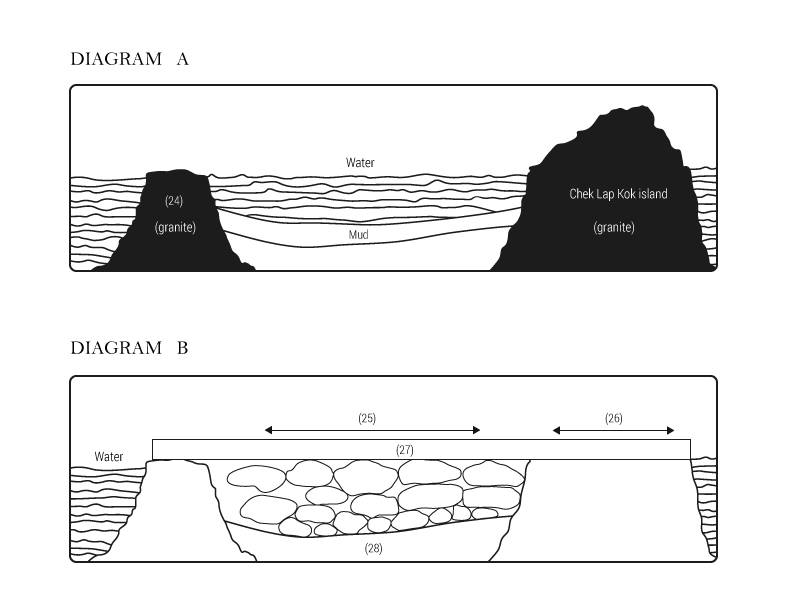
24
25
26
27
28
-
spellcheck Answers
24. B
Choose B because the passage names the land that was there before work began: "the original little island of Chek Lap Kok and a smaller outcrop called Lam Chau."25. A
Choose A because the passage says what the granite rock is used for: "Most of the rock will become the foundations for the airport's runways and its taxiways."26. E
Choose E because the passage says where the terminal goes: "Most of the terminal buildings will be placed above the site of the existing island."27. C
Choose C because the passage describes the top layer of the new island: "The sand dredged from the waters will also be used to provide a two-metre capping layer over the granite platform."28. D
Choose D because the passage says what was left under the new land after dredging: "sand was dredged from the waters and piled on top of the layer of stiff clay that the massive dredging had laid bare."
A river delta is a landform that forms from the deposition of sediment that is carried by a river as the flow leaves its mouth and enters slower-moving or stagnant water. This often occurs when a river enters an ocean. The river builds them up. The sea wears them down; their outlines are always changing. The changes in China's Pearl River delta, however, are more dramatic than these natural fluctuations. An island six kilometres long with an area of 1248 hectares called Chek Lap Kok is being created there. Civil engineers are focused not only on performance but also on speed and size. This is a bit of the delta that they want to endure.
Chek Lap Kok was assimilated via land reclamation into the 12.48 square kilometres island for the current Hong Kong International Airport. As the fresh island of Chek Lap Kok rose, another Asian island was sinking back into the sea. This is a 520-hectare island built in Osaka Bay, Japan, that serves as the platform for the new Kansai airport. Chek Lap Kok was built differently and thus hopes to avoid the same sinking fate.
The conventional way to reclaim land is to pile sand rock on to the seabed. When the seabed oozes with mud, this is rather like placing a textbook on a wet sponge: the weight squeezes the water out, causing both water and sponge to settle lower. The settlement is rarely even: different parts sink at different rates. So buildings, pipes, roads and so on tend to buckle and crack. You can engineer around these problems, or you can engineer them out. Kansai took the first approach; Chek Lap Kok is taking the second.
The differences are both political and geological. Kansai was supposed to be built just one kilometre offshore, where the seabed is quite solid. Fishermen protested, and the site was shifted a further five kilometres. That put it in deeper water (around 20 metres) and above a seabed that consisted of 20 metres of soft alluvial silt and mud deposits. Worse, below it was a not-very- firm glacial deposit hundreds of metres thick.
The Kansai builders recognised that settlement was inevitable. Sand was driven into the seabed to strengthen it before the landfill was piled on top, in an attempt to slow the process; but this has not been as effective as had been hoped. To cope with settlement, Kansai's giant terminal is supported on 900 pillars. Each of them can be individually jacked up, allowing wedges to be added underneath. That is meant to keep the building level. But it could be a tricky task.
Conditions are different at Chek Lap Kok. There was some land there to begin with, the original little island of Chek Lap Kok and a smaller outcrop called Lam Chau. Between them, these two outcrops of hard, weathered granite make up a quarter of the new island's surface area. Unfortunately, between the islands there was a layer of soft mud, 27 metres thick in places.
According to Frans Uiterwijk, a Dutchman who is the project's reclamation director, it would have been possible to leave this mud below the reclaimed land, and to deal with the resulting settlement by the Kansai method. But the consortium that won the contract for the island opted for a more aggressive approach. It assembled the world's largest fleet of dredgers, which sucked up 150m cubic metres of clay and mud and dumped it in deeper waters. At the same time, sand was dredged from the waters and piled on top of the layer of stiff clay that the massive dredging had laid bare.
Nor was the sand the only thing used. The original granite island which had hills up to 120 metres high was drilled and blasted into boulders no bigger than two metres in diameter. This provided 70m cubic metres of granite to add to the island's foundations. Because the heap of boulders does not fill the space perfectly, this represents the equivalent of 105m cubic metres of landfill. Most of the rock will become the foundations for the airport's runways and its taxiways. The sand dredged from the waters will also be used to provide a two-metre capping layer over the granite platform. This makes it easier for utilities to dig trenches - granite is unyielding stuff. Most of the terminal buildings will be placed above the site of the existing island. Only a limited amount of pile-driving is needed to support building foundations above softer areas.
The completed island will be six to seven metres above sea level. In all, 350m cubic metres of material will have been moved. And much of it, like the overloads, has to be moved several times before reaching its final resting place. For example, there has to be a motorway capable of carrying 150-tonne dump-trucks; and there has to be a raised area for the 15,000 construction workers. These are temporary; they will be removed when the airport is finished.
The airport, though, is here to stay. To protect it, the new coastline is being bolstered with a formidable twelve kilometres of sea defences. The brunt of a typhoon will be deflected by the neighbouring island of Lantau; the sea walls should guard against the rest. Gentler but more persistent bad weather - the rainfall of the summer monsoon - is also being taken into account. A mat-like material called geotextile is being laid across the island to separate the rock and sand layers. That will stop sand particles from being washed into the rock voids, and so causing further settlement. This island is being built never to be sunk.
Tipo de pregunta 11 – Preguntas de respuesta corta
En este tipo de pregunta tienes que escribir una, dos o tres palabras o un número como respuesta.
Las preguntas suelen referirse a información factual sobre detalles del texto.
Las instrucciones indicarán claramente cuántas palabras o números debes usar en cada respuesta, p. ej., NO MORE THAN THREE WORDS AND/OR A NUMBER del pasaje, ONE WORD ONLY o NO MORE THAN TWO WORDS.
Si escribes más palabras de las que se piden, perderás puntos.
Los números pueden escribirse en cifras o en letras.
Consulta nuestra aula completa sobre cómo responder a las preguntas de respuesta corta. Incluye vídeos para ambas versiones del examen y explicaciones detalladas con preguntas de muestra.
Questions 25-27
Answer the questions below.
Choose NO MORE THAN THREE WORDS AND/ OR A NUMBER from the passage for each answer.
25. To obtain a scholarship, what is the minimum course length?
26. What do scholarship winners receive towards their airfares if they live over 2,650 km from Fairhaven?
27. Who pays for dependent children to travel?
-
spellcheck Answers
25. 23 weeks / twenty-three weeks
The answer is 23 weeks because it is supported by the passage evidence: "any course lasting less than 23 weeks.". This evidence gives the same meaning as the question, so the answer follows directly from the text.26. vouchers / airline vouchers
The answer is (airline) vouchers because it is supported by the passage evidence: "airline vouchers will be supplied instead.". This evidence gives the same meaning as the question, so the answer follows directly from the text.27. scholarship holder / the scholarship holder
The answer is (the) scholarship holder because it is supported by the passage evidence: "must be paid by the scholarship holder.". This evidence gives the same meaning as the question, so the answer follows directly from the text.
Section 2 Read the text below and answer Questions 15-24.
Sandridge Institute
Welcome to Sandridge Institute. We want your training period here to be successful, so this guide outlines the Institute and highlights key details about our professional courses.
Hillcrest Institute was created to deliver high-quality, short training programmes for a variety of professional purposes. Its teaching team is both experienced and highly qualified, and many of the teachers have worked in classrooms overseas.
Courses at Sandridge Institute are arranged as ten-week modules. Most programmes, including Office Management, Librarianship and Medical Records Organisation, contain two modules, whereas Biotechnology and Computer Analysis may run for three or four. A two-week interval separates the modules; however, assignments or projects must be completed during these intervals, so vacations cannot be taken then.
Class hours are not standard across all programmes because each course has its own requirements. The correct timetable for your course appears at the front of your course manual and should be checked carefully.
Students who miss part of a course because they failed to read their course timetable correctly cannot receive attendance or achievement certificates from Sandridge Institute. Absence for valid reasons, such as illness, will be considered if documentary evidence is supplied; in that situation, only an achievement certificate will be issued.
Facilities The snack bar, coffee lounge and restaurant opening times are listed beneath your course timetable. You do not need to book any eating venue except the restaurant for dinner on Monday and Tuesday. The coffee lounge and restaurant are usually closed on public holidays. Nevertheless, restaurant dinner bookings can be accepted on those days for groups with a minimum of 23 people, and a non-refundable deposit is required.
Oakbridge Institute offers an excellent sports complex. The swimming pool is open every day from 11.00 am to 11.00 pm and is free for all Percil students wbo show a valid student enrolment card. Any student with a valid student card may reserve the squash courts, which cost $7.53 per half hour. The gymnasium costs $43.00 for ten weeks, $8.00 for a single visit, or $115 for an annual subscription. Guests of Percil students are welcome to use the swimming pool, although they may not use the gymnasium areas.
Security Do not leave valuables in classrooms at any time. Sandridge Institute accepts no responsibility for loss of, or damage to, student property caused by student negligence. The Institute's front doors are locked after 11.33 pm. If you need entry after that time, press the doorbell and speak to the caretaker through the intercom. Students admitted by the caretaker must show their student card.
Medical Care Minor accidents and injuries can generally be treated on site at the Oakbridge Centre on the third floor, and these services are free. Headache pills and other analgesics are sold at standard pharmacy prices.
Read the text below and answer Questions 25-27.
Percil Memorial Training Scholarships (6 offered per year)
Sandridge Institute provides several scholarships for overseas applicants who intend to settle in Ireland and require re-training. The scholarships are for full-time study only and are unavailable for any course lasting less than 23 weeks.
Requirements/eligibility Applicants must show strong academic ability through qualifications already earned in their home country. Alternatively, they need at least five years of relevant work experience in their chosen field, supported by references from at least two employers or supervisors.
The award Scholarship awards include return airfares to Ireland from the applicant's home country if the flight distance from the departure city to Fairhaven is no more than 2,650 kilometres. If the journey is longer, airline vouchers will be supplied instead. Travel to and from airports for both outward and return trips is covered, and an airline excess baggage allowance of 135 kg is included.
Scholarship holders do not receive payment for personal removal expenses. If the scholarship holder is married when applying, some travel and removal expenses may be paid for the husband or wife. Any travel costs or support for dependent children must be paid by the scholarship holder.
Scholars may receive help with accommodation in the Fairhaven metropolitan area, but married accommodation is not available on the Redhill Institute campus. Because campus accommodation is always in heavy demand, scholarship applicants should apply at least ten weeks before they plan to move into residence.
Short Answer
Learn how to answer these questions in a step-by-step interactive exercise
Short Answer
Una pregunta Short Answer te pide encontrar un dato concreto en el texto, como un nombre, una fecha, un lugar, un número o una expresión breve. Tu respuesta tiene que salir del texto palabra por palabra, y cada pregunta tiene un límite de palabras.
Echa un vistazo a la pregunta y luego haz clic en Siguiente para continuar.
Echar un vistazo a la pregunta
Choose NO MORE THAN THREE WORDS AND/OR A NUMBER from the passage for each answer.
1. To obtain a scholarship, what is the minimum course length?
2. What do scholarship winners receive towards their airfares if they live over 2,650 km from Fairhaven?
3. Who pays for dependent children to travel?
Empieza por la palabra interrogativa. What, why, who, where, when, which y how many te indican qué tipo de respuesta necesitas: un material, una razón, un nombre o un año, por ejemplo. Después marca los nombres, números y sustantivos académicos que te dicen dónde buscar, junto con el verbo que nombra la acción; si ese verbo tiene más de una palabra, márcalo entero. Haz esto con todas las preguntas de la lista antes de escanear el texto.
Haz clic en las palabras clave de cada pregunta.
Seleccionar las palabras clave
Haz clic en las palabras clave de cada pregunta.
1. To obtain a scholarship what is the minimum course length
2. What do scholarship winners receive towards their airfares if they live over 2,650 km from Fairhaven
3. Who pays for dependent children to travel
Usa tus palabras clave como objetivo y lee el texto rápidamente, buscando solo esas palabras o sinónimos cercanos. Cuando las encuentres, detente y lee esa oración con atención, porque las palabras de la respuesta suelen estar dentro de ella.
Todavía no escribes la respuesta.
Selecciona la oración que responde a la pregunta.
Pregunta 1
1. To obtain a scholarship, what is the minimum course length?
Selecciona la oración que responde a la pregunta.
Sandridge Institute provides several scholarships for overseas applicants who intend to settle in Ireland and require re-training. The scholarships are for full-time study only and are unavailable for any course lasting less than 23 weeks.
Requirements/eligibility Applicants must show strong academic ability through qualifications already earned in their home country. Alternatively, they need at least five years of relevant work experience in their chosen field, supported by references from at least two employers or supervisors.
The award Scholarship awards include return airfares to Ireland from the applicant's home country if the flight distance from the departure city to Fairhaven is no more than 2,650 kilometres. If the journey is longer, airline vouchers will be supplied instead. Travel to and from airports for both outward and return trips is covered, and an airline excess baggage allowance of 135 kg is included.
Scholarship holders do not receive payment for personal removal expenses. If the scholarship holder is married when applying, some travel and removal expenses may be paid for the husband or wife. Any travel costs or support for dependent children must be paid by the scholarship holder.
Scholars may receive help with accommodation in the Fairhaven metropolitan area, but married accommodation is not available on the Redhill Institute campus. Because campus accommodation is always in heavy demand, scholarship applicants should apply at least ten weeks before they plan to move into residence.
Vuelve a escanear el texto en busca de tus palabras clave. Las preguntas Short Answer suelen seguir el orden del texto, así que la siguiente respuesta suele aparecer después de la oración que ya usaste. Ten en cuenta que el autor usará otras palabras para la misma idea.
Selecciona la oración que responde a la pregunta.
Pregunta 2
2. What do scholarship winners receive towards their airfares if they live over 2,650 km from Fairhaven?
Selecciona la oración que responde a la pregunta.
Sandridge Institute provides several scholarships for overseas applicants who intend to settle in Ireland and require re-training. The scholarships are for full-time study only and are unavailable for any course lasting less than 23 weeks.
Requirements/eligibility Applicants must show strong academic ability through qualifications already earned in their home country. Alternatively, they need at least five years of relevant work experience in their chosen field, supported by references from at least two employers or supervisors.
The award Scholarship awards include return airfares to Ireland from the applicant's home country if the flight distance from the departure city to Fairhaven is no more than 2,650 kilometres. If the journey is longer, airline vouchers will be supplied instead. Travel to and from airports for both outward and return trips is covered, and an airline excess baggage allowance of 135 kg is included.
Scholarship holders do not receive payment for personal removal expenses. If the scholarship holder is married when applying, some travel and removal expenses may be paid for the husband or wife. Any travel costs or support for dependent children must be paid by the scholarship holder.
Scholars may receive help with accommodation in the Fairhaven metropolitan area, but married accommodation is not available on the Redhill Institute campus. Because campus accommodation is always in heavy demand, scholarship applicants should apply at least ten weeks before they plan to move into residence.
Vuelve a escanear el texto y comprueba que la oración que eliges responde de verdad a la pregunta. Una oración que repite una palabra clave pero cuenta otra cosa es una trampa.
Selecciona la oración que responde a la pregunta.
Pregunta 3
3. Who pays for dependent children to travel?
Selecciona la oración que responde a la pregunta.
Sandridge Institute provides several scholarships for overseas applicants who intend to settle in Ireland and require re-training. The scholarships are for full-time study only and are unavailable for any course lasting less than 23 weeks.
Requirements/eligibility Applicants must show strong academic ability through qualifications already earned in their home country. Alternatively, they need at least five years of relevant work experience in their chosen field, supported by references from at least two employers or supervisors.
The award Scholarship awards include return airfares to Ireland from the applicant's home country if the flight distance from the departure city to Fairhaven is no more than 2,650 kilometres. If the journey is longer, airline vouchers will be supplied instead. Travel to and from airports for both outward and return trips is covered, and an airline excess baggage allowance of 135 kg is included.
Scholarship holders do not receive payment for personal removal expenses. If the scholarship holder is married when applying, some travel and removal expenses may be paid for the husband or wife. Any travel costs or support for dependent children must be paid by the scholarship holder.
Scholars may receive help with accommodation in the Fairhaven metropolitan area, but married accommodation is not available on the Redhill Institute campus. Because campus accommodation is always in heavy demand, scholarship applicants should apply at least ten weeks before they plan to move into residence.