Test de Speaking IELTS Gratuito: prepárate con los temas y plantillas de IELTS Speaking para las partes 1, 2 y 3
En esta guía harás un test de speaking IELTS gratuito y practicarás con los temas de preguntas de IELTS Speaking más frecuentes con sus respuestas. Aprenderás a responder a las preguntas del test de speaking IELTS para las partes 1, 2 y 3 utilizando nuestras plantillas de speaking totalmente probadas.
Obtén respuestas de muestra gratuitas de speaking de IELTS después de completar una prueba de práctica de speaking de IELTS.
play_circle_outline Empezar prueba de práctica de speaking de IELTSA continuación encontrarás nuestra lista completa de preguntas de speaking de IELTS con respuestas de muestra. Nota: los enlaces en rojo son nuestras preguntas de speaking más populares y recomendadas por nuestros estudiantes, y puedes practicarlas gratis cuando quieras.
Guía para tener éxito en el IELTS Speaking
Bienvenido a la guía oficial del test IELTS speaking de BestMyTest. El resto de esta guía se centrará en aprender los temas IELTS speaking más usados en speaking part 1 - 3, escuchar respuestas modelo de banda 9, y aprender consejos y recursos importantes para tu éxito en el IELTS speaking. Usa el índice a continuación para encontrar rápidamente lo que buscas.
Índice
- Introducción al test IELTS Speaking
- Temas de IELTS Speaking para Part 1
- Temas de IELTS Speaking para Part 2 y 3
- Cómo abordar IELTS Speaking Part 1
- Cómo abordar IELTS Speaking Part 2
- Cómo abordar IELTS Speaking Part 3
- Práctica IELTS Speaking para tu éxito
- Cómo se puntúan las preguntas de IELTS Speaking
- Recursos gratuitos para el test IELTS Speaking
Test IELTS Speaking
El test IELTS speaking puede resultar un poco intimidante al principio, sobre todo porque te evaluarán en directo frente a tu examinador. Debido a este formato en vivo, encontrar temas de speaking gratuitos con respuestas de muestra puede ser difícil, pero no te preocupes, te tenemos cubierto. Antes de practicar con nuestros temas IELTS speaking, echemos un vistazo rápido al test de speaking y cómo funciona.
Formato del test de Speaking
El test de speaking dura aproximadamente 11 - 15 minutos, y consta de 3 partes. Ten en cuenta que los temas de speaking del Saludo y la Parte 1 son los mismos, por lo que se consideran solo 1 parte, pero los hemos separado para tu conveniencia.
- Saludo del test IELTS Speaking
- Test IELTS Speaking Part 1
- Test IELTS Speaking Part 2
- Test IELTS Speaking Part 3
El saludo
Cuando hagas el test IELTS speaking y entres en la sala del examen, el examinador no comienza con preguntas IELTS speaking difíciles, en su lugar, empieza despacio con saludos. Ten en cuenta que SERÁS evaluado en tu capacidad de saludar, por lo que es importante que estés preparado para ello. Dicho esto, veamos rápidamente un saludo sencillo y su respuesta.
- El examinador se presentará y te preguntará tu nombre. Tú responderás "My name's _______".
- A continuación, te preguntará "What can I call you?", a lo que puedes responder "You can call me _______". Puedes usar tu nombre inglés aquí, si tienes uno. Puede sonar extraño, pero algunas personas no saben pronunciar su propio nombre inglés. Eso NO ES ACEPTABLE. Si no puedes pronunciarlo, es mejor que no lo uses.
- Después de tu nombre, te preguntará de dónde eres. Solo di "I'm from _____". Es suficiente. No necesitas dar información adicional sobre tus respuestas en esta fase.
- Finalmente, te pedirán identificación. Después de mostrarla, comenzarás el test.
IELTS Speaking Part 1
IELTS Speaking part 1 dura entre 4 y 5 minutos, incluye alrededor de 8-10 preguntas IELTS speaking, y unos 2-3 temas IELTS speaking familiares como tu trabajo, tus estudios, tu familia, tu ciudad natal, tu alojamiento, etc. Estos temas son más fáciles que los temas de IELTS speaking part 2. A continuación tienes algunos ejemplos de lo que podrían preguntarte.
Where is your hometown?
What do you like about it?
What do you not like about it?
How important is your hometown to you?
Let's move on to talk about accommodation:
Tell me about the kind of accommodation you live in?
Does the place you live in have many amenities?
Is there anything you would like to change about the place you live in?
Do you plan to live there for a long time?
Las preguntas de Part 1 pueden describirse como preguntas que imitan una charla informal entre dos desconocidos o conocidos. No son muy profundas, pero no dejes que estas preguntas te engañen y pienses que no necesitas prepararte para ellas. Solo un poco de preparación puede marcar la diferencia y nos agradecerás haberte hecho practicarlas. También encontrarás algunos consejos sobre cómo prepararte para las preguntas de Part 1 más adelante en esta publicación.
IELTS Speaking Part 2
En la part 2, hablarás sobre un tema concreto de IELTS speaking. El tema se selecciona para ti y te será entregado en una tarjeta (Candidate Task Card). Luego tendrás 1 minuto para preparar tu respuesta y, después, un máximo de 2 minutos para hablar. Se te proporcionará un lápiz y papel para tomar notas. A continuación tienes un ejemplo de pregunta de IELTS speaking part 2:
Describe a useful electronic device you would like to own.
You should say:
- What it is
- How it would help your life
- If it would be expensive to buy
And explain why you would like it.
Una vez terminados tus dos minutos de habla, es posible que el examinador del test concluya esta parte preguntándote un par de preguntas sencillas relacionadas con tu respuesta de la part 2.
A veces se conocen como rounding off questions (preguntas de cierre),
porque ayudan a "redondear" o completar tu conversación. Veamos algunas preguntas IELTS speaking que podrían hacerse.
Por ejemplo, supongamos que el tema IELTS speaking del que has hablado en la part 2 fue "Describe your favorite form of public transport".
El examinador podría cerrar tu conversación preguntando:
- Are the buses cheap in your city?
- Did you travel to the test today by bus?
Por lo general, estas preguntas de cierre son sencillas, por lo que solo será necesario que respondas con respuestas simples.
Aquí no se requieren respuestas largas y complejas, ya que el examinador probablemente esté listo para pasar a la part 3.
Por ejemplo, puedes responder a una pregunta de cierre con una respuesta corta como esta:
- Yes, about 2 dollars for a single journey.
- No, actually I came by taxi.
Por otro lado, hay casos en los que el examinador puede omitir las preguntas de cierre y proceder directamente a la part 3. Si este es el caso durante tu test IELTS speaking, no te preocupes; esto indica que tu respuesta de speaking part 2 fue lo suficientemente larga, y que tus 3 minutos para la part 2 ya han terminado.
IELTS Speaking Part 3
En la part 3, se te harán entre 4 y 8 preguntas IELTS speaking adicionales que están conectadas con los temas IELTS speaking discutidos en la part 2. El examinador también te hará algunas preguntas basadas en tus respuestas, por lo que toda la part 3 es una discusión bidireccional con el examinador y durará 4 - 5 minutos. Aquí tienes algunas preguntas generales de speaking que el examinador podría hacerte basadas en los temas anteriores de IELTS speaking part 2:
What devices do you think will be popular in the future?
Do you think people spend too much money on electronic devices?
In what ways can electronic devices make our lives harder?
What would the world be like without computers?
Should children be taught to use computers at school?
Temas de IELTS Speaking
Ahora que has visto cómo funciona el test IELTS speaking, puedes ver que podrían preguntarse muchos temas. Es importante que te familiarices con algunos de los temas IELTS speaking más usados. No solo hemos creado una lista completa, sino que cada tema también incluye una respuesta de muestra de IELTS speaking.
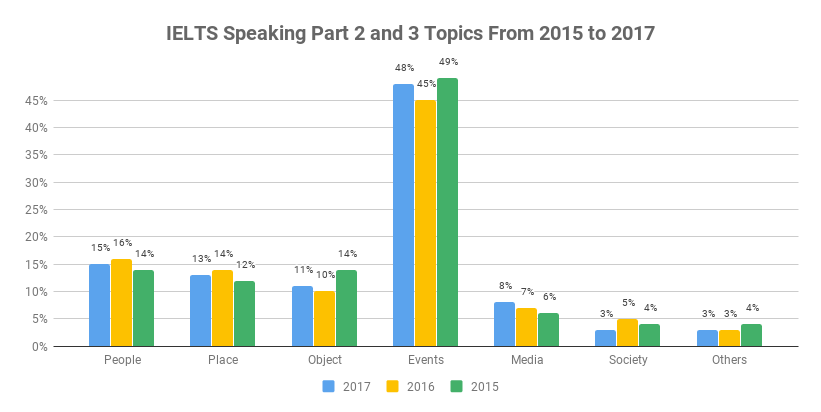
La gráfica de barras a continuación representa los temas de speaking más populares utilizados entre 2015 y 2017. El eje Y muestra el porcentaje de uso, mientras que el eje X representa los temas. Por último, empezando desde la izquierda, cada barra representa un año: 2017, 2016 y 2015, respectivamente.
Temas de IELTS Speaking Part 1
La lista a continuación contiene algo más que preguntas, también muestra los temas de speaking que los examinadores han preguntado a las personas en el pasado. Un buen consejo es responder a estas preguntas IELTS speaking part 1 frente a un espejo o con un amigo. La tabla siguiente muestra la frecuencia con la que se utiliza cada tema:
| Temas | Frecuencia |
|---|---|
| Ciudad natal / Alojamiento / País | Alta |
| Amigos / Familia / Tareas domésticas / Hijos | Alta |
| TV / Lectura / Música / Periódicos y revistas / Películas | Alta |
| Tecnología / Ordenadores / Internet | Alta |
| Trabajo / Empleos / Planificación de carrera / Voluntariado | Alta |
| Especialidades escolares / Instituto | Media |
| Deportes / Actividades al aire libre / Actividades de interior | Media |
| Viajes / Estilo de vida | Media |
| Estaciones / Lluvia / Días soleados / Clima | Media |
| Moda / Zapatos / Bolsos / Ropa | Media |
| Transporte / Barcos / Autobuses / Taxis | Media |
| Famosos / Anuncios / Medios | Media |
| Fotos / Fotografía / Colores / Arte | Baja |
| Ruido / Paciencia / Cortesía | Baja |
| Espejos / Regalos | Baja |
My hometown is a tiny village in Malaysia. It is about 40 kilometers away from any major city. Most people probably wouldn't be able to find it on a map.
I like how the people in my hometown are so friendly, and the way that everyone knows everyone. It’s a really close-knit community, which is hard to find in big cities.
Well...I suppose my least favorite thing about it is that there aren’t too many fun things to do or see. It’s not the most exciting place, so sometimes I feel a little bored.
My hometown is very important to me, because that’s where my family lives. It’s where I come from, so it shapes a lot of who I am as a person. If I move away, I’ll likely be homesick for awhile.
Well...I’ve lived in my hometown since I was born, and I would be happy to continue living there. However, I’d like to try living abroad, even if it’s just for a short time.
My hometown, Delhi, is the second largest in India. The capital of the country, New Delhi, is also there. There is an international airport in Delhi, so it’s easy to travel in and out of the country from there.
It has developed much better public transportation, such as the metro, which has really improved the overall accessibility of the city. There have also been measures undertaken to reduce pollution and crowds, so those problems have slightly improved. Improvements are still being made to the education system, as well.
I think one of the biggest issues in Delhi is women’s safety. The city does not have a good reputation surrounding this problem, and many women fear going out alone in the city because of it. More needs to be done to protect women in Delhi.
Yes, there are trains, buses and major highways that connect easily to Delhi. There is an airport in New Delhi, and since it’s the capital of India, it is very well connected to the rest of the country.
Well, there are many different kinds of jobs, since it is a major city, but I think some of the fastest growing job markets are in computer programming and software development. There are also many jobs in marketing and retail. However, the salaries that people make can vary quite a bit depending on how much experience they have, so sometimes it can be hard to make a living even in a city like Delhi.
¿Quieres ver nuestra lista completa de temas IELTS speaking? Puedes consultarlos aquí: Ver lista completa de temas de speaking
¿Buscas muestras de IELTS speaking con respuestas? Puedes empezar a practicar gratis ahora pulsando el botón siguiente.
Simulacro gratuito IELTS Speaking - Part 1
Temas de IELTS Speaking Part 2 y 3
Ahora aprenderás algunos de los temas más usados de speaking part 2 y 3 y repasarás algunas preguntas relacionadas con los temas (con cada pregunta se incluye una respuesta modelo de banda 9).
| Categoría amplia | IELTS Speaking Part 2 y 3 |
|---|---|
| Medios y entretenimiento | Anuncios / Arte / Libros / Internet / Noticias / TV |
| Objeto | Ropa / Dispositivos electrónicos / Comida / Muebles / Regalos Máquinas / Dinero / Instrumentos musicales / Productos tradicionales / Verduras |
| Personas | Profesor / Familia / Amigos / Personas influyentes / Buenos padres |
| Lugar | Ciudad / Empresa / Escuela / Museos / Fiestas / Lugares de compras |
| Eventos | Un cambio en la vida / Decisión / Experiencias emocionantes / Vacaciones / Experiencias de enfermedad Ayudar a las personas / Experiencias memorables / Una experiencia de llegar tarde / Experiencias de viaje |
| Sociedad | Medio ambiente / Normas de tráfico / Sociedad / Transporte |
| Otros | Actividades de ocio / Idioma / Deportes |
Speaking part 2 y 3 te examinarán sobre temas similares, así que el tema anuncios a continuación incluye preguntas y respuestas de muestra para ambas partes.
Speaking Part 2
candidate task card
Describe an advertisement that persuaded you to buy a product.
You should say
What advertisement it was
Was it shown on TV, radio or newspaper
What was good about that advertisement
Explain why you think that advertisement made the product seem attractive.
Speaking Part 3
There are many popular ways companies can choose to advertise. In today’s world, the top three advertisement types are probably internet ads, TV ads, and signs. Internet ads are obviously popular because they are cheap, yet they are highly effective, and can be targeted to the customer based on their online habits. On the other hand, TV ads are probably equally as popular, because although they are more expensive, they will be viewed by a large number of people watching TV. Lastly, signs are popular to use for ads because they can be put into specific places where potential customers might see them, like department stores. So, those are some of the most popular ways to advertise.
Well, I would say that I prefer internet ads. I say that because the internet is the only type of media I even use these days, as I don’t own a television or listen to the radio. I like internet ads because they’re often based on my internet history, which means I only see ads that are relevant to things I’m interested in, rather than ads for things I don’t care about. Another reason why I like internet ads is that they are easy to ignore or cancel when they appear. Unlike TV commercials, which are distracting, noisy, and cannot be skipped, internet ads are usually more subtle, like a small banner on the side of the webpage that can be easily ignored. That’s why I like internet ads the best.
Yes, definitely. If there were no advertising and you went to a shop, then you would just buy whatever you wanted. Your choice might be based on what others have told you, what the product looks like, or, depending on the product, what it says on the label. Advertising builds up a brand and people then trust a certain thing because they have seen it on television or elsewhere. Also, there is so much advertising around us that it must influence us. You can’t escape it, as it is fed to us constantly in our daily lives – not only in magazines, radio and television, but on billboards, on TVs installed on trains and platforms, even in schools and universities. So yes, advertising influences what we buy.
I think that advertisers should bear a certain level of responsibility when they make their ads. The most important thing is they need to ensure that the information they are sharing is relatively truthful, and is not harmful or destructive in some way. For example, fast food ads for fried chicken should not turn around and try to convince people that the food they’re selling is somehow healthy. They can, however, promote how delicious the food is. Advertisers should try to tell the truth as much as possible.
It could be seen as necessary in terms of the fact that, as I mentioned before, there are so many choices that we might need someone to guide us in what to buy, or to give us some extra information about products. Without this, it would be difficult to know where to start. However, that said, I’m not sure that I would regard it as ‘necessary’, as overall I think it may do more harm than good. As we just discussed, advertising encourages people to buy things they might not need. We live in a consumer society and many people are in debt because we are encouraged to buy and buy, and I’m sure advertising plays a major role in this. Without advertising, we could just do our own research and decide what we really need. So no, I would not say that advertising in necessary in modern society.
It seems to me that advertising can affect kids in a few different ways. First of all, advertisements can mislead and confuse children by exaggerating the effects a product can have, like how makeup ads try to convince people that their eyelashes will grow if they use a particular brand of mascara. Secondly, ads can affect children’s self-image and self-esteem by causing them to think that they need to be like the people in the ads, who are often misrepresentations of real people. Impressionable children who see ads may get the wrong idea about some things.
Unfortunately, there are some ads that can be harmful to kids. For example, ads for types of foods and drinks which contain high amounts of sugar and fat can manipulate children into wanting to eat these foods. Another way that ads can harm children is that they can negatively affect children’s self-esteem. Children who see models in advertisements may believe that they need to look like those people, and become upset when they aren’t able to achieve perfection. So, promoting unhealthy influences and lowering self-esteem are a few reasons why ads can be harmful to kids.
¿Quieres ver nuestra lista completa de temas IELTS speaking? Puedes consultarlos aquí: Ver lista completa de temas de speaking
¿Buscas muestras de IELTS speaking con respuestas? Puedes empezar a practicar gratis ahora pulsando el botón siguiente.
Simulacro gratuito IELTS Speaking - Part 2
Cómo abordar IELTS Speaking Part 1
Como se ha mencionado antes, las preguntas IELTS speaking part 1 son como conversaciones diarias con hablantes nativos. Si te sientes cómodo manteniendo conversaciones básicas con un hablante nativo de inglés, la part 1 no debería darte muchos problemas, sin embargo, deberías prepararte para ella.
Al responder a los temas de IELTS speaking part 1, tu respuesta no debe ser ni demasiado corta ni demasiado larga.. Por ejemplo, si te preguntan "Do you like sports?" Decir "No. I don't like sports." no es una respuesta lo suficientemente buena. Recuerda siempre que estás aquí para demostrar que sabes hablar inglés, por lo que necesitas dar al examinador respuestas más largas para que pueda evaluarte. Una respuesta aceptable sería "I understand the benefits of being in sports and the entertainment of watching it, but even as a child, I could never get into sports. I prefer to sit down and read an engaging book.". Como regla general, una respuesta de part 1 debería tener entre 3 y 4 oraciones.
Afortunadamente, hay maneras sencillas de extender tus respuestas IELTS speaking de forma natural, sin correr el riesgo de usar gramática difícil o desconocida. Aquí puedes encontrar 5 formas fáciles, con ejemplos, de cómo extender eficazmente tus respuestas al hacer IELTS speaking part 1.
| 1. Dar razones | |
|---|---|
|
What do you like to do in your spare time? I am really into swimming, so I like to swim in my free time. I suppose this is thanks to the influence of my parents who both like swimming. |
|
|
What kind of programme do you like to watch on TV? My favorite TV programmes are dramas, since I don't have to think too much when I watch them. They're a little over dramatic at times, but that's part of the fun. |
|
|
Do you usually watch films alone or with others? I like watching films with my family and friends, because afterwards we can talk about our favorite parts and figure out what we think the plot was about. |
|
|
Who do you get on best within your family? It's hard to say, since we're all so close. I guess I probably get on best with my mother, as we are the most alike. We're both very chatty and warm people. |
|
| 2. Dar ejemplos | |
|---|---|
|
Do you like to keep fit? Yes! I like to keep fit. I am keen on sports! For instance, I play basketball every week and use the gym whenever I have the chance |
|
|
Do you like learning a new language? Yes! I really do! Take learning English as example. I love reading English magazines and listening to English podcasts. |
|
|
Is there anything you would change about your hometown? Well.. my least favorite thing about it is that there aren't too many fun things to do or see. A case in point is that shopping centres and restaurants close too early. |
|
| 3. Dar detalles | |
|---|---|
|
Tell me about your hometown? My hometown, Delhi, is the second largest in India. The capital of the country, New Delhi, is also there. There is an international airport in Delhi, so it's easy to travel in and out of the country from there. |
|
|
Tell me about the kind of accommodation you live in? I live in a rented room in a paying guest accommodation. It is a superb building equipped with all the facilities. Round-the-clock security, access to free Wi-Fi, medical room and a common room all are made available to the guests living in the building. Every major part of the city is accessible from our building. |
|
|
Tell me about the favorite shop you often go to? It is a book shop near where I live. It's on the main street. I often go in there to browse and have a look through all the books they have. |
|
| 4. Hablar del pasado o del futuro | |
|---|---|
|
Where do you live in your country now? I am currently living in Delhi, which is the second most populated city in India. I've lived there for a couple of years, but I used to live in Bangalore, which is also a big city in southern India. |
|
|
Are you working at the moment? No! Not at the moment. I am unemployed now, but I am planning to apply for some internship positions this summer. Hopefully things will change soon. |
|
|
Have you ever been to a concert before? No. I've never been to a concert before, but I think I will. Concerts are always happening around where I live, so I will try to go check them out when I can. |
|
| 5. Hacer especulaciones | |
|---|---|
|
Do you think you'll ever live in another country? I suppose I'd be happy to leave my country if I was offered a job abroad that was interesting. |
|
|
What would be your ideal holiday destination? Hmm.. I'd doubt whether I'll ever go there, but I'd love to go to Africa to see the wild nature. Right now I don't have money for vacation. If I had more money, I would probably go with my girlfriend. |
|
|
What would be your ideal job? You know..that's a tricky one. It would probably be working as a software engineer in Google if I managed to pass Google's interview. |
|
Al hablar en el examen, intenta sonar natural, como si estuvieras hablando con un buen amigo. Cuando te pones nervioso o estresado, es habitual mirar hacia abajo, hablar con voz monótona, hablar demasiado bajo, dar respuestas cortas de una sola palabra o incluso fruncir el ceño. Estos hábitos hacen que tus respuestas suenen menos seguras y pueden afectar negativamente a tu puntuación, por lo que son comportamientos que debes evitar.
En su lugar, céntrate en hacer las cosas que crean una impresión fuerte y positiva. Mantén un contacto visual natural con el examinador, habla con energía y entusiasmo, y proyecta tu voz para que se te oiga con facilidad. Da respuestas descriptivas y desarrolladas en lugar de respuestas cortas, y recuerda sonreír. Una actitud amistosa y segura hace que tu speaking sea mucho más atractivo y eficaz.
Cómo abordar IELTS Speaking Part 2
El IELTS speaking part 2 requiere que hables durante 2 minutos seguidos y potencialmente sobre un tema que no te resulte familiar. Muchos estudiantes IELTS se ponen nerviosos y se estresan durante su intervención, y se quedan sin cosas que decir. Para ayudarte a superar estos problemas, hemos preparado 4 consejos IELTS speaking que pueden ayudarte a sentirte seguro y relajado durante tu intervención.
1. No dejes que los puntos de la tarjeta limiten tu respuesta
Un error común es creer que los estudiantes deben hablar exactamente sobre lo que está escrito en la tarjeta, pero eso no es cierto. En los criterios oficiales de puntuación no se dice nada de que tengas que hablar sobre cada uno de los puntos. Los puntos solo están ahí para ayudarte, así que si hay uno o dos sobre los que no te apetece o no te sientes cómodo hablando, déjalos fuera y habla sobre otra cosa. ¿Qué significa esto para ti? Significa que puedes elegir hablar sobre algunos de los puntos con los que te sientas cómodo y otras cosas no relacionadas con los puntos pero sí con el tema. Esto te ayudará a dar una respuesta mejor y más fluida.
2. Planifica tu respuesta durante el minuto de preparación
Tendrás un minuto para prepararte antes de empezar a hablar. Durante este 1 minuto, debes esquematizar la estructura de tu respuesta y apuntar algunas palabras clave para ayudarte a recordar lo que quieres decir durante tu intervención.
3. No te preocupes por cometer errores
El último consejo IELTS speaking es no preocuparse por cometer errores. Todo el que hace un test IELTS speaking comete errores tanto de gramática como de vocabulario. De hecho, los examinadores esperan que cometas algunos errores. Lo importante es transmitir el mensaje; cometer algunos pequeños errores no perjudicará tu mensaje general. Lo que perjudicará a tu mensaje es pensar en el error, porque perderás el hilo de tu pensamiento y eso es muy peligroso. Si puedes corregirlo de inmediato, entonces está bien hacerlo, pero si te cuesta o te lleva un poco de tiempo pensar la corrección, entonces olvídalo y sigue adelante.
4. Prepara una estructura para planificar tu respuesta
No hay nada peor que tener una idea en la cabeza pero no poder expresarla con palabras fáciles de seguir y entender por el oyente. Esto ocurre normalmente cuando no estás acostumbrado a hablar con una estructura. Es recomendable tener una estructura en mente para responder a todas las preguntas IELTS speaking. Aquí recomendamos dos estrategias para estructurar tus respuestas:
Primera estrategia
En la primera estrategia, la estructura de la respuesta se divide en 3 partes:
Introducción:
En la introducción, puedes reformular un poco la pregunta y luego utilizar una oración para presentar lo que vas a contar.
Una simple frase introductoria como "I'm going to talk about..." o "I'd like to talk about..." funcionará bien.
La introducción normalmente dura unos 10 segundos.
O puedes decir algo como "Hmm..this is an interesting topic. My first thought is.." o,
"That's a tough question for me, but if I had to choose, I'd choose..".
Después, deberás pasar a hablar de los puntos principales.
Puntos principales:
Cuando hayas decidido de qué quieres hablar, lo primero que debes hacer es pensar en palabras interrogativas como
"who," "what," "where," or "when," y entonces puedes empezar a elaborar respuestas básicas a esas preguntas.
Puedes anotar algunas de tus ideas en tu hoja. A continuación, puedes empezar a mirar los puntos clave y elegir dos de ellos para tratar.
Una vez más, puedes anotar algunas ideas para cada punto de la tarjeta.
Por último, debes centrarte en las preguntas que empiezan por "why". Normalmente hay una pregunta "why" en la tarjeta.
Extensión:
Si llegado a este punto aún no has agotado los 2 minutos, puedes extender tu respuesta hablando de cómo te sientes en general y qué te gustaría hacer en el futuro respecto al tema.
Hacer eso debería ayudarte a añadir otros 20 segundos. Siempre puedes empezar con oraciones como "Overall, I feel .., y "I think in the future I will....".
You should say:
- what it is
- what you used it for
- how long you have used it
- and describe why it is important to you
Laptop, HP, Good configuration, Windows 8
Bought from BestBuy few years ago.
Present from my mom
Bullet point:
What I used it for: study, take notes, watch movies, listen to music
How long I have used it: 1 year
Why: essential part of my life
This is an interesting topic. My first thought is that I find a lot of electronic equipment useful, but today I am going to talk about the laptop I have.
My laptop computer is manufactured by HP. This laptop has a good configuration and it supports most of the latest software. It came with the Windows 8 operating system and a warranty for three years. I remembered my mom bought it for me as a present. We bought it at Best Buy. I remember it was black friday, so the computers were on sale and we got a great discount.
As for what I use it for, I'd say it is useful in virtually all aspects of my life, including studying, and entertainment. For instance, I use my laptop to take notes. I remember I used to take notes by hand in highschool. It was extremely time-consuming. Now with my laptop, I can type notes directly into a document. It is just much faster and much more flexible. I also use my laptop for entertainment purposes. For example, when I get home from school, I listen to music on my laptop. On weekends, I like watching my favorite TV shows on Netflix. If I didn't have my laptop, I would have to use my phone to watch videos, and I think the phone's screen would be too small for me to really enjoy the programme.
With regards to how long I have used it, well, I had my old laptop for over 5 years, but I finally decided to upgrade and bought my current one a year ago.
Finally, I want to talk about why the laptop is important to me. As I said earlier, this laptop has become an essential piece of equipment for me in almost every aspect of my life. I use it to watch movies and listen to music. I also use it to take notes. I even use it to write a blog, and play games occasionally.
Overall, I feel I am a bit emotionally attached to this laptop as it has become a part of my life. I think in the future, I will continue to use it until it stops working. Even if it breaks, I'll probably still keep it and treat it as a valuable.
Segunda estrategia
En esta estrategia, la estructura de la respuesta también se divide en 3 partes, que puedes pensar como 3 "historias" diferentes que contarás al examinador del test IELTS speaking.Estas tres historias tratarán sobre acontecimientos del pasado, presente y futuro. Es decir, contarás una historia sobre lo que pasó antes, una historia sobre lo que está pasando ahora y una historia sobre lo que crees que pasará después. Al utilizar esta estructura, no te quedarás bloqueado intentando pensar de qué hablar, y es más probable que hables el tiempo suficiente para llegar a los 2 minutos.
Si no tienes suficiente material con solo los puntos clave, esta estructura puede ayudarte a obtener ideas para extender tu respuesta. De hecho, no tienes que ceñirte a las preguntas de los puntos clave. Aunque deberías empezar con el tema IELTS speaking dado en la tarjeta, no tienes que mantenerte en ese tema; está bien responder usando historias relevantes e incluso desviarte del tema.
- Who they are
- How you met them
- Why you think they are good parents
- And explain what it requires to be good parents.
There are lots of ways to be a good parent, and today I'd like to tell you three stories about my experiences with parenting.
Well, first of all, when I was growing up, I think I was very fortunate to have good parents. My parents both worked very hard, but also took the time to make sure they taught us valuable lessons and spent time with us every day. I remember that we would always have dinner at the dinner table together, and my mother and father would ask me and my siblings questions about our day and make jokes with us. They are still very important people in my life now.
Next, I'd like to talk about some great parents that I know today. They are my friends who are new parents. Even though they are still learning about how to be good parents, I watch them lose sleep each night and sacrifice their own comfort regularly for the sake of their baby. The mother is so patient, even when she has not had time to take a shower or relax, she always smiles and plays with the baby. The father works hard and even after a long day, he still takes time to give his wife a break when he comes home from work, so she can have some time to herself. The couple is not only kind to their baby, but they are also kind to each other.
For my last story today, I'm going to tell you about a TV show I saw that has influenced how I think I want to be a parent in the future. The show is called "Parenthood," and it's a sitcom about a few different families. Although they are all very different, the thing that holds them together is their support, honesty, and love for one another. I hope that when I become a parent someday, I can give my family the same amount of all of those things, and be accepting of my children even if they are different from how I expected them to be.
Cómo abordar IELTS Speaking Part 3
En la part 3 del test IELTS speaking, el examinador hará un abanico más amplio de preguntas basadas en los temas tratados en la part 2. Estas preguntas son más generales y requieren que desarrolles más tu respuesta con explicaciones y ejemplos.
Si has investigado las preguntas IELTS speaking para la part 3, podrías pensar que son impredecibles, lo que hace que sean difíciles de preparar. Sin embargo, si las miras de cerca, puedes ver patrones entre las preguntas. En general, las preguntas de IELTS speaking part 3 te piden
- dar tu opinión sobre un tema
- expresar tu preferencia sobre un tema
- comparar y contrastar dos cosas
- hacer una predicción sobre algo en el futuro
- hacer una comparación con el pasado
- hablar sobre una situación hipotética
- hablar sobre tus ideas acerca de las personas en la sociedad
- hablar sobre causas y efectos
- proporcionar soluciones a un problema
| Tipos de preguntas de IELTS Speaking Part 3 | |
|---|---|
Dar tu opinión sobre un tema
|
|
Expresar tu preferencia
|
|
Hablar de personas o cosas de tu país
|
|
Hablar de causas y efectos
|
|
Comparar y contrastar dos cosas
|
|
Hacer una predicción sobre algo en el futuro
|
|
Hacer una comparación con el pasado
|
|
Hablar de una situación hipotética
|
|
Proporcionar soluciones a un problema
|
|
Si te preocupa hablar tantas oraciones, no estás solo. Incluso los hablantes nativos necesitan practicar con preguntas IELTS speaking para dar una respuesta de 5-8 oraciones de alta puntuación. Sin embargo, existen algunas plantillas de muestra IELTS speaking que te facilitarán la vida. Mientras practiques suficientes preguntas, aprendas nuestros temas IELTS speaking y sigas nuestra estructura, te sentirás más seguro y mejorarás tu habla.
Ahora veamos cómo estructurar tu respuesta según el estilo de la pregunta IELTS speaking. Ten en cuenta que las estructuras de respuesta solo sirven para ayudarte a tener una imagen clara de lo que quieres decir y ayudarte a mantenerte organizado. Sin embargo, no es estrictamente necesario seguirlas siempre y cuando tu respuesta esté en el tema y demuestre tu dominio del inglés.
Veamos cómo extender y estructurar tu respuesta según el estilo de la pregunta.
| Hacer una predicción sobre algo en el futuro | |
|---|---|
| Estructura |
|
| Pregunta IELTS Speaking | What do you think cities will be like in 50 years time? |
| Respuesta modelo y análisis: | |
|
Describe the prediction:
I think cities in the future will be more densely populated. At the same time, people will still require transportation, so I think the transportation in future cities will be more modern, fast, and convenient. Describe the current trend and say this trend will probably continue: In fact, I think there is a growing trend across the world of futuristic cities emerging where transportation is becoming more convenient to meet the growing demands of population. This trend will probably continue going forward. Describe how you feel about this prediction: I personally like this trend as more futuristic cities will emerge. A good example of a futuristic city is I think I will say it is Tokyo, where people have access to clean transportation, and live in compact spaces, like high-rises. |
|
| Hacer una comparación con el pasado | |
|---|---|
| Estructura |
|
| Pregunta IELTS Speaking | How has teaching changed in your country over the past few decades? |
| Respuesta modelo y análisis: | |
|
State that there have been changes over the past decade:
In the past few decades, there have definitely been some noticeable changes in education through generations. Describe the first comparison: I mean ..most notably, students today can no longer be punished physically by teachers, while in the past, that was pretty common. Describe the second comparison: Another way that education has changed is teacher student interaction. Today, it’s more normal to see students answering questions and having discussions, while in the past, the teacher simply lectured, and the students listened silently. Describe how you feel about this change: Overall, I think education is making progress in my country. |
|
| Comparar y contrastar dos cosas | |
|---|---|
| Estructura |
|
| Pregunta IELTS Speaking | What are the differences between living in the city and the countryside? |
| Respuesta modelo y análisis: | |
|
State that there are a few differences between two things:
For me, there are quite a few differences between life in the city and life in the country. Life in the city and in the country is vastly different. Describe the first comparison: First of all, the way people interact with each other is different. For example, in a small town, people usually wave to say hello, and notice strangers in town. But in a big city, most people ignore each other and try to give each other space in public. Describe the second comparison: Another big difference between the two is the amount of noise, which is higher in cities, and lower in small towns. Give a short conclusion: Overall, life in both places varies. |
|
| Proporcionar soluciones a un problema | |
|---|---|
| Estructura |
|
| Pregunta IELTS Speaking | How can we stop violence on TV? |
| Respuesta modelo y análisis: | |
|
Briefly talk about the problem:
I think violence on TV is the most problematic for children, but there isn’t really a simple way to make it stop, because there is a demand for action, horror, and excitement on TV. Talk about the first solution: The way I see it, there are two possible ways to deal with violent TV shows. The first is to make policies that actually ban that kind of programming altogether, although that would likely not be popular. Talk about the second solution: The second way could be to educate people on why violent TV shows are problematic, and see if they will stop watching the shows to lower the demand for them. Describe how you feel about the problem and the solutions: I mean either way, I think this problem probably isn’t going to disappear with just one simple solution. |
|
| Hablar de causas o efectos de un fenómeno | |
|---|---|
| Estructura |
|
| Pregunta IELTS Speaking | What are some of the causes of water pollution? |
| Respuesta modelo y análisis: | |
|
Briefly talk about the phenomenon:
Water pollution definitely has more disastrous effects on our health Point out the cause or effect: From what I understand, water pollution is caused mostly by human activity, so it seems like the likely sources of water pollution would be factories, runoff from farms, and sewage from cities. Provide an example of the cause or effect: For instance, I’ve seen a few studies recently that declared the Australian Great Barrier Reef to be dead due to man-made pollutants and garbage in the water. Describe how you feel about the phenomenon: I think it’s quite sad, as that probably could have been prevented if people paid more attention to the effects big industry has on the environment. |
|
| Hablar de personas o cosas de tu país | |
|---|---|
| Estructura |
|
| Pregunta IELTS Speaking | How popular is watching television in your country? |
| Respuesta modelo y análisis: | |
|
Answer the IELTS speaking question:
As far as I know, watching TV is probably one of the most popular pastimes for people in my country. Give examples of how most people do things: For example, in the evening, almost every home I pass has the TV in the living room switched on, and families will be sitting around together watching shows. I think most people like watching the news, or watching dramas. Give examples of how you do things: As for me, I also watch quite a bit of TV when I’m at home. For instance, I watch sitcoms on Friday nights after work.I guess other people in my country probably do the same thing as I do. |
|
| Dar tu opinión sobre un tema | |
|---|---|
| Pregunta IELTS Speaking | Do you think people spend too much money on electronic devices? |
| Respuesta modelo y análisis: | |
|
Answer the question:
If you ask me, yes, I think that some people spend too much money trying to keep up with the latest trends in technology. Explain the reason: However, I can understand why they do it, because these days devices become obsolete almost immediately after they are purchased. Give examples to support your reasons: For example, a new smartphone might have some great new camera today, but tomorrow, another one will appear with an even better camera. Then, everyone will want to upgrade to the new device. As for me, I am satisfied with using a slightly outdated device in order to save money until I really need a new one. |
|
| Expresar tu preferencia | |
|---|---|
| Pregunta IELTS Speaking | Do you generally read a lot of books or do you prefer watching T.V? |
| Respuesta modelo y análisis: | |
|
Answer the question:
Even though I love to read, the reality is I spend quite a bit more time watching TV. Explain the reason: I think the main reason I watch more TV is because it’s lazier, which is unfortunate. But at the same time, there are some great shows to choose from. Give examples to support your reasons: For instance, one of my favorite shows is “Dexter”, which has great writing, an interesting plot, and well-developed characters, just like a book. I think in the age we live in now, TV is just going to keep getting better and better, so I am going to probably continue watching more TV. |
|
| Hablar de una situación hipotética | |
|---|---|
| Pregunta IELTS Speaking | If you could influence or had the power to change the world with your writings what would you want to change? |
| Respuesta modelo y análisis: | |
|
Answer the question:
If I could change the world with my writings, my biggest priority would probably be to educate people about how and why they need to make changes to what they buy, what they eat, and consume to help save the environment. Explain the reason: The main reason is that people nowadays are using so much disposable plastic and products. This has led to many environmental problems. If my writing could change our consumption habits, that would have a drastic effect on our environmental footprint. Give examples to support your reasons: For example, I’ve seen a few studies recently predicting that, by 2050, the mass of plastic in the world’s oceans will exceed the mass of all the fish that live there. If that happens, the entire food chain will be severely damaged. |
|
Práctica IELTS Speaking para tu éxito
BestMyTest es un curso online de preparación IELTS pensado para tu comodidad. Nuestras preguntas del test IELTS speaking están diseñadas para verse y sentirse idénticas al test oficial IELTS speaking (Hicimos todo lo posible para simular un escenario tipo entrevista para ti). Nos aseguramos de que todo fuera igual, incluida la dificultad, el formato e incluso el funcionamiento del test. Ten en cuenta que ofrecemos 4 simulacros IELTS con preguntas nunca antes vistas y una muestra de IELTS speaking completamente gratuita. Puedes empezar a practicar ahora: IELTS Speaking Practice 1 part 1
Estos temas IELTS speaking se han creado con los temas más recientes, por lo que nuestras muestras IELTS speaking son relevantes para tu preparación IELTS speaking. Asegúrate de completarlos todos y conseguirás una puntuación de banda IELTS speaking alta.
Próximos pasos
Regístrate para una prueba gratuita de 7 días para acceder a nuestras lecciones y preguntas de IELTS speaking y empezar tu preparación IELTS.
Prueba gratuita de 7 díasCómo se puntúan las preguntas de IELTS Speaking
En el test IELTS speaking, tu habilidad oral se calificará en función de cuatro categorías. Se conocen como Fluency and coherence, Lexical resource, Grammatical range and accuracy y Pronunciation. Sigue leyendo para tener la oportunidad de familiarizarte mejor con cada una de estas categorías. Para más información, también puedes consultar estos descriptores de banda que los examinadores IELTS utilizan para puntuar la sección de Speaking del test. Ahora veamos estas cuatro categorías en detalle.
Fluency & Coherence
¿Puedes discutir tus ideas de manera clara y lógica? La fluidez se refiere a tu capacidad de transmitir tus ideas de forma racional, y la coherencia se refiere a hasta qué punto los demás pueden entender tus ideas. Para obtener una banda 9 en la categoría de Fluency and Coherence, debes ser capaz de hablar continuamente sin parar para recordar palabras o gramática, mientras desarrollas a la vez una respuesta completa y práctica a las preguntas de IELTS speaking.
Si vacilas con frecuencia para construir una respuesta gramaticalmente correcta, tu fluidez se verá afectada negativamente. Debes centrarte en usar el inglés para comunicar eficazmente el contenido de tu mensaje en todo momento, no en encontrar las palabras correctas en sí. Para puntuar bien en el área de coherencia, tus ideas deben fluir juntas con sentido para tu oyente. Puedes valerte de elementos cohesivos, como transiciones, y de marcadores discursivos comunes para mejorar tu cohesión, y también ganar un poco más de tiempo para pensar tu mejor respuesta.
Lexical Resource
Tu lexical resource se refiere a tu capacidad de aprovechar eficazmente tu "diccionario mental" o léxico. Si sueles hablar con un vocabulario amplio y variado, sin duda te irá bien en la categoría de lexical resource. Ten en cuenta que aquí se consideran tanto la adecuación como la precisión de tus elecciones de vocabulario, por lo que debes asegurarte de elegir la palabra correcta tanto por su significado COMO por el contexto en el que aparece.
Por otro lado, si tienes un vocabulario limitado o no tienes mucha experiencia encontrando el contexto correcto para algunas palabras, puede que necesites práctica adicional en este área. Recuerda que solo saber lo que "significa" una palabra inglesa no garantiza que la estés usando correctamente, ya que las palabras inglesas suelen tener connotaciones que no necesariamente figuran en el diccionario. Por cierto, entenderás mejor de qué hablamos a medida que repases nuestras muestras IELTS speaking. Continuando, repetir las mismas palabras con las que te sientes cómodo una y otra vez es otro error común a evitar, ya que indicará al examinador que tus recursos léxicos son limitados. Por último, el examinador esperará que sepas parafrasear correctamente las preguntas IELTS speaking usando tus propias palabras para repetir la pregunta. Eso significa que escuchar y entender la formulación de las preguntas también es importante.
Grammatical Range
Como no podía ser de otro modo para la mayoría, tu gramática también se considerará como parte de tu puntuación IELTS speaking. Para dar lo mejor en esta categoría, debes familiarizarte con tantos temas IELTS speaking como puedas, de modo que puedas centrarte más en tu gramática y, entonces, intentar demostrar tu capacidad gramatical y tu variedad de la forma más natural posible. Evitar errores no bastará para obtener una puntuación alta en este área, ya que el examinador necesita amplias oportunidades para oírte usar estructuras y rasgos gramaticales más complejos o difíciles. Tu objetivo debe ser mostrar tus conocimientos gramaticales mientras pareces cómodo utilizando una variedad de construcciones de oraciones y tiempos verbales.
Sin embargo, como muchos hablantes de una segunda lengua saben, esto se dice más fácil que se hace. Si tienes dudas sobre cómo usar algunos puntos de gramática, o no estás seguro de si cometes errores al hablar, considera grabar tus respuestas orales la próxima vez que practiques respondiendo preguntas del test IELTS speaking. Al escucharte, puede que descubras que hay errores que ni siquiera sabías que cometías. Descubrirlos te permitirá entender cómo romper malos hábitos ANTES de que el examinador te los oiga en el test. Si es posible, consigue que un hablante nativo, un profesor o un amigo con buen inglés te ayude a corregir tus errores y a explicarte las reglas gramaticales. Asegúrate también de volver a repasar, incluso las lecciones de gramática más básicas.
Pronunciation
Por último, pero no menos importante, los examinadores puntuarán tu pronunciación. Quienes obtienen las puntuaciones más altas en esta categoría pronunciarán las palabras lo suficientemente bien como para que los hablantes nativos los entiendan perfectamente en todo momento. Los problemas de pronunciación que limiten tu capacidad de ser entendido al hablar reducirán tu puntuación.
Es importante recordar que la pronunciación en inglés implica algo más que los sonidos de las palabras. Los hablantes nativos también escucharán el tono, el énfasis y la fluidez apropiados en tus palabras y dentro de las oraciones. Cuando los examinandos no están familiarizados con el ritmo natural y los patrones de entonación del inglés, la única forma segura de mejorar es escuchar y usar tanto inglés hablado como sea posible a lo largo del día. Puedes hablar inglés y escuchar tu respuesta cada día aquí mismo, en BestMyTest, con nuestras preguntas de práctica IELTS speaking.
De forma realista, esto puede no ser posible para todo el mundo. Aun así, puedes sacar el máximo provecho de tu tiempo limitado escuchando grabaciones de hablantes nativos. Para practicar y mejorar tu pronunciación, deberás canalizar tu loro interior. Intenta detener la grabación y repetir fragmentos cortos exactamente como los oíste unas cuantas veces. Escucha los tonos ascendentes y descendentes, las pausas e incluso la emoción del hablante. Hacer esto te permitirá desarrollar tu propia pronunciación en distintos contextos, además de entrenarte para oír y replicar los sonidos reales del inglés similar al nativo.
Recursos gratuitos para el test IELTS Speaking
Mejorar tus habilidades de speaking con recursos gratuitos es algo más complicado que en las otras tres secciones del IELTS. Es cierto que hablar inglés puede ayudarte a mejorar, pero lo que realmente ayuda es mantener conversaciones con un hablante de inglés fluido. Alguien que pueda ayudarte a corregir tus errores. Por supuesto, un hablante de inglés fluido no siempre está disponible, así que recurriremos a la siguiente mejor opción: recursos gratuitos de IELTS speaking.
Preguntas IELTS Speaking
Para hacerte una idea de cómo es el test IELTS speaking para cada parte, puedes ver los vídeos oficiales de YouTube del IELTS a continuación de forma totalmente gratuita. Contienen muchísima información útil y muestras IELTS speaking.
- YouTube Video: IELTS Speaking 1 (Kenn, Band 8.5)
- YouTube Video: IELTS Speaking 2 (Tina, Band 5)
- YouTube Video: IELTS Speaking 3 (Kopi, Band 8)
A continuación tienes algunos recursos gratuitos increíbles que puedes usar para entrenar y mantener tus habilidades de IELTS speaking.
1. Google Speech-to-Text
Esta es una gran herramienta para enseñarte a hablar a un buen ritmo y pronunciar correctamente. Lo que notarás es que si cometes un error, la API de Google escribirá lo que cree que dijiste. De hecho, tenemos algo similar en nuestra sección de preguntas IELTS speaking bajo la pestaña "SAMPLE", pero necesitarás Google Chrome en escritorio para usarlo.
2. YouTube
YouTube tiene toneladas de recursos gratuitos relacionados con la práctica del test IELTS speaking. Algunos vídeos incluso ofrecen muestras IELTS speaking con respuestas.
3. Google Play Store
Hay un montón de apps gratuitas de fluidez en inglés hablado en Google Play Store. Realmente no puedes equivocarte con estas apps gratuitas. Solo descárgalas y empieza. Con la app adecuada, deberías poder mejorar tus habilidades IELTS speaking, al menos, un poco.