En esta guía harás un test de listening IELTS gratuito y obtendrás un análisis completo de tu puntuación de IELTS Listening. Te prepararás con más de 125 tests de práctica de IELTS Listening, lecciones, consejos y explicaciones en vídeo de las respuestas. Siguiendo nuestro plan de estudio personalizado, alcanzarás la puntuación de banda IELTS Listening que deseas.
Obtén un análisis gratuito de tu puntuación de listening de IELTS y un plan de estudio personalizado después de completar una prueba gratuita de listening de IELTS.
play_circle_outline Empezar prueba de práctica de listening de IELTSA continuación encontrarás nuestra lista completa de preguntas de listening de IELTS con respuestas. Nota: los enlaces en rojo son nuestras preguntas de listening más populares y recomendadas por nuestros estudiantes, y puedes practicarlas gratis cuando quieras.
Guía de práctica del IELTS Listening
El resto de esta guía te enseñará todo sobre el examen de IELTS Listening. Aprenderás cómo se calcula la puntuación de Listening, cómo responder con éxito a cada tipo de pregunta para mejorar tu band score en el IELTS Listening, y conocerás nuestro proceso probado en 3 pasos para preparar el IELTS Listening en línea.
Índice de contenidos
Información sobre el examen de IELTS Listening
El examen de IELTS Listening se divide en 4 secciones. En cada sección, escucharás a uno o más hablantes nativos de inglés y después responderás unas 10 preguntas relacionadas con lo que acabas de oír. En total, la sección de IELTS Listening contiene 40 preguntas. En general, las grabaciones empiezan siendo más fáciles y se van haciendo más difíciles a medida que avanza el examen. Cada grabación se escucha una sola vez e incluye una variedad de acentos: británico, australiano, neozelandés, estadounidense y canadiense.
- Sección 1 – una conversación entre dos personas en un contexto social cotidiano. Por ejemplo, puedes oír una conversación para confirmar los datos de una reserva o para hacer un pedido por teléfono.
- Sección 2 - un monólogo en un contexto social cotidiano. Por ejemplo, puedes oír un discurso sobre instalaciones locales, indicaciones para llegar a algún sitio o información básica sobre un evento.
- Sección 3 – una conversación entre hasta cuatro personas en un contexto educativo o de formación. Por ejemplo, puedes oír a un tutor universitario y a un estudiante hablando de un trabajo, o a un par de estudiantes comentando algo de clase.
- Sección 4 - un monólogo sobre un tema académico. Por ejemplo, escucharás una clase universitaria impartida por un profesor. Para la mayoría de los estudiantes es la grabación más difícil del examen de Listening.
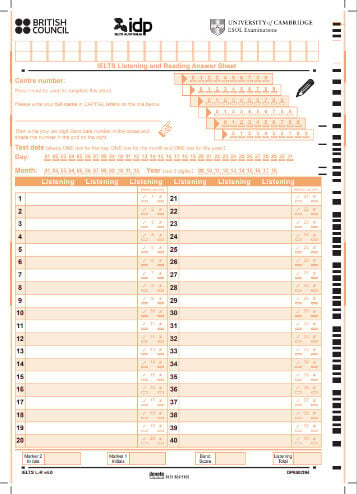
El examen de IELTS Listening dura unos 40 minutos. Dedicarás 30 minutos a escuchar las grabaciones y a responder las preguntas. Se te entregará un Cuadernillo de Preguntas y una Hoja de Respuestas. En el Cuadernillo de Preguntas verás todas las preguntas que debes responder. En la Hoja de Respuestas escribirás tus respuestas definitivas para la corrección.
Puedes consultar la hoja oficial de respuestas del IELTS Listening en PDF aquí o simplemente ver la imagen de abajo :)
Al final de la sección de Listening, dispones de 10 minutos para pasar las respuestas del Cuadernillo de Preguntas a la Hoja de Respuestas.
¡IMPORTANTE!
Las faltas de ortografía y los errores gramaticales se marcan como INCORRECTOS, así que utiliza esos 10 minutos para revisar la ortografía y la gramática.
Cómo se calcula la puntuación del IELTS Listening
En la sección de Listening, cada pregunta vale 1 punto, por lo que puedes obtener una puntuación «bruta» máxima de 40 puntos. Después, tu puntuación bruta se convierte en tu band score. ¡Recuerda! No pierdes puntos por respuestas incorrectas. La siguiente tabla te puede dar una idea general de cómo se convierten las puntuaciones brutas en band scores.
| Puntuación bruta | Band score |
|---|---|
| 39-40 | 9 |
| 37-38 | 8.5 |
| 35-36 | 8 |
| 32-34 | 7.5 |
| 30-31 | 7 |
| 26-29 | 6.5 |
| 23-25 | 6 |
| 18-22 | 5.5 |
| 16-17 | 5 |
| 13-15 | 4.5 |
| 11-12 | 4 |
Como cada versión del IELTS es ligeramente diferente, la puntuación bruta necesaria para conseguir un determinado band score varía en función del rendimiento de todas las personas que hicieron el examen ese día. Por eso, el número de respuestas correctas necesarias para obtener un determinado band score variará ligeramente de un examen a otro, pero, en general, deberías intentar acertar unas 30 de 40 preguntas si quieres conseguir un band score de 7.
Como hemos indicado antes, las secciones se vuelven cada vez más difíciles a medida que avanzas en el examen de IELTS Listening. Sin embargo, todas las preguntas valen el mismo número de puntos. Por eso, asegúrate de no perder puntos fáciles por quedarte atascado en preguntas difíciles.
Descarga gratis un PDF de muestra del IELTS Listening con respuestas
Aquí tienes algunas muestras gratuitas del IELTS Listening en formato PDF con respuestas del British Council (los creadores del examen IELTS). Intenta responder a las preguntas y comprueba qué tal lo haces.
- IELTS Listening Practice Test 1- questions (Online Examples)
- IELTS Listening Practice Test 1- answers (PDF)
- IELTS Listening Practice Test 1- answer sheet (PDF)
This is the first section of your IELTS Listening test. Listen to the audio and answer questions 1-10. You can download the audio transcripts from IELTS Listening Practice Test 1 - questions (PDF)

Questions 1-5
Complete the notes below.
Write no more than two words and/or a number for each answer.
| Questions: transport from Bayswater | |
|
Express train leaves at (1) Nearest station is (2) Number 706 bus goes to (3) Number (4) bus goes to station Earlier bus leaves at (5) | |
Complete the notes below.
Write no more than two words and/or a number for each answer.
| Transport | Cash fare | Card fare |
| Bus | (6) $ | $1.50 |
| Train (peak) | $10 | $10 |
|
Train (off-peak) – before 5pm or after (7) pm) |
$10 | (8) $ |
| (9) ferry | $4.50 | $3.55 |
| Tourist ferry ((10)) | $35 | – |
| Tourist ferry (whole day) | $65 | – |
-
spellcheck Answers1. 9.30 (am)
2. Helendale
3. Central Street/St
4. (number/no./#) 792
5. 8.55 (am)
6. 1.80
7. 7.30
8. 7.15
9. commuter
10. afternoon
This is the second section of your Listening test. Listen to the audio and answer questions 11-20. You can download the audio transcripts from IELTS Listening Practice Test 1- questions (PDF)

Questions 11-14
Which counsellor should you see?
A Louise Bagshaw
B Tony Denby
C Naomi Flynn
Write the correct letter, A, B or C, next to questions 11–14.
11 if it is your first time seeing a counsellor
12 if you are unable to see a counsellor during normal office hours
13 if you do not have an appointment
14 if your concerns are related to anxiety
Questions 15–20
Complete the table below.
Write no more than two words for each answer.
| Workshop | Contact | Target group |
| Adjusting | what you need to succeed academically | (15) students |
| Getting Organised |
use time effectively, find (16) between study and leisure |
all students |
| Communicating | talking with staff, communicating across cultures |
all students, especially (17) |
| Anxiety | (18) , breathing techniques, meditation, etc. | students about to sit exams |
| (19) | staying on track for long periods | (20) students only |
-
spellcheck Answers11. C
12. C
13. A
14. B
15. first/1st year
16. (right) balance
17. international/foreign (students)
18. relaxation
19. motivation
20. research/advanced
This is the third section of your Listening test. Listen to the audio and answer questions 21-30. You can download the audio transcripts from IELTS Listening Practice Test 1- questions (PDF)
Questions 21-30
Complete the notes below.
Write no more than three words for each answer.
| Questions |
| Novel: (21) |
| Protagonists: Mary Lennox; Colin Craven |
| Time period: Early in (22) |
|
Mary moves to UK – meets Colin who thinks he'll never be able to (23) . They become friends. |
| Point of view: “Omniscient�? – narrator knows all about characters' feelings, opinions and (24) |
| Audience: Good for children – story simple to follow |
Symbols (physical items that represent (25) ):
|
Motifs (patterns in the story):
|
Themes: Connections between
|
-
spellcheck Answers21. The Secret Garden
22. (the) 20th/twentieth century
23. walk
24. motivations/motivation
25. abstract ideas
26. roses
27. dark(ness) to light(ness)
28. health
29. environment
30. human companionship
This is the fourth section of your Listening test. Listen to the audio and answer questions 31-40. You can download the audio transcripts from IELTS Listening Practice Test 1- questions (PDF)
Questions 31-35
Complete the table below.
Write one word only for each answer.
| Time Perspectives | ||
| Time Zone | Outlook | Features & Consequences |
| Past | Positive |
Remember good times, e.g. birthdays. Keep family records, photo albums, etc. |
| (31) | Focus on disappointments, failures, bad decisions. | |
| Present | Hedonistic | Live for (32) ; seek sensation; avoid pain. |
| Fatalistic | Life is governed by (33) , religious beliefs, social conditions. Life's path can't be changed. | |
| Future | (34) | Prefer work to play. Don't give in to temptation. |
| Fatalistic | Have a strong belief in life after death and importance of (35) in life. | |
Choose the correct letter, A, B or C.
- A. at school
- B. at birth
- C. while eating and drinking
- A. they need to be in control of the way they learn
- B. they play video games instead of doing school work
- C. they are not as intelligent as girls
- A. do not realise present actions can have negative future effects
- B. are unable to learn lessons from past mistakes
- C. know what could happen if they do something bad, but do it anyway
- A. working harder
- B. building relationships
- C. sharing family meals
- A become more virtuous
- B work together better
- C identify careless or ambitious people
-
spellcheck Answers31. negative
32. pleasure
33. poverty
34. active
35. success
36. B
37. A
38. C
39. A
40. B
¿Qué tal te ha ido con las preguntas de muestra del IELTS Listening anteriores? ¿Te ha resultado difícil alguna pregunta? Si ha sido así, te conviene revisar con más detalle los 6 tipos de tareas del IELTS Listening. Cuanto mejor entiendas cada tipo de tarea, menos esfuerzo necesitarás para averiguar qué tienes que hacer y más tiempo te quedará para encontrar la respuesta.
Los 6 tipos de tareas del IELTS Listening
En el examen de IELTS Listening hay 6 tipos diferentes de preguntas. Es importante que practiques cada tipo de tarea para descubrir la mejor forma de afrontar cada una y conseguir un band score alto. En los siguientes apartados aprenderás todo sobre los 6 tipos de tareas del IELTS Listening y podrás probar una pregunta de muestra de cada uno.
Qué tipos de tareas de comprensión auditiva les resultan más difíciles a nuestros estudiantes
En lugar de una tendencia de 2017, aquí presentamos lo que muestran 2.25 millones de respuestas de nuestros estudiantes a preguntas de comprensión auditiva del IELTS en BestMyTest. El porcentaje indica con qué frecuencia nuestros estudiantes respondieron correctamente a ese tipo de tarea.
| Tipo de tarea | Respuestas correctas |
|---|---|
| Completar notas | 33% |
| Completar tablas | 34% |
| Completar oraciones | 45% |
| Respuesta corta | 48% |
| Opción múltiple | 50% |
| Selección múltiple | 51% |
| Etiquetar planos, mapas y diagramas | 55% |
| Completar formularios | 73% |
| Emparejamiento | 85% |
- Las tareas de completar son donde se pierden puntos. Las tareas de completar notas y tablas se responden correctamente solo una de cada tres veces, mientras que las de completar formularios, que requieren la misma habilidad en un formato más sencillo, alcanzan el 73%. La diferencia está en la ortografía, la forma de las palabras y los límites de palabras bajo la presión del tiempo, no en la comprensión.
- En 61.964 pruebas de práctica completas de comprensión auditiva realizadas por 55.296 estudiantes, la puntuación media de banda fue de 5.5. El 41% de las pruebas alcanzó la banda 6.0 y el 12% alcanzó la banda 7.0.
- En las secciones individuales de comprensión auditiva, un tercio de los intentos obtuvo un 40% o menos y el 30% obtuvo un 80% o más. La mayoría de los estudiantes obtiene resultados muy bajos en una o dos secciones, en lugar de una puntuación uniformemente baja, por lo que practicar las secciones 3 y 4 por separado da buenos resultados.
Las cifras proceden de los datos de las pruebas de práctica y las revisiones de BestMyTest hasta octubre de 2026. Los porcentajes por tipo de pregunta son las tasas de respuestas correctas de todos los intentos; las cifras por criterio son puntuaciones de tutores o de IA, según se indique. Última actualización: 5 de octubre de 2026.
Aunque cada tipo de pregunta de Listening tiene un aspecto distinto, el enfoque básico para abordarlas es el mismo. Más adelante en este artículo te mostraremos la estrategia básica para enfrentarte a los 6 tipos de preguntas. Ahora vamos a ver cada tipo de tarea en detalle.
- Tipo de tarea 1 – Completar oraciones
- Tipo de tarea 2 – Emparejamiento (Matching)
- Tipo de tarea 3 – Etiquetado de planos, mapas y diagramas
- Tipo de tarea 4 – Completar formularios, notas, tablas, diagramas de flujo y resúmenes
- Tipo de tarea 5 – Opción múltiple
- Tipo de tarea 6 – Preguntas de respuesta corta
Tipo de tarea 1 – Completar oraciones
En este tipo de tarea tienes que completar una oración con una respuesta corta.
Casi siempre la oración será una paráfrasis de algo que oirás en la grabación.
En otras palabras, no esperes oír al hablante decir la frase exacta tal y como aparece en la pregunta.
Lee las instrucciones con mucha atención. Por ejemplo, si la instrucción dice NO MORE THAN TWO WORDS,
te penalizarán por escribir más de DOS palabras. La respuesta puede ser una sola palabra, pero nunca podrá tener más de dos.

Questions 27 – 30
Complete the sentences below.
Write NO MORE THAN TWO WORDS for each answer.
Studying with the Open University demanded a great deal of 27 _________
Studying and working at the same time improved Rachel's 28 _________ skills.
It was helpful that the course was structured in 29 _________
She enjoyed meeting other students at 30 _________
Answer sheet
| 27 | |
| 28 | |
| 29 | |
| 30 |
-
spellcheck Answers27 motivation
28 time(-)management
29 modules
30 summer school(s)
Two friends, Rachel and Paul:, are discussing studying with the Open University. Rachel has already done a course at the university, but Paul: has not. The extract relating to these questions comes from the last part of the recording.
Paul: The other thing I wanted to ask you was, did you find it hard, studying with the Open University?
Rachel: You mean, because you're studying on your own, most of the time?
Paul: Mm.
Rachel: Well it took me a while to get used to it. I found I needed to maintain a high level of motivation, because it's so different from school. There's no-one saying, ‘Why haven't you written your assignment yet?' and that sort of thing.
Paul: Oh dear.
Rachel: You'll learn it, Paul. Another thing was that I got very good at time- management because I had to fit time for studying round a full-time job.
Paul: Well I'm hoping to change to working part-time, so that'll help.
Rachel: What makes it easier is that the degree is made up of modules, so you can take time off between them if you need to. It isn't like a traditional three-or four-year course, where you've got to do the whole thing of it in one go.
Paul: That's good, because I'd like to spend six months travelling next year.
Rachel: Huh, it's all right for some. Then even though you're mostly studying at home, remember you've got tutors to help you, and from time to time there are summer schools. They usually last a week. They're great, because you meet all the other people struggling with the same things as you. I've made some really good friends that way.
Paul: Sounds good. So how do I apply?
Tipo de tarea 2 – Emparejamiento (Matching)
En una tarea de emparejamiento debes asociar una lista numerada de elementos del texto auditivo con un conjunto de opciones que aparecen en el cuadernillo de preguntas. Esta tarea requiere escuchar información detallada y reconocer relaciones y conexiones entre los hechos del texto auditivo. Por ejemplo, es posible que tengas que identificar los distintos tipos de hoteles o alojamientos de hospedaje. Es importante analizar estas preguntas antes de escuchar el fragmento para entender la categoría de las opciones de respuesta marcadas con letras.

Questions 21 - 25
What does Jack: tell his tutor about each of the following course options?
A. He'll definitely do it.
B. He may or may not do it.
C. He won't do it.
Write the correct letter, A, B or C next to questions 21- 25. You may choose any letter more than once.
21. Media Studies
22. Women and Power
23. Culture and Society
24. Identity and Popular Culture
25. Introduction to Cultural Theory
Answer sheet
| 21 | |
| 22 | |
| 23 | |
| 24 | |
| 25 |
-
spellcheck Answers21. C
22. A
23. B
24. B
25. C
(A customer has been arranging with a shipping agent to send a large box overseas. This is the last part of the conversation.)
You will hear a Communication Studies student talking to his tutor about optional courses for the next semester.
Dr Ray: Come in. Oh hello Jack. Have a seat. Right ... you said you wanted to see me to talk about your options next semester?
Jack: That's right. We have to decide by the end of next week. Really, I'd like to do all five options but we have to choose two, don't we.
Dr Ray: Yes, but the choice depends on your major to some extent. You're majoring in Communication Studies, aren't you?
Jack: That's right.
Dr Ray: So for example the Media Studies Option will cover quite a lot of the same area you did in the core module on mass communications this semester - the development of the media through the last two series, in relation to political and social issues.
Jack: Mmm. Well that was interesting, but I've decided I'd rather do something completely new. There's a Women's Studies option, isn't there?
Dr Ray: Yes, 'Women and Power' – again it has a historical focus, it aims to contextualise women's studies by looking at the legal and social situation in the nineteenth and early twentieth centuries …
Jack: So it would be useful if I intended to specialise in women's studies ... but I'm not sure I do actually.
Dr Ray: Well, it might still be useful to give you an idea of the issues involved. It's taught by Dr Steed.
Jack: Oh, really? I'll sign up for that, then. What about the option on Culture and Society?
Dr Ray: That addresses the historical debate on the place of culture since the Industrial Revolution in Britain.
Jack: So a historical focus again ...
Dr Ray: Do I get the message you're not so keen on history?
Jack: Well, it's just we seem to have done quite a lot this semester … Listening sample task – Matching (example 1) anyway I'll think about that one.
Dr Ray: If you're interested in a course focusing on current issues there's the option on Identity and Popular Culture – that approaches the subject through things like contemporary film, adverts, soap operas and so on.
Jack: Oh? That sounds interesting. Can you tell me who runs it?
Dr Ray: Well, it's normally Dr Stevens but he's on sabbatical next semester, so I'm not sure who'll be running it. It should be decided by next week though.
Jack: Right, well I might wait until then to decide ... And the last option is Introduction to Cultural Theory, isn't it. I'm quite interested in that too – I was talking to one of the second year students, and she said it was really useful, it made a lot of things fall into place.
Dr Ray: Yes, but in fact in your major, you'll have covered a lot of that already in Communications 102, so that might be less useful than some of the others.
Jack: Oh, I'll forget about that one, then.
Dr Ray: Now while you're here, we could also discuss how you're getting on with your Core Module assignment ...
Tipo de tarea 3 – Etiquetado de planos, mapas y diagramas
En este tipo de tarea tienes que completar las etiquetas de un plano (p. ej., de un edificio), un mapa (p. ej., de una parte de una ciudad)
o un diagrama (p. ej., de un equipo). Las respuestas se eligen normalmente de una lista en el cuadernillo de preguntas.
Este tipo de tarea aparece en todas las secciones, aunque sobre todo en la sección 2.
En la sección 2 escucharás a un único hablante hablando de una situación cotidiana habitual. Por ejemplo,
es posible que tengas que oír a alguien dando una visita guiada o describiendo a unos inversores un emplazamiento propuesto.

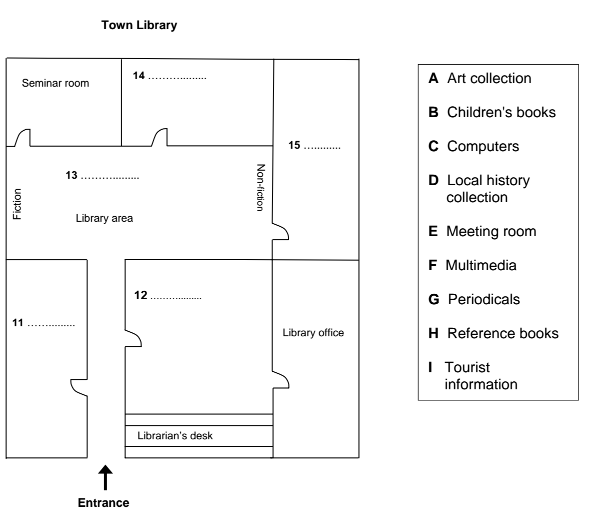
Question 11 - 15
Label the plan below.
Choose FIVE answers from the box and write the correct letters A-I next to questions 11-15.
Answer sheet
| 11 | |
| 12 | |
| 13 | |
| 14 | |
| 15 |
-
spellcheck Answers11. H
12. G
13. D
14. B
15. F
You will hear the librarian of a new town library talking to a group of people who are visiting the library.
OK everyone. So here we are at the entrance to the town library. My name is Ann, and I'm the chief librarian here, and you'll usually find me at the desk just by the main entrance here. So I'd like to tell you a bit about the way the library is organised, and what you'll find where … and you should all have a plan in front of you. Well, as you see my desk is just on your right as you go in, and opposite this the first room on your left has an excellent collection of reference books and is also a place where people can read or study peacefully. Just beyond the librarian's desk on the right is a room where we have up to date periodicals such as newspapers and magazines and this room also has a photocopier in case you want to copy any of the articles. If you carry straight on you'll come into a large room and this is the main library area. There is fiction in the shelves on the left, and non-fiction materials on your right, and on the shelves on the far wall there is an excellent collection of books relating to local history. We're hoping to add a section on local tourist attractions too, later in the year. Through the far door in the library just past the fiction shelves is a seminar room, and that can be booked for meetings or talks, and next door to that is the children's library, which has a good collection of stories and picture books for the under elevens. Then there's a large room to the right of the library area – that's the multimedia collection, where you can borrow videos and DVDs and so on, and we also have CD-Roms you can borrow to use on your computer at home. It was originally the art collection but that's been moved to another building. And that's about it – oh, there's also the Library Office, on the left of the librarian's desk. OK, now does anyone have any questions?
Tipo de tarea 4 – Completar formularios, notas, tablas, diagramas de flujo y resúmenes
En este tipo de tarea te darán un formulario, un conjunto de notas, una tabla, un resumen o un diagrama de flujo y tendrás que rellenar la información que falta a partir de la grabación. Es posible que tengas que elegir las respuestas de una lista del cuadernillo de preguntas o identificar las palabras que faltan a partir de la grabación, asegurándote de respetar el límite de palabras indicado en las instrucciones.
- un formulario:
Las preguntas con formulario son un tipo de tarea habitual en la sección 1. Rellenarás un formulario, como una solicitud, una reserva o un pedido. A menudo será una conversación telefónica entre dos personas. Una pedirá información, hará una reserva o un pedido, mientras que la otra le ayuda. - un conjunto de notas:
Las preguntas con notas son un tipo de tarea habitual en la sección 4. Escucharás una clase universitaria y después se te entregarán unos apuntes incompletos. Tendrás que rellenar la información que falta a partir de la clase. - una tabla:
Las preguntas con tabla se usan a menudo para clasificar varias cosas, como lugares, horarios o precios. Tendrás que rellenar la información que falta en la tabla. - un diagrama de flujo:
Un diagrama de flujo puede mostrar un proceso, un plan o una secuencia de hechos pasados. Tendrás que completar el diagrama, ya sea con palabras de la grabación o eligiendo una de las opciones de una lista marcada con letras. - un resumen:
En una pregunta de resumen se te presentará un párrafo que resume la grabación y tendrás que rellenar las palabras necesarias para completarlo a partir de lo que oigas.
Lee las instrucciones con mucha atención. Por ejemplo, si la instrucción dice ‘NO MORE THAN TWO WORDS', te penalizarán por escribir más de dos palabras.

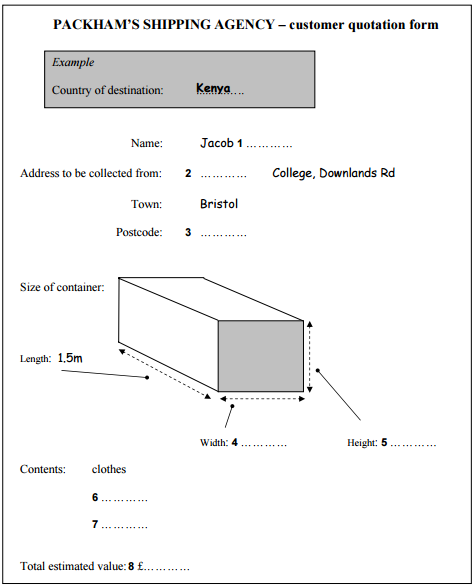
Question 1 - 8
Complete the form below
Write NO MORE THAN THREE WORDS AND/OR A NUMBER for each answer
Answer sheet
| 1 | |
| 2 | |
| 3 | |
| 4 | |
| 5 | |
| 6 | |
| 7 | |
| 8 |
-
spellcheck Answers1. Mkere
2. Westall
3. BS8 9PU
4. 0.75 m/metre(s)/meter(s) (wide) / three(-)quarter(s) (of) (a) metre/meter (wide) / ¾ m (wide) / 75 cm(s) (wide)
5. 0.5 m/metre(s)/meter(s) (high/deep) / (a) half (a) metre/meter (high/deep) / ½ m (high/deep) / 50 cm(s) (high/deep)
6. & 7 in either order
(some) books (some) toys
8. 1,700
A: Good morning Packham's Shipping Agents. Can I help you?
B Oh yes, I'm ringing to make enquiries about sending a large box, a container, back home to Kenya from the UK.
A: Yes, of course. Would you like me to try and find some quotations for you?
B: Yes, that'd be great. Thank you.
A: Well first of all, I need a few details from you.
B: Fine.
A: Can I take your name?
B: It's Jacob Mkere.
A: Can you spell your surname, please?
B: Yes, it's M-K-E-R-E.
A: Is that ‘M' for mother?
B: Yes.
A: Thank you, and you say that you will be sending the box to Kenya?
B: That's right.
A: And where would you like the box picked up from?
B: From college, if possible.
A: Yes, of course. I'll take down the address now.
B: It's Westall College.
A: Is that W-E-S-T-A-L-L?
B: Yes, ... college.
A: Westall College. And where's that? Listening sample task – Form completion (to be used with IELTS Listening Recording 1)
B: It's Downlands Road, in Bristol.
A: Oh yes, I know it. And the postcode?
B: It's BS8 9PU.
A: Right ... and I need to know the size.
B: Yes, I've measured it carefully and it's 1.5m long ...
A: Right.
B: 0.75m wide ...
A: OK.
B: And it's 0.5m high or deep.
A: Great. So I'll calculate the volume in a moment and get some quotes for that. But first can you tell me, you know, very generally, what will be in the box?
B: Yes there's mostly clothes.
A: OK. [writing down]
B: And there's some books.
A: OK. Good. Um ... Anything else?
B: Yes, there's also some toys.
A: OK and what is the total value, do you think, of the contents?
B: Well the main costs are the clothes and the books – they'll be about £1500 but then the toys are about another two hundred – so I'd put down £1700.
Tipo de tarea 5 – Opción múltiple
En una tarea de opción múltiple hay una pregunta seguida de tres posibles respuestas, o el inicio de una oración
seguido de tres posibles formas de terminarla.
Debes contestar con LETRAS (A, B o C) en la Hoja de Respuestas. ¡No escribas la palabra o las palabras de la opción de respuesta!
A veces se ofrece una lista más larga de posibles respuestas y se te pide que elijas más de una.
En ese caso, lee la pregunta con atención y comprueba cuántas respuestas se requieren.

Questions 9 – 10
Choose the correct letter, A, B or C.
- Economy
- Standard
- Premium
- port
- home
- depot
Answer sheet
| 9 | |
| 10 |
-
spellcheck Answers9. C
10. A
(A customer has been arranging with a shipping agent to send a large box overseas. This is the last part of the conversation.)
A: OK right. Now obviously insurance is an important thing to consider and our companies are able to offer very good rates in a number of different all-inclusive packages.
B: Sorry, could you explain a bit more?
A: Yes, sorry, um. There's really three rates according to quality of insurance cover – there's the highest comprehensive cover which is Premium rate, then there's standard rate and then there's economy rate. That one will only cover the cost of the contents second hand.
B: Oh I've been stung before with economy insurance so I'll go for the highest.
A: Mh'hm and can I just check would you want home delivery or to a local depot or would you want to pick it up at the nearest port?
B: The port'd be fine – I've got transport that end.
A: Fine and will you be paying by credit card?
B: Can I pay by cheque?
Tipo de tarea 6 – Respuestas cortas
En las preguntas de respuesta corta tienes que leer una pregunta y después escribir una respuesta breve con información del texto auditivo.
Lo más probable es que haya un límite, por ejemplo «No more than two words».
Si escribes más palabras de las que indican las instrucciones, tu respuesta se considerará incorrecta.
Muy a menudo, tendrás que encontrar información detallada relacionada con alguna categoría.
Por ejemplo, podrías encontrarte con una pregunta como esta:
What TWO factors can make social contact in a foreign country difficult?

Question 11 - 16
Answer the questions below
Write NO MORE THAN THREE WORDS AND/OR A NUMBER for each answer
What TWO factors can make social contact in a foreign country difficult?
- 11 ....................
- 12 ....................
Which types of community group does the speaker give examples of?
- theater
- 13 ....................
- 14 ....................
In which TWO places can information about community activities be found?
- 15 ....................
- 16 ....................
Answer sheet
| 11 | |
| 12 | |
| 13 | |
| 14 | |
| 15 | |
| 16 |
-
spellcheck Answers11 & 12: (in either order) language, customs
13 & 14: (in either order) music, local history
15 & 16: (in either order) library/libraries, town hall
You will hear an extract from a talk given to a group who are going to stay in the UK. Good evening, and welcome to the British Council. My name is John Parker and I've been asked to talk to you briefly about certain aspects of life in the UK before you actually go there. So I'm going to talk first about the best ways of making social contacts there. Now you might be wondering why it should be necessary. After all, we meet people all the time. But when you're living in a foreign country it can be more difficult, not just because of the language, but because customs may be different. If you're going to work in the UK you will probably be living in private accommodation, so it won't be quite so easy to meet people. But there are still things that you can do to help yourself. First of all, you can get involved in activities in your local community, join a group of some kind. For example, you'll probably find that there are theatre groups who might be looking for actors, set designers and so on, or if you play an instrument you could join music groups in your area. Or if you like the idea of finding out about local history there'll be a group for that too. These are just examples. And the best places to get information about things like this are either the town hall or the public library. Libraries in the UK perform quite a broad range of functions nowadays – they're not just confined to lending books, although that's their main role of course.
3 pasos para una preparación eficaz del IELTS Listening en línea
Aunque cada tipo de pregunta (tarea) del IELTS Listening es distinto, el enfoque básico para abordarlas es el mismo. Puedes afrontar todos los tipos de tareas con una única estrategia sencilla y paso a paso. Estos son los tres pasos que te recomendamos seguir para los distintos tipos de preguntas de Listening:
- Examina las preguntas con detenimiento para encontrar información clave
- Anticipa posibles respuestas antes de escuchar
- Sigue la grabación para emparejar las preguntas con su contenido a medida que escuchas
Paso 1: Examina las preguntas
En la sección de IELTS Listening dispones de un breve tiempo de preparación (de 30 a 40 segundos) antes de que empiece la grabación. Es tu oportunidad para echar un vistazo a las preguntas que tendrás que responder, y de eso trata precisamente el primer paso de esta estrategia. En lugar de aprovechar ese tiempo para tomarte un descanso o revisar tus respuestas, debes centrarte en aprender todo lo que puedas sobre las preguntas que están por venir. Este paso es importante para evitar el error de hacer varias cosas a la vez: escuchar al hablante y, al mismo tiempo, intentar leer las preguntas por primera vez.
Cuando empiece el tiempo de preparación, aprovéchalo al máximo examinando las preguntas para conocerlas mejor. Estos son algunos de los datos que deberías buscar al examinar cada una de las preguntas del IELTS Listening:
- ¿De qué tipo de pregunta se trata?
- ¿Qué aspecto tendrá la respuesta? (por ejemplo: una fecha, un número, un nombre)
- ¿Cuáles son las frases y palabras más importantes —las palabras clave— de las preguntas?
Un ejemplo podría ser una pregunta del tipo «Note Completion», como esta:
Complete the notes below.
Write NO MORE THAN THREE WORDS for each answer.
Primero, puedes subrayar algunas de las palabras clave de la pregunta.
Two reasons for the new approach to pricing are changes in (27) ______ and (28) _________ programs.
En este ejemplo, escuchar atentamente la frase clave «two reasons», que ya habías subrayado, te permite
empezar a prestar atención en el momento adecuado. Aquí tienes la parte del audio que revela la respuesta:
Mark: Well, there seem to be two basic reasons. Firstly, because the law has changed recently to allow companies to behave like this. In the past, they weren't allowed to change the prices of the tickets. And secondly, we now have computer programs that do the calculations so that prices can be changed very quickly and accurately.
Tras haber examinado las preguntas, sabrías que «the law» y «computer» son las respuestas correctas aquí, basándote en algunas palabras clave y en saber qué tipo de pregunta es.
Paso 2: Anticipa posibles respuestas
El segundo paso de esta estrategia para tener éxito en la sección de IELTS Listening está muy ligado al primero. De hecho, deberías intentar completar ambos pasos en los mismos 20 segundos de tiempo de preparación antes de que empiece la grabación. Aunque pueda parecer difícil hacerlo en tan poco tiempo, recuerda que estos pasos están conectados entre sí.
Para anticipar posibles respuestas a las preguntas de Listening, antes tendrás que haber completado el paso 1 examinando bien las preguntas. Llegados a este punto, ya deberías saber a qué tipo de pregunta te enfrentas, qué aspecto tendrán las posibles respuestas y qué palabras clave te ayudarán a localizar las respuestas con rapidez. Para anticipar respuestas, combinarás toda esa información y harás una suposición sobre qué tipo de respuesta esperas oír.
Volvamos al ejemplo anterior de la pregunta de Note Completion.
Two reasons for the new approach to pricing are changes in (27) and (28) programs.
Con solo mirar la gramática de la oración, ya puedes identificar a qué categoría gramatical pertenecerá la respuesta. En este caso, la preposición «in» va delante de las dos posibles respuestas. Gramaticalmente, solo los sustantivos o sintagmas nominales pueden utilizarse así en las frases preposicionales. No solo puedes predecir, con acierto, que la respuesta será un sustantivo o un sintagma nominal, sino que también podrías anticipar que la respuesta podría ser algo relacionado con políticas o con el gobierno (law), y una palabra que pueda aparecer junto a «programs» (computer) en función del contexto.
Aunque es imposible adivinar la respuesta exacta solo a partir de predicciones, al intentar imaginar cuál podría ser la respuesta es más probable que prestes atención a la información relevante y dejes de lado la que no lo es. Anticipar posibles respuestas antes de que empiece la grabación preparará tu oído y te acercará un paso más a la respuesta correcta.
Ahora prueba a combinar el paso 1 (examinar las preguntas) y el paso 2 (anticipar posibles respuestas) con una pregunta de opción múltiple un poco más difícil.
Choose the correct letter, A, B, C or D.
- are for weekend shows
- are booked well in advance
- are non-refundable
- are booked for groups
Aunque no hay forma de conocer con seguridad las respuestas a estas preguntas, sí puedes usar la información de las propias preguntas para anticipar posibles respuestas y orientar tu escucha. Por ejemplo, la pregunta 24 se refiere a la razón por la que las entradas de teatro serán las más baratas, así que tendrás que escuchar con atención cualquiera de las razones que se mencionen. Ten en cuenta que es posible que se mencione más de una. Echa un vistazo al guion siguiente para ver cómo la anticipación puede ayudarte a descartar respuestas incorrectas.
Fíjate en que se mencionan tres de las posibles respuestas: «booked for groups», «are for weekend shows» y «are non-refundable». Sin embargo, la respuesta correcta es C «are non-refundable», porque se menciona como la opción más barata de forma diferenciada de las otras dos, que aparecen simplemente enumeradas juntas.
Paso 3: Sigue la grabación
Una vez que empiece la grabación y comience la parte de escucha propiamente dicha del examen, deberás seguir la audición para completar el tercer paso de esta estrategia para la sección de IELTS Listening. Seguir la grabación implica centrarte atentamente en lo que oyes y, al mismo tiempo, tener presente a qué pregunta puede estar respondiendo el contenido.
Las preguntas de la sección de IELTS Listening suelen aparecer en el mismo orden en el que se pueden encontrar las respuestas en el contenido de la grabación. Esto te da ventaja en el examen, porque significa que en cuanto hayas oído la respuesta a una pregunta, podrás centrar inmediatamente tu atención en la siguiente. Si consigues seguir la grabación con éxito relacionando el contexto de las preguntas con lo que estás oyendo, te mantendrás bien orientado y evitarás perder información clave para responder a cada una de las preguntas.
Sin embargo, hacer esto es más fácil de decir que de hacer. Tendrás que realizar varias tareas a la vez: escuchar mientras mantienes un ojo en la siguiente pregunta. Si, llegado el caso, te pierdes la respuesta a una pregunta, lo sabrás cuando oigas la respuesta a otra posterior. Aunque esto puede ser confuso e incluso frustrante, fallar una respuesta y ser consciente de ello es mejor que perderse por completo en el contenido y fallar muchas más. Si te pierdes una pregunta, simplemente déjala y pasa a la siguiente. Al final, tendrás que arriesgarte con tu mejor suposición sobre la pregunta que dejaste sin responder. No obstante, lo bueno es que escuchar la grabación entera puede aportarte pistas contextuales adicionales que te ayuden a contestar con mayor precisión las preguntas que se te habían escapado.
Recursos gratuitos para practicar el IELTS Listening
Necesitarás unas habilidades sólidas de comprensión auditiva para conseguir un band score alto en el IELTS Listening. Por eso, es importante que entrenes de forma constante todos los días hasta el día del examen.
A continuación tienes algunos recursos que puedes utilizar para entrenar y mantener tus habilidades de comprensión auditiva a diario.
- YouTube - https://www.youtube.com
- BBC Learning English - http://www.bbc.co.uk/learningenglish
- TED - https://www.ted.com/
- BBC radio - https://www.bbc.co.uk/worldserviceradio
- ABC news in Australia - https://radio.abc.net.au/stations/news/live?play=true