Selamat datang di panduan tes latihan TOEFL Reading gratis kami. Di sini Anda bisa mengerjakan contoh tes TOEFL Reading gratis dengan jawaban dan penjelasan yang lengkap. Tes Reading kami memakai tes adaptif yang sama dengan ujian TOEFL Reading resmi. Anda juga bisa berlatih dengan latihan Reading kami, mendapatkan tips persiapan, dan menemukan apa yang kami pelajari dari 636.000 tes latihan TOEFL Reading yang dikerjakan pelajar kami.
Pertama-tama, jika Anda ingin mengikuti tes latihan TOEFL reading gratis atau sekadar ingin tahu seperti apa tes TOEFL reading resmi, klik tombol di bawah ini.
play_circle_outline Mulai Tes Latihan TOEFL ReadingDi bawah ini adalah daftar semua soal TOEFL reading kami, tempat Anda dapat mempelajari setiap soal sesuai kecepatan Anda sendiri. Untuk memulai soal tes TOEFL reading gratis, klik tautan Mock Test 1.
- spellcheck Lengkapi Kata-kata
- import_contacts Baca dalam Kehidupan Sehari-hari
- school Bacaan Akademik
TOEFL Soal Latihan Reading - Lengkapi Kata-kata 1 - 224
TOEFL Soal Latihan Reading - Baca dalam Kehidupan Sehari-hari 1 - 232
TOEFL Soal Latihan Reading - Bacaan Akademik 1 - 163
Daftar Isi
- Apa Isi Tes TOEFL Reading?
- Contoh Soal TOEFL Reading
- Apa yang Kami Pelajari dari 636.000 Set Latihan TOEFL Reading
- Bagaimana Soal TOEFL Reading Berubah di Tes Baru
- 10 Jenis Soal TOEFL Reading
- Cara Mempersiapkan Tes TOEFL Reading
- Soal Latihan TOEFL Reading Kami
- Pelajaran TOEFL Reading Gratis
- Sumber Latihan TOEFL Reading Gratis
Apa Isi Tes TOEFL Reading?
Tes TOEFL Reading memiliki 50 soal dalam tiga jenis tugas: Complete the Words, Read in Daily Life, dan Read an Academic Passage. Anda memiliki waktu sekitar 30 menit. Bagian ini adaptif dalam dua tahap, jadi jawaban Anda di tahap 1 menentukan seberapa sulit tahap 2. Skor Reading Anda berupa band dari 1 sampai 6.
Jenis tugas |
Apa yang Anda lakukan |
Panjang |
|---|---|---|
Complete the Words |
Anda membaca teks akademik yang pendek. Sepuluh kata kehilangan separuh huruf terakhirnya. Anda mengetik huruf yang hilang. |
Sekitar 80 kata, 10 bagian kosong |
Read in Daily Life |
Anda membaca teks sehari-hari, misalnya email, pengumuman, pesan, atau unggahan online. Lalu Anda menjawab soal pilihan ganda tentang teks itu. |
50 sampai 170 kata, biasanya 2 soal |
Read an Academic Passage |
Anda membaca bacaan pendek seperti bacaan dari mata kuliah tahun pertama di universitas. Lalu Anda menjawab soal pilihan ganda dan soal yang meminta Anda mengklik bagian bacaan. |
150 sampai 400 kata, biasanya 5 soal |
Total 50 soal, sekitar 30 menit |
||
Sejak Januari 2026, tes TOEFL Reading memakai tiga jenis tugas ini. Teksnya pendek dan setiap jawaban ada di dalam teks, jadi Anda tidak pernah memerlukan pengetahuan dari luar. Ada satu timer untuk seluruh bagian, bukan satu timer untuk setiap soal. Artinya, Anda punya sekitar 36 detik per soal. Di dalam satu tahap, Anda bisa melewati soal dan kembali lagi nanti. Setelah menyelesaikan tahap 1, Anda tidak bisa kembali ke tahap itu.
Tingkat kesulitannya berkisar dari bahasa Inggris sehari-hari sampai bahasa Inggris mata kuliah pengantar di universitas. Tahap 2 menjadi lebih sulit jika Anda mengerjakan tahap 1 dengan baik, dan tahap 2 yang lebih sulit dapat menghasilkan band yang lebih tinggi.
Contoh Soal TOEFL Reading
Berikut tiga contoh soal TOEFL Reading gratis, satu untuk setiap jenis tugas: teks Complete the Words, teks Read in Daily Life, dan Read an Academic Passage. Coba kerjakan sendiri masing-masing, lalu buka jawabannya untuk memeriksa. Panduan TOEFL Complete the Words kami menjelaskan delapan jenis kata yang hilang.
-
spellcheck Answers1. gists (Biologists)
2. nted (jointed)
3. sory (sensory)
4. stand (understand)
5. cupy (occupy)
6. tats (habitats)
7. ders (spiders)
8. ong (belong)
9. oad (broad)
10. oup (group)

Complete the Words
Learn how to answer this question in a step-by-step interactive exercise
Complete the Words
Pada jenis soal Lengkapi Kata, Anda diberi sebuah paragraf yang memiliki bagian kosong. Setiap bagian kosong adalah kata yang kehilangan separuh hurufnya. Tugas Anda adalah mengisi kesepuluh bagian kosong.
Lihat soalnya terlebih dahulu, lalu klik Berikutnya untuk melanjutkan.
Lihat Soal Sekilas
Soal 1: Pilih kategori tata bahasa yang benar. Setelah memilih kategori yang benar, Anda akan mengisi huruf yang hilang.
Complete the Word Biolo_____
Cara memutuskan
Anda tidak perlu mengetahui setiap kata sulit untuk mengisi bagian kosong ini. Tata bahasa memberi Anda titik awal yang andal, dan huruf yang terlihat memastikan pilihan Anda.
- Abaikan dulu huruf yang terlihat.
- Baca kata di kedua sisi dan tanyakan: apa fungsi yang harus dijalankan kata yang hilang?
- Tebak kategorinya: kata benda, kata kerja, kata kerja modal, kata sifat, kata keterangan, kata depan, atau kata penentu.
- Gunakan huruf yang terlihat dan maknanya hanya setelah Anda tahu kategorinya.
The experiment produced a surprising
result: kata benda setelah kata sifat.Scientists the samples daily
observed: kata kerja setelah subjek.The change affect the climate
might: kata kerja modal sebelum kata kerja bentuk dasar.The team used a method
reliable: kata sifat sebelum kata benda.Researchers recorded the data
carefully: kata keterangan yang menjelaskan cara mereka mencatatnya.The samples remained the cabinet
inside: kata depan yang menunjukkan tempat.As a , the trial was repeated
result: kata benda yang melengkapi frasa transisi.studies reached the same conclusion
Several: kata penentu yang mengawali kata benda.Lewati kata yang tidak Anda ketahui. Mengisi kata yang Anda ketahui dapat membantu Anda menemukan kata yang tidak Anda ketahui.
Kata benda (S/O)
Kata benda menamai orang, tempat, benda, atau gagasan. Dalam kalimat, kata benda sering menjalankan salah satu dari dua fungsi: subjek yang melakukan tindakan atau objek yang menerima tindakan itu.
Cari petunjuk yang kuat: “a”, “an”, “the”, “this”, atau “that” sebelum bagian kosong; kata sifat tepat sebelumnya; atau kata kerja/kata depan sebelumnya yang membutuhkan objek.
ContohThe changed medicine
discovery: kata benda sebagai subjek.Researchers measured the
temperature: kata benda sebagai objek.a useful
method: kata benda setelah kata sifat.Jika bagian kosong menjawab “siapa?” atau “apa?”, kata benda adalah tebakan yang sangat tepat.
Kata benda (transisi)
Beberapa kata benda berada di dalam frasa transisi tetap yang menghubungkan gagasan. Pelajari seluruh frasa sebagai satu kesatuan yang berguna, misalnya “for example”, “in fact”, dan “as a result”.
Contohfor
example: bagian dari frasa “for example”.in
fact: bagian dari frasa “in fact”.As a
result: bagian dari frasa “as a result”.Banyak peserta tes mengira bacaan akademik hanya menguji kosakata sulit seperti “photosynthesis” atau “archaeological”. Kenyataannya, tugas ini menghapus huruf dari kata-kata yang muncul dengan jarak teratur, jadi kata struktural sederhana di dalam kata penghubung mudah sekali menjadi bagian kosong.
Jika Anda melihat koma atau awal kata penghubung yang sudah dikenal, lengkapi frasa yang sudah Anda ketahui. Jawabannya bisa jauh lebih sederhana daripada topiknya.
Kata kerja
Kata kerja menyatakan tindakan atau keadaan. Kata kerja harus sesuai dengan subjeknya dan dengan waktu kalimat. Kata kerja juga bisa muncul sebagai participle yang berakhiran “-ing” atau “-ed”.
ContohPlants sunlight
require: kata kerja setelah subjek.The evidence a change
suggests: kata kerja setelah subjek.The river is rapidly
flowing: kata kerja setelah kata kerja bantu.Petunjuk: temukan subjeknya, lalu tanyakan apa yang dilakukan subjek itu atau dalam keadaan apa subjek itu. Periksa kata kerja bantu di dekatnya seperti “is”, “was”, “has”, atau “can”.
Setelah Anda menemukan subjeknya, pilihan bentuk kata kerja yang hilang biasanya sudah sangat terbatas.
Kata kerja modal
Kata kerja modal adalah kata kerja bantu khusus yang menyatakan kemungkinan, kemampuan, izin, saran, prediksi, atau keharusan. Modal yang umum antara lain “can”, “could”, “may”, “might”, “must”, “should”, “will”, dan “would”.
ContohThe change affect the climate
might: kata kerja modal sebelum kata kerja bentuk dasar.This process explain the pattern
could: kata kerja modal sebelum kata kerja bentuk dasar.Researchers compare both samples
should: kata kerja modal sebelum kata kerja bentuk dasar.Petunjuk terkuat adalah kata setelah bagian kosong: modal biasanya diikuti kata kerja bentuk dasar, tanpa “to”. Contohnya: “might occur”, “could explain”, dan “should compare”.
Jika kata pendek yang hilang muncul sebelum kata kerja bentuk dasar, coba modal. Kata kerja struktural kecil ini sering muncul dan sangat mudah ditebak.
Kata sifat
Kata sifat menjelaskan kata benda. Kata sifat biasanya muncul tepat sebelum kata benda itu atau setelah kata kerja penghubung seperti “be”, “seem”, atau “become”.
Contoha source
reliable: kata sifat sebelum kata benda.the known fossil
oldest: kata sifat sebelum kata benda.The surface became
rough: kata sifat setelah kata kerja penghubung.Petunjuk: lihat tepat setelah bagian kosong untuk mencari kata benda, atau lihat ke kiri untuk mencari kata kerja penghubung. “More”, “most”, “-er”, dan “-est” juga mengarah pada kata sifat.
Jika bagian kosong menjawab “jenis apa?” atau “yang mana?” tentang suatu kata benda, prediksikan kata sifat.
Kata keterangan
Kata keterangan menerangkan kata kerja, kata sifat, atau kata keterangan lain. Kata keterangan bisa memberi tahu bagaimana, kapan, di mana, atau sejauh mana sesuatu terjadi.
Contohly
only: kata keterangan sebelum -ly.The team moved
quickly: kata keterangan berakhiran -ly.The result was significant
highly: kata keterangan yang menerangkan kata sifat.Akhiran -ly adalah petunjuk yang kuat, meskipun tidak semua kata keterangan berakhiran -ly dan tidak semua kata berakhiran -ly adalah kata keterangan. Pastikan fungsi kata itu dalam kalimat.
Jika bagian kosong mengubah kekuatan atau cara dari kata lain, kemungkinan besar jawabannya kata keterangan.
Kata depan
Kata depan (preposisi) adalah kata struktural pendek yang menunjukkan hubungan: tempat, waktu, arah, sumber, atau cara. Contoh yang umum antara lain “in”, “on”, “at”, “by”, “with”, “through”, dan “between”.
ContohResearchers worked the sample
with: kata depan yang menunjukkan cara.The border lies two regions
between: kata depan yang menunjukkan tempat.Water passed the membrane
through: kata depan yang menunjukkan arah.Banyak peserta tes mengira bacaan akademik hanya menguji kosakata sulit seperti “photosynthesis” atau “archaeological”. Kenyataannya, tugas ini menghapus huruf dari kata-kata yang muncul dengan jarak teratur, jadi kata struktural yang sangat sederhana pun sering ikut dipotong.
Jangan menolak jawaban yang mudah hanya karena bacaannya terdengar sulit. Periksa hubungan apa yang dibutuhkan kalimat itu.
Kata penentu
Kata penentu (determiner) mengawali atau membatasi frasa kata benda. Kata ini memberi tahu yang mana, berapa banyak, atau milik siapa. Contohnya “a”, “an”, “the”, “this”, “these”, “each”, “every”, “several”, dan “many”.
Contohparticipant
each: kata penentu yang mengawali kata benda.experiments
several: kata penentu yang mengawali kata benda.results
these: kata penentu yang mengawali kata benda.Banyak peserta tes mengira bacaan akademik hanya menguji kosakata sulit seperti “photosynthesis” atau “archaeological”. Kenyataannya, tugas ini menghapus huruf dari kata-kata yang muncul dengan jarak teratur, jadi kata tata bahasa kecil yang mengawali kata benda sering menjadi bagian kosong.
Jika kata sifat atau kata benda langsung menyusul dan frasa itu butuh kata pengantar, coba kata penentu. Kata sederhana bisa menjadi jawaban yang benar.
Soal 2: Pilih kategori tata bahasa yang benar. Setelah memilih kategori yang benar, Anda akan mengisi huruf yang hilang.
Complete the Word joi____
Cara memutuskan
Anda tidak perlu mengetahui setiap kata sulit untuk mengisi bagian kosong ini. Tata bahasa memberi Anda titik awal yang andal, dan huruf yang terlihat memastikan pilihan Anda.
- Abaikan dulu huruf yang terlihat.
- Baca kata di kedua sisi dan tanyakan: apa fungsi yang harus dijalankan kata yang hilang?
- Tebak kategorinya: kata benda, kata kerja, kata kerja modal, kata sifat, kata keterangan, kata depan, atau kata penentu.
- Gunakan huruf yang terlihat dan maknanya hanya setelah Anda tahu kategorinya.
The experiment produced a surprising
result: kata benda setelah kata sifat.Scientists the samples daily
observed: kata kerja setelah subjek.The change affect the climate
might: kata kerja modal sebelum kata kerja bentuk dasar.The team used a method
reliable: kata sifat sebelum kata benda.Researchers recorded the data
carefully: kata keterangan yang menjelaskan cara mereka mencatatnya.The samples remained the cabinet
inside: kata depan yang menunjukkan tempat.As a , the trial was repeated
result: kata benda yang melengkapi frasa transisi.studies reached the same conclusion
Several: kata penentu yang mengawali kata benda.Lewati kata yang tidak Anda ketahui. Mengisi kata yang Anda ketahui dapat membantu Anda menemukan kata yang tidak Anda ketahui.
Kata benda (S/O)
Kata benda menamai orang, tempat, benda, atau gagasan. Dalam kalimat, kata benda sering menjalankan salah satu dari dua fungsi: subjek yang melakukan tindakan atau objek yang menerima tindakan itu.
Cari petunjuk yang kuat: “a”, “an”, “the”, “this”, atau “that” sebelum bagian kosong; kata sifat tepat sebelumnya; atau kata kerja/kata depan sebelumnya yang membutuhkan objek.
ContohThe changed medicine
discovery: kata benda sebagai subjek.Researchers measured the
temperature: kata benda sebagai objek.a useful
method: kata benda setelah kata sifat.Jika bagian kosong menjawab “siapa?” atau “apa?”, kata benda adalah tebakan yang sangat tepat.
Kata benda (transisi)
Beberapa kata benda berada di dalam frasa transisi tetap yang menghubungkan gagasan. Pelajari seluruh frasa sebagai satu kesatuan yang berguna, misalnya “for example”, “in fact”, dan “as a result”.
Contohfor
example: bagian dari frasa “for example”.in
fact: bagian dari frasa “in fact”.As a
result: bagian dari frasa “as a result”.Banyak peserta tes mengira bacaan akademik hanya menguji kosakata sulit seperti “photosynthesis” atau “archaeological”. Kenyataannya, tugas ini menghapus huruf dari kata-kata yang muncul dengan jarak teratur, jadi kata struktural sederhana di dalam kata penghubung mudah sekali menjadi bagian kosong.
Jika Anda melihat koma atau awal kata penghubung yang sudah dikenal, lengkapi frasa yang sudah Anda ketahui. Jawabannya bisa jauh lebih sederhana daripada topiknya.
Kata kerja
Kata kerja menyatakan tindakan atau keadaan. Kata kerja harus sesuai dengan subjeknya dan dengan waktu kalimat. Kata kerja juga bisa muncul sebagai participle yang berakhiran “-ing” atau “-ed”.
ContohPlants sunlight
require: kata kerja setelah subjek.The evidence a change
suggests: kata kerja setelah subjek.The river is rapidly
flowing: kata kerja setelah kata kerja bantu.Petunjuk: temukan subjeknya, lalu tanyakan apa yang dilakukan subjek itu atau dalam keadaan apa subjek itu. Periksa kata kerja bantu di dekatnya seperti “is”, “was”, “has”, atau “can”.
Setelah Anda menemukan subjeknya, pilihan bentuk kata kerja yang hilang biasanya sudah sangat terbatas.
Kata kerja modal
Kata kerja modal adalah kata kerja bantu khusus yang menyatakan kemungkinan, kemampuan, izin, saran, prediksi, atau keharusan. Modal yang umum antara lain “can”, “could”, “may”, “might”, “must”, “should”, “will”, dan “would”.
ContohThe change affect the climate
might: kata kerja modal sebelum kata kerja bentuk dasar.This process explain the pattern
could: kata kerja modal sebelum kata kerja bentuk dasar.Researchers compare both samples
should: kata kerja modal sebelum kata kerja bentuk dasar.Petunjuk terkuat adalah kata setelah bagian kosong: modal biasanya diikuti kata kerja bentuk dasar, tanpa “to”. Contohnya: “might occur”, “could explain”, dan “should compare”.
Jika kata pendek yang hilang muncul sebelum kata kerja bentuk dasar, coba modal. Kata kerja struktural kecil ini sering muncul dan sangat mudah ditebak.
Kata sifat
Kata sifat menjelaskan kata benda. Kata sifat biasanya muncul tepat sebelum kata benda itu atau setelah kata kerja penghubung seperti “be”, “seem”, atau “become”.
Contoha source
reliable: kata sifat sebelum kata benda.the known fossil
oldest: kata sifat sebelum kata benda.The surface became
rough: kata sifat setelah kata kerja penghubung.Petunjuk: lihat tepat setelah bagian kosong untuk mencari kata benda, atau lihat ke kiri untuk mencari kata kerja penghubung. “More”, “most”, “-er”, dan “-est” juga mengarah pada kata sifat.
Jika bagian kosong menjawab “jenis apa?” atau “yang mana?” tentang suatu kata benda, prediksikan kata sifat.
Kata keterangan
Kata keterangan menerangkan kata kerja, kata sifat, atau kata keterangan lain. Kata keterangan bisa memberi tahu bagaimana, kapan, di mana, atau sejauh mana sesuatu terjadi.
Contohly
only: kata keterangan sebelum -ly.The team moved
quickly: kata keterangan berakhiran -ly.The result was significant
highly: kata keterangan yang menerangkan kata sifat.Akhiran -ly adalah petunjuk yang kuat, meskipun tidak semua kata keterangan berakhiran -ly dan tidak semua kata berakhiran -ly adalah kata keterangan. Pastikan fungsi kata itu dalam kalimat.
Jika bagian kosong mengubah kekuatan atau cara dari kata lain, kemungkinan besar jawabannya kata keterangan.
Kata depan
Kata depan (preposisi) adalah kata struktural pendek yang menunjukkan hubungan: tempat, waktu, arah, sumber, atau cara. Contoh yang umum antara lain “in”, “on”, “at”, “by”, “with”, “through”, dan “between”.
ContohResearchers worked the sample
with: kata depan yang menunjukkan cara.The border lies two regions
between: kata depan yang menunjukkan tempat.Water passed the membrane
through: kata depan yang menunjukkan arah.Banyak peserta tes mengira bacaan akademik hanya menguji kosakata sulit seperti “photosynthesis” atau “archaeological”. Kenyataannya, tugas ini menghapus huruf dari kata-kata yang muncul dengan jarak teratur, jadi kata struktural yang sangat sederhana pun sering ikut dipotong.
Jangan menolak jawaban yang mudah hanya karena bacaannya terdengar sulit. Periksa hubungan apa yang dibutuhkan kalimat itu.
Kata penentu
Kata penentu (determiner) mengawali atau membatasi frasa kata benda. Kata ini memberi tahu yang mana, berapa banyak, atau milik siapa. Contohnya “a”, “an”, “the”, “this”, “these”, “each”, “every”, “several”, dan “many”.
Contohparticipant
each: kata penentu yang mengawali kata benda.experiments
several: kata penentu yang mengawali kata benda.results
these: kata penentu yang mengawali kata benda.Banyak peserta tes mengira bacaan akademik hanya menguji kosakata sulit seperti “photosynthesis” atau “archaeological”. Kenyataannya, tugas ini menghapus huruf dari kata-kata yang muncul dengan jarak teratur, jadi kata tata bahasa kecil yang mengawali kata benda sering menjadi bagian kosong.
Jika kata sifat atau kata benda langsung menyusul dan frasa itu butuh kata pengantar, coba kata penentu. Kata sederhana bisa menjadi jawaban yang benar.
Soal 3: Pilih kategori tata bahasa yang benar. Setelah memilih kategori yang benar, Anda akan mengisi huruf yang hilang.
Complete the Word sen____
Cara memutuskan
Anda tidak perlu mengetahui setiap kata sulit untuk mengisi bagian kosong ini. Tata bahasa memberi Anda titik awal yang andal, dan huruf yang terlihat memastikan pilihan Anda.
- Abaikan dulu huruf yang terlihat.
- Baca kata di kedua sisi dan tanyakan: apa fungsi yang harus dijalankan kata yang hilang?
- Tebak kategorinya: kata benda, kata kerja, kata kerja modal, kata sifat, kata keterangan, kata depan, atau kata penentu.
- Gunakan huruf yang terlihat dan maknanya hanya setelah Anda tahu kategorinya.
The experiment produced a surprising
result: kata benda setelah kata sifat.Scientists the samples daily
observed: kata kerja setelah subjek.The change affect the climate
might: kata kerja modal sebelum kata kerja bentuk dasar.The team used a method
reliable: kata sifat sebelum kata benda.Researchers recorded the data
carefully: kata keterangan yang menjelaskan cara mereka mencatatnya.The samples remained the cabinet
inside: kata depan yang menunjukkan tempat.As a , the trial was repeated
result: kata benda yang melengkapi frasa transisi.studies reached the same conclusion
Several: kata penentu yang mengawali kata benda.Lewati kata yang tidak Anda ketahui. Mengisi kata yang Anda ketahui dapat membantu Anda menemukan kata yang tidak Anda ketahui.
Kata benda (S/O)
Kata benda menamai orang, tempat, benda, atau gagasan. Dalam kalimat, kata benda sering menjalankan salah satu dari dua fungsi: subjek yang melakukan tindakan atau objek yang menerima tindakan itu.
Cari petunjuk yang kuat: “a”, “an”, “the”, “this”, atau “that” sebelum bagian kosong; kata sifat tepat sebelumnya; atau kata kerja/kata depan sebelumnya yang membutuhkan objek.
ContohThe changed medicine
discovery: kata benda sebagai subjek.Researchers measured the
temperature: kata benda sebagai objek.a useful
method: kata benda setelah kata sifat.Jika bagian kosong menjawab “siapa?” atau “apa?”, kata benda adalah tebakan yang sangat tepat.
Kata benda (transisi)
Beberapa kata benda berada di dalam frasa transisi tetap yang menghubungkan gagasan. Pelajari seluruh frasa sebagai satu kesatuan yang berguna, misalnya “for example”, “in fact”, dan “as a result”.
Contohfor
example: bagian dari frasa “for example”.in
fact: bagian dari frasa “in fact”.As a
result: bagian dari frasa “as a result”.Banyak peserta tes mengira bacaan akademik hanya menguji kosakata sulit seperti “photosynthesis” atau “archaeological”. Kenyataannya, tugas ini menghapus huruf dari kata-kata yang muncul dengan jarak teratur, jadi kata struktural sederhana di dalam kata penghubung mudah sekali menjadi bagian kosong.
Jika Anda melihat koma atau awal kata penghubung yang sudah dikenal, lengkapi frasa yang sudah Anda ketahui. Jawabannya bisa jauh lebih sederhana daripada topiknya.
Kata kerja
Kata kerja menyatakan tindakan atau keadaan. Kata kerja harus sesuai dengan subjeknya dan dengan waktu kalimat. Kata kerja juga bisa muncul sebagai participle yang berakhiran “-ing” atau “-ed”.
ContohPlants sunlight
require: kata kerja setelah subjek.The evidence a change
suggests: kata kerja setelah subjek.The river is rapidly
flowing: kata kerja setelah kata kerja bantu.Petunjuk: temukan subjeknya, lalu tanyakan apa yang dilakukan subjek itu atau dalam keadaan apa subjek itu. Periksa kata kerja bantu di dekatnya seperti “is”, “was”, “has”, atau “can”.
Setelah Anda menemukan subjeknya, pilihan bentuk kata kerja yang hilang biasanya sudah sangat terbatas.
Kata kerja modal
Kata kerja modal adalah kata kerja bantu khusus yang menyatakan kemungkinan, kemampuan, izin, saran, prediksi, atau keharusan. Modal yang umum antara lain “can”, “could”, “may”, “might”, “must”, “should”, “will”, dan “would”.
ContohThe change affect the climate
might: kata kerja modal sebelum kata kerja bentuk dasar.This process explain the pattern
could: kata kerja modal sebelum kata kerja bentuk dasar.Researchers compare both samples
should: kata kerja modal sebelum kata kerja bentuk dasar.Petunjuk terkuat adalah kata setelah bagian kosong: modal biasanya diikuti kata kerja bentuk dasar, tanpa “to”. Contohnya: “might occur”, “could explain”, dan “should compare”.
Jika kata pendek yang hilang muncul sebelum kata kerja bentuk dasar, coba modal. Kata kerja struktural kecil ini sering muncul dan sangat mudah ditebak.
Kata sifat
Kata sifat menjelaskan kata benda. Kata sifat biasanya muncul tepat sebelum kata benda itu atau setelah kata kerja penghubung seperti “be”, “seem”, atau “become”.
Contoha source
reliable: kata sifat sebelum kata benda.the known fossil
oldest: kata sifat sebelum kata benda.The surface became
rough: kata sifat setelah kata kerja penghubung.Petunjuk: lihat tepat setelah bagian kosong untuk mencari kata benda, atau lihat ke kiri untuk mencari kata kerja penghubung. “More”, “most”, “-er”, dan “-est” juga mengarah pada kata sifat.
Jika bagian kosong menjawab “jenis apa?” atau “yang mana?” tentang suatu kata benda, prediksikan kata sifat.
Kata keterangan
Kata keterangan menerangkan kata kerja, kata sifat, atau kata keterangan lain. Kata keterangan bisa memberi tahu bagaimana, kapan, di mana, atau sejauh mana sesuatu terjadi.
Contohly
only: kata keterangan sebelum -ly.The team moved
quickly: kata keterangan berakhiran -ly.The result was significant
highly: kata keterangan yang menerangkan kata sifat.Akhiran -ly adalah petunjuk yang kuat, meskipun tidak semua kata keterangan berakhiran -ly dan tidak semua kata berakhiran -ly adalah kata keterangan. Pastikan fungsi kata itu dalam kalimat.
Jika bagian kosong mengubah kekuatan atau cara dari kata lain, kemungkinan besar jawabannya kata keterangan.
Kata depan
Kata depan (preposisi) adalah kata struktural pendek yang menunjukkan hubungan: tempat, waktu, arah, sumber, atau cara. Contoh yang umum antara lain “in”, “on”, “at”, “by”, “with”, “through”, dan “between”.
ContohResearchers worked the sample
with: kata depan yang menunjukkan cara.The border lies two regions
between: kata depan yang menunjukkan tempat.Water passed the membrane
through: kata depan yang menunjukkan arah.Banyak peserta tes mengira bacaan akademik hanya menguji kosakata sulit seperti “photosynthesis” atau “archaeological”. Kenyataannya, tugas ini menghapus huruf dari kata-kata yang muncul dengan jarak teratur, jadi kata struktural yang sangat sederhana pun sering ikut dipotong.
Jangan menolak jawaban yang mudah hanya karena bacaannya terdengar sulit. Periksa hubungan apa yang dibutuhkan kalimat itu.
Kata penentu
Kata penentu (determiner) mengawali atau membatasi frasa kata benda. Kata ini memberi tahu yang mana, berapa banyak, atau milik siapa. Contohnya “a”, “an”, “the”, “this”, “these”, “each”, “every”, “several”, dan “many”.
Contohparticipant
each: kata penentu yang mengawali kata benda.experiments
several: kata penentu yang mengawali kata benda.results
these: kata penentu yang mengawali kata benda.Banyak peserta tes mengira bacaan akademik hanya menguji kosakata sulit seperti “photosynthesis” atau “archaeological”. Kenyataannya, tugas ini menghapus huruf dari kata-kata yang muncul dengan jarak teratur, jadi kata tata bahasa kecil yang mengawali kata benda sering menjadi bagian kosong.
Jika kata sifat atau kata benda langsung menyusul dan frasa itu butuh kata pengantar, coba kata penentu. Kata sederhana bisa menjadi jawaban yang benar.
Soal 4: Pilih kategori tata bahasa yang benar. Setelah memilih kategori yang benar, Anda akan mengisi huruf yang hilang.
Complete the Word under_____
Cara memutuskan
Anda tidak perlu mengetahui setiap kata sulit untuk mengisi bagian kosong ini. Tata bahasa memberi Anda titik awal yang andal, dan huruf yang terlihat memastikan pilihan Anda.
- Abaikan dulu huruf yang terlihat.
- Baca kata di kedua sisi dan tanyakan: apa fungsi yang harus dijalankan kata yang hilang?
- Tebak kategorinya: kata benda, kata kerja, kata kerja modal, kata sifat, kata keterangan, kata depan, atau kata penentu.
- Gunakan huruf yang terlihat dan maknanya hanya setelah Anda tahu kategorinya.
The experiment produced a surprising
result: kata benda setelah kata sifat.Scientists the samples daily
observed: kata kerja setelah subjek.The change affect the climate
might: kata kerja modal sebelum kata kerja bentuk dasar.The team used a method
reliable: kata sifat sebelum kata benda.Researchers recorded the data
carefully: kata keterangan yang menjelaskan cara mereka mencatatnya.The samples remained the cabinet
inside: kata depan yang menunjukkan tempat.As a , the trial was repeated
result: kata benda yang melengkapi frasa transisi.studies reached the same conclusion
Several: kata penentu yang mengawali kata benda.Lewati kata yang tidak Anda ketahui. Mengisi kata yang Anda ketahui dapat membantu Anda menemukan kata yang tidak Anda ketahui.
Kata benda (S/O)
Kata benda menamai orang, tempat, benda, atau gagasan. Dalam kalimat, kata benda sering menjalankan salah satu dari dua fungsi: subjek yang melakukan tindakan atau objek yang menerima tindakan itu.
Cari petunjuk yang kuat: “a”, “an”, “the”, “this”, atau “that” sebelum bagian kosong; kata sifat tepat sebelumnya; atau kata kerja/kata depan sebelumnya yang membutuhkan objek.
ContohThe changed medicine
discovery: kata benda sebagai subjek.Researchers measured the
temperature: kata benda sebagai objek.a useful
method: kata benda setelah kata sifat.Jika bagian kosong menjawab “siapa?” atau “apa?”, kata benda adalah tebakan yang sangat tepat.
Kata benda (transisi)
Beberapa kata benda berada di dalam frasa transisi tetap yang menghubungkan gagasan. Pelajari seluruh frasa sebagai satu kesatuan yang berguna, misalnya “for example”, “in fact”, dan “as a result”.
Contohfor
example: bagian dari frasa “for example”.in
fact: bagian dari frasa “in fact”.As a
result: bagian dari frasa “as a result”.Banyak peserta tes mengira bacaan akademik hanya menguji kosakata sulit seperti “photosynthesis” atau “archaeological”. Kenyataannya, tugas ini menghapus huruf dari kata-kata yang muncul dengan jarak teratur, jadi kata struktural sederhana di dalam kata penghubung mudah sekali menjadi bagian kosong.
Jika Anda melihat koma atau awal kata penghubung yang sudah dikenal, lengkapi frasa yang sudah Anda ketahui. Jawabannya bisa jauh lebih sederhana daripada topiknya.
Kata kerja
Kata kerja menyatakan tindakan atau keadaan. Kata kerja harus sesuai dengan subjeknya dan dengan waktu kalimat. Kata kerja juga bisa muncul sebagai participle yang berakhiran “-ing” atau “-ed”.
ContohPlants sunlight
require: kata kerja setelah subjek.The evidence a change
suggests: kata kerja setelah subjek.The river is rapidly
flowing: kata kerja setelah kata kerja bantu.Petunjuk: temukan subjeknya, lalu tanyakan apa yang dilakukan subjek itu atau dalam keadaan apa subjek itu. Periksa kata kerja bantu di dekatnya seperti “is”, “was”, “has”, atau “can”.
Setelah Anda menemukan subjeknya, pilihan bentuk kata kerja yang hilang biasanya sudah sangat terbatas.
Kata kerja modal
Kata kerja modal adalah kata kerja bantu khusus yang menyatakan kemungkinan, kemampuan, izin, saran, prediksi, atau keharusan. Modal yang umum antara lain “can”, “could”, “may”, “might”, “must”, “should”, “will”, dan “would”.
ContohThe change affect the climate
might: kata kerja modal sebelum kata kerja bentuk dasar.This process explain the pattern
could: kata kerja modal sebelum kata kerja bentuk dasar.Researchers compare both samples
should: kata kerja modal sebelum kata kerja bentuk dasar.Petunjuk terkuat adalah kata setelah bagian kosong: modal biasanya diikuti kata kerja bentuk dasar, tanpa “to”. Contohnya: “might occur”, “could explain”, dan “should compare”.
Jika kata pendek yang hilang muncul sebelum kata kerja bentuk dasar, coba modal. Kata kerja struktural kecil ini sering muncul dan sangat mudah ditebak.
Kata sifat
Kata sifat menjelaskan kata benda. Kata sifat biasanya muncul tepat sebelum kata benda itu atau setelah kata kerja penghubung seperti “be”, “seem”, atau “become”.
Contoha source
reliable: kata sifat sebelum kata benda.the known fossil
oldest: kata sifat sebelum kata benda.The surface became
rough: kata sifat setelah kata kerja penghubung.Petunjuk: lihat tepat setelah bagian kosong untuk mencari kata benda, atau lihat ke kiri untuk mencari kata kerja penghubung. “More”, “most”, “-er”, dan “-est” juga mengarah pada kata sifat.
Jika bagian kosong menjawab “jenis apa?” atau “yang mana?” tentang suatu kata benda, prediksikan kata sifat.
Kata keterangan
Kata keterangan menerangkan kata kerja, kata sifat, atau kata keterangan lain. Kata keterangan bisa memberi tahu bagaimana, kapan, di mana, atau sejauh mana sesuatu terjadi.
Contohly
only: kata keterangan sebelum -ly.The team moved
quickly: kata keterangan berakhiran -ly.The result was significant
highly: kata keterangan yang menerangkan kata sifat.Akhiran -ly adalah petunjuk yang kuat, meskipun tidak semua kata keterangan berakhiran -ly dan tidak semua kata berakhiran -ly adalah kata keterangan. Pastikan fungsi kata itu dalam kalimat.
Jika bagian kosong mengubah kekuatan atau cara dari kata lain, kemungkinan besar jawabannya kata keterangan.
Kata depan
Kata depan (preposisi) adalah kata struktural pendek yang menunjukkan hubungan: tempat, waktu, arah, sumber, atau cara. Contoh yang umum antara lain “in”, “on”, “at”, “by”, “with”, “through”, dan “between”.
ContohResearchers worked the sample
with: kata depan yang menunjukkan cara.The border lies two regions
between: kata depan yang menunjukkan tempat.Water passed the membrane
through: kata depan yang menunjukkan arah.Banyak peserta tes mengira bacaan akademik hanya menguji kosakata sulit seperti “photosynthesis” atau “archaeological”. Kenyataannya, tugas ini menghapus huruf dari kata-kata yang muncul dengan jarak teratur, jadi kata struktural yang sangat sederhana pun sering ikut dipotong.
Jangan menolak jawaban yang mudah hanya karena bacaannya terdengar sulit. Periksa hubungan apa yang dibutuhkan kalimat itu.
Kata penentu
Kata penentu (determiner) mengawali atau membatasi frasa kata benda. Kata ini memberi tahu yang mana, berapa banyak, atau milik siapa. Contohnya “a”, “an”, “the”, “this”, “these”, “each”, “every”, “several”, dan “many”.
Contohparticipant
each: kata penentu yang mengawali kata benda.experiments
several: kata penentu yang mengawali kata benda.results
these: kata penentu yang mengawali kata benda.Banyak peserta tes mengira bacaan akademik hanya menguji kosakata sulit seperti “photosynthesis” atau “archaeological”. Kenyataannya, tugas ini menghapus huruf dari kata-kata yang muncul dengan jarak teratur, jadi kata tata bahasa kecil yang mengawali kata benda sering menjadi bagian kosong.
Jika kata sifat atau kata benda langsung menyusul dan frasa itu butuh kata pengantar, coba kata penentu. Kata sederhana bisa menjadi jawaban yang benar.
Soal 5: Pilih kategori tata bahasa yang benar. Setelah memilih kategori yang benar, Anda akan mengisi huruf yang hilang.
Complete the Word oc____
Cara memutuskan
Anda tidak perlu mengetahui setiap kata sulit untuk mengisi bagian kosong ini. Tata bahasa memberi Anda titik awal yang andal, dan huruf yang terlihat memastikan pilihan Anda.
- Abaikan dulu huruf yang terlihat.
- Baca kata di kedua sisi dan tanyakan: apa fungsi yang harus dijalankan kata yang hilang?
- Tebak kategorinya: kata benda, kata kerja, kata kerja modal, kata sifat, kata keterangan, kata depan, atau kata penentu.
- Gunakan huruf yang terlihat dan maknanya hanya setelah Anda tahu kategorinya.
The experiment produced a surprising
result: kata benda setelah kata sifat.Scientists the samples daily
observed: kata kerja setelah subjek.The change affect the climate
might: kata kerja modal sebelum kata kerja bentuk dasar.The team used a method
reliable: kata sifat sebelum kata benda.Researchers recorded the data
carefully: kata keterangan yang menjelaskan cara mereka mencatatnya.The samples remained the cabinet
inside: kata depan yang menunjukkan tempat.As a , the trial was repeated
result: kata benda yang melengkapi frasa transisi.studies reached the same conclusion
Several: kata penentu yang mengawali kata benda.Lewati kata yang tidak Anda ketahui. Mengisi kata yang Anda ketahui dapat membantu Anda menemukan kata yang tidak Anda ketahui.
Kata benda (S/O)
Kata benda menamai orang, tempat, benda, atau gagasan. Dalam kalimat, kata benda sering menjalankan salah satu dari dua fungsi: subjek yang melakukan tindakan atau objek yang menerima tindakan itu.
Cari petunjuk yang kuat: “a”, “an”, “the”, “this”, atau “that” sebelum bagian kosong; kata sifat tepat sebelumnya; atau kata kerja/kata depan sebelumnya yang membutuhkan objek.
ContohThe changed medicine
discovery: kata benda sebagai subjek.Researchers measured the
temperature: kata benda sebagai objek.a useful
method: kata benda setelah kata sifat.Jika bagian kosong menjawab “siapa?” atau “apa?”, kata benda adalah tebakan yang sangat tepat.
Kata benda (transisi)
Beberapa kata benda berada di dalam frasa transisi tetap yang menghubungkan gagasan. Pelajari seluruh frasa sebagai satu kesatuan yang berguna, misalnya “for example”, “in fact”, dan “as a result”.
Contohfor
example: bagian dari frasa “for example”.in
fact: bagian dari frasa “in fact”.As a
result: bagian dari frasa “as a result”.Banyak peserta tes mengira bacaan akademik hanya menguji kosakata sulit seperti “photosynthesis” atau “archaeological”. Kenyataannya, tugas ini menghapus huruf dari kata-kata yang muncul dengan jarak teratur, jadi kata struktural sederhana di dalam kata penghubung mudah sekali menjadi bagian kosong.
Jika Anda melihat koma atau awal kata penghubung yang sudah dikenal, lengkapi frasa yang sudah Anda ketahui. Jawabannya bisa jauh lebih sederhana daripada topiknya.
Kata kerja
Kata kerja menyatakan tindakan atau keadaan. Kata kerja harus sesuai dengan subjeknya dan dengan waktu kalimat. Kata kerja juga bisa muncul sebagai participle yang berakhiran “-ing” atau “-ed”.
ContohPlants sunlight
require: kata kerja setelah subjek.The evidence a change
suggests: kata kerja setelah subjek.The river is rapidly
flowing: kata kerja setelah kata kerja bantu.Petunjuk: temukan subjeknya, lalu tanyakan apa yang dilakukan subjek itu atau dalam keadaan apa subjek itu. Periksa kata kerja bantu di dekatnya seperti “is”, “was”, “has”, atau “can”.
Setelah Anda menemukan subjeknya, pilihan bentuk kata kerja yang hilang biasanya sudah sangat terbatas.
Kata kerja modal
Kata kerja modal adalah kata kerja bantu khusus yang menyatakan kemungkinan, kemampuan, izin, saran, prediksi, atau keharusan. Modal yang umum antara lain “can”, “could”, “may”, “might”, “must”, “should”, “will”, dan “would”.
ContohThe change affect the climate
might: kata kerja modal sebelum kata kerja bentuk dasar.This process explain the pattern
could: kata kerja modal sebelum kata kerja bentuk dasar.Researchers compare both samples
should: kata kerja modal sebelum kata kerja bentuk dasar.Petunjuk terkuat adalah kata setelah bagian kosong: modal biasanya diikuti kata kerja bentuk dasar, tanpa “to”. Contohnya: “might occur”, “could explain”, dan “should compare”.
Jika kata pendek yang hilang muncul sebelum kata kerja bentuk dasar, coba modal. Kata kerja struktural kecil ini sering muncul dan sangat mudah ditebak.
Kata sifat
Kata sifat menjelaskan kata benda. Kata sifat biasanya muncul tepat sebelum kata benda itu atau setelah kata kerja penghubung seperti “be”, “seem”, atau “become”.
Contoha source
reliable: kata sifat sebelum kata benda.the known fossil
oldest: kata sifat sebelum kata benda.The surface became
rough: kata sifat setelah kata kerja penghubung.Petunjuk: lihat tepat setelah bagian kosong untuk mencari kata benda, atau lihat ke kiri untuk mencari kata kerja penghubung. “More”, “most”, “-er”, dan “-est” juga mengarah pada kata sifat.
Jika bagian kosong menjawab “jenis apa?” atau “yang mana?” tentang suatu kata benda, prediksikan kata sifat.
Kata keterangan
Kata keterangan menerangkan kata kerja, kata sifat, atau kata keterangan lain. Kata keterangan bisa memberi tahu bagaimana, kapan, di mana, atau sejauh mana sesuatu terjadi.
Contohly
only: kata keterangan sebelum -ly.The team moved
quickly: kata keterangan berakhiran -ly.The result was significant
highly: kata keterangan yang menerangkan kata sifat.Akhiran -ly adalah petunjuk yang kuat, meskipun tidak semua kata keterangan berakhiran -ly dan tidak semua kata berakhiran -ly adalah kata keterangan. Pastikan fungsi kata itu dalam kalimat.
Jika bagian kosong mengubah kekuatan atau cara dari kata lain, kemungkinan besar jawabannya kata keterangan.
Kata depan
Kata depan (preposisi) adalah kata struktural pendek yang menunjukkan hubungan: tempat, waktu, arah, sumber, atau cara. Contoh yang umum antara lain “in”, “on”, “at”, “by”, “with”, “through”, dan “between”.
ContohResearchers worked the sample
with: kata depan yang menunjukkan cara.The border lies two regions
between: kata depan yang menunjukkan tempat.Water passed the membrane
through: kata depan yang menunjukkan arah.Banyak peserta tes mengira bacaan akademik hanya menguji kosakata sulit seperti “photosynthesis” atau “archaeological”. Kenyataannya, tugas ini menghapus huruf dari kata-kata yang muncul dengan jarak teratur, jadi kata struktural yang sangat sederhana pun sering ikut dipotong.
Jangan menolak jawaban yang mudah hanya karena bacaannya terdengar sulit. Periksa hubungan apa yang dibutuhkan kalimat itu.
Kata penentu
Kata penentu (determiner) mengawali atau membatasi frasa kata benda. Kata ini memberi tahu yang mana, berapa banyak, atau milik siapa. Contohnya “a”, “an”, “the”, “this”, “these”, “each”, “every”, “several”, dan “many”.
Contohparticipant
each: kata penentu yang mengawali kata benda.experiments
several: kata penentu yang mengawali kata benda.results
these: kata penentu yang mengawali kata benda.Banyak peserta tes mengira bacaan akademik hanya menguji kosakata sulit seperti “photosynthesis” atau “archaeological”. Kenyataannya, tugas ini menghapus huruf dari kata-kata yang muncul dengan jarak teratur, jadi kata tata bahasa kecil yang mengawali kata benda sering menjadi bagian kosong.
Jika kata sifat atau kata benda langsung menyusul dan frasa itu butuh kata pengantar, coba kata penentu. Kata sederhana bisa menjadi jawaban yang benar.
Soal 6: Pilih kategori tata bahasa yang benar. Setelah memilih kategori yang benar, Anda akan mengisi huruf yang hilang.
Complete the Word habi____
Cara memutuskan
Anda tidak perlu mengetahui setiap kata sulit untuk mengisi bagian kosong ini. Tata bahasa memberi Anda titik awal yang andal, dan huruf yang terlihat memastikan pilihan Anda.
- Abaikan dulu huruf yang terlihat.
- Baca kata di kedua sisi dan tanyakan: apa fungsi yang harus dijalankan kata yang hilang?
- Tebak kategorinya: kata benda, kata kerja, kata kerja modal, kata sifat, kata keterangan, kata depan, atau kata penentu.
- Gunakan huruf yang terlihat dan maknanya hanya setelah Anda tahu kategorinya.
The experiment produced a surprising
result: kata benda setelah kata sifat.Scientists the samples daily
observed: kata kerja setelah subjek.The change affect the climate
might: kata kerja modal sebelum kata kerja bentuk dasar.The team used a method
reliable: kata sifat sebelum kata benda.Researchers recorded the data
carefully: kata keterangan yang menjelaskan cara mereka mencatatnya.The samples remained the cabinet
inside: kata depan yang menunjukkan tempat.As a , the trial was repeated
result: kata benda yang melengkapi frasa transisi.studies reached the same conclusion
Several: kata penentu yang mengawali kata benda.Lewati kata yang tidak Anda ketahui. Mengisi kata yang Anda ketahui dapat membantu Anda menemukan kata yang tidak Anda ketahui.
Kata benda (S/O)
Kata benda menamai orang, tempat, benda, atau gagasan. Dalam kalimat, kata benda sering menjalankan salah satu dari dua fungsi: subjek yang melakukan tindakan atau objek yang menerima tindakan itu.
Cari petunjuk yang kuat: “a”, “an”, “the”, “this”, atau “that” sebelum bagian kosong; kata sifat tepat sebelumnya; atau kata kerja/kata depan sebelumnya yang membutuhkan objek.
ContohThe changed medicine
discovery: kata benda sebagai subjek.Researchers measured the
temperature: kata benda sebagai objek.a useful
method: kata benda setelah kata sifat.Jika bagian kosong menjawab “siapa?” atau “apa?”, kata benda adalah tebakan yang sangat tepat.
Kata benda (transisi)
Beberapa kata benda berada di dalam frasa transisi tetap yang menghubungkan gagasan. Pelajari seluruh frasa sebagai satu kesatuan yang berguna, misalnya “for example”, “in fact”, dan “as a result”.
Contohfor
example: bagian dari frasa “for example”.in
fact: bagian dari frasa “in fact”.As a
result: bagian dari frasa “as a result”.Banyak peserta tes mengira bacaan akademik hanya menguji kosakata sulit seperti “photosynthesis” atau “archaeological”. Kenyataannya, tugas ini menghapus huruf dari kata-kata yang muncul dengan jarak teratur, jadi kata struktural sederhana di dalam kata penghubung mudah sekali menjadi bagian kosong.
Jika Anda melihat koma atau awal kata penghubung yang sudah dikenal, lengkapi frasa yang sudah Anda ketahui. Jawabannya bisa jauh lebih sederhana daripada topiknya.
Kata kerja
Kata kerja menyatakan tindakan atau keadaan. Kata kerja harus sesuai dengan subjeknya dan dengan waktu kalimat. Kata kerja juga bisa muncul sebagai participle yang berakhiran “-ing” atau “-ed”.
ContohPlants sunlight
require: kata kerja setelah subjek.The evidence a change
suggests: kata kerja setelah subjek.The river is rapidly
flowing: kata kerja setelah kata kerja bantu.Petunjuk: temukan subjeknya, lalu tanyakan apa yang dilakukan subjek itu atau dalam keadaan apa subjek itu. Periksa kata kerja bantu di dekatnya seperti “is”, “was”, “has”, atau “can”.
Setelah Anda menemukan subjeknya, pilihan bentuk kata kerja yang hilang biasanya sudah sangat terbatas.
Kata kerja modal
Kata kerja modal adalah kata kerja bantu khusus yang menyatakan kemungkinan, kemampuan, izin, saran, prediksi, atau keharusan. Modal yang umum antara lain “can”, “could”, “may”, “might”, “must”, “should”, “will”, dan “would”.
ContohThe change affect the climate
might: kata kerja modal sebelum kata kerja bentuk dasar.This process explain the pattern
could: kata kerja modal sebelum kata kerja bentuk dasar.Researchers compare both samples
should: kata kerja modal sebelum kata kerja bentuk dasar.Petunjuk terkuat adalah kata setelah bagian kosong: modal biasanya diikuti kata kerja bentuk dasar, tanpa “to”. Contohnya: “might occur”, “could explain”, dan “should compare”.
Jika kata pendek yang hilang muncul sebelum kata kerja bentuk dasar, coba modal. Kata kerja struktural kecil ini sering muncul dan sangat mudah ditebak.
Kata sifat
Kata sifat menjelaskan kata benda. Kata sifat biasanya muncul tepat sebelum kata benda itu atau setelah kata kerja penghubung seperti “be”, “seem”, atau “become”.
Contoha source
reliable: kata sifat sebelum kata benda.the known fossil
oldest: kata sifat sebelum kata benda.The surface became
rough: kata sifat setelah kata kerja penghubung.Petunjuk: lihat tepat setelah bagian kosong untuk mencari kata benda, atau lihat ke kiri untuk mencari kata kerja penghubung. “More”, “most”, “-er”, dan “-est” juga mengarah pada kata sifat.
Jika bagian kosong menjawab “jenis apa?” atau “yang mana?” tentang suatu kata benda, prediksikan kata sifat.
Kata keterangan
Kata keterangan menerangkan kata kerja, kata sifat, atau kata keterangan lain. Kata keterangan bisa memberi tahu bagaimana, kapan, di mana, atau sejauh mana sesuatu terjadi.
Contohly
only: kata keterangan sebelum -ly.The team moved
quickly: kata keterangan berakhiran -ly.The result was significant
highly: kata keterangan yang menerangkan kata sifat.Akhiran -ly adalah petunjuk yang kuat, meskipun tidak semua kata keterangan berakhiran -ly dan tidak semua kata berakhiran -ly adalah kata keterangan. Pastikan fungsi kata itu dalam kalimat.
Jika bagian kosong mengubah kekuatan atau cara dari kata lain, kemungkinan besar jawabannya kata keterangan.
Kata depan
Kata depan (preposisi) adalah kata struktural pendek yang menunjukkan hubungan: tempat, waktu, arah, sumber, atau cara. Contoh yang umum antara lain “in”, “on”, “at”, “by”, “with”, “through”, dan “between”.
ContohResearchers worked the sample
with: kata depan yang menunjukkan cara.The border lies two regions
between: kata depan yang menunjukkan tempat.Water passed the membrane
through: kata depan yang menunjukkan arah.Banyak peserta tes mengira bacaan akademik hanya menguji kosakata sulit seperti “photosynthesis” atau “archaeological”. Kenyataannya, tugas ini menghapus huruf dari kata-kata yang muncul dengan jarak teratur, jadi kata struktural yang sangat sederhana pun sering ikut dipotong.
Jangan menolak jawaban yang mudah hanya karena bacaannya terdengar sulit. Periksa hubungan apa yang dibutuhkan kalimat itu.
Kata penentu
Kata penentu (determiner) mengawali atau membatasi frasa kata benda. Kata ini memberi tahu yang mana, berapa banyak, atau milik siapa. Contohnya “a”, “an”, “the”, “this”, “these”, “each”, “every”, “several”, dan “many”.
Contohparticipant
each: kata penentu yang mengawali kata benda.experiments
several: kata penentu yang mengawali kata benda.results
these: kata penentu yang mengawali kata benda.Banyak peserta tes mengira bacaan akademik hanya menguji kosakata sulit seperti “photosynthesis” atau “archaeological”. Kenyataannya, tugas ini menghapus huruf dari kata-kata yang muncul dengan jarak teratur, jadi kata tata bahasa kecil yang mengawali kata benda sering menjadi bagian kosong.
Jika kata sifat atau kata benda langsung menyusul dan frasa itu butuh kata pengantar, coba kata penentu. Kata sederhana bisa menjadi jawaban yang benar.
Soal 7: Pilih kategori tata bahasa yang benar. Setelah memilih kategori yang benar, Anda akan mengisi huruf yang hilang.
Complete the Word spi____
Cara memutuskan
Anda tidak perlu mengetahui setiap kata sulit untuk mengisi bagian kosong ini. Tata bahasa memberi Anda titik awal yang andal, dan huruf yang terlihat memastikan pilihan Anda.
- Abaikan dulu huruf yang terlihat.
- Baca kata di kedua sisi dan tanyakan: apa fungsi yang harus dijalankan kata yang hilang?
- Tebak kategorinya: kata benda, kata kerja, kata kerja modal, kata sifat, kata keterangan, kata depan, atau kata penentu.
- Gunakan huruf yang terlihat dan maknanya hanya setelah Anda tahu kategorinya.
The experiment produced a surprising
result: kata benda setelah kata sifat.Scientists the samples daily
observed: kata kerja setelah subjek.The change affect the climate
might: kata kerja modal sebelum kata kerja bentuk dasar.The team used a method
reliable: kata sifat sebelum kata benda.Researchers recorded the data
carefully: kata keterangan yang menjelaskan cara mereka mencatatnya.The samples remained the cabinet
inside: kata depan yang menunjukkan tempat.As a , the trial was repeated
result: kata benda yang melengkapi frasa transisi.studies reached the same conclusion
Several: kata penentu yang mengawali kata benda.Lewati kata yang tidak Anda ketahui. Mengisi kata yang Anda ketahui dapat membantu Anda menemukan kata yang tidak Anda ketahui.
Kata benda (S/O)
Kata benda menamai orang, tempat, benda, atau gagasan. Dalam kalimat, kata benda sering menjalankan salah satu dari dua fungsi: subjek yang melakukan tindakan atau objek yang menerima tindakan itu.
Cari petunjuk yang kuat: “a”, “an”, “the”, “this”, atau “that” sebelum bagian kosong; kata sifat tepat sebelumnya; atau kata kerja/kata depan sebelumnya yang membutuhkan objek.
ContohThe changed medicine
discovery: kata benda sebagai subjek.Researchers measured the
temperature: kata benda sebagai objek.a useful
method: kata benda setelah kata sifat.Jika bagian kosong menjawab “siapa?” atau “apa?”, kata benda adalah tebakan yang sangat tepat.
Kata benda (transisi)
Beberapa kata benda berada di dalam frasa transisi tetap yang menghubungkan gagasan. Pelajari seluruh frasa sebagai satu kesatuan yang berguna, misalnya “for example”, “in fact”, dan “as a result”.
Contohfor
example: bagian dari frasa “for example”.in
fact: bagian dari frasa “in fact”.As a
result: bagian dari frasa “as a result”.Banyak peserta tes mengira bacaan akademik hanya menguji kosakata sulit seperti “photosynthesis” atau “archaeological”. Kenyataannya, tugas ini menghapus huruf dari kata-kata yang muncul dengan jarak teratur, jadi kata struktural sederhana di dalam kata penghubung mudah sekali menjadi bagian kosong.
Jika Anda melihat koma atau awal kata penghubung yang sudah dikenal, lengkapi frasa yang sudah Anda ketahui. Jawabannya bisa jauh lebih sederhana daripada topiknya.
Kata kerja
Kata kerja menyatakan tindakan atau keadaan. Kata kerja harus sesuai dengan subjeknya dan dengan waktu kalimat. Kata kerja juga bisa muncul sebagai participle yang berakhiran “-ing” atau “-ed”.
ContohPlants sunlight
require: kata kerja setelah subjek.The evidence a change
suggests: kata kerja setelah subjek.The river is rapidly
flowing: kata kerja setelah kata kerja bantu.Petunjuk: temukan subjeknya, lalu tanyakan apa yang dilakukan subjek itu atau dalam keadaan apa subjek itu. Periksa kata kerja bantu di dekatnya seperti “is”, “was”, “has”, atau “can”.
Setelah Anda menemukan subjeknya, pilihan bentuk kata kerja yang hilang biasanya sudah sangat terbatas.
Kata kerja modal
Kata kerja modal adalah kata kerja bantu khusus yang menyatakan kemungkinan, kemampuan, izin, saran, prediksi, atau keharusan. Modal yang umum antara lain “can”, “could”, “may”, “might”, “must”, “should”, “will”, dan “would”.
ContohThe change affect the climate
might: kata kerja modal sebelum kata kerja bentuk dasar.This process explain the pattern
could: kata kerja modal sebelum kata kerja bentuk dasar.Researchers compare both samples
should: kata kerja modal sebelum kata kerja bentuk dasar.Petunjuk terkuat adalah kata setelah bagian kosong: modal biasanya diikuti kata kerja bentuk dasar, tanpa “to”. Contohnya: “might occur”, “could explain”, dan “should compare”.
Jika kata pendek yang hilang muncul sebelum kata kerja bentuk dasar, coba modal. Kata kerja struktural kecil ini sering muncul dan sangat mudah ditebak.
Kata sifat
Kata sifat menjelaskan kata benda. Kata sifat biasanya muncul tepat sebelum kata benda itu atau setelah kata kerja penghubung seperti “be”, “seem”, atau “become”.
Contoha source
reliable: kata sifat sebelum kata benda.the known fossil
oldest: kata sifat sebelum kata benda.The surface became
rough: kata sifat setelah kata kerja penghubung.Petunjuk: lihat tepat setelah bagian kosong untuk mencari kata benda, atau lihat ke kiri untuk mencari kata kerja penghubung. “More”, “most”, “-er”, dan “-est” juga mengarah pada kata sifat.
Jika bagian kosong menjawab “jenis apa?” atau “yang mana?” tentang suatu kata benda, prediksikan kata sifat.
Kata keterangan
Kata keterangan menerangkan kata kerja, kata sifat, atau kata keterangan lain. Kata keterangan bisa memberi tahu bagaimana, kapan, di mana, atau sejauh mana sesuatu terjadi.
Contohly
only: kata keterangan sebelum -ly.The team moved
quickly: kata keterangan berakhiran -ly.The result was significant
highly: kata keterangan yang menerangkan kata sifat.Akhiran -ly adalah petunjuk yang kuat, meskipun tidak semua kata keterangan berakhiran -ly dan tidak semua kata berakhiran -ly adalah kata keterangan. Pastikan fungsi kata itu dalam kalimat.
Jika bagian kosong mengubah kekuatan atau cara dari kata lain, kemungkinan besar jawabannya kata keterangan.
Kata depan
Kata depan (preposisi) adalah kata struktural pendek yang menunjukkan hubungan: tempat, waktu, arah, sumber, atau cara. Contoh yang umum antara lain “in”, “on”, “at”, “by”, “with”, “through”, dan “between”.
ContohResearchers worked the sample
with: kata depan yang menunjukkan cara.The border lies two regions
between: kata depan yang menunjukkan tempat.Water passed the membrane
through: kata depan yang menunjukkan arah.Banyak peserta tes mengira bacaan akademik hanya menguji kosakata sulit seperti “photosynthesis” atau “archaeological”. Kenyataannya, tugas ini menghapus huruf dari kata-kata yang muncul dengan jarak teratur, jadi kata struktural yang sangat sederhana pun sering ikut dipotong.
Jangan menolak jawaban yang mudah hanya karena bacaannya terdengar sulit. Periksa hubungan apa yang dibutuhkan kalimat itu.
Kata penentu
Kata penentu (determiner) mengawali atau membatasi frasa kata benda. Kata ini memberi tahu yang mana, berapa banyak, atau milik siapa. Contohnya “a”, “an”, “the”, “this”, “these”, “each”, “every”, “several”, dan “many”.
Contohparticipant
each: kata penentu yang mengawali kata benda.experiments
several: kata penentu yang mengawali kata benda.results
these: kata penentu yang mengawali kata benda.Banyak peserta tes mengira bacaan akademik hanya menguji kosakata sulit seperti “photosynthesis” atau “archaeological”. Kenyataannya, tugas ini menghapus huruf dari kata-kata yang muncul dengan jarak teratur, jadi kata tata bahasa kecil yang mengawali kata benda sering menjadi bagian kosong.
Jika kata sifat atau kata benda langsung menyusul dan frasa itu butuh kata pengantar, coba kata penentu. Kata sederhana bisa menjadi jawaban yang benar.
Soal 8: Pilih kategori tata bahasa yang benar. Setelah memilih kategori yang benar, Anda akan mengisi huruf-huruf yang hilang.
Complete the Word bel___
Cara memutuskan
Anda tidak perlu mengetahui setiap kata sulit untuk mengisi bagian kosong ini. Tata bahasa memberi Anda titik awal yang andal, dan huruf yang terlihat memastikan pilihan Anda.
- Abaikan dulu huruf yang terlihat.
- Baca kata di kedua sisi dan tanyakan: apa fungsi yang harus dijalankan kata yang hilang?
- Tebak kategorinya: kata benda, kata kerja, kata kerja modal, kata sifat, kata keterangan, kata depan, atau kata penentu.
- Gunakan huruf yang terlihat dan maknanya hanya setelah Anda tahu kategorinya.
The experiment produced a surprising
result: kata benda setelah kata sifat.Scientists the samples daily
observed: kata kerja setelah subjek.The change affect the climate
might: kata kerja modal sebelum kata kerja bentuk dasar.The team used a method
reliable: kata sifat sebelum kata benda.Researchers recorded the data
carefully: kata keterangan yang menjelaskan cara mereka mencatatnya.The samples remained the cabinet
inside: kata depan yang menunjukkan tempat.As a , the trial was repeated
result: kata benda yang melengkapi frasa transisi.studies reached the same conclusion
Several: kata penentu yang mengawali kata benda.Lewati kata yang tidak Anda ketahui. Mengisi kata yang Anda ketahui dapat membantu Anda menemukan kata yang tidak Anda ketahui.
Kata benda (S/O)
Kata benda menamai orang, tempat, benda, atau gagasan. Dalam kalimat, kata benda sering menjalankan salah satu dari dua fungsi: subjek yang melakukan tindakan atau objek yang menerima tindakan itu.
Cari petunjuk yang kuat: “a”, “an”, “the”, “this”, atau “that” sebelum bagian kosong; kata sifat tepat sebelumnya; atau kata kerja/kata depan sebelumnya yang membutuhkan objek.
ContohThe changed medicine
discovery: kata benda sebagai subjek.Researchers measured the
temperature: kata benda sebagai objek.a useful
method: kata benda setelah kata sifat.Jika bagian kosong menjawab “siapa?” atau “apa?”, kata benda adalah tebakan yang sangat tepat.
Kata benda (transisi)
Beberapa kata benda berada di dalam frasa transisi tetap yang menghubungkan gagasan. Pelajari seluruh frasa sebagai satu kesatuan yang berguna, misalnya “for example”, “in fact”, dan “as a result”.
Contohfor
example: bagian dari frasa “for example”.in
fact: bagian dari frasa “in fact”.As a
result: bagian dari frasa “as a result”.Banyak peserta tes mengira bacaan akademik hanya menguji kosakata sulit seperti “photosynthesis” atau “archaeological”. Kenyataannya, tugas ini menghapus huruf dari kata-kata yang muncul dengan jarak teratur, jadi kata struktural sederhana di dalam kata penghubung mudah sekali menjadi bagian kosong.
Jika Anda melihat koma atau awal kata penghubung yang sudah dikenal, lengkapi frasa yang sudah Anda ketahui. Jawabannya bisa jauh lebih sederhana daripada topiknya.
Kata kerja
Kata kerja menyatakan tindakan atau keadaan. Kata kerja harus sesuai dengan subjeknya dan dengan waktu kalimat. Kata kerja juga bisa muncul sebagai participle yang berakhiran “-ing” atau “-ed”.
ContohPlants sunlight
require: kata kerja setelah subjek.The evidence a change
suggests: kata kerja setelah subjek.The river is rapidly
flowing: kata kerja setelah kata kerja bantu.Petunjuk: temukan subjeknya, lalu tanyakan apa yang dilakukan subjek itu atau dalam keadaan apa subjek itu. Periksa kata kerja bantu di dekatnya seperti “is”, “was”, “has”, atau “can”.
Setelah Anda menemukan subjeknya, pilihan bentuk kata kerja yang hilang biasanya sudah sangat terbatas.
Kata kerja modal
Kata kerja modal adalah kata kerja bantu khusus yang menyatakan kemungkinan, kemampuan, izin, saran, prediksi, atau keharusan. Modal yang umum antara lain “can”, “could”, “may”, “might”, “must”, “should”, “will”, dan “would”.
ContohThe change affect the climate
might: kata kerja modal sebelum kata kerja bentuk dasar.This process explain the pattern
could: kata kerja modal sebelum kata kerja bentuk dasar.Researchers compare both samples
should: kata kerja modal sebelum kata kerja bentuk dasar.Petunjuk terkuat adalah kata setelah bagian kosong: modal biasanya diikuti kata kerja bentuk dasar, tanpa “to”. Contohnya: “might occur”, “could explain”, dan “should compare”.
Jika kata pendek yang hilang muncul sebelum kata kerja bentuk dasar, coba modal. Kata kerja struktural kecil ini sering muncul dan sangat mudah ditebak.
Kata sifat
Kata sifat menjelaskan kata benda. Kata sifat biasanya muncul tepat sebelum kata benda itu atau setelah kata kerja penghubung seperti “be”, “seem”, atau “become”.
Contoha source
reliable: kata sifat sebelum kata benda.the known fossil
oldest: kata sifat sebelum kata benda.The surface became
rough: kata sifat setelah kata kerja penghubung.Petunjuk: lihat tepat setelah bagian kosong untuk mencari kata benda, atau lihat ke kiri untuk mencari kata kerja penghubung. “More”, “most”, “-er”, dan “-est” juga mengarah pada kata sifat.
Jika bagian kosong menjawab “jenis apa?” atau “yang mana?” tentang suatu kata benda, prediksikan kata sifat.
Kata keterangan
Kata keterangan menerangkan kata kerja, kata sifat, atau kata keterangan lain. Kata keterangan bisa memberi tahu bagaimana, kapan, di mana, atau sejauh mana sesuatu terjadi.
Contohly
only: kata keterangan sebelum -ly.The team moved
quickly: kata keterangan berakhiran -ly.The result was significant
highly: kata keterangan yang menerangkan kata sifat.Akhiran -ly adalah petunjuk yang kuat, meskipun tidak semua kata keterangan berakhiran -ly dan tidak semua kata berakhiran -ly adalah kata keterangan. Pastikan fungsi kata itu dalam kalimat.
Jika bagian kosong mengubah kekuatan atau cara dari kata lain, kemungkinan besar jawabannya kata keterangan.
Kata depan
Kata depan (preposisi) adalah kata struktural pendek yang menunjukkan hubungan: tempat, waktu, arah, sumber, atau cara. Contoh yang umum antara lain “in”, “on”, “at”, “by”, “with”, “through”, dan “between”.
ContohResearchers worked the sample
with: kata depan yang menunjukkan cara.The border lies two regions
between: kata depan yang menunjukkan tempat.Water passed the membrane
through: kata depan yang menunjukkan arah.Banyak peserta tes mengira bacaan akademik hanya menguji kosakata sulit seperti “photosynthesis” atau “archaeological”. Kenyataannya, tugas ini menghapus huruf dari kata-kata yang muncul dengan jarak teratur, jadi kata struktural yang sangat sederhana pun sering ikut dipotong.
Jangan menolak jawaban yang mudah hanya karena bacaannya terdengar sulit. Periksa hubungan apa yang dibutuhkan kalimat itu.
Kata penentu
Kata penentu (determiner) mengawali atau membatasi frasa kata benda. Kata ini memberi tahu yang mana, berapa banyak, atau milik siapa. Contohnya “a”, “an”, “the”, “this”, “these”, “each”, “every”, “several”, dan “many”.
Contohparticipant
each: kata penentu yang mengawali kata benda.experiments
several: kata penentu yang mengawali kata benda.results
these: kata penentu yang mengawali kata benda.Banyak peserta tes mengira bacaan akademik hanya menguji kosakata sulit seperti “photosynthesis” atau “archaeological”. Kenyataannya, tugas ini menghapus huruf dari kata-kata yang muncul dengan jarak teratur, jadi kata tata bahasa kecil yang mengawali kata benda sering menjadi bagian kosong.
Jika kata sifat atau kata benda langsung menyusul dan frasa itu butuh kata pengantar, coba kata penentu. Kata sederhana bisa menjadi jawaban yang benar.
Soal 9: Pilih kategori tata bahasa yang benar. Setelah memilih kategori yang benar, Anda akan mengisi huruf-huruf yang hilang.
Complete the Word br___
Cara memutuskan
Anda tidak perlu mengetahui setiap kata sulit untuk mengisi bagian kosong ini. Tata bahasa memberi Anda titik awal yang andal, dan huruf yang terlihat memastikan pilihan Anda.
- Abaikan dulu huruf yang terlihat.
- Baca kata di kedua sisi dan tanyakan: apa fungsi yang harus dijalankan kata yang hilang?
- Tebak kategorinya: kata benda, kata kerja, kata kerja modal, kata sifat, kata keterangan, kata depan, atau kata penentu.
- Gunakan huruf yang terlihat dan maknanya hanya setelah Anda tahu kategorinya.
The experiment produced a surprising
result: kata benda setelah kata sifat.Scientists the samples daily
observed: kata kerja setelah subjek.The change affect the climate
might: kata kerja modal sebelum kata kerja bentuk dasar.The team used a method
reliable: kata sifat sebelum kata benda.Researchers recorded the data
carefully: kata keterangan yang menjelaskan cara mereka mencatatnya.The samples remained the cabinet
inside: kata depan yang menunjukkan tempat.As a , the trial was repeated
result: kata benda yang melengkapi frasa transisi.studies reached the same conclusion
Several: kata penentu yang mengawali kata benda.Lewati kata yang tidak Anda ketahui. Mengisi kata yang Anda ketahui dapat membantu Anda menemukan kata yang tidak Anda ketahui.
Kata benda (S/O)
Kata benda menamai orang, tempat, benda, atau gagasan. Dalam kalimat, kata benda sering menjalankan salah satu dari dua fungsi: subjek yang melakukan tindakan atau objek yang menerima tindakan itu.
Cari petunjuk yang kuat: “a”, “an”, “the”, “this”, atau “that” sebelum bagian kosong; kata sifat tepat sebelumnya; atau kata kerja/kata depan sebelumnya yang membutuhkan objek.
ContohThe changed medicine
discovery: kata benda sebagai subjek.Researchers measured the
temperature: kata benda sebagai objek.a useful
method: kata benda setelah kata sifat.Jika bagian kosong menjawab “siapa?” atau “apa?”, kata benda adalah tebakan yang sangat tepat.
Kata benda (transisi)
Beberapa kata benda berada di dalam frasa transisi tetap yang menghubungkan gagasan. Pelajari seluruh frasa sebagai satu kesatuan yang berguna, misalnya “for example”, “in fact”, dan “as a result”.
Contohfor
example: bagian dari frasa “for example”.in
fact: bagian dari frasa “in fact”.As a
result: bagian dari frasa “as a result”.Banyak peserta tes mengira bacaan akademik hanya menguji kosakata sulit seperti “photosynthesis” atau “archaeological”. Kenyataannya, tugas ini menghapus huruf dari kata-kata yang muncul dengan jarak teratur, jadi kata struktural sederhana di dalam kata penghubung mudah sekali menjadi bagian kosong.
Jika Anda melihat koma atau awal kata penghubung yang sudah dikenal, lengkapi frasa yang sudah Anda ketahui. Jawabannya bisa jauh lebih sederhana daripada topiknya.
Kata kerja
Kata kerja menyatakan tindakan atau keadaan. Kata kerja harus sesuai dengan subjeknya dan dengan waktu kalimat. Kata kerja juga bisa muncul sebagai participle yang berakhiran “-ing” atau “-ed”.
ContohPlants sunlight
require: kata kerja setelah subjek.The evidence a change
suggests: kata kerja setelah subjek.The river is rapidly
flowing: kata kerja setelah kata kerja bantu.Petunjuk: temukan subjeknya, lalu tanyakan apa yang dilakukan subjek itu atau dalam keadaan apa subjek itu. Periksa kata kerja bantu di dekatnya seperti “is”, “was”, “has”, atau “can”.
Setelah Anda menemukan subjeknya, pilihan bentuk kata kerja yang hilang biasanya sudah sangat terbatas.
Kata kerja modal
Kata kerja modal adalah kata kerja bantu khusus yang menyatakan kemungkinan, kemampuan, izin, saran, prediksi, atau keharusan. Modal yang umum antara lain “can”, “could”, “may”, “might”, “must”, “should”, “will”, dan “would”.
ContohThe change affect the climate
might: kata kerja modal sebelum kata kerja bentuk dasar.This process explain the pattern
could: kata kerja modal sebelum kata kerja bentuk dasar.Researchers compare both samples
should: kata kerja modal sebelum kata kerja bentuk dasar.Petunjuk terkuat adalah kata setelah bagian kosong: modal biasanya diikuti kata kerja bentuk dasar, tanpa “to”. Contohnya: “might occur”, “could explain”, dan “should compare”.
Jika kata pendek yang hilang muncul sebelum kata kerja bentuk dasar, coba modal. Kata kerja struktural kecil ini sering muncul dan sangat mudah ditebak.
Kata sifat
Kata sifat menjelaskan kata benda. Kata sifat biasanya muncul tepat sebelum kata benda itu atau setelah kata kerja penghubung seperti “be”, “seem”, atau “become”.
Contoha source
reliable: kata sifat sebelum kata benda.the known fossil
oldest: kata sifat sebelum kata benda.The surface became
rough: kata sifat setelah kata kerja penghubung.Petunjuk: lihat tepat setelah bagian kosong untuk mencari kata benda, atau lihat ke kiri untuk mencari kata kerja penghubung. “More”, “most”, “-er”, dan “-est” juga mengarah pada kata sifat.
Jika bagian kosong menjawab “jenis apa?” atau “yang mana?” tentang suatu kata benda, prediksikan kata sifat.
Kata keterangan
Kata keterangan menerangkan kata kerja, kata sifat, atau kata keterangan lain. Kata keterangan bisa memberi tahu bagaimana, kapan, di mana, atau sejauh mana sesuatu terjadi.
Contohly
only: kata keterangan sebelum -ly.The team moved
quickly: kata keterangan berakhiran -ly.The result was significant
highly: kata keterangan yang menerangkan kata sifat.Akhiran -ly adalah petunjuk yang kuat, meskipun tidak semua kata keterangan berakhiran -ly dan tidak semua kata berakhiran -ly adalah kata keterangan. Pastikan fungsi kata itu dalam kalimat.
Jika bagian kosong mengubah kekuatan atau cara dari kata lain, kemungkinan besar jawabannya kata keterangan.
Kata depan
Kata depan (preposisi) adalah kata struktural pendek yang menunjukkan hubungan: tempat, waktu, arah, sumber, atau cara. Contoh yang umum antara lain “in”, “on”, “at”, “by”, “with”, “through”, dan “between”.
ContohResearchers worked the sample
with: kata depan yang menunjukkan cara.The border lies two regions
between: kata depan yang menunjukkan tempat.Water passed the membrane
through: kata depan yang menunjukkan arah.Banyak peserta tes mengira bacaan akademik hanya menguji kosakata sulit seperti “photosynthesis” atau “archaeological”. Kenyataannya, tugas ini menghapus huruf dari kata-kata yang muncul dengan jarak teratur, jadi kata struktural yang sangat sederhana pun sering ikut dipotong.
Jangan menolak jawaban yang mudah hanya karena bacaannya terdengar sulit. Periksa hubungan apa yang dibutuhkan kalimat itu.
Kata penentu
Kata penentu (determiner) mengawali atau membatasi frasa kata benda. Kata ini memberi tahu yang mana, berapa banyak, atau milik siapa. Contohnya “a”, “an”, “the”, “this”, “these”, “each”, “every”, “several”, dan “many”.
Contohparticipant
each: kata penentu yang mengawali kata benda.experiments
several: kata penentu yang mengawali kata benda.results
these: kata penentu yang mengawali kata benda.Banyak peserta tes mengira bacaan akademik hanya menguji kosakata sulit seperti “photosynthesis” atau “archaeological”. Kenyataannya, tugas ini menghapus huruf dari kata-kata yang muncul dengan jarak teratur, jadi kata tata bahasa kecil yang mengawali kata benda sering menjadi bagian kosong.
Jika kata sifat atau kata benda langsung menyusul dan frasa itu butuh kata pengantar, coba kata penentu. Kata sederhana bisa menjadi jawaban yang benar.
Soal 10: Pilih kategori tata bahasa yang benar. Setelah memilih kategori yang benar, Anda akan mengisi huruf-huruf yang hilang.
Complete the Word gr___
Cara memutuskan
Anda tidak perlu mengetahui setiap kata sulit untuk mengisi bagian kosong ini. Tata bahasa memberi Anda titik awal yang andal, dan huruf yang terlihat memastikan pilihan Anda.
- Abaikan dulu huruf yang terlihat.
- Baca kata di kedua sisi dan tanyakan: apa fungsi yang harus dijalankan kata yang hilang?
- Tebak kategorinya: kata benda, kata kerja, kata kerja modal, kata sifat, kata keterangan, kata depan, atau kata penentu.
- Gunakan huruf yang terlihat dan maknanya hanya setelah Anda tahu kategorinya.
The experiment produced a surprising
result: kata benda setelah kata sifat.Scientists the samples daily
observed: kata kerja setelah subjek.The change affect the climate
might: kata kerja modal sebelum kata kerja bentuk dasar.The team used a method
reliable: kata sifat sebelum kata benda.Researchers recorded the data
carefully: kata keterangan yang menjelaskan cara mereka mencatatnya.The samples remained the cabinet
inside: kata depan yang menunjukkan tempat.As a , the trial was repeated
result: kata benda yang melengkapi frasa transisi.studies reached the same conclusion
Several: kata penentu yang mengawali kata benda.Lewati kata yang tidak Anda ketahui. Mengisi kata yang Anda ketahui dapat membantu Anda menemukan kata yang tidak Anda ketahui.
Kata benda (S/O)
Kata benda menamai orang, tempat, benda, atau gagasan. Dalam kalimat, kata benda sering menjalankan salah satu dari dua fungsi: subjek yang melakukan tindakan atau objek yang menerima tindakan itu.
Cari petunjuk yang kuat: “a”, “an”, “the”, “this”, atau “that” sebelum bagian kosong; kata sifat tepat sebelumnya; atau kata kerja/kata depan sebelumnya yang membutuhkan objek.
ContohThe changed medicine
discovery: kata benda sebagai subjek.Researchers measured the
temperature: kata benda sebagai objek.a useful
method: kata benda setelah kata sifat.Jika bagian kosong menjawab “siapa?” atau “apa?”, kata benda adalah tebakan yang sangat tepat.
Kata benda (transisi)
Beberapa kata benda berada di dalam frasa transisi tetap yang menghubungkan gagasan. Pelajari seluruh frasa sebagai satu kesatuan yang berguna, misalnya “for example”, “in fact”, dan “as a result”.
Contohfor
example: bagian dari frasa “for example”.in
fact: bagian dari frasa “in fact”.As a
result: bagian dari frasa “as a result”.Banyak peserta tes mengira bacaan akademik hanya menguji kosakata sulit seperti “photosynthesis” atau “archaeological”. Kenyataannya, tugas ini menghapus huruf dari kata-kata yang muncul dengan jarak teratur, jadi kata struktural sederhana di dalam kata penghubung mudah sekali menjadi bagian kosong.
Jika Anda melihat koma atau awal kata penghubung yang sudah dikenal, lengkapi frasa yang sudah Anda ketahui. Jawabannya bisa jauh lebih sederhana daripada topiknya.
Kata kerja
Kata kerja menyatakan tindakan atau keadaan. Kata kerja harus sesuai dengan subjeknya dan dengan waktu kalimat. Kata kerja juga bisa muncul sebagai participle yang berakhiran “-ing” atau “-ed”.
ContohPlants sunlight
require: kata kerja setelah subjek.The evidence a change
suggests: kata kerja setelah subjek.The river is rapidly
flowing: kata kerja setelah kata kerja bantu.Petunjuk: temukan subjeknya, lalu tanyakan apa yang dilakukan subjek itu atau dalam keadaan apa subjek itu. Periksa kata kerja bantu di dekatnya seperti “is”, “was”, “has”, atau “can”.
Setelah Anda menemukan subjeknya, pilihan bentuk kata kerja yang hilang biasanya sudah sangat terbatas.
Kata kerja modal
Kata kerja modal adalah kata kerja bantu khusus yang menyatakan kemungkinan, kemampuan, izin, saran, prediksi, atau keharusan. Modal yang umum antara lain “can”, “could”, “may”, “might”, “must”, “should”, “will”, dan “would”.
ContohThe change affect the climate
might: kata kerja modal sebelum kata kerja bentuk dasar.This process explain the pattern
could: kata kerja modal sebelum kata kerja bentuk dasar.Researchers compare both samples
should: kata kerja modal sebelum kata kerja bentuk dasar.Petunjuk terkuat adalah kata setelah bagian kosong: modal biasanya diikuti kata kerja bentuk dasar, tanpa “to”. Contohnya: “might occur”, “could explain”, dan “should compare”.
Jika kata pendek yang hilang muncul sebelum kata kerja bentuk dasar, coba modal. Kata kerja struktural kecil ini sering muncul dan sangat mudah ditebak.
Kata sifat
Kata sifat menjelaskan kata benda. Kata sifat biasanya muncul tepat sebelum kata benda itu atau setelah kata kerja penghubung seperti “be”, “seem”, atau “become”.
Contoha source
reliable: kata sifat sebelum kata benda.the known fossil
oldest: kata sifat sebelum kata benda.The surface became
rough: kata sifat setelah kata kerja penghubung.Petunjuk: lihat tepat setelah bagian kosong untuk mencari kata benda, atau lihat ke kiri untuk mencari kata kerja penghubung. “More”, “most”, “-er”, dan “-est” juga mengarah pada kata sifat.
Jika bagian kosong menjawab “jenis apa?” atau “yang mana?” tentang suatu kata benda, prediksikan kata sifat.
Kata keterangan
Kata keterangan menerangkan kata kerja, kata sifat, atau kata keterangan lain. Kata keterangan bisa memberi tahu bagaimana, kapan, di mana, atau sejauh mana sesuatu terjadi.
Contohly
only: kata keterangan sebelum -ly.The team moved
quickly: kata keterangan berakhiran -ly.The result was significant
highly: kata keterangan yang menerangkan kata sifat.Akhiran -ly adalah petunjuk yang kuat, meskipun tidak semua kata keterangan berakhiran -ly dan tidak semua kata berakhiran -ly adalah kata keterangan. Pastikan fungsi kata itu dalam kalimat.
Jika bagian kosong mengubah kekuatan atau cara dari kata lain, kemungkinan besar jawabannya kata keterangan.
Kata depan
Kata depan (preposisi) adalah kata struktural pendek yang menunjukkan hubungan: tempat, waktu, arah, sumber, atau cara. Contoh yang umum antara lain “in”, “on”, “at”, “by”, “with”, “through”, dan “between”.
ContohResearchers worked the sample
with: kata depan yang menunjukkan cara.The border lies two regions
between: kata depan yang menunjukkan tempat.Water passed the membrane
through: kata depan yang menunjukkan arah.Banyak peserta tes mengira bacaan akademik hanya menguji kosakata sulit seperti “photosynthesis” atau “archaeological”. Kenyataannya, tugas ini menghapus huruf dari kata-kata yang muncul dengan jarak teratur, jadi kata struktural yang sangat sederhana pun sering ikut dipotong.
Jangan menolak jawaban yang mudah hanya karena bacaannya terdengar sulit. Periksa hubungan apa yang dibutuhkan kalimat itu.
Kata penentu
Kata penentu (determiner) mengawali atau membatasi frasa kata benda. Kata ini memberi tahu yang mana, berapa banyak, atau milik siapa. Contohnya “a”, “an”, “the”, “this”, “these”, “each”, “every”, “several”, dan “many”.
Contohparticipant
each: kata penentu yang mengawali kata benda.experiments
several: kata penentu yang mengawali kata benda.results
these: kata penentu yang mengawali kata benda.Banyak peserta tes mengira bacaan akademik hanya menguji kosakata sulit seperti “photosynthesis” atau “archaeological”. Kenyataannya, tugas ini menghapus huruf dari kata-kata yang muncul dengan jarak teratur, jadi kata tata bahasa kecil yang mengawali kata benda sering menjadi bagian kosong.
Jika kata sifat atau kata benda langsung menyusul dan frasa itu butuh kata pengantar, coba kata penentu. Kata sederhana bisa menjadi jawaban yang benar.
Upcoming Billing Cycle and Payment Reminders
Important Dates for July 2025 Billing Cycle
The monthly billing cycle for all SecureBank credit accounts will close on July 24, 2025, with automatic payments processed on July 25, 2025 for enrolled customers. To avoid payment failure or late fees, make sure sufficient funds are available in your linked account by 5:00 P.M. on July 24. Customers not enrolled in automatic payments are encouraged to submit their payment manually through our online banking platform, mobile app, or at any branch before the due date.
To review your billing statement, sign in at www.securebank.com. For questions or updates to your payment settings, contact us at billing@securebank.com or call (800) 555-0123.
Thank you for choosing SecureBank.
- To announce a new account policy
- To remind all customers of the upcoming billing cycle
- To confirm individual payments
- To promote mobile banking features
- Update their credit limit
- Disable payment alerts
- Ensure funds are available by July 24
- Close their accounts
-
spellcheck Answers
1. Answer: B
(B) The correct answer is to remind all customers of the upcoming billing cycle. In paragraph 1 and the heading, "Upcoming Billing Cycle and Payment Reminders," the notice explains that "The monthly billing cycle for all SecureBank credit accounts will close on July 24, 2025, with automatic payments processed on July 25, 2025" and provides instructions about avoiding late fees. These details confirm that the notice’s main purpose is to alert every customer about the upcoming billing cycle and associated payment dates.
(A) "To announce a new account policy" is incorrect since no new or revised policies are introduced; the text only reiterates existing billing dates and procedures.
(C) "To confirm individual payments" is incorrect because the notice does not acknowledge receipt of any specific payment; instead, it speaks prospectively about what customers should do before the billing cycle ends.
(D) "To promote mobile banking features" is incorrect; although the notice mentions the mobile app as one payment option, the document’s focus is not marketing the app but reminding customers of billing deadlines.
2. Answer: C
(C) The correct answer is ensure funds are available by July 24. In paragraph 1, the notice states, "To avoid payment failure or late fees, make sure sufficient funds are available in your linked account by 5:00 P.M. on July 24." This directive is specifically aimed at customers whose automatic payments will be processed the next day, indicating the recommended action.
(A) "Update their credit limit" is incorrect because the notice never advises changing credit limits; it only addresses payment timing and fund availability.
(B) "Disable payment alerts" is incorrect as the notice does not mention disabling alerts; instead, it emphasizes keeping automatic payments active and funded.
(D) "Close their accounts" is incorrect since the text nowhere suggests that customers should close their accounts; it focuses on maintaining payments.

Gist Purpose
Learn how to answer question 1 in a step-by-step interactive exercise
Gist Purpose
Soal Gist-Purpose menanyakan tujuan utama penulis dalam sebuah pemberitahuan, pengumuman, atau email. Soal ini tidak menanyakan detail kecil di bagian akhir teks. Anda memilih satu huruf: A, B, C, atau D.
Baca sekilas soalnya, lalu klik Berikutnya untuk melanjutkan.
Lihat Soal Sekilas
- To announce a new account policy
- To remind all customers of the upcoming billing cycle
- To confirm individual payments
- To promote mobile banking features
Untuk menjawab soal Gist-Purpose, Anda perlu terlebih dahulu menangkap gagasan utama teks. Dalam pemberitahuan, pengumuman, dan email, penulis langsung menyatakan poin utamanya, sehingga beberapa kalimat pertama biasanya memuatnya. Kalimat-kalimat pembuka itu menyebutkan untuk apa teks itu ditulis dan menambahkan detail pendukung pertama. Kalimat-kalimat di bagian bawah biasanya menambahkan informasi yang benar, tetapi terlalu kecil untuk menjadi tujuannya.
Pilih kalimat yang mengungkapkan tujuan utama.
Beberapa Kalimat Pertama (Pengait)
Pilih kalimat yang mengungkapkan tujuan utama.
Important Dates for July 2025 Billing Cycle
The monthly billing cycle for all SecureBank credit accounts will close on July 24, 2025, with automatic payments processed on July 25, 2025 for enrolled customers. To avoid payment failure or late fees, make sure sufficient funds are available in your linked account by 5:00 P.M. on July 24. Customers not enrolled in automatic payments are encouraged to submit their payment manually through our online banking platform, mobile app, or at any branch before the due date.
To review your billing statement, sign in at www.securebank.com. For questions or updates to your payment settings, contact us at billing@securebank.com or call (800) 555-0123.
Sebelum membandingkan pilihan jawaban yang tersisa, coret jawaban yang jelas salah. Pilihan yang jelas salah bertentangan dengan isi teks atau menyebut hal yang tidak pernah dibahas. Pilihan yang menyampaikan detail nyata dari teks tidak termasuk jelas salah; biarkan saja.
Ingat, gunakan Proses Eliminasi hanya saat Anda buntu. Biasanya Anda akan menemukan jawabannya, atau menyingkirkan pilihan yang salah dengan sendirinya sambil berpikir. Fokuslah mengeliminasi pilihan hanya saat Anda kesulitan menentukan jawaban yang benar.
Coret setidaknya satu jawaban yang jelas salah.
Proses Eliminasi (Opsional)
Important Dates for July 2025 Billing Cycle
The monthly billing cycle for all SecureBank credit accounts will close on July 24, 2025, with automatic payments processed on July 25, 2025 for enrolled customers. To avoid payment failure or late fees, make sure sufficient funds are available in your linked account by 5:00 P.M. on July 24. Customers not enrolled in automatic payments are encouraged to submit their payment manually through our online banking platform, mobile app, or at any branch before the due date.
To review your billing statement, sign in at www.securebank.com. For questions or updates to your payment settings, contact us at billing@securebank.com or call (800) 555-0123.
Coret setidaknya satu jawaban yang jelas salah.
- To announce a new account policy
- To remind all customers of the upcoming billing cycle
- To confirm individual payments
- To promote mobile banking features
Anda sudah memiliki kalimat pembuka dan daftar pilihan yang lebih pendek. Jawaban yang benar jarang mengulang kata-kata teks. Jawaban itu menyatakan ulang tujuannya dengan sinonim atau kata-kata yang berbeda, jadi jangan memilih opsi hanya karena opsi itu memuat kata-kata yang Anda lihat di teks.
Pilih huruf yang menyatakan ulang tujuan utama.
Important Dates for July 2025 Billing Cycle
The monthly billing cycle for all SecureBank credit accounts will close on July 24, 2025, with automatic payments processed on July 25, 2025 for enrolled customers. To avoid payment failure or late fees, make sure sufficient funds are available in your linked account by 5:00 P.M. on July 24. Customers not enrolled in automatic payments are encouraged to submit their payment manually through our online banking platform, mobile app, or at any branch before the due date.
To review your billing statement, sign in at www.securebank.com. For questions or updates to your payment settings, contact us at billing@securebank.com or call (800) 555-0123.
Jawab Soal
- To announce a new account policy
- To remind all customers of the upcoming billing cycle
- To confirm individual payments
- To promote mobile banking features
The development of windmills marked an important step in the history of mechanical power. Historical evidence suggests that early wind-driven machines were used for grinding grain, pumping water, and supporting agricultural communities. These devices were especially valuable in regions where flowing water was limited.
Some of the earliest windmills were simple in design. [A] Builders often used wooden frames and cloth sails to catch moving air. [B] However, not all early windmills remained rudimentary. [C] Over time, engineers developed improved gears and stronger towers that allowed mills to work more reliably. [D] These advances increased the range of tasks windmills could perform.
The shift from simple wind-powered structures to more refined machines suggests advances in design, planning, and local engineering knowledge. Better windmills allowed communities to process food more efficiently and manage water with less labor. Recent discoveries have also shown that windmill technology may have spread between regions in more complex ways than researchers once believed.
- basic
- decorative
- fragile
- imported
- They could help grind grain.
- Some used cloth sails.
- They were always highly complex from the beginning.
- They were valuable where flowing water was limited.
- They made windmills more reliable and useful for more tasks.
- They removed the need for sails entirely.
- They prevented windmills from spreading between regions.
- They made wind power less efficient than before.
- It spread between regions in more complex ways than once believed.
- It was used only for decorative buildings.
- It depended entirely on metal sails.
- It appeared only after steam engines were invented.
There are four locations [▪] in the passage that indicate where the following sentence could be added.
Where would the sentence best fit? Select a location [▪] to add the sentence to the passage.
Some mills could be turned so their sails faced changing wind directions more effectively.
- [A]
- [B]
- [C]
- [D]
-
spellcheck Answers
1. Answer: A
(A) The correct answer is basic. In the passage, "The development of windmills marked an important step in the history of mechanical power." shows that the word is closest in meaning to "basic".
(B) decorative is incorrect because that meaning does not fit the way the word is used in the sentence
(C) fragile is incorrect because that meaning does not fit the way the word is used in the sentence
(D) imported is incorrect because that meaning does not fit the way the word is used in the sentence
2. Answer: C
(C) The correct answer is They were always highly complex from the beginning. This question asks for the choice that is NOT mentioned or supported. The passage gives support for They could help grind grain.; Some used cloth sails.; They were valuable where flowing water was limited., but it does not support "They were always highly complex from the beginning."
(A) They could help grind grain. is incorrect because the passage does mention this point; However, not all early windmills remained rudimentary.
(B) Some used cloth sails. is incorrect because the passage does mention this point; However, not all early windmills remained rudimentary.
(D) They were valuable where flowing water was limited. is incorrect because the passage does mention this point; These devices were especially valuable in regions where flowing water was limited.
3. Answer: A
(A) The correct answer is They made windmills more reliable and useful for more tasks. In the passage, "Some of the earliest windmills were simple in design." supports the inference that "They made windmills more reliable and useful for more tasks."
(B) They removed the need for sails entirely. is incorrect because it is not supported by what the passage implies
(C) They prevented windmills from spreading between regions. is incorrect because it goes beyond what the passage suggests; the support points instead to Some of the earliest windmills were simple in design.
(D) They made wind power less efficient than before. is incorrect because it is not supported by what the passage implies
4. Answer: A
(A) The correct answer is It spread between regions in more complex ways than once believed. In the passage, "Recent discoveries have also shown that windmill technology may have spread between regions in more complex ways than researchers once believed." directly supports "It spread between regions in more complex ways than once believed."
(B) It was used only for decorative buildings. is incorrect because the passage does not support that detail
(C) It depended entirely on metal sails. is incorrect because the passage does not support that detail
(D) It appeared only after steam engines were invented. is incorrect because the passage does not support that detail
5. Answer: C
(C) The correct answer is Position C. This position follows the sentence “However, not all early windmills remained rudimentary,” which clearly introduces a shift toward technological improvements. The added sentence fits perfectly here as a specific example of that improvement, and it smoothly leads into the next sentence about improved gears and stronger towers. The structure becomes: contrast → example → further developments.
(A) Position A. Too early—this part describes simple windmills. The sentence adds an advanced feature, which contradicts that idea.
(B) Position B. It comes before “However,” which introduces improvement. Adding the sentence here makes the contrast unclear or repetitive.
(D) Position D. Too late—the paragraph is summarizing. Adding a specific detail here breaks the general flow.

Vocabulary
Learn how to answer question 1 in a step-by-step interactive exercise
Vocabulary
Pada langkah ini, Anda akan mempelajari petunjuk sinonim. Petunjuk sinonim adalah kata di dekatnya yang maknanya mirip, dalam kalimat yang sama atau kalimat berikutnya.
Penulis tidak suka mengulang kata yang sama. Mereka sering menyampaikan gagasan yang sama lagi dengan kata yang berbeda, dalam kalimat yang sama atau dalam kalimat sebelum atau sesudahnya. Carilah kata yang dirangkai dengan kata yang disorot dalam sebuah daftar, atau bagian ketika penulis menyebut hal yang sama lagi dengan kata baru.
Pilihan jawaban yang benar bukanlah kata petunjuk itu sendiri. Jawabannya adalah kata lain dengan makna yang sama, jadi gunakan petunjuk itu untuk menentukan arti kata yang disorot.
Klik kata-kata petunjuknya, lalu pilih makna kata yang disorot.
Petunjuk Sinonim
Klik kata-kata petunjuknya, lalu pilih makna kata yang disorot.
Some of the earliest windmills were simple in design. Builders often used wooden frames and cloth sails to catch moving air. However, not all early windmills remained rudimentary. Over time, engineers developed improved gears and stronger towers that allowed mills to work more reliably.
Sekarang pilih makna kata yang disorot.
- basic
- decorative
- fragile
- imported
Apa yang Kami Pelajari dari 636.000 Set Latihan TOEFL Reading
Pelajar kami telah mengerjakan 636.975 set latihan TOEFL Reading bersama kami, termasuk 117.593 bagian Reading dari tes latihan lengkap dan 519.382 soal latihan terpisah. Hasil mereka menunjukkan di mana pelajar sering kesulitan. Soal Academic Passage paling menyulitkan pelajar, dengan 62.1% benar, sedangkan soal Read in Daily Life paling mudah, dengan 83.4%. Dua jenis soal sangat menantang karena pelajar menjawabnya dengan benar kurang dari separuh waktu.
Skor Rata-rata Tes Latihan TOEFL Reading Adalah Band 4.2
Dalam 117.593 bagian Reading dari 69.392 pelajar, 69% mencapai band 4 atau lebih, 28.9% mencapai band 5 atau lebih, dan 3% mencapai band 6.

Pelajar Paling Banyak Kehilangan Poin pada Soal Academic Passage di TOEFL Reading
Dalam tes adaptif kami, dari jenis tugas yang paling mudah sampai yang paling sulit, pelajar menjawab dengan benar 83.4% soal Read in Daily Life, 65.3% soal Complete the Words dan 62.1% soal Academic Passage. Pelajar juga menghabiskan sekitar 8 menit untuk membaca satu bacaan akademik dan menjawab soalnya. Itu sama dengan 27% dari 30 menit yang Anda miliki untuk seluruh bagian Reading.

Dua Jenis Soal TOEFL Reading Dijawab Benar di Bawah 50%
Pelajar menjawab 46.9% soal Select in Passage dengan benar. Berikutnya adalah Insert a Sentence dengan 47.6%, Rhetorical Purpose dengan 55.8% dan Negative Factual Information dengan 57.7%. Keempat jenis ini sama-sama meminta Anda menafsirkan atau menggunakan informasi dari bacaan, bukan hanya menemukan fakta yang tertulis.
Jenis soal yang paling mudah adalah Gist Purpose dengan 82.0% dan Detail dengan 74.7%.

TOEFL Reading Complete the Words Butuh Sekitar 12 Detik per Bagian Kosong
Dalam 1.34 juta soal Complete the Words, pelajar menghabiskan sekitar 12 detik per soal dan menjawab 65.3% dengan benar. Huruf yang hilang bisa ada pada kosakata akademik atau pada kata tata bahasa yang pendek, jadi baca kalimat di sekitar setiap bagian kosong sebelum Anda mengetik.

Vocabulary Adalah Jenis Soal Termudah Kelima dari 10 Jenis Soal TOEFL Reading
Pelajar menjawab 62.4% dari 201.299 soal Vocabulary dengan benar. Hasil Inference (60.6%) lebih rendah, dan hasil Organization (63.1%) lebih tinggi. Soal kosakata bisa sama menantangnya dengan soal yang menanyakan hubungan gagasan dalam bacaan, jadi beri perhatian yang sama pada kata-kata di sekitar kata yang disorot.

Bagaimana Soal TOEFL Reading Berubah di Tes Baru
Jenis soal TOEFL Reading sebagian besar tetap sama pada Januari 2026, tetapi bacaannya berubah. Bacaan akademik lama memiliki sekitar 700 kata dan 10 soal. Bacaan baru memiliki 150 sampai 400 kata dan sekitar 5 soal. Kami membandingkan jenis soal yang sama di kedua format. Beberapa jenis menjadi jauh lebih mudah, dan beberapa menjadi lebih sulit.
Jenis soal |
Bacaan lama |
Bacaan baru |
|---|---|---|
Inference | 47.4% | 71.7% |
Rhetorical Purpose | 46.0% | 63.9% |
Detail | 67.7% | 79.9% |
Vocabulary | 62.8% | 62.1% |
Negative Factual Information | 62.0% | 54.0% |
Insert a Sentence | 48.3% | 40.1% |
Soal Inference dan Rhetorical Purpose TOEFL Reading Menjadi Jauh Lebih Mudah
Pelajar menjawab 47.4% soal Inference dengan benar pada bacaan lama, dibandingkan dengan 71.7% pada bacaan baru, jadi Inference menjadi jauh lebih mudah. Rhetorical Purpose juga menjadi jauh lebih mudah, dari 46.0% menjadi 63.9%.
Salah satu alasannya mungkin karena bacaan yang lebih pendek membuat petunjuknya lebih dekat dengan soal. Untuk jenis soal ini, mulailah dari kalimat yang disebut dalam soal, lalu baca kalimat tepat sebelum dan sesudahnya.

Soal Detail TOEFL Reading Juga Menjadi Jauh Lebih Mudah
Soal Detail berubah dari 67.7% benar pada bacaan lama menjadi 79.9% pada bacaan baru, sehingga Detail menjadi jenis soal termudah kedua dari 10 jenis soal TOEFL Reading. Strategi terbaiknya sederhana: temukan kata kunci dari soal di bacaan, lalu pilih jawaban yang menyatakan gagasan yang sama dengan kata-kata berbeda.

Soal Negative Factual Information dan Insert a Sentence TOEFL Reading Menjadi Lebih Sulit
Negative Factual Information menjadi lebih sulit, dari 62.0% benar menjadi 54.0%, dan Insert a Sentence menjadi lebih sulit, dari 48.3% menjadi 40.1%. Kedua jenis soal ini meminta Anda memahami bagaimana informasi saling terhubung di seluruh bacaan, bukan hanya menemukan satu fakta.
Untuk Negative Factual Information, cocokkan tiga pilihan jawaban dengan informasi di bacaan. Pilihan yang tidak bisa Anda dukung adalah jawabannya. Untuk Insert a Sentence, cari kata di kalimat baru yang menghubungkannya dengan gagasan di dekatnya, misalnya "this", "these", atau "however".

Soal Vocabulary TOEFL Reading Menjadi Lebih Sulit di Tes Baru
Pelajar menjawab 62.8% soal Vocabulary dengan benar pada bacaan lama dan 62.1% pada bacaan baru. Bacaan yang lebih pendek membuat soal Vocabulary 0.7 poin lebih sulit. Jika Anda tidak tahu katanya, teks yang lebih sedikit di sekitarnya mungkin tidak membantu, jadi membangun kosakata TOEFL Anda tetap sama pentingnya seperti sebelumnya.

Empat jenis soal lama tidak ada di tes baru. Reference, Essential Information, Complete the Summary, dan Complete the Table sudah tidak ada. Complete the Words, Select in Passage, Organization, dan Gist Purpose adalah jenis baru. Buku TOEFL lama masih membantu untuk Detail, Inference, dan Vocabulary, tetapi latih jenis tugas baru pada bacaan pendek.
10 Jenis Soal TOEFL Reading
Soal dalam tiga jenis tugas terbagi menjadi sepuluh jenis soal TOEFL Reading. Teks Read in Daily Life sebagian besar memakai soal Detail, Gist Purpose, dan Inference. Bacaan akademik memakai kesepuluh jenis.
- Detail: fakta yang dinyatakan di dalam bacaan.
- Gist Purpose: alasan penulis menulis teks tersebut.
- Rhetorical Purpose: alasan penulis memasukkan satu detail.
- Inference: hal yang diisyaratkan bacaan tetapi tidak dikatakan.
- Negative Factual Information: pilihan mana yang TIDAK didukung oleh bacaan.
- Vocabulary: arti kata yang disorot di dalam bacaan.
- Organization: bagaimana dua bagian bacaan saling terhubung.
- Select in Passage: klik satu kalimat yang menjawab soal.
- Insert a Sentence: klik kotak tempat kalimat baru cocok dimasukkan.
- Complete the Words: ketik huruf yang hilang pada sepuluh kata.
Setiap jenis punya cara sendiri untuk sampai ke jawaban, dan pelajaran kami mengajarkannya satu per satu. Panduan kami tentang jenis soal TOEFL Reading menjelaskan setiap jenis dan memberikan contoh soal beserta jawabannya.
Cara Mempersiapkan Tes TOEFL Reading
Meningkatkan skor TOEFL Reading Anda bukan hanya soal membaca lebih banyak teks bahasa Inggris. Yang penting adalah memahami apa yang diuji setiap jenis soal, belajar cara menemukan jawaban yang benar, dan mengatur waktu dengan efektif. Beberapa soal TOEFL Reading menguji tata bahasa dan kosakata Anda, sementara soal lain meminta Anda menemukan informasi tertentu, memahami tujuan penulis, atau menghubungkan gagasan. Setiap jenis soal memerlukan strategi yang sedikit berbeda, jadi melatih semuanya dengan cara yang sama mungkin tidak memberikan hasil terbaik.
Tujuh tips TOEFL Reading di bawah ini akan membantu Anda mengenali kesalahan umum, mengembangkan strategi menjawab yang lebih baik, dan memusatkan persiapan pada keterampilan yang paling penting.
Tips TOEFL Reading 1: Complete the Words
Complete the Words mungkin terlihat sederhana, tetapi kesalahan tata bahasa yang kecil pun bisa membuat Anda kehilangan poin. Dalam tes latihan kami, pelajar menjawab 65% soal ini dengan benar, dengan rata-rata 12 detik untuk setiap soal. Bagian kosong bisa ada pada preposisi, kata sandang, atau kata tata bahasa lain semudah pada kata akademik. Artinya, mengetahui lebih banyak kata tingkat lanjut tidak selalu cukup untuk meningkatkan skor Anda.
Kuncinya adalah menggunakan tata bahasa dan makna kalimat sebelum mencoba menebak kata yang hilang. Baca kata-kata sebelum dan sesudah bagian kosong. Apakah kalimat itu memerlukan kata benda, kata kerja, preposisi, atau jenis kata lain? Setelah Anda memahami jenis kata yang hilang, gunakan huruf yang terlihat untuk memastikan jawaban Anda.
Jika Anda macet pada satu bagian kosong, jangan habiskan terlalu banyak waktu untuk menebak. Lanjutkan ke bagian berikutnya dan kembali nanti. Melengkapi kata-kata di sekitarnya dapat membuat kata yang hilang lebih mudah dikenali.
Panduan TOEFL Complete the Words kami menjelaskan delapan jenis kata hilang yang umum dan cara mengenalinya. Anda juga bisa mencoba soal latihan Complete the Words gratis untuk menerapkan strategi ini dan langsung mendapatkan umpan balik.
Ingat, Anda tidak selalu memerlukan kosakata yang lebih banyak untuk menjawab soal ini dengan benar. Anda perlu lebih memperhatikan bagaimana kata-kata bekerja bersama dalam kalimat.
Tips TOEFL Reading 2: Read in Daily Life
Email, pengumuman, jadwal, dan teks sehari-hari lainnya mungkin terlihat lebih mudah daripada bacaan akademik, tetapi apakah Anda bisa dengan cepat mengetahui apa yang ingin penulis sampaikan atau minta dari pembaca? Read in Daily Life adalah jenis tugas terkuat dari 3 jenis tugas Reading bagi pelajar kami, dengan rata-rata ketepatan 83.4%. Sebagian besar soal menanyakan detail tertentu, sementara soal lain menguji pemahaman Anda tentang tujuan utama teks atau meminta Anda menarik kesimpulan.
Satu kesalahan umum adalah memilih jawaban hanya karena jawaban itu menyebut sesuatu yang muncul di dalam teks. Sebuah jawaban bisa berisi detail yang benar dan tetap salah karena tidak menjawab pertanyaan yang diajukan.
Mulailah dengan menemukan tujuan teks. Jika Anda membaca email atau pengumuman, periksa baris subjek, judul, dan kalimat pembuka untuk mencari petunjuk tentang alasan teks itu ditulis. Lalu baca soal dengan cermat dan putuskan apakah Anda perlu menemukan detail, menentukan tujuan keseluruhan, atau menarik kesimpulan yang logis.
Misalnya, sebuah email mungkin menyebut waktu rapat, lokasi, dan tenggat waktu. Jika soal menanyakan mengapa email itu dikirim, jawaban yang benar mungkin adalah untuk mengingatkan seseorang agar menyerahkan dokumen, bukan sekadar memberikan detail rapat.
Jangan mencampuradukkan informasi yang disebut di dalam teks dengan alasan utama teks itu ditulis. Belajar mengenali perbedaan ini akan membantu Anda menghindari jebakan umum.
Cobalah soal latihan Read in Daily Life gratis dan berlatihlah menemukan tujuan penulis sekaligus informasi yang diperlukan untuk menjawab setiap soal.
Tips TOEFL Reading 3: Read an Academic Passage
Bagi pelajar kami, bacaan akademik adalah jenis tugas paling menantang dari 3 jenis tugas di bagian TOEFL Reading. Dalam tes latihan kami, pelajar menjawab 62% soal ini dengan benar dan menghabiskan sekitar 8 menit untuk setiap bacaan. Namun, ada hal penting yang perlu diingat: Anda tidak perlu memahami setiap kata dalam bacaan akademik untuk menjawab soalnya dengan benar.
Banyak pelajar membuat kesalahan dengan membaca setiap kalimat secara perlahan dan mencoba memahami setiap detail sebelum melihat soal. Ini bisa membuang waktu yang berharga, terutama jika sebuah soal hanya memerlukan informasi dari satu bagian bacaan.
Untuk soal tentang detail tertentu, mulailah dengan membaca soal dan menemukan kata kuncinya. Pindai bacaan untuk menemukan informasi yang relevan, lalu baca kalimat di sekitarnya dengan cermat untuk memahami maknanya.
Berhati-hatilah terutama dengan pilihan jawaban yang mengulang kata-kata dari bacaan. Jawaban yang benar sering menyampaikan gagasan yang sama dengan kata-kata yang berbeda, sedangkan pilihan yang salah mungkin memakai kosakata yang familier tetapi mengubah detail atau hubungan yang penting.
Namun, tidak setiap soal bisa dijawab dengan menemukan satu kalimat. Soal tentang tujuan penulis, susunan paragraf, atau tempat menyisipkan kalimat meminta Anda memahami bagaimana gagasan saling terhubung. Ini adalah keterampilan yang perlu Anda latih secara terpisah.
Beberapa jenis soal yang paling menantang adalah Select in Passage, Insert a Sentence, Rhetorical Purpose, dan Negative Factual Information. Mempelajari strategi khusus untuk setiap jenis dapat membantu Anda menjawab dengan lebih tepat tanpa membuang waktu.
Daripada mencoba membaca semuanya dengan sempurna, belajarlah membaca dengan tujuan. Ketahui apa yang ditanyakan soal, temukan informasi yang Anda perlukan, dan periksa bahwa jawaban Anda sesuai dengan makna bacaan.
Cobalah soal latihan Read an Academic Passage gratis untuk melatih strategi ini dan mengetahui jenis soal mana yang memerlukan perhatian lebih.
Tips TOEFL Reading 4: Membaca Lebih Cepat dengan Memecah Kalimat Panjang
Salah satu alasan terbesar pelajar kesulitan di TOEFL Reading adalah mereka menghabiskan terlalu banyak waktu untuk memahami setiap kata dalam kalimat. Rahasia membaca lebih cepat bukanlah menggerakkan mata lebih cepat, melainkan belajar mengenali gagasan utama tanpa terganggu oleh detail yang tidak perlu. Bacaan akademik sering berisi kalimat panjang yang penuh dengan klausa relatif, frasa deskriptif, dan informasi tambahan. Kalimat seperti ini mungkin terlihat rumit, tetapi makna utamanya sering kali ternyata sederhana begitu Anda tahu apa yang harus diperhatikan.
Kuncinya adalah menemukan subjek, kata kerja utama, dan objek atau pelengkap dari setiap kalimat. Unsur-unsur ini memberi tahu Anda tentang siapa atau apa kalimat itu dan apa yang terjadi. Saat membaca untuk menemukan gagasan utama, Anda bisa melewati detail yang kurang penting untuk sementara dan kembali ke detail itu jika soal memerlukan informasi tersebut.
Sebagai contoh, perhatikan kalimat ini:
The researchers, who had spent several years studying marine ecosystems in the Pacific Ocean, discovered a new species of fish near an underwater volcano.
Kalimat ini terlihat rumit, tetapi makna intinya sederhana:
The researchers (subjek) + discovered (kata kerja) + a new species of fish (objek).
Informasi tambahan menjelaskan para peneliti dan tempat penemuan terjadi, tetapi Anda tidak memerlukan semua detail itu untuk memahami poin utamanya.
Berlatihlah menemukan makna inti setiap kalimat sebelum memeriksa detail pendukungnya. Setelah Anda makin terbiasa dengan teknik ini, Anda akan menghabiskan lebih sedikit waktu untuk membaca ulang kalimat yang rumit dan lebih banyak waktu untuk memahami bacaan.
Namun, membaca lebih cepat tidak berarti mengabaikan informasi penting. Detail tentang sebab, perbandingan, pertentangan, dan syarat mungkin sangat penting untuk menjawab soal tertentu. Tujuannya adalah memahami gagasan utama lebih dulu dan memeriksa detail tambahan bila perlu.
Panduan kami tentang Cara Membaca Lebih Cepat dengan Memecah Kalimat Panjang mengajarkan cara menyederhanakan kalimat yang rumit dan berfokus pada informasi yang paling penting.
Anda tidak perlu membaca setiap kata dengan perhatian yang sama. Belajarlah mengenali makna inti sebuah kalimat lebih dulu, dan Anda akan bisa membaca lebih efisien tanpa mengorbankan pemahaman.
Tips TOEFL Reading 5: Atur Waktu TOEFL Reading Anda
Pernahkah Anda menghabiskan beberapa menit untuk satu soal Reading yang sulit, lalu terburu-buru mengerjakan soal yang lebih mudah di akhir? Manajemen waktu yang buruk bisa membuat Anda kehilangan poin meskipun Anda memahami bacaannya. Dalam tes latihan TOEFL Reading kami, pelajar rata-rata memiliki sekitar 36 detik per soal. Satu bacaan akademik beserta soalnya memakan waktu sekitar 8 menit bagi pelajar kami. Itu lebih dari 3 menit yang didapat lima soalnya dengan 36 detik per soal, jadi menghabiskan terlalu lama untuk satu bacaan bisa membuat waktu Anda tidak cukup untuk soal-soal yang tersisa.
Keterampilan manajemen waktu yang paling penting adalah mengetahui kapan harus lanjut. Jika Anda kesulitan dengan sebuah soal, singkirkan jawaban yang Anda tahu salah, pilih pilihan terbaik Anda, dan lanjutkan. Anda bisa kembali ke soal sebelumnya dalam tahap yang sama jika masih ada waktu, tetapi Anda tidak bisa kembali setelah menyelesaikan tahap itu.
Ingat bahwa tidak setiap soal layak mendapat waktu yang sama. Beberapa soal bisa dijawab dengan cepat, sementara soal lain memerlukan pembacaan yang lebih cermat. Tujuannya adalah menggunakan waktu dengan bijak, bukan memberi setiap soal perhatian yang persis sama.
Berlatihlah dengan batas waktu yang realistis, jangan selalu belajar tanpa timer. Setelah setiap tes, periksa laporan skor Anda untuk melihat berapa lama waktu yang Anda habiskan untuk setiap soal. Carilah polanya: Apakah Anda terlalu lama mengerjakan soal Inference? Apakah Anda membaca ulang bacaan akademik beberapa kali? Apakah jenis soal tertentu memperlambat Anda?
Setelah Anda tahu di mana Anda kehilangan waktu, Anda bisa melatih strategi yang diperlukan untuk menjawab soal-soal itu dengan lebih efisien.
Satu soal yang sulit tidak boleh menghalangi Anda menjawab beberapa soal yang lebih mudah. Belajar mengetahui kapan harus lanjut bisa membuat perbedaan yang berarti pada hasil Reading Anda.
Tips TOEFL Reading 6: Kerjakan Tes Latihan TOEFL Reading
Anda mungkin merasa yakin saat menjawab soal latihan Reading satu per satu, tetapi apakah Anda bisa mempertahankan ketepatan yang sama saat harus menyelesaikan seluruh bagian Reading di bawah tekanan waktu? Karena itulah mengerjakan tes latihan TOEFL Reading adalah bagian penting dari persiapan Anda. Latihan per soal membantu Anda mengembangkan keterampilan tertentu, tetapi tes latihan lengkap menunjukkan seberapa baik Anda bisa menerapkan keterampilan itu dalam kondisi yang realistis.
Bagian TOEFL Reading memakai format adaptif, artinya hasil Anda di tahap pertama memengaruhi tingkat kesulitan tahap kedua. Dalam tes simulasi kami, Anda akan merasakan struktur adaptif dua tahap, menyelesaikan 50 soal, dan berlatih mengatur waktu di seluruh bagian.
Mulailah dengan mengerjakan tes latihan Reading untuk mengetahui posisi Anda. Laporan skor Anda akan menunjukkan band Reading Anda, ketepatan Anda per jenis soal, dan berapa lama waktu yang Anda habiskan untuk menjawab soal. Gunakan hasil ini untuk menemukan keterampilan yang paling perlu diperhatikan.
Misalnya, jika Anda bagus di soal Read in Daily Life tetapi kesulitan di soal Academic Passage, jangan habiskan waktu yang sama untuk melatih keduanya. Fokuslah pada jenis soal akademik yang menurunkan skor Anda.
Setelah meninjau pelajaran yang relevan dan menyelesaikan latihan yang terarah, kerjakan tes latihan lagi untuk mengukur kemajuan Anda. Ini akan membantu Anda melihat apakah strategi Anda berhasil dan di mana Anda masih perlu meningkatkan diri.
Anda bisa mendaftar gratis dan mengerjakan Sample Test 1, tes latihan adaptif dengan panjang penuh. Anggota Premium juga memiliki akses ke 50 tes simulasi. Jika Anda ingin berfokus khusus pada Reading, Anda bisa mengerjakan tes simulasi TOEFL Reading secara terpisah.
Jangan memakai tes latihan hanya untuk mengumpulkan skor. Gunakan setiap tes untuk menemukan apa yang perlu Anda pelajari berikutnya.
Tips TOEFL Reading 7: Bangun Kosakata TOEFL Reading Anda
Kosakata yang kuat adalah salah satu keterampilan terpenting untuk TOEFL Reading. Makin banyak kata yang Anda kenali secara otomatis, makin cepat Anda membaca dan makin mudah memahami bacaan akademik. Dalam tes latihan kami, pelajar menjawab 62% soal Vocabulary dengan benar, angka tertinggi kelima dari 10 jenis soal. Namun, kosakata tidak hanya memengaruhi soal-soal ini. Saat Anda menemukan terlalu banyak kata yang tidak dikenal, Anda mungkin kesulitan memahami gagasan utama, melewatkan detail penting, atau menghabiskan waktu berharga untuk membaca ulang kalimat.
Kuncinya adalah mempelajari kosakata dalam konteks, bukan sekadar menghafal definisi. Saat menemukan kata yang tidak dikenal, baca kalimat di sekitarnya untuk mencari petunjuk tentang maknanya. Carilah pernyataan ulang, contoh, dan gagasan yang berlawanan. Kata seperti or, but, dan however dapat membantu Anda memahami hubungan kata yang tidak dikenal dengan bagian kalimat lainnya.
Sebagai contoh, perhatikan kalimat ini:
The region experienced an arid climate, with very little rainfall throughout the year.
Meskipun Anda tidak tahu kata arid, frasa very little rainfall membantu Anda memahami bahwa artinya sangat kering.
Namun, mengandalkan petunjuk konteks saja tidak cukup. Anda juga perlu membangun kosakata yang memungkinkan Anda mengenali kata-kata akademik yang umum dengan cepat dan tepat. Daripada menghafal daftar kata secara acak, fokuslah pada kata-kata yang Anda temui dalam bacaan TOEFL Reading. Pelajari artinya, pelajari cara pemakaiannya dalam kalimat, dan ulangi secara teratur sampai Anda bisa mengenalinya tanpa ragu.
Untuk membantu Anda membangun kosakata dengan lebih efektif, kami menyediakan tiga alat belajar:
- Daftar Kosakata TOEFL: Pelajari kosakata TOEFL yang berguna melalui pelajaran singkat yang menjelaskan arti dan penggunaan setiap kata.
- Flashcard Kosakata TOEFL: Uji ingatan Anda dan catat kata-kata yang sudah Anda ketahui serta kata-kata yang masih perlu Anda ulangi.
- Latihan Kosakata TOEFL: Berlatih mengenali dan mengingat kosakata melalui latihan interaktif.
Soal Latihan TOEFL Reading Kami
Soal latihan TOEFL Reading kami terlihat dan terasa seperti tes TOEFL resmi. Jenis tugas, tata letak, tingkat kesulitan, dan waktunya sama, jadi Anda berlatih dalam situasi tes yang sebenarnya. Setiap soal memiliki penjelasan jawaban, dan hasil Anda dikirim ke AI Tutor, yang menemukan jenis soal yang menjadi kelemahan Anda dan memberi Anda latihan untuk jenis soal tersebut.
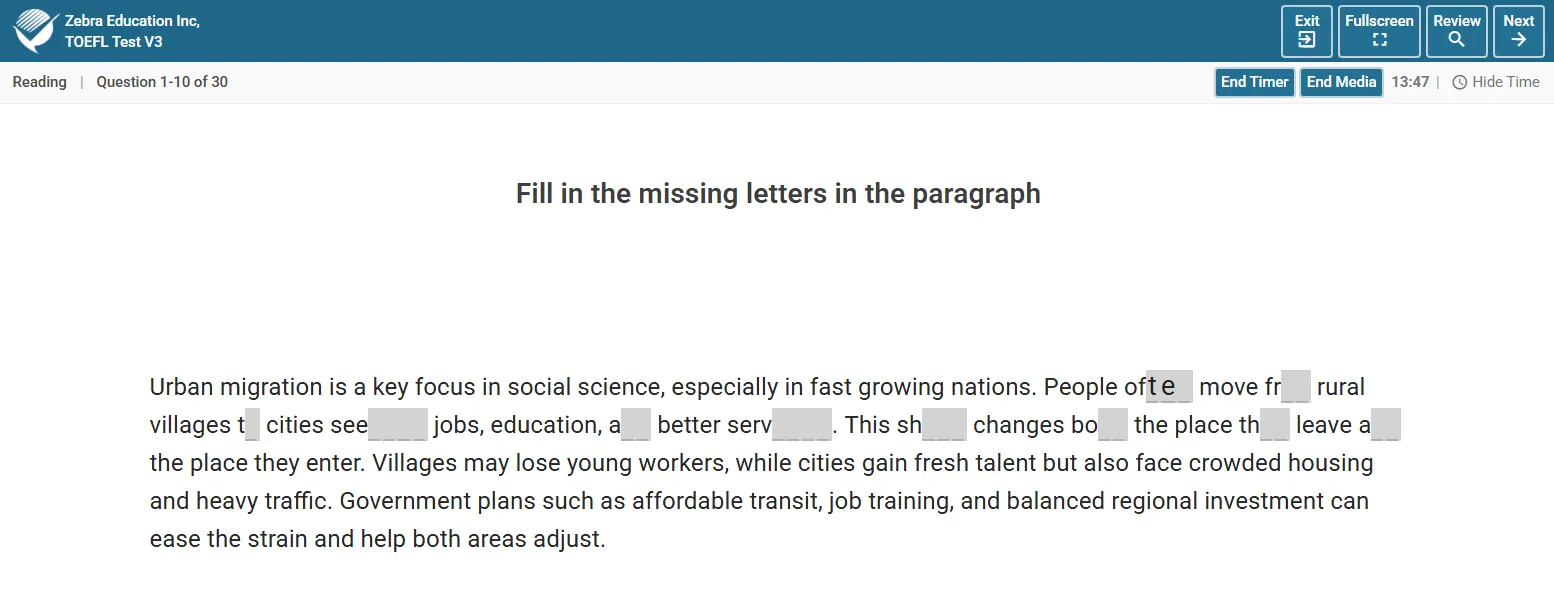
Untuk melihat semua soal latihan TOEFL Reading kami, buka menu TOEFL Practice di TOEFL Tutor App kami. Membaca adalah keterampilan. Keterampilan ini meningkat dengan latihan yang menargetkan jenis soal yang menjadi kelemahan Anda, dan pemahaman bacaan Anda meningkat dengan setiap bacaan yang Anda tinjau.
Bagian Reading memiliki 50 soal dalam tiga jenis tugas:
- Complete the Words: 10 bagian kosong per teks
- Read in Daily Life: biasanya 2 soal per teks
- Read an Academic Passage: biasanya 5 soal per bacaan
Pelajaran TOEFL Reading Gratis
Buat akun gratis untuk membuka pelajaran TOEFL Reading berikut dan mulai membangun keterampilan membaca Anda:
- Pengantar TOEFL Reading
- Strategi Sukses TOEFL Reading
- Soal Complete the Words
- Soal Detail
- Soal Gist Purpose
- Soal Rhetorical Purpose
- Soal Inference
- Soal Negative Factual Information
- Soal Vocabulary
- Soal Organization
- Soal Select in Passage
- Soal Sentence Insertion
Sumber Latihan TOEFL Reading Gratis
Semua yang ada di bawah ini adalah latihan TOEFL Reading gratis yang dibuat untuk tiga jenis tugas dalam tes saat ini. Setiap soal latihan lengkap menilai jawaban Anda dan menampilkan penjelasannya.
- Soal Latihan Lengkap Complete the Words: satu teks akademik dengan sepuluh bagian kosong, dinilai saat Anda mengetik.
- Soal Latihan Lengkap Read in Daily Life: sebuah email dengan soal dan penjelasan.
- Soal Latihan Lengkap Read an Academic Passage: sebuah bacaan dengan lima soal dan penjelasan untuk setiap soal.
- Sample Test 1: simulasi lengkap TOEFL adaptif secara gratis, dengan bagian Reading dan skor band.
- Jenis soal TOEFL Reading: panduan tentang sepuluh jenis soal dengan contoh untuk masing-masing.
- TOEFL Complete the Words: tugasnya, contoh teks, delapan jenis kata yang hilang, dan waktu yang perlu Anda habiskan.
- PDF latihan TOEFL Reading: 13 teks dan 64 soal dengan kunci jawaban, gratis dengan akun gratis.
Angka di halaman ini berasal dari data performa siswa TOEFL BestMyTest, yaitu catatan latihan TOEFL di BestMyTest sampai 10/2026. Cara setiap angka diukur dijelaskan di halaman tersebut. Terakhir diperbarui: 15/10/2026.