
BestMyLingo GMAT TOEIC IELTS TOEFL
How to get a high IELTS reading score

IELTSリーディングテストガイド:IELTSジェネラルリーディングおよびIELTSアカデミックリーディング向け無料IELTSリーディング模擬試験

本ガイドでは、無料のIELTSリーディングテストを受験してIELTSリーディング対策を始めることができます。なお、本テストにはIELTSジェネラルリーディングとIELTSアカデミックリーディングの2種類があります。当サイトのIELTSリーディング教材を使い、ご自身に合った試験の選び方や、各設問形式への対処法を学べます。

下のリンクをクリックすると、無料のIELTSリーディング模擬テストを受けることができ、専門的なスコア分析とパーソナライズされた学習プランを受け取れます。

IELTS Generalリーディングテスト IELTS Academicリーディングテスト

play_circle_outline テストをスタート

play_circle_outline テストをスタート


IELTSリーディング模擬試験ガイド

このガイドの残りの部分では、ジェネラルトレーニングとアカデミックの両方のIELTSリーディングテストについて、すべてをお伝えします。リーディングスコアの計算方法、各リーディング問題タイプにうまく答える方法、IELTSのテキスト教材でリーディング力を向上させる方法、そしてIELTSリーディング練習を成功させるための3つの戦略を習得していただきます。

目次

IELTSリーディングテストの情報

IELTSリーディングテストは3つのセクションで構成され、合計40問あります。一般的に、 各セクションで12〜14問に回答することになり、リーディング試験全体を完了するために正確に60分が与えられます。各セクションには、受験するテストに応じて1〜3つのパッセージが含まれます。 受験するテストがすでに分かっている場合は、次のいくつかのセクションを飛ばしていただいて構いません。まだ分からない場合は、各テストとその準備方法について 学ぶことが重要です。

どちらのIELTSリーディングテストを受験すべきですか?

IELTSリーディングテストには2つのバージョンがあります。IELTSジェネラルリーディングとIELTSアカデミックリーディングです。移住や高校への入学を目的とする場合は、ジェネラルリーディングを受験します。高等教育を目的とする場合は、アカデミックリーディングを 受験します。ジェネラルリーディングとアカデミックリーディングの最大の違いは、IELTSリーディングパッセージの難易度です。名前が示すとおり、アカデミックテストは学術的な資料からのIELTSリーディング教材を使用し、ジェネラルテストは日常生活の教材を使用します。

どちらのテストも3セクション、40問、11種類の問題タイプで構成されています。両方のテストの各セクションの詳細については、以下の表でご確認いただけます。

セクション IELTSアカデミックリーディングテスト IELTSジェネラルリーディングテスト
1 記述的・事実的なものから、論述的・分析的なものまでを範囲とする1つの長い学術的テキスト。テキストは 書籍、学術誌、雑誌、新聞から取られます。

12〜14問
2〜3つの短い事実的なテキスト。 トピックは英語圏の国における日常生活に関連したものです。

12〜14問
2 記述的・事実的なものから、論述的・分析的なものまでを範囲とする1つの長い学術的テキスト。テキストは 書籍、学術誌、雑誌、新聞から取られます。

10〜14問
仕事関連の話題(例:求人応募、会社の方針、給与・労働条件)に焦点を当てた2つの短い事実的なテキスト。

12〜14問
3 記述的・事実的なものから、論述的・分析的なものまでを範囲とする1つの長い学術的テキスト。テキストは 書籍、学術誌、雑誌、新聞から取られます。

12〜14問
一般的な関心のあるトピックに関する、より長く複雑なテキスト1つ。 テキストは本物で、お知らせ、広告、会社のハンドブック、書籍、雑誌、新聞から取られます。

12〜14問

IELTSリーディングテストの構成、およびIELTSジェネラルリーディングとIELTSアカデミックリーディングの両方についてご理解いただいたところで、ペーパー版テストとコンピューター版テストのどちらを受験するのがよいかを学んでいきましょう。

IELTSペーパー版テスト(PBT)とIELTSコンピューター版テスト(CBT)の比較

PBTでは、問題冊子と解答用紙が配られます。 問題冊子には、回答すべきすべての問題が記載されています。 解答用紙は、採点用の最終的な解答を記入する場所です。 公式IELTS解答用紙PDFはこちらでご覧いただけます。

注意:IELTSリスニングテストとは異なり、 解答を冊子から解答用紙に書き写すための追加時間は与えられませんので、各IELTSリーディング問題の解答を解いたときにすぐに解答用紙に 記入するようにしてください。

CBTでは、コンピューター上で問題に解答します。左側にパッセージ、右側に問題が表示されます。 また、テキストをハイライトしたり、制御機能を使って解答をコピー&ペーストしたりすることもできます。 PBTとCBTの詳細については、 IELTSコンピューター版テストガイドをご覧ください。

当社の無料IELTSリーディング模擬試験では、いつでもお好きなときにどちらのバージョンも練習できます。すべてのIELTSリーディング教材へのリンクは、ページの上部にあります。

IELTSリーディングのサンプル問題

無料のIELTS Academic Reading練習が2つあります。まず自分で解いてから、解答を開いて確かめましょう。IELTSリーディングの問題タイプのガイドでは、各タイプの説明と、さらに多くのサンプル問題を紹介しています。

IELTS Academic Reading Practice 1
Questions 1-9
Choose TRUE if the statement agrees with the information, choose FALSE if the statement contradicts the information, or choose NOT GIVEN if there is no information on this.

  • 1. An understanding of Britain’s pre-glacial flora’s development has been deduced from studies of pollen and seed deposits in peat.
  • 2. Various species of wildwood types began growing in Britain in around the year 8500 BC.
  • 3. Beech and lime did not spread beyond southern Britain.
  • 4. The extinction of large herbivores in Europe adds to speculation that Vera’s theory might not be as applicable to Britain.
  • 5. The persistence of oak in Britain supports Francis Vera’s theory.
  • 6. The sharp decline in elm around 4000 BC is more likely to be the result of clearance than elm disease.
  • 7. The first evidence of clearance of land for agriculture appears at the end of the Bronze Age.
  • 8. The practice of coppicing is traceable back to the Neolithic period.
  • 9. The Black Death negatively impacted growth of forests of Europe.

The answer is FALSE. The statement says, "An understanding of Britain’s pre-glacial flora’s development has been deduced from studies of pollen and seed deposits in peat." However, the passage specifically states, "Information regarding the development of Britain’s flora following glaciation can be found by studying the deposits of pollen and seed in peat, as well as by the use of radiocarbon dating." (Paragraph 2) This means the studies pertain to post-glacial (after glaciation) development, not pre-glacial. Therefore, the statement contradicts the information given in the text.

Associated Text:
Information regarding the development of Britain’s flora following glaciation can be found by studying the deposits of pollen and seed in peat, as well as by the use of radiocarbon dating.

The answer is FALSE. The statement says various species of wildwood types began growing in Britain in around the year 8500 BC, but the passage says, "From the moment lime arrived, in about 7300, to about 4500 BC the climate remained stable for a length of time known as the Atlantic Period, a time in which numerous species grew to form a series of wildwood or wilderness types." (Paragraph 2) This means wildwood types began growing starting from about 7300, not 8500 BC. Therefore, the statement is incorrect based on the information in the passage.

Associated Text:
From the moment lime arrived, in about 7300, to about 4500 BC the climate remained stable for a length of time known as the Atlantic Period, a time in which numerous species grew to form a series of wildwood or wilderness types.

The answer is NOT GIVEN. The statement says beech and lime did not spread beyond southern Britain. While the passage mentions that various trees, including oak, alder, lime, elm, beech, and maple, "all spread northwards one after the other," it does not clarify specifically whether beech and lime spread beyond southern Britain. There is not enough explicit information in the text to confirm or deny the statement. (Paragraph 2)

Associated Text:
Oak and alder came after pine, then lime, elm, beech, and maple, all spreading northwards one after the other.

The answer is FALSE. The statement suggests that the extinction of large herbivores in Europe casts doubt on Vera’s theory’s applicability to Britain. However, the passage clearly states, "since the last glaciation, the bison, elk and other large herbivores which persisted on mainland Europe were extinct in Britain, so Vera’s theory may not apply so well to Britain." (Paragraph 3) This shows it is the extinction of large herbivores in Britain, not Europe, that causes speculation about Vera’s theory. Therefore, the statement contradicts the information given.

Associated Text:
since the last glaciation, the bison, elk and other large herbivores which persisted on mainland Europe were extinct in Britain, so Vera’s theory may not apply so well to Britain.

The answer is TRUE. The passage asserts, "the sustained growth of oak in Britain demonstrates that the wildwood was not as continual as once believed. Oak is a pioneer species, which requires vacant space to generate more of itself. Grazing animals are also present to keep areas open, so Oak regenerates in the thorny brush as a protective measure from their grazing." (Paragraph 4) This supports Vera's theory that wilderness was not dense, as oak needs open space, aligning with his idea of park-like, open areas maintained by animals.

Associated Text:
the sustained growth of oak in Britain demonstrates that the wildwood was not as continual as once believed. Oak is a pioneer species, which requires vacant space to generate more of itself. Grazing animals are also present to keep areas open, so Oak regenerates in the thorny brush as a protective measure from their grazing.

The answer is FALSE. The statement claims the sharp decline in elm around 4000 BC is more likely to be the result of clearance than elm disease. However, the passage clearly says, "the falling elm population around 4,000 BC all across Europe has been attributed not to the clearing of trees, but to what’s referred to as Elm disease." (Paragraph 5) This directly contradicts the statement.

Associated Text:
the falling elm population around 4,000 BC all across Europe has been attributed not to the clearing of trees, but to what’s referred to as Elm disease.

The answer is FALSE. The statement suggests that the first evidence of clearance of land for agriculture appears at the end of the Bronze Age. In fact, the passage states, "As the Mesolithic (10,000-3000 BC) era ended, evidence of the beginnings of agriculture emerges." (Paragraph 5) The Mesolithic period precedes both the Bronze and Iron Ages. Therefore, the statement is incorrect based on passage details.

Associated Text:
As the Mesolithic (10,000-3000 BC) era ended, evidence of the beginnings of agriculture emerges.

The answer is TRUE. The passage mentions, "Neolithic man had discovered this practice, known as coppicing." (Paragraph 6) This indicates that the practice of coppicing traces back to the Neolithic period.

Associated Text:
Neolithic man had discovered this practice, known as coppicing.

The answer is FALSE. The statement says the Black Death negatively impacted the growth of forests. However, the passage says, "This stopped suddenly with the plague of the Black Death of 1349 wiping out some of the human population. Woods which had persisted up to 1350 mostly prospered over the next 500 years." (Paragraph 8) Thus, the Black Death actually allowed woodlands to prosper due to reduced population pressure, contradicting the statement.

Associated Text:
This stopped suddenly with the plague of the Black Death of 1349 wiping out some of the human population. Woods which had persisted up to 1350 mostly prospered over the next 500 years.

Questions 19-23
Look at the following Items (Questions 19-23) and A list of periods of time below.

Match each item with the period of time it best corresponds with

NB You may use any letter more than once.

A list of periods of time
  1. The Palaeolithic era
  2. The Bronze age
  3. The Iron age
  4. The Medieval era
  5. The Mesolithic age
  6. Roman times

  • 19. Every type of wood in England belonged to some person or some community.
  • 20. People used woodworking to create elaborate boats, houses, and wheels.
  • 21. Animals kept expansive areas of land clear without human interference.
  • 22. Coppicing was first used for woodland management.
  • 23. Houses were made with short pieces of wood, and longer pieces were used for religious buildings.
  • A. The Palaeolithic era
  • B. The Bronze age
  • C. The Iron age
  • D. The Medieval era
  • E. The Mesolithic age
  • F. Roman times
Having trouble with drag & drop?   Fix Drag & Drop
19. Every type of wood in England belonged to some person or some community.
20. People used woodworking to create elaborate boats, houses, and wheels.
21. Animals kept expansive areas of land clear without human interference.
22. Coppicing was first used for woodland management.
23. Houses were made with short pieces of wood, and longer pieces were used for religious buildings.

Bring back Drag & Drop anytime!   Reload Drag & Drop

The answer is F. The passage states, "As evidenced by The Domesday Book (1086), all the wood in England had an economic value and was the property of either an individual or community owner." (Paragraph 9) This event is linked directly with the time of the Domesday Book, which was created just after the Norman Conquest in Roman times. The matching list references Roman times as option (F), making this the correct answer.

Associated Text:
As evidenced by The Domesday Book (1086), all the wood in England had an economic value and was the property of either an individual or community owner.

The answer is C. The statement reads, "The Celtic peoples living in the Iron Age were able to master woodworking as an artform. Today, Celtic woodworking can be seen in houses, boats, wheels and other artifacts of the time." (Paragraph 10) This places the production of elaborate wooden boats, houses, and wheels in the Iron Age.

Associated Text:
The Celtic peoples living in the Iron Age were able to master woodworking as an artform. Today, Celtic woodworking can be seen in houses, boats, wheels and other artifacts of the time.

The answer is A. The passage in Paragraph 3 explains Vera’s theory about the Palaeolithic era: “creatures of the Palaeolithic era needed to roam large areas of grassland to survive.” This indicates that large animals kept open areas clear before humans started interfering, matching the Palaeolithic era (option A).

Associated Text:
creatures of the Palaeolithic era needed to roam large areas of grassland to survive.

The answer is B. The passage states, "Much of the remaining woods were maintained by way of this method during the Bronze Age." (Paragraph 7) Although discovered earlier, coppicing first saw widespread use for woodland management in the Bronze Age, making option B correct.

Associated Text:
Much of the remaining woods were maintained by way of this method during the Bronze Age.

The answer is D. According to the passage in Paragraph 11, "The average wood-framed houses of the Medieval era mostly used oaks shorter than 18” in diameter. Longer pieces of timber were hard to come by, and kept only for elaborate buildings intended for the Church." This places the practice in the Medieval era (option D).

Associated Text:
The average wood-framed houses of the Medieval era mostly used oaks shorter than 18” in diameter. Longer pieces of timber were hard to come by, and kept only for elaborate buildings intended for the Church.


  • spellcheck Answers
    1. FALSE
    2. FALSE
    3. NOT GIVEN
    4. FALSE
    5. TRUE
    6. FALSE
    7. FALSE
    8. TRUE
    9. FALSE
    10. F
    11. C
    12. A
    13. B
    14. D
Reading Passage

The climate in Britain has been arctic for the last several million years, punctuated by relatively warm timespans, or interglacials of thousands of years, one of which we are in as of now. Since the last glaciation, British woodland history is considered quite short in terms of geological time spans, and is also closely related to the human civilization developing.

At the peak of the last glaciation (100,000 – 12,000 BC), the majority of Britain would have had no trees. Birch and willow scrub may have grown along the lower reaches of the ice, with pine in some areas. It’s possible that remnants of pre-glacial flora were sheltered along the western bays of Great Britain and Ireland’s coasts, but as far as the southern parts of England, the ice kept any land barren. Information regarding the development of Britain’s flora following glaciation can be found by studying the deposits of pollen and seed in peat, as well as by the use of radiocarbon dating. Tundra and moorland followed the retreating ice, which lead to phases of different tree species spreading from the south. First came birch, aspen and sallow, followed by pine and hazel continuing to spread north as of 8500 BC, replacing birch to make it less commonly found for the next few thousand years. Oak and alder came after pine, then lime, elm, beech, and maple, all spreading northwards one after the other.  From the moment lime arrived, in about 7300, to about 4500 BC the climate remained stable for a length of time known as the Atlantic Period, a time in which numerous species grew to form a series of wildwood or wilderness types.

What did the wilderness or wildwood look like, before man started interfering with it? One theory holds that Britain and Western Europe in Palaeolithic times was covered from coast to coast in a wildwood of continuous trees. However, a modern theory proposed by Francis Vera holds that Western Europe wilderness was a combination of grassland, scrub, and clusters or groves of trees. It was not a dense, impassable wildwood, but instead, an area similar to a park, kept up by wild herbivores eating the plants and grass. Throughout earlier interglacial periods, this may also have been the case in Britain, as creatures of the Palaeolithic era needed to roam large areas of grassland to survive. A variety of grassland plants continued to live there in the last interglacial, as according to pollen records. However,  since the last glaciation, the bison, elk and other large herbivores which persisted on mainland Europe were extinct in Britain, so Vera’s theory may not apply so well to Britain.

Meanwhile, throughout the period since it’s spread northwards after the last glaciation, the sustained growth of oak in Britain demonstrates that the wildwood was not as continual as once believed. Oak is a pioneer species, which requires vacant space to generate more of itself. Grazing animals are also present to keep areas open, so Oak regenerates in the thorny brush as a protective measure from their grazing. Archaeological evidence indicates that red deer, who graze on grass as well as browse from trees, were essential to the economy in Mesolithic Britain, with people utilizing them for meat, skins, antlers and bones.

As the Mesolithic (10,000-3000 BC) era ended, evidence of the beginnings of agriculture emerges. Agricultural weeds, such as plantain and stinging nettle, were also increasing in number. Nearly all the wildwood was cut down as the population increased rapidly. However, the falling elm population around 4,000 BC all across Europe has been attributed not to the clearing of trees, but to what’s referred to as Elm disease.

Throughout the Bronze Age (2400-750 BC), people were cutting down trees more than ever before, until the prevalence of the practice “coppicing” peaked, likely at some point during the early Iron Age.  Oliver Rackham (1990) theorizes that nearly 50% of land throughout England was no longer wildwood by 500 BC. The regrowth from a stump grows more readily than the original tree, and Neolithic man had discovered this practice, known as coppicing. Much of the remaining woods were maintained by way of this method during the Bronze Age.

The Celtic peoples living in the Iron Age were able to master woodworking as an artform. Today, Celtic woodworking can be seen in houses, boats, wheels and other artifacts of the time. Coppicing as a means to manage woodland was of massive importance throughout two millennia that followed. Buildings, roads, fences, carts, and the fuel for heating, cooking, metalworking and pottery were all made possible due to wood materials gained from the vital practice of coppicing.

A clear divide has existed between wooded and non-wooded regions of Britain since the time of the Romans. As evidenced by The Domesday Book (1086), all the wood in England had an economic value and was the property of either an individual or community owner. Woods were the territories, or ‘exclaves’ of communities who lived some miles away. Even though it had to be transported over long distances, the materials which woodlands produced were of obvious value, and their ownership was long before established. Merely around 15% of land in England was represented by woodland or wood- pasture in the year 1086.

English woodlands produced mostly underwood used as fuel along with other things, with small oaks being used to construct buildings. The average wood-framed houses of the Medieval era mostly used oaks shorter than 18” in diameter. Longer pieces of timber were hard to come by, and kept only for elaborate buildings intended for the Church. Imported boards of thin oak or wainscot from Central Europe were brought in for the purpose of domestic building. Woodland cover was as low as 15% in 1086, and continued to decline from as a result of an ever- growing population to 10% by 1350. This stopped suddenly with the plague of the Black Death of 1349 wiping out some of the human population. Woods which had persisted up to 1350 mostly prospered over the next 500 years.

(From the moment lime arrived, in about 7300, to about 4500 BC the climate remained stable for a length of time known as the Atlantic Period, a time in which numerous species grew to form a series of wildwood or wilderness types) => So we tell that various species of wildwood types began growing in around 7300 to 4500 BC, therefore, the answer is FALSE.
The key phrase here is "beyond southern Britain". The trees spread northward, so it's possible they spread beyond southern Britain, but northward doesn't provide enough information to say with certainty that it did grow past southern Britain. Therefore, the answer is NOT GIVEN.
FALSE

The statement "An understanding of Britain’s pre-glacial flora’s development has been deduced from studies of pollen and seed deposits in peat" is FALSE. The text provides information about the development of Britain's flora following the last glaciation, not pre-glacial flora. It states, "Information regarding the development of Britain’s flora following glaciation can be found by studying the deposits of pollen and seed in peat, as well as by the use of radiocarbon dating." This indicates that the studies of pollen and seed deposits in peat are used to understand the post-glacial development of Britain's flora, not the pre-glacial period.

The other options are incorrect for the following reasons:

TRUE is incorrect because the text does not mention studies of pollen and seed deposits in peat being used to deduce the development of pre-glacial flora. It specifically refers to the period following the last glaciation.

NOT GIVEN is incorrect because the text does provide information about the period being studied with pollen and seed deposits in peat, which is the post-glacial period, not the pre-glacial period. Therefore, the statement is directly contradicted by the information given, making FALSE the correct answer.
Statement: The extinction of large herbivores in Europe adds to speculation that Vera’s theory might not be as applicable to Britain.

Answer: FALSE

Explanation:

The passage states:
"However, since the last glaciation, the bison, elk and other large herbivores which persisted on mainland Europe were extinct in Britain, so Vera’s theory may not apply so well to Britain."

This clearly indicates that the extinction of large herbivores in Britain, not Europe, adds to speculation that Vera’s theory might not be as applicable. The statement given incorrectly states "Europe" instead of "Britain." Therefore, the statement contradicts the information in the passage.

Why the other answers are incorrect:

- TRUE: This answer would be incorrect because the passage specifically mentions that the extinction of large herbivores in Britain, not Europe, is what adds to the speculation about Vera’s theory’s applicability.

- NOT GIVEN: This answer is incorrect because the passage directly addresses the impact of the extinction of large herbivores on Vera's theory's applicability to Britain. Therefore, there is clear information provided on this matter.

In summary, the correct answer is FALSE because the extinction of large herbivores in Britain, not Europe, leads to doubts about Vera's theory's relevance to Britain.
The correct answer is B. The Bronze Age.

The passage states:

“Throughout the Bronze Age (2400–750 BC), people were cutting down trees more than ever before, until the prevalence of the practice ‘coppicing’ peaked, likely at some point during the early Iron Age.”
“Neolithic man had discovered this practice, known as coppicing. Much of the remaining woods were maintained by way of this method during the Bronze Age.”

This shows that although coppicing was discovered earlier (in the Neolithic), its first use for woodland management took place during the Bronze Age, when it was widely practiced to maintain woods.

Thus, the correct choice is B. The Bronze Age.

IELTS Academic Reading Practice 3
Questions 1-8
Look at the following Descriptions (Questions 1-8) and List of psychologists below.

Match each description with the correct psychologist

NB You may use any letter more than once.

List of psychologists
  1. Clark Hull
  2. Howard and Tracy Kendler
  3. Michael Cole and colleagues
  4. Simon Hewson

  • 1. is cited as having demonstrated that earlier experiments into children's ability to reason deductively may have led to the wrong conclusions.
  • 2. experimented with things that the subjects might have been expected to encounter in everyday life, rather than with a machine.
  • 3. appears to have proved that a change in the apparatus dramatically improves the performance of children of certain ages.
  • 4. is cited as famous in the field of psychology.
  • 5. demonstrated that the two-stage experiment involving button-pressing and inserting a marble into a hole poses problems for certain adults as well as children.
  • 6. trained children separately in the two stages of their experiments with the use of marbles.
  • 7. devised an experiment that investigated deductive reasoning without the use of any marbles.
  • 8. used a machine to measure inductive reasoning that replaced button-pressing with drawer-opening.
  • A. Clark Hull
  • B. Howard and Tracy Kendler
  • C. Michael Cole and colleagues
  • D. Simon Hewson
Having trouble with drag & drop?   Fix Drag & Drop
1. is cited as having demonstrated that earlier experiments into children's ability to reason deductively may have led to the wrong conclusions.
2. experimented with things that the subjects might have been expected to encounter in everyday life, rather than with a machine.
3. appears to have proved that a change in the apparatus dramatically improves the performance of children of certain ages.
4. is cited as famous in the field of psychology.
5. demonstrated that the two-stage experiment involving button-pressing and inserting a marble into a hole poses problems for certain adults as well as children.
6. trained children separately in the two stages of their experiments with the use of marbles.
7. devised an experiment that investigated deductive reasoning without the use of any marbles.
8. used a machine to measure inductive reasoning that replaced button-pressing with drawer-opening.

Bring back Drag & Drop anytime!   Reload Drag & Drop

The answer is D. Simon Hewson is cited as having demonstrated that earlier experiments into children's ability to reason deductively may have led to the wrong conclusions. In the final paragraph, the passage says, "Hewson's experiments showed that children faced with the Kendler apparatus experienced difficulty not related to reasoning, but to the nature of the tasks themselves, and that difficulty cannot be taken as proof that they are incapable of deductive reasoning." This demonstrates that Hewson showed previous experiments may have falsely concluded that children could not reason deductively due to flaws in the task, not in their reasoning abilities.

Associated Text:
Hewson's experiments showed that children faced with the Kendler apparatus experienced difficulty not related to reasoning, but to the nature of the tasks themselves, and that difficulty cannot be taken as proof that they are incapable of deductive reasoning.

The answer is C. Michael Cole and colleagues experimented with things the subjects might have been expected to encounter in everyday life, rather than with a machine. This is found in the paragraph describing Cole’s test: "Cole substituted a locked box for the machine with the buttons, and then used two matchboxes of different colors. ... Instead of subjects being presented with a strange machine, they are given familiar objects in a simpler context." This shows that Cole used familiar, everyday objects in his experiment.

Associated Text:
Instead of subjects being presented with a strange machine, they are given familiar objects in a simpler context.

The answer is D. Simon Hewson appears to have proved that a change in the apparatus dramatically improves the performance of children of certain ages. The last paragraph says, "Hewson's two modifications to the experiment led to a rise in success rates from 30 percent to 90 percent for five-year old children and from 35 percent to 72.5 per cent for four-year-olds." This demonstrates that changes made by Hewson dramatically improved performance for certain ages.

Associated Text:
Hewson's two modifications to the experiment led to a rise in success rates from 30 percent to 90 percent for five-year old children and from 35 percent to 72.5 per cent for four-year-olds.

The answer is A. Clark Hull is cited as famous in the field of psychology. In the first paragraph, it states: “Clark Hull, an acclaimed American psychologist, theorized that it was, describing that reasoning is achieved by the way two ‘behavior segments’ are combined in new ways to achieve goals.” The keyword 'acclaimed' indicates fame.

Associated Text:
Clark Hull, an acclaimed American psychologist

The answer is C. Michael Cole and his colleagues demonstrated that the two-stage experiment involving button-pressing and inserting a marble into a hole poses problems for certain adults as well as children. The third paragraph states, "According to the work of psychologist and professor Michael Cole and his associates, some adults from specific African tribes are also unable to successfully complete the Kendlers' two-step test of deductive reasoning." This proves both some adults and children had problems with the experiment.

Associated Text:
According to the work of psychologist and professor Michael Cole and his associates, some adults from specific African tribes are also unable to successfully complete the Kendlers' two-step test of deductive reasoning.

The answer is B. Howard and Tracy Kendler trained children separately in the two stages of their experiments with the use of marbles. The first paragraph describes the Kendler process: "The children learned each of the two steps individually, with the first being to correctly choose and press one of two buttons, and the second to place a marble into a small opening." This shows the children were trained in each stage with marbles involved in the second stage.

Associated Text:
The children learned each of the two steps individually, with the first being to correctly choose and press one of two buttons, and the second to place a marble into a small opening.

The answer is C. Michael Cole and colleagues devised an experiment that investigated deductive reasoning without the use of any marbles. The relevant paragraph says, "In this test, Cole substituted a locked box for the machine with the buttons, and then used two matchboxes of different colors. One of the matchboxes held a key for the locked box." There is no mention of marbles in Cole’s test.

Associated Text:
Cole substituted a locked box for the machine with the buttons, and then used two matchboxes of different colors. One of the matchboxes held a key for the locked box.

The answer is D. Simon Hewson used a machine to measure inductive reasoning that replaced button-pressing with drawer-opening. The sixth paragraph states, "Hewson made two essential changes to the test in order to build on this idea. First, he replaced the button-pressing mechanism with drawers that a child could slide open and shut." This directly indicates Hewson made this specific modification.

Associated Text:
First, he replaced the button-pressing mechanism with drawers that a child could slide open and shut.

Questions 17-20
Choose TRUE if the statement agrees with the information, choose FALSE if the statement contradicts the information, or choose NOT GIVEN if there is no information on this.

  • 17. Howard and Tracy Kendler devised a two-stage experiment involving button-pressing.
  • 18. Michael Cole and his colleagues demonstrated that children performance on deductive reasoning tasks depends on features of the apparatus and procedure.
  • 19. All Hewson's experiments used marbles of the same size.
  • 20. Hewson's modifications resulted in a higher success rate for children of all ages.

The answer is TRUE. Howard and Tracy Kendler did indeed devise a two-stage experiment involving button-pressing, as described in the first paragraph: "In this test, children needed to learn how to use a machine in a two-step process. The children learned each of the two steps individually, with the first being to correctly choose and press one of two buttons, and the second to place a marble into a small opening." This confirms that their experiment involved button-pressing as the first stage.

Associated Text:
In this test, children needed to learn how to use a machine in a two-step process. The children learned each of the two steps individually, with the first being to correctly choose and press one of two buttons, and the second to place a marble into a small opening.

The answer is FALSE. Michael Cole and his colleagues did not demonstrate that children's performance on deductive reasoning tasks depends on features of the apparatus and procedure. This finding is actually attributed to Simon Hewson. The passage states, "Hewson made two essential changes to the test in order to build on this idea.... Hewson's two modifications to the experiment led to a rise in success rates... Hewson's experiments showed that children faced with the Kendler apparatus experienced difficulty not related to reasoning, but to the nature of the tasks themselves."

Associated Text:
Hewson made two essential changes to the test in order to build on this idea. First, he replaced the button-pressing mechanism with drawers that a child could slide open and shut. ... Hewson's two modifications to the experiment led to a rise in success rates... Hewson's experiments showed that children faced with the Kendler apparatus experienced difficulty not related to reasoning, but to the nature of the tasks themselves, and that difficulty cannot be taken as proof that they are incapable of deductive reasoning.

The answer is TRUE. The passage implies that all of Hewson's experiments used marbles of the same size. In the sixth paragraph, the passage says that Hewson demonstrated the functional equivalence of different marbles (but all marbles were identical in size): "It would then be safe to say that the child will not assume that different marbles of identical size could be used the same way... Hewson clearly demonstrated the functional equivalence of different marbles to the children by playing a 'swapping game.'"

Associated Text:
It would then be safe to say that the child will not assume that different marbles of identical size could be used the same way. But, to solve the problem, this assumption must be made. Hewson clearly demonstrated the functional equivalence of different marbles to the children by playing a 'swapping game.'

The answer is FALSE. Hewson's modifications did not result in a higher success rate for children of all ages. The passage clearly says: "Strangely enough for three-year olds, Hewson’s changes did not lead to any improvement, and instead there was a slight drop in performance from the change." This specific information shows that the modifications failed to improve and even slightly decreased performance for three-year-olds.

Associated Text:
Strangely enough for three-year olds, Hewson’s changes did not lead to any improvement, and instead there was a slight drop in performance from the change.


  • spellcheck Answers
    1. D
    2. C
    3. D
    4. A
    5. C
    6. B
    7. C
    8. D
    9. TRUE
    10. FALSE
    11. TRUE
    12. FALSE
Reading Passage

Could it be that the very essence of reasoning itself is found in the way we behave? Clark Hull, an acclaimed American psychologist, theorized that it was, describing that reasoning is achieved by the way two “behavior segments” are combined in new ways to achieve goals. Howard and Tracey Kendler, who were two of Hull’s followers, used Hull’s principle ideas to design a reasoning test for children. In this test, children needed to learn how to use a machine in a two-step process. The children learned each of the two steps individually, with the first being to correctly choose and press one of two buttons, and the second to place a marble into a small opening. If both steps were completed successfully, a toy would be released as rewards to the children.

From this test, the Kendlers learned that although the children were able to learn each step, they were not able to “integrate” the two tasks without intervention. In other words, the children could not successfully perform the first step, pushing the button, and then proceed to the second step, inserting the marble into the hole, by themselves. This failure to  independently integrate the steps led the Kendlers to believe that children of this age were not able to use deductive reasoning.

According the the work of psychologist and professor Michael Cole and his associates, some adults from specific African tribes are also unable to successfully complete the Kendlers' two-step test of deductive reasoning. However, this finding remains questionable in light of the findings of a similar test to the Kenders’, which revealed that the African tribes people were, in fact, able to complete the test.

In this test, Cole substituted a locked box for the machine with the buttons, and then used two matchboxes of different colors. One of the matchboxes held a key for the locked box. Just like with the Kendlers’ test, Cole’s test also involved two behavior segments, these being to first open the right match-box to get the key, and second to use the key to open the box. However, Cole’s test differs quite a bit psychologically. Instead of subjects being presented with a strange machine, they are given familiar objects in a simpler context. Cole found the difficulty of 'integration' was greatly reduced here.

It seems that the same truth which Cole discovered can be extended to explain the deductive reasoning skills of young children. Psychologist Simon Hewson believes that perhaps the task’s difficulty is not in inferential processes themselves, but is instead tied to confusing features of the test apparatus, such as the button machine, as well as the context of the procedure being tested. When these factors are adjusted in order to prevent the inferential nature of the problem being affected, five-year-old children are able to successfully complete these tests as well as college students did in the Kendlers' test.

Hewson made two essential changes to the test in order to build on this idea. First, he replaced the button-pressing mechanism with drawers that a child could slide open and shut. This removed confusion on what to do with the original button apparatus from the first stage of training. Secondly, Hewson made sure that children understood that there was nothing special or magical about the marble which was used to successfully complete the second step of the task and get the reward.

This is important because a child cannot easily comprehend a mechanism in which a marble put into a hole can open a little door. It would then be safe to say that the child will not assume that different marbles of identical size could be used the same way. But, to solve the problem, this assumption must be made. Hewson clearly demonstrated the functional equivalence of different marbles to the children by playing a 'swapping game.” Hewson's two modifications to the experiment led to a rise in success rates from 30 percent to 90 percent for five-year old children and from 35 percent to 72.5 per cent for four-year-olds. Strangely enough for three-year olds, Hewson’s changes did not lead to any improvement, and instead there was a slight drop in performance from the change. Hewson's experiments showed that children faced with the Kendler apparatus experienced difficulty not related to reasoning, but to the nature of the tasks themselves, and that difficulty cannot be taken as proof that they are incapable of deductive reasoning.

Statement Analysis:
Statement: "Michael Cole and his colleagues demonstrated that children's performance on deductive reasoning tasks depends on features of the apparatus and procedure."

Answer: FALSE

Explanation:
The passage attributes this finding specifically to *Simon Hewson* rather than Michael Cole. According to the passage, Hewson modified the Kendler apparatus to demonstrate that children can complete deductive reasoning tasks when confusing features of the apparatus and procedure are removed.

In contrast, Michael Cole’s work focused on adults from specific African tribes using a different test apparatus. Cole’s experiment involved a locked box, colored matchboxes, and a key. He found that adults from specific African tribes could successfully complete the two-step reasoning task using familiar objects.

Hewson's modifications involved replacing the button mechanism with drawers and clearly demonstrating that different marbles could achieve the same outcome. These modifications led to a significant increase in children’s success rates, revealing that features of the apparatus and procedure were influencing their performance.

Alternative Answers Explanation:

TRUE: This answer is incorrect because the statement is falsely attributed to Michael Cole rather than Simon Hewson. Cole's experiments were conducted with adults from African tribes using different apparatuses.

NOT GIVEN: This answer is incorrect because the statement about features of the apparatus affecting performance is explicitly covered in the passage.

Key Passage Extract:
"Hewson made two essential changes to the test in order to build on this idea. First, he replaced the button-pressing mechanism with drawers that a child could slide open and shut. [...] Hewson's two modifications to the experiment led to a rise in success rates [...] Hewson's experiments showed that children faced with the Kendler apparatus experienced difficulty not related to reasoning, but to the nature of the tasks themselves."

IELTSジェネラルリーディングテスト

ジェネラルテストでは、IELTSリーディングパッセージは英語圏の環境で日常的に出会うであろう書籍、雑誌、新聞、お知らせ、広告、会社のハンドブック やガイドラインから取られています。 アカデミックリーディングテストと同様に3つのセクションがありますが、 IELTSジェネラルリーディングテストでは、各セクションが少しずつ異なります。

IELTSジェネラルリーディング紹介ビデオ
  1. セクション1:2〜3の短いテキスト、または複数のより短いテキストを含む

    このセクションはソーシャル・サバイバルと呼ばれ、英語での基本的な言語的サバイバルに関連するテキストが含まれます。 課題は主に一般的な事実情報を取得・提供することで、例えばお知らせ、広告、時刻表などです。
  2. セクション2:2つのテキストで構成

    このセクションはワークプレイス・サバイバルと呼ばれ、 職務記述書、契約書、社員研修・教育資料などの職場の文脈に焦点を当てています。
  3. セクション3:1つの長いテキスト

    このセクションはジェネラルリーディングと呼ばれ、より複雑な構造を持つ 長めの散文を読むことが含まれます。論述的というよりも 記述的・指示的な文章に焦点が当てられています。

圧倒されすぎていないことを願っています。リーディングテストは見た目ほど難しくはありません。 当社のIELTSリーディングのヒントに従い、無料のIELTSリーディング練習問題を活用していただければ、 どんなリーディングパッセージにも対応でき、目標のIELTSリーディングスコアを達成できるようになります。ところで、アカデミックリーディングテストは ジェネラルリーディングテストとは若干異なる方法で採点されます。次にリーディングのバンドスコアと、その計算方法 について説明します。

IELTSアカデミックリーディングテスト

アカデミックテストでは、IELTSリーディングパッセージは大学生にふさわしい学術的な情報源 からの書籍、学術誌、雑誌、新聞から取られています。各パッセージは 長く、6〜10段落程度になり、物語的または記述的なさまざまな文体で書かれていることがあり、 人類学、歴史、科学、生物学、芸術、教育、言語学などの幅広い学術的なトピックを扱っています。 パッセージには、専門用語や、図表やグラフなどの視覚的な資料が含まれることもあります。 これらのトピックなどを当社のIELTSリーディング模擬試験問題で練習することができます。

IELTSアカデミックリーディング紹介ビデオ

では、公式IELTSアカデミックリーディングテストで最も多く出題されるアカデミックなトピックは何でしょうか?

2022-2024年と2024-2026年では、最も多かったアカデミックリーディングのトピックは 歴史でした。次に生物学、その次に心理学と社会科学(文化、教育、言語学、社会学を含む)でした。

下のグラフは、2022-2024年と2024-2026年のアカデミックIELTSリーディングテストで出題されたさまざまな科目を示しています。
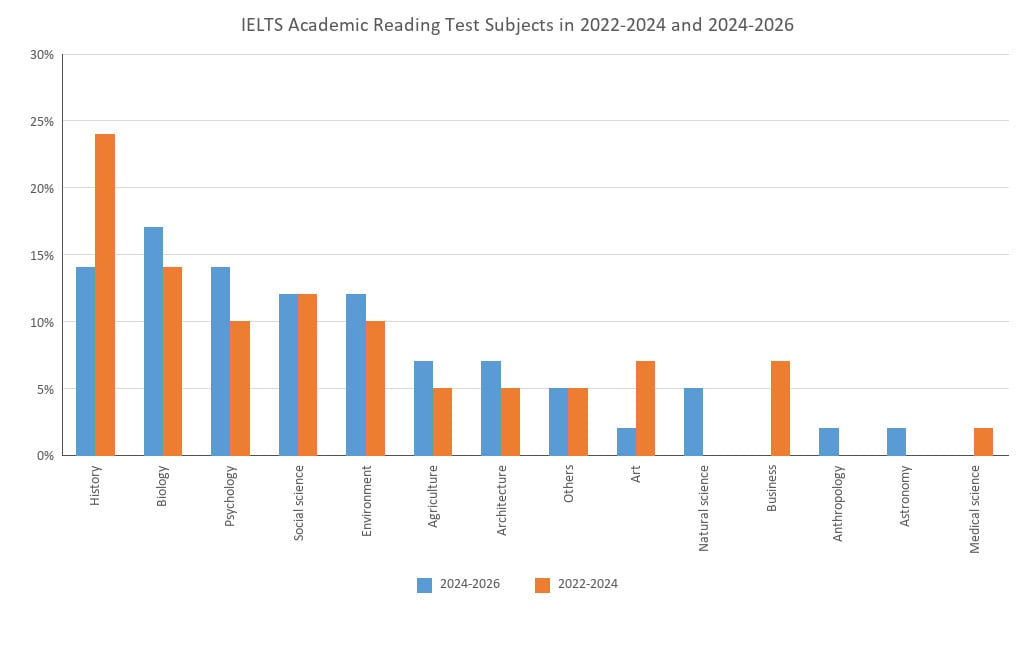
2022-2024年と2024-2026年のIELTSアカデミックリーディングテストの科目

これらの傾向を踏まえて、当社のIELTSリーディング模擬試験ではこれらのトピックをカバーするようにしました。 万が一に備えて、出題頻度の低いトピックからのリーディングサンプルも追加しています。どんなIELTSリーディングトピックが出題されるか分からないので、 あらゆる状況に備えておくことが 重要です。

IELTSリーディングスコアの計算方法

各IELTSリーディング問題は1点なので、最大40点の 「素点」を獲得できます。その後、素点はバンドスコアに換算されます。 以下の表で、各テストの素点がどのようにバンドスコアに換算されるかの概要をご確認いただけます。

IELTSジェネラルリーディングスコアとIELTSアカデミックリーディングスコアの比較
素点:アカデミック バンドスコア:アカデミック 素点:ジェネラル バンドスコア:ジェネラル
39-40 9 40 9
37-38 8.5 39 8.5
35-36 8 37-38 8
33-34 7.5 36 7.5
30-32 7 34-35 7
27-29 6.5 32-33 6.5
23-26 6 30-31 6
19-22 5.5 27-29 5.5
15-18 5 23-26 5
13-14 4.5 19-22 4.5
10-12 4 15-18 4
8-9 3.5 12-14 3.5
6-7 3 9-11 3
4-5 2.5 6-8 2.5
1-3 2 1-5 2

ただし、IELTSリーディングテストの各バージョンは若干異なり、 特定のバンドを達成するために必要な点数は、その日にテストを受けた全員のパフォーマンスに応じて変動することにご留意ください。したがって、 バンドスコアを取得するために必要な正答数はテストごとに若干異なりますが、 一般的にバンド7のスコアを目指す場合は、40問中およそ30問の正解を目標にするとよいでしょう。

もう1つお伝えしたいのは、最も難しい問題と最も簡単な問題は 最終的なリーディングスコアに等しく寄与するということです。難しい問題で行き詰まって、簡単な問題で取れるはずの得点を失わないように 気をつけてください。次に、各リーディング問題に答えるためのIELTSリーディングのヒントと戦略をいくつかご紹介します。

IELTSリーディングのヒント - 11種類のリーディング問題タイプの解き方

リーディングテストには11種類の問題タイプがあり、それぞれ異なる戦略が必要です。

各問題タイプのサンプルと解答はIELTSリーディングの問題タイプのガイドにあります。

傾向はIELTSリーディングテストの準備にどう役立つか

学習者が最も苦手とするリーディングの問題形式

BestMyTestの学習者は、当サイトの模擬試験でアカデミック・リーディングの問題に100万問、ジェネラル・トレーニング・リーディングの問題に600,000問解答しています。パーセンテージは、各問題形式の正答率を示しています。

問題形式アカデミックジェネラル・トレーニング
情報のマッチング(Matching information)34%72%
正しい / 誤り / 記載なし(True / False / Not Given)39%60%
選択問題(Multiple choice)43%48%
特徴のマッチング(Matching features)48%74%
文の穴埋め(Sentence completion)49%75%
見出しのマッチング(Matching headings)53%40%
はい / いいえ / 記載なし(Yes / No / Not Given)55%57%
要約の穴埋め(Summary completion)59%46%
短答問題(Short answer)54%75%
  • アカデミック・リーディングでは、最も苦手とされる2つの形式は情報のマッチングと正しい / 誤り / 記載なしで、どちらも正答率が40%未満です。どちらも、一致するキーワードではなく、言い換えられた内容を見つける必要があります。
  • ジェネラル・トレーニングでは、状況が逆転します。見出しのマッチングの正答率が40%と最も低い一方、情報を探す形式では、文章が短く、より直接的に書かれているため、4回に3回は正解しています。
  • アカデミックの読解問題の平均正答率は46%で、ジェネラル・トレーニングの読解問題では59%です。アカデミックの読解問題への解答の半数は、正答率が40%以下です。
  • 38,534人の学習者が受験したリーディング模擬試験の全問受験43,711回分の平均バンドスコアは5.4でした。36%がバンドスコア6.0に、14%がバンドスコア7.0に達しました。
  • すべての形式への対策は必要ですが、時間が限られている場合は、この表から、どこに時間をかけると最も効果的かがわかります。

数値は、2026年10月までのBestMyTestの模擬試験および添削データに基づいています。問題形式ごとのパーセンテージは、すべての解答における正答率です。評価基準ごとの数値は、表示のとおり、講師またはAIによるスコアです。最終更新日:2026年10月5日。

次に、リーディングで高得点を取るために必要なIELTSリーディングのヒントと戦略を確認していきます。

IELTSリーディングのヒント - リーディングバンドスコアを上げる方法

ほとんどの学生がリーディングセクションで失敗する理由は、以下の3つです

  1. 読むスピードが遅い
  2. 語彙が少ない
  3. 準備不足、または準備がない
読むスピードを上げる

まずは、明らかなことから片付けましょう。読むスピードを上げるためには、実際に読書を練習し、それを継続的に行う必要があります。

では、文の大きな塊の意味を理解するのに役立つ、もう少し見えにくい戦略を見てみましょう。文を分解することから始めてください。文の主語と動詞を探すことでこれを行います。 主語と動詞を見つけることで、文の意味を理解できるようになります。 アカデミックリーディングのパッセージが理解しにくい理由の1つは、長い複合文を形成するために一連のアイデアをつなげているからです。これにより、文の大きな塊が生まれ、それは吸収するのが難しくなります。ですから、主語と動詞を全体の塊を理解するためのガイドとして使うのは、IELTSリーディング試験の間に使える素晴らしいツールです。

語彙を増やす

多くの人は、リーディング問題に答えることはキーワードや情報を求めて段落をスキャンするのと同じくらい簡単だと考えています...しかし残念ながら、それほど単純ではありません。 リーディング問題は通常パラフレーズされており、つまり、IELTSリーディングパッセージの単語の同義語を使うように単語が変更されています。これは難易度を上げるために行われており、そうしなければテストは簡単すぎるからです。このため、ある単語の多くの異なる同義語を知るために、語彙を増やす必要があります。

リーディングテストの準備をしながら、知らない単語に出会ったら、立ち止まって調べるか、少なくとも書き留めて後で調べる習慣を作ってください。少し面倒ですが、非常に効果的です。あなたの目標は、毎日15〜20の新しいアカデミックな単語を学ぶことであるべきですが、それに限定する必要はありません。

問題タイプによって解答が順番通りであるかどうかを知る

一部の問題タイプでは、解答は通常(ほぼ常に)IELTSリーディングパッセージと同じ順序であることを知っておくことが重要です。 他の問題タイプでは、解答がリーディングパッセージと同じ順序であることはほとんどありません。順序通りのものとそうでないものの問題タイプを表にまとめました。心に留めておいてください。

解答は通常(ほぼ常に)パッセージと同じ順序です 解答はパッセージと同じ順序になることはほとんどありません。
  • 要約、メモ、表、フローチャート完成
  • 図表ラベル完成
  • 情報の識別(TRUE/FALSE/NOT GIVEN)
  • 見解の識別(YES/NO/NOT GIVEN)
  • 多肢選択
  • 文末マッチング
  • 短答
  • 見出しマッチング
  • 情報マッチング
  • 特徴マッチング

自分に最適なリーディング戦略を見つける

IELTSリーディング試験で大多数の人が直面する最大の課題は、時間切れになる前にすべてのリーディング問題を完了することです。 次のセクションでは、3つの戦略を学び、どれが自分に最も適しているかを判断するのはあなた次第です。 当社の無料リーディング練習を使ってそれを行います。

3つのIELTSリーディング戦略

戦略1:パッセージ全体を読んでから問題に答える。

まずはじめに、これは戦略というほどのものではありません。リーディング試験のための適切な準備をしない人が行うものです。しかし、技術的に言えば、最初に読み通すだけでパッセージからの情報を保持し、問題に答えることができるのであれば、戦略2は必要ないので、戦略として含めました。

この戦略は、平均以上の記憶力がない場合、非効率的です。 すべての問題に答える前に時間切れになってしまうでしょう。多くの人がこの間違いを犯します。 しかし、それほど多くの努力を必要としない問題もあり、この戦略から恩恵を受けるものもあります。たとえば 問題が「Yes」または「No」の解答である場合、すばやくスキミングして解答をすぐに見つけることができますが、そのような問題タイプは多くないので、対応できる場合を除いて、この戦略を使うのは推奨できません。

戦略2:問題を最初に読み、目的を持って読み、メモを取り、そして賢く問題に答える

これは当社が推奨する戦略です。これは、より高いIELTSリーディングスコアを取得するのに役立ちます。 これを、試験に一般的にどのようにアプローチするかの明確なマップとして考えてください。

ステップ1:まず問題を読む

受験者がリーディング試験にアプローチする際に最も犯しがちな間違いの1つは、 IELTSリーディングパッセージのすべての単語を読むことです。読書を楽しむことで試験のために 練習することはできますが、「やみくもに読むこと」(問題が何を尋ねるかの感覚なしに読むこと)は試験で何の役にも立たないでしょう。 むしろ、効果的に時間を管理し、最高のスコアを取るためのチャンスを台無しにすることになります。

最初に問題を読む主な理由は、問題のタイプによって、パッセージで何を読むか、どのように読むかが 決まる可能性があるからです。たとえば、一部の問題タイプでは「スキミング」のテクニックが必要となり、 他のものでは「スキャニング」のテクニックが必要となる場合があります。

同じ問題タイプの問題セットに取り組むことが重要です。 最初にどの問題タイプに取り組みたいかを決める必要があります。 良い戦略は、簡単な問題タイプから始めて、より難しい問題タイプに後で進むことです。 最も簡単な問題タイプとは、読むのに費やす時間が少ないものです。 たとえば、見出しマッチングの問題タイプは、段落の主旨を最もよく表す 見出しを見つけるだけでいいので、簡単な部類です。 難しい問題タイプの例は、情報の識別です。この問題タイプでは、 各段落を読んで、パッセージに従って各陳述がTRUE、FALSE、またはNOT GIVENかを見極める必要があります。

以下は、各問題タイプの難易度レベルを示す表です。最初にどの問題タイプに 取り組むかを選ぶときの参考としてこの表を使ってください。

難易度レベル 問題タイプ
簡単 見出しマッチング
短答
中程度 文末マッチング
特徴マッチング
多肢選択
文完成
図表ラベル、要約、メモ、表、フローチャート完成
難しい 情報マッチング
情報の識別(TRUE/FALSE/NOT GIVEN)
見解の識別(YES/NO/NOT GIVEN)

ステップ2:目的を持って読む

IELTSテキストから問題を読んだ後、目的を持って読むことが できるようになります。これはどういう意味でしょうか?たとえば、「1896」という年を含む問題に出会った場合、 この年がテキストでいつ出てくるかをメモしておけば、それを使って後で 問題に答えることができます。

目的を持って読み続けるのに役立つ2つのリーディング技術があります。 最初の1つ、スキミングは、パッセージの「要旨」つまり一般的なアイデアを 把握するために高速で読むこととして最もよく定義されます。この技術では、知らない単語で立ち止まったり、 特定の詳細を探したりしません。2つ目の技術、スキャニングは、特定の情報のために読むこととして最もよく 定義されます。この技術では、全体的な要旨ではなく、特定の情報を読みます。 これらの各技術には、念頭に置いた特定の目的があることに注意してください。これにより、 情報をすばやく見つけることができます。

ステップ3:メモを取る

目的を持って読んでいる間、パッセージの余白にメモを取り、 さまざまな問題に答えるのに役立つと思われる重要な情報の横に星印を付けたり、ものを下線で引いたりするべきです。 これにより、問題で特定のことを尋ねられたときに振り返るのが簡単になります。 自分に合ったメモ取りシステムを選んでください。とにかく実行することが大切です。

ステップ4:賢く答える

問題を読み、パッセージを読み、適切なメモを取った後は、 慎重に読む必要があるテキストの部分を 特定しているはずです。 そうしたら、注意深く読み、批判的に考えて、正しい解答を判断するだけです。

戦略3:スキミング、メモ取り、そして問題タイプ。

これは多くのIELTS受験者によって使用されるもう1つの戦略です。これは、より高いリーディングスコアを取得するのに役立ちます。 この戦略は4つのステップで構成されます。

  1. 各段落の一般的なアイデアを把握するために各段落をスキミングする。段落の主旨は通常最初のいくつかの文にあるので、それらの文にもう少し焦点を当てる。 次の文はすぐにスキミングして、目立つ名前/単語/フレーズに下線を引くことができます。
  2. 各段落をスキミングした後、その段落の主旨についての最良の推測を、各段落の横に短いメモ(2〜5語)として書きます。
  3. 次に、同じ問題タイプの問題セットに答えます。
  4. 最後に、効率的かつ正確に問題セットに答えます。

ステップ1と2に3〜5分以上費やさないことが重要です。これらのステップに時間をかけすぎると、時間を浪費し、結果として時間切れになります。

ステップ1と2

ここでの目標は、パッセージで解答を見つけるための効率的な方法を設定することです。各段落の一般的なアイデアを書き留めることで、どの段落に各問題の解答が含まれているか分かるようになります。これにより、書き留めていなければ、各段落をスキミングして問題の一般的なアイデアを取得し、それから注意深く段落の解答をスキャンする必要があるところを、多くの時間を節約することができます。各段落の主旨を書き留めることで、各段落をスキミングする最初のステップを飛ばして、解答をスキャンする段階に進むことができます。

ステップ3

テキストを徹底的にスキミングし、いくつかのメモを書き留めた後、ステップ3の準備ができました。 このステップでは、最初にどの問題タイプに取り組みたいかを決める必要があります。 良い戦略は、簡単な問題タイプから始めて、より難しい問題タイプに後で進むことです。 最も簡単な問題タイプとは、読むのに費やす時間が少ないものです。 たとえば、見出しマッチングの問題タイプは、段落の主旨を最もよく表す 見出しを見つけるだけでいいので、簡単な部類です。技術的には、この問題タイプに答えるにはステップ1と2だけで十分です。 難しい問題タイプの例は、情報の識別です。この問題タイプでは、 各段落を読んで、パッセージに従って各陳述がTRUE、FALSE、またはNOT GIVENかを見極める必要があります。

以下は、各問題タイプの難易度レベルを示す表です。最初にどの問題タイプに取り組むかを選ぶときの参考としてこの表を使ってください。

難易度レベル 問題タイプ
簡単 見出しマッチング
短答
中程度 文末マッチング
特徴マッチング
多肢選択
文完成
図表ラベル、要約、メモ、表、フローチャート完成
難しい 情報マッチング
情報の識別(TRUE/FALSE/NOT GIVEN)
見解の識別(YES/NO/NOT GIVEN)

ステップ4

最初にどの問題セットに答えるか決めたところで、いよいよ実際に答える時です :( 心配しないでください!各問題タイプは異なりますが、それらに正しく答える戦略はすべてに当てはまります。 基本原則は単純です。下の手順に従ってください。

  1. 問題を注意深く読み、重要なキーワードを特定する。
  2. 問題に答えるために必要な情報を含む段落を見つける。(すでに各段落の一般的なアイデアを書き留めているはずなので、これは簡単にできるはずです。)
  3. 注意深く読む必要があるテキストの部分を見つけるまで、重要なキーワード(おそらく同義語です!)のために段落をスキャンする。
  4. 最後に、注意深く読み、批判的に考えて、正しい解答を判断する。

解答付き無料IELTSリーディングサンプルPDFダウンロード

以下は、British Council(IELTS試験の作成者)からの無料リーディングサンプルです。 問題に答えてみて、どれだけできるか確認してみてください!