
本ガイドでは、無料のIELTSリスニングテストを受験し、IELTSリスニングスコアの詳細な分析を確認できます。125以上のIELTSリスニング模擬試験、レッスン、コツ、解説動画で対策しましょう。当サイトの個別学習プランに沿って学習することで、目標とするIELTSリスニングバンドスコアを達成できます。
下のリンクをクリックすると、無料のIELTSリスニング模擬テストを受けることができ、専門的なスコア分析とパーソナライズされた学習プランを受け取れます。
play_circle_outline IELTSリスニング模擬テストを開始以下はIELTSリスニング問題と解答の全リストです。いつでも無料で練習できます。
IELTS リスニング セクション1 練習問題 1 - 59
A conversation between two people in an everyday situation
IELTS リスニング セクション2 練習問題 1 - 75
A talk by one speaker about an everyday topic
IELTS リスニング セクション3 練習問題 1 - 65
A conversation between up to four people about studies or training
IELTS リスニング セクション4 練習問題 1 - 62
A talk by one speaker on an academic subject
IELTSリスニング模擬試験ガイド
このガイドの残りの部分では、IELTSリスニングテストに関するすべてをお教えします。リスニングスコアの計算方法、IELTSリスニングバンドスコアを向上させるための各リスニング問題タイプにうまく答える方法、そしてIELTSリスニングテストをオンラインで学習するためにテスト済みの3ステップのプロセスを学びます。
目次
IELTSリスニングテスト情報
IELTSリスニングテストは4つのセクションに分かれています。各セクションでは、1人または複数のネイティブの英語話者の音声を聞き、その後、聞いた内容に関連する約10問の質問に答えます。IELTSリスニングセクション全体には合計40問あります。 一般的に、リスニング録音は最初は簡単で、試験が進むにつれて難しくなっていきます。各録音は一度だけ再生され、イギリス、オーストラリア、ニュージーランド、アメリカ、カナダなど、さまざまなアクセントが含まれます。
- セクション1 – 日常的な社会的状況での2人の会話。例えば、予約の詳細を確認する会話や、電話での注文を聞くかもしれません。
- セクション2 - 日常的な社会的状況での独白。 例えば、地元の施設に関するスピーチや、道案内をする人、イベントに関する基本情報を提供する人の話を聞くかもしれません。
- セクション3 – 教育や訓練の文脈で最大4人までの会話。 例えば、大学のチューターと学生が課題について議論したり、何人かの学生が授業の内容について議論したりするのを聞くかもしれません。
- セクション4 - 学術的なテーマに関する独白。例えば、教授による大学の講義を聞きます。これはほとんどの学生にとってリスニング試験で最も難しい録音です。
IELTSリスニングテストは約40分かかります。 30分は録音を聞いて質問に答えるのに費やします。 問題冊子と解答用紙が渡されます。 問題冊子では、答える必要のあるすべての質問が見られます。 解答用紙は採点のための最終的な答えを書く場所です。
こちらでIELTS公式リスニング解答用紙PDFを確認できます、または下の画像をご覧ください :)
リスニングセクションの最後に、問題冊子から解答用紙に解答を転記する時間として10分が与えられます。
重要!
スペルミスや文法の誤りは不正解とされますので、10分間でスペルと文法を再確認してください。
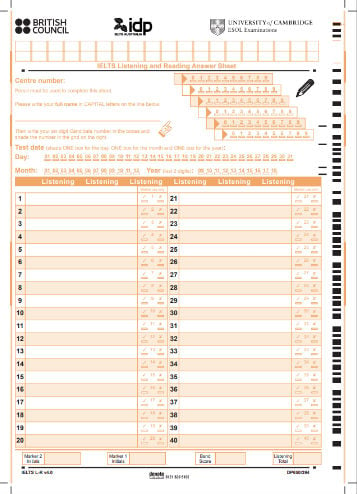
IELTSリスニングスコアの計算
リスニングセクションでは、各問題は1点です。したがって、「素」点は最大40点まで取得できます。次に、素点はバンドスコアに変換されます。 覚えておいてください!不正解で減点されることはありません。 下の表は、素点がどのようにバンドスコアに変換されるかの一般的なアイデアを示しています。
| 素点 | バンドスコア |
|---|---|
| 39-40 | 9 |
| 37-38 | 8.5 |
| 35-36 | 8 |
| 32-34 | 7.5 |
| 30-31 | 7 |
| 26-29 | 6.5 |
| 23-25 | 6 |
| 18-22 | 5.5 |
| 16-17 | 5 |
| 13-15 | 4.5 |
| 11-12 | 4 |
IELTSの各バージョンが少しずつ異なるため、特定のバンドスコアを達成するために必要な素点は、その日にテストを受けた皆の成績によって異なります。 したがって、バンドスコアを取得するために必要な正解数はテストによって若干異なりますが、一般的にバンドスコア7を取得したい場合は、40点中30点程度を目指す必要があります。
上記のとおり、IELTSリスニングテストが進むにつれてセクションはますます難しくなります。 しかし、すべての問題は同じ得点です。 したがって、難しい問題で行き詰まってより簡単な得点を失わないようにしてください。
解答付き無料IELTSリスニングサンプルPDFダウンロード
British Council(IELTS試験の作成元)からの解答付きPDF形式のIELTSリスニング無料サンプルをいくつか紹介します。リンクの下では、BestMyTestの無料の音声と解答付きIELTSリスニングテストも受けられます。4つのセクションすべてがあり、各セクションでは解答と一緒に音声スクリプトを確認できます。 質問に答えてみて、どれくらいできるか試してみましょう!
音声を聞いて、問題1-10に答えてください。解答と音声スクリプトは、問題の下のボックスにあります。
Questions 1-10
Complete the notes below.
Write ONE WORD AND/OR A NUMBER for each answer.
This can provide the carer with:
• time for other duties
• a 1
Assessment of aunt's needs
This may involve discussing:
• how much 2 is spent caring
Daily tasks discussed:
• help with dressing
• helping her take a 3
• shopping
• helping with meals
• managing 4
• any parts of caring that are particularly hard, e.g.
• loss of 5
• 6 her
• avoiding a 7
Types of support that may be provided for carers
• transport costs, e.g. cost of a 8
• vehicle-related costs, e.g. fuel and 9
• help with housework
• support to lower 10
-
spellcheck 解答
1. Break
Break is correct because this detail is stated in the recording at the point where the question is answered.2. Time
Time is correct because this detail is stated in the recording at the point where the question is answered.3. Shower
Shower is correct because this detail is stated in the recording at the point where the question is answered.4. Money
Money is correct because this detail is stated in the recording at the point where the question is answered.5. Memory
Memory is correct because this detail is stated in the recording at the point where the question is answered.6. Lifting
Lifting is correct because this detail is stated in the recording at the point where the question is answered.7. Fall
Fall is correct because this detail is stated in the recording at the point where the question is answered.8. Minicab
Minicab is correct because this detail is stated in the recording at the point where the question is answered.9. Parking
Parking is correct because this detail is stated in the recording at the point where the question is answered.10. Anxiety
Anxiety is correct because this detail is stated in the recording at the point where the question is answered.
Audio ScriptNora: It's really good to see you, Marcus. Since I had to give up work, I feel I'm losing touch with my friends and colleagues.
Marcus: We really miss you in the office. We were all so sorry you had to leave. But you must be relieved to have more time to look after your aunt. How is she?
Nora: Well, she's very cheerful, but she needs a lot of help.
Marcus: Have you tried to get any support from the local council?
Nora: No. I didn't know I could.
Marcus: Yes. But for different kinds of practical support, they realise that carers sometimes need time for all the other responsibilities they have, apart from the person they're caring for, and also that they sometimes need a break.
Nora: Absolutely. OK, so tell me more, how do I go about getting this support?
Marcus: Well, you'd have to have an assessment of your aunt's needs. That means someone would come round and talk to you about the situation and what you need. So for a start, they'd want to know the amount of time you spend looking after your aunt every day.
Nora: OK.
Marcus: Then they'll probably ask you what sorts of tasks you do for your aunt during the day. Things like if she needs help with getting dressed, for example.
Nora: Right. I help her with that. And also I help her get into the shower in the morning.
Marcus: Yes. That sort of thing. They'll probably ask you if you do the shopping for her, and help her at meal times, and whether she can cope using money.
Nora: Yes. That's becoming a bit of a problem. She used to be very good at it, but not anymore.
Before you hear the rest of the conversation, you have some time to look at questions 5 to 10. [20 seconds] Now listen, and answer questions 5 to 10.Marcus: And be ready to tell them about anything you find particularly difficult about caring for your aunt.
Nora: So recently I've noticed she started to have quite bad problems with her memory. If I wasn't there, I think she'd forget to eat, for example. And often she doesn't seem quite sure what day it is.
Marcus: Yes. Tell them about that. And are there any physical difficulties you have caring for her? Lifting her, for example.
Nora: Yes. She's quite heavy, and I'm afraid of hurting my back. I'd be in real trouble if that happened.
Marcus: They can give you advice about that, and also about how to avoid the possibility of your aunt having a fall.
Nora: Great. So, once they've done this assessment, if I'm eligible, what happens next?
Marcus: Well, they might support you financially. So they might help you with travel costs, like if you have to get a minicab to take your aunt for an appointment, for example.
Nora: I usually drive her myself, actually. So could I claim for the petrol?
Marcus: You could. And you can claim for the parking, too.
Nora: Oh, right.
Marcus: And if you need help with the housework, they can arrange for someone to come along once or twice a week. And one other thing. I hope you don't mind me saying this, but it's important you look after yourself. And it seems to me you're dealing with quite a bit of anxiety.
Nora: I am, yes.
Marcus: Well, tell the council, because they may be able to give you some advice on how to minimise it.
Nora: Really? Though, actually, I feel so much better having talked to you. I'll get in touch with the council straight away. Now, shall we go for coffee, or something?
音声を聞いて、問題11-20に答えてください。解答と音声スクリプトは、問題の下のボックスにあります。
Questions 11-14
Choose the correct letter, A, B or C.
11. Who began turning the unused Whitfield site into a planted space?
- city council officials.
- nearby residents.
- a gardening charity.
12. What was Lillian Hartley trying to achieve through public campaigning?
- preventing a housing sale
- blocking army exercises
- winning maintenance funding
13. Why was the park rejected as a place for troop exercises?
- council permission was refused.
- too little usable space.
- a better site was chosen.
14. How does the speaker describe the latest redesign plans?
- 2013 plan used unchanged.
- 2013 plan revised pre-work.
- 2015 plan finished in 2016.
Questions 15-20
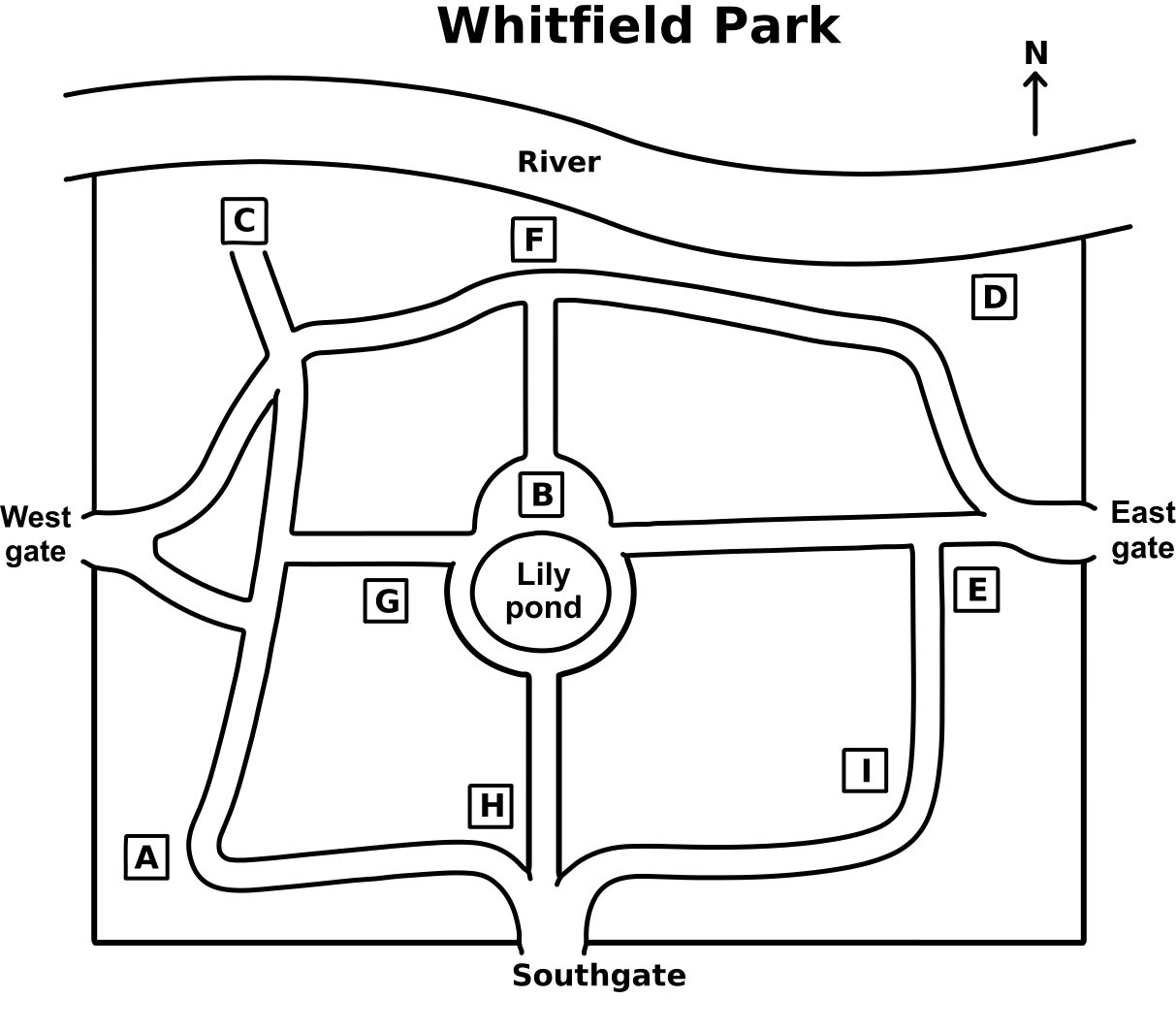
Label the plan of Whitfield Park below.
Write the correct letter, A-I, next to questions 15-20.
- statue of Lillian Hartley
- wooden sculptures
- playground
- maze
- tennis courts
- fitness area
-
spellcheck 解答
11. B
(A) is incorrect. The council took ownership later.(B) is correct. The initial planting was done by residents from nearby streets.
(C) is incorrect. The recording does not support this option: a gardening charity.
12. A
(A) is correct. Hartley organised public pressure so the council would keep the land as a park rather than sell it for housing.(B) is incorrect. The recording does not support this option: blocking army exercises.
(C) is incorrect. The recording does not support this option: winning maintenance funding.
13. B
(A) is incorrect. The recording does not support this option: council permission was refused.(B) is correct. , after inspection, the army concluded that the park was too small for practical use.
(C) is incorrect. The recording does not support this option: a better site was chosen.
14. B
(A) is incorrect. The recording does not support this option: 2013 plan used unchanged.(B) is correct. The plans dated from 2013 but were revised in 2015 before work began.
(C) is incorrect. The recording does not support this option: 2015 plan finished in 2016.
15. B
The correct answer is B because the statue of Lillian Hartley is now immediately north of the lily pond near the centre of the park, and that position is labelled B.16. D
The correct answer is D because the wooden sculptures are on the riverbank where the path from the East Gate makes a sharp bend, which corresponds to D.17. F
The correct answer is F because the playground is between the river and the path from the lily pond to the river, and that location is marked F.18. C
The correct answer is C because the maze is found by entering from the West Gate, walking north, and turning left, which places it at C.19. A
The correct answer is A because the tennis courts remain in the southern corner where the perimeter path makes a right-angled bend, labelled A.20. G
The correct answer is G because the fitness area is beside the lily pond on the same side as the West Gate, matching G on the plan.
Audio ScriptI'm delighted this evening to introduce our guest speaker, Sarah Holloway, who is going to talk to us about the recent transformation of Whitfield Park. Over to you, Sarah. Thank you very much. I'm sure you all know Whitfield Park well, it has been one of the city's landmarks for well over a century, and the city council has been responsible for it for most of that time. What perhaps fewer of you will know is how the park actually began.
Unlike many city centre parks, which started life as the private gardens of a large house, Whitfield was originally just an unused patch of waste ground. The first flowers there were actually planted by a small group of local residents who lived in the surrounding streets. They began work on the site in 1892. At that point nobody was entirely sure who legally owned the land, and it was a full twenty years later before the city council finally took it into public ownership. Some of you will have seen the statue near one of the gates. That figure is Lillian Hartley, who played a really important role in the early history of the park.
Once the council legally owned the land, its first instinct was to sell it off as building plots for housing. A great many local residents, however, wanted the park to stay open as a place where everyone could enjoy fresh air and green space, bear in mind that this is a very densely built up residential district. Lillian Hartley was at the heart of that campaign, and it was she who organised the petitions and the public demonstrations which, in the end, persuaded the council to drop the sale and keep the land as a park.
Soon afterwards, in 1914, the First World War broke out, and most of the park was dug up and used to grow vegetables, which were sold to local residents. At one point the army did look into taking over the park as a site for troop exercises. They actually wrote to the city council about it, but when they inspected it they concluded that the park was simply too small to be of any practical use to them, so the idea was dropped. The only military activity in the park during the war was the occasional public meeting held on a small area of grass that had been kept clear of vegetable plots.
After the war, the park was largely returned to the way it had been before 1914, and from then on it remained almost unchanged for decades. New plans for transforming the park were drawn up several times over the years; the most recent version dates from 2013, but those plans were then revised in 2015, well before any actual work had got under way. Work on the ground finally began in 2016 and was completed, on schedule, last year.
Before you hear the rest of the talk, you have some time to look at questions 15 to 20. [20 seconds] Now listen and answer questions 15 to 20.All right, I'd like to describe some of the more important changes that have been made, and one or two things that have deliberately been left as they were. If you take a quick look at the map you've been handed, you'll see the familiar outline of Whitfield Park. The river forms the northern boundary, and there is a gate in each of the three other walls.
From there, follow the path up towards the river and the enlarged children's playground sits between that path and the river itself. If you keep your eye on the riverbank, over towards the East Gate side, the new wooden sculptures are at the point where the path coming up from that gate makes a sharp bend.
Back near the West Gate side of the park, there is a maze, a circular pattern of paths separated by low hedges. Head in from the West Gate, walk north towards the river, and then turn left to find it. Close to the same central lily pond, on the side facing the West Gate, you'll also find the new outdoor fitness area.
Down in the southern corner, where the perimeter path makes that distinct right angled bend, the tennis courts are still in their familiar position, though we have now doubled them from four to eight. Now, since you are all keen gardeners, I'm sure you'll want to hear about the plants that have been chosen for the new beds.
音声を聞いて、問題21-30に答えてください。解答と音声スクリプトは、問題の下のボックスにあります。
Questions 21-25
Choose the correct letter, A, B or C.
21. Nina and Owen were surprised to learn that coastal cities
- are home to just under half of all people.
- account for many of the largest cities.
- are expanding at double the rate of inland cities.
22. According to Owen, building coastal cities near to rivers
- can carry contamination back towards urban areas.
- can leave too little land for farming upstream.
- can cause factories to damage rural scenery.
23. What mistake was made when building water drainage channels in Port Selby in the 1950s?
- The system did not include enough channels.
- The builders selected the wrong construction materials.
- The design failed to anticipate rising sea levels.
24. What do Nina and Owen think that the authorities in Port Selby should do immediately?
- take measures to restore coastal ecosystems
- pay for a new flood prevention system
- stop disposing of waste materials into the ocean
25. What do they agree should be the priority for international action?
- greater coordination of activities
- more sharing of information
- agreement on shared policies
Questions 26-30
What decision do the students make about each of the following parts of their presentation?
Write the correct letter, A-G, next to questions 26-30.
- use visuals
- keep it short
- involve other students
- check the information is accurate
- provide a handout
- focus on one example
- do online research
- Historical background
- Geographical factors
- Past mistakes
- Future risks
- International implications
-
spellcheck 解答
21. B
(A) is incorrect. The recording does not support this option: are home to just under half of all people.(B) is correct. Nina says most of the biggest cities are built by the sea.
(C) is incorrect. The recording does not support this option: are expanding at double the rate of inland cities.
22. A
(A) is correct. Owen says pollutants from inland agriculture and industry travel down rivers to cities.(B) is incorrect. The recording does not support this option: can leave too little land for farming upstream.
(C) is incorrect. The recording does not support this option: can cause factories to damage rural scenery.
23. C
(A) is incorrect. The recording does not support this option: The system did not include enough channels.(B) is incorrect. The recording does not support this option: The builders selected the wrong construction materials.
(C) is correct. Port Selby's drainage channels were built without allowing for global warming and rising sea levels.
24. B
(A) is incorrect. The recording does not support this option: take measures to restore coastal ecosystems.(B) is correct. Nina says they need money to replace the drainage channels for flood protection now.
(C) is incorrect. The recording does not support this option: stop disposing of waste materials into the ocean.
25. A
(A) is correct. They say coastal cities must act together internationally.(B) is incorrect. The recording does not support this option: more sharing of information.
(C) is incorrect. The recording does not support this option: agreement on shared policies.
26. B
B is correct because they decide not to spend too long on historical background, so they will keep it short.27. A
A is correct because they decide to use slides with maps showing geographical factors.28. F
F is correct because they choose the Meriton case study as the basis for past mistakes, focusing on one example.29. G
G is correct because they need to look at websites for future risks, so online research is required.30. C
C is correct because they plan to ask audience members from different places, involving other students.
Audio ScriptTutor: OK, so what I'd like you to do now is to talk to your partner about your presentations on environmental planning. You should have done most of the reading now, so I'd like you to share your ideas and talk about the structure of your presentation and what you need to do next.
Nina: OK, Owen, I'm glad we chose quite a specific topic: coastal cities. It made it much easier to find relevant information.
Owen: Yeah, and cities are growing so quickly. I mean, we know that more than half the world's population lives in cities now.
Nina: Yeah, though that's all cities, not just coastal ones. But most of the biggest cities are actually built by the sea. I'd not realised that before.
Owen: Nor me. And what's more, a lot of them are built at places where rivers come out into the sea. But apparently this can be a problem.
Nina: Why?
Owen: Well, as the city expands, agriculture and industry tend to spread further inland along the rivers. And so agriculture moves even further inland up the river. That's not necessarily a problem, except it means more and more pollutants are discharged into the rivers.
Nina: That's a serious problem.
Owen: Right.
Nina: Did you read that article about Port Selby on the south coast?
Owen: No.
Nina: Well, apparently back in the 1950s, they built channels to drain away the water in case of flooding.
Owen: Sounds sensible.
Nina: Yeah, they spent quite a lot of money on them. But what they didn't take into account was global warming. So they built the drainage channels too close to sea level. And now sea levels are rising, they're more or less useless. If there's a lot of rain, the water can't run away. There's nowhere for it to go.
Owen: So they did not help much in the end.
Nina: So what are the authorities doing about it now?
Owen: I don't know. I did read that they're aiming to stop disposing of waste water into the ocean over the next 10 years. But that won't help with flood prevention now, will it?
Nina: No, really, they just need to find the money for something to replace the drainage channels in order to protect against flooding now. But in the long term, they need to consider the whole ecosystem.
Owen: Right.
Nina: Really though, coastal cities can't deal with their problems on their own, can they? I mean, they've got to start acting together at an international level instead of just doing their own thing.
Owen: Absolutely. The thing is, everyone knows what the problems are and environmental planners have a pretty good idea of what we should be doing about them. So they should be able to work together to some extent.
Nina: But it's going to be a long time before countries come to a decision on what principles they're prepared to abide by.
Owen: Yeah, if they ever do.
Before you hear the rest of the conversation, you have some time to look at questions 26 to 30. [20 seconds] Now listen and answer questions 26 to 30.Nina: So I think we've probably got enough for our presentation. It's only 15 minutes.
Owen: OK, so I suppose we'll begin with some general historical background about why coastal cities were established. But we don't want to spend too long on that. The other students will already know a bit about it.
Nina: It's all to do with communications and so on.
Owen: Yes, we should mention some geographical factors, things like wetlands and river estuaries and coastal erosion and so on.
Nina: We could have some maps of different cities with these features marked.
Owen: On a handout, you mean, or some slides everyone can see.
Nina: Yeah, that'd be better.
Owen: It'd be good to go into past mistakes in a bit more detail. Did you read that case study of the problems there were in Meriton with flooding a few years ago?
Nina: Yes, we could use that as the basis for that part of the talk. I don't think the other students will have read it, but they'll remember hearing about the flooding at the time.
Owen: Hmm, OK. So that's probably enough background. So then we'll go on to talk about what actions have been taken to deal with the problems of coastal cities.
Nina: OK, what else do we need to talk about? Maybe something on future risks looking more at the long term if populations continue to grow?
Owen: Yeah, we'll need to do a bit of work there. I haven't got much information, have you?
Nina: No, we'll need to look at some websites. Shouldn't take too long.
Owen: OK. And I think we should end by talking about international implications. Maybe we could ask people in the audience. We've got people from quite a lot of different places.
Nina: That'd be interesting if we have time, yes. So now should we go on?
音声を聞いて、問題31-40に答えてください。解答と音声スクリプトは、問題の下のボックスにあります。
Questions 31-36
What point does the lecturer make about each item?
Write the correct letter, A-K, next to questions 31-36.
- changes drainage
- protects animals
- increases nutrients
- kills germs
- affects many species
- creates dense shade
- alters the soil
- supports farming
- reduces competition
- attracts bell-miners
- helps recovery
- Eucalyptus woodland
- Damage to eucalyptus woodland
- Oil from eucalyptus leaves
- Lime used in construction
- Direct iron supply
- Moderate bushfires
Questions 37-40
Complete the notes below.
Write ONE WORD ONLY for each answer.
Bell-miner associated dieback:
• The process starts with insects feeding on eucalyptus 37
• A sweet liquid containing 38 attracts bell-miners
Fire patterns:
• If fires happen too often, 39 becomes the main vegetation
• When fires are almost absent, thick growth gives bell-miners protected 40 sites
-
spellcheck 解答
31. B
B is correct because eucalyptus woodland provides nesting places and shelter for birds, bats and small mammals.32. E
E is correct because damage to eucalyptus woodland affects a wider community of species, not only the trees themselves.33. D
D is correct because oil from eucalyptus leaves is used in disinfectant, where it can kill certain germs.34. G
G is correct because lime from road construction was washed into the soil and interfered with tree roots.35. K
K is correct because affected trees recovered surprisingly quickly when iron was supplied directly.36. I
I is correct because occasional fire removes fast-growing competitors that would otherwise use water needed by eucalyptus trees.37. leaves
The correct answer is leaves. The lecturer says the process begins when insects settle on eucalyptus leaves and feed on them.38. sugar
The correct answer is sugar. The lecturer says the insects produce a sweet liquid containing sugar, which attracts bell-miners.39. grass
The correct answer is grass. The lecturer says grass tends to dominate afterwards if fires occur too often.40. nesting
The correct answer is nesting. The lecturer says dense growth creates protected nesting sites for bell-miners when fire is suppressed.
Audio ScriptGood morning. Today I want to focus on the eucalyptus tree, one of the best known features of the Australian landscape. Many people call it a gum tree, but the name eucalyptus actually covers hundreds of related species, from small scrubby trees to very tall forest giants.
Now, eucalyptus trees are important in several ways. Ecologically, they provide nesting places and shelter for birds, bats and small mammals. Their flowers also produce nectar, which is an important food source for insects and birds. So when eucalyptus woodland is damaged, the effect is felt across a much wider community of species.
As for their value to people, the trees are also useful. Oil from eucalyptus leaves has long been used in cleaning products, and one common use is in disinfectant, because the oil can kill certain germs. Eucalyptus timber is also used in building and fencing, although that is not really the main focus of today's lecture.
So, these trees can live for centuries, and some individuals survive for four hundred years or more. That is why researchers became concerned when large numbers began dying much earlier than expected in different parts of Australia.
Now, one disease that attracted attention was Mundulla Yellows. The leaves of affected trees slowly turned yellow and then, over time, the whole tree declined. For years the cause was unclear. Eventually, researchers discovered that lime, or calcium hydroxide, had been used in road construction nearby. Rain washed the lime into the surrounding soil, where it interfered with the roots of eucalyptus trees. The trees were still surrounded by nutrients, but they could no longer absorb the iron they needed for healthy growth. When iron was supplied directly to affected trees, they recovered surprisingly quickly.
However, Mundulla Yellows affected only a limited number of places. A much wider problem on the east coast was Bell miner associated dieback. Now, bell miners are small native birds, but they are not the direct cause of the damage. The process begins when insects settle on eucalyptus leaves and feed on them. While feeding, these insects produce a sweet liquid containing sugar. Bell miners are attracted to that liquid, and they aggressively chase away other birds and insects that might otherwise reduce the insect population. As a result, the insects multiply, the leaves are badly damaged, and the trees gradually lose their ability to survive.
But some scientists think fire history is also part of the explanation. An influential theory, first proposed by the ecologist William Jackson, links the type of vegetation in a region to the frequency of bushfires. If fires occur too often, grass tends to dominate the area afterwards. If fires occur at moderate intervals, eucalyptus forest is more likely to persist. This is because occasional fire removes fast growing competitors which would otherwise take up the water eucalyptus trees need. And it also helps maintain the soil by preventing dense undergrowth from changing the soil structure and removing nutrients.
At the other extreme, if fires are almost completely suppressed, a different ecosystem can develop. Scientists sometimes call this dry rainforest. Now, the name sounds contradictory, because we usually associate rainforest with wet tropical conditions. But in this case it means a dense, shaded vegetation system with relatively few species. It can create excellent conditions for bell miners, because the thick growth gives them protected nesting sites while excluding many of the species that would normally compete with them.
What this tells us is that before European settlement, Aboriginal communities used controlled burning over long periods, and this probably created a more balanced pattern of vegetation. Since European settlement, fire has often been suppressed, roads and farms have altered drainage, and some local ecosystems have shifted away from eucalyptus woodland. The decline of eucalyptus trees, then, is not caused by one single factor. It is the result of disease, insects, birds, soil chemistry and fire management interacting with one another.

Completion - Part 1
Learn how to answer these questions in a step-by-step interactive exercise
Completion - Part 1
空欄には時間や頻度が入ることがあります。話し手はたいてい同じ期間を別の言葉で言うので、紙に書かれた言い方を待つのではなく、意味で空欄と結びつけましょう。
そのうえで、提出する前に語数制限を確認します。答えを空欄に入れた状態で行全体を読み返し、すでにその行にある語は取り除きましょう。意味が正しくても長すぎる答えは得点になりません。
「再生」をクリックして音声を聞きましょう
メモには、must provide や need to bring のような平易な動詞が使われます。話し手がその動詞をそのまま言うことはまれで、同義語を使ったり、行動を説明したりします。実際に何が必要とされているかを聞き取りましょう。
話し手は、まず余分な項目を挙げてから、それを除外することがよくあります。空欄を聞き逃したら、そこは空けたまま次に進みましょう。答えは音声の順序どおりに出てくるので、1つの空欄にこだわると、その後の空欄まで失うことがあります。
「再生」をクリックして音声を聞きましょう
上記のIELTSリスニングのサンプル問題に答えてみてどうでしたか?どれか難しい質問はありましたか? もしあった場合は、6つのIELTSリスニング問題タイプすべてをよく見てみると役に立つでしょう。 問題タイプをよく理解すればするほど、何をしなければならないか見つけるための労力が少なくなり、 答えを見つける時間が増えます。
6つのIELTSリスニング問題タイプ
IELTSリスニングテストには6種類の異なる問題があります。 高いIELTSリスニングスコアを得るためには、各問題タイプを練習して、それぞれに対処する最良の方法を学ぶことが重要です。
学習者が最も難しいと感じるリスニングの問題形式
BestMyTestの学習者によるIELTSリスニングの222万件の解答から分かったことをご紹介します。下の表は、各問題形式で学習者が正解した割合を示しています。どこで点を落としているかがすぐに分かります。
| 問題形式 | 正答率 |
|---|---|
| Note completion | 33% |
| Table completion | 34% |
| Sentence completion | 45% |
| Short answer | 48% |
| Multiple choice | 50% |
| Multiple selection | 52% |
| Plan, map, diagram labelling | 55% |
| Form completion | 73% |
| Matching | 85% |
- 失点しやすいのは穴埋め問題です。 穴埋め問題の中では、Note completion の正答率が33%で、同じスキルを別のレイアウトで使う Form completion は73%に達しています。どの穴埋め問題でも聞こえた語を書くので、スペル、語形、語数制限がすべて関係します。どれも練習で伸ばせることです。
- 54,523人の学習者が受験したリスニングの模擬テスト全61,104回の平均バンドスコアは5.6でした。テストの41%でバンドスコア6.0に、12%でバンドスコア7.0に達しました。
- リスニングの各セクションを見ると、解答の31%で得点率が40%以下となり、30%で得点率が80%以上となりました。セクション3と4はテストの学術的な部分なので、フルテストの中だけでなく、個別にも練習しましょう。
各リスニング問題タイプは異なって見えますが、それぞれへの基本的なアプローチは同じです。この投稿の後半では、 6つの問題タイプすべてに取り組むための基本戦略を示します。 各問題タイプの音声サンプルと解答はIELTSリスニングの問題タイプのガイドにあります。
効果的なIELTSリスニングテストオンライン準備のための3ステップ
IELTSの各リスニング問題(タスク)タイプは異なりますが、それぞれへの基本的なアプローチは同じです。 シンプルなステップバイステップの戦略を使用して、すべての問題タイプに取り組むことができます。 リスニング問題タイプに取り組むためにあなたが使用することを推奨する3つのステップは次のとおりです。
- 問題を綿密に検討して重要な情報を見つける
- 聞く前に潜在的な答えを予測する
- 聞きながら問題と内容を一致させるためにフォローアップする
ステップ1: 問題を検討する
IELTSリスニングセクションでは、録音が始まる前に簡単な準備時間(30〜40秒)が与えられます。これは、答えなければならない問題を見る機会であり、この戦略の最初のステップが何についてかです。 この時間を休憩に使ったり、答えを確認したりするのではなく、 これからの問題についてできるだけ多くを学ぶことに集中します。 このステップを実行することは、話者を聞きながら問題を初めて読もうとするマルチタスクの間違いを避けるために重要です。
準備時間が始まったら、まず問題を検討してそれらについて詳しく知ることで、この時間を最大限に活用してください。各IELTSリスニング問題を検討するときに探すべき情報のいくつかは次のとおりです。
- これはどのような問題ですか?
- 解答はどのように見えますか?(例: 日付、数字、名前)
- 問題の中で最も重要なフレーズや単語、つまりキーワードは何ですか?
1つの例として、次のようなノート完成問題があります。
下のメモを完成させてください。
各解答に3語以下で記入してください。
まず、問題のいくつかのキーワードに下線を引くことができます。
新しい価格設定アプローチの2つの理由は、(27) ______と(28) _________ プログラムの変更です。
この例では、すでに下線を引いていたキーフレーズ「2つの理由」を聞くことで、適切な瞬間に注意を払い始めることができます。これが答えを示す音声スクリプトの一部です:
Mark: ええと、2つの基本的な理由があるようです。まず、企業がこのように行動することを許可するために、法律が最近変更されたためです。 過去には、彼らはチケットの価格を変更することは許可されていませんでした。次に、現在は、価格を非常に迅速かつ正確に変更できるように計算を行うコンピュータープログラムがあります。
問題を検討した後、いくつかのキーワードと問題タイプを知ることで、ここでは「法律」と「コンピューター」が正しい応答であることがわかります。
ステップ2: 潜在的な答えを予測する
IELTSリスニングセクションで成功するためのこの戦略の2番目のステップは、最初のステップと非常に密接に関連しています。実際、録音が始まる前の同じ20秒の準備時間内に 両方のステップを完了するように試みる必要があります。これはそれほど短い時間で行うのは難しい作業のように思えるかもしれませんが、これらのステップは実際には互いに関連していることを覚えておいてください。
リスニング問題に対する潜在的な答えを予測するには、まずステップ1を完了し、問題を綿密に検討する必要があります。この時点で、どんな問題を見ているか、どんな潜在的な答えがあり、答えを素早く見つけるためにどのキーワードが役立つかを知っているはずです。答えを予測するには、これらすべての情報を組み合わせ、どんな答えを聞くと期待するかを推測します。
上記と同じノート完成例の問題を再度見てみましょう。
新しい価格設定アプローチの2つの理由は、(27) と(28) プログラムの変更です。
この文の文法を見るだけで、解答がどの品詞かを特定できます。この場合、前置詞「in」が両方の潜在的な解答に先行しています。 文法的には、前置詞句のこのような方法で使用できるのは名詞または名詞句のみです。解答が名詞または名詞句であると正しく予測できるだけでなく、コンテキストに基づいて、解答が政策または政府(法律)に関連するものや、プログラム(コンピューター)と一緒に現れる単語である可能性も予測できるでしょう。
予測だけで正確な正解を推測することは不可能ですが、答えが何であるか想像しようとすることで、関連のない情報を無視しながら、関連情報に耳を傾ける可能性が高くなります。録音が始まる前に潜在的な答えを予測することで、あなたの耳が準備され、正解への一歩近づくことができます。
では、より難しい複数選択例の問題でステップ1(問題を検討)とステップ2(潜在的な答えを予測)を組み合わせてみてください。
A、B、CまたはDの正しい文字を選んでください。
- 週末の公演のためです
- かなり前に予約されています
- 返金不可です
- グループ用に予約されています
これらの問題への答えを確実に知る方法はありませんが、これらの問題で見つけた情報を使って潜在的な答えを予測し、 リスニングのターゲットを絞ることはできます。例えば、問題24は劇場のチケット価格が最も安くなる理由に関するもので、これらの理由のいずれかに耳を傾けることになります。複数の理由が言及される可能性があることを覚えておいてください。 予測がどう不正解を排除するのに役立つかを見るには、以下のスクリプトをご覧ください。
3つの潜在的な答え「グループ用に予約された」、「週末の公演のため」、「返金不可」がどう言及されているか注目してください。 しかし、正しい答えはC「返金不可」です。他の2つが単にリストされているのに対して、これは別々に安いと言及されているからです。
ステップ3: フォローアップ
録音が始まり、テストの実際のリスニング部分が始まると、このIELTSリスニングセクション戦略のステップ3を完了するためにフォローアップする必要があります。 フォローアップするには、あなたが聞いていることに密接に集中しながら、同時にコンテンツがどの問題に対処しているかを追跡する必要があります。
IELTSリスニング試験セクションの問題は通常、録音の内容で答えが見つかる場所の順序で表示されます。 これによりテストで優位性が得られます。なぜなら、ある問題の答えを聞いたら、すぐに次の問題に順番に注意を向けることになるからです。 問題から聞いていることへのコンテキストを一致させて成功裏にフォローアップすることができれば、 順調に進み、各問題に答えるために必要なキー情報を見逃すのを避けることができます。
しかし、これを行うのは口で言うほど容易ではありません。次の問題を視野に入れながらリスニングしながらマルチタスクをする必要があります。 実際に問題への答えを見逃した場合、後の問題の答えを聞いたときに気づくでしょう。 これは混乱して苛立たしいこともありますが、1つの答えを見逃してそれに気づくことは、内容に完全に迷ってさらに多くの答えを見逃すよりはまだましです。 問題を見逃したシナリオでは、単にそれを残し、次の問題に進む必要があります。 最後に、見逃した問題について最善の推測をする必要があります。 しかし、明るい面として、録音をすべて聞いていれば、他の文脈的なヒントが提供され、見逃した問題により正確に答えることができる可能性があります。
IELTSリスニング練習のための無料リソース
高いバンドIELTSリスニングスコアを得るためには、強力なリスニングスキルが必要です。そのため、試験日まで毎日一貫してトレーニングすることが重要です。
以下は、毎日リスニングスキルをトレーニングし維持するために使用できるリソースです。
- YouTube - https://www.youtube.com
- BBC Learning English - http://www.bbc.co.uk/learningenglish
- TED - https://www.ted.com/
- BBC radio - https://www.bbc.co.uk/worldserviceradio
- ABC news in Australia - https://www.abc.net.au/listen/live/news
このページの数字は、BestMyTest での IELTS 練習の 2026年10月 までの記録であるBestMyTest IELTS 学習者パフォーマンスデータによるものです。それぞれの数字の測り方はそのページで説明しています。最終更新:2026年10月15日。