
Bu rehberde, ücretsiz bir IELTS okuma testi çözerek IELTS okuma çalışmanıza başlayabilirsiniz. Ancak testin iki farklı sürümü vardır: IELTS genel okuma ve IELTS akademik okuma. Hangi sürümün size uygun olduğunu ve IELTS okuma materyallerimizi kullanarak her bir okuma soru tipini nasıl çözeceğinizi öğreneceksiniz.
Ucretsiz bir IELTS reading pratik testini tamamladiktan sonra ucretsiz IELTS reading puan analizi ve kisisellestirilmis calisma plani alin.
| IELTS General Reading testi | IELTS Academic Reading testi |
|---|---|
Asagida cevaplariyla birlikte tum IELTS reading sorularimizin listesi yer alir. Not: kirmizi baglantilar, ogrencilerimiz tarafindan puanlanan en populer ve onerilen reading sorularimizdir; bunlari istediginiz zaman ucretsiz calisabilirsiniz.
General IELTS Reading pratik test sorulari 1 - 135
Short everyday texts, workplace texts, and one longer passage
Academic IELTS Reading pratik test sorulari 1 - 171
Three long passages from books, journals, magazines, and newspapers
IELTS Okuma Pratik Test Rehberi
Bu rehberin geri kalanı, hem genel eğitim hem de akademik okuma testi için IELTS okuma testi hakkında her şeyi size öğretecek. Okuma puanının nasıl hesaplandığını öğreneceksiniz, her okuma sorusu türünü başarıyla nasıl yanıtlayacağınızı öğreneceksiniz, IELTS metin materyaliyle okumanızı geliştireceksiniz ve IELTS okuma pratik başarınız için 3 stratejimizde ustalaşacaksınız.
İçindekiler
- IELTS Okuma Testi Bilgileri
- IELTS Reading Örnek Soruları
- IELTS Genel Okuma Testi Bilgileri
- IELTS Akademik Okuma Testi Bilgileri
- IELTS Okuma Puanı Hesaplayıcısı
- 11 IELTS Okuma Sorusu Türünün Tümünün Nasıl Yanıtlanacağı
- IELTS Okuma Bant Puanınızı Nasıl Geliştirirsiniz
- 3 IELTS Okuma Stratejisi
- Cevaplarla Birlikte Ücretsiz IELTS Okuma Pratik Testi PDF İndirme
IELTS Okuma Testi Bilgileri
IELTS Okuma Testi 3 bölümden ve toplam 40 sorudan oluşur. Genel olarak, her bölüm için 12-14 soru yanıtlayacaksınız ve okuma sınavınızı tamamlamanız için tam 60 dakika verilecektir. Her bölüm, hangi testi aldığınıza bağlı olarak 1-3 metin içerir. Hangi testi aldığınızı biliyorsanız, sonraki birkaç bölümü atlayabilirsiniz. Bilmiyorsanız, her test hakkında bilgi edinmek ve onlara nasıl hazırlanacağınızı öğrenmek önemlidir.
Hangi IELTS Okuma Testi Bana Uygun?
IELTS okuma testinin iki versiyonu vardır: IELTS Genel Okuma ve IELTS Akademik Okuma. Eğer göç etmek veya liseye kaydolmak istiyorsanız Genel Okuma alacaksınız. Yükseköğretim arıyorsanız Akademik Okuma alacaksınız. Genel okuma ile akademik okuma arasındaki en büyük fark, IELTS okuma metinlerindeki zorluktur. Adından da anlaşılacağı gibi, akademik test akademik kaynaklardan IELTS okuma materyali kullanır, genel test ise günlük yaşamdan materyal kullanır.
Her iki test de 3 bölüm, 40 soru ve 11 soru türü içerir. Aşağıdaki tabloda her iki test için her bölüm hakkında ayrıntılı bilgi okuyabilirsiniz.
| Bölüm | IELTS Akademik Okuma Testi | IELTS Genel Okuma Testi |
|---|---|---|
| 1 | Betimleyici ve olgusal olandan tartışmacı ve analitik olana kadar değişen bir uzun akademik metin. Metin
kitaplardan, dergilerden ve gazetelerden alınacaktır. 12-14 soru |
İki veya üç kısa olgusal metin.
Konular İngilizce konuşulan bir ülkedeki günlük yaşamla ilgilidir.
12-14 soru |
| 2 | Betimleyici ve olgusal olandan tartışmacı ve analitik olana kadar değişen bir uzun akademik metin. Metin
kitaplardan, dergilerden ve gazetelerden alınacaktır. 10-14 soru |
İşle ilgili konulara odaklanan iki kısa olgusal metin (örn. iş başvurusu, şirket politikaları, ücret ve koşullar).
12-14 soru |
| 3 | Betimleyici ve olgusal olandan tartışmacı ve analitik olana kadar değişen bir uzun akademik metin. Metin
kitaplardan, dergilerden ve gazetelerden alınacaktır. 12-14 soru |
Genel ilgi alanı bir konuda daha uzun, daha karmaşık bir metin.
Metinler özgündür ve duyurulardan, reklamlardan, şirket el kitaplarından, kitaplardan, dergilerden ve gazetelerden alınmıştır.
12-14 soru |
Artık IELTS okuma testi yapısı ve hem IELTS genel okuma hem de IELTS akademik okuma hakkında bilgi sahibi olduğunuza göre, kağıt tabanlı testi mi yoksa bilgisayar tabanlı testi mi almanın daha iyi olduğunu öğrenmenin zamanı geldi.
IELTS Kağıt Tabanlı Test (PBT) - IELTS Bilgisayar Tabanlı Test (CBT) Karşılaştırması
PBT'de size bir Soru Kitapçığı ve bir Cevap Kağıdı verilecektir. Soru Kitapçığı, yanıtlamanız gereken tüm soruları göreceğiniz yerdir. Cevap Kağıdı, son cevaplarınızı not için yazacağınız yerdir. resmi IELTS cevap kağıdı pdf'ine buradan göz atabilirsiniz
Not: IELTS dinleme testinden farklı olarak, cevaplarınızı kitapçıktan cevap kağıdına aktarmak için size ek süre verilmeyecek, bu yüzden her IELTS okuma testi sorusunu cevap kağıdına yanıtlarken eklediğinizden emin olun.
CBT'de soruları bilgisayarda yanıtlayacaksınız. Metinleriniz sol tarafta ve sorularınız sağ tarafta olacaktır. Ayrıca metni vurgulayabilecek ve cevapları kopyalayıp yapıştırmak için kontrol işlevlerini kullanabileceksiniz. PBT ve CBT hakkında daha fazla bilgi için IELTS Bilgisayar Tabanlı Test Rehberi'ne göz atın.
Ücretsiz IELTS okuma pratik testimizle istediğiniz zaman her iki sürümü de uygulayabilirsiniz. Sayfanın üst kısmında tüm IELTS okuma materyallerimize bağlantılar bulabilirsiniz.
IELTS Reading Örnek Soruları
Burada iki ücretsiz IELTS Academic Reading alıştırması var. Her birini kendiniz çözün, sonra cevapları açıp kontrol edin. IELTS Reading soru tipleri rehberi her tipi açıklar ve daha fazla örnek soru sunar.
Match each item with the period of time it best corresponds with
NB You may use any letter more than once.
- The Palaeolithic era
- The Bronze age
- The Iron age
- The Medieval era
- The Mesolithic age
- Roman times
-
spellcheck Answers1. FALSE
2. FALSE
3. NOT GIVEN
4. FALSE
5. TRUE
6. FALSE
7. FALSE
8. TRUE
9. FALSE
10. F
11. C
12. A
13. B
14. D
The climate in Britain has been arctic for the last several million years, punctuated by relatively warm timespans, or interglacials of thousands of years, one of which we are in as of now. Since the last glaciation, British woodland history is considered quite short in terms of geological time spans, and is also closely related to the human civilization developing.
At the peak of the last glaciation (100,000 – 12,000 BC), the majority of Britain would have had no trees. Birch and willow scrub may have grown along the lower reaches of the ice, with pine in some areas. It’s possible that remnants of pre-glacial flora were sheltered along the western bays of Great Britain and Ireland’s coasts, but as far as the southern parts of England, the ice kept any land barren. Information regarding the development of Britain’s flora following glaciation can be found by studying the deposits of pollen and seed in peat, as well as by the use of radiocarbon dating. Tundra and moorland followed the retreating ice, which lead to phases of different tree species spreading from the south. First came birch, aspen and sallow, followed by pine and hazel continuing to spread north as of 8500 BC, replacing birch to make it less commonly found for the next few thousand years. Oak and alder came after pine, then lime, elm, beech, and maple, all spreading northwards one after the other. From the moment lime arrived, in about 7300, to about 4500 BC the climate remained stable for a length of time known as the Atlantic Period, a time in which numerous species grew to form a series of wildwood or wilderness types.
What did the wilderness or wildwood look like, before man started interfering with it? One theory holds that Britain and Western Europe in Palaeolithic times was covered from coast to coast in a wildwood of continuous trees. However, a modern theory proposed by Francis Vera holds that Western Europe wilderness was a combination of grassland, scrub, and clusters or groves of trees. It was not a dense, impassable wildwood, but instead, an area similar to a park, kept up by wild herbivores eating the plants and grass. Throughout earlier interglacial periods, this may also have been the case in Britain, as creatures of the Palaeolithic era needed to roam large areas of grassland to survive. A variety of grassland plants continued to live there in the last interglacial, as according to pollen records. However, since the last glaciation, the bison, elk and other large herbivores which persisted on mainland Europe were extinct in Britain, so Vera’s theory may not apply so well to Britain.
Meanwhile, throughout the period since it’s spread northwards after the last glaciation, the sustained growth of oak in Britain demonstrates that the wildwood was not as continual as once believed. Oak is a pioneer species, which requires vacant space to generate more of itself. Grazing animals are also present to keep areas open, so Oak regenerates in the thorny brush as a protective measure from their grazing. Archaeological evidence indicates that red deer, who graze on grass as well as browse from trees, were essential to the economy in Mesolithic Britain, with people utilizing them for meat, skins, antlers and bones.
As the Mesolithic (10,000-3000 BC) era ended, evidence of the beginnings of agriculture emerges. Agricultural weeds, such as plantain and stinging nettle, were also increasing in number. Nearly all the wildwood was cut down as the population increased rapidly. However, the falling elm population around 4,000 BC all across Europe has been attributed not to the clearing of trees, but to what’s referred to as Elm disease.
Throughout the Bronze Age (2400-750 BC), people were cutting down trees more than ever before, until the prevalence of the practice “coppicing” peaked, likely at some point during the early Iron Age. Oliver Rackham (1990) theorizes that nearly 50% of land throughout England was no longer wildwood by 500 BC. The regrowth from a stump grows more readily than the original tree, and Neolithic man had discovered this practice, known as coppicing. Much of the remaining woods were maintained by way of this method during the Bronze Age.
The Celtic peoples living in the Iron Age were able to master woodworking as an artform. Today, Celtic woodworking can be seen in houses, boats, wheels and other artifacts of the time. Coppicing as a means to manage woodland was of massive importance throughout two millennia that followed. Buildings, roads, fences, carts, and the fuel for heating, cooking, metalworking and pottery were all made possible due to wood materials gained from the vital practice of coppicing.
A clear divide has existed between wooded and non-wooded regions of Britain since the time of the Romans. As evidenced by The Domesday Book (1086), all the wood in England had an economic value and was the property of either an individual or community owner. Woods were the territories, or ‘exclaves’ of communities who lived some miles away. Even though it had to be transported over long distances, the materials which woodlands produced were of obvious value, and their ownership was long before established. Merely around 15% of land in England was represented by woodland or wood- pasture in the year 1086.
English woodlands produced mostly underwood used as fuel along with other things, with small oaks being used to construct buildings. The average wood-framed houses of the Medieval era mostly used oaks shorter than 18” in diameter. Longer pieces of timber were hard to come by, and kept only for elaborate buildings intended for the Church. Imported boards of thin oak or wainscot from Central Europe were brought in for the purpose of domestic building. Woodland cover was as low as 15% in 1086, and continued to decline from as a result of an ever- growing population to 10% by 1350. This stopped suddenly with the plague of the Black Death of 1349 wiping out some of the human population. Woods which had persisted up to 1350 mostly prospered over the next 500 years.
Match each description with the correct psychologist
NB You may use any letter more than once.
- Clark Hull
- Howard and Tracy Kendler
- Michael Cole and colleagues
- Simon Hewson
-
spellcheck Answers1. D
2. C
3. D
4. A
5. C
6. B
7. C
8. D
9. TRUE
10. FALSE
11. TRUE
12. FALSE
Could it be that the very essence of reasoning itself is found in the way we behave? Clark Hull, an acclaimed American psychologist, theorized that it was, describing that reasoning is achieved by the way two “behavior segments” are combined in new ways to achieve goals. Howard and Tracey Kendler, who were two of Hull’s followers, used Hull’s principle ideas to design a reasoning test for children. In this test, children needed to learn how to use a machine in a two-step process. The children learned each of the two steps individually, with the first being to correctly choose and press one of two buttons, and the second to place a marble into a small opening. If both steps were completed successfully, a toy would be released as rewards to the children.
From this test, the Kendlers learned that although the children were able to learn each step, they were not able to “integrate” the two tasks without intervention. In other words, the children could not successfully perform the first step, pushing the button, and then proceed to the second step, inserting the marble into the hole, by themselves. This failure to independently integrate the steps led the Kendlers to believe that children of this age were not able to use deductive reasoning.
According the the work of psychologist and professor Michael Cole and his associates, some adults from specific African tribes are also unable to successfully complete the Kendlers' two-step test of deductive reasoning. However, this finding remains questionable in light of the findings of a similar test to the Kenders’, which revealed that the African tribes people were, in fact, able to complete the test.
In this test, Cole substituted a locked box for the machine with the buttons, and then used two matchboxes of different colors. One of the matchboxes held a key for the locked box. Just like with the Kendlers’ test, Cole’s test also involved two behavior segments, these being to first open the right match-box to get the key, and second to use the key to open the box. However, Cole’s test differs quite a bit psychologically. Instead of subjects being presented with a strange machine, they are given familiar objects in a simpler context. Cole found the difficulty of 'integration' was greatly reduced here.
It seems that the same truth which Cole discovered can be extended to explain the deductive reasoning skills of young children. Psychologist Simon Hewson believes that perhaps the task’s difficulty is not in inferential processes themselves, but is instead tied to confusing features of the test apparatus, such as the button machine, as well as the context of the procedure being tested. When these factors are adjusted in order to prevent the inferential nature of the problem being affected, five-year-old children are able to successfully complete these tests as well as college students did in the Kendlers' test.
Hewson made two essential changes to the test in order to build on this idea. First, he replaced the button-pressing mechanism with drawers that a child could slide open and shut. This removed confusion on what to do with the original button apparatus from the first stage of training. Secondly, Hewson made sure that children understood that there was nothing special or magical about the marble which was used to successfully complete the second step of the task and get the reward.
This is important because a child cannot easily comprehend a mechanism in which a marble put into a hole can open a little door. It would then be safe to say that the child will not assume that different marbles of identical size could be used the same way. But, to solve the problem, this assumption must be made. Hewson clearly demonstrated the functional equivalence of different marbles to the children by playing a 'swapping game.” Hewson's two modifications to the experiment led to a rise in success rates from 30 percent to 90 percent for five-year old children and from 35 percent to 72.5 per cent for four-year-olds. Strangely enough for three-year olds, Hewson’s changes did not lead to any improvement, and instead there was a slight drop in performance from the change. Hewson's experiments showed that children faced with the Kendler apparatus experienced difficulty not related to reasoning, but to the nature of the tasks themselves, and that difficulty cannot be taken as proof that they are incapable of deductive reasoning.
Genel IELTS Okuma Testi
Genel testte, IELTS okuma metinleri kitaplardan, dergilerden, gazetelerden, duyurulardan, reklamlardan, şirket el kitaplarından ve İngilizce konuşulan bir ortamda günlük olarak karşılaşacağınız malzemelerden alınan kılavuzlardan alınır. Tıpkı akademik okuma testinde olduğu gibi 3 bölüm vardır, ancak bir IELTS genel okuma testinde her bölüm birbirinden biraz farklıdır.
IELTS Genel Okuma Tanıtım Videosu
-
Bölüm 1: İki veya üç kısa metin ya da birkaç daha kısa metin içerir
Bu bölüme Sosyal Hayatta Kalma denir ve İngilizce'de temel dilsel hayatta kalmaya ilişkin metinler içerir; görevler ağırlıklı olarak duyurular, reklamlar ve programlar gibi genel olgusal bilgileri alma ve sağlama hakkındadır. -
Bölüm 2: İki metinden oluşur
Bu bölüme İşyerinde Hayatta Kalma denir ve örneğin iş tanımları, sözleşmeler, personel gelişimi ve eğitim materyalleri gibi işyeri bağlamına odaklanır. -
Bölüm 3: Bir uzun metindir
Bu bölüme Genel Okuma denir ve daha karmaşık yapıya sahip daha geniş bir nesir okumayı içerir. Odak, tartışmalı metinler yerine betimleyici ve öğretici metinler üzerindedir.
Umarım çok bunalmış hissetmiyorsunuzdur. Okuma testi göründüğü kadar zor değil. IELTS okuma ipuçlarımızı takip ettiğiniz ve ücretsiz IELTS okuma pratik sorularımızı kullandığınız sürece, herhangi bir okuma metniyle başa çıkmaya hazır olacak ve hedef IELTS okuma puanınıza ulaşacaksınız. Bu arada, akademik okuma testi genel okuma testinden biraz farklı puanlanır. Sırada okuma bant puanını ve nasıl hesaplandıklarını gözden geçireceğiz.
Akademik IELTS Okuma Testi
Akademik testte, IELTS okuma metinleri üniversite öğrencileri için uygun olabilecek akademik kaynaklardan kitaplardan, dergilerden ve gazetelerden alınır. Her metin uzundur, belki 6 - 10 paragraf, anlatı veya betimleyici gibi çeşitli stillerde yazılmış olabilir ve antropoloji, tarih, bilim, biyoloji, sanat, eğitim, dilbilim vb. gibi geniş bir akademik konu yelpazesini kapsar. Metinler bazen teknik terimleri veya hatta grafikler ve diyagramlar gibi görsel malzemeleri içerecektir. Bu konuları ve daha fazlasını IELTS okuma pratik testi sorularımız ile uygulayabilirsiniz.
IELTS Akademik Okuma Tanıtım Videosu
Peki resmi IELTS Akademik Okuma Testinde hangi akademik konular en çok görünüyor?
2022-2024 ve 2024-2026'da, en yaygın akademik okuma konusu tarihti. Ardından biyoloji, sonra kültür, eğitim, dilbilim ve sosyolojiyi içeren psikoloji ve sosyal bilimler geldi.
Aşağıdaki grafik, 2022-2024 ve 2024-2026'daki akademik IELTS okuma testlerinde test edilen farklı konuları göstermektedir.
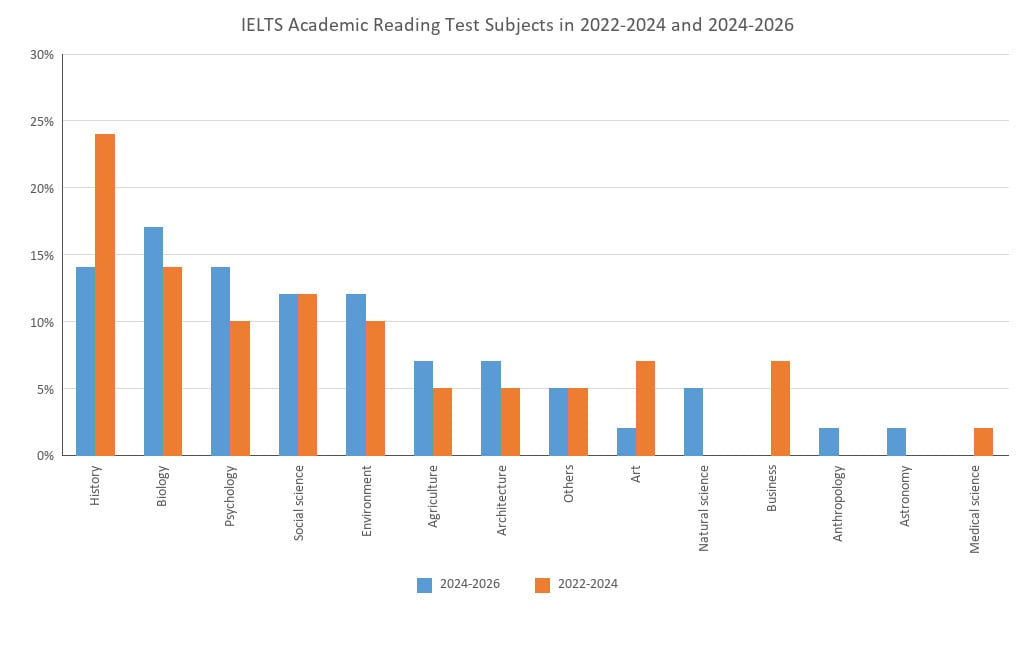
Bu eğilimler nedeniyle, IELTS okuma pratik testlerimizin bu konuları kapsadığından emin olduk. Ayrıca, ne olur ne olmaz diye, daha az kullanılan konulardan da okuma örnekleri ekledik. Tüm durumlar için hazırlanmanız önemlidir, çünkü hangi IELTS okuma konusunu alacağınızı asla bilemezsiniz.
IELTS Okuma Puanınız Nasıl Hesaplanır
Her IELTS okuma sorusu 1 puan değerindedir, bu nedenle 40 puana kadar "ham" puan alabilirsiniz. Ardından, ham puanınız bant puanınıza dönüştürülecektir. Aşağıdaki tablolar, ham IELTS okuma puanlarının her test için bant puanlarına nasıl dönüştürüldüğüne dair size genel bir fikir verebilir.
IELTS Genel Okuma Puanı - IELTS Akademik Okuma Puanı Karşılaştırması
| Ham Puanlar: Akademik | Bant Puanları: Akademik | Ham Puanlar: Genel | Bant Puanları: Genel |
|---|---|---|---|
| 39-40 | 9 | 40 | 9 |
| 37-38 | 8.5 | 39 | 8.5 |
| 35-36 | 8 | 37-38 | 8 |
| 33-34 | 7.5 | 36 | 7.5 |
| 30-32 | 7 | 34-35 | 7 |
| 27-29 | 6.5 | 32-33 | 6.5 |
| 23-26 | 6 | 30-31 | 6 |
| 19-22 | 5.5 | 27-29 | 5.5 |
| 15-18 | 5 | 23-26 | 5 |
| 13-14 | 4.5 | 19-22 | 4.5 |
| 10-12 | 4 | 15-18 | 4 |
| 8-9 | 3.5 | 12-14 | 3.5 |
| 6-7 | 3 | 9-11 | 3 |
| 4-5 | 2.5 | 6-8 | 2.5 |
| 1-3 | 2 | 1-5 | 2 |
Ancak, IELTS okuma testinin her sürümünün biraz farklı olduğunu ve belirli bir bant elde etmek için gereken puanın, o testi alan herkesin o belirli günde nasıl performans gösterdiğine bağlı olarak değiştiğini unutmayın. Bu nedenle, bir bant puanı almak için gereken doğru cevap sayısı testten teste biraz farklılık gösterecektir, ancak genel olarak bant 7 puanı almak istiyorsanız 40 üzerinden 30 civarında almayı hedeflemelisiniz.
Size hatırlatmak istediğimiz başka bir şey, en zor sorular ve en kolay sorular nihai okuma puanınıza eşit derecede sayılır, bu yüzden daha zor sorularda takılıp kalarak daha kolay puanları kaybetmediğinizden emin olun. Sırada bazı IELTS okuma ipuçları ve her okuma testi sorusunun nasıl yanıtlanacağına dair stratejiler sunacağız.
IELTS Okuma İpuçları - 11 Okuma Sorusu Türünü Nasıl Yanıtlanır
Okuma testinde 11 farklı soru türü vardır ve hepsinin farklı bir strateji gerektirir.
Her tipin örneği ve cevabı IELTS Reading soru tipleri rehberinde.
- Soru Türü 1 – Bilgi Eşleştirme
- Soru Türü 2 – Başlık Eşleştirme
- Soru Türü 3 – Özellik Eşleştirme
- Soru Türü 4 – Bilgi Belirleme
- Soru Türü 5 – Yazarın Görüşlerini/İddialarını Belirleme
- Soru Türü 6 – Çoktan Seçmeli
- Soru Türü 7 – Cümle Sonlarını Eşleştirme
- Soru Türü 8 – Cümle Tamamlama
- Soru Türü 9 – Özet, Not, Tablo, Akış Şeması Tamamlama
- Soru Türü 10 – Diyagram Etiketi Tamamlama
- Soru Türü 11 – Kısa Cevap Soruları
- Eğilimler IELTS Okuma Testine Hazırlanmanıza Nasıl Yardımcı Olur
Eğilimler IELTS Okuma Testine Hazırlanmanıza Nasıl Yardımcı Olur
Öğrencilerimizin en çok zorlandığı okuma sorusu türleri
BestMyTest öğrencileri deneme sınavlarımızda bir milyon Akademik Okuma sorusu ve 600.000 Genel Eğitim Okuma sorusu yanıtladı. Yüzdeler, her soru türünün ne sıklıkla doğru yanıtlandığını gösterir.
| Soru türü | Akademik | Genel Eğitim |
|---|---|---|
| Bilgi eşleştirme | 34% | 72% |
| Doğru / Yanlış / Belirtilmemiş | 39% | 60% |
| Çoktan seçmeli | 43% | 48% |
| Özellik eşleştirme | 48% | 74% |
| Cümle tamamlama | 49% | 75% |
| Başlık eşleştirme | 53% | 40% |
| Evet / Hayır / Belirtilmemiş | 55% | 57% |
| Özet tamamlama | 59% | 46% |
| Kısa yanıt | 54% | 75% |
- Akademik Okuma bölümünde başarı oranının en düşük olduğu iki soru türü, her ikisi de 40% düzeyinin altında kalan bilgi eşleştirme ve Doğru/Yanlış/Belirtilmemiş sorularıdır. Her ikisi de aynı anahtar kelimeyi bulmak yerine, farklı sözcüklerle ifade edilmiş bir fikri bulmanızı gerektirir.
- Genel Eğitim bölümünde ise tablo tersine döner: başlık eşleştirme, 40% ile başarı oranının en düşük olduğu soru türüyken, metinler daha kısa ve daha doğrudan anlatımlı olduğu için bilgiyi bulmaya yönelik soru türleri dört denemenin üçünde doğru yanıtlanır.
- Akademik metinlere ilişkin sorular ortalama 46%, Genel Eğitim metinlerine ilişkin sorular ise 59% oranında doğru yanıtlanır. Akademik metinlere yönelik denemelerin yarısında başarı oranı 40% veya daha düşüktür.
- 38.534 öğrencinin katıldığı toplam 43.711 tam kapsamlı okuma deneme sınavında ortalama bant puanı 5.4 oldu. Öğrencilerin 36% kadarı 6.0 bant puanına, 14% kadarı ise 7.0 bant puanına ulaştı.
- Yine de her soru türüne hazırlanmalısınız, ancak zamanınız kısıtlıysa tablo, zamanınızı en verimli şekilde nereye ayırabileceğinizi gösterir.
Rakamlar, Ekim 2026 tarihine kadar olan BestMyTest deneme sınavı ve değerlendirme verilerine dayanmaktadır. Soru türü yüzdeleri, tüm denemelerdeki doğru yanıt oranlarını gösterir; ölçütlere ilişkin rakamlar ise belirtildiği üzere eğitmen veya yapay zekâ tarafından verilen puanlardır. Son güncelleme: 5 Ekim 2026.
Sırada yüksek bir okuma puanı için gerekli IELTS okuma ipuçları ve stratejilerini gözden geçireceğiz.
IELTS Okuma İpuçları - Okuma Bant Puanınızı Nasıl Geliştirirsiniz
Çoğu öğrenci aşağıdaki üç nedenden dolayı okuma bölümünde başarısız olur
- Yavaş okuma hızı
- Zayıf kelime dağarcığı
- Az veya hiç hazırlık yok
Okuma hızınızı geliştirmek
Önce, açık olanı yoldan çıkaralım. Okuma hızınızı geliştirmek için, gerçekten okumayı uygulamanız ve bunu sürekli olarak yapmanız gerekir.
Şimdi, büyük cümle parçalarının anlamını anlamanıza yardımcı olacak daha az bariz bir stratejiye bakalım. Cümleyi parçalara ayırarak başlayın. Bunu, cümlenin öznesi ve fiilini arayarak yapın. Özne ve fiili bulmak, cümlenin anlamını anlamanıza yardımcı olacaktır. Akademik okuma metinlerinin anlaşılmasının zor olmasının bir nedeni, fikir dizilerini birleştirerek uzun bileşik cümleler oluşturmasıdır. Bu, daha zor sindirilebilen büyük cümle parçaları üretir, bu nedenle özne ve fiili tüm parçayı anlamak için rehberiniz olarak kullanmak, IELTS okuma sınavınız sırasında kullanabileceğiniz harika bir araçtır.
Kelime dağarcığınızı geliştirmek
Birçok insan, okuma sorularını yanıtlamanın paragrafı anahtar kelimeler ve bilgi için taramak kadar basit olduğunu düşünüyor... Maalesef, o kadar basit değil. okuma soruları genellikle parafraze edilir, yani kelimeler IELTS okuma metnindeki kelimelerin eş anlamlılarını kullanmak için değiştirilmiştir. Bu, zorluğu artırmak için yapılır, aksi takdirde test çok kolay olur. Bu nedenle, bir kelimenin birçok farklı eş anlamlısını bilmek için kelime dağarcığınızı geliştirmelisiniz.
Okuma testine hazırlanırken bilmediğiniz bir kelimeyle karşılaştığınızda, ya durup ona bakma ya da en azından yazıp sonra ona bakma alışkanlığı edinin. Biraz sıkıcı, ama son derece etkili. Hedefiniz, her gün 15 ila 20 yeni akademik kelime çalışmak olmalıdır, ancak bununla sınırlı değildir.
Hangi soru türlerinde cevapların sırada olduğunu/olmadığını bilmek
Bazı soru türleri için, cevapların genellikle (neredeyse her zaman) IELTS okuma metniyle aynı sırada olduğunu bilmek önemlidir. Diğer soru türleri için, cevaplar nadiren okuma metniyle aynı sırada olur. Takip eden ve etmeyen soru türleri için bir tablo tamamladık. Lütfen aklınızda bulundurun.
| Cevaplar genellikle (neredeyse her zaman) metinle aynı sırada | Cevaplar nadiren metinle aynı sırada. |
|---|---|
|
|
Sizin için en iyi okuma stratejisini bulmak
Çoğu insanın IELTS okuma sınavında karşılaştığı en büyük zorluk, zaman dolmadan tüm okuma sorularını tamamlamaktır. Bir sonraki bölümde, üç stratejiyi öğreneceksiniz ve hangisinin size en uygun olduğunu belirlemek size kalmış. Bunu ücretsiz okuma uygulamalarımız kullanarak yapacaksınız.
3 IELTS Okuma Stratejisi
Strateji 1: Tüm metni okumak ve ardından soruları cevaplamak.
Her şeyden önce, bu pek bir strateji değil. Bu, insanlar okuma sınavına düzgün şekilde hazırlanmadıklarında yapacakları bir şeydir. Ancak, teknik olarak konuşursak, ilk okuyuşta metinden bilgileri tutabilir ve soruları yanıtlayabilirseniz, strateji 2'ye ihtiyacınız olmayacak, bu yüzden bunu bir strateji olarak dahil ettik.
Bu strateji, ortalamanın üzerinde bir hafızanız yoksa, verimsizdir. Tüm soruları cevaplayabilmeden zamanınız tükenecek. Birçok insan bu hatayı yapar. Ancak, çok fazla çaba gerektirmeyen ve bu stratejiden yararlanabilecek bazı sorular vardır, Soru "Evet" veya "Hayır" cevabıysa, hızlıca tarayıp cevabı çabucak bulabilirsiniz, ancak bu soru türlerinden yeterince yok, bu yüzden bunu yapamazsanız bu stratejiyi kullanmak önerilmez.
Strateji 2: Önce soruları okumak, bir amaç için okumak ve not almak ve ardından soruları akıllıca cevaplamak
Bu bizim önerdiğimiz stratejidir. Daha yüksek bir IELTS okuma puanı almanıza yardımcı olacaktır. Bunu sınava genel olarak nasıl yaklaşılacağına dair net bir harita olarak düşünün:
Adayların okuma sınavına yaklaşırken yaptığı en yaygın hatalardan biri,
IELTS okuma metinlerinin her bir kelimesini okumaktır. Sınava sınıf okuma yaparak hazırlanabilirsiniz, ancak
"kör okuma" (soruların ne soracağına dair herhangi bir his olmadan okuma)
sınavda size hiçbir iyilik yapmayacak. Bunun yerine, zamanınızı etkili bir şekilde yönetme ve en iyi puanı alma şansınızı zarar verecektir.
Önce soruları okumanın ana nedeni, soru türünün metinde ne okuyacağınızı veya nasıl okuyacağınızı belirleyebilmesidir.
Örneğin, bazı soru türleri "tarama" tekniğini gerektirebilirken, diğerleri "okuma" tekniğini gerektirebilir.
Aynı soru türündeki bir dizi soruyu ele almak önemlidir.
İlk önce hangi soru türünü ele almak istediğinizi belirlemeniz gerekecek.
İyi bir strateji, daha kolay soru türüyle başlamak ve daha sonra daha zor soru türlerine geçmek olur.
En kolay soru türleri, daha az zaman okuduğunuz türlerdir.
Örneğin, Başlık Eşleştirme soru türü daha kolay bir türdür çünkü
sadece bir paragrafın ana fikrini en iyi tanımlayan başlığı bulmanız gerekir.
Zor bir soru türünün bir örneği Bilgi Belirleme olur. Bu soru türü için,
her ifadenin metne göre DOĞRU, YANLIŞ veya VERİLMEMİŞ olup olmadığını öğrenmek için her paragrafı okumanız gerekir.
İşte her soru türü için zorluk seviyelerini listeleyen bir tablo. Hangi soru türünü ilk önce ele alacağınızı seçerken bu tabloyu referans olarak kullanın.
| Zorluk seviyesi | Soru Türü |
|---|---|
| Kolay | Başlık Eşleştirme Kısa cevap |
| Orta |
Cümle Sonlarını Eşleştirme Özellik Eşleştirme Çoktan seçmeli Cümle Tamamlama Diyagram Etiketi, Özet, Not, Tablo, Akış Şeması Tamamlama |
| Zor |
Bilgi Eşleştirme Bilgi Belirleme (DOĞRU/YANLIŞ/VERİLMEMİŞ) İzleyici İddialarını Belirleme (EVET/HAYIR/VERİLMEMİŞ) |
IELTS metninden soruları okuduktan sonra, bir amaç için okumaya başlayabilirsiniz. Bu ne anlama geliyor? Örneğin, "1896" yılını içeren bir soru ile karşılaştığınızda, bu yılın metinde ne zaman geldiğine dair not alabilir, daha sonra soruyu cevaplamak için kullanabilirsiniz.
Bir amaç için okurken takip etmenize yardımcı olacak iki okuma tekniği vardır. İlki, tarama, bir metnin "özünü" veya genel fikrini elde etmek için hızlı okuma olarak en iyi şekilde tanımlanır. Bu teknikle, herhangi bir tanıdık olmayan kelime için durmuyorsunuz veya belirli ayrıntıları aramıyorsunuz. İkinci teknik, okuma, belirli bilgileri okuma olarak en iyi şekilde tanımlanır. Bu teknikle, genel öz için değil, belirli bilgi için okuyorsunuz. Bu tekniklerin her birinin nasıl belirli bir amacı olduğuna dikkat edin. Bu, bilgileri daha hızlı bulmanıza yardımcı olacaktır.
Bir amaç için okurken, ayrıca metnin kenarlarına notlar almanız, çeşitli soruları cevaplamanıza yardımcı olacağına inandığınız anahtar bilgilerin yanına yıldızlar koymanız veya altını çizmeniz gerekir. Bu, sorularda belirli şeyler sorulduğunda geri kontrol etmenizi kolaylaştıracaktır. Sizin için doğru olan not alma sistemini seçin - sadece yaptığınızdan emin olun!
Soruları okuduktan, metni okuduktan ve uygun notlar aldıktan sonra, dikkatli okumanız gereken metnin bölümünü bulmuş olmalısınız. Sonra sadece dikkatli okuyun ve doğru cevabı belirlemek için eleştirel düşünün.
Strateji 3: Tarama, not alma ve soru türleri.
Bu, birçok IELTS test alıcısı tarafından kullanılan başka bir stratejidir. Daha yüksek bir okuma puanı almanıza yardımcı olacaktır. Strateji 4 adımdan oluşur:
- Her paragrafın genel fikrini almak için her paragrafı tarayın. Bir paragrafın ana fikri genellikle ilk birkaç cümlede bulunur, bu yüzden bu cümlelere biraz daha odaklanın. Sonraki cümleler hızlıca taranabilir, öne çıkan isimleri/kelimeleri/ifadeleri altını çizerek.
- Her paragrafı taradıktan sonra, o paragrafın ana fikri hakkında en iyi tahmininizle her paragrafın yanına kısa notlar (2-5 kelime) yazın.
- Sonra, aynı soru türünden bir dizi soruyu cevaplayın.
- Son olarak, bir dizi soruyu verimli ve doğru bir şekilde cevaplayın.
Adım 1 ve 2'ye 3-5 dakikadan fazla harcamamanız önemlidir. Bu adımlara çok fazla zaman harcamak çok zaman boşa harcayacak ve sonunda zamanınız tükenecek.
Adım 1 ve 2Buradaki amaç, metinde cevap bulmak için verimli bir yöntem oluşturmaktır. Her paragrafın genel fikrini yazarak, her sorunun cevabını içeren paragrafın hangisi olduğunu bileceksiniz. Bu size çok zaman kazandıracaktır çünkü onu yazmasaydınız, muhtemelen sorunun genel fikri için her paragrafı taramaya ihtiyacınız olurdu, sonra cevap için paragrafı dikkatlice taramanız gerekirdi. Her paragrafın ana fikrini not alarak, her paragrafı tarama ilk adımını atlayabilir ve cevabı taramaya başlayabilirsiniz.
Adım 3
Metni iyice taradıktan ve bazı notlar yazdıktan sonra, Adım 3 için hazırsınız.
Bu adımda, ilk önce hangi soru türünü ele almak istediğinizi belirlemeniz gerekecek.
İyi bir strateji, daha kolay soru türüyle başlamak ve daha sonra daha zor soru türlerine geçmek olur.
En kolay soru türleri, daha az zaman okuduğunuz türlerdir.
Örneğin, Başlık Eşleştirme soru türü daha kolay bir türdür çünkü
sadece bir paragrafın ana fikrini en iyi tanımlayan başlığı bulmanız gerekir, bu nedenle teknik olarak bu soru türünü cevaplamak için yalnızca Adım 1 ve 2'ye ihtiyacınız var.
Zor bir soru türünün bir örneği Bilgi Belirleme olur. Bu soru türü için,
her ifadenin metne göre DOĞRU, YANLIŞ veya VERİLMEMİŞ olup olmadığını öğrenmek için her paragrafı okumanız gerekir.
İşte her soru türü için zorluk seviyelerini listeleyen bir tablo. Hangi soru türünü ilk önce ele alacağınızı seçerken bu tabloyu referans olarak kullanın.
| Zorluk seviyesi | Soru Türü |
|---|---|
| Kolay | Başlık Eşleştirme Kısa cevap |
| Orta |
Cümle Sonlarını Eşleştirme Özellik Eşleştirme Çoktan seçmeli Cümle Tamamlama Diyagram Etiketi, Özet, Not, Tablo, Akış Şeması Tamamlama |
| Zor |
Bilgi Eşleştirme Bilgi Belirleme (DOĞRU/YANLIŞ/VERİLMEMİŞ) İzleyici İddialarını Belirleme (EVET/HAYIR/VERİLMEMİŞ) |
Şimdi ilk önce hangi soru setini cevaplayacağınızı bulduğunuza göre, gerçekten onları cevaplamanın zamanı geldi :( Endişelenmeyin! Her soru türü farklı olsa da, onları doğru cevaplama stratejisi hepsine uygulanır. Temel ilke basittir, sadece aşağıdaki adımları takip edin:
- Soruyu dikkatlice okuyun ve önemli anahtar kelimeleri belirleyin.
- Soruyu cevaplamak için gereken bilgileri içeren paragrafı bulun. (Umarım her paragraf için genel fikirleri zaten yazmışsınızdır, böylece bunu kolayca anlayabilirsiniz.)
- Dikkatli okumanız gereken metnin bölümünü bulana kadar paragrafı önemli anahtar kelimeler için tarayın (Bunlar büyük olasılıkla eş anlamlılardır!).
- Son olarak, dikkatli okuyun ve doğru cevabı belirlemek için eleştirel düşünün.
Cevaplarla Birlikte Ücretsiz IELTS Okuma Örnek PDF İndirmeleri
Aşağıda British Council'den (IELTS sınavının yapımcıları) bazı ücretsiz okuma örnekleri bulunmaktadır. Soruları cevaplamaya çalışın ve nasıl yaptığınıza bakın!