
Bu rehberde, ücretsiz bir IELTS dinleme testi çözecek ve eksiksiz bir IELTS dinleme puan analizi alacaksınız. 125'ten fazla IELTS dinleme deneme testi, ders, ipucu ve videolu cevap açıklamasıyla hazırlanacaksınız. Kişiselleştirilmiş çalışma planımızı takip ederek hedeflediğiniz IELTS dinleme bant puanına ulaşacaksınız.
Ucretsiz bir IELTS listening pratik testini tamamladiktan sonra ucretsiz IELTS listening puan analizi ve kisisellestirilmis calisma plani alin.
play_circle_outline IELTS Listening pratik testini baslatAsagida cevaplariyla birlikte tum IELTS listening sorularimizin listesi yer alir. Not: kirmizi baglantilar, ogrencilerimiz tarafindan puanlanan en populer ve onerilen listening sorularimizdir; bunlari istediginiz zaman ucretsiz calisabilirsiniz.
IELTS Dinleme Bölüm 1 Alıştırma Testi Soruları 1 - 59
A conversation between two people in an everyday situation
IELTS Dinleme Bölüm 2 Alıştırma Testi Soruları 1 - 75
A talk by one speaker about an everyday topic
IELTS Dinleme Bölüm 3 Alıştırma Testi Soruları 1 - 65
A conversation between up to four people about studies or training
IELTS Dinleme Bölüm 4 Alıştırma Testi Soruları 1 - 62
A talk by one speaker on an academic subject
IELTS Dinleme Deneme Testi Rehberi
Bu rehberin geri kalanı size IELTS dinleme testi hakkında bilmeniz gereken her şeyi öğretecek. Dinleme puanının nasıl hesaplandığını öğrenecek, dinleme bant puanınızı yükseltmek için her bir dinleme soru tipini nasıl başarıyla yanıtlayacağınızı keşfedecek ve IELTS dinleme testlerine çevrimiçi çalışmanıza yardımcı olacak kanıtlanmış 3 adımlı bir süreç öğreneceksiniz.
İçindekiler
IELTS Dinleme Testi Bilgisi
IELTS dinleme testi 4 bölüme ayrılmıştır. Her bölümde, ana dili İngilizce olan bir veya birden fazla konuşmacıyı dinleyecek, ardından az önce duyduklarınızla ilgili yaklaşık 10 soruyu yanıtlayacaksınız. Tüm dinleme bölümünde toplam 40 soru bulunmaktadır. Genel olarak, dinleme kayıtları en kolayından başlayıp testte ilerledikçe zorlaşır. Her kayıt yalnızca bir kez çalınır ve İngiliz, Avustralya, Yeni Zelanda, Amerikan ve Kanada gibi çeşitli aksanları içerir.
- Bölüm 1 – Günlük sosyal bir bağlamda iki kişi arasındaki bir konuşma. Örneğin, bir rezervasyonun ayrıntılarını doğrulamak için yapılan bir görüşmeyi veya telefonla bir sipariş veren birini dinleyebilirsiniz.
- Bölüm 2 - Günlük sosyal bir bağlamda bir monolog. Örneğin, yerel olanaklar hakkında bir konuşmayı, yol tarifi veren birini veya bir etkinlik hakkında temel bilgiler veren birini dinleyebilirsiniz.
- Bölüm 3 – Eğitim veya öğretim bağlamında dört kişiye kadar olan bir konuşma. Örneğin, bir üniversite profesörü ve bir öğrencinin bir ödev hakkında konuştuğunu veya iki öğrencinin sınıftan bir şey hakkında konuştuğunu dinleyebilirsiniz.
- Bölüm 4 - Akademik bir konu hakkında bir monolog. Örneğin, bir profesörden üniversite dersi dinleyeceksiniz. Bu, çoğu öğrenci için dinleme testinin en zor kaydıdır.
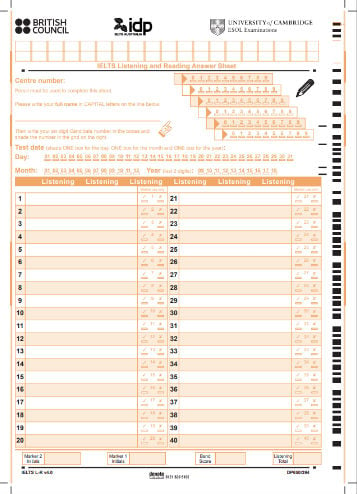
IELTS dinleme testi yaklaşık 40 dakika sürer. Kayıtları dinlemek ve soruları yanıtlamak için 30 dakika harcayacaksınız. Size bir soru kitapçığı ve bir cevap kağıdı verilecektir. Soru kitapçığı, yanıtlamanız gereken tüm soruları bulacağınız yerdir. Cevap kağıdı ise nihai cevaplarınızı puanlandırılmak üzere yazacağınız yerdir.
resmi IELTS dinleme cevap kağıdı PDF'ini buradan görüntüleyebilir veya aşağıdaki resme bakabilirsiniz :)
Dinleme bölümünün sonunda, cevaplarınızı soru kitapçığından cevap kağıdına aktarmanız için 10 dakika verilir.
Önemli!
Yazım hataları ve yanlış dilbilgisi yanlış olarak işaretlenir, bu nedenle 10 dakikayı yazım ve dilbilgisini iki kez kontrol etmek için kullanın.
IELTS Dinleme Puan Hesaplama
Dinleme bölümünde, her soru bir puan değerindedir, bu nedenle 40 puan kadar "ham" puan elde edebilirsiniz. Daha sonra ham puanınız bir bant puanına dönüştürülür. Unutmayın! Yanlış cevaplardan dolayı puan kaybetmezsiniz. Aşağıdaki tablo, ham puanların bant puanlarına nasıl dönüştürüldüğüne dair size genel bir fikir verebilir.
| Ham Puanlar | Bant Puanları |
|---|---|
| 39-40 | 9 |
| 37-38 | 8.5 |
| 35-36 | 8 |
| 32-34 | 7.5 |
| 30-31 | 7 |
| 26-29 | 6.5 |
| 23-25 | 6 |
| 18-22 | 5.5 |
| 16-17 | 5 |
| 13-15 | 4.5 |
| 11-12 | 4 |
IELTS'in her sürümü biraz farklı olduğundan, belirli bir bant puanına ulaşmak için gereken ham puan, o gün teste girenlerin nasıl performans gösterdiğine bağlı olarak değişir. Bu nedenle, bant puanı için gerekli olan doğru cevap sayısı testten teste hafifçe değişecektir; ancak genel olarak, bant 7 puanı almak istiyorsanız 40 üzerinden yaklaşık 30 hedeflemelisiniz.
Yukarıda belirtildiği gibi, IELTS dinleme testinde ilerledikçe bölümler zorlaşır. Bununla birlikte, her soru aynı sayıda puana değer. Bu nedenle, zor sorulara takılı kaldığınız için kolay puanları kaybetmediğinizden emin olun.
Cevaplı Ücretsiz IELTS Dinleme Örnek PDF İndirme
İşte British Council'den (IELTS testinin yapımcıları) bazı ücretsiz IELTS dinleme örnekleri PDF'leri ve cevapları. Bağlantıların altında BestMyTest'in ücretsiz ses kaydı ve cevaplarıyla IELTS dinleme testini de çözebilirsiniz. Testte dört bölümün hepsi var ve her bölüm cevaplarla birlikte ses transkriptini gösteriyor. Soruları yanıtlamayı deneyin ve nasıl yapacağınızı görün!
- IELTS Dinleme Deneme Testi 1 - Sorular (Çevrimiçi Örnekler)
- IELTS Dinleme Deneme Testi 1 - Cevaplar (PDF)
- IELTS Dinleme Deneme Testi 1 - Cevap Kağıdı (PDF)
Kaydı dinleyin ve 1-10 arası soruları yanıtlayın. Cevaplar ve ses transkripti soruların altındaki kutudadır.
Questions 1-10
Complete the notes below.
Write ONE WORD AND/OR A NUMBER for each answer.
This can provide the carer with:
• time for other duties
• a 1
Assessment of aunt's needs
This may involve discussing:
• how much 2 is spent caring
Daily tasks discussed:
• help with dressing
• helping her take a 3
• shopping
• helping with meals
• managing 4
• any parts of caring that are particularly hard, e.g.
• loss of 5
• 6 her
• avoiding a 7
Types of support that may be provided for carers
• transport costs, e.g. cost of a 8
• vehicle-related costs, e.g. fuel and 9
• help with housework
• support to lower 10
-
spellcheck Cevaplar
1. Break
Break is correct because this detail is stated in the recording at the point where the question is answered.2. Time
Time is correct because this detail is stated in the recording at the point where the question is answered.3. Shower
Shower is correct because this detail is stated in the recording at the point where the question is answered.4. Money
Money is correct because this detail is stated in the recording at the point where the question is answered.5. Memory
Memory is correct because this detail is stated in the recording at the point where the question is answered.6. Lifting
Lifting is correct because this detail is stated in the recording at the point where the question is answered.7. Fall
Fall is correct because this detail is stated in the recording at the point where the question is answered.8. Minicab
Minicab is correct because this detail is stated in the recording at the point where the question is answered.9. Parking
Parking is correct because this detail is stated in the recording at the point where the question is answered.10. Anxiety
Anxiety is correct because this detail is stated in the recording at the point where the question is answered.
Audio ScriptNora: It's really good to see you, Marcus. Since I had to give up work, I feel I'm losing touch with my friends and colleagues.
Marcus: We really miss you in the office. We were all so sorry you had to leave. But you must be relieved to have more time to look after your aunt. How is she?
Nora: Well, she's very cheerful, but she needs a lot of help.
Marcus: Have you tried to get any support from the local council?
Nora: No. I didn't know I could.
Marcus: Yes. But for different kinds of practical support, they realise that carers sometimes need time for all the other responsibilities they have, apart from the person they're caring for, and also that they sometimes need a break.
Nora: Absolutely. OK, so tell me more, how do I go about getting this support?
Marcus: Well, you'd have to have an assessment of your aunt's needs. That means someone would come round and talk to you about the situation and what you need. So for a start, they'd want to know the amount of time you spend looking after your aunt every day.
Nora: OK.
Marcus: Then they'll probably ask you what sorts of tasks you do for your aunt during the day. Things like if she needs help with getting dressed, for example.
Nora: Right. I help her with that. And also I help her get into the shower in the morning.
Marcus: Yes. That sort of thing. They'll probably ask you if you do the shopping for her, and help her at meal times, and whether she can cope using money.
Nora: Yes. That's becoming a bit of a problem. She used to be very good at it, but not anymore.
Before you hear the rest of the conversation, you have some time to look at questions 5 to 10. [20 seconds] Now listen, and answer questions 5 to 10.Marcus: And be ready to tell them about anything you find particularly difficult about caring for your aunt.
Nora: So recently I've noticed she started to have quite bad problems with her memory. If I wasn't there, I think she'd forget to eat, for example. And often she doesn't seem quite sure what day it is.
Marcus: Yes. Tell them about that. And are there any physical difficulties you have caring for her? Lifting her, for example.
Nora: Yes. She's quite heavy, and I'm afraid of hurting my back. I'd be in real trouble if that happened.
Marcus: They can give you advice about that, and also about how to avoid the possibility of your aunt having a fall.
Nora: Great. So, once they've done this assessment, if I'm eligible, what happens next?
Marcus: Well, they might support you financially. So they might help you with travel costs, like if you have to get a minicab to take your aunt for an appointment, for example.
Nora: I usually drive her myself, actually. So could I claim for the petrol?
Marcus: You could. And you can claim for the parking, too.
Nora: Oh, right.
Marcus: And if you need help with the housework, they can arrange for someone to come along once or twice a week. And one other thing. I hope you don't mind me saying this, but it's important you look after yourself. And it seems to me you're dealing with quite a bit of anxiety.
Nora: I am, yes.
Marcus: Well, tell the council, because they may be able to give you some advice on how to minimise it.
Nora: Really? Though, actually, I feel so much better having talked to you. I'll get in touch with the council straight away. Now, shall we go for coffee, or something?
Kaydı dinleyin ve 11-20 arası soruları yanıtlayın. Cevaplar ve ses transkripti soruların altındaki kutudadır.
Questions 11-14
Choose the correct letter, A, B or C.
11. Who began turning the unused Whitfield site into a planted space?
- city council officials.
- nearby residents.
- a gardening charity.
12. What was Lillian Hartley trying to achieve through public campaigning?
- preventing a housing sale
- blocking army exercises
- winning maintenance funding
13. Why was the park rejected as a place for troop exercises?
- council permission was refused.
- too little usable space.
- a better site was chosen.
14. How does the speaker describe the latest redesign plans?
- 2013 plan used unchanged.
- 2013 plan revised pre-work.
- 2015 plan finished in 2016.
Questions 15-20
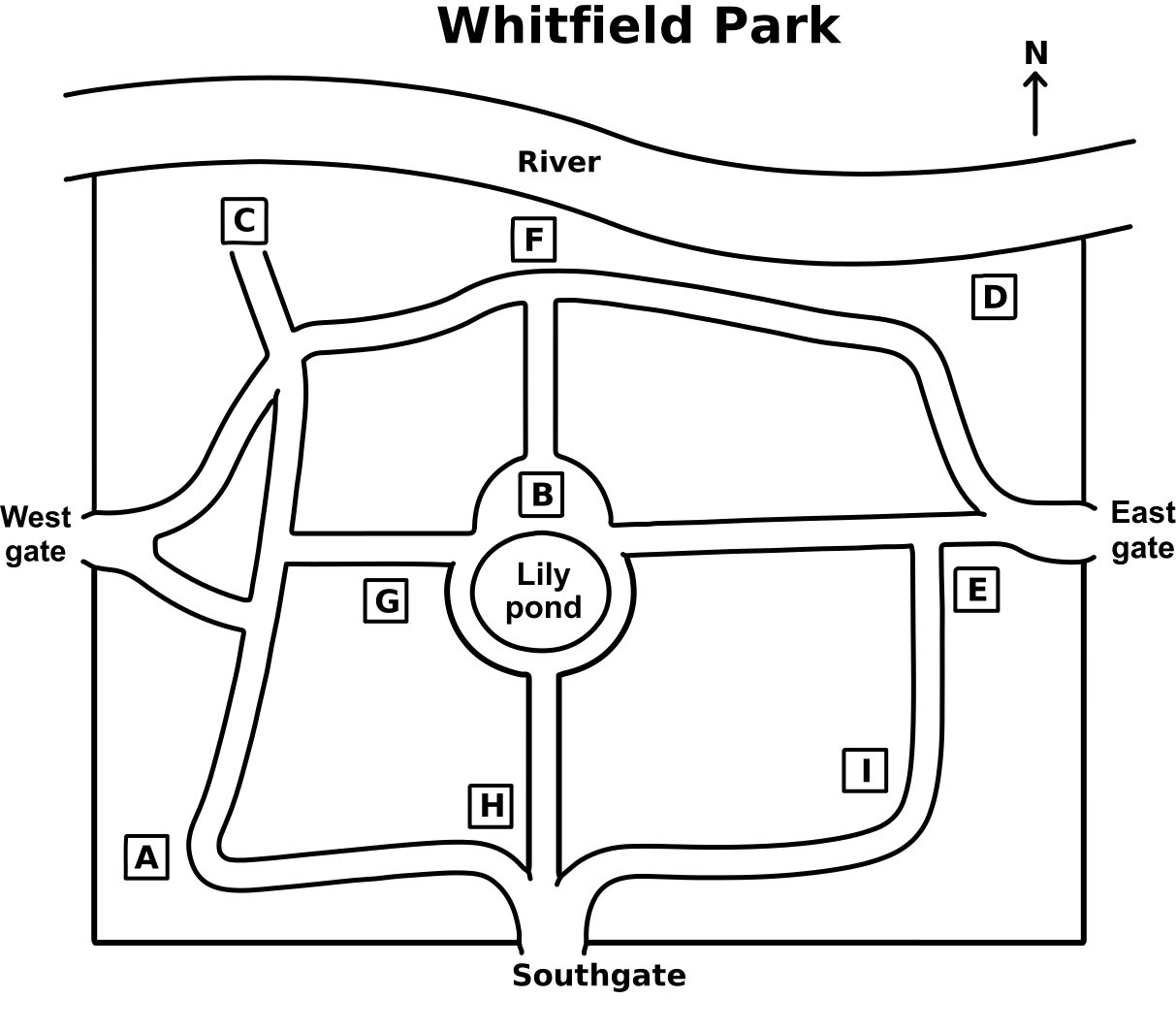
Label the plan of Whitfield Park below.
Write the correct letter, A-I, next to questions 15-20.
- statue of Lillian Hartley
- wooden sculptures
- playground
- maze
- tennis courts
- fitness area
-
spellcheck Cevaplar
11. B
(A) is incorrect. The council took ownership later.(B) is correct. The initial planting was done by residents from nearby streets.
(C) is incorrect. The recording does not support this option: a gardening charity.
12. A
(A) is correct. Hartley organised public pressure so the council would keep the land as a park rather than sell it for housing.(B) is incorrect. The recording does not support this option: blocking army exercises.
(C) is incorrect. The recording does not support this option: winning maintenance funding.
13. B
(A) is incorrect. The recording does not support this option: council permission was refused.(B) is correct. , after inspection, the army concluded that the park was too small for practical use.
(C) is incorrect. The recording does not support this option: a better site was chosen.
14. B
(A) is incorrect. The recording does not support this option: 2013 plan used unchanged.(B) is correct. The plans dated from 2013 but were revised in 2015 before work began.
(C) is incorrect. The recording does not support this option: 2015 plan finished in 2016.
15. B
The correct answer is B because the statue of Lillian Hartley is now immediately north of the lily pond near the centre of the park, and that position is labelled B.16. D
The correct answer is D because the wooden sculptures are on the riverbank where the path from the East Gate makes a sharp bend, which corresponds to D.17. F
The correct answer is F because the playground is between the river and the path from the lily pond to the river, and that location is marked F.18. C
The correct answer is C because the maze is found by entering from the West Gate, walking north, and turning left, which places it at C.19. A
The correct answer is A because the tennis courts remain in the southern corner where the perimeter path makes a right-angled bend, labelled A.20. G
The correct answer is G because the fitness area is beside the lily pond on the same side as the West Gate, matching G on the plan.
Audio ScriptI'm delighted this evening to introduce our guest speaker, Sarah Holloway, who is going to talk to us about the recent transformation of Whitfield Park. Over to you, Sarah. Thank you very much. I'm sure you all know Whitfield Park well, it has been one of the city's landmarks for well over a century, and the city council has been responsible for it for most of that time. What perhaps fewer of you will know is how the park actually began.
Unlike many city centre parks, which started life as the private gardens of a large house, Whitfield was originally just an unused patch of waste ground. The first flowers there were actually planted by a small group of local residents who lived in the surrounding streets. They began work on the site in 1892. At that point nobody was entirely sure who legally owned the land, and it was a full twenty years later before the city council finally took it into public ownership. Some of you will have seen the statue near one of the gates. That figure is Lillian Hartley, who played a really important role in the early history of the park.
Once the council legally owned the land, its first instinct was to sell it off as building plots for housing. A great many local residents, however, wanted the park to stay open as a place where everyone could enjoy fresh air and green space, bear in mind that this is a very densely built up residential district. Lillian Hartley was at the heart of that campaign, and it was she who organised the petitions and the public demonstrations which, in the end, persuaded the council to drop the sale and keep the land as a park.
Soon afterwards, in 1914, the First World War broke out, and most of the park was dug up and used to grow vegetables, which were sold to local residents. At one point the army did look into taking over the park as a site for troop exercises. They actually wrote to the city council about it, but when they inspected it they concluded that the park was simply too small to be of any practical use to them, so the idea was dropped. The only military activity in the park during the war was the occasional public meeting held on a small area of grass that had been kept clear of vegetable plots.
After the war, the park was largely returned to the way it had been before 1914, and from then on it remained almost unchanged for decades. New plans for transforming the park were drawn up several times over the years; the most recent version dates from 2013, but those plans were then revised in 2015, well before any actual work had got under way. Work on the ground finally began in 2016 and was completed, on schedule, last year.
Before you hear the rest of the talk, you have some time to look at questions 15 to 20. [20 seconds] Now listen and answer questions 15 to 20.All right, I'd like to describe some of the more important changes that have been made, and one or two things that have deliberately been left as they were. If you take a quick look at the map you've been handed, you'll see the familiar outline of Whitfield Park. The river forms the northern boundary, and there is a gate in each of the three other walls.
From there, follow the path up towards the river and the enlarged children's playground sits between that path and the river itself. If you keep your eye on the riverbank, over towards the East Gate side, the new wooden sculptures are at the point where the path coming up from that gate makes a sharp bend.
Back near the West Gate side of the park, there is a maze, a circular pattern of paths separated by low hedges. Head in from the West Gate, walk north towards the river, and then turn left to find it. Close to the same central lily pond, on the side facing the West Gate, you'll also find the new outdoor fitness area.
Down in the southern corner, where the perimeter path makes that distinct right angled bend, the tennis courts are still in their familiar position, though we have now doubled them from four to eight. Now, since you are all keen gardeners, I'm sure you'll want to hear about the plants that have been chosen for the new beds.
Kaydı dinleyin ve 21-30 arası soruları yanıtlayın. Cevaplar ve ses transkripti soruların altındaki kutudadır.
Questions 21-25
Choose the correct letter, A, B or C.
21. Nina and Owen were surprised to learn that coastal cities
- are home to just under half of all people.
- account for many of the largest cities.
- are expanding at double the rate of inland cities.
22. According to Owen, building coastal cities near to rivers
- can carry contamination back towards urban areas.
- can leave too little land for farming upstream.
- can cause factories to damage rural scenery.
23. What mistake was made when building water drainage channels in Port Selby in the 1950s?
- The system did not include enough channels.
- The builders selected the wrong construction materials.
- The design failed to anticipate rising sea levels.
24. What do Nina and Owen think that the authorities in Port Selby should do immediately?
- take measures to restore coastal ecosystems
- pay for a new flood prevention system
- stop disposing of waste materials into the ocean
25. What do they agree should be the priority for international action?
- greater coordination of activities
- more sharing of information
- agreement on shared policies
Questions 26-30
What decision do the students make about each of the following parts of their presentation?
Write the correct letter, A-G, next to questions 26-30.
- use visuals
- keep it short
- involve other students
- check the information is accurate
- provide a handout
- focus on one example
- do online research
- Historical background
- Geographical factors
- Past mistakes
- Future risks
- International implications
-
spellcheck Cevaplar
21. B
(A) is incorrect. The recording does not support this option: are home to just under half of all people.(B) is correct. Nina says most of the biggest cities are built by the sea.
(C) is incorrect. The recording does not support this option: are expanding at double the rate of inland cities.
22. A
(A) is correct. Owen says pollutants from inland agriculture and industry travel down rivers to cities.(B) is incorrect. The recording does not support this option: can leave too little land for farming upstream.
(C) is incorrect. The recording does not support this option: can cause factories to damage rural scenery.
23. C
(A) is incorrect. The recording does not support this option: The system did not include enough channels.(B) is incorrect. The recording does not support this option: The builders selected the wrong construction materials.
(C) is correct. Port Selby's drainage channels were built without allowing for global warming and rising sea levels.
24. B
(A) is incorrect. The recording does not support this option: take measures to restore coastal ecosystems.(B) is correct. Nina says they need money to replace the drainage channels for flood protection now.
(C) is incorrect. The recording does not support this option: stop disposing of waste materials into the ocean.
25. A
(A) is correct. They say coastal cities must act together internationally.(B) is incorrect. The recording does not support this option: more sharing of information.
(C) is incorrect. The recording does not support this option: agreement on shared policies.
26. B
B is correct because they decide not to spend too long on historical background, so they will keep it short.27. A
A is correct because they decide to use slides with maps showing geographical factors.28. F
F is correct because they choose the Meriton case study as the basis for past mistakes, focusing on one example.29. G
G is correct because they need to look at websites for future risks, so online research is required.30. C
C is correct because they plan to ask audience members from different places, involving other students.
Audio ScriptTutor: OK, so what I'd like you to do now is to talk to your partner about your presentations on environmental planning. You should have done most of the reading now, so I'd like you to share your ideas and talk about the structure of your presentation and what you need to do next.
Nina: OK, Owen, I'm glad we chose quite a specific topic: coastal cities. It made it much easier to find relevant information.
Owen: Yeah, and cities are growing so quickly. I mean, we know that more than half the world's population lives in cities now.
Nina: Yeah, though that's all cities, not just coastal ones. But most of the biggest cities are actually built by the sea. I'd not realised that before.
Owen: Nor me. And what's more, a lot of them are built at places where rivers come out into the sea. But apparently this can be a problem.
Nina: Why?
Owen: Well, as the city expands, agriculture and industry tend to spread further inland along the rivers. And so agriculture moves even further inland up the river. That's not necessarily a problem, except it means more and more pollutants are discharged into the rivers.
Nina: That's a serious problem.
Owen: Right.
Nina: Did you read that article about Port Selby on the south coast?
Owen: No.
Nina: Well, apparently back in the 1950s, they built channels to drain away the water in case of flooding.
Owen: Sounds sensible.
Nina: Yeah, they spent quite a lot of money on them. But what they didn't take into account was global warming. So they built the drainage channels too close to sea level. And now sea levels are rising, they're more or less useless. If there's a lot of rain, the water can't run away. There's nowhere for it to go.
Owen: So they did not help much in the end.
Nina: So what are the authorities doing about it now?
Owen: I don't know. I did read that they're aiming to stop disposing of waste water into the ocean over the next 10 years. But that won't help with flood prevention now, will it?
Nina: No, really, they just need to find the money for something to replace the drainage channels in order to protect against flooding now. But in the long term, they need to consider the whole ecosystem.
Owen: Right.
Nina: Really though, coastal cities can't deal with their problems on their own, can they? I mean, they've got to start acting together at an international level instead of just doing their own thing.
Owen: Absolutely. The thing is, everyone knows what the problems are and environmental planners have a pretty good idea of what we should be doing about them. So they should be able to work together to some extent.
Nina: But it's going to be a long time before countries come to a decision on what principles they're prepared to abide by.
Owen: Yeah, if they ever do.
Before you hear the rest of the conversation, you have some time to look at questions 26 to 30. [20 seconds] Now listen and answer questions 26 to 30.Nina: So I think we've probably got enough for our presentation. It's only 15 minutes.
Owen: OK, so I suppose we'll begin with some general historical background about why coastal cities were established. But we don't want to spend too long on that. The other students will already know a bit about it.
Nina: It's all to do with communications and so on.
Owen: Yes, we should mention some geographical factors, things like wetlands and river estuaries and coastal erosion and so on.
Nina: We could have some maps of different cities with these features marked.
Owen: On a handout, you mean, or some slides everyone can see.
Nina: Yeah, that'd be better.
Owen: It'd be good to go into past mistakes in a bit more detail. Did you read that case study of the problems there were in Meriton with flooding a few years ago?
Nina: Yes, we could use that as the basis for that part of the talk. I don't think the other students will have read it, but they'll remember hearing about the flooding at the time.
Owen: Hmm, OK. So that's probably enough background. So then we'll go on to talk about what actions have been taken to deal with the problems of coastal cities.
Nina: OK, what else do we need to talk about? Maybe something on future risks looking more at the long term if populations continue to grow?
Owen: Yeah, we'll need to do a bit of work there. I haven't got much information, have you?
Nina: No, we'll need to look at some websites. Shouldn't take too long.
Owen: OK. And I think we should end by talking about international implications. Maybe we could ask people in the audience. We've got people from quite a lot of different places.
Nina: That'd be interesting if we have time, yes. So now should we go on?
Kaydı dinleyin ve 31-40 arası soruları yanıtlayın. Cevaplar ve ses transkripti soruların altındaki kutudadır.
Questions 31-36
What point does the lecturer make about each item?
Write the correct letter, A-K, next to questions 31-36.
- changes drainage
- protects animals
- increases nutrients
- kills germs
- affects many species
- creates dense shade
- alters the soil
- supports farming
- reduces competition
- attracts bell-miners
- helps recovery
- Eucalyptus woodland
- Damage to eucalyptus woodland
- Oil from eucalyptus leaves
- Lime used in construction
- Direct iron supply
- Moderate bushfires
Questions 37-40
Complete the notes below.
Write ONE WORD ONLY for each answer.
Bell-miner associated dieback:
• The process starts with insects feeding on eucalyptus 37
• A sweet liquid containing 38 attracts bell-miners
Fire patterns:
• If fires happen too often, 39 becomes the main vegetation
• When fires are almost absent, thick growth gives bell-miners protected 40 sites
-
spellcheck Cevaplar
31. B
B is correct because eucalyptus woodland provides nesting places and shelter for birds, bats and small mammals.32. E
E is correct because damage to eucalyptus woodland affects a wider community of species, not only the trees themselves.33. D
D is correct because oil from eucalyptus leaves is used in disinfectant, where it can kill certain germs.34. G
G is correct because lime from road construction was washed into the soil and interfered with tree roots.35. K
K is correct because affected trees recovered surprisingly quickly when iron was supplied directly.36. I
I is correct because occasional fire removes fast-growing competitors that would otherwise use water needed by eucalyptus trees.37. leaves
The correct answer is leaves. The lecturer says the process begins when insects settle on eucalyptus leaves and feed on them.38. sugar
The correct answer is sugar. The lecturer says the insects produce a sweet liquid containing sugar, which attracts bell-miners.39. grass
The correct answer is grass. The lecturer says grass tends to dominate afterwards if fires occur too often.40. nesting
The correct answer is nesting. The lecturer says dense growth creates protected nesting sites for bell-miners when fire is suppressed.
Audio ScriptGood morning. Today I want to focus on the eucalyptus tree, one of the best known features of the Australian landscape. Many people call it a gum tree, but the name eucalyptus actually covers hundreds of related species, from small scrubby trees to very tall forest giants.
Now, eucalyptus trees are important in several ways. Ecologically, they provide nesting places and shelter for birds, bats and small mammals. Their flowers also produce nectar, which is an important food source for insects and birds. So when eucalyptus woodland is damaged, the effect is felt across a much wider community of species.
As for their value to people, the trees are also useful. Oil from eucalyptus leaves has long been used in cleaning products, and one common use is in disinfectant, because the oil can kill certain germs. Eucalyptus timber is also used in building and fencing, although that is not really the main focus of today's lecture.
So, these trees can live for centuries, and some individuals survive for four hundred years or more. That is why researchers became concerned when large numbers began dying much earlier than expected in different parts of Australia.
Now, one disease that attracted attention was Mundulla Yellows. The leaves of affected trees slowly turned yellow and then, over time, the whole tree declined. For years the cause was unclear. Eventually, researchers discovered that lime, or calcium hydroxide, had been used in road construction nearby. Rain washed the lime into the surrounding soil, where it interfered with the roots of eucalyptus trees. The trees were still surrounded by nutrients, but they could no longer absorb the iron they needed for healthy growth. When iron was supplied directly to affected trees, they recovered surprisingly quickly.
However, Mundulla Yellows affected only a limited number of places. A much wider problem on the east coast was Bell miner associated dieback. Now, bell miners are small native birds, but they are not the direct cause of the damage. The process begins when insects settle on eucalyptus leaves and feed on them. While feeding, these insects produce a sweet liquid containing sugar. Bell miners are attracted to that liquid, and they aggressively chase away other birds and insects that might otherwise reduce the insect population. As a result, the insects multiply, the leaves are badly damaged, and the trees gradually lose their ability to survive.
But some scientists think fire history is also part of the explanation. An influential theory, first proposed by the ecologist William Jackson, links the type of vegetation in a region to the frequency of bushfires. If fires occur too often, grass tends to dominate the area afterwards. If fires occur at moderate intervals, eucalyptus forest is more likely to persist. This is because occasional fire removes fast growing competitors which would otherwise take up the water eucalyptus trees need. And it also helps maintain the soil by preventing dense undergrowth from changing the soil structure and removing nutrients.
At the other extreme, if fires are almost completely suppressed, a different ecosystem can develop. Scientists sometimes call this dry rainforest. Now, the name sounds contradictory, because we usually associate rainforest with wet tropical conditions. But in this case it means a dense, shaded vegetation system with relatively few species. It can create excellent conditions for bell miners, because the thick growth gives them protected nesting sites while excluding many of the species that would normally compete with them.
What this tells us is that before European settlement, Aboriginal communities used controlled burning over long periods, and this probably created a more balanced pattern of vegetation. Since European settlement, fire has often been suppressed, roads and farms have altered drainage, and some local ecosystems have shifted away from eucalyptus woodland. The decline of eucalyptus trees, then, is not caused by one single factor. It is the result of disease, insects, birds, soil chemistry and fire management interacting with one another.

Completion - Part 1
Learn how to answer these questions in a step-by-step interactive exercise
Completion - Part 1
Bir boşluk bir zaman ya da sıklık isteyebilir. Konuşmacı genellikle aynı süreyi başka kelimelerle söyler; bu yüzden sayfadaki ifadeyi beklemek yerine anlamı boşlukla eşleştirin.
Ardından göndermeden önce kelime sınırını kontrol edin. Cevabınız boşluktayken satırın tamamını yeniden okuyun ve satırda zaten bulunan her kelimeyi çıkarın. Anlamı doğru ama fazla uzun olan bir cevap hiç puan almaz.
Sesi dinlemek için oynat'a tıklayın
Notlarda must provide ya da need to bring gibi basit bir fiil kullanılır. Konuşmacı bu fiili nadiren söyler; onun yerine eş anlamlı bir kelime kullanır ya da eylemi anlatır. Bu yüzden gerçekte neyin gerekli olduğunu dinleyin.
Konuşmacılar çoğu zaman önce fazladan öğelerden söz eder, sonra onları eler. Bir boşluğu kaçırırsanız onu bırakıp bir sonrakine geçin, çünkü cevaplar ses kaydının sırasını izler ve kaçırılan bir boşluk, ardından gelenlere de mal olabilir.
Sesi dinlemek için oynat'a tıklayın
Yukarıdaki örnek IELTS dinleme sorularını yanıtlarken nasıl performans gösterdiniz? Soruların hiçbiri size zor geldi mi? Eğer öyleyse, 6 IELTS dinleme görev tipinin tümüne daha yakından bakmanızda fayda olabilir. Görev türünü ne kadar iyi anlarsanız, ne yapmanız gerektiğini bulmak için harcamanız gereken çaba o kadar az olur ve cevabı bulmak için o kadar çok zamanınız kalır.
6 IELTS Dinleme Görev Tipi
IELTS dinleme testinde 6 farklı türde soru bulunmaktadır. Yüksek IELTS dinleme puanı almak için her bir görevi en iyi nasıl ele alacağınızı öğrenmek üzere her görev türünü uygulamanız önemlidir.
Öğrencilerimizin en çok zorlandığı dinleme soru türleri
BestMyTest öğrencilerinin 2,22 milyon IELTS Dinleme yanıtının ne gösterdiğine bakalım. Aşağıdaki tablo, öğrencilerimizin her soru türünü doğru yanıtlama oranını gösteriyor. Böylece puanların nerede kaybedildiğini hemen görebilirsiniz.
| Soru türü | Doğru yanıt oranı |
|---|---|
| Note completion | %33 |
| Table completion | %34 |
| Sentence completion | %45 |
| Short answer | %48 |
| Multiple choice | %50 |
| Multiple selection | %52 |
| Plan, map, diagram labelling | %55 |
| Form completion | %73 |
| Matching | %85 |
Puan kayıpları tamamlama sorularında yaşanıyor. Tamamlama soruları arasında Note completion sorularında doğru yanıt oranı %33, aynı beceriyi farklı bir düzende kullanan Form completion sorularında ise %73. Her tamamlama sorusu duyduğunuz bir kelimeyi yazmanızı ister, bu yüzden yazım, kelime biçimi ve kelime sınırı önemlidir. Bunların hepsi çalışarak geliştirebileceğiniz şeylerdir.
54.523 öğrencinin çözdüğü 61.104 tam dinleme deneme sınavında ortalama bant puanı 5,6 oldu. Sınavların %41 kadarı 6.0 bant puanına, %12 kadarı ise 7.0 bant puanına ulaştı.
Tek tek dinleme bölümlerinde denemelerin %31 kadarında %40 veya daha düşük, %30 kadarında ise %80 veya daha yüksek puan alındı. 3 ve 4 numaralı bölümler sınavın akademik kısımlarıdır, bu yüzden onları hem tam sınavların içinde hem de ayrı ayrı çalışın.
Her dinleme soru türü farklı görünse de, her birinin temel yaklaşımı aynıdır. Bu yazının ilerleyen bölümlerinde, 6 soru türünün hepsiyle başa çıkmak için temel stratejiyi size göstereceğiz. Her tipin ses örneği ve cevabı IELTS Listening soru tipleri rehberinde.
IELTS Dinleme Testine Çevrimiçi Etkili Hazırlanmak İçin 3 Adım
Her bir IELTS dinleme soru (görev) türü farklı olsa da, her birinin temel yaklaşımı aynıdır. Sıralı adımlardan oluşan basit bir stratejiyle tüm görev türlerine yaklaşabilirsiniz. Dinleme soru türlerine yaklaşmak için kullanmanızı önerdiğimiz üç adım şunlardır:
- Anahtar bilgileri bulmak için soruları kapsamlı bir şekilde tarayın
- Dinlemeden önce olası cevapları tahmin edin
- Dinlerken soruları içerikle eşleştirmek için takip edin
1. Adım: Soruları Tarayın
IELTS'in dinleme bölümünde, kayıt başlamadan önce hazırlık için kısa bir süre (30-40 saniye) verilecektir. Bu, yanıtlamanız gereken soruları gözden geçirme şansınızdır ve bu stratejinin tam olarak ilk adımının ilgili olduğu şeydir. Bu zamanı bir mola vermek veya cevaplarınızı kontrol etmek için kullanmak yerine, gelecek sorular hakkında olabildiğince fazla şey öğrenmeye odaklanacaksınız. Bu adımı atmak, konuşmacıyı dinlerken ve soruları ilk kez okumaya çalışırken çoklu görev hatasından kaçınmak için önemlidir.
Hazırlık zamanınız başladığında, soruları tarayarak bu süreden olabildiğince yararlanın ve onlar hakkında daha fazla şey öğrenin. Her IELTS dinleme sorusunu tararken aramanız gereken bilgiler şunlardır:
- Bu hangi tür sorudur?
- Cevap nasıl görünecek? (örnek: tarih, sayı, isim)
- Sorulardaki en önemli ifadeler ve kelimeler veya anahtar kelimeler nelerdir?
Buna bir örnek, şuna benzer bir not tamamlama soru türü olabilir:
Aşağıdaki notları tamamlayın.
Her cevap için EN FAZLA ÜÇ KELİME yazın.
İlk olarak, sorudaki bazı anahtar kelimelerin altını çizebilirsiniz.
Yeni fiyatlandırma yaklaşımının iki nedeni, programlarındaki değişikliklerdir (27) ______ ve (28) _________.
Bu örnekte, zaten altını çizdiğiniz "iki neden" anahtar ifadesini dinlemek,
doğru anda yakından dikkat etmeye başlamanıza olanak tanır. İşte cevabı ortaya çıkaran ses transkriptinin bir kısmı:
Mark: Şey, görünüşe göre iki ana neden var. Birincisi, kanun son zamanlarda şirketlerin bu şekilde davranmasına izin verecek şekilde değişti. Geçmişte, bilet fiyatlarını değiştirmelerine izin verilmiyordu. Ve ikincisi, artık hesaplamaları yapan bilgisayar programlarımız var, böylece fiyatlar çok hızlı ve doğru bir şekilde değiştirilebilir.
Soruları taradıktan sonra, bazı anahtar kelimeler ve soru türünü bilmek dayanak alınarak "kanun" ve "bilgisayar"ın burada doğru cevap olduğunu bileceksiniz.
2. Adım: Olası Cevapları Tahmin Edin
IELTS dinleme bölümünde başarı için bu stratejinin ikinci adımı birinciyle çok ilgilidir. Aslında, kayıt başlamadan önce her iki adımı da aynı 20 saniyelik hazırlık dönemi içinde tamamlamaya çalışmalısınız. Bu, böylesine kısa bir sürede yapılması zor bir görev gibi görünse de, bu adımların aslında birbiriyle bağlantılı olduğunu unutmayın.
Dinleme sorularına olası cevapları tahmin etmek için önce soruları kapsamlı bir şekilde tarayarak ilk adımı tamamlamanız gerekir. Bu noktada, baktığınız soru türünü, olası cevapların nasıl görüneceğini ve cevapları hızlı bir şekilde tanımlamanıza yardımcı olacak anahtar kelimeleri bilmelisiniz. Cevapları tahmin etmek için, bu bilgilerin tümünü bir araya getirecek ve duymayı beklediğiniz cevap türünü tahmin edeceksiniz.
Yukarıdaki aynı not tamamlama soru örneğine yeniden bakalım.
Yeni fiyatlandırma yaklaşımının iki nedeni, (27) ve (28) programlarındaki değişikliklerdir.
Bu cümlenin yalnızca dilbilgisine bakarak, cevabın hangi konuşmanın parçası olacağını belirleyebilirsiniz. Bu durumda, "in" edatı her iki olası cevaptan da önce gelir. Dilbilgisel olarak, edat öbeklerinde bu şekilde yalnızca isimler veya isim öbekleri kullanılabilir. Sadece cevabın bir isim veya isim öbeği olacağını doğru bir şekilde tahmin edebilirsiniz, ancak cevabın bağlama dayalı olarak siyaset veya hükümetle (kanun) ilgili bir şey olabileceğini ve programlarla (bilgisayar) birlikte görünebilecek bir kelime olabileceğini de tahmin etmek mümkün olacaktır.
Sadece tahminlere dayanarak doğru kesin cevabı tahmin etmek imkansız olsa da, cevabın ne olabileceğini hayal etmeye çalışarak, ilgili bilgileri dinleme ve ilgisiz bilgileri görmezden gelme olasılığınız daha yüksektir. Kayıt başlamadan önce olası cevapları tahmin etmek kulağınızı hazırlayacak ve sizi doğru cevaptan bir adım daha öteye taşıyacaktır.
Şimdi, daha zorlu bir çoktan seçmeli soru örneğinde 1. Adım (Soruları Tarayın) ve 2. Adım (Olası Cevapları Tahmin Edin)'i bir araya getirmeyi deneyin.
Doğru harfi A, B veya C veya D seçin.
- hafta sonu gösterileri için
- uzun süre önce rezerve edilmiş
- geri ödemesiz
- gruplar için rezerve edilmiş
Bu soruların cevaplarını kesin olarak bilmenin bir yolu olmasa da, olası cevapları tahmin etmek ve dinlemenizi hedeflemek için bu sorulardaki bilgileri kullanabilirsiniz. Örneğin, soru 24, tiyatro bileti fiyatlarının en düşük olacağı nedeni hakkındadır, bu yüzden bahsedilen bu nedenlerden herhangi birini yakından dinlemek isteyeceksiniz. Birden fazla nedenden bahsedilmesi mümkün olduğunu unutmayın. Tahmin etmenin yanlış cevapları elemenize nasıl yardımcı olabileceğini görmek için aşağıdaki transkripte bakın.
"Gruplar için rezerve edilmiş", "hafta sonu gösterileri için" ve "geri ödemesiz" olmak üzere üç olası cevabın nasıl belirtildiğine dikkat edin. Bununla birlikte, doğru cevap C "geri ödemesiz"dir çünkü diğer ikisinden ayrı olarak daha ucuz olarak belirtilmiştir, diğer ikisi sadece birlikte listelenmiştir.
3. Adım: Takip Edin
Kayıt başladığında ve testin gerçek dinleme kısmı başladığında, IELTS dinleme bölümü stratejisinin üçüncü adımını tamamlamak için takip etmelisiniz. Takip etmek, içeriğin aynı zamanda hangi soruyu ele alabileceğini izlerken duyduklarınıza yakından odaklanmanızı gerektirir.
IELTS dinleme testinin bir bölümündeki sorular genellikle cevaplarının kayıt içeriğinde bulunabileceği sırayla görünür. Bu, testte size bir avantaj sağlar, çünkü bir sorunun cevabını duyar duymaz, dikkatinizi hemen sıradaki sonraki soruya çevireceğiniz anlamına gelir. Soruların bağlamını kayıtta duyduklarınızla eşleştirerek başarılı bir şekilde takip edebilirseniz, yolda kalacak ve her soruyu yanıtlamak için gereken anahtar bilgileri kaybetmekten kaçınacaksınız.
Ancak bunu yapmak söylemekten daha kolaydır. Aynı zamanda gözünüzü bir sonraki soruda tutarken dinleyerek çoklu görev yapmanız gerekecek. Bir sorunun cevabını kaçırırsanız, sonraki bir sorunun cevabını duyduğunuzda bunu bileceksiniz. Bu kafa karıştırıcı ve hatta sinir bozucu olabilse de, bir cevabı kaçırmak ve bunun farkında olmak, içerikte tamamen kaybolmak ve daha fazla cevap kaybetmekten daha iyidir. Bir soruyu kaçırma durumunda, basitçe bırakmalı ve bir sonrakine geçmelisiniz. Sonunda, kaçırdığınız soru için en iyi tahmininizi yapmanız gerekecektir. Ancak iyi tarafından bakarsak, tüm kaydı dinlemenin başka bağlamsal ipuçları sağlaması ve kaçırdığınız soruları daha doğru bir şekilde yanıtlamanıza olanak tanıması mümkündür.
Ücretsiz IELTS Dinleme Çalışma Kaynakları
Yüksek bir IELTS dinleme bant puanı almak için güçlü dinleme becerilerine ihtiyacınız olacak. Bu nedenle, test gününe kadar her gün düzenli olarak pratik yapmanız önemlidir.
Aşağıda, dinleme becerilerinizi günlük olarak uygulamak ve sürdürmek için kullanabileceğiniz bazı kaynaklar bulunmaktadır.
- YouTube - https://www.youtube.com
- BBC Learning English - http://www.bbc.co.uk/learningenglish
- TED - https://www.ted.com/
- BBC radio - https://www.bbc.co.uk/worldserviceradio
- ABC news in Australia - https://www.abc.net.au/listen/live/news
Bu sayfadaki rakamlar, BestMyTest'teki IELTS çalışmalarının 10.2026 tarihine kadarki kayıtları olan BestMyTest IELTS öğrenci performans verilerinden geliyor. Her rakamın nasıl ölçüldüğü o sayfada anlatılıyor. Son güncelleme: 15.10.2026.