The TOEFL changed on January 21, 2026. The test is shorter, Reading and Listening are adaptive, and almost every task in Speaking and Writing is new. Old advice and old practice books no longer match what you will see on test day.
Good preparation comes down to three things: practise the real tasks, find out exactly where you lose points, and fix the English skill behind each mistake. Answering more and more questions without that middle step is the most common reason scores stop improving.
This guide covers every task in the test with a real sample question from our practice bank and a free interactive exercise. For Reading and Listening you get the strategy for each question type; for Speaking and Writing, an answer plan and a walkthrough of the sample. The last part shows how to use the BestMyTest TOEFL course to practise each step until test day.
Table Of Contents
- Understand the 2026 TOEFL First
- Start with a Diagnostic Test
- How to Prepare for TOEFL Reading
- How to Prepare for TOEFL Listening
- How to Prepare for TOEFL Speaking
- How to Prepare for TOEFL Writing
- Build Vocabulary and Grammar for Every Section
- How to Use the BestMyTest TOEFL Course System
- Choose a TOEFL Study Plan
- TOEFL Preparation: Frequently Asked Questions
1. Understand the 2026 TOEFL First
You can't prepare well for a test you don't understand. The 2026 TOEFL iBT takes about 90 minutes of testing time, and your score is a band from 1 to 6 instead of a number out of 120. Here is what you will practise:
| Section | Tasks | Questions and time |
|---|---|---|
| Reading | Complete the Words, Read in Daily Life, Read an Academic Passage | About 50 questions in about 30 minutes, one timer for the section, adaptive |
| Listening | Listen and Choose a Response, Listen to a Conversation, Listen to an Announcement, Listen to an Academic Talk | About 47 questions in about 29 minutes, adaptive, every recording plays once |
| Writing | Build a Sentence, Write an Email, Write for an Academic Discussion | 12 questions in about 23 minutes |
| Speaking | Listen and Repeat, Take an Interview | 11 questions in about 8 minutes, last in the test |
What "adaptive" means for your preparation. In Reading and Listening, everyone starts with the same first stage. How well you do there decides whether you get an easier or a harder second stage, and only the harder stage leads to the top bands. So accuracy in the first stage matters more than speed. Practise until you can answer carefully without running out of time.
For the full details, see our new TOEFL format guide, how the TOEFL adaptive test works, and what each TOEFL band score means.
2. Start with a Diagnostic Test
Before you plan anything, find out where you stand. Take a full-length test under real conditions: one sitting, timed, no pauses, no dictionary. Our free Sample Test 1 is a full adaptive TOEFL with a band for every section and your result by question type.
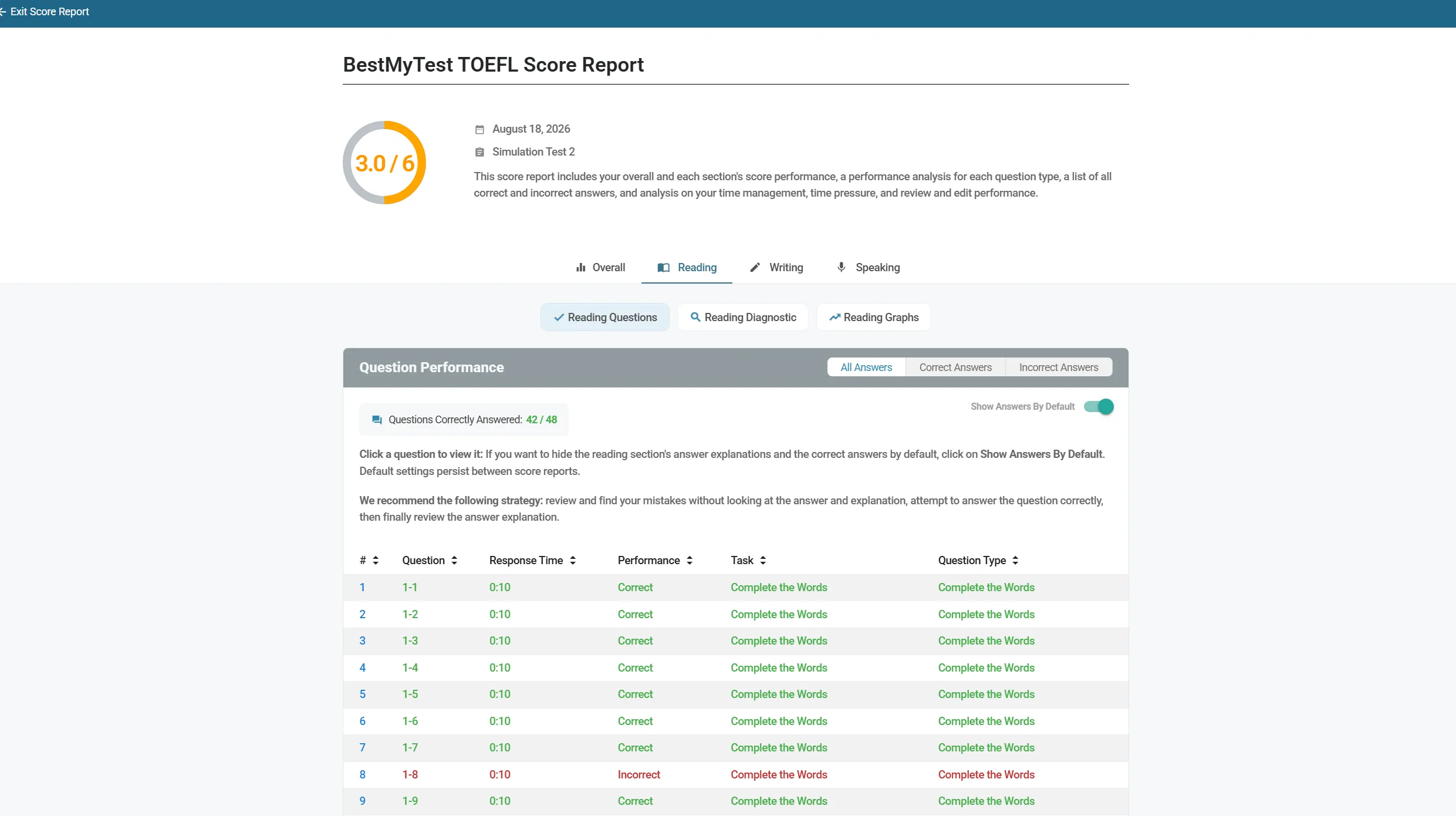
The score is only the start. The real value of a diagnostic test is in the review. Go through every wrong answer and work out why you missed it: a word you didn't know, a sentence you misread, a detail you missed in the audio, or a question type you don't have a strategy for. Most learners find that the same few skills cause most of their lost points. Those skills are where your preparation should start, and the sections below show how to work on each one.
3. How to Prepare for TOEFL Reading
TOEFL Reading has three task types under one timer for the whole section. Inside them you meet eleven question types, and each one has its own strategy. Try the sample for each task, then use the strategy table below to recognize every question type and know what to do with it.
Complete the Words
You get a short academic paragraph of about 80 words. Ten words show only their first letters, and you type the rest. It looks like a vocabulary test, but most gaps are decided by grammar. Give a text about 4 minutes.
The Complete the Words strategy: You do not need to know every difficult word to solve these gaps. Grammar gives you a reliable starting point, and the visible letters confirm your choice. Also, use the first sentence of the paragraph, which has no missing words, as your foundation. This sentence establishes the topic and context for the entire paragraph. Read it carefully to understand what the passage will discuss.
- Start with the first sentence. The beginning of the paragraph has no missing words. Read it carefully to understand the topic and context of the passage.
- Use grammatical knowledge. Look at the words before and after each incomplete word. Determine what part of speech is needed (noun, verb, adjective, etc.) and what grammatical form is required (plural, verb tense, comparative, etc.).
- Look for context clues. Consider the meaning of the sentence and the surrounding ideas. Pay attention to logical connections between sentences. Ask yourself: “What word would make sense here?”
- Use visible letters and word patterns. Look at the given letters, common prefixes, suffixes, and word roots to identify possible words. Check that your answer fits both the grammar and meaning of the sentence.
-
spellcheck Answers1. tists (Scientists)
2. kness (thickness)
3. face (surface)
4. stand (understand)
5. iers (glaciers)
6. ation (variation)
7. erve (preserve)
8. ence (evidence)
9. leys (valleys)
10. ying (carrying)

Complete the Words
Learn how to answer this question in a step-by-step interactive exercise
Complete the Words
En una pregunta de tipo Complete the Words te dan un párrafo con huecos. Cada hueco es una palabra a la que le falta la mitad de sus letras. Tu tarea es rellenar los 10 huecos.
Echa un vistazo a la pregunta y luego haz clic en Siguiente para continuar.
Echar un vistazo a la pregunta
Pregunta 1: elige la categoría gramatical correcta. Después de elegirla, completarás las letras que faltan.
Complete the Word Scien_____
Cómo decidir
No necesitas conocer todas las palabras difíciles para resolver estos espacios en blanco. La gramática te da un punto de partida fiable, y las letras visibles confirman tu elección.
- Ignora por un momento las letras visibles.
- Lee las palabras de ambos lados y pregúntate: ¿qué función debe cumplir la palabra que falta?
- Predice la categoría: sustantivo, verbo, verbo modal, adjetivo, adverbio, preposición o determinante.
- Usa las letras visibles y el significado solo cuando ya sepas la categoría.
The experiment produced a surprising
result: un sustantivo después de un adjetivo.Scientists the samples daily
observed: un verbo después del sujeto.The change affect the climate
might: un verbo modal antes de un verbo en forma base.The team used a method
reliable: un adjetivo antes de un sustantivo.Researchers recorded the data
carefully: un adverbio que describe cómo registraron los datos.The samples remained the cabinet
inside: una preposición que indica lugar.As a , the trial was repeated
result: un sustantivo que completa una expresión de transición.studies reached the same conclusion
Several: un determinante que introduce un sustantivo.Salta las palabras que no conozcas. Completar las que sí conoces puede ayudarte a descubrir las que no.
Sustantivo (S/O)
Un sustantivo nombra una persona, un lugar, una cosa o una idea. En una oración suele cumplir una de dos funciones: sujeto, que realiza la acción, u objeto, que la recibe.
Busca pistas claras: “a”, “an”, “the”, “this” o “that” antes del espacio en blanco; un adjetivo justo delante; o un verbo o una preposición que necesita un objeto después.
EjemplosThe changed medicine
discovery: sustantivo sujeto.Researchers measured the
temperature: sustantivo objeto.a useful
method: sustantivo después de un adjetivo.Si el espacio en blanco responde a “¿quién?” o “¿qué?”, un sustantivo es una predicción excelente.
Sustantivo (transición)
Algunos sustantivos forman parte de expresiones de transición fijas que conectan ideas. Aprende la expresión completa como una sola unidad útil: por ejemplo, “for example”, “in fact” y “as a result”.
Ejemplosfor
example: parte de la expresión “for example”.in
fact: parte de la expresión “in fact”.As a
result: parte de la expresión “as a result”.Muchos candidatos esperan que un texto académico evalúe solo vocabulario complejo, como “photosynthesis” o “archaeological”. En realidad, esta tarea quita letras de palabras repartidas a intervalos regulares, así que una palabra estructural sencilla dentro de un conector puede convertirse fácilmente en un espacio en blanco.
Cuando veas comas o el comienzo de un conector conocido, completa la expresión que ya sabes. La respuesta puede ser mucho más sencilla que el tema.
Verbo
Un verbo expresa una acción o un estado. Debe concordar con su sujeto y con el tiempo de la oración. Un verbo también puede aparecer como participio terminado en “-ing” o “-ed”.
EjemplosPlants sunlight
require: un verbo después del sujeto.The evidence a change
suggests: un verbo después del sujeto.The river is rapidly
flowing: un verbo después de un verbo auxiliar.Pistas: busca el sujeto y pregúntate qué hace o en qué estado está. Fíjate en los verbos auxiliares cercanos, como “is”, “was”, “has” o “can”.
Una vez que localizas el sujeto, la forma del verbo que falta suele quedar muy limitada.
Verbo modal
Un verbo modal es un verbo auxiliar especial que expresa posibilidad, capacidad, permiso, consejo, predicción u obligación. Los modales más comunes son “can”, “could”, “may”, “might”, “must”, “should”, “will” y “would”.
EjemplosThe change affect the climate
might: un verbo modal antes de un verbo en forma base.This process explain the pattern
could: un verbo modal antes de un verbo en forma base.Researchers compare both samples
should: un verbo modal antes de un verbo en forma base.La pista más fuerte es la palabra que va después del espacio en blanco: a un modal normalmente le sigue la forma base de un verbo, sin “to”. Por ejemplo: “might occur”, “could explain” y “should compare”.
Cuando la palabra corta que falta va antes de un verbo en forma base, prueba con un modal. Estos pequeños verbos estructurales son frecuentes y muy predecibles.
Adjetivo
Un adjetivo describe un sustantivo. Suele aparecer justo antes de ese sustantivo o después de un verbo copulativo como «be», «seem» o «become».
Ejemplosa source
reliable: un adjetivo antes de un sustantivo.the known fossil
oldest: un adjetivo antes de un sustantivo.The surface became
rough: un adjetivo después de un verbo copulativo.Pistas: mira justo a la derecha del espacio en blanco por si hay un sustantivo, o a la izquierda por si hay un verbo copulativo. «More», «most», «-er» y «-est» también apuntan a un adjetivo.
Si el espacio en blanco responde a «¿de qué tipo?» o «¿cuál?» sobre un sustantivo, predice un adjetivo.
Adverbio
Un adverbio modifica a un verbo, a un adjetivo o a otro adverbio. Puede indicar cómo, cuándo, dónde o en qué grado ocurre algo.
Ejemplosly
only: un adverbio antes de -ly.The team moved
quickly: un adverbio terminado en -ly.The result was significant
highly: un adverbio que modifica a un adjetivo.La terminación -ly es una pista muy útil, aunque no todos los adverbios terminan en -ly y no todas las palabras en -ly son adverbios. Confirma la función de la palabra en la oración.
Si el espacio en blanco cambia la intensidad o el modo de otra palabra, probablemente sea un adverbio.
Preposición
Una preposición es una palabra estructural corta que muestra una relación: lugar, tiempo, dirección, origen o medio. Algunos ejemplos comunes son “in”, “on”, “at”, “by”, “with”, “through” y “between”.
EjemplosResearchers worked the sample
with: una preposición que indica medio.The border lies two regions
between: una preposición que indica lugar.Water passed the membrane
through: una preposición que indica dirección.Muchos candidatos esperan que un texto académico evalúe solo vocabulario complejo, como “photosynthesis” o “archaeological”. En realidad, esta tarea quita letras de palabras repartidas a intervalos regulares, así que también se cortan a menudo palabras estructurales muy sencillas.
No descartes una respuesta fácil porque el texto parezca difícil. Comprueba qué relación necesita la oración.
Determinante
Un determinante introduce o delimita un sintagma nominal. Nos dice cuál, cuántos o de quién. Algunos ejemplos son “a”, “an”, “the”, “this”, “these”, “each”, “every”, “several” y “many”.
Ejemplosparticipant
each: un determinante que introduce un sustantivo.experiments
several: un determinante que introduce un sustantivo.results
these: un determinante que introduce un sustantivo.Muchos candidatos esperan que un texto académico evalúe solo vocabulario complejo, como “photosynthesis” o “archaeological”. En realidad, esta tarea quita letras de palabras repartidas a intervalos regulares, así que las palabras gramaticales pequeñas que introducen sustantivos aparecen con mucha frecuencia.
Si justo después viene un adjetivo o un sustantivo y la frase necesita algo que lo introduzca, prueba con un determinante. Las palabras sencillas también pueden ser la respuesta correcta.
Pregunta 2: elige la categoría gramatical correcta. Después de elegirla, completarás las letras que faltan.
Complete the Word thic_____
Cómo decidir
No necesitas conocer todas las palabras difíciles para resolver estos espacios en blanco. La gramática te da un punto de partida fiable, y las letras visibles confirman tu elección.
- Ignora por un momento las letras visibles.
- Lee las palabras de ambos lados y pregúntate: ¿qué función debe cumplir la palabra que falta?
- Predice la categoría: sustantivo, verbo, verbo modal, adjetivo, adverbio, preposición o determinante.
- Usa las letras visibles y el significado solo cuando ya sepas la categoría.
The experiment produced a surprising
result: un sustantivo después de un adjetivo.Scientists the samples daily
observed: un verbo después del sujeto.The change affect the climate
might: un verbo modal antes de un verbo en forma base.The team used a method
reliable: un adjetivo antes de un sustantivo.Researchers recorded the data
carefully: un adverbio que describe cómo registraron los datos.The samples remained the cabinet
inside: una preposición que indica lugar.As a , the trial was repeated
result: un sustantivo que completa una expresión de transición.studies reached the same conclusion
Several: un determinante que introduce un sustantivo.Salta las palabras que no conozcas. Completar las que sí conoces puede ayudarte a descubrir las que no.
Sustantivo (S/O)
Un sustantivo nombra una persona, un lugar, una cosa o una idea. En una oración suele cumplir una de dos funciones: sujeto, que realiza la acción, u objeto, que la recibe.
Busca pistas claras: “a”, “an”, “the”, “this” o “that” antes del espacio en blanco; un adjetivo justo delante; o un verbo o una preposición que necesita un objeto después.
EjemplosThe changed medicine
discovery: sustantivo sujeto.Researchers measured the
temperature: sustantivo objeto.a useful
method: sustantivo después de un adjetivo.Si el espacio en blanco responde a “¿quién?” o “¿qué?”, un sustantivo es una predicción excelente.
Sustantivo (transición)
Algunos sustantivos forman parte de expresiones de transición fijas que conectan ideas. Aprende la expresión completa como una sola unidad útil: por ejemplo, “for example”, “in fact” y “as a result”.
Ejemplosfor
example: parte de la expresión “for example”.in
fact: parte de la expresión “in fact”.As a
result: parte de la expresión “as a result”.Muchos candidatos esperan que un texto académico evalúe solo vocabulario complejo, como “photosynthesis” o “archaeological”. En realidad, esta tarea quita letras de palabras repartidas a intervalos regulares, así que una palabra estructural sencilla dentro de un conector puede convertirse fácilmente en un espacio en blanco.
Cuando veas comas o el comienzo de un conector conocido, completa la expresión que ya sabes. La respuesta puede ser mucho más sencilla que el tema.
Verbo
Un verbo expresa una acción o un estado. Debe concordar con su sujeto y con el tiempo de la oración. Un verbo también puede aparecer como participio terminado en “-ing” o “-ed”.
EjemplosPlants sunlight
require: un verbo después del sujeto.The evidence a change
suggests: un verbo después del sujeto.The river is rapidly
flowing: un verbo después de un verbo auxiliar.Pistas: busca el sujeto y pregúntate qué hace o en qué estado está. Fíjate en los verbos auxiliares cercanos, como “is”, “was”, “has” o “can”.
Una vez que localizas el sujeto, la forma del verbo que falta suele quedar muy limitada.
Verbo modal
Un verbo modal es un verbo auxiliar especial que expresa posibilidad, capacidad, permiso, consejo, predicción u obligación. Los modales más comunes son “can”, “could”, “may”, “might”, “must”, “should”, “will” y “would”.
EjemplosThe change affect the climate
might: un verbo modal antes de un verbo en forma base.This process explain the pattern
could: un verbo modal antes de un verbo en forma base.Researchers compare both samples
should: un verbo modal antes de un verbo en forma base.La pista más fuerte es la palabra que va después del espacio en blanco: a un modal normalmente le sigue la forma base de un verbo, sin “to”. Por ejemplo: “might occur”, “could explain” y “should compare”.
Cuando la palabra corta que falta va antes de un verbo en forma base, prueba con un modal. Estos pequeños verbos estructurales son frecuentes y muy predecibles.
Adjetivo
Un adjetivo describe un sustantivo. Suele aparecer justo antes de ese sustantivo o después de un verbo copulativo como «be», «seem» o «become».
Ejemplosa source
reliable: un adjetivo antes de un sustantivo.the known fossil
oldest: un adjetivo antes de un sustantivo.The surface became
rough: un adjetivo después de un verbo copulativo.Pistas: mira justo a la derecha del espacio en blanco por si hay un sustantivo, o a la izquierda por si hay un verbo copulativo. «More», «most», «-er» y «-est» también apuntan a un adjetivo.
Si el espacio en blanco responde a «¿de qué tipo?» o «¿cuál?» sobre un sustantivo, predice un adjetivo.
Adverbio
Un adverbio modifica a un verbo, a un adjetivo o a otro adverbio. Puede indicar cómo, cuándo, dónde o en qué grado ocurre algo.
Ejemplosly
only: un adverbio antes de -ly.The team moved
quickly: un adverbio terminado en -ly.The result was significant
highly: un adverbio que modifica a un adjetivo.La terminación -ly es una pista muy útil, aunque no todos los adverbios terminan en -ly y no todas las palabras en -ly son adverbios. Confirma la función de la palabra en la oración.
Si el espacio en blanco cambia la intensidad o el modo de otra palabra, probablemente sea un adverbio.
Preposición
Una preposición es una palabra estructural corta que muestra una relación: lugar, tiempo, dirección, origen o medio. Algunos ejemplos comunes son “in”, “on”, “at”, “by”, “with”, “through” y “between”.
EjemplosResearchers worked the sample
with: una preposición que indica medio.The border lies two regions
between: una preposición que indica lugar.Water passed the membrane
through: una preposición que indica dirección.Muchos candidatos esperan que un texto académico evalúe solo vocabulario complejo, como “photosynthesis” o “archaeological”. En realidad, esta tarea quita letras de palabras repartidas a intervalos regulares, así que también se cortan a menudo palabras estructurales muy sencillas.
No descartes una respuesta fácil porque el texto parezca difícil. Comprueba qué relación necesita la oración.
Determinante
Un determinante introduce o delimita un sintagma nominal. Nos dice cuál, cuántos o de quién. Algunos ejemplos son “a”, “an”, “the”, “this”, “these”, “each”, “every”, “several” y “many”.
Ejemplosparticipant
each: un determinante que introduce un sustantivo.experiments
several: un determinante que introduce un sustantivo.results
these: un determinante que introduce un sustantivo.Muchos candidatos esperan que un texto académico evalúe solo vocabulario complejo, como “photosynthesis” o “archaeological”. En realidad, esta tarea quita letras de palabras repartidas a intervalos regulares, así que las palabras gramaticales pequeñas que introducen sustantivos aparecen con mucha frecuencia.
Si justo después viene un adjetivo o un sustantivo y la frase necesita algo que lo introduzca, prueba con un determinante. Las palabras sencillas también pueden ser la respuesta correcta.
Pregunta 3: elige la categoría gramatical correcta. Después de elegirla, completarás las letras que faltan.
Complete the Word sur____
Cómo decidir
No necesitas conocer todas las palabras difíciles para resolver estos espacios en blanco. La gramática te da un punto de partida fiable, y las letras visibles confirman tu elección.
- Ignora por un momento las letras visibles.
- Lee las palabras de ambos lados y pregúntate: ¿qué función debe cumplir la palabra que falta?
- Predice la categoría: sustantivo, verbo, verbo modal, adjetivo, adverbio, preposición o determinante.
- Usa las letras visibles y el significado solo cuando ya sepas la categoría.
The experiment produced a surprising
result: un sustantivo después de un adjetivo.Scientists the samples daily
observed: un verbo después del sujeto.The change affect the climate
might: un verbo modal antes de un verbo en forma base.The team used a method
reliable: un adjetivo antes de un sustantivo.Researchers recorded the data
carefully: un adverbio que describe cómo registraron los datos.The samples remained the cabinet
inside: una preposición que indica lugar.As a , the trial was repeated
result: un sustantivo que completa una expresión de transición.studies reached the same conclusion
Several: un determinante que introduce un sustantivo.Salta las palabras que no conozcas. Completar las que sí conoces puede ayudarte a descubrir las que no.
Sustantivo (S/O)
Un sustantivo nombra una persona, un lugar, una cosa o una idea. En una oración suele cumplir una de dos funciones: sujeto, que realiza la acción, u objeto, que la recibe.
Busca pistas claras: “a”, “an”, “the”, “this” o “that” antes del espacio en blanco; un adjetivo justo delante; o un verbo o una preposición que necesita un objeto después.
EjemplosThe changed medicine
discovery: sustantivo sujeto.Researchers measured the
temperature: sustantivo objeto.a useful
method: sustantivo después de un adjetivo.Si el espacio en blanco responde a “¿quién?” o “¿qué?”, un sustantivo es una predicción excelente.
Sustantivo (transición)
Algunos sustantivos forman parte de expresiones de transición fijas que conectan ideas. Aprende la expresión completa como una sola unidad útil: por ejemplo, “for example”, “in fact” y “as a result”.
Ejemplosfor
example: parte de la expresión “for example”.in
fact: parte de la expresión “in fact”.As a
result: parte de la expresión “as a result”.Muchos candidatos esperan que un texto académico evalúe solo vocabulario complejo, como “photosynthesis” o “archaeological”. En realidad, esta tarea quita letras de palabras repartidas a intervalos regulares, así que una palabra estructural sencilla dentro de un conector puede convertirse fácilmente en un espacio en blanco.
Cuando veas comas o el comienzo de un conector conocido, completa la expresión que ya sabes. La respuesta puede ser mucho más sencilla que el tema.
Verbo
Un verbo expresa una acción o un estado. Debe concordar con su sujeto y con el tiempo de la oración. Un verbo también puede aparecer como participio terminado en “-ing” o “-ed”.
EjemplosPlants sunlight
require: un verbo después del sujeto.The evidence a change
suggests: un verbo después del sujeto.The river is rapidly
flowing: un verbo después de un verbo auxiliar.Pistas: busca el sujeto y pregúntate qué hace o en qué estado está. Fíjate en los verbos auxiliares cercanos, como “is”, “was”, “has” o “can”.
Una vez que localizas el sujeto, la forma del verbo que falta suele quedar muy limitada.
Verbo modal
Un verbo modal es un verbo auxiliar especial que expresa posibilidad, capacidad, permiso, consejo, predicción u obligación. Los modales más comunes son “can”, “could”, “may”, “might”, “must”, “should”, “will” y “would”.
EjemplosThe change affect the climate
might: un verbo modal antes de un verbo en forma base.This process explain the pattern
could: un verbo modal antes de un verbo en forma base.Researchers compare both samples
should: un verbo modal antes de un verbo en forma base.La pista más fuerte es la palabra que va después del espacio en blanco: a un modal normalmente le sigue la forma base de un verbo, sin “to”. Por ejemplo: “might occur”, “could explain” y “should compare”.
Cuando la palabra corta que falta va antes de un verbo en forma base, prueba con un modal. Estos pequeños verbos estructurales son frecuentes y muy predecibles.
Adjetivo
Un adjetivo describe un sustantivo. Suele aparecer justo antes de ese sustantivo o después de un verbo copulativo como «be», «seem» o «become».
Ejemplosa source
reliable: un adjetivo antes de un sustantivo.the known fossil
oldest: un adjetivo antes de un sustantivo.The surface became
rough: un adjetivo después de un verbo copulativo.Pistas: mira justo a la derecha del espacio en blanco por si hay un sustantivo, o a la izquierda por si hay un verbo copulativo. «More», «most», «-er» y «-est» también apuntan a un adjetivo.
Si el espacio en blanco responde a «¿de qué tipo?» o «¿cuál?» sobre un sustantivo, predice un adjetivo.
Adverbio
Un adverbio modifica a un verbo, a un adjetivo o a otro adverbio. Puede indicar cómo, cuándo, dónde o en qué grado ocurre algo.
Ejemplosly
only: un adverbio antes de -ly.The team moved
quickly: un adverbio terminado en -ly.The result was significant
highly: un adverbio que modifica a un adjetivo.La terminación -ly es una pista muy útil, aunque no todos los adverbios terminan en -ly y no todas las palabras en -ly son adverbios. Confirma la función de la palabra en la oración.
Si el espacio en blanco cambia la intensidad o el modo de otra palabra, probablemente sea un adverbio.
Preposición
Una preposición es una palabra estructural corta que muestra una relación: lugar, tiempo, dirección, origen o medio. Algunos ejemplos comunes son “in”, “on”, “at”, “by”, “with”, “through” y “between”.
EjemplosResearchers worked the sample
with: una preposición que indica medio.The border lies two regions
between: una preposición que indica lugar.Water passed the membrane
through: una preposición que indica dirección.Muchos candidatos esperan que un texto académico evalúe solo vocabulario complejo, como “photosynthesis” o “archaeological”. En realidad, esta tarea quita letras de palabras repartidas a intervalos regulares, así que también se cortan a menudo palabras estructurales muy sencillas.
No descartes una respuesta fácil porque el texto parezca difícil. Comprueba qué relación necesita la oración.
Determinante
Un determinante introduce o delimita un sintagma nominal. Nos dice cuál, cuántos o de quién. Algunos ejemplos son “a”, “an”, “the”, “this”, “these”, “each”, “every”, “several” y “many”.
Ejemplosparticipant
each: un determinante que introduce un sustantivo.experiments
several: un determinante que introduce un sustantivo.results
these: un determinante que introduce un sustantivo.Muchos candidatos esperan que un texto académico evalúe solo vocabulario complejo, como “photosynthesis” o “archaeological”. En realidad, esta tarea quita letras de palabras repartidas a intervalos regulares, así que las palabras gramaticales pequeñas que introducen sustantivos aparecen con mucha frecuencia.
Si justo después viene un adjetivo o un sustantivo y la frase necesita algo que lo introduzca, prueba con un determinante. Las palabras sencillas también pueden ser la respuesta correcta.
Pregunta 4: elige la categoría gramatical correcta. Después de elegirla, completarás las letras que faltan.
Complete the Word under_____
Cómo decidir
No necesitas conocer todas las palabras difíciles para resolver estos espacios en blanco. La gramática te da un punto de partida fiable, y las letras visibles confirman tu elección.
- Ignora por un momento las letras visibles.
- Lee las palabras de ambos lados y pregúntate: ¿qué función debe cumplir la palabra que falta?
- Predice la categoría: sustantivo, verbo, verbo modal, adjetivo, adverbio, preposición o determinante.
- Usa las letras visibles y el significado solo cuando ya sepas la categoría.
The experiment produced a surprising
result: un sustantivo después de un adjetivo.Scientists the samples daily
observed: un verbo después del sujeto.The change affect the climate
might: un verbo modal antes de un verbo en forma base.The team used a method
reliable: un adjetivo antes de un sustantivo.Researchers recorded the data
carefully: un adverbio que describe cómo registraron los datos.The samples remained the cabinet
inside: una preposición que indica lugar.As a , the trial was repeated
result: un sustantivo que completa una expresión de transición.studies reached the same conclusion
Several: un determinante que introduce un sustantivo.Salta las palabras que no conozcas. Completar las que sí conoces puede ayudarte a descubrir las que no.
Sustantivo (S/O)
Un sustantivo nombra una persona, un lugar, una cosa o una idea. En una oración suele cumplir una de dos funciones: sujeto, que realiza la acción, u objeto, que la recibe.
Busca pistas claras: “a”, “an”, “the”, “this” o “that” antes del espacio en blanco; un adjetivo justo delante; o un verbo o una preposición que necesita un objeto después.
EjemplosThe changed medicine
discovery: sustantivo sujeto.Researchers measured the
temperature: sustantivo objeto.a useful
method: sustantivo después de un adjetivo.Si el espacio en blanco responde a “¿quién?” o “¿qué?”, un sustantivo es una predicción excelente.
Sustantivo (transición)
Algunos sustantivos forman parte de expresiones de transición fijas que conectan ideas. Aprende la expresión completa como una sola unidad útil: por ejemplo, “for example”, “in fact” y “as a result”.
Ejemplosfor
example: parte de la expresión “for example”.in
fact: parte de la expresión “in fact”.As a
result: parte de la expresión “as a result”.Muchos candidatos esperan que un texto académico evalúe solo vocabulario complejo, como “photosynthesis” o “archaeological”. En realidad, esta tarea quita letras de palabras repartidas a intervalos regulares, así que una palabra estructural sencilla dentro de un conector puede convertirse fácilmente en un espacio en blanco.
Cuando veas comas o el comienzo de un conector conocido, completa la expresión que ya sabes. La respuesta puede ser mucho más sencilla que el tema.
Verbo
Un verbo expresa una acción o un estado. Debe concordar con su sujeto y con el tiempo de la oración. Un verbo también puede aparecer como participio terminado en “-ing” o “-ed”.
EjemplosPlants sunlight
require: un verbo después del sujeto.The evidence a change
suggests: un verbo después del sujeto.The river is rapidly
flowing: un verbo después de un verbo auxiliar.Pistas: busca el sujeto y pregúntate qué hace o en qué estado está. Fíjate en los verbos auxiliares cercanos, como “is”, “was”, “has” o “can”.
Una vez que localizas el sujeto, la forma del verbo que falta suele quedar muy limitada.
Verbo modal
Un verbo modal es un verbo auxiliar especial que expresa posibilidad, capacidad, permiso, consejo, predicción u obligación. Los modales más comunes son “can”, “could”, “may”, “might”, “must”, “should”, “will” y “would”.
EjemplosThe change affect the climate
might: un verbo modal antes de un verbo en forma base.This process explain the pattern
could: un verbo modal antes de un verbo en forma base.Researchers compare both samples
should: un verbo modal antes de un verbo en forma base.La pista más fuerte es la palabra que va después del espacio en blanco: a un modal normalmente le sigue la forma base de un verbo, sin “to”. Por ejemplo: “might occur”, “could explain” y “should compare”.
Cuando la palabra corta que falta va antes de un verbo en forma base, prueba con un modal. Estos pequeños verbos estructurales son frecuentes y muy predecibles.
Adjetivo
Un adjetivo describe un sustantivo. Suele aparecer justo antes de ese sustantivo o después de un verbo copulativo como «be», «seem» o «become».
Ejemplosa source
reliable: un adjetivo antes de un sustantivo.the known fossil
oldest: un adjetivo antes de un sustantivo.The surface became
rough: un adjetivo después de un verbo copulativo.Pistas: mira justo a la derecha del espacio en blanco por si hay un sustantivo, o a la izquierda por si hay un verbo copulativo. «More», «most», «-er» y «-est» también apuntan a un adjetivo.
Si el espacio en blanco responde a «¿de qué tipo?» o «¿cuál?» sobre un sustantivo, predice un adjetivo.
Adverbio
Un adverbio modifica a un verbo, a un adjetivo o a otro adverbio. Puede indicar cómo, cuándo, dónde o en qué grado ocurre algo.
Ejemplosly
only: un adverbio antes de -ly.The team moved
quickly: un adverbio terminado en -ly.The result was significant
highly: un adverbio que modifica a un adjetivo.La terminación -ly es una pista muy útil, aunque no todos los adverbios terminan en -ly y no todas las palabras en -ly son adverbios. Confirma la función de la palabra en la oración.
Si el espacio en blanco cambia la intensidad o el modo de otra palabra, probablemente sea un adverbio.
Preposición
Una preposición es una palabra estructural corta que muestra una relación: lugar, tiempo, dirección, origen o medio. Algunos ejemplos comunes son “in”, “on”, “at”, “by”, “with”, “through” y “between”.
EjemplosResearchers worked the sample
with: una preposición que indica medio.The border lies two regions
between: una preposición que indica lugar.Water passed the membrane
through: una preposición que indica dirección.Muchos candidatos esperan que un texto académico evalúe solo vocabulario complejo, como “photosynthesis” o “archaeological”. En realidad, esta tarea quita letras de palabras repartidas a intervalos regulares, así que también se cortan a menudo palabras estructurales muy sencillas.
No descartes una respuesta fácil porque el texto parezca difícil. Comprueba qué relación necesita la oración.
Determinante
Un determinante introduce o delimita un sintagma nominal. Nos dice cuál, cuántos o de quién. Algunos ejemplos son “a”, “an”, “the”, “this”, “these”, “each”, “every”, “several” y “many”.
Ejemplosparticipant
each: un determinante que introduce un sustantivo.experiments
several: un determinante que introduce un sustantivo.results
these: un determinante que introduce un sustantivo.Muchos candidatos esperan que un texto académico evalúe solo vocabulario complejo, como “photosynthesis” o “archaeological”. En realidad, esta tarea quita letras de palabras repartidas a intervalos regulares, así que las palabras gramaticales pequeñas que introducen sustantivos aparecen con mucha frecuencia.
Si justo después viene un adjetivo o un sustantivo y la frase necesita algo que lo introduzca, prueba con un determinante. Las palabras sencillas también pueden ser la respuesta correcta.
Pregunta 5: elige la categoría gramatical correcta. Después de elegirla, completarás las letras que faltan.
Complete the Word glac____
Cómo decidir
No necesitas conocer todas las palabras difíciles para resolver estos espacios en blanco. La gramática te da un punto de partida fiable, y las letras visibles confirman tu elección.
- Ignora por un momento las letras visibles.
- Lee las palabras de ambos lados y pregúntate: ¿qué función debe cumplir la palabra que falta?
- Predice la categoría: sustantivo, verbo, verbo modal, adjetivo, adverbio, preposición o determinante.
- Usa las letras visibles y el significado solo cuando ya sepas la categoría.
The experiment produced a surprising
result: un sustantivo después de un adjetivo.Scientists the samples daily
observed: un verbo después del sujeto.The change affect the climate
might: un verbo modal antes de un verbo en forma base.The team used a method
reliable: un adjetivo antes de un sustantivo.Researchers recorded the data
carefully: un adverbio que describe cómo registraron los datos.The samples remained the cabinet
inside: una preposición que indica lugar.As a , the trial was repeated
result: un sustantivo que completa una expresión de transición.studies reached the same conclusion
Several: un determinante que introduce un sustantivo.Salta las palabras que no conozcas. Completar las que sí conoces puede ayudarte a descubrir las que no.
Sustantivo (S/O)
Un sustantivo nombra una persona, un lugar, una cosa o una idea. En una oración suele cumplir una de dos funciones: sujeto, que realiza la acción, u objeto, que la recibe.
Busca pistas claras: “a”, “an”, “the”, “this” o “that” antes del espacio en blanco; un adjetivo justo delante; o un verbo o una preposición que necesita un objeto después.
EjemplosThe changed medicine
discovery: sustantivo sujeto.Researchers measured the
temperature: sustantivo objeto.a useful
method: sustantivo después de un adjetivo.Si el espacio en blanco responde a “¿quién?” o “¿qué?”, un sustantivo es una predicción excelente.
Sustantivo (transición)
Algunos sustantivos forman parte de expresiones de transición fijas que conectan ideas. Aprende la expresión completa como una sola unidad útil: por ejemplo, “for example”, “in fact” y “as a result”.
Ejemplosfor
example: parte de la expresión “for example”.in
fact: parte de la expresión “in fact”.As a
result: parte de la expresión “as a result”.Muchos candidatos esperan que un texto académico evalúe solo vocabulario complejo, como “photosynthesis” o “archaeological”. En realidad, esta tarea quita letras de palabras repartidas a intervalos regulares, así que una palabra estructural sencilla dentro de un conector puede convertirse fácilmente en un espacio en blanco.
Cuando veas comas o el comienzo de un conector conocido, completa la expresión que ya sabes. La respuesta puede ser mucho más sencilla que el tema.
Verbo
Un verbo expresa una acción o un estado. Debe concordar con su sujeto y con el tiempo de la oración. Un verbo también puede aparecer como participio terminado en “-ing” o “-ed”.
EjemplosPlants sunlight
require: un verbo después del sujeto.The evidence a change
suggests: un verbo después del sujeto.The river is rapidly
flowing: un verbo después de un verbo auxiliar.Pistas: busca el sujeto y pregúntate qué hace o en qué estado está. Fíjate en los verbos auxiliares cercanos, como “is”, “was”, “has” o “can”.
Una vez que localizas el sujeto, la forma del verbo que falta suele quedar muy limitada.
Verbo modal
Un verbo modal es un verbo auxiliar especial que expresa posibilidad, capacidad, permiso, consejo, predicción u obligación. Los modales más comunes son “can”, “could”, “may”, “might”, “must”, “should”, “will” y “would”.
EjemplosThe change affect the climate
might: un verbo modal antes de un verbo en forma base.This process explain the pattern
could: un verbo modal antes de un verbo en forma base.Researchers compare both samples
should: un verbo modal antes de un verbo en forma base.La pista más fuerte es la palabra que va después del espacio en blanco: a un modal normalmente le sigue la forma base de un verbo, sin “to”. Por ejemplo: “might occur”, “could explain” y “should compare”.
Cuando la palabra corta que falta va antes de un verbo en forma base, prueba con un modal. Estos pequeños verbos estructurales son frecuentes y muy predecibles.
Adjetivo
Un adjetivo describe un sustantivo. Suele aparecer justo antes de ese sustantivo o después de un verbo copulativo como «be», «seem» o «become».
Ejemplosa source
reliable: un adjetivo antes de un sustantivo.the known fossil
oldest: un adjetivo antes de un sustantivo.The surface became
rough: un adjetivo después de un verbo copulativo.Pistas: mira justo a la derecha del espacio en blanco por si hay un sustantivo, o a la izquierda por si hay un verbo copulativo. «More», «most», «-er» y «-est» también apuntan a un adjetivo.
Si el espacio en blanco responde a «¿de qué tipo?» o «¿cuál?» sobre un sustantivo, predice un adjetivo.
Adverbio
Un adverbio modifica a un verbo, a un adjetivo o a otro adverbio. Puede indicar cómo, cuándo, dónde o en qué grado ocurre algo.
Ejemplosly
only: un adverbio antes de -ly.The team moved
quickly: un adverbio terminado en -ly.The result was significant
highly: un adverbio que modifica a un adjetivo.La terminación -ly es una pista muy útil, aunque no todos los adverbios terminan en -ly y no todas las palabras en -ly son adverbios. Confirma la función de la palabra en la oración.
Si el espacio en blanco cambia la intensidad o el modo de otra palabra, probablemente sea un adverbio.
Preposición
Una preposición es una palabra estructural corta que muestra una relación: lugar, tiempo, dirección, origen o medio. Algunos ejemplos comunes son “in”, “on”, “at”, “by”, “with”, “through” y “between”.
EjemplosResearchers worked the sample
with: una preposición que indica medio.The border lies two regions
between: una preposición que indica lugar.Water passed the membrane
through: una preposición que indica dirección.Muchos candidatos esperan que un texto académico evalúe solo vocabulario complejo, como “photosynthesis” o “archaeological”. En realidad, esta tarea quita letras de palabras repartidas a intervalos regulares, así que también se cortan a menudo palabras estructurales muy sencillas.
No descartes una respuesta fácil porque el texto parezca difícil. Comprueba qué relación necesita la oración.
Determinante
Un determinante introduce o delimita un sintagma nominal. Nos dice cuál, cuántos o de quién. Algunos ejemplos son “a”, “an”, “the”, “this”, “these”, “each”, “every”, “several” y “many”.
Ejemplosparticipant
each: un determinante que introduce un sustantivo.experiments
several: un determinante que introduce un sustantivo.results
these: un determinante que introduce un sustantivo.Muchos candidatos esperan que un texto académico evalúe solo vocabulario complejo, como “photosynthesis” o “archaeological”. En realidad, esta tarea quita letras de palabras repartidas a intervalos regulares, así que las palabras gramaticales pequeñas que introducen sustantivos aparecen con mucha frecuencia.
Si justo después viene un adjetivo o un sustantivo y la frase necesita algo que lo introduzca, prueba con un determinante. Las palabras sencillas también pueden ser la respuesta correcta.
Pregunta 6: elige la categoría gramatical correcta. Después de elegirla, completarás las letras que faltan.
Complete the Word vari_____
Cómo decidir
No necesitas conocer todas las palabras difíciles para resolver estos espacios en blanco. La gramática te da un punto de partida fiable, y las letras visibles confirman tu elección.
- Ignora por un momento las letras visibles.
- Lee las palabras de ambos lados y pregúntate: ¿qué función debe cumplir la palabra que falta?
- Predice la categoría: sustantivo, verbo, verbo modal, adjetivo, adverbio, preposición o determinante.
- Usa las letras visibles y el significado solo cuando ya sepas la categoría.
The experiment produced a surprising
result: un sustantivo después de un adjetivo.Scientists the samples daily
observed: un verbo después del sujeto.The change affect the climate
might: un verbo modal antes de un verbo en forma base.The team used a method
reliable: un adjetivo antes de un sustantivo.Researchers recorded the data
carefully: un adverbio que describe cómo registraron los datos.The samples remained the cabinet
inside: una preposición que indica lugar.As a , the trial was repeated
result: un sustantivo que completa una expresión de transición.studies reached the same conclusion
Several: un determinante que introduce un sustantivo.Salta las palabras que no conozcas. Completar las que sí conoces puede ayudarte a descubrir las que no.
Sustantivo (S/O)
Un sustantivo nombra una persona, un lugar, una cosa o una idea. En una oración suele cumplir una de dos funciones: sujeto, que realiza la acción, u objeto, que la recibe.
Busca pistas claras: “a”, “an”, “the”, “this” o “that” antes del espacio en blanco; un adjetivo justo delante; o un verbo o una preposición que necesita un objeto después.
EjemplosThe changed medicine
discovery: sustantivo sujeto.Researchers measured the
temperature: sustantivo objeto.a useful
method: sustantivo después de un adjetivo.Si el espacio en blanco responde a “¿quién?” o “¿qué?”, un sustantivo es una predicción excelente.
Sustantivo (transición)
Algunos sustantivos forman parte de expresiones de transición fijas que conectan ideas. Aprende la expresión completa como una sola unidad útil: por ejemplo, “for example”, “in fact” y “as a result”.
Ejemplosfor
example: parte de la expresión “for example”.in
fact: parte de la expresión “in fact”.As a
result: parte de la expresión “as a result”.Muchos candidatos esperan que un texto académico evalúe solo vocabulario complejo, como “photosynthesis” o “archaeological”. En realidad, esta tarea quita letras de palabras repartidas a intervalos regulares, así que una palabra estructural sencilla dentro de un conector puede convertirse fácilmente en un espacio en blanco.
Cuando veas comas o el comienzo de un conector conocido, completa la expresión que ya sabes. La respuesta puede ser mucho más sencilla que el tema.
Verbo
Un verbo expresa una acción o un estado. Debe concordar con su sujeto y con el tiempo de la oración. Un verbo también puede aparecer como participio terminado en “-ing” o “-ed”.
EjemplosPlants sunlight
require: un verbo después del sujeto.The evidence a change
suggests: un verbo después del sujeto.The river is rapidly
flowing: un verbo después de un verbo auxiliar.Pistas: busca el sujeto y pregúntate qué hace o en qué estado está. Fíjate en los verbos auxiliares cercanos, como “is”, “was”, “has” o “can”.
Una vez que localizas el sujeto, la forma del verbo que falta suele quedar muy limitada.
Verbo modal
Un verbo modal es un verbo auxiliar especial que expresa posibilidad, capacidad, permiso, consejo, predicción u obligación. Los modales más comunes son “can”, “could”, “may”, “might”, “must”, “should”, “will” y “would”.
EjemplosThe change affect the climate
might: un verbo modal antes de un verbo en forma base.This process explain the pattern
could: un verbo modal antes de un verbo en forma base.Researchers compare both samples
should: un verbo modal antes de un verbo en forma base.La pista más fuerte es la palabra que va después del espacio en blanco: a un modal normalmente le sigue la forma base de un verbo, sin “to”. Por ejemplo: “might occur”, “could explain” y “should compare”.
Cuando la palabra corta que falta va antes de un verbo en forma base, prueba con un modal. Estos pequeños verbos estructurales son frecuentes y muy predecibles.
Adjetivo
Un adjetivo describe un sustantivo. Suele aparecer justo antes de ese sustantivo o después de un verbo copulativo como «be», «seem» o «become».
Ejemplosa source
reliable: un adjetivo antes de un sustantivo.the known fossil
oldest: un adjetivo antes de un sustantivo.The surface became
rough: un adjetivo después de un verbo copulativo.Pistas: mira justo a la derecha del espacio en blanco por si hay un sustantivo, o a la izquierda por si hay un verbo copulativo. «More», «most», «-er» y «-est» también apuntan a un adjetivo.
Si el espacio en blanco responde a «¿de qué tipo?» o «¿cuál?» sobre un sustantivo, predice un adjetivo.
Adverbio
Un adverbio modifica a un verbo, a un adjetivo o a otro adverbio. Puede indicar cómo, cuándo, dónde o en qué grado ocurre algo.
Ejemplosly
only: un adverbio antes de -ly.The team moved
quickly: un adverbio terminado en -ly.The result was significant
highly: un adverbio que modifica a un adjetivo.La terminación -ly es una pista muy útil, aunque no todos los adverbios terminan en -ly y no todas las palabras en -ly son adverbios. Confirma la función de la palabra en la oración.
Si el espacio en blanco cambia la intensidad o el modo de otra palabra, probablemente sea un adverbio.
Preposición
Una preposición es una palabra estructural corta que muestra una relación: lugar, tiempo, dirección, origen o medio. Algunos ejemplos comunes son “in”, “on”, “at”, “by”, “with”, “through” y “between”.
EjemplosResearchers worked the sample
with: una preposición que indica medio.The border lies two regions
between: una preposición que indica lugar.Water passed the membrane
through: una preposición que indica dirección.Muchos candidatos esperan que un texto académico evalúe solo vocabulario complejo, como “photosynthesis” o “archaeological”. En realidad, esta tarea quita letras de palabras repartidas a intervalos regulares, así que también se cortan a menudo palabras estructurales muy sencillas.
No descartes una respuesta fácil porque el texto parezca difícil. Comprueba qué relación necesita la oración.
Determinante
Un determinante introduce o delimita un sintagma nominal. Nos dice cuál, cuántos o de quién. Algunos ejemplos son “a”, “an”, “the”, “this”, “these”, “each”, “every”, “several” y “many”.
Ejemplosparticipant
each: un determinante que introduce un sustantivo.experiments
several: un determinante que introduce un sustantivo.results
these: un determinante que introduce un sustantivo.Muchos candidatos esperan que un texto académico evalúe solo vocabulario complejo, como “photosynthesis” o “archaeological”. En realidad, esta tarea quita letras de palabras repartidas a intervalos regulares, así que las palabras gramaticales pequeñas que introducen sustantivos aparecen con mucha frecuencia.
Si justo después viene un adjetivo o un sustantivo y la frase necesita algo que lo introduzca, prueba con un determinante. Las palabras sencillas también pueden ser la respuesta correcta.
Pregunta 7: elige la categoría gramatical correcta. Después de elegirla, completarás las letras que faltan.
Complete the Word pres____
Cómo decidir
No necesitas conocer todas las palabras difíciles para resolver estos espacios en blanco. La gramática te da un punto de partida fiable, y las letras visibles confirman tu elección.
- Ignora por un momento las letras visibles.
- Lee las palabras de ambos lados y pregúntate: ¿qué función debe cumplir la palabra que falta?
- Predice la categoría: sustantivo, verbo, verbo modal, adjetivo, adverbio, preposición o determinante.
- Usa las letras visibles y el significado solo cuando ya sepas la categoría.
The experiment produced a surprising
result: un sustantivo después de un adjetivo.Scientists the samples daily
observed: un verbo después del sujeto.The change affect the climate
might: un verbo modal antes de un verbo en forma base.The team used a method
reliable: un adjetivo antes de un sustantivo.Researchers recorded the data
carefully: un adverbio que describe cómo registraron los datos.The samples remained the cabinet
inside: una preposición que indica lugar.As a , the trial was repeated
result: un sustantivo que completa una expresión de transición.studies reached the same conclusion
Several: un determinante que introduce un sustantivo.Salta las palabras que no conozcas. Completar las que sí conoces puede ayudarte a descubrir las que no.
Sustantivo (S/O)
Un sustantivo nombra una persona, un lugar, una cosa o una idea. En una oración suele cumplir una de dos funciones: sujeto, que realiza la acción, u objeto, que la recibe.
Busca pistas claras: “a”, “an”, “the”, “this” o “that” antes del espacio en blanco; un adjetivo justo delante; o un verbo o una preposición que necesita un objeto después.
EjemplosThe changed medicine
discovery: sustantivo sujeto.Researchers measured the
temperature: sustantivo objeto.a useful
method: sustantivo después de un adjetivo.Si el espacio en blanco responde a “¿quién?” o “¿qué?”, un sustantivo es una predicción excelente.
Sustantivo (transición)
Algunos sustantivos forman parte de expresiones de transición fijas que conectan ideas. Aprende la expresión completa como una sola unidad útil: por ejemplo, “for example”, “in fact” y “as a result”.
Ejemplosfor
example: parte de la expresión “for example”.in
fact: parte de la expresión “in fact”.As a
result: parte de la expresión “as a result”.Muchos candidatos esperan que un texto académico evalúe solo vocabulario complejo, como “photosynthesis” o “archaeological”. En realidad, esta tarea quita letras de palabras repartidas a intervalos regulares, así que una palabra estructural sencilla dentro de un conector puede convertirse fácilmente en un espacio en blanco.
Cuando veas comas o el comienzo de un conector conocido, completa la expresión que ya sabes. La respuesta puede ser mucho más sencilla que el tema.
Verbo
Un verbo expresa una acción o un estado. Debe concordar con su sujeto y con el tiempo de la oración. Un verbo también puede aparecer como participio terminado en “-ing” o “-ed”.
EjemplosPlants sunlight
require: un verbo después del sujeto.The evidence a change
suggests: un verbo después del sujeto.The river is rapidly
flowing: un verbo después de un verbo auxiliar.Pistas: busca el sujeto y pregúntate qué hace o en qué estado está. Fíjate en los verbos auxiliares cercanos, como “is”, “was”, “has” o “can”.
Una vez que localizas el sujeto, la forma del verbo que falta suele quedar muy limitada.
Verbo modal
Un verbo modal es un verbo auxiliar especial que expresa posibilidad, capacidad, permiso, consejo, predicción u obligación. Los modales más comunes son “can”, “could”, “may”, “might”, “must”, “should”, “will” y “would”.
EjemplosThe change affect the climate
might: un verbo modal antes de un verbo en forma base.This process explain the pattern
could: un verbo modal antes de un verbo en forma base.Researchers compare both samples
should: un verbo modal antes de un verbo en forma base.La pista más fuerte es la palabra que va después del espacio en blanco: a un modal normalmente le sigue la forma base de un verbo, sin “to”. Por ejemplo: “might occur”, “could explain” y “should compare”.
Cuando la palabra corta que falta va antes de un verbo en forma base, prueba con un modal. Estos pequeños verbos estructurales son frecuentes y muy predecibles.
Adjetivo
Un adjetivo describe un sustantivo. Suele aparecer justo antes de ese sustantivo o después de un verbo copulativo como «be», «seem» o «become».
Ejemplosa source
reliable: un adjetivo antes de un sustantivo.the known fossil
oldest: un adjetivo antes de un sustantivo.The surface became
rough: un adjetivo después de un verbo copulativo.Pistas: mira justo a la derecha del espacio en blanco por si hay un sustantivo, o a la izquierda por si hay un verbo copulativo. «More», «most», «-er» y «-est» también apuntan a un adjetivo.
Si el espacio en blanco responde a «¿de qué tipo?» o «¿cuál?» sobre un sustantivo, predice un adjetivo.
Adverbio
Un adverbio modifica a un verbo, a un adjetivo o a otro adverbio. Puede indicar cómo, cuándo, dónde o en qué grado ocurre algo.
Ejemplosly
only: un adverbio antes de -ly.The team moved
quickly: un adverbio terminado en -ly.The result was significant
highly: un adverbio que modifica a un adjetivo.La terminación -ly es una pista muy útil, aunque no todos los adverbios terminan en -ly y no todas las palabras en -ly son adverbios. Confirma la función de la palabra en la oración.
Si el espacio en blanco cambia la intensidad o el modo de otra palabra, probablemente sea un adverbio.
Preposición
Una preposición es una palabra estructural corta que muestra una relación: lugar, tiempo, dirección, origen o medio. Algunos ejemplos comunes son “in”, “on”, “at”, “by”, “with”, “through” y “between”.
EjemplosResearchers worked the sample
with: una preposición que indica medio.The border lies two regions
between: una preposición que indica lugar.Water passed the membrane
through: una preposición que indica dirección.Muchos candidatos esperan que un texto académico evalúe solo vocabulario complejo, como “photosynthesis” o “archaeological”. En realidad, esta tarea quita letras de palabras repartidas a intervalos regulares, así que también se cortan a menudo palabras estructurales muy sencillas.
No descartes una respuesta fácil porque el texto parezca difícil. Comprueba qué relación necesita la oración.
Determinante
Un determinante introduce o delimita un sintagma nominal. Nos dice cuál, cuántos o de quién. Algunos ejemplos son “a”, “an”, “the”, “this”, “these”, “each”, “every”, “several” y “many”.
Ejemplosparticipant
each: un determinante que introduce un sustantivo.experiments
several: un determinante que introduce un sustantivo.results
these: un determinante que introduce un sustantivo.Muchos candidatos esperan que un texto académico evalúe solo vocabulario complejo, como “photosynthesis” o “archaeological”. En realidad, esta tarea quita letras de palabras repartidas a intervalos regulares, así que las palabras gramaticales pequeñas que introducen sustantivos aparecen con mucha frecuencia.
Si justo después viene un adjetivo o un sustantivo y la frase necesita algo que lo introduzca, prueba con un determinante. Las palabras sencillas también pueden ser la respuesta correcta.
Pregunta 8: Elige la categoría gramatical correcta. Después de elegirla, completarás las letras que faltan.
Complete the Word evid____
Cómo decidir
No necesitas conocer todas las palabras difíciles para resolver estos espacios en blanco. La gramática te da un punto de partida fiable, y las letras visibles confirman tu elección.
- Ignora por un momento las letras visibles.
- Lee las palabras de ambos lados y pregúntate: ¿qué función debe cumplir la palabra que falta?
- Predice la categoría: sustantivo, verbo, verbo modal, adjetivo, adverbio, preposición o determinante.
- Usa las letras visibles y el significado solo cuando ya sepas la categoría.
The experiment produced a surprising
result: un sustantivo después de un adjetivo.Scientists the samples daily
observed: un verbo después del sujeto.The change affect the climate
might: un verbo modal antes de un verbo en forma base.The team used a method
reliable: un adjetivo antes de un sustantivo.Researchers recorded the data
carefully: un adverbio que describe cómo registraron los datos.The samples remained the cabinet
inside: una preposición que indica lugar.As a , the trial was repeated
result: un sustantivo que completa una expresión de transición.studies reached the same conclusion
Several: un determinante que introduce un sustantivo.Salta las palabras que no conozcas. Completar las que sí conoces puede ayudarte a descubrir las que no.
Sustantivo (S/O)
Un sustantivo nombra una persona, un lugar, una cosa o una idea. En una oración suele cumplir una de dos funciones: sujeto, que realiza la acción, u objeto, que la recibe.
Busca pistas claras: “a”, “an”, “the”, “this” o “that” antes del espacio en blanco; un adjetivo justo delante; o un verbo o una preposición que necesita un objeto después.
EjemplosThe changed medicine
discovery: sustantivo sujeto.Researchers measured the
temperature: sustantivo objeto.a useful
method: sustantivo después de un adjetivo.Si el espacio en blanco responde a “¿quién?” o “¿qué?”, un sustantivo es una predicción excelente.
Sustantivo (transición)
Algunos sustantivos forman parte de expresiones de transición fijas que conectan ideas. Aprende la expresión completa como una sola unidad útil: por ejemplo, “for example”, “in fact” y “as a result”.
Ejemplosfor
example: parte de la expresión “for example”.in
fact: parte de la expresión “in fact”.As a
result: parte de la expresión “as a result”.Muchos candidatos esperan que un texto académico evalúe solo vocabulario complejo, como “photosynthesis” o “archaeological”. En realidad, esta tarea quita letras de palabras repartidas a intervalos regulares, así que una palabra estructural sencilla dentro de un conector puede convertirse fácilmente en un espacio en blanco.
Cuando veas comas o el comienzo de un conector conocido, completa la expresión que ya sabes. La respuesta puede ser mucho más sencilla que el tema.
Verbo
Un verbo expresa una acción o un estado. Debe concordar con su sujeto y con el tiempo de la oración. Un verbo también puede aparecer como participio terminado en “-ing” o “-ed”.
EjemplosPlants sunlight
require: un verbo después del sujeto.The evidence a change
suggests: un verbo después del sujeto.The river is rapidly
flowing: un verbo después de un verbo auxiliar.Pistas: busca el sujeto y pregúntate qué hace o en qué estado está. Fíjate en los verbos auxiliares cercanos, como “is”, “was”, “has” o “can”.
Una vez que localizas el sujeto, la forma del verbo que falta suele quedar muy limitada.
Verbo modal
Un verbo modal es un verbo auxiliar especial que expresa posibilidad, capacidad, permiso, consejo, predicción u obligación. Los modales más comunes son “can”, “could”, “may”, “might”, “must”, “should”, “will” y “would”.
EjemplosThe change affect the climate
might: un verbo modal antes de un verbo en forma base.This process explain the pattern
could: un verbo modal antes de un verbo en forma base.Researchers compare both samples
should: un verbo modal antes de un verbo en forma base.La pista más fuerte es la palabra que va después del espacio en blanco: a un modal normalmente le sigue la forma base de un verbo, sin “to”. Por ejemplo: “might occur”, “could explain” y “should compare”.
Cuando la palabra corta que falta va antes de un verbo en forma base, prueba con un modal. Estos pequeños verbos estructurales son frecuentes y muy predecibles.
Adjetivo
Un adjetivo describe un sustantivo. Suele aparecer justo antes de ese sustantivo o después de un verbo copulativo como «be», «seem» o «become».
Ejemplosa source
reliable: un adjetivo antes de un sustantivo.the known fossil
oldest: un adjetivo antes de un sustantivo.The surface became
rough: un adjetivo después de un verbo copulativo.Pistas: mira justo a la derecha del espacio en blanco por si hay un sustantivo, o a la izquierda por si hay un verbo copulativo. «More», «most», «-er» y «-est» también apuntan a un adjetivo.
Si el espacio en blanco responde a «¿de qué tipo?» o «¿cuál?» sobre un sustantivo, predice un adjetivo.
Adverbio
Un adverbio modifica a un verbo, a un adjetivo o a otro adverbio. Puede indicar cómo, cuándo, dónde o en qué grado ocurre algo.
Ejemplosly
only: un adverbio antes de -ly.The team moved
quickly: un adverbio terminado en -ly.The result was significant
highly: un adverbio que modifica a un adjetivo.La terminación -ly es una pista muy útil, aunque no todos los adverbios terminan en -ly y no todas las palabras en -ly son adverbios. Confirma la función de la palabra en la oración.
Si el espacio en blanco cambia la intensidad o el modo de otra palabra, probablemente sea un adverbio.
Preposición
Una preposición es una palabra estructural corta que muestra una relación: lugar, tiempo, dirección, origen o medio. Algunos ejemplos comunes son “in”, “on”, “at”, “by”, “with”, “through” y “between”.
EjemplosResearchers worked the sample
with: una preposición que indica medio.The border lies two regions
between: una preposición que indica lugar.Water passed the membrane
through: una preposición que indica dirección.Muchos candidatos esperan que un texto académico evalúe solo vocabulario complejo, como “photosynthesis” o “archaeological”. En realidad, esta tarea quita letras de palabras repartidas a intervalos regulares, así que también se cortan a menudo palabras estructurales muy sencillas.
No descartes una respuesta fácil porque el texto parezca difícil. Comprueba qué relación necesita la oración.
Determinante
Un determinante introduce o delimita un sintagma nominal. Nos dice cuál, cuántos o de quién. Algunos ejemplos son “a”, “an”, “the”, “this”, “these”, “each”, “every”, “several” y “many”.
Ejemplosparticipant
each: un determinante que introduce un sustantivo.experiments
several: un determinante que introduce un sustantivo.results
these: un determinante que introduce un sustantivo.Muchos candidatos esperan que un texto académico evalúe solo vocabulario complejo, como “photosynthesis” o “archaeological”. En realidad, esta tarea quita letras de palabras repartidas a intervalos regulares, así que las palabras gramaticales pequeñas que introducen sustantivos aparecen con mucha frecuencia.
Si justo después viene un adjetivo o un sustantivo y la frase necesita algo que lo introduzca, prueba con un determinante. Las palabras sencillas también pueden ser la respuesta correcta.
Pregunta 9: Elige la categoría gramatical correcta. Después de elegirla, completarás las letras que faltan.
Complete the Word val____
Cómo decidir
No necesitas conocer todas las palabras difíciles para resolver estos espacios en blanco. La gramática te da un punto de partida fiable, y las letras visibles confirman tu elección.
- Ignora por un momento las letras visibles.
- Lee las palabras de ambos lados y pregúntate: ¿qué función debe cumplir la palabra que falta?
- Predice la categoría: sustantivo, verbo, verbo modal, adjetivo, adverbio, preposición o determinante.
- Usa las letras visibles y el significado solo cuando ya sepas la categoría.
The experiment produced a surprising
result: un sustantivo después de un adjetivo.Scientists the samples daily
observed: un verbo después del sujeto.The change affect the climate
might: un verbo modal antes de un verbo en forma base.The team used a method
reliable: un adjetivo antes de un sustantivo.Researchers recorded the data
carefully: un adverbio que describe cómo registraron los datos.The samples remained the cabinet
inside: una preposición que indica lugar.As a , the trial was repeated
result: un sustantivo que completa una expresión de transición.studies reached the same conclusion
Several: un determinante que introduce un sustantivo.Salta las palabras que no conozcas. Completar las que sí conoces puede ayudarte a descubrir las que no.
Sustantivo (S/O)
Un sustantivo nombra una persona, un lugar, una cosa o una idea. En una oración suele cumplir una de dos funciones: sujeto, que realiza la acción, u objeto, que la recibe.
Busca pistas claras: “a”, “an”, “the”, “this” o “that” antes del espacio en blanco; un adjetivo justo delante; o un verbo o una preposición que necesita un objeto después.
EjemplosThe changed medicine
discovery: sustantivo sujeto.Researchers measured the
temperature: sustantivo objeto.a useful
method: sustantivo después de un adjetivo.Si el espacio en blanco responde a “¿quién?” o “¿qué?”, un sustantivo es una predicción excelente.
Sustantivo (transición)
Algunos sustantivos forman parte de expresiones de transición fijas que conectan ideas. Aprende la expresión completa como una sola unidad útil: por ejemplo, “for example”, “in fact” y “as a result”.
Ejemplosfor
example: parte de la expresión “for example”.in
fact: parte de la expresión “in fact”.As a
result: parte de la expresión “as a result”.Muchos candidatos esperan que un texto académico evalúe solo vocabulario complejo, como “photosynthesis” o “archaeological”. En realidad, esta tarea quita letras de palabras repartidas a intervalos regulares, así que una palabra estructural sencilla dentro de un conector puede convertirse fácilmente en un espacio en blanco.
Cuando veas comas o el comienzo de un conector conocido, completa la expresión que ya sabes. La respuesta puede ser mucho más sencilla que el tema.
Verbo
Un verbo expresa una acción o un estado. Debe concordar con su sujeto y con el tiempo de la oración. Un verbo también puede aparecer como participio terminado en “-ing” o “-ed”.
EjemplosPlants sunlight
require: un verbo después del sujeto.The evidence a change
suggests: un verbo después del sujeto.The river is rapidly
flowing: un verbo después de un verbo auxiliar.Pistas: busca el sujeto y pregúntate qué hace o en qué estado está. Fíjate en los verbos auxiliares cercanos, como “is”, “was”, “has” o “can”.
Una vez que localizas el sujeto, la forma del verbo que falta suele quedar muy limitada.
Verbo modal
Un verbo modal es un verbo auxiliar especial que expresa posibilidad, capacidad, permiso, consejo, predicción u obligación. Los modales más comunes son “can”, “could”, “may”, “might”, “must”, “should”, “will” y “would”.
EjemplosThe change affect the climate
might: un verbo modal antes de un verbo en forma base.This process explain the pattern
could: un verbo modal antes de un verbo en forma base.Researchers compare both samples
should: un verbo modal antes de un verbo en forma base.La pista más fuerte es la palabra que va después del espacio en blanco: a un modal normalmente le sigue la forma base de un verbo, sin “to”. Por ejemplo: “might occur”, “could explain” y “should compare”.
Cuando la palabra corta que falta va antes de un verbo en forma base, prueba con un modal. Estos pequeños verbos estructurales son frecuentes y muy predecibles.
Adjetivo
Un adjetivo describe un sustantivo. Suele aparecer justo antes de ese sustantivo o después de un verbo copulativo como «be», «seem» o «become».
Ejemplosa source
reliable: un adjetivo antes de un sustantivo.the known fossil
oldest: un adjetivo antes de un sustantivo.The surface became
rough: un adjetivo después de un verbo copulativo.Pistas: mira justo a la derecha del espacio en blanco por si hay un sustantivo, o a la izquierda por si hay un verbo copulativo. «More», «most», «-er» y «-est» también apuntan a un adjetivo.
Si el espacio en blanco responde a «¿de qué tipo?» o «¿cuál?» sobre un sustantivo, predice un adjetivo.
Adverbio
Un adverbio modifica a un verbo, a un adjetivo o a otro adverbio. Puede indicar cómo, cuándo, dónde o en qué grado ocurre algo.
Ejemplosly
only: un adverbio antes de -ly.The team moved
quickly: un adverbio terminado en -ly.The result was significant
highly: un adverbio que modifica a un adjetivo.La terminación -ly es una pista muy útil, aunque no todos los adverbios terminan en -ly y no todas las palabras en -ly son adverbios. Confirma la función de la palabra en la oración.
Si el espacio en blanco cambia la intensidad o el modo de otra palabra, probablemente sea un adverbio.
Preposición
Una preposición es una palabra estructural corta que muestra una relación: lugar, tiempo, dirección, origen o medio. Algunos ejemplos comunes son “in”, “on”, “at”, “by”, “with”, “through” y “between”.
EjemplosResearchers worked the sample
with: una preposición que indica medio.The border lies two regions
between: una preposición que indica lugar.Water passed the membrane
through: una preposición que indica dirección.Muchos candidatos esperan que un texto académico evalúe solo vocabulario complejo, como “photosynthesis” o “archaeological”. En realidad, esta tarea quita letras de palabras repartidas a intervalos regulares, así que también se cortan a menudo palabras estructurales muy sencillas.
No descartes una respuesta fácil porque el texto parezca difícil. Comprueba qué relación necesita la oración.
Determinante
Un determinante introduce o delimita un sintagma nominal. Nos dice cuál, cuántos o de quién. Algunos ejemplos son “a”, “an”, “the”, “this”, “these”, “each”, “every”, “several” y “many”.
Ejemplosparticipant
each: un determinante que introduce un sustantivo.experiments
several: un determinante que introduce un sustantivo.results
these: un determinante que introduce un sustantivo.Muchos candidatos esperan que un texto académico evalúe solo vocabulario complejo, como “photosynthesis” o “archaeological”. En realidad, esta tarea quita letras de palabras repartidas a intervalos regulares, así que las palabras gramaticales pequeñas que introducen sustantivos aparecen con mucha frecuencia.
Si justo después viene un adjetivo o un sustantivo y la frase necesita algo que lo introduzca, prueba con un determinante. Las palabras sencillas también pueden ser la respuesta correcta.
Pregunta 10: Elige la categoría gramatical correcta. Después de elegirla, completarás las letras que faltan.
Complete the Word carr____
Cómo decidir
No necesitas conocer todas las palabras difíciles para resolver estos espacios en blanco. La gramática te da un punto de partida fiable, y las letras visibles confirman tu elección.
- Ignora por un momento las letras visibles.
- Lee las palabras de ambos lados y pregúntate: ¿qué función debe cumplir la palabra que falta?
- Predice la categoría: sustantivo, verbo, verbo modal, adjetivo, adverbio, preposición o determinante.
- Usa las letras visibles y el significado solo cuando ya sepas la categoría.
The experiment produced a surprising
result: un sustantivo después de un adjetivo.Scientists the samples daily
observed: un verbo después del sujeto.The change affect the climate
might: un verbo modal antes de un verbo en forma base.The team used a method
reliable: un adjetivo antes de un sustantivo.Researchers recorded the data
carefully: un adverbio que describe cómo registraron los datos.The samples remained the cabinet
inside: una preposición que indica lugar.As a , the trial was repeated
result: un sustantivo que completa una expresión de transición.studies reached the same conclusion
Several: un determinante que introduce un sustantivo.Salta las palabras que no conozcas. Completar las que sí conoces puede ayudarte a descubrir las que no.
Sustantivo (S/O)
Un sustantivo nombra una persona, un lugar, una cosa o una idea. En una oración suele cumplir una de dos funciones: sujeto, que realiza la acción, u objeto, que la recibe.
Busca pistas claras: “a”, “an”, “the”, “this” o “that” antes del espacio en blanco; un adjetivo justo delante; o un verbo o una preposición que necesita un objeto después.
EjemplosThe changed medicine
discovery: sustantivo sujeto.Researchers measured the
temperature: sustantivo objeto.a useful
method: sustantivo después de un adjetivo.Si el espacio en blanco responde a “¿quién?” o “¿qué?”, un sustantivo es una predicción excelente.
Sustantivo (transición)
Algunos sustantivos forman parte de expresiones de transición fijas que conectan ideas. Aprende la expresión completa como una sola unidad útil: por ejemplo, “for example”, “in fact” y “as a result”.
Ejemplosfor
example: parte de la expresión “for example”.in
fact: parte de la expresión “in fact”.As a
result: parte de la expresión “as a result”.Muchos candidatos esperan que un texto académico evalúe solo vocabulario complejo, como “photosynthesis” o “archaeological”. En realidad, esta tarea quita letras de palabras repartidas a intervalos regulares, así que una palabra estructural sencilla dentro de un conector puede convertirse fácilmente en un espacio en blanco.
Cuando veas comas o el comienzo de un conector conocido, completa la expresión que ya sabes. La respuesta puede ser mucho más sencilla que el tema.
Verbo
Un verbo expresa una acción o un estado. Debe concordar con su sujeto y con el tiempo de la oración. Un verbo también puede aparecer como participio terminado en “-ing” o “-ed”.
EjemplosPlants sunlight
require: un verbo después del sujeto.The evidence a change
suggests: un verbo después del sujeto.The river is rapidly
flowing: un verbo después de un verbo auxiliar.Pistas: busca el sujeto y pregúntate qué hace o en qué estado está. Fíjate en los verbos auxiliares cercanos, como “is”, “was”, “has” o “can”.
Una vez que localizas el sujeto, la forma del verbo que falta suele quedar muy limitada.
Verbo modal
Un verbo modal es un verbo auxiliar especial que expresa posibilidad, capacidad, permiso, consejo, predicción u obligación. Los modales más comunes son “can”, “could”, “may”, “might”, “must”, “should”, “will” y “would”.
EjemplosThe change affect the climate
might: un verbo modal antes de un verbo en forma base.This process explain the pattern
could: un verbo modal antes de un verbo en forma base.Researchers compare both samples
should: un verbo modal antes de un verbo en forma base.La pista más fuerte es la palabra que va después del espacio en blanco: a un modal normalmente le sigue la forma base de un verbo, sin “to”. Por ejemplo: “might occur”, “could explain” y “should compare”.
Cuando la palabra corta que falta va antes de un verbo en forma base, prueba con un modal. Estos pequeños verbos estructurales son frecuentes y muy predecibles.
Adjetivo
Un adjetivo describe un sustantivo. Suele aparecer justo antes de ese sustantivo o después de un verbo copulativo como «be», «seem» o «become».
Ejemplosa source
reliable: un adjetivo antes de un sustantivo.the known fossil
oldest: un adjetivo antes de un sustantivo.The surface became
rough: un adjetivo después de un verbo copulativo.Pistas: mira justo a la derecha del espacio en blanco por si hay un sustantivo, o a la izquierda por si hay un verbo copulativo. «More», «most», «-er» y «-est» también apuntan a un adjetivo.
Si el espacio en blanco responde a «¿de qué tipo?» o «¿cuál?» sobre un sustantivo, predice un adjetivo.
Adverbio
Un adverbio modifica a un verbo, a un adjetivo o a otro adverbio. Puede indicar cómo, cuándo, dónde o en qué grado ocurre algo.
Ejemplosly
only: un adverbio antes de -ly.The team moved
quickly: un adverbio terminado en -ly.The result was significant
highly: un adverbio que modifica a un adjetivo.La terminación -ly es una pista muy útil, aunque no todos los adverbios terminan en -ly y no todas las palabras en -ly son adverbios. Confirma la función de la palabra en la oración.
Si el espacio en blanco cambia la intensidad o el modo de otra palabra, probablemente sea un adverbio.
Preposición
Una preposición es una palabra estructural corta que muestra una relación: lugar, tiempo, dirección, origen o medio. Algunos ejemplos comunes son “in”, “on”, “at”, “by”, “with”, “through” y “between”.
EjemplosResearchers worked the sample
with: una preposición que indica medio.The border lies two regions
between: una preposición que indica lugar.Water passed the membrane
through: una preposición que indica dirección.Muchos candidatos esperan que un texto académico evalúe solo vocabulario complejo, como “photosynthesis” o “archaeological”. En realidad, esta tarea quita letras de palabras repartidas a intervalos regulares, así que también se cortan a menudo palabras estructurales muy sencillas.
No descartes una respuesta fácil porque el texto parezca difícil. Comprueba qué relación necesita la oración.
Determinante
Un determinante introduce o delimita un sintagma nominal. Nos dice cuál, cuántos o de quién. Algunos ejemplos son “a”, “an”, “the”, “this”, “these”, “each”, “every”, “several” y “many”.
Ejemplosparticipant
each: un determinante que introduce un sustantivo.experiments
several: un determinante que introduce un sustantivo.results
these: un determinante que introduce un sustantivo.Muchos candidatos esperan que un texto académico evalúe solo vocabulario complejo, como “photosynthesis” o “archaeological”. En realidad, esta tarea quita letras de palabras repartidas a intervalos regulares, así que las palabras gramaticales pequeñas que introducen sustantivos aparecen con mucha frecuencia.
Si justo después viene un adjetivo o un sustantivo y la frase necesita algo que lo introduzca, prueba con un determinante. Las palabras sencillas también pueden ser la respuesta correcta.
Read in Daily Life
You read a short practical text, such as a notice, an email, a schedule, or a web post, and answer about two questions. These texts mostly use detail, gist purpose, and inference questions, plus function questions on text messages.
Upcoming Billing Cycle and Payment Reminders
Important Dates for July 2025 Billing Cycle
The monthly billing cycle for all SecureBank credit accounts will close on July 24, 2025, with automatic payments processed on July 25, 2025 for enrolled customers. To avoid payment failure or late fees, make sure sufficient funds are available in your linked account by 5:00 P.M. on July 24. Customers not enrolled in automatic payments are encouraged to submit their payment manually through our online banking platform, mobile app, or at any branch before the due date.
To review your billing statement, sign in at www.securebank.com. For questions or updates to your payment settings, contact us at billing@securebank.com or call (800) 555-0123.
Thank you for choosing SecureBank.
- To announce a new account policy
- To remind all customers of the upcoming billing cycle
- To confirm individual payments
- To promote mobile banking features
- Update their credit limit
- Disable payment alerts
- Ensure funds are available by July 24
- Close their accounts
-
spellcheck Answers
1. Answer: B
(B) The correct answer is to remind all customers of the upcoming billing cycle. In paragraph 1 and the heading, "Upcoming Billing Cycle and Payment Reminders," the notice explains that "The monthly billing cycle for all SecureBank credit accounts will close on July 24, 2025, with automatic payments processed on July 25, 2025" and provides instructions about avoiding late fees. These details confirm that the notice’s main purpose is to alert every customer about the upcoming billing cycle and associated payment dates.
(A) "To announce a new account policy" is incorrect since no new or revised policies are introduced; the text only reiterates existing billing dates and procedures.
(C) "To confirm individual payments" is incorrect because the notice does not acknowledge receipt of any specific payment; instead, it speaks prospectively about what customers should do before the billing cycle ends.
(D) "To promote mobile banking features" is incorrect; although the notice mentions the mobile app as one payment option, the document’s focus is not marketing the app but reminding customers of billing deadlines.
2. Answer: C
(C) The correct answer is ensure funds are available by July 24. In paragraph 1, the notice states, "To avoid payment failure or late fees, make sure sufficient funds are available in your linked account by 5:00 P.M. on July 24." This directive is specifically aimed at customers whose automatic payments will be processed the next day, indicating the recommended action.
(A) "Update their credit limit" is incorrect because the notice never advises changing credit limits; it only addresses payment timing and fund availability.
(B) "Disable payment alerts" is incorrect as the notice does not mention disabling alerts; instead, it emphasizes keeping automatic payments active and funded.
(D) "Close their accounts" is incorrect since the text nowhere suggests that customers should close their accounts; it focuses on maintaining payments.

Gist Purpose
Learn how to answer question 1 in a step-by-step interactive exercise
Gist Purpose
Una pregunta de tipo Gist-Purpose pregunta por el propósito principal del autor en un aviso, un anuncio o un correo electrónico. No pregunta por un pequeño detalle que aparece más adelante en el texto. Eliges una letra: A, B, C o D.
Revisa la pregunta y luego haz clic en Siguiente para continuar.
Echar un vistazo a la pregunta
- To announce a new account policy
- To remind all customers of the upcoming billing cycle
- To confirm individual payments
- To promote mobile banking features
Para responder una pregunta de tipo Gist-Purpose, primero necesitas la idea principal del texto. En los avisos, anuncios y correos electrónicos, el autor dice lo principal de inmediato, así que normalmente son las primeras oraciones las que lo transmiten. Esas oraciones iniciales dicen para qué sirve el texto y añaden los primeros detalles de apoyo. Las oraciones que vienen más abajo suelen añadir información que es cierta, pero demasiado pequeña para ser el propósito.
Selecciona las oraciones que revelan el propósito principal.
Las primeras oraciones (el gancho)
Selecciona las oraciones que revelan el propósito principal.
Important Dates for July 2025 Billing Cycle
The monthly billing cycle for all SecureBank credit accounts will close on July 24, 2025, with automatic payments processed on July 25, 2025 for enrolled customers. To avoid payment failure or late fees, make sure sufficient funds are available in your linked account by 5:00 P.M. on July 24. Customers not enrolled in automatic payments are encouraged to submit their payment manually through our online banking platform, mobile app, or at any branch before the due date.
To review your billing statement, sign in at www.securebank.com. For questions or updates to your payment settings, contact us at billing@securebank.com or call (800) 555-0123.
Antes de comparar las opciones que quedan, tacha cualquier respuesta que sea claramente incorrecta. Una opción claramente incorrecta contradice lo que dice el texto o menciona algo que no aparece nunca. Una opción que recoge un detalle real del texto no es claramente incorrecta; déjala.
Recuerda: usa el proceso de eliminación solo cuando estés atascado. Normalmente encontrarás la respuesta, o descartarás las opciones incorrectas de forma natural mientras piensas. Céntrate en eliminar opciones solo cuando te cueste decidir cuál es la respuesta correcta.
Tacha al menos una respuesta claramente incorrecta.
Proceso de eliminación (opcional)
Important Dates for July 2025 Billing Cycle
The monthly billing cycle for all SecureBank credit accounts will close on July 24, 2025, with automatic payments processed on July 25, 2025 for enrolled customers. To avoid payment failure or late fees, make sure sufficient funds are available in your linked account by 5:00 P.M. on July 24. Customers not enrolled in automatic payments are encouraged to submit their payment manually through our online banking platform, mobile app, or at any branch before the due date.
To review your billing statement, sign in at www.securebank.com. For questions or updates to your payment settings, contact us at billing@securebank.com or call (800) 555-0123.
Tacha al menos una respuesta claramente incorrecta.
- To announce a new account policy
- To remind all customers of the upcoming billing cycle
- To confirm individual payments
- To promote mobile banking features
Ya tienes las oraciones iniciales y una lista de opciones más corta. La respuesta correcta casi nunca repite las palabras del texto. Expresa el propósito con sinónimos o palabras distintas, así que no elijas una opción solo porque contiene palabras que viste en el texto.
Elige la letra que reformula el propósito principal.
Important Dates for July 2025 Billing Cycle
The monthly billing cycle for all SecureBank credit accounts will close on July 24, 2025, with automatic payments processed on July 25, 2025 for enrolled customers. To avoid payment failure or late fees, make sure sufficient funds are available in your linked account by 5:00 P.M. on July 24. Customers not enrolled in automatic payments are encouraged to submit their payment manually through our online banking platform, mobile app, or at any branch before the due date.
To review your billing statement, sign in at www.securebank.com. For questions or updates to your payment settings, contact us at billing@securebank.com or call (800) 555-0123.
Responder a la pregunta
- To announce a new account policy
- To remind all customers of the upcoming billing cycle
- To confirm individual payments
- To promote mobile banking features
Read an Academic Passage
You read a passage of 150 to 400 words on an academic topic and answer about five questions. An academic passage can use any of the other question types.
[2] One well-known example involves cleaner wrasses and many different client species. When clients approach a cleaning station, they may slow down, hold still, or open their mouths and gill covers. These behaviors make it easier for cleaners to work efficiently while reducing the risk of injury.
[3] Researchers have also found that repeated encounters matter. Some clients return to cleaners that have treated them well in the past, while cleaners may adjust their behavior depending on who is waiting nearby. This pattern suggests that cooperation can be shaped by reputation and ongoing interaction. These findings continue to influence how scientists understand mutualism on coral reefs.
- They can influence how cooperative the interaction becomes.
- They prevent cleaner fish from feeding efficiently.
- They matter only when many reefs are damaged.
- They eliminate the role of signals at cleaning stations.
-
spellcheck AnswerAnswer: A
(A) The correct answer is They can influence how cooperative the interaction becomes. In the passage, "It was once assumed that such exchanges were merely routine , but researchers now recognize that they involve signals, repeated interactions, and choice." supports the inference that "They can influence how cooperative the interaction becomes."
(B) They prevent cleaner fish from feeding efficiently. is incorrect because it goes beyond what the passage suggests; the support points instead to It was once assumed that such exchanges were merely routine , but researchers now recognize that they involve signals, repeated interactions, and choice.
(C) They matter only when many reefs are damaged. is incorrect because it goes beyond what the passage suggests; the support points instead to It was once assumed that such exchanges were merely routine , but researchers now recognize that they involve signals, repeated interactions, and choice.
(D) They eliminate the role of signals at cleaning stations. is incorrect because it goes beyond what the passage suggests; the support points instead to It was once assumed that such exchanges were merely routine , but researchers now recognize that they involve signals, repeated interactions, and choice.

Inference
Learn how to answer this question in a step-by-step interactive exercise
Inference
Una pregunta de inferencia pregunta qué sugiere razonablemente el texto. La respuesta no aparece palabra por palabra, pero aun así el texto tiene que respaldarla. Eliges una letra: A, B, C o D.
Revisa la pregunta y luego haz clic en Siguiente para continuar.
Echar un vistazo a la pregunta
- They can influence how cooperative the interaction becomes.
- They prevent cleaner fish from feeding efficiently.
- They matter only when many reefs are damaged.
- They eliminate the role of signals at cleaning stations.
Para localizar la evidencia, primero identifica las palabras clave de la pregunta. Suelen ser nombres, fechas, sustantivos académicos o verbos de acción importantes. Estas palabras te indican qué párrafo y qué oración debes buscar.
Haz clic en las palabras clave de la pregunta.
Encontrar el objetivo
Haz clic en las palabras clave de la pregunta.
Ahora que tienes las palabras clave, recorre el texto buscando esas mismas palabras. Recorrer el texto significa que tus ojos se mueven rápido sobre él buscando solo esas palabras, sin leer cada oración para entenderla. Cuando las encuentres, deja de buscar. Esas oraciones son tu ancla. Luego léelas con atención, junto con la oración inmediatamente anterior y la siguiente.
Una inferencia se construye a partir de los hechos y de las condiciones que los rodean, así que conserva las oraciones cercanas que dan la razón.
Selecciona las oraciones que contienen esas palabras y las oraciones cercanas que ayudan a responder la pregunta.
Encontrar la evidencia
Selecciona las oraciones que contienen esas palabras y las oraciones cercanas que ayudan a responder la pregunta.
Some reef fish form partnerships in which small cleaner fish remove parasites and dead tissue from larger client fish. These interactions can improve the health of the clients and provide food for the cleaners. It was once assumed that such exchanges were merely routine, but researchers now recognize that they involve signals, repeated interactions, and choice.
One well-known example involves cleaner wrasses and many different client species. When clients approach a cleaning station, they may slow down, hold still, or open their mouths and gill covers. These behaviors make it easier for cleaners to work efficiently while reducing the risk of injury.
Researchers have also found that repeated encounters matter. Some clients return to cleaners that have treated them well in the past, while cleaners may adjust their behavior depending on who is waiting nearby. This pattern suggests that cooperation can be shaped by reputation and ongoing interaction. These findings continue to influence how scientists understand mutualism on coral reefs.
Antes de comparar las opciones que quedan, tacha cualquier respuesta que sea claramente incorrecta. Una opción claramente incorrecta contradice la propia pregunta o no se menciona nunca en la evidencia. Una opción de la que se habla pero que está ligeramente cambiada no es claramente incorrecta; déjala.
Recuerda: usa el proceso de eliminación solo cuando estés atascado. Normalmente encontrarás la respuesta, o descartarás las opciones incorrectas de forma natural mientras piensas. Céntrate en eliminar opciones solo cuando te cueste decidir cuál es la respuesta correcta.
Tacha al menos una respuesta claramente incorrecta.
Proceso de eliminación (opcional)
3 Researchers have also found that repeated encounters matter. Some clients return to cleaners that have treated them well in the past, while cleaners may adjust their behavior depending on who is waiting nearby. This pattern suggests that cooperation can be shaped by reputation and ongoing interaction. These findings continue to influence how scientists understand mutualism on coral reefs.
Tacha al menos una respuesta claramente incorrecta.
- They can influence how cooperative the interaction becomes.
- They prevent cleaner fish from feeding efficiently.
- They matter only when many reefs are damaged.
- They eliminate the role of signals at cleaning stations.
Ya tienes el objetivo y la evidencia. Una inferencia tiene que mantenerse cerca de esa evidencia, así que elige la respuesta prudente en lugar de la más rotunda. Una palabra como all, only o impossible, o una razón añadida que el texto nunca da, hace que una opción sea incorrecta.
Elige la letra que respalda la evidencia.
Some reef fish form partnerships in which small cleaner fish remove parasites and dead tissue from larger client fish. These interactions can improve the health of the clients and provide food for the cleaners. It was once assumed that such exchanges were merely routine, but researchers now recognize that they involve signals, repeated interactions, and choice.
One well-known example involves cleaner wrasses and many different client species. When clients approach a cleaning station, they may slow down, hold still, or open their mouths and gill covers. These behaviors make it easier for cleaners to work efficiently while reducing the risk of injury.
Researchers have also found that repeated encounters matter. Some clients return to cleaners that have treated them well in the past, while cleaners may adjust their behavior depending on who is waiting nearby. This pattern suggests that cooperation can be shaped by reputation and ongoing interaction. These findings continue to influence how scientists understand mutualism on coral reefs.
Responder a la pregunta
- They can influence how cooperative the interaction becomes.
- They prevent cleaner fish from feeding efficiently.
- They matter only when many reefs are damaged.
- They eliminate the role of signals at cleaning stations.
TOEFL Reading Question Types and Strategies
| Question type | What it asks | Strategy |
|---|---|---|
| Complete the Words | Type the missing letters of ten words | Start with the complete first sentence, decide the part of speech and form from the words around the gap, check the meaning, then confirm with the visible letters. |
| Detail | A fact the passage states directly | Find the key word of the question in the text and read that sentence closely. The answer is stated, usually in different words. |
| Gist purpose | Why the text, or a part of it, was written | Read the title and the first sentence. Choose the answer that covers the whole text, not one detail in it. |
| Vocabulary | The meaning of a word as it is used in the passage | Read the whole sentence and replace the word with each choice. Choose by meaning in context, not the dictionary definition. |
| Inference | What the passage suggests but doesn't say | Find the sentences the question points to and choose the conclusion they support. Reject choices that go beyond the text. |
| Function | What a writer means by one statement quoted from a text message | Read the messages just before and after the quote, then work out what the writer is doing with it, such as suggesting, asking, or doubting. Choose the paraphrase of that meaning; reject a choice that only repeats the quote's words. |
| Negative factual information | The one choice that is NOT true (look for NOT or EXCEPT) | Check each choice against the paragraph and cross out the three you can find. The one left is the answer. |
| Rhetorical purpose | Why the author included a detail or example | Connect the detail to the main point of its paragraph. Phrases such as for example or however just before it show its job. |
| Organization | How ideas are arranged or connected | Note the main idea of each paragraph as you skim, so you can see how one part leads to the next. |
| Select in passage | Click the sentence that answers the question | The sentence must directly support the idea asked about, not just mention the same topic. |
| Insert a sentence | Where a new sentence fits in a paragraph | Look for words in the new sentence that point back, such as this, these, or however. It must follow from the sentence before and lead into the one after. |
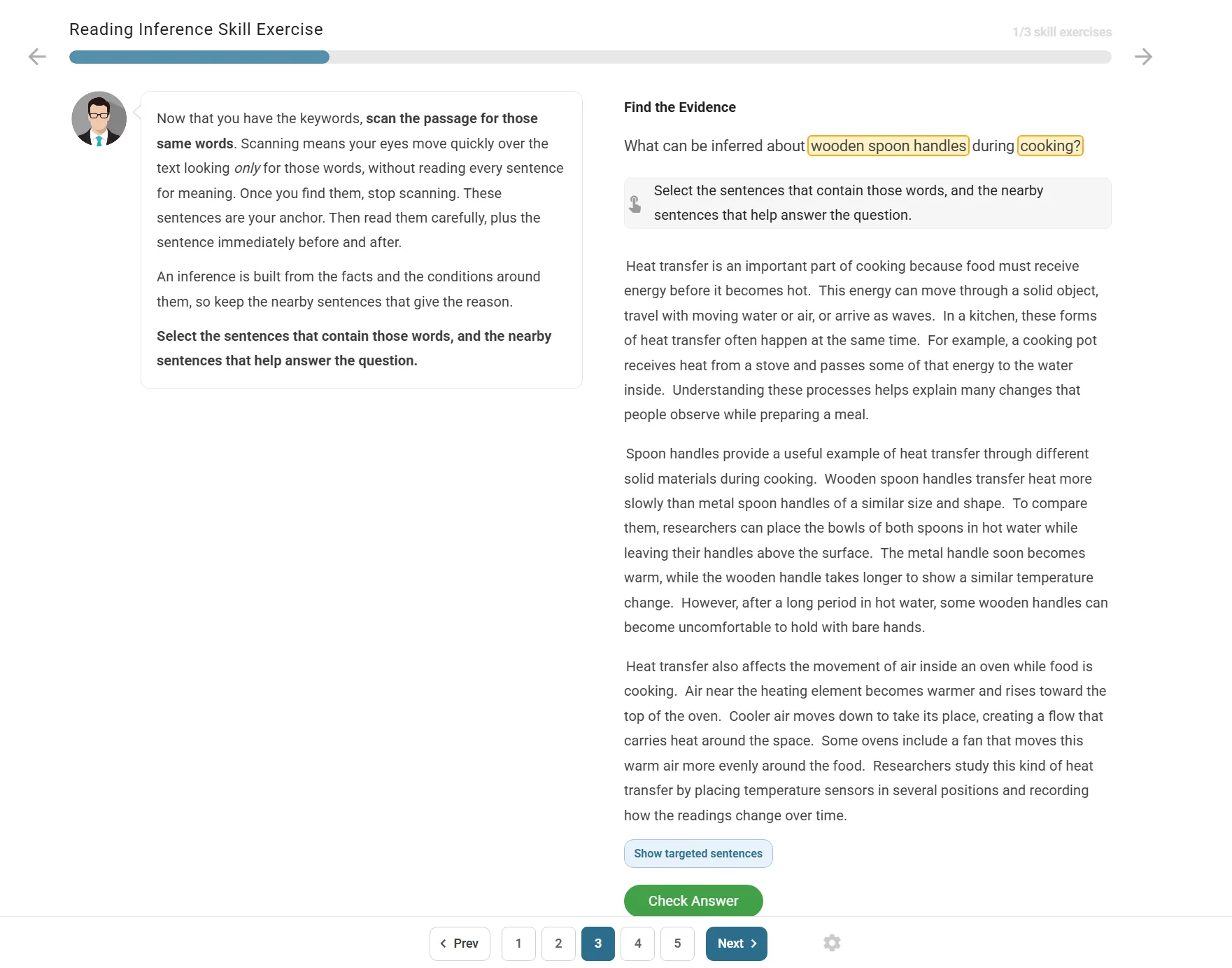
For a sample question and the answer for every type, see our TOEFL Reading question types guide, and for the eight kinds of missing word, our TOEFL Complete the Words practice guide.
4. How to Prepare for TOEFL Listening
In TOEFL Listening, every recording plays only once, and each question has its own timer of 20 or 30 seconds. There are four tasks and seven question types, plus Listen and Choose a Response, which is a task of its own. Try the sample for each task, then use the strategy table below for every question type.
Listen and Choose a Response
You hear one short sentence or question and choose the best reply from four options.
In the Choose a Response task, you'll listen to a short question or statement and choose the most appropriate response.

- I rode the first bus.
- You can follow me there.
- Usually about fifteen minutes.
- Even later than that.
-
spellcheck Answer
Answer: A
(A) The correct answer is I rode the first bus. This is the only choice that explains how the speaker got there so early.
(B) You can follow me there. is incorrect because it is an offer, not an explanation of how the speaker arrived.
(C) Usually about fifteen minutes. is incorrect because it gives a typical duration, not the method of travel.
(D) Even later than that. is incorrect because it is unrelated.
Transcript
How did you get here so early?
Listen to a Conversation
You hear two people, often students or a student and a staff member, and answer two questions.
In the Listen to a Conversation task, you'll listen to a short conversation and answer 2 questions.

- The seats now come with extra padding.
- The image looks clearer than before.
- Tickets are sold out most nights now.
- The magazine made the upgrade sound bigger.
- Visit the planetarium on his own.
- Buy an annual membership pass.
- Post an online review tonight.
- Finish the magazine piece he started.
-
spellcheck Answers
1. Answer: B
(B) The image looks clearer than before. is correct because the woman states, "I could actually make out the faint stars this time." The planetarium image looks clearer than before.
(A) The seats now come with extra padding. is incorrect because she later says the seats finally support your neck. That is only about neck support. She never says they added padding.
(C) Tickets are sold out most nights now. is incorrect because she later says it was not sold out when she went.
(D) The magazine made the upgrade sound bigger. is incorrect because she later says the article explains the equipment. She does not say it overstated anything.
2. Answer: D
(D) Finish the magazine piece he started. is correct because the woman states, "I'd finish that before you go over there." The man then says, "I'll give it a try tonight." He will finish the magazine article tonight.
(A) Visit the planetarium on his own. is incorrect because he suggests that they go together soon, not that he visit alone tonight.
(B) Buy an annual membership pass. is incorrect because she tells him not to worry about a membership.
(C) Post an online review tonight. is incorrect because she tells him not to worry about a review.
Transcript
Woman: Hey, have you been to the planetarium lately?
Man: Not since last spring. Is it actually better?
Woman: Yeah, I went Monday. I could actually make out the faint stars this time.
Man: Oh, nice. We should go together soon. I read that alumni magazine article about the upgrade, but I only got through the first page.
Woman: Yeah, the later part is where they explain the equipment. I'd finish that before you go over there. The seats finally support your neck, too. Don't worry about a membership or a review. It wasn't sold out when I went.
Man: Yeah, alright. Good to know. I'll give it a try tonight.

Detail - Conversation
Learn how to answer question 1 in a step-by-step interactive exercise
Detail - Conversation
Algunas preguntas de detalle sobre conversaciones preguntan qué dice una de las personas sobre un tema. La respuesta es un comentario, una opinión o un dato concreto, no el tema general de la conversación.
Quien habla puede dar una primera reacción y luego cambiarla. Escucha toda su intervención antes de decidir.
Haz clic en reproducir para escuchar el audio
Listen to an Announcement
You hear a short announcement, such as a notice on campus or a message from a professor, and answer questions about its purpose and details.
In the Listen to an Announcement task, you'll listen to a short announcement and answer 2 questions.

- To list the topics that will be covered in the workshop
- To explain the eligibility requirements for attending
- To describe outcomes achieved by previous workshop attendees
- To advertise new funding opportunities for the semester
- To announce deadline changes for current grant applications
- To describe a new graduate admissions requirement
- To invite students to a grant writing workshop
- To introduce a visiting professor's research seminar
-
spellcheck Answers
1. Answer: C
(C) The correct answer is To describe outcomes achieved by previous workshop attendees.. In the announcement, "Attendees from previous workshops have gone on to secure funding for independent research projects and conference travel." shows why the author or speaker mentions that detail, so "To describe outcomes achieved by previous workshop attendees." is the best explanation of its function.
(A) To list the topics that will be covered in the workshop. is incorrect because the author or speaker mentions the detail to support a different purpose, not this one
(B) To explain the eligibility requirements for attending. is incorrect because the author or speaker mentions the detail to support a different purpose, not this one
(D) To advertise new funding opportunities for the semester. is incorrect because the author or speaker mentions the detail to support a different purpose, not this one
2. Answer: C
(C) The correct answer is To invite students to a grant writing workshop.. The announcement as a whole conveys this purpose, as supported by "The graduate school is presenting a grant writing workshop this Wednesday.".
(A) To announce deadline changes for current grant applications. is incorrect because the overall purpose of the announcement is different from what this choice describes.
(B) To describe a new graduate admissions requirement. is incorrect because the overall purpose of the announcement is different from what this choice describes.
(D) To introduce a visiting professor's research seminar. is incorrect because the overall purpose of the announcement is different from what this choice describes.
Transcript
Listen to an announcement at a student center.
Attention all students! The graduate school is presenting a grant writing workshop this Wednesday at two p.m. in the student center conference room. A panel of funded researchers will walk you through the process of writing competitive grant proposals, from identifying funding sources to structuring a persuasive narrative. Attendees from previous workshops have gone on to secure funding for independent research projects and conference travel. All students considering graduate-level research are strongly encouraged to attend.

Function
Learn how to answer question 1 in a step-by-step interactive exercise
Function
Una pregunta de función no trata del significado de diccionario de las palabras. Trata de la función que cumple la frase en la conversación o en la charla. Las frases justo antes y justo después de la oración citada muestran esa función. Lo que dice a continuación la otra persona suele mostrar cómo se entendió la frase.
Haz clic en reproducir para escuchar el audio
Listen to an Academic Talk
You hear a short talk from a class, up to about 250 words, and answer about four questions.
In the Listen to an Academic Talk task, you'll listen to a short academic talk and answer 4 questions.

- They are actively supporting reusable product initiatives
- They are contributing to the massive plastic waste problem the speaker describes
- They always purchase the most environmentally friendly options available
- They carefully research each product's environmental impact first
-
spellcheck Answers
1. Answer: B
(B) The correct answer is They are contributing to the massive plastic waste problem the speaker describes. The convenience model depends on single-use and disposal, generating massive waste.
(A) is incorrect because discarding plastics supports the opposite. (C) is incorrect because environmental friendliness isn't implied. (D) is incorrect because impact research isn't suggested.
Transcript
Listen to a talk in a class about plastic waste.
The single-use plastics industry operates on what you might call a convenience-at-all-costs model. Manufacturers produce enormous quantities of plastic bags, bottles, utensils, and packaging designed to be used once and thrown away. A typical example is plastic water bottles—petroleum is refined into plastic pellets, the bottles are molded and filled, consumers drink the water, and within minutes the bottle is discarded. It's estimated that humans produce over three hundred million tons of plastic waste every year, and less than ten percent is actually recycled.
The reusable alternatives movement pushes back against this by encouraging consumers to switch to durable, multi-use products. One strategy is designing attractive, functional reusable items—stainless steel water bottles, silicone food bags, beeswax wraps—that make the switch feel like an upgrade rather than a sacrifice. Companies are making these products stylish and convenient so consumers actually want to use them repeatedly.
Another approach focuses on infrastructure changes. Programs that install water refill stations in public spaces, eliminate plastic bags at checkout through fees or bans, and incentivize businesses to use compostable packaging are gaining traction in cities around the world. Take reusable cup programs at coffee chains—some shops now offer discounts for bringing your own cup, and, uh, a few have even switched to a deposit-and-return model where customers borrow a reusable cup and return it for cleaning. It's not a perfect system yet, but it's keeping tons of disposable cups out of landfills.
Inference
Learn how to answer this question in a step-by-step interactive exercise
Inference
A veces la conclusión depende de lo que las personas no dicen. Una lista que deja fuera un elemento, un servicio que no está disponible o una sugerencia que se ofrece en lugar de una norma pueden dar a entender la respuesta.
Pregúntate qué debe de ser cierto probablemente, teniendo en cuenta todo lo que oíste. Luego quédate con la opción que apoya la evidencia y descarta la que va más allá de la evidencia.
Haz clic en reproducir para escuchar el audio
TOEFL Listening Question Types and Strategies
| Question type | What it asks | Strategy |
|---|---|---|
| Choose a Response | The best reply to one short line | Listen for the purpose of the line (a question about method, a request, a complaint, an offer). The right reply answers that purpose, not just the words. |
| Gist-content | What the recording is mainly about | The main topic is the idea that keeps coming back. Reject a choice that names only one example: it is too narrow. |
| Gist-purpose | Why the speaker is talking | Listen hardest to the first one or two sentences. Say the speaker's goal to yourself in a short sentence that begins with "to", then match it. |
| Detail | A fact the speaker states directly | A speaker may give a first reaction and then change it, so listen to the whole turn before you decide. The answer is usually a paraphrase. |
| Function | What a speaker is doing with one line | Use the lines just before and after the quoted line. Reject a choice that only restates the words; the answer is the action behind them. |
| Inference | What the speaker implies but doesn't say | Use the speaker's tone, what they do next, or what they leave out. Keep the choice the evidence supports and reject one that goes further. |
| Rhetorical purpose | Why the speaker mentions something | The phrase before the line shows its job: for example gives support, in other words restates, but or however corrects. |
| Reason for action | Why a speaker does something | Listen for because, since, had to, needed to (a cause) and to, so that, in order to (a goal). Connect the problem to the action. |
For an audio example and the answer for every type, see our TOEFL Listening question types guide.
5. How to Prepare for TOEFL Speaking
TOEFL Speaking has 11 questions in about 8 minutes, and it comes last, when you are most tired. There is no reading and no preparation time. It has two tasks that test different things: Listen and Repeat tests how accurately you hear and reproduce English, and Take an Interview tests how clearly and fluently you answer questions.
Listen and Repeat
You hear 7 sentences on one situation, one at a time, and repeat each one exactly. Each sentence plays only once, and the sentences get longer. Each one is scored from 0 to 5: a 5 means every word is there and clear, while a 4 keeps the meaning with a small change. You don't need a native accent. You need every word, in order, said clearly.
The method:
- Listen to the whole sentence before you speak. Don't start repeating in your head while the speaker is still talking.
- Remember the meaning, not the sounds. Picture the action. A sentence you understand is much easier to hold.
- Repeat in word groups, keeping the speaker's stress and rhythm.
- Say every ending. A lost -s or -ed is one of the most common reasons a 5 becomes a 4.
- If you lose a word, keep going. A sentence with one word missing scores far more than one you stop halfway.
You are using an interactive city guide to plan a trip. Listen to your guide and repeat what she says. Repeat only once.
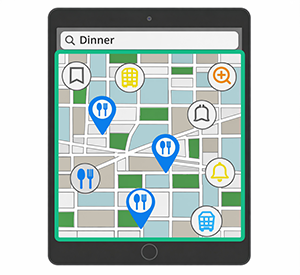
-
spellcheck AnswerWelcome to this digital guide for the city.
Listen to the audio, then click to record what you just heard.
Practice speaking questions in our app
-
spellcheck AnswerCheck local dining spots for regional meals.
Listen to the audio, then click to record what you just heard.
Practice speaking questions in our app
-
spellcheck AnswerUse the transit symbol to locate places to explore.
Listen to the audio, then click to record what you just heard.
Practice speaking questions in our app
-
spellcheck AnswerUse this button to look for available hotel rooms.
Listen to the audio, then click to record what you just heard.
Practice speaking questions in our app
-
spellcheck AnswerMagnify the map for a closer look at each area.
Listen to the audio, then click to record what you just heard.
Practice speaking questions in our app
-
spellcheck AnswerSave places you like so you can return to them easily later.
Listen to the audio, then click to record what you just heard.
Practice speaking questions in our app
-
spellcheck AnswerYou can also check updated hours and current traffic conditions there.
Listen to the audio, then click to record what you just heard.
Practice speaking questions in our appHow to approach this sample
The first sentence, "Welcome to this digital guide for the city," has 8 words. The last, "You can also check updated hours and current traffic conditions there," has 11. Don't try to memorize 11 separate words. Hold four meaningful groups: You can also check / updated hours / and current traffic conditions / there.
Then check the details that cost points: the -ed in updated, the plural -s in hours and conditions, and the small words also and there at either end, which are the easiest to drop.
Full guide with scoring and more tips: TOEFL Listen and Repeat practice.
Take an Interview
An interviewer on video asks you 4 questions on one theme, and you answer each one for 45 seconds with no preparation time. Each answer is scored from 0 to 5 on fluency, how easy you are to understand, vocabulary and grammar, and organization. Forty-five seconds is about 90 to 110 words, so you need a ready structure before the question ends.
Identify the question pattern first. Every interview question fits one of seven patterns, and each pattern has its own structure. These are the patterns our AI Tutor teaches in its TOEFL speaking task achievement skill. As soon as you hear the question, decide which pattern it is, then follow its structure one step at a time:
| Question pattern | Use it when the question asks… | Structure |
|---|---|---|
| Opinion / Preference | what you think, prefer, choose, or believe | Answer + Reason → Explain → Example → Details or Result → Second Reason or Contrast → Details → Conclusion |
| Personal Background | about your education, work, hometown, daily life, or current situation | Direct Answer → Background → What You Did → Specific Detail → Current Situation → Extra Detail |
| Personal Experience | about something you experienced, such as a trip, event, activity, or memorable situation | Direct Answer → Set the Scene → What Stood Out or Happened → Specific Detail → Reaction or Result → What You Learned |
| Challenge / Problem Experience | about a difficult, confusing, uncomfortable, or stressful experience and how you handled it | Introduce the Situation → Explain the Problem → Say What You Did → Result → What You Learned |
| Something You Learned / Discovered | what you learned, discovered, noticed, or found surprising | What You Learned → Example → Explain the Difference → Reaction → Result → Reflection |
| Advantages / Disadvantages | about benefits and drawbacks, positive and negative effects, or pros and cons | Main Advantage → Explain → Example or Result → Main Disadvantage → Explain → Example or Result → Conclusion |
| Change / Comparison | how something has changed, how two situations are different, or how the past compares with the present | Main Change or Difference → Explain → Example → Second Change or Difference → Result → Overall View |
An interview usually mixes patterns. The first question often asks about your own background or habits, and the later ones ask for a choice, an opinion, or the pros and cons of an idea.
If you need a second to think, use a controlled filler such as "Well," "I'd say," or "What I mean by that is" instead of silence, because long pauses cost fluency points.
You have agreed to take part in a research study about online shopping behavior and digital marketplaces. You will have a short online interview with a researcher. The researcher will ask you some questions.
-
spellcheck TranscriptThank you for participating. I'd like to discuss buying textbooks, clothes, or electronics online. What makes you trust a seller you have never used before?
-
Sample ResponseWell, when I am deciding whether to trust a seller I have never used before, I usually look at several signs, you know. Firstly, I read a good number of recent reviews and I pay closer attention to the detailed ones that mention customer service, packaging and delivery speed. Secondly, I compare their rating with the average rating in that category; a small gap is fine but a big one raises alarms. Also, I check if the shop offers clear return policies and responsive chat support. Finally, secure payment options like credit card or PayPal reassure me.

Task Fulfillment
Learn how to answer this question in a step-by-step interactive exercise
Task Fulfillment
El primer paso para responder una pregunta de la entrevista de TOEFL Speaking es identificar el patrón de la pregunta. En cuanto reconoces el patrón, puedes recurrir mentalmente a la estructura de respuesta que le corresponde.
Así sabes con claridad qué decir a continuación, de modo que puedes empezar a hablar casi de inmediato y mantener tu respuesta en marcha sin pausas largas. En lugar de intentar planificar toda la respuesta antes de hablar, sigue la estructura paso a paso.
En este paso aprenderás los 7 patrones de pregunta más comunes y la estructura de respuesta de cada uno. Haz clic en la pestaña de cada patrón para ver cómo funciona.
Vamos a trabajar con la pregunta 1.
Primero, identifica el patrón de la pregunta. Pregúntate: ¿Qué me pide hacer esta pregunta? En cuanto reconozcas el patrón, usa la estructura de respuesta que le corresponde para guiar tu respuesta.
En esta pregunta, el patrón es Opinion / Preference, así que sigue esta estructura:
Answer + Reason → Explain → Example → Details or Result → Second Reason or Contrast → Details → Conclusion
Mientras hablas, usa muletillas controladas como Well, Actually, For example, What I mean by that is y So overall. Estas expresiones hacen que tu respuesta suene más fluida y te dan un poco más de tiempo para pensar si por un momento olvidas qué decir a continuación. Úsalas con naturalidad, no en cada oración. Aquí tienes la lista de muletillas controladas.
Thank you for participating. I'd like to discuss buying textbooks, clothes, or electronics online. What makes you trust a seller you have never used before?
Vamos a trabajar con la pregunta 2.
Primero, identifica el patrón de la pregunta. Pregúntate: ¿Qué me pide hacer esta pregunta? En cuanto reconozcas el patrón, usa la estructura de respuesta que le corresponde para guiar tu respuesta.
En esta pregunta, el patrón es Opinion / Preference, así que sigue esta estructura:
Answer + Reason → Explain → Example → Details or Result → Second Reason or Contrast → Details → Conclusion
Mientras hablas, usa muletillas controladas como Well, Actually, For example, What I mean by that is y So overall. Estas expresiones hacen que tu respuesta suene más fluida y te dan un poco más de tiempo para pensar si por un momento olvidas qué decir a continuación. Úsalas con naturalidad, no en cada oración. Aquí tienes la lista de muletillas controladas.
I see. When delivery is late or an item arrives damaged, do you usually contact the seller, the platform, or your bank first? Why?
Vamos a trabajar con la pregunta 3.
Primero, identifica el patrón de la pregunta. Pregúntate: ¿Qué me pide hacer esta pregunta? En cuanto reconozcas el patrón, usa la estructura de respuesta que le corresponde para guiar tu respuesta.
En esta pregunta, el patrón es Advantages / Disadvantages, así que sigue esta estructura:
Main Advantage → Explain → Example or Result → Main Disadvantage → Explain → Example or Result → Conclusion
Mientras hablas, usa muletillas controladas como Well, Actually, For example, What I mean by that is y So overall. Estas expresiones hacen que tu respuesta suene más fluida y te dan un poco más de tiempo para pensar si por un momento olvidas qué decir a continuación. Úsalas con naturalidad, no en cada oración. Aquí tienes la lista de muletillas controladas.
Interesting. Subscription boxes and automatic reorders save time but can create waste. Do you use them, and do you think they are responsible choices?
Vamos a trabajar con la pregunta 4.
Primero, identifica el patrón de la pregunta. Pregúntate: ¿Qué me pide hacer esta pregunta? En cuanto reconozcas el patrón, usa la estructura de respuesta que le corresponde para guiar tu respuesta.
En esta pregunta, el patrón es Opinion / Preference, así que sigue esta estructura:
Answer + Reason → Explain → Example → Details or Result → Second Reason or Contrast → Details → Conclusion
Mientras hablas, usa muletillas controladas como Well, Actually, For example, What I mean by that is y So overall. Estas expresiones hacen que tu respuesta suene más fluida y te dan un poco más de tiempo para pensar si por un momento olvidas qué decir a continuación. Úsalas con naturalidad, no en cada oración. Aquí tienes la lista de muletillas controladas.
Good points. One final question. Should marketplaces be legally responsible for counterfeit goods sold by third parties, or only the individual seller?
What makes the sample response work
The question asks what makes you trust a seller you have never used before, so it asks what you believe: an Opinion / Preference question. The response follows that pattern:
- Answer: "I usually look at several signs." The listener knows the point right away.
- First reason and details: "Firstly, I read a good number of recent reviews", then the detail that makes it concrete: the ones "that mention customer service, packaging and delivery speed."
- Second reason and details: "Secondly, I compare their rating with the average rating in that category; a small gap is fine but a big one raises alarms."
- More support: clear return policies, responsive chat support, and secure payment options.
Linking words, Firstly, Secondly, Also, Finally, make the organization easy to follow, and every reason has a specific detail. That development is what moves an answer from a 3, which answers with limited development, to a 5.
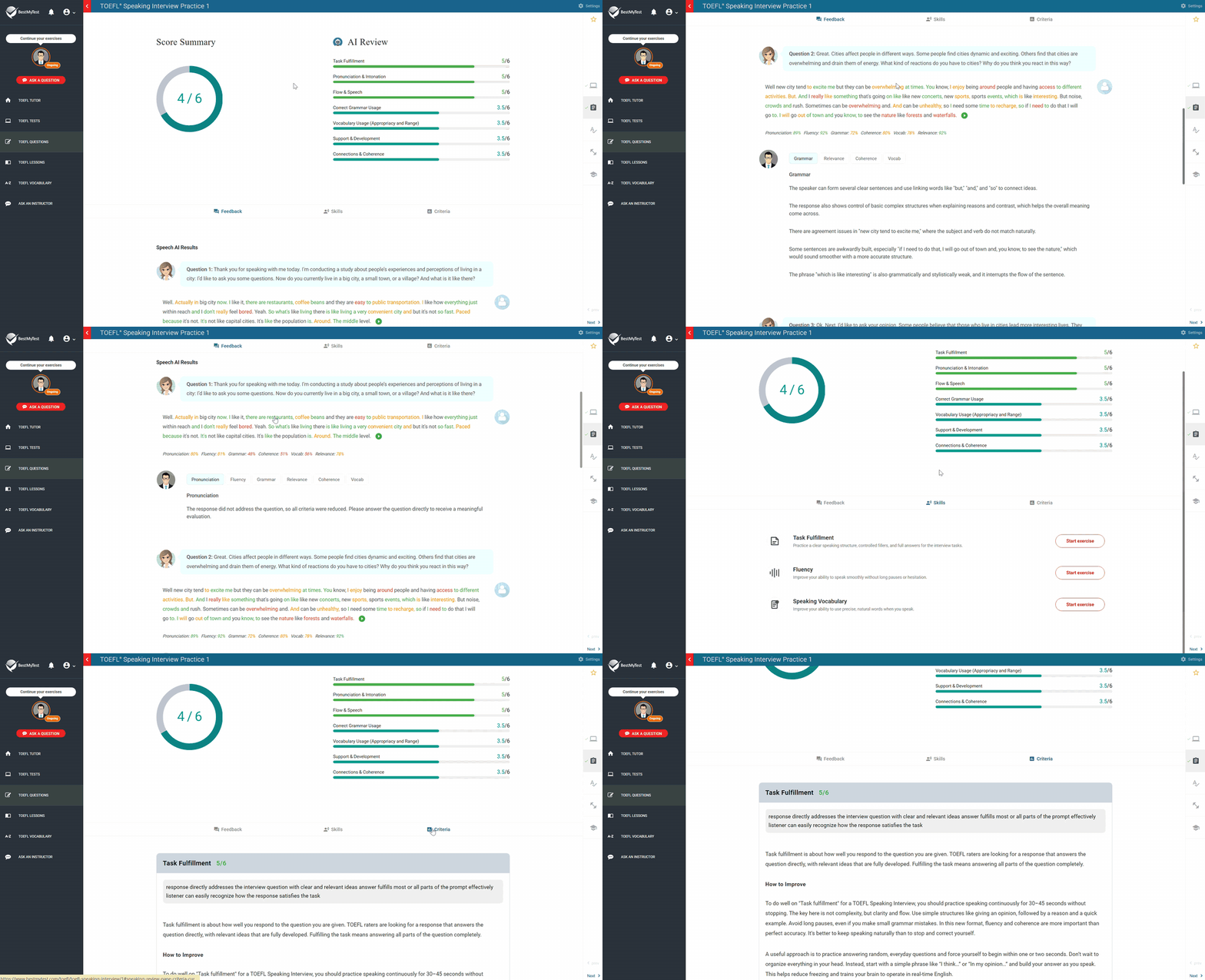
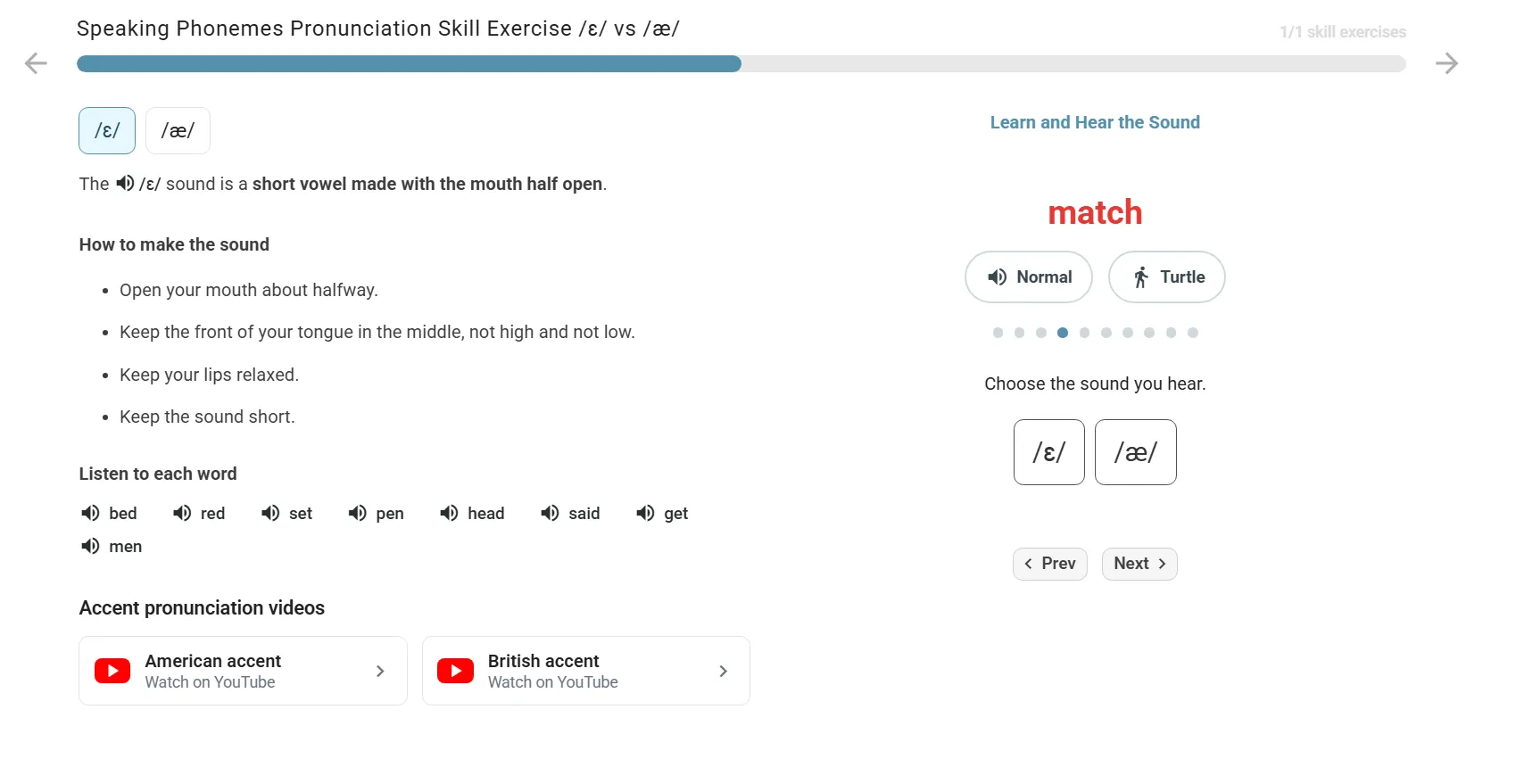
For a structure and a sample answer with audio for every pattern, see our TOEFL speaking templates. For a full four-question interview, see TOEFL Take an Interview, and for how answers are scored, the TOEFL speaking rubric.
6. How to Prepare for TOEFL Writing
TOEFL Writing has 12 questions in about 23 minutes: 10 Build a Sentence items, one email, and one Academic Discussion post. The two longer tasks are scored from 0 to 5 on whether you do what the task asks, how clearly you develop your ideas, and how accurate your language is.
Build a Sentence
You see one line from a speaker and a reply with its pieces out of order. You put the pieces in the right order, and one piece doesn't belong. There are 10 items in about 6 minutes, about 36 seconds each, and an item is either fully right or wrong.
The method:
- Read what you already have: the first line, any words already in place, and the final punctuation. A question mark means the reply is a question.
- Find the subject and the main verb first, then build the rest around them.
- Watch question order: a question puts its auxiliary before the subject, as in Could we move the meeting?
- Find the piece that never fits. It is usually a wrong verb form, a wrong auxiliary, or a wrong pronoun.
- Read it back from the start. It must answer the first line.
 I'm thinking about starting a weekly strength routine.
 it ?
-
spellcheck AnswerWill it include any new exercises?

Build a Sentence
Learn how to answer this question in a step-by-step interactive exercise
Build a Sentence
Una tarea de tipo Build a Sentence te muestra una frase de un hablante y una respuesta con las palabras desordenadas. Mueves las palabras a las casillas para formar una respuesta gramatical que encaje en el diálogo. A veces algunas palabras de la respuesta ya aparecen en la pantalla.
En este ejercicio completas una casilla cada vez, de izquierda a derecha, y cada casilla te da unos 5 segundos. Ese tiempo tan corto te entrena para decidir rápido.
Antes de empezar, lee la primera frase y lee las palabras de la respuesta que ya aparecen. Te indican quién habla, el momento del diálogo y hacia dónde va la oración.
Revisa la pregunta y luego haz clic en Siguiente para continuar.
Echar un vistazo a la pregunta
 I'm thinking about starting a weekly strength routine.
 it
?
La respuesta es una pregunta, así que no empieza por su sujeto. Una pregunta de sí o no empieza con un auxiliar como «should», «would», «could» o «did». Una pregunta que pide información empieza con una palabra interrogativa como «what», «where» o «how».
Lee la primera frase para ver sobre qué pregunta la respuesta y luego busca en el banco de palabras el único segmento que puede abrir una pregunta.
Elige el segmento que abre la pregunta.
La palabra que va después del hueco es it, que ya está dada. El segmento tiene que enlazar directamente con ella.
Hueco 1
I'm thinking about starting a weekly strength routine.
it
?
Ahora tienes it, el sujeto. Un sujeto suele ir seguido de su verbo. También puede ir primero un modal o un auxiliar (we can, she has), o una palabra como never o already.
El verbo tiene que concordar con el sujeto (she works, they work), y su tiempo verbal tiene que coincidir con el momento del diálogo. En una pregunta, el auxiliar del principio decide la forma: Could we move...?
Prueba cada segmento del banco de palabras con estas opciones.
Hueco 2
I'm thinking about starting a weekly strength routine.
Will
it
?
Ahora tienes la palabra include, un verbo. Tenemos que añadir algo después del verbo. Un verbo suele ir seguido de un objeto: un sustantivo, un pronombre o un sintagma nominal (the report, a new plan). En cambio, también puede ir seguido de un infinitivo (to + verbo), una forma en -ing o una cláusula nominal (that / what / where + sujeto + verbo). Después de be o de un verbo copulativo como seem, puede ir un adjetivo (is ready).
Cada verbo admite solo algunas de estas opciones. Piensa en cómo se usa normalmente include: want to go pero enjoy going, think that pero ask if.
Prueba cada segmento del banco de palabras con estas opciones.
Hueco 3
I'm thinking about starting a weekly strength routine.
Will
it
include
?
Ahora tienes any, un determinante. Un determinante abre un sintagma nominal, así que va seguido de un sustantivo (the bus) o de un adjetivo y luego un sustantivo (the early bus). Detrás no puede ir un verbo, to ni un pronombre.
Revisa también la forma. A y an van con una sola cosa (a ticket), y these y those van con más de una (these tickets).
Prueba cada segmento del banco de palabras con estas opciones.
Hueco 4
I'm thinking about starting a weekly strength routine.
Will
it
include
any
?
How to solve this sample
The reply ends with ?, and it is already in place as the subject. A question needs an auxiliary before the subject, and the bank has two: will and do. Do can't go with it (you would need does), so do is the extra piece.
That gives Will it, then the base verb include, then its object any new exercises: Will it include any new exercises? It answers the first line, about starting a new strength routine.
Full guide: TOEFL Build a Sentence practice.
Write an Email
You read a short situation and write an email that covers three points given in the prompt. You have 7 minutes. The email is scored first on whether every point is there, then on clear detail, the right tone for the reader, and accuracy. There's no required length, but a good email is usually 100 to 150 words.
The 7-minute plan:
- About 1 minute to plan. Note the reader and the three points, and choose a greeting: "Dear Professor Ahmad," for a professor, "Hi Maya," for a friend.
- About 5 minutes to write. One opening line that says why you are writing, then one short paragraph per point, in the prompt's order, each with one specific detail.
- About 1 minute to check. Confirm all three points are there, then fix spelling, verb endings, and missing words.
Write an email to Maya. In your email, do the following:
- Explain why you need her help with planning.
- Describe the tasks you want her to help with.
- Suggest a date and time to meet and discuss details.
Write as much as you can and complete the sentences.
Dear Maya,
I hope you are doing well. I am organizing a farewell party for our class mentor before graduation, and I would really appreciate your help. My coursework and internship hours are heavy this month, so handling all preparation alone will be difficult.
There are several tasks I need help with, including reserving a room, coordinating invitations, and preparing simple decorations. I also want to create a short appreciation segment, so I need help collecting messages from classmates in advance.
Would you be available to meet this Friday at 5:30 p.m. at the campus cafe to discuss the plan? One focused planning session would help us organize everything smoothly.
Thanks so much for considering it.
Best,
Jordan
Task Fulfillment — Email
Learn how to answer this question in a step-by-step interactive exercise
Task Fulfillment — Email
Una tarea de email te da una situación, un lector y una lista numerada de puntos que tu mensaje debe cubrir. Cubrir todos los puntos importa más que escribir mucho.
Cuenta los puntos obligatorios antes de planificar nada. Un email corto que responde a todos es mejor que un email largo que deja uno fuera.
Revisa la tarea y luego haz clic en Siguiente para continuar.
Echar un vistazo a la pregunta
Write an email to Maya. In your email, do the following:
1. Explain why you need her help with planning.
2. Describe the tasks you want her to help with.
3. Suggest a date and time to meet and discuss details.
Antes de escribir, responde tres preguntas de planificación: quién es el lector, por qué escribes y qué te pide incluir la tarea.
El lector decide lo formal que tiene que ser tu lenguaje, y los puntos numerados deciden lo que tiene que aparecer en el cuerpo. El enunciado ya contiene las tres respuestas, así que nada de esto es una suposición.
Relaciona cada pregunta de planificación con la parte del enunciado que la responde.
Entender la tarea
Relaciona cada pregunta de planificación con la parte del enunciado que la responde.
El saludo y la despedida muestran al lector lo formal que es tu mensaje, así que mantenlos en el mismo nivel.
Esta tarea menciona a un compañero de clase u otra persona de tu mismo nivel, así que lo adecuado es un saludo cálido con el nombre de pila y una despedida relajada como «Best,» o «See you soon,». Un tratamiento formal aquí suena frío y distante, y te resta puntos por el tono, igual que un saludo informal en un email formal.
Elige un saludo y una despedida adecuados para el lector.
Elegir el saludo y la despedida
Choose a greeting
- Dear Maya,
- Hi Maya,
- Dear Ms. Maya,
- To whom it may concern,
- Yo Maya,
Choose a closing
- Best,
- See you soon,
- Respectfully yours,
- Yours faithfully,
Construye el cuerpo punto por punto, en el orden en que los enumera el enunciado. Empieza por el primer punto obligatorio.
Un inicio de oración abre la oración con un tono amistoso y natural, y tú terminas la idea. Las contracciones como «I'm» y «can't» están bien, pero escribe oraciones completas, no fragmentos como de mensaje de texto. Añade un detalle propio para que la oración responda al punto en lugar de repetirlo.
Elige un inicio para el primer punto obligatorio y luego termina la oración con tus propias palabras.
Escribir el punto obligatorio 1
Explain why you need her help
Pasa al segundo punto obligatorio y dale su propia oración. Mantén el tono amistoso que estableciste en el saludo.
Puedes preguntar directamente, como lo harías en un mensaje a un amigo, pero deja claro lo que quieres, porque el lector tiene que poder responder.
Elige un inicio para el segundo punto obligatorio y luego termina la oración con tus propias palabras.
Escribir el punto obligatorio 2
Describe the tasks
Termina el cuerpo con el último punto obligatorio. Cuando cada punto tiene su oración, la tarea está completa y no necesitas añadir nada más.
Lee una vez más la lista numerada del enunciado antes de salir de este paso. Un punto que falta cuesta más que una respuesta corta.
Elige un inicio para el último punto obligatorio y luego termina la oración con tus propias palabras.
Escribir el punto obligatorio 3
Suggest a time to meet
Las oraciones que escribiste en cada paso aparecen ahora juntas como un solo email. Lee el mensaje completo y comprueba las tres cosas que mide esta tarea: todos los puntos obligatorios tienen respuesta, el tono es adecuado para el lector, y el saludo y la despedida enmarcan el mensaje.
Luego compara tus palabras con la respuesta de muestra. La muestra es una buena respuesta, no la única.
Lee tu email completo y luego compáralo con la muestra.
Revisar tu correo completo
Cómo escribirlo
La tarea Email te da una situación, un destinatario y una lista numerada de puntos que tu mensaje debe cubrir. Los evaluadores comprueban si respondes a cada punto y si tu lenguaje se ajusta al destinatario.
Sigue siempre el mismo orden para no dejar fuera ningún punto obligatorio.
- Entender la tarea. Decide quién es el destinatario, por qué escribes y qué te pide incluir el enunciado.
- Elegir el saludo y la despedida. Elige un saludo y una despedida que se ajusten al nivel de formalidad del destinatario.
- Escribir cada punto obligatorio. Dedica a cada punto de la lista su propia oración, en el orden del enunciado, y añade un detalle propio.
- Revisar tu correo completo. Lee el mensaje completo y comprueba que respondes a cada punto.
Cuenta los puntos obligatorios antes de escribir. Un correo breve que responde a todos los puntos obtiene mejor puntuación que uno largo al que le falta uno, porque un punto ausente es lo primero que nota un evaluador.
Planificar
Tres preguntas sirven para planificar el correo: quién es el destinatario, por qué escribes y qué te pide incluir el enunciado. El destinatario fija el nivel de formalidad, y los puntos numerados fijan el contenido del cuerpo del mensaje.
Tono
El saludo y la despedida le muestran al destinatario lo formal que es el mensaje, así que mantenlos en el mismo nivel. Primero fíjate en quién es el destinatario. Un profesor, un decano o una oficina requieren un tratamiento y una despedida formal, sin contracciones. Un asesor, un profesor asistente o un coordinador requieren un tono cortés y profesional con el nombre de la persona. Un compañero de clase o de equipo requiere el nombre de pila y una despedida informal. Equivocarse de nivel, en cualquier dirección, te resta puntos de tono.
Puntos obligatorios
Responde a los puntos en el orden en que los enumera el enunciado y dedica a cada uno su propia oración. Termina cada oración con un detalle propio, porque una oración que solo repite el punto no lo responde.
Why the sample email scores at the top
Every point has its own paragraph, in order. Paragraph 1 explains why the writer needs help, with a reason: "My coursework and internship hours are heavy this month." Paragraph 2 lists the tasks, including a specific one: "collecting messages from classmates." Paragraph 3 suggests a time and place: "this Friday at 5:30 p.m. at the campus cafe."
The tone fits the reader. Maya is a friend, so the email is warm and polite ("I would really appreciate your help") and closes with a simple "Best,". The request is a question, "Would you be available...?", not an order.
Full guide: TOEFL Write an Email task.
Write for an Academic Discussion
A professor posts a question on a class discussion board, two students reply, and you write your own post with your opinion. You have 10 minutes, and an effective post has at least 100 words. The most important rule: add something new. Repeating a student's reason in different words counts as no contribution, even when your English is good.
The 10-minute plan:
- Read the question and both posts (about 1 minute). Note each student's reason, because you can't reuse it.
- Choose the side you can explain fastest (about 1 minute). Agree with one student, disagree with both, or take a middle view. Any position can score a 5.
- State your position in the first sentence.
- Give two reasons of your own, each with support (about 6 minutes): a reason says why, and the support shows it in a real situation.
- Close in one sentence, then check (1 to 2 minutes) for grammar, spelling, and missing words.
In your response you should:
- express and support your opinion
- make a contribution to the discussion
An effective response will contain at least 100 words.
In my opinion, society should move toward mostly digital payment, but it should not remove cash completely. Electronic payment is useful because it leaves a clear trail for taxes and makes it easier for small shops to sell online or at street events without keeping many coins. However, a country also needs a back-up plan. During a power cut, a storm, or a problem with a payment company, people still need to buy food, medicine, and bus tickets. Cash also gives people some privacy for simple daily purchases. For this reason, I support a mixed system: digital payment as the normal choice, with cash protected for emergencies and basic public services.
Task Fulfillment — Discussion
Learn how to answer this question in a step-by-step interactive exercise
Task Fulfillment — Discussion
Una tarea de Academic Discussion te da una pregunta del profesor y dos publicaciones breves de estudiantes. Escribes una publicación propia en un tiempo límite de diez minutos.
Lee a los dos estudiantes antes de planificar nada. Sus razones y ejemplos ya están en la discusión, así que tu publicación tiene que aportar algo que ellos no dijeron.
Revisa la discusión y luego haz clic en Siguiente para continuar.
Echar un vistazo a la pregunta
Toda buena publicación empieza con una postura clara. El lector tiene que saber lo que piensas desde la primera oración, así que no empieces con un comentario general sobre el tema.
Puedes estar de acuerdo o en desacuerdo con uno de los otros estudiantes, o tomar una postura propia. Elijas la que elijas, las razones que des tienen que ser tuyas, no las de ellos. Cualquier postura puede obtener una puntuación alta si la apoyas, así que elige la que puedas explicar más rápido. Limita la postura a una oración y guarda tus razones para el siguiente paso.
Elige tu postura y luego reescribe la oración temática con tus propias palabras.
Elegir tu postura y escribir la oración temática
Una idea principal es una razón que explica por qué tu postura es correcta. Dos razones son un plan seguro para diez minutos. Una oración que solo repite tu postura con otras palabras no es una razón, y una razón copiada de uno de los estudiantes no aporta nada a la discusión.
Escribe cada razón como una oración completa y usa tu propio vocabulario en lugar de las palabras del enunciado. Las explicaciones y los ejemplos vienen en los siguientes pasos.
Reescribe cada idea principal como una oración clara que apoye tu postura.
Desarrollar dos ideas principales
Digital payment helps with taxes and small shops.
Cash is a back-up when payment systems fail.
Una razón por sí sola no convence. Añade una explicación o un ejemplo concreto para que el lector vea cómo funciona la razón en la vida real.
Un ejemplo concreto nombra una situación, una persona o un resultado. Basta con una o dos oraciones, porque tu segunda idea principal y tu conclusión todavía necesitan tiempo.
Escribe una o dos oraciones que expliquen o den un ejemplo de tu primera idea principal.
Explicar o dar un ejemplo de la idea principal 1
25
Da a tu segunda razón el mismo apoyo que a la primera. Una publicación que desarrolla bien una idea y deja la otra sin apoyo se ve desequilibrada, y el lector solo ve una razón.
Usa aquí una explicación o un ejemplo diferente. Repetir el apoyo que ya escribiste añade extensión, pero no contenido nuevo.
Escribe una o dos oraciones que expliquen o den un ejemplo de tu segunda idea principal.
Explicar o dar un ejemplo de la idea principal 2
25
Una conclusión breve le indica al lector que la publicación ha terminado. Basta con una oración: reformula tu postura con otras palabras y remite a tus razones.
No copies tu oración inicial palabra por palabra y no plantees una idea nueva. No queda tiempo para apoyar una idea que aparece al final.
Escribe una oración de conclusión que reformule tu postura.
Escribir la conclusión
15
Las oraciones que escribiste en cada paso aparecen ahora juntas como una sola publicación. Lee la publicación completa y comprueba las tres cosas que necesita una buena publicación: una postura clara, dos razones propias y una explicación o un ejemplo concreto detrás de cada razón.
Luego compara tus palabras con la respuesta de muestra. La muestra es una buena respuesta, no la única.
Lee tu respuesta completa y luego compárala con la muestra.
Revisar tu respuesta completa
Cómo escribirlo
La tarea Academic Discussion te pide tu propia opinión sobre la pregunta del profesor, escrita como una publicación breve en un límite de diez minutos. Los evaluadores quieren una postura clara y bien apoyada, no un ensayo largo.
Sigue siempre el mismo orden para que no se te acabe el tiempo antes de explicar tus razones.
- Elegir tu postura y escribir la oración temática. Di lo que piensas en una oración. Puedes estar de acuerdo o en desacuerdo con un estudiante, pero tus razones deben ser propias.
- Desarrollar dos ideas principales. Escribe dos razones que expliquen por qué tu postura es correcta.
- Explicar o dar un ejemplo de cada idea principal. Añade una o dos oraciones de explicación, o un ejemplo concreto, debajo de cada razón.
- Escribir la conclusión. Reformula tu postura en una oración y vuelve a remitir a tus razones.
- Revisar tu respuesta completa. Lee la publicación completa y comprueba que cada oración apoya tu postura y que nada repite lo que ya dijo un estudiante.
Responde a la pregunta del profesor con tu propia opinión. Puedes estar de acuerdo o en desacuerdo con uno de los otros estudiantes, pero tus razones y ejemplos deben ser propios. Una publicación que repite lo que ya dijo un estudiante no aporta nada a la discusión.
Posición
Tu postura es tu respuesta a la pregunta del profesor. Ponla en la primera oración para que el lector nunca tenga que adivinar lo que piensas. Cualquiera de las dos posturas puede obtener una puntuación alta, así que elige la que puedas apoyar más rápido.
Ideas principales
Una idea principal es una razón que explica por qué tu postura es correcta. Dos razones bastan para diez minutos. Escribe cada una como una oración completa con tu propio vocabulario en lugar de repetir las palabras del enunciado.
Apoyo
Una explicación dice cómo funciona la razón. Un ejemplo nombra una situación, una persona o un resultado. Da a cada idea principal una o dos oraciones de apoyo, y usa un apoyo distinto para cada una.
Conclusión
Una oración basta para cerrar la publicación. Reformula tu postura con palabras nuevas y vuelve a remitir a tus razones. No introduzcas una idea nueva que no tengas tiempo de apoyar.
Why the sample post works
Paul says cashless payment is efficient, and Sunny says it can exclude people. The sample takes a middle position in its first sentence: mostly digital, but cash should not disappear.
Then it adds ideas neither student gave: digital payment leaves a clear record for taxes and helps small shops sell at street events, while cash is a back-up "during a power cut, a storm, or a problem with a payment company" and protects privacy. The last sentence restates the view as a clear proposal: a mixed system. That's what raters mean by a contribution.
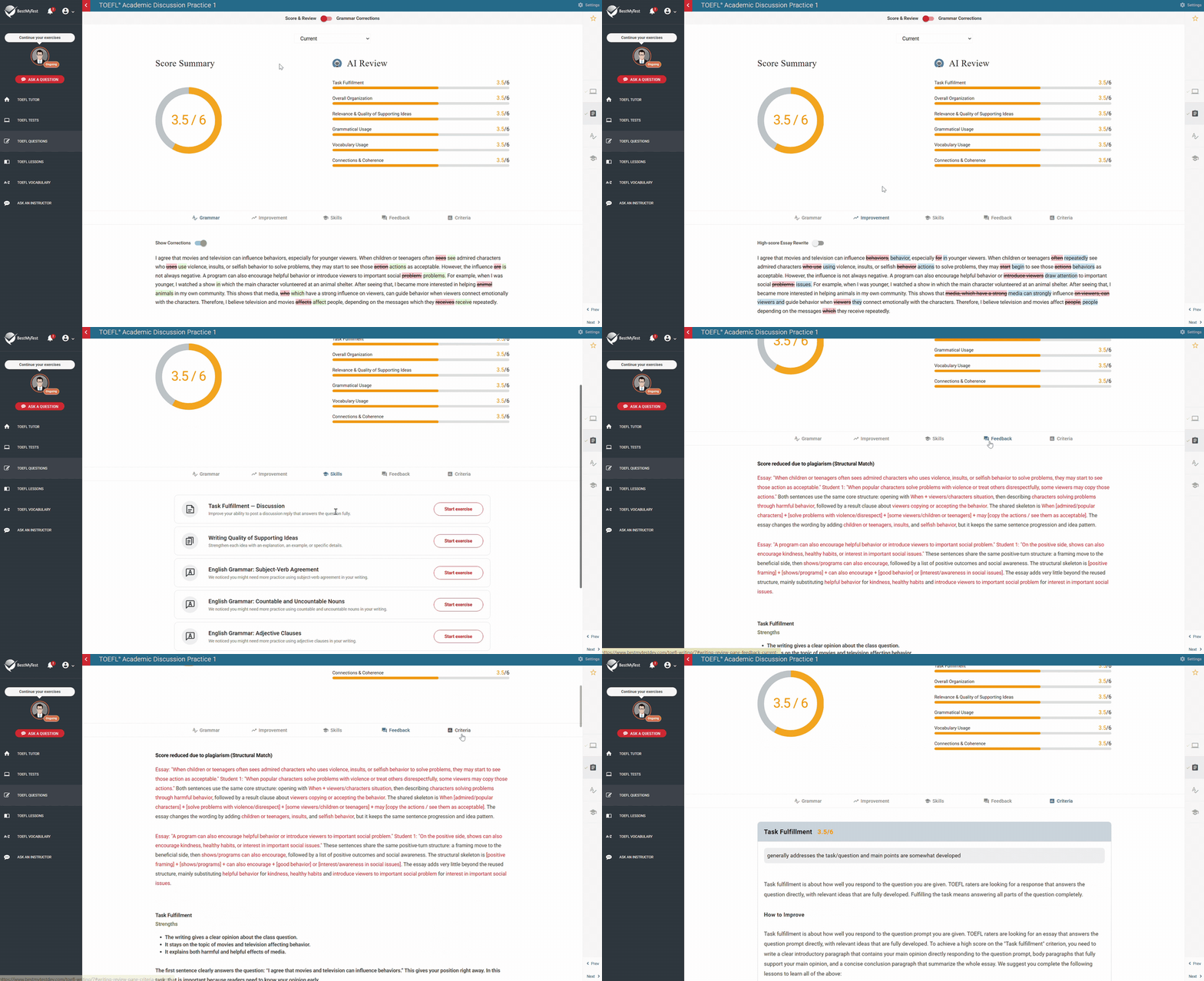
Full guides: TOEFL Academic Discussion task, TOEFL writing templates, and the TOEFL writing rubric.
7. Build Vocabulary and Grammar for Every Section
Vocabulary and grammar are behind most of the points in every section. You saw it in the samples above: Complete the Words and Build a Sentence are decided by grammar, Reading and Listening answers are paraphrases, and Speaking and Writing are scored on accurate language.
- Learn words in context, with their word forms and the words they go with: preserve evidence, secure funding, respond to change. A list of single words is much harder to use.
- Collect paraphrases. When a correct answer rewords the text, write both versions down: "make out the faint stars" = "the image looks clearer." This trains the exact skill Reading and Listening test.
- Review the grammar you use most: verb tenses, articles, prepositions, subject-verb agreement, question word order, and relative, noun, and adverb clauses.
- Use new words actively in your next interview answer or email. A word you have used is a word you will recognize.
In BestMyTest: vocabulary training covers more than 5,000 commonly used English words with lessons, flashcards, and exercises, and the AI Tutor grammar skills let you practise the structures behind your recurring mistakes.
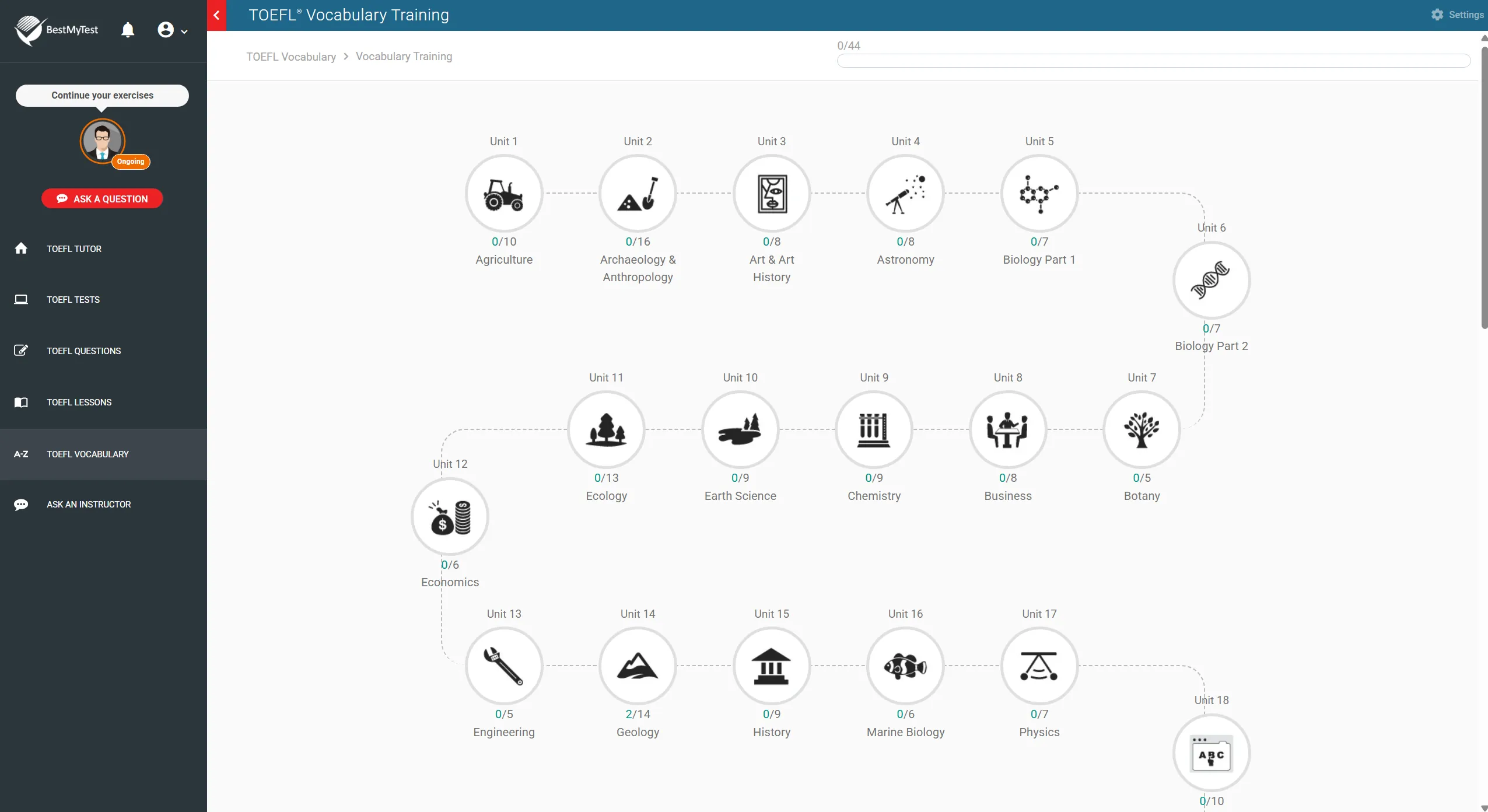
8. How to Use the BestMyTest TOEFL Course System
Every method in this guide follows the same loop: practise, find the mistake, fix the skill, try again. The BestMyTest TOEFL course is built around that loop, and each part of the course has one job in it.
| Step | What you do | Where in BestMyTest |
|---|---|---|
| 1. Practise | Answer questions by task type, or take a full test to measure your level | 6,500+ practice questions for every 2026 task; 50 full-length adaptive practice tests |
| 2. Review | Find out why each answer was wrong and which skill it tests | Answer explanations and transcripts; score reports by question type; instant AI scores and feedback for Speaking and Writing |
| 3. Improve | Fix the skill behind the mistake | AI Tutor exercises for your weak skills; 200+ TOEFL and English lessons; vocabulary training |
| 4. Apply | Try new questions and check the mistake is gone | New practice questions of the same type; the next full-length test |
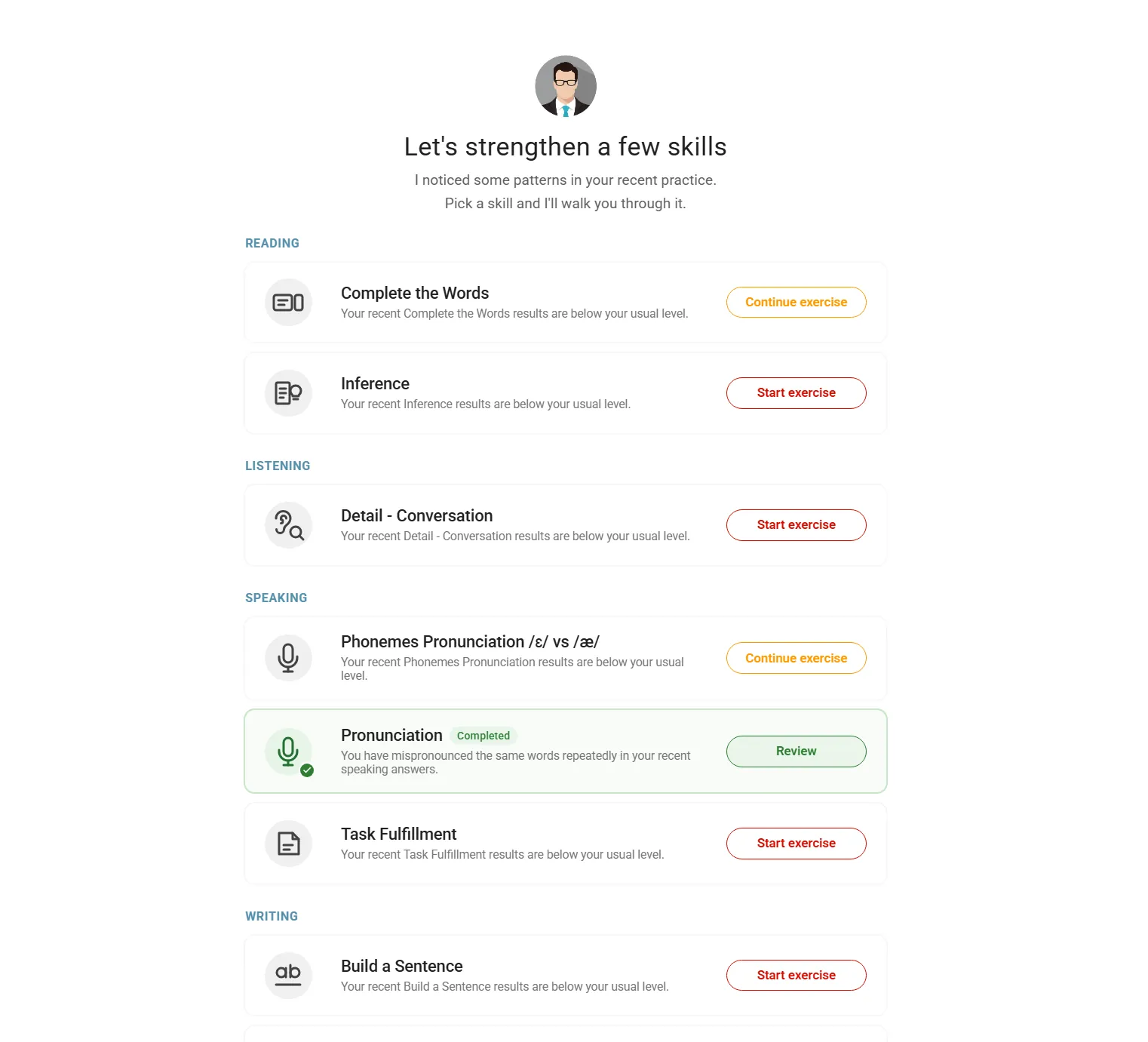
Here's what one cycle looks like. Say your score report shows you missed three inference questions in Reading. You open the explanations and see the same pattern each time: you chose answers that sounded reasonable but went beyond the passage. The AI Tutor gives you an inference exercise that starts from a question you missed and walks you through finding the evidence. Then you answer five new inference questions in the question bank. When they come out right, that skill is fixed, and you move on to the next weak skill your results show.
Speaking and Writing work the same way. Record an interview answer or submit an email, read the instant AI feedback, and complete the AI Tutor pronunciation, fluency, grammar, or writing skill it points to. Then answer a new question. When you want a deeper look, you can get a detailed AI review or a review by a TOEFL certified teacher, and Ask-An-Instructor is there when you have a question about a lesson or about English.
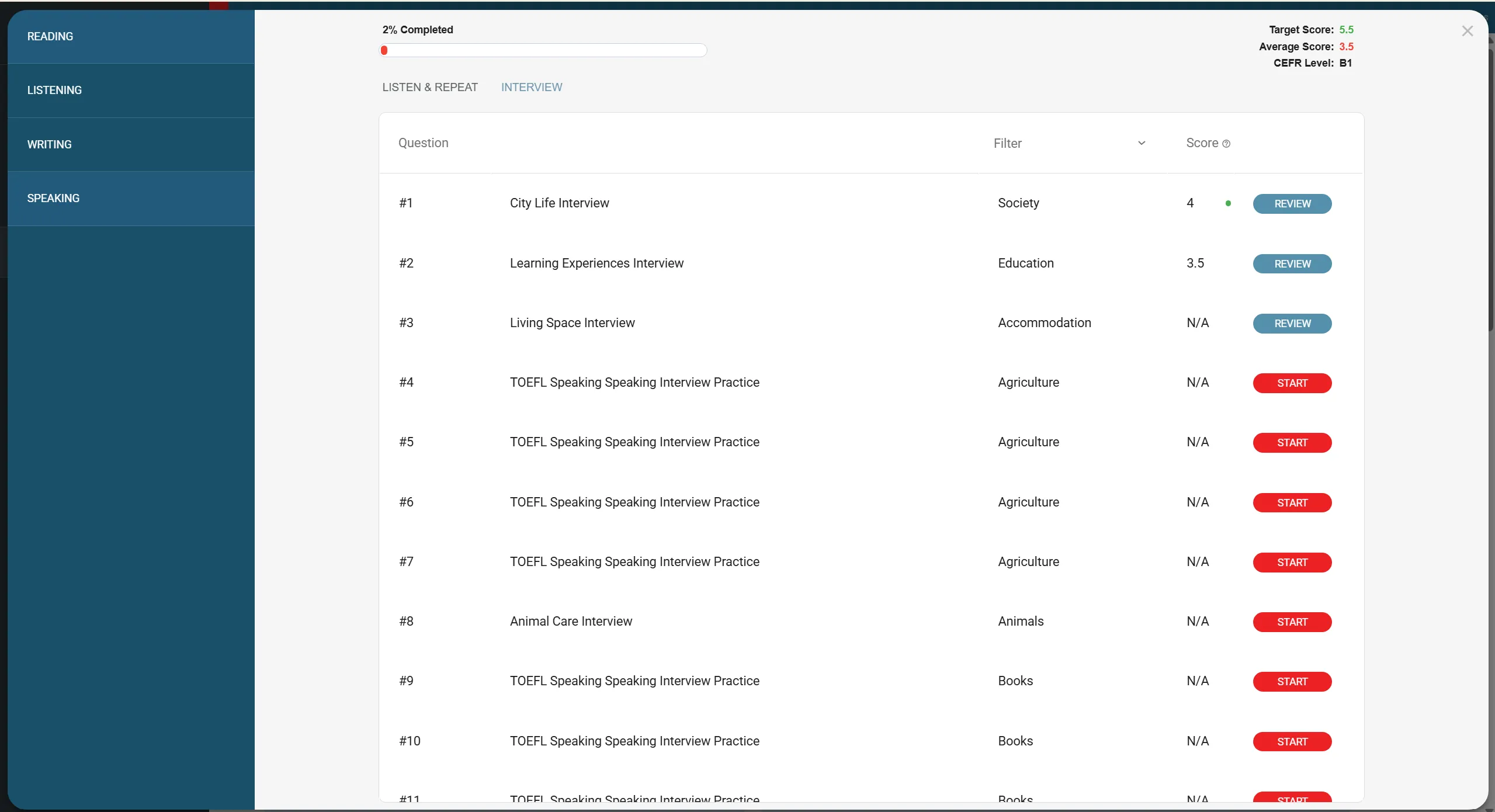
For a full tour of every part of the course, see our TOEFL preparation courses page.
9. Choose a TOEFL Study Plan
How long you need depends on your English level today and your test date. We've built two free TOEFL 2026 study plans around the loop above:
- 1-month plan: for students who already have intermediate or upper-intermediate English and test within a month. Plan on 2 to 3 hours a day, 6 days a week. Week 1 is a diagnostic test and learning every task type; weeks 2 and 3 build skills, speed, and accuracy; week 4 is a final full-length test and test-day review.
- 6-month plan: for students who want to strengthen their English while preparing. Plan on 1.5 to 2 hours a day, 6 days a week. Months 1 to 3 combine TOEFL practice with AI Tutor lessons to build your English foundation; months 4 to 6 add speed, timed practice, and regular full-length tests.
Whichever plan you follow, take a full-length practice test every week or two to check that your weak skills are improving. See the week-by-week schedules, daily practice targets, and the downloadable study guides on our TOEFL study plan page.
TOEFL Preparation: Frequently Asked Questions
helpHow long should I prepare for the TOEFL?expand_moreexpand_less
If you already have intermediate or upper-intermediate English, one month of focused study, about 2 to 3 hours a day, can be enough. If you need to strengthen your English first, plan on about six months.
helpWhich TOEFL section should I study first?expand_moreexpand_less
Start with a full-length diagnostic test, then practise all four sections every week. Spend extra time on the section and question types where the test shows you lose the most points.
helpHow many TOEFL practice tests should I take?expand_moreexpand_less
Take one at the start to find your weaknesses, then one every week or two to measure progress. Always review a test fully before you take the next one; that review is where most of the improvement comes from.
helpCan I prepare for the TOEFL online on my own?expand_moreexpand_less
Yes, as long as you get feedback on your mistakes. Instant AI scores for Speaking and Writing, AI Tutor exercises for your weak skills, and teacher reviews when you need them let you study at your own pace without a classroom.
helpIs BestMyTest updated for the 2026 TOEFL?expand_moreexpand_less
Yes. The practice questions and the 50 full-length practice tests cover every task in the format introduced on January 21, 2026, including adaptive Reading and Listening.
Start Your TOEFL Preparation Today
The fastest way to a higher TOEFL score is not more questions. It is finding out why you miss them and fixing that skill. Take the free Sample Test 1, review every mistake, and work through the strategies in this guide one task at a time.
Lo que dicen los estudiantes sobre BestMyTest
It’s the best platform to practice for the toefl test, there is a lot of useful excercises that helps you improve the section that you struggle the most. Definitelly, I recommend using bestmytest as it is a practical way to prepare for the exam.
The Vocabulary lessons were absolutely amazing. I can vividly remember that I was struggling with new word across different topics, and those lessons assisted me to learn the needed vocabulary for the TOEFL test in a short matter of time, thanks to Ms., Sonya. I appreciate the efforts made by the best my test as a whole.
This application is easy, fun, and very helpful for anyone who wants to learn or practice for the TOEFL exam. The questions are well designed and make studying more enjoyable. I definitely recommend it for TOEFL preparation!
I scored a 5/6 in TOEFL with the help of Best My Test. Their wide range of material helped me practice, kept me consistent, and eventually improved my score. I would really appreciate if they would provide more writing and speaking reviews since their reviews are great and accurate as well. Lastly, I haven’t found so many materials for TOEFL on any other prep course website. Really grateful and highly recommended.
Very good site for Toefl Practice sessions
BestMyTest provided exceptional support during the internet shutdown in Iran by renewing my account for free. This showed real understanding and integrity. Beyond that, their TOEFL preparation platform is extremely effective—the lessons are well structured, the practice questions closely match the real TOEFL exam, and the explanations help you understand your mistakes clearly. I highly recommend BestMyTest both for their high-quality service and their strong ethical values.
BestMyTest is an absolutely fantastic platform. The service is excellent and very professional. The practice tests are high quality, very close to the real exam, and extremely helpful for building confidence. The explanations are clear, detailed, and easy to understand. Customer support is fast, friendly, and truly supportive. I highly recommend BestMyTest to anyone preparing for the TOEFL. An outstanding experience from start to finish
It's a really helpful website. With TOEFL practice sessions, you can improve your general reading and listening skills while also working towards the TOEFL. There are so many examples, you don't need to buy any additional reference books or anything else. By simply studying on this site, you can achieve excellent TOEFL scores by applying both your general English skills and exam-specific tactics.
With their help, I easily achieved a TOEFL score of 107. They helped me overcome the barriers.
This is the best website that I practiced TOEFL materials.
I find this website very useful. I believe it is one of the best online TOEFL preparation on the internet. One of the thing I like is it mimic test condition. If you are struggle with time management, it will help you a lot. After practicing with the BestMyTest, I saw a significant improvement in my TOEFL scores. My score increased by 8 points. However, I needed more time to study because pharmacy certification has different requirements, and due to unforeseen circumstances I had to take break. I would recommend this website to anyone to use it. You have everything you need to pass you test in one place.
After practicing with the BestMyTest app, I saw a noticeable improvement in my TOEFL scores. The practice questions helped me significantly enhance my reading and listening skills. As a result, my score increased by 6 points. The focused practice through BestMyTest played a key role in my progress.
Excellent I recommend to study for the toefl from there it has everything you need 💙
I highly recommend BestMyTest for TOEFL preparation. The platform offers comprehensive practice tests, detailed feedback, and excellent study resources. It significantly improved my skills and boosted my confidence. An invaluable tool for anyone aiming to achieve a high TOEFL score.
i have received my scores and i am glad😁 81: R18, L21, S22, W20! I already enrolled in the college and I will go to the US this fall! you helped me with the fulfillment of my childhood dream 🥰 i absolutely recommend BestMyTest for all students who want to pass TOEFL exam with the best grades!
The best website out there to learn about TOEFL! I'll always recommend it to my friends. Thanks so much for your effort to make such an amazing TOEFL platform.
I highly recommend bestmytest_toefl. I haven’t met my desired score yet, but i am working on it and obviously, I can tell, I have improvements.
The best ! I prepared for 8 days and scored 91, for me it’s amazing! I didn’t expect that. I highly recommend it !
I just prepared for few days and was able to score 103 on my TOEFL-iBT test, I am glad I made the right purchase, thankyou!
Best app for toefl practicer. Easy to access, gives so many instructions and reviews which can help to update my score. They are so humble and kind. I am still practicing from it....
The best platform available for TOEFL preparation. It saved my time by providing all materials I needed.
The number of tests is good and the the application resembles the actual toefl test app too.
I highly recommend BestMyTest for TOEFL preparation. The website offers fantastic resources that are comprehensive and user-friendly. The practice materials are top-notch, providing valuable insights into exam patterns. What sets BestMyTest apart is their exceptional customer service. The team is not only kind and understanding but also incredibly helpful. They genuinely care about your success and go the extra mile to assist you in your preparation journey. If you're looking for a reliable platform with excellent resources and a supportive team, BestMyTest is the way to go. They have made a significant difference in my preparation, and I am truly grateful for their guidance.
Great website to score 100+ in toefl 👏🏻
Great platform for TOEFL practice, I definitely recommend this platform to everyone. The staff is also very helpful with everything you need.
It's a great platform with everything someone will ever need to prepare for the TOEFL. Highly recommend.
Best my test have best course for TOEFL...... Helped me a lot to score good
Bestmytest has everything you need to prepare for toefl. As a non-english speaking person who lives in french-speaking country, it was almost impossible to defeat toefl. Nevertheless, because of this site, I learned and got what I needed. I highly recommend everyone who wants to pass their toefl exam to use this site. It is very cheap and easy to use. I practiced and learned strategies there for 3 months and got my toefl score. My dream score was 66(17 for each reading and writing, 16 for each listening and speaking) but I got 89(20 R, 23 W, 25 S and 21 L) on actual exam and the reviews I got from Bestmytest were almost the same. For you to succeed, you would just need to study carefully their lessons and follow their advices. Thank you Bestmytest for helping me defeat this dreadful english exam.
The customer service is responsive, also every time I have a question regarding a section for TOEFL, they explain it properly. The speaking and writing reviews are also effective in improving my score. Moreover, they also constructive feedback when they need to improve something on their website or content.
BestMyTest has been the best platform in my preparation process for the TOEFL. They have what appears to be the largest question bank of all websites. Plus, by doing the Simulation Tests, I have greatly improved my english overall. Their support is agile and effective as well.
It is the best website for studying TOEFL. Their questions are very similar to TOEFL format and not only questions, also the experience is very similar to TOEFL exam. Also, they are very thoughtful and helpful.
I just recently took my TOEFL test and managed to score 114/120 thanks to this course! :) Reading 30 / Listening 30 / Speaking 24 / Writing 30 The course especially helps getting into the "exam mode" and to get accustomed to the type of questions that aren't your everyday type of task (--> especially the speaking part). While I didn't do a lot of the learning modules, some of them really helped me to work on specific issues I had (e.g. a certain type of question in the reading part that I always messed up). Based on your right/wrong results, BestMyTest suggests you modules that may help to improve in that certain aspect. I primarily focused on these lectures + structure lectures for writing/speaking as well as practice to minimize the amount of time spent learning (I'd say I invested about 50h max preparing for the TOEFL). However, I found the grading done by BestMyTest tutors to be a little more strict than the actual results (at least that's what I believe as I never scored as high as I did in my actual exam). That's not a bad thing though as it motivates you to push even harder. Last, but not least ;) ... BestMyTest has great customer support. I reached out with an issue and they got back to me within under 24h + were able to help out. Twice. It's rare to have such great customer service nowadays :) Overall, I'd recommend everyone to get the course as it's really worth the money
It contains huge number of exercises and is probably the best way to prepare for TOEFL.
Bestmytest is the best way to study Toefl. They have a lot of lessons and practice questions. I recommend using this platform if you want to reach your goal. Also, they have great customer service.
Best website to improve and learn. I have tried multiple websites for Toefl but this is helping for sure.I am yet in the process of taking my test and will review once I get my expected scores. But I will certainly say that the customer service and the content of the study is awesome.
Since I have never took TOEFL before, best my test really helped with the introduction and tips and trick. The contents are precise and focused, with tactics and gradings that help us in greatly improving our scores.The structured video lessons, the practice resources and the full length tests helped me immensely.I absolutely love their chat support and how they resolve all your doubts. I wish I started sooner with best my test and also did all exercises. Thank you,Best my test! I definitely recommend it to everyone :)
This is by far the best website I used to prepare for the toefl. The speaking and the writing reviews helped me focus on my weaknesses. I ended up scoring 28/30 S and 29/30 W. I struggled while I was trying to find someone to accurately evaluate my speaking and writings. Furthermore, the practice test that the Toefl ibt offers on their website will give you a score without explanation or corrections so it was not that helpful. And most of the tutors I contacted charged 3 times more what the review costs here. I also appreciate that you can record your voice and take as many mock tests as you'd like. I absolutely recommend this for any student who is preparing for the toefl.
This is the good site to practice TOEFL I came across this site there features I like it -Flexible pricing according to need -Real time simulation similar to exam simulation -practice test are of similar level real exam
Bestmytest is actually the best website you can can ever find to help you prepare for TOEFL. They have ample number of tests and practice questions which is hard to find anywhere else, additionally, the tests are on a par with actual TOEFL test. No matter how much research you do, you will not find any platform better than this for TOEFL, take my word to the bank. I definitely recommend this to all those preparing for TOEFL exam. Prices are very much affordable, moreover the whole team of bestmytest is very kind and genuine, they always get back to you with their wonderful service if you are stuck somewhere. I had an amazing experience preparing with this platform. I wish bestmytest to continue helping students as they are in future. Thank you BESTMYTEST. You really are the best!
Frankly, the best platform to prepare for TOEFL. I would recommend it to everyone.
I would recommend best my test to each and every student preparing for TOEFL. It is the bestest portal I have ever used.
BestMyTest.com was my personal tutor in studying for my TOEFL exam. The platform is very user-friendly and navigation is easy. The practice and simulated tests really prepared me for the TOEFL in a way I could face the actual exam with ease. The feedback on the Writing and Speaking sections that were given by instructors was pointing out exactly where I had to focus and these gave me a pretty good indication about what I was doing wrong as well as getting right. I loved the learning experience and the many templates that are there in the lessons section were totally awesome! Those really gave me a guideline I could stick with and helped me organize my answers. I did not go to any physical classes. Instead, I followed the advice I was given and focused 1 month on my studies using this eLearning site and did really well in the TOEFL. Thank you so much! I highly recommend BestMyTest.com to anyone who wishes to do their TOEFL studies.
"Hello all, I am super happy with the pricing and rates from the company. Specifically I like the speaking parts. They have provided many practice tests to choose from. I took 7 day access and upon my request, they extended for 2 more days untill my real TOEFL test. It helped me a lot. Thanks "
I got my TOEFL scores today and I am so happy with that. Due to financial constraints, I could not take purchase any of your courses, but your free materials helped me a lot. This mail is a thanking mail to you. I want to express my gratitude towards you through this email. I would definitely recommend your website if anyone asks me for a TOEFL preparation recommendation.
This site is extremely helpful for TOEFL preparation. I haven't passed the exam yet but I do exercises much better than before. What is good about this site? 1)Reading, Listening Besides many available TOEFL questions, special lessons do help you. The system recommends the most relevant lessons based on your progress and mistakes. 2)Speaking, Writing Bestmytest is way ahead of competitors. As far as I'm concerned, it's the only popular TOEFL preparation site that has a large enough number of professional reviews of your work 3)Nice design, really responsive team Ideas for further improvement: developing a phone app; sending notifications
I started studying for Toefl in March, I didn't have much time and didn't know where to start. I searched on the internet for free materials, it was very confusing. Then I found the Bestmytest website, I studied all the free materials, but I needed more. Because of the banking system in my country, I couldn't purchase any of their plans. So I emailed them and promised to pay as soon as I moved to my destination country, surprisingly they accepted and gave me access to their platform for two months. It was AMAZING. My score improved from 87 to 98! I am grateful to them, not only for their number one platform but also for their kindness.
They have lots of questions to practice which helped me improve my basics and score well in TOEFL.
Helped me to improve my score by 12 points just in one month! Super useful strategies and clear explanations.
I used your app for my TOEFL exam, and I got the score I needed. It was extremely useful, so thank you very much. In one month, more or less, I improved 9 points.
I payed the 3-month subscription and it worked beautifully. I honestly feel like I “bested my test” (pun intended). I scored 9 points above the average calculated by the website. The more you practice, the best the website will work for you. The video lessons are very well organized. Recommended 10/10
This is so far the best course out there for TOEFL preparation. I found it extremely helpful, I am sure you will too.
I think bestmytest is the best way to study Toefl. They have tons of practice tests and everything for the Toefl preparation. Especially, their review system helped me a lot to improve my writing and speaking skills. Thank you so much bestmytest.
BESTMYTEST is extremely useful service. I love that there are a lot of theory and practice. Everyone can find the answers on their questions. Definitely recommend!
Best my test is the best TOEFL preparation! It’s very useful and helped me improved my score! On the first attempt, I study by myself and the results is not good enough then I decided to give best my test a chance for my second time. And it turns out great! I took a test today and so far I improved my reading part by 8 points and listening part by 5 points which made me happy. Also, the website and very easy to use! I love it.
It is the best app to practice for TOEFL!!! I really recommend Bestmytest!
Bestmytest is by far the best toefl preparation service ever. I was really amazed with their prep materials and their practice tests. Its so close to the actual Toefl test. Keep up the good work
It is the best app to practice for TOEFL. It has a lot of exercises in each of the four sections and also provides you a lot of useful tips to increase your score! I highly recommend it! It has helped me a lot... Thank you so much for your services.
Bestmytest helped me so much with my studying, it was extremely useful and efficient, thank you very much ! I deeply recommand Bestmytest for your TOEFL prep!
Best my test is a platform that helps you to clearly understand the objectives of each section and provide you with the best study tips on how to tackle each section. The tips provided are invaluable and the adequate practice questions help you gain the mastery over that section. I got a 94 in TOEFL without BMT, but with Best My test, I got a 117. I would 100% recommend this to anyone looking to improve their TOEFL score
Excellent experience. Very well organized. Same as Toefl.
Very helpful! Most questions provided by the BESTMYTEST service are similar to those of the actual TOEFL test. It helped me find my weaknesses and supplement those parts successfully. Subscribing the BESTMYTEST would be one of excellent ways to prepare for the TOEFL test considering the cost-effectiveness.
The best online preparation Toefl course, I recommend this course for all test taker for several reasons: - Very organized - Highly experienced touters - thousands of practices question. - Analytical dashboard which helps you to identify your weaknesses and strong point. - Quick response from touters when you ask for an essay writing and speaking review. Overall, I highly recommend every test taker to try this comprehensive preparation course.
This is the Best site for TOEFL preparation. Their detailed reviews on the speaking and writing section were very helpful. And the simulated tests were very accurate to the actual test. Would recommend BestMyTest to anyone who is preparing for TOEFL.
My experience with BestMyTest institute is very satisfying. The Mock-tests and the study materials are of very high quality. The teachers are really very helpful and co-operative. They always clear my doubts whenever I ask them. This is one of the best online coaching institutes for TOEFL preparation. I would definitely recommend to other students to Join BestMyTest for preparation of TOEFL exam.
Thank you BestMyTest! BestMyTest makes me successfully head to Stanford University to implement my research work in 4-month preparation. I am a Taiwanese student. Listening has always been my short. In Taiwan, probably because these TOEFL online learning websites are full English, a limited number of people would use websites. As a result, most people spend a great amount of money on going to cram schools since teachers there would share feedbacks and techniques on how to get high scores, especially in speaking and writing section. However, the teaching materials of cram schools are not sufficient, which makes students need to buy extra reference books or download exercises from the internet. Couple years ago, I spent nearly 100 USD on a famous cram school in Taiwan. To be honest, cram school is not a miraculous cure if you do not spend plenty of time in practice; as a result, I got only a 75. I found complete courses with YouTube videos included of how to use these logics (techniques of getting high scores) where I can achieve the same effect by cram school, and BestMyTest also provides speaking and writing reviews. The abundant simulated exercises perhaps value this website the most, an amount equal to buying 10 more reference books. In addition, the simulated exercises in BestMyTest is a bit more difficult than official TOEFL tests, which renders me to feel easier and less tense when I took the official TOEFL exam. Lastly, a long-term advantage, not the instant advantage for Taiwanese students-BestMyTest is a full English website, but I think it is a good start to adapt in English earlier for any student who wants to go abroad. To conclude, BestMyTest integrates accomplished courses and rich simulated exercises. Nevertheless, the cost is only one-fifth of going to a cram school. For those who want to get high scores or to immerse yourself in English, I sincerely recommend BestMyTest.
BestMyTest is a website that offers an online course that every candidate should consider when preparing for the TOEFL exam. This website meets all my personal needs. Of course, just following the course cannot replace other general sources of English learning such as conversing with English speakers, reading English books and articles, watching English TV shows and movies and so on. On the other hand, BestMyTest can be used as a primary source or guide, if you like, on your way to test preparation. To make it short, I can list several reasons why I liked this source. The main one I was looking for was the opportunity to practice as much as possible. In fact, the practice materials, in my opinion, correspond to the level of difficulty of this exam, if not more. Hence, this almost unlimited ability to practice and then reinforce all the skills by studying sample answers is crucial. Next, TOEFL is a test in which timing is everything, and therefore BestMyTest adequately solves this problem. Each candidate can start developing time-related skills from the very beginning on the way in ones preparation. In addition, anyone interested in building their own set of new academic vocabulary can find many useful lessons and materials in this regard. The site structure is very easy to navigate. Since BestMyTest offers a 7-day free trial, one can utilize this option effectively and learn how to navigate the website. Last but not least, my interaction with customer support has always been very productive. The service is organized professionally. I received all the answers to my inquiries in a timely and concise manner. As a final thought, I believe BestMyTest is a great all-round source when it comes to TOEFL preparation, and it works great when paired with polishing your general English as I mentioned above.
Bestmytest is a reliable online course preparation to enhance confidence for TOEFL exam. There are plenty of exercises, vocabulary lessons, simulations with a diagnostic overview, and really interesting statistics to understand how your training is. The writing and listening reviews are amazing to improve you grade in the test. Definitely, I recommend this course!
This is an absolutely great website. I have almost practiced all the exercises available on the website and I have noticed that all major and minute details are handled with so much effort and determination. If I will be unable to get a good score in TOEFL then I will own the whole blame as not for achieving a score even after getting myself prepared from the remarkable website.
It is really same with Toefl exam. I feel lucky to find you. Your practices are really helpful to prepare my exam 🌟
I think that Bestmytest is the best TOEFL preparation program. It's practice tests are of same level as original test. Also, the wide varieties of practice questions help you to improve English. The reviews from Bestmytest are really helpful to get better score. I really recommend others to use this program.
I started preparing for my TOEFL test one month ahead. Bestmytest gave me a plenty of possibilities to learn grammar, words, templates and gave me tips on how to prepare. However, best was a huge amount of practice exercises. I practised a lot and with the optional review on your writing and speaking bestmytest is great. I could improve from a score of less than 90 to 108 in four weeks.
The Practice tests are a good exercise for the TOEFL test preparation. Ask an instructor is an useful tool for tips and Q&A
If you need to take the TOEFL exam and you want to study on your own, you won't succeed. I thought I was doing great while studying on my own but I started the 1 month program and realized that you NEED this website to reach your goals. Feel free to try your 7 days free trial and you will realize that you need to keep using this website. I improved from 80 to 92 in only one month. And I am not the best at writing and speaking, but the templates provided for both section helped me a lot. I would recommend taking at least 1 month program 100%. THANKS!!
Great program. It helped me a lot with my TOEFL preparations. I would definitely suggest to many other people :)
If you are looking for a high TOEFL score you are at the perfect place. I would definitely recommend Bestmytest on my good experience with them.
I am preparing for TOEFL as a student studying in Korea. Bestmytest has been really helping me with the preparation for TOEFL. Without the need to purchase other materials, Bestmytest provides different packages all-in-one. 1. First, it allows us to set our goals for TOEFL scores and help us to track how we are doing. Tons of practice questions for all 4 sections are organized really well. A 7-day free trial is there, so you can always check out how they are before you pay for a subscription. 2. Moreover, Bestmytest provides lessons with a lot of tips for each section. Especially, at first, I faced problems in the speaking and writing section as I did not know to deal with the questions. However, with Bestmytest, I learned many strategies that I can apply to the questions. 3. Lastly, the best part of Bestmytest is that it has a review service for the speaking and writing section. It is really difficult to judge the performance of myself even with the rubrics, so reviews from the professional really help to know how well you are prepared for the test. I really suggest Bestmytest to people who are struggling with TOEFL for the above reasons! The price is really reasonable compared to the services they provide. I really thank Bestmytest for helping me with the study. :)
Very good course, helped me to get from 89 to 97 in 2 weeks. I will study for one more month though. Aiming to pass 100! Thank you to everyone who made bestmytest possible. My little suggestion is that speaking reviews seem to be very expensive :( And with a 1-month plan which does not cost a little, you only get 1 whole speaking task review, anyway I won't cut off stars, as this course absolutely helped me to improve my score significantly.
I think this website is one of the best to prepare for the TOEFL exam. It offers lessons, vocabulary, and tips/tricks for each section, a wide range of well-made tests (which imitate exactly how the exam goes) and it is also up to date. The price is very affordable and you can benefit from their free trial period as well. Another important thing to keep in mind is that the samples they offer (for speaking and writing) are almost perfect, professional. But normally nobody can provide such an accurate answer, so no need to worry. They are only for guidance. You can obtain a really good score with more natural responses (which can include pauses, stuttering or less fancy words).
I definitely recommend ''BEST MY TEST''. You will not get this helpful source and helpful , professional tutor service from anywhere. The way they created is not only amazing but also make your expert in toefl. You absolutely achieve your target score. thank you so much.
It is a wonderful site which helps you to achieve such a fabulous score on your toefl exam. I strictly recommend this site to everyone who is going to attend to TOEFL.
They are the best team on your TOEFL preparation. All of their practise tests are equal to real one. I personally increased my score by 15 points. This is awesome. I want to say thanks to. BestMyTest team. Wish you best
Best platform to prepare for TOEFl exam. You will see 100% improvement in your score.
As I have checked and used most of the online TOEFL preparation tools, I can definitly tell that Bestmytest is the top online tool on the market. Mert Cetin
First of all, I have been using Bestmytest for 2 months. This is the best program for Toefl. There are very good practices test. Moreover, my favorite section is grammar correction. Secondly, Bestmytest has excellent team. When i had a question, they responsed with big patient and quickly. Even if questions are weird. :) Thank you very my BESTMYTEST team. ☺️☺️☺️
I can't thank you enough for the perfect training your website has provided!! Received my scores today: achieved 119/120. I felt pretty confident at the test center due to the exercises I have done on your page - however I did not expect such a great result. Keep on doing what you are doing - this really is a great opportunitity for students to prepare at a price which is affordable for everyone.
I took my TOEFL test recently and recieved a score of 106. I think this was possible only because of the materials and preparation guides provided by bestmytest team. The prep materials were really good and I would surely recommend bestmytest to my friends or juniors. The company provided me with a one week free extension service when I requested which I think most of the companies would hesitate. I am very thankful for this deed. Once again thanks a lot bestmytest team. Keep continuing this work!
This is PERFECT! I normally don't prefer to give review. However, I would love to do it today because I am very happy that I got high score in TOEFL. Thanks to Bestmytest. Can't believe I did it :) I would Highly recommend Bestmytest. As name says: Bestmytest is best.... Really worth it.
After trying a different course, I can say that Best my test course is very professional and recommended. They have very good lessons and multiple ways to practice and strength both foundations and skills. Their practice tests are very similar to the actual TOFEL test and reflecting the real test level. Their online speaking and writing reviews are accurate and eventually reflected my score. Thanks to best my test I achieved my target score.
I got my TOEFL test score back today and I scored 108. This was my first try and I'm very happy with my score :) I just wanted to say thanks for taking the time to answer all my questions and also giving me the advice I needed. I hope many students will score high through this program. Thanks again! :D
I just got my Toefl score yesterday- 114/120, and I owe a massive part of that achievement to Bestmytest. The reason I went for Bestmytest is for access to experts to provide feedback on the speaking and writing areas in particular as I felt that self study won't enable me to see my mistakes. I got 30/30 in both these sections! Below are the benefits I experienced: 1. The home screen provides information on my progress: what my current score is and what I require, what percentage of each section I have completed and which question types, reading in particular, I am struggling with. I found the gist content and insert sentences questions to be particularly challenging so I sought further expert help in those areas. 2. For the few IT related queries I needed help with, Jane was really helpful and swiftly guided me. Overall, the program is sophisticated and user friendly. 3. The experts who reviewed my submissions gave really constructive feedback. The response was speedy too. I personally found their bank of questions to be harder, and the scores of submitted work to be non-lenient, which challenged me to work harder. 4. Practice makes perfect. Bestmytest have a universe of questions which was exactly what I needed. 5. They have helpful videos and templates on how to approach questions too. I am glad that I supplemented my revision with this excellent learning program. I would highly recommend it! I'm a very anxious exam taker and Bestmytest helped me build within myself, that confidence, which guided me to success.
Their 20 tests are almost identical to the actual TOEFL test. The writing and speaking feedback is very helpful as well. I spent two weeks using the website and I improved from 93 to 105. From a guy who spent nine months fighting against the toefl test, I can tell that there is no platform better than Bestmytest to prepare for the toefl test.
I prepared for 12 days(approximately 30hrs) on bestmytest and got 113/120 on TOEFL. I'm extremely happy that I got this score and I would say that bestmytest helped me a lot! I experienced the following advantages preparing from bestmytest: 1- Excellent speaking and writing reviews(I got the exact same score on speaking-29 and almost the same score on writing-28 on the actual TOEFL exam) 2- Excellent high level practice questions: I felt that the practice questions on bestmytest reading and listening section were of a higher level than tested on the actual TOEFL exam. But, that was a big plus, as I felt at ease during the TOEFL exam. 3- Excellent sample essays and speaking sample answers. One must go through 50% of these to get well prepared! 4- Excellent structure explained in videos for speaking and writing section. Make sure you go thorough all the videos on TOEFL guides for speaking and writing section, given on best my test. I followed the exact same structure for responses on speaking and writing section, and got 29 in speaking and 28 in writing. 5- Excellent questions and software for speaking and writing section. In fact, for all the sections :) The good thing is that you can record your responses on the speaking section and check for the errors. In conclusion, I would say that even if you have less time(about 10-20 days) to prepare for the TOEFL exam, you should take services of bestmytest. Good luck with your TOEFL prep! Regards, Shahzil
First of all, I am greatly appreciated to Bestmytest team! You guys are the best of the best in terms of the Toefl tutoring. I have struggled to get my required score for looong time. I finally got Improved my score from 77 to 90 with each section of R20, L24, W24, S22 for only 3 weeks of intense study. I have taken TOEFL for 3 times before, and never passed 80 each time. My first trial was 72 and 77, last one was 75. I was about to give up my studying and felt exhausted. I have studied by myself with official TOEFL books and youtube videos or other free resources whole this time. Out of four section, my listening and reading skills were the worst than other two, and I have tried many times, still, couldn’t improve them significantly. I think entire this time, I was just waisting my time and doing it wrong way over and over again. So I realized that I need tutoring but I couldnt afford personal tutoring, and I searched internet hoping that I would find some solution. Eventually, I found you guys very practical and affordable, and decided to give a shot after 7 weeks of free trial. It was the best decision of my life. I think everything on the website is super useful and handy. I realized that because of lack of my academic vacabulary knowledge, caused my L and R score low, after studying with Bestmytest, I felt much more familiar with the academic topics, and It helped me Improve a lot in my understanding of those sections. To be honest, I only utilized around 50% of what bestmytest offer and If I completed it fully, I feel like I could improve my score even higher than 90. Impossibilty became possible with you guys! I really didnt expect today that I would get this score. I was surprised and get emotionaly same time thanked for God that helped me find you guys! I would definetely recommend you guys to everyone who is not only taking Toefl but also wants to improve their english generally! Finally, I truly wish everyone in your team good luck at what you are doing and best of all from my heart! :)
I`d like to share my wonderful experience whit all who are looking for a great TOEFL prep plan , I am super satisfied with bestmytest and recommend it to all ,,,,
Fantastic website for students looking to study TOEFL. Very good interface and content. Can surely help you boost your scores.
A big thanks to BestMyTest. It played a major role in improving my skills in English. Especially in speaking, there were lots of practice questions and tests which is in the same kind of TOEFL speaking questions. It helped me to get familiar with the pattern. After practicing those questions I was able to face all the speaking questions without any anxiety. I felt vocabulary exercises and academic videos are useful because no other websites have this clarity in teaching academic words that are mostly used by ETS TOEFL exams. I found those vocabulary sessions are interesting since it has pictures and definitions with the word that you can easily relate the word with real-world situations. After going through these sessions, I was able to understand reading and listening sections easily. You can find plenty of resources for TOEFL online, but it is tough to find efficient TOEFL resources like BestMyTest. I am glad that I found them before taking my TOEFL exam.
I found bestmytest useful for studying for the TOEFL tests. Lessons and practice tests are diverse and helpful. I was able to get 98 on my TOEFL test after studying on BestMyTest for three months. I would recommend my anyone who want to pass the TOEFL exam to get a bestmytest TOEFL online course.
I strongly recommend bestmytest TOEFL preparation program. I scored 114 mainly thanks to the effective practice tests which includes very similar speaking tasks which was my main weakness.
Downsides - A - subscription is pricey B - I can't buy access only to the section I am interested in. Upsides - A - their question database is huge and the quality is impressive B - simulated tests are pretty realistic C - ideal for people who already speak english (like myself) but only need a specific TOEFL training thanks
TOEFL is a tough examination and I was finding it tough to crack on my own. It was at that time that I came across Best my test. The guidance they provide in the TOEFL examination is absolutely the best and it was they who helped me to crack the examination. Their special method of TOEFL practice test was very helpful, especially in building my confident approach towards the exam.
Amazing plateform and very helpful service after purchase. The UX is seamless, and allows you to progress and visualize your weaknesses and areas of improvement. I honestly wish I discovered it sooner, best investment made!
This app is not only great for their services but also for their gestures. I asked them to extend my service for 2 days and they did it unquestionably. Highly recommended to all tier of students.
I found this website awesome! organized lessons, reviews and techniques. customer service responds fast and greatly serve the customer. the only negative thing in my opinion is that the paid packages are limited with time not with a quantity. I have a suggestion for that. accessing the materials should be unlimited time but maybe taking reviews from real teachers can be limited with a certain time. I give it 5 start because for me the pros are more than cons. and it's specially for the customer service which I miss in so many services in Europe.
Very good services provided by the bestmytest team!!!
For a long time I was looking for a program that would help me to prepare for the exam. My best score is a program that really helped me in my study process to get the most out of everything and get my maximum score.
I have improved a lot in my english skills. There are many exercises to practice.
Amazing platform! Super helpful individuals! Really liked the fact that you could get free writing and speaking reviews with your plan! Anyways I can't thank them enough!
Amazing experience... Effective course material, test, questions and lessons all helped me to improve my English.. Thanks Best my test
This is a great platform for a beginner to learn from scratch. Best my test tool helps you to improve your scores and you can reach your target score easily with the materials and lessons provided by them.
Every resource on the bestmytest website was easy to understand and navigate, making it one of the best websites I've ever seen.
Best my test really helps me to reach my goal. And their customer service is really great.
It’s great platform. I recommend to everyone who wants to prepare themselves for toefl or ielts.
Go-to website for mock tests. After a lot of web searching I zeroed in on this website. Excellent content. After taking a free test, I decided it was worth it. The quality of test papers are really good. Especially the listening tests are very helpful.
I strongly recommend this course. By far is the best one and the staff always reply you in a short time. There is a lot of material to study and it is very interactive. Enjoy it!
Bmt helped me a lot while I was preparing for the exam. Actually I have 10 more days to take the test but, I have to say that they improved me a lot. I am so thankful to them. I recommend everyone because there are plenty of tests and questions.
They have many questions for practice which could be really helpful.
Very good website and service!
BestMyTest has a wide variety of training modules and tools, which are difficult to obtain from other sources. For me the BestMyTest speaking modules are especially important. They are well designed and convenient to use. I could not find anything similar by effectiveness from other sites.
Your study plan is very helpful and affordable. I'll highly recommend it to my friends.
I am happy with BestMyTest.
I started using this BestMyTest and it has been very helpful for my learning. From the lessons to the numerous practice questions. I definitely recommend.
I used this for my speaking and writing review. It is a very good resource and the team is very supportive.
This is the best platform where you will find lots of practice sets and you can get assistance any time you needed in any of the sections. This helped me strengthened all my weak sections especially writing section.
A lot of questions for preparation and helpful customer service.
Highly recommended Amazing content Quick support
Great material, variety of tests. Great customer service! They were keen to help on any question we had. Highly recommended.
The support is very helpful and gives a response quickly. Besides, the content is so well explaining, and there are many valuable tests and exercises.
Great costumer service! Great organized website, but you need to look at harder listening exercises.
They offer a great materia that completely close to the real test
The content is great.
I find this program great because it is comprehensive. It has well structured lessons, vocabulary cards and most importantly a lot of practice with sample answers. The package also includes thorough speaking and writing reviews as well as questions to ask to an instructor. In addition, requests are answered in a timely fashion.
The materials as well as services are excellent at a reasonable cost. I strongly recommend everyone.
This is currently the most comprehensive preparation for TOEFL and IELTS. What is included here? -Clear and useful lessons on exam preparation strategies -A lot of practical material. I have never seen so many tasks! -A great system for speaking exercises with the ability to record your answer many times -The packages include assessment of your oral and written answers by professional English-speaking teachers -11 complete real-time practice tests. -4 complete verification tests that emulate the conditions of a real exam -7 days of full trial access -Low cost compared to all other sites -All tasks are accompanied by explanations of errors.
I was searching for a course to help me with my IELTS exam. I would like to say that I found Bestmytest a great place in order to study. In the beginning, I took the custom study plan in Bestmyest for 1 month, I found the course with excellent resources, a lot of simulations, and good reviews of my speaking and writing from their teachers. I started getting in the reading part at 4.5 grade, and low scores in the other skills but thanks to the lesson on Bestmytest, now I got 6.5 in simulations. So, I decided to buy the premium package because I wanted to continue practicing for my IELTS exam (the first time that I paid for an online course, but I consider this course is the best investment that I did). In addition to that, the team supporters are ready to reply to you when you have any doubts. I am happy with Bestmytest due to I am improving my reading, speaking, writing, and listening. I consider this course is the best if someone wants to get a good score in IELTS.
Bestmytest is a great tool to prepare for IELTS. The lessons are structured in a clear format and quite detailed while the practice tests are very useful and well written aside for a few typos. I would recommend it to everyone who wants to get ready for any of the tests they offer.
I strongly recommend this platform for IELTS preparation. It has everything needed for the test
I recommend this to everyone preparing for an IELTS test! All material and instructors are super helpful. I really liked the amount of examples for speaking, listening etc. You even get grades and feedback for your practise if you pay for the service. I prepared for 2 months with this page only and got an overall 8.5
I am from India securing high IELTS band score (equivalence in CEFR C1 - Proficient user) in my IELTS examination investing few hours of preparation everyday for a couple of months with BestMyTest systematically. " The course offered by BestMyTest contains meticulous information on strategizing, practicing and weighing my potential. The module structure is segmented into chunks enabling quick preparation and easy representation in the practice tests. The listening and reading sections are tuned for complex tough question patterns. The speaking and writing techniques are greatly helpful. The base course price provides true value and custom add-on packages are handy for last minute preparations. The support provided by the team is tremendous in answering questions providing examples and reference links that nullifies the absence of a live session. I definitely recommend BestMyTest providing good service that enabled me to achieve success."
It is an excellent website, with a structure of costumer support which you can solve your problem as fast as possible. Besides that, the content is very objective and help me out a lot on my Ielts preparation. Thank you! I really recommend them.
I love bestmytest so much. There are lots of helpful lessons and practice test. My favourite part: ability to receive reviews of your work from professionals. Customer support team is also adorable! These guys are aware and ready for help.
I researched a lot regarding best IELTS preparation material. Finally, I settled on Bestmytest. They have the best IELTS preparation material and also offered the most competitive price. I took my initial mock test of IELTS and get it checked from verified teachers of BestmyTest. I scored... Listening 6.5 Reading 5.5 Writing 6.0 Speaking 6.0 Overall (Band 6.0) Afterwards, I went through intense practice. I found out that the Reading Articles and Listening sections both are of a bit higher level then original exams. Due to this fact, I was already practicing at a different level. Both writing and speaking material are thoroughly described, with some exceptional tips. So finally in my IELTS exam, I was expecting to score a Band 6.5 or Band 7 maximum. But my actual results were completely mind blowing. I managed to score Writing 7 Speaking 7 Reading 8.5 Listening 8.5 Overall (Band 8) This drastic change is because on exam day I found that the original questions were bit easier in comparison to what I was practiced on Bestmytest. All in all, I'm glad to study with their resources. Outstanding support team, state-of-the-art exam oriented resources and teachers. Thanks for helping me achieve an exceptional IELTS result.
The perfect website if you need to study for the IELTS, by far. I spent a month studying there, every comment is accurate, their database is incredibly wide, instructors are really helpful and Don't be afraid to pay for reviews (speaking and listening), it may be sharp sometimes, but it's actually what you need at the moment. Overall they helped me gain more than 1 point in each band. I am very thankful.
I would like to thank bestmytest team for their great support and study material, I would strongly recommend anyone who wants to pass IELTS exam to sign up with this great team.
In the beginning, when i started to study, my total score was around 5-5.5 but now I can easily get overall 6.5 and it is important progress for me. If you want to improve your exam score anything you need is BestMyTest which has lots of text and examples
Firstly, I want to thank you so much for your great service. I am seeing the improvement.I’m preparing for the Ielts exam and I’ve always had this problem with different sections of Ielts listening but your great website has solved it for me. Things I love about your website is that it gives you the required feedback and an estimated score which I think is necessary so that I can evaluate myself.The audio-scripts let me check my mistakes and I’ll go back to the recording and can get some great tips on how to not make those mistakes again. This feature of course goes for other sections of the test such as reading, speaking and writing. It is so thorough and it feels like an actual test. I couldn’t be more satisfied. Thank you so much.
To prepare for my Ielts exam I wanted a resource that could help me prepare at a level of the exam or higher. Plus, I wanted the tests to be in exactly the same format so that i dont have any surprises on the exam day. Bestmytest provided me exactly that. Lastly, they also have have exceptional customer service which is beneficial if you run into any problems.
I like this course because it cover all the basic concepts , help in developing new skill and easy to use both in mobile and laptop. Overall this course helps in improving the bands.
I did enroll myself with 2 other IELTS Coaches before BESTMYTEST. However, I am so pleased to inform to fellow IELTS aspirants that the BESTMYTEST platform is extremely helpful, and undoubtedly carrying the correct content and following structure formats with their sample papers. Practice material, their mock tests, their samples of WRITING MODULES are precise and provide you innumerable ideas to write and think. I am getting great academic support from this website. Highly recommended.... Good Luck IELTS fellow Aspirants.
The platform is quite user-friendly and the IELTS prep materials are great!
As many know, there are tens of IELTS education websites, I can easily say that BESTMYTEST is the easiest one to use and benefit from. the quality of questions and answers is impressive. I'm targeting 8, and I think with enough practice it is easy to get.
Bestmytest is the best tool for IELTS prep. I was able to increase my overall score 1 point higher by following some guidelines. This time I will practice more on this app to get my dream score.
There are lot of websites providing the IELTS training but trust me , The "Bestmytest" is giving you the most realistic training for IELTS. I would recommend this to you all. Other than best study material they are also very helpful in providing the support. Once again thanks Team.
With several websites available for the IELTS preparation, I can assure you will never repent your investment in BestMyTest. There website and its contents are flawless with some excellent practice exams and exercises. They value clients/ students and responds any query quickly. A real genuine partner whom we can trust. I wish them luck and more success in their business.
There are many valuable tests and exercises for the IELTS exam preparation. All the website is well-organized, and the costumer service helps so quickly which is great!! I highly recommend BESTMYTEST!!
Very helpful and quick response to any problem. BestMyTest trains you very well for the IELTS exam. Fully recommended website for home practice.
*****Highly highly recommonded***** Bestmytest is the best detailed course I have ever taken for sure I think that the wide varieties of practice questions help you to improve your general English plus learn best techniques for answering IELTS questions.Great customer service.Great team I'm so much confident now to pass my test with a high score thank you very much.
This is best IELTS preparation platform… I chose this almost 1 month before my IELTS exam and turned out to be best IELTS preparation platform available till now. It’s very easy to use and you can customise your study plan. Thanks to bestmytest team for developing this website.
BestMyTest is an excellent tool for IELTS exam! Specially Whey it regardes to classes about IELTS questions, which guides us to understand better about the exam and improve scores.
This is best IELTS preparation platform available till now. It’s very easy to use and you can customise your study plan. Thanks to bestmytest team for developing this website.
One of the best platforms for IELTS preparation. I would highly recommend everyone to make the maximum use of this site.
I struggled with the TOEFL exam for many years because I need it for pharmacy certification. I usually passed most sections but always missed one. When I retook the test, my score would drop in another section. There was never a time when I passed all four sections in the same exam. After ETS changed the exam format, I found that BestMyTest had a lot of helpful study materials. I decided to focus on this website because I had practiced with it before the exam format changed, so I was already familiar with it. The website is very user-friendly. If you put in the time to practice, it really helps you improve. I especially like that they explain both the correct and incorrect answers, which helped me understand my mistakes. There are also plenty of practice materials, so you will never run out of questions. The difficulty level is very similar to the actual ETS exam. Finally, I passed all four sections in one attempt. My scores were Reading: 5, Listening: 5, Writing: 5, and Speaking: 5. I would definitely recommend BestMyTest to anyone who is struggling with the TOEFL exam.