
In questa guida, sosterrai un test IELTS listening gratuito e otterrai un'analisi completa del tuo punteggio IELTS listening. Ti preparerai con oltre 125 test di pratica IELTS listening, lezioni, suggerimenti e video di spiegazione delle risposte. Seguendo il nostro piano di studi personalizzato, raggiungerai il tuo punteggio di banda IELTS listening obiettivo.
Ottieni analisi gratuite del punteggio IELTS listening e un piano di studio personalizzato dopo aver completato un test di pratica IELTS listening gratuito.
play_circle_outline Inizia il test di pratica IELTS ListeningDi seguito trovi il nostro elenco completo di domande IELTS listening con risposte. Nota: i link rossi sono le nostre domande listening piu popolari e consigliate, valutate dai nostri studenti, e puoi esercitarti gratuitamente in qualsiasi momento.
Domande di esercitazione della Sezione 1 di ascolto IELTS 1 - 59
A conversation between two people in an everyday situation
Domande di esercitazione della Sezione 2 di ascolto IELTS 1 - 75
A talk by one speaker about an everyday topic
Domande di esercitazione della Sezione 3 di ascolto IELTS 1 - 65
A conversation between up to four people about studies or training
Domande di esercitazione della Sezione 4 di ascolto IELTS 1 - 62
A talk by one speaker on an academic subject
Guida al Test di Pratica IELTS Listening
Il resto di questa guida ti insegnerà tutto sul test IELTS listening. Imparerai come viene calcolato il punteggio di listening, come rispondere con successo a ciascun tipo di domanda di listening per migliorare il tuo punteggio di banda IELTS listening, e imparerai il nostro processo collaudato in 3 passaggi per aiutarti a studiare i test IELTS listening online.
Indice
Informazioni sul Test IELTS Listening
Il Test IELTS Listening è suddiviso in 4 sezioni. In ogni sezione, ascolterai uno o più madrelingua inglesi e poi risponderai a circa 10 domande relative a ciò che hai appena sentito. L'intera sezione IELTS listening contiene 40 domande in totale. In generale, le registrazioni di listening iniziano più facili e diventano più difficili man mano che si procede nell'esame. Ogni registrazione viene ascoltata una sola volta e include una serie di accenti, tra cui britannico, australiano, neozelandese, americano e canadese.
- Sezione 1: una conversazione tra due persone ambientata in un contesto sociale quotidiano. Ad esempio, potresti sentire una conversazione sulla conferma dei dettagli di una prenotazione o sull'effettuazione di un ordine telefonico.
- Sezione 2: un monologo ambientato in un contesto sociale quotidiano. Ad esempio, potresti sentire un discorso sulle strutture locali, qualcuno che fornisce indicazioni stradali o presenta informazioni di base su un evento.
- Sezione 3: una conversazione tra un massimo di quattro persone ambientata in un contesto educativo o formativo. Ad esempio, potresti sentire un tutor universitario e uno studente che discutono di un compito, oppure un paio di studenti che parlano di qualcosa visto in classe.
- Sezione 4: un monologo su un argomento accademico. Ad esempio, sentirai una lezione universitaria di un professore. Per la maggior parte degli studenti questa è la registrazione più difficile dell'esame di Listening.
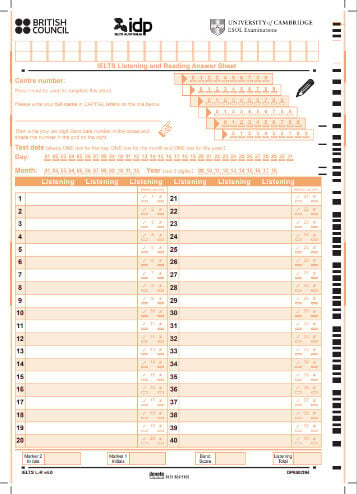
Il Test IELTS Listening dura circa 40 minuti. Trascorrerai 30 minuti ad ascoltare le registrazioni e a rispondere alle domande. Ti verranno consegnati un Libretto delle Domande e un Foglio Risposte. Il Libretto delle Domande è dove vedrai tutte le domande a cui devi rispondere. Il Foglio Risposte è dove scriverai le tue risposte finali per la valutazione.
Puoi consultare il PDF ufficiale del foglio risposte IELTS listening qui oppure semplicemente guardare l'immagine qui sotto :)
Alla fine della sezione listening, ti vengono concessi 10 minuti per trasferire le risposte dal tuo Libretto delle Domande al tuo Foglio Risposte.
IMPORTANTE!
Errori di ortografia e grammatica errata vengono segnati come NON CORRETTI, quindi usa i 10 minuti per ricontrollare la tua ortografia e la grammatica.
Calcolo del Punteggio IELTS Listening
Nella sezione Listening, ogni domanda vale 1 punto, quindi puoi ottenere un punteggio "grezzo" fino a 40 punti. Quindi, il tuo punteggio grezzo verrà convertito nel tuo punteggio di banda. Ricorda! Non perdi punti per le risposte errate. La tabella qui sotto può darti un'idea generale di come i punteggi grezzi vengono convertiti in punteggi di banda.
| Punteggi grezzi | Punteggi di banda |
|---|---|
| 39-40 | 9 |
| 37-38 | 8.5 |
| 35-36 | 8 |
| 32-34 | 7.5 |
| 30-31 | 7 |
| 26-29 | 6.5 |
| 23-25 | 6 |
| 18-22 | 5.5 |
| 16-17 | 5 |
| 13-15 | 4.5 |
| 11-12 | 4 |
Poiché ogni versione dell'IELTS è leggermente diversa, il punteggio grezzo richiesto per ottenere un determinato punteggio di banda differisce a seconda di come tutti coloro che hanno sostenuto il test si sono comportati quel giorno. Pertanto, il numero di risposte corrette necessarie per ottenere un punteggio di banda varierà leggermente da test a test, ma in generale dovresti puntare a ottenere circa 30 su 40 se vuoi ottenere un punteggio di banda 7.
Come notato sopra, le sezioni diventano sempre più difficili man mano che procedi nel test IELTS listening. Tuttavia, ogni domanda vale lo stesso numero di punti. Pertanto, assicurati di non perdere punti più facili perché ti blocchi su domande difficili.
Download PDF di Esempio Gratuito IELTS Listening con Risposte
Ecco alcuni esempi gratuiti di IELTS listening in formato PDF con risposte dal British Council (i creatori dell'esame IELTS). Sotto i link puoi anche fare gratis un test IELTS Listening con audio e risposte di BestMyTest. Contiene tutte e quattro le sezioni, e ogni sezione mostra la trascrizione audio insieme alle risposte. Prova a rispondere alle domande e vedi come te la cavi!
- IELTS Listening Practice Test 1 - domande (esempi online)
- IELTS Listening Practice Test 1 - risposte (PDF)
- IELTS Listening Practice Test 1 - foglio risposte (PDF)
Ascolta la registrazione e rispondi alle domande da 1 a 10. Le risposte e la trascrizione audio sono nel riquadro sotto le domande.
Questions 1-10
Complete the notes below.
Write ONE WORD AND/OR A NUMBER for each answer.
This can provide the carer with:
• time for other duties
• a 1
Assessment of aunt's needs
This may involve discussing:
• how much 2 is spent caring
Daily tasks discussed:
• help with dressing
• helping her take a 3
• shopping
• helping with meals
• managing 4
• any parts of caring that are particularly hard, e.g.
• loss of 5
• 6 her
• avoiding a 7
Types of support that may be provided for carers
• transport costs, e.g. cost of a 8
• vehicle-related costs, e.g. fuel and 9
• help with housework
• support to lower 10
-
spellcheck Risposte
1. Break
Break is correct because this detail is stated in the recording at the point where the question is answered.2. Time
Time is correct because this detail is stated in the recording at the point where the question is answered.3. Shower
Shower is correct because this detail is stated in the recording at the point where the question is answered.4. Money
Money is correct because this detail is stated in the recording at the point where the question is answered.5. Memory
Memory is correct because this detail is stated in the recording at the point where the question is answered.6. Lifting
Lifting is correct because this detail is stated in the recording at the point where the question is answered.7. Fall
Fall is correct because this detail is stated in the recording at the point where the question is answered.8. Minicab
Minicab is correct because this detail is stated in the recording at the point where the question is answered.9. Parking
Parking is correct because this detail is stated in the recording at the point where the question is answered.10. Anxiety
Anxiety is correct because this detail is stated in the recording at the point where the question is answered.
Audio ScriptNora: It's really good to see you, Marcus. Since I had to give up work, I feel I'm losing touch with my friends and colleagues.
Marcus: We really miss you in the office. We were all so sorry you had to leave. But you must be relieved to have more time to look after your aunt. How is she?
Nora: Well, she's very cheerful, but she needs a lot of help.
Marcus: Have you tried to get any support from the local council?
Nora: No. I didn't know I could.
Marcus: Yes. But for different kinds of practical support, they realise that carers sometimes need time for all the other responsibilities they have, apart from the person they're caring for, and also that they sometimes need a break.
Nora: Absolutely. OK, so tell me more, how do I go about getting this support?
Marcus: Well, you'd have to have an assessment of your aunt's needs. That means someone would come round and talk to you about the situation and what you need. So for a start, they'd want to know the amount of time you spend looking after your aunt every day.
Nora: OK.
Marcus: Then they'll probably ask you what sorts of tasks you do for your aunt during the day. Things like if she needs help with getting dressed, for example.
Nora: Right. I help her with that. And also I help her get into the shower in the morning.
Marcus: Yes. That sort of thing. They'll probably ask you if you do the shopping for her, and help her at meal times, and whether she can cope using money.
Nora: Yes. That's becoming a bit of a problem. She used to be very good at it, but not anymore.
Before you hear the rest of the conversation, you have some time to look at questions 5 to 10. [20 seconds] Now listen, and answer questions 5 to 10.Marcus: And be ready to tell them about anything you find particularly difficult about caring for your aunt.
Nora: So recently I've noticed she started to have quite bad problems with her memory. If I wasn't there, I think she'd forget to eat, for example. And often she doesn't seem quite sure what day it is.
Marcus: Yes. Tell them about that. And are there any physical difficulties you have caring for her? Lifting her, for example.
Nora: Yes. She's quite heavy, and I'm afraid of hurting my back. I'd be in real trouble if that happened.
Marcus: They can give you advice about that, and also about how to avoid the possibility of your aunt having a fall.
Nora: Great. So, once they've done this assessment, if I'm eligible, what happens next?
Marcus: Well, they might support you financially. So they might help you with travel costs, like if you have to get a minicab to take your aunt for an appointment, for example.
Nora: I usually drive her myself, actually. So could I claim for the petrol?
Marcus: You could. And you can claim for the parking, too.
Nora: Oh, right.
Marcus: And if you need help with the housework, they can arrange for someone to come along once or twice a week. And one other thing. I hope you don't mind me saying this, but it's important you look after yourself. And it seems to me you're dealing with quite a bit of anxiety.
Nora: I am, yes.
Marcus: Well, tell the council, because they may be able to give you some advice on how to minimise it.
Nora: Really? Though, actually, I feel so much better having talked to you. I'll get in touch with the council straight away. Now, shall we go for coffee, or something?
Ascolta la registrazione e rispondi alle domande da 11 a 20. Le risposte e la trascrizione audio sono nel riquadro sotto le domande.
Questions 11-14
Choose the correct letter, A, B or C.
11. Who began turning the unused Whitfield site into a planted space?
- city council officials.
- nearby residents.
- a gardening charity.
12. What was Lillian Hartley trying to achieve through public campaigning?
- preventing a housing sale
- blocking army exercises
- winning maintenance funding
13. Why was the park rejected as a place for troop exercises?
- council permission was refused.
- too little usable space.
- a better site was chosen.
14. How does the speaker describe the latest redesign plans?
- 2013 plan used unchanged.
- 2013 plan revised pre-work.
- 2015 plan finished in 2016.
Questions 15-20
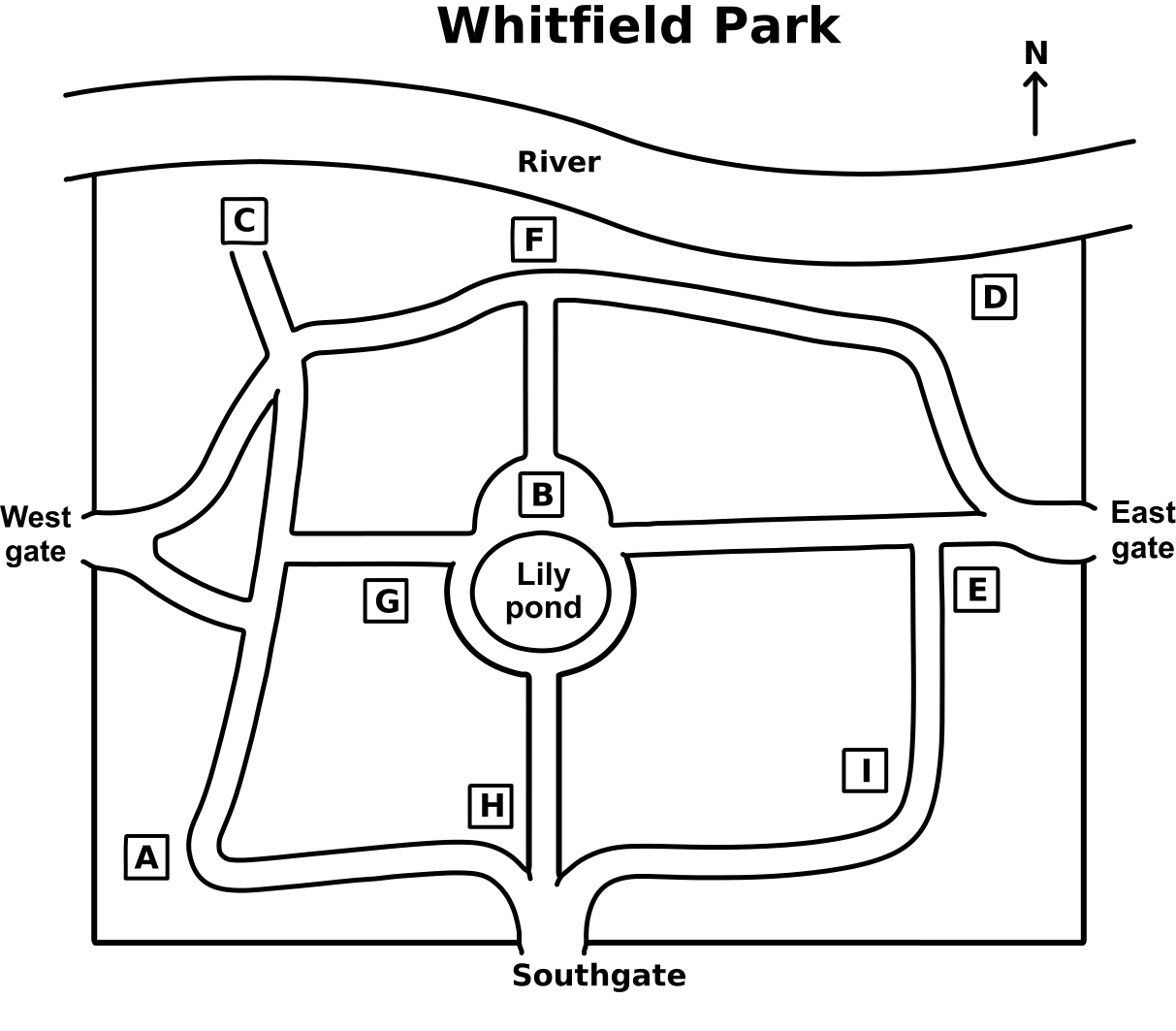
Label the plan of Whitfield Park below.
Write the correct letter, A-I, next to questions 15-20.
- statue of Lillian Hartley
- wooden sculptures
- playground
- maze
- tennis courts
- fitness area
-
spellcheck Risposte
11. B
(A) is incorrect. The council took ownership later.(B) is correct. The initial planting was done by residents from nearby streets.
(C) is incorrect. The recording does not support this option: a gardening charity.
12. A
(A) is correct. Hartley organised public pressure so the council would keep the land as a park rather than sell it for housing.(B) is incorrect. The recording does not support this option: blocking army exercises.
(C) is incorrect. The recording does not support this option: winning maintenance funding.
13. B
(A) is incorrect. The recording does not support this option: council permission was refused.(B) is correct. , after inspection, the army concluded that the park was too small for practical use.
(C) is incorrect. The recording does not support this option: a better site was chosen.
14. B
(A) is incorrect. The recording does not support this option: 2013 plan used unchanged.(B) is correct. The plans dated from 2013 but were revised in 2015 before work began.
(C) is incorrect. The recording does not support this option: 2015 plan finished in 2016.
15. B
The correct answer is B because the statue of Lillian Hartley is now immediately north of the lily pond near the centre of the park, and that position is labelled B.16. D
The correct answer is D because the wooden sculptures are on the riverbank where the path from the East Gate makes a sharp bend, which corresponds to D.17. F
The correct answer is F because the playground is between the river and the path from the lily pond to the river, and that location is marked F.18. C
The correct answer is C because the maze is found by entering from the West Gate, walking north, and turning left, which places it at C.19. A
The correct answer is A because the tennis courts remain in the southern corner where the perimeter path makes a right-angled bend, labelled A.20. G
The correct answer is G because the fitness area is beside the lily pond on the same side as the West Gate, matching G on the plan.
Audio ScriptI'm delighted this evening to introduce our guest speaker, Sarah Holloway, who is going to talk to us about the recent transformation of Whitfield Park. Over to you, Sarah. Thank you very much. I'm sure you all know Whitfield Park well, it has been one of the city's landmarks for well over a century, and the city council has been responsible for it for most of that time. What perhaps fewer of you will know is how the park actually began.
Unlike many city centre parks, which started life as the private gardens of a large house, Whitfield was originally just an unused patch of waste ground. The first flowers there were actually planted by a small group of local residents who lived in the surrounding streets. They began work on the site in 1892. At that point nobody was entirely sure who legally owned the land, and it was a full twenty years later before the city council finally took it into public ownership. Some of you will have seen the statue near one of the gates. That figure is Lillian Hartley, who played a really important role in the early history of the park.
Once the council legally owned the land, its first instinct was to sell it off as building plots for housing. A great many local residents, however, wanted the park to stay open as a place where everyone could enjoy fresh air and green space, bear in mind that this is a very densely built up residential district. Lillian Hartley was at the heart of that campaign, and it was she who organised the petitions and the public demonstrations which, in the end, persuaded the council to drop the sale and keep the land as a park.
Soon afterwards, in 1914, the First World War broke out, and most of the park was dug up and used to grow vegetables, which were sold to local residents. At one point the army did look into taking over the park as a site for troop exercises. They actually wrote to the city council about it, but when they inspected it they concluded that the park was simply too small to be of any practical use to them, so the idea was dropped. The only military activity in the park during the war was the occasional public meeting held on a small area of grass that had been kept clear of vegetable plots.
After the war, the park was largely returned to the way it had been before 1914, and from then on it remained almost unchanged for decades. New plans for transforming the park were drawn up several times over the years; the most recent version dates from 2013, but those plans were then revised in 2015, well before any actual work had got under way. Work on the ground finally began in 2016 and was completed, on schedule, last year.
Before you hear the rest of the talk, you have some time to look at questions 15 to 20. [20 seconds] Now listen and answer questions 15 to 20.All right, I'd like to describe some of the more important changes that have been made, and one or two things that have deliberately been left as they were. If you take a quick look at the map you've been handed, you'll see the familiar outline of Whitfield Park. The river forms the northern boundary, and there is a gate in each of the three other walls.
From there, follow the path up towards the river and the enlarged children's playground sits between that path and the river itself. If you keep your eye on the riverbank, over towards the East Gate side, the new wooden sculptures are at the point where the path coming up from that gate makes a sharp bend.
Back near the West Gate side of the park, there is a maze, a circular pattern of paths separated by low hedges. Head in from the West Gate, walk north towards the river, and then turn left to find it. Close to the same central lily pond, on the side facing the West Gate, you'll also find the new outdoor fitness area.
Down in the southern corner, where the perimeter path makes that distinct right angled bend, the tennis courts are still in their familiar position, though we have now doubled them from four to eight. Now, since you are all keen gardeners, I'm sure you'll want to hear about the plants that have been chosen for the new beds.
Ascolta la registrazione e rispondi alle domande da 21 a 30. Le risposte e la trascrizione audio sono nel riquadro sotto le domande.
Questions 21-25
Choose the correct letter, A, B or C.
21. Nina and Owen were surprised to learn that coastal cities
- are home to just under half of all people.
- account for many of the largest cities.
- are expanding at double the rate of inland cities.
22. According to Owen, building coastal cities near to rivers
- can carry contamination back towards urban areas.
- can leave too little land for farming upstream.
- can cause factories to damage rural scenery.
23. What mistake was made when building water drainage channels in Port Selby in the 1950s?
- The system did not include enough channels.
- The builders selected the wrong construction materials.
- The design failed to anticipate rising sea levels.
24. What do Nina and Owen think that the authorities in Port Selby should do immediately?
- take measures to restore coastal ecosystems
- pay for a new flood prevention system
- stop disposing of waste materials into the ocean
25. What do they agree should be the priority for international action?
- greater coordination of activities
- more sharing of information
- agreement on shared policies
Questions 26-30
What decision do the students make about each of the following parts of their presentation?
Write the correct letter, A-G, next to questions 26-30.
- use visuals
- keep it short
- involve other students
- check the information is accurate
- provide a handout
- focus on one example
- do online research
- Historical background
- Geographical factors
- Past mistakes
- Future risks
- International implications
-
spellcheck Risposte
21. B
(A) is incorrect. The recording does not support this option: are home to just under half of all people.(B) is correct. Nina says most of the biggest cities are built by the sea.
(C) is incorrect. The recording does not support this option: are expanding at double the rate of inland cities.
22. A
(A) is correct. Owen says pollutants from inland agriculture and industry travel down rivers to cities.(B) is incorrect. The recording does not support this option: can leave too little land for farming upstream.
(C) is incorrect. The recording does not support this option: can cause factories to damage rural scenery.
23. C
(A) is incorrect. The recording does not support this option: The system did not include enough channels.(B) is incorrect. The recording does not support this option: The builders selected the wrong construction materials.
(C) is correct. Port Selby's drainage channels were built without allowing for global warming and rising sea levels.
24. B
(A) is incorrect. The recording does not support this option: take measures to restore coastal ecosystems.(B) is correct. Nina says they need money to replace the drainage channels for flood protection now.
(C) is incorrect. The recording does not support this option: stop disposing of waste materials into the ocean.
25. A
(A) is correct. They say coastal cities must act together internationally.(B) is incorrect. The recording does not support this option: more sharing of information.
(C) is incorrect. The recording does not support this option: agreement on shared policies.
26. B
B is correct because they decide not to spend too long on historical background, so they will keep it short.27. A
A is correct because they decide to use slides with maps showing geographical factors.28. F
F is correct because they choose the Meriton case study as the basis for past mistakes, focusing on one example.29. G
G is correct because they need to look at websites for future risks, so online research is required.30. C
C is correct because they plan to ask audience members from different places, involving other students.
Audio ScriptTutor: OK, so what I'd like you to do now is to talk to your partner about your presentations on environmental planning. You should have done most of the reading now, so I'd like you to share your ideas and talk about the structure of your presentation and what you need to do next.
Nina: OK, Owen, I'm glad we chose quite a specific topic: coastal cities. It made it much easier to find relevant information.
Owen: Yeah, and cities are growing so quickly. I mean, we know that more than half the world's population lives in cities now.
Nina: Yeah, though that's all cities, not just coastal ones. But most of the biggest cities are actually built by the sea. I'd not realised that before.
Owen: Nor me. And what's more, a lot of them are built at places where rivers come out into the sea. But apparently this can be a problem.
Nina: Why?
Owen: Well, as the city expands, agriculture and industry tend to spread further inland along the rivers. And so agriculture moves even further inland up the river. That's not necessarily a problem, except it means more and more pollutants are discharged into the rivers.
Nina: That's a serious problem.
Owen: Right.
Nina: Did you read that article about Port Selby on the south coast?
Owen: No.
Nina: Well, apparently back in the 1950s, they built channels to drain away the water in case of flooding.
Owen: Sounds sensible.
Nina: Yeah, they spent quite a lot of money on them. But what they didn't take into account was global warming. So they built the drainage channels too close to sea level. And now sea levels are rising, they're more or less useless. If there's a lot of rain, the water can't run away. There's nowhere for it to go.
Owen: So they did not help much in the end.
Nina: So what are the authorities doing about it now?
Owen: I don't know. I did read that they're aiming to stop disposing of waste water into the ocean over the next 10 years. But that won't help with flood prevention now, will it?
Nina: No, really, they just need to find the money for something to replace the drainage channels in order to protect against flooding now. But in the long term, they need to consider the whole ecosystem.
Owen: Right.
Nina: Really though, coastal cities can't deal with their problems on their own, can they? I mean, they've got to start acting together at an international level instead of just doing their own thing.
Owen: Absolutely. The thing is, everyone knows what the problems are and environmental planners have a pretty good idea of what we should be doing about them. So they should be able to work together to some extent.
Nina: But it's going to be a long time before countries come to a decision on what principles they're prepared to abide by.
Owen: Yeah, if they ever do.
Before you hear the rest of the conversation, you have some time to look at questions 26 to 30. [20 seconds] Now listen and answer questions 26 to 30.Nina: So I think we've probably got enough for our presentation. It's only 15 minutes.
Owen: OK, so I suppose we'll begin with some general historical background about why coastal cities were established. But we don't want to spend too long on that. The other students will already know a bit about it.
Nina: It's all to do with communications and so on.
Owen: Yes, we should mention some geographical factors, things like wetlands and river estuaries and coastal erosion and so on.
Nina: We could have some maps of different cities with these features marked.
Owen: On a handout, you mean, or some slides everyone can see.
Nina: Yeah, that'd be better.
Owen: It'd be good to go into past mistakes in a bit more detail. Did you read that case study of the problems there were in Meriton with flooding a few years ago?
Nina: Yes, we could use that as the basis for that part of the talk. I don't think the other students will have read it, but they'll remember hearing about the flooding at the time.
Owen: Hmm, OK. So that's probably enough background. So then we'll go on to talk about what actions have been taken to deal with the problems of coastal cities.
Nina: OK, what else do we need to talk about? Maybe something on future risks looking more at the long term if populations continue to grow?
Owen: Yeah, we'll need to do a bit of work there. I haven't got much information, have you?
Nina: No, we'll need to look at some websites. Shouldn't take too long.
Owen: OK. And I think we should end by talking about international implications. Maybe we could ask people in the audience. We've got people from quite a lot of different places.
Nina: That'd be interesting if we have time, yes. So now should we go on?
Ascolta la registrazione e rispondi alle domande da 31 a 40. Le risposte e la trascrizione audio sono nel riquadro sotto le domande.
Questions 31-36
What point does the lecturer make about each item?
Write the correct letter, A-K, next to questions 31-36.
- changes drainage
- protects animals
- increases nutrients
- kills germs
- affects many species
- creates dense shade
- alters the soil
- supports farming
- reduces competition
- attracts bell-miners
- helps recovery
- Eucalyptus woodland
- Damage to eucalyptus woodland
- Oil from eucalyptus leaves
- Lime used in construction
- Direct iron supply
- Moderate bushfires
Questions 37-40
Complete the notes below.
Write ONE WORD ONLY for each answer.
Bell-miner associated dieback:
• The process starts with insects feeding on eucalyptus 37
• A sweet liquid containing 38 attracts bell-miners
Fire patterns:
• If fires happen too often, 39 becomes the main vegetation
• When fires are almost absent, thick growth gives bell-miners protected 40 sites
-
spellcheck Risposte
31. B
B is correct because eucalyptus woodland provides nesting places and shelter for birds, bats and small mammals.32. E
E is correct because damage to eucalyptus woodland affects a wider community of species, not only the trees themselves.33. D
D is correct because oil from eucalyptus leaves is used in disinfectant, where it can kill certain germs.34. G
G is correct because lime from road construction was washed into the soil and interfered with tree roots.35. K
K is correct because affected trees recovered surprisingly quickly when iron was supplied directly.36. I
I is correct because occasional fire removes fast-growing competitors that would otherwise use water needed by eucalyptus trees.37. leaves
The correct answer is leaves. The lecturer says the process begins when insects settle on eucalyptus leaves and feed on them.38. sugar
The correct answer is sugar. The lecturer says the insects produce a sweet liquid containing sugar, which attracts bell-miners.39. grass
The correct answer is grass. The lecturer says grass tends to dominate afterwards if fires occur too often.40. nesting
The correct answer is nesting. The lecturer says dense growth creates protected nesting sites for bell-miners when fire is suppressed.
Audio ScriptGood morning. Today I want to focus on the eucalyptus tree, one of the best known features of the Australian landscape. Many people call it a gum tree, but the name eucalyptus actually covers hundreds of related species, from small scrubby trees to very tall forest giants.
Now, eucalyptus trees are important in several ways. Ecologically, they provide nesting places and shelter for birds, bats and small mammals. Their flowers also produce nectar, which is an important food source for insects and birds. So when eucalyptus woodland is damaged, the effect is felt across a much wider community of species.
As for their value to people, the trees are also useful. Oil from eucalyptus leaves has long been used in cleaning products, and one common use is in disinfectant, because the oil can kill certain germs. Eucalyptus timber is also used in building and fencing, although that is not really the main focus of today's lecture.
So, these trees can live for centuries, and some individuals survive for four hundred years or more. That is why researchers became concerned when large numbers began dying much earlier than expected in different parts of Australia.
Now, one disease that attracted attention was Mundulla Yellows. The leaves of affected trees slowly turned yellow and then, over time, the whole tree declined. For years the cause was unclear. Eventually, researchers discovered that lime, or calcium hydroxide, had been used in road construction nearby. Rain washed the lime into the surrounding soil, where it interfered with the roots of eucalyptus trees. The trees were still surrounded by nutrients, but they could no longer absorb the iron they needed for healthy growth. When iron was supplied directly to affected trees, they recovered surprisingly quickly.
However, Mundulla Yellows affected only a limited number of places. A much wider problem on the east coast was Bell miner associated dieback. Now, bell miners are small native birds, but they are not the direct cause of the damage. The process begins when insects settle on eucalyptus leaves and feed on them. While feeding, these insects produce a sweet liquid containing sugar. Bell miners are attracted to that liquid, and they aggressively chase away other birds and insects that might otherwise reduce the insect population. As a result, the insects multiply, the leaves are badly damaged, and the trees gradually lose their ability to survive.
But some scientists think fire history is also part of the explanation. An influential theory, first proposed by the ecologist William Jackson, links the type of vegetation in a region to the frequency of bushfires. If fires occur too often, grass tends to dominate the area afterwards. If fires occur at moderate intervals, eucalyptus forest is more likely to persist. This is because occasional fire removes fast growing competitors which would otherwise take up the water eucalyptus trees need. And it also helps maintain the soil by preventing dense undergrowth from changing the soil structure and removing nutrients.
At the other extreme, if fires are almost completely suppressed, a different ecosystem can develop. Scientists sometimes call this dry rainforest. Now, the name sounds contradictory, because we usually associate rainforest with wet tropical conditions. But in this case it means a dense, shaded vegetation system with relatively few species. It can create excellent conditions for bell miners, because the thick growth gives them protected nesting sites while excluding many of the species that would normally compete with them.
What this tells us is that before European settlement, Aboriginal communities used controlled burning over long periods, and this probably created a more balanced pattern of vegetation. Since European settlement, fire has often been suppressed, roads and farms have altered drainage, and some local ecosystems have shifted away from eucalyptus woodland. The decline of eucalyptus trees, then, is not caused by one single factor. It is the result of disease, insects, birds, soil chemistry and fire management interacting with one another.

Completion - Part 1
Learn how to answer these questions in a step-by-step interactive exercise
Completion - Part 1
Uno spazio vuoto può richiedere un orario o una frequenza. Di solito chi parla indica lo stesso periodo con altre parole, quindi abbina il significato allo spazio invece di aspettare le parole scritte sulla pagina.
Poi controlla il limite di parole prima di inviare. Rileggi l'intera riga con la tua risposta nello spazio e togli ogni parola che la riga contiene già. Una risposta giusta nel significato ma troppo lunga non vale punti.
Clicca su Riproduci per ascoltare l'audio
Gli appunti usano un verbo semplice come must provide o need to bring. Chi parla dice raramente quel verbo e usa invece un sinonimo o descrive l'azione, quindi ascolta cosa è davvero richiesto.
Spesso chi parla nomina prima elementi in più e poi li esclude. Se perdi uno spazio vuoto, lascialo e passa al successivo, perché le risposte seguono l'ordine della registrazione e uno spazio perso può farti perdere anche quelli dopo.
Clicca su Riproduci per ascoltare l'audio
Come te la sei cavata rispondendo alle domande di esempio IELTS listening qui sopra? Hai trovato qualche domanda difficile? Se sì, potrebbe esserti utile dare un'occhiata più da vicino a tutti i 6 tipi di prove IELTS listening. Meglio comprendi un tipo di prova, meno sforzo dovrai fare per capire cosa devi fare e più tempo avrai per capire la risposta.
I 6 Tipi di Prove IELTS Listening
Ci sono 6 diversi tipi di domande nel test IELTS listening. È importante che ti eserciti con ciascun tipo di prova per imparare il modo migliore per affrontarne una per ottenere un alto punteggio IELTS listening.
Quali tipi di esercizi di ascolto risultano più difficili per i nostri studenti
Ecco cosa mostrano 2.22 milioni di risposte di IELTS Listening degli studenti di BestMyTest. La tabella qui sotto indica la percentuale di risposte corrette dei nostri studenti per ogni tipo di esercizio, così vedi subito dove si perdono i punti.
| Tipo di esercizio | Risposte corrette |
|---|---|
| Note completion | 33% |
| Table completion | 34% |
| Sentence completion | 45% |
| Short answer | 48% |
| Multiple choice | 50% |
| Multiple selection | 52% |
| Plan, map, diagram labelling | 55% |
| Form completion | 73% |
| Matching | 85% |
- È negli esercizi di completamento che si perdono punti. Tra gli esercizi di completamento, Note completion ha il 33% di risposte corrette, mentre Form completion, che usa la stessa abilità con una struttura diversa, arriva al 73%. Ogni esercizio di completamento ti chiede di scrivere una parola che senti, quindi contano l'ortografia, la forma delle parole e il limite di parole, e sono tutte cose che puoi allenare.
- Su 61.104 simulazioni complete della prova di ascolto svolte da 54.523 studenti, la fascia media è stata 5.6. Il 41% delle prove ha raggiunto la fascia 6.0 e il 12% la fascia 7.0.
- Nelle singole sezioni di ascolto, il 31% dei tentativi ha ottenuto un punteggio pari o inferiore al 40%, e il 30% un punteggio pari o superiore all'80%. Le sezioni 3 e 4 sono le parti accademiche del test, quindi esercitati su di esse da sole oltre che dentro le simulazioni complete.
Anche se ogni tipo di domanda di listening sembra diverso, l'approccio di base a ciascuno è lo stesso. Più avanti in questo post, ti mostreremo la strategia di base per affrontare tutti e 6 i tipi di domande. Ogni tipo ha un audio di esempio e la risposta nella guida ai tipi di domande IELTS Listening.
3 passaggi per una Preparazione Efficace al Test IELTS Listening Online
Sebbene ogni tipo di domanda (prova) IELTS listening sia diverso, l'approccio di base a ciascuno è lo stesso. Puoi affrontare tutti i tipi di prove utilizzando una semplice strategia passo dopo passo. Ecco i tre passaggi che ti consigliamo di utilizzare per affrontare i tipi di domande di Listening:
- Esamina attentamente le domande per trovare le informazioni chiave
- Prevedi le potenziali risposte prima di ascoltare
- Segui per abbinare le domande al contenuto mentre ascolti
Passaggio 1: Esamina le Domande
Nella sezione Listening IELTS, ti verrà concesso un breve tempo di preparazione (30-40 secondi) prima dell'inizio della registrazione. Questa è la tua opportunità di dare un'occhiata alle domande a cui dovrai rispondere, che è esattamente ciò di cui tratta il primo passaggio di questa strategia. Invece di usare questo tempo per fare una pausa o controllare le tue risposte, ti concentrerai sull'apprendere il più possibile sulle domande che verranno. Compiere questo passaggio è importante per evitare l'errore di fare più cose contemporaneamente mentre ascolti il parlante e cerchi di leggere le domande per la prima volta.
Quando inizia il tuo tempo di preparazione, prima sfrutta al meglio questo tempo esaminando le domande per scoprire di più su di esse. Queste sono alcune delle informazioni che dovresti cercare quando esamini ciascuna delle domande IELTS Listening:
- Che tipo di domanda è questa?
- Come sarà la risposta? (esempio: una data, un numero, un nome)
- Quali sono le frasi e le parole più importanti, o parole chiave, nelle domande?
Un esempio potrebbe essere un tipo di domanda Note Completion, come questa:
Completa gli appunti qui sotto.
Scrivi NO MORE THAN THREE WORDS per ogni risposta.
Per prima cosa, puoi sottolineare alcune delle parole chiave nella domanda.
Two reasons for the new approach to pricing are changes in (27) ______ and (28) _________ programs.
In questo esempio, ascoltare la frase chiave "two reasons" che avevi già sottolineato ti permette
di iniziare a prestare molta attenzione al momento giusto. Ecco la parte della trascrizione audio che rivela la risposta:
Mark: Well, there seem to be two basic reasons. Firstly, because the law has changed recently to allow companies to behave like this. In the past, they weren't allowed to change the prices of the tickets. And secondly, we now have computer programs that do the calculations so that prices can be changed very quickly and accurately.
Dopo aver esaminato le domande, sapresti che "the law" e "computer" erano la risposta corretta qui in base ad alcune parole chiave e conoscendo il tipo di domanda.
Passaggio 2: Prevedi le Potenziali Risposte
Il secondo passaggio in questa strategia per avere successo nella sezione IELTS Listening è strettamente correlato al primo. Infatti, dovresti tentare di completare entrambi questi passaggi entro lo stesso tempo di preparazione di 20 secondi prima dell'inizio della registrazione. Sebbene questo possa sembrare un compito difficile da svolgere in così poco tempo, ricorda che questi passaggi sono effettivamente collegati tra loro.
Per prevedere le potenziali risposte alle domande di Listening, dovrai prima aver completato il primo passaggio esaminando attentamente le domande. A questo punto, dovresti sapere che tipo di domanda stai guardando, come saranno le potenziali risposte, nonché quali parole chiave saranno utili per individuare rapidamente le risposte. Per prevedere le risposte, combinerai tutte queste informazioni e farai un'ipotesi su che tipo di risposta ti aspetti di sentire.
Rivisitiamo la stessa domanda di esempio Note Completion di sopra.
Two reasons for the new approach to pricing are changes in (27) and (28) programs.
Solo guardando la grammatica di questa frase ti permette di identificare quale parte del discorso sarà la risposta. In questo caso, la preposizione "in" precede entrambe le potenziali risposte. Grammaticalmente, solo i nomi o le frasi nominali possono essere usati in questo modo nelle frasi preposizionali. Non solo puoi prevedere, correttamente, che la risposta sarà un nome o una frase nominale, ma sarebbe anche possibile prevedere che la risposta potrebbe essere qualcosa relativo a politica o governo (legge), e una parola che può apparire con i programmi (computer) in base al contesto.
Sebbene sia impossibile indovinare l'esatta risposta corretta basandosi solo sulle previsioni, facendo il tentativo di immaginare quale potrebbe essere la risposta, è più probabile che tu ascolti informazioni rilevanti ignorando informazioni non rilevanti. Prevedere le potenziali risposte prima dell'inizio della registrazione preparerà il tuo orecchio, portandoti un passo più vicino alla risposta corretta.
Ora, prova a mettere insieme il Passaggio 1 (esamina le domande) e il Passaggio 2 (prevedi le potenziali risposte) in una domanda di esempio a scelta multipla più difficile.
Scegli la lettera corretta, A, B, C o D.
- are for weekend shows
- are booked well in advance
- are non-refundable
- are booked for groups
Sebbene non ci sia un modo per conoscere con certezza le risposte a queste domande, puoi comunque utilizzare le informazioni trovate in queste domande per prevedere le potenziali risposte e mirare il tuo ascolto. Ad esempio, la domanda 24 riguarda il motivo per cui i prezzi dei biglietti del teatro saranno i più bassi, quindi vorrai ascoltare attentamente per qualcuno di quei motivi menzionati. Tieni presente che è possibile che ne venga menzionato più di uno. Dai un'occhiata allo script qui sotto per vedere come la previsione può aiutarti a eliminare le risposte sbagliate.
Nota come tre delle potenziali risposte siano menzionate, "booked for groups", "are for weekend shows" e "are non-refundable". Tuttavia, la risposta corretta è C "are non-refundable" perché è menzionata come più economica separatamente dalle altre due, che sono semplicemente elencate insieme.
Passaggio 3: Segui
Una volta che la registrazione inizia e la parte effettiva di ascolto del test inizia, dovresti seguire per completare il passaggio tre di questa strategia per la sezione IELTS Listening. Seguire ti richiede di concentrarti attentamente su ciò che stai ascoltando, mentre allo stesso tempo tieni traccia di quale domanda il contenuto potrebbe affrontare.
Le domande nella sezione IELTS Listening esame appariranno solitamente nell'ordine in cui le loro risposte possono essere trovate nel contenuto della registrazione. Questo ti dà un vantaggio nel test, perché significa che una volta che hai sentito la risposta a una domanda, rivolgerai immediatamente la tua attenzione alla successiva in ordine. Se sei in grado di seguire con successo abbinando il contesto delle domande a ciò che stai ascoltando nella registrazione, rimarrai in carreggiata ed eviterai di perdere informazioni chiave necessarie per rispondere a ciascuna delle domande.
Tuttavia, farlo è più facile a dirsi che a farsi. Dovrai fare più cose contemporaneamente ascoltando mentre tieni d'occhio la domanda successiva. Se, in effetti, perdi la risposta a una domanda, lo saprai quando senti la risposta a una successiva. Anche se questo può essere fonte di confusione e persino frustrante, perdere una risposta ed esserne consapevoli è ancora preferibile al perdersi completamente nel contenuto e perdere ancora più risposte. Nello scenario di perdere una domanda, dovresti semplicemente lasciarla e continuare con la successiva. Alla fine, dovrai fare la tua migliore ipotesi sulla domanda che hai perso. Tuttavia, dal lato positivo, è possibile che ascoltare la registrazione nella sua interezza possa fornirti altri indizi contestuali e permetterti di rispondere a qualsiasi domanda persa con maggiore precisione.
Risorse Gratuite per la Pratica IELTS Listening
Avrai bisogno di forti capacità di ascolto per ottenere un alto punteggio di banda IELTS listening. Per questo motivo, è importante che ti alleni costantemente ogni giorno fino al giorno del test.
Di seguito ci sono alcune risorse che puoi utilizzare per allenare e mantenere le tue capacità di ascolto quotidianamente.
- YouTube - https://www.youtube.com
- BBC Learning English - http://www.bbc.co.uk/learningenglish
- TED - https://www.ted.com/
- BBC radio - https://www.bbc.co.uk/worldserviceradio
- ABC news in Australia - https://www.abc.net.au/listen/live/news
I dati di questa pagina vengono dai dati sulle prestazioni degli studenti IELTS di BestMyTest, i nostri registri delle esercitazioni IELTS su BestMyTest fino a ottobre 2026. Quella pagina spiega come misuriamo ogni dato. Ultimo aggiornamento: 15 ottobre 2026.