In questa guida, sosterrai un test IELTS speaking gratuito e ti eserciterai con gli argomenti più frequenti delle domande IELTS speaking con risposte. Imparerai come rispondere alle domande del test IELTS speaking per le parti 1, 2 e 3 utilizzando i nostri modelli di speaking testati a fondo.
Ottieni risposte di esempio gratuite IELTS speaking dopo aver completato un test di pratica IELTS speaking.
play_circle_outline Inizia il test di pratica IELTS SpeakingDi seguito trovi il nostro elenco completo di domande IELTS speaking con risposte di esempio. Nota: i link rossi sono le nostre domande speaking piu popolari e consigliate, valutate dai nostri studenti, e puoi esercitarti gratuitamente in qualsiasi momento.
Domande IELTS Speaking Part 1 1 - 96
Short questions about familiar topics like your home, work, and hobbies
Domande IELTS Speaking Part 2 1 - 83
Cue cards where you speak for 1 to 2 minutes about one topic
Domande IELTS Speaking Part 3 1 - 97
Discussion questions linked to the Part 2 topic
Guida al Successo IELTS Speaking
Benvenuto nella guida ufficiale BestMyTest al test IELTS speaking. Il resto di questa guida si concentrerà sull'apprendimento degli argomenti IELTS speaking più frequentemente utilizzati per le parti 1-3 del test, sull'ascolto di risposte di esempio di banda 9 e sull'apprendimento di importanti suggerimenti e risorse IELTS speaking per il tuo successo. Usa l'indice qui sotto per trovare rapidamente ciò che stai cercando.
Indice
- Introduzione al Test IELTS Speaking
- Argomenti IELTS Speaking per la Parte 1
- Argomenti IELTS Speaking per le Parti 2 e 3
- Come affrontare IELTS Speaking Parte 1
- Come affrontare IELTS Speaking Parte 2
- Come affrontare IELTS Speaking Parte 3
- Pratica IELTS Speaking per il Tuo Successo
- Come Vengono Valutate le Domande IELTS Speaking
- Risorse Gratuite per il Test IELTS Speaking
Test IELTS Speaking
Il test IELTS speaking può essere un po' intimidatorio all'inizio, soprattutto perché sarai testato dal vivo davanti al tuo esaminatore. A causa di questo formato dal vivo, trovare argomenti speaking gratuiti con risposte di esempio può essere difficile, ma non preoccuparti, ci pensiamo noi. Prima di esercitarti con i nostri argomenti IELTS speaking, diamo una rapida occhiata al test di speaking e vediamo come funziona.
Formato del Test di Speaking
Il test di speaking dura circa 11-15 minuti ed è composto da 3 parti. Si prega di notare che gli argomenti di speaking per il Saluto e la Parte 1 sono gli stessi, quindi sono considerati una sola parte, ma li abbiamo separati per tua comodità.
- Saluto del Test IELTS Speaking
- Parte 1 del Test IELTS Speaking
- Parte 2 del Test IELTS Speaking
- Parte 3 del Test IELTS Speaking
Il Saluto
Quando sostieni il test IELTS speaking ed entri nella sala d'esame, l'esaminatore non inizia con domande IELTS speaking difficili, ma inizia lentamente con i saluti. Si prega di notare che SARAI valutato sulla tua capacità di salutare, quindi è importante che tu sia preparato per questo. Detto ciò, diamo una rapida occhiata a un saluto semplice e a una risposta.
- L'esaminatore si presenterà e ti chiederà come ti chiami. Risponderai "My name's _______".
- Successivamente, ti verrà chiesto "What can I call you?", a cui puoi rispondere "You can call me_______". Puoi usare il tuo nome inglese qui, se ne hai uno. Questo può sembrare strano, ma alcune persone non riescono a pronunciare il proprio nome inglese. Questo è NON ACCETTABILE. Se non riesci a pronunciarlo, è meglio non usarlo.
- Dopo il tuo nome, ti chiederanno da dove vieni. Basta dire "I'm from_____". È sufficiente. A questo punto non devi fornire informazioni aggiuntive sulle tue risposte.
- Infine, ti verrà chiesto un documento di identità. Dopo averlo mostrato, inizierai il test.
IELTS Speaking Parte 1
IELTS Speaking parte 1 dura tra 4-5 minuti, include circa 8-10 domande IELTS speaking e circa 2-3 argomenti familiari IELTS speaking come il tuo lavoro, i tuoi studi, la tua famiglia, la tua città natale, il tuo alloggio, ecc. Questi argomenti sono più facili degli argomenti di IELTS speaking parte 2. Di seguito alcuni esempi di ciò che potresti essere domandato.
Where is your hometown?
What do you like about it?
What do you not like about it?
How important is your hometown to you?
Let's move on to talk about accommodation:
Tell me about the kind of accommodation you live in?
Does the place you live in have many amenities?
Is there anything you would like to change about the place you live in?
Do you plan to live there for a long time?
Le domande della parte 1 potrebbero essere meglio descritte come domande che imitano una conversazione informale tra due sconosciuti o conoscenti. Non sono molto approfondite, ma non lasciare che queste domande ti facciano credere di non doverti preparare per esse. Solo un po' di preparazione può fare molto e ci ringrazierai per averti spinto a farlo! Più avanti in questo post troverai anche alcuni suggerimenti su come prepararsi per le domande della parte 1.
IELTS Speaking Parte 2
Nella parte 2, parlerai di un particolare argomento IELTS speaking. L'argomento è selezionato per te e ti verrà fornito su una scheda (Candidate Task Card). Avrai poi 1 minuto per preparare la tua risposta e poi un massimo di 2 minuti per parlare. Ti verranno forniti una matita e della carta per prendere appunti. Di seguito un esempio di domanda IELTS speaking parte 2:
Describe a useful electronic device you would like to own.
You should say:
- What it is
- How it would help your life
- If it would be expensive to buy
And explain why you would like it.
Una volta che i tuoi due minuti di tempo di parola sono terminati, è possibile che l'esaminatore concluda questa parte del test ponendoti un paio di semplici domande relative alla tua risposta della parte 2.
Queste sono talvolta conosciute come rounding off questions,
poiché aiutano a "concludere" la tua conversazione. Diamo un'occhiata ad alcune domande IELTS speaking che potrebbero essere poste.
Ad esempio, forse l'argomento IELTS speaking di cui hai parlato nella parte 2 era "Describe your favorite form of public transport".
L'esaminatore potrebbe concludere la tua conversazione chiedendo:
- Are the buses cheap in your city?
- Did you travel to the test today by bus?
Tipicamente, queste rounding off questions sono semplici, quindi sarà necessario solo che tu risponda con risposte semplici.
Risposte lunghe e complesse non sono richieste qui, poiché l'esaminatore sarà probabilmente pronto a passare alla parte 3.
Ad esempio, puoi rispondere a una rounding off question con una breve risposta come questa:
- Yes, about 2 dollars for a single journey.
- No, actually I came by taxi.
D'altra parte, ci sono casi in cui l'esaminatore potrebbe saltare del tutto le rounding off questions e procedere direttamente alla parte 3. Se questo dovesse essere il caso durante il tuo test IELTS speaking, non preoccuparti; questo indica che la tua risposta della parte 2 di speaking è stata abbastanza lunga e che i tuoi 3 minuti di tempo di parola per la parte 2 sono già scaduti.
IELTS Speaking Parte 3
Nella parte 3, ti verranno poste circa 4-8 ulteriori domande IELTS speaking che sono collegate agli argomenti IELTS speaking discussi nella parte 2. L'esaminatore ti farà anche alcune domande basate sulle tue risposte, quindi l'intera parte 3 è una discussione bidirezionale con l'esaminatore e durerà 4 - 5 minuti. Ecco alcune domande generali di speaking che l'esaminatore potrebbe farti basandosi sui suddetti argomenti IELTS speaking parte 2:
What devices do you think will be popular in the future?
Do you think people spend too much money on electronic devices?
In what ways can electronic devices make our lives harder?
What would the world be like without computers?
Should children be taught to use computers at school?
Argomenti IELTS Speaking
Ora che ti è stato presentato come funziona il test IELTS speaking, puoi vedere che potrebbero essere richiesti un numero qualsiasi di argomenti. È importante che tu familiarizzi con alcuni degli argomenti IELTS speaking più frequentemente utilizzati. Non solo abbiamo creato un elenco completo, ma ognuno include anche una risposta IELTS speaking di esempio.
Il grafico a barre qui sotto mostra le categorie di argomenti più comuni dell'IELTS Speaking parti 2 e 3 nel 2025 e nel 2026. L'asse orizzontale (asse x) elenca sette categorie di argomenti, mentre l'asse verticale (asse y) mostra la percentuale di argomenti in ciascuna categoria. Le barre blu rappresentano il 2025 e le barre arancioni il 2026.
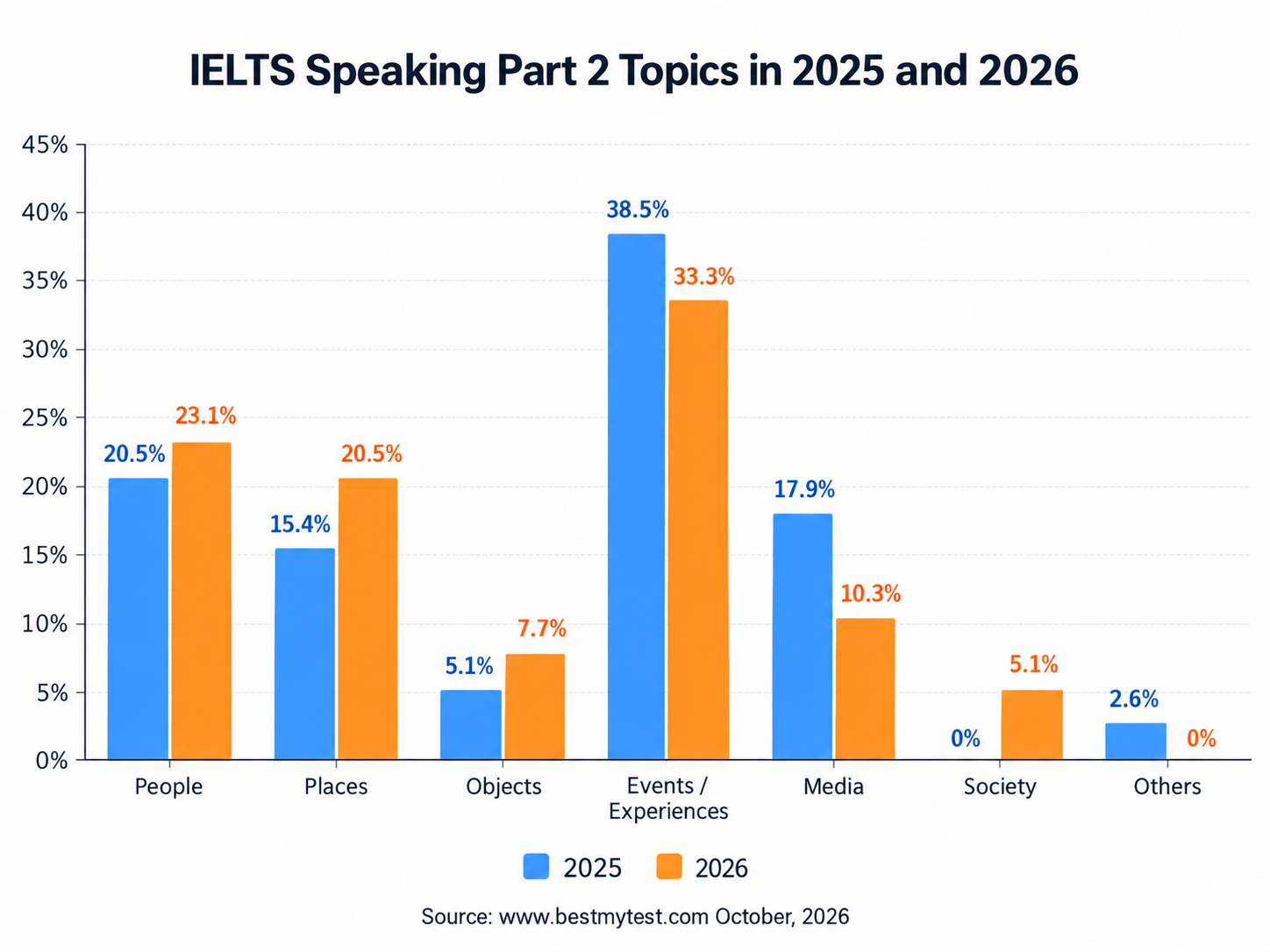
Come si vede, eventi ed esperienze sono la categoria più ampia in entrambi gli anni e rappresentano il 38,5% degli argomenti nel 2025 e il 33,3% nel 2026. Queste domande di solito ti chiedono di descrivere qualcosa che hai fatto o vissuto, come un viaggio memorabile, una festa speciale o una volta in cui hai aiutato qualcuno.
Anche le persone e i luoghi sono categorie importanti. Insieme rappresentano il 43,6% degli argomenti nel 2026. Potresti dover descrivere qualcuno che ammiri, una persona che ti ha influenzato, un posto che ti piace visitare o un luogo che vorresti esplorare.
Altre categorie, tra cui oggetti, media e società, compaiono meno spesso in questo campione. Vale comunque la pena esercitarle, perché le domande dell'IELTS Speaking possono trattare molti argomenti della vita quotidiana.
Che cosa significa per la tua preparazione all'IELTS? Inizia a esercitarti su domande sulle tue esperienze personali, sulle persone che conosci e sui luoghi che hai visitato. Questi argomenti costituiscono una grande parte delle domande nel grafico. Prepara alcune storie ed esempi flessibili da adattare a domande diverse, invece di memorizzare risposte intere.
Argomenti IELTS Speaking Parte 1
L'elenco qui sotto contiene più che semplici domande, mostra anche gli argomenti di speaking che gli esaminatori hanno chiesto alle persone in passato. Un ottimo consiglio è rispondere a queste domande IELTS speaking parte 1 davanti a uno specchio o con un amico. La tabella qui sotto mostra la frequenza con cui ogni argomento è utilizzato:
| Argomenti | Frequenza |
|---|---|
| Città natale/Alloggio/Paese | Alta |
| Amici/Famiglia/Faccende domestiche/Bambini | Alta |
| TV/Lettura/Musica/Giornali e riviste/Film | Alta |
| Tecnologia/Computer/Internet | Alta |
| Lavoro/Mestieri/Pianificazione della carriera/Volontariato | Alta |
| Indirizzi scolastici/Scuola superiore | Media |
| Sport/Attività all'aperto/Attività al chiuso | Media |
| Viaggi/Stile di vita | Media |
| Stagioni/Pioggia/Giornate soleggiate/Tempo | Media |
| Moda/Scarpe/Borse/Abbigliamento | Media |
| Trasporti/Barche/Autobus/Taxi | Media |
| Celebrità/Pubblicità/Media | Media |
| Foto/Fotografia/Colori/Arte | Bassa |
| Rumore/Pazienza/Cortesia | Bassa |
| Specchi/Regali | Bassa |
Question 1
-
spellcheck TranscriptDo you enjoy going out in your free time? Why or why not?
-
Sample Response
Yeah, I usually enjoy going out in my free time because it helps me relax and meet new people. Honestly, it’s a great way to take a break from daily routine and clear my mind a little.
Watch the video question, then click to record your answer.
Practice speaking questions in our appQuestion 2
-
spellcheck TranscriptWhat kind of places do you usually go to when you go out?
-
Sample Response
Well, when I go out, I often like to visit cafes or parks. Sometimes, I also enjoy going to the cinema or shopping malls because those places are lively and fun to hang out in, you know.
Watch the video question, then click to record your answer.
Practice speaking questions in our appQuestion 3
-
spellcheck TranscriptWho do you prefer to go out with, friends or family? Why?
-
Sample Response
I think I prefer going out with friends, actually, because we share similar interests. However, sometimes I also enjoy spending time with my family. It really depends on the occasion, to be honest.
Watch the video question, then click to record your answer.
Practice speaking questions in our appQuestion 4
-
spellcheck TranscriptHow often do you go out in the evenings?
-
Sample Response
To be fair, I don’t go out every evening. I guess maybe two or three times a week, depending on my schedule. If I’m tired or busy, I usually just stay at home and relax.
Watch the video question, then click to record your answer.
Practice speaking questions in our appQuestion 5
-
spellcheck TranscriptHas the way you go out changed compared to when you were younger?
-
Sample Response
Yes, the way I go out has definitely changed since I was younger. I used to go out more often and stay out late. Now, I prefer quieter places and I’m a bit more careful with my time.
Watch the video question, then click to record your answer.
Practice speaking questions in our appQuestion 6
-
spellcheck TranscriptLet's move on to talk about goals. Do you have any specific goals for this year?
-
Sample Response
Let’s see, this year my main goal is to improve my English and maybe learn a new skill. I also want to travel to at least one new country if possible, just to experience something different.
Watch the video question, then click to record your answer.
Practice speaking questions in our appQuestion 7
-
spellcheck TranscriptWhy is it important for people to set goals?
-
Sample Response
I believe setting goals is really important because it gives us direction and motivation. Without goals, it’s easy to lose focus and just drift through life without achieving anything meaningful, don’t you think?
Watch the video question, then click to record your answer.
Practice speaking questions in our appQuestion 8
-
spellcheck TranscriptHave you ever achieved a goal that was difficult for you?
-
Sample Response
Actually, yes, I once had a goal to run a half marathon. It was really difficult for me because I’m not a natural runner. But after a lot of training, I finally managed to do it and I felt so proud.
Watch the video question, then click to record your answer.
Practice speaking questions in our appQuestion 9
-
spellcheck TranscriptHow do you keep track of your progress towards your goals?
-
Sample Response
To be honest, I usually write my goals down in a notebook or on my phone. I try to check in regularly, maybe once a week, to see how I’m doing and make any changes if needed.
Watch the video question, then click to record your answer.
Practice speaking questions in our appQuestion 10
-
spellcheck TranscriptDid you have any goals when you were a child?
-
Sample Response
When I was a child, I definitely had some goals, like becoming a teacher or learning to play the piano. Even though I didn’t achieve all of them, some childhood dreams still motivate me today.
Watch the video question, then click to record your answer.
Practice speaking questions in our app
Task Achievement — IELTS Speaking 1
Learn how to answer these questions in a step-by-step interactive exercise
Task Achievement — IELTS Speaking 1
Il primo passo per rispondere a una domanda di IELTS Speaking Part 1 è dare una risposta diretta e poi svilupparla con qualche dettaglio in più.
Una struttura di risposta semplice ti aiuta a sapere cosa dire dopo: così rispondi in fretta e continui a parlare in modo naturale, senza allungare troppo la risposta. Invece di fermarti dopo una sola frase breve, segui la struttura un passo alla volta.
In questo passaggio imparerai a usare questa struttura per costruire risposte chiare e naturali per IELTS Speaking Part 1.
Lavoriamo sulla domanda 1.
Per prima cosa, riconosci lo schema della domanda. Chiediti: che cosa mi chiede di fare questa domanda? Una volta riconosciuto lo schema, usa la struttura di risposta corrispondente per guidare la tua risposta.
Per questa domanda lo schema è Direct Answer, quindi segui questa struttura:
Answer + Reason → Example or Detail → Result or Extra Detail
Mentre parli, usa riempitivi controllati come Well, Actually, For example, What I mean by that is e So overall. Queste espressioni rendono la risposta più scorrevole e ti danno un po' di tempo in più per pensare se per un attimo non ricordi cosa dire. Usale in modo naturale, non in ogni frase. Ecco l'elenco dei riempitivi controllati.
Do you enjoy going out in your free time? Why or why not?
Lavoriamo sulla domanda 2.
Per prima cosa, riconosci lo schema della domanda. Chiediti: che cosa mi chiede di fare questa domanda? Una volta riconosciuto lo schema, usa la struttura di risposta corrispondente per guidare la tua risposta.
Per questa domanda lo schema è Direct Answer, quindi segui questa struttura:
Answer + Reason → Example or Detail → Result or Extra Detail
Mentre parli, usa riempitivi controllati come Well, Actually, For example, What I mean by that is e So overall. Queste espressioni rendono la risposta più scorrevole e ti danno un po' di tempo in più per pensare se per un attimo non ricordi cosa dire. Usale in modo naturale, non in ogni frase. Ecco l'elenco dei riempitivi controllati.
What kind of places do you usually go to when you go out?
Lavoriamo sulla domanda 3.
Per prima cosa, riconosci lo schema della domanda. Chiediti: che cosa mi chiede di fare questa domanda? Una volta riconosciuto lo schema, usa la struttura di risposta corrispondente per guidare la tua risposta.
Per questa domanda lo schema è Direct Answer, quindi segui questa struttura:
Answer + Reason → Example or Detail → Result or Extra Detail
Mentre parli, usa riempitivi controllati come Well, Actually, For example, What I mean by that is e So overall. Queste espressioni rendono la risposta più scorrevole e ti danno un po' di tempo in più per pensare se per un attimo non ricordi cosa dire. Usale in modo naturale, non in ogni frase. Ecco l'elenco dei riempitivi controllati.
Who do you prefer to go out with, friends or family? Why?
Lavoriamo sulla domanda 4.
Per prima cosa, riconosci lo schema della domanda. Chiediti: che cosa mi chiede di fare questa domanda? Una volta riconosciuto lo schema, usa la struttura di risposta corrispondente per guidare la tua risposta.
Per questa domanda lo schema è Direct Answer, quindi segui questa struttura:
Answer + Reason → Example or Detail → Result or Extra Detail
Mentre parli, usa riempitivi controllati come Well, Actually, For example, What I mean by that is e So overall. Queste espressioni rendono la risposta più scorrevole e ti danno un po' di tempo in più per pensare se per un attimo non ricordi cosa dire. Usale in modo naturale, non in ogni frase. Ecco l'elenco dei riempitivi controllati.
How often do you go out in the evenings?
Lavoriamo sulla domanda 5.
Per prima cosa, riconosci lo schema della domanda. Chiediti: che cosa mi chiede di fare questa domanda? Una volta riconosciuto lo schema, usa la struttura di risposta corrispondente per guidare la tua risposta.
Per questa domanda lo schema è Direct Answer, quindi segui questa struttura:
Answer + Reason → Example or Detail → Result or Extra Detail
Mentre parli, usa riempitivi controllati come Well, Actually, For example, What I mean by that is e So overall. Queste espressioni rendono la risposta più scorrevole e ti danno un po' di tempo in più per pensare se per un attimo non ricordi cosa dire. Usale in modo naturale, non in ogni frase. Ecco l'elenco dei riempitivi controllati.
Has the way you go out changed compared to when you were younger?
Lavoriamo sulla domanda 6.
Per prima cosa, riconosci lo schema della domanda. Chiediti: che cosa mi chiede di fare questa domanda? Una volta riconosciuto lo schema, usa la struttura di risposta corrispondente per guidare la tua risposta.
Per questa domanda lo schema è Direct Answer, quindi segui questa struttura:
Answer + Reason → Example or Detail → Result or Extra Detail
Mentre parli, usa riempitivi controllati come Well, Actually, For example, What I mean by that is e So overall. Queste espressioni rendono la risposta più scorrevole e ti danno un po' di tempo in più per pensare se per un attimo non ricordi cosa dire. Usale in modo naturale, non in ogni frase. Ecco l'elenco dei riempitivi controllati.
Let's move on to talk about goals. Do you have any specific goals for this year?
Lavoriamo sulla domanda 7.
Per prima cosa, riconosci lo schema della domanda. Chiediti: che cosa mi chiede di fare questa domanda? Una volta riconosciuto lo schema, usa la struttura di risposta corrispondente per guidare la tua risposta.
Per questa domanda lo schema è Direct Answer, quindi segui questa struttura:
Answer + Reason → Example or Detail → Result or Extra Detail
Mentre parli, usa riempitivi controllati come Well, Actually, For example, What I mean by that is e So overall. Queste espressioni rendono la risposta più scorrevole e ti danno un po' di tempo in più per pensare se per un attimo non ricordi cosa dire. Usale in modo naturale, non in ogni frase. Ecco l'elenco dei riempitivi controllati.
Why is it important for people to set goals?
Lavoriamo sulla domanda 8.
Per prima cosa, riconosci lo schema della domanda. Chiediti: che cosa mi chiede di fare questa domanda? Una volta riconosciuto lo schema, usa la struttura di risposta corrispondente per guidare la tua risposta.
Per questa domanda lo schema è Direct Answer, quindi segui questa struttura:
Answer + Reason → Example or Detail → Result or Extra Detail
Mentre parli, usa riempitivi controllati come Well, Actually, For example, What I mean by that is e So overall. Queste espressioni rendono la risposta più scorrevole e ti danno un po' di tempo in più per pensare se per un attimo non ricordi cosa dire. Usale in modo naturale, non in ogni frase. Ecco l'elenco dei riempitivi controllati.
Have you ever achieved a goal that was difficult for you?
Lavoriamo sulla domanda 9.
Per prima cosa, riconosci lo schema della domanda. Chiediti: che cosa mi chiede di fare questa domanda? Una volta riconosciuto lo schema, usa la struttura di risposta corrispondente per guidare la tua risposta.
Per questa domanda lo schema è Direct Answer, quindi segui questa struttura:
Answer + Reason → Example or Detail → Result or Extra Detail
Mentre parli, usa riempitivi controllati come Well, Actually, For example, What I mean by that is e So overall. Queste espressioni rendono la risposta più scorrevole e ti danno un po' di tempo in più per pensare se per un attimo non ricordi cosa dire. Usale in modo naturale, non in ogni frase. Ecco l'elenco dei riempitivi controllati.
How do you keep track of your progress towards your goals?
Lavoriamo sulla domanda 10.
Per prima cosa, riconosci lo schema della domanda. Chiediti: che cosa mi chiede di fare questa domanda? Una volta riconosciuto lo schema, usa la struttura di risposta corrispondente per guidare la tua risposta.
Per questa domanda lo schema è Direct Answer, quindi segui questa struttura:
Answer + Reason → Example or Detail → Result or Extra Detail
Mentre parli, usa riempitivi controllati come Well, Actually, For example, What I mean by that is e So overall. Queste espressioni rendono la risposta più scorrevole e ti danno un po' di tempo in più per pensare se per un attimo non ricordi cosa dire. Usale in modo naturale, non in ogni frase. Ecco l'elenco dei riempitivi controllati.
Did you have any goals when you were a child?
Vuoi vedere il nostro elenco completo dei nostri argomenti IELTS speaking? Puoi consultarli qui: Vedi l'elenco completo degli argomenti di speaking
Stai cercando esempi IELTS speaking con risposte? Puoi iniziare a esercitarti gratis ora cliccando sul pulsante qui sotto.
Mock Test IELTS Speaking Gratuito - Parte 1
Argomenti IELTS Speaking Parte 2 e 3
Ora imparerai alcuni degli argomenti più comunemente utilizzati dalle parti speaking 2 e 3 e affronterai alcune domande di speaking relative agli argomenti (con ogni domanda è inclusa una risposta di esempio).
| Categoria Generale | IELTS Speaking Parte 2 e 3 |
|---|---|
| Media e Intrattenimento | Pubblicità/Arte/Libri/Internet/Notizie/TV |
| Oggetti | Abbigliamento/Dispositivi elettronici/Cibo/Mobili/Regali Macchina/Denaro/Strumenti musicali/Prodotti tradizionali/Verdure |
| Persone | Insegnante/Famiglia/Amici/Persone influenti/Buoni genitori |
| Luoghi | Città/Azienda/Scuola/Musei/festa/Luoghi per fare shopping |
| Eventi | Un cambiamento nella vita/Decisione/Esperienze emozionanti/Vacanza/Esperienze di malattia Aiutare le persone/Esperienze memorabili/Un'esperienza di essere in ritardo/Esperienze di viaggio |
| Società | Ambiente/Codice della strada/Società/Trasporti |
| Altri | Attività del tempo libero/Lingua/Sport |
Le parti 2 e 3 di speaking ti testeranno su argomenti simili, quindi l'argomento lavoro qui sotto avrà domande di esempio e risposte per entrambe le parti incluse.
candidate task card
Describe your dream job.
You should say:
What kind of things you would do in that job
What the working conditions would be like
What kind of workplace you would work in
And say if you think you will be able to get a job like that or not, and why
-
Sample Response
My dream job is to be a freelance writer, and today I’ll explain a little bit about what it means to be a freelance writer, as well as why it interests me.
If I were a writer, I would use my computer to write things for different clients. A freelance employee does not have to work at an office, or at any specific company. My ideal workplace if I were a freelance writer would be at a home office. I would like to set up a comfortable desk in a quiet space at home for an environment that keeps me focused.
So, as a freelance writer, I would be able to do my writing from any place I choose, while also having some control over my work schedule. However, most writers will need complete assignments by a specific date, so there would still be some time constraints. I would probably have some stress over meeting deadlines on time, but I think I could handle it.
As far as finding a job as freelance writer is concerned, I think it may be possible in the future. First, I’ll need more experience writing, so that reputable companies will want to hire me. And most importantly, I’ll need to be financially stable enough that I can handle working less hours in the beginning.
Becoming a freelance writer would allow me independence, while doing something I enjoy. I believe with skill and patience, my dream of being a freelance writer will come true someday.
Read the cue card, then click to record your answer.
Practice speaking questions in our appTask Achievement — IELTS Speaking 2
Learn how to answer this question in a step-by-step interactive exercise
Task Achievement — IELTS Speaking 2
Nell'**IELTS Speaking Part 2** hai **1 minuto per prepararti** prima di parlare per **1–2 minuti**. L'esaminatore ti dà una **cue card**, una **matita** e un **foglio** per gli appunti.
Usa bene questo tempo di preparazione. Prima di tutto, leggi la cue card prima di pianificare la tua risposta.
Non devi ancora scrivere né parlare. Assicurati solo di capire cosa chiede ogni punto. Nel passaggio successivo scriverai **una breve idea per ogni punto**.
Ora decidi cosa vuoi dire per ogni punto della cue card. Scrivi solo **una breve idea principale** per ogni punto.
La tua idea rapida deve essere solo **qualche parola o una breve espressione**, **non** una **frase completa o una risposta orale completa**. **Una riga breve** per ogni punto è sufficiente.
Nei passaggi successivi svilupperai ogni idea aggiungendo un **dettaglio di supporto** e una **reazione, decisione o risultato personale**.
Per il primo **punto della cue card**, mantieni l'idea rapida che hai già scritto e aggiungi **uno o due dettagli di supporto**.
**Non** cercare di scrivere tutto quello che intendi dire. Durante il minuto di preparazione, scrivi solo **4–5 parole veloci o brevi espressioni** per i punti della cue card, nell'ordine in cui vuoi parlarne.
Usa la **seconda riga** per aggiungere un dettaglio utile, come **chi, cosa, dove, quando, perché, un esempio o una breve descrizione**.
Usa la **terza riga** per aggiungere qualcosa di personale, come **come ti sei sentito, cosa hai deciso o cosa è successo dopo**. Non devi includere tutto questo. Scegli ciò che si adatta meglio.
Se ti serve aiuto per iniziare, clicca su **Show an Idea** per compilare la seconda e la terza riga.
Gli altri punti della cue card resteranno chiusi durante questo passaggio.
Per il secondo **punto della cue card**, mantieni l'idea rapida che hai già scritto e aggiungi **uno o due dettagli di supporto**.
**Non** cercare di scrivere tutto quello che intendi dire. Durante il minuto di preparazione, scrivi solo **4–5 parole veloci o brevi espressioni** per i punti della cue card, nell'ordine in cui vuoi parlarne.
Usa la **seconda riga** per aggiungere un dettaglio utile, come **chi, cosa, dove, quando, perché, un esempio o una breve descrizione**.
Usa la **terza riga** per aggiungere qualcosa di personale, come **come ti sei sentito, cosa hai deciso o cosa è successo dopo**. Non devi includere tutto questo. Scegli ciò che si adatta meglio.
Se ti serve aiuto per iniziare, clicca su **Show an Idea** per compilare la seconda e la terza riga.
Gli altri punti della cue card resteranno chiusi durante questo passaggio.
Per il terzo **punto della cue card**, mantieni l'idea rapida che hai già scritto e aggiungi **uno o due dettagli di supporto**.
**Non** cercare di scrivere tutto quello che intendi dire. Durante il minuto di preparazione, scrivi solo **4–5 parole veloci o brevi espressioni** per i punti della cue card, nell'ordine in cui vuoi parlarne.
Usa la **seconda riga** per aggiungere un dettaglio utile, come **chi, cosa, dove, quando, perché, un esempio o una breve descrizione**.
Usa la **terza riga** per aggiungere qualcosa di personale, come **come ti sei sentito, cosa hai deciso o cosa è successo dopo**. Non devi includere tutto questo. Scegli ciò che si adatta meglio.
Se ti serve aiuto per iniziare, clicca su **Show an Idea** per compilare la seconda e la terza riga.
Gli altri punti della cue card resteranno chiusi durante questo passaggio.
Per il quarto **punto della cue card**, mantieni l'idea rapida che hai già scritto e aggiungi **uno o due dettagli di supporto**.
**Non** cercare di scrivere tutto quello che intendi dire. Durante il minuto di preparazione, scrivi solo **4–5 parole veloci o brevi espressioni** per i punti della cue card, nell'ordine in cui vuoi parlarne.
Usa la **seconda riga** per aggiungere un dettaglio utile, come **chi, cosa, dove, quando, perché, un esempio o una breve descrizione**.
Usa la **terza riga** per aggiungere qualcosa di personale, come **come ti sei sentito, cosa hai deciso o cosa è successo dopo**. Non devi includere tutto questo. Scegli ciò che si adatta meglio.
Se ti serve aiuto per iniziare, clicca su **Show an Idea** per compilare la seconda e la terza riga.
Gli altri punti della cue card resteranno chiusi durante questo passaggio.
Ora usa i tuoi appunti per dare la risposta completa. Parla da uno a due minuti e tratta ogni punto della cue card.
Segui gli appunti dal primo all'ultimo punto. Per ogni punto, collega l'idea, il dettaglio e la reazione personale in un breve tratto di discorso. Non devi memorizzare le parole esatte. Continua a parlare finché non hai trattato tutti e quattro i punti.
Question 1
-
spellcheck TranscriptDo you think job satisfaction is more important than your salary when choosing a job?
-
Sample Response
Yes, overall I think that job satisfaction outweighs salary in importance when someone chooses a job. Even though the job’s salary is important to survive and pay the bills, with enough money, it becomes more important to be happy at work. After all, most people spend the majority of their time outside of the home working, so they might as well be content, or even excited about their jobs. For people like me, I think being satisfied at work is a more important component when choosing a job than the salary.
Watch the video question, then click to record your answer.
Practice speaking questions in our appQuestion 2
-
spellcheck TranscriptWhat skills do you think are needed to get a good job these days?
-
Sample Response
These days I think having a variety of skills is important in the workplace, but there are a few that are essential to getting a good job. First, most employees today need to be able to communicate effectively with a variety of people. Speaking a second or even third language is one way to communicate well with many others. Another important skill to get a good job is being able to use a computer well, as in, typing, word processing, and using the internet. Without these skills, finding a job will be difficult for most people in today’s world.
Watch the video question, then click to record your answer.
Practice speaking questions in our appQuestion 3
-
spellcheck TranscriptDo you think that women should be able to do the same jobs as men?
-
Sample Response
Yes, as a woman I think that I should be allowed to do the same kind of jobs that men do. In the past, women were limited to very few lines of work, such as nursing and teaching. These days, we see women in all different jobs, and they make important contributions to the fields they work in, such as female scientists, doctors, and lawyers. Even though women and men are different in some ways, they should both still be equally able to find employment in a variety of jobs.
Watch the video question, then click to record your answer.
Practice speaking questions in our appQuestion 4
-
spellcheck TranscriptWhat’s the difference between white collar and blue collar jobs?
-
Sample Response
To me, there are two main differences between white collar and blue collar jobs. The first big difference is work environment. Blue collar workers tend to work on specific job sites, like construction sites, factories, or kitchens, while white collar workers are almost all in offices. Another big difference between these two types of jobs is the level of respect people give them socially. White collar workers tend to be seen as more successful, even if that’s not necessarily true. Blue collar workers are seen as more low-class by many, even if they are highly-skilled. So, those are the two ways I think blue and white collar jobs are different.
Watch the video question, then click to record your answer.
Practice speaking questions in our appQuestion 5
-
spellcheck TranscriptWhat jobs do you think are most valuable to society?
-
Sample Response
That’s a somewhat difficult question, because there are so many important jobs, but I would say that in today’s world, the most important jobs are those that provide us with stability, and those that promote progress. An example of a job that provides stability would be something like an electrician. This type of job keeps our houses and businesses powered, so we can live our lives without inconvenience. On the other hand, a type of job that promotes progress would be something like a scientist, who does research that may help us cure diseases or create new technology. Those are the two types of job I think matter most.
Watch the video question, then click to record your answer.
Practice speaking questions in our appTask Achievement — IELTS Speaking 3
Learn how to answer these questions in a step-by-step interactive exercise
Task Achievement — IELTS Speaking 3
Il primo passo per rispondere a una domanda di IELTS Speaking Part 3 è riconoscere lo schema della domanda. Una volta riconosciuto lo schema, puoi richiamare subito in mente la struttura di risposta corrispondente.
Così hai un'idea chiara di cosa dire dopo: puoi sviluppare la risposta in modo scorrevole senza bloccarti. Invece di cercare di pianificare tutta la risposta prima di parlare, segui semplicemente la struttura un passo alla volta.
In questo passaggio imparerai gli 8 schemi di domanda più comuni di IELTS Speaking Part 3 e la struttura di risposta per ciascuno. Clicca sulla scheda di ogni schema per vedere come funziona.
Lavoriamo sulla domanda 1.
Per prima cosa, riconosci lo schema della domanda. Chiediti: che cosa mi chiede di fare questa domanda? Una volta riconosciuto lo schema, usa la struttura di risposta corrispondente per guidare la tua risposta.
Per questa domanda lo schema è Opinion / View, quindi segui questa struttura:
Answer → Reason → Explain → Example → Result → Second Point or Contrast → Conclusion
Mentre parli, usa riempitivi controllati come Well, Actually, For example, What I mean by that is e So overall. Queste espressioni rendono la risposta più scorrevole e ti danno un po' di tempo in più per pensare se per un attimo non ricordi cosa dire. Usale in modo naturale, non in ogni frase. Ecco l'elenco dei riempitivi controllati.
Do you think job satisfaction is more important than your salary when choosing a job?
Lavoriamo sulla domanda 2.
Per prima cosa, riconosci lo schema della domanda. Chiediti: che cosa mi chiede di fare questa domanda? Una volta riconosciuto lo schema, usa la struttura di risposta corrispondente per guidare la tua risposta.
Per questa domanda lo schema è Descriptive / Types, quindi segui questa struttura:
Main Type → Explain → Example → Second Type → Explain or Compare → Overall View
Mentre parli, usa riempitivi controllati come Well, Actually, For example, What I mean by that is e So overall. Queste espressioni rendono la risposta più scorrevole e ti danno un po' di tempo in più per pensare se per un attimo non ricordi cosa dire. Usale in modo naturale, non in ogni frase. Ecco l'elenco dei riempitivi controllati.
What skills do you think are needed to get a good job these days?
Lavoriamo sulla domanda 3.
Per prima cosa, riconosci lo schema della domanda. Chiediti: che cosa mi chiede di fare questa domanda? Una volta riconosciuto lo schema, usa la struttura di risposta corrispondente per guidare la tua risposta.
Per questa domanda lo schema è Opinion / View, quindi segui questa struttura:
Answer → Reason → Explain → Example → Result → Second Point or Contrast → Conclusion
Mentre parli, usa riempitivi controllati come Well, Actually, For example, What I mean by that is e So overall. Queste espressioni rendono la risposta più scorrevole e ti danno un po' di tempo in più per pensare se per un attimo non ricordi cosa dire. Usale in modo naturale, non in ogni frase. Ecco l'elenco dei riempitivi controllati.
Do you think that women should be able to do the same jobs as men?
Lavoriamo sulla domanda 4.
Per prima cosa, riconosci lo schema della domanda. Chiediti: che cosa mi chiede di fare questa domanda? Una volta riconosciuto lo schema, usa la struttura di risposta corrispondente per guidare la tua risposta.
Per questa domanda lo schema è Compare / Contrast, quindi segui questa struttura:
Main Difference → Explain → Example → Second Difference → Contrast → Overall Comparison
Mentre parli, usa riempitivi controllati come Well, Actually, For example, What I mean by that is e So overall. Queste espressioni rendono la risposta più scorrevole e ti danno un po' di tempo in più per pensare se per un attimo non ricordi cosa dire. Usale in modo naturale, non in ogni frase. Ecco l'elenco dei riempitivi controllati.
What’s the difference between white collar and blue collar jobs?
Lavoriamo sulla domanda 5.
Per prima cosa, riconosci lo schema della domanda. Chiediti: che cosa mi chiede di fare questa domanda? Una volta riconosciuto lo schema, usa la struttura di risposta corrispondente per guidare la tua risposta.
Per questa domanda lo schema è Descriptive / Types, quindi segui questa struttura:
Main Type → Explain → Example → Second Type → Explain or Compare → Overall View
Mentre parli, usa riempitivi controllati come Well, Actually, For example, What I mean by that is e So overall. Queste espressioni rendono la risposta più scorrevole e ti danno un po' di tempo in più per pensare se per un attimo non ricordi cosa dire. Usale in modo naturale, non in ogni frase. Ecco l'elenco dei riempitivi controllati.
What jobs do you think are most valuable to society?
Vuoi vedere il nostro elenco completo dei nostri argomenti IELTS speaking? Puoi consultarli qui: Vedi l'elenco completo degli argomenti di speaking
Stai cercando esempi IELTS speaking con risposte? Puoi iniziare a esercitarti gratis ora cliccando sul pulsante qui sotto.
Mock Test IELTS Speaking Gratuito - Parte 2
Come affrontare IELTS Speaking Parte 1
Come notato in precedenza, le domande del test IELTS speaking parte 1 sono come conversazioni quotidiane con madrelingua. Se ti senti a tuo agio nel sostenere conversazioni di base con un madrelingua inglese, la parte 1 non dovrebbe essere troppo problematica, tuttavia, dovresti comunque prepararti.
Quando rispondi agli argomenti IELTS speaking della parte 1, la tua risposta non dovrebbe essere troppo breve né troppo lunga.. Ad esempio, se ti viene chiesto "Do you like sports?" Dire "No. I don't like sports." non è una risposta sufficiente. Ricorda sempre, sei qui per dimostrare che puoi parlare inglese, quindi devi dare all'esaminatore risposte più lunghe affinché possa valutarti. Una risposta accettabile sarebbe "I understand the benefits of being in sports and the entertainment of watching it, but even as a child, I could never get into sports. I prefer to sit down and read an engaging book.". Come regola generale, una risposta della parte 1 dovrebbe avere circa 3-4 frasi.
Per fortuna, ci sono alcuni modi semplici per estendere le tue risposte IELTS speaking in modo naturale, senza correre il rischio di usare grammatica difficile o non familiare. Qui puoi trovare 5 modi semplici, con esempi forniti, di come estendere efficacemente le tue risposte quando sostieni IELTS speaking parte 1.
| 1. Fornire Motivi | |
|---|---|
|
What do you like to do in your spare time? I am really into swimming, so I like to swim in my free time. I suppose this is thanks to the influence of my parents who both like swimming. |
|
|
What kind of programme do you like to watch on TV? My favorite TV programmes are dramas, since I don't have to think too much when I watch them. They're a little over dramatic at times, but that's part of the fun. |
|
|
Do you usually watch films alone or with others? I like watching films with my family and friends, because afterwards we can talk about our favorite parts and figure out what we think the plot was about. |
|
|
Who do you get on best within your family? It's hard to say, since we're all so close. I guess I probably get on best with my mother, as we are the most alike. We're both very chatty and warm people. |
|
| 2. Fornire Esempi | |
|---|---|
|
Do you like to keep fit? Yes! I like to keep fit. I am keen on sports! For instance, I play basketball every week and use the gym whenever I have the chance |
|
|
Do you like learning a new language? Yes! I really do! Take learning English as example. I love reading English magazines and listening to English podcasts. |
|
|
Is there anything you would change about your hometown? Well.. my least favorite thing about it is that there aren't too many fun things to do or see. A case in point is that shopping centres and restaurants close too early. |
|
| 3. Fornire Dettagli | |
|---|---|
|
Tell me about your hometown? My hometown, Delhi, is the second largest in India. The capital of the country, New Delhi, is also there. There is an international airport in Delhi, so it's easy to travel in and out of the country from there. |
|
|
Tell me about the kind of accommodation you live in? I live in a rented room in a paying guest accommodation. It is a superb building equipped with all the facilities. Round-the-clock security, access to free Wi-Fi, medical room and a common room all are made available to the guests living in the building. Every major part of the city is accessible from our building. |
|
|
Tell me about the favorite shop you often go to? It is a book shop near where I live. It's on the main street. I often go in there to browse and have a look through all the books they have. |
|
| 4. Parlare del Passato o del Futuro | |
|---|---|
|
Where do you live in your country now? I am currently living in Delhi, which is the second most populated city in India. I've lived there for a couple of years, but I used to live in Bangalore, which is also a big city in southern India. |
|
|
Are you working at the moment? No! Not at the moment. I am unemployed now, but I am planning to apply for some internship positions this summer. Hopefully things will change soon. |
|
|
Have you ever been to a concert before? No. I've never been to a concert before, but I think I will. Concerts are always happening around where I live, so I will try to go check them out when I can. |
|
| 5. Fare Speculazioni | |
|---|---|
|
Do you think you'll ever live in another country? I suppose I'd be happy to leave my country if I was offered a job abroad that was interesting. |
|
|
What would be your ideal holiday destination? Hmm.. I'd doubt whether I'll ever go there, but I'd love to go to Africa to see the wild nature. Right now I don't have money for vacation. If I had more money, I would probably go with my girlfriend. |
|
|
What would be your ideal job? You know..that's a tricky one. It would probably be working as a software engineer in Google if I managed to pass Google's interview. |
|
Quando parli all'esame, cerca di sembrare naturale, proprio come se stessi parlando con un buon amico. Quando ti senti nervoso o stressato, è comune guardare in basso, parlare con voce monotona, parlare troppo a bassa voce, dare risposte brevi di una sola parola o persino aggrottare la fronte. Queste abitudini fanno sembrare le tue risposte meno sicure e possono influenzare negativamente il tuo punteggio, quindi sono comportamenti che devi evitare.
Concentrati invece sul fare le cose che creano un'impressione forte e positiva. Stabilisci un contatto visivo naturale con l'esaminatore, parla con energia ed entusiasmo e proietta la voce in modo che sia facile da sentire. Dai risposte descrittive e sviluppate piuttosto che brevi, e ricorda di sorridere. Un atteggiamento amichevole e sicuro rende il tuo speaking molto più coinvolgente ed efficace.
Come affrontare IELTS Speaking Parte 2
Il IELTS speaking parte 2 ti richiede di parlare per 2 minuti di seguito e potenzialmente di parlare di un argomento non familiare. Molti studenti IELTS si innervosiscono e si stressano durante il loro discorso e finiscono le cose da dire. Per aiutarti a superare questi problemi, abbiamo elaborato 4 suggerimenti IELTS speaking che possono aiutarti a sentirti sicuro e rilassato durante il tuo discorso.
1. Parla di Ogni Punto della Scheda IELTS Speaking Parte 2
La scheda ti dà un argomento e quattro punti di cui parlare. Parla di ogni punto, nell'ordine in cui appaiono sulla scheda. I punti sono il tuo piano, così sai sempre cosa dire dopo. Se un punto è difficile, dai una breve idea su quel punto e passa al punto successivo. Resta sull'argomento della scheda per tutta la risposta.
2. Pianifica la tua risposta durante il minuto di preparazione
Avrai un minuto per prepararti prima di iniziare a parlare. Durante questo minuto, dovresti delineare la struttura della tua risposta di speaking e annotare alcune parole chiave per aiutarti a ricordare di cosa vuoi parlare durante il tuo discorso.
3. Non preoccuparti di fare errori
L'ultimo suggerimento IELTS speaking è di non preoccuparti di fare errori. Tutti coloro che sostengono un test IELTS speaking commettono errori sia di grammatica che di vocabolario. Gli esaminatori si aspettano effettivamente che tu commetta alcuni errori. Ciò che è importante è far passare il messaggio; commettere alcuni piccoli errori non danneggerà il tuo messaggio complessivo. Ciò che danneggerà il tuo messaggio è pensare all'errore perché perderai il filo del pensiero e questo è molto pericoloso. Se riesci a correggerlo immediatamente, allora va bene correggerlo, ma se fai fatica o ci vuole un po' di tempo per pensare alla correzione, allora per favore dimenticalo e vai avanti.
4. Prepara una struttura per pianificare la tua risposta di speaking
Non c'è niente di peggio che avere un'idea in mente, ma non riuscire a dirla in modo chiaro. Una struttura ti aiuta a parlare in modo chiaro e aiuta l'esaminatore a seguirti. Ecco una struttura per la tua risposta IELTS Speaking Parte 2: costruisci ogni punto della scheda in tre righe brevi.
Struttura IELTS Speaking Parte 2: Un Punto alla Volta
Usa il tuo minuto di preparazione per scrivere tre righe brevi per ogni punto della scheda. Scrivi parole ed espressioni brevi, non frasi complete.
Idea veloce:
Scrivi una breve idea principale per il punto, in poche parole. Per esempio, per "what it is" potresti scrivere "My HP laptop".
Dettaglio di supporto:
Aggiungi un dettaglio utile sull'idea. Pensa a "who," "what," "where," "when" o "why", a un esempio o a una breve descrizione.
Reazione personale:
Aggiungi qualcosa di personale: come ti sei sentito, cosa hai deciso o cosa è successo dopo. Scegli quella più adatta.
Parla dai tuoi appunti:
Quando l'esaminatore ti chiede di iniziare, segui i punti in ordine. Per ogni punto, collega l'idea, il dettaglio e la reazione in alcune frasi. Continua a parlare finché non hai trattato tutti e quattro i punti. Se hai ancora tempo dopo l'ultimo punto, puoi aggiungere una frase su come ti senti in generale, come "Overall, I feel ...".
You should say:
- what it is
- what you used it for
- how long you have used it
- and describe why it is important to you
What I use it for: Study and entertainment / Notes, songs, Netflix / Faster than notes by hand
How long I have used it: About one year / Old laptop for five years / Wanted the latest software
Why it is important: Essential part of my life / Movies, music, blog, games / Will keep it if broken
-
Sample Response
This is an interesting topic. My immediate thought is that I find much electronic equipment useful, but I am going to talk about the laptop I have.
This is a laptop computer which is manufactured by HP. This laptop has a good configuration and it supports most of the latest software. It came with the Windows 8 operating system and a warranty for three years. I remembered my mom bought it for me as a present. We bought it at BestBuy. I remember it was black friday so the price is discounted.
As for what I used it for, I’d say it is useful in virtually all aspects of my life, including study, and entertainment. For instance, I use my laptop to take notes. I remember I used to take notes by hand in highschool. It was extremely time-consuming. Now with my laptop, I can type my notes directly into a document. It is just much faster and much more flexible. I also use my laptop for entertainment purposes. For example, When I get back home from school, I play songs on the laptop. On weekends, I like watching my favorite TV shows on Netflix. If I didn’t have my laptop, I would have to use my phone to watch videos, and I think the phone’s screen would be too small for me to really enjoy the program.
With regards to how long I have used it, well. I used to have a laptop for more than 5 years but I bought this current one a year ago because this one has the latest software.
Finally, I want to talk about why it is important to me. As I said earlier, this laptop has become an essential piece of equipment for me in every aspect of my life. I use it to watch movies and listen to music. I also use it to take notes. I even use it to write a blog, and play games occasionally.
Overall, I feel I am a bit emotionally attached to this laptop as it has become part of my life. I think in the future, I will continue to use it until it is broken. Even it is broken, I will still keep it and treat it as a valuable item.
Read the cue card, then click to record your answer.
Practice speaking questions in our appTask Achievement — IELTS Speaking 2
Learn how to answer this question in a step-by-step interactive exercise
Task Achievement — IELTS Speaking 2
Nell'**IELTS Speaking Part 2** hai **1 minuto per prepararti** prima di parlare per **1–2 minuti**. L'esaminatore ti dà una **cue card**, una **matita** e un **foglio** per gli appunti.
Usa bene questo tempo di preparazione. Prima di tutto, leggi la cue card prima di pianificare la tua risposta.
Non devi ancora scrivere né parlare. Assicurati solo di capire cosa chiede ogni punto. Nel passaggio successivo scriverai **una breve idea per ogni punto**.
Ora decidi cosa vuoi dire per ogni punto della cue card. Scrivi solo **una breve idea principale** per ogni punto.
La tua idea rapida deve essere solo **qualche parola o una breve espressione**, **non** una **frase completa o una risposta orale completa**. **Una riga breve** per ogni punto è sufficiente.
Nei passaggi successivi svilupperai ogni idea aggiungendo un **dettaglio di supporto** e una **reazione, decisione o risultato personale**.
Per il primo **punto della cue card**, mantieni l'idea rapida che hai già scritto e aggiungi **uno o due dettagli di supporto**.
**Non** cercare di scrivere tutto quello che intendi dire. Durante il minuto di preparazione, scrivi solo **4–5 parole veloci o brevi espressioni** per i punti della cue card, nell'ordine in cui vuoi parlarne.
Usa la **seconda riga** per aggiungere un dettaglio utile, come **chi, cosa, dove, quando, perché, un esempio o una breve descrizione**.
Usa la **terza riga** per aggiungere qualcosa di personale, come **come ti sei sentito, cosa hai deciso o cosa è successo dopo**. Non devi includere tutto questo. Scegli ciò che si adatta meglio.
Se ti serve aiuto per iniziare, clicca su **Show an Idea** per compilare la seconda e la terza riga.
Gli altri punti della cue card resteranno chiusi durante questo passaggio.
Per il secondo **punto della cue card**, mantieni l'idea rapida che hai già scritto e aggiungi **uno o due dettagli di supporto**.
**Non** cercare di scrivere tutto quello che intendi dire. Durante il minuto di preparazione, scrivi solo **4–5 parole veloci o brevi espressioni** per i punti della cue card, nell'ordine in cui vuoi parlarne.
Usa la **seconda riga** per aggiungere un dettaglio utile, come **chi, cosa, dove, quando, perché, un esempio o una breve descrizione**.
Usa la **terza riga** per aggiungere qualcosa di personale, come **come ti sei sentito, cosa hai deciso o cosa è successo dopo**. Non devi includere tutto questo. Scegli ciò che si adatta meglio.
Se ti serve aiuto per iniziare, clicca su **Show an Idea** per compilare la seconda e la terza riga.
Gli altri punti della cue card resteranno chiusi durante questo passaggio.
Per il terzo **punto della cue card**, mantieni l'idea rapida che hai già scritto e aggiungi **uno o due dettagli di supporto**.
**Non** cercare di scrivere tutto quello che intendi dire. Durante il minuto di preparazione, scrivi solo **4–5 parole veloci o brevi espressioni** per i punti della cue card, nell'ordine in cui vuoi parlarne.
Usa la **seconda riga** per aggiungere un dettaglio utile, come **chi, cosa, dove, quando, perché, un esempio o una breve descrizione**.
Usa la **terza riga** per aggiungere qualcosa di personale, come **come ti sei sentito, cosa hai deciso o cosa è successo dopo**. Non devi includere tutto questo. Scegli ciò che si adatta meglio.
Se ti serve aiuto per iniziare, clicca su **Show an Idea** per compilare la seconda e la terza riga.
Gli altri punti della cue card resteranno chiusi durante questo passaggio.
Per il quarto **punto della cue card**, mantieni l'idea rapida che hai già scritto e aggiungi **uno o due dettagli di supporto**.
**Non** cercare di scrivere tutto quello che intendi dire. Durante il minuto di preparazione, scrivi solo **4–5 parole veloci o brevi espressioni** per i punti della cue card, nell'ordine in cui vuoi parlarne.
Usa la **seconda riga** per aggiungere un dettaglio utile, come **chi, cosa, dove, quando, perché, un esempio o una breve descrizione**.
Usa la **terza riga** per aggiungere qualcosa di personale, come **come ti sei sentito, cosa hai deciso o cosa è successo dopo**. Non devi includere tutto questo. Scegli ciò che si adatta meglio.
Se ti serve aiuto per iniziare, clicca su **Show an Idea** per compilare la seconda e la terza riga.
Gli altri punti della cue card resteranno chiusi durante questo passaggio.
Ora usa i tuoi appunti per dare la risposta completa. Parla da uno a due minuti e tratta ogni punto della cue card.
Segui gli appunti dal primo all'ultimo punto. Per ogni punto, collega l'idea, il dettaglio e la reazione personale in un breve tratto di discorso. Non devi memorizzare le parole esatte. Continua a parlare finché non hai trattato tutti e quattro i punti.
- Who they are
- How you met them
- Why you think they are good parents
- And explain what it requires to be good parents.
How I met them: Through Delilah, at fourteen / Moved from another country / Always chatted with me
Why they are good parents: Respect and attention / Gave us our space / I respect and admire them
What good parents need: Clear rules and some freedom / Their own hobbies and interests / Support a child's interests
-
Sample Response
Although I’ve met many great parents throughout my life, I think some of the people I know who best exemplify good parenting are my best friend from high school’s parents.
My friend Delilah and I met when I was about 14 years old. Her parents moved to the country where I grew up from a different country, so their cultural background was a little different than my family’s. When I would go to her house, her parents would always make a point to have a short conversation with me. They genuinely seemed interested in our lives.
I think the reason why I respect and admire Delilah’s parents so much is that they always treated us with respect, gave us our space, and yet seemed very attentive to us at the same time. With their own daughter Delilah, they had established clear boundaries as far as what was expected from her, but they also gave her quite a bit of freedom. The most important reason why I think they are good examples as parents is that they had their own hobbies and interests, and helped Delilah to do the same. When she expressed interest in something, they gave her as many opportunities as possible to do it.
Read the cue card, then click to record your answer.
Practice speaking questions in our appTask Achievement — IELTS Speaking 2
Learn how to answer this question in a step-by-step interactive exercise
Task Achievement — IELTS Speaking 2
Nell'**IELTS Speaking Part 2** hai **1 minuto per prepararti** prima di parlare per **1–2 minuti**. L'esaminatore ti dà una **cue card**, una **matita** e un **foglio** per gli appunti.
Usa bene questo tempo di preparazione. Prima di tutto, leggi la cue card prima di pianificare la tua risposta.
Non devi ancora scrivere né parlare. Assicurati solo di capire cosa chiede ogni punto. Nel passaggio successivo scriverai **una breve idea per ogni punto**.
Ora decidi cosa vuoi dire per ogni punto della cue card. Scrivi solo **una breve idea principale** per ogni punto.
La tua idea rapida deve essere solo **qualche parola o una breve espressione**, **non** una **frase completa o una risposta orale completa**. **Una riga breve** per ogni punto è sufficiente.
Nei passaggi successivi svilupperai ogni idea aggiungendo un **dettaglio di supporto** e una **reazione, decisione o risultato personale**.
Per il primo **punto della cue card**, mantieni l'idea rapida che hai già scritto e aggiungi **uno o due dettagli di supporto**.
**Non** cercare di scrivere tutto quello che intendi dire. Durante il minuto di preparazione, scrivi solo **4–5 parole veloci o brevi espressioni** per i punti della cue card, nell'ordine in cui vuoi parlarne.
Usa la **seconda riga** per aggiungere un dettaglio utile, come **chi, cosa, dove, quando, perché, un esempio o una breve descrizione**.
Usa la **terza riga** per aggiungere qualcosa di personale, come **come ti sei sentito, cosa hai deciso o cosa è successo dopo**. Non devi includere tutto questo. Scegli ciò che si adatta meglio.
Se ti serve aiuto per iniziare, clicca su **Show an Idea** per compilare la seconda e la terza riga.
Gli altri punti della cue card resteranno chiusi durante questo passaggio.
Per il secondo **punto della cue card**, mantieni l'idea rapida che hai già scritto e aggiungi **uno o due dettagli di supporto**.
**Non** cercare di scrivere tutto quello che intendi dire. Durante il minuto di preparazione, scrivi solo **4–5 parole veloci o brevi espressioni** per i punti della cue card, nell'ordine in cui vuoi parlarne.
Usa la **seconda riga** per aggiungere un dettaglio utile, come **chi, cosa, dove, quando, perché, un esempio o una breve descrizione**.
Usa la **terza riga** per aggiungere qualcosa di personale, come **come ti sei sentito, cosa hai deciso o cosa è successo dopo**. Non devi includere tutto questo. Scegli ciò che si adatta meglio.
Se ti serve aiuto per iniziare, clicca su **Show an Idea** per compilare la seconda e la terza riga.
Gli altri punti della cue card resteranno chiusi durante questo passaggio.
Per il terzo **punto della cue card**, mantieni l'idea rapida che hai già scritto e aggiungi **uno o due dettagli di supporto**.
**Non** cercare di scrivere tutto quello che intendi dire. Durante il minuto di preparazione, scrivi solo **4–5 parole veloci o brevi espressioni** per i punti della cue card, nell'ordine in cui vuoi parlarne.
Usa la **seconda riga** per aggiungere un dettaglio utile, come **chi, cosa, dove, quando, perché, un esempio o una breve descrizione**.
Usa la **terza riga** per aggiungere qualcosa di personale, come **come ti sei sentito, cosa hai deciso o cosa è successo dopo**. Non devi includere tutto questo. Scegli ciò che si adatta meglio.
Se ti serve aiuto per iniziare, clicca su **Show an Idea** per compilare la seconda e la terza riga.
Gli altri punti della cue card resteranno chiusi durante questo passaggio.
Per il quarto **punto della cue card**, mantieni l'idea rapida che hai già scritto e aggiungi **uno o due dettagli di supporto**.
**Non** cercare di scrivere tutto quello che intendi dire. Durante il minuto di preparazione, scrivi solo **4–5 parole veloci o brevi espressioni** per i punti della cue card, nell'ordine in cui vuoi parlarne.
Usa la **seconda riga** per aggiungere un dettaglio utile, come **chi, cosa, dove, quando, perché, un esempio o una breve descrizione**.
Usa la **terza riga** per aggiungere qualcosa di personale, come **come ti sei sentito, cosa hai deciso o cosa è successo dopo**. Non devi includere tutto questo. Scegli ciò che si adatta meglio.
Se ti serve aiuto per iniziare, clicca su **Show an Idea** per compilare la seconda e la terza riga.
Gli altri punti della cue card resteranno chiusi durante questo passaggio.
Ora usa i tuoi appunti per dare la risposta completa. Parla da uno a due minuti e tratta ogni punto della cue card.
Segui gli appunti dal primo all'ultimo punto. Per ogni punto, collega l'idea, il dettaglio e la reazione personale in un breve tratto di discorso. Non devi memorizzare le parole esatte. Continua a parlare finché non hai trattato tutti e quattro i punti.
Come affrontare IELTS Speaking Parte 3
Nella parte 3 del test IELTS speaking, l'esaminatore farà una gamma più ampia di domande basate sugli argomenti discussi nella parte 2. Queste domande sono più generali e ti richiedono di sviluppare ulteriormente la tua risposta con spiegazioni ed esempi.
Se hai fatto qualche ricerca sulle domande IELTS speaking per la parte 3, potresti pensare che siano imprevedibili, rendendole difficili da preparare. Tuttavia, se le guardi da vicino, puoi vedere schemi tra le domande. In generale, le domande in IELTS speaking parte 3 ti chiedono di
- dare la tua opinione su un argomento
- esprimere la tua preferenza su un argomento
- confrontare due cose
- fare una previsione su qualcosa nel futuro
- fare un confronto con il passato
- parlare di una situazione ipotetica
- parlare delle tue idee sulle persone nella società
- parlare di cause ed effetti
- fornire soluzioni a un problema
| Tipi di Domande IELTS Speaking Parte 3 | |
|---|---|
Dai la tua opinione su un argomento
|
|
Esprimi la tua preferenza
|
|
Parla delle persone o cose nel tuo paese
|
|
Parla di cause ed effetti
|
|
Confronta due cose
|
|
Fai una previsione su qualcosa nel futuro
|
|
Fai un confronto con il passato
|
|
Parla di una situazione ipotetica
|
|
Fornisci soluzioni a un problema
|
|
Se sei preoccupato di parlare per così tante frasi, non sei solo. Persino i madrelingua avrebbero bisogno di esercitarsi con le domande IELTS speaking per fornire una risposta da 5-8 frasi ad alto punteggio. Tuttavia, ci sono alcuni modelli di esempio IELTS speaking che renderanno la tua vita più facile. Finché ti eserciti con abbastanza domande, impari i nostri argomenti IELTS speaking e segui la nostra struttura di speaking, ti sentirai più sicuro e migliorerai il tuo discorso.
Ora vediamo come strutturare la tua risposta in base allo stile di domanda IELTS speaking. Tieni presente che le strutture di risposta servono solo a aiutarti ad avere un'idea chiara di ciò che vuoi dire e ad aiutarti a rimanere organizzato. Tuttavia, non devi necessariamente seguirle finché la tua risposta è in tema e può mostrare la tua competenza in inglese.
Vediamo come estendere e strutturare la tua risposta in base allo stile della domanda.
| Fai una previsione su qualcosa nel futuro | |
|---|---|
| Struttura |
|
| Domanda IELTS Speaking | What do you think cities will be like in 50 years time? |
| Risposta Modello e Analisi: | |
|
Descrivi la previsione:
I think cities in the future will be more densely populated. At the same time, people will still require transportation, so I think the transportation in future cities will be more modern, fast, and convenient. Descrivi la tendenza attuale e di' che questa tendenza probabilmente continuerà: In fact, I think there is a growing trend across the world of futuristic cities emerging where transportation is becoming more convenient to meet the growing demands of population. This trend will probably continue going forward. Descrivi come ti senti riguardo a questa previsione: I personally like this trend as more futuristic cities will emerge. A good example of a futuristic city is I think I will say it is Tokyo, where people have access to clean transportation, and live in compact spaces, like high-rises. |
|
| Fai un confronto con il passato | |
|---|---|
| Struttura |
|
| Domanda IELTS Speaking | How has teaching changed in your country over the past few decades? |
| Risposta Modello e Analisi: | |
|
Indica che ci sono stati cambiamenti nell'ultimo decennio:
In the past few decades, there have definitely been some noticeable changes in education through generations. Descrivi il primo confronto: I mean ..most notably, students today can no longer be punished physically by teachers, while in the past, that was pretty common. Descrivi il secondo confronto: Another way that education has changed is teacher student interaction. Today, it’s more normal to see students answering questions and having discussions, while in the past, the teacher simply lectured, and the students listened silently. Descrivi come ti senti riguardo a questo cambiamento: Overall, I think education is making progress in my country. |
|
| Confronta due cose | |
|---|---|
| Struttura |
|
| Domanda IELTS Speaking | What are the differences between living in the city and the countryside? |
| Risposta Modello e Analisi: | |
|
Indica che ci sono alcune differenze tra due cose:
For me, there are quite a few differences between life in the city and life in the country. Life in the city and in the country is vastly different. Descrivi il primo confronto: First of all, the way people interact with each other is different. For example, in a small town, people usually wave to say hello, and notice strangers in town. But in a big city, most people ignore each other and try to give each other space in public. Descrivi il secondo confronto: Another big difference between the two is the amount of noise, which is higher in cities, and lower in small towns. Dai una breve conclusione: Overall, life in both places varies. |
|
| Fornisci soluzioni a un problema | |
|---|---|
| Struttura |
|
| Domanda IELTS Speaking | How can we stop violence on TV? |
| Risposta Modello e Analisi: | |
|
Parla brevemente del problema:
I think violence on TV is the most problematic for children, but there isn’t really a simple way to make it stop, because there is a demand for action, horror, and excitement on TV. Parla della prima soluzione: The way I see it, there are two possible ways to deal with violent TV shows. The first is to make policies that actually ban that kind of programming altogether, although that would likely not be popular. Parla della seconda soluzione: The second way could be to educate people on why violent TV shows are problematic, and see if they will stop watching the shows to lower the demand for them. Descrivi come ti senti riguardo al problema e alle soluzioni: I mean either way, I think this problem probably isn’t going to disappear with just one simple solution. |
|
| Parla delle cause o degli effetti di un fenomeno | |
|---|---|
| Struttura |
|
| Domanda IELTS Speaking | What are some of the causes of water pollution? |
| Risposta Modello e Analisi: | |
|
Parla brevemente del fenomeno:
Water pollution definitely has more disastrous effects on our health Indica la causa o l'effetto: From what I understand, water pollution is caused mostly by human activity, so it seems like the likely sources of water pollution would be factories, runoff from farms, and sewage from cities. Fornisci un esempio della causa o dell'effetto: For instance, I’ve seen a few studies recently that declared the Australian Great Barrier Reef to be dead due to man-made pollutants and garbage in the water. Descrivi come ti senti riguardo al fenomeno: I think it’s quite sad, as that probably could have been prevented if people paid more attention to the effects big industry has on the environment. |
|
| Parla delle persone o cose nel tuo paese | |
|---|---|
| Struttura |
|
| Domanda IELTS Speaking | How popular is watching television in your country? |
| Risposta Modello e Analisi: | |
|
Rispondi alla domanda IELTS speaking:
As far as I know, watching TV is probably one of the most popular pastimes for people in my country. Fai esempi di come la maggior parte delle persone fa le cose: For example, in the evening, almost every home I pass has the TV in the living room switched on, and families will be sitting around together watching shows. I think most people like watching the news, or watching dramas. Fai esempi di come tu fai le cose: As for me, I also watch quite a bit of TV when I’m at home. For instance, I watch sitcoms on Friday nights after work.I guess other people in my country probably do the same thing as I do. |
|
| Dai la tua opinione su un argomento | |
|---|---|
| Domanda IELTS Speaking | Do you think people spend too much money on electronic devices? |
| Risposta Modello e Analisi: | |
|
Rispondi alla domanda:
If you ask me, yes, I think that some people spend too much money trying to keep up with the latest trends in technology. Spiega il motivo: However, I can understand why they do it, because these days devices become obsolete almost immediately after they are purchased. Fornisci esempi a sostegno delle tue ragioni: For example, a new smartphone might have some great new camera today, but tomorrow, another one will appear with an even better camera. Then, everyone will want to upgrade to the new device. As for me, I am satisfied with using a slightly outdated device in order to save money until I really need a new one. |
|
| Esprimi la tua preferenza | |
|---|---|
| Domanda IELTS Speaking | Do you generally read a lot of books or do you prefer watching T.V? |
| Risposta Modello e Analisi: | |
|
Rispondi alla domanda:
Even though I love to read, the reality is I spend quite a bit more time watching TV. Spiega il motivo: I think the main reason I watch more TV is because it’s lazier, which is unfortunate. But at the same time, there are some great shows to choose from. Fornisci esempi a sostegno delle tue ragioni: For instance, one of my favorite shows is “Dexter”, which has great writing, an interesting plot, and well-developed characters, just like a book. I think in the age we live in now, TV is just going to keep getting better and better, so I am going to probably continue watching more TV. |
|
| Parla di una situazione ipotetica | |
|---|---|
| Domanda IELTS Speaking | If you could influence or had the power to change the world with your writings what would you want to change? |
| Risposta Modello e Analisi: | |
|
Rispondi alla domanda:
If I could change the world with my writings, my biggest priority would probably be to educate people about how and why they need to make changes to what they buy, what they eat, and consume to help save the environment. Spiega il motivo: The main reason is that people nowadays are using so much disposable plastic and products. This has led to many environmental problems. If my writing could change our consumption habits, that would have a drastic effect on our environmental footprint. Fornisci esempi a sostegno delle tue ragioni: For example, I’ve seen a few studies recently predicting that, by 2050, the mass of plastic in the world’s oceans will exceed the mass of all the fish that live there. If that happens, the entire food chain will be severely damaged. |
|
Pratica IELTS Speaking per il Tuo Successo
BestMyTest è un corso di preparazione IELTS online costruito per la tua comodità. Le nostre domande del test IELTS speaking sono state progettate per sembrare e funzionare in modo identico al test IELTS speaking ufficiale (Abbiamo fatto del nostro meglio per simulare uno scenario simile a un'intervista per te). Ci siamo assicurati che tutto fosse uguale, inclusa la difficoltà, la formattazione e persino il modo in cui il test funziona. Si prega di notare che offriamo 4 test IELTS simulati con domande mai viste prima e un esempio di test IELTS speaking completamente gratuito. Puoi iniziare a esercitarti ora: IELTS Speaking Pratica 1 parte 1
Questi argomenti IELTS speaking sono stati creati con gli argomenti dell'anno più recente, quindi i nostri esempi IELTS speaking sono pertinenti alla tua preparazione IELTS speaking! Assicurati di completarli tutti e raggiungerai un alto punteggio di banda IELTS speaking.
Cosa c'è dopo
Iscriviti a una prova gratuita di 7 giorni per accedere alle nostre lezioni e domande IELTS speaking e iniziare la tua preparazione IELTS.
Prova gratuita di 7 giorniCome Vengono Valutate le Domande IELTS Speaking
Cosa ci dicono 52.000 registrazioni della prova orale IELTS
Tra il 2023 e il 2026 BestMyTest ha valutato 52.043 registrazioni della prova orale IELTS di 2.557 studenti, e i nostri tutor hanno esaminato altre 3.600 risposte e prove orali complete. La tendenza è la stessa in ogni insieme di dati: la grammatica è il criterio più debole e la pronuncia quello più forte.
- La grammatica determina la fascia di punteggio. L'ampiezza e accuratezza grammaticale ha ottenuto il punteggio più basso dei quattro nel 71% delle registrazioni di Part 1, nell'81% di Part 2 e nell'83% di Part 3. I nostri tutor le hanno assegnato il punteggio più basso nel 79%, nell'85% e nell'86% delle risposte che hanno esaminato.
- La pronuncia raramente è decisiva. La pronuncia è stata il criterio con il punteggio più basso in meno del 4% delle registrazioni. Se sei nella fascia 6, non è quasi mai il tuo accento a frenarti.
- Punteggi medi assegnati dai tutor alle singole risposte: Part 1: grammatica 5.2, lessico 5.7, fluidità e coerenza 6.0, pronuncia 7.1. Part 3 è la più difficile per la grammatica, con 5.0.
- È la velocità a distinguere le fasce di punteggio, non il numero di pause. Gli studenti valutati nella fascia 5 hanno prodotto 57 parole corrette al minuto e sono rimasti in silenzio per il 39% del tempo. Gli studenti della fascia 7 hanno prodotto 107 parole al minuto e sono rimasti in silenzio per il 23% del tempo. Le pause al minuto erano circa 45 in ogni fascia, quindi chi parla bene fa pause altrettanto spesso, ma più brevi.
- Molti studenti si bloccano. Il 18% delle registrazioni di Part 2 e il 22% delle registrazioni di Part 3 non contenevano alcun parlato valutabile, contro il 5% di Part 1. Esercitarsi nell'intervento lungo e nelle domande astratte di Part 3 usando un timer conta più che esercitarsi in Part 1.
- Lunghezza tipica delle risposte secondo i nostri dati: Part 1 circa 55 parole in 30 secondi, Part 3 circa 75 parole in 40 secondi, Part 2 circa 180 parole in 100 secondi.
- Le parole che i nostri studenti pronunciano male più spesso, su 2.16 milioni di tentativi di pronuncia di parole valutati nelle esercitazioni orali TOEFL e IELTS: calm, meals, decisions, offer, energy, wanted, bears, moments, culture e uncomfortable. Gli errori ricorrenti sono l'omissione dei suoni finali (-s, -ed), le lettere mute (calm) e l'accento tonico sulla sillaba sbagliata (energy, culture, museum).
I dati provengono dalle simulazioni d'esame e dalle revisioni di BestMyTest fino a ottobre 2026. Le percentuali per tipo di domanda indicano i tassi di risposta corretta sul totale dei tentativi; i valori relativi ai criteri sono punteggi assegnati dai tutor o dall'IA, come indicato. Ultimo aggiornamento: 5 ottobre 2026.
Nel test IELTS speaking, la tua capacità di speaking sarà valutata in base a quattro categorie. Queste sono note come Fluency and coherence, Lexical resource, Grammatical range and accuracy e Pronunciation. Continua a leggere per avere l'opportunità di familiarizzare con ognuna di queste categorie. Per maggiori informazioni, puoi anche consultare questi descrittori di banda che gli esaminatori IELTS utilizzano per valutare la sezione Speaking del test. Ora vediamo in dettaglio queste quattro categorie.
Fluency e Coherence
Riesci a discutere i tuoi pensieri in modo chiaro e logico? La fluency si riferisce alla tua capacità di trasmettere le tue idee razionalmente, e la coherence si riferisce a quanto gli altri possano comprendere le tue idee. Per ottenere un punteggio di Banda 9 nella categoria Fluency and Coherence, dovresti essere in grado di parlare in modo continuo senza fermarti per ricordare parole o grammatica, mentre simultaneamente sviluppi una risposta completa e pratica alle domande IELTS speaking.
Se esiti frequentemente per mettere insieme una risposta grammaticalmente corretta, la tua fluency sarà influenzata negativamente. Dovresti essere concentrato sull'utilizzo dell'inglese per comunicare efficacemente il contenuto del tuo messaggio in ogni momento, non sulla ricerca delle parole giuste in sé. Per ottenere un buon punteggio nell'area della coherence, le tue idee devono fluire insieme in modo sensato per il tuo ascoltatore. Puoi utilizzare caratteristiche di coesione, come transizioni e marker di discorso comuni per migliorare la tua coesione e anche guadagnare un po' più di tempo per pensare alla tua migliore risposta.
Lexical Resource
La tua lexical resource riguarda la tua capacità di attingere efficacemente al tuo "dizionario mentale" o lessico. Se tendi a parlare con un vocabolario espansivo e variato, sicuramente otterrai buoni risultati nella categoria lexical resource. Nota che sia l'appropriatezza che l'accuratezza delle tue scelte di vocabolario sono considerate qui, quindi devi essere sicuro di scegliere la parola corretta sia per il suo significato CHE per il contesto in cui appare.
D'altra parte, se hai un vocabolario limitato o sei inesperto nel trovare il contesto giusto per alcune parole, potresti aver bisogno di un po' di pratica aggiuntiva in quest'area. Ricorda, semplicemente sapere cosa "significa" una parola inglese non assicura che tu la stia usando correttamente, poiché le parole inglesi spesso hanno connotazioni che non si trovano necessariamente nel dizionario. A proposito, capirai meglio di cosa stiamo parlando man mano che procedi attraverso i nostri esempi IELTS speaking. Continuando, ripetere le stesse parole con cui ti senti a tuo agio a usare ancora e ancora è un altro errore comune da evitare, poiché indicherà all'esaminatore che le tue lexical resources sono limitate. Infine, l'esaminatore si aspetterà che tu sia in grado di parafrasare correttamente le domande IELTS speaking utilizzando le tue parole per ripetere la domanda. Ciò significa che anche ascoltare e comprendere la formulazione delle domande è importante.
Grammatical Range
Non sorprendentemente per la maggior parte, anche la tua grammatica sarà considerata come parte del tuo punteggio IELTS speaking. Per fare del tuo meglio in questa categoria, dovresti familiarizzare con il maggior numero possibile di argomenti IELTS speaking, in modo da poterti concentrare maggiormente sulla tua grammatica, quindi puoi tentare di dimostrare la tua capacità grammaticale e gamma nel modo più naturale possibile. Evitare gli errori non sarà sufficiente per ottenere un punteggio alto in quest'area, poiché l'esaminatore ha bisogno di ampie opportunità per sentirti utilizzare strutture e caratteristiche grammaticali più complesse o difficili. Il tuo obiettivo dovrebbe essere mostrare le tue conoscenze grammaticali apparendo a tuo agio nell'utilizzo di una varietà di costruzioni di frasi e tempi verbali. Nelle valutazioni dei nostri tutor, questo è il criterio che determina la fascia di punteggio: per uno studente tipico di BestMyTest, si colloca un'intera fascia al di sotto della pronuncia.
Tuttavia, come molti parlanti di seconda lingua sanno, è più facile a dirsi che a farsi. Se sei confuso su come usare alcuni punti grammaticali, o non sei sicuro se stai facendo errori quando parli, considera di registrare le tue risposte parlate la prossima volta che ti eserciti a rispondere alle domande del test IELTS speaking. Mentre ascolti, potresti scoprire che ci sono alcuni errori che non sapevi nemmeno di fare. Scoprirli ti permetterà di capire come rompere le cattive abitudini PRIMA che l'esaminatore ti senta farle nel test. Se possibile, fai aiutare un madrelingua, un istruttore o un amico con un buon inglese per correggere i tuoi errori e spiegare le regole grammaticali. Assicurati di tornare e ripassare anche le lezioni di grammatica più basilari.
Pronunciation
Ultimo ma non meno importante, gli esaminatori valuteranno la tua pronunciation. Coloro che ottengono i punteggi più alti in questa categoria pronunceranno le parole abbastanza bene da consentire ai madrelingua di comprenderle perfettamente in ogni momento. I problemi di pronunciation che limitano la tua capacità di essere compreso quando parli ridurranno il tuo punteggio.
È importante ricordare che la pronuncia inglese implica più dei semplici suoni delle parole. I madrelingua ascolteranno anche il tono, l'accento e la fluidità appropriati nelle tue parole così come all'interno delle frasi. Quando i candidati non hanno familiarità con il ritmo naturale e i modelli di intonazione dell'inglese, l'unico modo sicuro per migliorare è ascoltare e usare il maggior inglese parlato possibile durante il giorno. Puoi parlare inglese e ascoltare la tua risposta ogni giorno qui su BestMyTest con le nostre domande di pratica IELTS speaking.
Realisticamente, fare questo potrebbe non essere possibile per tutti. Anche così, puoi comunque sfruttare al massimo il tuo tempo limitato ascoltando le registrazioni di madrelingua. Per esercitarti a migliorare la tua pronunciation, dovrai canalizzare il tuo pappagallo interiore. Prova a fermare la registrazione e ripetere brevi porzioni esattamente come le hai sentite alcune volte. Ascolta toni ascendenti e discendenti, pause e persino l'emozione del parlante. Fare questo ti permetterà di sviluppare la tua pronunciation all'interno di diversi contesti, oltre che di allenarti ad ascoltare e replicare i veri suoni dell'inglese simile a quello dei madrelingua.
Risorse Gratuite per il Test IELTS Speaking
Migliorare le tue capacità di speaking con risorse gratuite è un po' più impegnativo rispetto alle altre tre sezioni IELTS. È vero che parlare inglese può aiutarti a migliorare, ma ciò che davvero aiuta è avere conversazioni con un parlante inglese fluente. Qualcuno che possa aiutarti a correggere i tuoi errori. Ovviamente, un parlante inglese fluente non è sempre disponibile, quindi passeremo alla cosa successiva migliore. Risorse gratuite IELTS speaking.
Domande IELTS Speaking
Per avere un'idea di come è il test IELTS speaking per ogni parte, puoi guardare i video YouTube ufficiali IELTS qui sotto completamente gratis. Contengono una marea di informazioni utili ed esempi IELTS speaking.
- Video YouTube: IELTS Speaking 1 (Kenn, Banda 8.5)
- Video YouTube: IELTS Speaking 2 (Tina, Banda 5)
- Video YouTube: IELTS Speaking 3 (Kopi, Banda 8)
Di seguito ci sono alcune fantastiche risorse gratuite che puoi utilizzare per allenare e mantenere le tue capacità IELTS speaking.
1. Google Speech-to-Text
Questo è un ottimo strumento per insegnarti a parlare a un buon ritmo e a pronunciare correttamente. Quello che noterai è che se commetti un errore, l'API di Google scriverà ciò che pensa tu abbia detto. Abbiamo effettivamente qualcosa di simile nella nostra sezione di domande IELTS speaking sotto la scheda "SAMPLE", ma avrai bisogno di Google Chrome su desktop per utilizzarlo.
2. YouTube
YouTube ha tonnellate di risorse gratuite relative alla pratica del test IELTS speaking. Alcuni video offrono persino esempi IELTS speaking con risposte.
3. Google Play Store
Ci sono tonnellate di app gratuite per la fluidità nell'inglese parlato dal Google play store. Davvero non puoi sbagliarti con queste app gratuite. Basta scaricarle e iniziare. Con l'app giusta, dovresti essere in grado di migliorare le tue capacità IELTS speaking, almeno un po'.