
In questa guida imparerai a scrivere temi ad alto punteggio per IELTS writing task 1 e IELTS writing task 2. Indipendentemente dal test che stai sostenendo, academic o general training, ti copriamo: questa guida include esempi IELTS writing, argomenti e lezioni dettagliate per general writing task 1 e 2 e academic writing task 1 e 2.
Ottieni risposte di esempio gratuite IELTS writing dopo aver completato un test di pratica IELTS writing.
| Test IELTS General Writing | Test IELTS Academic Writing |
|---|---|
Di seguito trovi il nostro elenco completo di domande IELTS writing con saggi di esempio. Nota: i link rossi sono le nostre domande writing piu popolari e consigliate, valutate dai nostri studenti, e puoi esercitarti gratuitamente in qualsiasi momento.
Esempi IELTS General Writing Task 1 1 - 44
Informal, formal, & semi-formal letters
Esempi IELTS Academic Writing Task 1 1 - 52
Line graphs, bar charts, pie charts, tables, maps, flow charts, & multiple charts
Esempi IELTS Writing Task 2 1 - 96
Opinion, discussion, advantages & disadvantages, problem & solution, cause & effect, & two-part questions
Indice
Informazioni sul Test IELTS Writing
Il test di writing è composto da 2 prove di scrittura e avrai un totale di 60 minuti per completarle entrambe. Puoi completare le prove in qualsiasi ordine, assicurati solo di gestire bene il tuo tempo e dedicare circa 20 minuti al IELTS writing task 1 e 40 minuti al IELTS writing task 2.
IELTS Academic Writing Task VS IELTS General Writing Task
L'IELTS offre due versioni del test. La versione Academic è per coloro che cercano un'istruzione superiore, mentre la versione General Training è per coloro che cercano semplicemente di emigrare o forse un'istruzione di livello inferiore. Esistono altri criteri per entrambe le versioni, quindi contatta il servizio clienti IELTS per scoprire quale test è giusto per te.
Quindi quale test è più difficile? Il test academic, come avrai intuito, è più difficile del general training. La differenza tra i due è la difficoltà del IELTS writing task 1. Per fortuna, solo il Writing Task 1 è diverso. Il IELTS writing task 2 è uguale per entrambe le versioni del test. La tabella sottostante riassume i due tipi di test IELTS writing.
| Tipo di test | Task 1 | Task 2 |
|---|---|---|
| Academic Writing | IELTS Academic Writing Task 1
Nel IELTS academic writing task 1, ti viene presentato un grafico, una tabella o un diagramma e ti viene chiesto di descrivere, riassumere o spiegare le informazioni con parole tue. |
IELTS Writing Task 2 Nel IELTS writing task 2, dovrai scrivere un saggio in stile tradizionale in risposta a una domanda. Devi scrivere almeno 250 parole |
| General Writing |
IELTS General Writing Task 1
Nel IELTS General Writing Task 1, ti viene chiesto di scrivere una lettera su una determinata situazione. Questa lettera sarà di uno dei seguenti tipi: - Formale (le lettere formali vengono inviate a persone che non conosciamo o che non abbiamo mai incontrato.) - Semi-formale (le lettere semi-formali vengono inviate a persone che non conosciamo bene.) - Informale (le lettere informali vengono inviate a persone che conosciamo bene, come i nostri amici) |
Video Panoramica del IELTS Academic Writing Task
Video Panoramica del IELTS General Writing Task
In arrivo!
Come viene valutato il Test IELTS Writing
Nel test IELTS writing, il tuo punteggio di scrittura sarà valutato in base a quattro categorie. Queste sono note come
Task Achievement/Task Response, Coherence and Cohesion, Lexical Resource e Grammatical Range and Accuracy.
Fai riferimento ai seguenti descrittori di banda che gli esaminatori IELTS utilizzano per valutare la sezione di writing del test:
- IELTS Writing Task 1 Band Descriptors
- IELTS Writing Task 2 Band Descriptors
Nota che i criteri di valutazione per entrambe le prove includono:
- Task Achievement/Task Response - Hai risposto pienamente alla domanda e presentato una risposta completamente sviluppata?
- Coherence and Cohesion - Il tuo argomento o analisi ha senso? È ben pensato e presentato in modo completo?
- Lexical Resource – Hai utilizzato un'ampia gamma di vocabolario in un tono naturale e formale?
- Grammatical Range and Accuracy – Il tuo saggio è praticamente privo di errori? Sei riuscito a utilizzare un'ampia gamma di strutture grammaticali?
Il IELTS Writing Task 1 e il IELTS Writing Task 2 valgono lo stesso numero di punti?
Beh, proprio come dedicherai il doppio del tempo a scrivere il IELTS writing task 2,
vale anche circa il doppio dei punti. Ora non è esattamente il doppio.
Un altro modo di vederla è aggiungere il punteggio del writing task 2 due volte. Quindi prendi
i punteggi di banda 7 per il task uno e 4 per il task due e ottieni la seguente
formula per calcolare il tuo punteggio IELTS writing:
(7 + (4 x 2))/3 = 5.
Pertanto, il punteggio totale di banda IELTS writing è di circa 4,5 - 6. Vedi che non possiamo dare un numero esatto
perché l'IELTS non ha reso pubblica la sua formula di valutazione, ma la formula
qui presentata è abbastanza accurata fino a una differenza di circa 0,5 punti.
Cosa rivelano 19.000 elaborati IELTS valutati
Tra il 2020 e il 2026 i tutor di BestMyTest hanno valutato circa 9.400 prove di scrittura IELTS e il nostro servizio di revisione con IA ha corretto altri 9.614 elaborati. Emergono tre aspetti.
- La grammatica determina la fascia di punteggio. La varietà e correttezza grammaticale ha ottenuto il punteggio più basso tra i quattro criteri nel 91% degli elaborati del Task 2, nell'84% delle relazioni del Task 1 Academic e nel 94% delle lettere General Training. Punteggi medi assegnati dai tutor per il Task 2: grammatica 5.5, risorse lessicali 6.0, coerenza e coesione 6.1, risposta alla traccia 6.1. Per il Task 1 Academic: grammatica 5.5, coerenza 5.8, svolgimento del compito 5.8, risorse lessicali 5.8. Per il Task 1 General Training: grammatica 5.3, risorse lessicali 5.9, coerenza 6.0, svolgimento del compito 6.2.
- Gli elaborati brevi vengono penalizzati. Il 17% degli elaborati del Task 2 era al di sotto del minimo di 250 parole e ha ottenuto una media di 4.9 per la risposta alla traccia, contro 6.1 per gli elaborati che raggiungevano le 250 parole. Il 13% delle relazioni del Task 1 Academic e il 16% delle lettere General Training erano inferiori a 150 parole. Le medie dei nostri studenti sono di 285 parole per il Task 2 e circa 175 parole per il Task 1.
- Gli errori sono piccoli e ripetitivi. Un elaborato del Task 2 riceve circa 21 correzioni. La punteggiatura è al primo posto (17% delle correzioni), seguita da articoli (11%), ortografia (10%), sostantivi singolari e plurali (9%), concordanza soggetto-verbo (7%) e preposizioni (6%). Due terzi degli elaborati del Task 2 contenevano un errore nell'uso degli articoli e il 58% un errore di concordanza soggetto-verbo. Nel Task 1 Academic il lessico usato per descrivere i dati causa ulteriori errori: da "male" a "males", da "increase" a "increased", da "compare" a "compared". Nelle lettere General Training, l'uso delle maiuscole (9% delle correzioni) e i tempi verbali (6%) incidono più che nelle altre prove.
- Le correzioni più frequenti del nostro servizio di revisione: da "this" a "these", da "is" a "are", da "have" a "has", da "in" a "on", da "of" a "for", da "amount" a "number", da "then" a "than", da "that" a "who", da "goverment" a "government", da "belive" a "believe", da "accomodation" a "accommodation".
Le cifre provengono dai dati delle simulazioni d'esame e delle revisioni di BestMyTest fino a ottobre 2026. Le percentuali per tipologia di domanda indicano i tassi di risposte corrette sul totale dei tentativi; i valori relativi ai criteri sono punteggi assegnati dai tutor o dall'IA, come indicato. Ultimo aggiornamento: 5 ottobre 2026.
IELTS Academic Writing Task 1
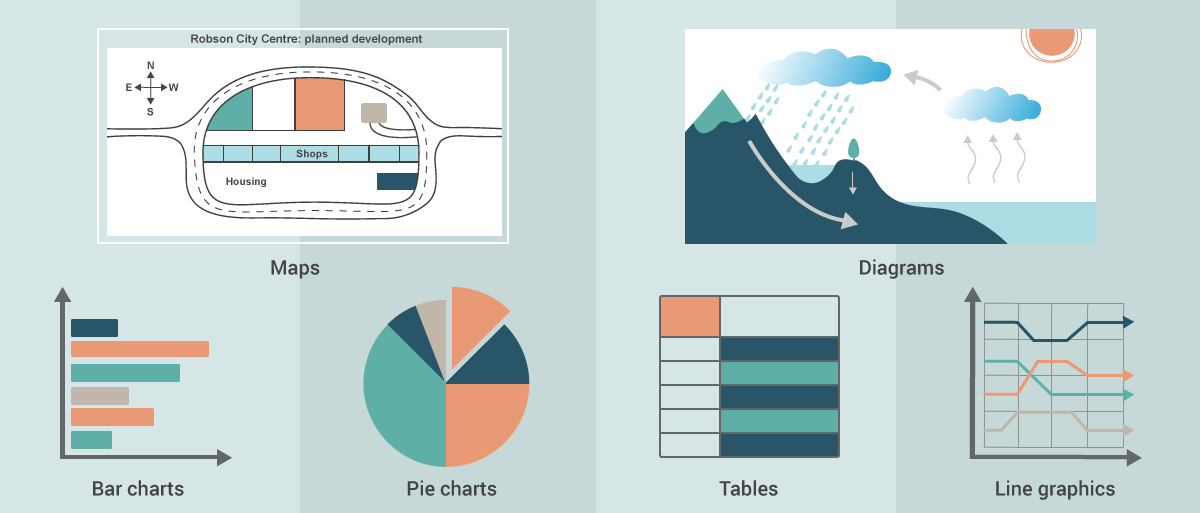
Nel IELTS academic writing task 1, ti viene presentato un grafico, una tabella o un diagramma e ti viene chiesto di descrivere, riassumere o spiegare le informazioni con parole tue. Ti potrebbe essere chiesto di descrivere e spiegare dati, descrivere le fasi di un processo, come funziona qualcosa o di descrivere un oggetto o un evento.
Indipendentemente dalle informazioni visive che ti vengono presentate, il tuo compito è scrivere un riassunto delle informazioni visive e descrivere le tendenze principali, le differenze complessive, i cambiamenti principali o i componenti principali di un sistema, o le fasi principali di un processo. Devi scrivere 150 parole o più e dovresti dedicare circa 20 minuti a questa parte del test. La struttura della scrittura può essere la seguente:
- Introduzione: parafrasare la domanda
- Panoramica: descrivere la tendenza generale o scrivere una panoramica generale dei principali raggruppamenti
- Paragrafo del corpo 1: scrivi in dettaglio sul primo raggruppamento in modo logico
- Paragrafo del corpo 2: scrivi in dettaglio sul secondo raggruppamento in modo logico
Quindi i passaggi per scrivere il rapporto per questa prova sono molto semplici:
- Analizza il grafico/i grafici e pianifica come raggruppare le informazioni
- Scrivi un saggio utilizzando la struttura di saggio raccomandata
- Rileggi il saggio
Diamo un'occhiata a ciascun diverso possibile tipo di grafici visivi, tabelle e diagrammi che potresti incontrare nel tuo test IELTS writing:
Grafici a Linee
In questo tipo di prova, ti verranno forniti uno o più grafici a linee. Ogni grafico a linee avrà 1-8 linee che mostrano come i valori cambiano nel tempo. Il periodo di tempo potrebbe essere il passato, il presente o il futuro, o una combinazione di tutti e tre. Il tuo compito è scrivere un riassunto, coprendo i punti più importanti e sostenendo la tua descrizione includendo dati.
The chart illustrates average CO2 emissions per person in four European countries between 1975 and 2015.
Summarise the information by selecting and reporting the main features, and make comparisons where relevant.
- Write at least 150 words.
- You should spend around 20 minutes on this task.
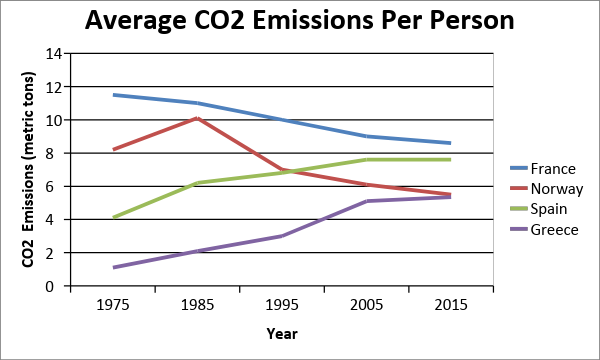
The line graph depicts the average Carbon dioxide emission for each individual residing in four countries, namely France, Norway, Spain, and Greece, over 40 years.
Overall, although CO2 production in France and Norway declined, it increased significantly in Spain and Greece over the period. Norway improved the most to become the most environmentally friendly, whereas Greece had the highest increase of all in that time.
Throughout the period, France produced the most CO2, though production declined overall from 11 tonnes per individual in 1975 to around 8.5 tonnes by 2015. In turn, except for a spike in emissions in 1985, Norway’s production of CO2 fell from 8 to under 6 tonnes forty years later.
On the contrary, CO2 release in Spain and Greece saw a more upward turn. In Spain, production doubled from 4 tonnes in 1975, overtaking Norway by 1995, to a final figure of just under 8 metric tonnes per head of population. Similarly, emissions in Greece, which were the lowest in 1975, increased five times to equal those of Norway in 2015.

Line Chart
Learn how to answer this question in a step-by-step interactive exercise
Line Chart
Nel Task 1 dell'IELTS Academic descrivi ciò che mostra un grafico. Non dai un'opinione e non spieghi perché i numeri sono così.
Un grafico a linee mostra come cambiano i valori nel tempo, spesso per più linee contemporaneamente, quindi questo report descrive il cambiamento e confronta le linee.
Guarda in anteprima la consegna, poi clicca su Avanti per continuare.
Leggi in anteprima la domanda
Summarise the information by selecting and reporting the main features, and make comparisons where relevant.
Write at least 150 words.
Leggi il grafico prima di scrivere. Controlla il titolo, il periodo di tempo sull'asse orizzontale, le unità di misura sull'asse verticale e la legenda che dà il nome a ogni linea.
Poi trova il punto in cui finiscono i dati misurati e inizia una proiezione. Quel punto divide i tempi verbali: forme del passato per gli anni già misurati e forme come is expected to, is predicted to e is set to per gli anni che devono ancora venire.
Rispondi alle domande sul grafico.
Leggi il grafico
L'introduzione dice con parole tue che cosa mostra il grafico. Parafrasa la consegna: cambia le parole, mantieni il significato e conserva l'argomento, ciò che misurano le linee e il periodo di tempo.
Copiare la frase della consegna non ti fa guadagnare punti, e qui i dati non vanno inseriti. Tieni tutti i numeri per i paragrafi centrali.
Scrivi una o due frasi che parafrasino la consegna.
Scrivi l'introduzione
Consegna
The chart illustrates average CO2 emissions per person in four European countries between 1975 and 2015.
Summarise the information by selecting and reporting the main features, and make comparisons where relevant.
Write at least 150 words.
Un report del Task 1 ha bisogno di un paragrafo centrale per ogni gruppo di linee, e un grafico a linee di solito ha più linee che gruppi. Raggruppa le linee che si muovono nella stessa direzione: quelle che salgono, quelle che scendono e quelle che restano stabili. Se tutte le linee si muovono nello stesso modo hai un paragrafo; una di ogni tipo ne dà tre.
Un paragrafo per ogni linea, o un paragrafo per ogni metà del periodo, spezza il confronto che la consegna richiede. Raggruppare solo in base al livello può mettere una linea in salita e una in discesa nello stesso paragrafo.
Scegli il raggruppamento che dà a ogni paragrafo un andamento chiaro.
Crea i gruppi
Scegli il raggruppamento che dà a ogni paragrafo un andamento chiaro.
- Group 1: Norway, Spain, Greece. Group 2: France.
- Group 1: Greece. Group 2: France, Norway, Spain.
- Group 1: Norway, Greece. Group 2: France, Spain.
- Group 1: France, Norway. Group 2: Spain, Greece.
La panoramica è lo schema più importante dell'intero grafico. La formano le caratteristiche principali. Prima: qual è la direzione generale di ogni gruppo nel corso del periodo? Poi: quando ci sono due o più gruppi, quanto restano distanti il primo e l'ultimo gruppo, e questo divario aumenta, si riduce o si inverte?
Metti insieme queste caratteristiche e avrai la tua panoramica. Qui non aggiungere singoli anni o numeri. Tienili per i paragrafi centrali.
Trova le caratteristiche principali per costruire la tua panoramica.
Trova la tendenza generale
Ora trasforma le due caratteristiche principali in una o due frasi. La panoramica è la parte del report che l'esaminatore cerca per prima, quindi scrivila prima di qualsiasi dettaglio e mantienila generale.
Usa il tempo verbale adatto al grafico e descrivi che cosa mostra il grafico, non perché. Non dare dati e non aggiungere opinioni.
Scrivi una o due frasi generali sullo schema più importante.
Scrivi la tua panoramica
Il paragrafo centrale 1 tratta solo il tuo primo gruppo di linee lungo tutto il periodo, ed è qui che vanno i dati.
Descrivi la forma di ogni linea invece di ogni suo punto: il valore iniziale, la direzione, eventuali cambi di direzione e il valore finale o previsto. Usa il linguaggio del cambiamento nel tempo, come rise steadily, fluctuate, level off e peak, e indica l'anno insieme a ogni dato.
Se non sai bene come esprimere un punto, cliccaci sopra e una frase di esempio verrà aggiunta al tuo spazio di scrittura.
Scrivi tre o quattro frasi sul tuo primo gruppo, con i dati.
Scrivi il paragrafo centrale 1
Il paragrafo centrale 2 tratta solo il tuo secondo gruppo di linee. Trattalo allo stesso modo: la forma di ogni linea, sostenuta dai dati.
Non ripetere il paragrafo centrale 1. Collega i gruppi quando vale la pena evidenziare una differenza, con espressioni come in contrast e far lower than.
Se non sai bene come esprimere un punto, cliccaci sopra e una frase di esempio verrà aggiunta al tuo spazio di scrittura.
Scrivi tre o quattro frasi sul tuo secondo gruppo, con i dati.
Scrivi il paragrafo centrale 2
Il piano del tuo report è completo. Una risposta completa al Task 1 ha queste parti, in quest'ordine: un'introduzione che parafrasa la consegna, una panoramica dello schema più importante e un paragrafo centrale per ogni gruppo, che sostiene quello schema con dati selezionati.
Rileggi insieme le tue sezioni e controlla tre cose: la panoramica e i dettagli sono coerenti, il tempo verbale corrisponde ai valori misurati e previsti, e ogni dato ha la sua unità di misura e il suo anno.
Rivedi il piano del tuo report, poi confrontalo con il testo modello.
Piano completo del report
Come decidere
Un grafico a linee dell'IELTS Academic Task 1 mostra come cambiano i valori nel tempo, spesso per più linee insieme. Descrivi questi cambiamenti e confronti le linee. Non ti serve ogni punto di ogni linea.
Lavora sempre nello stesso ordine, così il report è pianificato prima che tu scriva la prima frase.
- Leggi il grafico. Controlla il titolo, il periodo di tempo, le unità di misura, la legenda e il punto in cui finiscono i dati misurati e iniziano le eventuali previsioni.
- Scrivi l'introduzione. Parafrasa la consegna e indica cosa mostra il grafico.
- Crea i gruppi. Raggruppa le linee che si comportano in modo simile, così ogni paragrafo centrale ha una sola idea chiara.
- Trova la tendenza generale. Stabilisci lo schema più importante di tutto il grafico prima di guardare i singoli valori.
- Scrivi il report per fasi. Scrivi prima la panoramica, poi un paragrafo centrale per ogni gruppo con alcuni dati scelti, poi rivedi tutto il piano.
Raggruppa le linee prima di descriverle. Un grafico con molte linee diventa un report breve quando le linee simili condividono un paragrafo, e raggruppare è proprio ciò che la consegna intende con selezionare le caratteristiche principali.
Leggi il grafico
Comincia dagli assi. L'asse orizzontale indica il periodo di tempo, l'asse verticale le unità di misura e la legenda dà il nome a ogni linea. Trova il punto in cui finiscono i dati misurati, perché tutto ciò che viene dopo è una previsione e richiede forme del futuro.
Introduzione
L'introduzione è formata da una o due frasi che dicono cosa mostra il grafico con parole diverse da quelle della consegna. Mantieni l'argomento, ciò che misurano le linee e il periodo di tempo. Lascia fuori dati e tendenze.
Gruppi
Un report di Task 1 ha un paragrafo centrale per ogni gruppo di linee. Raggruppa le linee che vanno nella stessa direzione: quelle che salgono, quelle che scendono e quelle che restano stabili. Se tutte le linee vanno nella stessa direzione hai un paragrafo; se ce n'è una di ogni tipo ne hai tre.
Tendenza generale
La tendenza generale è lo schema più importante del grafico: la direzione generale di ogni gruppo nel periodo e quanto restano distanti i gruppi. È un'affermazione generale, quindi non contiene dati.
Per imparare ad affrontare il IELTS Academic Writing Task 1 Grafici a Linee, dai un'occhiata alla nostra lezione IELTS Academic Writing Task - Line Graphs.
Prova gratuita di 7 giorniGrafici a Barre
In questo tipo di prova, ti verranno forniti uno o più grafici a barre. I grafici a barre possono mostrare come i valori cambiano nel tempo (dati dinamici), le differenze tra valori in un determinato momento (dati statici), o i risultati di un sondaggio o questionario. Le informazioni potrebbero riguardare la situazione nel passato, nel presente o nel futuro, o una combinazione di tutti e tre. Il tuo compito è scrivere un riassunto, coprendo i punti più importanti e sostenendo la tua descrizione includendo dati.
The chart below shows the proportion of males and females in Malaysia who commonly do physical activity in 2010.
Summarise the information by selecting and reporting the main features, and make comparisons where necessary.
- Write at least 150 words.
- You should spend around 20 minutes on this task.
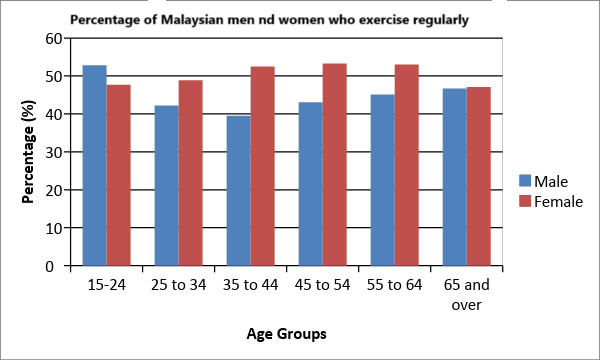
The bar chart compares the proportion of male and females of differing age groups who frequently undertook physical activity in 2010.
Overall, while the Malaysian population keeps fit in general, a higher proportion of women than men exercised in 2010, with some further differences between age groups. Middle-aged females were the most likely to work out, while for men, those aged 15 to 24 tended to do the most physical activity.
In terms of men’s exercise habits, younger men were much more likely to exercise than older men with 52.8% of those aged under 24 exercising as opposed to only around 40% of older age groups
By contrast, around half of all women in all age groups reported keeping fit, especially those aged between 35 and 64 at around 53%. The exception was the youngest age group in which only 47.7 percent of women exercised compared to 52.8% of men. Similarly, for people 65 and over, just approximately 47% of both sexes were recorded regularly working out.
Bar Chart
Learn how to answer this question in a step-by-step interactive exercise
Bar Chart
Nel Task 1 dell'IELTS Academic descrivi ciò che mostra un grafico. Non dai un'opinione e non spieghi perché i numeri sono così.
Un grafico a barre confronta dei gruppi in una serie di categorie, quindi questo report si basa sui confronti e non sul cambiamento nel tempo.
Guarda in anteprima la consegna, poi clicca su Avanti per continuare.
Leggi in anteprima la domanda
Summarise the information by selecting and reporting the main features, and make comparisons where necessary.
Write at least 150 words
Leggi il grafico prima di scrivere. Controlla il titolo, le categorie sull'asse orizzontale, le unità di misura sull'asse verticale e la legenda che dà il nome a ogni gruppo di barre.
Le unità di misura determinano le parole che usi. Numero di persone, percentuali e somme di denaro non sono la stessa cosa, e indicare l'unità sbagliata ti fa perdere punti anche se il resto della frase è corretto.
Rispondi alle domande sul grafico.
Leggi il grafico
L'introduzione dice con parole tue che cosa mostra il grafico. Parafrasa la consegna: cambia le parole, mantieni il significato e conserva l'argomento, i gruppi confrontati e il luogo o il periodo, se la consegna li indica.
Copiare la frase della consegna non ti fa guadagnare punti, e qui i dati non vanno inseriti. Tieni tutti i numeri per i paragrafi centrali.
Scrivi una o due frasi che parafrasino la consegna.
Scrivi l'introduzione
Consegna
The chart below shows the proportion of males and females in Malaysia who commonly do physical activity in 2010.
Summarise the information by selecting and reporting the main features, and make comparisons where necessary.
Write at least 150 words
Un report del Task 1 ha bisogno di un paragrafo centrale per ogni gruppo, quindi decidi presto come dividere i dati. Raggruppa le serie della legenda che si comportano in modo simile: le serie che si trovano a un livello simile, o che sono più alte e più basse nelle stesse categorie, stanno nello stesso paragrafo. Le serie che si comportano diversamente hanno un paragrafo tutto loro. Così ogni paragrafo contiene un'idea chiara.
Una divisione che separa soltanto i valori alti da quelli bassi, o che dà a ogni categoria un paragrafo a sé, ti costringe a ripeterti.
Scegli il raggruppamento che dà a ogni paragrafo un'idea chiara.
Crea i gruppi
Scegli il raggruppamento che dà a ogni paragrafo un'idea chiara.
- Group 1: Female. Group 2: Male.
- One group: Male and Female.
La panoramica è lo schema più importante dell'intero grafico. La formano fino a tre caratteristiche principali. Quale gruppo è più alto nella maggior parte delle categorie? Quale gruppo è il più basso nella maggior parte delle categorie? Il divario è più o meno uguale in tutte le categorie, oppure una categoria è molto diversa dalle altre?
Non tutti i grafici mostrano tutte e tre le cose, quindi questo passaggio chiede solo le caratteristiche che contano per questo grafico. Mettile insieme e avrai la tua panoramica. Qui non aggiungere singoli numeri. Tienili per i paragrafi centrali.
Trova le caratteristiche principali per costruire la tua panoramica.
Trova la tendenza generale
Ora trasforma le caratteristiche principali che hai trovato in una o due frasi. La panoramica è la parte del report che l'esaminatore cerca per prima, quindi scrivila prima di qualsiasi dettaglio e mantienila generale.
Descrivi che cosa mostra il grafico, non perché è così. Non dare dati e non aggiungere opinioni.
Scrivi una o due frasi generali sullo schema più importante.
Scrivi la tua panoramica
Il paragrafo centrale 1 tratta solo il tuo primo gruppo, ed è qui che vanno i dati.
Seleziona i confronti che contano: il valore più alto, il valore più basso e qualsiasi categoria che si comporta in modo diverso dalle altre. Poiché un grafico a barre confronta gruppi nello stesso periodo, usa il linguaggio del confronto, come higher than, twice as many as e the largest of all the categories.
Se non sai bene come esprimere un punto, cliccaci sopra e una frase di esempio verrà aggiunta al tuo spazio di scrittura.
Scrivi tre o quattro frasi sul tuo primo gruppo, con i dati.
Scrivi il paragrafo centrale 1
Il paragrafo centrale 2 tratta solo il tuo secondo gruppo. Trattalo come il primo: i confronti più chiari, sostenuti dai dati.
Non ripetere il paragrafo centrale 1. Collega i gruppi quando vale la pena evidenziare una differenza, con espressioni come in contrast e compared with.
Se non sai bene come esprimere un punto, cliccaci sopra e una frase di esempio verrà aggiunta al tuo spazio di scrittura.
Scrivi tre o quattro frasi sul tuo secondo gruppo, con i dati.
Scrivi il paragrafo centrale 2
Il piano del tuo report è completo. Una risposta completa al Task 1 ha queste parti, in quest'ordine: un'introduzione che parafrasa la consegna, una panoramica dello schema più importante e un paragrafo centrale per ogni gruppo, che sostiene quello schema con dati selezionati.
Rileggi insieme le tue sezioni e controlla tre cose: la panoramica e i dettagli sono coerenti, ogni dato ha la sua unità di misura e hai descritto il grafico senza spiegarlo.
Rivedi il piano del tuo report, poi confrontalo con il testo modello.
Piano completo del report
Come decidere
Un grafico a barre dell'IELTS Academic Task 1 ti chiede di descrivere cosa mostra il grafico e di confrontare i gruppi al suo interno. Non ti servono tutti i numeri. Ti servono i confronti importanti.
Lavora sempre nello stesso ordine, così il report è pianificato prima che tu scriva la prima frase.
- Leggi il grafico. Controlla il titolo, le categorie, le unità di misura e la legenda prima di scrivere qualsiasi cosa.
- Scrivi l'introduzione. Parafrasa la consegna e indica cosa mostra il grafico.
- Crea i gruppi. Dividi i dati in modo che ogni paragrafo centrale abbia una sola idea chiara.
- Trova la tendenza generale. Stabilisci lo schema più importante di tutto il grafico prima di guardare i singoli valori.
- Scrivi il report per fasi. Scrivi prima la panoramica, poi un paragrafo centrale per ogni gruppo con alcuni dati scelti, poi rivedi tutto il piano.
Una panoramica chiara vale più di qualche numero in più. La consegna ti chiede di selezionare le caratteristiche principali, quindi un'affermazione generale con pochi confronti forti prende un punteggio migliore di un elenco di tutti i valori.
Leggi il grafico
Comincia dagli assi. L'asse orizzontale indica cosa viene confrontato, l'asse verticale le unità di misura e la legenda dà il nome a ogni gruppo di barre. Un report che indica l'unità di misura sbagliata cambia il significato di ogni sua frase.
Introduzione
L'introduzione è formata da una o due frasi che dicono cosa mostra il grafico con parole diverse da quelle della consegna. Mantieni l'argomento, i gruppi confrontati e il luogo o il periodo. Lascia fuori dati e tendenze.
Gruppi
Un report di Task 1 ha un paragrafo centrale per ogni gruppo. Raggruppa le serie della legenda che si comportano in modo simile: serie a un livello simile, oppure serie più alte e più basse nelle stesse categorie. Così ogni paragrafo contiene una sola idea e non ti ripeti mai.
Tendenza generale
La tendenza generale è lo schema più importante del grafico: quale gruppo è più alto nella maggior parte delle categorie, quale gruppo è più basso nella maggior parte delle categorie, e se la differenza è più o meno la stessa in ogni categoria oppure una categoria è molto diversa. Un grafico può mostrarne uno, due o tutti e tre. È un'affermazione generale, quindi non contiene dati.
I grafici a barre sono piuttosto comuni nel IELTS writing task 1 academic. Ci sono tre diversi scenari che incontrerai in una prova con grafico a barre:
- Un grafico a barre con categorie sull'asse x
- Un grafico a barre con date o anni sull'asse (funziona come un grafico a linee)
- Due grafici a barre presentati
Ogni scenario richiede di scrivere il rapporto in modo diverso. Iscriviti a una prova gratuita di 7 giorni per accedere alle seguenti lezioni sui grafici a barre:
- Lezione IELTS Academic Writing Task - Bar Charts Part 1.
- Lezione IELTS Academic Writing Task - Bar Charts Part 2.
- Lezione IELTS Academic Writing Task - Bar Charts Part 3.
Grafici a Torta
In questo tipo di prova, ti verranno forniti uno, due o tre grafici a torta. I grafici a torta possono mostrare percentuali di un totale. Se hai un grafico a torta, rappresenterà un punto nel tempo (dati statici). Se hai due o più grafici a torta, possono rappresentare come le percentuali cambiano nel tempo o confrontare diversi paesi o gruppi. Il tuo compito è scrivere un riassunto, coprendo i punti più importanti e sostenendo la tua descrizione includendo dati.
The charts below show the percentage of water used for different purposes in six areas of the world. Summarise the information by selecting and reporting the main features, and make comparisons where relevant.
- Write at least 150 words.
- You should spend around 20 minutes on this task.
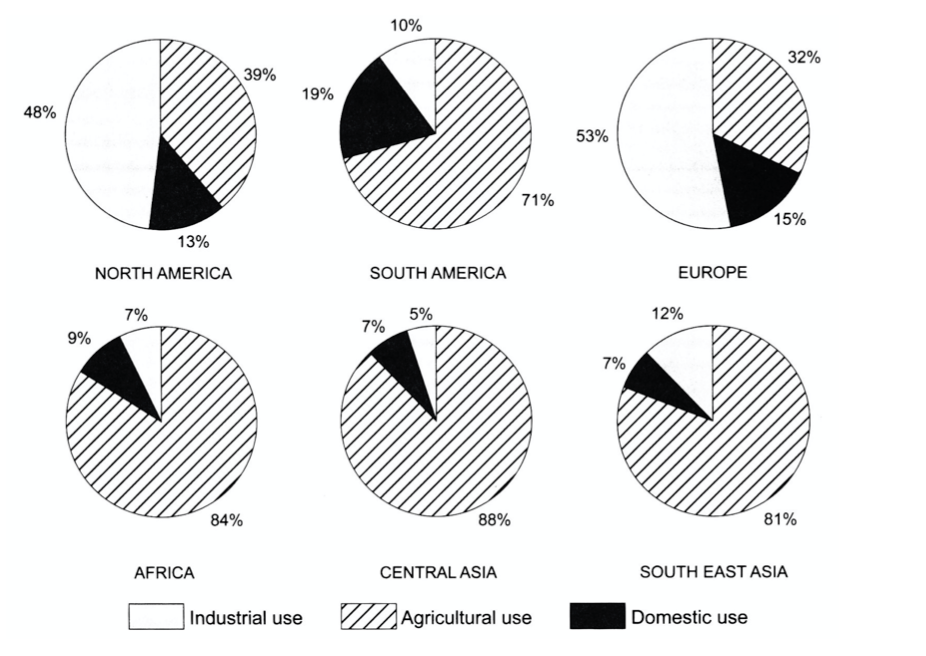
The pie charts provide information regarding the proportions of water used for industrial, agriculture, and domestic use in six regions.
In general, water serves mostly an industrial purpose in North America and Europe, whereas it is predominantly used for agriculture in South America, Africa, Central Asia, and South-East Asia.
Regarding industrial and domestic use, North America and Europe consume an average of approximately 50 percent of water for industrial purposes. However, these two regions report much less water consumption for domestic purposes, utilizing 13 percent and 15 percent, respectively. Out of all six regions, South America dedicates the highest percentage of water consumption for domestic use, but uses only 10 percent for industrial reasons. Both industrial and domestic use remain the least popular choices in Africa, Central Asia, and South-East Asia, where their combined use makes up less than 20 percent of the overall water consumption in each of the three regions.
Agricultural use, on the other hand, accounts for 71 percent of water consumption in South America and over three-fourths of water use in Africa, South-East Asia, and Central Asia, where it is nearly 90 percent. North America and Europe consume less than 40 percent of water for agricultural purposes.
Per imparare ad affrontare il IELTS Academic Writing Task 1 Grafici a Torta, iscriviti a una prova gratuita di 7 giorni per accedere alla lezione IELTS Academic Writing Task - Pie Charts.
Prova gratuita di 7 giorniTabelle
In questo tipo di prova, ti viene fornita una tabella contenente dati. può mostrare cifre dinamiche che cambiano nel tempo o dati statici per un punto nel tempo. Spesso ci sono troppe informazioni, quindi non sarai in grado di includere ogni dettaglio. Il tuo compito è scrivere un riassunto, coprendo i punti più importanti e sostenendo la tua descrizione includendo dati.
The table below gives the average time spent and distance traveled by UK commuters in one year. Time and distance are given in minutes and miles accordingly.
Summarise the information by selecting and reporting the main features, and make comparisons where relevant.
Commuting Habits of different regions of the UK in a year
UK Region | Average Commuting Time (minutes) | Average Commuting Distance (miles) |
London | 54 | 14 |
South East | 78 | 20 |
Scotland | 45 | 19 |
West Midlands | 39 | 18 |
North West | 36 | 18 |
Northern Ireland | 36 | 15 |
Yorkshire & Humberside | 36 | 14 |
South West | 34 | 16 |
East Anglia | 33 | 15 |
North East | 32 | 19 |
East Midlands | 32 | 15 |
Wales | 27 | 14 |
- Write at least 150 words.
- You should spend around 20 minutes on this task.
The table shows data on the average commuting time (minutes) and distance (miles) completed by UK citizens in 12 different regions in one year.
Overall, with the exception of London, the further people travel, the more time they need to reach work people. Commuters in the south east region spend the longest time commuting over the greatest distance, whereas people in Wales spend the least.
Regarding the top three UK regions, on average, people in the south east travel both the farthest and longest at 20 miles over 78 minutes. Likewise inhabitants of Scotland journey a similar distance to work, yet spend almost half the time doing so at 45 minutes to get there, while those living in London spend the second-longest time travelling (54 minutes) over just 14 miles.
Of the other regions, people in the West Midlands spent the most time travelling at 39 minutes whereas those in Wales recorded the lowest time at 27 minutes. With regard to distance, residents of the North East, West Midlands and North West recorded the greatest mileage at 19, 18 and 18 miles respectively, while people in Yorkshire and Humberside as well as Wales both travelled the shortest distance to work of all at 14 miles.
Per imparare ad affrontare il IELTS Academic Writing Task 1 Tabelle, iscriviti a una prova gratuita di 7 giorni per accedere alle seguenti lezioni:
- Lezione IELTS Academic Writing Task - Tables Part 1.
- Lezione IELTS Academic Writing Task - Tables Part 2.
Diagrammi di Processo
Per questo tipo di domanda, ti verrà fornito un diagramma che mostra come funziona qualcosa.
Il diagramma può mostrare una macchina, un sistema o un fenomeno naturale.
Spesso non ci sono dati o ci sono pochi dati inclusi.
Il tuo compito è riassumere le informazioni mostrate nel diagramma.
The diagram below shows the water cycle, which is the continuous movement of water on, above and below the surface of the Earth.
Summarise the information by selecting and reporting the main features.
- Write at least 150 words.
- You should spend around 20 minutes on this task.
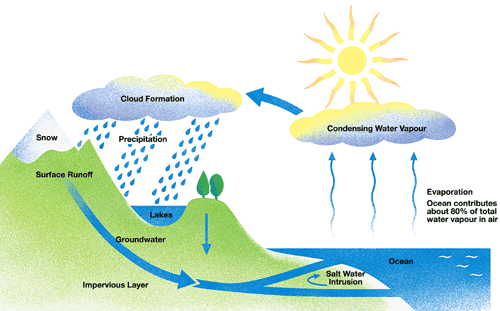
The diagram illustrates the hydrological cycle by which water moves through our natural environment. Overall, there are several stages to the process involving evaporation, precipitation and the final return of water to the ocean where the process begins over.
Since 80% of all water begins in the ocean, most water originates from this source. Initially sea water is warmed by the sun, causing it to evaporate into the air becoming water vapor. This then rises to condense into clouds at a higher elevation, which are then then pushed by the wind over land where it condenses further and precipitation occurs, falling as either snow or rain.
After precipitation on land, water then takes one of three routes. Some of it may fall into lakes or return to the ocean as surface runoff. Still further water percolates underground to an impermeable layer where it again flows back to the sea. Salt water also intrudes from the ocean into the land in coastal areas.

Process Diagram
Learn how to answer this question in a step-by-step interactive exercise
Process Diagram
Una prova di Task 1 dell'IELTS Academic con un diagramma di processo mostra come si produce qualcosa o come funziona un sistema, passo dopo passo. Riporti le fasi nell'ordine in cui le mostra il diagramma, senza dare motivi né opinioni.
Guarda in anteprima la consegna, poi clicca su Avanti per continuare.
Leggi in anteprima la domanda
Summarise the information by selecting and reporting the main features.
Write at least 150 words.
Prima di scrivere qualsiasi cosa, assicurati di aver capito il diagramma. Conta le fasi e segui le frecce per vedere dove inizia il processo e dove finisce. Se l'ultima freccia torna alla prima fase, il processo è un ciclo e non c'è un prodotto finale.
Rispondi alle domande sul diagramma.
Leggi il grafico
L'introduzione dice al lettore che cosa mostra il diagramma. Parafrasa la consegna con parole tue invece di copiarla e indica il processo. Qui non descrivere nessuna delle fasi.
Scrivi una o due frasi per la tua introduzione.
Scrivi l'introduzione
Consegna
The diagram below shows the water cycle, which is the continuous movement of water on, above and below the surface of the Earth.
Summarise the information by selecting and reporting the main features.
Write at least 150 words.
Un report del Task 1 dell'IELTS ha bisogno di un paragrafo centrale per ogni gruppo di fasi. Non scrivere un paragrafo per ogni fase. Dividi il processo nei suoi punti di passaggio naturali, dove cambiano il luogo, il materiale o lo scopo, in modo che ogni gruppo sia una serie di fasi consecutive. La maggior parte dei processi dà due gruppi; un processo breve può darne uno e uno lungo tre.
Scegli i gruppi.
Crea i gruppi
Scegli i gruppi.
- Group 1: stages 1 to 2 (Evaporation to Condensing Water Vapour). Group 2: stages 3 to 4 (Cloud Formation to Precipitation). Group 3: stages 5 to 6 (Surface Runoff to Groundwater).
- Group 1: stages 1 to 3 (Evaporation to Cloud Formation). Group 2: stages 4 to 5 (Precipitation to Surface Runoff). Group 3: stage 6 (Groundwater).
- Group 1: stages 1 to 3 (Evaporation to Cloud Formation). Group 2: stages 4 to 6 (Precipitation to Groundwater).
- Group 1: stages 1 to 2 (Evaporation to Condensing Water Vapour). Group 2: stages 3 to 5 (Cloud Formation to Surface Runoff). Group 3: stage 6 (Groundwater).
La panoramica riassume l'intero processo a colpo d'occhio. Chiediti quante fasi ci sono e quali sono le fasi principali dall'inizio alla fine. Un processo raramente viene confrontato con qualcos'altro, quindi descrivi la struttura del processo invece di cercare un aumento o una diminuzione.
Rispondi alle domande per trovare la tendenza generale.
Trova la tendenza generale
Usa gli appunti del passaggio precedente. La panoramica indica il numero di fasi e le fasi principali, e dice se il processo termina con un prodotto o si ripete come un ciclo. Tieni macchinari, tempi e temperature per i paragrafi centrali, e non dare motivi né opinioni.
Scrivi una o due frasi per la tua panoramica.
Scrivi la tua panoramica
Il paragrafo centrale 1 descrive il primo gruppo di fasi, passo dopo passo nell'ordine indicato dalle frecce. Usa le forme passive, come is heated, is mixed e is poured, perché il diagramma raramente dice chi svolge il lavoro. Collega le fasi con parole di sequenza come first, then e after that.
Scrivi tre o quattro frasi per il paragrafo centrale 1.
Scrivi il paragrafo centrale 1
Il paragrafo centrale 2 descrive il tuo secondo gruppo di fasi. Riprende dal punto in cui si è fermato il paragrafo centrale 1, così la sequenza non si interrompe mai. Continua a usare le forme passive e collega i gruppi con espressioni come once e after this. Se questo è l'ultimo paragrafo, segnala la fine con in the final stage o finally, e se il processo è un ciclo, di' che l'ultima fase riporta alla prima.
Scrivi tre o quattro frasi per il paragrafo centrale 2.
Scrivi il paragrafo centrale 2
Ora le tue sezioni formano un unico report: l'introduzione, la panoramica e un paragrafo centrale per ogni gruppo di fasi. Leggile insieme e controlla che le fasi siano ancora in sequenza, che le forme passive siano corrette e che il report sia abbastanza lungo.
Leggi tutto il piano del tuo report, poi clicca su Avanti per confrontarlo con il report modello.
Piano completo del report
Come decidere
Un compito con un diagramma di processo mostra, passo dopo passo, come si produce qualcosa o come funziona un sistema. Il diagramma ha un ordine fisso, quindi il report segue quell'ordine dalla prima all'ultima fase.
Lavora sempre nello stesso ordine, così le fasi restano in sequenza e non salti nessun passaggio.
- Leggi il grafico. Conta le fasi e segui le frecce per vedere dove inizia e dove finisce il processo.
- Scrivi l'introduzione. Parafrasa la domanda della consegna e indica il processo, senza dettagli.
- Crea i gruppi. Dividi le fasi in gruppi nei punti naturali del processo, un paragrafo centrale per ogni gruppo.
- Trova la tendenza generale. Stabilisci quante fasi ci sono e quali sono le fasi principali dall'inizio alla fine.
- Scrivi la panoramica e i paragrafi centrali. Riassumi prima la forma del processo, poi descrivi le fasi in sequenza.
- Piano completo del report. Leggi insieme le tue sezioni e confrontale con il report modello.
Un report su un processo si scrive al passivo. Il diagramma dice raramente chi fa il lavoro, quindi usa forme come «is heated», «is mixed» e «is stored», e collega le fasi con parole di sequenza come «first», «after that» e «finally».
Leggi
Un diagramma di processo mostra delle fasi collegate da frecce. Conta le fasi e segui le frecce per controllare dove inizia e dove finisce il processo. Se l'ultima freccia torna alla prima fase, il processo è un ciclo e non c'è un prodotto finale.
Introduzione
L'introduzione dice cosa mostra il diagramma. Parafrasa la domanda della consegna con parole tue invece di copiarla, e indica il processo. Lascia fuori da queste frasi le singole fasi.
Gruppi
Un report di Task 1 richiede un paragrafo centrale per ogni gruppo di fasi. Non scrivere un paragrafo per ogni passaggio. Dividi il processo nei suoi punti naturali, dove cambiano il luogo, il materiale o lo scopo, così ogni gruppo è una serie di fasi consecutive. La maggior parte dei processi dà due gruppi; un processo breve può darne uno, uno lungo tre.
Tendenza
La panoramica riassume a colpo d'occhio tutto il processo: quante fasi ci sono e quali sono le fasi principali. Un processo viene raramente confrontato con qualcos'altro, quindi descrivi la forma del processo invece di cercare un aumento o un calo.
Scrivi
La panoramica viene per prima e resta generale, senza attrezzature, tempi o temperature. Poi ogni paragrafo centrale descrive le sue fasi nell'ordine indicato dalle frecce. Usa forme passive come «is heated» e «is poured», e collega le fasi con parole di sequenza come «first», «next», «after that» e «finally».
Per imparare ad affrontare il IELTS Academic Writing Task 1 Diagrammi di Processo, iscriviti a una prova gratuita di 7 giorni per accedere alla lezione IELTS Academic Writing Task - Process Diagrams.
Prova gratuita di 7 giorniMappe
Per questo tipo di domanda, ti verranno fornite una, due o tre mappe.
Le mappe possono mostrare una città, un'isola o un'altra area geografica.
Le mappe di solito mostrano i cambiamenti avvenuti nell'area durante un periodo di tempo.
I cambiamenti potrebbero essere correlati alla costruzione (ad es. lo sviluppo di un'area per il turismo)
o alla distruzione (ad es. come un'area è stata colpita da un disastro naturale come un terremoto)
Il tuo compito è scrivere un riassunto dei cambiamenti che hanno avuto luogo e coprire i punti più importanti.
The maps below show the centre of a small town called Islip as it is now, and plans for its development. Summarise the information by selecting and reporting the main features, and make comparisons where relevant.
- Write at least 150 words.
- You should spend around 20 minutes on this task.
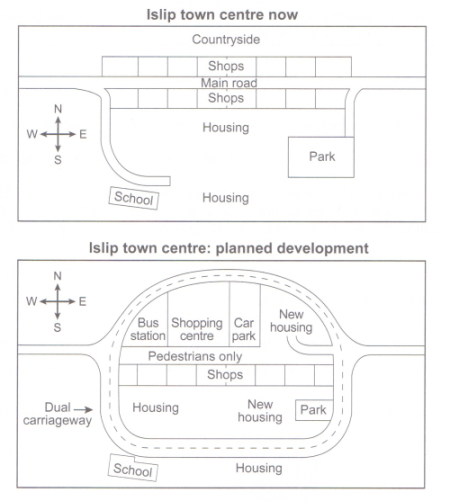
The diagrams illustrate some proposed changes to the central area of the town of Islip.
Overall, the principal change to the town will be the construction of a ring road around the centre. Various other developments with regard to shops and housing will accompany the building of this road.
As the first map reveals, lslip town center now is relatively small. There is a main road from the west to the east with shops on both sides. The northern area is rarely countryside, while the southern area is filled with houses with a school at the end of the fork road in the southwest corner and a park in the southeast area.
In the future, the main road is expected to reform into a dual carriageway as a round containing all the new buildings. The shops along the north side of the new pedestrian street will be demolished to make way for a bus station, shopping centre, car parks and new housing area. The shops along the south side of the street will remain, but it seems that the town's park will be reduced in size so that more new houses can be built within the ring road.
Map
Learn how to answer this question in a step-by-step interactive exercise
Map
Una prova di Task 1 dell'IELTS Academic con una mappa ti presenta due o più piante dello stesso luogo in momenti diversi, di solito due. Scrivi un report di almeno 150 parole che descrive come è cambiato il luogo, senza dare opinioni né motivi.
Guarda in anteprima la consegna, poi clicca su Avanti per continuare.
Leggi in anteprima la domanda
Write at least 150 words.
Inizia leggendo le mappe, non scrivendo. Controlla il luogo rappresentato, i momenti messi a confronto e quante mappe hai. Poi cerca che cosa è nuovo, che cosa è sparito e che cosa ora è usato per qualcos'altro.
Rispondi alle domande sulle mappe.
Leggi il grafico
L'introduzione parafrasa la consegna con parole tue. Indica che cosa mostrano le mappe e il periodo che coprono, e cambia le parole della consegna invece di copiarla. I dettagli, il linguaggio della posizione e i verbi di cambiamento vengono dopo.
Scrivi una o due frasi che parafrasino la consegna.
Scrivi l'introduzione
Consegna
The maps below show the centre of a small town called Islip as it is now, and plans for its development. Summarise the information by selecting and reporting the main features, and make comparisons where relevant.
Write at least 150 words.
Un report del Task 1 ha bisogno di un paragrafo centrale per ogni gruppo di mappe. Di solito ogni mappa è un gruppo a sé: la mappa precedente nel primo paragrafo e quella successiva nel secondo, perché così i momenti restano separati. Due mappe che si descrivono meglio insieme possono formare un gruppo, e tre mappe di solito danno tre paragrafi.
Un paragrafo per ogni elemento, o uno per ogni metà della mappa, spezza il confronto tra i momenti.
Scegli il raggruppamento che dà paragrafi centrali chiari.
Crea i gruppi
Scegli il raggruppamento che dà paragrafi centrali chiari.
- One group: now and planned development.
- Group 1: now. Group 2: planned development.
La panoramica indica il cambiamento più importante nell'intero periodo. Chiediti se il luogo si è ingrandito o rimpicciolito, e quali tipi di uso del territorio sono comparsi o scomparsi. I singoli elementi e le posizioni esatte restano fuori dalla panoramica.
Scegli le risposte che descrivono il cambiamento complessivo.
Trova la tendenza generale
Ora scrivi la panoramica con parole tue, usando gli appunti del passaggio precedente. Bastano una o due frasi. Descrivi lo sviluppo generale del luogo e lascia fuori le posizioni esatte, i singoli elementi e qualsiasi motivo del cambiamento.
Scrivi la tua panoramica in una o due frasi.
Scrivi la tua panoramica
Il primo paragrafo centrale descrive nel dettaglio la mappa o le mappe del tuo primo gruppo. Usa le forme del passato per una situazione che non esiste più e il linguaggio della posizione, come «to the north of», «beside» e «on the edge of», così il lettore può collocare ogni elemento. Descrivi gli elementi, non i motivi.
Scrivi tre o quattro frasi per il paragrafo centrale 1.
Scrivi il paragrafo centrale 1
Il secondo paragrafo centrale descrive la mappa o le mappe del tuo secondo gruppo e il cambiamento rispetto alla mappa precedente. Usa le forme passive per ciò che è stato costruito, rimosso o sostituito, come «was built», «had been cleared» e «has been converted», perché le mappe non dicono chi ha fatto i lavori. Il linguaggio della posizione continua a mostrare dove è avvenuto ogni cambiamento.
Scrivi tre o quattro frasi per il paragrafo centrale 2.
Scrivi il paragrafo centrale 2
Ora le tue sezioni formano un unico report: introduzione, panoramica e un paragrafo centrale per ogni gruppo di mappe. Leggile in ordine e controlla che la panoramica dia il quadro generale e che i paragrafi centrali contengano i dettagli.
Leggi il piano del tuo report, poi confrontalo con il report modello.
Piano completo del report
Come decidere
Un compito con le mappe ti dà due o più piante dello stesso luogo in momenti diversi. Non descrivi ogni etichetta. Riporti come è cambiato il luogo da un momento all'altro.
Lavora sempre nello stesso ordine, così il report presenta il quadro generale prima dei dettagli.
- Leggi il grafico. Prima di pianificare, controlla il luogo, i momenti nel tempo e gli elementi principali di ogni mappa.
- Crea i gruppi. Dividi le informazioni in gruppi di mappe, un paragrafo centrale per ciascuno, di solito prima la mappa più vecchia e poi quella più recente.
- Trova la tendenza generale. Stabilisci il cambiamento più importante in tutto il periodo, per esempio una crescita, un declino o un nuovo uso del territorio.
- Scrivi il report per fasi. Scrivi l'introduzione, poi la panoramica, poi un paragrafo centrale per ogni gruppo.
- Piano completo del report. Leggi insieme le sezioni e confrontale con il report modello.
Le espressioni di posizione e le forme passive sono il cuore di un report sulle mappe. Espressioni come «to the north of» e «beside the river» collocano ogni elemento, e forme come «was built» o «had been removed» riportano un cambiamento senza dire chi ha fatto il lavoro.
Leggi
Prima di pianificare, controlla cosa mostrano le mappe: il luogo, i momenti nel tempo e gli elementi principali di ogni mappa. Poi cerca cosa c'è di nuovo, cosa è sparito e cosa ora ha un altro uso. Questa fase di lettura ti evita di descrivere una sola delle mappe.
Gruppi
Un report di IELTS Task 1 richiede un paragrafo centrale per ogni gruppo di mappe. Di solito ogni mappa è un gruppo a sé, prima la mappa più vecchia e poi quella più recente. Due mappe che conviene descrivere insieme possono formare un solo gruppo, e tre mappe di solito danno tre paragrafi. Decidi la divisione prima di scrivere, perché stabilisce l'ordine di tutto il report.
Panoramica
La panoramica indica il cambiamento più importante in tutto il periodo, non il piccolo dettaglio. Chiediti se il luogo si è ingrandito o ridotto, e quali tipi di uso del territorio sono comparsi o scomparsi. I singoli elementi e le posizioni esatte vanno nei paragrafi centrali.
Scrivi
Il report si costruisce in brevi fasi. L'introduzione parafrasa la consegna, la panoramica indica il cambiamento principale e un paragrafo centrale descrive ogni gruppo. Usa le forme del passato per una situazione che non esiste più, forme passive come «was built» o «had been cleared» per i cambiamenti, ed espressioni di posizione per mostrare dove si trova ogni elemento.
Per imparare ad affrontare il IELTS Academic Writing Task 1 Mappe, iscriviti a una prova gratuita di 7 giorni per accedere alla lezione IELTS Academic Writing Task - Maps.
Prova gratuita di 7 giorniDati Misti
In questo tipo di prova, ti verranno forniti due insiemi di dati.
I dati saranno di tipi diversi. Ad esempio, un insieme potrebbe mostrare un cambiamento nel tempo mentre il secondo insieme è statico.
In alternativa, un insieme di dati potrebbe mostrare la percentuale mentre il secondo insieme mostra numeri.
Potresti anche ricevere un'illustrazione (ad es. un diagramma o una mappa) e un insieme di dati (ad es. un grafico a barre, un grafico a linee, un grafico a torta o una tabella)
Il tuo compito è riassumere entrambi gli insiemi di dati.
The pie graph depicts the main reasons for the productivity loss of agricultural land worldwide. The table shows how these causes influenced three world regions during the 2000s.
Summarise the information by selecting and reporting the main features, and make comparisons where relevant.
Causes of Land Degradation by Region (%) | ||||
Region: | Deforestation | Over-cultivation | Over-grazing | Total land degraded |
North America | 0.3 | 3.4 | 1.7 | 5.4 |
Asia | 9.8 | 7.8 | 5.7 | 23.3 |
Australia & Oceania | 1.6 | 0.3 | 11 | 12.9 |
- Write at least 150 words.
- You should spend around 20 minutes on this task.
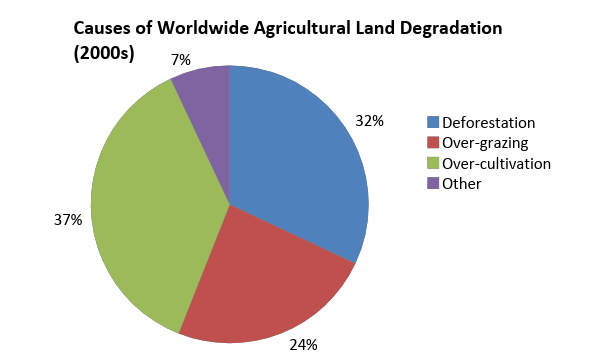
The pie chart shows the four main causes of farmland degradation in the world today, while the table presents the amount of land surface area affected by each one in three separate global regions during the 2000s.
Overall, Asia suffered more from the deterioration of farmland than other regions owing to deforestation and over-cultivation which were also the primary reasons for agricultural land loss worldwide.
Globally, 69% of degraded land is attributed to excessive cultivation and tree clearance, constituting 37% and 32% respectively. A further quarter of global land loss is due to over cultivation of crops. Other causes made up only 7% collectively.
In the 2000s, these causes affected regions of our planet differently. Asia was the worst affected where the top two causes of global land loss, deforestation and over-cultivation, resulted in 9.8% and 7.8% of degraded land there. The impact on Australia and Oceania was less severe though over-grazing was the predominant cause of land deterioration at eleven percent. The least affected of all was North America where only 5.4% of land was diminished, principally because of over-cultivation at 3.4%.
Mixed Charts
Learn how to answer this question in a step-by-step interactive exercise
Mixed Charts
Una prova di Task 1 dell'IELTS Academic con grafici misti ti presenta due o più rappresentazioni di tipo diverso sullo stesso argomento. Scrivi un report di almeno 150 parole che riporta le caratteristiche principali e collega le rappresentazioni, senza dare opinioni né motivi.
Guarda in anteprima la consegna, poi clicca su Avanti per continuare.
Leggi in anteprima la domanda
Summarise the information by selecting and reporting the main features, and make comparisons where relevant.
Write at least 150 words.
Inizia leggendo le rappresentazioni, non scrivendo. Controlla che cosa mostra ciascuna e leggi ogni etichetta degli assi e unità di misura prima di pianificare. Rappresentazioni di tipo diverso spesso misurano cose diverse, quindi annota che cosa hanno in comune, come lo stesso gruppo di persone o lo stesso periodo.
Rispondi alle domande sulle rappresentazioni.
Leggi il grafico
L'introduzione parafrasa la consegna con parole tue. Chiarisci che cosa mostra ogni rappresentazione e quale gruppo e periodo copre, e cambia le parole della consegna invece di copiarla. I dati e i collegamenti tra le rappresentazioni vengono dopo.
Scrivi una o due frasi che parafrasino la consegna.
Scrivi l'introduzione
Consegna
The pie graph depicts the main reasons for the productivity loss of agricultural land worldwide. The table shows how these causes influenced three world regions during the 2000s.
Summarise the information by selecting and reporting the main features, and make comparisons where relevant.
Write at least 150 words.
Un report del Task 1 ha bisogno di un paragrafo centrale per ogni gruppo di rappresentazioni, e un insieme di grafici misti dà da uno a tre gruppi. Le rappresentazioni dello stesso tipo o sullo stesso argomento vanno insieme, perché un paragrafo che mescola due misure è difficile da seguire. Due grafici a torta sulla stessa cosa condividono un paragrafo, mentre un grafico a linee su una misura diversa ne ha uno tutto suo.
Un paragrafo per ogni rappresentazione può dividere ciò che va insieme, e un unico paragrafo per tutte le rappresentazioni mescola le misure. Dividere per anni o per i valori più alti e più bassi spezza il confronto che la consegna richiede.
Scegli il raggruppamento che dà a ogni paragrafo una misura chiara.
Crea i gruppi
Scegli il raggruppamento che dà a ogni paragrafo una misura chiara.
- Group 1: the pie chart. Group 2: the table.
- One group: the pie chart and the table.
La panoramica indica lo schema più importante in tutte le rappresentazioni e viene prima di qualsiasi dettaglio. Trova l'andamento principale di ogni rappresentazione, poi decidi se una rappresentazione sostiene o spiega l'altra. I dati esatti restano fuori dalla panoramica.
Scegli le risposte che descrivono lo schema principale.
Trova la tendenza generale
Ora scrivi la panoramica con parole tue, usando gli appunti del passaggio precedente. Bastano una o due frasi. Indica lo schema principale e il collegamento tra le rappresentazioni, e lascia fuori i dati esatti e qualsiasi motivo dello schema.
Scrivi la tua panoramica in una o due frasi.
Scrivi la tua panoramica
Il primo paragrafo centrale descrive nel dettaglio il primo gruppo. Riporta i confronti significativi, come il punto più alto, il punto più basso e il cambiamento più evidente, e sostieni ciascuno con alcuni dati selezionati. Non elencare tutti i numeri e qui non descrivere gli altri gruppi.
Scrivi tre o quattro frasi per il paragrafo centrale 1.
Scrivi il paragrafo centrale 1
Il secondo paragrafo centrale descrive il secondo gruppo e lo collega al primo. Raggruppa i confronti che vanno insieme invece di trattare una categoria alla volta, e usa un'espressione di collegamento per mostrare dove le rappresentazioni concordano. Riporta ciò che mostrano i dati, non il perché.
Scrivi tre o quattro frasi per il paragrafo centrale 2.
Scrivi il paragrafo centrale 2
Ora le tue sezioni formano un unico report: introduzione, panoramica e un paragrafo centrale per ogni gruppo di rappresentazioni. Leggile in ordine e controlla che la panoramica dia il quadro generale e che i paragrafi centrali contengano i dettagli.
Leggi il piano del tuo report, poi confrontalo con il report modello.
Piano completo del report
Come decidere
Un compito con grafici misti ti dà due o più elementi visivi di tipo diverso sullo stesso argomento. Non scrivi un report separato per ogni elemento visivo. Riporti le caratteristiche principali di ciascuno e li colleghi dove i dati sono in relazione.
Lavora sempre nello stesso ordine, così il report presenta il quadro generale prima dei dettagli.
- Leggi il grafico. Controlla cosa mostra ogni elemento visivo e leggi ogni asse, etichetta e unità di misura prima di pianificare.
- Crea i gruppi. Dividi gli elementi visivi in un numero di gruppi da uno a tre, un paragrafo centrale per ciascuno, di solito con un tipo di grafico o un argomento per gruppo.
- Trova la tendenza generale. Stabilisci lo schema più importante in tutti gli elementi visivi e annota ogni collegamento tra di essi.
- Scrivi il report per fasi. Scrivi l'introduzione, poi la panoramica, poi un paragrafo centrale per ogni gruppo.
- Piano completo del report. Leggi insieme le sezioni e confrontale con il report modello.
Raggruppa i confronti significativi invece di elencare ogni numero. Pochi dati scelti che sostengono uno schema valgono di più di un lungo elenco che ripete soltanto ciò che l'elemento visivo mostra già.
Leggi
Elementi visivi di tipo diverso misurano cose diverse, quindi prima leggili uno alla volta. Controlla il titolo, le etichette degli assi, le unità di misura e il periodo, poi annota cosa hanno in comune, per esempio lo stesso gruppo di persone o lo stesso periodo. Una quota di tempo in un grafico a torta e un totale in un grafico a linee non sono la stessa misura.
Gruppi
Un report di IELTS Task 1 richiede un paragrafo centrale per ogni gruppo di elementi visivi, quindi gli elementi visivi devono dividersi in uno, due o tre gruppi. Gli elementi visivi dello stesso tipo o sullo stesso argomento vanno insieme, e un elemento visivo che misura qualcosa di diverso ha un paragrafo a sé. Decidi la divisione prima di scrivere, perché stabilisce l'ordine di tutto il report.
Panoramica
La panoramica indica in una o due frasi lo schema più importante in tutti gli elementi visivi. Trova l'andamento principale di ciascun elemento visivo, poi decidi se uno sostiene o spiega l'altro. I dati esatti e le singole categorie vanno nei paragrafi centrali.
Scrivi
Il report si costruisce in brevi fasi. L'introduzione parafrasa la consegna, la panoramica indica lo schema principale e un paragrafo centrale descrive ogni gruppo. Nei paragrafi centrali raggruppa i confronti che vanno insieme e sostieni ciascuno con pochi dati scelti invece di elencare ogni numero.
Per imparare ad affrontare il IELTS Academic Writing Task 1 Dati Misti, iscriviti a una prova gratuita di 7 giorni per accedere alla lezione IELTS Academic Writing Task - Mixed Data.
Prova gratuita di 7 giorniVocabolario per IELTS Academic Writing Task 1
Per ottenere un punteggio alto in questa prova, devi imparare a utilizzare parole e frasi appropriate per presentare i dati forniti in un grafico a torta/a barre/a linee/misto. Ti suggeriamo di iscriverti a una prova gratuita di 7 giorni e completare le seguenti lezioni:
- IELTS Academic Writing Task 1 Lezione - Come scrivere dei numeri
- IELTS Academic Writing Task 1 Lezione - Come scrivere delle percentuali
- IELTS Academic Writing Task 1 Lezione - Come scrivere dei cambiamenti nei dati
Esempi di IELTS Writing Task 1
Questa sezione presenta un elenco di esempi IELTS writing per IELTS Academic Writing Task 1.
- IELTS Academic Writing Task 1 - Line Chart Questions
- IELTS Academic Writing Task 1 - Bar Chart Questions
- IELTS Academic Writing Task 1 - Pie Chart Questions
- IELTS Academic Writing Task 1 - Map Questions
- IELTS Academic Writing Task 1 - Process Diagram Questions
- IELTS Academic Writing Task 1 - Mixed Data Questions
IELTS General Writing Task 1
Nel IELTS general training writing task 1, ti verrà presentata una situazione e dovrai scrivere una risposta personale sotto forma di lettera informale, semi-formale o formale di almeno 150 parole. Le situazioni su cui ti viene chiesto di scrivere sono comuni e quotidiane, come ad esempio:
- scrivere a un responsabile dell'alloggio del college su problemi con l'alloggio,
- scrivere a un nuovo datore di lavoro su problemi di gestione del tempo che stanno avendo,
- scrivere a un giornale locale su un piano per sviluppare un aeroporto locale,
- scrivere a un'agenzia di affitti per risolvere problemi con il sistema di riscaldamento nella loro casa.
Per quanto riguarda la situazione, ti verranno fornite informazioni sotto forma di tre punti elenco che devi includere nella tua risposta. Potrebbe esserti richiesto di chiedere o fornire informazioni e/o spiegare una situazione. Per fare questo, potresti dover fare alcune delle seguenti cose:
- chiedere e/o fornire informazioni fattuali generali,
- esprimere bisogni, desideri, gusti o avversioni,
- esprimere opinioni o lamentele,
- fare richieste o suggerimenti/raccomandazioni.
Stile IELTS General Writing
Lo stile di scrittura che userai dipende da chi ti viene chiesto di scrivere (cioè il pubblico) e quanto bene dovresti conoscerlo. Devi scrivere in uno stile appropriato per il tuo pubblico e che ti aiuti a raggiungere il tuo scopo di scrittura, ad es. scrivere a un amico (informale) o scrivere a un manager (semi-formale o formale). Non è necessario includere alcun indirizzo all'inizio delle tue lettere.
Come evitare di perdere punti nel IELTS General Writing Task 1
Come accennato, non dedicare più di 20 minuti a questa prova e assicurati di scrivere almeno 150 parole o sarai penalizzato. Anche se non sarai penalizzato per aver scritto più di 150 parole, dovresti ricordare che una risposta più lunga al task 1 può significare che hai meno tempo da dedicare al task 2, che contribuisce il doppio al punteggio di banda Writing.
Dovresti anche ricordare che sarai penalizzato per irrilevanza, se la risposta è fuori tema o non è scritta come testo completo e collegato (ad es. usando elenchi puntati in qualsiasi parte della risposta o forma di appunti, ecc.). Sarai severamente penalizzato per plagio (cioè copiare da un'altra fonte).
Last weekend, your cousin celebrated her 50th birthday, but you couldn't attend and you forgot to cancel.
Write a letter to your cousin. In your letter:
- Apologize for missing the birthday celebration
- Explain why you missed it and why you hadn't let her know
- Describe how you will make it up to her
You do NOT need to write any addresses.
Begin your letter as follows:
Dear ___,
- Write at least 150 words.
- You should spend around 20 minutes on this task.
Dear Marnie,
Happy belated birthday! I hope you're doing well and that you had a great 50th birthday party.
I'm so sorry that I wasn't at your party to celebrate with you. It's been such a long time since we've been able to catch up and see each other.
To be completely honest, I've been swamped with work lately, and I was asked to go on a last-minute business trip a few days before your birthday. I was so busy that I had completely forgotten about your party, and it didn't occur to me to call you and cancel.
My busy schedule is absolutely not an excuse for missing your 50th birthday, though, and I would love to make it up to you. I've reserved a table for two next Friday night at the new sushi restaurant in town. Can I please treat you to a luxurious birthday dinner?
I hope we can celebrate together next Friday!
Speak to you soon,
Jessica
Total Word Count: 162 words

Task Achievement — Letter
Learn how to answer this question in a step-by-step interactive exercise
Task Achievement — Letter
Nel Task 1 dell'IELTS General Training scrivi una lettera in risposta a una situazione. Il Task Achievement dipende dal coprire ogni punto elenco della consegna, perché una buona lettera che ne salta uno perde comunque punti.
Leggi la situazione, i punti elenco ed eventuali righe iniziali che la consegna ti dà.
Guarda in anteprima la consegna, poi clicca su Avanti per continuare.
Leggi in anteprima la domanda
Write a letter to your cousin. In your letter:
- Apologize for missing the birthday celebration
- Explain why you missed it and why you hadn't let her know
- Describe how you will make it up to her
Write at least 150 words. You do NOT need to write any addresses.
Begin your letter as follows:
Dear ___,
Prima di scrivere, pianifica la lettera rispondendo a tre domande. A chi scrivi, perché scrivi e che cosa deve contenere la lettera?
Il destinatario decide quanto deve essere formale la lingua, lo scopo decide come inizi e i punti elenco decidono il contenuto. Ogni risposta si trova già da qualche parte nella consegna.
Abbina ogni domanda di pianificazione alla parte della consegna che le risponde.
Comprendi la consegna
Abbina ogni domanda di pianificazione alla parte della consegna che le risponde.
Il saluto iniziale e quello finale dicono al lettore quanto è formale la lettera, quindi devono essere adatti alla persona a cui scrivi. Una lettera a uno sconosciuto o a un responsabile è formale, una lettera a un amico è informale.
Mantieni lo stesso livello all'inizio e alla fine della lettera. Un saluto iniziale formale seguito da una chiusura informale confonde il lettore.
Scegli un saluto iniziale e uno finale adatti al destinatario.
Scegli saluto iniziale e chiusura
Confirm the greeting
- Dear ___,
- Dear Sir or Madam,
- Dear Ms. Smith,
- Hey you,
Choose a closing
- Speak to you soon,
- Lots of love,
- Best wishes,
- Yours faithfully,
- Yours sincerely,
Dedica al primo punto elenco un paragrafo tutto suo. Il Task Achievement valuta se ogni punto elenco è coperto e sviluppato, non solo menzionato.
Ti vengono dati alcuni inizi di frase. Completa il pensiero con parole tue e mantieni lo stesso tono del saluto iniziale.
Scrivi un paragrafo che copra il primo punto elenco.
Scrivi il punto elenco 1
Apologise for missing the birthday celebration
Anche il secondo punto elenco ha bisogno di un paragrafo tutto suo. Dagli la stessa lunghezza e lo stesso livello di dettaglio del primo, perché un punto trattato solo a metà costa comunque punti.
Usa un inizio di frase per cominciare, poi aggiungi i dettagli di cui il destinatario avrebbe davvero bisogno in questa situazione.
Scrivi un paragrafo che copra il secondo punto elenco.
Scrivi il punto elenco 2
Explain why you missed it and did not let her know
Completa il corpo della lettera con il terzo punto elenco. Quando tutti e tre sono coperti con frasi complete, la consegna è svolta.
Mantieni un tono coerente fino alla fine e controlla che questo paragrafo risponda a ciò che il punto elenco chiedeva davvero.
Scrivi un paragrafo che copra il terzo punto elenco.
Scrivi il punto elenco 3
Describe how you will make it up to her
Ora i tuoi paragrafi compaiono insieme come un'unica lettera, con il saluto iniziale e quello finale al loro posto. Leggila come un unico testo e controlla che ogni punto elenco sia coperto.
Confronta le tue parole con la lettera di esempio e nota come il tono resta lo stesso dal saluto iniziale a quello finale.
Rivedi la tua lettera, poi clicca su Avanti per continuare.
Rivedi la tua lettera completa
Come decidere
Una lettera di Task 1 risponde a una situazione e copre una serie di punti elenco. Il Task Achievement dipende dal coprire ogni punto elenco e dall'adattare il tono al destinatario.
Lavora sempre nello stesso ordine, così non salti nessun punto elenco e il livello di formalità resta lo stesso dall'inizio alla fine.
- Comprendi la consegna. Capisci a chi scrivi, perché scrivi e cosa deve contenere la lettera.
- Scegli saluto iniziale e chiusura. Adatta l'apertura e la chiusura al destinatario e mantienile allo stesso livello di formalità.
- Scrivi i punti elenco. Dai a ogni punto elenco un paragrafo a sé e sviluppalo con dettagli concreti.
- Rivedi la tua lettera completa. Leggi insieme i paragrafi e controlla di aver coperto ogni punto elenco.
Scrivi un paragrafo per ogni punto elenco. Questo piano semplice rende quasi impossibile tralasciare un punto elenco, che è il modo più rapido per perdere punti nel Task Achievement.
Pianifica
Tre domande pianificano tutta la lettera. A chi scrivi, perché scrivi e che cosa deve contenere la lettera? Ogni risposta si trova già da qualche parte nella consegna.
Tono
Il saluto iniziale e quello finale mostrano al destinatario quanto è formale la lettera. Una lettera a uno sconosciuto o a un responsabile è formale, una lettera a un amico è informale, e l'inizio e la fine della lettera devono restare allo stesso livello.
Punti elenco
Ogni punto elenco ha un paragrafo a sé. Trattalo con frasi complete e con i dettagli di cui il destinatario avrebbe davvero bisogno, e dai ai paragrafi una lunghezza simile, così nessun punto sembra scritto di fretta.
Per ulteriori informazioni sul IELTS General Writing Task 1, dai un'occhiata a The Ultimate Guide for the IELTS General Writing Task 1
IELTS Writing Task 2
Nel IELTS writing task 2, dovrai scrivere un saggio in stile tradizionale in risposta a una domanda. Devi scrivere almeno 250 parole. Se non scrivi abbastanza parole, sarai penalizzato. Ci sono 6 diversi tipi di domande nel task 2. Diamo un'occhiata a domande di esempio e modelli di saggi per ogni tipo di saggio.
Cause ed effetti
In questo tipo di domanda, ti verrà fornito un problema o una situazione. Il tuo compito è descrivere le cause della situazione e alcuni degli effetti della situazione.
It is observed that in many countries not enough students are choosing to study science at university. What are the causes? And what will be the effects on society?
- Write at least 250 words.
- You should spend around 40 minutes on this task.
It is a fact that many students globally are avoiding science in favor of other subjects at university. Such a trend is largely due to how science is perceived, which may be having a detrimental effect on a nation’s development.
The primary reason for the drop in enrollment in science-based courses is that many undergraduates are put off by their difficulty. While many high school students enjoy science, they soon find themselves facing a lot of theory and research based courses once in college. For example according to a recent poll of UK universities, many students stated that while science was interesting in high school, there was too much theory learnt in classes, and not enough application in the lab to make it interesting. Furthermore, there are plenty of easier alternatives such as humanities for students to choose from these days. As a result, most choose a more appealing humanities degree over a science one.
Countries with the lowest science enrollment rates are affected the most competitively and economically. Fewer science graduates mean a shortage of skilled researchers in science-related fields like bio-engineering which reduces a countries competitiveness in attracting foreign investment. In other words foreign companies are usually unwilling to invest in nations with a low pool of skilled workers. In addition, a low number of skilled workers mean fewer technological developments for such countries, which may cause their economies to suffer from lost business in being the first to market with new products. For example, evidence shows that the number of patents filed by Chinese corporations is beginning to threaten the number credited to American ones.
In conclusion, there is a direct correlation between the perceived difficulty of science degrees and limited economic growth. Only by changing this attitude will countries reverse this trend.
Task Achievement — Task 2
Learn how to answer this question in a step-by-step interactive exercise
Task Achievement — Task 2
Nel Task 2 del Writing IELTS scrivi un saggio che risponde a ogni parte della domanda. Leggi con attenzione l'affermazione e la riga con le istruzioni, e nota che cosa ti chiede di discutere la domanda.
Un saggio che resta sull'argomento ma non risponde mai alla domanda posta non può raggiungere una band alta.
Guarda in anteprima la domanda, poi clicca su Avanti per continuare.
Leggi in anteprima la domanda
Scriviamo l'introduzione in due frasi, per un totale di circa 25-35 parole. Per prima cosa, riscrivi la domanda con parole tue. Parafrasa la domanda usando parole tue e sinonimi. Così il tuo saggio resta sull'argomento e puoi dimostrare un'ampia varietà di vocabolario. La seconda frase presenta gli argomenti specifici che tratterai nei paragrafi centrali.
Scrivi un'introduzione.
Scrivi l'introduzione
Ogni paragrafo centrale ha bisogno di una frase principale (topic sentence) che ne presenti il punto principale. Due paragrafi centrali bastano per un saggio di questa lunghezza.
Scrivi una frase chiara per ogni paragrafo. Mantieni ogni frase tra 12 e 20 parole e lascia le spiegazioni e gli esempi per i prossimi passaggi.
Scrivi una frase principale per ogni paragrafo centrale.
Scrivi due frasi principali
science courses are seen as too hard
fewer scientists hurt the economy
Una frase principale fa guadagnare punti solo quando è sostenuta. Sviluppa il primo paragrafo centrale con due punti. Per ogni punto, scrivi una spiegazione e un esempio specifico.
Ogni paragrafo centrale dovrebbe avere circa 4–5 frasi, cioè 60-80 parole. Una situazione concreta e precisa è più efficace di un'affermazione generale.
Scrivi il resto del primo paragrafo centrale.
Sviluppa il paragrafo centrale 1
60
Dai al secondo paragrafo centrale la stessa profondità del primo. Usa due punti e sostieni ciascuno con una spiegazione e un esempio.
Ogni paragrafo centrale dovrebbe avere circa 4–5 frasi, cioè 60-80 parole. Non ripetere il primo paragrafo con parole nuove.
Scrivi il resto del secondo paragrafo centrale.
Sviluppa il paragrafo centrale 2
60
La conclusione chiude il saggio. Scrivi un riassunto in due frasi dei punti principali, poi aggiungi una o due frasi sul perché l'argomento è importante.
Non copiare l'introduzione e non aggiungere un nuovo argomento. Mantieni tutta la conclusione tra 35 e 50 parole.
Scrivi una conclusione di 3–4 frasi.
Scrivi la conclusione
35
Ora l'introduzione, le frasi principali, i paragrafi centrali e la conclusione compaiono insieme come un unico saggio. Leggilo come un unico testo e controlla che risponda a ogni parte della domanda.
Confronta le tue parole con il saggio di esempio e nota come ogni paragrafo svolge un compito diverso.
Rivedi il tuo saggio, poi clicca su Avanti per continuare.
Rivedi il tuo saggio completo
Come decidere
Un tema di Task 2 risponde a ogni parte della domanda. Il Task Achievement dipende dal coprire ciò che chiede la domanda e dal sostenere ogni punto principale con una spiegazione e un esempio.
Lavora sempre nello stesso ordine: introduzione, due frasi principali, due paragrafi centrali sviluppati, poi una conclusione.
- Scrivi l'introduzione.
In generale, per questo paragrafo ti servono due frasi. Parafrasa la domanda con parole tue e con sinonimi. Così il tema resta in argomento e puoi dimostrare un'ampia varietà di vocabolario. La seconda frase presenta gli argomenti specifici di cui parlerai nei paragrafi centrali. Quindi la tua introduzione deve contenere:
- Domanda riformulata
- Presentazione degli argomenti specifici
- Scrivi due frasi principali. Scrivi una frase principale (topic sentence) per ogni paragrafo centrale.
- Sviluppa i paragrafi centrali. Sostieni ogni paragrafo centrale con due punti, e dai a ogni punto una spiegazione e un esempio. Ogni paragrafo centrale dovrebbe avere circa 4–5 frasi.
- Scrivi la conclusione. Riassumi i punti principali, poi di' perché l'argomento è importante.
- Rivedi il tuo saggio completo. Leggi insieme le parti e controlla di aver risposto a ogni parte della domanda.
Due paragrafi sviluppati prendono un punteggio migliore di quattro punti non sviluppati. Gli esaminatori premiano il sostegno alle idee, quindi aggiungi una spiegazione e un esempio a un punto che hai già invece di aggiungere un altro punto.
Introduzione
In generale, per questo paragrafo ti servono due frasi. Parafrasa la domanda con parole tue e con sinonimi. Così il tema resta in argomento e puoi dimostrare un'ampia varietà di vocabolario. La seconda frase presenta gli argomenti specifici di cui parlerai nei paragrafi centrali. Quindi la tua introduzione deve contenere:
- Domanda riformulata
- Presentazione degli argomenti specifici
Frasi principali
Scrivi una frase principale (topic sentence) per ogni paragrafo centrale. Ogni frase deve introdurre il punto principale di quel paragrafo in 12-20 parole e lasciare gli esempi alla fase successiva.
Supporto
Una frase principale prende punti quando è sostenuta. Spiega perché il punto è vero, fai un esempio specifico e dai a entrambi i paragrafi centrali lo stesso sostegno. Ogni paragrafo centrale dovrebbe avere circa 4–5 frasi.
Conclusione
La conclusione riassume i punti principali in due frasi, poi aggiunge una o due frasi sul perché l'argomento è importante. Non copiare l'introduzione e non aggiungere un nuovo argomento a sostegno.
Discuti entrambe le opinioni e dai la tua opinione
In questo tipo di domanda, ti verranno fornite due opinioni opposte relative a una questione. Di solito, le due opinioni saranno in frasi separate collegate da una parola di transizione come "tuttavia" per indicare che le due opinioni sono in contrasto. Il tuo compito è scrivere un saggio discorsivo, contrapponendo entrambi i lati della questione e presentando il tuo punto di vista.
Some people argue that the public should be allowed to have guns. Others do not agree. Discuss both points of view and give your opinion.
- Write at least 250 words.
- You should spend around 40 minutes on this task.
Gun ownership is a controversial topic with some people arguing that the public should have the choice to own them, while others disagree wholeheartedly with the idea. In my opinion, I believe that the public should only be entitled to own guns after having proper training.
The benefits of gun ownership are touted in some countries more than others. In countries where owning one is a civic right, like the United States, it is legal to use one in self-defense is legal. With muggings, murder and burglary rising in many countries, there may be some truth to the claim that owing a gun gives the owner increased security. Furthermore, in remote or dangerous areas, guns may be a necessity rather than an option. Without police nearby, properly stored, guns may be a great asset in deterring criminals from breaking and entering a remote property.
However, rather than deter violence, guns tend to escalate it in areas where they are widely available. Research shows that violent crime increases dramatically when guns are prevalent in society. When the public is armed, criminals and the police become so too, creating a situation in which guns beget more guns and eventually death. Additionally, greater ease of access is dangerous for children. Having a gun easily accessible may tempt children to abuse them as evidenced by the almost weekly school shootings in the US. There is further a proven link between increased suicide rates when guns are present.
It is my belief that the general public should be barred from owning guns of any kind. Also, guns should be restricted to specialists with a proven need for a firearm such as soldiers or hunters. While there are certain circumstances where owning a gun is an advantage, in the vast majority of situations there is no place for a gun in modern society.
Task Achievement — Task 2
Learn how to answer this question in a step-by-step interactive exercise
Task Achievement — Task 2
Nel Task 2 del Writing IELTS scrivi un saggio che risponde a ogni parte della domanda. Leggi con attenzione l'affermazione e la riga con le istruzioni, e nota che cosa ti chiede di discutere la domanda.
Un saggio che resta sull'argomento ma non risponde mai alla domanda posta non può raggiungere una band alta.
Guarda in anteprima la domanda, poi clicca su Avanti per continuare.
Leggi in anteprima la domanda
Scriviamo l'introduzione in due frasi, per un totale di circa 25-35 parole. Per prima cosa, riscrivi la domanda con parole tue. Parafrasa la domanda usando parole tue e sinonimi. Così il tuo saggio resta sull'argomento e puoi dimostrare un'ampia varietà di vocabolario. La seconda frase presenta gli argomenti specifici che tratterai nei paragrafi centrali.
Scrivi un'introduzione.
Scrivi l'introduzione
Ogni paragrafo centrale ha bisogno di una frase principale (topic sentence) che ne presenti il punto principale. Due paragrafi centrali bastano per un saggio di questa lunghezza.
Scrivi una frase chiara per ogni paragrafo. Mantieni ogni frase tra 12 e 20 parole e lascia le spiegazioni e gli esempi per i prossimi passaggi.
Scrivi una frase principale per ogni paragrafo centrale.
Scrivi due frasi principali
guns help people defend themselves
more guns lead to more violence
Una frase principale fa guadagnare punti solo quando è sostenuta. Sviluppa il primo paragrafo centrale con due punti. Per ogni punto, scrivi una spiegazione e un esempio specifico.
Ogni paragrafo centrale dovrebbe avere circa 4–5 frasi, cioè 60-80 parole. Una situazione concreta e precisa è più efficace di un'affermazione generale.
Scrivi il resto del primo paragrafo centrale.
Sviluppa il paragrafo centrale 1
60
Dai al secondo paragrafo centrale la stessa profondità del primo. Usa due punti e sostieni ciascuno con una spiegazione e un esempio.
Ogni paragrafo centrale dovrebbe avere circa 4–5 frasi, cioè 60-80 parole. Non ripetere il primo paragrafo con parole nuove.
Scrivi il resto del secondo paragrafo centrale.
Sviluppa il paragrafo centrale 2
60
La conclusione chiude il saggio. Scrivi un riassunto in due frasi dei punti principali, poi aggiungi una o due frasi sul perché l'argomento è importante.
Non copiare l'introduzione e non aggiungere un nuovo argomento. Mantieni tutta la conclusione tra 35 e 50 parole.
Scrivi una conclusione di 3–4 frasi.
Scrivi la conclusione
35
Ora l'introduzione, le frasi principali, i paragrafi centrali e la conclusione compaiono insieme come un unico saggio. Leggilo come un unico testo e controlla che risponda a ogni parte della domanda.
Confronta le tue parole con il saggio di esempio e nota come ogni paragrafo svolge un compito diverso.
Rivedi il tuo saggio, poi clicca su Avanti per continuare.
Rivedi il tuo saggio completo
Come decidere
Un tema di Task 2 risponde a ogni parte della domanda. Il Task Achievement dipende dal coprire ciò che chiede la domanda e dal sostenere ogni punto principale con una spiegazione e un esempio.
Lavora sempre nello stesso ordine: introduzione, due frasi principali, due paragrafi centrali sviluppati, poi una conclusione.
- Scrivi l'introduzione.
In generale, per questo paragrafo ti servono due frasi. Parafrasa la domanda con parole tue e con sinonimi. Così il tema resta in argomento e puoi dimostrare un'ampia varietà di vocabolario. La seconda frase presenta gli argomenti specifici di cui parlerai nei paragrafi centrali. Quindi la tua introduzione deve contenere:
- Domanda riformulata
- Presentazione degli argomenti specifici
- Scrivi due frasi principali. Scrivi una frase principale (topic sentence) per ogni paragrafo centrale.
- Sviluppa i paragrafi centrali. Sostieni ogni paragrafo centrale con due punti, e dai a ogni punto una spiegazione e un esempio. Ogni paragrafo centrale dovrebbe avere circa 4–5 frasi.
- Scrivi la conclusione. Riassumi i punti principali, poi di' perché l'argomento è importante.
- Rivedi il tuo saggio completo. Leggi insieme le parti e controlla di aver risposto a ogni parte della domanda.
Due paragrafi sviluppati prendono un punteggio migliore di quattro punti non sviluppati. Gli esaminatori premiano il sostegno alle idee, quindi aggiungi una spiegazione e un esempio a un punto che hai già invece di aggiungere un altro punto.
Introduzione
In generale, per questo paragrafo ti servono due frasi. Parafrasa la domanda con parole tue e con sinonimi. Così il tema resta in argomento e puoi dimostrare un'ampia varietà di vocabolario. La seconda frase presenta gli argomenti specifici di cui parlerai nei paragrafi centrali. Quindi la tua introduzione deve contenere:
- Domanda riformulata
- Presentazione degli argomenti specifici
Frasi principali
Scrivi una frase principale (topic sentence) per ogni paragrafo centrale. Ogni frase deve introdurre il punto principale di quel paragrafo in 12-20 parole e lasciare gli esempi alla fase successiva.
Supporto
Una frase principale prende punti quando è sostenuta. Spiega perché il punto è vero, fai un esempio specifico e dai a entrambi i paragrafi centrali lo stesso sostegno. Ogni paragrafo centrale dovrebbe avere circa 4–5 frasi.
Conclusione
La conclusione riassume i punti principali in due frasi, poi aggiunge una o due frasi sul perché l'argomento è importante. Non copiare l'introduzione e non aggiungere un nuovo argomento a sostegno.
Vantaggi e svantaggi
In questo tipo di domanda, ti verrà chiesto di discutere gli aspetti positivi e negativi di una situazione, soluzione o tendenza. Potrebbe esserti chiesto anche di dare la tua opinione su quale lato pensi sia più importante.
In some countries, governments are encouraging industries and businesses to move to regional areas outside the big cities. Do the advantages of this trend outweigh the disadvantages?
- Write at least 250 words.
- You should spend around 40 minutes on this task.
There is a movement among some countries to promote regional areas away from cities as attractive to business and industry. In my opinion, I consider relocation of business to bring about more drawbacks than benefits over the long term.
There are several attractive benefits to businesses moving to regional areas. For businesses rural locations mean lower land prices. Cheaper land allows large or small business equal prospects to become established cheaply with additional room to expand. As an example, the average size of a business in UK cities is currently 25 square meters while those in the rural locales average around 50m2. Additionally, countries benefits principally from the direct investment in underperforming parts of the country. Having companies operating in less urbanized areas, creates jobs, attracts talent and increases immigration which brings greater wealth.
On the other hand, relocation is not without its drawbacks. For one thing, locations away from population centers may mean a greater distance to market for goods. As a result, cost savings from cheaper land may be mitigated by the increased transportation costs of shipping products to customers. For another thing, there are often fewer skilled workers in regional areas. It may not be easy to attract employees to work in out-of-the-way places, which would mean longer commutes for staff from nearby cities at the expense of the company coffers. Lastly, increased business in country areas, disturbs the life of local residents. Country roads are not built for heavy trucks or traffic which may cause increased noise, congestions and inconvenience to those living nearby.
To sum up, while regional settings may be well suited to certain internet-based businesses, for more traditional companies, the distance from the city presents many challenges to overcome.
Task Achievement — Task 2
Learn how to answer this question in a step-by-step interactive exercise
Task Achievement — Task 2
Nel Task 2 del Writing IELTS scrivi un saggio che risponde a ogni parte della domanda. Leggi con attenzione l'affermazione e la riga con le istruzioni, e nota che cosa ti chiede di discutere la domanda.
Un saggio che resta sull'argomento ma non risponde mai alla domanda posta non può raggiungere una band alta.
Guarda in anteprima la domanda, poi clicca su Avanti per continuare.
Leggi in anteprima la domanda
Scriviamo l'introduzione in due frasi, per un totale di circa 25-35 parole. Per prima cosa, riscrivi la domanda con parole tue. Parafrasa la domanda usando parole tue e sinonimi. Così il tuo saggio resta sull'argomento e puoi dimostrare un'ampia varietà di vocabolario. La seconda frase presenta gli argomenti specifici che tratterai nei paragrafi centrali.
Scrivi un'introduzione.
Scrivi l'introduzione
Ogni paragrafo centrale ha bisogno di una frase principale (topic sentence) che ne presenti il punto principale. Due paragrafi centrali bastano per un saggio di questa lunghezza.
Scrivi una frase chiara per ogni paragrafo. Mantieni ogni frase tra 12 e 20 parole e lascia le spiegazioni e gli esempi per i prossimi passaggi.
Scrivi una frase principale per ogni paragrafo centrale.
Scrivi due frasi principali
cheaper land and new jobs in the regions
higher transport costs and fewer skilled workers
Una frase principale fa guadagnare punti solo quando è sostenuta. Sviluppa il primo paragrafo centrale con due punti. Per ogni punto, scrivi una spiegazione e un esempio specifico.
Ogni paragrafo centrale dovrebbe avere circa 4–5 frasi, cioè 60-80 parole. Una situazione concreta e precisa è più efficace di un'affermazione generale.
Scrivi il resto del primo paragrafo centrale.
Sviluppa il paragrafo centrale 1
60
Dai al secondo paragrafo centrale la stessa profondità del primo. Usa due punti e sostieni ciascuno con una spiegazione e un esempio.
Ogni paragrafo centrale dovrebbe avere circa 4–5 frasi, cioè 60-80 parole. Non ripetere il primo paragrafo con parole nuove.
Scrivi il resto del secondo paragrafo centrale.
Sviluppa il paragrafo centrale 2
60
La conclusione chiude il saggio. Scrivi un riassunto in due frasi dei punti principali, poi aggiungi una o due frasi sul perché l'argomento è importante.
Non copiare l'introduzione e non aggiungere un nuovo argomento. Mantieni tutta la conclusione tra 35 e 50 parole.
Scrivi una conclusione di 3–4 frasi.
Scrivi la conclusione
35
Ora l'introduzione, le frasi principali, i paragrafi centrali e la conclusione compaiono insieme come un unico saggio. Leggilo come un unico testo e controlla che risponda a ogni parte della domanda.
Confronta le tue parole con il saggio di esempio e nota come ogni paragrafo svolge un compito diverso.
Rivedi il tuo saggio, poi clicca su Avanti per continuare.
Rivedi il tuo saggio completo
Come decidere
Un tema di Task 2 risponde a ogni parte della domanda. Il Task Achievement dipende dal coprire ciò che chiede la domanda e dal sostenere ogni punto principale con una spiegazione e un esempio.
Lavora sempre nello stesso ordine: introduzione, due frasi principali, due paragrafi centrali sviluppati, poi una conclusione.
- Scrivi l'introduzione.
In generale, per questo paragrafo ti servono due frasi. Parafrasa la domanda con parole tue e con sinonimi. Così il tema resta in argomento e puoi dimostrare un'ampia varietà di vocabolario. La seconda frase presenta gli argomenti specifici di cui parlerai nei paragrafi centrali. Quindi la tua introduzione deve contenere:
- Domanda riformulata
- Presentazione degli argomenti specifici
- Scrivi due frasi principali. Scrivi una frase principale (topic sentence) per ogni paragrafo centrale.
- Sviluppa i paragrafi centrali. Sostieni ogni paragrafo centrale con due punti, e dai a ogni punto una spiegazione e un esempio. Ogni paragrafo centrale dovrebbe avere circa 4–5 frasi.
- Scrivi la conclusione. Riassumi i punti principali, poi di' perché l'argomento è importante.
- Rivedi il tuo saggio completo. Leggi insieme le parti e controlla di aver risposto a ogni parte della domanda.
Due paragrafi sviluppati prendono un punteggio migliore di quattro punti non sviluppati. Gli esaminatori premiano il sostegno alle idee, quindi aggiungi una spiegazione e un esempio a un punto che hai già invece di aggiungere un altro punto.
Introduzione
In generale, per questo paragrafo ti servono due frasi. Parafrasa la domanda con parole tue e con sinonimi. Così il tema resta in argomento e puoi dimostrare un'ampia varietà di vocabolario. La seconda frase presenta gli argomenti specifici di cui parlerai nei paragrafi centrali. Quindi la tua introduzione deve contenere:
- Domanda riformulata
- Presentazione degli argomenti specifici
Frasi principali
Scrivi una frase principale (topic sentence) per ogni paragrafo centrale. Ogni frase deve introdurre il punto principale di quel paragrafo in 12-20 parole e lasciare gli esempi alla fase successiva.
Supporto
Una frase principale prende punti quando è sostenuta. Spiega perché il punto è vero, fai un esempio specifico e dai a entrambi i paragrafi centrali lo stesso sostegno. Ogni paragrafo centrale dovrebbe avere circa 4–5 frasi.
Conclusione
La conclusione riassume i punti principali in due frasi, poi aggiunge una o due frasi sul perché l'argomento è importante. Non copiare l'introduzione e non aggiungere un nuovo argomento a sostegno.
Problemi e soluzioni
In questo tipo di domanda, ti verrà fornito un problema o una situazione. Il tuo compito è descrivere le cause della situazione e alcune soluzioni al problema. La domanda potrebbe chiedere soluzioni generali (ad es. Come potrebbe essere risolto questo problema) o chiedere come gruppi specifici possono risolvere il problema (ad es. Quali misure possono prendere i governi e gli individui per affrontare il problema?). Non è necessario menzionare gli effetti in dettaglio, solo brevemente.
More and more wild animals are on the verge of extinction and others are on the endangered list. What are the reasons for this? What can be done to solve this problem?
- Write at least 250 words.
- You should spend around 40 minutes on this task.
The number of critically endangered animals is growing significantly, while a disturbing number of other species have become threatened. This worrying trend stems from several causes, though solutions exist where the will to implement them is present.
Regarding species on the critically endangered list, outmoded beliefs in Eastern medicine that endangered animal parts have medicinal qualities is driving demand for them, particularly in China. Animals are needlessly killed to cure ailments from infertility to arthritis, and China’s increasing affluence mean demand is expected to increase even further. Despite this, limited action by governments has proven ineffective at stopping such a trade. Many species threatened with extinction live in national parks, typically in developing countries. However, chronic underfunding means officials there are powerless to catch poachers, and corruption means the ones who are caught, often get away.
Where political will is available, several solutions may help. To begin with, developed countries could help fund budgets to protect endangered species in poorer countries. While this doesn’t solve the issue of corruption, it would increase deterrence and hopefully reduce the number of animals needlessly killed. More meaningfully, in countries where animal parts are bought and sold, laws should be more strictly enforced and punishments massively increased to discourage both sellers and buyers alike. A concerted education campaign should also be effected to stamp out the perception that animal parts have any curative properties to reduce the market for such ‘goods’ once and for all.
In conclusion, removing the market for animal parts, and better protecting the endangered animals that remain may help preserve the world’s natural heritage before it is too late.
Further reasons to consider:
Development destroying their habitat and food sourceGrowing cities and farmland encroach on habitatMany animals cannot find the place to raise their youngFurther solutions to consider:
Increase government budgets to protect animalsFor example, the panda is now rebounding in Southern China due to concerted government efforts to protect it.Task Achievement — Task 2
Learn how to answer this question in a step-by-step interactive exercise
Task Achievement — Task 2
Nel Task 2 del Writing IELTS scrivi un saggio che risponde a ogni parte della domanda. Leggi con attenzione l'affermazione e la riga con le istruzioni, e nota che cosa ti chiede di discutere la domanda.
Un saggio che resta sull'argomento ma non risponde mai alla domanda posta non può raggiungere una band alta.
Guarda in anteprima la domanda, poi clicca su Avanti per continuare.
Leggi in anteprima la domanda
Scriviamo l'introduzione in due frasi, per un totale di circa 25-35 parole. Per prima cosa, riscrivi la domanda con parole tue. Parafrasa la domanda usando parole tue e sinonimi. Così il tuo saggio resta sull'argomento e puoi dimostrare un'ampia varietà di vocabolario. La seconda frase presenta gli argomenti specifici che tratterai nei paragrafi centrali.
Scrivi un'introduzione.
Scrivi l'introduzione
Ogni paragrafo centrale ha bisogno di una frase principale (topic sentence) che ne presenti il punto principale. Due paragrafi centrali bastano per un saggio di questa lunghezza.
Scrivi una frase chiara per ogni paragrafo. Mantieni ogni frase tra 12 e 20 parole e lascia le spiegazioni e gli esempi per i prossimi passaggi.
Scrivi una frase principale per ogni paragrafo centrale.
Scrivi due frasi principali
animals are killed for traditional medicine
more funding, stricter laws and education
Una frase principale fa guadagnare punti solo quando è sostenuta. Sviluppa il primo paragrafo centrale con due punti. Per ogni punto, scrivi una spiegazione e un esempio specifico.
Ogni paragrafo centrale dovrebbe avere circa 4–5 frasi, cioè 60-80 parole. Una situazione concreta e precisa è più efficace di un'affermazione generale.
Scrivi il resto del primo paragrafo centrale.
Sviluppa il paragrafo centrale 1
60
Dai al secondo paragrafo centrale la stessa profondità del primo. Usa due punti e sostieni ciascuno con una spiegazione e un esempio.
Ogni paragrafo centrale dovrebbe avere circa 4–5 frasi, cioè 60-80 parole. Non ripetere il primo paragrafo con parole nuove.
Scrivi il resto del secondo paragrafo centrale.
Sviluppa il paragrafo centrale 2
60
La conclusione chiude il saggio. Scrivi un riassunto in due frasi dei punti principali, poi aggiungi una o due frasi sul perché l'argomento è importante.
Non copiare l'introduzione e non aggiungere un nuovo argomento. Mantieni tutta la conclusione tra 35 e 50 parole.
Scrivi una conclusione di 3–4 frasi.
Scrivi la conclusione
35
Ora l'introduzione, le frasi principali, i paragrafi centrali e la conclusione compaiono insieme come un unico saggio. Leggilo come un unico testo e controlla che risponda a ogni parte della domanda.
Confronta le tue parole con il saggio di esempio e nota come ogni paragrafo svolge un compito diverso.
Rivedi il tuo saggio, poi clicca su Avanti per continuare.
Rivedi il tuo saggio completo
Come decidere
Un tema di Task 2 risponde a ogni parte della domanda. Il Task Achievement dipende dal coprire ciò che chiede la domanda e dal sostenere ogni punto principale con una spiegazione e un esempio.
Lavora sempre nello stesso ordine: introduzione, due frasi principali, due paragrafi centrali sviluppati, poi una conclusione.
- Scrivi l'introduzione.
In generale, per questo paragrafo ti servono due frasi. Parafrasa la domanda con parole tue e con sinonimi. Così il tema resta in argomento e puoi dimostrare un'ampia varietà di vocabolario. La seconda frase presenta gli argomenti specifici di cui parlerai nei paragrafi centrali. Quindi la tua introduzione deve contenere:
- Domanda riformulata
- Presentazione degli argomenti specifici
- Scrivi due frasi principali. Scrivi una frase principale (topic sentence) per ogni paragrafo centrale.
- Sviluppa i paragrafi centrali. Sostieni ogni paragrafo centrale con due punti, e dai a ogni punto una spiegazione e un esempio. Ogni paragrafo centrale dovrebbe avere circa 4–5 frasi.
- Scrivi la conclusione. Riassumi i punti principali, poi di' perché l'argomento è importante.
- Rivedi il tuo saggio completo. Leggi insieme le parti e controlla di aver risposto a ogni parte della domanda.
Due paragrafi sviluppati prendono un punteggio migliore di quattro punti non sviluppati. Gli esaminatori premiano il sostegno alle idee, quindi aggiungi una spiegazione e un esempio a un punto che hai già invece di aggiungere un altro punto.
Introduzione
In generale, per questo paragrafo ti servono due frasi. Parafrasa la domanda con parole tue e con sinonimi. Così il tema resta in argomento e puoi dimostrare un'ampia varietà di vocabolario. La seconda frase presenta gli argomenti specifici di cui parlerai nei paragrafi centrali. Quindi la tua introduzione deve contenere:
- Domanda riformulata
- Presentazione degli argomenti specifici
Frasi principali
Scrivi una frase principale (topic sentence) per ogni paragrafo centrale. Ogni frase deve introdurre il punto principale di quel paragrafo in 12-20 parole e lasciare gli esempi alla fase successiva.
Supporto
Una frase principale prende punti quando è sostenuta. Spiega perché il punto è vero, fai un esempio specifico e dai a entrambi i paragrafi centrali lo stesso sostegno. Ogni paragrafo centrale dovrebbe avere circa 4–5 frasi.
Conclusione
La conclusione riassume i punti principali in due frasi, poi aggiunge una o due frasi sul perché l'argomento è importante. Non copiare l'introduzione e non aggiungere un nuovo argomento a sostegno.
Domanda in due parti
In questo tipo di domanda, ti verranno date due domande e dovrai rispondere a entrambe. Le due domande saranno diverse. Ad esempio, potresti dover valutare l'importanza di un'idea o di un'azione (ad es. Quanto è importante?) e dire se sei d'accordo o in disaccordo (ad es. Sei d'accordo o in disaccordo?).
News editors decide what to broadcast on television and what to print in newspapers. What factors do you think influence these decisions? Do you think that there is too much emphasis on bad news these days?
- Write at least 250 words.
- You should spend around 40 minutes on this task.
In the news business, editors have the final say in what makes it to air, or what makes it to print in newspapers. There are a variety of factors that affect their decision making; however, in my opinion, the public is inundated with negative news content, and more positive news would be beneficial to all.
Regarding news stories worth focusing on, editors must weigh up a number of aspects. For one thing, timing is a major factor in choosing stories to inform the public, especially ones that affect many people. Stories that happen right away are classified as newsworthy, however, if the same story happens again, it’s no longer interesting. For another, proximity to a story is important. Stories that happen closer to home become more newsworthy than those far away, so domestic news stories become more noteworthy than international ones. Finally, human interest stories always garner attention since they don’t date quickly, and often offer an emotion connection with the audience.
However, to my mind most news shared with the public is of a negative slant. Through TV, print and online media, society is inundated with stories of crime, disasters, and war to the point that the good news becomes exceptional. As a result, people have become accustomed to this trend and become more anxious about the state of the world. For this reason, I believe having a greater proportion of positive news in the media would benefit everyone. Stories of human interest, scientific discovery or human achievement help everyone understand the world around them, and make better decisions. That way, society can better understand the world rather than simply view it as a dangerous place.
In conclusion, although news editors face a lot of challenges in choosing newsworthy stories, I believe a more optimistic approach would add further value to the news profession.
Task Achievement — Task 2
Learn how to answer this question in a step-by-step interactive exercise
Task Achievement — Task 2
Nel Task 2 del Writing IELTS scrivi un saggio che risponde a ogni parte della domanda. Leggi con attenzione l'affermazione e la riga con le istruzioni, e nota che cosa ti chiede di discutere la domanda.
Un saggio che resta sull'argomento ma non risponde mai alla domanda posta non può raggiungere una band alta.
Guarda in anteprima la domanda, poi clicca su Avanti per continuare.
Leggi in anteprima la domanda
Scriviamo l'introduzione in due frasi, per un totale di circa 25-35 parole. Per prima cosa, riscrivi la domanda con parole tue. Parafrasa la domanda usando parole tue e sinonimi. Così il tuo saggio resta sull'argomento e puoi dimostrare un'ampia varietà di vocabolario. La seconda frase presenta gli argomenti specifici che tratterai nei paragrafi centrali.
Scrivi un'introduzione.
Scrivi l'introduzione
Ogni paragrafo centrale ha bisogno di una frase principale (topic sentence) che ne presenti il punto principale. Due paragrafi centrali bastano per un saggio di questa lunghezza.
Scrivi una frase chiara per ogni paragrafo. Mantieni ogni frase tra 12 e 20 parole e lascia le spiegazioni e gli esempi per i prossimi passaggi.
Scrivi una frase principale per ogni paragrafo centrale.
Scrivi due frasi principali
timing, distance and human interest
too much bad news makes people anxious
Una frase principale fa guadagnare punti solo quando è sostenuta. Sviluppa il primo paragrafo centrale con due punti. Per ogni punto, scrivi una spiegazione e un esempio specifico.
Ogni paragrafo centrale dovrebbe avere circa 4–5 frasi, cioè 60-80 parole. Una situazione concreta e precisa è più efficace di un'affermazione generale.
Scrivi il resto del primo paragrafo centrale.
Sviluppa il paragrafo centrale 1
60
Dai al secondo paragrafo centrale la stessa profondità del primo. Usa due punti e sostieni ciascuno con una spiegazione e un esempio.
Ogni paragrafo centrale dovrebbe avere circa 4–5 frasi, cioè 60-80 parole. Non ripetere il primo paragrafo con parole nuove.
Scrivi il resto del secondo paragrafo centrale.
Sviluppa il paragrafo centrale 2
60
La conclusione chiude il saggio. Scrivi un riassunto in due frasi dei punti principali, poi aggiungi una o due frasi sul perché l'argomento è importante.
Non copiare l'introduzione e non aggiungere un nuovo argomento. Mantieni tutta la conclusione tra 35 e 50 parole.
Scrivi una conclusione di 3–4 frasi.
Scrivi la conclusione
35
Ora l'introduzione, le frasi principali, i paragrafi centrali e la conclusione compaiono insieme come un unico saggio. Leggilo come un unico testo e controlla che risponda a ogni parte della domanda.
Confronta le tue parole con il saggio di esempio e nota come ogni paragrafo svolge un compito diverso.
Rivedi il tuo saggio, poi clicca su Avanti per continuare.
Rivedi il tuo saggio completo
Come decidere
Un tema di Task 2 risponde a ogni parte della domanda. Il Task Achievement dipende dal coprire ciò che chiede la domanda e dal sostenere ogni punto principale con una spiegazione e un esempio.
Lavora sempre nello stesso ordine: introduzione, due frasi principali, due paragrafi centrali sviluppati, poi una conclusione.
- Scrivi l'introduzione.
In generale, per questo paragrafo ti servono due frasi. Parafrasa la domanda con parole tue e con sinonimi. Così il tema resta in argomento e puoi dimostrare un'ampia varietà di vocabolario. La seconda frase presenta gli argomenti specifici di cui parlerai nei paragrafi centrali. Quindi la tua introduzione deve contenere:
- Domanda riformulata
- Presentazione degli argomenti specifici
- Scrivi due frasi principali. Scrivi una frase principale (topic sentence) per ogni paragrafo centrale.
- Sviluppa i paragrafi centrali. Sostieni ogni paragrafo centrale con due punti, e dai a ogni punto una spiegazione e un esempio. Ogni paragrafo centrale dovrebbe avere circa 4–5 frasi.
- Scrivi la conclusione. Riassumi i punti principali, poi di' perché l'argomento è importante.
- Rivedi il tuo saggio completo. Leggi insieme le parti e controlla di aver risposto a ogni parte della domanda.
Due paragrafi sviluppati prendono un punteggio migliore di quattro punti non sviluppati. Gli esaminatori premiano il sostegno alle idee, quindi aggiungi una spiegazione e un esempio a un punto che hai già invece di aggiungere un altro punto.
Introduzione
In generale, per questo paragrafo ti servono due frasi. Parafrasa la domanda con parole tue e con sinonimi. Così il tema resta in argomento e puoi dimostrare un'ampia varietà di vocabolario. La seconda frase presenta gli argomenti specifici di cui parlerai nei paragrafi centrali. Quindi la tua introduzione deve contenere:
- Domanda riformulata
- Presentazione degli argomenti specifici
Frasi principali
Scrivi una frase principale (topic sentence) per ogni paragrafo centrale. Ogni frase deve introdurre il punto principale di quel paragrafo in 12-20 parole e lasciare gli esempi alla fase successiva.
Supporto
Una frase principale prende punti quando è sostenuta. Spiega perché il punto è vero, fai un esempio specifico e dai a entrambi i paragrafi centrali lo stesso sostegno. Ogni paragrafo centrale dovrebbe avere circa 4–5 frasi.
Conclusione
La conclusione riassume i punti principali in due frasi, poi aggiunge una o due frasi sul perché l'argomento è importante. Non copiare l'introduzione e non aggiungere un nuovo argomento a sostegno.
Opinione
In questo tipo di domanda, ti verrà data una domanda che contiene un'opinione. Il tuo compito è scrivere un saggio in risposta all'opinione. Questo tipo di domanda spesso chiede se sei d'accordo o in disaccordo con un'opinione.
Some people are concerned that children spend too much time on computers – playing games, chatting and watching videos. But all this time is actually good preparation for children, who will have to spend many hours working on computers throughout their education and their working lives.To what extent do you agree or disagree with this statement?
- Write at least 250 words.
- You should spend around 40 minutes on this task.
With all the time that children spend engaged in various activities on computers, some people believe this is good preparation for a future in which many will work on computers full time through school and at work. I completely oppose this belief for several reasons.
To begin with, time on computers learning computer skills cannot be equated with that spent playing games or chatting online. While there may be some truth that videos games increase problem solving and analytical skills, there is no evidence to suggest that they improve other workplace skills. The skills children really need in a future work place are coding, designing, and software skills to name a few. The only way to ensure they learn these is for adults to be on hand to teach and supervise such learning.
Furthermore, spending too much time online may further have negative consequences to a child’s mental health. Unsupervised time on computers can result in children encountering inappropriate content online. Children have an extremely short attention span so are easily distracted by what they see or encounter online. There’s also the very real risk that children become addicted to the video games they play. Video game addiction is a proven disorder and affects many children in the US today. The quick-reward based system of such games is attractive and negatively affects how children learn and are motivated.
In conclusion, unless a child wishes to be a video game designer, increased computer time not only has little value to them beyond entertainment, it may even negatively affect a child’s development in the long term. Children should be supervised by adults when using computers to ensure they learn what they’re supposed to.
Task Achievement — Task 2
Learn how to answer this question in a step-by-step interactive exercise
Task Achievement — Task 2
Nel Task 2 del Writing IELTS scrivi un saggio che risponde a ogni parte della domanda. Leggi con attenzione l'affermazione e la riga con le istruzioni, e nota che cosa ti chiede di discutere la domanda.
Un saggio che resta sull'argomento ma non risponde mai alla domanda posta non può raggiungere una band alta.
Guarda in anteprima la domanda, poi clicca su Avanti per continuare.
Leggi in anteprima la domanda
Scriviamo l'introduzione in due frasi, per un totale di circa 25-35 parole. Per prima cosa, riscrivi la domanda con parole tue. Parafrasa la domanda usando parole tue e sinonimi. Così il tuo saggio resta sull'argomento e puoi dimostrare un'ampia varietà di vocabolario. La seconda frase presenta gli argomenti specifici che tratterai nei paragrafi centrali.
Scrivi un'introduzione.
Scrivi l'introduzione
Ogni paragrafo centrale ha bisogno di una frase principale (topic sentence) che ne presenti il punto principale. Due paragrafi centrali bastano per un saggio di questa lunghezza.
Scrivi una frase chiara per ogni paragrafo. Mantieni ogni frase tra 12 e 20 parole e lascia le spiegazioni e gli esempi per i prossimi passaggi.
Scrivi una frase principale per ogni paragrafo centrale.
Scrivi due frasi principali
games do not teach work skills
too much screen time harms children
Una frase principale fa guadagnare punti solo quando è sostenuta. Sviluppa il primo paragrafo centrale con due punti. Per ogni punto, scrivi una spiegazione e un esempio specifico.
Ogni paragrafo centrale dovrebbe avere circa 4–5 frasi, cioè 60-80 parole. Una situazione concreta e precisa è più efficace di un'affermazione generale.
Scrivi il resto del primo paragrafo centrale.
Sviluppa il paragrafo centrale 1
60
Dai al secondo paragrafo centrale la stessa profondità del primo. Usa due punti e sostieni ciascuno con una spiegazione e un esempio.
Ogni paragrafo centrale dovrebbe avere circa 4–5 frasi, cioè 60-80 parole. Non ripetere il primo paragrafo con parole nuove.
Scrivi il resto del secondo paragrafo centrale.
Sviluppa il paragrafo centrale 2
60
La conclusione chiude il saggio. Scrivi un riassunto in due frasi dei punti principali, poi aggiungi una o due frasi sul perché l'argomento è importante.
Non copiare l'introduzione e non aggiungere un nuovo argomento. Mantieni tutta la conclusione tra 35 e 50 parole.
Scrivi una conclusione di 3–4 frasi.
Scrivi la conclusione
35
Ora l'introduzione, le frasi principali, i paragrafi centrali e la conclusione compaiono insieme come un unico saggio. Leggilo come un unico testo e controlla che risponda a ogni parte della domanda.
Confronta le tue parole con il saggio di esempio e nota come ogni paragrafo svolge un compito diverso.
Rivedi il tuo saggio, poi clicca su Avanti per continuare.
Rivedi il tuo saggio completo
Come decidere
Un tema di Task 2 risponde a ogni parte della domanda. Il Task Achievement dipende dal coprire ciò che chiede la domanda e dal sostenere ogni punto principale con una spiegazione e un esempio.
Lavora sempre nello stesso ordine: introduzione, due frasi principali, due paragrafi centrali sviluppati, poi una conclusione.
- Scrivi l'introduzione.
In generale, per questo paragrafo ti servono due frasi. Parafrasa la domanda con parole tue e con sinonimi. Così il tema resta in argomento e puoi dimostrare un'ampia varietà di vocabolario. La seconda frase presenta gli argomenti specifici di cui parlerai nei paragrafi centrali. Quindi la tua introduzione deve contenere:
- Domanda riformulata
- Presentazione degli argomenti specifici
- Scrivi due frasi principali. Scrivi una frase principale (topic sentence) per ogni paragrafo centrale.
- Sviluppa i paragrafi centrali. Sostieni ogni paragrafo centrale con due punti, e dai a ogni punto una spiegazione e un esempio. Ogni paragrafo centrale dovrebbe avere circa 4–5 frasi.
- Scrivi la conclusione. Riassumi i punti principali, poi di' perché l'argomento è importante.
- Rivedi il tuo saggio completo. Leggi insieme le parti e controlla di aver risposto a ogni parte della domanda.
Due paragrafi sviluppati prendono un punteggio migliore di quattro punti non sviluppati. Gli esaminatori premiano il sostegno alle idee, quindi aggiungi una spiegazione e un esempio a un punto che hai già invece di aggiungere un altro punto.
Introduzione
In generale, per questo paragrafo ti servono due frasi. Parafrasa la domanda con parole tue e con sinonimi. Così il tema resta in argomento e puoi dimostrare un'ampia varietà di vocabolario. La seconda frase presenta gli argomenti specifici di cui parlerai nei paragrafi centrali. Quindi la tua introduzione deve contenere:
- Domanda riformulata
- Presentazione degli argomenti specifici
Frasi principali
Scrivi una frase principale (topic sentence) per ogni paragrafo centrale. Ogni frase deve introdurre il punto principale di quel paragrafo in 12-20 parole e lasciare gli esempi alla fase successiva.
Supporto
Una frase principale prende punti quando è sostenuta. Spiega perché il punto è vero, fai un esempio specifico e dai a entrambi i paragrafi centrali lo stesso sostegno. Ogni paragrafo centrale dovrebbe avere circa 4–5 frasi.
Conclusione
La conclusione riassume i punti principali in due frasi, poi aggiunge una o due frasi sul perché l'argomento è importante. Non copiare l'introduzione e non aggiungere un nuovo argomento a sostegno.
Esempi e Strategie IELTS Writing per IELTS Writing Task 2
In generale, ci sono 4 passaggi per affrontare il IELTS Writing Task 2:
1. Leggi e Comprendi - Sebbene questo passaggio possa sembrare ovvio, molti candidati lasciano che i loro nervi prendano il sopravvento e non comprendono pienamente la domanda in questione. Per questo motivo, la prima cosa che dovrai fare durante il Writing Task 2 è comprendere pienamente la domanda e sottolineare le parole chiave. Inoltre, pensa a queste due cose:
- Che tipo di saggio dovrò scrivere? (Ad esempio, può essere Problem and Solution).
- Quanta familiarità ho con questo argomento? (Questa domanda è importante, perché può influenzare lo schema che scegli di utilizzare.
2. Pianifica il tuo Schema - Ora che hai capito cosa chiede la domanda e quale tipo di saggio dovrai scrivere, sei pronto a delineare il tuo schema. Non saltare questo passaggio. Dovrebbe richiedere solo 2 o 3 minuti e fungerà da riferimento per te in seguito. Inoltre, a seconda di come la domanda ti viene posta, lo schema sarà diverso. Per imparare ad analizzare la domanda e pianificare lo schema per ogni tipo di saggio, dai un'occhiata alle nostre lezioni IELTS writing task 2
3. Fai Note dello Schema - Ora che hai scelto e redatto il tuo schema, fai delle note nel tuo schema usando le parole chiave delle frasi principali di ogni paragrafo. Questo ti aiuterà a "tracciare" il tuo saggio e a darti una visione d'insieme di come apparirà. A questo punto, dovresti già essere in grado di comprendere gli argomenti principali di ciascun paragrafo.4. Inizia a Scrivere - Dopo aver pianificato il tuo schema, inizia a scrivere con la tua introduzione e continuando da lì. Assicurati di usare un tono formale (non usare contrazioni, scrivi i numeri inferiori a 10 in lettere, ecc.) e fai rientro dopo ogni paragrafo.
I seguenti post del blog ti insegnano come affrontare ogni tipo di domanda e contengono oltre 100 domande e saggi di esempio per il IELTS writing task 2. Sentiti libero di usarli per la tua preparazione IELTS.
- How to Answer Opinion Question Types in IELTS Writing Task 2
- How to Answer Discussion Question Types in IELTS Writing Task 2
- How to Answer Advantage & Disadvantage Question Types in IELTS Writing Task 2
- How to Answer Problem and Solution Question Types in IELTS Writing Task 2
- How to Answer Answer Cause and Effect Question Types in IELTS Writing Task 2
- How to Answer Two-part Question Types in IELTS Writing Task 2