
W tym przewodniku weźmiesz udział w bezpłatnym teście IELTS Listening i otrzymasz pełną analizę wyniku z części Listening IELTS. Będziesz się przygotowywać dzięki ponad 125 testom praktycznym IELTS Listening, lekcjom, wskazówkom i wideo wyjaśnieniom odpowiedzi. Stosując się do naszego spersonalizowanego planu nauki, osiągniesz wymarzony wynik z części Listening IELTS.
Po ukończeniu darmowego testu ćwiczeniowego IELTS Listening otrzymaj darmową analizę wyniku IELTS Listening oraz spersonalizowany plan nauki.
play_circle_outline Rozpocznij test ćwiczeniowy IELTS ListeningPoniżej znajduje się pełna lista naszych pytań IELTS Listening z odpowiedziami. Uwaga: czerwone linki to nasze najpopularniejsze i najbardziej polecane pytania listening oceniane przez naszych uczniów, które możesz ćwiczyć za darmo w dowolnym momencie.
IELTS Słuchanie – pytania testowe do ćwiczeń, sekcja 1 1 - 59
A conversation between two people in an everyday situation
IELTS Słuchanie – pytania testowe do ćwiczeń, sekcja 2 1 - 75
A talk by one speaker about an everyday topic
IELTS Słuchanie – pytania testowe do ćwiczeń, sekcja 3 1 - 65
A conversation between up to four people about studies or training
IELTS Słuchanie – pytania testowe do ćwiczeń, sekcja 4 1 - 62
A talk by one speaker on an academic subject
Przewodnik po teście próbnym IELTS Listening
Reszta tego przewodnika nauczy Cię wszystkiego o teście IELTS Listening. Dowiesz się, jak obliczany jest wynik z części Listening, jak skutecznie odpowiadać na każdy typ pytania, aby poprawić swój band score IELTS Listening, oraz poznasz nasz sprawdzony 3-etapowy proces, który pomoże Ci uczyć się do testów IELTS Listening online.
Spis treści
Informacje o teście IELTS Listening
Test IELTS Listening jest podzielony na 4 sekcje. W każdej sekcji wysłuchasz jednego lub kilku rodzimych użytkowników języka angielskiego, a następnie odpowiesz na około 10 pytań związanych z tym, co właśnie usłyszałeś. Cała część IELTS Listening zawiera łącznie 40 pytań. Generalnie nagrania zaczynają się od łatwiejszych, a w miarę postępu egzaminu stają się trudniejsze. Każde nagranie odtwarzane jest tylko raz i zawiera różne akcenty, w tym brytyjski, australijski, nowozelandzki, amerykański i kanadyjski.
- Sekcja 1 – rozmowa pomiędzy dwiema osobami osadzona w codziennym kontekście społecznym. Na przykład możesz usłyszeć rozmowę dotyczącą potwierdzenia szczegółów rezerwacji lub składania zamówienia przez telefon.
- Sekcja 2 – monolog osadzony w codziennym kontekście społecznym. Na przykład możesz usłyszeć przemówienie o lokalnych obiektach, kogoś udzielającego wskazówek lub przedstawiającego podstawowe informacje o jakimś wydarzeniu.
- Sekcja 3 – rozmowa pomiędzy maksymalnie czterema osobami osadzona w kontekście edukacyjnym lub szkoleniowym. Na przykład możesz usłyszeć wykładowcę uniwersyteckiego i studenta omawiających zadanie lub dwoje studentów dyskutujących o czymś z zajęć.
- Sekcja 4 – monolog na temat akademicki. Na przykład usłyszysz wykład uniwersytecki wygłaszany przez profesora. Dla większości studentów jest to najtrudniejsze nagranie w teście Listening.
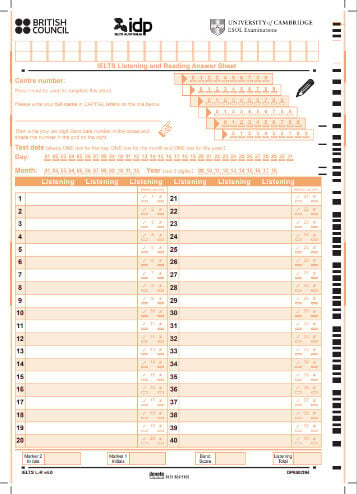
Test IELTS Listening trwa około 40 minut. 30 minut spędzisz na słuchaniu nagrań i odpowiadaniu na pytania. Otrzymasz Question Booklet (zeszyt z pytaniami) oraz Answer Sheet (arkusz odpowiedzi). W Question Booklet zobaczysz wszystkie pytania, na które musisz odpowiedzieć. W Answer Sheet zapiszesz swoje finalne odpowiedzi do oceny.
Możesz zapoznać się z oficjalnym arkuszem odpowiedzi IELTS Listening w formacie PDF tutaj lub po prostu spojrzeć na obrazek poniżej :)
Po zakończeniu sekcji Listening masz 10 minut na przeniesienie odpowiedzi z Question Booklet na swój Answer Sheet.
WAŻNE!
Błędy ortograficzne i niepoprawna gramatyka są oceniane jako NIEPOPRAWNE, więc wykorzystaj te 10 minut na dokładne sprawdzenie pisowni i gramatyki.
Obliczanie wyniku IELTS Listening
W sekcji Listening każde pytanie jest warte 1 punkt, więc możesz uzyskać „surowy” wynik do 40 punktów. Następnie Twój surowy wynik zostanie przeliczony na band score. Pamiętaj! Za błędne odpowiedzi nie są odejmowane punkty. Poniższa tabela daje ogólne wyobrażenie o tym, jak surowe wyniki są przeliczane na band score.
| Wynik surowy | Band score |
|---|---|
| 39-40 | 9 |
| 37-38 | 8.5 |
| 35-36 | 8 |
| 32-34 | 7.5 |
| 30-31 | 7 |
| 26-29 | 6.5 |
| 23-25 | 6 |
| 18-22 | 5.5 |
| 16-17 | 5 |
| 13-15 | 4.5 |
| 11-12 | 4 |
Ponieważ każda wersja testu IELTS jest nieco inna, surowy wynik wymagany do osiągnięcia danego band score różni się w zależności od tego, jak danego dnia poradzili sobie wszyscy zdający. Liczba poprawnych odpowiedzi potrzebnych do uzyskania danego band score będzie więc nieznacznie się różnić od testu do testu, ale ogólnie powinieneś dążyć do uzyskania około 30 z 40 punktów, jeśli chcesz osiągnąć band score 7.
Jak wspomniano powyżej, kolejne sekcje testu IELTS Listening są coraz trudniejsze. Jednak każde pytanie warte jest tyle samo punktów. Upewnij się więc, że nie tracisz łatwych punktów dlatego, że utknąłeś na trudnych pytaniach.
Bezpłatny przykładowy test IELTS Listening w PDF wraz z odpowiedziami
Oto kilka bezpłatnych przykładowych testów IELTS Listening w formacie PDF z odpowiedziami od British Council (twórców egzaminu IELTS). Pod linkami możesz też bezpłatnie rozwiązać test IELTS Listening z nagraniem i odpowiedziami od BestMyTest. Zawiera wszystkie cztery sekcje, a przy każdej sekcji znajdziesz transkrypcję nagrania razem z odpowiedziami. Spróbuj odpowiedzieć na pytania i sprawdź, jak Ci pójdzie!
- IELTS Listening Practice Test 1 – questions (przykłady online)
- IELTS Listening Practice Test 1 – answers (PDF)
- IELTS Listening Practice Test 1 – answer sheet (PDF)
Listen to the recording and answer questions 1 to 10. The answers and the audio script are in the box below the questions.
Questions 1-10
Complete the notes below.
Write ONE WORD AND/OR A NUMBER for each answer.
This can provide the carer with:
• time for other duties
• a 1
Assessment of aunt's needs
This may involve discussing:
• how much 2 is spent caring
Daily tasks discussed:
• help with dressing
• helping her take a 3
• shopping
• helping with meals
• managing 4
• any parts of caring that are particularly hard, e.g.
• loss of 5
• 6 her
• avoiding a 7
Types of support that may be provided for carers
• transport costs, e.g. cost of a 8
• vehicle-related costs, e.g. fuel and 9
• help with housework
• support to lower 10
-
spellcheck Odpowiedzi
1. Break
Break is correct because this detail is stated in the recording at the point where the question is answered.2. Time
Time is correct because this detail is stated in the recording at the point where the question is answered.3. Shower
Shower is correct because this detail is stated in the recording at the point where the question is answered.4. Money
Money is correct because this detail is stated in the recording at the point where the question is answered.5. Memory
Memory is correct because this detail is stated in the recording at the point where the question is answered.6. Lifting
Lifting is correct because this detail is stated in the recording at the point where the question is answered.7. Fall
Fall is correct because this detail is stated in the recording at the point where the question is answered.8. Minicab
Minicab is correct because this detail is stated in the recording at the point where the question is answered.9. Parking
Parking is correct because this detail is stated in the recording at the point where the question is answered.10. Anxiety
Anxiety is correct because this detail is stated in the recording at the point where the question is answered.
Audio ScriptNora: It's really good to see you, Marcus. Since I had to give up work, I feel I'm losing touch with my friends and colleagues.
Marcus: We really miss you in the office. We were all so sorry you had to leave. But you must be relieved to have more time to look after your aunt. How is she?
Nora: Well, she's very cheerful, but she needs a lot of help.
Marcus: Have you tried to get any support from the local council?
Nora: No. I didn't know I could.
Marcus: Yes. But for different kinds of practical support, they realise that carers sometimes need time for all the other responsibilities they have, apart from the person they're caring for, and also that they sometimes need a break.
Nora: Absolutely. OK, so tell me more, how do I go about getting this support?
Marcus: Well, you'd have to have an assessment of your aunt's needs. That means someone would come round and talk to you about the situation and what you need. So for a start, they'd want to know the amount of time you spend looking after your aunt every day.
Nora: OK.
Marcus: Then they'll probably ask you what sorts of tasks you do for your aunt during the day. Things like if she needs help with getting dressed, for example.
Nora: Right. I help her with that. And also I help her get into the shower in the morning.
Marcus: Yes. That sort of thing. They'll probably ask you if you do the shopping for her, and help her at meal times, and whether she can cope using money.
Nora: Yes. That's becoming a bit of a problem. She used to be very good at it, but not anymore.
Before you hear the rest of the conversation, you have some time to look at questions 5 to 10. [20 seconds] Now listen, and answer questions 5 to 10.Marcus: And be ready to tell them about anything you find particularly difficult about caring for your aunt.
Nora: So recently I've noticed she started to have quite bad problems with her memory. If I wasn't there, I think she'd forget to eat, for example. And often she doesn't seem quite sure what day it is.
Marcus: Yes. Tell them about that. And are there any physical difficulties you have caring for her? Lifting her, for example.
Nora: Yes. She's quite heavy, and I'm afraid of hurting my back. I'd be in real trouble if that happened.
Marcus: They can give you advice about that, and also about how to avoid the possibility of your aunt having a fall.
Nora: Great. So, once they've done this assessment, if I'm eligible, what happens next?
Marcus: Well, they might support you financially. So they might help you with travel costs, like if you have to get a minicab to take your aunt for an appointment, for example.
Nora: I usually drive her myself, actually. So could I claim for the petrol?
Marcus: You could. And you can claim for the parking, too.
Nora: Oh, right.
Marcus: And if you need help with the housework, they can arrange for someone to come along once or twice a week. And one other thing. I hope you don't mind me saying this, but it's important you look after yourself. And it seems to me you're dealing with quite a bit of anxiety.
Nora: I am, yes.
Marcus: Well, tell the council, because they may be able to give you some advice on how to minimise it.
Nora: Really? Though, actually, I feel so much better having talked to you. I'll get in touch with the council straight away. Now, shall we go for coffee, or something?
Listen to the recording and answer questions 11 to 20. The answers and the audio script are in the box below the questions.
Questions 11-14
Choose the correct letter, A, B or C.
11. Who began turning the unused Whitfield site into a planted space?
- city council officials.
- nearby residents.
- a gardening charity.
12. What was Lillian Hartley trying to achieve through public campaigning?
- preventing a housing sale
- blocking army exercises
- winning maintenance funding
13. Why was the park rejected as a place for troop exercises?
- council permission was refused.
- too little usable space.
- a better site was chosen.
14. How does the speaker describe the latest redesign plans?
- 2013 plan used unchanged.
- 2013 plan revised pre-work.
- 2015 plan finished in 2016.
Questions 15-20
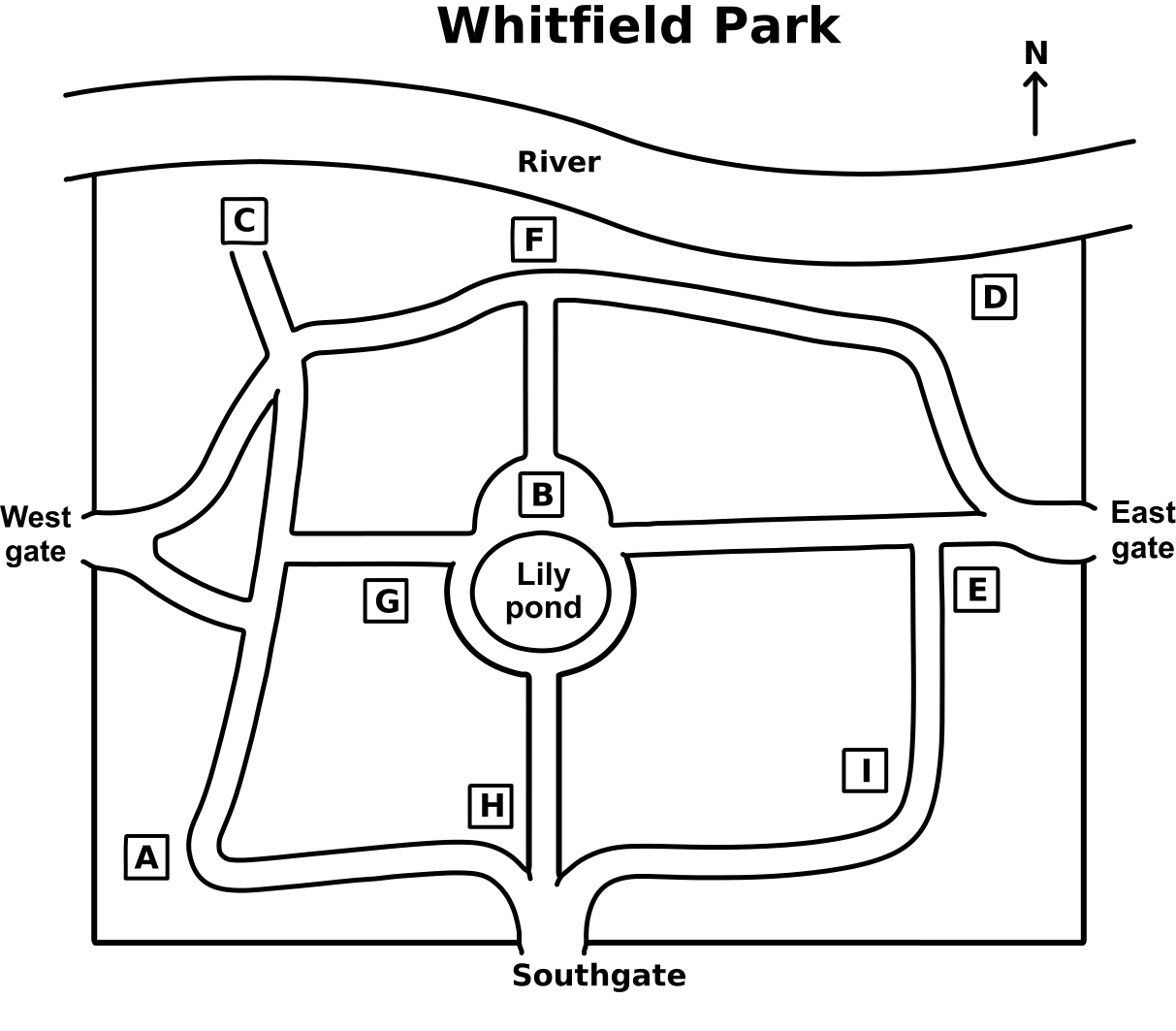
Label the plan of Whitfield Park below.
Write the correct letter, A-I, next to questions 15-20.
- statue of Lillian Hartley
- wooden sculptures
- playground
- maze
- tennis courts
- fitness area
-
spellcheck Odpowiedzi
11. B
(A) is incorrect. The council took ownership later.(B) is correct. The initial planting was done by residents from nearby streets.
(C) is incorrect. The recording does not support this option: a gardening charity.
12. A
(A) is correct. Hartley organised public pressure so the council would keep the land as a park rather than sell it for housing.(B) is incorrect. The recording does not support this option: blocking army exercises.
(C) is incorrect. The recording does not support this option: winning maintenance funding.
13. B
(A) is incorrect. The recording does not support this option: council permission was refused.(B) is correct. , after inspection, the army concluded that the park was too small for practical use.
(C) is incorrect. The recording does not support this option: a better site was chosen.
14. B
(A) is incorrect. The recording does not support this option: 2013 plan used unchanged.(B) is correct. The plans dated from 2013 but were revised in 2015 before work began.
(C) is incorrect. The recording does not support this option: 2015 plan finished in 2016.
15. B
The correct answer is B because the statue of Lillian Hartley is now immediately north of the lily pond near the centre of the park, and that position is labelled B.16. D
The correct answer is D because the wooden sculptures are on the riverbank where the path from the East Gate makes a sharp bend, which corresponds to D.17. F
The correct answer is F because the playground is between the river and the path from the lily pond to the river, and that location is marked F.18. C
The correct answer is C because the maze is found by entering from the West Gate, walking north, and turning left, which places it at C.19. A
The correct answer is A because the tennis courts remain in the southern corner where the perimeter path makes a right-angled bend, labelled A.20. G
The correct answer is G because the fitness area is beside the lily pond on the same side as the West Gate, matching G on the plan.
Audio ScriptI'm delighted this evening to introduce our guest speaker, Sarah Holloway, who is going to talk to us about the recent transformation of Whitfield Park. Over to you, Sarah. Thank you very much. I'm sure you all know Whitfield Park well, it has been one of the city's landmarks for well over a century, and the city council has been responsible for it for most of that time. What perhaps fewer of you will know is how the park actually began.
Unlike many city centre parks, which started life as the private gardens of a large house, Whitfield was originally just an unused patch of waste ground. The first flowers there were actually planted by a small group of local residents who lived in the surrounding streets. They began work on the site in 1892. At that point nobody was entirely sure who legally owned the land, and it was a full twenty years later before the city council finally took it into public ownership. Some of you will have seen the statue near one of the gates. That figure is Lillian Hartley, who played a really important role in the early history of the park.
Once the council legally owned the land, its first instinct was to sell it off as building plots for housing. A great many local residents, however, wanted the park to stay open as a place where everyone could enjoy fresh air and green space, bear in mind that this is a very densely built up residential district. Lillian Hartley was at the heart of that campaign, and it was she who organised the petitions and the public demonstrations which, in the end, persuaded the council to drop the sale and keep the land as a park.
Soon afterwards, in 1914, the First World War broke out, and most of the park was dug up and used to grow vegetables, which were sold to local residents. At one point the army did look into taking over the park as a site for troop exercises. They actually wrote to the city council about it, but when they inspected it they concluded that the park was simply too small to be of any practical use to them, so the idea was dropped. The only military activity in the park during the war was the occasional public meeting held on a small area of grass that had been kept clear of vegetable plots.
After the war, the park was largely returned to the way it had been before 1914, and from then on it remained almost unchanged for decades. New plans for transforming the park were drawn up several times over the years; the most recent version dates from 2013, but those plans were then revised in 2015, well before any actual work had got under way. Work on the ground finally began in 2016 and was completed, on schedule, last year.
Before you hear the rest of the talk, you have some time to look at questions 15 to 20. [20 seconds] Now listen and answer questions 15 to 20.All right, I'd like to describe some of the more important changes that have been made, and one or two things that have deliberately been left as they were. If you take a quick look at the map you've been handed, you'll see the familiar outline of Whitfield Park. The river forms the northern boundary, and there is a gate in each of the three other walls.
From there, follow the path up towards the river and the enlarged children's playground sits between that path and the river itself. If you keep your eye on the riverbank, over towards the East Gate side, the new wooden sculptures are at the point where the path coming up from that gate makes a sharp bend.
Back near the West Gate side of the park, there is a maze, a circular pattern of paths separated by low hedges. Head in from the West Gate, walk north towards the river, and then turn left to find it. Close to the same central lily pond, on the side facing the West Gate, you'll also find the new outdoor fitness area.
Down in the southern corner, where the perimeter path makes that distinct right angled bend, the tennis courts are still in their familiar position, though we have now doubled them from four to eight. Now, since you are all keen gardeners, I'm sure you'll want to hear about the plants that have been chosen for the new beds.
Listen to the recording and answer questions 21 to 30. The answers and the audio script are in the box below the questions.
Questions 21-25
Choose the correct letter, A, B or C.
21. Nina and Owen were surprised to learn that coastal cities
- are home to just under half of all people.
- account for many of the largest cities.
- are expanding at double the rate of inland cities.
22. According to Owen, building coastal cities near to rivers
- can carry contamination back towards urban areas.
- can leave too little land for farming upstream.
- can cause factories to damage rural scenery.
23. What mistake was made when building water drainage channels in Port Selby in the 1950s?
- The system did not include enough channels.
- The builders selected the wrong construction materials.
- The design failed to anticipate rising sea levels.
24. What do Nina and Owen think that the authorities in Port Selby should do immediately?
- take measures to restore coastal ecosystems
- pay for a new flood prevention system
- stop disposing of waste materials into the ocean
25. What do they agree should be the priority for international action?
- greater coordination of activities
- more sharing of information
- agreement on shared policies
Questions 26-30
What decision do the students make about each of the following parts of their presentation?
Write the correct letter, A-G, next to questions 26-30.
- use visuals
- keep it short
- involve other students
- check the information is accurate
- provide a handout
- focus on one example
- do online research
- Historical background
- Geographical factors
- Past mistakes
- Future risks
- International implications
-
spellcheck Odpowiedzi
21. B
(A) is incorrect. The recording does not support this option: are home to just under half of all people.(B) is correct. Nina says most of the biggest cities are built by the sea.
(C) is incorrect. The recording does not support this option: are expanding at double the rate of inland cities.
22. A
(A) is correct. Owen says pollutants from inland agriculture and industry travel down rivers to cities.(B) is incorrect. The recording does not support this option: can leave too little land for farming upstream.
(C) is incorrect. The recording does not support this option: can cause factories to damage rural scenery.
23. C
(A) is incorrect. The recording does not support this option: The system did not include enough channels.(B) is incorrect. The recording does not support this option: The builders selected the wrong construction materials.
(C) is correct. Port Selby's drainage channels were built without allowing for global warming and rising sea levels.
24. B
(A) is incorrect. The recording does not support this option: take measures to restore coastal ecosystems.(B) is correct. Nina says they need money to replace the drainage channels for flood protection now.
(C) is incorrect. The recording does not support this option: stop disposing of waste materials into the ocean.
25. A
(A) is correct. They say coastal cities must act together internationally.(B) is incorrect. The recording does not support this option: more sharing of information.
(C) is incorrect. The recording does not support this option: agreement on shared policies.
26. B
B is correct because they decide not to spend too long on historical background, so they will keep it short.27. A
A is correct because they decide to use slides with maps showing geographical factors.28. F
F is correct because they choose the Meriton case study as the basis for past mistakes, focusing on one example.29. G
G is correct because they need to look at websites for future risks, so online research is required.30. C
C is correct because they plan to ask audience members from different places, involving other students.
Audio ScriptTutor: OK, so what I'd like you to do now is to talk to your partner about your presentations on environmental planning. You should have done most of the reading now, so I'd like you to share your ideas and talk about the structure of your presentation and what you need to do next.
Nina: OK, Owen, I'm glad we chose quite a specific topic: coastal cities. It made it much easier to find relevant information.
Owen: Yeah, and cities are growing so quickly. I mean, we know that more than half the world's population lives in cities now.
Nina: Yeah, though that's all cities, not just coastal ones. But most of the biggest cities are actually built by the sea. I'd not realised that before.
Owen: Nor me. And what's more, a lot of them are built at places where rivers come out into the sea. But apparently this can be a problem.
Nina: Why?
Owen: Well, as the city expands, agriculture and industry tend to spread further inland along the rivers. And so agriculture moves even further inland up the river. That's not necessarily a problem, except it means more and more pollutants are discharged into the rivers.
Nina: That's a serious problem.
Owen: Right.
Nina: Did you read that article about Port Selby on the south coast?
Owen: No.
Nina: Well, apparently back in the 1950s, they built channels to drain away the water in case of flooding.
Owen: Sounds sensible.
Nina: Yeah, they spent quite a lot of money on them. But what they didn't take into account was global warming. So they built the drainage channels too close to sea level. And now sea levels are rising, they're more or less useless. If there's a lot of rain, the water can't run away. There's nowhere for it to go.
Owen: So they did not help much in the end.
Nina: So what are the authorities doing about it now?
Owen: I don't know. I did read that they're aiming to stop disposing of waste water into the ocean over the next 10 years. But that won't help with flood prevention now, will it?
Nina: No, really, they just need to find the money for something to replace the drainage channels in order to protect against flooding now. But in the long term, they need to consider the whole ecosystem.
Owen: Right.
Nina: Really though, coastal cities can't deal with their problems on their own, can they? I mean, they've got to start acting together at an international level instead of just doing their own thing.
Owen: Absolutely. The thing is, everyone knows what the problems are and environmental planners have a pretty good idea of what we should be doing about them. So they should be able to work together to some extent.
Nina: But it's going to be a long time before countries come to a decision on what principles they're prepared to abide by.
Owen: Yeah, if they ever do.
Before you hear the rest of the conversation, you have some time to look at questions 26 to 30. [20 seconds] Now listen and answer questions 26 to 30.Nina: So I think we've probably got enough for our presentation. It's only 15 minutes.
Owen: OK, so I suppose we'll begin with some general historical background about why coastal cities were established. But we don't want to spend too long on that. The other students will already know a bit about it.
Nina: It's all to do with communications and so on.
Owen: Yes, we should mention some geographical factors, things like wetlands and river estuaries and coastal erosion and so on.
Nina: We could have some maps of different cities with these features marked.
Owen: On a handout, you mean, or some slides everyone can see.
Nina: Yeah, that'd be better.
Owen: It'd be good to go into past mistakes in a bit more detail. Did you read that case study of the problems there were in Meriton with flooding a few years ago?
Nina: Yes, we could use that as the basis for that part of the talk. I don't think the other students will have read it, but they'll remember hearing about the flooding at the time.
Owen: Hmm, OK. So that's probably enough background. So then we'll go on to talk about what actions have been taken to deal with the problems of coastal cities.
Nina: OK, what else do we need to talk about? Maybe something on future risks looking more at the long term if populations continue to grow?
Owen: Yeah, we'll need to do a bit of work there. I haven't got much information, have you?
Nina: No, we'll need to look at some websites. Shouldn't take too long.
Owen: OK. And I think we should end by talking about international implications. Maybe we could ask people in the audience. We've got people from quite a lot of different places.
Nina: That'd be interesting if we have time, yes. So now should we go on?
Listen to the recording and answer questions 31 to 40. The answers and the audio script are in the box below the questions.
Questions 31-36
What point does the lecturer make about each item?
Write the correct letter, A-K, next to questions 31-36.
- changes drainage
- protects animals
- increases nutrients
- kills germs
- affects many species
- creates dense shade
- alters the soil
- supports farming
- reduces competition
- attracts bell-miners
- helps recovery
- Eucalyptus woodland
- Damage to eucalyptus woodland
- Oil from eucalyptus leaves
- Lime used in construction
- Direct iron supply
- Moderate bushfires
Questions 37-40
Complete the notes below.
Write ONE WORD ONLY for each answer.
Bell-miner associated dieback:
• The process starts with insects feeding on eucalyptus 37
• A sweet liquid containing 38 attracts bell-miners
Fire patterns:
• If fires happen too often, 39 becomes the main vegetation
• When fires are almost absent, thick growth gives bell-miners protected 40 sites
-
spellcheck Odpowiedzi
31. B
B is correct because eucalyptus woodland provides nesting places and shelter for birds, bats and small mammals.32. E
E is correct because damage to eucalyptus woodland affects a wider community of species, not only the trees themselves.33. D
D is correct because oil from eucalyptus leaves is used in disinfectant, where it can kill certain germs.34. G
G is correct because lime from road construction was washed into the soil and interfered with tree roots.35. K
K is correct because affected trees recovered surprisingly quickly when iron was supplied directly.36. I
I is correct because occasional fire removes fast-growing competitors that would otherwise use water needed by eucalyptus trees.37. leaves
The correct answer is leaves. The lecturer says the process begins when insects settle on eucalyptus leaves and feed on them.38. sugar
The correct answer is sugar. The lecturer says the insects produce a sweet liquid containing sugar, which attracts bell-miners.39. grass
The correct answer is grass. The lecturer says grass tends to dominate afterwards if fires occur too often.40. nesting
The correct answer is nesting. The lecturer says dense growth creates protected nesting sites for bell-miners when fire is suppressed.
Audio ScriptGood morning. Today I want to focus on the eucalyptus tree, one of the best known features of the Australian landscape. Many people call it a gum tree, but the name eucalyptus actually covers hundreds of related species, from small scrubby trees to very tall forest giants.
Now, eucalyptus trees are important in several ways. Ecologically, they provide nesting places and shelter for birds, bats and small mammals. Their flowers also produce nectar, which is an important food source for insects and birds. So when eucalyptus woodland is damaged, the effect is felt across a much wider community of species.
As for their value to people, the trees are also useful. Oil from eucalyptus leaves has long been used in cleaning products, and one common use is in disinfectant, because the oil can kill certain germs. Eucalyptus timber is also used in building and fencing, although that is not really the main focus of today's lecture.
So, these trees can live for centuries, and some individuals survive for four hundred years or more. That is why researchers became concerned when large numbers began dying much earlier than expected in different parts of Australia.
Now, one disease that attracted attention was Mundulla Yellows. The leaves of affected trees slowly turned yellow and then, over time, the whole tree declined. For years the cause was unclear. Eventually, researchers discovered that lime, or calcium hydroxide, had been used in road construction nearby. Rain washed the lime into the surrounding soil, where it interfered with the roots of eucalyptus trees. The trees were still surrounded by nutrients, but they could no longer absorb the iron they needed for healthy growth. When iron was supplied directly to affected trees, they recovered surprisingly quickly.
However, Mundulla Yellows affected only a limited number of places. A much wider problem on the east coast was Bell miner associated dieback. Now, bell miners are small native birds, but they are not the direct cause of the damage. The process begins when insects settle on eucalyptus leaves and feed on them. While feeding, these insects produce a sweet liquid containing sugar. Bell miners are attracted to that liquid, and they aggressively chase away other birds and insects that might otherwise reduce the insect population. As a result, the insects multiply, the leaves are badly damaged, and the trees gradually lose their ability to survive.
But some scientists think fire history is also part of the explanation. An influential theory, first proposed by the ecologist William Jackson, links the type of vegetation in a region to the frequency of bushfires. If fires occur too often, grass tends to dominate the area afterwards. If fires occur at moderate intervals, eucalyptus forest is more likely to persist. This is because occasional fire removes fast growing competitors which would otherwise take up the water eucalyptus trees need. And it also helps maintain the soil by preventing dense undergrowth from changing the soil structure and removing nutrients.
At the other extreme, if fires are almost completely suppressed, a different ecosystem can develop. Scientists sometimes call this dry rainforest. Now, the name sounds contradictory, because we usually associate rainforest with wet tropical conditions. But in this case it means a dense, shaded vegetation system with relatively few species. It can create excellent conditions for bell miners, because the thick growth gives them protected nesting sites while excluding many of the species that would normally compete with them.
What this tells us is that before European settlement, Aboriginal communities used controlled burning over long periods, and this probably created a more balanced pattern of vegetation. Since European settlement, fire has often been suppressed, roads and farms have altered drainage, and some local ecosystems have shifted away from eucalyptus woodland. The decline of eucalyptus trees, then, is not caused by one single factor. It is the result of disease, insects, birds, soil chemistry and fire management interacting with one another.

Completion - Part 1
Learn how to answer these questions in a step-by-step interactive exercise
Completion - Part 1
Luka może wymagać podania czasu lub częstotliwości. Mówiący zwykle określa ten sam okres innymi słowami, więc dopasuj znaczenie do luki, zamiast czekać na sformułowanie ze strony.
Przed wysłaniem sprawdź limit słów. Przeczytaj cały wiersz z odpowiedzią w luce i usuń każde słowo, które ten wiersz już zawiera. Odpowiedź poprawna pod względem znaczenia, ale za długa, nie dostaje punktów.
Kliknij odtwórz, aby wysłuchać nagrania
W notatkach pojawia się prosty czasownik, taki jak must provide czy need to bring. Mówiący rzadko używa tego czasownika; zamiast tego posługuje się synonimem albo opisuje czynność, więc wsłuchuj się w to, co faktycznie jest wymagane.
Rozmówcy często najpierw wymieniają dodatkowe rzeczy, a potem je wykluczają. Jeśli przegapisz lukę, zostaw ją i przejdź do następnej, bo odpowiedzi idą w kolejności nagrania, a jedna zgubiona luka może Cię kosztować kolejne.
Kliknij odtwórz, aby wysłuchać nagrania
Jak Ci poszło z odpowiedziami na powyższe przykładowe pytania IELTS Listening? Czy któreś z pytań sprawiło Ci trudność? Jeśli tak, warto przyjrzeć się bliżej wszystkim 6 typom zadań w IELTS Listening. Im lepiej zrozumiesz typ zadania, tym mniej wysiłku będziesz potrzebować na zorientowanie się, co masz zrobić, i tym więcej czasu będziesz mieć na znalezienie odpowiedzi.
6 typów zadań w teście IELTS Listening
W teście IELTS Listening występuje 6 różnych typów pytań. Ważne jest, abyś przećwiczył każdy typ zadania i poznał najlepszy sposób radzenia sobie z każdym z nich, aby uzyskać wysoki wynik IELTS Listening.
Które typy zadań ze słuchania sprawiają naszym kursantom najwięcej trudności
Zamiast trendu z 2017 roku przedstawiamy wnioski z 2.25 miliona odpowiedzi kursantów BestMyTest na pytania w części IELTS ze słuchania. Wartość procentowa pokazuje, jak często nasi kursanci odpowiadali poprawnie w danym typie zadania.
| Typ zadania | Poprawne odpowiedzi |
|---|---|
| Uzupełnianie notatek | 33% |
| Uzupełnianie tabeli | 34% |
| Uzupełnianie zdań | 45% |
| Krótka odpowiedź | 48% |
| Wybór jednej odpowiedzi | 50% |
| Wybór kilku odpowiedzi | 51% |
| Podpisywanie planu, mapy lub diagramu | 55% |
| Uzupełnianie formularza | 73% |
| Dopasowywanie | 85% |
- To w zadaniach na uzupełnianie kursanci tracą punkty. W uzupełnianiu notatek i tabel poprawna jest tylko jedna odpowiedź na trzy, podczas gdy w uzupełnianiu formularza, które wymaga tej samej umiejętności przy prostszym układzie, odsetek ten sięga 73%. Różnica wynika z pisowni, formy wyrazów i limitów słów pod presją czasu, a nie z rozumienia.
- W 61 964 pełnych testach próbnych ze słuchania rozwiązanych przez 55 296 kursantów średni wynik wyniósł 5.5. W 41% testów osiągnięto wynik 6.0, a w 12% wynik 7.0.
- W poszczególnych sekcjach części ze słuchania jedna trzecia prób zakończyła się wynikiem 40% lub niższym, a 30% wynikiem 80% lub wyższym. Większość kursantów wypada bardzo słabo w jednej lub dwóch sekcjach, zamiast uzyskiwać równie niskie wyniki we wszystkich, dlatego warto ćwiczyć sekcje 3 i 4 osobno.
Dane pochodzą z testów próbnych i ocen BestMyTest zgromadzonych do października 2026. Wartości procentowe dla typów pytań to odsetki poprawnych odpowiedzi we wszystkich próbach; dane dotyczące kryteriów to oceny nauczyciela lub AI, zgodnie z oznaczeniem. Ostatnia aktualizacja: 5 października 2026.
Choć każdy typ pytania w części Listening wygląda inaczej, podstawowe podejście do każdego z nich jest takie samo. W dalszej części tego wpisu przedstawimy podstawową strategię radzenia sobie ze wszystkimi 6 typami pytań. Każdy typ ma nagranie i odpowiedź w przewodniku typy pytań IELTS Listening.
3 kroki do skutecznego przygotowania do testu IELTS Listening online
Choć każdy typ pytania (zadania) w IELTS Listening jest inny, podstawowe podejście do każdego z nich jest takie samo. Możesz poradzić sobie ze wszystkimi typami zadań, stosując jedną prostą strategię krok po kroku. Oto trzy kroki, które polecamy w podejściu do typów pytań w części Listening:
- Dokładnie przeanalizuj pytania, aby znaleźć kluczowe informacje
- Przewiduj możliwe odpowiedzi przed słuchaniem
- Śledź nagranie, dopasowując pytania do treści w trakcie słuchania
Krok 1: Przeanalizuj pytania
W sekcji IELTS Listening dostaniesz krótki czas na przygotowanie (30–40 sekund) zanim rozpocznie się nagranie. To Twoja okazja, by przyjrzeć się pytaniom, na które będziesz musiał odpowiedzieć, a właśnie o tym jest pierwszy krok tej strategii. Zamiast wykorzystywać ten czas na odpoczynek lub sprawdzanie odpowiedzi, skup się na zdobyciu jak największej ilości informacji o nadchodzących pytaniach. Wykonanie tego kroku jest ważne, aby uniknąć błędu wykonywania wielu zadań jednocześnie – słuchania mówcy i czytania pytań po raz pierwszy.
Gdy rozpocznie się czas na przygotowanie, najpierw maksymalnie wykorzystaj ten czas, analizując pytania w celu uzyskania o nich więcej informacji. Oto niektóre informacje, których powinieneś szukać, analizując każde z pytań w IELTS Listening:
- Jakiego rodzaju jest to pytanie?
- Jak będzie wyglądać odpowiedź? (przykład: data, liczba, imię)
- Jakie są najważniejsze frazy i słowa, czyli słowa kluczowe, w pytaniach?
Jednym z przykładów może być pytanie typu Note Completion, takie jak to:
Complete the notes below.
Write NO MORE THAN THREE WORDS for each answer.
Najpierw możesz podkreślić niektóre słowa kluczowe w pytaniu.
Two reasons for the new approach to pricing are changes in (27) ______ and (28) _________ programs.
W tym przykładzie nasłuchiwanie kluczowej frazy „two reasons”, którą wcześniej podkreśliłeś, pozwala
zacząć uważnie słuchać we właściwym momencie. Oto fragment audio script, który ujawnia odpowiedź:
Mark: Well, there seem to be two basic reasons. Firstly, because the law has changed recently to allow companies to behave like this. In the past, they weren't allowed to change the prices of the tickets. And secondly, we now have computer programs that do the calculations so that prices can be changed very quickly and accurately.
Po przeanalizowaniu pytań wiedziałbyś, że „the law” i „computer” to poprawne odpowiedzi w tym miejscu, na podstawie słów kluczowych i znajomości typu pytania.
Krok 2: Przewiduj możliwe odpowiedzi
Drugi krok tej strategii sukcesu w sekcji IELTS Listening jest bardzo blisko związany z pierwszym. W rzeczywistości powinieneś spróbować wykonać oba te kroki w tym samym 20-sekundowym czasie przygotowania przed rozpoczęciem nagrania. Choć może się to wydawać trudnym zadaniem do wykonania w tak krótkim czasie, pamiętaj, że te kroki są ze sobą powiązane.
Aby przewidzieć możliwe odpowiedzi na pytania w części Listening, najpierw musisz wykonać krok pierwszy, dokładnie analizując pytania. W tym momencie powinieneś wiedzieć, na jakie pytanie patrzysz, jak będą wyglądały potencjalne odpowiedzi, a także które słowa kluczowe pomogą szybko zlokalizować odpowiedzi. Aby przewidzieć odpowiedzi, połączysz wszystkie te informacje i zgadniesz, jakiego rodzaju odpowiedzi się spodziewać.
Wróćmy do tego samego przykładu pytania typu Note Completion z powyżej.
Two reasons for the new approach to pricing are changes in (27) and (28) programs.
Już samo spojrzenie na gramatykę tego zdania pozwala zidentyfikować, jaką częścią mowy będzie odpowiedź. W tym przypadku przyimek „in” poprzedza obie potencjalne odpowiedzi. Gramatycznie tylko rzeczowniki lub frazy rzeczownikowe mogą być używane w ten sposób w wyrażeniach przyimkowych. Możesz nie tylko poprawnie przewidzieć, że odpowiedzią będzie rzeczownik lub fraza rzeczownikowa, ale również można przewidzieć, że odpowiedź może być czymś związanym z polityką lub rządem (law) oraz słowem, które może występować z programs (computer) na podstawie kontekstu.
Choć nie da się odgadnąć dokładnej poprawnej odpowiedzi tylko na podstawie przewidywań, próbując wyobrazić sobie, jaka może być odpowiedź, jest większe prawdopodobieństwo, że będziesz nasłuchiwać istotnych informacji, ignorując te nieistotne. Przewidywanie potencjalnych odpowiedzi przed rozpoczęciem nagrania przygotuje Twoje ucho, przybliżając Cię o krok do poprawnej odpowiedzi.
Teraz spróbuj połączyć krok 1 (przeanalizuj pytania) i krok 2 (przewiduj możliwe odpowiedzi) na trudniejszym przykładowym pytaniu typu Multiple Choice.
Choose the correct letter, A, B, C or D.
- are for weekend shows
- are booked well in advance
- are non-refundable
- are booked for groups
Choć nie ma sposobu, by mieć pewność co do odpowiedzi na te pytania, nadal możesz wykorzystać informacje znalezione w tych pytaniach do przewidywania potencjalnych odpowiedzi i ukierunkowania słuchania. Na przykład pytanie 24 dotyczy powodu, dla którego ceny biletów do teatru są najniższe, więc będziesz chciał uważnie nasłuchiwać wszystkich wymienionych powodów. Pamiętaj, że może zostać wymieniony więcej niż jeden. Spójrz na poniższy script, aby zobaczyć, jak przewidywanie może pomóc wyeliminować błędne odpowiedzi.
Zauważ, że trzy z potencjalnych odpowiedzi są wymienione: „booked for groups”, „are for weekend shows” i „are non-refundable”. Jednak poprawną odpowiedzią jest C „are non-refundable”, ponieważ jest ona wymieniona jako tańsza oddzielnie od dwóch pozostałych, które są po prostu wymienione razem.
Krok 3: Śledź na bieżąco
Gdy rozpocznie się nagranie i właściwa część słuchania testu, powinieneś śledzić nagranie, aby wykonać trzeci krok tej strategii w sekcji IELTS Listening. Śledzenie nagrania wymaga uważnego skupienia na tym, co słyszysz, jednocześnie pamiętając o tym, którego pytania może dotyczyć dana treść.
Pytania w części IELTS Listening zazwyczaj pojawiają się w kolejności, w jakiej można znaleźć odpowiedzi w treści nagrania. Daje Ci to przewagę w teście, ponieważ oznacza to, że gdy tylko usłyszysz odpowiedź na jedno pytanie, natychmiast zwrócisz uwagę na następne w kolejności. Jeśli uda Ci się skutecznie śledzić, dopasowując kontekst pytań do tego, co słyszysz w nagraniu, utrzymasz właściwy tor i unikniesz pominięcia kluczowych informacji potrzebnych do odpowiedzi na każde z pytań.
Łatwiej to powiedzieć, niż zrobić. Musisz wykonywać kilka zadań jednocześnie – słuchać i jednocześnie mieć oko na następne pytanie. Jeśli rzeczywiście pominiesz odpowiedź na jakieś pytanie, zorientujesz się, gdy usłyszysz odpowiedź na późniejsze. Choć może to być mylące, a nawet frustrujące, pominięcie jednej odpowiedzi i bycie tego świadomym jest nadal lepsze niż całkowite pogubienie się w treści i pominięcie jeszcze większej liczby odpowiedzi. W przypadku pominięcia pytania po prostu je opuść i przejdź do następnego. Na koniec będziesz musiał obstawić swoją najlepszą próbę odpowiedzi na pominięte pytanie. Z pozytywnej strony, jest możliwe, że wysłuchanie nagrania w całości dostarczy Ci innych wskazówek kontekstowych i pozwoli odpowiedzieć na pominięte pytania dokładniej.
Bezpłatne materiały do ćwiczenia IELTS Listening
Aby uzyskać wysoki band score w IELTS Listening, potrzebujesz silnych umiejętności słuchania. Dlatego ważne jest, abyś trenował konsekwentnie każdego dnia aż do dnia testu.
Poniżej znajdziesz materiały, których możesz używać do codziennego trenowania i utrzymywania swoich umiejętności słuchania.
- YouTube - https://www.youtube.com
- BBC Learning English - http://www.bbc.co.uk/learningenglish
- TED - https://www.ted.com/
- BBC radio - https://www.bbc.co.uk/worldserviceradio
- ABC news in Australia - https://www.abc.net.au/listen/live/news