În acest ghid vei susține un test gratuit IELTS Speaking și vei exersa cu cele mai frecvent întâlnite teme de întrebări IELTS Speaking cu răspunsuri. Vei învăța cum să răspunzi la întrebările testului IELTS Speaking pentru părțile 1, 2 și 3 folosind șabloanele noastre verificate pentru exprimarea orală.
Obține răspunsuri demonstrative gratuite pentru IELTS speaking după finalizarea unui test de practică IELTS speaking.
play_circle_outline Începe testul de practică IELTS SpeakingMai jos este lista noastră completă de întrebări IELTS speaking cu răspunsuri demonstrative. Notă: linkurile roșii reprezintă cele mai populare și recomandate întrebări de speaking, evaluate de studenții noștri, pe care le poți exersa gratuit oricând.
Întrebări IELTS Speaking partea 1 1 - 96
Short questions about familiar topics like your home, work, and hobbies
Întrebări IELTS Speaking partea 2 1 - 83
Cue cards where you speak for 1 to 2 minutes about one topic
Întrebări IELTS Speaking partea 3 1 - 97
Discussion questions linked to the Part 2 topic
Ghid pentru succesul la IELTS Speaking
Bun venit la ghidul oficial BestMyTest pentru testul IELTS Speaking. Restul acestui ghid se va concentra pe învățarea celor mai frecvent folosite subiecte pentru părțile 1 - 3 ale testului IELTS Speaking, ascultarea unor răspunsuri model de nivel band 9 și învățarea unor sfaturi importante și resurse pentru succesul tău la IELTS Speaking. Folosește cuprinsul de mai jos pentru a găsi rapid ceea ce cauți.
Cuprins
- Introducere în testul IELTS Speaking
- Subiecte IELTS Speaking pentru Part 1
- Subiecte IELTS Speaking pentru Part 2 și 3
- Cum să abordezi IELTS Speaking Part 1
- Cum să abordezi IELTS Speaking Part 2
- Cum să abordezi IELTS Speaking Part 3
- Practica IELTS Speaking pentru succesul tău
- Cum sunt punctate întrebările IELTS Speaking
- Resurse gratuite pentru testul IELTS Speaking
Testul IELTS Speaking
Testul IELTS Speaking poate fi puțin intimidant la început, mai ales pentru că vei fi testat în direct, în fața examinatorului. Din cauza acestui format live, găsirea unor subiecte gratuite de speaking cu răspunsuri model poate fi dificilă, însă nu-ți face griji, te ajutăm noi. Înainte de a exersa cu subiectele noastre IELTS Speaking, hai să aruncăm o privire rapidă asupra testului de speaking și să vedem cum funcționează.
Formatul testului Speaking
Testul Speaking durează aproximativ 11 - 15 minute și este format din 3 părți. Te rugăm să reții că subiectele de speaking pentru Greeting și Part 1 sunt aceleași, deci sunt considerate o singură parte, dar le-am separat pentru comoditatea ta.
- Salutul în testul IELTS Speaking
- Testul IELTS Speaking Part 1
- Testul IELTS Speaking Part 2
- Testul IELTS Speaking Part 3
Salutul
Când susții testul IELTS Speaking și intri în sala de examen, examinatorul nu începe cu întrebări dificile de IELTS Speaking, ci pornește ușor, cu salutul. Te rugăm să reții, vei FI notat pe abilitatea ta de a saluta, așa că este important să fii pregătit pentru asta. Astfel, hai să aruncăm o privire rapidă asupra unui salut simplu și a răspunsului la el.
- Examinatorul se va prezenta și te va întreba cum te cheamă. Vei răspunde „My name's _______”.
- Apoi, vei fi întrebat „What can I call you?”, la care poți răspunde „You can call me_______”. Poți folosi numele tău în engleză aici, dacă ai unul. Poate suna ciudat, dar unele persoane nu pot pronunța propriul nume în engleză. Acest lucru NU ESTE ACCEPTABIL. Dacă nu poți să-l pronunți, e mai bine să nu îl folosești.
- După nume, te vor întreba de unde ești. Spune doar „I'm from_____”. Atât este suficient. Nu trebuie să oferi informații suplimentare despre răspunsurile tale în această etapă.
- În final, ți se va cere un act de identitate. După ce îl arăți, vei începe testul.
IELTS Speaking Part 1
IELTS Speaking Part 1 durează între 4-5 minute, include aproximativ 8-10 întrebări IELTS Speaking și aproximativ 2-3 subiecte IELTS Speaking familiare, cum ar fi jobul tău, studiile tale, familia ta, orașul tău natal, locuința ta etc. Aceste subiecte sunt mai ușoare decât subiectele din IELTS Speaking Part 2. Mai jos sunt câteva exemple de ceea ce ai putea fi întrebat.
Where is your hometown?
What do you like about it?
What do you not like about it?
How important is your hometown to you?
Let's move on to talk about accommodation:
Tell me about the kind of accommodation you live in?
Does the place you live in have many amenities?
Is there anything you would like to change about the place you live in?
Do you plan to live there for a long time?
Întrebările din Part 1 ar putea fi cel mai bine descrise ca întrebări care imită o conversație de complezență între doi străini sau cunoștințe. Nu sunt foarte aprofundate, dar nu te lăsa păcălit să crezi că nu trebuie să te pregătești pentru ele. Doar puțină pregătire poate face o mare diferență și ne vei mulțumi că te-am pus să o faci! Vei găsi, de asemenea, câteva sfaturi despre cum să te pregătești pentru întrebările din Part 1 mai târziu în acest articol.
IELTS Speaking Part 2
În Part 2, vei vorbi despre un anumit subiect IELTS Speaking. Subiectul este ales pentru tine și îți va fi dat pe un card (Candidate Task Card). Apoi vei avea 1 minut pentru a-ți pregăti răspunsul și un maximum de 2 minute pentru a vorbi. Ți se vor pune la dispoziție creion și hârtie pentru a-ți face notițe. Mai jos este un exemplu de întrebare IELTS Speaking Part 2:
Describe a useful electronic device you would like to own.
You should say:
- What it is
- How it would help your life
- If it would be expensive to buy
And explain why you would like it.
Odată ce cele două minute ale tale de vorbire s-au încheiat, este posibil ca examinatorul să încheie această parte a testului punându-ți câteva întrebări simple legate de răspunsul tău din Part 2.
Acestea sunt cunoscute uneori drept rounding off questions (întrebări de încheiere),
deoarece ajută la „rotunjirea” sau finalizarea conversației. Hai să ne uităm la câteva întrebări IELTS Speaking care ar putea fi puse.
De exemplu, poate că subiectul IELTS Speaking despre care ai discutat în Part 2 a fost „Describe your favorite form of public transport”.
Examinatorul ar putea încheia conversația întrebând:
- Are the buses cheap in your city?
- Did you travel to the test today by bus?
De obicei, aceste rounding off questions sunt simple, așa că va fi necesar doar să răspunzi cu răspunsuri simple.
Răspunsurile lungi și complexe nu sunt necesare aici, deoarece examinatorul va fi probabil pregătit să treacă la Part 3.
De exemplu, poți răspunde la o rounding off question cu un răspuns scurt, astfel:
- Yes, about 2 dollars for a single journey.
- No, actually I came by taxi.
Pe de altă parte, există cazuri în care examinatorul poate sări complet peste rounding off questions și, în loc, va trece direct la Part 3. Dacă se întâmplă acest lucru în timpul testului tău IELTS Speaking, nu-ți face griji. Asta indică faptul că răspunsul tău din speaking Part 2 a fost suficient de lung și că cele 3 minute de vorbire pentru Part 2 s-au scurs deja.
IELTS Speaking Part 3
În Part 3, ți se vor pune încă 4-8 întrebări IELTS Speaking care sunt legate de subiectele IELTS Speaking discutate în Part 2. Examinatorul îți va pune și câteva întrebări bazate pe răspunsurile tale, așa că întregul Part 3 este o discuție bidirecțională cu examinatorul și va dura 4 - 5 minute. Iată câteva întrebări generale de speaking pe care examinatorul ți le-ar putea pune pe baza subiectelor IELTS Speaking Part 2 de mai sus:
What devices do you think will be popular in the future?
Do you think people spend too much money on electronic devices?
In what ways can electronic devices make our lives harder?
What would the world be like without computers?
Should children be taught to use computers at school?
Subiecte IELTS Speaking
Acum că ai aflat cum funcționează testul IELTS Speaking, poți vedea că ar putea fi întrebat orice număr de subiecte. Este important să te familiarizezi cu unele dintre cele mai frecvent folosite subiecte IELTS Speaking. Nu doar că am creat o listă cuprinzătoare, ci fiecare subiect include și un răspuns model IELTS Speaking.
Graficul cu bare de mai jos arată cele mai frecvente categorii de subiecte IELTS Speaking partea 2 și 3 în 2025 și 2026. Axa orizontală (axa x) enumeră șapte categorii de subiecte, iar axa verticală (axa y) arată procentul de subiecte din fiecare categorie. Barele albastre reprezintă 2025, iar barele portocalii reprezintă 2026.
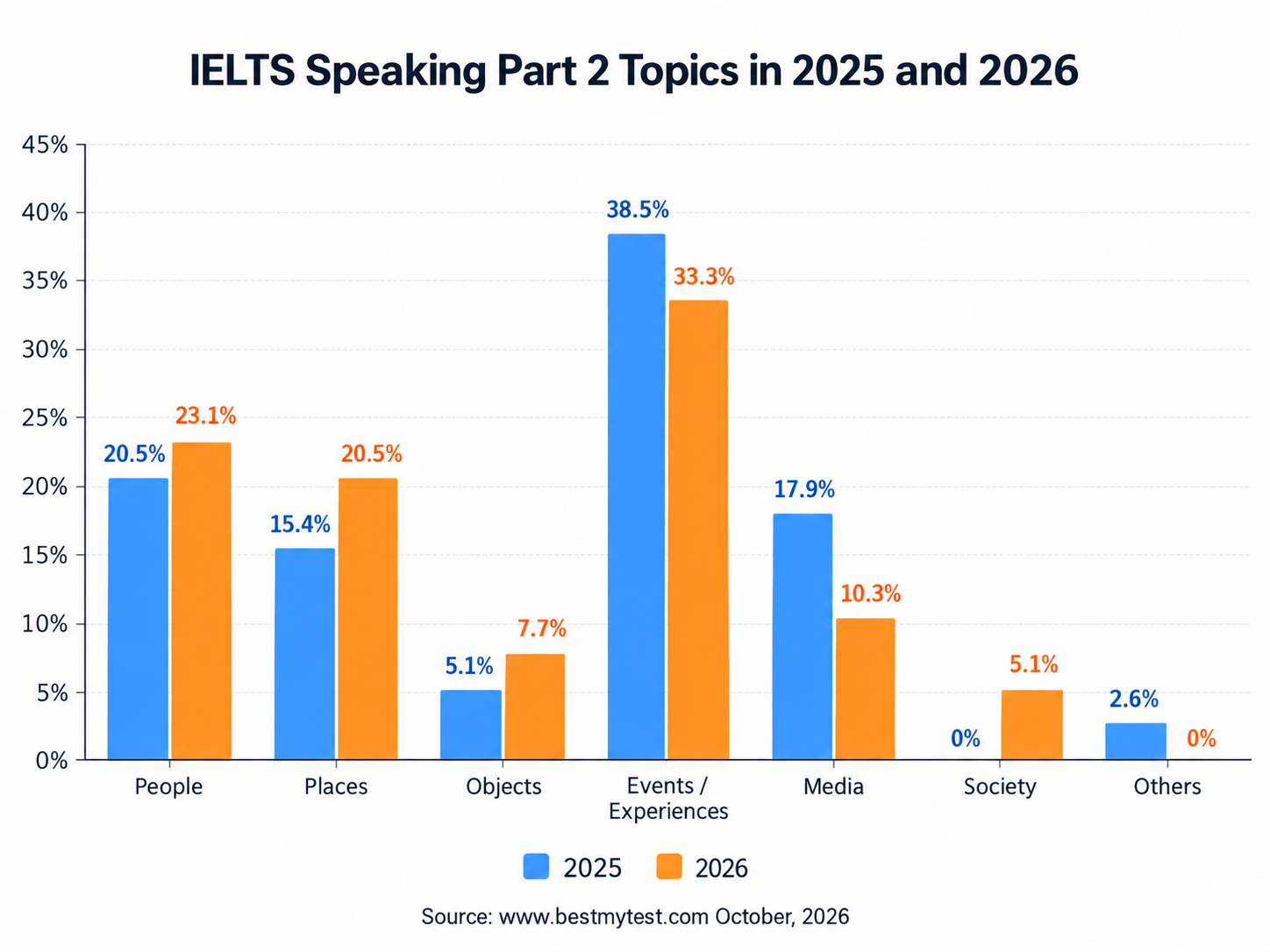
După cum se vede, evenimentele și experiențele sunt cea mai mare categorie în ambii ani, reprezentând 38,5% din subiecte în 2025 și 33,3% în 2026. Aceste întrebări îți cer de obicei să descrii ceva ce ai făcut sau ai trăit, cum ar fi o călătorie memorabilă, o sărbătoare specială sau un moment în care ai ajutat pe cineva.
Oamenii și locurile sunt și ele categorii importante. Împreună reprezintă 43,6% din subiectele din 2026. Ți se poate cere să descrii pe cineva pe care îl admiri, o persoană care te-a influențat, un loc pe care îți place să îl vizitezi sau o locație pe care ai vrea să o explorezi.
Alte categorii, inclusiv obiecte, media și societate, apar mai rar în acest eșantion. Merită totuși să le exersezi, pentru că întrebările IELTS Speaking pot acoperi o gamă largă de subiecte de zi cu zi.
Ce înseamnă asta pentru pregătirea ta la IELTS? Începe prin a exersa întrebări despre experiențele tale personale, oamenii pe care îi cunoști și locurile pe care le-ai vizitat. Aceste subiecte reprezintă o mare parte din întrebările din grafic. Pregătește câteva povești și exemple flexibile pe care să le adaptezi la întrebări diferite, în loc să memorezi răspunsuri complete.
Subiecte IELTS Speaking Part 1
Lista de mai jos conține mai mult decât întrebări – include și subiectele de speaking pe care examinatorii le-au pus persoanelor în trecut. Un sfat foarte bun este să răspunzi la aceste întrebări IELTS Speaking Part 1 în oglindă sau cu un prieten. Tabelul de mai jos arată frecvența cu care este folosit fiecare subiect:
| Subiecte | Frecvență |
|---|---|
| Hometown/Accommodation/Country | Ridicată |
| Friends/Family/Housework/Children | Ridicată |
| TV/Reading/Music/Newspapers & Magazines/Films | Ridicată |
| Technology/Computers/Internet | Ridicată |
| Work/Jobs/Career Planning/Volunteer Work | Ridicată |
| School majors/High School | Medie |
| Sports/Outdoor Activities/Indoor Activities | Medie |
| Travel/Lifestyle | Medie |
| Season/Rain/Sunny Days/Weather | Medie |
| Fashion/Shoes/Bags/Clothes | Medie |
| Transportation/Boats/Buses/Taxis | Medie |
| Celebrities/Advertisements/Media | Medie |
| Photos/Photography/Colors/Art | Scăzută |
| Noise/Patience/Politeness | Scăzută |
| Mirrors/Gifts | Scăzută |
Question 1
-
spellcheck TranscriptDo you enjoy going out in your free time? Why or why not?
-
Sample Response
Yeah, I usually enjoy going out in my free time because it helps me relax and meet new people. Honestly, it’s a great way to take a break from daily routine and clear my mind a little.
Watch the video question, then click to record your answer.
Practice speaking questions in our appQuestion 2
-
spellcheck TranscriptWhat kind of places do you usually go to when you go out?
-
Sample Response
Well, when I go out, I often like to visit cafes or parks. Sometimes, I also enjoy going to the cinema or shopping malls because those places are lively and fun to hang out in, you know.
Watch the video question, then click to record your answer.
Practice speaking questions in our appQuestion 3
-
spellcheck TranscriptWho do you prefer to go out with, friends or family? Why?
-
Sample Response
I think I prefer going out with friends, actually, because we share similar interests. However, sometimes I also enjoy spending time with my family. It really depends on the occasion, to be honest.
Watch the video question, then click to record your answer.
Practice speaking questions in our appQuestion 4
-
spellcheck TranscriptHow often do you go out in the evenings?
-
Sample Response
To be fair, I don’t go out every evening. I guess maybe two or three times a week, depending on my schedule. If I’m tired or busy, I usually just stay at home and relax.
Watch the video question, then click to record your answer.
Practice speaking questions in our appQuestion 5
-
spellcheck TranscriptHas the way you go out changed compared to when you were younger?
-
Sample Response
Yes, the way I go out has definitely changed since I was younger. I used to go out more often and stay out late. Now, I prefer quieter places and I’m a bit more careful with my time.
Watch the video question, then click to record your answer.
Practice speaking questions in our appQuestion 6
-
spellcheck TranscriptLet's move on to talk about goals. Do you have any specific goals for this year?
-
Sample Response
Let’s see, this year my main goal is to improve my English and maybe learn a new skill. I also want to travel to at least one new country if possible, just to experience something different.
Watch the video question, then click to record your answer.
Practice speaking questions in our appQuestion 7
-
spellcheck TranscriptWhy is it important for people to set goals?
-
Sample Response
I believe setting goals is really important because it gives us direction and motivation. Without goals, it’s easy to lose focus and just drift through life without achieving anything meaningful, don’t you think?
Watch the video question, then click to record your answer.
Practice speaking questions in our appQuestion 8
-
spellcheck TranscriptHave you ever achieved a goal that was difficult for you?
-
Sample Response
Actually, yes, I once had a goal to run a half marathon. It was really difficult for me because I’m not a natural runner. But after a lot of training, I finally managed to do it and I felt so proud.
Watch the video question, then click to record your answer.
Practice speaking questions in our appQuestion 9
-
spellcheck TranscriptHow do you keep track of your progress towards your goals?
-
Sample Response
To be honest, I usually write my goals down in a notebook or on my phone. I try to check in regularly, maybe once a week, to see how I’m doing and make any changes if needed.
Watch the video question, then click to record your answer.
Practice speaking questions in our appQuestion 10
-
spellcheck TranscriptDid you have any goals when you were a child?
-
Sample Response
When I was a child, I definitely had some goals, like becoming a teacher or learning to play the piano. Even though I didn’t achieve all of them, some childhood dreams still motivate me today.
Watch the video question, then click to record your answer.
Practice speaking questions in our app
Task Achievement — IELTS Speaking 1
Learn how to answer these questions in a step-by-step interactive exercise
Task Achievement — IELTS Speaking 1
Primul pas când răspunzi la o întrebare din IELTS Speaking Partea 1 este să dai un răspuns direct și apoi să îl dezvolți cu puțin mai multe detalii.
O structură simplă de răspuns te ajută să știi ce să spui în continuare, așa că poți răspunde repede și poți vorbi natural, fără să lungești prea mult răspunsul. În loc să te oprești după o singură propoziție scurtă, urmează structura pas cu pas.
În acest pas vei învăța cum să folosești această structură ca să construiești răspunsuri clare și naturale pentru IELTS Speaking Partea 1.
Hai să lucrăm la întrebarea 1.
Mai întâi, identifică tiparul întrebării. Întreabă-te: Ce mi se cere să fac în această întrebare? După ce recunoști tiparul, folosește structura de răspuns potrivită ca să îți ghidezi răspunsul.
La această întrebare, tiparul este Direct Answer, așa că urmează această structură:
Answer + Reason → Example or Detail → Result or Extra Detail
În timp ce vorbești, folosește expresii de umplutură controlate, precum Well, Actually, For example, What I mean by that is și So overall. Aceste expresii îți pot face răspunsul mai fluent și îți dau puțin timp în plus de gândire dacă uiți pentru o clipă ce voiai să spui. Folosește-le natural, nu în fiecare propoziție. Iată lista expresiilor de umplutură controlate.
Do you enjoy going out in your free time? Why or why not?
Hai să lucrăm la întrebarea 2.
Mai întâi, identifică tiparul întrebării. Întreabă-te: Ce mi se cere să fac în această întrebare? După ce recunoști tiparul, folosește structura de răspuns potrivită ca să îți ghidezi răspunsul.
La această întrebare, tiparul este Direct Answer, așa că urmează această structură:
Answer + Reason → Example or Detail → Result or Extra Detail
În timp ce vorbești, folosește expresii de umplutură controlate, precum Well, Actually, For example, What I mean by that is și So overall. Aceste expresii îți pot face răspunsul mai fluent și îți dau puțin timp în plus de gândire dacă uiți pentru o clipă ce voiai să spui. Folosește-le natural, nu în fiecare propoziție. Iată lista expresiilor de umplutură controlate.
What kind of places do you usually go to when you go out?
Hai să lucrăm la întrebarea 3.
Mai întâi, identifică tiparul întrebării. Întreabă-te: Ce mi se cere să fac în această întrebare? După ce recunoști tiparul, folosește structura de răspuns potrivită ca să îți ghidezi răspunsul.
La această întrebare, tiparul este Direct Answer, așa că urmează această structură:
Answer + Reason → Example or Detail → Result or Extra Detail
În timp ce vorbești, folosește expresii de umplutură controlate, precum Well, Actually, For example, What I mean by that is și So overall. Aceste expresii îți pot face răspunsul mai fluent și îți dau puțin timp în plus de gândire dacă uiți pentru o clipă ce voiai să spui. Folosește-le natural, nu în fiecare propoziție. Iată lista expresiilor de umplutură controlate.
Who do you prefer to go out with, friends or family? Why?
Hai să lucrăm la întrebarea 4.
Mai întâi, identifică tiparul întrebării. Întreabă-te: Ce mi se cere să fac în această întrebare? După ce recunoști tiparul, folosește structura de răspuns potrivită ca să îți ghidezi răspunsul.
La această întrebare, tiparul este Direct Answer, așa că urmează această structură:
Answer + Reason → Example or Detail → Result or Extra Detail
În timp ce vorbești, folosește expresii de umplutură controlate, precum Well, Actually, For example, What I mean by that is și So overall. Aceste expresii îți pot face răspunsul mai fluent și îți dau puțin timp în plus de gândire dacă uiți pentru o clipă ce voiai să spui. Folosește-le natural, nu în fiecare propoziție. Iată lista expresiilor de umplutură controlate.
How often do you go out in the evenings?
Hai să lucrăm la întrebarea 5.
Mai întâi, identifică tiparul întrebării. Întreabă-te: Ce mi se cere să fac în această întrebare? După ce recunoști tiparul, folosește structura de răspuns potrivită ca să îți ghidezi răspunsul.
La această întrebare, tiparul este Direct Answer, așa că urmează această structură:
Answer + Reason → Example or Detail → Result or Extra Detail
În timp ce vorbești, folosește expresii de umplutură controlate, precum Well, Actually, For example, What I mean by that is și So overall. Aceste expresii îți pot face răspunsul mai fluent și îți dau puțin timp în plus de gândire dacă uiți pentru o clipă ce voiai să spui. Folosește-le natural, nu în fiecare propoziție. Iată lista expresiilor de umplutură controlate.
Has the way you go out changed compared to when you were younger?
Hai să lucrăm la întrebarea 6.
Mai întâi, identifică tiparul întrebării. Întreabă-te: Ce mi se cere să fac în această întrebare? După ce recunoști tiparul, folosește structura de răspuns potrivită ca să îți ghidezi răspunsul.
La această întrebare, tiparul este Direct Answer, așa că urmează această structură:
Answer + Reason → Example or Detail → Result or Extra Detail
În timp ce vorbești, folosește expresii de umplutură controlate, precum Well, Actually, For example, What I mean by that is și So overall. Aceste expresii îți pot face răspunsul mai fluent și îți dau puțin timp în plus de gândire dacă uiți pentru o clipă ce voiai să spui. Folosește-le natural, nu în fiecare propoziție. Iată lista expresiilor de umplutură controlate.
Let's move on to talk about goals. Do you have any specific goals for this year?
Hai să lucrăm la întrebarea 7.
Mai întâi, identifică tiparul întrebării. Întreabă-te: Ce mi se cere să fac în această întrebare? După ce recunoști tiparul, folosește structura de răspuns potrivită ca să îți ghidezi răspunsul.
La această întrebare, tiparul este Direct Answer, așa că urmează această structură:
Answer + Reason → Example or Detail → Result or Extra Detail
În timp ce vorbești, folosește expresii de umplutură controlate, precum Well, Actually, For example, What I mean by that is și So overall. Aceste expresii îți pot face răspunsul mai fluent și îți dau puțin timp în plus de gândire dacă uiți pentru o clipă ce voiai să spui. Folosește-le natural, nu în fiecare propoziție. Iată lista expresiilor de umplutură controlate.
Why is it important for people to set goals?
Hai să lucrăm la întrebarea 8.
Mai întâi, identifică tiparul întrebării. Întreabă-te: Ce mi se cere să fac în această întrebare? După ce recunoști tiparul, folosește structura de răspuns potrivită ca să îți ghidezi răspunsul.
La această întrebare, tiparul este Direct Answer, așa că urmează această structură:
Answer + Reason → Example or Detail → Result or Extra Detail
În timp ce vorbești, folosește expresii de umplutură controlate, precum Well, Actually, For example, What I mean by that is și So overall. Aceste expresii îți pot face răspunsul mai fluent și îți dau puțin timp în plus de gândire dacă uiți pentru o clipă ce voiai să spui. Folosește-le natural, nu în fiecare propoziție. Iată lista expresiilor de umplutură controlate.
Have you ever achieved a goal that was difficult for you?
Hai să lucrăm la întrebarea 9.
Mai întâi, identifică tiparul întrebării. Întreabă-te: Ce mi se cere să fac în această întrebare? După ce recunoști tiparul, folosește structura de răspuns potrivită ca să îți ghidezi răspunsul.
La această întrebare, tiparul este Direct Answer, așa că urmează această structură:
Answer + Reason → Example or Detail → Result or Extra Detail
În timp ce vorbești, folosește expresii de umplutură controlate, precum Well, Actually, For example, What I mean by that is și So overall. Aceste expresii îți pot face răspunsul mai fluent și îți dau puțin timp în plus de gândire dacă uiți pentru o clipă ce voiai să spui. Folosește-le natural, nu în fiecare propoziție. Iată lista expresiilor de umplutură controlate.
How do you keep track of your progress towards your goals?
Hai să lucrăm la întrebarea 10.
Mai întâi, identifică tiparul întrebării. Întreabă-te: Ce mi se cere să fac în această întrebare? După ce recunoști tiparul, folosește structura de răspuns potrivită ca să îți ghidezi răspunsul.
La această întrebare, tiparul este Direct Answer, așa că urmează această structură:
Answer + Reason → Example or Detail → Result or Extra Detail
În timp ce vorbești, folosește expresii de umplutură controlate, precum Well, Actually, For example, What I mean by that is și So overall. Aceste expresii îți pot face răspunsul mai fluent și îți dau puțin timp în plus de gândire dacă uiți pentru o clipă ce voiai să spui. Folosește-le natural, nu în fiecare propoziție. Iată lista expresiilor de umplutură controlate.
Did you have any goals when you were a child?
Vrei să vezi lista noastră completă de subiecte IELTS Speaking? Le poți consulta aici: Vezi lista completă de subiecte de speaking
Cauți exemple IELTS Speaking cu răspunsuri? Poți începe să exersezi gratuit acum apăsând butonul de mai jos.
Test simulat IELTS Speaking gratuit - Part 1
Subiecte IELTS Speaking Part 2 și 3
Acum vei învăța câteva dintre subiectele cele mai frecvent folosite în speaking Part 2 și 3 și vei parcurge câteva întrebări legate de subiecte (fiecare întrebare include un răspuns model).
| Categorie generală | IELTS Speaking Part 2 și 3 |
|---|---|
| Media și divertisment | Advertisements/Art/Books/Internet/News/TV |
| Obiect | Clothing/Electronic Devices/Food/Furniture/Gifts Machine/Money/Musical Instruments/Traditional Products/Vegetables |
| Persoane | Teacher/Family/Friends/Influential People/Good Parents |
| Loc | City/Company/School/Museums/party/Shopping Places |
| Evenimente | A change in life/Decision/Exciting Experiences/Holiday/Illness Experiences Helping People/Memorable Experiences/An Experience of Being Late/Travel Experiences |
| Societate | Environment/Traffic Rule/Society/Transportation |
| Altele | Leisure Activities/Language/Sports |
Speaking Part 2 și 3 te vor testa pe subiecte similare, așa că subiectul work de mai jos va avea exemple de întrebări și răspunsuri incluse pentru ambele părți.
candidate task card
Describe your dream job.
You should say:
What kind of things you would do in that job
What the working conditions would be like
What kind of workplace you would work in
And say if you think you will be able to get a job like that or not, and why
-
Sample Response
My dream job is to be a freelance writer, and today I’ll explain a little bit about what it means to be a freelance writer, as well as why it interests me.
If I were a writer, I would use my computer to write things for different clients. A freelance employee does not have to work at an office, or at any specific company. My ideal workplace if I were a freelance writer would be at a home office. I would like to set up a comfortable desk in a quiet space at home for an environment that keeps me focused.
So, as a freelance writer, I would be able to do my writing from any place I choose, while also having some control over my work schedule. However, most writers will need complete assignments by a specific date, so there would still be some time constraints. I would probably have some stress over meeting deadlines on time, but I think I could handle it.
As far as finding a job as freelance writer is concerned, I think it may be possible in the future. First, I’ll need more experience writing, so that reputable companies will want to hire me. And most importantly, I’ll need to be financially stable enough that I can handle working less hours in the beginning.
Becoming a freelance writer would allow me independence, while doing something I enjoy. I believe with skill and patience, my dream of being a freelance writer will come true someday.
Read the cue card, then click to record your answer.
Practice speaking questions in our appTask Achievement — IELTS Speaking 2
Learn how to answer this question in a step-by-step interactive exercise
Task Achievement — IELTS Speaking 2
La **IELTS Speaking Partea 2** ai **1 minut de pregătire** înainte să vorbești **1–2 minute**. Examinatorul îți dă un **cartonaș cu subiectul**, un **creion** și o **foaie de hârtie** pentru notițe.
Folosește cu grijă acest timp de pregătire. Mai întâi, citește cartonașul înainte să-ți planifici răspunsul.
Nu trebuie să scrii sau să vorbești încă. Doar asigură-te că înțelegi ce cere fiecare punct. La pasul următor vei scrie **câte o idee scurtă pentru fiecare punct**.
Acum decide ce vrei să spui pentru fiecare punct de pe cartonaș. Scrie doar **o idee principală scurtă** pentru fiecare punct.
Ideea rapidă trebuie să aibă doar **câteva cuvinte sau o expresie scurtă**, **nu** o **propoziție întreagă sau un răspuns complet**. **Un singur rând scurt** pentru fiecare punct este suficient.
La pașii următori vei dezvolta fiecare idee adăugând un **detaliu de susținere** și o **reacție, decizie sau un rezultat personal**.
Pentru primul **punct de pe cartonaș**, păstrează ideea rapidă pe care ai scris-o deja și adaugă **unul sau două detalii de susținere**.
**Nu** încerca să scrii tot ce ai de gând să spui. În minutul de pregătire, scrie doar **4–5 cuvinte rapide sau expresii scurte** pentru punctele de pe cartonaș, în ordinea în care vrei să vorbești despre ele.
Folosește **al doilea rând** ca să adaugi un detaliu util, cum ar fi **cine, ce, unde, când, de ce, un exemplu sau o scurtă descriere**.
Folosește **al treilea rând** ca să adaugi ceva personal, cum ar fi **ce ai simțit, ce ai decis sau ce s-a întâmplat după aceea**. Nu trebuie să le incluzi pe toate. Alege-o pe cea care se potrivește cel mai bine.
Dacă ai nevoie de ajutor ca să începi, apasă pe **Show an Idea** ca să se completeze al doilea și al treilea rând.
Celelalte puncte de pe cartonaș rămân închise la acest pas.
Pentru al doilea **punct de pe cartonaș**, păstrează ideea rapidă pe care ai scris-o deja și adaugă **unul sau două detalii de susținere**.
**Nu** încerca să scrii tot ce ai de gând să spui. În minutul de pregătire, scrie doar **4–5 cuvinte rapide sau expresii scurte** pentru punctele de pe cartonaș, în ordinea în care vrei să vorbești despre ele.
Folosește **al doilea rând** ca să adaugi un detaliu util, cum ar fi **cine, ce, unde, când, de ce, un exemplu sau o scurtă descriere**.
Folosește **al treilea rând** ca să adaugi ceva personal, cum ar fi **ce ai simțit, ce ai decis sau ce s-a întâmplat după aceea**. Nu trebuie să le incluzi pe toate. Alege-o pe cea care se potrivește cel mai bine.
Dacă ai nevoie de ajutor ca să începi, apasă pe **Show an Idea** ca să se completeze al doilea și al treilea rând.
Celelalte puncte de pe cartonaș rămân închise la acest pas.
Pentru al treilea **punct de pe cartonaș**, păstrează ideea rapidă pe care ai scris-o deja și adaugă **unul sau două detalii de susținere**.
**Nu** încerca să scrii tot ce ai de gând să spui. În minutul de pregătire, scrie doar **4–5 cuvinte rapide sau expresii scurte** pentru punctele de pe cartonaș, în ordinea în care vrei să vorbești despre ele.
Folosește **al doilea rând** ca să adaugi un detaliu util, cum ar fi **cine, ce, unde, când, de ce, un exemplu sau o scurtă descriere**.
Folosește **al treilea rând** ca să adaugi ceva personal, cum ar fi **ce ai simțit, ce ai decis sau ce s-a întâmplat după aceea**. Nu trebuie să le incluzi pe toate. Alege-o pe cea care se potrivește cel mai bine.
Dacă ai nevoie de ajutor ca să începi, apasă pe **Show an Idea** ca să se completeze al doilea și al treilea rând.
Celelalte puncte de pe cartonaș rămân închise la acest pas.
Pentru al patrulea **punct de pe cartonaș**, păstrează ideea rapidă pe care ai scris-o deja și adaugă **unul sau două detalii de susținere**.
**Nu** încerca să scrii tot ce ai de gând să spui. În minutul de pregătire, scrie doar **4–5 cuvinte rapide sau expresii scurte** pentru punctele de pe cartonaș, în ordinea în care vrei să vorbești despre ele.
Folosește **al doilea rând** ca să adaugi un detaliu util, cum ar fi **cine, ce, unde, când, de ce, un exemplu sau o scurtă descriere**.
Folosește **al treilea rând** ca să adaugi ceva personal, cum ar fi **ce ai simțit, ce ai decis sau ce s-a întâmplat după aceea**. Nu trebuie să le incluzi pe toate. Alege-o pe cea care se potrivește cel mai bine.
Dacă ai nevoie de ajutor ca să începi, apasă pe **Show an Idea** ca să se completeze al doilea și al treilea rând.
Celelalte puncte de pe cartonaș rămân închise la acest pas.
Acum folosește-ți notițele ca să dai răspunsul complet. Vorbește între unul și două minute și acoperă fiecare punct de pe cartonaș.
Urmează notițele de la primul punct până la ultimul. Leagă ideea, detaliul și reacția personală într-o scurtă secvență vorbită pentru fiecare punct. Nu trebuie să memorezi formulările. Continuă să vorbești până ai acoperit toate cele patru puncte.
Question 1
-
spellcheck TranscriptDo you think job satisfaction is more important than your salary when choosing a job?
-
Sample Response
Yes, overall I think that job satisfaction outweighs salary in importance when someone chooses a job. Even though the job’s salary is important to survive and pay the bills, with enough money, it becomes more important to be happy at work. After all, most people spend the majority of their time outside of the home working, so they might as well be content, or even excited about their jobs. For people like me, I think being satisfied at work is a more important component when choosing a job than the salary.
Watch the video question, then click to record your answer.
Practice speaking questions in our appQuestion 2
-
spellcheck TranscriptWhat skills do you think are needed to get a good job these days?
-
Sample Response
These days I think having a variety of skills is important in the workplace, but there are a few that are essential to getting a good job. First, most employees today need to be able to communicate effectively with a variety of people. Speaking a second or even third language is one way to communicate well with many others. Another important skill to get a good job is being able to use a computer well, as in, typing, word processing, and using the internet. Without these skills, finding a job will be difficult for most people in today’s world.
Watch the video question, then click to record your answer.
Practice speaking questions in our appQuestion 3
-
spellcheck TranscriptDo you think that women should be able to do the same jobs as men?
-
Sample Response
Yes, as a woman I think that I should be allowed to do the same kind of jobs that men do. In the past, women were limited to very few lines of work, such as nursing and teaching. These days, we see women in all different jobs, and they make important contributions to the fields they work in, such as female scientists, doctors, and lawyers. Even though women and men are different in some ways, they should both still be equally able to find employment in a variety of jobs.
Watch the video question, then click to record your answer.
Practice speaking questions in our appQuestion 4
-
spellcheck TranscriptWhat’s the difference between white collar and blue collar jobs?
-
Sample Response
To me, there are two main differences between white collar and blue collar jobs. The first big difference is work environment. Blue collar workers tend to work on specific job sites, like construction sites, factories, or kitchens, while white collar workers are almost all in offices. Another big difference between these two types of jobs is the level of respect people give them socially. White collar workers tend to be seen as more successful, even if that’s not necessarily true. Blue collar workers are seen as more low-class by many, even if they are highly-skilled. So, those are the two ways I think blue and white collar jobs are different.
Watch the video question, then click to record your answer.
Practice speaking questions in our appQuestion 5
-
spellcheck TranscriptWhat jobs do you think are most valuable to society?
-
Sample Response
That’s a somewhat difficult question, because there are so many important jobs, but I would say that in today’s world, the most important jobs are those that provide us with stability, and those that promote progress. An example of a job that provides stability would be something like an electrician. This type of job keeps our houses and businesses powered, so we can live our lives without inconvenience. On the other hand, a type of job that promotes progress would be something like a scientist, who does research that may help us cure diseases or create new technology. Those are the two types of job I think matter most.
Watch the video question, then click to record your answer.
Practice speaking questions in our appTask Achievement — IELTS Speaking 3
Learn how to answer these questions in a step-by-step interactive exercise
Task Achievement — IELTS Speaking 3
Primul pas când răspunzi la o întrebare din IELTS Speaking Partea 3 este să identifici tiparul întrebării. După ce recunoști tiparul, poți folosi rapid în minte structura de răspuns potrivită.
Astfel știi clar ce să spui în continuare, așa că îți poți dezvolta răspunsul fără poticneli și fără să te blochezi. În loc să încerci să plănuiești tot răspunsul înainte să vorbești, urmează pur și simplu structura pas cu pas.
În acest pas vei învăța cele 8 tipare frecvente de întrebări din IELTS Speaking Partea 3 și structura de răspuns pentru fiecare. Dă clic pe fila fiecărui tipar ca să vezi cum funcționează.
Hai să lucrăm la întrebarea 1.
Mai întâi, identifică tiparul întrebării. Întreabă-te: Ce mi se cere să fac în această întrebare? După ce recunoști tiparul, folosește structura de răspuns potrivită ca să îți ghidezi răspunsul.
La această întrebare, tiparul este Opinion / View, așa că urmează această structură:
Answer → Reason → Explain → Example → Result → Second Point or Contrast → Conclusion
În timp ce vorbești, folosește expresii de umplutură controlate, precum Well, Actually, For example, What I mean by that is și So overall. Aceste expresii îți pot face răspunsul mai fluent și îți dau puțin timp în plus de gândire dacă uiți pentru o clipă ce voiai să spui. Folosește-le natural, nu în fiecare propoziție. Iată lista expresiilor de umplutură controlate.
Do you think job satisfaction is more important than your salary when choosing a job?
Hai să lucrăm la întrebarea 2.
Mai întâi, identifică tiparul întrebării. Întreabă-te: Ce mi se cere să fac în această întrebare? După ce recunoști tiparul, folosește structura de răspuns potrivită ca să îți ghidezi răspunsul.
La această întrebare, tiparul este Descriptive / Types, așa că urmează această structură:
Main Type → Explain → Example → Second Type → Explain or Compare → Overall View
În timp ce vorbești, folosește expresii de umplutură controlate, precum Well, Actually, For example, What I mean by that is și So overall. Aceste expresii îți pot face răspunsul mai fluent și îți dau puțin timp în plus de gândire dacă uiți pentru o clipă ce voiai să spui. Folosește-le natural, nu în fiecare propoziție. Iată lista expresiilor de umplutură controlate.
What skills do you think are needed to get a good job these days?
Hai să lucrăm la întrebarea 3.
Mai întâi, identifică tiparul întrebării. Întreabă-te: Ce mi se cere să fac în această întrebare? După ce recunoști tiparul, folosește structura de răspuns potrivită ca să îți ghidezi răspunsul.
La această întrebare, tiparul este Opinion / View, așa că urmează această structură:
Answer → Reason → Explain → Example → Result → Second Point or Contrast → Conclusion
În timp ce vorbești, folosește expresii de umplutură controlate, precum Well, Actually, For example, What I mean by that is și So overall. Aceste expresii îți pot face răspunsul mai fluent și îți dau puțin timp în plus de gândire dacă uiți pentru o clipă ce voiai să spui. Folosește-le natural, nu în fiecare propoziție. Iată lista expresiilor de umplutură controlate.
Do you think that women should be able to do the same jobs as men?
Hai să lucrăm la întrebarea 4.
Mai întâi, identifică tiparul întrebării. Întreabă-te: Ce mi se cere să fac în această întrebare? După ce recunoști tiparul, folosește structura de răspuns potrivită ca să îți ghidezi răspunsul.
La această întrebare, tiparul este Compare / Contrast, așa că urmează această structură:
Main Difference → Explain → Example → Second Difference → Contrast → Overall Comparison
În timp ce vorbești, folosește expresii de umplutură controlate, precum Well, Actually, For example, What I mean by that is și So overall. Aceste expresii îți pot face răspunsul mai fluent și îți dau puțin timp în plus de gândire dacă uiți pentru o clipă ce voiai să spui. Folosește-le natural, nu în fiecare propoziție. Iată lista expresiilor de umplutură controlate.
What’s the difference between white collar and blue collar jobs?
Hai să lucrăm la întrebarea 5.
Mai întâi, identifică tiparul întrebării. Întreabă-te: Ce mi se cere să fac în această întrebare? După ce recunoști tiparul, folosește structura de răspuns potrivită ca să îți ghidezi răspunsul.
La această întrebare, tiparul este Descriptive / Types, așa că urmează această structură:
Main Type → Explain → Example → Second Type → Explain or Compare → Overall View
În timp ce vorbești, folosește expresii de umplutură controlate, precum Well, Actually, For example, What I mean by that is și So overall. Aceste expresii îți pot face răspunsul mai fluent și îți dau puțin timp în plus de gândire dacă uiți pentru o clipă ce voiai să spui. Folosește-le natural, nu în fiecare propoziție. Iată lista expresiilor de umplutură controlate.
What jobs do you think are most valuable to society?
Vrei să vezi lista noastră completă de subiecte IELTS Speaking? Le poți consulta aici: Vezi lista completă de subiecte de speaking
Cauți exemple IELTS Speaking cu răspunsuri? Poți începe să exersezi gratuit acum apăsând butonul de mai jos.
Test simulat IELTS Speaking gratuit - Part 2
Cum să abordezi IELTS Speaking Part 1
După cum am menționat anterior, întrebările din IELTS Speaking Part 1 sunt asemănătoare conversațiilor zilnice cu vorbitori nativi. Dacă te simți confortabil purtând conversații de bază cu un vorbitor nativ de engleză, Part 1 nu ar trebui să fie prea dificil, însă tot trebuie să te pregătești pentru el.
Când răspunzi la subiectele IELTS Speaking din Part 1, răspunsul tău nu ar trebui să fie nici prea scurt, nici prea lung.. De exemplu, dacă ești întrebat „Do you like sports?”, a spune „No. I don't like sports.” nu este un răspuns suficient de bun. Ține minte mereu că ești aici pentru a dovedi că poți vorbi engleză, așa că trebuie să-i dai examinatorului răspunsuri mai lungi pentru ca el să te poată nota. Un răspuns acceptabil ar fi „I understand the benefits of being in sports and the entertainment of watching it, but even as a child, I could never get into sports. I prefer to sit down and read an engaging book.”. Ca regulă generală, un răspuns la Part 1 ar trebui să aibă aproximativ 3-4 propoziții.
Din fericire, există câteva modalități simple prin care îți poți extinde răspunsurile IELTS Speaking în mod natural, fără riscul de a folosi gramatică dificilă sau nefamiliară. Aici găsești 5 metode ușoare, cu exemple incluse, de a-ți extinde eficient răspunsurile la IELTS Speaking Part 1.
| 1. Oferirea unor motive | |
|---|---|
|
What do you like to do in your spare time? I am really into swimming, so I like to swim in my free time. I suppose this is thanks to the influence of my parents who both like swimming. |
|
|
What kind of programme do you like to watch on TV? My favorite TV programmes are dramas, since I don't have to think too much when I watch them. They're a little over dramatic at times, but that's part of the fun. |
|
|
Do you usually watch films alone or with others? I like watching films with my family and friends, because afterwards we can talk about our favorite parts and figure out what we think the plot was about. |
|
|
Who do you get on best within your family? It's hard to say, since we're all so close. I guess I probably get on best with my mother, as we are the most alike. We're both very chatty and warm people. |
|
| 2. Oferirea unor exemple | |
|---|---|
|
Do you like to keep fit? Yes! I like to keep fit. I am keen on sports! For instance, I play basketball every week and use the gym whenever I have the chance |
|
|
Do you like learning a new language? Yes! I really do! Take learning English as example. I love reading English magazines and listening to English podcasts. |
|
|
Is there anything you would change about your hometown? Well.. my least favorite thing about it is that there aren't too many fun things to do or see. A case in point is that shopping centres and restaurants close too early. |
|
| 3. Oferirea de detalii | |
|---|---|
|
Tell me about your hometown? My hometown, Delhi, is the second largest in India. The capital of the country, New Delhi, is also there. There is an international airport in Delhi, so it's easy to travel in and out of the country from there. |
|
|
Tell me about the kind of accommodation you live in? I live in a rented room in a paying guest accommodation. It is a superb building equipped with all the facilities. Round-the-clock security, access to free Wi-Fi, medical room and a common room all are made available to the guests living in the building. Every major part of the city is accessible from our building. |
|
|
Tell me about the favorite shop you often go to? It is a book shop near where I live. It's on the main street. I often go in there to browse and have a look through all the books they have. |
|
| 4. Vorbește despre trecut sau viitor | |
|---|---|
|
Where do you live in your country now? I am currently living in Delhi, which is the second most populated city in India. I've lived there for a couple of years, but I used to live in Bangalore, which is also a big city in southern India. |
|
|
Are you working at the moment? No! Not at the moment. I am unemployed now, but I am planning to apply for some internship positions this summer. Hopefully things will change soon. |
|
|
Have you ever been to a concert before? No. I've never been to a concert before, but I think I will. Concerts are always happening around where I live, so I will try to go check them out when I can. |
|
| 5. Formularea unor presupuneri | |
|---|---|
|
Do you think you'll ever live in another country? I suppose I'd be happy to leave my country if I was offered a job abroad that was interesting. |
|
|
What would be your ideal holiday destination? Hmm.. I'd doubt whether I'll ever go there, but I'd love to go to Africa to see the wild nature. Right now I don't have money for vacation. If I had more money, I would probably go with my girlfriend. |
|
|
What would be your ideal job? You know..that's a tricky one. It would probably be working as a software engineer in Google if I managed to pass Google's interview. |
|
Când vorbești la examen, încearcă să suni natural – ca și cum ai vorbi cu un prieten bun. Când te simți nervos sau stresat, este firesc să privești în jos, să vorbești pe un ton monoton, să vorbești prea încet, să dai răspunsuri scurte dintr-un singur cuvânt sau chiar să te încrunți. Aceste obiceiuri îți fac răspunsurile să sune mai puțin sigure pe sine și pot afecta negativ scorul, așa că sunt comportamente pe care trebuie să le eviți.
În schimb, concentrează-te pe lucrurile care creează o impresie puternică și pozitivă. Stabilește un contact vizual natural cu examinatorul, vorbește cu energie și entuziasm și proiectează-ți vocea astfel încât să fii ușor de auzit. Dă răspunsuri descriptive și dezvoltate, în loc de unele scurte, și nu uita să zâmbești. O atitudine prietenoasă și încrezătoare îți face vorbirea mult mai antrenantă și mai eficientă.
Cum să abordezi IELTS Speaking Part 2
IELTS Speaking Part 2 îți cere să vorbești 2 minute fără întrerupere și poate să vorbești despre un subiect nefamiliar. Mulți studenți IELTS devin nervoși și se stresează în timpul discursului și rămân fără lucruri de spus. Pentru a te ajuta să depășești aceste probleme, am pregătit 4 sfaturi IELTS Speaking care te pot ajuta să te simți încrezător și relaxat în timpul discursului.
1. Acoperă fiecare punct de pe cardul IELTS Speaking Part 2
Cardul îți dă un subiect și patru puncte despre care să vorbești. Vorbește despre fiecare punct, în ordinea în care apar pe card. Punctele sunt planul tău, așa că știi mereu ce să spui mai departe. Dacă un punct este greu, spune o idee scurtă despre el și treci la punctul următor. Rămâi la subiectul de pe card pe tot parcursul răspunsului.
2. Plănuiește-ți răspunsul în timpul minutului de pregătire
Vei avea un minut pentru a te pregăti înainte de a începe să vorbești. În timpul acestui minut, ar trebui să-ți stabilești structura răspunsului și să notezi câteva cuvinte cheie care să te ajute să-ți amintești despre ce vrei să vorbești în timpul discursului.
3. Nu-ți face griji că faci greșeli
Ultimul sfat IELTS Speaking este să nu-ți faci griji că faci greșeli. Toți cei care susțin un test IELTS Speaking fac greșeli de gramatică și de vocabular. Examinatorii se așteaptă, de fapt, să faci niște greșeli. Important este să transmiți mesajul; câteva greșeli mici nu îți vor afecta mesajul general. Ceea ce îți va afecta mesajul este să te gândești la greșeală, pentru că îți vei pierde firul gândirii și asta este foarte periculos. Dacă o poți corecta imediat, atunci este în regulă să o corectezi, dar dacă te chinui sau îți ia puțin timp să te gândești la corectură, uită de ea și mergi mai departe.
4. Pregătește o structură pentru a-ți planifica răspunsul de speaking
Nimic nu e mai rău decât să ai o idee în minte, dar să nu reușești să o spui clar. O structură te ajută să vorbești clar și îl ajută pe examinator să te urmărească. Iată o structură pentru răspunsul tău la IELTS Speaking Part 2: construiește fiecare punct de pe card în trei rânduri scurte.
Structura pentru IELTS Speaking Part 2: câte un punct pe rând
Folosește minutul de pregătire ca să scrii trei rânduri scurte pentru fiecare punct de pe card. Scrie cuvinte și expresii scurte, nu propoziții complete.
Idee rapidă:
Scrie o idee principală scurtă pentru punct, în câteva cuvinte. De exemplu, pentru „what it is” poți scrie „My HP laptop”.
Detaliu de sprijin:
Adaugă un detaliu util despre idee. Gândește-te la „who”, „what”, „where”, „when” sau „why”, la un exemplu sau la o descriere scurtă.
Reacție personală:
Adaugă ceva personal: cum te-ai simțit, ce ai decis sau ce s-a întâmplat după aceea. Alege varianta care se potrivește cel mai bine.
Vorbește după notițe:
Când examinatorul îți cere să începi, parcurge punctele în ordine. Pentru fiecare punct, leagă ideea, detaliul și reacția în câteva propoziții. Continuă să vorbești până acoperi toate cele patru puncte. Dacă mai ai timp după ultimul punct, poți adăuga o propoziție despre cum te simți în general, de exemplu „Overall, I feel ...”.
You should say:
- what it is
- what you used it for
- how long you have used it
- and describe why it is important to you
What I use it for: Study and entertainment / Notes, songs, Netflix / Faster than notes by hand
How long I have used it: About one year / Old laptop for five years / Wanted the latest software
Why it is important: Essential part of my life / Movies, music, blog, games / Will keep it if broken
-
Sample Response
This is an interesting topic. My immediate thought is that I find much electronic equipment useful, but I am going to talk about the laptop I have.
This is a laptop computer which is manufactured by HP. This laptop has a good configuration and it supports most of the latest software. It came with the Windows 8 operating system and a warranty for three years. I remembered my mom bought it for me as a present. We bought it at BestBuy. I remember it was black friday so the price is discounted.
As for what I used it for, I’d say it is useful in virtually all aspects of my life, including study, and entertainment. For instance, I use my laptop to take notes. I remember I used to take notes by hand in highschool. It was extremely time-consuming. Now with my laptop, I can type my notes directly into a document. It is just much faster and much more flexible. I also use my laptop for entertainment purposes. For example, When I get back home from school, I play songs on the laptop. On weekends, I like watching my favorite TV shows on Netflix. If I didn’t have my laptop, I would have to use my phone to watch videos, and I think the phone’s screen would be too small for me to really enjoy the program.
With regards to how long I have used it, well. I used to have a laptop for more than 5 years but I bought this current one a year ago because this one has the latest software.
Finally, I want to talk about why it is important to me. As I said earlier, this laptop has become an essential piece of equipment for me in every aspect of my life. I use it to watch movies and listen to music. I also use it to take notes. I even use it to write a blog, and play games occasionally.
Overall, I feel I am a bit emotionally attached to this laptop as it has become part of my life. I think in the future, I will continue to use it until it is broken. Even it is broken, I will still keep it and treat it as a valuable item.
Read the cue card, then click to record your answer.
Practice speaking questions in our appTask Achievement — IELTS Speaking 2
Learn how to answer this question in a step-by-step interactive exercise
Task Achievement — IELTS Speaking 2
La **IELTS Speaking Partea 2** ai **1 minut de pregătire** înainte să vorbești **1–2 minute**. Examinatorul îți dă un **cartonaș cu subiectul**, un **creion** și o **foaie de hârtie** pentru notițe.
Folosește cu grijă acest timp de pregătire. Mai întâi, citește cartonașul înainte să-ți planifici răspunsul.
Nu trebuie să scrii sau să vorbești încă. Doar asigură-te că înțelegi ce cere fiecare punct. La pasul următor vei scrie **câte o idee scurtă pentru fiecare punct**.
Acum decide ce vrei să spui pentru fiecare punct de pe cartonaș. Scrie doar **o idee principală scurtă** pentru fiecare punct.
Ideea rapidă trebuie să aibă doar **câteva cuvinte sau o expresie scurtă**, **nu** o **propoziție întreagă sau un răspuns complet**. **Un singur rând scurt** pentru fiecare punct este suficient.
La pașii următori vei dezvolta fiecare idee adăugând un **detaliu de susținere** și o **reacție, decizie sau un rezultat personal**.
Pentru primul **punct de pe cartonaș**, păstrează ideea rapidă pe care ai scris-o deja și adaugă **unul sau două detalii de susținere**.
**Nu** încerca să scrii tot ce ai de gând să spui. În minutul de pregătire, scrie doar **4–5 cuvinte rapide sau expresii scurte** pentru punctele de pe cartonaș, în ordinea în care vrei să vorbești despre ele.
Folosește **al doilea rând** ca să adaugi un detaliu util, cum ar fi **cine, ce, unde, când, de ce, un exemplu sau o scurtă descriere**.
Folosește **al treilea rând** ca să adaugi ceva personal, cum ar fi **ce ai simțit, ce ai decis sau ce s-a întâmplat după aceea**. Nu trebuie să le incluzi pe toate. Alege-o pe cea care se potrivește cel mai bine.
Dacă ai nevoie de ajutor ca să începi, apasă pe **Show an Idea** ca să se completeze al doilea și al treilea rând.
Celelalte puncte de pe cartonaș rămân închise la acest pas.
Pentru al doilea **punct de pe cartonaș**, păstrează ideea rapidă pe care ai scris-o deja și adaugă **unul sau două detalii de susținere**.
**Nu** încerca să scrii tot ce ai de gând să spui. În minutul de pregătire, scrie doar **4–5 cuvinte rapide sau expresii scurte** pentru punctele de pe cartonaș, în ordinea în care vrei să vorbești despre ele.
Folosește **al doilea rând** ca să adaugi un detaliu util, cum ar fi **cine, ce, unde, când, de ce, un exemplu sau o scurtă descriere**.
Folosește **al treilea rând** ca să adaugi ceva personal, cum ar fi **ce ai simțit, ce ai decis sau ce s-a întâmplat după aceea**. Nu trebuie să le incluzi pe toate. Alege-o pe cea care se potrivește cel mai bine.
Dacă ai nevoie de ajutor ca să începi, apasă pe **Show an Idea** ca să se completeze al doilea și al treilea rând.
Celelalte puncte de pe cartonaș rămân închise la acest pas.
Pentru al treilea **punct de pe cartonaș**, păstrează ideea rapidă pe care ai scris-o deja și adaugă **unul sau două detalii de susținere**.
**Nu** încerca să scrii tot ce ai de gând să spui. În minutul de pregătire, scrie doar **4–5 cuvinte rapide sau expresii scurte** pentru punctele de pe cartonaș, în ordinea în care vrei să vorbești despre ele.
Folosește **al doilea rând** ca să adaugi un detaliu util, cum ar fi **cine, ce, unde, când, de ce, un exemplu sau o scurtă descriere**.
Folosește **al treilea rând** ca să adaugi ceva personal, cum ar fi **ce ai simțit, ce ai decis sau ce s-a întâmplat după aceea**. Nu trebuie să le incluzi pe toate. Alege-o pe cea care se potrivește cel mai bine.
Dacă ai nevoie de ajutor ca să începi, apasă pe **Show an Idea** ca să se completeze al doilea și al treilea rând.
Celelalte puncte de pe cartonaș rămân închise la acest pas.
Pentru al patrulea **punct de pe cartonaș**, păstrează ideea rapidă pe care ai scris-o deja și adaugă **unul sau două detalii de susținere**.
**Nu** încerca să scrii tot ce ai de gând să spui. În minutul de pregătire, scrie doar **4–5 cuvinte rapide sau expresii scurte** pentru punctele de pe cartonaș, în ordinea în care vrei să vorbești despre ele.
Folosește **al doilea rând** ca să adaugi un detaliu util, cum ar fi **cine, ce, unde, când, de ce, un exemplu sau o scurtă descriere**.
Folosește **al treilea rând** ca să adaugi ceva personal, cum ar fi **ce ai simțit, ce ai decis sau ce s-a întâmplat după aceea**. Nu trebuie să le incluzi pe toate. Alege-o pe cea care se potrivește cel mai bine.
Dacă ai nevoie de ajutor ca să începi, apasă pe **Show an Idea** ca să se completeze al doilea și al treilea rând.
Celelalte puncte de pe cartonaș rămân închise la acest pas.
Acum folosește-ți notițele ca să dai răspunsul complet. Vorbește între unul și două minute și acoperă fiecare punct de pe cartonaș.
Urmează notițele de la primul punct până la ultimul. Leagă ideea, detaliul și reacția personală într-o scurtă secvență vorbită pentru fiecare punct. Nu trebuie să memorezi formulările. Continuă să vorbești până ai acoperit toate cele patru puncte.
- Who they are
- How you met them
- Why you think they are good parents
- And explain what it requires to be good parents.
How I met them: Through Delilah, at fourteen / Moved from another country / Always chatted with me
Why they are good parents: Respect and attention / Gave us our space / I respect and admire them
What good parents need: Clear rules and some freedom / Their own hobbies and interests / Support a child's interests
-
Sample Response
Although I’ve met many great parents throughout my life, I think some of the people I know who best exemplify good parenting are my best friend from high school’s parents.
My friend Delilah and I met when I was about 14 years old. Her parents moved to the country where I grew up from a different country, so their cultural background was a little different than my family’s. When I would go to her house, her parents would always make a point to have a short conversation with me. They genuinely seemed interested in our lives.
I think the reason why I respect and admire Delilah’s parents so much is that they always treated us with respect, gave us our space, and yet seemed very attentive to us at the same time. With their own daughter Delilah, they had established clear boundaries as far as what was expected from her, but they also gave her quite a bit of freedom. The most important reason why I think they are good examples as parents is that they had their own hobbies and interests, and helped Delilah to do the same. When she expressed interest in something, they gave her as many opportunities as possible to do it.
Read the cue card, then click to record your answer.
Practice speaking questions in our appTask Achievement — IELTS Speaking 2
Learn how to answer this question in a step-by-step interactive exercise
Task Achievement — IELTS Speaking 2
La **IELTS Speaking Partea 2** ai **1 minut de pregătire** înainte să vorbești **1–2 minute**. Examinatorul îți dă un **cartonaș cu subiectul**, un **creion** și o **foaie de hârtie** pentru notițe.
Folosește cu grijă acest timp de pregătire. Mai întâi, citește cartonașul înainte să-ți planifici răspunsul.
Nu trebuie să scrii sau să vorbești încă. Doar asigură-te că înțelegi ce cere fiecare punct. La pasul următor vei scrie **câte o idee scurtă pentru fiecare punct**.
Acum decide ce vrei să spui pentru fiecare punct de pe cartonaș. Scrie doar **o idee principală scurtă** pentru fiecare punct.
Ideea rapidă trebuie să aibă doar **câteva cuvinte sau o expresie scurtă**, **nu** o **propoziție întreagă sau un răspuns complet**. **Un singur rând scurt** pentru fiecare punct este suficient.
La pașii următori vei dezvolta fiecare idee adăugând un **detaliu de susținere** și o **reacție, decizie sau un rezultat personal**.
Pentru primul **punct de pe cartonaș**, păstrează ideea rapidă pe care ai scris-o deja și adaugă **unul sau două detalii de susținere**.
**Nu** încerca să scrii tot ce ai de gând să spui. În minutul de pregătire, scrie doar **4–5 cuvinte rapide sau expresii scurte** pentru punctele de pe cartonaș, în ordinea în care vrei să vorbești despre ele.
Folosește **al doilea rând** ca să adaugi un detaliu util, cum ar fi **cine, ce, unde, când, de ce, un exemplu sau o scurtă descriere**.
Folosește **al treilea rând** ca să adaugi ceva personal, cum ar fi **ce ai simțit, ce ai decis sau ce s-a întâmplat după aceea**. Nu trebuie să le incluzi pe toate. Alege-o pe cea care se potrivește cel mai bine.
Dacă ai nevoie de ajutor ca să începi, apasă pe **Show an Idea** ca să se completeze al doilea și al treilea rând.
Celelalte puncte de pe cartonaș rămân închise la acest pas.
Pentru al doilea **punct de pe cartonaș**, păstrează ideea rapidă pe care ai scris-o deja și adaugă **unul sau două detalii de susținere**.
**Nu** încerca să scrii tot ce ai de gând să spui. În minutul de pregătire, scrie doar **4–5 cuvinte rapide sau expresii scurte** pentru punctele de pe cartonaș, în ordinea în care vrei să vorbești despre ele.
Folosește **al doilea rând** ca să adaugi un detaliu util, cum ar fi **cine, ce, unde, când, de ce, un exemplu sau o scurtă descriere**.
Folosește **al treilea rând** ca să adaugi ceva personal, cum ar fi **ce ai simțit, ce ai decis sau ce s-a întâmplat după aceea**. Nu trebuie să le incluzi pe toate. Alege-o pe cea care se potrivește cel mai bine.
Dacă ai nevoie de ajutor ca să începi, apasă pe **Show an Idea** ca să se completeze al doilea și al treilea rând.
Celelalte puncte de pe cartonaș rămân închise la acest pas.
Pentru al treilea **punct de pe cartonaș**, păstrează ideea rapidă pe care ai scris-o deja și adaugă **unul sau două detalii de susținere**.
**Nu** încerca să scrii tot ce ai de gând să spui. În minutul de pregătire, scrie doar **4–5 cuvinte rapide sau expresii scurte** pentru punctele de pe cartonaș, în ordinea în care vrei să vorbești despre ele.
Folosește **al doilea rând** ca să adaugi un detaliu util, cum ar fi **cine, ce, unde, când, de ce, un exemplu sau o scurtă descriere**.
Folosește **al treilea rând** ca să adaugi ceva personal, cum ar fi **ce ai simțit, ce ai decis sau ce s-a întâmplat după aceea**. Nu trebuie să le incluzi pe toate. Alege-o pe cea care se potrivește cel mai bine.
Dacă ai nevoie de ajutor ca să începi, apasă pe **Show an Idea** ca să se completeze al doilea și al treilea rând.
Celelalte puncte de pe cartonaș rămân închise la acest pas.
Pentru al patrulea **punct de pe cartonaș**, păstrează ideea rapidă pe care ai scris-o deja și adaugă **unul sau două detalii de susținere**.
**Nu** încerca să scrii tot ce ai de gând să spui. În minutul de pregătire, scrie doar **4–5 cuvinte rapide sau expresii scurte** pentru punctele de pe cartonaș, în ordinea în care vrei să vorbești despre ele.
Folosește **al doilea rând** ca să adaugi un detaliu util, cum ar fi **cine, ce, unde, când, de ce, un exemplu sau o scurtă descriere**.
Folosește **al treilea rând** ca să adaugi ceva personal, cum ar fi **ce ai simțit, ce ai decis sau ce s-a întâmplat după aceea**. Nu trebuie să le incluzi pe toate. Alege-o pe cea care se potrivește cel mai bine.
Dacă ai nevoie de ajutor ca să începi, apasă pe **Show an Idea** ca să se completeze al doilea și al treilea rând.
Celelalte puncte de pe cartonaș rămân închise la acest pas.
Acum folosește-ți notițele ca să dai răspunsul complet. Vorbește între unul și două minute și acoperă fiecare punct de pe cartonaș.
Urmează notițele de la primul punct până la ultimul. Leagă ideea, detaliul și reacția personală într-o scurtă secvență vorbită pentru fiecare punct. Nu trebuie să memorezi formulările. Continuă să vorbești până ai acoperit toate cele patru puncte.
Cum să abordezi IELTS Speaking Part 3
În Part 3 al testului IELTS Speaking, examinatorul îți va pune o gamă mai largă de întrebări care se bazează pe subiectele discutate în Part 2. Aceste întrebări sunt mai generale și îți cer să-ți dezvolți răspunsul mai mult, cu explicații și exemple.
Dacă ai făcut puțină cercetare despre întrebările IELTS Speaking pentru Part 3, probabil te-ai gândit că sunt imprevizibile, ceea ce le face dificil de pregătit. Totuși, dacă te uiți atent la ele, poți observa tipare printre întrebări. În general vorbind, întrebările din IELTS Speaking Part 3 îți cer să
- oferi opinia ta pe un subiect
- exprimi preferința ta pe un subiect
- compari și să contrastezi două lucruri
- faci o predicție despre ceva în viitor
- faci o comparație cu trecutul
- vorbești despre o situație ipotetică
- vorbești despre ideile tale despre oameni în societate
- vorbești despre cauze și efecte
- oferi soluții la o problemă
| Tipuri de întrebări IELTS Speaking Part 3 | |
|---|---|
Oferă opinia ta pe un subiect
|
|
Exprimă-ți preferința
|
|
Vorbește despre oameni sau lucruri din țara ta
|
|
Vorbește despre cauze și efecte
|
|
Compară și contrastează două lucruri
|
|
Fă o predicție despre ceva în viitor
|
|
Fă o comparație cu trecutul
|
|
Vorbește despre o situație ipotetică
|
|
Oferă soluții la o problemă
|
|
Dacă ești îngrijorat că trebuie să vorbești atâtea propoziții, nu ești singurul. Chiar și vorbitorii nativi ar avea nevoie să exerseze cu întrebări IELTS Speaking pentru a oferi un răspuns de 5-8 propoziții cu scor mare. Totuși, există câteva șabloane de răspuns IELTS Speaking care îți vor ușura viața. Atâta vreme cât exersezi suficiente întrebări, înveți subiectele noastre IELTS Speaking și urmezi structura noastră de speaking, te vei simți mai încrezător și îți vei îmbunătăți vorbirea.
Acum hai să ne uităm la cum să-ți structurezi răspunsul în funcție de stilul întrebării IELTS Speaking. Ține minte că structurile de răspuns sunt doar pentru a te ajuta să ai o imagine clară despre ce vrei să spui și pentru a te ajuta să rămâi organizat. Totuși, nu trebuie neapărat să le urmezi, atâta vreme cât răspunsul tău este pe subiect și îți poate evidenția competența în engleză.
Hai să ne uităm la cum să-ți extinzi și să-ți structurezi răspunsul în funcție de stilul întrebării.
| Fă o predicție despre ceva în viitor | |
|---|---|
| Structură |
|
| Întrebare IELTS Speaking | What do you think cities will be like in 50 years time? |
| Răspuns model și analiză: | |
|
Descrie predicția:
I think cities in the future will be more densely populated. At the same time, people will still require transportation, so I think the transportation in future cities will be more modern, fast, and convenient. Descrie tendința actuală și spune că această tendință va continua probabil: In fact, I think there is a growing trend across the world of futuristic cities emerging where transportation is becoming more convenient to meet the growing demands of population. This trend will probably continue going forward. Descrie cum te simți față de această predicție: I personally like this trend as more futuristic cities will emerge. A good example of a futuristic city is I think I will say it is Tokyo, where people have access to clean transportation, and live in compact spaces, like high-rises. |
|
| Fă o comparație cu trecutul | |
|---|---|
| Structură |
|
| Întrebare IELTS Speaking | How has teaching changed in your country over the past few decades? |
| Răspuns model și analiză: | |
|
Spune că au existat schimbări în ultimul deceniu:
In the past few decades, there have definitely been some noticeable changes in education through generations. Descrie prima comparație: I mean ..most notably, students today can no longer be punished physically by teachers, while in the past, that was pretty common. Descrie a doua comparație: Another way that education has changed is teacher student interaction. Today, it’s more normal to see students answering questions and having discussions, while in the past, the teacher simply lectured, and the students listened silently. Descrie cum te simți față de această schimbare: Overall, I think education is making progress in my country. |
|
| Compară și contrastează două lucruri | |
|---|---|
| Structură |
|
| Întrebare IELTS Speaking | What are the differences between living in the city and the countryside? |
| Răspuns model și analiză: | |
|
Spune că există câteva diferențe între cele două lucruri:
For me, there are quite a few differences between life in the city and life in the country. Life in the city and in the country is vastly different. Descrie prima comparație: First of all, the way people interact with each other is different. For example, in a small town, people usually wave to say hello, and notice strangers in town. But in a big city, most people ignore each other and try to give each other space in public. Descrie a doua comparație: Another big difference between the two is the amount of noise, which is higher in cities, and lower in small towns. Oferă o scurtă concluzie: Overall, life in both places varies. |
|
| Oferă soluții la o problemă | |
|---|---|
| Structură |
|
| Întrebare IELTS Speaking | How can we stop violence on TV? |
| Răspuns model și analiză: | |
|
Vorbește pe scurt despre problemă:
I think violence on TV is the most problematic for children, but there isn’t really a simple way to make it stop, because there is a demand for action, horror, and excitement on TV. Vorbește despre prima soluție: The way I see it, there are two possible ways to deal with violent TV shows. The first is to make policies that actually ban that kind of programming altogether, although that would likely not be popular. Vorbește despre a doua soluție: The second way could be to educate people on why violent TV shows are problematic, and see if they will stop watching the shows to lower the demand for them. Descrie cum te simți față de problemă și soluții: I mean either way, I think this problem probably isn’t going to disappear with just one simple solution. |
|
| Vorbește despre cauzele sau efectele unui fenomen | |
|---|---|
| Structură |
|
| Întrebare IELTS Speaking | What are some of the causes of water pollution? |
| Răspuns model și analiză: | |
|
Vorbește pe scurt despre fenomen:
Water pollution definitely has more disastrous effects on our health Subliniază cauza sau efectul: From what I understand, water pollution is caused mostly by human activity, so it seems like the likely sources of water pollution would be factories, runoff from farms, and sewage from cities. Oferă un exemplu al cauzei sau efectului: For instance, I’ve seen a few studies recently that declared the Australian Great Barrier Reef to be dead due to man-made pollutants and garbage in the water. Descrie cum te simți față de fenomen: I think it’s quite sad, as that probably could have been prevented if people paid more attention to the effects big industry has on the environment. |
|
| Vorbește despre oameni sau lucruri din țara ta | |
|---|---|
| Structură |
|
| Întrebare IELTS Speaking | How popular is watching television in your country? |
| Răspuns model și analiză: | |
|
Răspunde la întrebarea IELTS Speaking:
As far as I know, watching TV is probably one of the most popular pastimes for people in my country. Oferă exemple despre cum fac majoritatea oamenilor lucrurile: For example, in the evening, almost every home I pass has the TV in the living room switched on, and families will be sitting around together watching shows. I think most people like watching the news, or watching dramas. Oferă exemple despre cum faci tu lucrurile: As for me, I also watch quite a bit of TV when I’m at home. For instance, I watch sitcoms on Friday nights after work.I guess other people in my country probably do the same thing as I do. |
|
| Oferă opinia ta pe un subiect | |
|---|---|
| Întrebare IELTS Speaking | Do you think people spend too much money on electronic devices? |
| Răspuns model și analiză: | |
|
Răspunde la întrebare:
If you ask me, yes, I think that some people spend too much money trying to keep up with the latest trends in technology. Explică motivul: However, I can understand why they do it, because these days devices become obsolete almost immediately after they are purchased. Oferă exemple pentru a-ți susține motivele: For example, a new smartphone might have some great new camera today, but tomorrow, another one will appear with an even better camera. Then, everyone will want to upgrade to the new device. As for me, I am satisfied with using a slightly outdated device in order to save money until I really need a new one. |
|
| Exprimă-ți preferința | |
|---|---|
| Întrebare IELTS Speaking | Do you generally read a lot of books or do you prefer watching T.V? |
| Răspuns model și analiză: | |
|
Răspunde la întrebare:
Even though I love to read, the reality is I spend quite a bit more time watching TV. Explică motivul: I think the main reason I watch more TV is because it’s lazier, which is unfortunate. But at the same time, there are some great shows to choose from. Oferă exemple pentru a-ți susține motivele: For instance, one of my favorite shows is “Dexter”, which has great writing, an interesting plot, and well-developed characters, just like a book. I think in the age we live in now, TV is just going to keep getting better and better, so I am going to probably continue watching more TV. |
|
| Vorbește despre o situație ipotetică | |
|---|---|
| Întrebare IELTS Speaking | If you could influence or had the power to change the world with your writings what would you want to change? |
| Răspuns model și analiză: | |
|
Răspunde la întrebare:
If I could change the world with my writings, my biggest priority would probably be to educate people about how and why they need to make changes to what they buy, what they eat, and consume to help save the environment. Explică motivul: The main reason is that people nowadays are using so much disposable plastic and products. This has led to many environmental problems. If my writing could change our consumption habits, that would have a drastic effect on our environmental footprint. Oferă exemple pentru a-ți susține motivele: For example, I’ve seen a few studies recently predicting that, by 2050, the mass of plastic in the world’s oceans will exceed the mass of all the fish that live there. If that happens, the entire food chain will be severely damaged. |
|
Practica IELTS Speaking pentru succesul tău
BestMyTest este un curs online de pregătire IELTS conceput pentru comoditatea ta. Întrebările noastre IELTS Speaking au fost create pentru a arăta și a se simți identic cu testul oficial IELTS Speaking (am făcut tot posibilul să simulăm un scenariu de tip interviu pentru tine). Ne-am asigurat că totul este la fel, inclusiv dificultatea, formatarea și chiar modul în care funcționează testul. Te rugăm să reții că oferim 4 teste IELTS simulate cu întrebări nemaivăzute și un exemplu complet gratuit de test IELTS Speaking. Poți începe să exersezi acum: IELTS Speaking Practice 1 part 1
Aceste subiecte IELTS Speaking au fost create pe baza subiectelor celor mai recente, așa că exemplele noastre IELTS Speaking sunt relevante pentru pregătirea ta IELTS Speaking! Asigură-te că le parcurgi pe toate și vei obține un band score IELTS Speaking ridicat.
Ce urmează
Înscrie-te pentru un trial gratuit de 7 zile pentru a avea acces la lecțiile și întrebările noastre IELTS Speaking și începe-ți pregătirea IELTS.
Trial gratuit de 7 zileCum sunt punctate întrebările IELTS Speaking
Ce ne arată 52.000 de înregistrări ale probei orale IELTS
Între 2023 și 2026, BestMyTest a evaluat 52.043 de înregistrări ale probei orale IELTS de la 2.557 de cursanți, iar profesorii noștri au analizat încă 3.600 de răspunsuri și teste orale complete. Tiparul este același în fiecare set de date: gramatica este criteriul cu cele mai slabe rezultate, iar pronunția, cel cu cele mai bune.
- Gramatica determină nivelul de punctaj. Varietatea și corectitudinea gramaticală a avut cel mai mic punctaj dintre cele patru criterii în 71% dintre înregistrările pentru Part 1, 81% pentru Part 2 și 83% pentru Part 3. Profesorii noștri i-au acordat cel mai mic punctaj în 79%, 85% și 86% dintre răspunsurile analizate.
- Pronunția rareori îl determină. Pronunția a fost criteriul cu cel mai mic punctaj în mai puțin de 4% dintre înregistrări. Dacă ești la nivelul de punctaj 6, accentul tău nu este aproape niciodată ceea ce te împiedică să progresezi.
- Mediile acordate de profesori pentru răspunsuri individuale: Part 1: gramatică 5.2, vocabular 5.7, fluență și coerență 6.0, pronunție 7.1. Part 3 este cea mai dificilă din punct de vedere gramatical, cu un punctaj de 5.0.
- Viteza face diferența între nivelurile de punctaj, nu numărul de pauze. Cursanții evaluați la nivelul de punctaj 5 au rostit 57 de cuvinte corecte pe minut și au tăcut 39% din timp. Cursanții de nivelul 7 au rostit 107 cuvinte pe minut și au tăcut 23% din timp. Numărul de pauze pe minut a fost de aproximativ 45 la fiecare nivel de punctaj, așadar cei care vorbesc bine fac pauze la fel de des, dar mai scurte.
- Mulți cursanți se blochează. 18% dintre înregistrările pentru Part 2 și 22% dintre înregistrările pentru Part 3 nu conțineau exprimare orală care să poată fi evaluată, față de 5% pentru Part 1. Exersarea monologului și a întrebărilor abstracte din Part 3 cu un cronometru contează mai mult decât exersarea Part 1.
- Lungimile tipice ale răspunsurilor, conform datelor noastre: Part 1: aproximativ 55 de cuvinte în 30 de secunde, Part 3: aproximativ 75 de cuvinte în 40 de secunde, Part 2: aproximativ 180 de cuvinte în 100 de secunde.
- Cuvintele pe care cursanții noștri le pronunță greșit cel mai des, din 2.16 milioane de încercări evaluate de pronunțare a cuvintelor în exercițiile de exprimare orală TOEFL și IELTS: calm, meals, decisions, offer, energy, wanted, bears, moments, culture și uncomfortable. Problemele comune sunt omiterea sunetelor finale (-s, -ed), literele care nu se pronunță (calm) și plasarea greșită a accentului în cuvânt (energy, culture, museum).
Cifrele provin din datele BestMyTest privind testele de antrenament și evaluările, până în octombrie 2026. Procentele pe tipuri de întrebări reprezintă ratele de răspunsuri corecte din totalul încercărilor; cifrele pe criterii reprezintă punctajele acordate de profesori sau de IA, conform indicațiilor. Ultima actualizare: 5 octombrie 2026.
În testul IELTS Speaking, abilitatea ta de a vorbi va fi notată pe baza a patru categorii. Acestea sunt cunoscute ca Fluency and Coherence, Lexical Resource, Grammatical Range and Accuracy și Pronunciation. Citește mai departe pentru o ocazie de a te familiariza cu fiecare dintre aceste categorii. Pentru mai multe informații, poți consulta și aceste descrieri de band pe care examinatorii IELTS le folosesc pentru a nota secțiunea Speaking a testului. Acum, hai să ne uităm la aceste patru categorii în detaliu.
Fluency & Coherence
Poți să-ți discuți gândurile într-un mod clar și logic? Fluența se referă la capacitatea ta de a-ți transmite ideile în mod rațional, iar coerența se referă la măsura în care ceilalți îți pot înțelege ideile. Pentru a obține un scor Band 9 la categoria Fluency and Coherence, ar trebui să poți vorbi continuu fără a te opri pentru a-ți aminti cuvinte sau gramatică, în timp ce dezvolți simultan un răspuns complet și practic la întrebările IELTS Speaking.
Dacă ezitați frecvent în a construi un răspuns corect gramatical, fluența ta va fi afectată negativ. Ar trebui să fii concentrat să folosești engleza pentru a comunica eficient conținutul mesajului tău în orice moment, nu pe găsirea cuvintelor potrivite în sine. Pentru a obține un scor bun la coerență, ideile tale trebuie să curgă împreună într-un mod logic pentru ascultător. Poți folosi elemente de coeziune, precum tranzițiile și marcatori discursivi obișnuiți, pentru a-ți îmbunătăți coeziunea și, de asemenea, pentru a-ți câștiga puțin mai mult timp să te gândești la cel mai bun răspuns.
Lexical Resource
Resursa ta lexicală se referă la capacitatea de a accesa eficient „dicționarul tău mental” sau lexiconul. Dacă tinzi să vorbești cu un vocabular extins și variat, cu siguranță te vei descurca bine la categoria Lexical Resource. Reține că aici sunt luate în considerare atât adecvarea, cât și acuratețea alegerilor tale de vocabular, așa că trebuie să te asiguri că alegi cuvântul corect atât pentru sensul său, CÂT ȘI pentru contextul în care apare.
Pe de altă parte, dacă ai un vocabular limitat sau ești neexperimentat în a găsi contextul potrivit pentru unele cuvinte, ar putea fi nevoie de puțină practică suplimentară în acest domeniu. Ține minte, simpla cunoaștere a faptului că un cuvânt englezesc „înseamnă” ceva nu garantează că îl folosești corect, deoarece cuvintele englezești au adesea conotații care nu se găsesc neapărat în dicționar. Apropo, vei înțelege mai bine despre ce vorbim pe măsură ce vei parcurge exemplele noastre IELTS Speaking. Continuând, repetarea acelorași cuvinte cu care te simți confortabil din nou și din nou este o altă greșeală comună de evitat, deoarece îi va indica examinatorului că resursele tale lexicale sunt limitate. În final, examinatorul se va aștepta să poți parafraza corect întrebările IELTS Speaking folosind propriile cuvinte pentru a repeta întrebarea. Asta înseamnă că ascultarea și înțelegerea formulării întrebărilor este și ea importantă.
Grammatical Range
Fără surprize pentru cei mai mulți, gramatica ta va fi de asemenea luată în considerare ca parte a scorului tău IELTS Speaking. Pentru a face tot posibilul la această categorie, ar trebui să te familiarizezi cu cât mai multe subiecte IELTS Speaking, ca să te poți concentra mai mult pe gramatică, iar apoi să încerci să-ți demonstrezi abilitățile și gama gramaticală cât mai natural posibil. Evitarea greșelilor nu va fi suficientă pentru a obține un scor mare în acest domeniu, deoarece examinatorul are nevoie de oportunități ample pentru a te auzi folosind structuri și caracteristici gramaticale mai complexe sau dificile. Obiectivul tău ar trebui să fie să-ți etalezi cunoștințele gramaticale, părând în același timp confortabil cu folosirea unei game variate de construcții de propoziții și timpuri verbale. În evaluările tutorilor noștri, acesta este criteriul care determină scorul: pentru un cursant obișnuit al BestMyTest, scorul la acest criteriu este cu o bandă întreagă sub cel la pronunție.
Totuși, după cum știu mulți vorbitori de a doua limbă, acest lucru este mai ușor de zis decât de făcut. Dacă ești confuz cu privire la cum să folosești unele puncte de gramatică sau nu ești sigur dacă faci greșeli când vorbești, ia în considerare să-ți înregistrezi răspunsurile orale data viitoare când exersezi la întrebări IELTS Speaking. În timp ce asculți, ai putea descoperi că există unele greșeli pe care nici nu știai că le făceai. Descoperirea lor îți va permite să afli cum să rupi obiceiurile proaste ÎNAINTE ca examinatorul să te audă făcându-le la test. Dacă este posibil, cere unui vorbitor nativ, unui instructor sau unui prieten cu engleză bună să te ajute să-ți corectezi greșelile și să-ți explice regulile gramaticale. Asigură-te că revii și revizuiești, de asemenea — chiar și cele mai elementare lecții de gramatică.
Pronunciation
Nu în ultimul rând, examinatorii îți vor nota pronunția. Cei cu cele mai mari scoruri în această categorie vor pronunța cuvintele suficient de bine pentru ca vorbitorii nativi să le înțeleagă perfect în orice moment. Problemele de pronunție care îți limitează capacitatea de a fi înțeles atunci când vorbești îți vor reduce scorul.
Este important să-ți amintești că pronunția engleză implică mai mult decât doar sunetele cuvintelor. Vorbitorii nativi vor asculta și un ton, un accent și un flux corespunzător în cuvintele tale, precum și în cadrul propozițiilor. Atunci când cei care susțin testul nu sunt familiarizați cu ritmul și tiparele de intonație naturale ale englezei, singura modalitate sigură de îmbunătățire este să auzi și să folosești cât mai multă engleză vorbită posibil în timpul zilei. Poți să vorbești engleza și să-ți asculți răspunsul în fiecare zi chiar aici, la BestMyTest, cu întrebările noastre de practică IELTS Speaking.
Realist vorbind, acest lucru nu este posibil pentru toată lumea. Chiar și așa, poți totuși să profiți la maximum de timpul tău limitat ascultând înregistrări ale vorbitorilor nativi. Pentru a-ți îmbunătăți pronunția, va trebui să-ți canalizezi papagalul interior. Încearcă să oprești înregistrarea și să repeți de câteva ori scurte porțiuni exact așa cum le-ai auzit. Ascultă pentru tonurile ascendente și descendente, pauze și chiar pentru emoția vorbitorului. Făcând asta îți vei permite să-ți dezvolți propria pronunție în diferite contexte, precum și să te antrenezi să auzi și să reproduci sunetele reale ale unei engleze asemănătoare celei native.
Resurse gratuite pentru testul IELTS Speaking
Îmbunătățirea abilităților de speaking cu resurse gratuite este puțin mai dificilă decât pentru celelalte trei secțiuni IELTS. Este adevărat că a vorbi engleză te poate ajuta să te îmbunătățești, dar ceea ce ajută cu adevărat este să porți conversații cu un vorbitor fluent de engleză. Cineva care te poate ajuta să-ți corectezi greșelile. Bineînțeles, un vorbitor fluent de engleză nu este întotdeauna disponibil, așa că vom apela la următoarea cea mai bună soluție: resurse gratuite IELTS Speaking.
Întrebări IELTS Speaking
Pentru a-ți face o idee despre cum este testul IELTS Speaking pentru fiecare parte, poți urmări videoclipurile oficiale IELTS de pe YouTube de mai jos complet gratuit. Conțin foarte multe informații utile și exemple IELTS Speaking.
- Videoclip YouTube: IELTS Speaking 1 (Kenn, Band 8.5)
- Videoclip YouTube: IELTS Speaking 2 (Tina, Band 5)
- Videoclip YouTube: IELTS Speaking 3 (Kopi, Band 8)
Mai jos sunt câteva resurse gratuite uimitoare pe care le poți folosi pentru a-ți antrena și menține abilitățile IELTS Speaking.
1. Google Speech-to-Text
Acesta este un instrument grozav pentru a te învăța singur să vorbești într-un ritm bun și să pronunți corect. Vei observa că, dacă faci o greșeală, API-ul Google va scrie ceea ce crede că ai spus. Avem ceva similar în secțiunea noastră de întrebări IELTS Speaking, sub tabul „SAMPLE”, dar vei avea nevoie de Google Chrome pe desktop pentru a-l folosi.
2. YouTube
YouTube are tone de resurse gratuite legate de practica testului IELTS Speaking. Unele videoclipuri oferă chiar exemple IELTS Speaking cu răspunsuri.
3. Google Play Store
Există o mulțime de aplicații gratuite pentru fluența vorbirii în engleză în Google Play Store. Cu adevărat, nu poți greși cu aceste aplicații gratuite. Doar descarcă-le și începe. Cu aplicația potrivită, ar trebui să-ți poți îmbunătăți abilitățile IELTS Speaking, cel puțin puțin.