
În acest ghid vei susține un test gratuit IELTS Listening și vei primi o analiză completă a punctajului tău la secțiunea Listening IELTS. Te vei pregăti cu peste 125 de teste de practică IELTS Listening, lecții, sfaturi și explicații video ale răspunsurilor. Urmând planul nostru personalizat de studiu, vei atinge punctajul dorit la Listening IELTS.
Obține o analiză gratuită a scorului IELTS listening și un plan de studiu personalizat după finalizarea unui test de practică IELTS listening gratuit.
play_circle_outline Începe testul de practică IELTS ListeningMai jos este lista noastră completă de întrebări IELTS listening cu răspunsuri. Notă: linkurile roșii reprezintă cele mai populare și recomandate întrebări de listening, evaluate de studenții noștri, pe care le poți exersa gratuit oricând.
Întrebări de test pentru exersare la Secțiunea 1 de ascultare IELTS 1 - 59
A conversation between two people in an everyday situation
Întrebări de test pentru exersare la Secțiunea 2 de ascultare IELTS 1 - 75
A talk by one speaker about an everyday topic
Întrebări de test pentru exersare la Secțiunea 3 de ascultare IELTS 1 - 65
A conversation between up to four people about studies or training
Întrebări de test pentru exersare la Secțiunea 4 de ascultare IELTS 1 - 62
A talk by one speaker on an academic subject
Ghid pentru testul de practică IELTS Listening
Restul acestui ghid te va învăța tot ce trebuie să știi despre testul de IELTS Listening. Vei afla cum se calculează scorul la listening, cum să răspunzi cu succes la fiecare tip de întrebare pentru a-ți îmbunătăți band score-ul IELTS Listening și vei învăța procesul nostru testat în 3 pași care te ajută să studiezi testele IELTS Listening online.
Cuprins
Informații despre testul IELTS Listening
Testul IELTS Listening este împărțit în 4 secțiuni. În fiecare secțiune, vei asculta unul sau mai mulți vorbitori nativi de engleză, apoi vei răspunde la aproximativ 10 întrebări legate de ce ai auzit. Întreaga secțiune de IELTS listening conține 40 de întrebări în total. În general, înregistrările de listening încep mai ușor și devin mai dificile pe măsură ce avansezi în examen. Fiecare înregistrare se ascultă o singură dată și include o gamă variată de accente, inclusiv britanic, australian, neozeelandez, american și canadian.
- Section 1 – o conversație între două persoane într-un context social cotidian. De exemplu, poți auzi o conversație despre confirmarea detaliilor unei rezervări sau plasarea unei comenzi la telefon.
- Section 2 - un monolog într-un context social cotidian. De exemplu, poți auzi un discurs despre facilitățile locale, pe cineva oferind indicații de orientare sau prezentând informații de bază despre un eveniment.
- Section 3 – o conversație între până la patru persoane într-un context educațional sau de formare profesională. De exemplu, poți auzi un tutor universitar și un student discutând despre o temă sau câțiva studenți discutând despre ceva de la curs.
- Section 4 - un monolog pe o temă academică. De exemplu, vei asculta o prelegere universitară susținută de un profesor. Aceasta este cea mai dificilă înregistrare din examenul de Listening pentru majoritatea studenților.
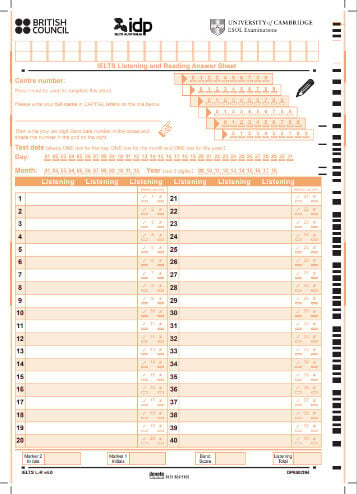
Testul IELTS Listening durează aproximativ 40 de minute. Vei petrece 30 de minute ascultând înregistrările și răspunzând la întrebări. Vei primi un Question Booklet și un Answer Sheet. Question Booklet este locul în care vei vedea toate întrebările la care trebuie să răspunzi. Answer Sheet este locul în care vei scrie răspunsurile finale pentru evaluare.
Poți consulta PDF-ul oficial al foii de răspunsuri IELTS listening aici sau pur și simplu privește imaginea de mai jos :)
La sfârșitul secțiunii de listening, ai la dispoziție 10 minute pentru a transfera răspunsurile din Question Booklet pe Answer Sheet.
IMPORTANT!
Greșelile de ortografie și gramatică incorectă sunt marcate ca INCORECTE, așa că folosește cele 10 minute pentru a-ți verifica de două ori ortografia și gramatica.
Calcularea scorului IELTS Listening
În secțiunea de Listening, fiecare întrebare valorează 1 punct, deci poți obține un scor „brut” de până la 40 de puncte. Apoi, scorul tău brut va fi convertit în band score. Reține! Nu pierzi puncte pentru răspunsurile greșite. Tabelul de mai jos îți poate oferi o idee generală despre cum sunt convertite scorurile brute în band score.
| Scor brut | Band score |
|---|---|
| 39-40 | 9 |
| 37-38 | 8.5 |
| 35-36 | 8 |
| 32-34 | 7.5 |
| 30-31 | 7 |
| 26-29 | 6.5 |
| 23-25 | 6 |
| 18-22 | 5.5 |
| 16-17 | 5 |
| 13-15 | 4.5 |
| 11-12 | 4 |
Deoarece fiecare versiune a IELTS este ușor diferită, scorul brut necesar pentru a obține un anumit band score diferă în funcție de performanța tuturor celor care au susținut testul în acea zi. Astfel, numărul de răspunsuri corecte necesare pentru a obține un band score va varia ușor de la un test la altul, dar, în general, ar trebui să țintești să obții aproximativ 30 din 40 dacă vrei un band score de 7.
După cum s-a menționat mai sus, secțiunile devin din ce în ce mai dificile pe măsură ce avansezi prin testul IELTS Listening. Cu toate acestea, fiecare întrebare valorează același număr de puncte. Prin urmare, asigură-te că nu pierzi puncte ușoare pentru că te blochezi la întrebări dificile.
Descărcare gratuită PDF cu exemple IELTS Listening și răspunsuri
Iată câteva exemple gratuite de IELTS listening în format PDF cu răspunsuri de la British Council (creatorii examenului IELTS). Sub linkuri poți susține gratuit și un test IELTS listening cu audio și răspunsuri de la BestMyTest. Are toate cele patru secțiuni, iar fiecare secțiune afișează transcrierea audio împreună cu răspunsurile. Încearcă să răspunzi la întrebări și vezi cum te descurci!
- IELTS Listening Practice Test 1- questions (Online Examples)
- IELTS Listening Practice Test 1- answers (PDF)
- IELTS Listening Practice Test 1- answer sheet (PDF)
Listen to the recording and answer questions 1 to 10. The answers and the audio script are in the box below the questions.
Questions 1-10
Complete the notes below.
Write ONE WORD AND/OR A NUMBER for each answer.
This can provide the carer with:
• time for other duties
• a 1
Assessment of aunt's needs
This may involve discussing:
• how much 2 is spent caring
Daily tasks discussed:
• help with dressing
• helping her take a 3
• shopping
• helping with meals
• managing 4
• any parts of caring that are particularly hard, e.g.
• loss of 5
• 6 her
• avoiding a 7
Types of support that may be provided for carers
• transport costs, e.g. cost of a 8
• vehicle-related costs, e.g. fuel and 9
• help with housework
• support to lower 10
-
spellcheck Răspunsuri
1. Break
Break is correct because this detail is stated in the recording at the point where the question is answered.2. Time
Time is correct because this detail is stated in the recording at the point where the question is answered.3. Shower
Shower is correct because this detail is stated in the recording at the point where the question is answered.4. Money
Money is correct because this detail is stated in the recording at the point where the question is answered.5. Memory
Memory is correct because this detail is stated in the recording at the point where the question is answered.6. Lifting
Lifting is correct because this detail is stated in the recording at the point where the question is answered.7. Fall
Fall is correct because this detail is stated in the recording at the point where the question is answered.8. Minicab
Minicab is correct because this detail is stated in the recording at the point where the question is answered.9. Parking
Parking is correct because this detail is stated in the recording at the point where the question is answered.10. Anxiety
Anxiety is correct because this detail is stated in the recording at the point where the question is answered.
Audio ScriptNora: It's really good to see you, Marcus. Since I had to give up work, I feel I'm losing touch with my friends and colleagues.
Marcus: We really miss you in the office. We were all so sorry you had to leave. But you must be relieved to have more time to look after your aunt. How is she?
Nora: Well, she's very cheerful, but she needs a lot of help.
Marcus: Have you tried to get any support from the local council?
Nora: No. I didn't know I could.
Marcus: Yes. But for different kinds of practical support, they realise that carers sometimes need time for all the other responsibilities they have, apart from the person they're caring for, and also that they sometimes need a break.
Nora: Absolutely. OK, so tell me more, how do I go about getting this support?
Marcus: Well, you'd have to have an assessment of your aunt's needs. That means someone would come round and talk to you about the situation and what you need. So for a start, they'd want to know the amount of time you spend looking after your aunt every day.
Nora: OK.
Marcus: Then they'll probably ask you what sorts of tasks you do for your aunt during the day. Things like if she needs help with getting dressed, for example.
Nora: Right. I help her with that. And also I help her get into the shower in the morning.
Marcus: Yes. That sort of thing. They'll probably ask you if you do the shopping for her, and help her at meal times, and whether she can cope using money.
Nora: Yes. That's becoming a bit of a problem. She used to be very good at it, but not anymore.
Before you hear the rest of the conversation, you have some time to look at questions 5 to 10. [20 seconds] Now listen, and answer questions 5 to 10.Marcus: And be ready to tell them about anything you find particularly difficult about caring for your aunt.
Nora: So recently I've noticed she started to have quite bad problems with her memory. If I wasn't there, I think she'd forget to eat, for example. And often she doesn't seem quite sure what day it is.
Marcus: Yes. Tell them about that. And are there any physical difficulties you have caring for her? Lifting her, for example.
Nora: Yes. She's quite heavy, and I'm afraid of hurting my back. I'd be in real trouble if that happened.
Marcus: They can give you advice about that, and also about how to avoid the possibility of your aunt having a fall.
Nora: Great. So, once they've done this assessment, if I'm eligible, what happens next?
Marcus: Well, they might support you financially. So they might help you with travel costs, like if you have to get a minicab to take your aunt for an appointment, for example.
Nora: I usually drive her myself, actually. So could I claim for the petrol?
Marcus: You could. And you can claim for the parking, too.
Nora: Oh, right.
Marcus: And if you need help with the housework, they can arrange for someone to come along once or twice a week. And one other thing. I hope you don't mind me saying this, but it's important you look after yourself. And it seems to me you're dealing with quite a bit of anxiety.
Nora: I am, yes.
Marcus: Well, tell the council, because they may be able to give you some advice on how to minimise it.
Nora: Really? Though, actually, I feel so much better having talked to you. I'll get in touch with the council straight away. Now, shall we go for coffee, or something?
Listen to the recording and answer questions 11 to 20. The answers and the audio script are in the box below the questions.
Questions 11-14
Choose the correct letter, A, B or C.
11. Who began turning the unused Whitfield site into a planted space?
- city council officials.
- nearby residents.
- a gardening charity.
12. What was Lillian Hartley trying to achieve through public campaigning?
- preventing a housing sale
- blocking army exercises
- winning maintenance funding
13. Why was the park rejected as a place for troop exercises?
- council permission was refused.
- too little usable space.
- a better site was chosen.
14. How does the speaker describe the latest redesign plans?
- 2013 plan used unchanged.
- 2013 plan revised pre-work.
- 2015 plan finished in 2016.
Questions 15-20
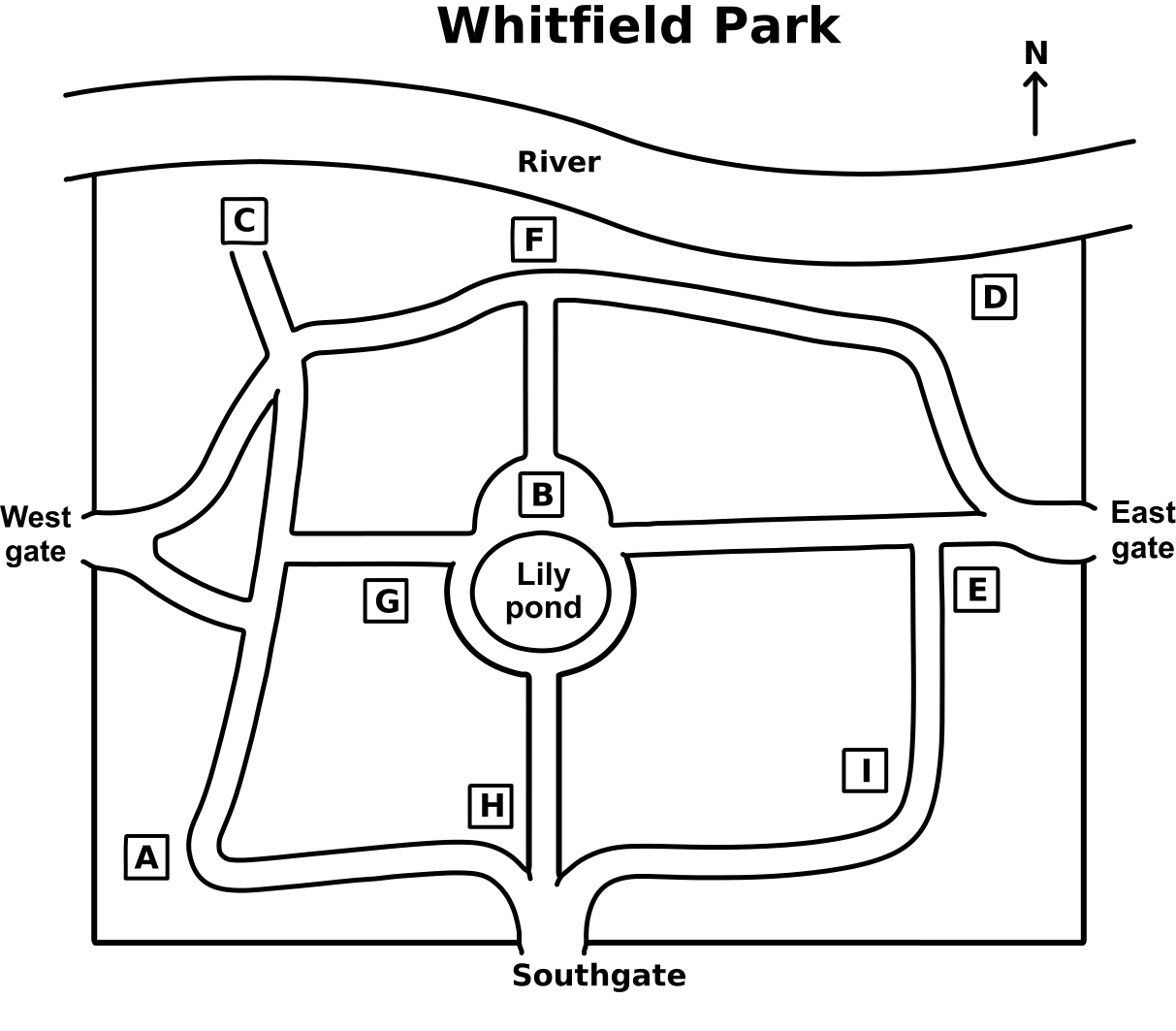
Label the plan of Whitfield Park below.
Write the correct letter, A-I, next to questions 15-20.
- statue of Lillian Hartley
- wooden sculptures
- playground
- maze
- tennis courts
- fitness area
-
spellcheck Răspunsuri
11. B
(A) is incorrect. The council took ownership later.(B) is correct. The initial planting was done by residents from nearby streets.
(C) is incorrect. The recording does not support this option: a gardening charity.
12. A
(A) is correct. Hartley organised public pressure so the council would keep the land as a park rather than sell it for housing.(B) is incorrect. The recording does not support this option: blocking army exercises.
(C) is incorrect. The recording does not support this option: winning maintenance funding.
13. B
(A) is incorrect. The recording does not support this option: council permission was refused.(B) is correct. , after inspection, the army concluded that the park was too small for practical use.
(C) is incorrect. The recording does not support this option: a better site was chosen.
14. B
(A) is incorrect. The recording does not support this option: 2013 plan used unchanged.(B) is correct. The plans dated from 2013 but were revised in 2015 before work began.
(C) is incorrect. The recording does not support this option: 2015 plan finished in 2016.
15. B
The correct answer is B because the statue of Lillian Hartley is now immediately north of the lily pond near the centre of the park, and that position is labelled B.16. D
The correct answer is D because the wooden sculptures are on the riverbank where the path from the East Gate makes a sharp bend, which corresponds to D.17. F
The correct answer is F because the playground is between the river and the path from the lily pond to the river, and that location is marked F.18. C
The correct answer is C because the maze is found by entering from the West Gate, walking north, and turning left, which places it at C.19. A
The correct answer is A because the tennis courts remain in the southern corner where the perimeter path makes a right-angled bend, labelled A.20. G
The correct answer is G because the fitness area is beside the lily pond on the same side as the West Gate, matching G on the plan.
Audio ScriptI'm delighted this evening to introduce our guest speaker, Sarah Holloway, who is going to talk to us about the recent transformation of Whitfield Park. Over to you, Sarah. Thank you very much. I'm sure you all know Whitfield Park well, it has been one of the city's landmarks for well over a century, and the city council has been responsible for it for most of that time. What perhaps fewer of you will know is how the park actually began.
Unlike many city centre parks, which started life as the private gardens of a large house, Whitfield was originally just an unused patch of waste ground. The first flowers there were actually planted by a small group of local residents who lived in the surrounding streets. They began work on the site in 1892. At that point nobody was entirely sure who legally owned the land, and it was a full twenty years later before the city council finally took it into public ownership. Some of you will have seen the statue near one of the gates. That figure is Lillian Hartley, who played a really important role in the early history of the park.
Once the council legally owned the land, its first instinct was to sell it off as building plots for housing. A great many local residents, however, wanted the park to stay open as a place where everyone could enjoy fresh air and green space, bear in mind that this is a very densely built up residential district. Lillian Hartley was at the heart of that campaign, and it was she who organised the petitions and the public demonstrations which, in the end, persuaded the council to drop the sale and keep the land as a park.
Soon afterwards, in 1914, the First World War broke out, and most of the park was dug up and used to grow vegetables, which were sold to local residents. At one point the army did look into taking over the park as a site for troop exercises. They actually wrote to the city council about it, but when they inspected it they concluded that the park was simply too small to be of any practical use to them, so the idea was dropped. The only military activity in the park during the war was the occasional public meeting held on a small area of grass that had been kept clear of vegetable plots.
After the war, the park was largely returned to the way it had been before 1914, and from then on it remained almost unchanged for decades. New plans for transforming the park were drawn up several times over the years; the most recent version dates from 2013, but those plans were then revised in 2015, well before any actual work had got under way. Work on the ground finally began in 2016 and was completed, on schedule, last year.
Before you hear the rest of the talk, you have some time to look at questions 15 to 20. [20 seconds] Now listen and answer questions 15 to 20.All right, I'd like to describe some of the more important changes that have been made, and one or two things that have deliberately been left as they were. If you take a quick look at the map you've been handed, you'll see the familiar outline of Whitfield Park. The river forms the northern boundary, and there is a gate in each of the three other walls.
From there, follow the path up towards the river and the enlarged children's playground sits between that path and the river itself. If you keep your eye on the riverbank, over towards the East Gate side, the new wooden sculptures are at the point where the path coming up from that gate makes a sharp bend.
Back near the West Gate side of the park, there is a maze, a circular pattern of paths separated by low hedges. Head in from the West Gate, walk north towards the river, and then turn left to find it. Close to the same central lily pond, on the side facing the West Gate, you'll also find the new outdoor fitness area.
Down in the southern corner, where the perimeter path makes that distinct right angled bend, the tennis courts are still in their familiar position, though we have now doubled them from four to eight. Now, since you are all keen gardeners, I'm sure you'll want to hear about the plants that have been chosen for the new beds.
Listen to the recording and answer questions 21 to 30. The answers and the audio script are in the box below the questions.
Questions 21-25
Choose the correct letter, A, B or C.
21. Nina and Owen were surprised to learn that coastal cities
- are home to just under half of all people.
- account for many of the largest cities.
- are expanding at double the rate of inland cities.
22. According to Owen, building coastal cities near to rivers
- can carry contamination back towards urban areas.
- can leave too little land for farming upstream.
- can cause factories to damage rural scenery.
23. What mistake was made when building water drainage channels in Port Selby in the 1950s?
- The system did not include enough channels.
- The builders selected the wrong construction materials.
- The design failed to anticipate rising sea levels.
24. What do Nina and Owen think that the authorities in Port Selby should do immediately?
- take measures to restore coastal ecosystems
- pay for a new flood prevention system
- stop disposing of waste materials into the ocean
25. What do they agree should be the priority for international action?
- greater coordination of activities
- more sharing of information
- agreement on shared policies
Questions 26-30
What decision do the students make about each of the following parts of their presentation?
Write the correct letter, A-G, next to questions 26-30.
- use visuals
- keep it short
- involve other students
- check the information is accurate
- provide a handout
- focus on one example
- do online research
- Historical background
- Geographical factors
- Past mistakes
- Future risks
- International implications
-
spellcheck Răspunsuri
21. B
(A) is incorrect. The recording does not support this option: are home to just under half of all people.(B) is correct. Nina says most of the biggest cities are built by the sea.
(C) is incorrect. The recording does not support this option: are expanding at double the rate of inland cities.
22. A
(A) is correct. Owen says pollutants from inland agriculture and industry travel down rivers to cities.(B) is incorrect. The recording does not support this option: can leave too little land for farming upstream.
(C) is incorrect. The recording does not support this option: can cause factories to damage rural scenery.
23. C
(A) is incorrect. The recording does not support this option: The system did not include enough channels.(B) is incorrect. The recording does not support this option: The builders selected the wrong construction materials.
(C) is correct. Port Selby's drainage channels were built without allowing for global warming and rising sea levels.
24. B
(A) is incorrect. The recording does not support this option: take measures to restore coastal ecosystems.(B) is correct. Nina says they need money to replace the drainage channels for flood protection now.
(C) is incorrect. The recording does not support this option: stop disposing of waste materials into the ocean.
25. A
(A) is correct. They say coastal cities must act together internationally.(B) is incorrect. The recording does not support this option: more sharing of information.
(C) is incorrect. The recording does not support this option: agreement on shared policies.
26. B
B is correct because they decide not to spend too long on historical background, so they will keep it short.27. A
A is correct because they decide to use slides with maps showing geographical factors.28. F
F is correct because they choose the Meriton case study as the basis for past mistakes, focusing on one example.29. G
G is correct because they need to look at websites for future risks, so online research is required.30. C
C is correct because they plan to ask audience members from different places, involving other students.
Audio ScriptTutor: OK, so what I'd like you to do now is to talk to your partner about your presentations on environmental planning. You should have done most of the reading now, so I'd like you to share your ideas and talk about the structure of your presentation and what you need to do next.
Nina: OK, Owen, I'm glad we chose quite a specific topic: coastal cities. It made it much easier to find relevant information.
Owen: Yeah, and cities are growing so quickly. I mean, we know that more than half the world's population lives in cities now.
Nina: Yeah, though that's all cities, not just coastal ones. But most of the biggest cities are actually built by the sea. I'd not realised that before.
Owen: Nor me. And what's more, a lot of them are built at places where rivers come out into the sea. But apparently this can be a problem.
Nina: Why?
Owen: Well, as the city expands, agriculture and industry tend to spread further inland along the rivers. And so agriculture moves even further inland up the river. That's not necessarily a problem, except it means more and more pollutants are discharged into the rivers.
Nina: That's a serious problem.
Owen: Right.
Nina: Did you read that article about Port Selby on the south coast?
Owen: No.
Nina: Well, apparently back in the 1950s, they built channels to drain away the water in case of flooding.
Owen: Sounds sensible.
Nina: Yeah, they spent quite a lot of money on them. But what they didn't take into account was global warming. So they built the drainage channels too close to sea level. And now sea levels are rising, they're more or less useless. If there's a lot of rain, the water can't run away. There's nowhere for it to go.
Owen: So they did not help much in the end.
Nina: So what are the authorities doing about it now?
Owen: I don't know. I did read that they're aiming to stop disposing of waste water into the ocean over the next 10 years. But that won't help with flood prevention now, will it?
Nina: No, really, they just need to find the money for something to replace the drainage channels in order to protect against flooding now. But in the long term, they need to consider the whole ecosystem.
Owen: Right.
Nina: Really though, coastal cities can't deal with their problems on their own, can they? I mean, they've got to start acting together at an international level instead of just doing their own thing.
Owen: Absolutely. The thing is, everyone knows what the problems are and environmental planners have a pretty good idea of what we should be doing about them. So they should be able to work together to some extent.
Nina: But it's going to be a long time before countries come to a decision on what principles they're prepared to abide by.
Owen: Yeah, if they ever do.
Before you hear the rest of the conversation, you have some time to look at questions 26 to 30. [20 seconds] Now listen and answer questions 26 to 30.Nina: So I think we've probably got enough for our presentation. It's only 15 minutes.
Owen: OK, so I suppose we'll begin with some general historical background about why coastal cities were established. But we don't want to spend too long on that. The other students will already know a bit about it.
Nina: It's all to do with communications and so on.
Owen: Yes, we should mention some geographical factors, things like wetlands and river estuaries and coastal erosion and so on.
Nina: We could have some maps of different cities with these features marked.
Owen: On a handout, you mean, or some slides everyone can see.
Nina: Yeah, that'd be better.
Owen: It'd be good to go into past mistakes in a bit more detail. Did you read that case study of the problems there were in Meriton with flooding a few years ago?
Nina: Yes, we could use that as the basis for that part of the talk. I don't think the other students will have read it, but they'll remember hearing about the flooding at the time.
Owen: Hmm, OK. So that's probably enough background. So then we'll go on to talk about what actions have been taken to deal with the problems of coastal cities.
Nina: OK, what else do we need to talk about? Maybe something on future risks looking more at the long term if populations continue to grow?
Owen: Yeah, we'll need to do a bit of work there. I haven't got much information, have you?
Nina: No, we'll need to look at some websites. Shouldn't take too long.
Owen: OK. And I think we should end by talking about international implications. Maybe we could ask people in the audience. We've got people from quite a lot of different places.
Nina: That'd be interesting if we have time, yes. So now should we go on?
Listen to the recording and answer questions 31 to 40. The answers and the audio script are in the box below the questions.
Questions 31-36
What point does the lecturer make about each item?
Write the correct letter, A-K, next to questions 31-36.
- changes drainage
- protects animals
- increases nutrients
- kills germs
- affects many species
- creates dense shade
- alters the soil
- supports farming
- reduces competition
- attracts bell-miners
- helps recovery
- Eucalyptus woodland
- Damage to eucalyptus woodland
- Oil from eucalyptus leaves
- Lime used in construction
- Direct iron supply
- Moderate bushfires
Questions 37-40
Complete the notes below.
Write ONE WORD ONLY for each answer.
Bell-miner associated dieback:
• The process starts with insects feeding on eucalyptus 37
• A sweet liquid containing 38 attracts bell-miners
Fire patterns:
• If fires happen too often, 39 becomes the main vegetation
• When fires are almost absent, thick growth gives bell-miners protected 40 sites
-
spellcheck Răspunsuri
31. B
B is correct because eucalyptus woodland provides nesting places and shelter for birds, bats and small mammals.32. E
E is correct because damage to eucalyptus woodland affects a wider community of species, not only the trees themselves.33. D
D is correct because oil from eucalyptus leaves is used in disinfectant, where it can kill certain germs.34. G
G is correct because lime from road construction was washed into the soil and interfered with tree roots.35. K
K is correct because affected trees recovered surprisingly quickly when iron was supplied directly.36. I
I is correct because occasional fire removes fast-growing competitors that would otherwise use water needed by eucalyptus trees.37. leaves
The correct answer is leaves. The lecturer says the process begins when insects settle on eucalyptus leaves and feed on them.38. sugar
The correct answer is sugar. The lecturer says the insects produce a sweet liquid containing sugar, which attracts bell-miners.39. grass
The correct answer is grass. The lecturer says grass tends to dominate afterwards if fires occur too often.40. nesting
The correct answer is nesting. The lecturer says dense growth creates protected nesting sites for bell-miners when fire is suppressed.
Audio ScriptGood morning. Today I want to focus on the eucalyptus tree, one of the best known features of the Australian landscape. Many people call it a gum tree, but the name eucalyptus actually covers hundreds of related species, from small scrubby trees to very tall forest giants.
Now, eucalyptus trees are important in several ways. Ecologically, they provide nesting places and shelter for birds, bats and small mammals. Their flowers also produce nectar, which is an important food source for insects and birds. So when eucalyptus woodland is damaged, the effect is felt across a much wider community of species.
As for their value to people, the trees are also useful. Oil from eucalyptus leaves has long been used in cleaning products, and one common use is in disinfectant, because the oil can kill certain germs. Eucalyptus timber is also used in building and fencing, although that is not really the main focus of today's lecture.
So, these trees can live for centuries, and some individuals survive for four hundred years or more. That is why researchers became concerned when large numbers began dying much earlier than expected in different parts of Australia.
Now, one disease that attracted attention was Mundulla Yellows. The leaves of affected trees slowly turned yellow and then, over time, the whole tree declined. For years the cause was unclear. Eventually, researchers discovered that lime, or calcium hydroxide, had been used in road construction nearby. Rain washed the lime into the surrounding soil, where it interfered with the roots of eucalyptus trees. The trees were still surrounded by nutrients, but they could no longer absorb the iron they needed for healthy growth. When iron was supplied directly to affected trees, they recovered surprisingly quickly.
However, Mundulla Yellows affected only a limited number of places. A much wider problem on the east coast was Bell miner associated dieback. Now, bell miners are small native birds, but they are not the direct cause of the damage. The process begins when insects settle on eucalyptus leaves and feed on them. While feeding, these insects produce a sweet liquid containing sugar. Bell miners are attracted to that liquid, and they aggressively chase away other birds and insects that might otherwise reduce the insect population. As a result, the insects multiply, the leaves are badly damaged, and the trees gradually lose their ability to survive.
But some scientists think fire history is also part of the explanation. An influential theory, first proposed by the ecologist William Jackson, links the type of vegetation in a region to the frequency of bushfires. If fires occur too often, grass tends to dominate the area afterwards. If fires occur at moderate intervals, eucalyptus forest is more likely to persist. This is because occasional fire removes fast growing competitors which would otherwise take up the water eucalyptus trees need. And it also helps maintain the soil by preventing dense undergrowth from changing the soil structure and removing nutrients.
At the other extreme, if fires are almost completely suppressed, a different ecosystem can develop. Scientists sometimes call this dry rainforest. Now, the name sounds contradictory, because we usually associate rainforest with wet tropical conditions. But in this case it means a dense, shaded vegetation system with relatively few species. It can create excellent conditions for bell miners, because the thick growth gives them protected nesting sites while excluding many of the species that would normally compete with them.
What this tells us is that before European settlement, Aboriginal communities used controlled burning over long periods, and this probably created a more balanced pattern of vegetation. Since European settlement, fire has often been suppressed, roads and farms have altered drainage, and some local ecosystems have shifted away from eucalyptus woodland. The decline of eucalyptus trees, then, is not caused by one single factor. It is the result of disease, insects, birds, soil chemistry and fire management interacting with one another.

Completion - Part 1
Learn how to answer these questions in a step-by-step interactive exercise
Completion - Part 1
Un spațiu liber poate cere o oră sau o frecvență. De obicei, vorbitorul numește aceeași perioadă prin alte cuvinte, așa că potrivește sensul cu spațiul, în loc să aștepți formularea de pe pagină.
Apoi verifică limita de cuvinte înainte să trimiți. Recitește tot rândul cu răspunsul tău în spațiu și elimină orice cuvânt pe care rândul îl conține deja. Un răspuns corect ca sens, dar prea lung nu primește niciun punct.
Apasă pe Redă ca să asculți înregistrarea
Notițele folosesc un verb simplu, cum ar fi must provide sau need to bring. Vorbitorul rareori spune acel verb; folosește în schimb un sinonim sau descrie acțiunea, așa că ascultă ce anume este de fapt obligatoriu.
Vorbitorii menționează adesea mai întâi elemente în plus și apoi le exclud. Dacă ratezi un spațiu, lasă-l și treci la următorul, pentru că răspunsurile urmează ordinea înregistrării, iar un spațiu pierdut te poate costa și pe cele de după el.
Apasă pe Redă ca să asculți înregistrarea
Cum te-ai descurcat la întrebările de mai sus din proba IELTS Listening? Ți s-au părut unele întrebări dificile? Dacă da, ar putea fi util să arunci o privire mai atentă asupra tuturor celor 6 tipuri de sarcini IELTS Listening. Cu cât înțelegi mai bine un tip de sarcină, cu atât vei avea nevoie de mai puțin efort pentru a-ți da seama ce trebuie să faci și vei avea mai mult timp să găsești răspunsul.
Cele 6 tipuri de sarcini IELTS Listening
Există 6 tipuri diferite de întrebări la testul IELTS Listening. Este important să exersezi fiecare tip de sarcină pentru a învăța cea mai bună modalitate de a o aborda și pentru a obține un band score IELTS Listening ridicat.
Ce tipuri de sarcini de ascultare li se par cele mai dificile cursanților noștri
În locul unei tendințe din 2017, iată ce arată 2.25 milioane de răspunsuri la IELTS Listening oferite de cursanții BestMyTest. Procentul indică frecvența cu care cursanții noștri au răspuns corect la acel tip de sarcină.
| Tip de sarcină | Răspunsuri corecte |
|---|---|
| Completarea notițelor | 33% |
| Completarea unui tabel | 34% |
| Completarea propozițiilor | 45% |
| Răspuns scurt | 48% |
| Alegerea unui răspuns corect | 50% |
| Selectarea mai multor răspunsuri corecte | 51% |
| Etichetarea unui plan, a unei hărți sau a unei diagrame | 55% |
| Completarea unui formular | 73% |
| Asociere | 85% |
- La sarcinile de completare se pierd puncte. Sarcinile de completare a notițelor și a tabelelor primesc răspunsuri corecte doar o dată din trei, în timp ce completarea unui formular, care folosește aceeași abilitate într-un format mai simplu, ajunge la 73%. Diferența ține de ortografie, de forma cuvintelor și de respectarea limitelor de cuvinte sub presiunea timpului, nu de înțelegere.
- În cele 61.964 de teste complete de pregătire pentru proba de ascultare susținute de 55.296 de cursanți, scorul mediu a fost de 5.5. 41% dintre teste au atins scorul 6.0, iar 12% au atins scorul 7.0.
- La secțiunile individuale ale probei de ascultare, o treime dintre încercări au obținut un punctaj de 40% sau mai puțin, iar 30% au obținut 80% sau mai mult. Majoritatea cursanților au una sau două secțiuni la care rezultatele scad drastic, mai degrabă decât un punctaj uniform scăzut, motiv pentru care exersarea separată a secțiunilor 3 și 4 dă rezultate.
Cifrele provin din datele BestMyTest privind testele de pregătire și evaluările până în octombrie 2026. Procentele pe tipuri de întrebări reprezintă ratele răspunsurilor corecte din totalul încercărilor; valorile pe criterii sunt scoruri acordate de profesori sau de IA, conform indicațiilor. Ultima actualizare: 5 octombrie 2026.
Deși fiecare tip de întrebare de listening arată diferit, abordarea de bază pentru fiecare este aceeași. Mai târziu în acest articol, îți vom arăta strategia de bază pentru a aborda toate cele 6 tipuri de întrebări. Fiecare tip are un exemplu audio și răspunsul în ghidul tipuri de întrebări IELTS Listening.
3 pași pentru o pregătire online eficientă a testului IELTS Listening
Deși fiecare tip de întrebare (sarcină) IELTS Listening este diferit, abordarea de bază pentru fiecare este aceeași. Poți rezolva toate tipurile de sarcini folosind o singură strategie simplă, pas cu pas. Iată cei trei pași pe care îți recomandăm să-i folosești pentru a aborda tipurile de întrebări Listening:
- Examinează cu atenție întrebările pentru a găsi informații cheie
- Anticipează răspunsurile posibile înainte de a asculta
- Urmărește înregistrarea pentru a potrivi întrebările cu conținutul pe măsură ce asculți
Pasul 1: Examinează întrebările
În secțiunea IELTS Listening, vei avea la dispoziție un scurt timp de pregătire (30-40 de secunde) înainte ca înregistrarea să înceapă. Aceasta este ocazia ta să te uiți la întrebările la care va trebui să răspunzi, iar exact despre asta este vorba în primul pas al acestei strategii. În loc să folosești acest timp pentru a lua o pauză sau pentru a-ți verifica răspunsurile, te vei concentra să afli cât mai multe despre întrebările care urmează. Acest pas este important pentru a evita greșeala de a face mai multe sarcini deodată, ascultând vorbitorul și încercând să citești întrebările pentru prima dată.
Când începe timpul tău de pregătire, folosește cât mai bine acest timp examinând întrebările pentru a afla mai multe despre ele. Acestea sunt câteva dintre informațiile pe care ar trebui să le cauți atunci când examinezi fiecare dintre întrebările IELTS Listening:
- Ce fel de întrebare este aceasta?
- Cum va arăta răspunsul? (exemplu: o dată, un număr, un nume)
- Care sunt cele mai importante expresii și cuvinte, sau cuvinte cheie, din întrebări?
Un exemplu ar putea fi un tip de întrebare Note Completion, ca aceasta:
Complete the notes below.
Write NO MORE THAN THREE WORDS for each answer.
Mai întâi, poți sublinia câteva dintre cuvintele cheie din întrebare.
Two reasons for the new approach to pricing are changes in (27) ______ and (28) _________ programs.
În acest exemplu, ascultarea atentă pentru expresia cheie „two reasons” pe care deja ai subliniat-o îți permite
să începi să fii atent la momentul potrivit. Iată partea din transcrierea audio care dezvăluie răspunsul:
Mark: Well, there seem to be two basic reasons. Firstly, because the law has changed recently to allow companies to behave like this. In the past, they weren't allowed to change the prices of the tickets. And secondly, we now have computer programs that do the calculations so that prices can be changed very quickly and accurately.
După examinarea întrebărilor, ai fi știut că „the law” și „computer” erau răspunsurile corecte aici, pe baza unor cuvinte cheie și a cunoașterii tipului de întrebare.
Pasul 2: Anticipează răspunsurile posibile
Al doilea pas al acestei strategii pentru a reuși la secțiunea IELTS Listening este strâns legat de primul. De fapt, ar trebui să încerci să parcurgi ambii pași în același timp de pregătire de 20 de secunde înainte ca înregistrarea să înceapă. Deși poate părea o sarcină dificilă într-un timp atât de scurt, ține minte că acești pași sunt de fapt legați între ei.
Pentru a anticipa răspunsurile posibile la întrebările de Listening, va trebui mai întâi să fi parcurs pasul 1 prin examinarea atentă a întrebărilor. În acest moment, ar trebui să știi ce tip de întrebare ai în față, cum vor arăta răspunsurile potențiale, precum și care cuvinte cheie te vor ajuta să localizezi răspunsurile rapid. Pentru a anticipa răspunsurile, vei combina toate aceste informații și vei face o presupunere despre ce fel de răspuns te aștepți să auzi.
Hai să revedem același exemplu de întrebare Note Completion de mai sus.
Two reasons for the new approach to pricing are changes in (27) and (28) programs.
Doar uitându-te la gramatica acestei propoziții poți identifica ce parte de vorbire va fi răspunsul. În acest caz, prepoziția „in” precede ambele răspunsuri potențiale. Din punct de vedere gramatical, numai substantivele sau sintagmele nominale pot fi folosite astfel în sintagmele prepoziționale. Nu doar că poți anticipa, corect, că răspunsul va fi un substantiv sau o sintagmă nominală, dar ai putea, de asemenea, să prezici că răspunsul ar putea fi ceva legat de politică sau guvern (law) și un cuvânt care poate apărea împreună cu programs (computer) pe baza contextului.
Deși este imposibil să ghicești răspunsul corect doar pe baza predicțiilor, încercând să-ți imaginezi ce ar putea fi răspunsul, ai mai multe șanse să asculți informațiile relevante și să ignori informațiile irelevante. Anticiparea răspunsurilor posibile înainte ca înregistrarea să înceapă îți va pregăti urechea, aducându-te cu un pas mai aproape de răspunsul corect.
Acum, încearcă să pui împreună Pasul 1 (examinează întrebările) și Pasul 2 (anticipează răspunsurile posibile) într-un exemplu mai dificil de întrebare cu alegere multiplă.
Choose the correct letter, A, B, C or D.
- are for weekend shows
- are booked well in advance
- are non-refundable
- are booked for groups
Deși nu există o modalitate de a ști sigur răspunsurile la aceste întrebări, poți totuși folosi informațiile din întrebări pentru a anticipa răspunsurile posibile și a-ți direcționa ascultarea. De exemplu, întrebarea 24 se referă la motivul pentru care prețurile biletelor de teatru vor fi cele mai mici, așa că vei dori să asculți cu atenție oricare dintre motivele menționate. Ține minte, este posibil ca mai mult de unul să fie menționat. Aruncă o privire la scriptul de mai jos pentru a vedea cum anticiparea te poate ajuta să elimini răspunsurile greșite.
Observă că trei dintre răspunsurile posibile sunt menționate: „booked for groups”, „are for weekend shows” și „are non-refundable”. Totuși, răspunsul corect este C „are non-refundable”, deoarece este menționat ca fiind mai ieftin separat de celelalte două, care sunt pur și simplu enumerate împreună.
Pasul 3: Urmărește înregistrarea
Odată ce înregistrarea începe și partea efectivă de listening a testului începe, ar trebui să urmărești înregistrarea pentru a parcurge pasul al treilea al acestei strategii pentru secțiunea IELTS Listening. Urmărirea înregistrării îți cere să te concentrezi îndeaproape pe ceea ce auzi, ținând în același timp evidența la care întrebare se referă conținutul.
Întrebările din secțiunea IELTS Listening apar de obicei în ordinea în care răspunsurile lor pot fi găsite în conținutul înregistrării. Acest lucru îți oferă un avantaj în test, deoarece înseamnă că odată ce ai auzit răspunsul la o întrebare, îți vei îndrepta imediat atenția spre următoarea, în ordine. Dacă reușești să urmărești înregistrarea cu succes, potrivind contextul întrebărilor cu ceea ce auzi în înregistrare, vei rămâne pe drumul cel bun și vei evita să pierzi informații cheie necesare pentru a răspunde la fiecare dintre întrebări.
A face acest lucru este mai ușor de zis decât de făcut. Va trebui să faci mai multe sarcini în paralel, ascultând și totodată ținând cu privirea următoarea întrebare. Dacă, totuși, pierzi răspunsul la o întrebare, îți vei da seama când auzi răspunsul la una ulterioară. Chiar dacă acest lucru poate fi confuz și chiar frustrant, a pierde un răspuns și a fi conștient de asta este totuși preferabil față de a te pierde complet în conținut și a rata și mai multe răspunsuri. În scenariul în care pierzi o întrebare, ar trebui pur și simplu să o lași și să continui cu următoarea. La final, va trebui să faci cea mai bună presupunere posibilă pentru întrebarea pe care ai ratat-o. Totuși, partea bună este că ascultarea înregistrării în întregime poate să-ți ofere alte indicii contextuale și să-ți permită să răspunzi mai precis la întrebările pe care le-ai ratat.
Resurse gratuite pentru practica IELTS Listening
Vei avea nevoie de abilități puternice de ascultare pentru a obține un band score IELTS Listening ridicat. Din acest motiv, este important să te antrenezi constant în fiecare zi până în ziua testului.
Mai jos sunt câteva resurse pe care le poți folosi pentru a-ți antrena și menține zilnic abilitățile de ascultare.
- YouTube - https://www.youtube.com
- BBC Learning English - http://www.bbc.co.uk/learningenglish
- TED - https://www.ted.com/
- BBC radio - https://www.bbc.co.uk/worldserviceradio
- ABC news in Australia - https://www.abc.net.au/listen/live/news