
I denna guide kan du börja din IELTS-läsövning genom att göra ett gratis IELTS-lästest. Det finns dock två versioner av testet: IELTS general reading och IELTS academic reading. Du får lära dig vilken version som passar dig och hur du hanterar varje typ av lässfråga med hjälp av vårt IELTS-läsmaterial.
Få gratis analys av din IELTS Reading-poäng och en personlig studieplan efter att du har genomfört ett gratis IELTS Reading-övningstest.
| IELTS General Reading-test | IELTS Academic Reading-test |
|---|---|
Nedan finns vår fullständiga lista med IELTS Reading-frågor och svar. Obs: De röda länkarna är våra mest populära och rekommenderade readingfrågor enligt våra studenter, och du kan öva på dem gratis när du vill.
Övningsfrågor för General IELTS Reading-test 1 - 135
Short everyday texts, workplace texts, and one longer passage
Övningsfrågor för Academic IELTS Reading-test 1 - 171
Three long passages from books, journals, magazines, and newspapers
IELTS Reading övningsprovsguide
Resten av denna guide kommer att lära dig allt om IELTS Reading-provet för både General Training och Academic Reading. Du får lära dig hur läspoängen beräknas, hur du framgångsrikt besvarar varje typ av läsfråga, hur du förbättrar din läsning med IELTS-textmaterial och hur du behärskar våra 3 strategier för framgång i din IELTS Reading-övning.
Innehållsförteckning
- Information om IELTS Reading-provet
- Exempelfrågor i IELTS Reading
- Information om IELTS General Reading-provet
- Information om IELTS Academic Reading-provet
- Poängkalkylator för IELTS Reading
- Hur du besvarar alla 11 frågetyper i IELTS Reading
- Hur du förbättrar din IELTS Reading bandpoäng
- 3 strategier för IELTS Reading
- Gratis nedladdning av IELTS Reading övningsprov-PDF med svar
Information om IELTS Reading-provet
IELTS Reading-provet består av 3 sektioner och totalt 40 frågor. I allmänhet besvarar du 12–14 frågor per sektion och har exakt 60 minuter på dig att slutföra ditt läsprov. Varje sektion innehåller 1–3 textavsnitt beroende på vilket prov du gör. Om du redan vet vilket prov du ska göra kan du hoppa över de närmaste avsnitten. Om inte är det viktigt att lära sig om vart och ett av proven och hur du förbereder dig för dem.
Vilket IELTS Reading-prov passar mig?
IELTS Reading-provet finns i två versioner: IELTS General Reading och IELTS Academic Reading. Du gör General Reading om du planerar att migrera eller söka till gymnasiet. Du gör Academic Reading om du söker till högre utbildning. Den största skillnaden mellan General Reading och Academic Reading är svårighetsgraden i IELTS-textavsnitten. Som namnet antyder använder Academic-provet IELTS-läsmaterial från akademiska källor, medan General-provet använder material från vardagslivet.
Båda proven innehåller 3 sektioner, 40 frågor och 11 frågetyper. Du kan läsa mer i detalj om varje sektion för båda proven i tabellen nedan.
| Sektion | IELTS Academic Reading-provet | IELTS General Reading-provet |
|---|---|---|
| 1 | En lång akademisk text som varierar från beskrivande och faktabaserad till diskursiv och analytisk. Texten är
hämtad från böcker, tidskrifter, magasin och tidningar. 12–14 frågor |
Två eller tre korta faktatexter.
Ämnena är relevanta för vardagslivet i ett engelskspråkigt land.
12–14 frågor |
| 2 | En lång akademisk text som varierar från beskrivande och faktabaserad till diskursiv och analytisk. Texten är
hämtad från böcker, tidskrifter, magasin och tidningar. 10–14 frågor |
Två korta faktatexter med fokus på arbetsrelaterade frågor (t.ex. att söka jobb, företagspolicy, lön och villkor).
12–14 frågor |
| 3 | En lång akademisk text som varierar från beskrivande och faktabaserad till diskursiv och analytisk. Texten är
hämtad från böcker, tidskrifter, magasin och tidningar. 12–14 frågor |
En längre, mer komplex text om ett ämne av allmänt intresse.
Texterna är autentiska och hämtade från meddelanden, annonser, företagshandböcker, böcker, magasin och tidningar.
12–14 frågor |
Nu när du är bekant med strukturen i IELTS Reading-provet och både IELTS General Reading och IELTS Academic Reading, är det dags att lära sig om du gör bäst i att skriva det pappersbaserade provet eller det datorbaserade provet.
IELTS pappersbaserat prov (PBT) jämfört med IELTS datorbaserat prov (CBT)
I PBT får du ett frågehäfte och ett svarsblad. Frågehäftet är där du ser alla frågor som du behöver besvara. Svarsbladet är där du skriver dina slutgiltiga svar för bedömning. Du kan kolla in det officiella IELTS-svarsbladet i pdf-format här
Obs: Till skillnad från i IELTS Listening-provet, får du ingen extra tid för att överföra dina svar från häftet till svarsbladet, så se till att du för in varje IELTS-läsfråga i svarsbladet i takt med att du besvarar dem.
I CBT besvarar du frågorna på datorn. Dina textavsnitt visas på vänster sida och dina frågor på höger sida. Du kan också markera text och använda kontrollfunktioner för att kopiera och klistra in svar. För mer information om PBT och CBT, kolla in The IELTS Computer Based Test Guide.
Du kan öva på vilken version som helst när du vill med vårt gratis IELTS Reading övningsprov. Du hittar länkar till allt vårt IELTS-läsmaterial högst upp på sidan.
Exempelfrågor i IELTS Reading
Här är två gratisövningar i IELTS Academic Reading. Gör varje övning själv och öppna sedan svaren för att kontrollera. Guiden om IELTS Reading-frågetyper förklarar varje typ och ger fler exempelfrågor.
Match each item with the period of time it best corresponds with
NB You may use any letter more than once.
- The Palaeolithic era
- The Bronze age
- The Iron age
- The Medieval era
- The Mesolithic age
- Roman times
-
spellcheck Answers1. FALSE
2. FALSE
3. NOT GIVEN
4. FALSE
5. TRUE
6. FALSE
7. FALSE
8. TRUE
9. FALSE
10. F
11. C
12. A
13. B
14. D
The climate in Britain has been arctic for the last several million years, punctuated by relatively warm timespans, or interglacials of thousands of years, one of which we are in as of now. Since the last glaciation, British woodland history is considered quite short in terms of geological time spans, and is also closely related to the human civilization developing.
At the peak of the last glaciation (100,000 – 12,000 BC), the majority of Britain would have had no trees. Birch and willow scrub may have grown along the lower reaches of the ice, with pine in some areas. It’s possible that remnants of pre-glacial flora were sheltered along the western bays of Great Britain and Ireland’s coasts, but as far as the southern parts of England, the ice kept any land barren. Information regarding the development of Britain’s flora following glaciation can be found by studying the deposits of pollen and seed in peat, as well as by the use of radiocarbon dating. Tundra and moorland followed the retreating ice, which lead to phases of different tree species spreading from the south. First came birch, aspen and sallow, followed by pine and hazel continuing to spread north as of 8500 BC, replacing birch to make it less commonly found for the next few thousand years. Oak and alder came after pine, then lime, elm, beech, and maple, all spreading northwards one after the other. From the moment lime arrived, in about 7300, to about 4500 BC the climate remained stable for a length of time known as the Atlantic Period, a time in which numerous species grew to form a series of wildwood or wilderness types.
What did the wilderness or wildwood look like, before man started interfering with it? One theory holds that Britain and Western Europe in Palaeolithic times was covered from coast to coast in a wildwood of continuous trees. However, a modern theory proposed by Francis Vera holds that Western Europe wilderness was a combination of grassland, scrub, and clusters or groves of trees. It was not a dense, impassable wildwood, but instead, an area similar to a park, kept up by wild herbivores eating the plants and grass. Throughout earlier interglacial periods, this may also have been the case in Britain, as creatures of the Palaeolithic era needed to roam large areas of grassland to survive. A variety of grassland plants continued to live there in the last interglacial, as according to pollen records. However, since the last glaciation, the bison, elk and other large herbivores which persisted on mainland Europe were extinct in Britain, so Vera’s theory may not apply so well to Britain.
Meanwhile, throughout the period since it’s spread northwards after the last glaciation, the sustained growth of oak in Britain demonstrates that the wildwood was not as continual as once believed. Oak is a pioneer species, which requires vacant space to generate more of itself. Grazing animals are also present to keep areas open, so Oak regenerates in the thorny brush as a protective measure from their grazing. Archaeological evidence indicates that red deer, who graze on grass as well as browse from trees, were essential to the economy in Mesolithic Britain, with people utilizing them for meat, skins, antlers and bones.
As the Mesolithic (10,000-3000 BC) era ended, evidence of the beginnings of agriculture emerges. Agricultural weeds, such as plantain and stinging nettle, were also increasing in number. Nearly all the wildwood was cut down as the population increased rapidly. However, the falling elm population around 4,000 BC all across Europe has been attributed not to the clearing of trees, but to what’s referred to as Elm disease.
Throughout the Bronze Age (2400-750 BC), people were cutting down trees more than ever before, until the prevalence of the practice “coppicing” peaked, likely at some point during the early Iron Age. Oliver Rackham (1990) theorizes that nearly 50% of land throughout England was no longer wildwood by 500 BC. The regrowth from a stump grows more readily than the original tree, and Neolithic man had discovered this practice, known as coppicing. Much of the remaining woods were maintained by way of this method during the Bronze Age.
The Celtic peoples living in the Iron Age were able to master woodworking as an artform. Today, Celtic woodworking can be seen in houses, boats, wheels and other artifacts of the time. Coppicing as a means to manage woodland was of massive importance throughout two millennia that followed. Buildings, roads, fences, carts, and the fuel for heating, cooking, metalworking and pottery were all made possible due to wood materials gained from the vital practice of coppicing.
A clear divide has existed between wooded and non-wooded regions of Britain since the time of the Romans. As evidenced by The Domesday Book (1086), all the wood in England had an economic value and was the property of either an individual or community owner. Woods were the territories, or ‘exclaves’ of communities who lived some miles away. Even though it had to be transported over long distances, the materials which woodlands produced were of obvious value, and their ownership was long before established. Merely around 15% of land in England was represented by woodland or wood- pasture in the year 1086.
English woodlands produced mostly underwood used as fuel along with other things, with small oaks being used to construct buildings. The average wood-framed houses of the Medieval era mostly used oaks shorter than 18” in diameter. Longer pieces of timber were hard to come by, and kept only for elaborate buildings intended for the Church. Imported boards of thin oak or wainscot from Central Europe were brought in for the purpose of domestic building. Woodland cover was as low as 15% in 1086, and continued to decline from as a result of an ever- growing population to 10% by 1350. This stopped suddenly with the plague of the Black Death of 1349 wiping out some of the human population. Woods which had persisted up to 1350 mostly prospered over the next 500 years.
Match each description with the correct psychologist
NB You may use any letter more than once.
- Clark Hull
- Howard and Tracy Kendler
- Michael Cole and colleagues
- Simon Hewson
-
spellcheck Answers1. D
2. C
3. D
4. A
5. C
6. B
7. C
8. D
9. TRUE
10. FALSE
11. TRUE
12. FALSE
Could it be that the very essence of reasoning itself is found in the way we behave? Clark Hull, an acclaimed American psychologist, theorized that it was, describing that reasoning is achieved by the way two “behavior segments” are combined in new ways to achieve goals. Howard and Tracey Kendler, who were two of Hull’s followers, used Hull’s principle ideas to design a reasoning test for children. In this test, children needed to learn how to use a machine in a two-step process. The children learned each of the two steps individually, with the first being to correctly choose and press one of two buttons, and the second to place a marble into a small opening. If both steps were completed successfully, a toy would be released as rewards to the children.
From this test, the Kendlers learned that although the children were able to learn each step, they were not able to “integrate” the two tasks without intervention. In other words, the children could not successfully perform the first step, pushing the button, and then proceed to the second step, inserting the marble into the hole, by themselves. This failure to independently integrate the steps led the Kendlers to believe that children of this age were not able to use deductive reasoning.
According the the work of psychologist and professor Michael Cole and his associates, some adults from specific African tribes are also unable to successfully complete the Kendlers' two-step test of deductive reasoning. However, this finding remains questionable in light of the findings of a similar test to the Kenders’, which revealed that the African tribes people were, in fact, able to complete the test.
In this test, Cole substituted a locked box for the machine with the buttons, and then used two matchboxes of different colors. One of the matchboxes held a key for the locked box. Just like with the Kendlers’ test, Cole’s test also involved two behavior segments, these being to first open the right match-box to get the key, and second to use the key to open the box. However, Cole’s test differs quite a bit psychologically. Instead of subjects being presented with a strange machine, they are given familiar objects in a simpler context. Cole found the difficulty of 'integration' was greatly reduced here.
It seems that the same truth which Cole discovered can be extended to explain the deductive reasoning skills of young children. Psychologist Simon Hewson believes that perhaps the task’s difficulty is not in inferential processes themselves, but is instead tied to confusing features of the test apparatus, such as the button machine, as well as the context of the procedure being tested. When these factors are adjusted in order to prevent the inferential nature of the problem being affected, five-year-old children are able to successfully complete these tests as well as college students did in the Kendlers' test.
Hewson made two essential changes to the test in order to build on this idea. First, he replaced the button-pressing mechanism with drawers that a child could slide open and shut. This removed confusion on what to do with the original button apparatus from the first stage of training. Secondly, Hewson made sure that children understood that there was nothing special or magical about the marble which was used to successfully complete the second step of the task and get the reward.
This is important because a child cannot easily comprehend a mechanism in which a marble put into a hole can open a little door. It would then be safe to say that the child will not assume that different marbles of identical size could be used the same way. But, to solve the problem, this assumption must be made. Hewson clearly demonstrated the functional equivalence of different marbles to the children by playing a 'swapping game.” Hewson's two modifications to the experiment led to a rise in success rates from 30 percent to 90 percent for five-year old children and from 35 percent to 72.5 per cent for four-year-olds. Strangely enough for three-year olds, Hewson’s changes did not lead to any improvement, and instead there was a slight drop in performance from the change. Hewson's experiments showed that children faced with the Kendler apparatus experienced difficulty not related to reasoning, but to the nature of the tasks themselves, and that difficulty cannot be taken as proof that they are incapable of deductive reasoning.
IELTS General Reading-provet
I General-provet är IELTS-textavsnitten hämtade från böcker, magasin, tidningar, meddelanden, annonser, företagshandböcker och riktlinjer som du skulle stöta på dagligen i en engelskspråkig miljö. Precis som i Academic Reading-provet finns det 3 sektioner, men i ett IELTS General Reading-prov skiljer sig varje sektion lite från de andra.
Introduktionsvideo om IELTS General Reading
-
Sektion 1: Innehåller två eller tre korta texter eller flera kortare texter
Denna sektion kallas Social Survival och innehåller texter som är relevanta för grundläggande språklig överlevnad på engelska, med uppgifter som främst handlar om att hämta och tillhandahålla allmän faktainformation, till exempel meddelanden, annonser och tidtabeller. -
Sektion 2: Består av två texter
Denna sektion kallas Workplace Survival och fokuserar på arbetsplatskontexten, till exempel jobbeskrivningar, kontrakt och material för personalutveckling och utbildning. -
Sektion 3: Är en lång text
Denna sektion kallas General Reading och innebär läsning av mer omfattande prosa med en mer komplex struktur. Fokus ligger på beskrivande och instruerande snarare än argumenterande texter.
Vi hoppas att du inte känner dig alltför överväldigad. Läsprovet är inte så svårt som det verkar. Så länge du följer våra IELTS-lästips och utnyttjar våra gratis IELTS-övningsfrågor i läsning, kommer du att vara redo att hantera vilket textavsnitt som helst och uppnå din målpoäng i IELTS Reading. Förresten, Academic Reading-provet bedöms något annorlunda än General Reading-provet. Härnäst kommer vi att gå igenom bandpoängen för läsning och hur de beräknas.
IELTS Academic Reading-provet
I Academic-provet är IELTS-textavsnitten hämtade från böcker, tidskrifter, magasin och tidningar från akademiska källor som lämpar sig för universitetsstudenter. Varje textavsnitt är långt, kanske 6–10 stycken, kan vara skrivet i en mängd olika stilar som narrativ eller beskrivande, och täcker ett brett spektrum av akademiska ämnen som antropologi, historia, vetenskap, biologi, konst, utbildning, lingvistik m.m. Avsnitten innehåller ibland tekniska termer eller till och med visuellt material som diagram och grafer. Du kan öva på dessa ämnen och fler med våra övningsfrågor för IELTS Reading.
Introduktionsvideo om IELTS Academic Reading
Vilka akademiska ämnen förekommer mest i det officiella IELTS Academic Reading-provet?
Under 2022-2024 och 2024-2026 var det vanligaste ämnet i Academic Reading historia. Därefter kom biologi, följt av psykologi och samhällsvetenskap, vilket inkluderar kultur, utbildning, lingvistik och sociologi.
Diagrammet nedan visar olika ämnen som testades i IELTS Academic Reading-prov under 2022-2024 och 2024-2026.
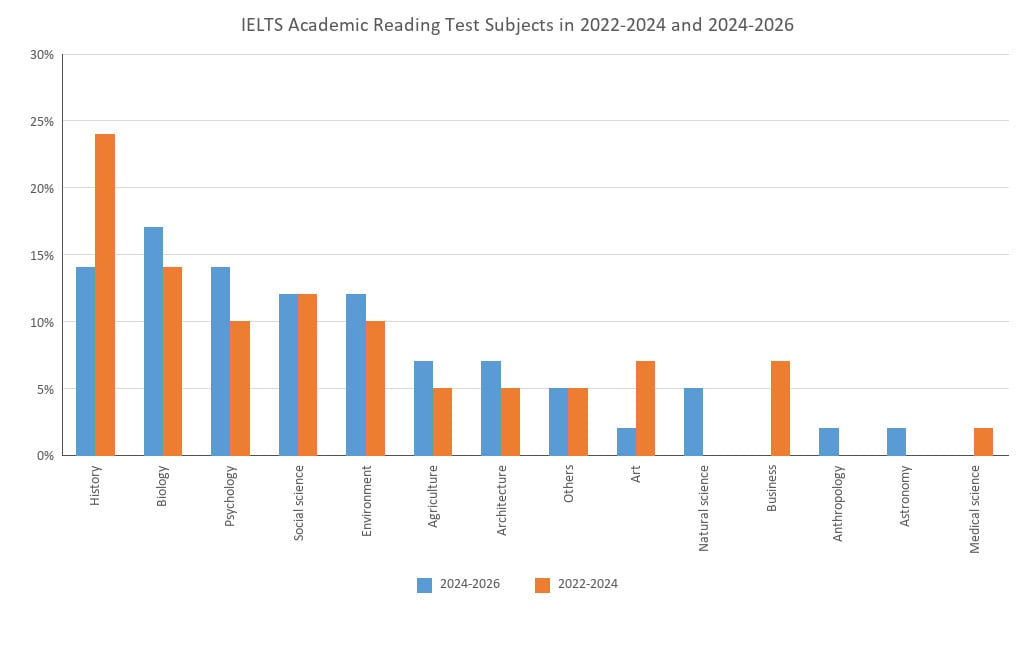
På grund av dessa trender har vi sett till att våra IELTS Reading-övningsprov täcker dessa ämnen. Vi har också lagt till lässample från mindre vanliga ämnen, för säkerhets skull. Det är viktigt att du förbereder dig för alla situationer, eftersom du aldrig vet vilket IELTS-läsämne du kommer att få.
Hur din IELTS Reading-poäng beräknas
Varje IELTS-läsfråga är värd 1 poäng, så du kan få en "rå" poäng på upp till 40 poäng. Därefter omvandlas din råpoäng till din bandpoäng. Tabellerna nedan ger dig en allmän bild av hur råpoäng i IELTS Reading omvandlas till bandpoäng för respektive prov.
IELTS General Reading-poäng jämfört med IELTS Academic Reading-poäng
| Råpoäng: Academic | Bandpoäng: Academic | Råpoäng: General | Bandpoäng: General |
|---|---|---|---|
| 39-40 | 9 | 40 | 9 |
| 37-38 | 8.5 | 39 | 8.5 |
| 35-36 | 8 | 37-38 | 8 |
| 33-34 | 7.5 | 36 | 7.5 |
| 30-32 | 7 | 34-35 | 7 |
| 27-29 | 6.5 | 32-33 | 6.5 |
| 23-26 | 6 | 30-31 | 6 |
| 19-22 | 5.5 | 27-29 | 5.5 |
| 15-18 | 5 | 23-26 | 5 |
| 13-14 | 4.5 | 19-22 | 4.5 |
| 10-12 | 4 | 15-18 | 4 |
| 8-9 | 3.5 | 12-14 | 3.5 |
| 6-7 | 3 | 9-11 | 3 |
| 4-5 | 2.5 | 6-8 | 2.5 |
| 1-3 | 2 | 1-5 | 2 |
Tänk dock på att varje version av IELTS Reading-provet är något olika och att antalet poäng som krävs för att uppnå en viss bandpoäng varierar beroende på hur alla som gjorde provet presterade just den dagen. Antalet korrekta svar som krävs för att få en viss bandpoäng skiljer sig därför något från prov till prov, men i allmänhet bör du sikta på cirka 30 av 40 om du vill få en bandpoäng på 7.
En annan sak vi vill påminna dig om är att de svåraste frågorna och de lättaste frågorna räknas lika mycket mot din slutliga läspoäng, så se till att du inte missar enklare poäng genom att fastna på svårare frågor. Härnäst går vi igenom några IELTS-lästips och strategier för hur du besvarar varje typ av läsfråga.
IELTS Reading-tips – Hur du besvarar de 11 frågetyperna i läsprovet
Det finns 11 olika frågetyper på läsprovet och alla kräver en egen strategi.
Varje typ har ett exempel och ett svar i guiden om IELTS Reading-frågetyper.
- Frågetyp 1 – Matching Information
- Frågetyp 2 – Matching Headings
- Frågetyp 3 – Matching Features
- Frågetyp 4 – Identifying Information
- Frågetyp 5 – Identifying Writer's Views/claims
- Frågetyp 6 – Multiple Choice
- Frågetyp 7 – Matching Sentence Endings
- Frågetyp 8 – Sentence Completion
- Frågetyp 9 – Summary, Note, Table, Flow-chart Completion
- Frågetyp 10 – Diagram Label Completion
- Frågetyp 11 – Short Answer Questions
- Hur trender hjälper dig att förbereda dig för IELTS Reading-provet
Hur trender hjälper dig att förbereda dig för IELTS Reading-provet
Vilka typer av läsförståelsefrågor våra elever tycker är svårast
BestMyTests elever har besvarat en miljon frågor i läsförståelsedelen i Academic och 600 000 frågor i läsförståelsedelen i General Training på våra övningsprov. Procenttalen visar hur ofta varje frågetyp besvarades korrekt.
| Frågetyp | Academic | General Training |
|---|---|---|
| Matcha information | 34% | 72% |
| Sant / Falskt / Ej angivet | 39% | 60% |
| Flervalsfrågor | 43% | 48% |
| Matcha egenskaper | 48% | 74% |
| Fylla i meningar | 49% | 75% |
| Matcha rubriker | 53% | 40% |
| Ja / Nej / Ej angivet | 55% | 57% |
| Fylla i en sammanfattning | 59% | 46% |
| Kortsvarsfrågor | 54% | 75% |
- I läsförståelsedelen i Academic är de två frågetyperna med lägst resultat matcha information och Sant/Falskt/Ej angivet, båda under 40%. Båda kräver att du hittar en omformulerad tanke snarare än ett matchande nyckelord.
- I General Training är bilden den omvända: matcha rubriker är frågetypen med lägst resultat på 40%, medan frågetyper där du ska hitta information besvaras korrekt tre gånger av fyra eftersom texterna är kortare och mer bokstavliga.
- Frågor till texter i Academic besvaras korrekt i genomsnitt i 46% av fallen och frågor till texter i General Training i 59% av fallen. Hälften av försöken på texter i Academic ger 40% rätt eller mindre.
- På totalt 43 711 fullständiga övningsprov i läsförståelse som genomfördes av 38 534 elever var den genomsnittliga bandpoängen 5.4. 36% nådde bandpoängen 6.0 och 14% nådde bandpoängen 7.0.
- Du behöver fortfarande förbereda dig på alla frågetyper, men om du har ont om tid visar tabellen var den gör mest nytta.
Siffrorna kommer från BestMyTests övningsprovs- och bedömningsdata fram till oktober 2026. Procenttalen för frågetyperna anger andelen korrekta svar för samtliga försök; siffrorna för bedömningskriterierna är poäng från lärare eller AI enligt märkningen. Senast uppdaterad 5 oktober 2026.
Härnäst går vi igenom IELTS-lästips och strategier som krävs för en hög läspoäng.
IELTS-lästips – Hur du förbättrar din bandpoäng i läsning
De flesta studenter klarar inte läsdelen av följande tre skäl
- Långsam läshastighet
- Bristfälligt ordförråd
- Lite eller ingen förberedelse
Förbättra din läshastighet
Först, låt oss få det uppenbara ur vägen. För att förbättra din läshastighet behöver du faktiskt öva på att läsa och göra det regelbundet.
Nu ska vi titta på en mindre uppenbar strategi som hjälper dig att förstå betydelsen av stora delar av meningar. Börja med att dissekera meningen. Gör detta genom att leta efter meningens subjekt och verb. Att hitta subjektet och verbet hjälper dig att förstå meningens innebörd. En anledning till att akademiska textavsnitt kan vara svåra att förstå är att de länkar samman flera idéer för att bilda långa, sammansatta meningar. Detta producerar stora delar av meningar som är svårare att ta in, så att använda subjekt och verb som vägledning för att förstå hela delen är ett bra verktyg som du kan använda under ditt IELTS Reading-prov.
Förbättra ditt ordförråd
Många tror att det är lika enkelt att besvara läsfrågor som att skanna stycket efter nyckelord och information... Tyvärr är det inte så enkelt. Läsfrågor är vanligtvis omformulerade, vilket innebär att orden har ändrats för att använda synonymer av ord från IELTS-textavsnittet. Detta görs för att öka svårighetsgraden, annars skulle provet vara för enkelt. Därför måste du förbättra ditt ordförråd för att kunna känna till de många olika synonymerna för ett ord.
När du förbereder dig för läsprovet och stöter på ett ord du inte kan, gör det till en vana att antingen stanna upp och slå upp det eller åtminstone skriva ned det och slå upp det senare. Det är lite tråkigt, men extremt effektivt. Ditt mål bör vara, men är inte begränsat till, att studera 15 till 20 nya akademiska ord varje dag.
Veta i vilka frågetyper svaren följer/inte följer ordningen
Det är viktigt att veta att för vissa frågetyper kommer svaren vanligtvis (nästan alltid) i samma ordning som IELTS-textavsnittet. För andra frågetyper är svaren sällan i samma ordning som textavsnittet. Vi har sammanställt en tabell över de frågetyper som följer ordningen och de som inte gör det. Tänk på detta.
| Svaren kommer vanligtvis (nästan alltid) i samma ordning som textavsnittet | Svaren kommer sällan i samma ordning som textavsnittet. |
|---|---|
|
|
Hitta den bästa lässtrategin för dig
Den största utmaningen som de flesta möter i IELTS Reading-provet är att hinna besvara alla läsfrågor innan tiden tar slut. I nästa avsnitt får du lära dig tre strategier och det är upp till dig att lista ut vilken som passar dig bäst. Det gör du med hjälp av våra gratis läsövningar.
3 strategier för IELTS Reading
Strategi 1: Läs hela textavsnittet och besvara sedan frågorna.
Först och främst är detta egentligen ingen strategi. Det är något folk gör när de inte förbereder sig ordentligt för läsprovet. Vi har dock inkluderat det som en strategi eftersom, tekniskt sett, om du kan komma ihåg informationen från textavsnittet vid första genomläsningen och kunna besvara frågorna, då behöver du inte strategi 2.
Denna strategi, om du inte har ett bättre minne än genomsnittet, är ineffektiv. Du kommer att få slut på tid innan du hinner besvara alla frågor. Många gör detta misstag. Det finns dock vissa frågor som inte kräver mycket ansträngning och som drar nytta av denna strategi, t.ex. Om frågan är ett "Yes"- eller "No"-svar kommer du att kunna skumma snabbt och hitta svaret snabbt, men det finns inte tillräckligt många av sådana frågetyper, så det är inte rekommendabelt att använda denna strategi om du inte klarar av det.
Strategi 2: Läs frågorna först, läs med ett mål och anteckna, och besvara sedan frågorna med eftertanke
Detta är vår rekommenderade strategi. Den hjälper dig att få en högre IELTS Reading-poäng. Tänk på detta som en tydlig karta över hur du i allmänhet ska närma dig provet:
Ett av de vanligaste misstagen som deltagare gör när de
närmar sig läsprovet är att läsa varje enskilt ord i IELTS-textavsnitten. Även om du kan
öva inför provet genom att läsa för nöjes skull, kommer "blind läsning" (att läsa utan någon känsla för
vad frågorna kommer att fråga om) inte att hjälpa dig under provet. I stället skadar det dina
chanser att effektivt hantera tiden och få bästa möjliga poäng.
Den främsta anledningen till att läsa frågorna först är att frågetypen kan avgöra vad
du läser i textavsnittet eller hur du läser det. Vissa frågetyper kräver till exempel
"skimming"-tekniken, medan andra kan kräva "scanning"-tekniken.
Det är viktigt att ta itu med en uppsättning frågor som är av samma frågetyp.
Du måste avgöra vilken frågetyp du vill ta itu med först.
En bra strategi är att börja med den lättare frågetypen och gå vidare till svårare frågetyper senare.
De lättaste frågetyperna är de där du tillbringar mindre tid med att läsa.
Till exempel är frågetypen Matching Heading en lättare en, eftersom du
bara behöver hitta den rubrik som bäst beskriver huvudidén i ett stycke.
Ett exempel på en svår frågetyp är Identifying Information. För denna frågetyp
måste du läsa varje stycke för att ta reda på om varje påstående är TRUE, FALSE eller NOT GIVEN enligt textavsnittet.
Här är en tabell som listar svårighetsgrader för varje frågetyp. Använd denna tabell som referens när du väljer vilken frågetyp
du vill ta itu med först.
| Svårighetsgrad | Frågetyp |
|---|---|
| Lätt | Match Headings Short answer |
| Medel |
Matching Sentence Endings Matching Features Multiple choice Sentence Completion Diagram Label, Summary, Note, Table, Flow-Chart Completion |
| Svår |
Match Information Identifying Information (TRUE/FALSE/NOT GIVEN) Identifying Viewer's claims (YES/NO/NOT GIVEN) |
När du har läst frågorna från IELTS-texten kan du läsa med ett mål. Vad innebär detta? Om du till exempel stöter på en fråga som innehåller årtalet "1896", kan du anteckna när detta år dyker upp i texten och använda det för att besvara frågan senare.
Det finns två lästekniker som hjälper dig att hålla dig på rätt spår med läsning för ett mål. Den första, skimming, beskrivs bäst som att läsa snabbt för att få "kontentan", eller den allmänna idén, av ett textavsnitt. Med denna teknik stannar du inte upp för okända ord eller letar efter specifika detaljer. Den andra tekniken, scanning, beskrivs bäst som att läsa efter specifik information. Med denna teknik läser du inte för att få den övergripande kontentan, utan snarare specifik information. Lägg märke till hur var och en av dessa tekniker har ett specifikt mål i åtanke. Detta hjälper dig att hitta information snabbare.
Medan du läser för ett mål bör du också göra anteckningar i marginalerna av textavsnittet, sätta stjärnor bredvid viktig information eller stryka under saker som du tror kommer att hjälpa dig att besvara de olika frågorna. Detta gör det enklare för dig att gå tillbaka när du tillfrågas om vissa saker i frågorna. Välj vilket anteckningssystem som passar dig bäst – se bara till att du gör det!
När du har läst frågorna, läst textavsnittet och tagit eventuella lämpliga anteckningar bör du ha lokaliserat den del av texten där du behöver läsa noggrant. Sedan är det bara att läsa noggrant och tänka kritiskt för att avgöra det rätta svaret.
Strategi 3: Skimming, antecknande och frågetyper.
Detta är ytterligare en strategi som många IELTS-deltagare använder. Den hjälper dig att få en högre läspoäng. Strategin består av 4 steg:
- Skumma varje stycke för att få den allmänna idén av varje stycke. Huvudidén i ett stycke finns oftast i de första få meningarna, så fokusera lite mer på dessa meningar. De följande meningarna kan skummas snabbt, varvid namn/ord/fraser som sticker ut understryks.
- Efter att ha skummat varje stycke, skriv korta anteckningar (2–5 ord) bredvid varje stycke med din bästa gissning om huvudidén i det stycket.
- Besvara därefter en uppsättning frågor som är av samma frågetyp.
- Slutligen, besvara en uppsättning frågor effektivt och korrekt.
Det är viktigt att du inte spenderar mer än 3–5 minuter på Steg 1 och 2. Att lägga för mycket tid på dessa steg slösar bort för mycket tid och du kommer att få slut på den.
Steg 1 & 2Målet här är att skapa en effektiv metod för att hitta svar i textavsnittet. Genom att skriva ner den allmänna idén i varje stycke vet du vilket stycke som innehåller svaret på varje fråga. Detta sparar mycket tid eftersom om du inte hade skrivit ner det skulle du sannolikt behöva skumma varje stycke för att få den allmänna idén för frågan, och sedan skulle du behöva noggrant skanna stycket efter svaret. Genom att anteckna varje styckes huvudidé hoppar du över det första steget att skumma varje stycke och börjar direkt skanna efter svaret.
Steg 3
Efter att du noggrant har skummat texten och skrivit ner några anteckningar är du redo för Steg 3.
I detta steg måste du avgöra vilken frågetyp du vill ta itu med först.
En bra strategi är att börja med den lättare frågetypen och gå vidare till svårare frågetyper senare.
De lättaste frågetyperna är de där du tillbringar mindre tid med att läsa.
Till exempel är frågetypen Matching Heading en lättare en, eftersom du
bara behöver hitta den rubrik som bäst beskriver huvudidén i ett stycke, så tekniskt sett behöver du bara Steg 1 och 2 för att besvara denna frågetyp.
Ett exempel på en svår frågetyp är Identifying Information. För denna frågetyp
behöver du läsa varje stycke för att ta reda på om varje påstående är TRUE, FALSE eller NOT GIVEN enligt textavsnittet.
Här är en tabell som listar svårighetsgrader för varje frågetyp. Använd denna tabell som referens när du väljer vilken frågetyp du vill ta itu med först.
| Svårighetsgrad | Frågetyp |
|---|---|
| Lätt | Match Headings Short answer |
| Medel |
Matching Sentence Endings Matching Features Multiple choice Sentence Completion Diagram Label, Summary, Note, Table, Flow-Chart Completion |
| Svår |
Match Information Identifying Information (TRUE/FALSE/NOT GIVEN) Identifying Viewer's claims (YES/NO/NOT GIVEN) |
Nu när du har räknat ut vilken uppsättning frågor du ska besvara först är det dags att faktiskt besvara dem :( Oroa dig inte! Även om varje frågetyp är olika, gäller strategin för att besvara dem korrekt för dem alla. Den grundläggande principen är enkel, följ bara stegen nedan:
- Läs frågan noggrant och identifiera viktiga nyckelord.
- Hitta det stycke som innehåller den information som behövs för att besvara frågan. (Förhoppningsvis har du redan skrivit ner de allmänna idéerna för varje stycke, så att du enkelt kan ta reda på detta.)
- Skanna stycket efter de viktiga nyckelorden (de är troligen synonymer!) tills du lokaliserar den del av texten där du behöver läsa noggrant.
- Slutligen, läs noggrant och tänk kritiskt för att avgöra det rätta svaret.
Gratis nedladdningar av IELTS Reading-provexempel i PDF med svar
Nedan finns några gratis lässample från British Council (skaparna av IELTS-provet). Försök besvara frågorna och se hur du klarar det!