
I denna guide gör du ett gratis IELTS-hörtest och får en fullständig analys av din IELTS-hörpoäng. Du förbereder dig med över 125 IELTS-höruppgiftsövningar, lektioner, tips och videoförklaringar till svaren. Genom att följa vår personligt anpassade studieplan uppnår du din mål-bandpoäng i IELTS Listening.
Få gratis analys av din IELTS Listening-poäng och en personlig studieplan efter att du har genomfört ett gratis IELTS Listening-övningstest.
play_circle_outline Starta IELTS Listening-övningstestNedan finns vår fullständiga lista med IELTS Listening-frågor och svar. Obs: De röda länkarna är våra mest populära och rekommenderade listeningfrågor enligt våra studenter, och du kan öva på dem gratis när du vill.
IELTS Hörförståelse – övningsfrågor för avsnitt 1 1 - 59
A conversation between two people in an everyday situation
IELTS Hörförståelse – övningsfrågor för avsnitt 2 1 - 75
A talk by one speaker about an everyday topic
IELTS Hörförståelse – övningsfrågor för avsnitt 3 1 - 65
A conversation between up to four people about studies or training
IELTS Hörförståelse – övningsfrågor för avsnitt 4 1 - 62
A talk by one speaker on an academic subject
IELTS Listening övningsprovsguide
Resten av denna guide kommer att lära dig allt om IELTS Listening-provet. Du kommer att lära dig hur Listening-poängen beräknas, hur du framgångsrikt besvarar varje frågetyp i Listening för att förbättra din IELTS Listening-bandpoäng, och lära dig vår beprövade 3-stegsprocess för att hjälpa dig studera IELTS Listening-prov online.
Innehållsförteckning
Information om IELTS Listening-provet
IELTS Listening-provet är uppdelat i 4 avsnitt. I varje avsnitt lyssnar du på en eller flera personer som talar engelska som modersmål och besvarar sedan cirka 10 frågor relaterade till det du just hörde. Hela IELTS Listening-avsnittet innehåller 40 frågor totalt. I allmänhet börjar Listening-inspelningarna lättare och blir svårare allteftersom provet fortskrider. Varje inspelning hörs endast en gång och innehåller en rad accenter, inklusive brittisk, australisk, nyzeeländsk, amerikansk och kanadensisk.
- Avsnitt 1 – ett samtal mellan två personer i en vardaglig social kontext. Du kan till exempel höra ett samtal om att bekräfta detaljer för en bokning eller att lägga en beställning per telefon.
- Avsnitt 2 – en monolog i en vardaglig social kontext. Du kan till exempel höra ett tal om lokala faciliteter, någon som ger vägbeskrivningar eller presenterar grundläggande information om ett evenemang.
- Avsnitt 3 – ett samtal mellan upp till fyra personer i en utbildnings- eller träningskontext. Du kan till exempel höra en universitetshandledare och en student diskutera en uppgift, eller ett par studenter som diskuterar något från lektionen.
- Avsnitt 4 – en monolog om ett akademiskt ämne. Du kommer till exempel att höra en universitetsföreläsning av en professor. Detta är den svåraste inspelningen i Listening-provet för de flesta studerande.
IELTS Listening-provet tar ungefär 40 minuter. Du kommer att lägga 30 minuter på att lyssna på inspelningar och besvara frågor. Du får ett frågehäfte och ett svarsblad. Frågehäftet är där du ser alla frågor du behöver besvara. Svarsbladet är där du skriver dina slutliga svar för bedömning.
Du kan kolla in IELTS officiella svarsblad för Listening i PDF-format här eller bara titta på bilden nedan :)
I slutet av Listening-avsnittet får du 10 minuter på dig att överföra svaren från ditt frågehäfte till ditt svarsblad.
VIKTIGT!
Felstavningar och felaktig grammatik markeras som FELAKTIGA, så använd de 10 minuterna för att dubbelkolla din stavning och grammatik.
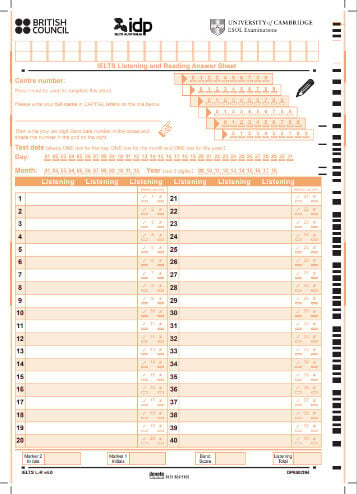
Beräkning av IELTS Listening-poäng
I Listening-avsnittet är varje fråga värd 1 poäng, så du kan uppnå en "rå" poäng på upp till 40 poäng. Sedan omvandlas din råpoäng till din bandpoäng. Kom ihåg! Du förlorar inga poäng för felaktiga svar. Tabellen nedan kan ge dig en allmän uppfattning om hur råpoäng omvandlas till bandpoäng.
| Råpoäng | Bandpoäng |
|---|---|
| 39-40 | 9 |
| 37-38 | 8.5 |
| 35-36 | 8 |
| 32-34 | 7.5 |
| 30-31 | 7 |
| 26-29 | 6.5 |
| 23-25 | 6 |
| 18-22 | 5.5 |
| 16-17 | 5 |
| 13-15 | 4.5 |
| 11-12 | 4 |
Eftersom varje version av IELTS är något annorlunda skiljer sig den råpoäng som krävs för att uppnå en viss bandpoäng beroende på hur alla som tog provet presterade den dagen. Således kommer antalet korrekta svar som behövs för att få en bandpoäng att variera något från prov till prov, men i allmänhet bör du sikta på att få cirka 30 av 40 om du vill ha en bandpoäng på 7.
Som nämnts ovan blir avsnitten svårare och svårare allteftersom du fortskrider genom IELTS Listening-provet. Varje fråga är dock värd samma antal poäng. Se därför till att du inte går miste om enklare poäng för att du fastnar på svåra frågor.
Gratis IELTS Listening-exempel PDF-nedladdning med svar
Här är några gratis IELTS Listening-exempel i PDF-format med svar från British Council (skaparna av IELTS-provet). Under länkarna kan du också göra ett gratis IELTS Listening-test med ljud och svar från BestMyTest. Det har alla fyra delar, och varje del visar sitt ljudmanus tillsammans med svaren. Försök besvara frågorna och se hur du klarar dig!
- IELTS Listening Practice Test 1 - questions (Online Examples)
- IELTS Listening Practice Test 1 - answers (PDF)
- IELTS Listening Practice Test 1 - answer sheet (PDF)
Listen to the recording and answer questions 1 to 10. The answers and the audio script are in the box below the questions.
Questions 1-10
Complete the notes below.
Write ONE WORD AND/OR A NUMBER for each answer.
This can provide the carer with:
• time for other duties
• a 1
Assessment of aunt's needs
This may involve discussing:
• how much 2 is spent caring
Daily tasks discussed:
• help with dressing
• helping her take a 3
• shopping
• helping with meals
• managing 4
• any parts of caring that are particularly hard, e.g.
• loss of 5
• 6 her
• avoiding a 7
Types of support that may be provided for carers
• transport costs, e.g. cost of a 8
• vehicle-related costs, e.g. fuel and 9
• help with housework
• support to lower 10
-
spellcheck Answers
1. Break
Break is correct because this detail is stated in the recording at the point where the question is answered.2. Time
Time is correct because this detail is stated in the recording at the point where the question is answered.3. Shower
Shower is correct because this detail is stated in the recording at the point where the question is answered.4. Money
Money is correct because this detail is stated in the recording at the point where the question is answered.5. Memory
Memory is correct because this detail is stated in the recording at the point where the question is answered.6. Lifting
Lifting is correct because this detail is stated in the recording at the point where the question is answered.7. Fall
Fall is correct because this detail is stated in the recording at the point where the question is answered.8. Minicab
Minicab is correct because this detail is stated in the recording at the point where the question is answered.9. Parking
Parking is correct because this detail is stated in the recording at the point where the question is answered.10. Anxiety
Anxiety is correct because this detail is stated in the recording at the point where the question is answered.
Audio ScriptNora: It's really good to see you, Marcus. Since I had to give up work, I feel I'm losing touch with my friends and colleagues.
Marcus: We really miss you in the office. We were all so sorry you had to leave. But you must be relieved to have more time to look after your aunt. How is she?
Nora: Well, she's very cheerful, but she needs a lot of help.
Marcus: Have you tried to get any support from the local council?
Nora: No. I didn't know I could.
Marcus: Yes. But for different kinds of practical support, they realise that carers sometimes need time for all the other responsibilities they have, apart from the person they're caring for, and also that they sometimes need a break.
Nora: Absolutely. OK, so tell me more, how do I go about getting this support?
Marcus: Well, you'd have to have an assessment of your aunt's needs. That means someone would come round and talk to you about the situation and what you need. So for a start, they'd want to know the amount of time you spend looking after your aunt every day.
Nora: OK.
Marcus: Then they'll probably ask you what sorts of tasks you do for your aunt during the day. Things like if she needs help with getting dressed, for example.
Nora: Right. I help her with that. And also I help her get into the shower in the morning.
Marcus: Yes. That sort of thing. They'll probably ask you if you do the shopping for her, and help her at meal times, and whether she can cope using money.
Nora: Yes. That's becoming a bit of a problem. She used to be very good at it, but not anymore.
Before you hear the rest of the conversation, you have some time to look at questions 5 to 10. [20 seconds] Now listen, and answer questions 5 to 10.Marcus: And be ready to tell them about anything you find particularly difficult about caring for your aunt.
Nora: So recently I've noticed she started to have quite bad problems with her memory. If I wasn't there, I think she'd forget to eat, for example. And often she doesn't seem quite sure what day it is.
Marcus: Yes. Tell them about that. And are there any physical difficulties you have caring for her? Lifting her, for example.
Nora: Yes. She's quite heavy, and I'm afraid of hurting my back. I'd be in real trouble if that happened.
Marcus: They can give you advice about that, and also about how to avoid the possibility of your aunt having a fall.
Nora: Great. So, once they've done this assessment, if I'm eligible, what happens next?
Marcus: Well, they might support you financially. So they might help you with travel costs, like if you have to get a minicab to take your aunt for an appointment, for example.
Nora: I usually drive her myself, actually. So could I claim for the petrol?
Marcus: You could. And you can claim for the parking, too.
Nora: Oh, right.
Marcus: And if you need help with the housework, they can arrange for someone to come along once or twice a week. And one other thing. I hope you don't mind me saying this, but it's important you look after yourself. And it seems to me you're dealing with quite a bit of anxiety.
Nora: I am, yes.
Marcus: Well, tell the council, because they may be able to give you some advice on how to minimise it.
Nora: Really? Though, actually, I feel so much better having talked to you. I'll get in touch with the council straight away. Now, shall we go for coffee, or something?
Listen to the recording and answer questions 11 to 20. The answers and the audio script are in the box below the questions.
Questions 11-14
Choose the correct letter, A, B or C.
11. Who began turning the unused Whitfield site into a planted space?
- city council officials.
- nearby residents.
- a gardening charity.
12. What was Lillian Hartley trying to achieve through public campaigning?
- preventing a housing sale
- blocking army exercises
- winning maintenance funding
13. Why was the park rejected as a place for troop exercises?
- council permission was refused.
- too little usable space.
- a better site was chosen.
14. How does the speaker describe the latest redesign plans?
- 2013 plan used unchanged.
- 2013 plan revised pre-work.
- 2015 plan finished in 2016.
Questions 15-20
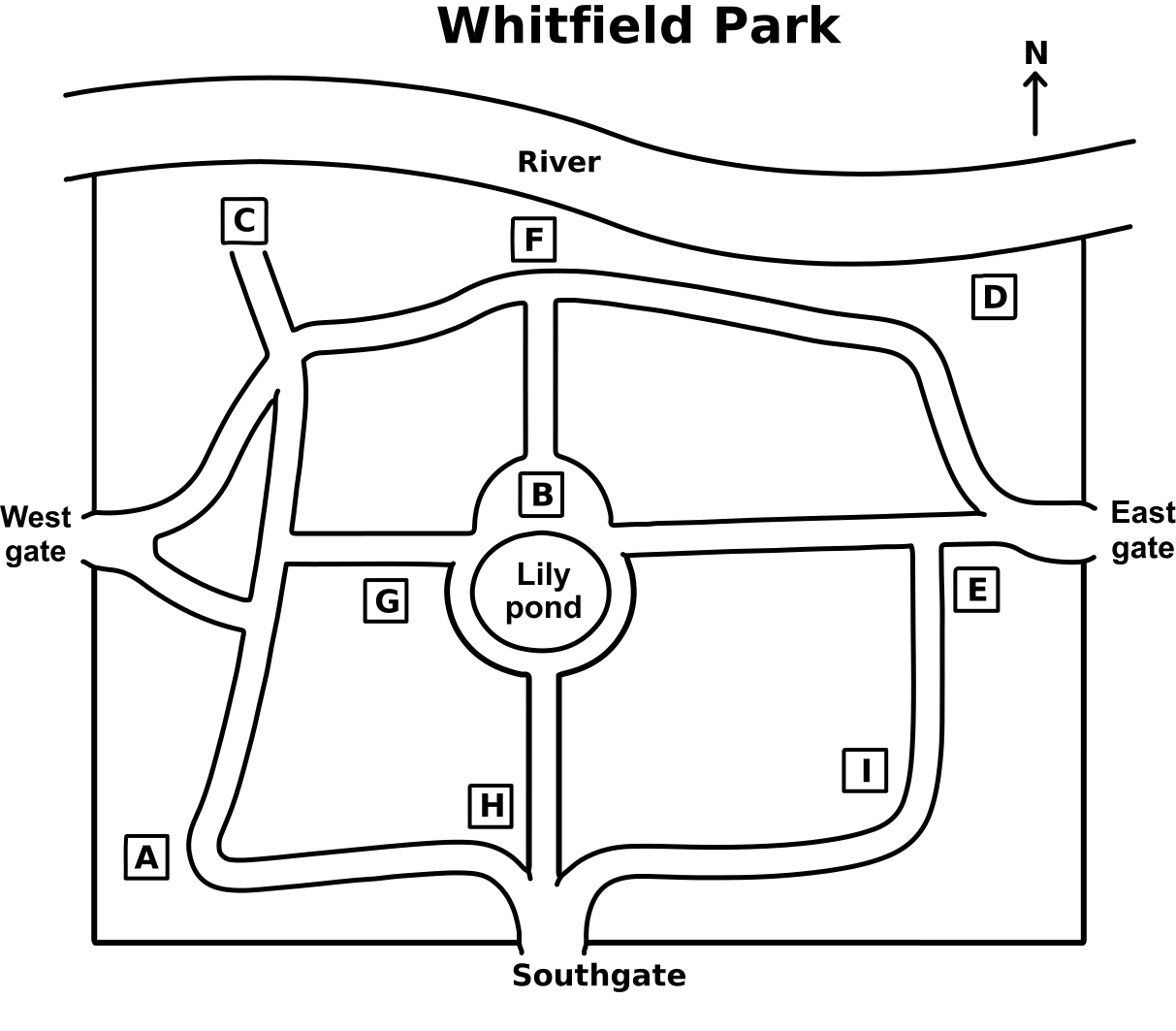
Label the plan of Whitfield Park below.
Write the correct letter, A-I, next to questions 15-20.
- statue of Lillian Hartley
- wooden sculptures
- playground
- maze
- tennis courts
- fitness area
-
spellcheck Answers
11. B
(A) is incorrect. The council took ownership later.(B) is correct. The initial planting was done by residents from nearby streets.
(C) is incorrect. The recording does not support this option: a gardening charity.
12. A
(A) is correct. Hartley organised public pressure so the council would keep the land as a park rather than sell it for housing.(B) is incorrect. The recording does not support this option: blocking army exercises.
(C) is incorrect. The recording does not support this option: winning maintenance funding.
13. B
(A) is incorrect. The recording does not support this option: council permission was refused.(B) is correct. , after inspection, the army concluded that the park was too small for practical use.
(C) is incorrect. The recording does not support this option: a better site was chosen.
14. B
(A) is incorrect. The recording does not support this option: 2013 plan used unchanged.(B) is correct. The plans dated from 2013 but were revised in 2015 before work began.
(C) is incorrect. The recording does not support this option: 2015 plan finished in 2016.
15. B
The correct answer is B because the statue of Lillian Hartley is now immediately north of the lily pond near the centre of the park, and that position is labelled B.16. D
The correct answer is D because the wooden sculptures are on the riverbank where the path from the East Gate makes a sharp bend, which corresponds to D.17. F
The correct answer is F because the playground is between the river and the path from the lily pond to the river, and that location is marked F.18. C
The correct answer is C because the maze is found by entering from the West Gate, walking north, and turning left, which places it at C.19. A
The correct answer is A because the tennis courts remain in the southern corner where the perimeter path makes a right-angled bend, labelled A.20. G
The correct answer is G because the fitness area is beside the lily pond on the same side as the West Gate, matching G on the plan.
Audio ScriptI'm delighted this evening to introduce our guest speaker, Sarah Holloway, who is going to talk to us about the recent transformation of Whitfield Park. Over to you, Sarah. Thank you very much. I'm sure you all know Whitfield Park well, it has been one of the city's landmarks for well over a century, and the city council has been responsible for it for most of that time. What perhaps fewer of you will know is how the park actually began.
Unlike many city centre parks, which started life as the private gardens of a large house, Whitfield was originally just an unused patch of waste ground. The first flowers there were actually planted by a small group of local residents who lived in the surrounding streets. They began work on the site in 1892. At that point nobody was entirely sure who legally owned the land, and it was a full twenty years later before the city council finally took it into public ownership. Some of you will have seen the statue near one of the gates. That figure is Lillian Hartley, who played a really important role in the early history of the park.
Once the council legally owned the land, its first instinct was to sell it off as building plots for housing. A great many local residents, however, wanted the park to stay open as a place where everyone could enjoy fresh air and green space, bear in mind that this is a very densely built up residential district. Lillian Hartley was at the heart of that campaign, and it was she who organised the petitions and the public demonstrations which, in the end, persuaded the council to drop the sale and keep the land as a park.
Soon afterwards, in 1914, the First World War broke out, and most of the park was dug up and used to grow vegetables, which were sold to local residents. At one point the army did look into taking over the park as a site for troop exercises. They actually wrote to the city council about it, but when they inspected it they concluded that the park was simply too small to be of any practical use to them, so the idea was dropped. The only military activity in the park during the war was the occasional public meeting held on a small area of grass that had been kept clear of vegetable plots.
After the war, the park was largely returned to the way it had been before 1914, and from then on it remained almost unchanged for decades. New plans for transforming the park were drawn up several times over the years; the most recent version dates from 2013, but those plans were then revised in 2015, well before any actual work had got under way. Work on the ground finally began in 2016 and was completed, on schedule, last year.
Before you hear the rest of the talk, you have some time to look at questions 15 to 20. [20 seconds] Now listen and answer questions 15 to 20.All right, I'd like to describe some of the more important changes that have been made, and one or two things that have deliberately been left as they were. If you take a quick look at the map you've been handed, you'll see the familiar outline of Whitfield Park. The river forms the northern boundary, and there is a gate in each of the three other walls.
From there, follow the path up towards the river and the enlarged children's playground sits between that path and the river itself. If you keep your eye on the riverbank, over towards the East Gate side, the new wooden sculptures are at the point where the path coming up from that gate makes a sharp bend.
Back near the West Gate side of the park, there is a maze, a circular pattern of paths separated by low hedges. Head in from the West Gate, walk north towards the river, and then turn left to find it. Close to the same central lily pond, on the side facing the West Gate, you'll also find the new outdoor fitness area.
Down in the southern corner, where the perimeter path makes that distinct right angled bend, the tennis courts are still in their familiar position, though we have now doubled them from four to eight. Now, since you are all keen gardeners, I'm sure you'll want to hear about the plants that have been chosen for the new beds.
Listen to the recording and answer questions 21 to 30. The answers and the audio script are in the box below the questions.
Questions 21-25
Choose the correct letter, A, B or C.
21. Nina and Owen were surprised to learn that coastal cities
- are home to just under half of all people.
- account for many of the largest cities.
- are expanding at double the rate of inland cities.
22. According to Owen, building coastal cities near to rivers
- can carry contamination back towards urban areas.
- can leave too little land for farming upstream.
- can cause factories to damage rural scenery.
23. What mistake was made when building water drainage channels in Port Selby in the 1950s?
- The system did not include enough channels.
- The builders selected the wrong construction materials.
- The design failed to anticipate rising sea levels.
24. What do Nina and Owen think that the authorities in Port Selby should do immediately?
- take measures to restore coastal ecosystems
- pay for a new flood prevention system
- stop disposing of waste materials into the ocean
25. What do they agree should be the priority for international action?
- greater coordination of activities
- more sharing of information
- agreement on shared policies
Questions 26-30
What decision do the students make about each of the following parts of their presentation?
Write the correct letter, A-G, next to questions 26-30.
- use visuals
- keep it short
- involve other students
- check the information is accurate
- provide a handout
- focus on one example
- do online research
- Historical background
- Geographical factors
- Past mistakes
- Future risks
- International implications
-
spellcheck Answers
21. B
(A) is incorrect. The recording does not support this option: are home to just under half of all people.(B) is correct. Nina says most of the biggest cities are built by the sea.
(C) is incorrect. The recording does not support this option: are expanding at double the rate of inland cities.
22. A
(A) is correct. Owen says pollutants from inland agriculture and industry travel down rivers to cities.(B) is incorrect. The recording does not support this option: can leave too little land for farming upstream.
(C) is incorrect. The recording does not support this option: can cause factories to damage rural scenery.
23. C
(A) is incorrect. The recording does not support this option: The system did not include enough channels.(B) is incorrect. The recording does not support this option: The builders selected the wrong construction materials.
(C) is correct. Port Selby's drainage channels were built without allowing for global warming and rising sea levels.
24. B
(A) is incorrect. The recording does not support this option: take measures to restore coastal ecosystems.(B) is correct. Nina says they need money to replace the drainage channels for flood protection now.
(C) is incorrect. The recording does not support this option: stop disposing of waste materials into the ocean.
25. A
(A) is correct. They say coastal cities must act together internationally.(B) is incorrect. The recording does not support this option: more sharing of information.
(C) is incorrect. The recording does not support this option: agreement on shared policies.
26. B
B is correct because they decide not to spend too long on historical background, so they will keep it short.27. A
A is correct because they decide to use slides with maps showing geographical factors.28. F
F is correct because they choose the Meriton case study as the basis for past mistakes, focusing on one example.29. G
G is correct because they need to look at websites for future risks, so online research is required.30. C
C is correct because they plan to ask audience members from different places, involving other students.
Audio ScriptTutor: OK, so what I'd like you to do now is to talk to your partner about your presentations on environmental planning. You should have done most of the reading now, so I'd like you to share your ideas and talk about the structure of your presentation and what you need to do next.
Nina: OK, Owen, I'm glad we chose quite a specific topic: coastal cities. It made it much easier to find relevant information.
Owen: Yeah, and cities are growing so quickly. I mean, we know that more than half the world's population lives in cities now.
Nina: Yeah, though that's all cities, not just coastal ones. But most of the biggest cities are actually built by the sea. I'd not realised that before.
Owen: Nor me. And what's more, a lot of them are built at places where rivers come out into the sea. But apparently this can be a problem.
Nina: Why?
Owen: Well, as the city expands, agriculture and industry tend to spread further inland along the rivers. And so agriculture moves even further inland up the river. That's not necessarily a problem, except it means more and more pollutants are discharged into the rivers.
Nina: That's a serious problem.
Owen: Right.
Nina: Did you read that article about Port Selby on the south coast?
Owen: No.
Nina: Well, apparently back in the 1950s, they built channels to drain away the water in case of flooding.
Owen: Sounds sensible.
Nina: Yeah, they spent quite a lot of money on them. But what they didn't take into account was global warming. So they built the drainage channels too close to sea level. And now sea levels are rising, they're more or less useless. If there's a lot of rain, the water can't run away. There's nowhere for it to go.
Owen: So they did not help much in the end.
Nina: So what are the authorities doing about it now?
Owen: I don't know. I did read that they're aiming to stop disposing of waste water into the ocean over the next 10 years. But that won't help with flood prevention now, will it?
Nina: No, really, they just need to find the money for something to replace the drainage channels in order to protect against flooding now. But in the long term, they need to consider the whole ecosystem.
Owen: Right.
Nina: Really though, coastal cities can't deal with their problems on their own, can they? I mean, they've got to start acting together at an international level instead of just doing their own thing.
Owen: Absolutely. The thing is, everyone knows what the problems are and environmental planners have a pretty good idea of what we should be doing about them. So they should be able to work together to some extent.
Nina: But it's going to be a long time before countries come to a decision on what principles they're prepared to abide by.
Owen: Yeah, if they ever do.
Before you hear the rest of the conversation, you have some time to look at questions 26 to 30. [20 seconds] Now listen and answer questions 26 to 30.Nina: So I think we've probably got enough for our presentation. It's only 15 minutes.
Owen: OK, so I suppose we'll begin with some general historical background about why coastal cities were established. But we don't want to spend too long on that. The other students will already know a bit about it.
Nina: It's all to do with communications and so on.
Owen: Yes, we should mention some geographical factors, things like wetlands and river estuaries and coastal erosion and so on.
Nina: We could have some maps of different cities with these features marked.
Owen: On a handout, you mean, or some slides everyone can see.
Nina: Yeah, that'd be better.
Owen: It'd be good to go into past mistakes in a bit more detail. Did you read that case study of the problems there were in Meriton with flooding a few years ago?
Nina: Yes, we could use that as the basis for that part of the talk. I don't think the other students will have read it, but they'll remember hearing about the flooding at the time.
Owen: Hmm, OK. So that's probably enough background. So then we'll go on to talk about what actions have been taken to deal with the problems of coastal cities.
Nina: OK, what else do we need to talk about? Maybe something on future risks looking more at the long term if populations continue to grow?
Owen: Yeah, we'll need to do a bit of work there. I haven't got much information, have you?
Nina: No, we'll need to look at some websites. Shouldn't take too long.
Owen: OK. And I think we should end by talking about international implications. Maybe we could ask people in the audience. We've got people from quite a lot of different places.
Nina: That'd be interesting if we have time, yes. So now should we go on?
Listen to the recording and answer questions 31 to 40. The answers and the audio script are in the box below the questions.
Questions 31-36
What point does the lecturer make about each item?
Write the correct letter, A-K, next to questions 31-36.
- changes drainage
- protects animals
- increases nutrients
- kills germs
- affects many species
- creates dense shade
- alters the soil
- supports farming
- reduces competition
- attracts bell-miners
- helps recovery
- Eucalyptus woodland
- Damage to eucalyptus woodland
- Oil from eucalyptus leaves
- Lime used in construction
- Direct iron supply
- Moderate bushfires
Questions 37-40
Complete the notes below.
Write ONE WORD ONLY for each answer.
Bell-miner associated dieback:
• The process starts with insects feeding on eucalyptus 37
• A sweet liquid containing 38 attracts bell-miners
Fire patterns:
• If fires happen too often, 39 becomes the main vegetation
• When fires are almost absent, thick growth gives bell-miners protected 40 sites
-
spellcheck Answers
31. B
B is correct because eucalyptus woodland provides nesting places and shelter for birds, bats and small mammals.32. E
E is correct because damage to eucalyptus woodland affects a wider community of species, not only the trees themselves.33. D
D is correct because oil from eucalyptus leaves is used in disinfectant, where it can kill certain germs.34. G
G is correct because lime from road construction was washed into the soil and interfered with tree roots.35. K
K is correct because affected trees recovered surprisingly quickly when iron was supplied directly.36. I
I is correct because occasional fire removes fast-growing competitors that would otherwise use water needed by eucalyptus trees.37. leaves
The correct answer is leaves. The lecturer says the process begins when insects settle on eucalyptus leaves and feed on them.38. sugar
The correct answer is sugar. The lecturer says the insects produce a sweet liquid containing sugar, which attracts bell-miners.39. grass
The correct answer is grass. The lecturer says grass tends to dominate afterwards if fires occur too often.40. nesting
The correct answer is nesting. The lecturer says dense growth creates protected nesting sites for bell-miners when fire is suppressed.
Audio ScriptGood morning. Today I want to focus on the eucalyptus tree, one of the best known features of the Australian landscape. Many people call it a gum tree, but the name eucalyptus actually covers hundreds of related species, from small scrubby trees to very tall forest giants.
Now, eucalyptus trees are important in several ways. Ecologically, they provide nesting places and shelter for birds, bats and small mammals. Their flowers also produce nectar, which is an important food source for insects and birds. So when eucalyptus woodland is damaged, the effect is felt across a much wider community of species.
As for their value to people, the trees are also useful. Oil from eucalyptus leaves has long been used in cleaning products, and one common use is in disinfectant, because the oil can kill certain germs. Eucalyptus timber is also used in building and fencing, although that is not really the main focus of today's lecture.
So, these trees can live for centuries, and some individuals survive for four hundred years or more. That is why researchers became concerned when large numbers began dying much earlier than expected in different parts of Australia.
Now, one disease that attracted attention was Mundulla Yellows. The leaves of affected trees slowly turned yellow and then, over time, the whole tree declined. For years the cause was unclear. Eventually, researchers discovered that lime, or calcium hydroxide, had been used in road construction nearby. Rain washed the lime into the surrounding soil, where it interfered with the roots of eucalyptus trees. The trees were still surrounded by nutrients, but they could no longer absorb the iron they needed for healthy growth. When iron was supplied directly to affected trees, they recovered surprisingly quickly.
However, Mundulla Yellows affected only a limited number of places. A much wider problem on the east coast was Bell miner associated dieback. Now, bell miners are small native birds, but they are not the direct cause of the damage. The process begins when insects settle on eucalyptus leaves and feed on them. While feeding, these insects produce a sweet liquid containing sugar. Bell miners are attracted to that liquid, and they aggressively chase away other birds and insects that might otherwise reduce the insect population. As a result, the insects multiply, the leaves are badly damaged, and the trees gradually lose their ability to survive.
But some scientists think fire history is also part of the explanation. An influential theory, first proposed by the ecologist William Jackson, links the type of vegetation in a region to the frequency of bushfires. If fires occur too often, grass tends to dominate the area afterwards. If fires occur at moderate intervals, eucalyptus forest is more likely to persist. This is because occasional fire removes fast growing competitors which would otherwise take up the water eucalyptus trees need. And it also helps maintain the soil by preventing dense undergrowth from changing the soil structure and removing nutrients.
At the other extreme, if fires are almost completely suppressed, a different ecosystem can develop. Scientists sometimes call this dry rainforest. Now, the name sounds contradictory, because we usually associate rainforest with wet tropical conditions. But in this case it means a dense, shaded vegetation system with relatively few species. It can create excellent conditions for bell miners, because the thick growth gives them protected nesting sites while excluding many of the species that would normally compete with them.
What this tells us is that before European settlement, Aboriginal communities used controlled burning over long periods, and this probably created a more balanced pattern of vegetation. Since European settlement, fire has often been suppressed, roads and farms have altered drainage, and some local ecosystems have shifted away from eucalyptus woodland. The decline of eucalyptus trees, then, is not caused by one single factor. It is the result of disease, insects, birds, soil chemistry and fire management interacting with one another.

Completion - Part 1
Learn how to answer these questions in a step-by-step interactive exercise
Completion - Part 1
En lucka kan fråga efter en tid eller hur ofta något sker. Talaren anger oftast samma period med andra ord, så matcha betydelsen med luckan i stället för att vänta på formuleringen som står på sidan.
Kontrollera sedan ordgränsen innan du skickar in. Läs hela raden med ditt svar i luckan och ta bort alla ord som redan står på raden. Ett svar som har rätt betydelse men är för långt ger noll poäng.
Klicka på Spela upp för att lyssna på ljudklippet
Anteckningar använder ett enkelt verb som must provide eller need to bring. Talaren säger sällan just det verbet utan använder en synonym eller beskriver handlingen, så lyssna efter vad som faktiskt krävs.
Talare nämner ofta extra saker först och utesluter dem sedan. Om du missar en lucka, låt den vara och gå vidare till nästa, eftersom svaren följer inspelningens ordning och en missad lucka kan kosta dig de luckor som kommer efter.
Klicka på Spela upp för att lyssna på ljudklippet
Hur gick det med att besvara IELTS Listening-exempelfrågorna ovan? Tyckte du att några av frågorna var svåra? Om du gjorde det kan det vara fördelaktigt för dig att ta en närmare titt på alla 6 IELTS Listening-uppgiftstyper. Ju bättre du förstår en uppgiftstyp, desto mindre ansträngning behöver du lägga på att lista ut vad du behöver göra och desto mer tid har du för att räkna ut svaret.
De 6 IELTS Listening-uppgiftstyperna
Det finns 6 olika typer av frågor i IELTS Listening-provet. Det är viktigt att du övar på varje uppgiftstyp för att lära dig det bästa sättet att hantera var och en för en hög IELTS Listening-poäng.
Vilka uppgiftstyper inom hörförståelse våra elever tycker är svårast
I stället för en trend från 2017 visar vi här vad 2.25 miljoner svar på IELTS hörförståelseuppgifter från BestMyTests elever visar. Procenttalet anger hur ofta våra elever svarade rätt på den uppgiftstypen.
| Uppgiftstyp | Rätt svar |
|---|---|
| Fylla i anteckningar | 33% |
| Fylla i tabeller | 34% |
| Fylla i meningar | 45% |
| Kortsvar | 48% |
| Flervalsfrågor med ett rätt svar | 50% |
| Flervalsfrågor med flera rätta svar | 51% |
| Märka ut på planritningar, kartor och diagram | 55% |
| Fylla i formulär | 73% |
| Matchning | 85% |
- Det är i luckuppgifterna som poängen går förlorade. Uppgifter där man fyller i anteckningar och tabeller besvaras rätt bara en gång av tre, medan uppgifter där man fyller i formulär, som kräver samma färdighet men har en enklare layout, når 73%. Skillnaden handlar om stavning, ordformer och ordgränser under tidspress, inte om förståelse.
- På 61 964 fullständiga övningsprov i hörförståelse som genomfördes av 55 296 elever var den genomsnittliga bandpoängen 5.5. 41% av proven nådde bandpoängen 6.0 och 12% nådde bandpoängen 7.0.
- På enskilda hörförståelsedelar gav en tredjedel av försöken 40% eller mindre och 30% gav 80% eller mer. De flesta elever har en eller två delar där resultatet rasar snarare än ett genomgående lågt resultat, vilket är anledningen till att det lönar sig att öva på delarna 3 och 4 separat.
Siffrorna kommer från BestMyTests data från övningsprov och bedömningar fram till oktober 2026. Procenttalen för frågetyperna anger andelen rätta svar över samtliga försök; siffrorna för bedömningskriterierna är poäng från lärare eller AI enligt märkningen. Senast uppdaterad 5 oktober 2026.
Även om varje Listening-frågetyp ser annorlunda ut är det grundläggande tillvägagångssättet för var och en detsamma. Senare i denna artikel kommer vi att visa dig den grundläggande strategin för att hantera alla 6 frågetyper. Varje typ har ett ljudexempel och ett svar i guiden om IELTS Listening-frågetyper.
- Uppgiftstyp 1 – Sentence Completion (Meningskomplettering)
- Uppgiftstyp 2 – Matching (Matchning)
- Uppgiftstyp 3 – Plan, Map, Diagram Labelling (Märkning av plan, karta, diagram)
- Uppgiftstyp 4 – Form, Note, Table, Flow-Chart, Summary Completion
- Uppgiftstyp 5 – Multiple Choice (Flervalsfråga)
- Uppgiftstyp 6 – Short Answer Questions (Kortsvarsfrågor)
3-stegs effektiv förberedelse för IELTS Listening-provet online
Även om varje frågetyp (uppgiftstyp) i IELTS Listening är annorlunda, är det grundläggande tillvägagångssättet för var och en detsamma. Du kan hantera alla uppgiftstyper med en enkel, steg-för-steg-strategi. Här är de tre stegen vi rekommenderar att du använder för att närma dig Listening-frågetyper:
- Granska frågorna noggrant för att hitta nyckelinformation
- Förutsäg potentiella svar innan du lyssnar
- Följ med för att matcha frågor med innehåll medan de lyssnar
Steg 1: Granska frågorna
I IELTS Listening-avsnittet får du en kort förberedelsetid (30-40 sekunder) innan inspelningen börjar. Detta är din möjlighet att titta på de frågor du behöver besvara, vilket är exakt vad det första steget i denna strategi handlar om. Istället för att använda denna tid till att ta en paus, eller att kontrollera dina svar, ska du fokusera på att lära dig så mycket du kan om frågorna framåt. Att ta detta steg är viktigt för att undvika misstaget att multitaska medan du lyssnar på talaren och försöker läsa frågorna för första gången.
När din förberedelsetid börjar, gör först bästa möjliga användning av denna tid genom att granska frågorna för att ta reda på mer om dem. Detta är några av de informationsbitar du bör leta efter när du granskar varje IELTS Listening-fråga:
- Vilken typ av fråga är detta?
- Hur kommer svaret att se ut? (exempel: ett datum, en siffra, ett namn)
- Vilka är de viktigaste fraserna och orden, eller nyckelorden, i frågorna?
Ett exempel kan vara en frågetyp av typen Note Completion, så här:
Complete the notes below.
Write NO MORE THAN THREE WORDS for each answer.
Först kan du understryka några av nyckelorden i frågan.
Two reasons for the new approach to pricing are changes in (27) ______ and (28) _________ programs.
I detta exempel gör att lyssna efter nyckelfrasen "two reasons" som du redan hade understrukit
att du kan börja vara extra uppmärksam vid rätt ögonblick. Här är delen av ljudmanuset som avslöjar svaret:
Mark: Well, there seem to be two basic reasons. Firstly, because the law has changed recently to allow companies to behave like this. In the past, they weren't allowed to change the prices of the tickets. And secondly, we now have computer programs that do the calculations so that prices can be changed very quickly and accurately.
Efter att ha granskat frågorna skulle du veta att "the law" och "computer" var det korrekta svaret här baserat på några nyckelord och kunskap om frågetypen.
Steg 2: Förutsäg potentiella svar
Det andra steget i denna strategi för att lyckas i IELTS Listening-avsnittet är mycket nära relaterat till det första. Faktum är att du bör försöka slutföra båda dessa steg inom samma 20 sekunders förberedelsetid innan inspelningen börjar. Även om detta kan verka som en svår uppgift att göra på så kort tid, kom ihåg att dessa steg faktiskt är kopplade till varandra.
För att förutsäga potentiella svar på Listening-frågorna behöver du först ha slutfört steg ett genom att granska frågorna noggrant. Vid denna punkt bör du veta vilken typ av fråga du tittar på, hur potentiella svar kommer att se ut, samt vilka nyckelord som kommer att vara till hjälp för att snabbt hitta svaren. För att förutsäga svar kombinerar du all denna information och gör en gissning om vilken typ av svar du förväntar dig att höra.
Låt oss återgå till samma Note Completion-exempelfråga från ovan.
Two reasons for the new approach to pricing are changes in (27) and (28) programs.
Bara genom att titta på grammatiken i denna mening kan du identifiera vilken ordklass svaret kommer att vara. I detta fall föregår prepositionen "in" båda potentiella svar. Grammatiskt kan endast substantiv eller substantivfraser användas på detta sätt i prepositionsfraser. Inte bara kan du förutsäga, korrekt, att svaret kommer att vara ett substantiv eller en substantivfras, utan det skulle också vara möjligt att förutsäga att svaret kan vara något relaterat till politik eller regering (lag), och ett ord som kan förekomma med program (computer) baserat på sammanhanget.
Även om det är omöjligt att gissa det exakta korrekta svaret enbart baserat på förutsägelser, är det mer sannolikt att du lyssnar efter relevant information samtidigt som du ignorerar irrelevant information genom att försöka föreställa dig vad svaret kan vara. Att förutsäga potentiella svar innan inspelningen börjar förbereder ditt öra och tar dig ett steg närmare det korrekta svaret.
Försök nu att sätta ihop Steg 1 (granska frågor) och Steg 2 (förutsäg potentiella svar) i en svårare flervalsexempelfråga.
Choose the correct letter, A, B, C or D.
- are for weekend shows
- are booked well in advance
- are non-refundable
- are booked for groups
Även om det inte finns något sätt att veta svaren på dessa frågor med säkerhet, kan du fortfarande använda informationen i dessa frågor för att förutsäga potentiella svar och rikta din lyssning. Till exempel handlar fråga 24 om anledningen till varför teaterbiljettpriserna kommer att vara lägst, så du vill lyssna noga efter någon av dessa anledningar som nämns. Tänk på att det är möjligt att mer än en kommer att nämnas. Ta en titt på manuset nedan för att se hur förutsägelse kan hjälpa dig att eliminera felaktiga svar.
Notera hur tre av de potentiella svaren nämns: "booked for groups", "are for weekend shows" och "are non-refundable". Det korrekta svaret är dock C "are non-refundable" eftersom det nämns som billigare separat från de andra två, som helt enkelt listas tillsammans.
Steg 3: Följ med
När inspelningen börjar och själva lyssningsdelen av provet börjar bör du följa med för att slutföra steg tre i denna strategi för IELTS Listening-avsnittet. Att följa med kräver att du fokuserar noga på det du hör, samtidigt som du håller koll på vilken fråga innehållet kan handla om.
Frågorna i IELTS Listening-provavsnittet kommer vanligtvis att förekomma i ordning efter där deras svar kan hittas i inspelningens innehåll. Detta ger dig en fördel i provet, eftersom det innebär att när du har hört svaret på en fråga, kommer du omedelbart att rikta din uppmärksamhet mot nästa i ordning. Om du framgångsrikt kan följa med genom att matcha sammanhanget från frågorna med vad du hör i inspelningen, kommer du att hålla dig på rätt spår och undvika att missa nyckelinformation som krävs för att besvara var och en av frågorna.
Att göra detta är dock lättare sagt än gjort. Du kommer att behöva multitaska genom att lyssna samtidigt som du håller ögonen på nästa fråga. Om du faktiskt missar svaret på en fråga, kommer du att veta det när du hör svaret på en senare. Även om detta kan vara förvirrande och till och med frustrerande, är det fortfarande att föredra att missa ett svar och vara medveten om det än att bli helt vilse i innehållet och missa ännu fler svar. I scenariot där du missar en fråga bör du helt enkelt lämna den och fortsätta till nästa. I slutet får du göra din bästa gissning om frågan du missade. På den ljusa sidan är det dock möjligt att lyssnandet på inspelningen i sin helhet kan ge dig andra kontextuella ledtrådar och låta dig besvara eventuella missade frågor mer korrekt.
Gratis resurser för IELTS Listening-övning
Du behöver starka lyssningsförmågor för att få en hög IELTS Listening-bandpoäng. På grund av detta är det viktigt att du tränar konsekvent varje dag fram till provdagen.
Nedan finns några resurser du kan använda för att träna och upprätthålla dina lyssningsförmågor dagligen.
- YouTube - https://www.youtube.com
- BBC Learning English - http://www.bbc.co.uk/learningenglish
- TED - https://www.ted.com/
- BBC radio - https://www.bbc.co.uk/worldserviceradio
- ABC news in Australia - https://www.abc.net.au/listen/live/news