I denna guide gör du ett gratis IELTS-talprov och övar med de mest använda IELTS-talämnena med svar. Du får lära dig hur du svarar på IELTS-talfrågor i del 1, 2 och 3 med hjälp av våra noggrant testade talmallar.
Få gratis exempelsvar för IELTS Speaking efter att du har genomfört ett IELTS Speaking-övningstest.
play_circle_outline Starta IELTS Speaking-övningstestNedan finns vår fullständiga lista med IELTS Speaking-frågor och exempelsvar. Obs: De röda länkarna är våra mest populära och rekommenderade speakingfrågor enligt våra studenter, och du kan öva på dem gratis när du vill.
IELTS Speaking-frågor del 1 1 - 96
Short questions about familiar topics like your home, work, and hobbies
IELTS Speaking-frågor del 2 1 - 83
Cue cards where you speak for 1 to 2 minutes about one topic
IELTS Speaking-frågor del 3 1 - 97
Discussion questions linked to the Part 2 topic
IELTS Speaking framgångsguide
Välkommen till den officiella BestMyTest IELTS Speaking-provguiden. Resten av denna guide kommer att fokusera på att lära sig de mest använda IELTS Speaking-ämnena för Speaking del 1-3, lyssna på band 9-exempelsvar i Speaking och lära sig viktiga IELTS Speaking-tips och resurser för din framgång. Använd innehållsförteckningen nedan för att snabbt hitta det du letar efter.
Innehållsförteckning
- Introduktion till IELTS Speaking-provet
- IELTS Speaking-ämnen för Del 1
- IELTS Speaking-ämnen för Del 2 & 3
- Hur du tar dig an IELTS Speaking Del 1
- Hur du tar dig an IELTS Speaking Del 2
- Hur du tar dig an IELTS Speaking Del 3
- IELTS Speaking-övning för din framgång
- Hur IELTS Speaking-frågor bedöms
- Gratis resurser för IELTS Speaking-provet
IELTS Speaking-provet
IELTS Speaking-provet kan vara lite skrämmande till en början, särskilt eftersom du kommer att bli testad live framför din examinator. På grund av detta liveformat kan det vara svårt att hitta gratis Speaking-ämnen med exempelsvar, men oroa dig inte, vi har dig täckt. Innan du övar med våra IELTS Speaking-ämnen, låt oss ta en snabb titt på Speaking-provet och se hur det fungerar.
Format för Speaking-provet
Speaking-provet varar i cirka 11-15 minuter och består av 3 delar. Observera att Speaking-ämnena för Hälsning och Del 1 är desamma, så de räknas som endast 1 del, men vi har separerat dem för din bekvämlighet.
- Hälsning i IELTS Speaking-provet
- IELTS Speaking-provet Del 1
- IELTS Speaking-provet Del 2
- IELTS Speaking-provet Del 3
Hälsningen
När du gör IELTS Speaking-provet och kommer in i provrummet börjar examinatorn inte med svåra IELTS Speaking-frågor, utan börjar långsamt med hälsningar. Observera, du KOMMER ATT bedömas på din förmåga att hälsa, så det är viktigt att du är förberedd för det. Med det sagt, låt oss ta en snabb titt på en enkel hälsning och svar.
- Examinatorn kommer att presentera sig och fråga vad du heter. Du svarar "My name's _______".
- Sedan får du frågan "What can I call you?", som du kan svara med "You can call me_______". Du kan använda ditt engelska namn här, om du har ett. Detta kan låta märkligt, men vissa människor kan inte uttala sitt eget engelska namn. Detta är INTE ACCEPTABELT. Om du inte kan uttala det är du bättre av att inte använda det.
- Efter ditt namn frågar de var du är ifrån. Säg bara "I'm from_____". Det räcker. Du behöver inte ge någon extra information om dina svar i detta skede.
- Slutligen ombeds du om identifikation. Efter att ha visat den börjar du provet.
IELTS Speaking Del 1
IELTS Speaking del 1 varar mellan 4-5 minuter, innehåller cirka 8-10 IELTS Speaking-frågor och cirka 2-3 bekanta IELTS Speaking-ämnen såsom ditt jobb, dina studier, din familj, din hemstad, ditt boende, etc. Dessa ämnen är lättare än ämnena från IELTS Speaking del 2. Nedan finns några exempel på vad du kan bli tillfrågad om.
Where is your hometown?
What do you like about it?
What do you not like about it?
How important is your hometown to you?
Let's move on to talk about accommodation:
Tell me about the kind of accommodation you live in?
Does the place you live in have many amenities?
Is there anything you would like to change about the place you live in?
Do you plan to live there for a long time?
Frågor i del 1 kan kanske bäst beskrivas som frågor som imiterar kallprat mellan två främlingar eller bekanta. De är inte särskilt djupgående, men låt inte dessa frågor lura dig att tro att du inte behöver förbereda dig för dem. Bara lite förberedelse kan räcka långt och du kommer att tacka oss för att vi tvingade dig att göra det! Du hittar också några tips om hur du förbereder dig för del 1-frågor senare i denna artikel.
IELTS Speaking Del 2
I del 2 talar du om ett särskilt IELTS Speaking-ämne. Ämnet väljs åt dig och ges till dig på ett kort (Candidate Task Card). Du har sedan 1 minut för att förbereda ditt svar och därefter maximalt 2 minuter för att tala. En penna och papper tillhandahålls så att du kan göra anteckningar. Nedan är en exempelfråga från IELTS Speaking del 2:
Describe a useful electronic device you would like to own.
You should say:
- What it is
- How it would help your life
- If it would be expensive to buy
And explain why you would like it.
När dina två minuters taltid är slut är det möjligt att provexaminatorn avslutar denna del av provet genom att ställa ett par enkla frågor relaterade till ditt del 2-svar.
Dessa kallas ibland avrundningsfrågor,
eftersom de hjälper till att "runda av" eller fullborda din konversation. Låt oss titta på några IELTS Speaking-frågor som kan ställas.
Kanske var till exempel det IELTS Speaking-ämne du diskuterade i del 2 "Describe your favorite form of public transport".
Examinatorn kan runda av din konversation genom att fråga:
- Are the buses cheap in your city?
- Did you travel to the test today by bus?
Vanligtvis är dessa avrundningsfrågor enkla, så det räcker att du svarar med enkla svar.
Långa, komplexa svar krävs inte här, eftersom examinatorn troligen är redo att övergå till del 3.
Du kan till exempel svara på en avrundningsfråga med ett kort svar så här:
- Yes, about 2 dollars for a single journey.
- No, actually I came by taxi.
Å andra sidan finns det tillfällen då examinatorn kan hoppa över avrundningsfrågorna helt och istället gå direkt till del 3. Om detta visar sig vara fallet under ditt IELTS Speaking-prov, oroa dig inte; detta indikerar att ditt Speaking del 2-svar var tillräckligt långt och att din 3 minuters taltid för del 2 redan har löpt ut.
IELTS Speaking Del 3
I del 3 får du cirka 4-8 fler IELTS Speaking-frågor som är kopplade till de IELTS Speaking-ämnen som diskuterades i del 2. Examinatorn kommer också att ställa några frågor baserat på dina svar, så hela del 3 är en tvåvägsdiskussion med examinatorn och varar i 4-5 minuter. Här är några allmänna Speaking-frågor som examinatorn kan ställa baserat på ovanstående IELTS Speaking del 2-ämnen:
What devices do you think will be popular in the future?
Do you think people spend too much money on electronic devices?
In what ways can electronic devices make our lives harder?
What would the world be like without computers?
Should children be taught to use computers at school?
IELTS Speaking-ämnen
Nu när du har introducerats till hur IELTS Speaking-provet fungerar kan du se att vilket antal ämnen som helst kan ställas. Det är viktigt att du bekantar dig med några av de oftare använda IELTS Speaking-ämnena. Vi har inte bara skapat en omfattande lista, utan varje ämne innehåller också ett IELTS Speaking-exempelsvar.
Stapeldiagrammet nedan visar de vanligaste ämneskategorierna i IELTS Speaking del 2 och 3 under 2025 och 2026. Den vågräta axeln (x-axeln) listar sju ämneskategorier och den lodräta axeln (y-axeln) visar andelen ämnen i varje kategori. De blå staplarna står för 2025 och de orangea staplarna för 2026.
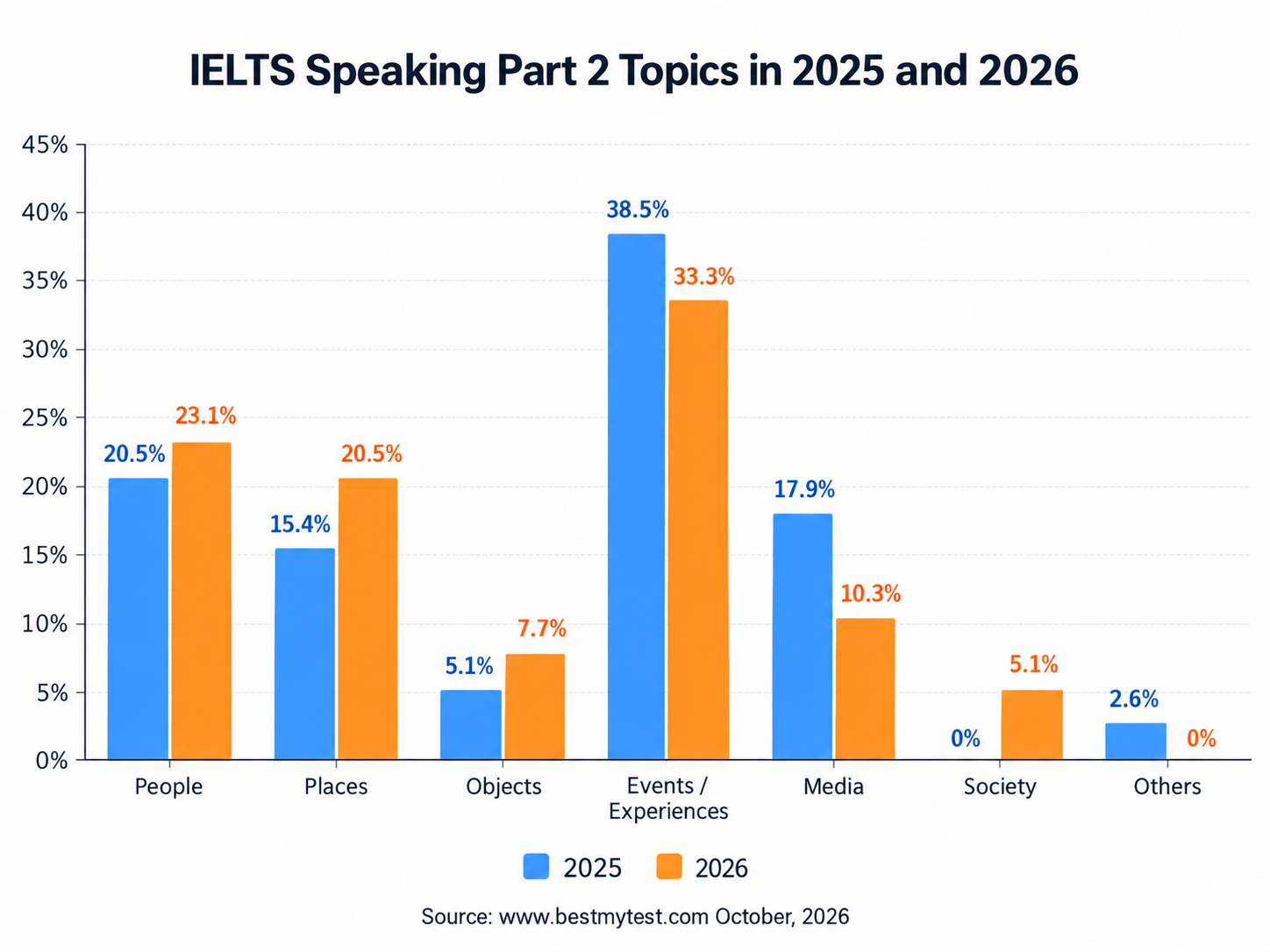
Som du ser är händelser och upplevelser den största kategorin båda åren. De står för 38,5 % av ämnena 2025 och 33,3 % 2026. De här frågorna ber dig oftast beskriva något du har gjort eller upplevt, till exempel en minnesvärd resa, en särskild fest eller ett tillfälle då du hjälpte någon.
Människor och platser är också viktiga kategorier. Tillsammans står de för 43,6 % av ämnena 2026. Du kan bli ombedd att beskriva någon du beundrar, en person som påverkat dig, en plats du gärna besöker eller en plats du skulle vilja utforska.
Andra kategorier, bland annat föremål, medier och samhälle, förekommer mer sällan i det här urvalet. Du bör ändå öva på dem, eftersom IELTS Speaking-frågor kan handla om många vardagliga ämnen.
Vad betyder det här för din IELTS-förberedelse? Börja med att öva på frågor om dina egna upplevelser, människor du känner och platser du har besökt. De här ämnena utgör en stor del av frågorna i diagrammet. Förbered några flexibla berättelser och exempel som du kan anpassa till olika frågor, i stället för att lära dig hela svar utantill.
IELTS Speaking-ämnen Del 1
Listan nedan innehåller mer än bara frågor, den visar också Speaking-ämnen som examinatorer har ställt till människor tidigare. Ett bra tips är att besvara dessa IELTS Speaking del 1-frågor framför en spegel eller med en vän. Tabellen nedan visar hur ofta varje ämne används:
| Ämnen | Frekvens |
|---|---|
| Hometown/Accommodation/Country | Hög |
| Friends/Family/Housework/Children | Hög |
| TV/Reading/Music/Newspapers & Magazines/Films | Hög |
| Technology/Computers/Internet | Hög |
| Work/Jobs/Career Planning/Volunteer Work | Hög |
| School majors/High School | Medel |
| Sports/Outdoor Activities/Indoor Activities | Medel |
| Travel/Lifestyle | Medel |
| Season/Rain/Sunny Days/Weather | Medel |
| Fashion/Shoes/Bags/Clothes | Medel |
| Transportation/Boats/Buses/Taxis | Medel |
| Celebrities/Advertisements/Media | Medel |
| Photos/Photography/Colors/Art | Låg |
| Noise/Patience/Politeness | Låg |
| Mirrors/Gifts | Låg |
Question 1
-
spellcheck TranscriptDo you enjoy going out in your free time? Why or why not?
-
Sample Response
Yeah, I usually enjoy going out in my free time because it helps me relax and meet new people. Honestly, it’s a great way to take a break from daily routine and clear my mind a little.
Watch the video question, then click to record your answer.
Practice speaking questions in our appQuestion 2
-
spellcheck TranscriptWhat kind of places do you usually go to when you go out?
-
Sample Response
Well, when I go out, I often like to visit cafes or parks. Sometimes, I also enjoy going to the cinema or shopping malls because those places are lively and fun to hang out in, you know.
Watch the video question, then click to record your answer.
Practice speaking questions in our appQuestion 3
-
spellcheck TranscriptWho do you prefer to go out with, friends or family? Why?
-
Sample Response
I think I prefer going out with friends, actually, because we share similar interests. However, sometimes I also enjoy spending time with my family. It really depends on the occasion, to be honest.
Watch the video question, then click to record your answer.
Practice speaking questions in our appQuestion 4
-
spellcheck TranscriptHow often do you go out in the evenings?
-
Sample Response
To be fair, I don’t go out every evening. I guess maybe two or three times a week, depending on my schedule. If I’m tired or busy, I usually just stay at home and relax.
Watch the video question, then click to record your answer.
Practice speaking questions in our appQuestion 5
-
spellcheck TranscriptHas the way you go out changed compared to when you were younger?
-
Sample Response
Yes, the way I go out has definitely changed since I was younger. I used to go out more often and stay out late. Now, I prefer quieter places and I’m a bit more careful with my time.
Watch the video question, then click to record your answer.
Practice speaking questions in our appQuestion 6
-
spellcheck TranscriptLet's move on to talk about goals. Do you have any specific goals for this year?
-
Sample Response
Let’s see, this year my main goal is to improve my English and maybe learn a new skill. I also want to travel to at least one new country if possible, just to experience something different.
Watch the video question, then click to record your answer.
Practice speaking questions in our appQuestion 7
-
spellcheck TranscriptWhy is it important for people to set goals?
-
Sample Response
I believe setting goals is really important because it gives us direction and motivation. Without goals, it’s easy to lose focus and just drift through life without achieving anything meaningful, don’t you think?
Watch the video question, then click to record your answer.
Practice speaking questions in our appQuestion 8
-
spellcheck TranscriptHave you ever achieved a goal that was difficult for you?
-
Sample Response
Actually, yes, I once had a goal to run a half marathon. It was really difficult for me because I’m not a natural runner. But after a lot of training, I finally managed to do it and I felt so proud.
Watch the video question, then click to record your answer.
Practice speaking questions in our appQuestion 9
-
spellcheck TranscriptHow do you keep track of your progress towards your goals?
-
Sample Response
To be honest, I usually write my goals down in a notebook or on my phone. I try to check in regularly, maybe once a week, to see how I’m doing and make any changes if needed.
Watch the video question, then click to record your answer.
Practice speaking questions in our appQuestion 10
-
spellcheck TranscriptDid you have any goals when you were a child?
-
Sample Response
When I was a child, I definitely had some goals, like becoming a teacher or learning to play the piano. Even though I didn’t achieve all of them, some childhood dreams still motivate me today.
Watch the video question, then click to record your answer.
Practice speaking questions in our app
Task Achievement — IELTS Speaking 1
Learn how to answer these questions in a step-by-step interactive exercise
Task Achievement — IELTS Speaking 1
Det första steget när du svarar på en fråga i IELTS Speaking Part 1 är att ge ett direkt svar och sedan utveckla det med lite fler detaljer.
En enkel svarsstruktur hjälper dig att veta vad du ska säga härnäst, så att du kan svara snabbt och fortsätta tala naturligt utan att göra svaret för långt. I stället för att sluta efter en kort mening följer du strukturen ett steg i taget.
I det här steget lär du dig att använda strukturen för att bygga tydliga och naturliga svar i IELTS Speaking Part 1.
Nu tar vi fråga 1.
Identifiera först frågemönstret. Fråga dig själv: Vad ber den här frågan mig att göra? När du känner igen mönstret låter du den matchande svarsstrukturen styra ditt svar.
I den här frågan är mönstret Direct Answer, så följ den här strukturen:
Answer + Reason → Example or Detail → Result or Extra Detail
Använd kontrollerade utfyllnadsfraser när du talar, till exempel Well, Actually, For example, What I mean by that is och So overall. Fraserna kan få ditt svar att låta smidigare och ge dig lite extra tid att tänka om du för ett ögonblick glömmer vad du ska säga härnäst. Använd dem naturligt, inte i varje mening. Här är listan med kontrollerade utfyllnadsfraser.
Do you enjoy going out in your free time? Why or why not?
Nu tar vi fråga 2.
Identifiera först frågemönstret. Fråga dig själv: Vad ber den här frågan mig att göra? När du känner igen mönstret låter du den matchande svarsstrukturen styra ditt svar.
I den här frågan är mönstret Direct Answer, så följ den här strukturen:
Answer + Reason → Example or Detail → Result or Extra Detail
Använd kontrollerade utfyllnadsfraser när du talar, till exempel Well, Actually, For example, What I mean by that is och So overall. Fraserna kan få ditt svar att låta smidigare och ge dig lite extra tid att tänka om du för ett ögonblick glömmer vad du ska säga härnäst. Använd dem naturligt, inte i varje mening. Här är listan med kontrollerade utfyllnadsfraser.
What kind of places do you usually go to when you go out?
Nu tar vi fråga 3.
Identifiera först frågemönstret. Fråga dig själv: Vad ber den här frågan mig att göra? När du känner igen mönstret låter du den matchande svarsstrukturen styra ditt svar.
I den här frågan är mönstret Direct Answer, så följ den här strukturen:
Answer + Reason → Example or Detail → Result or Extra Detail
Använd kontrollerade utfyllnadsfraser när du talar, till exempel Well, Actually, For example, What I mean by that is och So overall. Fraserna kan få ditt svar att låta smidigare och ge dig lite extra tid att tänka om du för ett ögonblick glömmer vad du ska säga härnäst. Använd dem naturligt, inte i varje mening. Här är listan med kontrollerade utfyllnadsfraser.
Who do you prefer to go out with, friends or family? Why?
Nu tar vi fråga 4.
Identifiera först frågemönstret. Fråga dig själv: Vad ber den här frågan mig att göra? När du känner igen mönstret låter du den matchande svarsstrukturen styra ditt svar.
I den här frågan är mönstret Direct Answer, så följ den här strukturen:
Answer + Reason → Example or Detail → Result or Extra Detail
Använd kontrollerade utfyllnadsfraser när du talar, till exempel Well, Actually, For example, What I mean by that is och So overall. Fraserna kan få ditt svar att låta smidigare och ge dig lite extra tid att tänka om du för ett ögonblick glömmer vad du ska säga härnäst. Använd dem naturligt, inte i varje mening. Här är listan med kontrollerade utfyllnadsfraser.
How often do you go out in the evenings?
Nu tar vi fråga 5.
Identifiera först frågemönstret. Fråga dig själv: Vad ber den här frågan mig att göra? När du känner igen mönstret låter du den matchande svarsstrukturen styra ditt svar.
I den här frågan är mönstret Direct Answer, så följ den här strukturen:
Answer + Reason → Example or Detail → Result or Extra Detail
Använd kontrollerade utfyllnadsfraser när du talar, till exempel Well, Actually, For example, What I mean by that is och So overall. Fraserna kan få ditt svar att låta smidigare och ge dig lite extra tid att tänka om du för ett ögonblick glömmer vad du ska säga härnäst. Använd dem naturligt, inte i varje mening. Här är listan med kontrollerade utfyllnadsfraser.
Has the way you go out changed compared to when you were younger?
Nu tar vi fråga 6.
Identifiera först frågemönstret. Fråga dig själv: Vad ber den här frågan mig att göra? När du känner igen mönstret låter du den matchande svarsstrukturen styra ditt svar.
I den här frågan är mönstret Direct Answer, så följ den här strukturen:
Answer + Reason → Example or Detail → Result or Extra Detail
Använd kontrollerade utfyllnadsfraser när du talar, till exempel Well, Actually, For example, What I mean by that is och So overall. Fraserna kan få ditt svar att låta smidigare och ge dig lite extra tid att tänka om du för ett ögonblick glömmer vad du ska säga härnäst. Använd dem naturligt, inte i varje mening. Här är listan med kontrollerade utfyllnadsfraser.
Let's move on to talk about goals. Do you have any specific goals for this year?
Nu tar vi fråga 7.
Identifiera först frågemönstret. Fråga dig själv: Vad ber den här frågan mig att göra? När du känner igen mönstret låter du den matchande svarsstrukturen styra ditt svar.
I den här frågan är mönstret Direct Answer, så följ den här strukturen:
Answer + Reason → Example or Detail → Result or Extra Detail
Använd kontrollerade utfyllnadsfraser när du talar, till exempel Well, Actually, For example, What I mean by that is och So overall. Fraserna kan få ditt svar att låta smidigare och ge dig lite extra tid att tänka om du för ett ögonblick glömmer vad du ska säga härnäst. Använd dem naturligt, inte i varje mening. Här är listan med kontrollerade utfyllnadsfraser.
Why is it important for people to set goals?
Nu tar vi fråga 8.
Identifiera först frågemönstret. Fråga dig själv: Vad ber den här frågan mig att göra? När du känner igen mönstret låter du den matchande svarsstrukturen styra ditt svar.
I den här frågan är mönstret Direct Answer, så följ den här strukturen:
Answer + Reason → Example or Detail → Result or Extra Detail
Använd kontrollerade utfyllnadsfraser när du talar, till exempel Well, Actually, For example, What I mean by that is och So overall. Fraserna kan få ditt svar att låta smidigare och ge dig lite extra tid att tänka om du för ett ögonblick glömmer vad du ska säga härnäst. Använd dem naturligt, inte i varje mening. Här är listan med kontrollerade utfyllnadsfraser.
Have you ever achieved a goal that was difficult for you?
Nu tar vi fråga 9.
Identifiera först frågemönstret. Fråga dig själv: Vad ber den här frågan mig att göra? När du känner igen mönstret låter du den matchande svarsstrukturen styra ditt svar.
I den här frågan är mönstret Direct Answer, så följ den här strukturen:
Answer + Reason → Example or Detail → Result or Extra Detail
Använd kontrollerade utfyllnadsfraser när du talar, till exempel Well, Actually, For example, What I mean by that is och So overall. Fraserna kan få ditt svar att låta smidigare och ge dig lite extra tid att tänka om du för ett ögonblick glömmer vad du ska säga härnäst. Använd dem naturligt, inte i varje mening. Här är listan med kontrollerade utfyllnadsfraser.
How do you keep track of your progress towards your goals?
Nu tar vi fråga 10.
Identifiera först frågemönstret. Fråga dig själv: Vad ber den här frågan mig att göra? När du känner igen mönstret låter du den matchande svarsstrukturen styra ditt svar.
I den här frågan är mönstret Direct Answer, så följ den här strukturen:
Answer + Reason → Example or Detail → Result or Extra Detail
Använd kontrollerade utfyllnadsfraser när du talar, till exempel Well, Actually, For example, What I mean by that is och So overall. Fraserna kan få ditt svar att låta smidigare och ge dig lite extra tid att tänka om du för ett ögonblick glömmer vad du ska säga härnäst. Använd dem naturligt, inte i varje mening. Här är listan med kontrollerade utfyllnadsfraser.
Did you have any goals when you were a child?
Vill du se vår kompletta lista över våra IELTS Speaking-ämnen? Du kan kolla in dem här: Se den kompletta listan över Speaking-ämnen
Letar du efter IELTS Speaking-exempel med svar? Du kan börja öva gratis nu genom att klicka på knappen nedan.
Gratis IELTS Speaking-prov - Del 1
IELTS Speaking-ämnen Del 2 & 3
Nu kommer du att lära dig några av de oftare använda ämnena från Speaking del 2 & 3 och gå igenom några Speaking-frågor relaterade till ämnena (inkluderat med varje fråga är ett exempelsvar).
| Bred kategori | IELTS Speaking Del 2 & 3 |
|---|---|
| Media & underhållning | Advertisements/Art/Books/Internet/News/TV |
| Föremål | Clothing/Electronic Devices/Food/Furniture/Gifts Machine/Money/Musical Instruments/Traditional Products/Vegetables |
| Människor | Teacher/Family/Friends/Influential People/Good Parents |
| Plats | City/Company/School/Museums/party/Shopping Places |
| Händelser | A change in life/Decision/Exciting Experiences/Holiday/Illness Experiences Helping People/Memorable Experiences/An Experience of Being Late/Travel Experiences |
| Samhälle | Environment/Traffic Rule/Society/Transportation |
| Övriga | Leisure Activities/Language/Sports |
Speaking del 2 och 3 testar dig på liknande ämnen, så ämnet work nedan kommer att ha exempelfrågor och svar för båda delarna.
candidate task card
Describe your dream job.
You should say:
What kind of things you would do in that job
What the working conditions would be like
What kind of workplace you would work in
And say if you think you will be able to get a job like that or not, and why
-
Sample Response
My dream job is to be a freelance writer, and today I’ll explain a little bit about what it means to be a freelance writer, as well as why it interests me.
If I were a writer, I would use my computer to write things for different clients. A freelance employee does not have to work at an office, or at any specific company. My ideal workplace if I were a freelance writer would be at a home office. I would like to set up a comfortable desk in a quiet space at home for an environment that keeps me focused.
So, as a freelance writer, I would be able to do my writing from any place I choose, while also having some control over my work schedule. However, most writers will need complete assignments by a specific date, so there would still be some time constraints. I would probably have some stress over meeting deadlines on time, but I think I could handle it.
As far as finding a job as freelance writer is concerned, I think it may be possible in the future. First, I’ll need more experience writing, so that reputable companies will want to hire me. And most importantly, I’ll need to be financially stable enough that I can handle working less hours in the beginning.
Becoming a freelance writer would allow me independence, while doing something I enjoy. I believe with skill and patience, my dream of being a freelance writer will come true someday.
Read the cue card, then click to record your answer.
Practice speaking questions in our appTask Achievement — IELTS Speaking 2
Learn how to answer this question in a step-by-step interactive exercise
Task Achievement — IELTS Speaking 2
I **IELTS Speaking Part 2** har du **1 minut att förbereda dig** innan du talar i **1–2 minuter**. Examinatorn ger dig ett **uppgiftskort (cue card)**, en **penna** och ett **papper** för anteckningar.
Använd förberedelsetiden väl. Läs först uppgiftskortet innan du planerar ditt svar.
Du behöver inte skriva eller tala än. Se bara till att du förstår vad varje punkt frågar efter. I nästa steg skriver du **en kort idé för varje punkt**.
Bestäm nu vad du vill säga för varje punkt på uppgiftskortet. Skriv bara **en kort huvudidé** för varje punkt.
Din snabba idé ska bara vara **några ord eller en kort fras**, **inte** en **hel mening eller ett färdigt talat svar**. **En kort rad** för varje punkt räcker.
I nästa steg bygger du vidare på varje idé genom att lägga till en **stödjande detalj** och en **personlig reaktion, ett beslut eller ett resultat**.
För den första **punkten på uppgiftskortet** behåller du den snabba idé du redan har skrivit och lägger till **en eller två stödjande detaljer**.
Försök **inte** skriva ner allt du tänker säga. Under din förberedelseminut skriver du bara **4–5 snabba ord eller korta fraser** för punkterna på uppgiftskortet, i den ordning du vill prata om dem.
Använd **andra raden** för att lägga till en användbar detalj, till exempel **vem, vad, var, när, varför, ett exempel eller en kort beskrivning**.
Använd **tredje raden** för att lägga till något personligt, till exempel **hur du kände dig, vad du bestämde dig för eller vad som hände efteråt**. Du behöver inte ta med allt detta. Välj det som passar bäst.
Om du behöver hjälp att komma igång klickar du på **Show an Idea** för att fylla i andra och tredje raden.
De andra punkterna på uppgiftskortet förblir stängda under det här steget.
För den andra **punkten på uppgiftskortet** behåller du den snabba idé du redan har skrivit och lägger till **en eller två stödjande detaljer**.
Försök **inte** skriva ner allt du tänker säga. Under din förberedelseminut skriver du bara **4–5 snabba ord eller korta fraser** för punkterna på uppgiftskortet, i den ordning du vill prata om dem.
Använd **andra raden** för att lägga till en användbar detalj, till exempel **vem, vad, var, när, varför, ett exempel eller en kort beskrivning**.
Använd **tredje raden** för att lägga till något personligt, till exempel **hur du kände dig, vad du bestämde dig för eller vad som hände efteråt**. Du behöver inte ta med allt detta. Välj det som passar bäst.
Om du behöver hjälp att komma igång klickar du på **Show an Idea** för att fylla i andra och tredje raden.
De andra punkterna på uppgiftskortet förblir stängda under det här steget.
För den tredje **punkten på uppgiftskortet** behåller du den snabba idé du redan har skrivit och lägger till **en eller två stödjande detaljer**.
Försök **inte** skriva ner allt du tänker säga. Under din förberedelseminut skriver du bara **4–5 snabba ord eller korta fraser** för punkterna på uppgiftskortet, i den ordning du vill prata om dem.
Använd **andra raden** för att lägga till en användbar detalj, till exempel **vem, vad, var, när, varför, ett exempel eller en kort beskrivning**.
Använd **tredje raden** för att lägga till något personligt, till exempel **hur du kände dig, vad du bestämde dig för eller vad som hände efteråt**. Du behöver inte ta med allt detta. Välj det som passar bäst.
Om du behöver hjälp att komma igång klickar du på **Show an Idea** för att fylla i andra och tredje raden.
De andra punkterna på uppgiftskortet förblir stängda under det här steget.
För den fjärde **punkten på uppgiftskortet** behåller du den snabba idé du redan har skrivit och lägger till **en eller två stödjande detaljer**.
Försök **inte** skriva ner allt du tänker säga. Under din förberedelseminut skriver du bara **4–5 snabba ord eller korta fraser** för punkterna på uppgiftskortet, i den ordning du vill prata om dem.
Använd **andra raden** för att lägga till en användbar detalj, till exempel **vem, vad, var, när, varför, ett exempel eller en kort beskrivning**.
Använd **tredje raden** för att lägga till något personligt, till exempel **hur du kände dig, vad du bestämde dig för eller vad som hände efteråt**. Du behöver inte ta med allt detta. Välj det som passar bäst.
Om du behöver hjälp att komma igång klickar du på **Show an Idea** för att fylla i andra och tredje raden.
De andra punkterna på uppgiftskortet förblir stängda under det här steget.
Använd nu dina anteckningar för att ge hela ditt svar. Tala i en till två minuter och ta upp varje punkt på uppgiftskortet.
Följ anteckningarna från första till sista punkten. Knyt ihop idén, detaljen och den personliga reaktionen till ett kort sammanhängande stycke tal för varje punkt. Du behöver inte lära dig formuleringarna utantill. Fortsätt tala tills du har tagit upp alla fyra punkterna.
Question 1
-
spellcheck TranscriptDo you think job satisfaction is more important than your salary when choosing a job?
-
Sample Response
Yes, overall I think that job satisfaction outweighs salary in importance when someone chooses a job. Even though the job’s salary is important to survive and pay the bills, with enough money, it becomes more important to be happy at work. After all, most people spend the majority of their time outside of the home working, so they might as well be content, or even excited about their jobs. For people like me, I think being satisfied at work is a more important component when choosing a job than the salary.
Watch the video question, then click to record your answer.
Practice speaking questions in our appQuestion 2
-
spellcheck TranscriptWhat skills do you think are needed to get a good job these days?
-
Sample Response
These days I think having a variety of skills is important in the workplace, but there are a few that are essential to getting a good job. First, most employees today need to be able to communicate effectively with a variety of people. Speaking a second or even third language is one way to communicate well with many others. Another important skill to get a good job is being able to use a computer well, as in, typing, word processing, and using the internet. Without these skills, finding a job will be difficult for most people in today’s world.
Watch the video question, then click to record your answer.
Practice speaking questions in our appQuestion 3
-
spellcheck TranscriptDo you think that women should be able to do the same jobs as men?
-
Sample Response
Yes, as a woman I think that I should be allowed to do the same kind of jobs that men do. In the past, women were limited to very few lines of work, such as nursing and teaching. These days, we see women in all different jobs, and they make important contributions to the fields they work in, such as female scientists, doctors, and lawyers. Even though women and men are different in some ways, they should both still be equally able to find employment in a variety of jobs.
Watch the video question, then click to record your answer.
Practice speaking questions in our appQuestion 4
-
spellcheck TranscriptWhat’s the difference between white collar and blue collar jobs?
-
Sample Response
To me, there are two main differences between white collar and blue collar jobs. The first big difference is work environment. Blue collar workers tend to work on specific job sites, like construction sites, factories, or kitchens, while white collar workers are almost all in offices. Another big difference between these two types of jobs is the level of respect people give them socially. White collar workers tend to be seen as more successful, even if that’s not necessarily true. Blue collar workers are seen as more low-class by many, even if they are highly-skilled. So, those are the two ways I think blue and white collar jobs are different.
Watch the video question, then click to record your answer.
Practice speaking questions in our appQuestion 5
-
spellcheck TranscriptWhat jobs do you think are most valuable to society?
-
Sample Response
That’s a somewhat difficult question, because there are so many important jobs, but I would say that in today’s world, the most important jobs are those that provide us with stability, and those that promote progress. An example of a job that provides stability would be something like an electrician. This type of job keeps our houses and businesses powered, so we can live our lives without inconvenience. On the other hand, a type of job that promotes progress would be something like a scientist, who does research that may help us cure diseases or create new technology. Those are the two types of job I think matter most.
Watch the video question, then click to record your answer.
Practice speaking questions in our appTask Achievement — IELTS Speaking 3
Learn how to answer these questions in a step-by-step interactive exercise
Task Achievement — IELTS Speaking 3
Det första steget när du svarar på en fråga i IELTS Speaking Part 3 är att identifiera frågemönstret. När du känner igen mönstret kan du snabbt plocka fram den matchande svarsstrukturen i huvudet.
Då vet du tydligt vad du ska säga härnäst, så att du kan utveckla svaret smidigt och undvika att fastna. I stället för att försöka planera hela svaret innan du börjar tala följer du bara strukturen ett steg i taget.
I det här steget lär du dig de 8 vanliga frågemönstren i IELTS Speaking Part 3 och svarsstrukturen för vart och ett. Klicka på varje mönsterflik för att se hur det fungerar.
Nu tar vi fråga 1.
Identifiera först frågemönstret. Fråga dig själv: Vad ber den här frågan mig att göra? När du känner igen mönstret låter du den matchande svarsstrukturen styra ditt svar.
I den här frågan är mönstret Opinion / View, så följ den här strukturen:
Answer → Reason → Explain → Example → Result → Second Point or Contrast → Conclusion
Använd kontrollerade utfyllnadsfraser när du talar, till exempel Well, Actually, For example, What I mean by that is och So overall. Fraserna kan få ditt svar att låta smidigare och ge dig lite extra tid att tänka om du för ett ögonblick glömmer vad du ska säga härnäst. Använd dem naturligt, inte i varje mening. Här är listan med kontrollerade utfyllnadsfraser.
Do you think job satisfaction is more important than your salary when choosing a job?
Nu tar vi fråga 2.
Identifiera först frågemönstret. Fråga dig själv: Vad ber den här frågan mig att göra? När du känner igen mönstret låter du den matchande svarsstrukturen styra ditt svar.
I den här frågan är mönstret Descriptive / Types, så följ den här strukturen:
Main Type → Explain → Example → Second Type → Explain or Compare → Overall View
Använd kontrollerade utfyllnadsfraser när du talar, till exempel Well, Actually, For example, What I mean by that is och So overall. Fraserna kan få ditt svar att låta smidigare och ge dig lite extra tid att tänka om du för ett ögonblick glömmer vad du ska säga härnäst. Använd dem naturligt, inte i varje mening. Här är listan med kontrollerade utfyllnadsfraser.
What skills do you think are needed to get a good job these days?
Nu tar vi fråga 3.
Identifiera först frågemönstret. Fråga dig själv: Vad ber den här frågan mig att göra? När du känner igen mönstret låter du den matchande svarsstrukturen styra ditt svar.
I den här frågan är mönstret Opinion / View, så följ den här strukturen:
Answer → Reason → Explain → Example → Result → Second Point or Contrast → Conclusion
Använd kontrollerade utfyllnadsfraser när du talar, till exempel Well, Actually, For example, What I mean by that is och So overall. Fraserna kan få ditt svar att låta smidigare och ge dig lite extra tid att tänka om du för ett ögonblick glömmer vad du ska säga härnäst. Använd dem naturligt, inte i varje mening. Här är listan med kontrollerade utfyllnadsfraser.
Do you think that women should be able to do the same jobs as men?
Nu tar vi fråga 4.
Identifiera först frågemönstret. Fråga dig själv: Vad ber den här frågan mig att göra? När du känner igen mönstret låter du den matchande svarsstrukturen styra ditt svar.
I den här frågan är mönstret Compare / Contrast, så följ den här strukturen:
Main Difference → Explain → Example → Second Difference → Contrast → Overall Comparison
Använd kontrollerade utfyllnadsfraser när du talar, till exempel Well, Actually, For example, What I mean by that is och So overall. Fraserna kan få ditt svar att låta smidigare och ge dig lite extra tid att tänka om du för ett ögonblick glömmer vad du ska säga härnäst. Använd dem naturligt, inte i varje mening. Här är listan med kontrollerade utfyllnadsfraser.
What’s the difference between white collar and blue collar jobs?
Nu tar vi fråga 5.
Identifiera först frågemönstret. Fråga dig själv: Vad ber den här frågan mig att göra? När du känner igen mönstret låter du den matchande svarsstrukturen styra ditt svar.
I den här frågan är mönstret Descriptive / Types, så följ den här strukturen:
Main Type → Explain → Example → Second Type → Explain or Compare → Overall View
Använd kontrollerade utfyllnadsfraser när du talar, till exempel Well, Actually, For example, What I mean by that is och So overall. Fraserna kan få ditt svar att låta smidigare och ge dig lite extra tid att tänka om du för ett ögonblick glömmer vad du ska säga härnäst. Använd dem naturligt, inte i varje mening. Här är listan med kontrollerade utfyllnadsfraser.
What jobs do you think are most valuable to society?
Vill du se vår kompletta lista över våra IELTS Speaking-ämnen? Du kan kolla in dem här: Se den kompletta listan över Speaking-ämnen
Letar du efter IELTS Speaking-exempel med svar? Du kan börja öva gratis nu genom att klicka på knappen nedan.
Gratis IELTS Speaking-prov - Del 2
Hur du tar dig an IELTS Speaking Del 1
Som tidigare nämnts är frågorna i IELTS Speaking-provet del 1 som vardagliga konversationer med modersmålstalare. Om du är bekväm med att ha grundläggande konversationer med en engelsk modersmålstalare bör del 1 inte vara alltför besvärligt, men du bör fortfarande förbereda dig för det.
När du besvarar IELTS Speaking-ämnen från del 1 ska ditt svar inte vara för kort eller för långt.. Om du till exempel får frågan "Do you like sports?" är att säga "No. I don't like sports." inte ett tillräckligt bra svar. Kom alltid ihåg, du är här för att bevisa att du kan tala engelska, så du måste ge examinatorn längre svar för att de ska kunna bedöma dig. Ett acceptabelt svar skulle vara "I understand the benefits of being in sports and the entertainment of watching it, but even as a child, I could never get into sports. I prefer to sit down and read an engaging book.". Som en allmän regel bör ett del 1-svar ha cirka 3-4 meningar.
Lyckligtvis finns det några enkla sätt för dig att förlänga dina IELTS Speaking-svar naturligt utan att riskera att använda någon svår eller obekant grammatik. Här hittar du 5 enkla sätt, med tillhandahållna exempel, för hur du effektivt kan förlänga dina svar när du gör IELTS Speaking del 1.
| 1. Att ge skäl | |
|---|---|
|
What do you like to do in your spare time? I am really into swimming, so I like to swim in my free time. I suppose this is thanks to the influence of my parents who both like swimming. |
|
|
What kind of programme do you like to watch on TV? My favorite TV programmes are dramas, since I don't have to think too much when I watch them. They're a little over dramatic at times, but that's part of the fun. |
|
|
Do you usually watch films alone or with others? I like watching films with my family and friends, because afterwards we can talk about our favorite parts and figure out what we think the plot was about. |
|
|
Who do you get on best within your family? It's hard to say, since we're all so close. I guess I probably get on best with my mother, as we are the most alike. We're both very chatty and warm people. |
|
| 2. Att ge exempel | |
|---|---|
|
Do you like to keep fit? Yes! I like to keep fit. I am keen on sports! For instance, I play basketball every week and use the gym whenever I have the chance |
|
|
Do you like learning a new language? Yes! I really do! Take learning English as example. I love reading English magazines and listening to English podcasts. |
|
|
Is there anything you would change about your hometown? Well.. my least favorite thing about it is that there aren't too many fun things to do or see. A case in point is that shopping centres and restaurants close too early. |
|
| 3. Att ge detaljer | |
|---|---|
|
Tell me about your hometown? My hometown, Delhi, is the second largest in India. The capital of the country, New Delhi, is also there. There is an international airport in Delhi, so it's easy to travel in and out of the country from there. |
|
|
Tell me about the kind of accommodation you live in? I live in a rented room in a paying guest accommodation. It is a superb building equipped with all the facilities. Round-the-clock security, access to free Wi-Fi, medical room and a common room all are made available to the guests living in the building. Every major part of the city is accessible from our building. |
|
|
Tell me about the favorite shop you often go to? It is a book shop near where I live. It's on the main street. I often go in there to browse and have a look through all the books they have. |
|
| 4. Att tala om det förflutna eller framtiden | |
|---|---|
|
Where do you live in your country now? I am currently living in Delhi, which is the second most populated city in India. I've lived there for a couple of years, but I used to live in Bangalore, which is also a big city in southern India. |
|
|
Are you working at the moment? No! Not at the moment. I am unemployed now, but I am planning to apply for some internship positions this summer. Hopefully things will change soon. |
|
|
Have you ever been to a concert before? No. I've never been to a concert before, but I think I will. Concerts are always happening around where I live, so I will try to go check them out when I can. |
|
| 5. Att göra spekulationer | |
|---|---|
|
Do you think you'll ever live in another country? I suppose I'd be happy to leave my country if I was offered a job abroad that was interesting. |
|
|
What would be your ideal holiday destination? Hmm.. I'd doubt whether I'll ever go there, but I'd love to go to Africa to see the wild nature. Right now I don't have money for vacation. If I had more money, I would probably go with my girlfriend. |
|
|
What would be your ideal job? You know..that's a tricky one. It would probably be working as a software engineer in Google if I managed to pass Google's interview. |
|
När du talar i provet, försök att låta naturlig — precis som om du talar med en god vän. När du känner dig nervös eller stressad är det vanligt att titta ner, tala med monoton röst, prata för tyst, ge korta enordssvar eller till och med rynka pannan. Dessa vanor får dina svar att låta mindre självsäkra och kan negativt påverka din poäng, så de är beteenden du måste undvika.
Fokusera istället på att göra de saker som skapar ett starkt, positivt intryck. Få naturlig ögonkontakt med examinatorn, tala med energi och entusiasm och projicera din röst så att du är lätt att höra. Ge beskrivande, utvecklade svar snarare än korta, och kom ihåg att le. En vänlig, självsäker attityd gör ditt tal mycket mer engagerande och effektivt.
Hur du tar dig an IELTS Speaking Del 2
IELTS Speaking del 2 kräver att du talar i 2 minuter rakt igenom och eventuellt talar om ett obekant ämne. Många IELTS-studenter blir nervösa och stressade under sitt tal och får slut på saker att säga. För att hjälpa dig att övervinna dessa problem har vi tagit fram 4 IELTS Speaking-tips som kan hjälpa dig att känna dig självsäker och avslappnad under ditt tal.
1. Ta upp varje punkt på cue-kortet i IELTS Speaking Del 2
Cue-kortet ger dig ett ämne och fyra punkter att prata om. Prata om varje punkt, i den ordning de står på kortet. Punkterna är din plan, så du vet alltid vad du ska säga härnäst. Om en punkt är svår, säg en kort idé om den och gå vidare till nästa punkt. Håll dig till kortets ämne under hela ditt svar.
2. Planera ditt svar under den 1 minut långa förberedelsetiden
Du har en minut på dig att förbereda dig innan du börjar tala. Under denna 1 minut bör du lägga upp strukturen för ditt taluttalande och skriva ner några nyckelord för att hjälpa dig komma ihåg vad du vill prata om under ditt tal.
3. Oroa dig inte för att göra misstag
Det sista IELTS Speaking-tipset är att inte oroa sig för att göra misstag. Alla som tar ett IELTS Speaking-prov gör både grammatik- och vokabulärmisstag. Examinatorerna förväntar sig faktiskt att du gör några misstag. Det viktiga är att få fram budskapet; att göra några små misstag kommer inte att skada ditt övergripande budskap. Vad som däremot kommer att skada ditt budskap är att tänka på misstaget eftersom du tappar tråden, och det är mycket farligt. Om du kan rätta det omedelbart är det okej att göra det, men om du kämpar eller det tar lite tid att tänka på korrigeringen, glöm det och gå vidare.
4. Förbered en struktur för att planera ditt talsvar
Det finns inget värre än att ha en idé i huvudet men inte kunna säga den tydligt. En struktur hjälper dig att tala tydligt och hjälper examinatorn att följa dig. Här är en struktur för ditt svar i IELTS Speaking Del 2: bygg varje punkt på cue-kortet i tre korta rader.
Struktur för IELTS Speaking Del 2: en punkt i taget
Använd din minut av förberedelsetid till att skriva tre korta rader för varje punkt på cue-kortet. Skriv ord och korta fraser, inte hela meningar.
Snabb idé:
Skriv en kort huvudidé för punkten med några få ord. Till exempel, för "what it is" kan du skriva "My HP laptop".
Stödjande detalj:
Lägg till en användbar detalj om idén. Tänk på "who," "what," "where," "when," eller "why," ett exempel eller en kort beskrivning.
Personlig reaktion:
Lägg till något personligt: hur du kände dig, vad du bestämde eller vad som hände efteråt. Välj det som passar bäst.
Tala utifrån dina anteckningar:
När examinatorn ber dig börja går du igenom punkterna i ordning. För varje punkt knyter du ihop idén, detaljen och reaktionen till några meningar. Fortsätt prata tills du har tagit upp alla fyra punkterna. Om du har tid kvar efter den sista punkten kan du lägga till en mening om hur du känner överlag, till exempel "Overall, I feel ...".
You should say:
- what it is
- what you used it for
- how long you have used it
- and describe why it is important to you
What I use it for: Study and entertainment / Notes, songs, Netflix / Faster than notes by hand
How long I have used it: About one year / Old laptop for five years / Wanted the latest software
Why it is important: Essential part of my life / Movies, music, blog, games / Will keep it if broken
-
Sample Response
This is an interesting topic. My immediate thought is that I find much electronic equipment useful, but I am going to talk about the laptop I have.
This is a laptop computer which is manufactured by HP. This laptop has a good configuration and it supports most of the latest software. It came with the Windows 8 operating system and a warranty for three years. I remembered my mom bought it for me as a present. We bought it at BestBuy. I remember it was black friday so the price is discounted.
As for what I used it for, I’d say it is useful in virtually all aspects of my life, including study, and entertainment. For instance, I use my laptop to take notes. I remember I used to take notes by hand in highschool. It was extremely time-consuming. Now with my laptop, I can type my notes directly into a document. It is just much faster and much more flexible. I also use my laptop for entertainment purposes. For example, When I get back home from school, I play songs on the laptop. On weekends, I like watching my favorite TV shows on Netflix. If I didn’t have my laptop, I would have to use my phone to watch videos, and I think the phone’s screen would be too small for me to really enjoy the program.
With regards to how long I have used it, well. I used to have a laptop for more than 5 years but I bought this current one a year ago because this one has the latest software.
Finally, I want to talk about why it is important to me. As I said earlier, this laptop has become an essential piece of equipment for me in every aspect of my life. I use it to watch movies and listen to music. I also use it to take notes. I even use it to write a blog, and play games occasionally.
Overall, I feel I am a bit emotionally attached to this laptop as it has become part of my life. I think in the future, I will continue to use it until it is broken. Even it is broken, I will still keep it and treat it as a valuable item.
Read the cue card, then click to record your answer.
Practice speaking questions in our appTask Achievement — IELTS Speaking 2
Learn how to answer this question in a step-by-step interactive exercise
Task Achievement — IELTS Speaking 2
I **IELTS Speaking Part 2** har du **1 minut att förbereda dig** innan du talar i **1–2 minuter**. Examinatorn ger dig ett **uppgiftskort (cue card)**, en **penna** och ett **papper** för anteckningar.
Använd förberedelsetiden väl. Läs först uppgiftskortet innan du planerar ditt svar.
Du behöver inte skriva eller tala än. Se bara till att du förstår vad varje punkt frågar efter. I nästa steg skriver du **en kort idé för varje punkt**.
Bestäm nu vad du vill säga för varje punkt på uppgiftskortet. Skriv bara **en kort huvudidé** för varje punkt.
Din snabba idé ska bara vara **några ord eller en kort fras**, **inte** en **hel mening eller ett färdigt talat svar**. **En kort rad** för varje punkt räcker.
I nästa steg bygger du vidare på varje idé genom att lägga till en **stödjande detalj** och en **personlig reaktion, ett beslut eller ett resultat**.
För den första **punkten på uppgiftskortet** behåller du den snabba idé du redan har skrivit och lägger till **en eller två stödjande detaljer**.
Försök **inte** skriva ner allt du tänker säga. Under din förberedelseminut skriver du bara **4–5 snabba ord eller korta fraser** för punkterna på uppgiftskortet, i den ordning du vill prata om dem.
Använd **andra raden** för att lägga till en användbar detalj, till exempel **vem, vad, var, när, varför, ett exempel eller en kort beskrivning**.
Använd **tredje raden** för att lägga till något personligt, till exempel **hur du kände dig, vad du bestämde dig för eller vad som hände efteråt**. Du behöver inte ta med allt detta. Välj det som passar bäst.
Om du behöver hjälp att komma igång klickar du på **Show an Idea** för att fylla i andra och tredje raden.
De andra punkterna på uppgiftskortet förblir stängda under det här steget.
För den andra **punkten på uppgiftskortet** behåller du den snabba idé du redan har skrivit och lägger till **en eller två stödjande detaljer**.
Försök **inte** skriva ner allt du tänker säga. Under din förberedelseminut skriver du bara **4–5 snabba ord eller korta fraser** för punkterna på uppgiftskortet, i den ordning du vill prata om dem.
Använd **andra raden** för att lägga till en användbar detalj, till exempel **vem, vad, var, när, varför, ett exempel eller en kort beskrivning**.
Använd **tredje raden** för att lägga till något personligt, till exempel **hur du kände dig, vad du bestämde dig för eller vad som hände efteråt**. Du behöver inte ta med allt detta. Välj det som passar bäst.
Om du behöver hjälp att komma igång klickar du på **Show an Idea** för att fylla i andra och tredje raden.
De andra punkterna på uppgiftskortet förblir stängda under det här steget.
För den tredje **punkten på uppgiftskortet** behåller du den snabba idé du redan har skrivit och lägger till **en eller två stödjande detaljer**.
Försök **inte** skriva ner allt du tänker säga. Under din förberedelseminut skriver du bara **4–5 snabba ord eller korta fraser** för punkterna på uppgiftskortet, i den ordning du vill prata om dem.
Använd **andra raden** för att lägga till en användbar detalj, till exempel **vem, vad, var, när, varför, ett exempel eller en kort beskrivning**.
Använd **tredje raden** för att lägga till något personligt, till exempel **hur du kände dig, vad du bestämde dig för eller vad som hände efteråt**. Du behöver inte ta med allt detta. Välj det som passar bäst.
Om du behöver hjälp att komma igång klickar du på **Show an Idea** för att fylla i andra och tredje raden.
De andra punkterna på uppgiftskortet förblir stängda under det här steget.
För den fjärde **punkten på uppgiftskortet** behåller du den snabba idé du redan har skrivit och lägger till **en eller två stödjande detaljer**.
Försök **inte** skriva ner allt du tänker säga. Under din förberedelseminut skriver du bara **4–5 snabba ord eller korta fraser** för punkterna på uppgiftskortet, i den ordning du vill prata om dem.
Använd **andra raden** för att lägga till en användbar detalj, till exempel **vem, vad, var, när, varför, ett exempel eller en kort beskrivning**.
Använd **tredje raden** för att lägga till något personligt, till exempel **hur du kände dig, vad du bestämde dig för eller vad som hände efteråt**. Du behöver inte ta med allt detta. Välj det som passar bäst.
Om du behöver hjälp att komma igång klickar du på **Show an Idea** för att fylla i andra och tredje raden.
De andra punkterna på uppgiftskortet förblir stängda under det här steget.
Använd nu dina anteckningar för att ge hela ditt svar. Tala i en till två minuter och ta upp varje punkt på uppgiftskortet.
Följ anteckningarna från första till sista punkten. Knyt ihop idén, detaljen och den personliga reaktionen till ett kort sammanhängande stycke tal för varje punkt. Du behöver inte lära dig formuleringarna utantill. Fortsätt tala tills du har tagit upp alla fyra punkterna.
- Who they are
- How you met them
- Why you think they are good parents
- And explain what it requires to be good parents.
How I met them: Through Delilah, at fourteen / Moved from another country / Always chatted with me
Why they are good parents: Respect and attention / Gave us our space / I respect and admire them
What good parents need: Clear rules and some freedom / Their own hobbies and interests / Support a child's interests
-
Sample Response
Although I’ve met many great parents throughout my life, I think some of the people I know who best exemplify good parenting are my best friend from high school’s parents.
My friend Delilah and I met when I was about 14 years old. Her parents moved to the country where I grew up from a different country, so their cultural background was a little different than my family’s. When I would go to her house, her parents would always make a point to have a short conversation with me. They genuinely seemed interested in our lives.
I think the reason why I respect and admire Delilah’s parents so much is that they always treated us with respect, gave us our space, and yet seemed very attentive to us at the same time. With their own daughter Delilah, they had established clear boundaries as far as what was expected from her, but they also gave her quite a bit of freedom. The most important reason why I think they are good examples as parents is that they had their own hobbies and interests, and helped Delilah to do the same. When she expressed interest in something, they gave her as many opportunities as possible to do it.
Read the cue card, then click to record your answer.
Practice speaking questions in our appTask Achievement — IELTS Speaking 2
Learn how to answer this question in a step-by-step interactive exercise
Task Achievement — IELTS Speaking 2
I **IELTS Speaking Part 2** har du **1 minut att förbereda dig** innan du talar i **1–2 minuter**. Examinatorn ger dig ett **uppgiftskort (cue card)**, en **penna** och ett **papper** för anteckningar.
Använd förberedelsetiden väl. Läs först uppgiftskortet innan du planerar ditt svar.
Du behöver inte skriva eller tala än. Se bara till att du förstår vad varje punkt frågar efter. I nästa steg skriver du **en kort idé för varje punkt**.
Bestäm nu vad du vill säga för varje punkt på uppgiftskortet. Skriv bara **en kort huvudidé** för varje punkt.
Din snabba idé ska bara vara **några ord eller en kort fras**, **inte** en **hel mening eller ett färdigt talat svar**. **En kort rad** för varje punkt räcker.
I nästa steg bygger du vidare på varje idé genom att lägga till en **stödjande detalj** och en **personlig reaktion, ett beslut eller ett resultat**.
För den första **punkten på uppgiftskortet** behåller du den snabba idé du redan har skrivit och lägger till **en eller två stödjande detaljer**.
Försök **inte** skriva ner allt du tänker säga. Under din förberedelseminut skriver du bara **4–5 snabba ord eller korta fraser** för punkterna på uppgiftskortet, i den ordning du vill prata om dem.
Använd **andra raden** för att lägga till en användbar detalj, till exempel **vem, vad, var, när, varför, ett exempel eller en kort beskrivning**.
Använd **tredje raden** för att lägga till något personligt, till exempel **hur du kände dig, vad du bestämde dig för eller vad som hände efteråt**. Du behöver inte ta med allt detta. Välj det som passar bäst.
Om du behöver hjälp att komma igång klickar du på **Show an Idea** för att fylla i andra och tredje raden.
De andra punkterna på uppgiftskortet förblir stängda under det här steget.
För den andra **punkten på uppgiftskortet** behåller du den snabba idé du redan har skrivit och lägger till **en eller två stödjande detaljer**.
Försök **inte** skriva ner allt du tänker säga. Under din förberedelseminut skriver du bara **4–5 snabba ord eller korta fraser** för punkterna på uppgiftskortet, i den ordning du vill prata om dem.
Använd **andra raden** för att lägga till en användbar detalj, till exempel **vem, vad, var, när, varför, ett exempel eller en kort beskrivning**.
Använd **tredje raden** för att lägga till något personligt, till exempel **hur du kände dig, vad du bestämde dig för eller vad som hände efteråt**. Du behöver inte ta med allt detta. Välj det som passar bäst.
Om du behöver hjälp att komma igång klickar du på **Show an Idea** för att fylla i andra och tredje raden.
De andra punkterna på uppgiftskortet förblir stängda under det här steget.
För den tredje **punkten på uppgiftskortet** behåller du den snabba idé du redan har skrivit och lägger till **en eller två stödjande detaljer**.
Försök **inte** skriva ner allt du tänker säga. Under din förberedelseminut skriver du bara **4–5 snabba ord eller korta fraser** för punkterna på uppgiftskortet, i den ordning du vill prata om dem.
Använd **andra raden** för att lägga till en användbar detalj, till exempel **vem, vad, var, när, varför, ett exempel eller en kort beskrivning**.
Använd **tredje raden** för att lägga till något personligt, till exempel **hur du kände dig, vad du bestämde dig för eller vad som hände efteråt**. Du behöver inte ta med allt detta. Välj det som passar bäst.
Om du behöver hjälp att komma igång klickar du på **Show an Idea** för att fylla i andra och tredje raden.
De andra punkterna på uppgiftskortet förblir stängda under det här steget.
För den fjärde **punkten på uppgiftskortet** behåller du den snabba idé du redan har skrivit och lägger till **en eller två stödjande detaljer**.
Försök **inte** skriva ner allt du tänker säga. Under din förberedelseminut skriver du bara **4–5 snabba ord eller korta fraser** för punkterna på uppgiftskortet, i den ordning du vill prata om dem.
Använd **andra raden** för att lägga till en användbar detalj, till exempel **vem, vad, var, när, varför, ett exempel eller en kort beskrivning**.
Använd **tredje raden** för att lägga till något personligt, till exempel **hur du kände dig, vad du bestämde dig för eller vad som hände efteråt**. Du behöver inte ta med allt detta. Välj det som passar bäst.
Om du behöver hjälp att komma igång klickar du på **Show an Idea** för att fylla i andra och tredje raden.
De andra punkterna på uppgiftskortet förblir stängda under det här steget.
Använd nu dina anteckningar för att ge hela ditt svar. Tala i en till två minuter och ta upp varje punkt på uppgiftskortet.
Följ anteckningarna från första till sista punkten. Knyt ihop idén, detaljen och den personliga reaktionen till ett kort sammanhängande stycke tal för varje punkt. Du behöver inte lära dig formuleringarna utantill. Fortsätt tala tills du har tagit upp alla fyra punkterna.
Hur du tar dig an IELTS Speaking Del 3
I del 3 av IELTS Speaking-provet kommer examinatorn att ställa ett bredare utbud av frågor som baseras på de ämnen som diskuterades i del 2. Dessa frågor är mer allmänna och kräver att du utvecklar ditt svar ytterligare med förklaringar och exempel.
Om du har gjort lite efterforskningar om IELTS Speaking-frågor för del 3 kanske du tycker att de är oförutsägbara, vilket gör dem utmanande att förbereda sig för. Men om du tittar närmare på dem kan du se mönster bland frågorna. Generellt sett ber frågorna i IELTS Speaking del 3 dig att
- ge din åsikt om ett ämne
- uttrycka din preferens för ett ämne
- jämföra och kontrastera två saker
- göra en förutsägelse om något i framtiden
- göra en jämförelse med det förflutna
- tala om en hypotetisk situation
- tala om dina idéer om människor i samhället
- tala om orsaker och effekter
- ge lösningar på ett problem
| IELTS Speaking Del 3-frågetyper | |
|---|---|
Ge din åsikt om ett ämne
|
|
Uttrycka din preferens
|
|
Tala om människor eller saker i ditt land
|
|
Tala om orsaker och effekter
|
|
Jämföra och kontrastera två saker
|
|
Göra en förutsägelse om något i framtiden
|
|
Göra en jämförelse med det förflutna
|
|
Tala om en hypotetisk situation
|
|
Ge lösningar på ett problem
|
|
Om du oroar dig för att tala så många meningar är du inte ensam. Även modersmålstalare skulle behöva öva med IELTS Speaking-frågor för att ge ett 5-8 meningars svar med hög poäng. Det finns dock några IELTS Speaking-exempelmallar som gör ditt liv enklare. Så länge du övar tillräckligt med frågor, lär dig våra IELTS Speaking-ämnen och följer vår talstruktur, kommer du att känna dig mer självsäker och förbättra ditt tal.
Låt oss nu titta på hur du strukturerar ditt svar baserat på IELTS Speaking-frågestilen. Tänk på att svarsstrukturerna endast är till för att hjälpa dig att ha en tydlig bild av vad du vill säga och att hjälpa dig att hålla dig organiserad. Du behöver dock inte nödvändigtvis följa dem så länge ditt svar är på ämnet och kan visa upp din engelska kompetens.
Låt oss titta på hur du förlänger och strukturerar ditt svar baserat på frågestilen.
| Göra en förutsägelse om något i framtiden | |
|---|---|
| Struktur |
|
| IELTS Speaking-fråga | What do you think cities will be like in 50 years time? |
| Modellsvar och analys: | |
|
Beskriv förutsägelsen:
I think cities in the future will be more densely populated. At the same time, people will still require transportation, so I think the transportation in future cities will be more modern, fast, and convenient. Beskriv den nuvarande trenden och säg att denna trend troligen kommer att fortsätta: In fact, I think there is a growing trend across the world of futuristic cities emerging where transportation is becoming more convenient to meet the growing demands of population. This trend will probably continue going forward. Beskriv hur du känner inför denna förutsägelse: I personally like this trend as more futuristic cities will emerge. A good example of a futuristic city is I think I will say it is Tokyo, where people have access to clean transportation, and live in compact spaces, like high-rises. |
|
| Göra en jämförelse med det förflutna | |
|---|---|
| Struktur |
|
| IELTS Speaking-fråga | How has teaching changed in your country over the past few decades? |
| Modellsvar och analys: | |
|
Slå fast att det har skett förändringar under det senaste decenniet:
In the past few decades, there have definitely been some noticeable changes in education through generations. Beskriv den första jämförelsen: I mean ..most notably, students today can no longer be punished physically by teachers, while in the past, that was pretty common. Beskriv den andra jämförelsen: Another way that education has changed is teacher student interaction. Today, it’s more normal to see students answering questions and having discussions, while in the past, the teacher simply lectured, and the students listened silently. Beskriv hur du känner inför denna förändring: Overall, I think education is making progress in my country. |
|
| Jämföra och kontrastera två saker | |
|---|---|
| Struktur |
|
| IELTS Speaking-fråga | What are the differences between living in the city and the countryside? |
| Modellsvar och analys: | |
|
Slå fast att det finns några skillnader mellan två saker:
For me, there are quite a few differences between life in the city and life in the country. Life in the city and in the country is vastly different. Beskriv den första jämförelsen: First of all, the way people interact with each other is different. For example, in a small town, people usually wave to say hello, and notice strangers in town. But in a big city, most people ignore each other and try to give each other space in public. Beskriv den andra jämförelsen: Another big difference between the two is the amount of noise, which is higher in cities, and lower in small towns. Ge en kort slutsats: Overall, life in both places varies. |
|
| Ge lösningar på ett problem | |
|---|---|
| Struktur |
|
| IELTS Speaking-fråga | How can we stop violence on TV? |
| Modellsvar och analys: | |
|
Tala kort om problemet:
I think violence on TV is the most problematic for children, but there isn’t really a simple way to make it stop, because there is a demand for action, horror, and excitement on TV. Tala om den första lösningen: The way I see it, there are two possible ways to deal with violent TV shows. The first is to make policies that actually ban that kind of programming altogether, although that would likely not be popular. Tala om den andra lösningen: The second way could be to educate people on why violent TV shows are problematic, and see if they will stop watching the shows to lower the demand for them. Beskriv hur du känner inför problemet och lösningarna: I mean either way, I think this problem probably isn’t going to disappear with just one simple solution. |
|
| Tala om orsaker eller effekter av ett fenomen | |
|---|---|
| Struktur |
|
| IELTS Speaking-fråga | What are some of the causes of water pollution? |
| Modellsvar och analys: | |
|
Tala kort om fenomenet:
Water pollution definitely has more disastrous effects on our health Peka ut orsaken eller effekten: From what I understand, water pollution is caused mostly by human activity, so it seems like the likely sources of water pollution would be factories, runoff from farms, and sewage from cities. Ge ett exempel på orsaken eller effekten: For instance, I’ve seen a few studies recently that declared the Australian Great Barrier Reef to be dead due to man-made pollutants and garbage in the water. Beskriv hur du känner inför fenomenet: I think it’s quite sad, as that probably could have been prevented if people paid more attention to the effects big industry has on the environment. |
|
| Tala om människor eller saker i ditt land | |
|---|---|
| Struktur |
|
| IELTS Speaking-fråga | How popular is watching television in your country? |
| Modellsvar och analys: | |
|
Besvara IELTS Speaking-frågan:
As far as I know, watching TV is probably one of the most popular pastimes for people in my country. Ge exempel på hur de flesta gör saker: For example, in the evening, almost every home I pass has the TV in the living room switched on, and families will be sitting around together watching shows. I think most people like watching the news, or watching dramas. Ge exempel på hur du gör saker: As for me, I also watch quite a bit of TV when I’m at home. For instance, I watch sitcoms on Friday nights after work.I guess other people in my country probably do the same thing as I do. |
|
| Ge din åsikt om ett ämne | |
|---|---|
| IELTS Speaking-fråga | Do you think people spend too much money on electronic devices? |
| Modellsvar och analys: | |
|
Besvara frågan:
If you ask me, yes, I think that some people spend too much money trying to keep up with the latest trends in technology. Förklara skälet: However, I can understand why they do it, because these days devices become obsolete almost immediately after they are purchased. Ge exempel för att stödja dina skäl: For example, a new smartphone might have some great new camera today, but tomorrow, another one will appear with an even better camera. Then, everyone will want to upgrade to the new device. As for me, I am satisfied with using a slightly outdated device in order to save money until I really need a new one. |
|
| Uttrycka din preferens | |
|---|---|
| IELTS Speaking-fråga | Do you generally read a lot of books or do you prefer watching T.V? |
| Modellsvar och analys: | |
|
Besvara frågan:
Even though I love to read, the reality is I spend quite a bit more time watching TV. Förklara skälet: I think the main reason I watch more TV is because it’s lazier, which is unfortunate. But at the same time, there are some great shows to choose from. Ge exempel för att stödja dina skäl: For instance, one of my favorite shows is “Dexter”, which has great writing, an interesting plot, and well-developed characters, just like a book. I think in the age we live in now, TV is just going to keep getting better and better, so I am going to probably continue watching more TV. |
|
| Tala om en hypotetisk situation | |
|---|---|
| IELTS Speaking-fråga | If you could influence or had the power to change the world with your writings what would you want to change? |
| Modellsvar och analys: | |
|
Besvara frågan:
If I could change the world with my writings, my biggest priority would probably be to educate people about how and why they need to make changes to what they buy, what they eat, and consume to help save the environment. Förklara skälet: The main reason is that people nowadays are using so much disposable plastic and products. This has led to many environmental problems. If my writing could change our consumption habits, that would have a drastic effect on our environmental footprint. Ge exempel för att stödja dina skäl: For example, I’ve seen a few studies recently predicting that, by 2050, the mass of plastic in the world’s oceans will exceed the mass of all the fish that live there. If that happens, the entire food chain will be severely damaged. |
|
IELTS Speaking-övning för din framgång
BestMyTest är en IELTS-förberedelsekurs online byggd för din bekvämlighet. Våra IELTS Speaking-provfrågor utformades för att se ut och kännas identiska med det officiella IELTS Speaking-provet (Vi gjorde vårt bästa för att simulera ett intervjuliknande scenario för dig). Vi såg till att allt var detsamma, inklusive svårighet, formatering och till och med hur provet fungerar. Observera att vi erbjuder 4 simulerade IELTS-prov med aldrig tidigare sedda frågor och ett helt gratis IELTS Speaking-provexempel. Du kan börja öva nu: IELTS Speaking-övning 1 del 1
Dessa IELTS Speaking-ämnen skapades med de senaste årens ämnen, så våra IELTS Speaking-exempel är relevanta för din IELTS Speaking-förberedelse! Se till att du slutför dem alla och du kommer att uppnå en hög IELTS Speaking-bandpoäng.
Vad händer härnäst
Registrera dig för en 7-dagars gratis provperiod för att få tillgång till våra IELTS Speaking-lektioner och frågor och börja din IELTS-förberedelse.
7 dagars gratis provperiodHur IELTS Speaking-frågor bedöms
Vad 52 000 inspelningar från IELTS talprov visar oss
Mellan 2023 och 2026 bedömde BestMyTest 52 043 inspelningar från IELTS talprov från 2 557 elever, och våra lärare granskade ytterligare 3 600 svar och fullständiga talprov. Mönstret är detsamma i alla datamängder: grammatik är det svagaste kriteriet och uttal det starkaste.
- Grammatiken avgör poängnivån. Grammatisk bredd och korrekthet fick lägst poäng av de fyra kriterierna i 71% av inspelningarna från Part 1, 81% från Part 2 och 83% från Part 3. Våra lärare gav det lägst poäng i 79%, 85% respektive 86% av svaren de granskade.
- Uttalet gör det sällan. Uttal var det lägst bedömda kriteriet i färre än 4% av inspelningarna. Om du ligger på poängnivå 6 är det nästan aldrig din brytning som håller dig tillbaka.
- Lärarnas genomsnittspoäng för enskilda svar: Part 1 grammatik 5.2, ordförråd 5.7, flyt och sammanhang 6.0, uttal 7.1. Part 3 är svårast när det gäller grammatik, med 5.0.
- Talhastigheten skiljer poängnivåerna åt, inte antalet pauser. Elever på poängnivå 5 producerade 57 korrekta ord i minuten och var tysta 39% av tiden. Elever på poängnivå 7 producerade 107 ord i minuten och var tysta 23% av tiden. Antalet pauser per minut var omkring 45 på varje poängnivå, så skickliga talare pausar lika ofta, men kortare.
- Många elever låser sig. 18% av inspelningarna från Part 2 och 22% av inspelningarna från Part 3 innehöll inget tal som gick att bedöma, jämfört med 5% i Part 1. Att öva på det längre anförandet och abstrakta frågor i Part 3 med tidtagning är viktigare än att öva på Part 1.
- Typiska svarslängder enligt våra data: Part 1 omkring 55 ord på 30 sekunder, Part 3 omkring 75 ord på 40 sekunder, Part 2 omkring 180 ord på 100 sekunder.
- De ord som våra elever oftast uttalar fel, baserat på 2.16 miljoner bedömda försök att uttala ord i talövningar för TOEFL och IELTS: calm, meals, decisions, offer, energy, wanted, bears, moments, culture och uncomfortable. De gemensamma nämnarna är utelämnade slutljud (-s, -ed), stumma bokstäver (calm) och felaktig ordbetoning (energy, culture, museum).
Siffrorna kommer från BestMyTests data från övningsprov och granskningar fram till oktober 2026. Procentsatserna för frågetyper anger andelen korrekta svar bland alla försök; siffrorna för kriterierna är lärar- eller AI-bedömningar enligt vad som anges. Senast uppdaterad 5 oktober 2026.
I IELTS Speaking-provet kommer din talförmåga att bedömas baserat på fyra kategorier. Dessa är kända som Fluency and coherence, Lexical resource, Grammatical range and accuracy, och Pronunciation. Läs vidare för att få en möjlighet att bli mer bekant med var och en av dessa kategorier. För mer information kan du också hänvisa till dessa bandbeskrivare som IELTS-examinatorer använder för att bedöma Speaking-avsnittet av provet. Låt oss nu titta på dessa fyra kategorier i detalj.
Fluency & Coherence
Kan du diskutera dina tankar på ett tydligt, logiskt sätt? Fluency syftar på din förmåga att framföra dina idéer rationellt, och coherence syftar på i vilken utsträckning andra kan förstå dina idéer. För att få en Band 9-poäng i kategorin Fluency and Coherence bör du kunna tala kontinuerligt utan att stanna upp för att komma ihåg ord eller grammatik, samtidigt som du utvecklar ett komplett, praktiskt svar på IELTS Speaking-frågor.
Om du ofta tvekar att sätta ihop ett grammatiskt korrekt svar kommer din fluency att påverkas negativt. Du bör fokusera på att använda engelska för att effektivt kommunicera innehållet i ditt budskap hela tiden, inte på att hitta de rätta orden i sig. För att få bra poäng inom området coherence behöver dina idéer flyta ihop på ett begripligt sätt för din lyssnare. Du kan använda kohesiva drag, som övergångar och vanliga diskursmarkörer för att förbättra din kohesion, och även köpa dig lite mer tid att tänka på ditt bästa svar.
Lexical Resource
Din lexical resource handlar om din förmåga att effektivt utnyttja din "mentala ordbok" eller lexikon. Om du tenderar att tala med ett omfattande, varierat ordförråd kommer du säkert att klara dig bra i kategorin lexical resource. Observera att både lämpligheten och noggrannheten i dina ordvalsval beaktas här, så du måste vara säker på att välja rätt ord för både dess betydelse OCH det sammanhang det förekommer i.
Å andra sidan, om du har ett begränsat ordförråd, eller är oerfaren med att hitta rätt sammanhang för vissa ord, kan du behöva ytterligare övning på detta område. Kom ihåg, bara att veta vad ett engelskt ord "betyder" garanterar inte att du använder det korrekt, eftersom engelska ord ofta har konnotationer som inte nödvändigtvis finns i ordboken. Förresten kommer du att förstå vad vi pratar om mer när du går igenom våra IELTS Speaking-exempel. Att upprepa samma ord som du är bekväm med att använda gång på gång är ett annat vanligt misstag att undvika, eftersom det kommer att indikera för examinatorn att dina lexikala resurser är begränsade. Slutligen kommer examinatorn att förvänta sig att du kan parafrasera IELTS Speaking-frågor korrekt genom att använda dina egna ord för att upprepa frågan. Det innebär att lyssna och förstå hur frågor formuleras också är viktigt.
Grammatical Range
Inte överraskande för de flesta, kommer även din grammatik att beaktas som en del av din IELTS Speaking-poäng. För att göra ditt bästa i denna kategori bör du bli bekant med så många IELTS Speaking-ämnen du kan, så att du kan fokusera mer på din grammatik, sedan kan du försöka demonstrera din grammatiska förmåga och ditt omfång så naturligt som möjligt. Att undvika misstag räcker inte för att få en hög poäng på detta område, eftersom examinatorn behöver gott om möjligheter att höra dig använda mer komplexa eller svåra grammatiska strukturer och drag. Ditt mål bör vara att visa upp din grammatiska kunskap samtidigt som du framstår som bekväm med att använda en mängd olika meningskonstruktioner och verbtempus. I våra lärares bedömningar är det här kriteriet som avgör bandpoängen: för en typisk BestMyTest-elev ligger det en hel bandpoäng under uttalet.
Som många som talar ett andraspråk vet är detta dock lättare sagt än gjort. Om du är förvirrad över hur du ska använda vissa grammatikpunkter, eller om du inte är säker på om du gör misstag när du talar, överväg att spela in dina talade svar nästa gång du övar på att besvara IELTS Speaking-provfrågor. När du lyssnar kan du upptäcka att det finns några misstag du inte ens visste att du gjorde. Att upptäcka dessa låter dig lista ut hur du kan bryta dåliga vanor INNAN examinatorn hör dig göra dem på provet. Om möjligt, få en modersmålstalare, instruktör eller en vän med god engelska att hjälpa dig att rätta dina misstag och förklara grammatikregler. Se till att gå tillbaka och granska också - även de mest grundläggande grammatiklektionerna.
Pronunciation
Sist men inte minst kommer examinatorerna att bedöma ditt uttal. De med högsta poängen i denna kategori kommer att uttala ord tillräckligt bra för att modersmålstalare ska förstå dem perfekt hela tiden. Uttalsproblem som begränsar din förmåga att förstås när du talar kommer att minska din poäng.
Det är viktigt att komma ihåg att engelskt uttal involverar mer än bara ljudet av ord. Modersmålstalare kommer också att lyssna efter rätt ton, betoning och flöde i dina ord såväl som inom meningar. När provtagare är obekanta med engelskans naturliga rytm- och intonationsmönster är det enda säkra sättet att förbättras att höra och använda så mycket talad engelska som möjligt under dagen. Du kan tala engelska och lyssna på ditt svar varje dag här på BestMyTest med våra IELTS Speaking-övningsfrågor.
Realistiskt sett kanske detta inte är möjligt för alla. Trots det kan du fortfarande få ut det mesta av din begränsade tid genom att lyssna på inspelningar av modersmålstalare. För att öva på att förbättra ditt uttal behöver du kanalisera din inre papegoja. Försök att stanna inspelningen och upprepa korta delar exakt så som du hörde dem några gånger. Lyssna efter stigande och fallande toner, pauser och till och med talarens känslor. Att göra detta låter dig utveckla ditt eget uttal inom olika sammanhang, samt träna dig själv att höra och replikera de verkliga ljuden av modersmålslik engelska.
Gratis resurser för IELTS Speaking-provet
Att förbättra dina talkunskaper med gratis resurser är lite mer utmanande än de andra tre IELTS-avsnitten. Det är sant att tala engelska kan hjälpa dig att förbättras, men vad som verkligen hjälper är att ha konversationer med en flytande engelsk talare. Någon som kan hjälpa till att korrigera dina misstag. Naturligtvis är en flytande engelsk talare inte alltid tillgänglig, så vi går till nästa bästa sak. Gratis IELTS Speaking-resurser.
IELTS Speaking-frågor
För att få en uppfattning om hur IELTS Speaking-provet är för varje del kan du titta på de officiella IELTS YouTube-videorna nedan helt gratis. De innehåller massor av användbar information och IELTS Speaking-exempel.
- YouTube-video: IELTS Speaking 1 (Kenn, Band 8.5)
- YouTube-video: IELTS Speaking 2 (Tina, Band 5)
- YouTube-video: IELTS Speaking 3 (Kopi, Band 8)
Nedan finns några fantastiska gratis resurser du kan använda för att träna och upprätthålla dina IELTS Speaking-färdigheter.
1. Google Speech-to-Text
Detta är ett bra verktyg för att lära dig själv att tala i ett bra tempo och uttala korrekt. Vad du kommer att märka är att om du gör ett misstag kommer Google API att skriva ner vad det tror du sa. Vi har faktiskt något liknande i vår IELTS Speaking-frågesektion under fliken "SAMPLE", men du behöver Google Chrome på datorn för att använda det.
2. YouTube
YouTube har massor av gratis resurser relaterade till IELTS Speaking-provsövning. Vissa videor erbjuder till och med IELTS Speaking-exempel med svar.
3. Google Play Store
Det finns massor av gratis appar för flytande engelskt tal från Google Play Store. Du kan verkligen inte gå fel med dessa gratis appar. Bara ladda ner dem och börja. Med rätt app bör du kunna förbättra dina IELTS Speaking-färdigheter, åtminstone lite grand.