
ในคู่มือนี้ คุณสามารถเริ่มฝึกอ่าน IELTS ได้ด้วยการทำแบบทดสอบ IELTS Reading ฟรี อย่างไรก็ตาม การสอบมีสองรูปแบบ ได้แก่ IELTS general reading และ IELTS academic reading คุณจะได้เรียนรู้ว่ารูปแบบใดเหมาะกับคุณ และจะใช้สื่อ IELTS Reading ของเรารับมือกับคำถามแต่ละประเภทอย่างไร
รับ การวิเคราะห์คะแนน IELTS Reading ฟรีและแผนการเรียนเฉพาะบุคคล หลังจากทำแบบฝึก IELTS Reading ฟรีเสร็จ
| แบบทดสอบ IELTS General Reading | แบบทดสอบ IELTS Academic Reading |
|---|---|
ด้านล่างคือรายการคำถาม IELTS Reading ทั้งหมดของเราพร้อมคำตอบ หมายเหตุ: ลิงก์สีแดง คือคำถาม reading ที่ได้รับความนิยมและเราแนะนำมากที่สุดตามการให้คะแนนของผู้เรียนของเรา และคุณสามารถฝึกได้ฟรีทุกเมื่อที่ต้องการ
คำถามฝึก IELTS General Reading 1 - 135
Short everyday texts, workplace texts, and one longer passage
คำถามฝึก IELTS Academic Reading 1 - 171
Three long passages from books, journals, magazines, and newspapers
คู่มือแบบฝึก IELTS Reading
คู่มือส่วนที่เหลือนี้จะสอนคุณทุกอย่างเกี่ยวกับการสอบ IELTS Reading ทั้งการสอบ general training และ academic reading คุณจะได้เรียนรู้เกี่ยวกับวิธีคำนวณคะแนนการอ่าน เรียนรู้วิธีตอบคำถามการอ่านแต่ละประเภทอย่างประสบความสำเร็จ ปรับปรุงการอ่านของคุณด้วยเนื้อหา IELTS และเชี่ยวชาญ 3 กลยุทธ์ของเราสำหรับความสำเร็จในการฝึก IELTS Reading
สารบัญ
- ข้อมูลการสอบ IELTS Reading
- ตัวอย่างคำถาม IELTS Reading
- ข้อมูลการสอบ IELTS General Reading
- ข้อมูลการสอบ IELTS Academic Reading
- เครื่องคำนวณคะแนน IELTS Reading
- วิธีตอบ 11 ประเภทคำถาม IELTS Reading
- วิธีปรับปรุงคะแนน Band ของ IELTS Reading
- 3 กลยุทธ์ IELTS Reading
- ดาวน์โหลด PDF แบบฝึก IELTS Reading ฟรีพร้อมเฉลย
ข้อมูลการสอบ IELTS Reading
การสอบ IELTS Reading ประกอบด้วย 3 ส่วน และ มีคำถามรวมทั้งหมด 40 ข้อ โดยทั่วไป คุณจะตอบคำถาม 12-14 ข้อสำหรับแต่ละส่วนและได้รับเวลา 60 นาที เพื่อทำการสอบการอ่านของคุณ แต่ละส่วนประกอบด้วยบทความ 1-3 บท ขึ้นอยู่กับการสอบที่คุณกำลังทำ หากคุณรู้ว่ากำลังสอบประเภทใด คุณสามารถข้ามสองสามส่วนถัดไปได้ หากคุณไม่รู้ สำคัญที่ต้องเรียนรู้เกี่ยวกับ การสอบแต่ละประเภทและวิธีเตรียมตัวสำหรับมัน
การสอบ IELTS Reading แบบใดเหมาะกับฉัน?
การสอบ IELTS Reading มีสองเวอร์ชัน: IELTS General Reading และ IELTS Academic Reading คุณจะสอบ General Reading หากคุณต้องการ ย้ายถิ่นฐานหรือเข้าเรียนในโรงเรียนมัธยม คุณจะสอบ Academic Reading หากคุณ มองหาการศึกษาระดับสูง ความแตกต่างที่ใหญ่ที่สุดระหว่าง general reading และ academic reading คือความยากในบทความ IELTS Reading ตามที่ชื่อบ่งบอก การสอบ academic ใช้เนื้อหา IELTS Reading จากแหล่งวิชาการ ในขณะที่การสอบ general ใช้เนื้อหาจากชีวิตประจำวัน
การสอบทั้งสองประกอบด้วย 3 ส่วน 40 คำถาม และ 11 ประเภทคำถาม คุณสามารถอ่านเกี่ยวกับแต่ละส่วนโดยละเอียดสำหรับทั้งสองการสอบในตารางด้านล่าง
| ส่วน | การสอบ IELTS Academic Reading | การสอบ IELTS General Reading |
|---|---|---|
| 1 | บทความเชิงวิชาการยาวหนึ่งบทที่ครอบคลุมตั้งแต่บรรยายและข้อเท็จจริงไปจนถึงพรรณนาและวิเคราะห์ บทความจะ
มาจากหนังสือ วารสาร นิตยสาร และหนังสือพิมพ์ คำถาม 12-14 ข้อ |
บทความข้อเท็จจริงสั้น ๆ สองหรือสามบท
หัวข้อเกี่ยวข้องกับชีวิตประจำวันในประเทศที่พูดภาษาอังกฤษ
คำถาม 12-14 ข้อ |
| 2 | บทความเชิงวิชาการยาวหนึ่งบทที่ครอบคลุมตั้งแต่บรรยายและข้อเท็จจริงไปจนถึงพรรณนาและวิเคราะห์ บทความจะ
มาจากหนังสือ วารสาร นิตยสาร และหนังสือพิมพ์ คำถาม 10-14 ข้อ |
บทความข้อเท็จจริงสั้น ๆ สองบทที่เน้นเรื่องการทำงาน (เช่น การสมัครงาน นโยบายของบริษัท เงินเดือนและเงื่อนไข)
คำถาม 12-14 ข้อ |
| 3 | บทความเชิงวิชาการยาวหนึ่งบทที่ครอบคลุมตั้งแต่บรรยายและข้อเท็จจริงไปจนถึงพรรณนาและวิเคราะห์ บทความจะ
มาจากหนังสือ วารสาร นิตยสาร และหนังสือพิมพ์ คำถาม 12-14 ข้อ |
บทความยาวกว่า ซับซ้อนกว่า ในหัวข้อที่น่าสนใจทั่วไป
บทความเป็นของจริงและถูกนำมาจากประกาศ โฆษณา คู่มือบริษัท หนังสือ นิตยสาร และหนังสือพิมพ์
คำถาม 12-14 ข้อ |
ตอนนี้คุณคุ้นเคยกับโครงสร้างการสอบ IELTS Reading และทั้ง IELTS general reading และ IELTS academic reading แล้ว ถึงเวลาเรียนรู้ว่าคุณควรทำการสอบแบบใช้กระดาษหรือการสอบแบบใช้คอมพิวเตอร์
IELTS Paper-based Test(PBT) เทียบกับ IELTS Computer-based Test(CBT)
ใน PBT คุณจะได้รับ หนังสือคำถาม และ กระดาษคำตอบ หนังสือคำถามเป็นที่ที่คุณจะเห็นคำถามทั้งหมดที่คุณต้องตอบ กระดาษคำตอบเป็นที่ที่คุณจะเขียนคำตอบสุดท้ายของคุณสำหรับการให้คะแนน คุณสามารถดู PDF กระดาษคำตอบ IELTS อย่างเป็นทางการที่นี่
หมายเหตุ: ไม่เหมือนในการสอบ IELTS Listening คุณจะไม่ได้รับเวลาพิเศษเพื่อโอนคำตอบของคุณจาก หนังสือไปยังกระดาษคำตอบ ดังนั้นให้แน่ใจว่าคุณเพิ่มคำถามการสอบ IELTS Reading แต่ละข้อลงในกระดาษคำตอบ ในขณะที่คุณตอบ
ใน CBT คุณจะตอบคำถามบนคอมพิวเตอร์ บทความของคุณจะอยู่ทางด้านซ้ายและคำถามของคุณจะอยู่ทางด้านขวา คุณยังสามารถไฮไลต์ข้อความและใช้ฟังก์ชันควบคุมเพื่อคัดลอกและวางคำตอบ สำหรับข้อมูลเพิ่มเติมเกี่ยวกับ PBT และ CBT ดูที่ คู่มือการสอบ IELTS Computer Based Test
คุณสามารถฝึกฝนเวอร์ชันใดก็ได้เมื่อใดก็ได้ที่คุณต้องการด้วยแบบฝึก IELTS Reading ฟรีของเรา คุณสามารถหาลิงก์ไปยังเนื้อหา IELTS Reading ทั้งหมดของเราที่ด้านบนของหน้า
ตัวอย่างคำถาม IELTS Reading
นี่คือแบบฝึก IELTS Academic Reading ฟรีสองชุด ลองทำแต่ละชุดด้วยตัวเอง แล้วเปิดคำตอบเพื่อตรวจ คู่มือประเภทคำถาม IELTS Readingอธิบายแต่ละประเภทและมีตัวอย่างเพิ่มเติม
Match each item with the period of time it best corresponds with
NB You may use any letter more than once.
- The Palaeolithic era
- The Bronze age
- The Iron age
- The Medieval era
- The Mesolithic age
- Roman times
-
spellcheck Answers1. FALSE
2. FALSE
3. NOT GIVEN
4. FALSE
5. TRUE
6. FALSE
7. FALSE
8. TRUE
9. FALSE
10. F
11. C
12. A
13. B
14. D
The climate in Britain has been arctic for the last several million years, punctuated by relatively warm timespans, or interglacials of thousands of years, one of which we are in as of now. Since the last glaciation, British woodland history is considered quite short in terms of geological time spans, and is also closely related to the human civilization developing.
At the peak of the last glaciation (100,000 – 12,000 BC), the majority of Britain would have had no trees. Birch and willow scrub may have grown along the lower reaches of the ice, with pine in some areas. It’s possible that remnants of pre-glacial flora were sheltered along the western bays of Great Britain and Ireland’s coasts, but as far as the southern parts of England, the ice kept any land barren. Information regarding the development of Britain’s flora following glaciation can be found by studying the deposits of pollen and seed in peat, as well as by the use of radiocarbon dating. Tundra and moorland followed the retreating ice, which lead to phases of different tree species spreading from the south. First came birch, aspen and sallow, followed by pine and hazel continuing to spread north as of 8500 BC, replacing birch to make it less commonly found for the next few thousand years. Oak and alder came after pine, then lime, elm, beech, and maple, all spreading northwards one after the other. From the moment lime arrived, in about 7300, to about 4500 BC the climate remained stable for a length of time known as the Atlantic Period, a time in which numerous species grew to form a series of wildwood or wilderness types.
What did the wilderness or wildwood look like, before man started interfering with it? One theory holds that Britain and Western Europe in Palaeolithic times was covered from coast to coast in a wildwood of continuous trees. However, a modern theory proposed by Francis Vera holds that Western Europe wilderness was a combination of grassland, scrub, and clusters or groves of trees. It was not a dense, impassable wildwood, but instead, an area similar to a park, kept up by wild herbivores eating the plants and grass. Throughout earlier interglacial periods, this may also have been the case in Britain, as creatures of the Palaeolithic era needed to roam large areas of grassland to survive. A variety of grassland plants continued to live there in the last interglacial, as according to pollen records. However, since the last glaciation, the bison, elk and other large herbivores which persisted on mainland Europe were extinct in Britain, so Vera’s theory may not apply so well to Britain.
Meanwhile, throughout the period since it’s spread northwards after the last glaciation, the sustained growth of oak in Britain demonstrates that the wildwood was not as continual as once believed. Oak is a pioneer species, which requires vacant space to generate more of itself. Grazing animals are also present to keep areas open, so Oak regenerates in the thorny brush as a protective measure from their grazing. Archaeological evidence indicates that red deer, who graze on grass as well as browse from trees, were essential to the economy in Mesolithic Britain, with people utilizing them for meat, skins, antlers and bones.
As the Mesolithic (10,000-3000 BC) era ended, evidence of the beginnings of agriculture emerges. Agricultural weeds, such as plantain and stinging nettle, were also increasing in number. Nearly all the wildwood was cut down as the population increased rapidly. However, the falling elm population around 4,000 BC all across Europe has been attributed not to the clearing of trees, but to what’s referred to as Elm disease.
Throughout the Bronze Age (2400-750 BC), people were cutting down trees more than ever before, until the prevalence of the practice “coppicing” peaked, likely at some point during the early Iron Age. Oliver Rackham (1990) theorizes that nearly 50% of land throughout England was no longer wildwood by 500 BC. The regrowth from a stump grows more readily than the original tree, and Neolithic man had discovered this practice, known as coppicing. Much of the remaining woods were maintained by way of this method during the Bronze Age.
The Celtic peoples living in the Iron Age were able to master woodworking as an artform. Today, Celtic woodworking can be seen in houses, boats, wheels and other artifacts of the time. Coppicing as a means to manage woodland was of massive importance throughout two millennia that followed. Buildings, roads, fences, carts, and the fuel for heating, cooking, metalworking and pottery were all made possible due to wood materials gained from the vital practice of coppicing.
A clear divide has existed between wooded and non-wooded regions of Britain since the time of the Romans. As evidenced by The Domesday Book (1086), all the wood in England had an economic value and was the property of either an individual or community owner. Woods were the territories, or ‘exclaves’ of communities who lived some miles away. Even though it had to be transported over long distances, the materials which woodlands produced were of obvious value, and their ownership was long before established. Merely around 15% of land in England was represented by woodland or wood- pasture in the year 1086.
English woodlands produced mostly underwood used as fuel along with other things, with small oaks being used to construct buildings. The average wood-framed houses of the Medieval era mostly used oaks shorter than 18” in diameter. Longer pieces of timber were hard to come by, and kept only for elaborate buildings intended for the Church. Imported boards of thin oak or wainscot from Central Europe were brought in for the purpose of domestic building. Woodland cover was as low as 15% in 1086, and continued to decline from as a result of an ever- growing population to 10% by 1350. This stopped suddenly with the plague of the Black Death of 1349 wiping out some of the human population. Woods which had persisted up to 1350 mostly prospered over the next 500 years.
Match each description with the correct psychologist
NB You may use any letter more than once.
- Clark Hull
- Howard and Tracy Kendler
- Michael Cole and colleagues
- Simon Hewson
-
spellcheck Answers1. D
2. C
3. D
4. A
5. C
6. B
7. C
8. D
9. TRUE
10. FALSE
11. TRUE
12. FALSE
Could it be that the very essence of reasoning itself is found in the way we behave? Clark Hull, an acclaimed American psychologist, theorized that it was, describing that reasoning is achieved by the way two “behavior segments” are combined in new ways to achieve goals. Howard and Tracey Kendler, who were two of Hull’s followers, used Hull’s principle ideas to design a reasoning test for children. In this test, children needed to learn how to use a machine in a two-step process. The children learned each of the two steps individually, with the first being to correctly choose and press one of two buttons, and the second to place a marble into a small opening. If both steps were completed successfully, a toy would be released as rewards to the children.
From this test, the Kendlers learned that although the children were able to learn each step, they were not able to “integrate” the two tasks without intervention. In other words, the children could not successfully perform the first step, pushing the button, and then proceed to the second step, inserting the marble into the hole, by themselves. This failure to independently integrate the steps led the Kendlers to believe that children of this age were not able to use deductive reasoning.
According the the work of psychologist and professor Michael Cole and his associates, some adults from specific African tribes are also unable to successfully complete the Kendlers' two-step test of deductive reasoning. However, this finding remains questionable in light of the findings of a similar test to the Kenders’, which revealed that the African tribes people were, in fact, able to complete the test.
In this test, Cole substituted a locked box for the machine with the buttons, and then used two matchboxes of different colors. One of the matchboxes held a key for the locked box. Just like with the Kendlers’ test, Cole’s test also involved two behavior segments, these being to first open the right match-box to get the key, and second to use the key to open the box. However, Cole’s test differs quite a bit psychologically. Instead of subjects being presented with a strange machine, they are given familiar objects in a simpler context. Cole found the difficulty of 'integration' was greatly reduced here.
It seems that the same truth which Cole discovered can be extended to explain the deductive reasoning skills of young children. Psychologist Simon Hewson believes that perhaps the task’s difficulty is not in inferential processes themselves, but is instead tied to confusing features of the test apparatus, such as the button machine, as well as the context of the procedure being tested. When these factors are adjusted in order to prevent the inferential nature of the problem being affected, five-year-old children are able to successfully complete these tests as well as college students did in the Kendlers' test.
Hewson made two essential changes to the test in order to build on this idea. First, he replaced the button-pressing mechanism with drawers that a child could slide open and shut. This removed confusion on what to do with the original button apparatus from the first stage of training. Secondly, Hewson made sure that children understood that there was nothing special or magical about the marble which was used to successfully complete the second step of the task and get the reward.
This is important because a child cannot easily comprehend a mechanism in which a marble put into a hole can open a little door. It would then be safe to say that the child will not assume that different marbles of identical size could be used the same way. But, to solve the problem, this assumption must be made. Hewson clearly demonstrated the functional equivalence of different marbles to the children by playing a 'swapping game.” Hewson's two modifications to the experiment led to a rise in success rates from 30 percent to 90 percent for five-year old children and from 35 percent to 72.5 per cent for four-year-olds. Strangely enough for three-year olds, Hewson’s changes did not lead to any improvement, and instead there was a slight drop in performance from the change. Hewson's experiments showed that children faced with the Kendler apparatus experienced difficulty not related to reasoning, but to the nature of the tasks themselves, and that difficulty cannot be taken as proof that they are incapable of deductive reasoning.
General IELTS Reading Test
ในการสอบ general บทความ IELTS Reading นำมาจากหนังสือ นิตยสาร หนังสือพิมพ์ ประกาศ โฆษณา คู่มือบริษัท และแนวทางที่พบจากเนื้อหาที่คุณจะพบในสภาพแวดล้อมที่พูดภาษาอังกฤษเป็นประจำวัน เช่นเดียวกับในการสอบ academic reading มี 3 ส่วน อย่างไรก็ตาม ในการสอบ IELTS general reading แต่ละส่วนจะแตกต่างจากอันอื่นเล็กน้อย
วิดีโอแนะนำ IELTS General Reading
-
Section 1: ประกอบด้วยข้อความสั้น ๆ สองหรือสามข้อความหรือข้อความสั้นกว่าหลายข้อความ
ส่วนนี้เรียกว่า Social Survival และประกอบด้วยข้อความ ที่เกี่ยวข้องกับการอยู่รอดทางภาษาขั้นพื้นฐานในภาษาอังกฤษโดยมีงานหลัก ๆ เกี่ยวกับ การดึงและให้ข้อมูลข้อเท็จจริงทั่วไป ตัวอย่างเช่น ประกาศ โฆษณา และตารางเวลา -
Section 2: ประกอบด้วยข้อความสองข้อความ
ส่วนนี้เรียกว่า Workplace Survival และมุ่งเน้นที่ บริบทของที่ทำงาน ตัวอย่างเช่น คำอธิบายงาน สัญญา และ เอกสารพัฒนาและฝึกอบรมพนักงาน -
Section 3: เป็นข้อความยาวหนึ่งข้อความ
ส่วนนี้เรียกว่า General Reading และเกี่ยวข้องกับการอ่าน ร้อยแก้วที่ขยายความมากขึ้นด้วยโครงสร้างที่ซับซ้อนมากขึ้น มุ่งเน้นที่ ข้อความบรรยายและคำสั่งแทนข้อความเชิงโต้แย้ง
ฉันหวังว่าคุณไม่รู้สึกหนักเกินไป การสอบการอ่านไม่ยากเท่า ที่ดู ตราบใดที่คุณทำตามเคล็ดลับ IELTS Reading ของเราและใช้ คำถามฝึก IELTS Reading ฟรีของเรา คุณจะพร้อมจัดการบทความการอ่านใด ๆ และ บรรลุคะแนน IELTS Reading เป้าหมายของคุณ อนึ่ง การสอบ academic reading ให้คะแนนต่างจากการสอบ general reading เล็กน้อย ต่อไป เราจะ ทบทวนคะแนน Band ของการอ่านและวิธีการคำนวณ
Academic IELTS Reading Test
ในการสอบ academic บทความ IELTS Reading นำมาจากหนังสือ วารสาร นิตยสาร และหนังสือพิมพ์จาก แหล่งวิชาการที่เหมาะสำหรับนักเรียนมหาวิทยาลัย แต่ละบทความ ยาว อาจ 6 - 10 ย่อหน้า อาจเขียนในรูปแบบต่าง ๆ เช่น เล่าเรื่องหรือบรรยาย และครอบคลุมหัวข้อทางวิชาการหลากหลายเช่น มานุษยวิทยา ประวัติศาสตร์ วิทยาศาสตร์ ชีววิทยา ศิลปะ การศึกษา ภาษาศาสตร์ ฯลฯ บทความบางครั้งจะรวมคำศัพท์ทางเทคนิคหรือแม้แต่เนื้อหาภาพเช่น แผนภูมิและกราฟ คุณสามารถฝึกฝนหัวข้อเหล่านี้และอีกมากมายด้วย คำถามฝึก IELTS Reading ของเรา
วิดีโอแนะนำ IELTS Academic Reading
แล้วหัวข้อทางวิชาการใดที่ปรากฏมากที่สุดในการสอบ IELTS Academic Reading อย่างเป็นทางการ?
ในปี 2022-2024 และ 2024-2026 หัวข้อ academic reading ที่พบบ่อยที่สุด คือประวัติศาสตร์ ถัดมาคือชีววิทยา ตามด้วยจิตวิทยาและสังคมศาสตร์ ซึ่งรวมถึงวัฒนธรรม การศึกษา ภาษาศาสตร์ และสังคมวิทยา
แผนภูมิด้านล่างแสดงหัวข้อต่าง ๆ ที่ทดสอบในการสอบ IELTS academic reading ในปี 2022-2024 และ 2024-2026
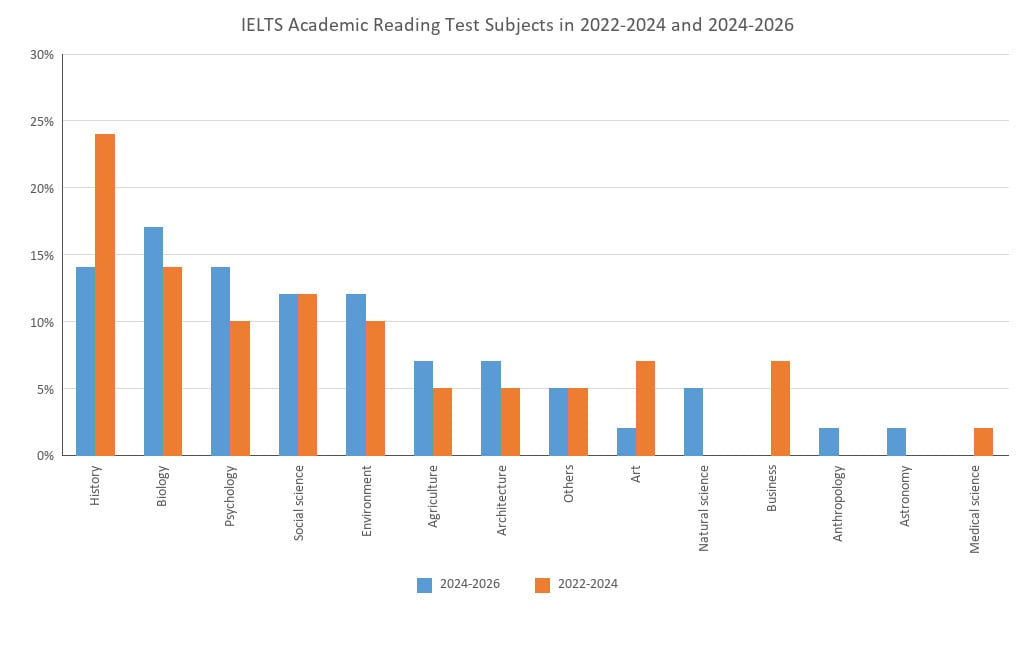
เนื่องจากแนวโน้มเหล่านี้ เราตรวจสอบให้แน่ใจว่าแบบฝึก IELTS Reading ของเราครอบคลุมหัวข้อเหล่านี้ เรายังได้เพิ่มตัวอย่างการอ่านจากหัวข้อที่ใช้น้อยกว่า เผื่อไว้ สำคัญ ที่คุณต้องเตรียมตัวสำหรับทุกสถานการณ์ เพราะคุณไม่มีทางรู้ว่าหัวข้อ IELTS Reading ใดที่คุณจะได้
วิธีคำนวณคะแนน IELTS Reading ของคุณ
คำถาม IELTS Reading แต่ละข้อมีค่า 1 คะแนน ดังนั้นคุณสามารถได้ คะแนน "ดิบ" สูงสุด 40 คะแนน จากนั้น คะแนนดิบของคุณจะถูกแปลงเป็นคะแนน Band ตารางด้านล่างสามารถให้ความคิดทั่วไปเกี่ยวกับวิธีที่คะแนน IELTS Reading ดิบถูกแปลงเป็นคะแนน Band สำหรับการสอบแต่ละแบบ
คะแนน IELTS General Reading เทียบกับคะแนน IELTS Academic Reading
| คะแนนดิบ: Academic | คะแนน Band: Academic | คะแนนดิบ: General | คะแนน Band: General |
|---|---|---|---|
| 39-40 | 9 | 40 | 9 |
| 37-38 | 8.5 | 39 | 8.5 |
| 35-36 | 8 | 37-38 | 8 |
| 33-34 | 7.5 | 36 | 7.5 |
| 30-32 | 7 | 34-35 | 7 |
| 27-29 | 6.5 | 32-33 | 6.5 |
| 23-26 | 6 | 30-31 | 6 |
| 19-22 | 5.5 | 27-29 | 5.5 |
| 15-18 | 5 | 23-26 | 5 |
| 13-14 | 4.5 | 19-22 | 4.5 |
| 10-12 | 4 | 15-18 | 4 |
| 8-9 | 3.5 | 12-14 | 3.5 |
| 6-7 | 3 | 9-11 | 3 |
| 4-5 | 2.5 | 6-8 | 2.5 |
| 1-3 | 2 | 1-5 | 2 |
อย่างไรก็ตาม โปรดจำไว้ว่า การสอบ IELTS Reading แต่ละเวอร์ชันแตกต่างกันเล็กน้อย และคะแนนที่ต้องการเพื่อให้ได้ Band ที่กำหนดจะเปลี่ยนแปลงไปตามวิธีที่ ทุกคนที่สอบในวันนั้นทำได้ในวันนั้น ดังนั้น จำนวนคำตอบ ที่ถูกต้องที่ต้องการเพื่อให้ได้คะแนน Band จะแตกต่างกันเล็กน้อยจากการสอบหนึ่ง ไปยังอีกการสอบหนึ่ง แต่โดยทั่วไปคุณควรตั้งเป้าให้ได้ประมาณ 30 จาก 40 หากคุณต้องการได้คะแนน band 7
อีกสิ่งที่เราต้องการเตือนคุณคือ คำถามที่ยากที่สุดและ คำถามที่ง่ายที่สุดนับเท่ากันต่อคะแนนการอ่านสุดท้ายของคุณ ดังนั้นให้แน่ใจว่าคุณไม่เสียคะแนนง่าย ๆ โดยการติดอยู่กับคำถามที่ยากกว่า ต่อไป เราจะครอบคลุมเคล็ดลับและกลยุทธ์ IELTS Reading บางอย่างเกี่ยวกับวิธีตอบคำถามการอ่านแต่ละข้อ
เคล็ดลับ IELTS Reading - วิธีตอบ 11 ประเภทคำถาม Reading
มี 11 ประเภทคำถามที่แตกต่างกันในการสอบการอ่าน และทั้งหมดต้องการกลยุทธ์ที่แตกต่างกัน
แต่ละประเภทมีตัวอย่างและคำตอบในคู่มือประเภทคำถาม IELTS Reading
- ประเภทคำถามที่ 1 – Matching Information
- ประเภทคำถามที่ 2 – Matching Headings
- ประเภทคำถามที่ 3 – Matching Features
- ประเภทคำถามที่ 4 – Identifying Information
- ประเภทคำถามที่ 5 – Identifying Writer's Views/claims
- ประเภทคำถามที่ 6 – Multiple Choice
- ประเภทคำถามที่ 7 – Matching Sentence Endings
- ประเภทคำถามที่ 8 – Sentence Completion
- ประเภทคำถามที่ 9 – Summary, Note, Table, Flow-chart Completion
- ประเภทคำถามที่ 10 – Diagram Label Completion
- ประเภทคำถามที่ 11 – Short Answer Questions
- แนวโน้มช่วยให้คุณเตรียมตัวสำหรับการสอบ IELTS Reading อย่างไร
แนวโน้มช่วยให้คุณเตรียมตัวสำหรับการสอบ IELTS Reading อย่างไร
คำถามการอ่านประเภทใดที่ผู้เรียนของเราพบว่ายากที่สุด
ผู้เรียนของ BestMyTest ได้ตอบคำถามการอ่านแบบ Academic ไปแล้วหนึ่งล้านข้อ และคำถามการอ่านแบบ General Training อีก 600,000 ข้อในแบบทดสอบฝึกทำของเรา เปอร์เซ็นต์แสดงสัดส่วนการตอบคำถามแต่ละประเภทได้ถูกต้อง
| ประเภทคำถาม | Academic | General Training |
|---|---|---|
| การจับคู่ข้อมูล (Matching information) | 34% | 72% |
| จริง / เท็จ / ไม่ได้ระบุ (True / False / Not Given) | 39% | 60% |
| การเลือกคำตอบ (Multiple choice) | 43% | 48% |
| การจับคู่ลักษณะ (Matching features) | 48% | 74% |
| การเติมประโยคให้สมบูรณ์ (Sentence completion) | 49% | 75% |
| การจับคู่หัวเรื่อง (Matching headings) | 53% | 40% |
| ใช่ / ไม่ใช่ / ไม่ได้ระบุ (Yes / No / Not Given) | 55% | 57% |
| การเติมบทสรุปให้สมบูรณ์ (Summary completion) | 59% | 46% |
| การตอบคำถามแบบสั้น (Short answer) | 54% | 75% |
- ในการอ่านแบบ Academic คำถามสองประเภทที่ผู้เรียนทำได้แย่ที่สุดคือการจับคู่ข้อมูลและจริง / เท็จ / ไม่ได้ระบุ โดยทั้งสองประเภทมีอัตราการตอบถูกต่ำกว่า 40% ทั้งสองประเภทต้องอาศัยการค้นหาใจความที่ถ่ายทอดด้วยถ้อยคำต่างออกไป แทนที่จะหาคำสำคัญที่ตรงกัน
- ในแบบ General Training สถานการณ์กลับกัน: การจับคู่หัวเรื่องเป็นประเภทที่ผู้เรียนทำได้แย่ที่สุด โดยมีอัตราการตอบถูก 40% ขณะที่คำถามประเภทค้นหาข้อมูลมีอัตราการตอบถูกสามในสี่ครั้ง เพราะบทอ่านสั้นกว่าและสื่อความหมายตรงตัวมากกว่า
- บทอ่านแบบ Academic มีอัตราการตอบถูกเฉลี่ย 46% และบทอ่านแบบ General Training มีอัตราการตอบถูก 59% ครึ่งหนึ่งของการทำแบบฝึกหัดบทอ่านแบบ Academic ได้คะแนน 40% หรือน้อยกว่า
- จากแบบทดสอบฝึกทำการอ่านฉบับเต็ม 43,711 ครั้ง ที่ทำโดยผู้เรียน 38,534 คน คะแนนแบนด์เฉลี่ยอยู่ที่ 5.4 โดย 36% ได้แบนด์ 6.0 และ 14% ได้แบนด์ 7.0
- คุณยังคงต้องเตรียมตัวสำหรับคำถามทุกประเภท แต่หากคุณมีเวลาน้อย ตารางนี้จะบอกว่าควรใช้เวลากับส่วนใดจึงจะคุ้มค่าที่สุด
ตัวเลขมาจากข้อมูลแบบทดสอบฝึกทำและการประเมินของ BestMyTest จนถึงเดือนตุลาคม 2026 เปอร์เซ็นต์ของคำถามแต่ละประเภทคืออัตราการตอบถูกจากการทำทั้งหมด ส่วนตัวเลขตามเกณฑ์คือคะแนนที่ให้โดยผู้สอนหรือ AI ตามที่ระบุ อัปเดตล่าสุด 5 ตุลาคม 2026
ต่อไป เราจะทบทวนเคล็ดลับและกลยุทธ์ IELTS reading ที่จำเป็นสำหรับคะแนนการอ่านสูง
เคล็ดลับ IELTS Reading - วิธีปรับปรุงคะแนน Band ของการอ่าน
นักเรียนส่วนใหญ่ล้มเหลวในพาร์ทการอ่านด้วยเหตุผลสามประการ
- ความเร็วการอ่านช้า
- คำศัพท์ที่จำกัด
- การเตรียมตัวน้อยหรือไม่มี
การปรับปรุงความเร็วการอ่านของคุณ
ขั้นแรก มาทำให้ชัดเจน เพื่อปรับปรุงความเร็วการอ่านของคุณ คุณต้องฝึกอ่านจริง ๆ และทำอย่างสม่ำเสมอ
ตอนนี้มาดูกลยุทธ์ที่ชัดเจนน้อยกว่าซึ่งจะช่วยให้คุณเข้าใจความหมายของส่วนใหญ่ของประโยค เริ่มโดยแยกประโยค ทำสิ่งนี้โดยการมองหาประธานและกริยาของประโยค การค้นหาประธานและกริยาจะช่วยให้คุณเข้าใจความหมายของประโยค เหตุผลหนึ่งที่ทำให้บทความ academic reading ยากที่จะเข้าใจคือเพราะมันรวมสายของความคิดเพื่อสร้างประโยครวมยาว สิ่งนี้สร้างส่วนใหญ่ของประโยคที่ยากต่อการดูดซับ ดังนั้นการใช้ประธานและกริยาเป็นแนวทางของคุณในการเข้าใจส่วนทั้งหมดเป็นเครื่องมือที่ดีที่คุณสามารถใช้ในการสอบ IELTS reading ของคุณ
การปรับปรุงคำศัพท์ของคุณ
หลายคนคิดว่าการตอบคำถามการอ่านง่ายเหมือนสแกนย่อหน้าหาคำสำคัญและข้อมูล...น่าเสียดาย มันไม่ง่ายอย่างนั้น คำถามการอ่านมักจะถูกถอดความ หมายความว่าคำถูกเปลี่ยนเป็นคำพ้องของคำจากบทความ IELTS reading สิ่งนี้ทำเพื่อเพิ่มความยาก ไม่อย่างนั้นการสอบจะง่ายเกินไป ด้วยเหตุนี้ คุณต้องปรับปรุงคำศัพท์ของคุณเพื่อรู้คำพ้องที่แตกต่างกันของคำ
ในขณะที่คุณเตรียมตัวสำหรับการสอบการอ่านและคุณพบคำที่คุณไม่รู้ ให้เป็นนิสัยในการหยุดและค้นหา หรืออย่างน้อยจดและค้นหาในภายหลัง น่าเบื่อเล็กน้อย แต่ก็มีประสิทธิภาพอย่างยิ่ง เป้าหมายของคุณควรเป็น แต่ไม่จำกัดเพียง การศึกษาคำศัพท์วิชาการใหม่ 15 ถึง 20 คำในแต่ละวัน
การรู้ว่าในประเภทคำถามใดคำตอบเรียง/ไม่เรียงลำดับ
สำคัญที่ต้องรู้ว่าสำหรับประเภทคำถามบางอย่าง คำตอบมักจะ (เกือบเสมอ) อยู่ในลำดับเดียวกันกับบทความ IELTS reading สำหรับประเภทคำถามอื่น ๆ คำตอบไม่ค่อยอยู่ในลำดับเดียวกันกับบทความการอ่าน เราได้เติมตารางสำหรับประเภทคำถามที่ทำตามและประเภทที่ไม่ทำตาม โปรดจำไว้
| คำตอบมักจะ (เกือบเสมอ) อยู่ในลำดับเดียวกันกับบทความ | คำตอบไม่ค่อยอยู่ในลำดับเดียวกันกับบทความ |
|---|---|
|
|
การหากลยุทธ์การอ่านที่ดีที่สุดสำหรับคุณ
ความท้าทายที่ใหญ่ที่สุดที่คนส่วนใหญ่เผชิญในการสอบ IELTS reading คือการทำคำถามการอ่านทั้งหมดให้เสร็จก่อนหมดเวลา ในส่วนถัดไป คุณจะได้เรียนรู้สามกลยุทธ์และจะขึ้นอยู่กับคุณว่าจะหาว่าอันไหนเหมาะกับคุณที่สุด คุณจะทำสิ่งนั้นโดยใช้ แบบฝึกการอ่านฟรี ของเรา
3 กลยุทธ์ IELTS Reading
กลยุทธ์ที่ 1: อ่านบทความทั้งหมดแล้วตอบคำถาม
ขั้นแรก นี่ไม่ค่อยใช่กลยุทธ์ มันคือสิ่งที่คนทำเมื่อพวกเขาไม่เตรียมตัวอย่างเหมาะสมสำหรับการสอบการอ่าน อย่างไรก็ตาม เราได้รวมไว้เป็นกลยุทธ์เพราะ ในทางเทคนิค หากคุณสามารถจดจำข้อมูลจากบทความในการอ่านครั้งแรกของคุณและสามารถตอบคำถามได้ คุณจะไม่ต้องใช้กลยุทธ์ที่ 2
กลยุทธ์นี้ ถ้าคุณไม่มีความจำที่ดีกว่าค่าเฉลี่ย ไม่มีประสิทธิภาพ คุณจะหมดเวลาก่อนที่จะตอบคำถามทั้งหมดได้ คนจำนวนมากทำผิดพลาดนี้ อย่างไรก็ตาม มีคำถามบางอย่างที่ไม่ต้องใช้ความพยายามมากและจะได้ประโยชน์จากกลยุทธ์นี้ เช่น หากคำถามเป็นคำตอบ "Yes" หรือ "No" คุณจะสามารถ skim อย่างรวดเร็วและหาคำตอบอย่างรวดเร็ว แต่ไม่มีประเภทคำถามเหล่านี้พอ ดังนั้นจึงไม่แนะนำให้ใช้กลยุทธ์นี้ เว้นแต่คุณจะจัดการได้
กลยุทธ์ที่ 2: อ่านคำถามก่อน อ่านเพื่อจุดประสงค์และจดบันทึก แล้วจึงตอบคำถามอย่างฉลาด
นี่คือกลยุทธ์ที่เราแนะนำ มันจะช่วยให้คุณได้คะแนน IELTS reading สูงขึ้น คิดว่านี่เป็นแผนที่ชัดเจนของวิธีเข้าหาการสอบโดยทั่วไป:
หนึ่งในข้อผิดพลาดที่พบบ่อยที่สุดที่ผู้สอบทำเมื่อ
เข้าหาการสอบการอ่านคือการอ่านทุกคำของบทความ IELTS reading แม้ว่าคุณสามารถ
ฝึกสำหรับการสอบโดยการอ่านเพื่อความเพลิดเพลิน "การอ่านอย่างมืดบอด" (อ่านโดยไม่รู้ว่า
คำถามจะถามอะไร) จะไม่ให้ประโยชน์แก่คุณในการสอบ แทนที่ มันจะทำลาย
โอกาสของคุณในการจัดการเวลาอย่างมีประสิทธิภาพและได้คะแนนที่ดีที่สุด
เหตุผลหลักในการอ่านคำถามก่อนคือ เพราะประเภทของคำถามอาจกำหนดว่า
คุณอ่านอะไรในบทความหรืออ่านอย่างไร ตัวอย่างเช่น ประเภทคำถามบางอย่างจะเรียกร้อง
เทคนิค "skimming" ในขณะที่อื่น ๆ อาจเรียกร้องเทคนิค "scanning"
สำคัญที่ต้อง จัดการชุดของคำถามที่เป็นประเภทคำถามเดียวกัน
คุณจะต้องกำหนดประเภทคำถามที่คุณต้องการจัดการก่อน
กลยุทธ์ที่ดีคือเริ่มด้วยประเภทคำถามที่ง่ายกว่าและไปยังประเภทคำถามที่ยากกว่าในภายหลัง
ประเภทคำถามที่ง่ายที่สุดคือประเภทที่คุณใช้เวลาอ่านน้อยกว่า
ตัวอย่างเช่น ประเภทคำถาม Matching Heading เป็นประเภทที่ง่ายกว่าเพราะคุณ
เพียงต้องการหาหัวเรื่องที่อธิบายแนวคิดหลักของย่อหน้าได้ดีที่สุด
ตัวอย่างของประเภทคำถามที่ยากคือ Identifying Information สำหรับประเภทคำถามนี้
คุณจะต้องอ่านแต่ละย่อหน้าเพื่อหาว่าแต่ละข้อความเป็น TRUE, FALSE หรือ NOT GIVEN ตามบทความ
นี่คือตารางที่แสดงระดับความยากสำหรับประเภทคำถามแต่ละข้อ ใช้ตารางนี้เป็นข้อมูลอ้างอิงเมื่อเลือกประเภทคำถาม
ที่คุณต้องการจัดการก่อน
| ระดับความยาก | ประเภทคำถาม |
|---|---|
| ง่าย | Match Headings Short answer |
| ปานกลาง |
Matching Sentence Endings Matching Features Multiple choice Sentence Completion Diagram Label, Summary, Note, Table, Flow-Chart Completion |
| ยาก |
Match Information Identifying Information (TRUE/FALSE/NOT GIVEN) Identifying Viewer's claims (YES/NO/NOT GIVEN) |
หลังจากที่คุณได้อ่านคำถามจากเนื้อหา IELTS แล้ว คุณจะสามารถ อ่านเพื่อจุดประสงค์ นี่หมายความว่าอย่างไร? ตัวอย่างเช่น หากคุณพบคำถามที่ รวมปี "1896" คุณสามารถจดบันทึกว่าปีนี้ขึ้นมาเมื่อใดในเนื้อหา โดยใช้มัน เพื่อตอบคำถามในภายหลัง
มีเทคนิคการอ่านสองเทคนิคที่จะช่วยให้คุณอยู่ในเส้นทางกับการอ่านเพื่อจุดประสงค์ เทคนิคแรก skimming ถูกนิยามดีที่สุดว่าอ่านเร็วเพื่อให้ได้ "ใจความ" หรือแนวคิด ทั่วไป หรือบทความ ด้วยเทคนิคนี้ คุณไม่หยุดสำหรับคำที่ไม่คุ้นเคยหรือ มองหารายละเอียดเฉพาะ เทคนิคที่สอง scanning ถูกนิยามดีที่สุดว่าอ่านเพื่อ ข้อมูลเฉพาะ ด้วยเทคนิคนี้ คุณไม่ได้อ่านสำหรับใจความโดยรวม แต่ ข้อมูลเฉพาะ สังเกตว่าแต่ละเทคนิคเหล่านี้มีจุดประสงค์เฉพาะในใจ นี่ จะช่วยให้คุณหาข้อมูลได้เร็วขึ้น
ในขณะที่คุณกำลังอ่านเพื่อจุดประสงค์ คุณควรทำบันทึกที่ ขอบของบทความ ใส่ดาวข้างข้อมูลสำคัญ หรือขีดเส้นใต้สิ่ง ที่คุณ เชื่อว่าจะช่วยให้คุณตอบคำถามต่าง ๆ สิ่งนี้จะทำให้ง่ายขึ้นสำหรับคุณในการตรวจสอบ เมื่อคุณถูกถามสิ่งบางอย่างในคำถาม เลือกระบบจดบันทึกใดก็ตามที่ เหมาะกับคุณ — เพียงแค่แน่ใจว่าคุณทำมัน!
หลังจากที่คุณได้อ่านคำถาม อ่านบทความ และทำ บันทึกที่เหมาะสมแล้ว คุณควรค้นหาส่วน ของเนื้อหาที่คุณต้องอ่านอย่างระมัดระวัง จากนั้นเพียงแค่ อ่านอย่างระมัดระวังและคิดอย่างวิจารณ์เพื่อกำหนดคำตอบที่ถูกต้อง
กลยุทธ์ที่ 3: Skimming, การจดบันทึก และประเภทคำถาม
นี่คือกลยุทธ์อีกอย่างที่ผู้สอบ IELTS หลายคนใช้ มันจะช่วยให้คุณได้คะแนนการอ่านสูงขึ้น กลยุทธ์ประกอบด้วย 4 ขั้นตอน:
- Skim แต่ละย่อหน้าเพื่อให้ได้แนวคิดทั่วไปของแต่ละย่อหน้า แนวคิดหลักของย่อหน้ามักพบในประโยคแรกไม่กี่ประโยค ดังนั้นให้เน้นที่ประโยคเหล่านั้นเล็กน้อย ประโยคต่อไปสามารถ skim ได้อย่างรวดเร็ว ขีดเส้นใต้ชื่อ/คำ/วลีที่โดดเด่น
- หลังจาก skim แต่ละย่อหน้า เขียนบันทึกสั้น ๆ (2-5 คำ) ข้างแต่ละย่อหน้าด้วยการคาดเดาที่ดีที่สุดของคุณเกี่ยวกับแนวคิดหลักของย่อหน้านั้น
- ต่อไป ตอบชุดของคำถามที่เป็นประเภทคำถามเดียวกัน
- สุดท้าย ตอบชุดของคำถามอย่างมีประสิทธิภาพและถูกต้อง
สำคัญที่คุณจะใช้เวลาไม่เกิน 3-5 นาทีในขั้นตอนที่ 1 และ 2 การใช้เวลามากเกินไปในขั้นตอนเหล่านี้จะเสียเวลามากเกินไปและคุณจะหมดเวลา
ขั้นตอนที่ 1 & 2เป้าหมายที่นี่คือการตั้งวิธีที่มีประสิทธิภาพในการหาคำตอบในบทความ โดยการจดแนวคิดทั่วไปของแต่ละย่อหน้า คุณจะรู้ว่าย่อหน้าใดมีคำตอบสำหรับคำถามแต่ละข้อ สิ่งนี้จะประหยัดเวลามากเพราะหากคุณไม่จดมัน คุณอาจต้อง skim แต่ละย่อหน้าสำหรับแนวคิดทั่วไปของคำถาม จากนั้นคุณจะต้อง scan ย่อหน้าอย่างระมัดระวังสำหรับคำตอบ โดยการจดแนวคิดหลักของแต่ละย่อหน้า คุณข้ามขั้นตอนแรกของการ skim แต่ละย่อหน้าและเริ่ม scan สำหรับคำตอบ
ขั้นตอนที่ 3
หลังจากที่คุณได้ skim ข้อความอย่างละเอียดและจดบันทึกบางอย่าง คุณพร้อมสำหรับขั้นตอนที่ 3
ในขั้นตอนนี้ คุณจะต้องกำหนดประเภทคำถามที่คุณต้องการจัดการก่อน
กลยุทธ์ที่ดีคือเริ่มด้วยประเภทคำถามที่ง่ายกว่าและไปยังประเภทคำถามที่ยากกว่าในภายหลัง
ประเภทคำถามที่ง่ายที่สุดคือประเภทที่คุณใช้เวลาอ่านน้อยกว่า
ตัวอย่างเช่น ประเภทคำถาม Matching Heading เป็นประเภทที่ง่ายกว่าเพราะคุณ
เพียงต้องการหาหัวเรื่องที่อธิบายแนวคิดหลักของย่อหน้าได้ดีที่สุด ดังนั้นในทางเทคนิคคุณเพียงต้องการขั้นตอนที่ 1 และ 2 เพื่อตอบประเภทคำถามนี้
ตัวอย่างของประเภทคำถามที่ยากคือ Identifying Information สำหรับประเภทคำถามนี้
คุณจะต้องอ่านแต่ละย่อหน้าเพื่อหาว่าแต่ละข้อความเป็น TRUE, FALSE หรือ NOT GIVEN ตามบทความ
นี่คือตารางที่แสดงระดับความยากสำหรับประเภทคำถามแต่ละข้อ ใช้ตารางนี้เป็นข้อมูลอ้างอิงเมื่อเลือกประเภทคำถามที่คุณต้องการจัดการก่อน
| ระดับความยาก | ประเภทคำถาม |
|---|---|
| ง่าย | Match Headings Short answer |
| ปานกลาง |
Matching Sentence Endings Matching Features Multiple choice Sentence Completion Diagram Label, Summary, Note, Table, Flow-Chart Completion |
| ยาก |
Match Information Identifying Information (TRUE/FALSE/NOT GIVEN) Identifying Viewer's claims (YES/NO/NOT GIVEN) |
ตอนนี้คุณได้คิดออกว่าจะตอบคำถามชุดใดก่อน ถึงเวลาที่จะตอบจริง ๆ :( อย่ากังวล! แม้ว่าแต่ละประเภทคำถามจะแตกต่างกัน กลยุทธ์ในการตอบให้ถูกต้องใช้กับทั้งหมด หลักการพื้นฐานเป็นเรื่องง่าย เพียงทำตามขั้นตอนด้านล่าง:
- อ่านคำถามอย่างระมัดระวังและระบุคำสำคัญที่สำคัญ
- หาย่อหน้าที่มีข้อมูลที่จำเป็นในการตอบคำถาม (หวังว่าคุณจะมีแนวคิดทั่วไปที่จดไว้แล้วสำหรับแต่ละย่อหน้า ดังนั้นคุณสามารถคิดออกได้อย่างง่ายดาย)
- Scan ย่อหน้าสำหรับคำสำคัญที่สำคัญ (พวกมันน่าจะเป็นคำพ้อง!) จนกว่าคุณจะค้นหาส่วนของเนื้อหาที่คุณต้องอ่านอย่างระมัดระวัง
- สุดท้าย อ่านอย่างระมัดระวังและคิดอย่างวิจารณ์เพื่อกำหนดคำตอบที่ถูกต้อง
ดาวน์โหลด PDF ตัวอย่าง IELTS Reading ฟรีพร้อมเฉลย
ด้านล่างคือตัวอย่างการอ่านฟรีบางส่วนจาก British Council (ผู้สร้างการสอบ IELTS) พยายามตอบคำถามและดูว่าคุณทำได้อย่างไร!