แบบทดสอบ IELTS Speaking ฟรี: เตรียมตัวด้วยหัวข้อและเทมเพลต IELTS Speaking สำหรับ IELTS Speaking Part 1, 2 และ 3
ในคู่มือนี้ คุณจะได้ทำแบบทดสอบ IELTS Speaking ฟรีและฝึกฝนกับหัวข้อคำถาม IELTS Speaking ที่พบบ่อยที่สุดพร้อมคำตอบ คุณจะได้เรียนรู้วิธีตอบคำถามการสอบ IELTS Speaking ในพาร์ท 1, 2 และ 3 โดยใช้เทมเพลตการพูดที่ผ่านการทดสอบอย่างเต็มรูปแบบของเรา
รับ ตัวอย่างคำตอบ IELTS Speaking ฟรี หลังจากทำแบบฝึก IELTS Speaking เสร็จ
play_circle_outline เริ่มแบบฝึก IELTS Speakingด้านล่างคือรายการคำถาม IELTS Speaking ทั้งหมดของเราพร้อมตัวอย่างคำตอบ หมายเหตุ: ลิงก์สีแดง คือคำถาม speaking ที่ได้รับความนิยมและเราแนะนำมากที่สุดตามการให้คะแนนของผู้เรียนของเรา และคุณสามารถฝึกได้ฟรีทุกเมื่อที่ต้องการ
คู่มือความสำเร็จ IELTS Speaking
ยินดีต้อนรับสู่คู่มือการสอบ IELTS Speaking อย่างเป็นทางการของ BestMyTest คู่มือส่วนที่เหลือนี้จะเน้นการเรียนรู้หัวข้อ IELTS Speaking ที่ใช้บ่อยที่สุดสำหรับ Speaking Part 1 - 3 ฟังตัวอย่างคำตอบการพูดระดับ Band 9 และเรียนรู้เคล็ดลับและแหล่งทรัพยากร IELTS Speaking ที่สำคัญต่อความสำเร็จของคุณ ใช้สารบัญด้านล่างเพื่อค้นหาสิ่งที่คุณกำลังมองหาอย่างรวดเร็ว
สารบัญ
- แนะนำการสอบ IELTS Speaking
- หัวข้อ IELTS Speaking สำหรับ Part 1
- หัวข้อ IELTS Speaking สำหรับ Part 2 & 3
- วิธีจัดการ IELTS Speaking Part 1
- วิธีจัดการ IELTS Speaking Part 2
- วิธีจัดการ IELTS Speaking Part 3
- การฝึก IELTS Speaking เพื่อความสำเร็จของคุณ
- วิธีให้คะแนนคำถาม IELTS Speaking
- แหล่งทรัพยากร IELTS Speaking ฟรี
การสอบ IELTS Speaking
การสอบ IELTS Speaking อาจดูน่ากลัวเล็กน้อยในตอนแรก โดยเฉพาะอย่างยิ่งเพราะคุณจะถูกทดสอบสด ๆ ต่อหน้าผู้คุมสอบ เนื่องจากรูปแบบสดนี้ การหาหัวข้อการพูดฟรีพร้อมตัวอย่างคำตอบอาจยาก แต่ไม่ต้องกังวล เราพร้อมช่วยคุณ ก่อนฝึกฝนกับหัวข้อ IELTS Speaking ของเรา มาดูการสอบพูดอย่างคร่าว ๆ และดูว่ามันทำงานอย่างไร
รูปแบบการสอบพูด
การสอบพูดใช้เวลาประมาณ 11 - 15 นาที ประกอบด้วย 3 พาร์ท โปรดสังเกตว่าหัวข้อการพูดสำหรับ ทักทาย และ Part 1 เหมือนกัน ดังนั้นจึงถือว่าเป็นเพียง 1 พาร์ทเท่านั้น แต่เราได้แยกเพื่อความสะดวกของคุณ
การทักทาย
เมื่อคุณเข้าทำการสอบ IELTS Speaking และเดินเข้าห้องสอบ ผู้คุมสอบจะไม่เริ่มด้วยคำถาม IELTS Speaking ที่ยาก แต่จะเริ่มช้า ๆ ด้วยการทักทาย โปรดสังเกตว่าคุณ จะถูก ให้คะแนนความสามารถในการทักทายของคุณ ดังนั้นจึงสำคัญที่คุณต้องเตรียมตัว เมื่อพูดมาแล้ว มาดูการทักทายและคำตอบง่าย ๆ กัน
- ผู้คุมสอบจะแนะนำตัวเองและถามชื่อคุณ คุณจะตอบว่า "My name's _______"
- ต่อไป คุณจะถูกถามว่า "What can I call you?" ซึ่งคุณสามารถตอบว่า "You can call me_______" คุณอาจใช้ชื่อภาษาอังกฤษของคุณที่นี่ หากมี ฟังดูแปลก แต่บางคนไม่สามารถออกเสียงชื่อภาษาอังกฤษของตนได้ นี่ไม่สามารถยอมรับได้ หากคุณออกเสียงไม่ได้ ดีกว่าที่จะไม่ใช้มัน
- หลังจากชื่อ พวกเขาจะถามว่าคุณมาจากที่ไหน เพียงตอบว่า "I'm from_____" เท่านี้ก็พอ คุณไม่จำเป็นต้องให้ข้อมูลเพิ่มเติมเกี่ยวกับคำตอบของคุณในขั้นตอนนี้
- สุดท้าย คุณจะถูกขอให้แสดงบัตรประจำตัว หลังจากแสดงแล้ว คุณจะเริ่มการสอบ
IELTS Speaking Part 1
IELTS Speaking Part 1 ใช้เวลาระหว่าง 4-5 นาที ประกอบด้วยคำถาม IELTS Speaking ประมาณ 8-10 ข้อ และหัวข้อ IELTS Speaking ที่คุ้นเคย 2-3 หัวข้อ เช่น งานของคุณ การเรียนของคุณ ครอบครัวของคุณ บ้านเกิดของคุณ ที่พักของคุณ ฯลฯ หัวข้อเหล่านี้ง่ายกว่าหัวข้อจาก IELTS Speaking Part 2 ด้านล่างคือตัวอย่างของสิ่งที่คุณอาจถูกถาม
Where is your hometown?
What do you like about it?
What do you not like about it?
How important is your hometown to you?
Let's move on to talk about accommodation:
Tell me about the kind of accommodation you live in?
Does the place you live in have many amenities?
Is there anything you would like to change about the place you live in?
Do you plan to live there for a long time?
คำถาม Part 1 อาจอธิบายได้ดีที่สุดว่าเป็นคำถามที่เลียนแบบ การสนทนาแบบเล็ก ๆ น้อย ๆ ระหว่างคนแปลกหน้าหรือคนรู้จักสองคน มันไม่ลึกซึ้งมาก แต่อย่าให้คำถามเหล่านี้หลอกให้คิดว่าไม่ต้องเตรียมตัวสำหรับมัน เพียงเตรียมตัวเล็กน้อยก็สามารถไปได้ไกล และคุณจะขอบคุณเราที่ทำให้คุณทำมัน! คุณยังสามารถหาเคล็ดลับบางอย่างเกี่ยวกับวิธีเตรียมตัวสำหรับคำถาม Part 1 ในภายหลังในโพสต์นี้
IELTS Speaking Part 2
ใน Part 2 คุณจะพูดเกี่ยวกับหัวข้อ IELTS Speaking ที่เฉพาะเจาะจง หัวข้อจะถูกเลือกให้คุณและจะให้คุณบนการ์ด (Candidate Task Card) คุณจะมี เวลา 1 นาทีในการเตรียมคำตอบ จากนั้นพูดสูงสุด 2 นาที จะมีดินสอและกระดาษให้สำหรับจดบันทึก ด้านล่างคือตัวอย่างคำถาม IELTS Speaking Part 2:
Describe a useful electronic device you would like to own.
You should say:
- What it is
- How it would help your life
- If it would be expensive to buy
And explain why you would like it.
เมื่อเวลาพูดสองนาทีของคุณสิ้นสุดลง เป็นไปได้ที่ผู้คุมสอบจะสรุปพาร์ทนี้ของการสอบโดยถามคำถามง่าย ๆ สองสามข้อที่เกี่ยวข้องกับคำตอบ Part 2 ของคุณ
บางครั้งเรียกว่า คำถามปิดท้าย
เพราะมันช่วย "ปิดท้าย" หรือจบการสนทนาของคุณ มาดูคำถาม IELTS Speaking บางข้อที่อาจถูกถามกัน
ตัวอย่างเช่น สมมติว่าหัวข้อ IELTS Speaking ที่คุณอภิปรายใน Part 2 คือ "Describe your favorite form of public transport"
ผู้คุมสอบอาจปิดท้ายการสนทนาโดยถามว่า:
- Are the buses cheap in your city?
- Did you travel to the test today by bus?
โดยทั่วไป คำถามปิดท้ายเหล่านี้ง่าย ดังนั้นคุณจะต้องตอบด้วยคำตอบง่าย ๆ เท่านั้น
ไม่จำเป็นต้องตอบยาว ๆ ซับซ้อนที่นี่ เนื่องจากผู้คุมสอบน่าจะพร้อมเปลี่ยนไปยัง Part 3
ตัวอย่างเช่น คุณสามารถตอบคำถามปิดท้ายด้วยคำตอบสั้น ๆ เช่นนี้:
- Yes, about 2 dollars for a single journey.
- No, actually I came by taxi.
ในทางกลับกัน มีบางครั้งที่ผู้คุมสอบอาจข้าม คำถามปิดท้ายทั้งหมดและไปยัง Part 3 โดยตรง หากเป็นเช่นนี้ระหว่างการสอบ IELTS Speaking ของคุณ อย่ากังวล นี่บ่งบอกว่าคำตอบ Speaking Part 2 ของคุณยาวพอ และ เวลาพูด 3 นาทีของคุณสำหรับ Part 2 หมดลงแล้ว
IELTS Speaking Part 3
ใน Part 3 คุณจะถูกถามคำถาม IELTS Speaking เพิ่มเติมประมาณ 4-8 ข้อ ซึ่งเชื่อมโยงกับหัวข้อ IELTS Speaking ที่อภิปรายใน Part 2 ผู้คุมสอบจะถามคำถามจำนวนหนึ่งตามคำตอบของคุณด้วย ดังนั้น Part 3 ทั้งหมดเป็นการอภิปรายสองทางกับผู้คุมสอบ และใช้เวลา 4 - 5 นาที นี่คือคำถามการพูดทั่วไปที่ผู้คุมสอบอาจถามคุณตามหัวข้อ IELTS Speaking Part 2 ข้างต้น:
What devices do you think will be popular in the future?
Do you think people spend too much money on electronic devices?
In what ways can electronic devices make our lives harder?
What would the world be like without computers?
Should children be taught to use computers at school?
หัวข้อ IELTS Speaking
ตอนนี้คุณได้ทำความรู้จักกับการทำงานของการสอบ IELTS Speaking แล้ว คุณจะเห็นได้ว่าอาจมีหัวข้อจำนวนใดก็ได้ที่ถูกถาม สำคัญที่คุณต้องคุ้นเคยกับหัวข้อ IELTS Speaking ที่ใช้บ่อยกว่า ไม่เพียงเราได้สร้างรายการที่ครอบคลุม แต่แต่ละหัวข้อยังมีตัวอย่างคำตอบ IELTS Speaking ด้วย
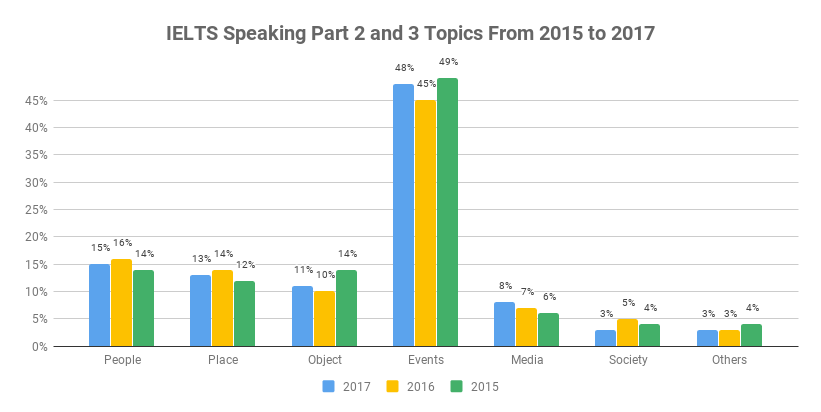
กราฟแท่งด้านล่างแสดงหัวข้อการพูดที่นิยมมากที่สุดที่ใช้ในปี 2015 ถึง 2017 แกน y แสดงเปอร์เซ็นต์การใช้ ในขณะที่แกน x แทนหัวข้อ สุดท้าย เริ่มจากซ้าย แต่ละแท่งแทนปี: 2017, 2016, และ 2015 ตามลำดับ
หัวข้อ IELTS Speaking Part 1
รายการด้านล่างมีมากกว่าแค่คำถาม มันยังแสดงหัวข้อการพูดที่ผู้คุมสอบเคย ถามคนในอดีต เคล็ดลับที่ดีคือตอบคำถาม IELTS Speaking Part 1 เหล่านี้ในกระจกหรือกับเพื่อน ตารางด้านล่างแสดงความถี่ของการใช้แต่ละหัวข้อ:
| หัวข้อ | ความถี่ |
|---|---|
| บ้านเกิด/ที่พัก/ประเทศ | สูง |
| เพื่อน/ครอบครัว/งานบ้าน/เด็ก ๆ | สูง |
| ทีวี/การอ่าน/ดนตรี/หนังสือพิมพ์และนิตยสาร/ภาพยนตร์ | สูง |
| เทคโนโลยี/คอมพิวเตอร์/อินเทอร์เน็ต | สูง |
| งาน/อาชีพ/การวางแผนอาชีพ/งานอาสาสมัคร | สูง |
| วิชาเอกในโรงเรียน/มัธยมศึกษา | กลาง |
| กีฬา/กิจกรรมกลางแจ้ง/กิจกรรมในร่ม | กลาง |
| การเดินทาง/ไลฟ์สไตล์ | กลาง |
| ฤดูกาล/ฝน/วันแดดออก/สภาพอากาศ | กลาง |
| แฟชั่น/รองเท้า/กระเป๋า/เสื้อผ้า | กลาง |
| การขนส่ง/เรือ/รถบัส/แท็กซี่ | กลาง |
| คนดัง/โฆษณา/สื่อ | กลาง |
| รูปภาพ/การถ่ายภาพ/สี/ศิลปะ | ต่ำ |
| เสียง/ความอดทน/ความสุภาพ | ต่ำ |
| กระจก/ของขวัญ | ต่ำ |
My hometown is a tiny village in Malaysia. It is about 40 kilometers away from any major city. Most people probably wouldn't be able to find it on a map.
I like how the people in my hometown are so friendly, and the way that everyone knows everyone. It’s a really close-knit community, which is hard to find in big cities.
Well...I suppose my least favorite thing about it is that there aren’t too many fun things to do or see. It’s not the most exciting place, so sometimes I feel a little bored.
My hometown is very important to me, because that’s where my family lives. It’s where I come from, so it shapes a lot of who I am as a person. If I move away, I’ll likely be homesick for awhile.
Well...I’ve lived in my hometown since I was born, and I would be happy to continue living there. However, I’d like to try living abroad, even if it’s just for a short time.
My hometown, Delhi, is the second largest in India. The capital of the country, New Delhi, is also there. There is an international airport in Delhi, so it’s easy to travel in and out of the country from there.
It has developed much better public transportation, such as the metro, which has really improved the overall accessibility of the city. There have also been measures undertaken to reduce pollution and crowds, so those problems have slightly improved. Improvements are still being made to the education system, as well.
I think one of the biggest issues in Delhi is women’s safety. The city does not have a good reputation surrounding this problem, and many women fear going out alone in the city because of it. More needs to be done to protect women in Delhi.
Yes, there are trains, buses and major highways that connect easily to Delhi. There is an airport in New Delhi, and since it’s the capital of India, it is very well connected to the rest of the country.
Well, there are many different kinds of jobs, since it is a major city, but I think some of the fastest growing job markets are in computer programming and software development. There are also many jobs in marketing and retail. However, the salaries that people make can vary quite a bit depending on how much experience they have, so sometimes it can be hard to make a living even in a city like Delhi.
ต้องการดูรายการ หัวข้อ IELTS Speaking ทั้งหมดของเราหรือไม่? คุณสามารถดูได้ที่นี่: ดูรายการหัวข้อการพูดทั้งหมด
คุณกำลังมองหาตัวอย่าง IELTS Speaking พร้อมคำตอบหรือไม่? คุณสามารถเริ่มฝึกฟรีได้ทันทีโดยคลิกปุ่มด้านล่าง
แบบทดสอบจำลอง IELTS Speaking ฟรี - Part 1
หัวข้อ IELTS Speaking Part 2 & 3
ตอนนี้คุณจะได้เรียนรู้หัวข้อที่ใช้บ่อยจาก Speaking Part 2 และ 3 และผ่านคำถามการพูดบางส่วนที่เกี่ยวข้องกับหัวข้อ (พร้อมแต่ละคำถามจะมีตัวอย่างคำตอบระดับ Band 9)
| หมวดหมู่กว้าง | IELTS Speaking Part 2 & 3 |
|---|---|
| สื่อและความบันเทิง | โฆษณา/ศิลปะ/หนังสือ/อินเทอร์เน็ต/ข่าว/ทีวี |
| วัตถุ | เสื้อผ้า/อุปกรณ์อิเล็กทรอนิกส์/อาหาร/เฟอร์นิเจอร์/ของขวัญ เครื่องจักร/เงิน/เครื่องดนตรี/ผลิตภัณฑ์ดั้งเดิม/ผัก |
| บุคคล | ครู/ครอบครัว/เพื่อน/บุคคลที่มีอิทธิพล/พ่อแม่ที่ดี |
| สถานที่ | เมือง/บริษัท/โรงเรียน/พิพิธภัณฑ์/งานเลี้ยง/สถานที่ช้อปปิ้ง |
| เหตุการณ์ | การเปลี่ยนแปลงในชีวิต/การตัดสินใจ/ประสบการณ์น่าตื่นเต้น/วันหยุด/ประสบการณ์การเจ็บป่วย การช่วยเหลือผู้คน/ประสบการณ์ที่น่าจดจำ/ประสบการณ์มาสาย/ประสบการณ์การเดินทาง |
| สังคม | สิ่งแวดล้อม/กฎจราจร/สังคม/การขนส่ง |
| อื่น ๆ | กิจกรรมยามว่าง/ภาษา/กีฬา |
Speaking Part 2 และ 3 จะทดสอบคุณในหัวข้อที่คล้ายกัน ดังนั้นหัวข้อ โฆษณา ด้านล่างจะมีคำถามตัวอย่างและคำตอบสำหรับทั้งสองพาร์ทรวมอยู่
Speaking Part 2
candidate task card
Describe an advertisement that persuaded you to buy a product.
You should say
What advertisement it was
Was it shown on TV, radio or newspaper
What was good about that advertisement
Explain why you think that advertisement made the product seem attractive.
Speaking Part 3
There are many popular ways companies can choose to advertise. In today’s world, the top three advertisement types are probably internet ads, TV ads, and signs. Internet ads are obviously popular because they are cheap, yet they are highly effective, and can be targeted to the customer based on their online habits. On the other hand, TV ads are probably equally as popular, because although they are more expensive, they will be viewed by a large number of people watching TV. Lastly, signs are popular to use for ads because they can be put into specific places where potential customers might see them, like department stores. So, those are some of the most popular ways to advertise.
Well, I would say that I prefer internet ads. I say that because the internet is the only type of media I even use these days, as I don’t own a television or listen to the radio. I like internet ads because they’re often based on my internet history, which means I only see ads that are relevant to things I’m interested in, rather than ads for things I don’t care about. Another reason why I like internet ads is that they are easy to ignore or cancel when they appear. Unlike TV commercials, which are distracting, noisy, and cannot be skipped, internet ads are usually more subtle, like a small banner on the side of the webpage that can be easily ignored. That’s why I like internet ads the best.
Yes, definitely. If there were no advertising and you went to a shop, then you would just buy whatever you wanted. Your choice might be based on what others have told you, what the product looks like, or, depending on the product, what it says on the label. Advertising builds up a brand and people then trust a certain thing because they have seen it on television or elsewhere. Also, there is so much advertising around us that it must influence us. You can’t escape it, as it is fed to us constantly in our daily lives – not only in magazines, radio and television, but on billboards, on TVs installed on trains and platforms, even in schools and universities. So yes, advertising influences what we buy.
I think that advertisers should bear a certain level of responsibility when they make their ads. The most important thing is they need to ensure that the information they are sharing is relatively truthful, and is not harmful or destructive in some way. For example, fast food ads for fried chicken should not turn around and try to convince people that the food they’re selling is somehow healthy. They can, however, promote how delicious the food is. Advertisers should try to tell the truth as much as possible.
It could be seen as necessary in terms of the fact that, as I mentioned before, there are so many choices that we might need someone to guide us in what to buy, or to give us some extra information about products. Without this, it would be difficult to know where to start. However, that said, I’m not sure that I would regard it as ‘necessary’, as overall I think it may do more harm than good. As we just discussed, advertising encourages people to buy things they might not need. We live in a consumer society and many people are in debt because we are encouraged to buy and buy, and I’m sure advertising plays a major role in this. Without advertising, we could just do our own research and decide what we really need. So no, I would not say that advertising in necessary in modern society.
It seems to me that advertising can affect kids in a few different ways. First of all, advertisements can mislead and confuse children by exaggerating the effects a product can have, like how makeup ads try to convince people that their eyelashes will grow if they use a particular brand of mascara. Secondly, ads can affect children’s self-image and self-esteem by causing them to think that they need to be like the people in the ads, who are often misrepresentations of real people. Impressionable children who see ads may get the wrong idea about some things.
Unfortunately, there are some ads that can be harmful to kids. For example, ads for types of foods and drinks which contain high amounts of sugar and fat can manipulate children into wanting to eat these foods. Another way that ads can harm children is that they can negatively affect children’s self-esteem. Children who see models in advertisements may believe that they need to look like those people, and become upset when they aren’t able to achieve perfection. So, promoting unhealthy influences and lowering self-esteem are a few reasons why ads can be harmful to kids.
ต้องการดูรายการ หัวข้อ IELTS Speaking ทั้งหมดของเราหรือไม่? คุณสามารถดูได้ที่นี่: ดูรายการหัวข้อการพูดทั้งหมด
คุณกำลังมองหาตัวอย่าง IELTS Speaking พร้อมคำตอบหรือไม่? คุณสามารถเริ่มฝึกฟรีได้ทันทีโดยคลิกปุ่มด้านล่าง
แบบทดสอบจำลอง IELTS Speaking ฟรี - Part 2
วิธีจัดการ IELTS Speaking Part 1
ดังที่กล่าวไว้ก่อนหน้า คำถาม IELTS Speaking Part 1 เป็นเหมือนการสนทนาประจำวันกับเจ้าของภาษา หากคุณรู้สึกสบายใจในการสนทนาพื้นฐานกับเจ้าของภาษาอังกฤษ Part 1 ไม่น่ามีปัญหามากนัก อย่างไรก็ตาม คุณยังคงควรเตรียมตัวสำหรับมัน
เมื่อตอบหัวข้อ IELTS Speaking จาก Part 1 คำตอบของคุณไม่ควรสั้นหรือยาวเกินไป ตัวอย่างเช่น หากคุณถูกถามว่า "Do you like sports?" การพูดว่า "No. I don't like sports." ไม่ใช่คำตอบที่ดีพอ จำไว้เสมอ คุณอยู่ที่นี่เพื่อพิสูจน์ว่าคุณพูดภาษาอังกฤษได้ ดังนั้นคุณต้องให้คำตอบที่ยาวกว่าแก่ผู้คุมสอบเพื่อให้คะแนนคุณ คำตอบที่ยอมรับได้คือ "I understand the benefits of being in sports and the entertainment of watching it, but even as a child, I could never get into sports. I prefer to sit down and read an engaging book." โดยทั่วไป คำตอบ Part 1 ควรมีประมาณ 3-4 ประโยค
โชคดีที่มีวิธีง่าย ๆ ในการขยายคำตอบ IELTS Speaking ของคุณอย่างเป็นธรรมชาติ โดยไม่เสี่ยงต่อการใช้ไวยากรณ์ที่ยากหรือไม่คุ้นเคย ที่นี่ คุณสามารถพบ 5 วิธีง่าย ๆ พร้อมตัวอย่าง ของวิธีการขยายคำตอบของคุณอย่างมีประสิทธิภาพเมื่อทำ IELTS Speaking Part 1
| 1. ให้เหตุผล | |
|---|---|
|
What do you like to do in your spare time? I am really into swimming, so I like to swim in my free time. I suppose this is thanks to the influence of my parents who both like swimming. |
|
|
What kind of programme do you like to watch on TV? My favorite TV programmes are dramas, since I don't have to think too much when I watch them. They're a little over dramatic at times, but that's part of the fun. |
|
|
Do you usually watch films alone or with others? I like watching films with my family and friends, because afterwards we can talk about our favorite parts and figure out what we think the plot was about. |
|
|
Who do you get on best within your family? It's hard to say, since we're all so close. I guess I probably get on best with my mother, as we are the most alike. We're both very chatty and warm people. |
|
| 2. ให้ตัวอย่าง | |
|---|---|
|
Do you like to keep fit? Yes! I like to keep fit. I am keen on sports! For instance, I play basketball every week and use the gym whenever I have the chance |
|
|
Do you like learning a new language? Yes! I really do! Take learning English as example. I love reading English magazines and listening to English podcasts. |
|
|
Is there anything you would change about your hometown? Well.. my least favorite thing about it is that there aren't too many fun things to do or see. A case in point is that shopping centres and restaurants close too early. |
|
| 3. ให้รายละเอียด | |
|---|---|
|
Tell me about your hometown? My hometown, Delhi, is the second largest in India. The capital of the country, New Delhi, is also there. There is an international airport in Delhi, so it's easy to travel in and out of the country from there. |
|
|
Tell me about the kind of accommodation you live in? I live in a rented room in a paying guest accommodation. It is a superb building equipped with all the facilities. Round-the-clock security, access to free Wi-Fi, medical room and a common room all are made available to the guests living in the building. Every major part of the city is accessible from our building. |
|
|
Tell me about the favorite shop you often go to? It is a book shop near where I live. It's on the main street. I often go in there to browse and have a look through all the books they have. |
|
| 4. พูดถึงอดีตหรืออนาคต | |
|---|---|
|
Where do you live in your country now? I am currently living in Delhi, which is the second most populated city in India. I've lived there for a couple of years, but I used to live in Bangalore, which is also a big city in southern India. |
|
|
Are you working at the moment? No! Not at the moment. I am unemployed now, but I am planning to apply for some internship positions this summer. Hopefully things will change soon. |
|
|
Have you ever been to a concert before? No. I've never been to a concert before, but I think I will. Concerts are always happening around where I live, so I will try to go check them out when I can. |
|
| 5. คาดเดา | |
|---|---|
|
Do you think you'll ever live in another country? I suppose I'd be happy to leave my country if I was offered a job abroad that was interesting. |
|
|
What would be your ideal holiday destination? Hmm.. I'd doubt whether I'll ever go there, but I'd love to go to Africa to see the wild nature. Right now I don't have money for vacation. If I had more money, I would probably go with my girlfriend. |
|
|
What would be your ideal job? You know..that's a tricky one. It would probably be working as a software engineer in Google if I managed to pass Google's interview. |
|
เมื่อพูดในการสอบ พยายามให้ดูเป็นธรรมชาติ เหมือนคุณกำลังคุยกับเพื่อนสนิท เมื่อคุณรู้สึกประหม่าหรือเครียด เป็นเรื่องปกติที่จะมองลง พูดด้วยน้ำเสียงเอกเสียง พูดเบาเกินไป ให้คำตอบสั้น ๆ คำเดียว หรือแม้แต่ขมวดคิ้ว นิสัยเหล่านี้ทำให้คำตอบของคุณฟังดูไม่มั่นใจและอาจส่งผลต่อคะแนนของคุณ ดังนั้นเป็นพฤติกรรมที่ต้องหลีกเลี่ยง
แทนที่จะเป็นเช่นนั้น ให้เน้นทำสิ่งที่สร้างความประทับใจที่ดีและเป็นบวก สบตากับผู้คุมสอบอย่างเป็นธรรมชาติ พูดด้วยพลังและกระตือรือร้น และฉายเสียงของคุณให้ได้ยินง่าย ให้คำตอบที่บรรยายและพัฒนามากกว่าตอบสั้น ๆ และอย่าลืมยิ้ม ทัศนคติที่เป็นมิตรและมั่นใจทำให้การพูดของคุณน่าสนใจและมีประสิทธิภาพมากขึ้น
วิธีจัดการ IELTS Speaking Part 2
IELTS Speaking Part 2 ต้องการให้คุณพูดต่อเนื่อง 2 นาที และอาจพูดเกี่ยวกับหัวข้อที่ไม่คุ้นเคย นักเรียน IELTS หลายคนเครียดและประหม่าระหว่างพูด และไม่มี อะไรจะพูด เพื่อช่วยให้คุณเอาชนะปัญหาเหล่านี้ เราได้นำเสนอ เคล็ดลับ IELTS Speaking 4 ข้อ ที่สามารถช่วยให้คุณรู้สึกมั่นใจและผ่อนคลายระหว่างพูด
1. อย่าให้หัวข้อย่อยบนการ์ดจำกัดคำตอบของคุณ
ความเข้าใจผิดทั่วไปคือนักเรียนต้องพูดเกี่ยวกับสิ่งที่เขียนบนการ์ดเป๊ะ ๆ แต่ไม่เป็นความจริง ใน เกณฑ์การให้คะแนนอย่างเป็นทางการ ไม่มีข้อกำหนดที่ระบุว่าคุณต้องพูดถึงทุกหัวข้อย่อย หัวข้อย่อยมีเพียงเพื่อช่วยคุณ ดังนั้นหากมีหนึ่งหรือสองข้อที่คุณไม่ชอบหรือไม่สบายใจที่จะพูด ให้ละไว้และพูดเกี่ยวกับสิ่งอื่น แล้วสิ่งนี้หมายความว่าอะไรกับคุณ? หมายความว่าคุณสามารถเลือกพูดเกี่ยวกับหัวข้อย่อยบางข้อที่คุณสบายใจ และสิ่งอื่นที่ไม่เกี่ยวข้องกับหัวข้อย่อยแต่เกี่ยวข้องกับหัวข้อ สิ่งนี้จะช่วยให้คุณให้คำตอบที่ดีและคล่องกว่า
2. วางแผนคำตอบของคุณในช่วงเวลาเตรียมตัว 1 นาที
คุณจะมีเวลา 1 นาทีเพื่อเตรียมตัวก่อนเริ่มพูด ในช่วง 1 นาทีนี้ คุณควรวางโครงสร้างคำตอบการพูดของคุณและจดคำสำคัญเพื่อช่วยคุณจำสิ่งที่คุณต้องการพูด ในระหว่างการพูดของคุณ
3. อย่ากังวลเกี่ยวกับการทำผิดพลาด
เคล็ดลับ IELTS Speaking สุดท้ายคืออย่ากังวลเกี่ยวกับการทำผิดพลาด ทุกคนที่สอบ IELTS Speaking ทำผิดทั้งไวยากรณ์และคำศัพท์ ผู้คุมสอบคาดว่าคุณจะทำผิดพลาดบ้าง สิ่งสำคัญคือ การส่งข้อความสื่อสาร การทำผิดเล็กน้อยจะไม่ทำลายข้อความโดยรวมของคุณ สิ่งที่จะทำลายข้อความของคุณคือการคิดเกี่ยวกับความผิดพลาด เพราะคุณจะเสียลำดับความคิด และนั่นอันตรายมาก หากคุณสามารถแก้ไขได้ทันที ก็ให้แก้ไข แต่ถ้าคุณติดขัดหรือใช้เวลาคิดแก้ไขเล็กน้อย โปรดลืมไปและไปต่อ
4. เตรียมโครงสร้างเพื่อวางแผนคำตอบการพูดของคุณ
ไม่มีอะไรแย่ไปกว่าการมีความคิดอยู่ในใจ แต่ไม่สามารถแสดงออก เป็นคำพูดที่ผู้ฟังเข้าใจง่าย นี่ เป็นกรณีปกติเมื่อคุณไม่ได้ฝึกพูดอย่างมีโครงสร้าง แนะนำ ให้คุณมีโครงสร้างในใจเพื่อตอบคำถาม IELTS Speaking ทั้งหมด ที่นี่เราแนะนำ สองกลยุทธ์ ในการจัดโครงสร้างคำตอบของคุณ:
กลยุทธ์แรก
ในกลยุทธ์แรก โครงสร้างของคำตอบแบ่งออกเป็น 3 ส่วน:
บทนำ:
ในบทนำ คุณสามารถถอดคำถามใหม่เล็กน้อย จากนั้นใช้ประโยคหนึ่งเพื่อแนะนำสิ่งที่คุณจะพูด
เพียงวลีแนะนำง่าย ๆ เช่น "I'm going to talk about..." หรือ "I'd like to talk about..." ก็ใช้ได้
บทนำมักใช้เวลาประมาณ 10 วินาที
หรือคุณสามารถพูดบางอย่างเช่น "Hmm..this is an interesting topic. My first thought is.." หรือ
"That's a tough question for me, but if I had to choose, I'd choose.."
จากนั้นคุณจะต้องไปยังประเด็นหลัก
ประเด็นหลัก:
เมื่อคุณตัดสินใจว่าต้องการพูดเรื่องอะไร สิ่งแรกที่คุณต้องการทำคือคิดถึงคำถาม เช่น
"who," "what," "where," หรือ "when," และคุณสามารถเริ่มสร้างคำตอบพื้นฐานสำหรับคำถามเหล่านี้
คุณสามารถจดความคิดบางอย่างของคุณบนกระดาษ ต่อไป คุณสามารถเริ่มดูที่หัวข้อย่อย และ เลือกสองข้อ เพื่อพูด
อีกครั้ง คุณสามารถจดความคิดสองสามข้อสำหรับแต่ละหัวข้อย่อยบนการ์ด
สุดท้าย คุณต้องเน้นคำถามที่เริ่มต้นด้วย "why" โดยปกติจะมีคำถาม "why" บนการ์ดคำถาม
ส่วนขยาย:
หากถึงจุดนี้ คุณยังไม่ได้ใช้เวลา 2 นาทีทั้งหมด คุณสามารถขยายคำตอบของคุณโดยพูดเกี่ยวกับ ความรู้สึกโดยรวมของคุณ และสิ่งที่คุณอาจต้องการทำในอนาคต เกี่ยวกับหัวข้อ
การทำเช่นนั้นควรช่วยให้คุณเพิ่มเวลาอีกประมาณ 20 วินาที คุณสามารถเริ่มด้วยประโยคเช่น "Overall, I feel .., และ "I think in the future I will...."
You should say:
- what it is
- what you used it for
- how long you have used it
- and describe why it is important to you
Laptop, HP, Good configuration, Windows 8
Bought from BestBuy few years ago.
Present from my mom
Bullet point:
What I used it for: study, take notes, watch movies, listen to music
How long I have used it: 1 year
Why: essential part of my life
This is an interesting topic. My first thought is that I find a lot of electronic equipment useful, but today I am going to talk about the laptop I have.
My laptop computer is manufactured by HP. This laptop has a good configuration and it supports most of the latest software. It came with the Windows 8 operating system and a warranty for three years. I remembered my mom bought it for me as a present. We bought it at Best Buy. I remember it was black friday, so the computers were on sale and we got a great discount.
As for what I use it for, I'd say it is useful in virtually all aspects of my life, including studying, and entertainment. For instance, I use my laptop to take notes. I remember I used to take notes by hand in highschool. It was extremely time-consuming. Now with my laptop, I can type notes directly into a document. It is just much faster and much more flexible. I also use my laptop for entertainment purposes. For example, when I get home from school, I listen to music on my laptop. On weekends, I like watching my favorite TV shows on Netflix. If I didn't have my laptop, I would have to use my phone to watch videos, and I think the phone's screen would be too small for me to really enjoy the programme.
With regards to how long I have used it, well, I had my old laptop for over 5 years, but I finally decided to upgrade and bought my current one a year ago.
Finally, I want to talk about why the laptop is important to me. As I said earlier, this laptop has become an essential piece of equipment for me in almost every aspect of my life. I use it to watch movies and listen to music. I also use it to take notes. I even use it to write a blog, and play games occasionally.
Overall, I feel I am a bit emotionally attached to this laptop as it has become a part of my life. I think in the future, I will continue to use it until it stops working. Even if it breaks, I'll probably still keep it and treat it as a valuable.
กลยุทธ์ที่สอง
ในกลยุทธ์นี้ โครงสร้างของคำตอบยังแบ่งออกเป็น 3 ส่วน ซึ่งคุณสามารถคิดว่าเป็น 3 "เรื่องเล่า" ที่แตกต่างกัน ที่คุณจะเล่าให้ผู้คุมสอบ IELTS Speaking ฟังเรื่องเล่าทั้งสามเรื่องนี้จะเกี่ยวกับเหตุการณ์จาก อดีต ปัจจุบัน และอนาคต ซึ่งหมายความว่าคุณจะเล่าเรื่อง เกี่ยวกับสิ่งที่เกิดขึ้นก่อนหน้านี้ เรื่องเกี่ยวกับสิ่งที่เกิดขึ้นในปัจจุบัน และเรื่องเกี่ยวกับสิ่งที่คุณคิดว่าจะเกิดขึ้นในภายหลัง ด้วยการใช้โครงสร้างนี้ คุณจะไม่ติดขัดในการพยายามคิดว่าจะพูดอะไร และมีแนวโน้มที่จะพูดได้นานพอที่จะถึง 2 นาที
หากคุณมีเนื้อหาไม่พอที่จะพูดโดยใช้เฉพาะหัวข้อย่อย โครงสร้างนี้สามารถช่วยให้คุณมีไอเดียในการขยายคำตอบ ที่จริง คุณไม่ต้องยึดกับคำถามในหัวข้อย่อย แม้คุณควรเริ่มด้วยหัวข้อ IELTS Speaking ที่ให้บนการ์ด คุณไม่ต้องอยู่ในหัวข้อนั้น ก็ไม่เป็นไรที่จะตอบโดยใช้เรื่องเล่าที่เกี่ยวข้องและแม้กระทั่งออกนอกเรื่อง
- Who they are
- How you met them
- Why you think they are good parents
- And explain what it requires to be good parents.
There are lots of ways to be a good parent, and today I'd like to tell you three stories about my experiences with parenting.
Well, first of all, when I was growing up, I think I was very fortunate to have good parents. My parents both worked very hard, but also took the time to make sure they taught us valuable lessons and spent time with us every day. I remember that we would always have dinner at the dinner table together, and my mother and father would ask me and my siblings questions about our day and make jokes with us. They are still very important people in my life now.
Next, I'd like to talk about some great parents that I know today. They are my friends who are new parents. Even though they are still learning about how to be good parents, I watch them lose sleep each night and sacrifice their own comfort regularly for the sake of their baby. The mother is so patient, even when she has not had time to take a shower or relax, she always smiles and plays with the baby. The father works hard and even after a long day, he still takes time to give his wife a break when he comes home from work, so she can have some time to herself. The couple is not only kind to their baby, but they are also kind to each other.
For my last story today, I'm going to tell you about a TV show I saw that has influenced how I think I want to be a parent in the future. The show is called "Parenthood," and it's a sitcom about a few different families. Although they are all very different, the thing that holds them together is their support, honesty, and love for one another. I hope that when I become a parent someday, I can give my family the same amount of all of those things, and be accepting of my children even if they are different from how I expected them to be.
วิธีจัดการ IELTS Speaking Part 3
ใน Part 3 ของการสอบ IELTS Speaking ผู้คุมสอบจะถามคำถามในวงกว้างกว่า ซึ่งอิงตามหัวข้อที่อภิปรายใน Part 2 คำถามเหล่านี้ทั่วไปกว่า และต้องการให้คุณพัฒนาคำตอบของคุณเพิ่มเติมด้วยคำอธิบายและตัวอย่าง
หากคุณได้ทำการค้นคว้าเกี่ยวกับคำถาม IELTS Speaking สำหรับ Part 3 คุณอาจคิดว่ามันคาดเดาไม่ได้ ทำให้ยากต่อการเตรียมตัว อย่างไรก็ตาม หากคุณดูอย่างใกล้ชิด คุณจะเห็นรูปแบบในคำถาม โดยทั่วไป คำถามใน IELTS Speaking Part 3 ขอให้คุณ
- ให้ความคิดเห็นของคุณเกี่ยวกับหัวข้อ
- แสดงความชอบของคุณเกี่ยวกับหัวข้อ
- เปรียบเทียบและตัดกันสองสิ่ง
- คาดการณ์เกี่ยวกับสิ่งใดสิ่งหนึ่งในอนาคต
- เปรียบเทียบกับอดีต
- พูดเกี่ยวกับสถานการณ์สมมติ
- พูดเกี่ยวกับความคิดของคุณเกี่ยวกับผู้คนในสังคม
- พูดเกี่ยวกับสาเหตุและผลกระทบ
- ให้วิธีแก้ไขปัญหา
| ประเภทคำถาม IELTS Speaking Part 3 | |
|---|---|
ให้ความคิดเห็นของคุณเกี่ยวกับหัวข้อ
|
|
แสดงความชอบของคุณ
|
|
พูดเกี่ยวกับผู้คนหรือสิ่งต่าง ๆ ในประเทศของคุณ
|
|
พูดเกี่ยวกับสาเหตุและผลกระทบ
|
|
เปรียบเทียบและตัดกันสองสิ่ง
|
|
คาดการณ์เกี่ยวกับสิ่งใดสิ่งหนึ่งในอนาคต
|
|
เปรียบเทียบกับอดีต
|
|
พูดเกี่ยวกับสถานการณ์สมมติ
|
|
ให้วิธีแก้ไขปัญหา
|
|
หากคุณกังวลเกี่ยวกับการพูดประโยคจำนวนมากเช่นนั้น คุณไม่ใช่คนเดียว แม้แต่เจ้าของภาษาเองยังต้องฝึกฝนคำถาม IELTS Speaking เพื่อให้คำตอบ 5-8 ประโยคที่ได้คะแนนสูง อย่างไรก็ตาม มี เทมเพลตตัวอย่าง IELTS Speaking บางอย่างที่จะทำให้ชีวิตของคุณง่ายขึ้น ตราบใดที่คุณฝึกฝนคำถามมากพอ เรียนรู้หัวข้อ IELTS Speaking ของเรา และคุณทำตามโครงสร้างการพูดของเรา คุณจะรู้สึกมั่นใจมากขึ้นและพัฒนาการพูดของคุณ
ตอนนี้มาดูวิธีจัดโครงสร้างคำตอบของคุณตามรูปแบบคำถาม IELTS Speaking โปรดจำไว้ว่าโครงสร้างคำตอบมีไว้เพื่อ ช่วยให้คุณมีภาพชัดเจนของสิ่งที่คุณต้องการพูด และ ช่วยให้คุณเป็นระเบียบ อย่างไรก็ตาม คุณไม่จำเป็นต้องทำตาม ตราบใดที่คำตอบของคุณอยู่ในหัวข้อและสามารถแสดงความสามารถภาษาอังกฤษของคุณ
มาดูวิธีขยายและจัดโครงสร้างคำตอบของคุณตามรูปแบบคำถาม
| คาดการณ์เกี่ยวกับสิ่งใดสิ่งหนึ่งในอนาคต | |
|---|---|
| โครงสร้าง |
|
| คำถาม IELTS Speaking | What do you think cities will be like in 50 years time? |
| ตัวอย่างคำตอบและการวิเคราะห์: | |
|
บรรยายการคาดการณ์:
I think cities in the future will be more densely populated. At the same time, people will still require transportation, so I think the transportation in future cities will be more modern, fast, and convenient. บรรยายแนวโน้มปัจจุบันและพูดว่าแนวโน้มนี้น่าจะดำเนินต่อไป: In fact, I think there is a growing trend across the world of futuristic cities emerging where transportation is becoming more convenient to meet the growing demands of population. This trend will probably continue going forward. บรรยายว่าคุณรู้สึกอย่างไรเกี่ยวกับการคาดการณ์นี้: I personally like this trend as more futuristic cities will emerge. A good example of a futuristic city is I think I will say it is Tokyo, where people have access to clean transportation, and live in compact spaces, like high-rises. |
|
| เปรียบเทียบกับอดีต | |
|---|---|
| โครงสร้าง |
|
| คำถาม IELTS Speaking | How has teaching changed in your country over the past few decades? |
| ตัวอย่างคำตอบและการวิเคราะห์: | |
|
กล่าวว่ามีการเปลี่ยนแปลงตลอดทศวรรษที่ผ่านมา:
In the past few decades, there have definitely been some noticeable changes in education through generations. บรรยายการเปรียบเทียบแรก: I mean ..most notably, students today can no longer be punished physically by teachers, while in the past, that was pretty common. บรรยายการเปรียบเทียบที่สอง: Another way that education has changed is teacher student interaction. Today, it’s more normal to see students answering questions and having discussions, while in the past, the teacher simply lectured, and the students listened silently. บรรยายว่าคุณรู้สึกอย่างไรเกี่ยวกับการเปลี่ยนแปลงนี้: Overall, I think education is making progress in my country. |
|
| เปรียบเทียบและตัดกันสองสิ่ง | |
|---|---|
| โครงสร้าง |
|
| คำถาม IELTS Speaking | What are the differences between living in the city and the countryside? |
| ตัวอย่างคำตอบและการวิเคราะห์: | |
|
กล่าวว่ามีความแตกต่างบางอย่างระหว่างสองสิ่ง:
For me, there are quite a few differences between life in the city and life in the country. Life in the city and in the country is vastly different. บรรยายการเปรียบเทียบแรก: First of all, the way people interact with each other is different. For example, in a small town, people usually wave to say hello, and notice strangers in town. But in a big city, most people ignore each other and try to give each other space in public. บรรยายการเปรียบเทียบที่สอง: Another big difference between the two is the amount of noise, which is higher in cities, and lower in small towns. ให้ข้อสรุปสั้น ๆ: Overall, life in both places varies. |
|
| ให้วิธีแก้ไขปัญหา | |
|---|---|
| โครงสร้าง |
|
| คำถาม IELTS Speaking | How can we stop violence on TV? |
| ตัวอย่างคำตอบและการวิเคราะห์: | |
|
พูดถึงปัญหาโดยย่อ:
I think violence on TV is the most problematic for children, but there isn’t really a simple way to make it stop, because there is a demand for action, horror, and excitement on TV. พูดถึงวิธีแก้ไขแรก: The way I see it, there are two possible ways to deal with violent TV shows. The first is to make policies that actually ban that kind of programming altogether, although that would likely not be popular. พูดถึงวิธีแก้ไขที่สอง: The second way could be to educate people on why violent TV shows are problematic, and see if they will stop watching the shows to lower the demand for them. บรรยายว่าคุณรู้สึกอย่างไรเกี่ยวกับปัญหาและวิธีแก้ไข: I mean either way, I think this problem probably isn’t going to disappear with just one simple solution. |
|
| พูดเกี่ยวกับสาเหตุหรือผลกระทบของปรากฏการณ์ | |
|---|---|
| โครงสร้าง |
|
| คำถาม IELTS Speaking | What are some of the causes of water pollution? |
| ตัวอย่างคำตอบและการวิเคราะห์: | |
|
พูดถึงปรากฏการณ์โดยย่อ:
Water pollution definitely has more disastrous effects on our health ชี้ให้เห็นสาเหตุหรือผลกระทบ: From what I understand, water pollution is caused mostly by human activity, so it seems like the likely sources of water pollution would be factories, runoff from farms, and sewage from cities. ให้ตัวอย่างของสาเหตุหรือผลกระทบ: For instance, I’ve seen a few studies recently that declared the Australian Great Barrier Reef to be dead due to man-made pollutants and garbage in the water. บรรยายว่าคุณรู้สึกอย่างไรเกี่ยวกับปรากฏการณ์: I think it’s quite sad, as that probably could have been prevented if people paid more attention to the effects big industry has on the environment. |
|
| พูดเกี่ยวกับผู้คนหรือสิ่งต่าง ๆ ในประเทศของคุณ | |
|---|---|
| โครงสร้าง |
|
| คำถาม IELTS Speaking | How popular is watching television in your country? |
| ตัวอย่างคำตอบและการวิเคราะห์: | |
|
ตอบคำถาม IELTS Speaking:
As far as I know, watching TV is probably one of the most popular pastimes for people in my country. ให้ตัวอย่างวิธีที่คนส่วนใหญ่ทำสิ่งต่าง ๆ: For example, in the evening, almost every home I pass has the TV in the living room switched on, and families will be sitting around together watching shows. I think most people like watching the news, or watching dramas. ให้ตัวอย่างวิธีที่คุณทำสิ่งต่าง ๆ: As for me, I also watch quite a bit of TV when I’m at home. For instance, I watch sitcoms on Friday nights after work.I guess other people in my country probably do the same thing as I do. |
|
| ให้ความคิดเห็นของคุณเกี่ยวกับหัวข้อ | |
|---|---|
| คำถาม IELTS Speaking | Do you think people spend too much money on electronic devices? |
| ตัวอย่างคำตอบและการวิเคราะห์: | |
|
ตอบคำถาม:
If you ask me, yes, I think that some people spend too much money trying to keep up with the latest trends in technology. อธิบายเหตุผล: However, I can understand why they do it, because these days devices become obsolete almost immediately after they are purchased. ให้ตัวอย่างเพื่อสนับสนุนเหตุผลของคุณ: For example, a new smartphone might have some great new camera today, but tomorrow, another one will appear with an even better camera. Then, everyone will want to upgrade to the new device. As for me, I am satisfied with using a slightly outdated device in order to save money until I really need a new one. |
|
| แสดงความชอบของคุณ | |
|---|---|
| คำถาม IELTS Speaking | Do you generally read a lot of books or do you prefer watching T.V? |
| ตัวอย่างคำตอบและการวิเคราะห์: | |
|
ตอบคำถาม:
Even though I love to read, the reality is I spend quite a bit more time watching TV. อธิบายเหตุผล: I think the main reason I watch more TV is because it’s lazier, which is unfortunate. But at the same time, there are some great shows to choose from. ให้ตัวอย่างเพื่อสนับสนุนเหตุผลของคุณ: For instance, one of my favorite shows is “Dexter”, which has great writing, an interesting plot, and well-developed characters, just like a book. I think in the age we live in now, TV is just going to keep getting better and better, so I am going to probably continue watching more TV. |
|
| พูดเกี่ยวกับสถานการณ์สมมติ | |
|---|---|
| คำถาม IELTS Speaking | If you could influence or had the power to change the world with your writings what would you want to change? |
| ตัวอย่างคำตอบและการวิเคราะห์: | |
|
ตอบคำถาม:
If I could change the world with my writings, my biggest priority would probably be to educate people about how and why they need to make changes to what they buy, what they eat, and consume to help save the environment. อธิบายเหตุผล: The main reason is that people nowadays are using so much disposable plastic and products. This has led to many environmental problems. If my writing could change our consumption habits, that would have a drastic effect on our environmental footprint. ให้ตัวอย่างเพื่อสนับสนุนเหตุผลของคุณ: For example, I’ve seen a few studies recently predicting that, by 2050, the mass of plastic in the world’s oceans will exceed the mass of all the fish that live there. If that happens, the entire food chain will be severely damaged. |
|
การฝึก IELTS Speaking เพื่อความสำเร็จของคุณ
BestMyTest เป็นคอร์สเตรียมสอบ IELTS ออนไลน์ที่สร้างขึ้นเพื่อความสะดวกของคุณ คำถามทดสอบ IELTS Speaking ของเราถูกออกแบบให้มีลักษณะและความรู้สึกเหมือนการสอบ IELTS Speaking อย่างเป็นทางการ (เราพยายามอย่างเต็มที่ในการจำลองสถานการณ์แบบสัมภาษณ์สำหรับคุณ) เราตรวจสอบให้แน่ใจว่าทุกอย่างเหมือนกัน รวมถึงความยาก รูปแบบ และแม้แต่วิธีการทำงานของการสอบ โปรดสังเกตว่าเราเสนอแบบทดสอบจำลอง IELTS 4 ชุดพร้อมคำถามที่ไม่เคยเห็นมาก่อน และตัวอย่างแบบทดสอบ IELTS Speaking ฟรีอย่างสมบูรณ์ คุณสามารถเริ่มฝึกได้ทันที: IELTS Speaking Practice 1 part 1
หัวข้อ IELTS Speaking เหล่านี้ถูกสร้างขึ้นด้วยหัวข้อในปีล่าสุด ดังนั้น ตัวอย่าง IELTS Speaking ของเราจึงเกี่ยวข้องกับการเตรียมสอบ IELTS Speaking ของคุณ! ตรวจสอบให้แน่ใจว่าคุณทำทั้งหมด และคุณจะได้คะแนน Band IELTS Speaking สูง ๆ
ขั้นตอนต่อไป
สมัครทดลองใช้ฟรี 7 วัน เพื่อเข้าถึงบทเรียนและคำถาม IELTS Speaking ของเรา และเริ่มเตรียมสอบ IELTS
ทดลองใช้ฟรี 7 วันวิธีให้คะแนนคำถาม IELTS Speaking
ในการสอบ IELTS Speaking ความสามารถในการพูดของคุณจะถูกให้คะแนนตามสี่หมวดหมู่ ซึ่งเป็นที่รู้จักกันในชื่อ Fluency and coherence, Lexical resource, Grammatical range and accuracy, และ Pronunciation อ่านต่อเพื่อโอกาสในการทำความคุ้นเคยกับแต่ละหมวดหมู่ สำหรับข้อมูลเพิ่มเติม คุณสามารถอ้างอิงถึง รายละเอียด Band เหล่านี้ ซึ่งผู้คุมสอบ IELTS ใช้ให้คะแนนพาร์ทการพูดของการสอบ ตอนนี้มาดูสี่หมวดหมู่นี้ในรายละเอียดกัน
ความคล่องและความสอดคล้อง
คุณสามารถอภิปรายความคิดของคุณในวิธีที่ชัดเจนและมีเหตุผลได้หรือไม่? ความคล่องหมายถึงความสามารถของคุณในการสื่อความคิดอย่างมีเหตุผล และความสอดคล้องหมายถึงระดับที่ผู้อื่นสามารถเข้าใจความคิดของคุณ เพื่อให้ได้คะแนน Band 9 ในหมวดความคล่องและความสอดคล้อง คุณควรสามารถพูดต่อเนื่องโดยไม่หยุดเพื่อจำคำหรือไวยากรณ์ ในขณะเดียวกันก็พัฒนาคำตอบที่ครบถ้วนและใช้งานได้สำหรับคำถาม IELTS Speaking
หากคุณลังเลบ่อย ๆ ในการสร้างคำตอบที่ถูกต้องตามไวยากรณ์ ความคล่องของคุณจะถูกกระทบในเชิงลบ คุณควรเน้นการใช้ภาษาอังกฤษเพื่อสื่อสารเนื้อหาของข้อความของคุณอย่างมีประสิทธิภาพตลอดเวลา ไม่ใช่การหาคำที่ถูกต้องเอง เพื่อให้ได้คะแนนดีในด้านความสอดคล้อง ความคิดของคุณต้องไหลรวมกันอย่างเป็นเหตุเป็นผลให้ผู้ฟัง คุณสามารถใช้คุณสมบัติเชื่อมต่อ เช่น คำเชื่อม และตัวบ่งชี้บทสนทนาทั่วไป เพื่อปรับปรุงความเชื่อมต่อของคุณ และซื้อเวลาคิดคำตอบที่ดีที่สุดของคุณเพิ่มขึ้นเล็กน้อย
คลังคำศัพท์
คลังคำศัพท์ของคุณเกี่ยวข้องกับความสามารถในการดึงข้อมูลจาก "พจนานุกรมในใจ" หรือคลังคำของคุณ หากคุณมักพูดด้วยคำศัพท์ที่กว้างขวางและหลากหลาย คุณจะทำได้ดีในหมวดคลังคำศัพท์ โปรดสังเกตว่าทั้งความเหมาะสมและความถูกต้องของการเลือกคำของคุณจะถูกพิจารณาที่นี่ ดังนั้นคุณต้องแน่ใจว่าเลือกคำที่ถูกต้องทั้งความหมายและบริบทที่ปรากฏ
ในทางกลับกัน หากคุณมีคำศัพท์จำกัด หรือไม่มีประสบการณ์ในการหาบริบทที่ถูกต้องสำหรับบางคำ คุณอาจต้องการการฝึกฝนเพิ่มเติมในด้านนี้ จำไว้ว่า การรู้แค่ว่าคำภาษาอังกฤษ "หมายถึง" อะไร ไม่ได้รับประกันว่าคุณกำลังใช้มันถูกต้อง เนื่องจากคำภาษาอังกฤษมักมีความหมายแฝงที่ไม่จำเป็นต้องพบในพจนานุกรม คุณจะเข้าใจสิ่งที่เรากำลังพูดถึงมากขึ้นเมื่อคุณทำตัวอย่าง IELTS Speaking ของเรา ต่อไป การใช้คำเดิม ๆ ที่คุณคุ้นเคยซ้ำ ๆ เป็นข้อผิดพลาดทั่วไปอีกอย่างที่ต้องหลีกเลี่ยง เนื่องจากจะบ่งบอกผู้คุมสอบว่าคลังคำศัพท์ของคุณจำกัด สุดท้าย ผู้คุมสอบจะคาดหวังให้คุณสามารถถอดคำถาม IELTS Speaking อย่างถูกต้องโดยใช้คำของคุณเองในการกล่าวคำถามซ้ำ นั่นหมายความว่าการฟังและเข้าใจการเรียบเรียงคำถามก็สำคัญเช่นกัน
ขอบเขตไวยากรณ์
ไม่น่าแปลกใจสำหรับคนส่วนใหญ่ ไวยากรณ์ของคุณจะถูกพิจารณาเป็นส่วนหนึ่งของคะแนน IELTS Speaking ของคุณด้วย เพื่อให้ดีที่สุดในหมวดนี้ คุณควรคุ้นเคยกับหัวข้อ IELTS Speaking ให้มากที่สุดเท่าที่จะทำได้ เพื่อให้คุณสามารถเน้นไวยากรณ์ของคุณได้มากขึ้น จากนั้นคุณสามารถพยายามแสดงความสามารถและขอบเขตทางไวยากรณ์ของคุณอย่างเป็นธรรมชาติที่สุด การหลีกเลี่ยงข้อผิดพลาดไม่เพียงพอที่จะได้คะแนนสูงในด้านนี้ เนื่องจากผู้คุมสอบต้องการโอกาสที่เพียงพอในการฟังคุณใช้โครงสร้างและคุณสมบัติทางไวยากรณ์ที่ซับซ้อนหรือยากกว่า เป้าหมายของคุณควรเป็นการแสดงความรู้ทางไวยากรณ์ของคุณ ในขณะที่ปรากฏสบายในการใช้โครงสร้างประโยคและกาลของกริยาที่หลากหลาย
อย่างไรก็ตาม ตามที่ผู้พูดภาษาที่สองหลายคนรู้ พูดง่ายกว่าทำ หากคุณสับสนเกี่ยวกับวิธีใช้จุดไวยากรณ์บางอย่าง หรือคุณไม่แน่ใจว่าทำผิดพลาดเมื่อพูดหรือไม่ ลองพิจารณาบันทึกคำตอบที่พูดของคุณครั้งต่อไปที่คุณฝึกตอบคำถามทดสอบ IELTS Speaking ขณะฟัง คุณอาจพบว่ามีข้อผิดพลาดบางอย่างที่คุณไม่เคยรู้ว่ากำลังทำอยู่ การค้นพบสิ่งเหล่านี้จะช่วยให้คุณคิดออกว่าจะทำลายนิสัยไม่ดีได้อย่างไรก่อนที่ผู้คุมสอบจะได้ยินคุณทำในการสอบ หากเป็นไปได้ ขอให้เจ้าของภาษา ผู้สอน หรือเพื่อนที่มีภาษาอังกฤษดีช่วยคุณแก้ไขข้อผิดพลาดและอธิบายกฎไวยากรณ์ อย่าลืมย้อนกลับและทบทวนแม้แต่บทเรียนไวยากรณ์ที่พื้นฐานที่สุด
การออกเสียง
สุดท้ายแต่ไม่ท้ายสุด ผู้คุมสอบจะให้คะแนนการออกเสียงของคุณ ผู้ที่ได้คะแนนสูงสุดในหมวดนี้จะออกเสียงคำได้ดีพอที่เจ้าของภาษาจะเข้าใจได้อย่างสมบูรณ์ตลอดเวลา ปัญหาการออกเสียงที่จำกัดความสามารถในการเข้าใจของคุณเมื่อพูดจะลดคะแนนของคุณ
สำคัญที่ต้องจำไว้ว่าการออกเสียงภาษาอังกฤษเกี่ยวข้องกับมากกว่าเพียงเสียงของคำ เจ้าของภาษาจะฟังโทน ความเน้น และการไหลที่เหมาะสมในคำของคุณและในประโยคด้วย เมื่อผู้สอบไม่คุ้นเคยกับจังหวะและรูปแบบการเน้นเสียงตามธรรมชาติของภาษาอังกฤษ วิธีเดียวที่แน่นอนในการปรับปรุงคือการฟังและใช้ภาษาอังกฤษที่พูดให้มากที่สุดตลอดทั้งวัน คุณสามารถพูดภาษาอังกฤษและฟังคำตอบของคุณทุกวันที่นี่ที่ BestMyTest ด้วยคำถามฝึก IELTS Speaking ของเรา
ในความเป็นจริง การทำเช่นนี้อาจไม่สามารถทำได้สำหรับทุกคน อย่างไรก็ตาม คุณยังสามารถใช้ประโยชน์จากเวลาที่จำกัดของคุณให้มากที่สุดโดยฟังการบันทึกของเจ้าของภาษา เพื่อฝึกปรับปรุงการออกเสียงของคุณ คุณจะต้องเป็นเหมือนนกแก้วในใจ ลองหยุดการบันทึกและพูดส่วนสั้น ๆ ซ้ำในแบบที่คุณได้ยินสักสองสามครั้ง ฟังโทนเสียงขึ้นและลง การหยุด และแม้แต่อารมณ์ของผู้พูด การทำเช่นนี้จะช่วยให้คุณพัฒนาการออกเสียงของคุณเองในบริบทต่าง ๆ และฝึกตัวเองให้ได้ยินและจำลองเสียงจริงของภาษาอังกฤษที่คล้ายเจ้าของภาษา
แหล่งทรัพยากร IELTS Speaking Test ฟรี
การปรับปรุงทักษะการพูดของคุณด้วยทรัพยากรฟรีค่อนข้างท้าทายกว่าอีกสามพาร์ท IELTS จริงที่การพูดภาษาอังกฤษช่วยให้คุณปรับปรุงได้ แต่สิ่งที่ช่วยได้จริง ๆ คือการสนทนากับผู้พูดภาษาอังกฤษคล่อง คนที่สามารถช่วยแก้ไขความผิดพลาดของคุณ แน่นอน ผู้พูดภาษาอังกฤษคล่องไม่ได้มีให้เสมอ ดังนั้นเราจะไปยังสิ่งที่ดีรองลงมา ทรัพยากร IELTS Speaking ฟรี
คำถาม IELTS Speaking
เพื่อให้ได้ไอเดียว่าการสอบ IELTS Speaking เป็นอย่างไรในแต่ละพาร์ท คุณสามารถดูวิดีโอ YouTube อย่างเป็นทางการของ IELTS ด้านล่างได้ฟรีอย่างสมบูรณ์ ประกอบด้วยข้อมูล ที่เป็นประโยชน์มากมายและตัวอย่าง IELTS Speaking
- วิดีโอ YouTube: IELTS Speaking 1 (Kenn, Band 8.5)
- วิดีโอ YouTube: IELTS Speaking 2 (Tina, Band 5)
- วิดีโอ YouTube: IELTS Speaking 3 (Kopi, Band 8)
ด้านล่างคือแหล่งฟรีอันยอดเยี่ยมบางส่วนที่คุณสามารถใช้เพื่อฝึกฝนและรักษาทักษะ IELTS Speaking ของคุณ
1. Google Speech-to-Text
นี่เป็นเครื่องมือที่ดีในการสอนตัวเองให้พูดด้วยความเร็วที่ดีและออกเสียงอย่างถูกต้อง สิ่งที่คุณจะสังเกตเห็นคือ หากคุณทำผิดพลาด Google API จะเขียนสิ่งที่คิดว่าคุณพูดลงไป ที่จริงเรามีสิ่งคล้ายกันในส่วนคำถาม IELTS Speaking ของเรา ใต้แท็บ "SAMPLE" แต่ คุณต้องใช้ Google Chrome บนเดสก์ท็อปเพื่อใช้
2. YouTube
YouTube มีทรัพยากรฟรีมากมายที่เกี่ยวข้องกับการฝึก IELTS Speaking บางวิดีโอเสนอตัวอย่าง IELTS Speaking พร้อมคำตอบ
3. Google Play Store
มีแอปฝึกพูดภาษาอังกฤษคล่องฟรีมากมายจาก Google Play Store คุณไม่สามารถผิดพลาด กับแอปฟรีเหล่านี้ เพียงดาวน์โหลดและเริ่มต้น ด้วยแอปที่ถูกต้อง คุณควร จะสามารถปรับปรุงทักษะ IELTS Speaking ของคุณได้อย่างน้อยเล็กน้อย