
ในคู่มือนี้ คุณจะได้ทำแบบทดสอบการฟัง IELTS ฟรีและได้รับผลวิเคราะห์คะแนนการฟัง IELTS อย่างครบถ้วน คุณจะได้เตรียมตัวกับแบบทดสอบฝึกฟัง IELTSกว่า 125 ชุด พร้อมบทเรียน เคล็ดลับ และวิดีโออธิบายเฉลย เมื่อทำตามแผนการเรียนที่ออกแบบเฉพาะบุคคล คุณจะบรรลุคะแนน Band การฟัง IELTS ตามเป้าหมาย
รับ การวิเคราะห์คะแนน IELTS Listening ฟรีและแผนการเรียนเฉพาะบุคคล หลังจากทำแบบฝึก IELTS Listening ฟรีเสร็จ
play_circle_outline เริ่มแบบฝึก IELTS Listeningด้านล่างคือรายการคำถาม IELTS Listening ทั้งหมดของเราพร้อมคำตอบ หมายเหตุ: ลิงก์สีแดง คือคำถาม listening ที่ได้รับความนิยมและเราแนะนำมากที่สุดตามการให้คะแนนของผู้เรียนของเรา และคุณสามารถฝึกได้ฟรีทุกเมื่อที่ต้องการ
คำถามแบบฝึกหัด IELTS Listening ส่วนที่ 1 1 - 59
A conversation between two people in an everyday situation
คำถามแบบฝึกหัด IELTS Listening ส่วนที่ 2 1 - 75
A talk by one speaker about an everyday topic
คำถามแบบฝึกหัด IELTS Listening ส่วนที่ 3 1 - 65
A conversation between up to four people about studies or training
คำถามแบบฝึกหัด IELTS Listening ส่วนที่ 4 1 - 62
A talk by one speaker on an academic subject
คู่มือแบบฝึก IELTS Listening
คู่มือส่วนที่เหลือนี้จะสอนคุณทุกอย่างเกี่ยวกับการสอบ IELTS Listening คุณจะได้เรียนรู้วิธีคำนวณคะแนนการฟัง เรียนรู้วิธีตอบคำถามการฟังแต่ละประเภทอย่างประสบความสำเร็จเพื่อปรับปรุงคะแนน Band ของ IELTS Listening และเรียนรู้กระบวนการ 3 ขั้นตอนที่ทดสอบแล้วเพื่อช่วยคุณศึกษาการสอบ IELTS Listening ออนไลน์
สารบัญ
ข้อมูลการสอบ IELTS Listening
การสอบ IELTS Listening แบ่งออกเป็น 4 ส่วน ในแต่ละส่วน คุณจะฟังเจ้าของภาษาอังกฤษหนึ่งคนหรือมากกว่า จากนั้น ตอบคำถามประมาณ 10 ข้อที่เกี่ยวข้องกับสิ่งที่คุณเพิ่งฟัง พาร์ทการฟัง IELTS ทั้งหมดมี คำถามรวม 40 ข้อ โดยทั่วไป การบันทึกการฟังจะเริ่มจากง่ายและยากขึ้นเมื่อคุณดำเนินไปในการสอบ การบันทึกแต่ละครั้งจะได้ยินเพียงครั้งเดียวและประกอบด้วยสำเนียงต่าง ๆ รวมถึงอังกฤษ ออสเตรเลีย นิวซีแลนด์ อเมริกัน และแคนาดา
- Section 1 – การสนทนาระหว่างคนสองคนในบริบทสังคมประจำวัน ตัวอย่างเช่น คุณอาจได้ยินการสนทนาเกี่ยวกับการยืนยันรายละเอียดสำหรับการจอง หรือการสั่งทางโทรศัพท์
- Section 2 - การพูดเดี่ยวในบริบทสังคมประจำวัน ตัวอย่างเช่น คุณอาจได้ยินการพูดเกี่ยวกับสิ่งอำนวยความสะดวกในท้องถิ่น หรือคนที่ให้คำแนะนำ หรือนำเสนอข้อมูลพื้นฐานเกี่ยวกับเหตุการณ์หนึ่ง
- Section 3 – การสนทนาระหว่างผู้คนไม่เกินสี่คนในบริบทการศึกษาหรือการฝึกอบรม ตัวอย่างเช่น คุณอาจได้ยินติวเตอร์มหาวิทยาลัยและนักเรียนกำลังอภิปรายเกี่ยวกับงานที่ได้รับมอบหมาย หรือนักเรียนสองสามคนกำลังอภิปรายเกี่ยวกับบางสิ่งจากชั้นเรียน
- Section 4 - การพูดเดี่ยวในหัวข้อทางวิชาการ ตัวอย่างเช่น คุณจะได้ยินการบรรยายในมหาวิทยาลัยจากศาสตราจารย์ นี่เป็นการบันทึกที่ยากที่สุดในการสอบ Listening สำหรับนักเรียนส่วนใหญ่
การสอบ IELTS Listening ใช้เวลาประมาณ 40 นาที คุณจะใช้เวลา 30 นาทีในการฟังการบันทึกและตอบคำถาม คุณจะได้รับ หนังสือคำถาม และ กระดาษคำตอบ หนังสือคำถามเป็นที่ที่คุณจะเห็นคำถามทั้งหมดที่คุณต้องตอบ กระดาษคำตอบเป็นที่ที่คุณจะเขียนคำตอบสุดท้ายของคุณสำหรับการให้คะแนน
คุณสามารถดู PDF กระดาษคำตอบการฟัง IELTS อย่างเป็นทางการที่นี่ หรือเพียงดูภาพด้านล่าง :)
เมื่อจบพาร์ทการฟัง คุณจะได้เวลา 10 นาทีเพื่อโอนคำตอบจากหนังสือคำถามของคุณไปยังกระดาษคำตอบของคุณ
สำคัญ!
การสะกดผิดและไวยากรณ์ไม่ถูกต้องจะถูกทำเครื่องหมายเป็น ผิด ดังนั้นใช้ 10 นาทีเพื่อตรวจสอบการสะกดและไวยากรณ์ของคุณซ้ำสองครั้ง
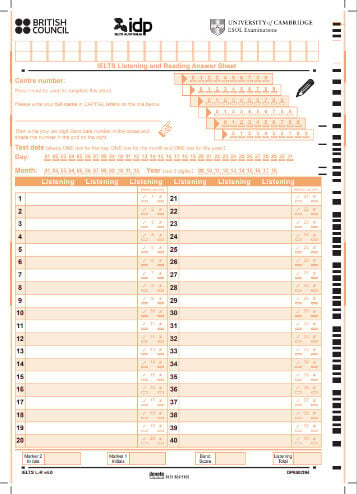
การคำนวณคะแนน IELTS Listening
ในพาร์ทการฟัง แต่ละคำถามมีค่า 1 คะแนน ดังนั้นคุณสามารถได้คะแนน "ดิบ" สูงสุด 40 คะแนน จากนั้น คะแนนดิบของคุณจะถูกแปลงเป็นคะแนน Band จำไว้! คุณจะไม่เสียคะแนนสำหรับคำตอบที่ผิด ตารางด้านล่างสามารถให้คุณรู้แนวคิดทั่วไปเกี่ยวกับวิธีที่คะแนนดิบถูกแปลงเป็นคะแนน Band
| คะแนนดิบ | คะแนน Band |
|---|---|
| 39-40 | 9 |
| 37-38 | 8.5 |
| 35-36 | 8 |
| 32-34 | 7.5 |
| 30-31 | 7 |
| 26-29 | 6.5 |
| 23-25 | 6 |
| 18-22 | 5.5 |
| 16-17 | 5 |
| 13-15 | 4.5 |
| 11-12 | 4 |
เนื่องจากแต่ละเวอร์ชันของ IELTS แตกต่างกันเล็กน้อย คะแนนดิบที่ต้องการ เพื่อให้ได้คะแนน Band ที่กำหนดจะแตกต่างกันขึ้นอยู่กับวิธีที่ทุกคนที่สอบในวันนั้นทำได้ ดังนั้น จำนวนคำตอบที่ถูกต้องที่ต้องการเพื่อให้ได้คะแนน Band จะแตกต่างกันเล็กน้อยจากการสอบหนึ่งไปยังอีกการสอบหนึ่ง แต่โดยทั่วไปคุณควรตั้งเป้าให้ได้ประมาณ 30 จาก 40 หากคุณต้องการได้คะแนน Band 7
ดังที่ได้กล่าวไว้ข้างต้น ส่วนต่าง ๆ จะยากขึ้นเรื่อย ๆ เมื่อคุณดำเนินไปในการสอบ IELTS Listening อย่างไรก็ตาม ทุกคำถามมีค่าคะแนนเท่ากัน ดังนั้น ให้แน่ใจว่าคุณไม่เสียคะแนนง่าย ๆ เพราะคุณติดอยู่กับคำถามยาก
ดาวน์โหลด PDF ตัวอย่าง IELTS Listening ฟรีพร้อมเฉลย
นี่คือตัวอย่าง IELTS Listening ฟรีบางส่วนในรูปแบบ PDF พร้อมเฉลยจาก British Council (ผู้สร้างการสอบ IELTS) ใต้ลิงก์ คุณยังสามารถทำแบบทดสอบ IELTS Listening พร้อมไฟล์เสียงและเฉลยฟรีจาก BestMyTest ได้ด้วย แบบทดสอบมีครบทั้งสี่พาร์ท และแต่ละพาร์ทจะแสดงสคริปต์เสียงพร้อมเฉลย พยายามตอบคำถามและดูว่าคุณทำได้อย่างไร!
- IELTS Listening Practice Test 1- คำถาม (ตัวอย่างออนไลน์)
- IELTS Listening Practice Test 1- คำตอบ (PDF)
- IELTS Listening Practice Test 1- กระดาษคำตอบ (PDF)
ฟังไฟล์เสียงและตอบคำถาม 1-10 เฉลยและสคริปต์เสียงอยู่ในกล่องด้านล่างคำถาม
Questions 1-10
Complete the notes below.
Write ONE WORD AND/OR A NUMBER for each answer.
This can provide the carer with:
• time for other duties
• a 1
Assessment of aunt's needs
This may involve discussing:
• how much 2 is spent caring
Daily tasks discussed:
• help with dressing
• helping her take a 3
• shopping
• helping with meals
• managing 4
• any parts of caring that are particularly hard, e.g.
• loss of 5
• 6 her
• avoiding a 7
Types of support that may be provided for carers
• transport costs, e.g. cost of a 8
• vehicle-related costs, e.g. fuel and 9
• help with housework
• support to lower 10
-
spellcheck เฉลย
1. Break
Break is correct because this detail is stated in the recording at the point where the question is answered.2. Time
Time is correct because this detail is stated in the recording at the point where the question is answered.3. Shower
Shower is correct because this detail is stated in the recording at the point where the question is answered.4. Money
Money is correct because this detail is stated in the recording at the point where the question is answered.5. Memory
Memory is correct because this detail is stated in the recording at the point where the question is answered.6. Lifting
Lifting is correct because this detail is stated in the recording at the point where the question is answered.7. Fall
Fall is correct because this detail is stated in the recording at the point where the question is answered.8. Minicab
Minicab is correct because this detail is stated in the recording at the point where the question is answered.9. Parking
Parking is correct because this detail is stated in the recording at the point where the question is answered.10. Anxiety
Anxiety is correct because this detail is stated in the recording at the point where the question is answered.
Audio ScriptNora: It's really good to see you, Marcus. Since I had to give up work, I feel I'm losing touch with my friends and colleagues.
Marcus: We really miss you in the office. We were all so sorry you had to leave. But you must be relieved to have more time to look after your aunt. How is she?
Nora: Well, she's very cheerful, but she needs a lot of help.
Marcus: Have you tried to get any support from the local council?
Nora: No. I didn't know I could.
Marcus: Yes. But for different kinds of practical support, they realise that carers sometimes need time for all the other responsibilities they have, apart from the person they're caring for, and also that they sometimes need a break.
Nora: Absolutely. OK, so tell me more, how do I go about getting this support?
Marcus: Well, you'd have to have an assessment of your aunt's needs. That means someone would come round and talk to you about the situation and what you need. So for a start, they'd want to know the amount of time you spend looking after your aunt every day.
Nora: OK.
Marcus: Then they'll probably ask you what sorts of tasks you do for your aunt during the day. Things like if she needs help with getting dressed, for example.
Nora: Right. I help her with that. And also I help her get into the shower in the morning.
Marcus: Yes. That sort of thing. They'll probably ask you if you do the shopping for her, and help her at meal times, and whether she can cope using money.
Nora: Yes. That's becoming a bit of a problem. She used to be very good at it, but not anymore.
Before you hear the rest of the conversation, you have some time to look at questions 5 to 10. [20 seconds] Now listen, and answer questions 5 to 10.Marcus: And be ready to tell them about anything you find particularly difficult about caring for your aunt.
Nora: So recently I've noticed she started to have quite bad problems with her memory. If I wasn't there, I think she'd forget to eat, for example. And often she doesn't seem quite sure what day it is.
Marcus: Yes. Tell them about that. And are there any physical difficulties you have caring for her? Lifting her, for example.
Nora: Yes. She's quite heavy, and I'm afraid of hurting my back. I'd be in real trouble if that happened.
Marcus: They can give you advice about that, and also about how to avoid the possibility of your aunt having a fall.
Nora: Great. So, once they've done this assessment, if I'm eligible, what happens next?
Marcus: Well, they might support you financially. So they might help you with travel costs, like if you have to get a minicab to take your aunt for an appointment, for example.
Nora: I usually drive her myself, actually. So could I claim for the petrol?
Marcus: You could. And you can claim for the parking, too.
Nora: Oh, right.
Marcus: And if you need help with the housework, they can arrange for someone to come along once or twice a week. And one other thing. I hope you don't mind me saying this, but it's important you look after yourself. And it seems to me you're dealing with quite a bit of anxiety.
Nora: I am, yes.
Marcus: Well, tell the council, because they may be able to give you some advice on how to minimise it.
Nora: Really? Though, actually, I feel so much better having talked to you. I'll get in touch with the council straight away. Now, shall we go for coffee, or something?
ฟังไฟล์เสียงและตอบคำถาม 11-20 เฉลยและสคริปต์เสียงอยู่ในกล่องด้านล่างคำถาม
Questions 11-14
Choose the correct letter, A, B or C.
11. Who began turning the unused Whitfield site into a planted space?
- city council officials.
- nearby residents.
- a gardening charity.
12. What was Lillian Hartley trying to achieve through public campaigning?
- preventing a housing sale
- blocking army exercises
- winning maintenance funding
13. Why was the park rejected as a place for troop exercises?
- council permission was refused.
- too little usable space.
- a better site was chosen.
14. How does the speaker describe the latest redesign plans?
- 2013 plan used unchanged.
- 2013 plan revised pre-work.
- 2015 plan finished in 2016.
Questions 15-20
Label the plan of Whitfield Park below.
Write the correct letter, A-I, next to questions 15-20.
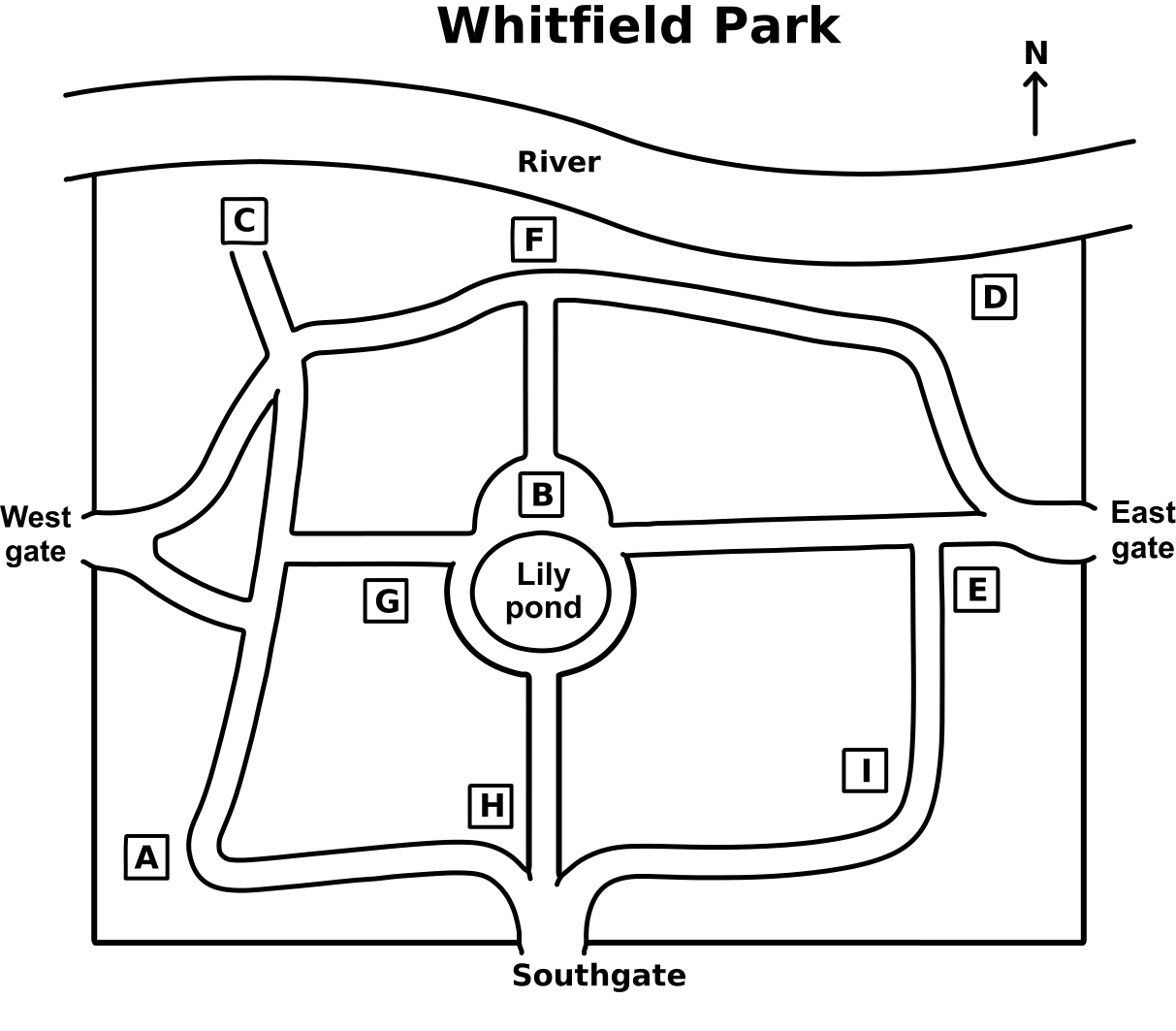
- statue of Lillian Hartley
- wooden sculptures
- playground
- maze
- tennis courts
- fitness area
-
spellcheck เฉลย
11. B
(A) is incorrect. The council took ownership later.(B) is correct. The initial planting was done by residents from nearby streets.
(C) is incorrect. The recording does not support this option: a gardening charity.
12. A
(A) is correct. Hartley organised public pressure so the council would keep the land as a park rather than sell it for housing.(B) is incorrect. The recording does not support this option: blocking army exercises.
(C) is incorrect. The recording does not support this option: winning maintenance funding.
13. B
(A) is incorrect. The recording does not support this option: council permission was refused.(B) is correct. , after inspection, the army concluded that the park was too small for practical use.
(C) is incorrect. The recording does not support this option: a better site was chosen.
14. B
(A) is incorrect. The recording does not support this option: 2013 plan used unchanged.(B) is correct. The plans dated from 2013 but were revised in 2015 before work began.
(C) is incorrect. The recording does not support this option: 2015 plan finished in 2016.
15. B
The correct answer is B because the statue of Lillian Hartley is now immediately north of the lily pond near the centre of the park, and that position is labelled B.16. D
The correct answer is D because the wooden sculptures are on the riverbank where the path from the East Gate makes a sharp bend, which corresponds to D.17. F
The correct answer is F because the playground is between the river and the path from the lily pond to the river, and that location is marked F.18. C
The correct answer is C because the maze is found by entering from the West Gate, walking north, and turning left, which places it at C.19. A
The correct answer is A because the tennis courts remain in the southern corner where the perimeter path makes a right-angled bend, labelled A.20. G
The correct answer is G because the fitness area is beside the lily pond on the same side as the West Gate, matching G on the plan.
Audio ScriptI'm delighted this evening to introduce our guest speaker, Sarah Holloway, who is going to talk to us about the recent transformation of Whitfield Park. Over to you, Sarah. Thank you very much. I'm sure you all know Whitfield Park well, it has been one of the city's landmarks for well over a century, and the city council has been responsible for it for most of that time. What perhaps fewer of you will know is how the park actually began.
Unlike many city centre parks, which started life as the private gardens of a large house, Whitfield was originally just an unused patch of waste ground. The first flowers there were actually planted by a small group of local residents who lived in the surrounding streets. They began work on the site in 1892. At that point nobody was entirely sure who legally owned the land, and it was a full twenty years later before the city council finally took it into public ownership. Some of you will have seen the statue near one of the gates. That figure is Lillian Hartley, who played a really important role in the early history of the park.
Once the council legally owned the land, its first instinct was to sell it off as building plots for housing. A great many local residents, however, wanted the park to stay open as a place where everyone could enjoy fresh air and green space, bear in mind that this is a very densely built up residential district. Lillian Hartley was at the heart of that campaign, and it was she who organised the petitions and the public demonstrations which, in the end, persuaded the council to drop the sale and keep the land as a park.
Soon afterwards, in 1914, the First World War broke out, and most of the park was dug up and used to grow vegetables, which were sold to local residents. At one point the army did look into taking over the park as a site for troop exercises. They actually wrote to the city council about it, but when they inspected it they concluded that the park was simply too small to be of any practical use to them, so the idea was dropped. The only military activity in the park during the war was the occasional public meeting held on a small area of grass that had been kept clear of vegetable plots.
After the war, the park was largely returned to the way it had been before 1914, and from then on it remained almost unchanged for decades. New plans for transforming the park were drawn up several times over the years; the most recent version dates from 2013, but those plans were then revised in 2015, well before any actual work had got under way. Work on the ground finally began in 2016 and was completed, on schedule, last year.
Before you hear the rest of the talk, you have some time to look at questions 15 to 20. [20 seconds] Now listen and answer questions 15 to 20.All right, I'd like to describe some of the more important changes that have been made, and one or two things that have deliberately been left as they were. If you take a quick look at the map you've been handed, you'll see the familiar outline of Whitfield Park. The river forms the northern boundary, and there is a gate in each of the three other walls.
From there, follow the path up towards the river and the enlarged children's playground sits between that path and the river itself. If you keep your eye on the riverbank, over towards the East Gate side, the new wooden sculptures are at the point where the path coming up from that gate makes a sharp bend.
Back near the West Gate side of the park, there is a maze, a circular pattern of paths separated by low hedges. Head in from the West Gate, walk north towards the river, and then turn left to find it. Close to the same central lily pond, on the side facing the West Gate, you'll also find the new outdoor fitness area.
Down in the southern corner, where the perimeter path makes that distinct right angled bend, the tennis courts are still in their familiar position, though we have now doubled them from four to eight. Now, since you are all keen gardeners, I'm sure you'll want to hear about the plants that have been chosen for the new beds.
ฟังไฟล์เสียงและตอบคำถาม 21-30 เฉลยและสคริปต์เสียงอยู่ในกล่องด้านล่างคำถาม
Questions 21-25
Choose the correct letter, A, B or C.
21. Nina and Owen were surprised to learn that coastal cities
- are home to just under half of all people.
- account for many of the largest cities.
- are expanding at double the rate of inland cities.
22. According to Owen, building coastal cities near to rivers
- can carry contamination back towards urban areas.
- can leave too little land for farming upstream.
- can cause factories to damage rural scenery.
23. What mistake was made when building water drainage channels in Port Selby in the 1950s?
- The system did not include enough channels.
- The builders selected the wrong construction materials.
- The design failed to anticipate rising sea levels.
24. What do Nina and Owen think that the authorities in Port Selby should do immediately?
- take measures to restore coastal ecosystems
- pay for a new flood prevention system
- stop disposing of waste materials into the ocean
25. What do they agree should be the priority for international action?
- greater coordination of activities
- more sharing of information
- agreement on shared policies
Questions 26-30
What decision do the students make about each of the following parts of their presentation?
Write the correct letter, A-G, next to questions 26-30.
- use visuals
- keep it short
- involve other students
- check the information is accurate
- provide a handout
- focus on one example
- do online research
- Historical background
- Geographical factors
- Past mistakes
- Future risks
- International implications
-
spellcheck เฉลย
21. B
(A) is incorrect. The recording does not support this option: are home to just under half of all people.(B) is correct. Nina says most of the biggest cities are built by the sea.
(C) is incorrect. The recording does not support this option: are expanding at double the rate of inland cities.
22. A
(A) is correct. Owen says pollutants from inland agriculture and industry travel down rivers to cities.(B) is incorrect. The recording does not support this option: can leave too little land for farming upstream.
(C) is incorrect. The recording does not support this option: can cause factories to damage rural scenery.
23. C
(A) is incorrect. The recording does not support this option: The system did not include enough channels.(B) is incorrect. The recording does not support this option: The builders selected the wrong construction materials.
(C) is correct. Port Selby's drainage channels were built without allowing for global warming and rising sea levels.
24. B
(A) is incorrect. The recording does not support this option: take measures to restore coastal ecosystems.(B) is correct. Nina says they need money to replace the drainage channels for flood protection now.
(C) is incorrect. The recording does not support this option: stop disposing of waste materials into the ocean.
25. A
(A) is correct. They say coastal cities must act together internationally.(B) is incorrect. The recording does not support this option: more sharing of information.
(C) is incorrect. The recording does not support this option: agreement on shared policies.
26. B
B is correct because they decide not to spend too long on historical background, so they will keep it short.27. A
A is correct because they decide to use slides with maps showing geographical factors.28. F
F is correct because they choose the Meriton case study as the basis for past mistakes, focusing on one example.29. G
G is correct because they need to look at websites for future risks, so online research is required.30. C
C is correct because they plan to ask audience members from different places, involving other students.
Audio ScriptTutor: OK, so what I'd like you to do now is to talk to your partner about your presentations on environmental planning. You should have done most of the reading now, so I'd like you to share your ideas and talk about the structure of your presentation and what you need to do next.
Nina: OK, Owen, I'm glad we chose quite a specific topic: coastal cities. It made it much easier to find relevant information.
Owen: Yeah, and cities are growing so quickly. I mean, we know that more than half the world's population lives in cities now.
Nina: Yeah, though that's all cities, not just coastal ones. But most of the biggest cities are actually built by the sea. I'd not realised that before.
Owen: Nor me. And what's more, a lot of them are built at places where rivers come out into the sea. But apparently this can be a problem.
Nina: Why?
Owen: Well, as the city expands, agriculture and industry tend to spread further inland along the rivers. And so agriculture moves even further inland up the river. That's not necessarily a problem, except it means more and more pollutants are discharged into the rivers.
Nina: That's a serious problem.
Owen: Right.
Nina: Did you read that article about Port Selby on the south coast?
Owen: No.
Nina: Well, apparently back in the 1950s, they built channels to drain away the water in case of flooding.
Owen: Sounds sensible.
Nina: Yeah, they spent quite a lot of money on them. But what they didn't take into account was global warming. So they built the drainage channels too close to sea level. And now sea levels are rising, they're more or less useless. If there's a lot of rain, the water can't run away. There's nowhere for it to go.
Owen: So they did not help much in the end.
Nina: So what are the authorities doing about it now?
Owen: I don't know. I did read that they're aiming to stop disposing of waste water into the ocean over the next 10 years. But that won't help with flood prevention now, will it?
Nina: No, really, they just need to find the money for something to replace the drainage channels in order to protect against flooding now. But in the long term, they need to consider the whole ecosystem.
Owen: Right.
Nina: Really though, coastal cities can't deal with their problems on their own, can they? I mean, they've got to start acting together at an international level instead of just doing their own thing.
Owen: Absolutely. The thing is, everyone knows what the problems are and environmental planners have a pretty good idea of what we should be doing about them. So they should be able to work together to some extent.
Nina: But it's going to be a long time before countries come to a decision on what principles they're prepared to abide by.
Owen: Yeah, if they ever do.
Before you hear the rest of the conversation, you have some time to look at questions 26 to 30. [20 seconds] Now listen and answer questions 26 to 30.Nina: So I think we've probably got enough for our presentation. It's only 15 minutes.
Owen: OK, so I suppose we'll begin with some general historical background about why coastal cities were established. But we don't want to spend too long on that. The other students will already know a bit about it.
Nina: It's all to do with communications and so on.
Owen: Yes, we should mention some geographical factors, things like wetlands and river estuaries and coastal erosion and so on.
Nina: We could have some maps of different cities with these features marked.
Owen: On a handout, you mean, or some slides everyone can see.
Nina: Yeah, that'd be better.
Owen: It'd be good to go into past mistakes in a bit more detail. Did you read that case study of the problems there were in Meriton with flooding a few years ago?
Nina: Yes, we could use that as the basis for that part of the talk. I don't think the other students will have read it, but they'll remember hearing about the flooding at the time.
Owen: Hmm, OK. So that's probably enough background. So then we'll go on to talk about what actions have been taken to deal with the problems of coastal cities.
Nina: OK, what else do we need to talk about? Maybe something on future risks looking more at the long term if populations continue to grow?
Owen: Yeah, we'll need to do a bit of work there. I haven't got much information, have you?
Nina: No, we'll need to look at some websites. Shouldn't take too long.
Owen: OK. And I think we should end by talking about international implications. Maybe we could ask people in the audience. We've got people from quite a lot of different places.
Nina: That'd be interesting if we have time, yes. So now should we go on?
ฟังไฟล์เสียงและตอบคำถาม 31-40 เฉลยและสคริปต์เสียงอยู่ในกล่องด้านล่างคำถาม
Questions 31-36
What point does the lecturer make about each item?
Write the correct letter, A-K, next to questions 31-36.
- changes drainage
- protects animals
- increases nutrients
- kills germs
- affects many species
- creates dense shade
- alters the soil
- supports farming
- reduces competition
- attracts bell-miners
- helps recovery
- Eucalyptus woodland
- Damage to eucalyptus woodland
- Oil from eucalyptus leaves
- Lime used in construction
- Direct iron supply
- Moderate bushfires
Questions 37-40
Complete the notes below.
Write ONE WORD ONLY for each answer.
Bell-miner associated dieback:
• The process starts with insects feeding on eucalyptus 37
• A sweet liquid containing 38 attracts bell-miners
Fire patterns:
• If fires happen too often, 39 becomes the main vegetation
• When fires are almost absent, thick growth gives bell-miners protected 40 sites
-
spellcheck เฉลย
31. B
B is correct because eucalyptus woodland provides nesting places and shelter for birds, bats and small mammals.32. E
E is correct because damage to eucalyptus woodland affects a wider community of species, not only the trees themselves.33. D
D is correct because oil from eucalyptus leaves is used in disinfectant, where it can kill certain germs.34. G
G is correct because lime from road construction was washed into the soil and interfered with tree roots.35. K
K is correct because affected trees recovered surprisingly quickly when iron was supplied directly.36. I
I is correct because occasional fire removes fast-growing competitors that would otherwise use water needed by eucalyptus trees.37. leaves
The correct answer is leaves. The lecturer says the process begins when insects settle on eucalyptus leaves and feed on them.38. sugar
The correct answer is sugar. The lecturer says the insects produce a sweet liquid containing sugar, which attracts bell-miners.39. grass
The correct answer is grass. The lecturer says grass tends to dominate afterwards if fires occur too often.40. nesting
The correct answer is nesting. The lecturer says dense growth creates protected nesting sites for bell-miners when fire is suppressed.
Audio ScriptGood morning. Today I want to focus on the eucalyptus tree, one of the best known features of the Australian landscape. Many people call it a gum tree, but the name eucalyptus actually covers hundreds of related species, from small scrubby trees to very tall forest giants.
Now, eucalyptus trees are important in several ways. Ecologically, they provide nesting places and shelter for birds, bats and small mammals. Their flowers also produce nectar, which is an important food source for insects and birds. So when eucalyptus woodland is damaged, the effect is felt across a much wider community of species.
As for their value to people, the trees are also useful. Oil from eucalyptus leaves has long been used in cleaning products, and one common use is in disinfectant, because the oil can kill certain germs. Eucalyptus timber is also used in building and fencing, although that is not really the main focus of today's lecture.
So, these trees can live for centuries, and some individuals survive for four hundred years or more. That is why researchers became concerned when large numbers began dying much earlier than expected in different parts of Australia.
Now, one disease that attracted attention was Mundulla Yellows. The leaves of affected trees slowly turned yellow and then, over time, the whole tree declined. For years the cause was unclear. Eventually, researchers discovered that lime, or calcium hydroxide, had been used in road construction nearby. Rain washed the lime into the surrounding soil, where it interfered with the roots of eucalyptus trees. The trees were still surrounded by nutrients, but they could no longer absorb the iron they needed for healthy growth. When iron was supplied directly to affected trees, they recovered surprisingly quickly.
However, Mundulla Yellows affected only a limited number of places. A much wider problem on the east coast was Bell miner associated dieback. Now, bell miners are small native birds, but they are not the direct cause of the damage. The process begins when insects settle on eucalyptus leaves and feed on them. While feeding, these insects produce a sweet liquid containing sugar. Bell miners are attracted to that liquid, and they aggressively chase away other birds and insects that might otherwise reduce the insect population. As a result, the insects multiply, the leaves are badly damaged, and the trees gradually lose their ability to survive.
But some scientists think fire history is also part of the explanation. An influential theory, first proposed by the ecologist William Jackson, links the type of vegetation in a region to the frequency of bushfires. If fires occur too often, grass tends to dominate the area afterwards. If fires occur at moderate intervals, eucalyptus forest is more likely to persist. This is because occasional fire removes fast growing competitors which would otherwise take up the water eucalyptus trees need. And it also helps maintain the soil by preventing dense undergrowth from changing the soil structure and removing nutrients.
At the other extreme, if fires are almost completely suppressed, a different ecosystem can develop. Scientists sometimes call this dry rainforest. Now, the name sounds contradictory, because we usually associate rainforest with wet tropical conditions. But in this case it means a dense, shaded vegetation system with relatively few species. It can create excellent conditions for bell miners, because the thick growth gives them protected nesting sites while excluding many of the species that would normally compete with them.
What this tells us is that before European settlement, Aboriginal communities used controlled burning over long periods, and this probably created a more balanced pattern of vegetation. Since European settlement, fire has often been suppressed, roads and farms have altered drainage, and some local ecosystems have shifted away from eucalyptus woodland. The decline of eucalyptus trees, then, is not caused by one single factor. It is the result of disease, insects, birds, soil chemistry and fire management interacting with one another.

Completion - Part 1
Learn how to answer these questions in a step-by-step interactive exercise
Completion - Part 1
ช่องว่างอาจถามเวลาหรือความถี่ ผู้พูดมักพูดถึงช่วงเวลาเดียวกันด้วยคำอื่น ดังนั้นให้จับคู่ความหมายกับช่องว่าง แทนการรอฟังคำที่ตรงกับบนหน้ากระดาษ
จากนั้นตรวจจำนวนคำที่กำหนดก่อนส่ง อ่านทวนทั้งบรรทัดโดยใส่คำตอบของคุณในช่องว่าง แล้วตัดคำที่บรรทัดนั้นมีอยู่แล้วออก คำตอบที่ความหมายถูกแต่ยาวเกินจะไม่ได้คะแนนเลย
คลิก เล่น เพื่อฟังเสียง
โน้ตใช้คำกริยาธรรมดาอย่าง must provide หรือ need to bring ผู้พูดแทบไม่พูดคำกริยานั้นตรงๆ แต่ใช้คำพ้องความหมายหรืออธิบายการกระทำแทน ดังนั้นให้ฟังว่าอะไรคือสิ่งที่ต้องมีจริงๆ
ผู้พูดมักพูดถึงสิ่งของอื่นๆ ก่อน แล้วค่อยตัดออก หากคุณพลาดช่องว่างใด ให้ข้ามไปช่องถัดไป เพราะคำตอบเรียงตามลำดับของเสียงบันทึก และการติดอยู่กับช่องที่พลาดไปอาจทำให้คุณเสียช่องถัดๆ ไปด้วย
คลิก เล่น เพื่อฟังเสียง
คุณตอบคำถามตัวอย่าง IELTS Listening ด้านบนได้อย่างไร? คุณพบว่าคำถามใดยากบ้างหรือไม่? หากใช่ คุณอาจได้ประโยชน์จากการดู 6 ประเภทของคำถาม IELTS Listening อย่างใกล้ชิด ยิ่งคุณเข้าใจประเภทคำถามมากเท่าใด คุณจะต้องใช้ความพยายามน้อยลงในการหา สิ่งที่คุณต้องทำ และมีเวลามากขึ้นในการหาคำตอบ
6 ประเภทของคำถาม IELTS Listening
มีคำถามในการสอบ IELTS Listening 6 ประเภทที่แตกต่างกัน สำคัญที่คุณต้องฝึกแต่ละประเภทของคำถามเพื่อเรียนรู้วิธีที่ดีที่สุดในการจัดการกับแต่ละข้อสำหรับคะแนน IELTS Listening สูง
โจทย์การฟังประเภทใดที่ผู้เรียนของเรารู้สึกว่ายากที่สุด
นี่คือสิ่งที่คำตอบ IELTS Listening จำนวน 2.22 ล้านคำตอบจากผู้เรียน BestMyTest แสดงให้เห็น ตารางด้านล่างแสดงเปอร์เซ็นต์ที่ผู้เรียนของเราตอบโจทย์แต่ละประเภทได้ถูกต้อง คุณจึงเห็นได้ทันทีว่าคะแนนหายไปตรงไหน
| ประเภทโจทย์ | ตอบถูก |
|---|---|
| Note completion | 33% |
| Table completion | 34% |
| Sentence completion | 45% |
| Short answer | 48% |
| Multiple choice | 50% |
| Multiple selection | 52% |
| Plan, map, diagram labelling | 55% |
| Form completion | 73% |
| Matching | 85% |
- โจทย์เติมคำคือจุดที่ผู้เรียนเสียคะแนน ในโจทย์เติมคำ Note completion มีอัตราการตอบถูก 33% ขณะที่ Form completion ซึ่งใช้ทักษะเดียวกันแต่มีรูปแบบต่างกัน มีอัตราการตอบถูกถึง 73% โจทย์เติมคำทุกแบบให้คุณเขียนคำที่ได้ยิน ดังนั้นการสะกดคำ รูปคำ และจำนวนคำที่กำหนดจึงมีผลทั้งหมด และทั้งหมดนี้เป็นสิ่งที่คุณฝึกได้
- จากแบบทดสอบฝึกฟังเต็มชุด 61,104 ครั้ง ที่ทำโดยผู้เรียน 54,523 คน คะแนนแบนด์เฉลี่ยอยู่ที่ 5.6 โดย 41% ของการทำแบบทดสอบได้ถึงแบนด์ 6.0 และ 12% ได้ถึงแบนด์ 7.0
- เมื่อดูแต่ละส่วนของแบบทดสอบการฟัง 31% ของการทำแบบทดสอบได้คะแนน 40% หรือต่ำกว่า และ 30% ได้คะแนน 80% หรือสูงกว่า ส่วนที่ 3 และ 4 เป็นส่วนเชิงวิชาการของข้อสอบ ดังนั้นให้ฝึกสองส่วนนี้แยกต่างหาก นอกเหนือจากการฝึกในแบบทดสอบเต็มชุด
แม้ว่าประเภทคำถามการฟังแต่ละประเภทจะดูแตกต่างกัน แต่แนวทางพื้นฐานสำหรับแต่ละข้อก็เหมือนกัน ในตอนหลังของโพสต์นี้ เราจะแสดงกลยุทธ์พื้นฐานในการจัดการกับ 6 ประเภทของคำถามทั้งหมด แต่ละประเภทมีตัวอย่างเสียงและคำตอบในคู่มือประเภทคำถาม IELTS Listening
3 ขั้นตอนสำหรับการเตรียมตัวสอบ IELTS Listening ออนไลน์อย่างมีประสิทธิภาพ
แม้ว่าแต่ละประเภทของคำถาม (งาน) IELTS Listening จะแตกต่างกัน แต่แนวทางพื้นฐานสำหรับแต่ละข้อก็เหมือนกัน คุณสามารถจัดการกับประเภทของงานทั้งหมดได้โดยใช้กลยุทธ์ง่าย ๆ ทีละขั้นตอน นี่คือสามขั้นตอนที่เราแนะนำให้คุณใช้เพื่อเข้าหาประเภทคำถาม Listening:
- ตรวจสอบคำถามอย่างใกล้ชิดเพื่อหาข้อมูลสำคัญ
- คาดการณ์คำตอบที่เป็นไปได้ก่อนฟัง
- ติดตามเพื่อจับคู่คำถามกับเนื้อหาขณะที่พวกเขาฟัง
ขั้นตอนที่ 1: ตรวจสอบคำถาม
ในพาร์ท IELTS Listening คุณจะได้รับเวลาเตรียมตัวสั้น ๆ (30-40 วินาที) ก่อนที่การบันทึกจะเริ่มต้น นี่เป็นโอกาสของคุณที่จะดูคำถามที่คุณจะต้องตอบ ซึ่งเป็นสิ่งที่ขั้นตอนแรกในกลยุทธ์นี้พูดถึง แทนที่จะใช้เวลานี้เพื่อพักผ่อน หรือตรวจสอบคำตอบของคุณ คุณ จะมุ่งเน้นไปที่การเรียนรู้เกี่ยวกับคำถามที่กำลังจะมาให้มากที่สุดเท่าที่จะเป็นไปได้ การทำขั้นตอนนี้สำคัญเพื่อหลีกเลี่ยงข้อผิดพลาดในการทำหลายอย่างพร้อมกันในขณะที่ ฟังผู้พูดและพยายามอ่านคำถามเป็นครั้งแรก
เมื่อเวลาเตรียมตัวของคุณเริ่ม ขั้นแรกใช้เวลานี้ให้ดีที่สุดโดยตรวจสอบ คำถามเพื่อค้นหาเพิ่มเติมเกี่ยวกับพวกเขา นี่คือข้อมูลบางอย่างที่คุณควรมองหาเมื่อตรวจสอบคำถาม IELTS Listening แต่ละข้อ:
- คำถามนี้เป็นประเภทอะไร?
- คำตอบจะมีลักษณะอย่างไร? (ตัวอย่าง: วันที่ ตัวเลข ชื่อ)
- วลีและคำที่สำคัญที่สุด หรือ คำสำคัญ ในคำถามคืออะไร?
ตัวอย่างหนึ่งอาจเป็นประเภทคำถาม Note Completion เช่นนี้:
Complete the notes below.
Write NO MORE THAN THREE WORDS for each answer.
ขั้นแรก คุณสามารถขีดเส้นใต้คำสำคัญบางคำในคำถาม
Two reasons for the new approach to pricing are changes in (27) ______ and (28) _________ programs.
ในตัวอย่างนี้ การฟังหาวลีสำคัญ "two reasons" ที่คุณได้ขีดเส้นใต้แล้วช่วยให้คุณ
เริ่มให้ความสนใจอย่างใกล้ชิดในขณะที่ถูกต้อง นี่คือส่วนของสคริปต์เสียงที่เปิดเผยคำตอบ:
Mark: Well, there seem to be two basic reasons. Firstly, because the law has changed recently to allow companies to behave like this. In the past, they weren't allowed to change the prices of the tickets. And secondly, we now have computer programs that do the calculations so that prices can be changed very quickly and accurately.
หลังจากที่ตรวจสอบคำถามแล้ว คุณจะรู้ว่า "the law" และ "computer" เป็นคำตอบที่ถูกต้องที่นี่ตามคำสำคัญบางคำและการรู้ประเภทของคำถาม
ขั้นตอนที่ 2: คาดการณ์คำตอบที่เป็นไปได้
ขั้นตอนที่สองในกลยุทธ์นี้เพื่อให้ประสบความสำเร็จในพาร์ท IELTS Listening เกี่ยวข้องอย่างใกล้ชิดกับขั้นตอนแรก ที่จริง คุณควรพยายาม ทำขั้นตอนทั้งสองนี้ภายในเวลาเตรียมตัว 20 วินาทีเดียวกัน ก่อนที่การบันทึกจะเริ่มต้น แม้ว่านี่อาจดูเหมือนเป็นงานที่ยากในเวลาสั้นเช่นนี้ แต่จำไว้ว่าขั้นตอนเหล่านี้เชื่อมโยงกันอย่างแท้จริง
เพื่อคาดการณ์คำตอบที่เป็นไปได้ของคำถาม Listening คุณจะต้องทำขั้นตอนที่หนึ่งให้เสร็จก่อนโดยการตรวจสอบคำถามอย่างใกล้ชิด ในขั้นตอนนี้ คุณควรรู้ว่าคุณกำลังดูคำถามประเภทใด คำตอบที่เป็นไปได้จะมีลักษณะอย่างไร และคำสำคัญใดจะช่วยในการค้นหาคำตอบอย่างรวดเร็ว เพื่อคาดการณ์คำตอบ คุณจะรวมข้อมูลทั้งหมดนี้และคาดเดาเกี่ยวกับประเภทของคำตอบที่คุณคาดว่าจะได้ยิน
มาดูคำถามตัวอย่าง Note Completion เดียวกันจากด้านบนอีกครั้ง
Two reasons for the new approach to pricing are changes in (27) and (28) programs.
เพียงดูที่ไวยากรณ์ของประโยคนี้ทำให้คุณระบุได้ว่าคำตอบจะเป็นส่วนของคำพูดอะไร ในกรณีนี้ คำบุพบท "in" นำหน้าคำตอบที่เป็นไปได้ทั้งสองข้อ ตามไวยากรณ์ มีเพียงคำนามหรือวลีนามเท่านั้นที่สามารถใช้ในวลีบุพบทเช่นนี้ได้ ไม่เพียงคุณสามารถคาดการณ์ได้อย่างถูกต้องว่าคำตอบจะเป็นคำนามหรือวลีนาม แต่ยังเป็นไปได้ที่จะคาดการณ์ว่าคำตอบอาจเป็นสิ่งที่เกี่ยวข้องกับนโยบายหรือรัฐบาล (law) และคำที่สามารถปรากฏกับ programs (computer) ตามบริบท
แม้ว่าจะเป็นไปไม่ได้ที่จะคาดเดาคำตอบที่ถูกต้องอย่างแม่นยำจากการคาดการณ์เพียงอย่างเดียว แต่โดยการพยายามจินตนาการว่าคำตอบอาจเป็นอย่างไร คุณมีแนวโน้มที่จะฟังข้อมูลที่เกี่ยวข้องในขณะที่ละเลยข้อมูลที่ไม่เกี่ยวข้อง การคาดการณ์คำตอบที่เป็นไปได้ก่อนที่การบันทึกจะเริ่มจะเตรียมหูของคุณ ทำให้คุณก้าวเข้าใกล้คำตอบที่ถูกต้องอีกขั้นหนึ่ง
ตอนนี้ ลองรวม ขั้นตอนที่ 1 (ตรวจสอบคำถาม) และ ขั้นตอนที่ 2 (คาดการณ์คำตอบที่เป็นไปได้) ในคำถามตัวอย่าง multiple choice ที่ยากขึ้น
Choose the correct letter, A, B, C or D.
- are for weekend shows
- are booked well in advance
- are non-refundable
- are booked for groups
แม้ว่าจะไม่มีทางรู้คำตอบสำหรับคำถามเหล่านี้แน่นอน แต่คุณยังคงสามารถใช้ข้อมูลที่พบในคำถามเหล่านี้เพื่อคาดการณ์ คำตอบที่เป็นไปได้และเน้นการฟังของคุณ ตัวอย่างเช่น คำถาม 24 เกี่ยวข้องกับ เหตุผลว่าทำไมราคาตั๋วโรงละครจะต่ำที่สุด ดังนั้นคุณจะต้องฟังเหตุผลเหล่านั้นที่กล่าวถึงอย่างใกล้ชิด โปรดจำไว้ว่ามีความเป็นไปได้ที่จะมีการกล่าวถึงมากกว่าหนึ่ง ดูที่สคริปต์ด้านล่างเพื่อดูว่าการคาดการณ์สามารถช่วยคุณตัดคำตอบที่ผิดได้อย่างไร
สังเกตว่าคำตอบที่เป็นไปได้สามข้อถูกกล่าวถึง "booked for groups", "are for weekend shows" และ "are non-refundable" อย่างไรก็ตาม คำตอบที่ถูกต้องคือ C "are non-refundable" เพราะมันถูกกล่าวถึงว่าถูกกว่าแยกต่างหากจากอีกสองข้อ ซึ่งเพียงแค่ถูกระบุไว้ด้วยกัน
ขั้นตอนที่ 3: ติดตาม
เมื่อการบันทึกเริ่มต้นและพาร์ทการฟังจริง ๆ ของการสอบเริ่มต้น คุณควรติดตามเพื่อทำขั้นตอนที่สามของกลยุทธ์พาร์ท IELTS Listening นี้ให้สำเร็จ การติดตามต้องการให้คุณเน้นอย่างใกล้ชิดที่สิ่งที่คุณกำลังได้ยิน ในขณะที่ติดตามคำถามที่เนื้อหาอาจกำลังกล่าวถึง
คำถามในพาร์ท IELTS Listening exam มักจะ ปรากฏตามลำดับ ของที่ที่คำตอบสามารถพบได้ในเนื้อหาของการบันทึก สิ่งนี้ทำให้คุณได้เปรียบในการสอบ เพราะหมายความว่า เมื่อคุณได้ยินคำตอบสำหรับคำถามหนึ่ง คุณจะหันความสนใจไปยังคำถามถัดไปตามลำดับทันที หากคุณสามารถติดตามได้สำเร็จโดยจับคู่บริบทจากคำถามกับสิ่งที่คุณกำลังได้ยินในการบันทึก คุณจะอยู่ในเส้นทางและหลีกเลี่ยงการพลาดข้อมูลสำคัญที่จำเป็นในการตอบคำถามแต่ละข้อ
อย่างไรก็ตาม การทำเช่นนี้พูดง่ายกว่าทำ คุณจะต้องทำหลายอย่างพร้อมกันโดยฟังในขณะที่จับตาดูคำถามถัดไปพร้อมกัน หากคุณพลาดคำตอบสำหรับคำถามหนึ่ง คุณจะรู้เมื่อคุณได้ยินคำตอบสำหรับคำถามถัดไป แม้ว่าสิ่งนี้อาจสับสนและน่าหงุดหงิด การพลาดคำตอบหนึ่งและตระหนักถึงมันยังคงดีกว่าการหลงทางในเนื้อหาโดยสมบูรณ์และพลาดคำตอบมากกว่านี้ ในสถานการณ์ของการพลาดคำถาม คุณควรปล่อยมันไว้ และดำเนินต่อไปยังคำถามถัดไป ในตอนท้าย คุณจะต้องคาดเดาที่ดีที่สุดเกี่ยวกับคำถามที่คุณพลาด อย่างไรก็ตาม ในด้านบวก เป็นไปได้ว่าการฟังการบันทึกทั้งหมดอาจให้เบาะแสบริบทอื่น ๆ และทำให้คุณสามารถตอบคำถามที่คุณพลาดได้อย่างแม่นยำมากขึ้น
แหล่งทรัพยากร IELTS Listening Practice ฟรี
คุณจะต้องมีทักษะการฟังที่แข็งแกร่งเพื่อให้ได้คะแนน Band ของ IELTS Listening สูง เนื่องจากสิ่งนี้ จึงสำคัญที่คุณต้องฝึกฝนอย่างสม่ำเสมอทุกวันจนถึงวันสอบ
ด้านล่างคือแหล่งบางส่วนที่คุณสามารถใช้เพื่อฝึกฝนและรักษาทักษะการฟังของคุณทุกวัน
- YouTube - https://www.youtube.com
- BBC Learning English - http://www.bbc.co.uk/learningenglish
- TED - https://www.ted.com/
- BBC radio - https://www.bbc.co.uk/worldserviceradio
- ABC news in Australia - https://www.abc.net.au/listen/live/news
ตัวเลขในหน้านี้มาจากข้อมูลผลการเรียนของผู้เรียน IELTS ของ BestMyTest ซึ่งเป็นบันทึกการฝึก IELTS บน BestMyTest จนถึง 10/2026 หน้านั้นอธิบายวิธีวัดตัวเลขแต่ละตัว อัปเดตล่าสุด 15/10/2026