
في هذا الدليل، يمكنك بدء التدريب على قراءة IELTS من خلال خوض اختبار IELTS مجاني للقراءة. لكنّ الاختبار يتوفر بنسختين: IELTS للقراءة العامة وIELTS للقراءة الأكاديمية. ستتعرّف على النسخة المناسبة لك وكيفية التعامل مع كل نوع من أسئلة القراءة باستخدام مواد القراءة في IELTS الخاصة بنا.
احصل على تحليل مجاني لدرجات IELTS في القراءة وخطة دراسة مخصصة بعد إكمال اختبار IELTS تدريبي مجاني في القراءة.
| اختبار IELTS العام في القراءة | اختبار IELTS الأكاديمي في القراءة |
|---|---|
فيما يلي قائمتنا الكاملة لأسئلة IELTS في القراءة مع الإجابات. ملاحظة: تمثل الروابط الحمراء أكثر أسئلة القراءة شيوعاً وتوصيةً وفق تقييم طلابنا، ويمكنك التدرب عليها مجاناً في أي وقت.
أسئلة اختبار القراءة التدريبي في IELTS العام 1 - 135
Short everyday texts, workplace texts, and one longer passage
أسئلة اختبار القراءة التدريبي في IELTS الأكاديمي 1 - 171
Three long passages from books, journals, magazines, and newspapers
دليل اختبار IELTS للقراءة التدريبي
سيُعلّمك ما تبقى من هذا الدليل كل شيء عن اختبار IELTS للقراءة لكلٍّ من اختباري التدريب العام والقراءة الأكاديمية. ستتعلّم كيفية حساب درجة القراءة، وكيفية الإجابة بنجاح على كل نوع من أسئلة القراءة، وتحسين قراءتك مع مادة نصوص IELTS، وإتقان استراتيجياتنا الثلاث لنجاحك في تدريب IELTS للقراءة.
جدول المحتويات
- معلومات اختبار IELTS للقراءة
- أسئلة IELTS للقراءة النموذجية
- معلومات اختبار IELTS العام للقراءة
- معلومات اختبار IELTS الأكاديمي للقراءة
- حاسبة درجة IELTS للقراءة
- كيفية الإجابة على جميع أنواع أسئلة IELTS للقراءة الـ 11
- كيف تحسّن درجة Band IELTS للقراءة
- 3 استراتيجيات لـ IELTS للقراءة
- تنزيل اختبار IELTS للقراءة التدريبي PDF مجاني مع الإجابات
معلومات اختبار IELTS للقراءة
يتكوّن اختبار IELTS للقراءة من 3 أقسام وإجمالي 40 سؤالًا. بشكل عام، ستجيب على 12-14 سؤالًا لكل قسم وسيُعطى لك بالضبط 60 دقيقة لإكمال اختبار قراءتك. يحتوي كل قسم على 1-3 نصوص اعتمادًا على الاختبار الذي تخوضه. إذا كنت تعرف الاختبار الذي ستخوضه، يمكنك تخطّي القسمين التاليين. إذا لم تكن تعرف، فمن المهم تعلّم كل اختبار وكيفية الاستعداد له.
أي اختبار IELTS للقراءة هو المناسب لي؟
يحتوي اختبار IELTS للقراءة على نسختين: IELTS العام للقراءة وIELTS الأكاديمي للقراءة. ستخوض القراءة العامة إذا كنت تتطلّع إلى الهجرة أو الالتحاق بالمدرسة الثانوية. ستخوض القراءة الأكاديمية إذا كنت تبحث عن التعليم العالي. أكبر فرق بين القراءة العامة والقراءة الأكاديمية هو الصعوبة في نصوص IELTS للقراءة. كما يوحي الاسم، يستخدم الاختبار الأكاديمي مادة IELTS للقراءة من مصادر أكاديمية، بينما يستخدم الاختبار العام مادة من الحياة اليومية.
يحتوي كلا الاختبارين على 3 أقسام و40 سؤالًا و11 نوع سؤال. يمكنك القراءة عن كل قسم بالتفصيل لكلا الاختبارين في الجدول أدناه.
| القسم | اختبار IELTS الأكاديمي للقراءة | اختبار IELTS العام للقراءة |
|---|---|---|
| 1 | نص أكاديمي طويل واحد يتراوح من الوصفي والوقائعي إلى الاستطرادي والتحليلي. سيُؤخذ النص
من الكتب والمجلات والصحف. 12-14 سؤالًا |
نصان أو ثلاثة نصوص قصيرة وقائعية.
المواضيع ذات صلة بالحياة اليومية في بلد ناطق بالإنجليزية.
12-14 سؤالًا |
| 2 | نص أكاديمي طويل واحد يتراوح من الوصفي والوقائعي إلى الاستطرادي والتحليلي. سيُؤخذ النص
من الكتب والمجلات والصحف. 10-14 سؤالًا |
نصان قصيران وقائعيان يركّزان على المسائل المتعلّقة بالعمل (مثل التقدم للوظائف وسياسات الشركة والأجور والشروط).
12-14 سؤالًا |
| 3 | نص أكاديمي طويل واحد يتراوح من الوصفي والوقائعي إلى الاستطرادي والتحليلي. سيُؤخذ النص
من الكتب والمجلات والصحف. 12-14 سؤالًا |
نص واحد أطول وأكثر تعقيدًا حول موضوع ذي اهتمام عام.
النصوص أصلية ومأخوذة من الإشعارات والإعلانات وأدلة الشركات والكتب والمجلات والصحف.
12-14 سؤالًا |
الآن وقد أصبحت على دراية ببنية اختبار IELTS للقراءة وكلٍّ من IELTS العام للقراءة وIELTS الأكاديمي للقراءة، حان الوقت لمعرفة ما إذا كان من الأفضل لك إجراء الاختبار الورقي أم الاختبار المعتمد على الكمبيوتر.
اختبار IELTS الورقي (PBT) مقابل اختبار IELTS على الكمبيوتر (CBT)
في PBT، سيتم إعطاؤك كتيب الأسئلة وورقة إجابة. كتيب الأسئلة هو المكان الذي ستشاهد فيه جميع الأسئلة التي تحتاج إلى الإجابة عليها. ورقة الإجابة هي المكان الذي ستكتب فيه إجاباتك النهائية للتقييم. يمكنك الاطلاع على ورقة إجابة IELTS الرسمية بصيغة pdf هنا
ملاحظة: على عكس اختبار IELTS للاستماع، لن يُعطى لك وقت إضافي لنقل إجاباتك من الكتيب إلى ورقة الإجابة، لذا تأكّد من إضافة كل سؤال من اختبار IELTS للقراءة إلى ورقة الإجابة أثناء الإجابة عليها.
في CBT، ستجيب على الأسئلة على الكمبيوتر. ستكون نصوصك على الجانب الأيسر وستكون أسئلتك على الجانب الأيمن. ستتمكّن أيضًا من تمييز النص واستخدام وظائف التحكم لنسخ ولصق الإجابات. لمزيد من المعلومات حول PBT وCBT، اطلع على دليل اختبار IELTS على الكمبيوتر.
يمكنك التدرّب على أيٍّ من النسختين في أي وقت تريده مع اختبار IELTS للقراءة التدريبي المجاني الخاص بنا. يمكنك العثور على روابط لجميع مواد IELTS للقراءة في الجزء العلوي من الصفحة.
أسئلة IELTS للقراءة النموذجية
إليك تمرينين مجانيين لاختبار IELTS الأكاديمي للقراءة. جرّب كل تمرين بنفسك، ثم افتح الإجابات للتحقق. يشرح دليل أنواع أسئلة IELTS Reading كل نوع ويقدّم المزيد من الأسئلة النموذجية.
Match each item with the period of time it best corresponds with
NB You may use any letter more than once.
- The Palaeolithic era
- The Bronze age
- The Iron age
- The Medieval era
- The Mesolithic age
- Roman times
-
spellcheck Answers1. FALSE
2. FALSE
3. NOT GIVEN
4. FALSE
5. TRUE
6. FALSE
7. FALSE
8. TRUE
9. FALSE
10. F
11. C
12. A
13. B
14. D
The climate in Britain has been arctic for the last several million years, punctuated by relatively warm timespans, or interglacials of thousands of years, one of which we are in as of now. Since the last glaciation, British woodland history is considered quite short in terms of geological time spans, and is also closely related to the human civilization developing.
At the peak of the last glaciation (100,000 – 12,000 BC), the majority of Britain would have had no trees. Birch and willow scrub may have grown along the lower reaches of the ice, with pine in some areas. It’s possible that remnants of pre-glacial flora were sheltered along the western bays of Great Britain and Ireland’s coasts, but as far as the southern parts of England, the ice kept any land barren. Information regarding the development of Britain’s flora following glaciation can be found by studying the deposits of pollen and seed in peat, as well as by the use of radiocarbon dating. Tundra and moorland followed the retreating ice, which lead to phases of different tree species spreading from the south. First came birch, aspen and sallow, followed by pine and hazel continuing to spread north as of 8500 BC, replacing birch to make it less commonly found for the next few thousand years. Oak and alder came after pine, then lime, elm, beech, and maple, all spreading northwards one after the other. From the moment lime arrived, in about 7300, to about 4500 BC the climate remained stable for a length of time known as the Atlantic Period, a time in which numerous species grew to form a series of wildwood or wilderness types.
What did the wilderness or wildwood look like, before man started interfering with it? One theory holds that Britain and Western Europe in Palaeolithic times was covered from coast to coast in a wildwood of continuous trees. However, a modern theory proposed by Francis Vera holds that Western Europe wilderness was a combination of grassland, scrub, and clusters or groves of trees. It was not a dense, impassable wildwood, but instead, an area similar to a park, kept up by wild herbivores eating the plants and grass. Throughout earlier interglacial periods, this may also have been the case in Britain, as creatures of the Palaeolithic era needed to roam large areas of grassland to survive. A variety of grassland plants continued to live there in the last interglacial, as according to pollen records. However, since the last glaciation, the bison, elk and other large herbivores which persisted on mainland Europe were extinct in Britain, so Vera’s theory may not apply so well to Britain.
Meanwhile, throughout the period since it’s spread northwards after the last glaciation, the sustained growth of oak in Britain demonstrates that the wildwood was not as continual as once believed. Oak is a pioneer species, which requires vacant space to generate more of itself. Grazing animals are also present to keep areas open, so Oak regenerates in the thorny brush as a protective measure from their grazing. Archaeological evidence indicates that red deer, who graze on grass as well as browse from trees, were essential to the economy in Mesolithic Britain, with people utilizing them for meat, skins, antlers and bones.
As the Mesolithic (10,000-3000 BC) era ended, evidence of the beginnings of agriculture emerges. Agricultural weeds, such as plantain and stinging nettle, were also increasing in number. Nearly all the wildwood was cut down as the population increased rapidly. However, the falling elm population around 4,000 BC all across Europe has been attributed not to the clearing of trees, but to what’s referred to as Elm disease.
Throughout the Bronze Age (2400-750 BC), people were cutting down trees more than ever before, until the prevalence of the practice “coppicing” peaked, likely at some point during the early Iron Age. Oliver Rackham (1990) theorizes that nearly 50% of land throughout England was no longer wildwood by 500 BC. The regrowth from a stump grows more readily than the original tree, and Neolithic man had discovered this practice, known as coppicing. Much of the remaining woods were maintained by way of this method during the Bronze Age.
The Celtic peoples living in the Iron Age were able to master woodworking as an artform. Today, Celtic woodworking can be seen in houses, boats, wheels and other artifacts of the time. Coppicing as a means to manage woodland was of massive importance throughout two millennia that followed. Buildings, roads, fences, carts, and the fuel for heating, cooking, metalworking and pottery were all made possible due to wood materials gained from the vital practice of coppicing.
A clear divide has existed between wooded and non-wooded regions of Britain since the time of the Romans. As evidenced by The Domesday Book (1086), all the wood in England had an economic value and was the property of either an individual or community owner. Woods were the territories, or ‘exclaves’ of communities who lived some miles away. Even though it had to be transported over long distances, the materials which woodlands produced were of obvious value, and their ownership was long before established. Merely around 15% of land in England was represented by woodland or wood- pasture in the year 1086.
English woodlands produced mostly underwood used as fuel along with other things, with small oaks being used to construct buildings. The average wood-framed houses of the Medieval era mostly used oaks shorter than 18” in diameter. Longer pieces of timber were hard to come by, and kept only for elaborate buildings intended for the Church. Imported boards of thin oak or wainscot from Central Europe were brought in for the purpose of domestic building. Woodland cover was as low as 15% in 1086, and continued to decline from as a result of an ever- growing population to 10% by 1350. This stopped suddenly with the plague of the Black Death of 1349 wiping out some of the human population. Woods which had persisted up to 1350 mostly prospered over the next 500 years.
Match each description with the correct psychologist
NB You may use any letter more than once.
- Clark Hull
- Howard and Tracy Kendler
- Michael Cole and colleagues
- Simon Hewson
-
spellcheck Answers1. D
2. C
3. D
4. A
5. C
6. B
7. C
8. D
9. TRUE
10. FALSE
11. TRUE
12. FALSE
Could it be that the very essence of reasoning itself is found in the way we behave? Clark Hull, an acclaimed American psychologist, theorized that it was, describing that reasoning is achieved by the way two “behavior segments” are combined in new ways to achieve goals. Howard and Tracey Kendler, who were two of Hull’s followers, used Hull’s principle ideas to design a reasoning test for children. In this test, children needed to learn how to use a machine in a two-step process. The children learned each of the two steps individually, with the first being to correctly choose and press one of two buttons, and the second to place a marble into a small opening. If both steps were completed successfully, a toy would be released as rewards to the children.
From this test, the Kendlers learned that although the children were able to learn each step, they were not able to “integrate” the two tasks without intervention. In other words, the children could not successfully perform the first step, pushing the button, and then proceed to the second step, inserting the marble into the hole, by themselves. This failure to independently integrate the steps led the Kendlers to believe that children of this age were not able to use deductive reasoning.
According the the work of psychologist and professor Michael Cole and his associates, some adults from specific African tribes are also unable to successfully complete the Kendlers' two-step test of deductive reasoning. However, this finding remains questionable in light of the findings of a similar test to the Kenders’, which revealed that the African tribes people were, in fact, able to complete the test.
In this test, Cole substituted a locked box for the machine with the buttons, and then used two matchboxes of different colors. One of the matchboxes held a key for the locked box. Just like with the Kendlers’ test, Cole’s test also involved two behavior segments, these being to first open the right match-box to get the key, and second to use the key to open the box. However, Cole’s test differs quite a bit psychologically. Instead of subjects being presented with a strange machine, they are given familiar objects in a simpler context. Cole found the difficulty of 'integration' was greatly reduced here.
It seems that the same truth which Cole discovered can be extended to explain the deductive reasoning skills of young children. Psychologist Simon Hewson believes that perhaps the task’s difficulty is not in inferential processes themselves, but is instead tied to confusing features of the test apparatus, such as the button machine, as well as the context of the procedure being tested. When these factors are adjusted in order to prevent the inferential nature of the problem being affected, five-year-old children are able to successfully complete these tests as well as college students did in the Kendlers' test.
Hewson made two essential changes to the test in order to build on this idea. First, he replaced the button-pressing mechanism with drawers that a child could slide open and shut. This removed confusion on what to do with the original button apparatus from the first stage of training. Secondly, Hewson made sure that children understood that there was nothing special or magical about the marble which was used to successfully complete the second step of the task and get the reward.
This is important because a child cannot easily comprehend a mechanism in which a marble put into a hole can open a little door. It would then be safe to say that the child will not assume that different marbles of identical size could be used the same way. But, to solve the problem, this assumption must be made. Hewson clearly demonstrated the functional equivalence of different marbles to the children by playing a 'swapping game.” Hewson's two modifications to the experiment led to a rise in success rates from 30 percent to 90 percent for five-year old children and from 35 percent to 72.5 per cent for four-year-olds. Strangely enough for three-year olds, Hewson’s changes did not lead to any improvement, and instead there was a slight drop in performance from the change. Hewson's experiments showed that children faced with the Kendler apparatus experienced difficulty not related to reasoning, but to the nature of the tasks themselves, and that difficulty cannot be taken as proof that they are incapable of deductive reasoning.
اختبار IELTS العام للقراءة
في الاختبار العام، تُؤخذ نصوص IELTS للقراءة من الكتب والمجلات والصحف والإشعارات والإعلانات وأدلة الشركات والإرشادات الموجودة من المواد التي ستواجهها يوميًا في بيئة ناطقة بالإنجليزية. تمامًا كما هو الحال في اختبار القراءة الأكاديمية، هناك 3 أقسام، ومع ذلك في اختبار IELTS العام للقراءة، يكون كل قسم مختلفًا قليلًا عن الآخر.
فيديو مقدمة IELTS العام للقراءة
-
القسم 1: يحتوي على نصين أو ثلاثة نصوص قصيرة أو عدة نصوص أقصر
يُسمى هذا القسم البقاء الاجتماعي ويحتوي على نصوص ذات صلة بالبقاء اللغوي الأساسي بالإنجليزية مع مهام تتعلّق بشكل رئيسي باسترجاع وتقديم المعلومات الوقائعية العامة، على سبيل المثال، الإشعارات والإعلانات والجداول الزمنية. -
القسم 2: يتألّف من نصين
يُسمى هذا القسم البقاء في مكان العمل ويركّز على سياق مكان العمل، على سبيل المثال، أوصاف الوظائف والعقود وتطوير الموظفين ومواد التدريب. -
القسم 3: هو نص طويل واحد
يُسمى هذا القسم القراءة العامة ويتضمّن قراءة نثر أكثر إسهابًا مع بنية أكثر تعقيدًا. التركيز على النصوص الوصفية والإرشادية بدلًا من النصوص الجدلية.
آمل أنك لا تشعر بالكثير من الإرهاق. اختبار القراءة ليس صعبًا كما يبدو. طالما أنك تتبع نصائح IELTS للقراءة وتستخدم أسئلة IELTS للقراءة التدريبية المجانية الخاصة بنا، ستكون مستعدًا للتعامل مع أي نص قراءة و تحقيق درجة IELTS للقراءة المستهدفة. بالمناسبة، اختبار القراءة الأكاديمية يُحسب بشكل مختلف قليلًا عن اختبار القراءة العامة. بعد ذلك، سنستعرض درجة band للقراءة وكيفية حسابها.
اختبار IELTS الأكاديمي للقراءة
في الاختبار الأكاديمي، تُؤخذ نصوص IELTS للقراءة من الكتب والمجلات والصحف من المصادر الأكاديمية المناسبة لطلاب الجامعات. كل نص طويل، ربما 6 - 10 فقرات، قد يُكتب بأساليب متنوّعة مثل السرد أو الوصف، ويغطي مجموعة واسعة من المواضيع الأكاديمية مثل الأنثروبولوجيا والتاريخ والعلوم والبيولوجيا والفن والتعليم واللغويات...إلخ. ستتضمّن النصوص أحيانًا مصطلحات تقنية أو حتى مواد بصرية مثل الرسوم البيانية والمخططات. يمكنك التدرّب على هذه المواضيع وأكثر مع أسئلة اختبار IELTS للقراءة التدريبية الخاصة بنا.
فيديو مقدمة IELTS الأكاديمي للقراءة
إذًا أي مواضيع أكاديمية تظهر أكثر في اختبار IELTS الأكاديمي للقراءة الرسمي؟
حسنًا في 2022-2024 و2024-2026، كان موضوع القراءة الأكاديمية الأكثر شيوعًا هو التاريخ. جاءت البيولوجيا بعد ذلك، ثم علم النفس والعلوم الاجتماعية، التي تشمل الثقافة والتعليم واللغويات وعلم الاجتماع.
يُظهر المخطط أدناه المواد المختلفة التي تم اختبارها في اختبارات IELTS الأكاديمي للقراءة في 2022-2024 و2024-2026.
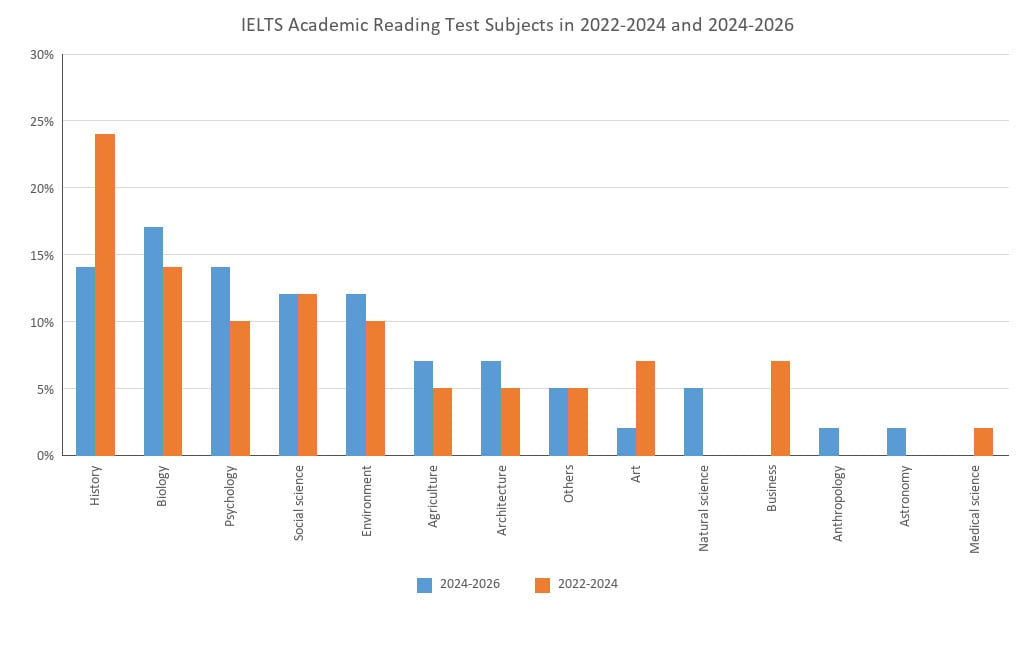
بسبب هذه الاتجاهات، تأكّدنا من أن اختباراتنا التدريبية لـ IELTS للقراءة تغطي هذه المواضيع. كما أضفنا عيّنات قراءة من مواضيع أقل استخدامًا، تحسّبًا. من المهم الاستعداد لجميع الحالات، لأنك لا تعرف أبدًا أي موضوع IELTS للقراءة ستحصل عليه.
كيف تُحسب درجة IELTS للقراءة الخاصة بك
كل سؤال IELTS للقراءة يستحق نقطة واحدة، لذلك يمكنك الحصول على درجة "خام" تصل إلى 40 نقطة. ثم سيتم تحويل درجتك الخام إلى درجة band الخاصة بك. يمكن أن تعطيك الجداول أدناه فكرة عامة عن كيفية تحويل درجات IELTS للقراءة الخام إلى درجات band لكل اختبار.
درجة IELTS العام للقراءة مقابل درجة IELTS الأكاديمي للقراءة
| الدرجات الخام: الأكاديمي | درجات Band: الأكاديمي | الدرجات الخام: العام | درجات Band: العام |
|---|---|---|---|
| 39-40 | 9 | 40 | 9 |
| 37-38 | 8.5 | 39 | 8.5 |
| 35-36 | 8 | 37-38 | 8 |
| 33-34 | 7.5 | 36 | 7.5 |
| 30-32 | 7 | 34-35 | 7 |
| 27-29 | 6.5 | 32-33 | 6.5 |
| 23-26 | 6 | 30-31 | 6 |
| 19-22 | 5.5 | 27-29 | 5.5 |
| 15-18 | 5 | 23-26 | 5 |
| 13-14 | 4.5 | 19-22 | 4.5 |
| 10-12 | 4 | 15-18 | 4 |
| 8-9 | 3.5 | 12-14 | 3.5 |
| 6-7 | 3 | 9-11 | 3 |
| 4-5 | 2.5 | 6-8 | 2.5 |
| 1-3 | 2 | 1-5 | 2 |
ومع ذلك، ضع في اعتبارك أن كل نسخة من اختبار IELTS للقراءة تختلف قليلًا وتتغيّر الدرجة المطلوبة لتحقيق band معيّن اعتمادًا على كيفية أداء كل من خاض ذلك الاختبار في ذلك اليوم بالذات. لذلك، سيختلف عدد الإجابات الصحيحة المطلوبة للحصول على درجة band قليلًا من اختبار إلى آخر، ولكن بشكل عام يجب أن تستهدف الحصول على حوالي 30 من 40 إذا كنت تريد الحصول على درجة band 7.
شيء آخر نريد أن نذكّرك به هو أن أصعب الأسئلة و أسهل الأسئلة تحسب بالتساوي تجاه درجة قراءتك النهائية، لذا تأكّد من أنك لا تخسر النقاط الأسهل بسبب التعثّر في الأسئلة الأصعب. بعد ذلك سنغطي بعض نصائح IELTS للقراءة والاستراتيجيات حول كيفية الإجابة على كل سؤال من اختبار القراءة.
نصائح IELTS للقراءة - كيفية الإجابة على أنواع أسئلة القراءة الـ 11
هناك 11 نوعًا مختلفًا من الأسئلة في اختبار القراءة وتتطلّب جميعها استراتيجية مختلفة.
لكل نوع مثال وإجابة في دليل أنواع أسئلة IELTS Reading.
- نوع السؤال 1 – مطابقة المعلومات
- نوع السؤال 2 – مطابقة العناوين
- نوع السؤال 3 – مطابقة الميزات
- نوع السؤال 4 – تحديد المعلومات
- نوع السؤال 5 – تحديد آراء/ادعاءات الكاتب
- نوع السؤال 6 – الاختيار من متعدد
- نوع السؤال 7 – مطابقة نهايات الجمل
- نوع السؤال 8 – إكمال الجمل
- نوع السؤال 9 – إكمال الملخص والملاحظة والجدول والمخطط الانسيابي
- نوع السؤال 10 – إكمال تسمية الرسم البياني
- نوع السؤال 11 – أسئلة الإجابة القصيرة
- كيف تساعدك الاتجاهات على الاستعداد لاختبار IELTS للقراءة
كيف تساعدك الاتجاهات على الاستعداد لاختبار IELTS للقراءة
أنواع أسئلة القراءة التي يجدها متعلمونا الأصعب
أجاب متعلمو BestMyTest عن مليون سؤال في القراءة الأكاديمية و600,000 سؤال في قراءة التدريب العام ضمن اختباراتنا التدريبية. وتبيّن النسبة المئوية مدى تكرار الإجابة الصحيحة عن كل نوع من الأسئلة.
| نوع السؤال | الأكاديمي | التدريب العام |
|---|---|---|
| مطابقة المعلومات (Matching information) | 34% | 72% |
| صحيح / خطأ / غير مذكور (True / False / Not Given) | 39% | 60% |
| الاختيار من متعدد (Multiple choice) | 43% | 48% |
| مطابقة الخصائص (Matching features) | 48% | 74% |
| إكمال الجمل (Sentence completion) | 49% | 75% |
| مطابقة العناوين (Matching headings) | 53% | 40% |
| نعم / لا / غير مذكور (Yes / No / Not Given) | 55% | 57% |
| إكمال الملخص (Summary completion) | 59% | 46% |
| الإجابة القصيرة (Short answer) | 54% | 75% |
- في القراءة الأكاديمية يُسجَّل أضعف أداء في نوعَي مطابقة المعلومات وصحيح / خطأ / غير مذكور، إذ تقل نسبة الإجابات الصحيحة في كليهما عن 40%. وكلاهما يتطلب منك تحديد موضع فكرة أُعيدت صياغتها، بدلًا من العثور على كلمة مفتاحية مطابقة.
- في التدريب العام تنقلب الصورة: يُسجَّل أضعف أداء في مطابقة العناوين بنسبة 40%، بينما تُجاب أسئلة تحديد موضع المعلومات إجابة صحيحة ثلاث مرات من كل أربع، لأن النصوص أقصر ومعانيها أكثر مباشرة.
- نصوص القراءة الأكاديمية تبلغ نسبة الإجابات الصحيحة عن أسئلتها 46% في المتوسط، مقابل 59% لنصوص التدريب العام. وفي نصف محاولات الإجابة عن أسئلة النصوص الأكاديمية، تبلغ النتيجة 40% أو أقل.
- عبر 43,711 اختبار قراءة تدريبيًا كاملًا أجراها 38,534 متعلمًا، بلغ متوسط الدرجة 5.4. وبلغ 36% الدرجة 6.0، وبلغ 14% الدرجة 7.0.
- لا يزال عليك الاستعداد لكل نوع، لكن إذا كان وقتك ضيقًا، فالجدول يوضّح لك أين تستثمره لتحقيق أكبر فائدة.
الأرقام مستمدة من بيانات الاختبارات التدريبية والمراجعات في BestMyTest حتى أكتوبر 2026. وتمثّل النسب المئوية لأنواع الأسئلة معدلات الإجابات الصحيحة عبر جميع المحاولات؛ أما أرقام المعايير فهي درجات يمنحها المدرّس أو الذكاء الاصطناعي، بحسب التسمية الموضّحة. آخر تحديث في 5 أكتوبر 2026.
بعد ذلك سنستعرض نصائح واستراتيجيات IELTS للقراءة الضرورية لدرجة قراءة عالية.
نصائح IELTS للقراءة - كيف تحسّن درجة Band القراءة الخاصة بك
يفشل معظم الطلاب في قسم القراءة لأسباب ثلاثة التالية
- سرعة قراءة بطيئة
- مفردات ضعيفة
- تحضير قليل أو معدوم
تحسين سرعة قراءتك
أوّلًا، دعنا نتخلص من الواضح. لتحسين سرعة قراءتك، تحتاج إلى ممارسة القراءة فعلًا والقيام بذلك باستمرار.
الآن لننظر إلى استراتيجية أقل وضوحًا ستساعدك على فهم معنى القطع الكبيرة من الجمل. ابدأ بتشريح الجملة. افعل ذلك بالبحث عن الفاعل والفعل في الجملة. إيجاد الفاعل والفعل سيساعدك على فهم معنى الجملة. أحد أسباب صعوبة فهم نصوص القراءة الأكاديمية هو أنها تربط سلاسل من الأفكار لتكوين جمل مركّبة طويلة. هذا ينتج قطعًا كبيرة من الجمل أصعب في الاستيعاب، لذا فإن استخدام الفاعل والفعل كدليلك لفهم القطعة بأكملها هو أداة رائعة يمكنك استخدامها خلال اختبار IELTS للقراءة الخاص بك.
تحسين مفرداتك
يعتقد الكثير من الناس أن الإجابة على أسئلة القراءة بسيطة كفحص الفقرة بحثًا عن الكلمات الأساسية والمعلومات... حسنًا، للأسف، الأمر ليس بهذه البساطة. عادة ما يتم إعادة صياغة أسئلة القراءة، أي أنه تم تغيير الكلمات لاستخدام مرادفات للكلمات من نص IELTS للقراءة. يتم ذلك لزيادة الصعوبة، وإلا فسيكون الاختبار سهلًا للغاية. لهذا السبب، يجب عليك تحسين مفرداتك من أجل معرفة المرادفات المختلفة الكثيرة لكلمة.
أثناء استعدادك لاختبار القراءة وتصادف كلمة لا تعرفها، اعتد على إما التوقف والبحث عنها أو على الأقل تدوينها والبحث عنها لاحقًا. إنه أمر مرهق قليلًا، لكنه فعال للغاية. يجب أن يكون هدفك، ولكن لا يقتصر على، دراسة 15 إلى 20 كلمة أكاديمية جديدة كل يوم.
معرفة في أي أنواع الأسئلة تكون الإجابات/لا تكون بالترتيب
من المهم أن تعرف أنه بالنسبة لبعض أنواع الأسئلة، تكون الإجابات عادة (تقريبًا دائمًا) بنفس ترتيب نص IELTS للقراءة. بالنسبة لأنواع أسئلة أخرى، نادرًا ما تكون الإجابات بنفس ترتيب نص القراءة. لقد أكملنا جدولًا لأنواع الأسئلة التي تتبع وتلك التي لا تفعل. يرجى أخذ ذلك في الاعتبار.
| الإجابات عادة (تقريبًا دائمًا) بنفس ترتيب النص | نادرًا ما تكون الإجابات بنفس ترتيب النص. |
|---|---|
|
|
إيجاد أفضل استراتيجية قراءة لك
أكبر تحدّ يواجهه معظم الناس في امتحان IELTS للقراءة هو إكمال جميع أسئلة القراءة قبل نفاد الوقت. في القسم التالي، ستتعلم ثلاث استراتيجيات وسيكون عليك تحديد أيّها يناسبك أكثر. ستفعل ذلك باستخدام تدريبات القراءة المجانية الخاصة بنا.
3 استراتيجيات لـ IELTS للقراءة
الاستراتيجية 1: قراءة النص بأكمله ثم الإجابة على الأسئلة.
أولًا وقبل كل شيء، هذه ليست استراتيجية حقيقية. إنه شيء يفعله الناس عندما لا يستعدون بشكل صحيح لامتحان القراءة. ومع ذلك، أدرجناها كاستراتيجية لأنه، من الناحية الفنية، إذا تمكنت من الاحتفاظ بالمعلومات من النص في قراءتك الأولى وكنت قادرًا على الإجابة على الأسئلة، فلن تحتاج إلى الاستراتيجية 2.
هذه الاستراتيجية، إذا لم يكن لديك ذاكرة أفضل من المتوسط، غير فعّالة. ستنتهي بنفاد الوقت قبل أن تتمكن من الإجابة على جميع الأسئلة. الكثير من الناس يرتكبون هذا الخطأ. ومع ذلك، هناك بعض الأسئلة التي لا تتطلب الكثير من الجهد وستستفيد من هذه الاستراتيجية مثل إذا كان السؤال إجابة "نعم" أو "لا"، فستتمكن من المسح بسرعة وإيجاد الإجابة بسرعة، ولكن ليس هناك ما يكفي من هذه الأنواع من الأسئلة، لذا لا يُنصح باستخدام هذه الاستراتيجية إلا إذا كنت تستطيع التعامل معها.
الاستراتيجية 2: قراءة الأسئلة أولًا، القراءة لهدف واتخاذ ملاحظات، ثم الإجابة على الأسئلة بحكمة
هذه هي استراتيجيتنا الموصى بها. ستساعدك على الحصول على درجة أعلى في IELTS للقراءة. فكر في هذا كخريطة واضحة لكيفية التعامل مع الامتحان بشكل عام:
أحد الأخطاء الأكثر شيوعًا التي يرتكبها المرشحون عند
التعامل مع امتحان القراءة هو قراءة كل كلمة واحدة من نصوص IELTS للقراءة. على الرغم من أنك يمكنك
التحضير للامتحان من خلال القراءة من أجل المتعة، فإن "القراءة العمياء" (القراءة دون أي إحساس
بما ستطلبه الأسئلة) لن تقدم لك أي خدمات في الامتحان. بدلًا من ذلك، ستضرّ
فرصك لإدارة وقتك بفعالية والحصول على أفضل درجة.
السبب الرئيسي لقراءة الأسئلة أولًا هو لأن نوع السؤال قد يحدد ما
ستقرأه في النص أو كيف ستقرأه. على سبيل المثال، ستتطلب بعض أنواع الأسئلة
تقنية "المسح"، بينما قد تتطلب أنواع أخرى تقنية "التصفح".
من المهم التعامل مع مجموعة من الأسئلة من نفس نوع السؤال.
ستحتاج إلى تحديد نوع السؤال الذي تريد التعامل معه أولًا.
ستكون استراتيجية جيدة هي البدء بنوع السؤال الأسهل والانتقال إلى أنواع الأسئلة الأكثر صعوبة لاحقًا.
أنواع الأسئلة الأسهل هي تلك التي تقضي وقتًا أقل في قراءتها.
على سبيل المثال، نوع السؤال مطابقة العناوين هو أحد الأسهل لأنك
تحتاج فقط إلى العثور على العنوان الذي يصف الفكرة الرئيسية لفقرة بشكل أفضل.
مثال على نوع سؤال صعب سيكون تحديد المعلومات. لهذا النوع من الأسئلة،
ستحتاج إلى قراءة كل فقرة لمعرفة ما إذا كانت كل عبارة صحيحة أم خطأ أم غير معطاة وفقًا للنص.
هنا جدول يسرد مستويات الصعوبة لكل نوع سؤال. استخدم هذا الجدول كمرجع عند اختيار نوع السؤال
الذي تريد التعامل معه أولًا.
| مستوى الصعوبة | نوع السؤال |
|---|---|
| سهل | مطابقة العناوين الإجابة القصيرة |
| متوسط |
مطابقة نهايات الجمل مطابقة الميزات الاختيار من متعدد إكمال الجمل إكمال تسمية الرسم البياني، الملخص، الملاحظة، الجدول، المخطط الانسيابي |
| صعب |
مطابقة المعلومات تحديد المعلومات (صحيح/خطأ/غير معطى) تحديد ادعاءات المُشاهد (نعم/لا/غير معطى) |
بعد أن تقرأ الأسئلة من نص IELTS، ستتمكن من القراءة لهدف. ماذا يعني هذا؟ على سبيل المثال، إذا صادفت سؤالًا يتضمن السنة "1896"، يمكنك تدوين متى تأتي هذه السنة في النص، باستخدامها للإجابة على السؤال لاحقًا.
هناك تقنيتان للقراءة ستساعدانك على البقاء على المسار الصحيح مع القراءة لهدف. الأولى، المسح، هي أفضل ما يتم تعريفها على أنها القراءة بسرعة من أجل الحصول على "الجوهر"، أو الفكرة العامة، لمقطع. مع هذه التقنية، أنت لا تتوقّف عن أي كلمات غير مألوفة أو تبحث عن تفاصيل محددة. التقنية الثانية، التصفح، هي أفضل ما يتم تعريفها على أنها القراءة لـ معلومات محددة. مع هذه التقنية، أنت لا تقرأ من أجل الجوهر العام، بل معلومات محددة. لاحظ كيف أن كل من هذه التقنيات لها هدف محدد في الذهن. هذا سيساعدك على إيجاد المعلومات بشكل أسرع.
أثناء قراءتك لهدف، يجب عليك أيضًا تدوين الملاحظات على هوامش النص، وضع نجوم بجانب المعلومات الأساسية، أو تسطير الأشياء التي تعتقد أنها ستساعدك على الإجابة على الأسئلة المختلفة. هذا سيجعل من الأسهل عليك التحقق عندما يُسأل لك عن أشياء معينة في الأسئلة. اختر أي نظام لتدوين الملاحظات مناسب لك - فقط تأكد من أنك تفعل ذلك!
بعد أن تقرأ الأسئلة، وقرأت النص، وأخذت أي ملاحظات مناسبة، يجب أن تكون قد حددت الجزء من النص الذي تحتاج إلى قراءته بعناية. ثم فقط اقرأ بعناية وفكر بشكل نقدي لتحديد الإجابة الصحيحة.
الاستراتيجية 3: المسح، تدوين الملاحظات، وأنواع الأسئلة.
هذه استراتيجية أخرى يستخدمها العديد من المختبرين في IELTS. ستساعدك على الحصول على درجة قراءة أعلى. تتكون الاستراتيجية من 4 خطوات:
- امسح كل فقرة للحصول على الفكرة العامة لكل فقرة. توجد الفكرة الرئيسية لفقرة عادة في الجمل القليلة الأولى لذا ركز قليلًا أكثر على تلك الجمل. يمكن مسح الجمل التالية بسرعة، تسطير الأسماء/الكلمات/العبارات التي تبرز.
- بعد مسح كل فقرة، اكتب ملاحظات قصيرة (2-5 كلمات) بجانب كل فقرة بأفضل تخمينك حول الفكرة الرئيسية لتلك الفقرة.
- بعد ذلك، أجب على مجموعة من الأسئلة من نفس نوع السؤال.
- أخيرًا، الإجابة على مجموعة من الأسئلة بكفاءة وبشكل صحيح.
من المهم ألا تقضي أكثر من 3-5 دقائق على الخطوتين 1 و2. إنفاق الكثير من الوقت على هذه الخطوات سيهدر الكثير من الوقت وستنفد منك في النهاية.
الخطوتان 1 و2الهدف هنا هو إنشاء طريقة فعّالة لإيجاد الإجابات في النص. من خلال كتابة الفكرة العامة لكل فقرة، ستعرف أي فقرة تحتوي على الإجابة على كل سؤال. هذا سيوفّر لك الكثير من الوقت لأنه إذا لم تكتبها، فستحتاج على الأرجح إلى مسح كل فقرة للفكرة العامة للسؤال، ثم ستحتاج إلى مسح الفقرة بعناية للإجابة. من خلال تدوين الفكرة الرئيسية لكل فقرة، يمكنك تخطّي الخطوة الأولى من مسح كل فقرة والبدء في تصفح الإجابة.
الخطوة 3
بعد أن تكون قد مسحت النص بدقة وكتبت بعض الملاحظات، فأنت مستعد للخطوة 3.
في هذه الخطوة، ستحتاج إلى تحديد نوع السؤال الذي تريد التعامل معه أولًا.
ستكون استراتيجية جيدة هي البدء بنوع السؤال الأسهل والانتقال إلى أنواع الأسئلة الأكثر صعوبة لاحقًا.
أنواع الأسئلة الأسهل هي تلك التي تقضي وقتًا أقل في قراءتها.
على سبيل المثال، نوع السؤال مطابقة العناوين هو أحد الأسهل لأنك
تحتاج فقط إلى العثور على العنوان الذي يصف الفكرة الرئيسية لفقرة بشكل أفضل، لذا فمن الناحية التقنية تحتاج فقط إلى الخطوتين 1 و2 للإجابة على هذا النوع من الأسئلة.
مثال على نوع سؤال صعب سيكون تحديد المعلومات. لهذا النوع من الأسئلة،
ستحتاج إلى قراءة كل فقرة لمعرفة ما إذا كانت كل عبارة صحيحة أم خطأ أم غير معطاة وفقًا للنص.
هنا جدول يسرد مستويات الصعوبة لكل نوع سؤال. استخدم هذا الجدول كمرجع عند اختيار نوع السؤال الذي تريد التعامل معه أولًا.
| مستوى الصعوبة | نوع السؤال |
|---|---|
| سهل | مطابقة العناوين الإجابة القصيرة |
| متوسط |
مطابقة نهايات الجمل مطابقة الميزات الاختيار من متعدد إكمال الجمل إكمال تسمية الرسم البياني، الملخص، الملاحظة، الجدول، المخطط الانسيابي |
| صعب |
مطابقة المعلومات تحديد المعلومات (صحيح/خطأ/غير معطى) تحديد ادعاءات المُشاهد (نعم/لا/غير معطى) |
الآن وقد اكتشفت أي مجموعة من الأسئلة ستجيب عليها أولًا، حان الوقت للإجابة عليها فعلًا :( لا تقلق! على الرغم من أن كل نوع سؤال مختلف، فإن استراتيجية الإجابة عليها بشكل صحيح تنطبق عليها جميعًا. المبدأ الأساسي بسيط، فقط اتبع الخطوات أدناه:
- اقرأ السؤال بعناية وحدد الكلمات الأساسية المهمة.
- ابحث عن الفقرة التي تحتوي على المعلومات اللازمة للإجابة على السؤال. (نأمل أنك قد كتبت بالفعل الأفكار العامة لكل فقرة، حتى تتمكن من معرفة ذلك بسهولة.)
- امسح الفقرة بحثًا عن الكلمات الأساسية المهمة (من المرجح أن تكون مرادفات!) حتى تحدد الجزء من النص الذي تحتاج إلى قراءته بعناية.
- أخيرًا، اقرأ بعناية وفكر بشكل نقدي لتحديد الإجابة الصحيحة.
تنزيلات PDF نموذجية مجانية لـ IELTS للقراءة مع الإجابات
أدناه بعض عيّنات القراءة المجانية من المجلس الثقافي البريطاني (صانعي اختبار IELTS). حاول الإجابة على الأسئلة وانظر كيف تفعل!