
في هذا الدليل، ستخوض اختبار IELTS مجانيًا للاستماع وستحصل على تحليل كامل لدرجتك. ستستعدّ مع أكثر من 125 اختبارًا تدريبيًا للاستماع في IELTS، إلى جانب الدروس والنصائح وشروحات الإجابات بالفيديو. وباتباع خطة الدراسة المخصصة لك، ستحقق درجة الاستماع المستهدفة في IELTS.
احصل على تحليل مجاني لدرجات IELTS في الاستماع وخطة دراسة مخصصة بعد إكمال اختبار IELTS تدريبي مجاني في الاستماع.
play_circle_outline ابدأ اختبار IELTS التدريبي في الاستماعفيما يلي قائمتنا الكاملة لأسئلة IELTS في الاستماع مع الإجابات. ملاحظة: تمثل الروابط الحمراء أكثر أسئلة الاستماع شيوعاً وتوصيةً وفق تقييم طلابنا، ويمكنك التدرب عليها مجاناً في أي وقت.
أسئلة اختبار تدريبي للقسم 1 من الاستماع في IELTS 1 - 59
A conversation between two people in an everyday situation
أسئلة اختبار تدريبي للقسم 2 من الاستماع في IELTS 1 - 75
A talk by one speaker about an everyday topic
أسئلة اختبار تدريبي للقسم 3 من الاستماع في IELTS 1 - 65
A conversation between up to four people about studies or training
أسئلة اختبار تدريبي للقسم 4 من الاستماع في IELTS 1 - 62
A talk by one speaker on an academic subject
دليل اختبار IELTS التدريبي للاستماع
سيُعلّمك ما تبقى من هذا الدليل كل شيء عن اختبار IELTS للاستماع. ستتعرّف على كيفية احتساب درجة الاستماع، وستتعلّم كيفية الإجابة بنجاح عن كل نوع من أسئلة الاستماع لتحسين درجة باند الاستماع، كما ستتعلّم العملية المُختبَرة من 3 خطوات لمساعدتك على دراسة اختبارات IELTS للاستماع عبر الإنترنت.
جدول المحتويات
معلومات اختبار IELTS للاستماع
اختبار IELTS للاستماع مقسّم إلى 4 أقسام. في كل قسم ستستمع إلى متحدّث أو أكثر من المتحدثين الناطقين بالإنجليزية كلغة أم، ثم تجيب عن حوالي 10 أسئلة تتعلق بما سمعته للتو. يحتوي قسم الاستماع بأكمله على 40 سؤالًا في المجموع. وبشكل عام، تبدأ تسجيلات الاستماع أسهل وتزداد صعوبة كلما تقدّمت في الاختبار. يُسمَع كل تسجيل مرة واحدة فقط ويتضمن مجموعة من اللهجات، تشمل البريطانية والأسترالية والنيوزيلندية والأمريكية والكندية.
- القسم 1 – محادثة بين شخصين في سياق اجتماعي يومي. على سبيل المثال، قد تستمع إلى محادثة لتأكيد تفاصيل حجز، أو لتقديم طلب عبر الهاتف.
- القسم 2 - مونولوج في سياق اجتماعي يومي. على سبيل المثال، قد تستمع إلى خطاب حول المرافق المحلية، أو شخص يقدّم اتجاهات، أو يقدّم معلومات أساسية عن حدث ما.
- القسم 3 – محادثة بين أربعة أشخاص بحدّ أقصى في سياق تعليمي أو تدريبي. على سبيل المثال، قد تستمع إلى أستاذ جامعي وطالب يناقشان واجبًا، أو طالبَين يناقشان شيئًا من الفصل.
- القسم 4 - مونولوج حول موضوع أكاديمي. على سبيل المثال، ستستمع إلى محاضرة جامعية من أستاذ. وهذا هو التسجيل الأصعب في اختبار الاستماع لمعظم الطلاب.
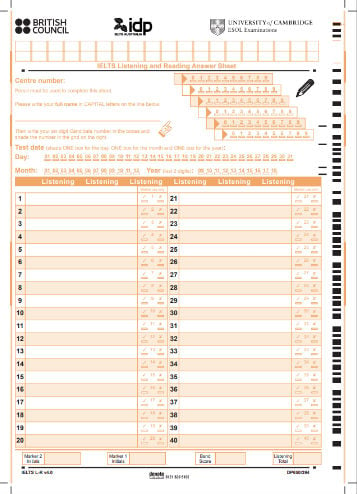
يستغرق اختبار IELTS للاستماع حوالي 40 دقيقة. ستقضي 30 دقيقة في الاستماع إلى التسجيلات والإجابة عن الأسئلة. ستُمنح كتيّب أسئلة وورقة إجابات. كتيّب الأسئلة هو حيث ستجد جميع الأسئلة التي تحتاج إلى الإجابة عنها. وورقة الإجابات هي حيث ستكتب إجاباتك النهائية للتقييم.
يمكنك الاطلاع على ورقة إجابات استماع IELTS الرسمية بصيغة PDF هنا أو ببساطة الاطلاع على الصورة أدناه :)
في نهاية قسم الاستماع، تُمنح 10 دقائق لنقل الإجابات من كتيّب الأسئلة إلى ورقة الإجابات.
مهم!
الأخطاء الإملائية والقواعد غير الصحيحة تُصنَّف غير صحيحة، لذلك استخدم الـ10 دقائق للتحقق المضاعف من الإملاء والقواعد.
احتساب درجة استماع IELTS
في قسم الاستماع، يستحق كل سؤال نقطة واحدة، لذا يمكنك تحقيق درجة "خام" تصل إلى 40 نقطة. ثم تُحوَّل درجتك الخام إلى درجة باند. تذكّر! لا تخسر نقاطًا بسبب الإجابات غير الصحيحة. يمكن للجدول أدناه أن يعطيك فكرة عامة عن كيفية تحويل الدرجات الخام إلى درجات الباند.
| الدرجات الخام | درجات الباند |
|---|---|
| 39-40 | 9 |
| 37-38 | 8.5 |
| 35-36 | 8 |
| 32-34 | 7.5 |
| 30-31 | 7 |
| 26-29 | 6.5 |
| 23-25 | 6 |
| 18-22 | 5.5 |
| 16-17 | 5 |
| 13-15 | 4.5 |
| 11-12 | 4 |
لأنّ كل نسخة من IELTS مختلفة قليلًا، فإن الدرجة الخام المطلوبة لتحقيق درجة باند معيّنة تختلف اعتمادًا على أداء كل من خاض الاختبار في ذلك اليوم. وهكذا، سيتباين عدد الإجابات الصحيحة المطلوبة للحصول على درجة باند بشكل طفيف من اختبار إلى آخر، ولكن بشكل عام يجب أن تستهدف الحصول على حوالي 30 من 40 إذا أردت الحصول على درجة باند 7.
كما لوحظ أعلاه، تزداد الأقسام صعوبة كلما تقدّمت في اختبار IELTS للاستماع. ومع ذلك، يستحق كل سؤال العدد نفسه من النقاط. لذلك، تأكّد من ألّا تخسر النقاط الأسهل لأنك علقت في أسئلة صعبة.
تنزيل مجاني لعينة PDF لاختبار IELTS للاستماع مع الإجابات
إليك بعض عينات IELTS للاستماع مجانية بصيغة PDF مع الإجابات من المجلس الثقافي البريطاني (صانعي اختبار IELTS). أسفل الروابط، يمكنك أيضًا إجراء اختبار IELTS للاستماع مع الصوت والإجابات مجانًا من BestMyTest. يضم الاختبار الأقسام الأربعة كلها، ويعرض كل قسم نصه الصوتي مع الإجابات. حاول الإجابة عن الأسئلة وانظر كيف ستفعل!
- اختبار IELTS التدريبي للاستماع 1 - الأسئلة (أمثلة عبر الإنترنت)
- اختبار IELTS التدريبي للاستماع 1 - الإجابات (PDF)
- اختبار IELTS التدريبي للاستماع 1 - ورقة الإجابات (PDF)
استمع إلى التسجيل وأجب عن الأسئلة 1 إلى 10. تجد الإجابات والنص الصوتي في المربع أسفل الأسئلة.
Questions 1-10
Complete the notes below.
Write ONE WORD AND/OR A NUMBER for each answer.
This can provide the carer with:
• time for other duties
• a 1
Assessment of aunt's needs
This may involve discussing:
• how much 2 is spent caring
Daily tasks discussed:
• help with dressing
• helping her take a 3
• shopping
• helping with meals
• managing 4
• any parts of caring that are particularly hard, e.g.
• loss of 5
• 6 her
• avoiding a 7
Types of support that may be provided for carers
• transport costs, e.g. cost of a 8
• vehicle-related costs, e.g. fuel and 9
• help with housework
• support to lower 10
-
spellcheck الإجابات
1. Break
Break is correct because this detail is stated in the recording at the point where the question is answered.2. Time
Time is correct because this detail is stated in the recording at the point where the question is answered.3. Shower
Shower is correct because this detail is stated in the recording at the point where the question is answered.4. Money
Money is correct because this detail is stated in the recording at the point where the question is answered.5. Memory
Memory is correct because this detail is stated in the recording at the point where the question is answered.6. Lifting
Lifting is correct because this detail is stated in the recording at the point where the question is answered.7. Fall
Fall is correct because this detail is stated in the recording at the point where the question is answered.8. Minicab
Minicab is correct because this detail is stated in the recording at the point where the question is answered.9. Parking
Parking is correct because this detail is stated in the recording at the point where the question is answered.10. Anxiety
Anxiety is correct because this detail is stated in the recording at the point where the question is answered.
Audio ScriptNora: It's really good to see you, Marcus. Since I had to give up work, I feel I'm losing touch with my friends and colleagues.
Marcus: We really miss you in the office. We were all so sorry you had to leave. But you must be relieved to have more time to look after your aunt. How is she?
Nora: Well, she's very cheerful, but she needs a lot of help.
Marcus: Have you tried to get any support from the local council?
Nora: No. I didn't know I could.
Marcus: Yes. But for different kinds of practical support, they realise that carers sometimes need time for all the other responsibilities they have, apart from the person they're caring for, and also that they sometimes need a break.
Nora: Absolutely. OK, so tell me more, how do I go about getting this support?
Marcus: Well, you'd have to have an assessment of your aunt's needs. That means someone would come round and talk to you about the situation and what you need. So for a start, they'd want to know the amount of time you spend looking after your aunt every day.
Nora: OK.
Marcus: Then they'll probably ask you what sorts of tasks you do for your aunt during the day. Things like if she needs help with getting dressed, for example.
Nora: Right. I help her with that. And also I help her get into the shower in the morning.
Marcus: Yes. That sort of thing. They'll probably ask you if you do the shopping for her, and help her at meal times, and whether she can cope using money.
Nora: Yes. That's becoming a bit of a problem. She used to be very good at it, but not anymore.
Before you hear the rest of the conversation, you have some time to look at questions 5 to 10. [20 seconds] Now listen, and answer questions 5 to 10.Marcus: And be ready to tell them about anything you find particularly difficult about caring for your aunt.
Nora: So recently I've noticed she started to have quite bad problems with her memory. If I wasn't there, I think she'd forget to eat, for example. And often she doesn't seem quite sure what day it is.
Marcus: Yes. Tell them about that. And are there any physical difficulties you have caring for her? Lifting her, for example.
Nora: Yes. She's quite heavy, and I'm afraid of hurting my back. I'd be in real trouble if that happened.
Marcus: They can give you advice about that, and also about how to avoid the possibility of your aunt having a fall.
Nora: Great. So, once they've done this assessment, if I'm eligible, what happens next?
Marcus: Well, they might support you financially. So they might help you with travel costs, like if you have to get a minicab to take your aunt for an appointment, for example.
Nora: I usually drive her myself, actually. So could I claim for the petrol?
Marcus: You could. And you can claim for the parking, too.
Nora: Oh, right.
Marcus: And if you need help with the housework, they can arrange for someone to come along once or twice a week. And one other thing. I hope you don't mind me saying this, but it's important you look after yourself. And it seems to me you're dealing with quite a bit of anxiety.
Nora: I am, yes.
Marcus: Well, tell the council, because they may be able to give you some advice on how to minimise it.
Nora: Really? Though, actually, I feel so much better having talked to you. I'll get in touch with the council straight away. Now, shall we go for coffee, or something?
استمع إلى التسجيل وأجب عن الأسئلة 11 إلى 20. تجد الإجابات والنص الصوتي في المربع أسفل الأسئلة.
Questions 11-14
Choose the correct letter, A, B or C.
11. Who began turning the unused Whitfield site into a planted space?
- city council officials.
- nearby residents.
- a gardening charity.
12. What was Lillian Hartley trying to achieve through public campaigning?
- preventing a housing sale
- blocking army exercises
- winning maintenance funding
13. Why was the park rejected as a place for troop exercises?
- council permission was refused.
- too little usable space.
- a better site was chosen.
14. How does the speaker describe the latest redesign plans?
- 2013 plan used unchanged.
- 2013 plan revised pre-work.
- 2015 plan finished in 2016.
Questions 15-20
Label the plan of Whitfield Park below.
Write the correct letter, A-I, next to questions 15-20.
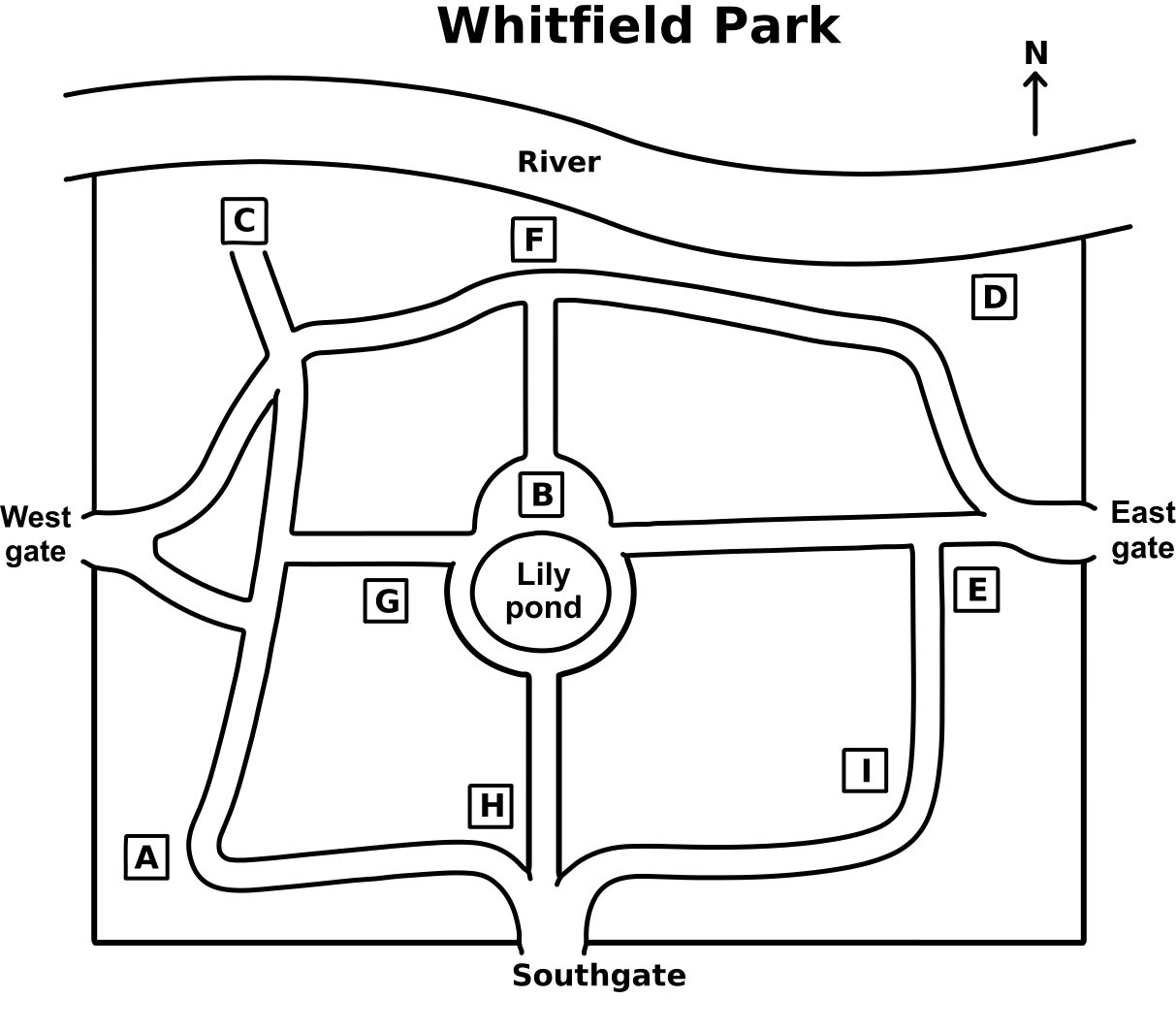
- statue of Lillian Hartley
- wooden sculptures
- playground
- maze
- tennis courts
- fitness area
-
spellcheck الإجابات
11. B
(A) is incorrect. The council took ownership later.(B) is correct. The initial planting was done by residents from nearby streets.
(C) is incorrect. The recording does not support this option: a gardening charity.
12. A
(A) is correct. Hartley organised public pressure so the council would keep the land as a park rather than sell it for housing.(B) is incorrect. The recording does not support this option: blocking army exercises.
(C) is incorrect. The recording does not support this option: winning maintenance funding.
13. B
(A) is incorrect. The recording does not support this option: council permission was refused.(B) is correct. , after inspection, the army concluded that the park was too small for practical use.
(C) is incorrect. The recording does not support this option: a better site was chosen.
14. B
(A) is incorrect. The recording does not support this option: 2013 plan used unchanged.(B) is correct. The plans dated from 2013 but were revised in 2015 before work began.
(C) is incorrect. The recording does not support this option: 2015 plan finished in 2016.
15. B
The correct answer is B because the statue of Lillian Hartley is now immediately north of the lily pond near the centre of the park, and that position is labelled B.16. D
The correct answer is D because the wooden sculptures are on the riverbank where the path from the East Gate makes a sharp bend, which corresponds to D.17. F
The correct answer is F because the playground is between the river and the path from the lily pond to the river, and that location is marked F.18. C
The correct answer is C because the maze is found by entering from the West Gate, walking north, and turning left, which places it at C.19. A
The correct answer is A because the tennis courts remain in the southern corner where the perimeter path makes a right-angled bend, labelled A.20. G
The correct answer is G because the fitness area is beside the lily pond on the same side as the West Gate, matching G on the plan.
Audio ScriptI'm delighted this evening to introduce our guest speaker, Sarah Holloway, who is going to talk to us about the recent transformation of Whitfield Park. Over to you, Sarah. Thank you very much. I'm sure you all know Whitfield Park well, it has been one of the city's landmarks for well over a century, and the city council has been responsible for it for most of that time. What perhaps fewer of you will know is how the park actually began.
Unlike many city centre parks, which started life as the private gardens of a large house, Whitfield was originally just an unused patch of waste ground. The first flowers there were actually planted by a small group of local residents who lived in the surrounding streets. They began work on the site in 1892. At that point nobody was entirely sure who legally owned the land, and it was a full twenty years later before the city council finally took it into public ownership. Some of you will have seen the statue near one of the gates. That figure is Lillian Hartley, who played a really important role in the early history of the park.
Once the council legally owned the land, its first instinct was to sell it off as building plots for housing. A great many local residents, however, wanted the park to stay open as a place where everyone could enjoy fresh air and green space, bear in mind that this is a very densely built up residential district. Lillian Hartley was at the heart of that campaign, and it was she who organised the petitions and the public demonstrations which, in the end, persuaded the council to drop the sale and keep the land as a park.
Soon afterwards, in 1914, the First World War broke out, and most of the park was dug up and used to grow vegetables, which were sold to local residents. At one point the army did look into taking over the park as a site for troop exercises. They actually wrote to the city council about it, but when they inspected it they concluded that the park was simply too small to be of any practical use to them, so the idea was dropped. The only military activity in the park during the war was the occasional public meeting held on a small area of grass that had been kept clear of vegetable plots.
After the war, the park was largely returned to the way it had been before 1914, and from then on it remained almost unchanged for decades. New plans for transforming the park were drawn up several times over the years; the most recent version dates from 2013, but those plans were then revised in 2015, well before any actual work had got under way. Work on the ground finally began in 2016 and was completed, on schedule, last year.
Before you hear the rest of the talk, you have some time to look at questions 15 to 20. [20 seconds] Now listen and answer questions 15 to 20.All right, I'd like to describe some of the more important changes that have been made, and one or two things that have deliberately been left as they were. If you take a quick look at the map you've been handed, you'll see the familiar outline of Whitfield Park. The river forms the northern boundary, and there is a gate in each of the three other walls.
From there, follow the path up towards the river and the enlarged children's playground sits between that path and the river itself. If you keep your eye on the riverbank, over towards the East Gate side, the new wooden sculptures are at the point where the path coming up from that gate makes a sharp bend.
Back near the West Gate side of the park, there is a maze, a circular pattern of paths separated by low hedges. Head in from the West Gate, walk north towards the river, and then turn left to find it. Close to the same central lily pond, on the side facing the West Gate, you'll also find the new outdoor fitness area.
Down in the southern corner, where the perimeter path makes that distinct right angled bend, the tennis courts are still in their familiar position, though we have now doubled them from four to eight. Now, since you are all keen gardeners, I'm sure you'll want to hear about the plants that have been chosen for the new beds.
استمع إلى التسجيل وأجب عن الأسئلة 21 إلى 30. تجد الإجابات والنص الصوتي في المربع أسفل الأسئلة.
Questions 21-25
Choose the correct letter, A, B or C.
21. Nina and Owen were surprised to learn that coastal cities
- are home to just under half of all people.
- account for many of the largest cities.
- are expanding at double the rate of inland cities.
22. According to Owen, building coastal cities near to rivers
- can carry contamination back towards urban areas.
- can leave too little land for farming upstream.
- can cause factories to damage rural scenery.
23. What mistake was made when building water drainage channels in Port Selby in the 1950s?
- The system did not include enough channels.
- The builders selected the wrong construction materials.
- The design failed to anticipate rising sea levels.
24. What do Nina and Owen think that the authorities in Port Selby should do immediately?
- take measures to restore coastal ecosystems
- pay for a new flood prevention system
- stop disposing of waste materials into the ocean
25. What do they agree should be the priority for international action?
- greater coordination of activities
- more sharing of information
- agreement on shared policies
Questions 26-30
What decision do the students make about each of the following parts of their presentation?
Write the correct letter, A-G, next to questions 26-30.
- use visuals
- keep it short
- involve other students
- check the information is accurate
- provide a handout
- focus on one example
- do online research
- Historical background
- Geographical factors
- Past mistakes
- Future risks
- International implications
-
spellcheck الإجابات
21. B
(A) is incorrect. The recording does not support this option: are home to just under half of all people.(B) is correct. Nina says most of the biggest cities are built by the sea.
(C) is incorrect. The recording does not support this option: are expanding at double the rate of inland cities.
22. A
(A) is correct. Owen says pollutants from inland agriculture and industry travel down rivers to cities.(B) is incorrect. The recording does not support this option: can leave too little land for farming upstream.
(C) is incorrect. The recording does not support this option: can cause factories to damage rural scenery.
23. C
(A) is incorrect. The recording does not support this option: The system did not include enough channels.(B) is incorrect. The recording does not support this option: The builders selected the wrong construction materials.
(C) is correct. Port Selby's drainage channels were built without allowing for global warming and rising sea levels.
24. B
(A) is incorrect. The recording does not support this option: take measures to restore coastal ecosystems.(B) is correct. Nina says they need money to replace the drainage channels for flood protection now.
(C) is incorrect. The recording does not support this option: stop disposing of waste materials into the ocean.
25. A
(A) is correct. They say coastal cities must act together internationally.(B) is incorrect. The recording does not support this option: more sharing of information.
(C) is incorrect. The recording does not support this option: agreement on shared policies.
26. B
B is correct because they decide not to spend too long on historical background, so they will keep it short.27. A
A is correct because they decide to use slides with maps showing geographical factors.28. F
F is correct because they choose the Meriton case study as the basis for past mistakes, focusing on one example.29. G
G is correct because they need to look at websites for future risks, so online research is required.30. C
C is correct because they plan to ask audience members from different places, involving other students.
Audio ScriptTutor: OK, so what I'd like you to do now is to talk to your partner about your presentations on environmental planning. You should have done most of the reading now, so I'd like you to share your ideas and talk about the structure of your presentation and what you need to do next.
Nina: OK, Owen, I'm glad we chose quite a specific topic: coastal cities. It made it much easier to find relevant information.
Owen: Yeah, and cities are growing so quickly. I mean, we know that more than half the world's population lives in cities now.
Nina: Yeah, though that's all cities, not just coastal ones. But most of the biggest cities are actually built by the sea. I'd not realised that before.
Owen: Nor me. And what's more, a lot of them are built at places where rivers come out into the sea. But apparently this can be a problem.
Nina: Why?
Owen: Well, as the city expands, agriculture and industry tend to spread further inland along the rivers. And so agriculture moves even further inland up the river. That's not necessarily a problem, except it means more and more pollutants are discharged into the rivers.
Nina: That's a serious problem.
Owen: Right.
Nina: Did you read that article about Port Selby on the south coast?
Owen: No.
Nina: Well, apparently back in the 1950s, they built channels to drain away the water in case of flooding.
Owen: Sounds sensible.
Nina: Yeah, they spent quite a lot of money on them. But what they didn't take into account was global warming. So they built the drainage channels too close to sea level. And now sea levels are rising, they're more or less useless. If there's a lot of rain, the water can't run away. There's nowhere for it to go.
Owen: So they did not help much in the end.
Nina: So what are the authorities doing about it now?
Owen: I don't know. I did read that they're aiming to stop disposing of waste water into the ocean over the next 10 years. But that won't help with flood prevention now, will it?
Nina: No, really, they just need to find the money for something to replace the drainage channels in order to protect against flooding now. But in the long term, they need to consider the whole ecosystem.
Owen: Right.
Nina: Really though, coastal cities can't deal with their problems on their own, can they? I mean, they've got to start acting together at an international level instead of just doing their own thing.
Owen: Absolutely. The thing is, everyone knows what the problems are and environmental planners have a pretty good idea of what we should be doing about them. So they should be able to work together to some extent.
Nina: But it's going to be a long time before countries come to a decision on what principles they're prepared to abide by.
Owen: Yeah, if they ever do.
Before you hear the rest of the conversation, you have some time to look at questions 26 to 30. [20 seconds] Now listen and answer questions 26 to 30.Nina: So I think we've probably got enough for our presentation. It's only 15 minutes.
Owen: OK, so I suppose we'll begin with some general historical background about why coastal cities were established. But we don't want to spend too long on that. The other students will already know a bit about it.
Nina: It's all to do with communications and so on.
Owen: Yes, we should mention some geographical factors, things like wetlands and river estuaries and coastal erosion and so on.
Nina: We could have some maps of different cities with these features marked.
Owen: On a handout, you mean, or some slides everyone can see.
Nina: Yeah, that'd be better.
Owen: It'd be good to go into past mistakes in a bit more detail. Did you read that case study of the problems there were in Meriton with flooding a few years ago?
Nina: Yes, we could use that as the basis for that part of the talk. I don't think the other students will have read it, but they'll remember hearing about the flooding at the time.
Owen: Hmm, OK. So that's probably enough background. So then we'll go on to talk about what actions have been taken to deal with the problems of coastal cities.
Nina: OK, what else do we need to talk about? Maybe something on future risks looking more at the long term if populations continue to grow?
Owen: Yeah, we'll need to do a bit of work there. I haven't got much information, have you?
Nina: No, we'll need to look at some websites. Shouldn't take too long.
Owen: OK. And I think we should end by talking about international implications. Maybe we could ask people in the audience. We've got people from quite a lot of different places.
Nina: That'd be interesting if we have time, yes. So now should we go on?
استمع إلى التسجيل وأجب عن الأسئلة 31 إلى 40. تجد الإجابات والنص الصوتي في المربع أسفل الأسئلة.
Questions 31-36
What point does the lecturer make about each item?
Write the correct letter, A-K, next to questions 31-36.
- changes drainage
- protects animals
- increases nutrients
- kills germs
- affects many species
- creates dense shade
- alters the soil
- supports farming
- reduces competition
- attracts bell-miners
- helps recovery
- Eucalyptus woodland
- Damage to eucalyptus woodland
- Oil from eucalyptus leaves
- Lime used in construction
- Direct iron supply
- Moderate bushfires
Questions 37-40
Complete the notes below.
Write ONE WORD ONLY for each answer.
Bell-miner associated dieback:
• The process starts with insects feeding on eucalyptus 37
• A sweet liquid containing 38 attracts bell-miners
Fire patterns:
• If fires happen too often, 39 becomes the main vegetation
• When fires are almost absent, thick growth gives bell-miners protected 40 sites
-
spellcheck الإجابات
31. B
B is correct because eucalyptus woodland provides nesting places and shelter for birds, bats and small mammals.32. E
E is correct because damage to eucalyptus woodland affects a wider community of species, not only the trees themselves.33. D
D is correct because oil from eucalyptus leaves is used in disinfectant, where it can kill certain germs.34. G
G is correct because lime from road construction was washed into the soil and interfered with tree roots.35. K
K is correct because affected trees recovered surprisingly quickly when iron was supplied directly.36. I
I is correct because occasional fire removes fast-growing competitors that would otherwise use water needed by eucalyptus trees.37. leaves
The correct answer is leaves. The lecturer says the process begins when insects settle on eucalyptus leaves and feed on them.38. sugar
The correct answer is sugar. The lecturer says the insects produce a sweet liquid containing sugar, which attracts bell-miners.39. grass
The correct answer is grass. The lecturer says grass tends to dominate afterwards if fires occur too often.40. nesting
The correct answer is nesting. The lecturer says dense growth creates protected nesting sites for bell-miners when fire is suppressed.
Audio ScriptGood morning. Today I want to focus on the eucalyptus tree, one of the best known features of the Australian landscape. Many people call it a gum tree, but the name eucalyptus actually covers hundreds of related species, from small scrubby trees to very tall forest giants.
Now, eucalyptus trees are important in several ways. Ecologically, they provide nesting places and shelter for birds, bats and small mammals. Their flowers also produce nectar, which is an important food source for insects and birds. So when eucalyptus woodland is damaged, the effect is felt across a much wider community of species.
As for their value to people, the trees are also useful. Oil from eucalyptus leaves has long been used in cleaning products, and one common use is in disinfectant, because the oil can kill certain germs. Eucalyptus timber is also used in building and fencing, although that is not really the main focus of today's lecture.
So, these trees can live for centuries, and some individuals survive for four hundred years or more. That is why researchers became concerned when large numbers began dying much earlier than expected in different parts of Australia.
Now, one disease that attracted attention was Mundulla Yellows. The leaves of affected trees slowly turned yellow and then, over time, the whole tree declined. For years the cause was unclear. Eventually, researchers discovered that lime, or calcium hydroxide, had been used in road construction nearby. Rain washed the lime into the surrounding soil, where it interfered with the roots of eucalyptus trees. The trees were still surrounded by nutrients, but they could no longer absorb the iron they needed for healthy growth. When iron was supplied directly to affected trees, they recovered surprisingly quickly.
However, Mundulla Yellows affected only a limited number of places. A much wider problem on the east coast was Bell miner associated dieback. Now, bell miners are small native birds, but they are not the direct cause of the damage. The process begins when insects settle on eucalyptus leaves and feed on them. While feeding, these insects produce a sweet liquid containing sugar. Bell miners are attracted to that liquid, and they aggressively chase away other birds and insects that might otherwise reduce the insect population. As a result, the insects multiply, the leaves are badly damaged, and the trees gradually lose their ability to survive.
But some scientists think fire history is also part of the explanation. An influential theory, first proposed by the ecologist William Jackson, links the type of vegetation in a region to the frequency of bushfires. If fires occur too often, grass tends to dominate the area afterwards. If fires occur at moderate intervals, eucalyptus forest is more likely to persist. This is because occasional fire removes fast growing competitors which would otherwise take up the water eucalyptus trees need. And it also helps maintain the soil by preventing dense undergrowth from changing the soil structure and removing nutrients.
At the other extreme, if fires are almost completely suppressed, a different ecosystem can develop. Scientists sometimes call this dry rainforest. Now, the name sounds contradictory, because we usually associate rainforest with wet tropical conditions. But in this case it means a dense, shaded vegetation system with relatively few species. It can create excellent conditions for bell miners, because the thick growth gives them protected nesting sites while excluding many of the species that would normally compete with them.
What this tells us is that before European settlement, Aboriginal communities used controlled burning over long periods, and this probably created a more balanced pattern of vegetation. Since European settlement, fire has often been suppressed, roads and farms have altered drainage, and some local ecosystems have shifted away from eucalyptus woodland. The decline of eucalyptus trees, then, is not caused by one single factor. It is the result of disease, insects, birds, soil chemistry and fire management interacting with one another.

Completion - Part 1
Learn how to answer these questions in a step-by-step interactive exercise
Completion - Part 1
قد يطلب الفراغ وقتاً أو معدّل تكرار. وعادةً ما يذكر المتحدث الفترة نفسها بكلمات أخرى، لذلك طابِق المعنى مع الفراغ بدلاً من انتظار الصياغة الموجودة على الصفحة.
ثم تحقّق من الحد الأقصى للكلمات قبل الإرسال. أعد قراءة السطر كاملاً وإجابتك في الفراغ، واحذف أي كلمة موجودة أصلاً في السطر. فالإجابة الصحيحة في المعنى لكنها أطول من المسموح لا تحصل على أي درجة.
انقر على تشغيل للاستماع إلى المقطع الصوتي
تستخدم الملاحظات فعلاً بسيطاً مثل must provide أو need to bring. ونادراً ما يقول المتحدث هذا الفعل، بل يستخدم مرادفاً أو يصف الفعل، لذلك استمع إلى ما هو مطلوب فعلاً.
كثيراً ما يذكر المتحدثون عناصر إضافية أولاً ثم يستبعدونها. إذا فاتك فراغ، فاتركه وانتقل إلى التالي، لأن الإجابات تتبع ترتيب التسجيل، وقد يكلّفك فراغ ضائع الفراغات التي بعده.
انقر على تشغيل للاستماع إلى المقطع الصوتي
كيف كان أداؤك في الإجابة عن أسئلة استماع IELTS النموذجية أعلاه؟ هل وجدت أيًا من الأسئلة صعبًا؟ إذا كان كذلك، فقد يكون من المفيد لك إلقاء نظرة فاحصة على جميع أنواع مهام استماع IELTS الستة. كلما فهمت نوع المهمة بشكل أفضل، قلّ الجهد الذي ستحتاج إلى بذله لمعرفة ما عليك فعله، وزاد الوقت المتاح لمعرفة الإجابة.
أنواع مهام استماع IELTS الستة
توجد 6 أنواع مختلفة من الأسئلة في اختبار IELTS للاستماع. من المهم أن تتدرّب على كل نوع من المهام لتعلم أفضل طريقة للتعامل مع كل واحد للحصول على درجة استماع IELTS عالية.
أنواع مهام الاستماع التي يجدها متعلمونا الأصعب
بدلًا من عرض اتجاه عام لعام 2017، إليك ما تكشفه 2.25 مليون إجابة لمتعلمي BestMyTest في قسم الاستماع في IELTS. تشير النسبة المئوية إلى مدى تكرار إجابات متعلمينا الصحيحة عن كل نوع من المهام.
| نوع المهمة | نسبة الإجابات الصحيحة |
|---|---|
| إكمال الملاحظات (Note completion) | 33% |
| إكمال الجداول (Table completion) | 34% |
| إكمال الجمل (Sentence completion) | 45% |
| الإجابة القصيرة (Short answer) | 48% |
| الاختيار من متعدد (Multiple choice) | 50% |
| اختيار إجابات متعددة (Multiple selection) | 51% |
| تسمية أجزاء مخطط أو خريطة أو رسم توضيحي (Plan, map, diagram labelling) | 55% |
| إكمال النماذج (Form completion) | 73% |
| المطابقة (Matching) | 85% |
- مهام الإكمال هي موضع خسارة النقاط. لا يُجاب عن مهام إكمال الملاحظات والجداول إجابة صحيحة إلا مرة واحدة من كل ثلاث مرات، بينما تصل النسبة في مهام إكمال النماذج، التي تستخدم المهارة نفسها بتنسيق أبسط، إلى 73%. يكمن الفرق في التهجئة وصيغة الكلمة والالتزام بالحد المسموح لعدد الكلمات تحت ضغط الوقت، وليس في الفهم.
- في 61,964 اختبارًا تدريبيًا كاملًا للاستماع أجراها 55,296 متعلمًا، بلغ متوسط الدرجة 5.5. وبلغت الدرجة 6.0 في 41% من الاختبارات، والدرجة 7.0 في 12% منها.
- في أجزاء الاستماع المنفردة، حقق ثلث المحاولات نتيجة 40% أو أقل، وحقق 30% منها نتيجة 80% أو أكثر. يعاني معظم المتعلمين من تراجع حاد في جزء أو جزأين بدلًا من انخفاض الدرجة في جميع الأجزاء بالتساوي، ولهذا يُجدي التدريب على الجزأين 3 و4 كلٍّ على حدة.
الأرقام مستمدة من بيانات الاختبارات التدريبية والمراجعة في BestMyTest حتى أكتوبر 2026. النسب المئوية لأنواع الأسئلة هي معدلات الإجابات الصحيحة في جميع المحاولات؛ أما أرقام المعايير فهي درجات يمنحها المدرّس أو الذكاء الاصطناعي، حسب الموضّح. آخر تحديث في 5 أكتوبر 2026.
على الرغم من أن كل نوع سؤال للاستماع يبدو مختلفًا، فإن النهج الأساسي لكل واحد هو نفسه. لاحقًا في هذه التدوينة، سنوضّح لك الاستراتيجية الأساسية للتعامل مع جميع أنواع الأسئلة الستة. لكل نوع مثال صوتي وإجابة في دليل أنواع أسئلة IELTS Listening.
3 خطوات للتحضير الفعّال لاختبار IELTS للاستماع عبر الإنترنت
على الرغم من أن كل نوع من أنواع أسئلة (مهام) استماع IELTS مختلف، فإن النهج الأساسي لكل واحد هو نفسه. يمكنك التعامل مع جميع أنواع المهام باستخدام استراتيجية بسيطة من خطوات متسلسلة. إليك الخطوات الثلاث التي نوصي باستخدامها للتعامل مع أنواع أسئلة الاستماع:
- افحص الأسئلة بدقة للعثور على المعلومات الرئيسية
- توقّع الإجابات المحتملة قبل الاستماع
- تابع لمطابقة الأسئلة بالمحتوى أثناء الاستماع
الخطوة 1: افحص الأسئلة
في قسم الاستماع من IELTS، سيُعطى لك وقت قصير للتحضير (30-40 ثانية) قبل بدء التسجيل. هذه فرصتك لإلقاء نظرة على الأسئلة التي ستحتاج إلى الإجابة عنها، وهو بالضبط ما تتعلق به الخطوة الأولى من هذه الاستراتيجية. بدلًا من استخدام هذا الوقت لأخذ استراحة، أو للتحقق من إجاباتك، ستركّز على معرفة أكبر قدر ممكن عن الأسئلة المقبلة. اتخاذ هذه الخطوة مهم لتجنب الخطأ في تعدد المهام أثناء الاستماع إلى المتحدّث ومحاولة قراءة الأسئلة لأول مرة.
عندما يبدأ وقت تحضيرك، استفد قدر الإمكان من هذا الوقت من خلال فحص الأسئلة لمعرفة المزيد عنها. هذه بعض المعلومات التي يجب أن تبحث عنها عند فحص كل سؤال من أسئلة الاستماع في IELTS:
- ما نوع هذا السؤال؟
- كيف ستبدو الإجابة؟ (مثال: تاريخ، رقم، اسم)
- ما هي العبارات والكلمات الأكثر أهمية، أو الكلمات المفتاحية، في الأسئلة؟
مثال على ذلك يمكن أن يكون نوع سؤال إكمال الملاحظة، مثل هذا:
أكمل الملاحظات أدناه.
اكتب NO MORE THAN THREE WORDS لكل إجابة.
أولًا، يمكنك تسطير بعض الكلمات المفتاحية في السؤال.
سببان للنهج الجديد لـالتسعير هما تغييرات في برامج (27) ______ و(28) _________.
في هذا المثال، الاستماع إلى العبارة المفتاحية "سببان" التي قمت بتسطيرها بالفعل يسمح
لك بالبدء في الانتباه عن كثب في اللحظة المناسبة. هذا هو جزء من النص الصوتي الذي يكشف الإجابة:
Mark: حسنًا، يبدو أن هناك سببين أساسيين. أولًا، لأن القانون قد تغير مؤخرًا للسماح للشركات بالتصرف بهذه الطريقة. في الماضي، لم يكن مسموحًا لهم بتغيير أسعار التذاكر. وثانيًا، لدينا الآن برامج الكمبيوتر التي تقوم بالحسابات بحيث يمكن تغيير الأسعار بسرعة كبيرة وبدقة.
بعد فحص الأسئلة، ستعرف أن "القانون" و"الكمبيوتر" كانا الإجابة الصحيحة هنا بناءً على بعض الكلمات المفتاحية ومعرفة نوع السؤال.
الخطوة 2: توقّع الإجابات المحتملة
الخطوة الثانية في هذه الاستراتيجية للنجاح في قسم استماع IELTS مرتبطة جدًا بالأولى. في الواقع، يجب أن تحاول إكمال كلتا الخطوتين خلال فترة التحضير نفسها التي تستغرق 20 ثانية قبل بدء التسجيل. على الرغم من أن هذا قد يبدو مهمة صعبة في مثل هذا الوقت القصير، تذكر أن هذه الخطوات مرتبطة فعليًا ببعضها.
لتوقّع الإجابات المحتملة لأسئلة الاستماع، ستحتاج أولًا إلى إكمال الخطوة الأولى عن طريق فحص الأسئلة بدقة. في هذه المرحلة، يجب أن تعرف نوع السؤال الذي تنظر إليه، وكيف ستبدو الإجابات المحتملة، بالإضافة إلى الكلمات المفتاحية التي ستساعد في تحديد الإجابات بسرعة. لتوقّع الإجابات، ستجمع كل هذه المعلومات وتخمّن نوع الإجابة التي تتوقّع سماعها.
دعنا نعيد النظر في نفس مثال سؤال إكمال الملاحظة من أعلاه.
سببان للنهج الجديد للتسعير هما تغييرات في برامج (27) و(28) .
مجرد النظر إلى قواعد هذه الجملة يسمح لك بتحديد ما هو جزء الكلام الذي ستكون عليه الإجابة. في هذه الحالة، حرف الجر "in" يسبق كلتا الإجابتين المحتملتين. نحويًا، فقط الأسماء أو العبارات الاسمية يمكن استخدامها بهذه الطريقة في عبارات حرف الجر. ليس فقط يمكنك التنبؤ، بشكل صحيح، أن الإجابة ستكون اسمًا أو عبارة اسمية، ولكن سيكون من الممكن أيضًا التنبؤ بأن الإجابة قد تكون شيئًا متعلقًا بالسياسة أو الحكومة (القانون)، وكلمة يمكن أن تظهر مع البرامج (الكمبيوتر) بناءً على السياق.
على الرغم من أنه من المستحيل تخمين الإجابة الصحيحة الدقيقة بناءً على التنبؤات وحدها، فمن خلال محاولة تخيل ما قد تكون عليه الإجابة، فمن المرجح أن تستمع للمعلومات ذات الصلة مع تجاهل المعلومات غير ذات الصلة. توقّع الإجابات المحتملة قبل بدء التسجيل سيُهيّئ أذنك، ويجعلك أقرب خطوة من الإجابة الصحيحة.
الآن، حاول وضع الخطوة 1 (فحص الأسئلة) والخطوة 2 (توقّع الإجابات المحتملة) معًا في مثال سؤال اختيار من متعدد أكثر صعوبة.
اختر الحرف الصحيح، A أو B أو C أو D.
- لعروض عطلة نهاية الأسبوع
- محجوزة قبل وقت طويل
- غير قابلة للاسترداد
- محجوزة لمجموعات
على الرغم من أنه لا توجد طريقة لمعرفة إجابات هذه الأسئلة بشكل مؤكد، يمكنك استخدام المعلومات الموجودة في هذه الأسئلة للتنبؤ بالإجابات المحتملة واستهداف استماعك. على سبيل المثال، يتعلق السؤال 24 بـ سبب أن أسعار تذاكر المسرح ستكون الأدنى، لذا ستريد الاستماع عن كثب لأي من هذه الأسباب المذكورة. ضع في اعتبارك، من الممكن أن يُذكر أكثر من سبب. ألقِ نظرة على النص أدناه لترى كيف يمكن أن يساعدك التنبؤ في إقصاء الإجابات الخاطئة.
لاحظ كيف تم ذكر ثلاث من الإجابات المحتملة، "محجوزة لمجموعات"، و"لعروض عطلة نهاية الأسبوع"، و"غير قابلة للاسترداد". ومع ذلك، الإجابة الصحيحة هي C "غير قابلة للاسترداد" لأنها مذكورة بشكل أرخص بشكل منفصل عن الاثنتين الأخريين، اللتين مدرجتان معًا ببساطة.
الخطوة 3: تابع
بمجرد بدء التسجيل وبدء الجزء الفعلي من الاستماع للاختبار، يجب أن تتابع لإكمال الخطوة الثالثة من استراتيجية قسم استماع IELTS. المتابعة تتطلب منك التركيز عن كثب على ما تسمعه، مع تتبع السؤال الذي قد يتناوله المحتوى في الوقت نفسه.
عادةً ما تظهر الأسئلة في قسم اختبار IELTS للاستماع بالترتيب الذي يمكن العثور فيه على إجاباتها في محتوى التسجيل. هذا يمنحك ميزة في الاختبار، لأنه يعني أنه بمجرد سماعك إجابة سؤال واحد، ستوجّه انتباهك فورًا إلى السؤال التالي بالترتيب. إذا تمكّنت من المتابعة بنجاح من خلال مطابقة سياق الأسئلة بما تسمعه في التسجيل، ستبقى على المسار وتتجنب فقدان المعلومات الرئيسية اللازمة للإجابة عن كل سؤال.
القيام بذلك أسهل من فعله، مع ذلك. ستحتاج إلى تعدد المهام بالاستماع مع الحفاظ على عينك على السؤال التالي في الوقت نفسه. إذا فاتتك إجابة سؤال، ستعرف ذلك عندما تسمع إجابة سؤال لاحق. على الرغم من أن هذا يمكن أن يكون مربكًا وحتى محبطًا، فإن فقدان إجابة واحدة وأن تكون على دراية بذلك أفضل من أن تتوه تمامًا في المحتوى وفقدان المزيد من الإجابات. في حالة فقدان سؤال، يجب ببساطة تركه والمتابعة إلى التالي. في النهاية، سيتعين عليك تخمين أفضل تخمين عن السؤال الذي فاتك. ومع ذلك، على الجانب المشرق، من الممكن أن يوفر الاستماع إلى التسجيل بأكمله إشارات سياقية أخرى ويسمح لك بالإجابة عن أي أسئلة فاتتك بشكل أكثر دقة.
موارد مجانية لتدريب الاستماع في IELTS
ستحتاج إلى مهارات استماع قوية للحصول على درجة باند استماع IELTS عالية. لذلك، من المهم أن تتدرّب باستمرار كل يوم حتى يوم الاختبار.
أدناه بعض الموارد التي يمكنك استخدامها للتدريب والحفاظ على مهارات الاستماع لديك يوميًا.
- YouTube - https://www.youtube.com
- BBC Learning English - http://www.bbc.co.uk/learningenglish
- TED - https://www.ted.com/
- BBC radio - https://www.bbc.co.uk/worldserviceradio
- ABC news in Australia - https://www.abc.net.au/listen/live/news