
歡迎來到IELTS 閱讀測驗指南, 在這邊你可以找到所有關於雅思閱讀測驗考試的內容、考題資訊、 以及超過1000題的雅思閱讀題庫。 本頁面中列出20回完整雅思閱讀測驗以及本站所有的閱讀模擬試題,想練習的同學請瀏覽並點擊下方的考題。
点下方连结即可使用免费的雅思阅读测验,还可获得专业的成绩分析与量身打造的学习计划。
| 雅思一般题组 (General) 阅读测验 | 雅思学术题组 (Academic) 阅读测验 |
|---|---|
下方列出我们完整的 IELTS 阅读题库与答案。你可以随时免费练习。
IELTS 一般题组阅读练习题 1 - 135
Short everyday texts, workplace texts, and one longer passage
IELTS 学术题组阅读练习题 1 - 171
Three long passages from books, journals, magazines, and newspapers
IELTS 閱讀練習測驗指南
本指南接下來的內容會教你關於雅思閱讀的所有重點,涵蓋 General Training 與 Academic Reading 兩種版本。 你會了解閱讀成績如何計算、學會如何成功解答各種閱讀題型、如何利用 IELTS 文章素材提升閱讀能力, 並且掌握我們提供的 3 個 IELTS 閱讀練習成功策略。
目錄
IELTS 閱讀測驗基本資訊
雅思閱讀測驗由3 個部分組成,總共有 40 題。 一般來說,你會在每個部分中閱讀一段文章並且回答 12–14 題,並且有 60 分鐘完成整個閱讀測驗。 如果你已經確定自己報考哪一種版本,可以跳過接下來幾個小節; 如果還不確定,了解兩種版本的差異以及如何準備就非常重要。
哪一種雅思閱讀測驗適合我?
雅思閱讀測驗有兩個版本: IELTS General Reading 與 IELTS Academic Reading。 如果你打算移民或申請進入高中就讀,會參加雅思的學術組 (Academic) 的閱讀測驗; 如果你要申請大學或研究所等高等教育,則會參加雅思的一般訓練組 (General Training) 的閱讀測驗。 兩者最大的不同在於 IELTS 閱讀文章的難度:Academic 版本使用學術來源的文章,而 General Training 版本則使用日常生活相關素材。 這兩種版本都包含 3 個部分、40 題,以及 11 種題型。 你可以在下方的表格中,看到兩個版本各個部分的詳細內容。
| 部分 | 學術組 | 一般訓練組 |
|---|---|---|
| 1 |
一篇篇幅較長的學術文章,文體可能是描述性、事實性、論述性或分析性。
文章將取自書籍、期刊、雜誌與報紙。 12–14 題 |
兩到三篇較短的事實性文章,
主題與在英語系國家生活的日常情境相關。 12–14 題 |
| 2 |
一篇篇幅較長的學術文章,同樣可能是描述性、事實性、論述性或分析性,
文章來源為書籍、期刊、雜誌與報紙。 10–14 題 |
兩篇與職場相關的短文,例如求職廣告、公司政策、薪資與工作條件等。 12–14 題 |
| 3 |
一篇篇幅較長的學術文章,內容從描述性與事實性到論述性與分析性皆可能出現,
文章來源同樣為書籍、期刊、雜誌與報紙。 12–14 題 |
一篇篇幅較長、結構較複雜的文章,主題為一般性議題。
文章取自公告、廣告、公司手冊、書籍、雜誌與報紙等真實文本。 12–14 題 |
現在你已經大致熟悉雅思閱讀測驗的結構,以及 IELTS General Reading 和 IELTS Academic Reading 的差異, 接下來就要看看你比較適合 Paper-based Test(紙本考試)還是 Computer-based Test(電腦考試)。
雅思紙本考試 (PBT) 與雅思電腦版考試(CBT)
在雅思紙本考試 (PBT)中,你會拿到 Question Booklet(題本)和 Answer Sheet(答案紙)。 Question Booklet 上會列出所有題目,而 Answer Sheet 則是你最後誠上作答、用來計分的地方。 你可以在這裡查看 官方 IELTS 閱讀答案紙 PDF。
在雅思電腦版考試 (CBT)中,你會直接在電腦上作答。文章會顯示在左側,題目會在右側。 你也可以在畫面上反白標記文字,並使用快捷鍵複製貼上答案。
此外,和 IELTS Listening Test 不同, 閱讀測驗並不會額外提供時間,讓你把答案從題本轉寫到答案紙上, 所以你在作答時務必要一邊解題、一邊把最終答案寫在 Answer Sheet 上。
IELTS 閱讀範例題
這裡有兩份免費的 IELTS Academic Reading 練習。先自己作答,再打開解答核對。IELTS 閱讀題型指南說明每一種題型,並提供更多範例題。
Match each item with the period of time it best corresponds with
NB You may use any letter more than once.
- The Palaeolithic era
- The Bronze age
- The Iron age
- The Medieval era
- The Mesolithic age
- Roman times
-
spellcheck Answers1. FALSE
2. FALSE
3. NOT GIVEN
4. FALSE
5. TRUE
6. FALSE
7. FALSE
8. TRUE
9. FALSE
10. F
11. C
12. A
13. B
14. D
The climate in Britain has been arctic for the last several million years, punctuated by relatively warm timespans, or interglacials of thousands of years, one of which we are in as of now. Since the last glaciation, British woodland history is considered quite short in terms of geological time spans, and is also closely related to the human civilization developing.
At the peak of the last glaciation (100,000 – 12,000 BC), the majority of Britain would have had no trees. Birch and willow scrub may have grown along the lower reaches of the ice, with pine in some areas. It’s possible that remnants of pre-glacial flora were sheltered along the western bays of Great Britain and Ireland’s coasts, but as far as the southern parts of England, the ice kept any land barren. Information regarding the development of Britain’s flora following glaciation can be found by studying the deposits of pollen and seed in peat, as well as by the use of radiocarbon dating. Tundra and moorland followed the retreating ice, which lead to phases of different tree species spreading from the south. First came birch, aspen and sallow, followed by pine and hazel continuing to spread north as of 8500 BC, replacing birch to make it less commonly found for the next few thousand years. Oak and alder came after pine, then lime, elm, beech, and maple, all spreading northwards one after the other. From the moment lime arrived, in about 7300, to about 4500 BC the climate remained stable for a length of time known as the Atlantic Period, a time in which numerous species grew to form a series of wildwood or wilderness types.
What did the wilderness or wildwood look like, before man started interfering with it? One theory holds that Britain and Western Europe in Palaeolithic times was covered from coast to coast in a wildwood of continuous trees. However, a modern theory proposed by Francis Vera holds that Western Europe wilderness was a combination of grassland, scrub, and clusters or groves of trees. It was not a dense, impassable wildwood, but instead, an area similar to a park, kept up by wild herbivores eating the plants and grass. Throughout earlier interglacial periods, this may also have been the case in Britain, as creatures of the Palaeolithic era needed to roam large areas of grassland to survive. A variety of grassland plants continued to live there in the last interglacial, as according to pollen records. However, since the last glaciation, the bison, elk and other large herbivores which persisted on mainland Europe were extinct in Britain, so Vera’s theory may not apply so well to Britain.
Meanwhile, throughout the period since it’s spread northwards after the last glaciation, the sustained growth of oak in Britain demonstrates that the wildwood was not as continual as once believed. Oak is a pioneer species, which requires vacant space to generate more of itself. Grazing animals are also present to keep areas open, so Oak regenerates in the thorny brush as a protective measure from their grazing. Archaeological evidence indicates that red deer, who graze on grass as well as browse from trees, were essential to the economy in Mesolithic Britain, with people utilizing them for meat, skins, antlers and bones.
As the Mesolithic (10,000-3000 BC) era ended, evidence of the beginnings of agriculture emerges. Agricultural weeds, such as plantain and stinging nettle, were also increasing in number. Nearly all the wildwood was cut down as the population increased rapidly. However, the falling elm population around 4,000 BC all across Europe has been attributed not to the clearing of trees, but to what’s referred to as Elm disease.
Throughout the Bronze Age (2400-750 BC), people were cutting down trees more than ever before, until the prevalence of the practice “coppicing” peaked, likely at some point during the early Iron Age. Oliver Rackham (1990) theorizes that nearly 50% of land throughout England was no longer wildwood by 500 BC. The regrowth from a stump grows more readily than the original tree, and Neolithic man had discovered this practice, known as coppicing. Much of the remaining woods were maintained by way of this method during the Bronze Age.
The Celtic peoples living in the Iron Age were able to master woodworking as an artform. Today, Celtic woodworking can be seen in houses, boats, wheels and other artifacts of the time. Coppicing as a means to manage woodland was of massive importance throughout two millennia that followed. Buildings, roads, fences, carts, and the fuel for heating, cooking, metalworking and pottery were all made possible due to wood materials gained from the vital practice of coppicing.
A clear divide has existed between wooded and non-wooded regions of Britain since the time of the Romans. As evidenced by The Domesday Book (1086), all the wood in England had an economic value and was the property of either an individual or community owner. Woods were the territories, or ‘exclaves’ of communities who lived some miles away. Even though it had to be transported over long distances, the materials which woodlands produced were of obvious value, and their ownership was long before established. Merely around 15% of land in England was represented by woodland or wood- pasture in the year 1086.
English woodlands produced mostly underwood used as fuel along with other things, with small oaks being used to construct buildings. The average wood-framed houses of the Medieval era mostly used oaks shorter than 18” in diameter. Longer pieces of timber were hard to come by, and kept only for elaborate buildings intended for the Church. Imported boards of thin oak or wainscot from Central Europe were brought in for the purpose of domestic building. Woodland cover was as low as 15% in 1086, and continued to decline from as a result of an ever- growing population to 10% by 1350. This stopped suddenly with the plague of the Black Death of 1349 wiping out some of the human population. Woods which had persisted up to 1350 mostly prospered over the next 500 years.
Match each description with the correct psychologist
NB You may use any letter more than once.
- Clark Hull
- Howard and Tracy Kendler
- Michael Cole and colleagues
- Simon Hewson
-
spellcheck Answers1. D
2. C
3. D
4. A
5. C
6. B
7. C
8. D
9. TRUE
10. FALSE
11. TRUE
12. FALSE
Could it be that the very essence of reasoning itself is found in the way we behave? Clark Hull, an acclaimed American psychologist, theorized that it was, describing that reasoning is achieved by the way two “behavior segments” are combined in new ways to achieve goals. Howard and Tracey Kendler, who were two of Hull’s followers, used Hull’s principle ideas to design a reasoning test for children. In this test, children needed to learn how to use a machine in a two-step process. The children learned each of the two steps individually, with the first being to correctly choose and press one of two buttons, and the second to place a marble into a small opening. If both steps were completed successfully, a toy would be released as rewards to the children.
From this test, the Kendlers learned that although the children were able to learn each step, they were not able to “integrate” the two tasks without intervention. In other words, the children could not successfully perform the first step, pushing the button, and then proceed to the second step, inserting the marble into the hole, by themselves. This failure to independently integrate the steps led the Kendlers to believe that children of this age were not able to use deductive reasoning.
According the the work of psychologist and professor Michael Cole and his associates, some adults from specific African tribes are also unable to successfully complete the Kendlers' two-step test of deductive reasoning. However, this finding remains questionable in light of the findings of a similar test to the Kenders’, which revealed that the African tribes people were, in fact, able to complete the test.
In this test, Cole substituted a locked box for the machine with the buttons, and then used two matchboxes of different colors. One of the matchboxes held a key for the locked box. Just like with the Kendlers’ test, Cole’s test also involved two behavior segments, these being to first open the right match-box to get the key, and second to use the key to open the box. However, Cole’s test differs quite a bit psychologically. Instead of subjects being presented with a strange machine, they are given familiar objects in a simpler context. Cole found the difficulty of 'integration' was greatly reduced here.
It seems that the same truth which Cole discovered can be extended to explain the deductive reasoning skills of young children. Psychologist Simon Hewson believes that perhaps the task’s difficulty is not in inferential processes themselves, but is instead tied to confusing features of the test apparatus, such as the button machine, as well as the context of the procedure being tested. When these factors are adjusted in order to prevent the inferential nature of the problem being affected, five-year-old children are able to successfully complete these tests as well as college students did in the Kendlers' test.
Hewson made two essential changes to the test in order to build on this idea. First, he replaced the button-pressing mechanism with drawers that a child could slide open and shut. This removed confusion on what to do with the original button apparatus from the first stage of training. Secondly, Hewson made sure that children understood that there was nothing special or magical about the marble which was used to successfully complete the second step of the task and get the reward.
This is important because a child cannot easily comprehend a mechanism in which a marble put into a hole can open a little door. It would then be safe to say that the child will not assume that different marbles of identical size could be used the same way. But, to solve the problem, this assumption must be made. Hewson clearly demonstrated the functional equivalence of different marbles to the children by playing a 'swapping game.” Hewson's two modifications to the experiment led to a rise in success rates from 30 percent to 90 percent for five-year old children and from 35 percent to 72.5 per cent for four-year-olds. Strangely enough for three-year olds, Hewson’s changes did not lead to any improvement, and instead there was a slight drop in performance from the change. Hewson's experiments showed that children faced with the Kendler apparatus experienced difficulty not related to reasoning, but to the nature of the tasks themselves, and that difficulty cannot be taken as proof that they are incapable of deductive reasoning.
雅思一般模組閱讀測驗 (IELTS General Reading Test)
在 General 版本中,IELTS 的閱讀文章取自書籍、雜誌、報紙、公告、廣告、公司手冊, 以及你在英語系國家日常生活中會遇到的各式指南或資訊。 與 Academic Reading 一樣,General Reading 也有 3 個 section, 但每個 section 的文章類型彼此之間會有些差異。
-
Section 1:包含兩到三篇短文或多篇更短的文章
這個 section 稱為 Social Survival(社會基本資訊), 內容多為日常生活中會遇到的資訊, 題目大多要求你搜尋並理解一般性的事實資訊,例如公告、廣告、行程表等。 -
Section 2:包含兩篇文章
這個 section 稱為 Workplace Survival(職場基本資訊), 主題集中在工作場合,例如職務說明、合約內容、公司政策、 員工訓練與工作條件等實用資訊。 -
Section 3:一篇長文
這個 section 稱為 General Reading(一般閱讀), 文章較長、結構比較複雜,重點通常放在描述性或指示性內容, 而不是學術性論證。
希望你不要因此感到負擔太大!其實閱讀測驗並沒有看起來那麼可怕。 只要你跟著我們提供的 IELTS Reading 解題技巧,加上充足的練習, 就能輕鬆應付閱讀文章,並達到你想要的分數。 順帶一提,Academic Reading 的計分方式與 General Reading 略有不同。 接下來會介紹閱讀的 Band 分數與計算方式。
雅思學術模組閱讀測驗 (IELTS Academic Reading Test)
在 Academic 版本中,IELTS 的閱讀文章取自書籍、期刊、雜誌與報紙等學術來源, 內容適合大學程度的讀者。每篇文章通常篇幅較長,大約有 6 至 10 個段落, 文體可能是敘述性、描述性,或其他學術常見的寫作風格。 主題範圍也很廣,包括人類學、歷史、科學、生物、藝術、教育、語言學等。 有些文章還會包含專業術語或圖表、資料等視覺資訊。 你可以透過我們的 IELTS Reading 練習題 來熟悉這些主題。
那麼,在官方 Academic IELTS Reading 中,哪些主題最常出現呢?
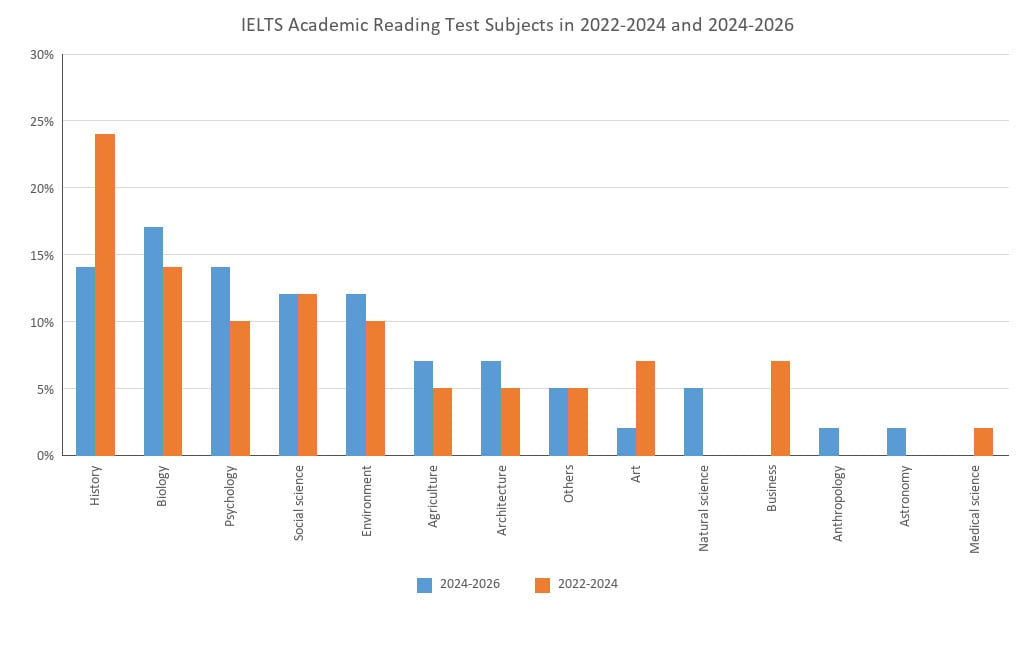
在 2022-2024 與 2024-2026 年,最常出現的主題是歷史。 其次是生物學,然後是心理學與社會科學, 例如文化、教育、語言學與社會學等。
下圖顯示 2022-2024 與 2024-2026 年 Academic IELTS Reading 的主題分佈。
因應這些趨勢,我們的 IELTS Reading 練習測驗也涵蓋了上述熱門主題。 我們同時也加入了較少見的主題,以確保學員能為所有可能性做好準備。 畢竟,你永遠無法預測正式 IELTS Reading 會考什麼主題!
IELTS Reading 分數如何計算?
IELTS Reading 的分數取決於你在 40 題中答對多少題。 Academic 與 General Training(GT)版本的閱讀難度不同, 因此相同的正確題數,換算出的分數可能會不一樣。
我們依照官方資料製作了下方表格,幫助你了解: 答對多少題會換算成 IELTS Reading 的哪一個分數(band score)。
IELTS Academic Reading 換算表:
| 正確題數(40 題滿分) | IELTS Academic Reading 分數 |
|---|---|
| 39–40 | 9.0 |
| 37–38 | 8.5 |
| 35–36 | 8.0 |
| 33–34 | 7.5 |
| 30–32 | 7.0 |
| 27–29 | 6.5 |
| 23–26 | 6.0 |
| 19–22 | 5.5 |
| 15–18 | 5.0 |
| 13–14 | 4.5 |
IELTS General Training Reading 換算表:
| 正確題數(40 題滿分) | IELTS GT Reading 分數 |
|---|---|
| 40 | 9.0 |
| 39 | 8.5 |
| 37–38 | 8.0 |
| 36 | 7.5 |
| 34–35 | 7.0 |
| 32–33 | 6.5 |
| 30–31 | 6.0 |
| 27–29 | 5.5 |
| 23–26 | 5.0 |
| 19–22 | 4.5 |
如你所見,GT 閱讀相較於 Academic 版本通常簡單一點, 因此 **GT 要取得相同的 IELTS 分數,需要答對更多題目**。
建議你一開始可以利用我們的 IELTS Reading 練習題判斷自身程度, 再搭配上述換算表,設定明確的分數目標。
11 種雅思閱讀題型
IELTS 閱讀測驗共有 11 種不同題型,而每一種題型都需要不同的解題策略。
每一種題型的範例與解答都在IELTS 閱讀題型指南。
- 資訊配對 (Matching Information)
- 標題配對題 (Matching Headings)
- 特徵配對 (Matching Features)
- 是非題 (Identifying Information)
- 辨識作者觀點 (Identifying Writer's Views/claims)
- 選擇題 – Multiple Choices
- 配對句子題 – Matching Sentence Endings
- 句子完成題 – Sentence Completion
- 填空題 (Summary, Note, Table, Flow-chart Completion)
- 圖表標籤完成題 (Diagram Label Completion)
- 簡答題 (Short Answer Questions)
- 雅思閱讀題型趨勢
雅思閱讀題型趨勢
我们的学员觉得哪些阅读题型最难
BestMyTest 学员已在我们的模拟测试中回答了一百万道学术类阅读题和 600,000 道培训类阅读题。下表中的百分比表示各题型的答题正确率。
| 题型 | 学术类 | 培训类 |
|---|---|---|
| 信息匹配题(Matching information) | 34% | 72% |
| 事实判断题:正确 / 错误 / 未提及(True / False / Not Given) | 39% | 60% |
| 选择题(Multiple choice) | 43% | 48% |
| 特征匹配题(Matching features) | 48% | 74% |
| 句子填空题(Sentence completion) | 49% | 75% |
| 标题匹配题(Matching headings) | 53% | 40% |
| 观点判断题:是 / 否 / 未提及(Yes / No / Not Given) | 55% | 57% |
| 摘要填空题(Summary completion) | 59% | 46% |
| 简答题(Short answer) | 54% | 75% |
- 在学术类阅读中,学员最薄弱的两种题型是信息匹配题和事实判断题,正确率均低于 40%。这两种题型都要求你定位经过改写的信息,而不是寻找相同的关键词。
- 在培训类阅读中,情况恰好相反:标题匹配题是最薄弱的题型,正确率为 40%,而信息定位类题型每四次作答就有三次正确,因为文章更短,表达也更直白。
- 学术类阅读文章的平均答题正确率为 46%,培训类阅读文章则为 59%。学术类阅读文章的作答记录中,有一半的正确率不超过 40%。
- 38,534 名学员完成了共 43,711 次完整阅读模拟测试,平均分为 5.4 分。36% 的学员达到 6.0 分,14% 的学员达到 7.0 分。
- 你仍然需要准备所有题型,但如果时间紧张,这张表能告诉你把时间花在哪里最有效。
数据来自截至 2026年10月的 BestMyTest 模拟测试和批改记录。各题型的百分比为所有作答记录的正确率;评分标准相关数值为教师或 AI 给出的评分,具体以标注为准。最后更新于 2026年10月5日。
接下來,我們會進入 IELTS reading 必備的實戰技巧與策略,幫助你大幅提升閱讀成績。
IELTS Reading 小技巧 - 如何提升你的閱讀分數
大多數學生在閱讀部分失敗有以下三個原因:
- 閱讀速度太慢
- 字彙量不足
- 缺乏準備或完全沒準備
提升閱讀速度
先把最明顯的事情說清楚:要提升閱讀速度,你就必須「真的去讀」,而且要持續練習。
接著,讓我們看看一個比較不那麼直覺,但非常有效的技巧── 從拆解句子開始,找出句子的主詞與動詞。找到主詞與動詞後,你就更容易理解整句話的意思。 學術文章之所以常常難以理解,是因為它們會把很多想法串在一起變成長長的複合句。 這會形成大段難以吸收的句子,因此在 IELTS 閱讀中,用主詞與動詞當作理解長句的指南,是非常有用的方法。
提升你的字彙量
很多人以為回答閱讀題目就是在文章中「掃到關鍵字」就好……但很可惜,沒那麼簡單。 閱讀題目通常會「改寫」文章原文,也就是使用同義字來替換 IELTS 閱讀文章中的詞彙, 這就是為什麼難度會提高。也因此,你必須提升字彙量,才能認出更多同義字。
當你準備閱讀時,只要遇到不認識的字,就養成習慣立即查詢,或至少記下來之後查。 這可能有點麻煩,但非常有效。你的目標應該是每天學習 15–20 個新的學術字彙。
了解哪些題型答案「有順序」/「沒順序」
很重要的一點是:在某些題型中,答案幾乎總是按照 IELTS 文章的順序出現; 而在另一些題型中,答案幾乎從來不是照順序的。以下是整理好的表格供你參考。
| 答案通常(幾乎總是)依照文章順序 | 答案幾乎從來不依照文章順序 |
|---|---|
|
|
找到最適合你的閱讀策略
大多數人在 IELTS 閱讀部分最大的挑戰,就是「在時間內做完所有題目」。 在下一段中,你會學到三種閱讀策略,而你要用 我們的免費閱讀練習 來找到最適合你的那一種。
IELTS 三大閱讀策略
策略 1:先讀完整篇文章,再回答問題
老實說,這稱不上是一種策略。通常是因為沒準備好的人才會這樣做。 但從技術上來說,如果你能在第一次閱讀時就記住所有資訊並順利回答問題, 那你確實不需要其他策略。
如果你的記憶力沒有特別好,這方法其實非常沒有效率, 很容易在答題前就耗盡時間。 當然,有些題目例如 Yes/No 題目,你可以快速略讀找到答案, 但這類題目不足以支持你用這個策略完成整份考試。
策略 2:先讀題目 → 帶著目的閱讀 → 做筆記 → 聰明回答
這是我們最推薦的策略。 也最能幫助你提升 IELTS 閱讀分數。
很多考生的大錯誤,就是一開始就從頭到尾讀文章。 雖然平常閱讀可以這樣做,但考試時這會浪費大量時間。 你應該先讀題目,因為題型會決定你該怎麼讀文章, 是用 skimming(略讀)還是 scanning(找特定資訊)。
另外,你應該先做「同一題型」的一組題目。 先從容易的題型開始,例如 段落標題配對(Matching Heading), 因為它只需要找段落主旨。 比較難的題型則是 資訊判斷(Identifying Information), 因為每一段都要仔細判斷 TRUE / FALSE / NOT GIVEN。
以下是難度對照表:
| 難度 | 題型 |
|---|---|
| 容易 | 段落標題配對 簡答題 |
| 中等 |
句子配對 特徵配對 選擇題 句子填空 圖表/摘要/筆記/表格/流程圖填空 |
| 困難 |
資訊配對 資訊判斷(TRUE/FALSE/NOT GIVEN) 觀點判斷(YES/NO/NOT GIVEN) |
讀題目後,你就能帶著目的閱讀。 例如題目出現年份「1896」,那你在文章中看到這一年時就可以立即標記。
兩大技巧會幫助你更有效找答案: Skimming:快速抓大意,不停下來查單字。 Scanning:只找特定資訊(如人名、年份、名詞)。
閱讀時,你應該在邊欄做記號、星號、底線, 只要是你覺得之後回答題目有用的資訊,都應該標記起來。
找到相關段落後,就要開始仔細閱讀, 並批判性思考來選出正確答案。
策略 3:略讀(Skimming)+ 做筆記 + 題型分組作答
這也是許多 IELTS 考生愛用的策略,主要分成四步驟:
- 略讀每一段,抓主旨句;快速底線重要名詞。
- 在每段旁邊寫下 2–5 字的主旨筆記。
- 選一組題型作答。
- 高效率且正確地回答問題。
步驟 1 和 2 不要超過 3–5 分鐘,否則會耗盡時間。
步驟 1 & 2這兩步的目的是建立快速找答案的索引。 有了每段的主旨,你會更快知道答案在哪一段。
步驟 3略讀+筆記完成後,你需要選擇要先做哪一題型。 一樣建議從簡單的題型開始,例如 段落標題配對。 困難題型如 資訊判斷 則需要更多時間與注意力。
| 難度 | 題型 |
|---|---|
| 容易 | 段落標題配對 簡答題 |
| 中等 |
句子配對 特徵配對 選擇題 句子填空 圖表/摘要/筆記/表格/流程圖填空 |
| 困難 |
資訊配對 資訊判斷(TRUE/FALSE/NOT GIVEN) 觀點判斷(YES/NO/NOT GIVEN) |
決定題型後,就可以開始作答。 請記住以下原則:
- 仔細讀題目,找出關鍵字。
- 找到可能有答案的段落(你的筆記會省大量時間)。
- 在段落中 掃描同義字,找出精準位置。
- 仔細閱讀、邏輯思考,選出正確答案。
免費 IELTS Reading 練習題 PDF(附答案)
以下是 British Council(IELTS 主辦單位)提供的免費閱讀練習。 試著先回答問題,看看自己的程度如何!