
En esta guía aprenderás a redactar ensayos de alta puntuación para la IELTS writing task 1 y la IELTS writing task 2. No importa qué examen vayas a presentar, academic o general training, te tenemos cubierto. Esta guía incluye ejemplos de IELTS Writing, temas y lecciones detalladas para general writing task 1 y 2 y academic writing task 1 y 2.
Obtén ensayos de muestra gratuitos de writing de IELTS después de completar una prueba de práctica de writing de IELTS.
| Examen de IELTS General Writing | Examen de IELTS Academic Writing |
|---|---|
A continuación encontrarás nuestra lista completa de preguntas de writing de IELTS con ensayos de muestra. Nota: los enlaces en rojo son nuestras preguntas de writing más populares y recomendadas por nuestros estudiantes, y puedes practicarlas gratis cuando quieras.
Ejemplos de IELTS General Writing Task 1 1 - 44
Informal, formal, & semi-formal letters
Ejemplos de IELTS Academic Writing Task 1 1 - 52
Line graphs, bar charts, pie charts, tables, maps, flow charts, & multiple charts
Ejemplos de IELTS Writing Task 2 1 - 96
Opinion, discussion, advantages & disadvantages, problem & solution, cause & effect, & two-part questions
Índice
Información sobre el test IELTS Writing
El test de writing consta de 2 tareas y dispondrás de un total de 60 minutos para completar ambas. Puedes hacer las tareas en cualquier orden, pero asegúrate de gestionar bien el tiempo y dedicar alrededor de 20 minutos a la IELTS writing task 1 y 40 minutos a la IELTS writing task 2.
IELTS Academic Writing Task VS IELTS General Writing Task
El IELTS ofrece dos versiones de examen. La versión Academic es para personas que buscan educación superior, mientras que la versión General Training es para quienes buscan simplemente migrar o cursar estudios inferiores. Existen más criterios para ambas versiones, así que contacta con el servicio de atención al cliente del IELTS para saber qué test es adecuado para ti.
¿Cuál es más difícil? El test academic, como puedes imaginar, es más difícil que el general training. La diferencia entre los dos está en la dificultad de la IELTS writing task 1. Por suerte, solo la Writing Task 1 es diferente. La IELTS writing task 2 es la misma para ambas versiones. La tabla siguiente resume los dos tipos de tests IELTS writing.
| Tipo de test | Task 1 | Task 2 |
|---|---|---|
| Academic Writing | IELTS Academic Writing Task 1
En la IELTS academic writing task 1, se te presenta una gráfica, tabla, diagrama o esquema y se te pide describir, resumir o explicar la información con tus propias palabras. |
IELTS Writing Task 2 En la IELTS writing task 2, tendrás que escribir un ensayo de estilo tradicional en respuesta a una pregunta. Debes escribir al menos 250 palabras. |
| General Writing |
IELTS General Writing Task 1
En la IELTS General Writing Task 1, se te pide escribir una carta sobre una situación dada. Esta carta será de uno de los siguientes tipos: - Formal (las cartas formales se envían a personas que no conocemos o con las que nunca nos hemos encontrado.) - Semiformal (las cartas semiformales se envían a personas a las que no conocemos bien.) - Informal (las cartas informales se envían a personas que conocemos bien, como nuestros amigos) |
Vídeo de introducción a IELTS Academic Writing
Vídeo de introducción a IELTS General Writing
¡Próximamente!
Cómo se puntúa el test IELTS Writing
En el test IELTS writing, tu puntuación de writing se calculará según cuatro categorías. Estas se conocen como
Task Achievement/Task Response, Coherence and Cohesion, Lexical Resource, y Grammatical Range and Accuracy.
Consulta los siguientes descriptores de banda que utilizan los examinadores IELTS para puntuar la sección de writing del test:
- IELTS Writing Task 1 Band Descriptors
- IELTS Writing Task 2 Band Descriptors
Ten en cuenta que los criterios de puntuación de ambas tareas incluyen:
- Task Achievement/Task Response - ¿Has respondido completamente a la pregunta y has presentado una respuesta plenamente desarrollada?
- Coherence and Cohesion - ¿Tiene sentido tu argumentación o análisis? ¿Está bien pensado y presentado de manera completa?
- Lexical Resource – ¿Has usado un vocabulario amplio con un tono natural y formal?
- Grammatical Range and Accuracy – ¿Tu ensayo está prácticamente libre de errores? ¿Has logrado utilizar una amplia variedad de estructuras gramaticales?
¿La IELTS Writing Task 1 y la IELTS Writing Task 2 valen la misma cantidad de puntos?
Bueno, igual que dedicarás el doble de tiempo a escribir la IELTS writing task 2,
también vale aproximadamente el doble de puntos. No es exactamente el doble.
Otra forma de verlo es sumar la puntuación de writing task 2 dos veces. Así, toma
las puntuaciones de banda 7 para task 1 y 4 para task 2 y obtendrás la siguiente
fórmula para calcular tu puntuación IELTS writing:
(7 + (4 x 2))/3 = 5.
Por lo tanto, la puntuación de banda total de IELTS writing es de aproximadamente 4,5 - 6. Como ves, no podemos dar un número exacto
porque el IELTS no ha hecho pública su fórmula de puntuación, pero la fórmula
presentada aquí es bastante exacta con una diferencia de aproximadamente 0,5 puntos.
Lo que revelan 19.000 ensayos de IELTS evaluados
Entre 2020 y 2026, los tutores de BestMyTest evaluaron unas 9.400 tareas de expresión escrita de IELTS y nuestro sistema de revisión con IA corrigió otros 9.614 ensayos. Hay tres aspectos que destacan.
- La gramática determina la banda de puntuación. La variedad y precisión gramatical obtuvo la puntuación más baja de los cuatro criterios en el 91% de los ensayos de Task 2, el 84% de los informes de Task 1 de la modalidad académica y el 94% de las cartas de la modalidad de formación general. Puntuaciones medias otorgadas por los tutores en Task 2: gramática 5.5, riqueza léxica 6.0, coherencia y cohesión 6.1, respuesta a la tarea 6.1. En Task 1 de la modalidad académica: gramática 5.5, coherencia 5.8, cumplimiento de la tarea 5.8, riqueza léxica 5.8. En Task 1 de la modalidad de formación general: gramática 5.3, riqueza léxica 5.9, coherencia 6.0, cumplimiento de la tarea 6.2.
- Los ensayos cortos se penalizan. El 17% de los ensayos de Task 2 no alcanzó el mínimo de 250 palabras y obtuvo una media de 4.9 en respuesta a la tarea, frente a 6.1 en los ensayos que alcanzaron las 250 palabras. El 13% de los informes de Task 1 de la modalidad académica y el 16% de las cartas de la modalidad de formación general tenían menos de 150 palabras. Las medias de nuestros estudiantes son de 285 palabras en Task 2 y unas 175 palabras en Task 1.
- Los errores son pequeños y repetitivos. Un ensayo de Task 2 recibe unas 21 correcciones. La puntuación encabeza la lista (17% de las correcciones), seguida de los artículos (11%), la ortografía (10%), los sustantivos en singular y plural (9%), la concordancia entre sujeto y verbo (7%) y las preposiciones (6%). Dos tercios de los ensayos de Task 2 contenían un error en el uso de artículos y el 58% un error de concordancia entre sujeto y verbo. En Task 1 de la modalidad académica, el vocabulario relacionado con los datos provoca errores adicionales: "male" a "males", "increase" a "increased", "compare" a "compared". En las cartas de la modalidad de formación general, el uso de mayúsculas (9% de las correcciones) y los tiempos verbales (6%) tienen más peso que en las otras tareas.
- Las correcciones más frecuentes de nuestro sistema de revisión: "this" a "these", "is" a "are", "have" a "has", "in" a "on", "of" a "for", "amount" a "number", "then" a "than", "that" a "who", "goverment" a "government", "belive" a "believe", "accomodation" a "accommodation".
Las cifras proceden de los datos de exámenes de práctica y revisiones de BestMyTest hasta octubre de 2026. Los porcentajes por tipo de pregunta son tasas de respuestas correctas calculadas sobre todos los intentos; las cifras por criterio son puntuaciones de tutores o de IA, según se indica. Última actualización: 5 de octubre de 2026.
IELTS Academic Writing Task 1
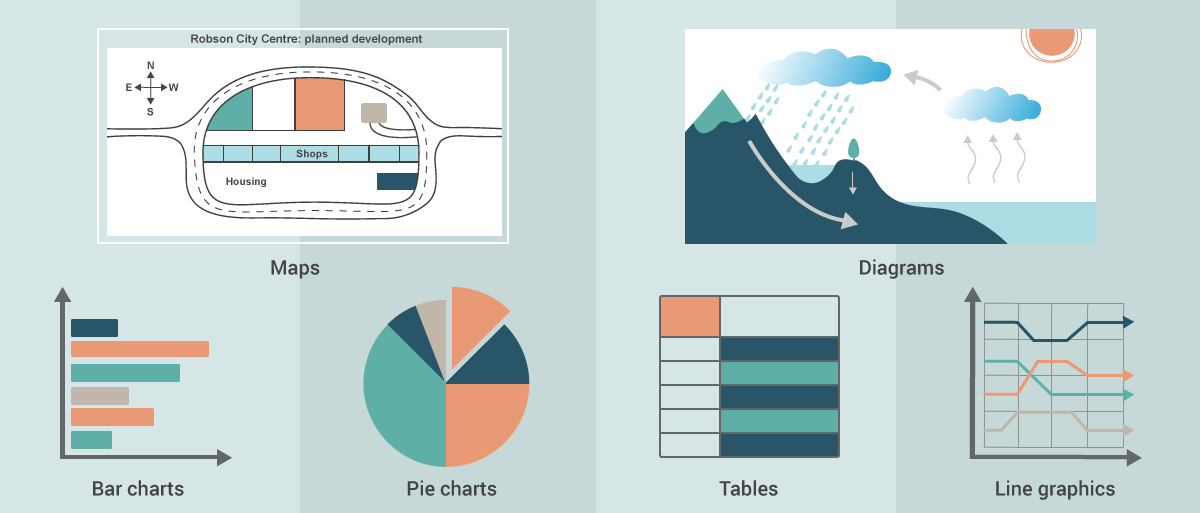
En la IELTS academic writing task 1, se te presenta una gráfica, tabla, diagrama o esquema y se te pide describir, resumir o explicar la información con tus propias palabras. Puede que se te pida describir y explicar datos, describir las fases de un proceso, cómo funciona algo o describir un objeto o evento.
Independientemente de la información visual que se te presente, tu tarea es escribir un resumen de la información visual y describir las principales tendencias, las diferencias generales, los cambios principales o los componentes principales de un sistema, o las fases principales de un proceso. Debes escribir 150 palabras o más y deberías dedicar unos 20 minutos a esta parte del test. La estructura de la redacción puede ser la siguiente:
- Introducción: parafrasear la pregunta
- Visión general: describir la tendencia global o redactar un resumen general de los principales grupos
- Párrafo de desarrollo 1: escribir en detalle sobre el primer grupo de forma lógica
- Párrafo de desarrollo 2: escribir en detalle sobre el segundo grupo de forma lógica
Los pasos para escribir el informe de esta tarea son muy sencillos:
- Analizar la(s) gráfica(s) y planificar cómo agrupar la información
- Escribir un ensayo utilizando la estructura recomendada
- Revisar el ensayo
Veamos cada uno de los distintos tipos posibles de gráficas, tablas, diagramas y esquemas visuales con los que podrías encontrarte en tu test IELTS writing:
Gráficas de líneas
En este tipo de tarea, recibirás una o más gráficas de líneas. Cada gráfica de líneas tendrá entre 1 y 8 líneas que muestran cómo cambian los valores a lo largo del tiempo. El periodo de tiempo podría ser el pasado, el presente o el futuro, o una combinación de los tres. Tu tarea es escribir un resumen, cubriendo los puntos más importantes y apoyando tu descripción incluyendo datos.
The chart illustrates average CO2 emissions per person in four European countries between 1975 and 2015.
Summarise the information by selecting and reporting the main features, and make comparisons where relevant.
- Write at least 150 words.
- You should spend around 20 minutes on this task.
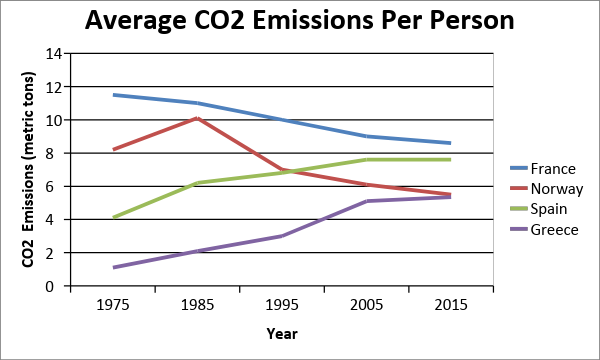
The line graph depicts the average Carbon dioxide emission for each individual residing in four countries, namely France, Norway, Spain, and Greece, over 40 years.
Overall, although CO2 production in France and Norway declined, it increased significantly in Spain and Greece over the period. Norway improved the most to become the most environmentally friendly, whereas Greece had the highest increase of all in that time.
Throughout the period, France produced the most CO2, though production declined overall from 11 tonnes per individual in 1975 to around 8.5 tonnes by 2015. In turn, except for a spike in emissions in 1985, Norway’s production of CO2 fell from 8 to under 6 tonnes forty years later.
On the contrary, CO2 release in Spain and Greece saw a more upward turn. In Spain, production doubled from 4 tonnes in 1975, overtaking Norway by 1995, to a final figure of just under 8 metric tonnes per head of population. Similarly, emissions in Greece, which were the lowest in 1975, increased five times to equal those of Norway in 2015.

Line Chart
Learn how to answer this question in a step-by-step interactive exercise
Line Chart
En la Task 1 de IELTS Academic describes lo que muestra un gráfico. No das tu opinión ni explicas por qué los números son como son.
Un gráfico de líneas muestra cómo cambian los valores a lo largo del tiempo, a menudo con varias líneas a la vez, así que este informe describe el cambio y compara las líneas.
Echa un vistazo a la tarea y luego haz clic en Siguiente para continuar.
Echar un vistazo a la pregunta
Summarise the information by selecting and reporting the main features, and make comparisons where relevant.
Write at least 150 words.
Lee el gráfico antes de escribir. Fíjate en el título, el periodo de tiempo del eje horizontal, las unidades del eje vertical y la leyenda que nombra cada línea.
Después busca el punto donde terminan los datos medidos y empieza una proyección. Ese punto divide tus tiempos verbales: formas del pasado para los años ya medidos, y formas como is expected to, is predicted to e is set to para los años que aún están por venir.
Responde a las preguntas sobre el gráfico.
Leer el gráfico
La introducción dice con tus propias palabras lo que muestra el gráfico. Parafrasea la tarea: cambia las palabras, mantén el significado y conserva el tema, lo que miden las líneas y el periodo de tiempo.
Copiar la oración de la tarea no suma puntos, y aquí no van cifras. Guarda todos los números para los párrafos de desarrollo.
Escribe una o dos oraciones que parafraseen la tarea.
Escribir la introducción
Pregunta de la tarea
The chart illustrates average CO2 emissions per person in four European countries between 1975 and 2015.
Summarise the information by selecting and reporting the main features, and make comparisons where relevant.
Write at least 150 words.
Un informe de Task 1 necesita un párrafo de desarrollo por cada grupo de líneas, y un gráfico de líneas suele tener más líneas que grupos. Agrupa las líneas que se mueven en la misma dirección: las que suben, las que bajan y las que se mantienen. Si todas las líneas se mueven igual, tienes un párrafo; si hay una de cada tipo, tienes tres.
Un párrafo por cada línea, o un párrafo por cada mitad del periodo, rompe la comparación que pide la tarea. Agrupar solo por nivel puede poner una línea que sube y otra que baja en el mismo párrafo.
Elige la agrupación que da a cada párrafo un patrón claro.
Hacer los grupos
Elige la agrupación que da a cada párrafo un patrón claro.
- Group 1: Norway, Spain, Greece. Group 2: France.
- Group 1: Greece. Group 2: France, Norway, Spain.
- Group 1: Norway, Greece. Group 2: France, Spain.
- Group 1: France, Norway. Group 2: Spain, Greece.
La visión general es el patrón más importante de todo el gráfico. La forman los rasgos principales. Primero: ¿cuál es la dirección general de cada grupo a lo largo del periodo? Después: cuando hay dos o más grupos, ¿qué distancia hay entre el primero y el último, y esa diferencia crece, se reduce o se invierte?
Junta estos rasgos y tendrás tu visión general. No añadas años ni números concretos aquí. Guárdalos para los párrafos de desarrollo.
Encuentra los rasgos principales para construir tu visión general.
Encontrar la tendencia general
Ahora convierte los dos rasgos principales en una o dos oraciones. La visión general es la parte del informe que el examinador busca primero, así que escríbela antes de cualquier detalle y mantenla general.
Usa el tiempo verbal que corresponde al gráfico y describe lo que muestra, no por qué. No des cifras ni añadas tu opinión.
Escribe una o dos oraciones generales sobre el patrón más importante.
Escribir tu visión general (overview)
El párrafo de desarrollo 1 trata solo tu primer grupo de líneas, a lo largo de todo el periodo, y aquí es donde van las cifras.
Describe la forma de cada línea en lugar de cada uno de sus puntos: el valor inicial, la dirección, cualquier cambio de dirección y el valor final o previsto. Usa lenguaje de cambio en el tiempo como rise steadily, fluctuate, level off y peak, e indica el año con cada cifra.
Si no sabes bien cómo expresar un punto, haz clic en él y se añadirá una oración de muestra a tu área de escritura.
Escribe tres o cuatro oraciones sobre tu primer grupo, con cifras.
Escribir el párrafo de desarrollo 1
El párrafo de desarrollo 2 trata solo tu segundo grupo de líneas. Trátalo igual: la forma de cada línea, apoyada con cifras.
No repitas el párrafo de desarrollo 1. Relaciona los grupos cuando valga la pena señalar una diferencia, con expresiones como in contrast y far lower than.
Si no sabes bien cómo expresar un punto, haz clic en él y se añadirá una oración de muestra a tu área de escritura.
Escribe tres o cuatro oraciones sobre tu segundo grupo, con cifras.
Escribir el párrafo de desarrollo 2
Tu plan del informe está completo. Una respuesta de Task 1 terminada tiene estas partes en este orden: una introducción que parafrasea la tarea, una visión general del patrón más importante y un párrafo de desarrollo por cada grupo que apoya ese patrón con cifras seleccionadas.
Lee tus secciones juntas y comprueba tres cosas: la visión general y los detalles coinciden, el tiempo verbal corresponde a los valores medidos y previstos, y cada cifra lleva su unidad y su año.
Revisa tu plan del informe y luego compáralo con la redacción modelo.
Plan completo del informe
Cómo decidir
Un gráfico de líneas de IELTS Academic Task 1 muestra cómo cambian los valores con el tiempo, a menudo en varias líneas a la vez. Describes esos cambios y comparas las líneas. No necesitas todos los puntos de cada línea.
Trabaja siempre en el mismo orden para tener el informe planificado antes de escribir la primera oración.
- Leer el gráfico. Comprueba el título, el periodo de tiempo, las unidades, la leyenda y dónde terminan los datos medidos y empieza cualquier proyección.
- Escribir la introducción. Parafrasea la tarea y di qué muestra el gráfico.
- Hacer los grupos. Agrupa las líneas que se comportan de forma parecida para que cada párrafo de desarrollo tenga una idea clara.
- Encontrar la tendencia general. Decide cuál es el patrón principal de todo el gráfico antes de fijarte en valores concretos.
- Escribir el informe por etapas. Escribe primero la visión general (overview), luego un párrafo de desarrollo por cada grupo con cifras seleccionadas, y después revisa el plan completo.
Agrupa las líneas antes de describirlas. Un gráfico con muchas líneas se convierte en un informe breve cuando las líneas parecidas comparten un párrafo, y agrupar es justo lo que la tarea quiere decir con seleccionar los rasgos principales.
Leer la gráfica
Empieza por los ejes. El eje horizontal da el periodo de tiempo, el eje vertical da las unidades y la leyenda nombra cada línea. Busca el punto donde terminan los datos medidos, porque todo lo que viene después es una proyección y necesita formas de futuro.
Introducción
La introducción son una o dos oraciones que dicen qué muestra el gráfico con palabras distintas de las de la tarea. Mantén el tema, lo que miden las líneas y el periodo de tiempo. No incluyas cifras ni tendencias.
Grupos
Un informe de Task 1 tiene un párrafo de desarrollo por cada grupo de líneas. Agrupa las líneas que se mueven en la misma dirección: las que suben, las que bajan y las que se mantienen estables. Si todas las líneas se mueven igual, tienes un párrafo; si hay una de cada tipo, tienes tres.
Tendencia general
La tendencia general es el patrón principal del gráfico: la dirección general de cada grupo a lo largo del periodo y la distancia que mantienen los grupos entre sí. Es una afirmación general, así que no lleva cifras.
Para aprender a abordar las gráficas de líneas en IELTS Academic Writing Task 1, consulta nuestra lección IELTS Academic Writing Task - Line Graphs.
Prueba gratuita de 7 díasGráficos de barras
En este tipo de tarea, recibirás uno o más gráficos de barras. Los gráficos de barras pueden mostrar cómo cambian los valores a lo largo del tiempo (datos dinámicos), las diferencias entre valores en un momento dado (datos estáticos), o los resultados de una encuesta o cuestionario. La información podría tratar sobre la situación en el pasado, el presente o el futuro, o una combinación de los tres. Tu tarea es escribir un resumen, cubriendo los puntos más importantes y apoyando tu descripción con datos.
The chart below shows the proportion of males and females in Malaysia who commonly do physical activity in 2010.
Summarise the information by selecting and reporting the main features, and make comparisons where necessary.
- Write at least 150 words.
- You should spend around 20 minutes on this task.
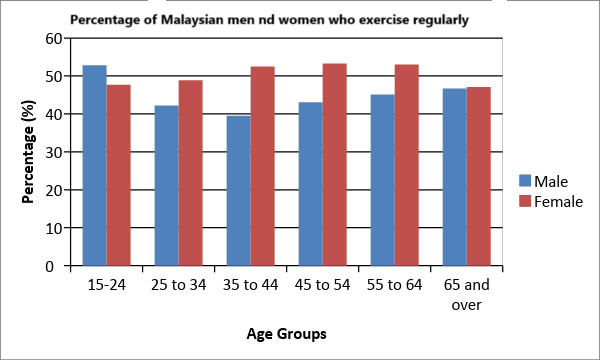
The bar chart compares the proportion of male and females of differing age groups who frequently undertook physical activity in 2010.
Overall, while the Malaysian population keeps fit in general, a higher proportion of women than men exercised in 2010, with some further differences between age groups. Middle-aged females were the most likely to work out, while for men, those aged 15 to 24 tended to do the most physical activity.
In terms of men’s exercise habits, younger men were much more likely to exercise than older men with 52.8% of those aged under 24 exercising as opposed to only around 40% of older age groups
By contrast, around half of all women in all age groups reported keeping fit, especially those aged between 35 and 64 at around 53%. The exception was the youngest age group in which only 47.7 percent of women exercised compared to 52.8% of men. Similarly, for people 65 and over, just approximately 47% of both sexes were recorded regularly working out.
Bar Chart
Learn how to answer this question in a step-by-step interactive exercise
Bar Chart
En la Task 1 de IELTS Academic describes lo que muestra un gráfico. No das tu opinión ni explicas por qué los números son como son.
Un gráfico de barras compara grupos en una serie de categorías, así que este informe se basa en comparaciones y no en cambios a lo largo del tiempo.
Echa un vistazo a la tarea y luego haz clic en Siguiente para continuar.
Echar un vistazo a la pregunta
Summarise the information by selecting and reporting the main features, and make comparisons where necessary.
Write at least 150 words
Lee el gráfico antes de escribir. Fíjate en el título, las categorías del eje horizontal, las unidades del eje vertical y la leyenda que nombra cada grupo de barras.
Las unidades deciden cómo lo expresas. Número de personas, porcentajes y cantidades de dinero no son lo mismo, y nombrar la unidad equivocada te hace perder puntos aunque el resto de la oración sea correcto.
Responde a las preguntas sobre el gráfico.
Leer el gráfico
La introducción dice con tus propias palabras lo que muestra el gráfico. Parafrasea la tarea: cambia las palabras, mantén el significado y conserva el tema, los grupos que se comparan y el lugar o la fecha si la tarea los indica.
Copiar la oración de la tarea no suma puntos, y aquí no van cifras. Guarda todos los números para los párrafos de desarrollo.
Escribe una o dos oraciones que parafraseen la tarea.
Escribir la introducción
Pregunta de la tarea
The chart below shows the proportion of males and females in Malaysia who commonly do physical activity in 2010.
Summarise the information by selecting and reporting the main features, and make comparisons where necessary.
Write at least 150 words
Un informe de Task 1 necesita un párrafo de desarrollo por cada grupo, así que decide pronto cómo vas a dividir los datos. Agrupa las series de la leyenda que se comportan de forma parecida: las series que están a un nivel similar, o que son más altas y más bajas en las mismas categorías, comparten párrafo. Las series que se comportan de otra manera van en su propio párrafo. Así cada párrafo contiene una idea clara.
Una división que solo separa los valores altos de los bajos, o que da a cada categoría su propio párrafo, te hace repetirte.
Elige la agrupación que da a cada párrafo una idea clara.
Hacer los grupos
Elige la agrupación que da a cada párrafo una idea clara.
- Group 1: Female. Group 2: Male.
- One group: Male and Female.
La visión general es el patrón más importante de todo el gráfico. La forman hasta tres rasgos principales. ¿Qué grupo es más alto en la mayoría de las categorías? ¿Qué grupo es el más bajo en la mayoría de las categorías? ¿La diferencia es más o menos igual en todas las categorías, o hay una categoría muy distinta de las demás?
No todos los gráficos muestran los tres, así que este paso solo pregunta por los rasgos que importan en este gráfico. Júntalos y tendrás tu visión general. No añadas números concretos aquí. Guárdalos para los párrafos de desarrollo.
Encuentra los rasgos principales para construir tu visión general.
Encontrar la tendencia general
Ahora convierte los rasgos principales que encontraste en una o dos oraciones. La visión general es la parte del informe que el examinador busca primero, así que escríbela antes de cualquier detalle y mantenla general.
Describe lo que muestra el gráfico, no por qué es así. No des cifras ni añadas tu opinión.
Escribe una o dos oraciones generales sobre el patrón más importante.
Escribir tu visión general (overview)
El párrafo de desarrollo 1 trata solo tu primer grupo, y aquí es donde van las cifras.
Selecciona las comparaciones importantes: el valor más alto, el valor más bajo y cualquier categoría que se comporte de forma distinta al resto. Como un gráfico de barras compara grupos en el mismo periodo, usa lenguaje de comparación como higher than, twice as many as y the largest of all the categories.
Si no sabes bien cómo expresar un punto, haz clic en él y se añadirá una oración de muestra a tu área de escritura.
Escribe tres o cuatro oraciones sobre tu primer grupo, con cifras.
Escribir el párrafo de desarrollo 1
El párrafo de desarrollo 2 trata solo tu segundo grupo. Trátalo igual que el primero: las comparaciones más claras, apoyadas con cifras.
No repitas el párrafo de desarrollo 1. Relaciona los grupos cuando valga la pena señalar una diferencia, con expresiones como in contrast y compared with.
Si no sabes bien cómo expresar un punto, haz clic en él y se añadirá una oración de muestra a tu área de escritura.
Escribe tres o cuatro oraciones sobre tu segundo grupo, con cifras.
Escribir el párrafo de desarrollo 2
Tu plan del informe está completo. Una respuesta de Task 1 terminada tiene estas partes en este orden: una introducción que parafrasea la tarea, una visión general del patrón más importante y un párrafo de desarrollo por cada grupo que apoya ese patrón con cifras seleccionadas.
Lee tus secciones juntas y comprueba tres cosas: la visión general y los detalles coinciden, cada cifra lleva su unidad y has descrito el gráfico sin explicarlo.
Revisa tu plan del informe y luego compáralo con la redacción modelo.
Plan completo del informe
Cómo decidir
Un gráfico de barras de IELTS Academic Task 1 te pide describir lo que muestra el gráfico y comparar sus grupos. No necesitas todos los números. Necesitas las comparaciones que importan.
Trabaja siempre en el mismo orden para tener el informe planificado antes de escribir la primera oración.
- Leer el gráfico. Comprueba el título, las categorías, las unidades y la leyenda antes de escribir nada.
- Escribir la introducción. Parafrasea la tarea y di qué muestra el gráfico.
- Hacer los grupos. Divide los datos para que cada párrafo de desarrollo tenga una idea clara.
- Encontrar la tendencia general. Decide cuál es el patrón principal de todo el gráfico antes de fijarte en valores concretos.
- Escribir el informe por etapas. Escribe primero la visión general (overview), luego un párrafo de desarrollo por cada grupo con cifras seleccionadas, y después revisa el plan completo.
Una visión general clara vale más que más números. La tarea te pide seleccionar los rasgos principales, así que una afirmación general con unas pocas comparaciones sólidas puntúa mejor que una lista de todos los valores.
Leer el gráfico
Empieza por los ejes. El eje horizontal nombra lo que se compara, el eje vertical da las unidades y la leyenda nombra cada grupo de barras. Un informe que nombra la unidad equivocada cambia el significado de todas sus oraciones.
Introducción
La introducción son una o dos oraciones que dicen qué muestra el gráfico con palabras distintas de las de la tarea. Mantén el tema, los grupos que se comparan y el lugar o el momento. No incluyas cifras ni tendencias.
Grupos
Un informe de Task 1 tiene un párrafo de desarrollo por cada grupo. Agrupa las series de la leyenda que se comportan de forma parecida: series con un nivel similar, o series que son más altas y más bajas en las mismas categorías. Así cada párrafo contiene una sola idea y nunca te repites.
Tendencia general
La tendencia general es el patrón principal del gráfico: qué grupo es más alto en la mayoría de las categorías, qué grupo es el más bajo en la mayoría de las categorías, y si la diferencia es más o menos la misma en todas las categorías o si una categoría es muy distinta. Un gráfico puede mostrar uno, dos o los tres rasgos. Es una afirmación general, así que no lleva cifras.
Los gráficos de barras son bastante comunes en IELTS writing task 1 academic. Hay tres escenarios distintos con los que te encontrarás en una tarea de gráfico de barras:
- Un gráfico de barras con categorías en el eje x
- Un gráfico de barras con fechas o años en el eje (funciona como una gráfica de líneas)
- Dos gráficos de barras presentados
Cada escenario requiere que redactes el informe de forma diferente. Regístrate para una prueba gratuita de 7 días para acceder a las siguientes lecciones de gráficos de barras:
- IELTS Academic Writing Task - Bar Charts Part 1 lesson.
- IELTS Academic Writing Task - Bar Charts Part 2 lesson.
- IELTS Academic Writing Task - Bar Charts Part 3 lesson.
Gráficos circulares
En este tipo de tarea, recibirás uno, dos o tres gráficos circulares. Los gráficos circulares pueden mostrar porcentajes de una cifra total. Si tienes un gráfico circular, representará un único momento en el tiempo (datos estáticos). Si tienes dos o más gráficos circulares, pueden representar cómo cambian los porcentajes a lo largo del tiempo o comparar distintos países o grupos. Tu tarea es escribir un resumen, cubriendo los puntos más importantes y apoyando tu descripción con datos.
The charts below show the percentage of water used for different purposes in six areas of the world. Summarise the information by selecting and reporting the main features, and make comparisons where relevant.
- Write at least 150 words.
- You should spend around 20 minutes on this task.
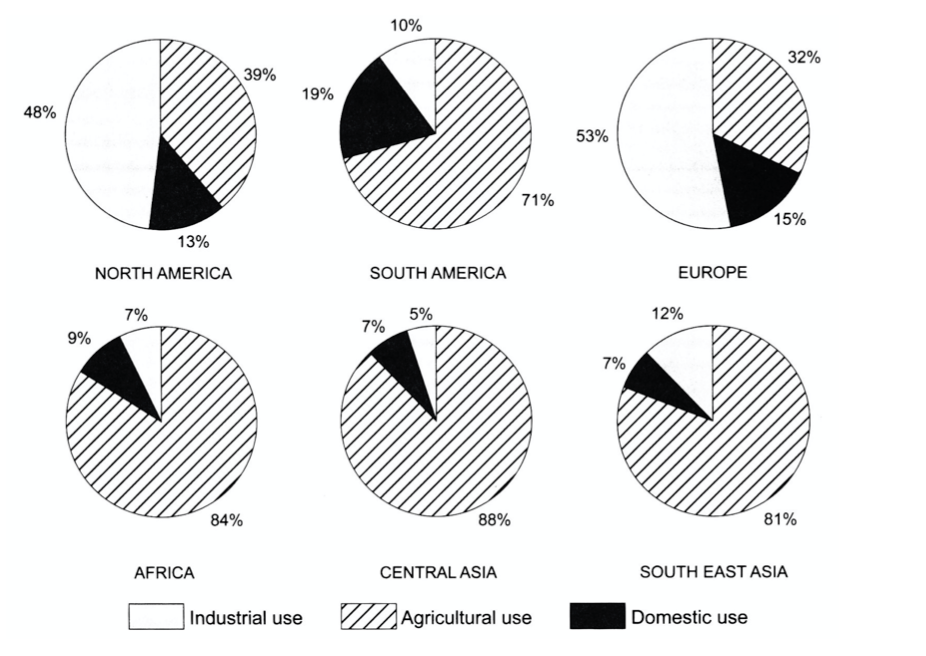
The pie charts provide information regarding the proportions of water used for industrial, agriculture, and domestic use in six regions.
In general, water serves mostly an industrial purpose in North America and Europe, whereas it is predominantly used for agriculture in South America, Africa, Central Asia, and South-East Asia.
Regarding industrial and domestic use, North America and Europe consume an average of approximately 50 percent of water for industrial purposes. However, these two regions report much less water consumption for domestic purposes, utilizing 13 percent and 15 percent, respectively. Out of all six regions, South America dedicates the highest percentage of water consumption for domestic use, but uses only 10 percent for industrial reasons. Both industrial and domestic use remain the least popular choices in Africa, Central Asia, and South-East Asia, where their combined use makes up less than 20 percent of the overall water consumption in each of the three regions.
Agricultural use, on the other hand, accounts for 71 percent of water consumption in South America and over three-fourths of water use in Africa, South-East Asia, and Central Asia, where it is nearly 90 percent. North America and Europe consume less than 40 percent of water for agricultural purposes.
Para aprender a abordar los gráficos circulares en IELTS Academic Writing Task 1, regístrate para una prueba gratuita de 7 días y accede a la lección IELTS Academic Writing Task - Pie Charts.
Prueba gratuita de 7 díasTablas
En este tipo de tarea, se te entrega una tabla con datos. Puede mostrar cifras dinámicas que cambian con el tiempo o datos estáticos para un único momento. A menudo hay demasiada información, por lo que no podrás incluir todos los detalles. Tu tarea es escribir un resumen, cubriendo los puntos más importantes y apoyando tu descripción con datos.
The table below gives the average time spent and distance traveled by UK commuters in one year. Time and distance are given in minutes and miles accordingly.
Summarise the information by selecting and reporting the main features, and make comparisons where relevant.
Commuting Habits of different regions of the UK in a year
UK Region | Average Commuting Time (minutes) | Average Commuting Distance (miles) |
London | 54 | 14 |
South East | 78 | 20 |
Scotland | 45 | 19 |
West Midlands | 39 | 18 |
North West | 36 | 18 |
Northern Ireland | 36 | 15 |
Yorkshire & Humberside | 36 | 14 |
South West | 34 | 16 |
East Anglia | 33 | 15 |
North East | 32 | 19 |
East Midlands | 32 | 15 |
Wales | 27 | 14 |
- Write at least 150 words.
- You should spend around 20 minutes on this task.
The table shows data on the average commuting time (minutes) and distance (miles) completed by UK citizens in 12 different regions in one year.
Overall, with the exception of London, the further people travel, the more time they need to reach work people. Commuters in the south east region spend the longest time commuting over the greatest distance, whereas people in Wales spend the least.
Regarding the top three UK regions, on average, people in the south east travel both the farthest and longest at 20 miles over 78 minutes. Likewise inhabitants of Scotland journey a similar distance to work, yet spend almost half the time doing so at 45 minutes to get there, while those living in London spend the second-longest time travelling (54 minutes) over just 14 miles.
Of the other regions, people in the West Midlands spent the most time travelling at 39 minutes whereas those in Wales recorded the lowest time at 27 minutes. With regard to distance, residents of the North East, West Midlands and North West recorded the greatest mileage at 19, 18 and 18 miles respectively, while people in Yorkshire and Humberside as well as Wales both travelled the shortest distance to work of all at 14 miles.
Para aprender a abordar las tablas en IELTS Academic Writing Task 1, regístrate para una prueba gratuita de 7 días y accede a las siguientes lecciones:
- IELTS Academic Writing Task - Tables Part 1 lesson.
- IELTS Academic Writing Task - Tables Part 2 lesson.
Diagramas de procesos
Para este tipo de pregunta, recibirás un diagrama que muestra cómo funciona algo.
El diagrama puede mostrar una máquina, un sistema o un fenómeno natural.
A menudo no hay datos o se incluyen pocos datos.
Tu tarea es resumir la información mostrada en el diagrama.
The diagram below shows the water cycle, which is the continuous movement of water on, above and below the surface of the Earth.
Summarise the information by selecting and reporting the main features.
- Write at least 150 words.
- You should spend around 20 minutes on this task.
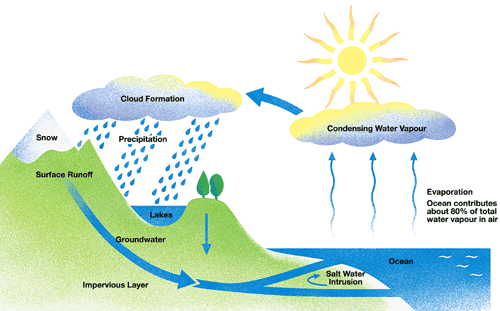
The diagram illustrates the hydrological cycle by which water moves through our natural environment. Overall, there are several stages to the process involving evaporation, precipitation and the final return of water to the ocean where the process begins over.
Since 80% of all water begins in the ocean, most water originates from this source. Initially sea water is warmed by the sun, causing it to evaporate into the air becoming water vapor. This then rises to condense into clouds at a higher elevation, which are then then pushed by the wind over land where it condenses further and precipitation occurs, falling as either snow or rain.
After precipitation on land, water then takes one of three routes. Some of it may fall into lakes or return to the ocean as surface runoff. Still further water percolates underground to an impermeable layer where it again flows back to the sea. Salt water also intrudes from the ocean into the land in coastal areas.

Process Diagram
Learn how to answer this question in a step-by-step interactive exercise
Process Diagram
Una tarea de diagrama de proceso de la Task 1 de IELTS Academic muestra paso a paso cómo se fabrica algo o cómo funciona un sistema. Presentas las etapas en el orden en que las muestra el diagrama, sin dar razones ni opiniones.
Echa un vistazo a la pregunta de la tarea y luego haz clic en Siguiente para continuar.
Echar un vistazo a la pregunta
Summarise the information by selecting and reporting the main features.
Write at least 150 words.
Antes de escribir nada, asegúrate de entender el diagrama. Cuenta los pasos y sigue las flechas para ver dónde empieza el proceso y dónde termina. Si la última flecha vuelve a la primera etapa, el proceso es un ciclo y no hay producto final.
Responde a las preguntas sobre el diagrama.
Leer el gráfico
La introducción le dice al lector qué muestra el diagrama. Parafrasea la pregunta de la tarea con tus propias palabras en lugar de copiarla, y nombra el proceso. No describas ninguno de los pasos aquí.
Escribe una o dos oraciones para tu introducción.
Escribir la introducción
Pregunta de la tarea
The diagram below shows the water cycle, which is the continuous movement of water on, above and below the surface of the Earth.
Summarise the information by selecting and reporting the main features.
Write at least 150 words.
Un informe de Task 1 de IELTS necesita un párrafo de desarrollo por cada grupo de etapas. No escribas un párrafo por cada paso. Divide el proceso en sus puntos naturales, donde cambia el lugar, el material o la finalidad, para que cada grupo sea una serie de etapas seguidas. La mayoría de los procesos dan dos grupos; un proceso corto puede dar uno, y uno largo, tres.
Elige los grupos.
Hacer los grupos
Elige los grupos.
- Group 1: stages 1 to 2 (Evaporation to Condensing Water Vapour). Group 2: stages 3 to 4 (Cloud Formation to Precipitation). Group 3: stages 5 to 6 (Surface Runoff to Groundwater).
- Group 1: stages 1 to 3 (Evaporation to Cloud Formation). Group 2: stages 4 to 5 (Precipitation to Surface Runoff). Group 3: stage 6 (Groundwater).
- Group 1: stages 1 to 3 (Evaporation to Cloud Formation). Group 2: stages 4 to 6 (Precipitation to Groundwater).
- Group 1: stages 1 to 2 (Evaporation to Condensing Water Vapour). Group 2: stages 3 to 5 (Cloud Formation to Surface Runoff). Group 3: stage 6 (Groundwater).
La visión general resume todo el proceso de un vistazo. Pregúntate cuántos pasos hay y cuáles son las etapas principales de principio a fin. Un proceso casi nunca se compara con otra cosa, así que describe la forma del proceso en lugar de buscar una subida o una bajada.
Responde a las preguntas para encontrar la tendencia general.
Encontrar la tendencia general
Usa tus notas del paso anterior. La visión general indica el número de pasos y las etapas principales, y dice si el proceso termina con un producto o se repite como un ciclo. Guarda el equipo, los tiempos y las temperaturas para los párrafos de desarrollo, y no des razones ni opiniones.
Escribe una o dos oraciones para tu visión general.
Escribir tu visión general (overview)
El párrafo de desarrollo 1 describe el primer grupo de etapas, paso a paso y en el orden que marcan las flechas. Usa formas pasivas como is heated, is mixed e is poured, porque el diagrama casi nunca dice quién hace el trabajo. Une los pasos con palabras de secuencia como first, then y after that.
Escribe tres o cuatro oraciones para el párrafo de desarrollo 1.
Escribir el párrafo de desarrollo 1
El párrafo de desarrollo 2 describe tu segundo grupo de etapas. Continúa desde el punto donde terminó el párrafo de desarrollo 1, así que la secuencia nunca se rompe. Sigue usando formas pasivas y relaciona los grupos con expresiones como once y after this. Si es el último párrafo, marca el final con in the final stage o finally, y si el proceso es un ciclo, di que el último paso lleva de nuevo al primero.
Escribe tres o cuatro oraciones para el párrafo de desarrollo 2.
Escribir el párrafo de desarrollo 2
Tus secciones ya forman un informe: la introducción, la visión general y un párrafo de desarrollo por cada grupo de etapas. Léelas juntas y comprueba que las etapas siguen en orden, que las formas pasivas son correctas y que el informe tiene la extensión suficiente.
Lee tu plan del informe completo y luego haz clic en Siguiente para compararlo con el informe modelo.
Plan completo del informe
Cómo decidir
Una tarea de diagrama de proceso muestra paso a paso cómo se fabrica algo o cómo funciona un sistema. El diagrama tiene un orden fijo, así que el informe sigue ese orden desde la primera etapa hasta la última.
Trabaja siempre en el mismo orden para que las etapas sigan su secuencia y no se te escape ningún paso.
- Leer el gráfico. Cuenta los pasos y sigue las flechas para ver dónde empieza y dónde termina el proceso.
- Escribir la introducción. Parafrasea la pregunta de la tarea y nombra el proceso, sin ningún detalle.
- Hacer los grupos. Divide las etapas en grupos en los puntos naturales del proceso, un párrafo de desarrollo por cada grupo.
- Encontrar la tendencia general. Decide cuántos pasos hay y cuáles son las etapas principales de principio a fin.
- Escribir la visión general y los párrafos de desarrollo. Resume primero la forma del proceso y luego describe los pasos en orden.
- Plan completo del informe. Lee tus secciones juntas y compáralas con el informe modelo.
Un informe de proceso se escribe en voz pasiva. El diagrama casi nunca dice quién hace el trabajo, así que usa formas como «is heated», «is mixed» e «is stored», y une los pasos con palabras de secuencia como «first», «after that» y «finally».
Leer
Un diagrama de proceso muestra etapas unidas por flechas. Cuenta los pasos y sigue las flechas para comprobar dónde empieza y dónde termina el proceso. Si la última flecha vuelve a la primera etapa, el proceso es un ciclo y no hay producto final.
Introducción
La introducción dice qué muestra el diagrama. Parafrasea la pregunta de la tarea con tus propias palabras en lugar de copiarla, y nombra el proceso. No incluyas los pasos concretos en estas oraciones.
Grupos
Un informe de Task 1 necesita un párrafo de desarrollo por cada grupo de etapas. No escribas un párrafo por cada paso. Divide el proceso en sus puntos naturales, donde cambia el lugar, el material o el propósito, para que cada grupo sea una serie de etapas seguidas. La mayoría de los procesos dan dos grupos; un proceso corto puede dar uno, y uno largo, tres.
Tendencia
La visión general resume todo el proceso de un vistazo: cuántos pasos hay y cuáles son las etapas principales. Un proceso casi nunca se compara con otra cosa, así que describe la forma del proceso en lugar de buscar una subida o una bajada.
Escribir
La visión general va primero y se mantiene general, sin equipos, tiempos ni temperaturas. Después, cada párrafo de desarrollo describe sus pasos en el orden que indican las flechas. Usa formas pasivas como «is heated» e «is poured», y une los pasos con palabras de secuencia como «first», «next», «after that» y «finally».
Para aprender a abordar los diagramas de procesos en IELTS Academic Writing Task 1, regístrate para una prueba gratuita de 7 días y accede a la lección IELTS Academic Writing Task - Process Diagrams.
Prueba gratuita de 7 díasMapas
Para este tipo de pregunta, recibirás uno, dos o tres mapas.
Los mapas pueden mostrar una ciudad, isla u otra zona geográfica.
Los mapas suelen mostrar los cambios ocurridos en la zona durante un periodo de tiempo.
Los cambios podrían estar relacionados con la construcción (p. ej., desarrollar una zona para el turismo)
o la destrucción (p. ej., cómo se vio afectada una zona por un desastre natural como un terremoto)
Tu tarea es escribir un resumen de los cambios que tuvieron lugar y cubrir los puntos más importantes.
The maps below show the centre of a small town called Islip as it is now, and plans for its development. Summarise the information by selecting and reporting the main features, and make comparisons where relevant.
- Write at least 150 words.
- You should spend around 20 minutes on this task.
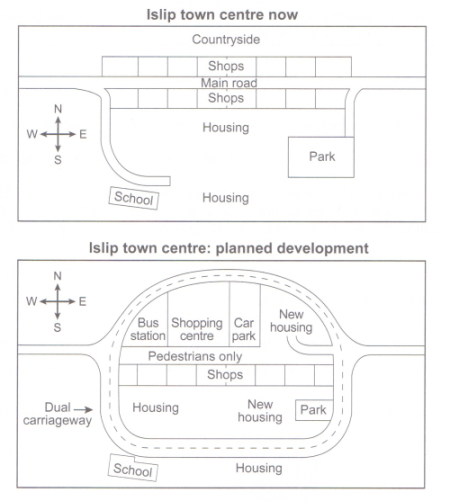
The diagrams illustrate some proposed changes to the central area of the town of Islip.
Overall, the principal change to the town will be the construction of a ring road around the centre. Various other developments with regard to shops and housing will accompany the building of this road.
As the first map reveals, lslip town center now is relatively small. There is a main road from the west to the east with shops on both sides. The northern area is rarely countryside, while the southern area is filled with houses with a school at the end of the fork road in the southwest corner and a park in the southeast area.
In the future, the main road is expected to reform into a dual carriageway as a round containing all the new buildings. The shops along the north side of the new pedestrian street will be demolished to make way for a bus station, shopping centre, car parks and new housing area. The shops along the south side of the street will remain, but it seems that the town's park will be reduced in size so that more new houses can be built within the ring road.
Map
Learn how to answer this question in a step-by-step interactive exercise
Map
Una tarea de mapa de la Task 1 de IELTS Academic te da dos o más planos del mismo lugar en momentos distintos, normalmente dos. Escribes un informe de al menos 150 palabras que describe cómo cambió el lugar, sin dar opiniones ni razones.
Echa un vistazo a la tarea y luego haz clic en Siguiente para continuar.
Echar un vistazo a la pregunta
Write at least 150 words.
Empieza leyendo los mapas, no escribiendo. Fíjate en el lugar que se muestra, los momentos que se comparan y cuántos mapas tienes. Después busca lo que es nuevo, lo que ha desaparecido y lo que ahora se usa para otra cosa.
Responde a las preguntas sobre los mapas.
Leer el gráfico
La introducción parafrasea la tarea con tus propias palabras. Di qué muestran los mapas y qué periodo cubren, y cambia las palabras de la tarea en lugar de copiarlas. Los detalles, el lenguaje de posición y los verbos de cambio vienen después.
Escribe una o dos oraciones que parafraseen la tarea.
Escribir la introducción
Pregunta de la tarea
The maps below show the centre of a small town called Islip as it is now, and plans for its development. Summarise the information by selecting and reporting the main features, and make comparisons where relevant.
Write at least 150 words.
Un informe de Task 1 necesita un párrafo de desarrollo por cada grupo de mapas. Normalmente cada mapa es su propio grupo: el mapa anterior en el primer párrafo y el posterior en el segundo, porque así los momentos quedan separados. Dos mapas que se describen mejor juntos pueden formar un grupo, y tres mapas suelen dar tres párrafos.
Un párrafo por cada elemento, o uno por cada mitad del mapa, rompe la comparación entre los momentos.
Elige la agrupación que da párrafos de desarrollo claros.
Hacer los grupos
Elige la agrupación que da párrafos de desarrollo claros.
- One group: now and planned development.
- Group 1: now. Group 2: planned development.
La visión general expresa el cambio más importante de todo el periodo. Pregúntate si el lugar creció o se redujo, y qué tipos de uso del suelo aparecieron o desaparecieron. Los elementos sueltos y las posiciones exactas no van en la visión general.
Elige las respuestas que describen el cambio general.
Encontrar la tendencia general
Ahora escribe la visión general con tus propias palabras, usando las notas del paso anterior. Basta con una o dos oraciones. Describe el desarrollo general del lugar y deja fuera las posiciones exactas, los elementos sueltos y cualquier razón del cambio.
Escribe tu visión general en una o dos oraciones.
Escribir tu visión general (overview)
El primer párrafo de desarrollo describe en detalle el mapa o los mapas de tu primer grupo. Usa formas del pasado para una situación que ya terminó, y usa lenguaje de posición como «to the north of», «beside» y «on the edge of», para que el lector pueda situar cada elemento. Describe elementos, no razones.
Escribe tres o cuatro oraciones para el párrafo de desarrollo 1.
Escribir el párrafo de desarrollo 1
El segundo párrafo de desarrollo describe el mapa o los mapas de tu segundo grupo y el cambio desde el mapa anterior. Usa formas pasivas para lo que se construyó, se quitó o se sustituyó, como «was built», «had been cleared» y «has been converted», porque los mapas no dicen quién hizo el trabajo. El lenguaje de posición sigue mostrando dónde ocurrió cada cambio.
Escribe tres o cuatro oraciones para el párrafo de desarrollo 2.
Escribir el párrafo de desarrollo 2
Tus secciones ya forman un informe: introducción, visión general y un párrafo de desarrollo por cada grupo de mapas. Léelas en orden y comprueba que la visión general da la imagen global y que los párrafos de desarrollo llevan los detalles.
Lee tu plan del informe y luego compáralo con el informe modelo.
Plan completo del informe
Cómo decidir
Una tarea de mapa te da dos o más planos del mismo lugar en momentos distintos. No describes cada etiqueta. Cuentas cómo cambió el lugar entre esos momentos.
Trabaja siempre en el mismo orden para que el informe presente la visión de conjunto antes que los detalles.
- Leer el gráfico. Comprueba el lugar, los momentos y los elementos principales de cada mapa antes de planificar.
- Hacer los grupos. Divide la información en grupos de mapas, con un párrafo de desarrollo cada uno, normalmente primero el mapa anterior y después el posterior.
- Encontrar la tendencia general. Decide cuál es el cambio más importante de todo el periodo, como un crecimiento, un declive o un nuevo uso del terreno.
- Escribir el informe por etapas. Escribe la introducción, luego la visión general y después un párrafo de desarrollo por cada grupo.
- Plan completo del informe. Lee las secciones juntas y compáralas con el informe modelo.
El lenguaje de posición y la voz pasiva sostienen un informe de mapa. Expresiones como «to the north of» y «beside the river» sitúan cada elemento, y formas como «was built» o «had been removed» cuentan un cambio sin decir quién lo hizo.
Leer
Antes de planificar, comprueba qué muestran los mapas: el lugar, los momentos y los elementos principales de cada mapa. Luego busca qué es nuevo, qué ha desaparecido y qué se usa ahora para otra cosa. Esta fase de lectura evita que describas solo uno de los mapas.
Grupos
Un informe de IELTS Task 1 necesita un párrafo de desarrollo por cada grupo de mapas. Normalmente cada mapa es su propio grupo, primero el mapa anterior y después el posterior. Dos mapas que se describen mejor juntos pueden formar un grupo, y tres mapas suelen dar tres párrafos. Decide la división antes de escribir, porque fija el orden de todo el informe.
Visión general (overview)
La visión general expone el cambio más importante de todo el periodo, no los pequeños detalles. Pregúntate si el lugar creció o se redujo, y qué usos del terreno aparecieron o desaparecieron. Los elementos concretos y las posiciones exactas van en los párrafos de desarrollo.
Escribir
El informe se construye en fases cortas. La introducción parafrasea la tarea, la visión general expone el cambio principal y cada párrafo de desarrollo describe un grupo. Usa formas de pasado para una situación que ya terminó, formas pasivas como «was built» o «had been cleared» para los cambios, y lenguaje de posición para mostrar dónde está cada elemento.
Para aprender a abordar los mapas en IELTS Academic Writing Task 1, regístrate para una prueba gratuita de 7 días y accede a la lección IELTS Academic Writing Task - Maps.
Prueba gratuita de 7 díasDatos mixtos
En este tipo de tarea, recibirás dos conjuntos de datos.
Los datos serán de tipos distintos. Por ejemplo, un conjunto podría ser cambios a lo largo del tiempo, mientras el segundo es estático.
Alternativamente, un conjunto de datos podría mostrar porcentajes mientras el segundo conjunto muestra números.
También se te puede dar una ilustración (p. ej., un diagrama o mapa) y un conjunto de datos (p. ej., gráfico de barras, gráfica de líneas, gráfico circular o tabla)
Tu tarea es resumir ambos conjuntos de datos.
The pie graph depicts the main reasons for the productivity loss of agricultural land worldwide. The table shows how these causes influenced three world regions during the 2000s.
Summarise the information by selecting and reporting the main features, and make comparisons where relevant.
Causes of Land Degradation by Region (%) | ||||
Region: | Deforestation | Over-cultivation | Over-grazing | Total land degraded |
North America | 0.3 | 3.4 | 1.7 | 5.4 |
Asia | 9.8 | 7.8 | 5.7 | 23.3 |
Australia & Oceania | 1.6 | 0.3 | 11 | 12.9 |
- Write at least 150 words.
- You should spend around 20 minutes on this task.
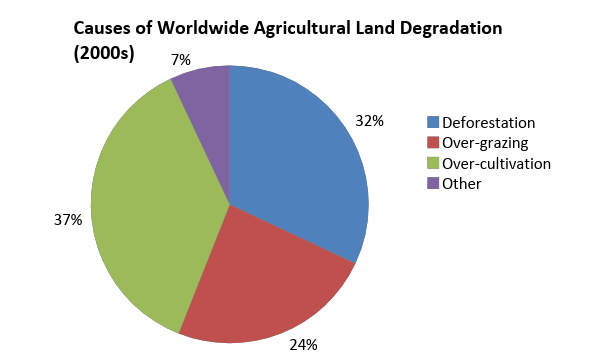
The pie chart shows the four main causes of farmland degradation in the world today, while the table presents the amount of land surface area affected by each one in three separate global regions during the 2000s.
Overall, Asia suffered more from the deterioration of farmland than other regions owing to deforestation and over-cultivation which were also the primary reasons for agricultural land loss worldwide.
Globally, 69% of degraded land is attributed to excessive cultivation and tree clearance, constituting 37% and 32% respectively. A further quarter of global land loss is due to over cultivation of crops. Other causes made up only 7% collectively.
In the 2000s, these causes affected regions of our planet differently. Asia was the worst affected where the top two causes of global land loss, deforestation and over-cultivation, resulted in 9.8% and 7.8% of degraded land there. The impact on Australia and Oceania was less severe though over-grazing was the predominant cause of land deterioration at eleven percent. The least affected of all was North America where only 5.4% of land was diminished, principally because of over-cultivation at 3.4%.
Mixed Charts
Learn how to answer this question in a step-by-step interactive exercise
Mixed Charts
Una tarea de gráficos combinados de la Task 1 de IELTS Academic te da dos o más elementos visuales de distinto tipo sobre un mismo tema. Escribes un informe de al menos 150 palabras que presenta los rasgos principales y relaciona los elementos visuales, sin dar opiniones ni razones.
Echa un vistazo a la tarea y luego haz clic en Siguiente para continuar.
Echar un vistazo a la pregunta
Summarise the information by selecting and reporting the main features, and make comparisons where relevant.
Write at least 150 words.
Empieza leyendo los elementos visuales, no escribiendo. Fíjate en lo que muestra cada uno y lee todas las etiquetas de los ejes y las unidades antes de planificar. Los elementos visuales de distinto tipo suelen medir cosas distintas, así que anota lo que comparten, como el mismo grupo de personas o el mismo periodo.
Responde a las preguntas sobre los elementos visuales.
Leer el gráfico
La introducción parafrasea la tarea con tus propias palabras. Deja claro qué muestra cada elemento visual y qué grupo y periodo cubre, y cambia las palabras de la tarea en lugar de copiarlas. Las cifras y las relaciones entre los elementos visuales vienen después.
Escribe una o dos oraciones que parafraseen la tarea.
Escribir la introducción
Pregunta de la tarea
The pie graph depicts the main reasons for the productivity loss of agricultural land worldwide. The table shows how these causes influenced three world regions during the 2000s.
Summarise the information by selecting and reporting the main features, and make comparisons where relevant.
Write at least 150 words.
Un informe de Task 1 necesita un párrafo de desarrollo por cada grupo de elementos visuales, y un conjunto de gráficos combinados da de uno a tres grupos. Los elementos visuales del mismo tipo o del mismo tema van juntos, porque un párrafo que mezcla dos medidas es difícil de seguir. Dos gráficos circulares sobre lo mismo comparten párrafo, y un gráfico de líneas sobre otra medida va en su propio párrafo.
Un párrafo por cada elemento visual puede separar lo que va junto, y un solo párrafo para todos los elementos visuales mezcla medidas. Dividir por años o por las cifras más altas y más bajas rompe la comparación que pide la tarea.
Elige la agrupación que da a cada párrafo una medida clara.
Hacer los grupos
Elige la agrupación que da a cada párrafo una medida clara.
- Group 1: the pie chart. Group 2: the table.
- One group: the pie chart and the table.
La visión general expresa el patrón más importante de todos los elementos visuales y va antes de cualquier detalle. Encuentra el movimiento principal de cada elemento visual y luego decide si uno apoya o explica al otro. Las cifras exactas no van en la visión general.
Elige las respuestas que describen el patrón principal.
Encontrar la tendencia general
Ahora escribe la visión general con tus propias palabras, usando las notas del paso anterior. Basta con una o dos oraciones. Expresa el patrón principal y la relación entre los elementos visuales, y deja fuera las cifras exactas y cualquier razón del patrón.
Escribe tu visión general en una o dos oraciones.
Escribir tu visión general (overview)
El primer párrafo de desarrollo describe en detalle el primer grupo. Presenta las comparaciones importantes, como el punto más alto, el punto más bajo y el cambio más claro, y apoya cada una con algunas cifras seleccionadas. No enumeres todos los números ni describas aquí los otros grupos.
Escribe tres o cuatro oraciones para el párrafo de desarrollo 1.
Escribir el párrafo de desarrollo 1
El segundo párrafo de desarrollo describe el segundo grupo y lo relaciona con el primero. Agrupa las comparaciones que van juntas en lugar de tratar cada categoría por turno, y usa una expresión de enlace para mostrar en qué coinciden los elementos visuales. Presenta lo que muestran los datos, no por qué.
Escribe tres o cuatro oraciones para el párrafo de desarrollo 2.
Escribir el párrafo de desarrollo 2
Tus secciones ya forman un informe: introducción, visión general y un párrafo de desarrollo por cada grupo de elementos visuales. Léelas en orden y comprueba que la visión general da la imagen global y que los párrafos de desarrollo llevan los detalles.
Lee tu plan del informe y luego compáralo con el informe modelo.
Plan completo del informe
Cómo decidir
Una tarea de gráficos combinados te da dos o más elementos visuales de tipos distintos sobre un mismo tema. No escribes un informe aparte para cada uno. Cuentas los rasgos principales de cada uno y los relacionas cuando los datos están conectados.
Trabaja siempre en el mismo orden para que el informe presente la visión de conjunto antes que los detalles.
- Leer el gráfico. Comprueba qué muestra cada elemento visual y lee cada eje, etiqueta y unidad antes de planificar.
- Hacer los grupos. Divide los elementos visuales en uno a tres grupos, con un párrafo de desarrollo cada uno, normalmente un tipo de gráfico o un tema en cada grupo.
- Encontrar la tendencia general. Decide cuál es el patrón principal de todos los elementos visuales y anota cualquier relación entre ellos.
- Escribir el informe por etapas. Escribe la introducción, luego la visión general y después un párrafo de desarrollo por cada grupo.
- Plan completo del informe. Lee las secciones juntas y compáralas con el informe modelo.
Agrupa las comparaciones importantes en lugar de enumerar todos los números. Unas pocas cifras seleccionadas que respaldan un patrón valen más que una lista larga que solo repite lo que el elemento visual ya muestra.
Leer
Los elementos visuales de distinto tipo miden cosas distintas, así que primero lee cada uno por separado. Comprueba el título, las etiquetas de los ejes, las unidades y el periodo de tiempo, y luego anota lo que tienen en común, como el mismo grupo de personas o el mismo periodo. Una proporción del tiempo en un gráfico circular y un total en un gráfico de líneas no son la misma medida.
Grupos
Un informe de IELTS Task 1 necesita un párrafo de desarrollo por cada grupo de elementos visuales, así que los elementos visuales tienen que repartirse en uno, dos o tres grupos. Los elementos visuales del mismo tipo o del mismo tema van juntos, y uno que trata otra medida lleva su propio párrafo. Decide la división antes de escribir, porque fija el orden de todo el informe.
Visión general (overview)
La visión general expone en una o dos oraciones el patrón principal de todos los elementos visuales. Busca el movimiento principal de cada uno y luego decide si uno respalda o explica al otro. Las cifras exactas y las categorías concretas van en los párrafos de desarrollo.
Escribir
El informe se construye en fases cortas. La introducción parafrasea la tarea, la visión general expone el patrón principal y cada párrafo de desarrollo describe un grupo. En los párrafos de desarrollo, agrupa las comparaciones que van juntas y respalda cada una con unas pocas cifras seleccionadas en lugar de enumerar todos los números.
Para aprender a abordar los datos mixtos en IELTS Academic Writing Task 1, regístrate para una prueba gratuita de 7 días y accede a la lección IELTS Academic Writing Task - Mixed Data.
Prueba gratuita de 7 díasVocabulario para IELTS Academic Writing Task 1
Para obtener una puntuación alta en esta tarea, debes aprender a usar palabras y frases adecuadas para presentar los datos dados en una gráfica circular/de barras/de líneas/mixta. Te sugerimos que te registres para una prueba gratuita de 7 días y completes las siguientes lecciones:
- IELTS Academic Writing Task 1 Lesson - How to write about numbers
- IELTS Academic Writing Task 1 Lesson - How to write about percentages
- IELTS Academic Writing Task 1 Lesson - How to write about changes in data
Muestras de IELTS Writing Task 1
Esta sección presenta una lista de muestras de IELTS writing para la IELTS Academic Writing Task 1.
- IELTS Academic Writing Task 1 - Line Chart Questions
- IELTS Academic Writing Task 1 - Bar Chart Questions
- IELTS Academic Writing Task 1 - Pie Chart Questions
- IELTS Academic Writing Task 1 - Map Questions
- IELTS Academic Writing Task 1 - Process Diagram Questions
- IELTS Academic Writing Task 1 - Mixed Data Questions
IELTS General Writing Task 1
En la IELTS general training writing task 1, se te presentará una situación y deberás escribir una respuesta personal en forma de carta informal, semiformal o formal de al menos 150 palabras. Las situaciones sobre las que se te pide escribir son comunes y cotidianas, como:
- escribir a un encargado de alojamiento universitario sobre problemas con el alojamiento,
- escribir a un nuevo empleador sobre problemas de gestión del tiempo que estás teniendo,
- escribir a un periódico local sobre un plan para desarrollar un aeropuerto local,
- escribir a una agencia de alquiler para resolver problemas con el sistema de calefacción de su casa.
Respecto a la situación, recibirás información en forma de tres puntos clave que debes incluir en tu respuesta. Puede que tengas que solicitar o dar información y/o explicar una situación. Para hacerlo, puede que necesites realizar algunas de las siguientes acciones:
- solicitar y/o proporcionar información factual general,
- expresar necesidades, deseos, gustos o aversiones,
- expresar opiniones o quejas,
- hacer peticiones o sugerencias/recomendaciones.
Estilo de escritura del IELTS General Writing
El estilo de escritura que usarás depende de a quién se te pide escribir (es decir, el destinatario) y cómo se supone que lo conoces. Necesitas escribir en un estilo apropiado para tu destinatario y que te ayude a alcanzar tu propósito al escribir, p. ej., escribir a un amigo (informal) o escribir a un gerente (semiformal o formal). No necesitas incluir ninguna dirección al inicio de tus cartas.
Cómo evitar perder puntos en IELTS General Writing Task 1
Como se ha mencionado, no dediques más de 20 minutos a esta tarea y asegúrate de escribir al menos 150 palabras o serás penalizado. Aunque no serás penalizado por escribir más de 150 palabras, recuerda que una respuesta más larga en la tarea 1 puede significar que tengas menos tiempo para dedicar a la tarea 2, que contribuye el doble a la puntuación de banda de Writing.
También debes recordar que se te penalizará por irrelevancia, si la respuesta está fuera de tema o no se escribe como texto completo y conectado (p. ej., usando puntos con viñetas en cualquier parte de la respuesta, o en forma de notas, etc.). Serás penalizado severamente por plagio (es decir, copiar de otra fuente).
Last weekend, your cousin celebrated her 50th birthday, but you couldn't attend and you forgot to cancel.
Write a letter to your cousin. In your letter:
- Apologize for missing the birthday celebration
- Explain why you missed it and why you hadn't let her know
- Describe how you will make it up to her
You do NOT need to write any addresses.
Begin your letter as follows:
Dear ___,
- Write at least 150 words.
- You should spend around 20 minutes on this task.
Dear Marnie,
Happy belated birthday! I hope you're doing well and that you had a great 50th birthday party.
I'm so sorry that I wasn't at your party to celebrate with you. It's been such a long time since we've been able to catch up and see each other.
To be completely honest, I've been swamped with work lately, and I was asked to go on a last-minute business trip a few days before your birthday. I was so busy that I had completely forgotten about your party, and it didn't occur to me to call you and cancel.
My busy schedule is absolutely not an excuse for missing your 50th birthday, though, and I would love to make it up to you. I've reserved a table for two next Friday night at the new sushi restaurant in town. Can I please treat you to a luxurious birthday dinner?
I hope we can celebrate together next Friday!
Speak to you soon,
Jessica
Total Word Count: 162 words

Task Achievement — Letter
Learn how to answer this question in a step-by-step interactive exercise
Task Achievement — Letter
En la Task 1 de IELTS General Training escribes una carta que responde a una situación. La Task Achievement depende de cubrir todos los puntos de la consigna, porque una buena carta que se salta uno sigue perdiendo puntos.
Lee la situación, los puntos y cualquier frase de apertura que te dé la tarea.
Echa un vistazo a la tarea y luego haz clic en Siguiente para continuar.
Echar un vistazo a la pregunta
Write a letter to your cousin. In your letter:
- Apologize for missing the birthday celebration
- Explain why you missed it and why you hadn't let her know
- Describe how you will make it up to her
Write at least 150 words. You do NOT need to write any addresses.
Begin your letter as follows:
Dear ___,
Antes de escribir, planifica la carta respondiendo a tres preguntas. ¿A quién le escribes, por qué le escribes y qué debe incluir la carta?
El destinatario decide lo formal que debe ser el lenguaje, el propósito decide cómo empiezas y los puntos deciden el contenido. Todas las respuestas ya están en algún lugar de la consigna.
Relaciona cada pregunta de planificación con la parte de la consigna que la responde.
Entender la tarea
Relaciona cada pregunta de planificación con la parte de la consigna que la responde.
El saludo y la despedida le indican al lector lo formal que es la carta, así que tienen que corresponder a la persona a la que escribes. Una carta a un desconocido o a un jefe es formal, y una carta a un amigo es informal.
Mantén el mismo nivel al principio y al final de la carta. Un saludo formal seguido de una despedida informal confunde al lector.
Elige un saludo y una despedida adecuados para el lector.
Elegir el saludo y la despedida
Confirm the greeting
- Dear ___,
- Dear Sir or Madam,
- Dear Ms. Smith,
- Hey you,
Choose a closing
- Speak to you soon,
- Lots of love,
- Best wishes,
- Yours faithfully,
- Yours sincerely,
Dale al primer punto su propio párrafo. La Task Achievement se evalúa según si cada punto está cubierto y desarrollado, no solo mencionado.
Tienes inicios de frase para empezar una oración. Termina la idea con tus propias palabras y mantén el mismo tono que en el saludo.
Escribe un párrafo que cubra el primer punto.
Escribir la viñeta 1
Apologise for missing the birthday celebration
El segundo punto también necesita su propio párrafo. Dale la misma extensión y el mismo detalle que al primero, porque un punto respondido a medias también cuesta puntos.
Usa un inicio de frase para empezar y luego añade el detalle que el lector necesitaría realmente en esta situación.
Escribe un párrafo que cubra el segundo punto.
Escribir la viñeta 2
Explain why you missed it and did not let her know
Termina el cuerpo de la carta con el tercer punto. Cuando los tres estén cubiertos con oraciones completas, la tarea estará completa.
Mantén el tono hasta el final y comprueba que este párrafo responde a lo que el punto pedía realmente.
Escribe un párrafo que cubra el tercer punto.
Escribir la viñeta 3
Describe how you will make it up to her
Tus párrafos aparecen ahora juntos como una sola carta, con el saludo y la despedida en su sitio. Léela como un único texto y comprueba que cubre todos los puntos.
Compara tus palabras con la carta de muestra y fíjate en cómo el tono se mantiene igual desde el saludo hasta la despedida.
Revisa tu carta y luego haz clic en Siguiente para continuar.
Revisar tu carta completa
Cómo decidir
Una carta de Task 1 responde a una situación y cubre una serie de viñetas. Task Achievement depende de cubrir todas las viñetas y de adaptar el tono al destinatario.
Trabaja siempre en el mismo orden para no olvidar ninguna viñeta y para mantener el mismo nivel de formalidad de principio a fin.
- Entender la tarea. Averigua a quién escribes, por qué escribes y qué debe incluir la carta.
- Elegir el saludo y la despedida. Adapta el saludo y la despedida al destinatario y mantén ambos en el mismo nivel de formalidad.
- Escribir las viñetas. Dale a cada viñeta su propio párrafo y desarróllala con detalles reales.
- Revisar tu carta completa. Lee los párrafos juntos y comprueba que cubres todas las viñetas.
Escribe un párrafo por cada viñeta. Este plan sencillo hace casi imposible que olvides una viñeta, que es la forma más rápida de perder puntos en Task Achievement.
Planificar
Tres preguntas planifican toda la carta. ¿A quién escribes, por qué escribes y qué debe incluir la carta? Cada respuesta ya está en algún lugar del enunciado.
Tono
El saludo y la despedida le muestran al destinatario lo formal que es la carta. Una carta a un desconocido o a un gerente es formal, una carta a un amigo es informal, y el principio y el final de la carta deben mantener el mismo nivel.
Viñetas
Cada viñeta tiene su propio párrafo. Desarróllala con oraciones completas y con los detalles que el destinatario realmente necesitaría, y da a los párrafos una extensión similar para que ningún punto parezca hecho con prisas.
Para más información sobre IELTS General Writing Task 1, consulta The Ultimate Guide for the IELTS General Writing Task 1
IELTS Writing Task 2
En la IELTS writing task 2, tendrás que escribir un ensayo de estilo tradicional en respuesta a una pregunta. Debes escribir al menos 250 palabras. Si no escribes suficientes palabras, serás penalizado. Hay 6 tipos diferentes de preguntas en la task 2. Veamos preguntas de muestra y ensayos modelo para cada tipo de ensayo.
Causas y efectos
En este tipo de pregunta, se te presentará un problema o situación. Tu tarea es describir las causas de la situación y algunos de los efectos de la situación.
It is observed that in many countries not enough students are choosing to study science at university. What are the causes? And what will be the effects on society?
- Write at least 250 words.
- You should spend around 40 minutes on this task.
It is a fact that many students globally are avoiding science in favor of other subjects at university. Such a trend is largely due to how science is perceived, which may be having a detrimental effect on a nation’s development.
The primary reason for the drop in enrollment in science-based courses is that many undergraduates are put off by their difficulty. While many high school students enjoy science, they soon find themselves facing a lot of theory and research based courses once in college. For example according to a recent poll of UK universities, many students stated that while science was interesting in high school, there was too much theory learnt in classes, and not enough application in the lab to make it interesting. Furthermore, there are plenty of easier alternatives such as humanities for students to choose from these days. As a result, most choose a more appealing humanities degree over a science one.
Countries with the lowest science enrollment rates are affected the most competitively and economically. Fewer science graduates mean a shortage of skilled researchers in science-related fields like bio-engineering which reduces a countries competitiveness in attracting foreign investment. In other words foreign companies are usually unwilling to invest in nations with a low pool of skilled workers. In addition, a low number of skilled workers mean fewer technological developments for such countries, which may cause their economies to suffer from lost business in being the first to market with new products. For example, evidence shows that the number of patents filed by Chinese corporations is beginning to threaten the number credited to American ones.
In conclusion, there is a direct correlation between the perceived difficulty of science degrees and limited economic growth. Only by changing this attitude will countries reverse this trend.
Task Achievement — Task 2
Learn how to answer this question in a step-by-step interactive exercise
Task Achievement — Task 2
En la Task 2 de IELTS Writing escribes una redacción que responde a todas las partes de la pregunta. Lee con atención la afirmación y la línea de instrucciones, y fíjate en lo que la pregunta te pide que comentes.
Una redacción que se mantiene en el tema pero nunca responde a la pregunta planteada no puede alcanzar una banda alta.
Echa un vistazo a la pregunta y luego haz clic en Siguiente para continuar.
Echar un vistazo a la pregunta
Vamos a escribir la introducción en dos oraciones, unas 25 a 35 palabras en total. Primero, reescribe la pregunta con tus propias palabras. Parafrasea la pregunta con tus propias palabras y con sinónimos. Así tu redacción se mantiene en el tema y puedes demostrar un vocabulario amplio. La segunda oración presenta los temas concretos que vas a tratar en los párrafos de desarrollo.
Escribe una introducción.
Escribir la introducción
Cada párrafo de desarrollo necesita una oración temática que presente su idea principal. Dos párrafos de desarrollo son suficientes para una redacción de esta extensión.
Escribe una oración clara para cada párrafo. Que cada oración tenga entre 12 y 20 palabras, y deja las explicaciones y los ejemplos para los pasos siguientes.
Escribe una oración temática para cada párrafo de desarrollo.
Escribe dos oraciones temáticas
science courses are seen as too hard
fewer scientists hurt the economy
Una oración temática solo suma puntos cuando está apoyada. Desarrolla el primer párrafo de desarrollo con dos ideas. Para cada idea, escribe una explicación y un ejemplo concreto.
Cada párrafo de desarrollo debe tener unas 4–5 oraciones, o 60 a 80 palabras. Una situación concreta es más fuerte que una afirmación general.
Escribe el resto del primer párrafo de desarrollo.
Amplía el párrafo de desarrollo 1
60
Dale al segundo párrafo de desarrollo la misma profundidad que al primero. Usa dos ideas y apoya cada una con una explicación y un ejemplo.
Cada párrafo de desarrollo debe tener unas 4–5 oraciones, o 60 a 80 palabras. No repitas el primer párrafo con otras palabras.
Escribe el resto del segundo párrafo de desarrollo.
Amplía el párrafo de desarrollo 2
60
La conclusión cierra la redacción. Escribe un resumen de dos oraciones de las ideas principales y luego añade una o dos oraciones sobre por qué el tema es importante.
No copies la introducción ni añadas un argumento nuevo. Que toda la conclusión tenga entre 35 y 50 palabras.
Escribe una conclusión de 3–4 oraciones.
Escribir la conclusión
35
Tu introducción, tus oraciones temáticas, tus párrafos de desarrollo y tu conclusión aparecen ahora juntos como una sola redacción. Léela como un único texto y comprueba que responde a todas las partes de la pregunta.
Compara tus palabras con la redacción de muestra y fíjate en cómo cada párrafo cumple una función distinta.
Revisa tu redacción y luego haz clic en Siguiente para continuar.
Revisar tu ensayo completo
Cómo decidir
Un ensayo de Task 2 responde a todas las partes de la pregunta. Task Achievement depende de cubrir lo que pide la pregunta y de respaldar cada punto principal con una explicación y un ejemplo.
Trabaja siempre en el mismo orden: introducción, dos oraciones temáticas, dos párrafos de desarrollo bien desarrollados y, por último, una conclusión.
- Escribir la introducción.
Por lo general, necesitarás dos oraciones para este párrafo. Parafrasea la pregunta con tus propias palabras y con sinónimos. Así tu ensayo no se sale del tema y puedes demostrar un vocabulario amplio. La segunda oración presenta los temas concretos que tratarás en los párrafos de desarrollo. Por lo tanto, tu introducción debe incluir:
- La pregunta reformulada
- La presentación de los temas concretos
- Escribe dos oraciones temáticas. Escribe una oración temática para cada párrafo de desarrollo.
- Amplía los párrafos de desarrollo. Respalda cada párrafo de desarrollo con dos puntos, y da a cada punto una explicación y un ejemplo. Cada párrafo de desarrollo debe tener unas 4–5 oraciones.
- Escribir la conclusión. Resume los puntos principales y luego di por qué el tema es importante.
- Revisar tu ensayo completo. Lee las partes juntas y comprueba que respondes a todas las partes de la pregunta.
Dos párrafos bien desarrollados puntúan más que cuatro puntos sin desarrollar. Los examinadores premian el respaldo, así que añade una explicación y un ejemplo a un punto que ya tienes en lugar de añadir otro punto.
Introducción
Por lo general, necesitarás dos oraciones para este párrafo. Parafrasea la pregunta con tus propias palabras y con sinónimos. Así tu ensayo no se sale del tema y puedes demostrar un vocabulario amplio. La segunda oración presenta los temas concretos que tratarás en los párrafos de desarrollo. Por lo tanto, tu introducción debe incluir:
- La pregunta reformulada
- La presentación de los temas concretos
Oraciones temáticas
Escribe una oración temática para cada párrafo de desarrollo. Cada oración debe presentar la idea principal de ese párrafo en 12 a 20 palabras y dejar los ejemplos para la siguiente fase.
Apoyo
Una oración temática suma puntos cuando está respaldada. Explica por qué el punto es cierto, da un ejemplo concreto y da a los dos párrafos de desarrollo el mismo nivel de respaldo. Cada párrafo de desarrollo debe tener unas 4–5 oraciones.
Conclusión
La conclusión resume los puntos principales en dos oraciones y luego añade una o dos oraciones sobre por qué el tema es importante. No copies la introducción ni añadas un argumento nuevo.
Discute ambas opiniones y da tu propia opinión
En este tipo de pregunta, se te darán dos puntos de vista opuestos relacionados con un asunto. Normalmente, los dos puntos de vista estarán en oraciones separadas conectadas por una palabra de transición como "however" para indicar que las dos opiniones contrastan. Tu tarea es escribir un ensayo discursivo, contrastando ambos lados del asunto y presentando tu propia opinión.
Some people argue that the public should be allowed to have guns. Others do not agree. Discuss both points of view and give your opinion.
- Write at least 250 words.
- You should spend around 40 minutes on this task.
Gun ownership is a controversial topic with some people arguing that the public should have the choice to own them, while others disagree wholeheartedly with the idea. In my opinion, I believe that the public should only be entitled to own guns after having proper training.
The benefits of gun ownership are touted in some countries more than others. In countries where owning one is a civic right, like the United States, it is legal to use one in self-defense is legal. With muggings, murder and burglary rising in many countries, there may be some truth to the claim that owing a gun gives the owner increased security. Furthermore, in remote or dangerous areas, guns may be a necessity rather than an option. Without police nearby, properly stored, guns may be a great asset in deterring criminals from breaking and entering a remote property.
However, rather than deter violence, guns tend to escalate it in areas where they are widely available. Research shows that violent crime increases dramatically when guns are prevalent in society. When the public is armed, criminals and the police become so too, creating a situation in which guns beget more guns and eventually death. Additionally, greater ease of access is dangerous for children. Having a gun easily accessible may tempt children to abuse them as evidenced by the almost weekly school shootings in the US. There is further a proven link between increased suicide rates when guns are present.
It is my belief that the general public should be barred from owning guns of any kind. Also, guns should be restricted to specialists with a proven need for a firearm such as soldiers or hunters. While there are certain circumstances where owning a gun is an advantage, in the vast majority of situations there is no place for a gun in modern society.
Task Achievement — Task 2
Learn how to answer this question in a step-by-step interactive exercise
Task Achievement — Task 2
En la Task 2 de IELTS Writing escribes una redacción que responde a todas las partes de la pregunta. Lee con atención la afirmación y la línea de instrucciones, y fíjate en lo que la pregunta te pide que comentes.
Una redacción que se mantiene en el tema pero nunca responde a la pregunta planteada no puede alcanzar una banda alta.
Echa un vistazo a la pregunta y luego haz clic en Siguiente para continuar.
Echar un vistazo a la pregunta
Vamos a escribir la introducción en dos oraciones, unas 25 a 35 palabras en total. Primero, reescribe la pregunta con tus propias palabras. Parafrasea la pregunta con tus propias palabras y con sinónimos. Así tu redacción se mantiene en el tema y puedes demostrar un vocabulario amplio. La segunda oración presenta los temas concretos que vas a tratar en los párrafos de desarrollo.
Escribe una introducción.
Escribir la introducción
Cada párrafo de desarrollo necesita una oración temática que presente su idea principal. Dos párrafos de desarrollo son suficientes para una redacción de esta extensión.
Escribe una oración clara para cada párrafo. Que cada oración tenga entre 12 y 20 palabras, y deja las explicaciones y los ejemplos para los pasos siguientes.
Escribe una oración temática para cada párrafo de desarrollo.
Escribe dos oraciones temáticas
guns help people defend themselves
more guns lead to more violence
Una oración temática solo suma puntos cuando está apoyada. Desarrolla el primer párrafo de desarrollo con dos ideas. Para cada idea, escribe una explicación y un ejemplo concreto.
Cada párrafo de desarrollo debe tener unas 4–5 oraciones, o 60 a 80 palabras. Una situación concreta es más fuerte que una afirmación general.
Escribe el resto del primer párrafo de desarrollo.
Amplía el párrafo de desarrollo 1
60
Dale al segundo párrafo de desarrollo la misma profundidad que al primero. Usa dos ideas y apoya cada una con una explicación y un ejemplo.
Cada párrafo de desarrollo debe tener unas 4–5 oraciones, o 60 a 80 palabras. No repitas el primer párrafo con otras palabras.
Escribe el resto del segundo párrafo de desarrollo.
Amplía el párrafo de desarrollo 2
60
La conclusión cierra la redacción. Escribe un resumen de dos oraciones de las ideas principales y luego añade una o dos oraciones sobre por qué el tema es importante.
No copies la introducción ni añadas un argumento nuevo. Que toda la conclusión tenga entre 35 y 50 palabras.
Escribe una conclusión de 3–4 oraciones.
Escribir la conclusión
35
Tu introducción, tus oraciones temáticas, tus párrafos de desarrollo y tu conclusión aparecen ahora juntos como una sola redacción. Léela como un único texto y comprueba que responde a todas las partes de la pregunta.
Compara tus palabras con la redacción de muestra y fíjate en cómo cada párrafo cumple una función distinta.
Revisa tu redacción y luego haz clic en Siguiente para continuar.
Revisar tu ensayo completo
Cómo decidir
Un ensayo de Task 2 responde a todas las partes de la pregunta. Task Achievement depende de cubrir lo que pide la pregunta y de respaldar cada punto principal con una explicación y un ejemplo.
Trabaja siempre en el mismo orden: introducción, dos oraciones temáticas, dos párrafos de desarrollo bien desarrollados y, por último, una conclusión.
- Escribir la introducción.
Por lo general, necesitarás dos oraciones para este párrafo. Parafrasea la pregunta con tus propias palabras y con sinónimos. Así tu ensayo no se sale del tema y puedes demostrar un vocabulario amplio. La segunda oración presenta los temas concretos que tratarás en los párrafos de desarrollo. Por lo tanto, tu introducción debe incluir:
- La pregunta reformulada
- La presentación de los temas concretos
- Escribe dos oraciones temáticas. Escribe una oración temática para cada párrafo de desarrollo.
- Amplía los párrafos de desarrollo. Respalda cada párrafo de desarrollo con dos puntos, y da a cada punto una explicación y un ejemplo. Cada párrafo de desarrollo debe tener unas 4–5 oraciones.
- Escribir la conclusión. Resume los puntos principales y luego di por qué el tema es importante.
- Revisar tu ensayo completo. Lee las partes juntas y comprueba que respondes a todas las partes de la pregunta.
Dos párrafos bien desarrollados puntúan más que cuatro puntos sin desarrollar. Los examinadores premian el respaldo, así que añade una explicación y un ejemplo a un punto que ya tienes en lugar de añadir otro punto.
Introducción
Por lo general, necesitarás dos oraciones para este párrafo. Parafrasea la pregunta con tus propias palabras y con sinónimos. Así tu ensayo no se sale del tema y puedes demostrar un vocabulario amplio. La segunda oración presenta los temas concretos que tratarás en los párrafos de desarrollo. Por lo tanto, tu introducción debe incluir:
- La pregunta reformulada
- La presentación de los temas concretos
Oraciones temáticas
Escribe una oración temática para cada párrafo de desarrollo. Cada oración debe presentar la idea principal de ese párrafo en 12 a 20 palabras y dejar los ejemplos para la siguiente fase.
Apoyo
Una oración temática suma puntos cuando está respaldada. Explica por qué el punto es cierto, da un ejemplo concreto y da a los dos párrafos de desarrollo el mismo nivel de respaldo. Cada párrafo de desarrollo debe tener unas 4–5 oraciones.
Conclusión
La conclusión resume los puntos principales en dos oraciones y luego añade una o dos oraciones sobre por qué el tema es importante. No copies la introducción ni añadas un argumento nuevo.
Ventajas e inconvenientes
En este tipo de pregunta, se te pedirá discutir los aspectos positivos y negativos de una situación, solución o tendencia. También se te puede pedir dar tu opinión sobre qué lado consideras más importante.
In some countries, governments are encouraging industries and businesses to move to regional areas outside the big cities. Do the advantages of this trend outweigh the disadvantages?
- Write at least 250 words.
- You should spend around 40 minutes on this task.
There is a movement among some countries to promote regional areas away from cities as attractive to business and industry. In my opinion, I consider relocation of business to bring about more drawbacks than benefits over the long term.
There are several attractive benefits to businesses moving to regional areas. For businesses rural locations mean lower land prices. Cheaper land allows large or small business equal prospects to become established cheaply with additional room to expand. As an example, the average size of a business in UK cities is currently 25 square meters while those in the rural locales average around 50m2. Additionally, countries benefits principally from the direct investment in underperforming parts of the country. Having companies operating in less urbanized areas, creates jobs, attracts talent and increases immigration which brings greater wealth.
On the other hand, relocation is not without its drawbacks. For one thing, locations away from population centers may mean a greater distance to market for goods. As a result, cost savings from cheaper land may be mitigated by the increased transportation costs of shipping products to customers. For another thing, there are often fewer skilled workers in regional areas. It may not be easy to attract employees to work in out-of-the-way places, which would mean longer commutes for staff from nearby cities at the expense of the company coffers. Lastly, increased business in country areas, disturbs the life of local residents. Country roads are not built for heavy trucks or traffic which may cause increased noise, congestions and inconvenience to those living nearby.
To sum up, while regional settings may be well suited to certain internet-based businesses, for more traditional companies, the distance from the city presents many challenges to overcome.
Task Achievement — Task 2
Learn how to answer this question in a step-by-step interactive exercise
Task Achievement — Task 2
En la Task 2 de IELTS Writing escribes una redacción que responde a todas las partes de la pregunta. Lee con atención la afirmación y la línea de instrucciones, y fíjate en lo que la pregunta te pide que comentes.
Una redacción que se mantiene en el tema pero nunca responde a la pregunta planteada no puede alcanzar una banda alta.
Echa un vistazo a la pregunta y luego haz clic en Siguiente para continuar.
Echar un vistazo a la pregunta
Vamos a escribir la introducción en dos oraciones, unas 25 a 35 palabras en total. Primero, reescribe la pregunta con tus propias palabras. Parafrasea la pregunta con tus propias palabras y con sinónimos. Así tu redacción se mantiene en el tema y puedes demostrar un vocabulario amplio. La segunda oración presenta los temas concretos que vas a tratar en los párrafos de desarrollo.
Escribe una introducción.
Escribir la introducción
Cada párrafo de desarrollo necesita una oración temática que presente su idea principal. Dos párrafos de desarrollo son suficientes para una redacción de esta extensión.
Escribe una oración clara para cada párrafo. Que cada oración tenga entre 12 y 20 palabras, y deja las explicaciones y los ejemplos para los pasos siguientes.
Escribe una oración temática para cada párrafo de desarrollo.
Escribe dos oraciones temáticas
cheaper land and new jobs in the regions
higher transport costs and fewer skilled workers
Una oración temática solo suma puntos cuando está apoyada. Desarrolla el primer párrafo de desarrollo con dos ideas. Para cada idea, escribe una explicación y un ejemplo concreto.
Cada párrafo de desarrollo debe tener unas 4–5 oraciones, o 60 a 80 palabras. Una situación concreta es más fuerte que una afirmación general.
Escribe el resto del primer párrafo de desarrollo.
Amplía el párrafo de desarrollo 1
60
Dale al segundo párrafo de desarrollo la misma profundidad que al primero. Usa dos ideas y apoya cada una con una explicación y un ejemplo.
Cada párrafo de desarrollo debe tener unas 4–5 oraciones, o 60 a 80 palabras. No repitas el primer párrafo con otras palabras.
Escribe el resto del segundo párrafo de desarrollo.
Amplía el párrafo de desarrollo 2
60
La conclusión cierra la redacción. Escribe un resumen de dos oraciones de las ideas principales y luego añade una o dos oraciones sobre por qué el tema es importante.
No copies la introducción ni añadas un argumento nuevo. Que toda la conclusión tenga entre 35 y 50 palabras.
Escribe una conclusión de 3–4 oraciones.
Escribir la conclusión
35
Tu introducción, tus oraciones temáticas, tus párrafos de desarrollo y tu conclusión aparecen ahora juntos como una sola redacción. Léela como un único texto y comprueba que responde a todas las partes de la pregunta.
Compara tus palabras con la redacción de muestra y fíjate en cómo cada párrafo cumple una función distinta.
Revisa tu redacción y luego haz clic en Siguiente para continuar.
Revisar tu ensayo completo
Cómo decidir
Un ensayo de Task 2 responde a todas las partes de la pregunta. Task Achievement depende de cubrir lo que pide la pregunta y de respaldar cada punto principal con una explicación y un ejemplo.
Trabaja siempre en el mismo orden: introducción, dos oraciones temáticas, dos párrafos de desarrollo bien desarrollados y, por último, una conclusión.
- Escribir la introducción.
Por lo general, necesitarás dos oraciones para este párrafo. Parafrasea la pregunta con tus propias palabras y con sinónimos. Así tu ensayo no se sale del tema y puedes demostrar un vocabulario amplio. La segunda oración presenta los temas concretos que tratarás en los párrafos de desarrollo. Por lo tanto, tu introducción debe incluir:
- La pregunta reformulada
- La presentación de los temas concretos
- Escribe dos oraciones temáticas. Escribe una oración temática para cada párrafo de desarrollo.
- Amplía los párrafos de desarrollo. Respalda cada párrafo de desarrollo con dos puntos, y da a cada punto una explicación y un ejemplo. Cada párrafo de desarrollo debe tener unas 4–5 oraciones.
- Escribir la conclusión. Resume los puntos principales y luego di por qué el tema es importante.
- Revisar tu ensayo completo. Lee las partes juntas y comprueba que respondes a todas las partes de la pregunta.
Dos párrafos bien desarrollados puntúan más que cuatro puntos sin desarrollar. Los examinadores premian el respaldo, así que añade una explicación y un ejemplo a un punto que ya tienes en lugar de añadir otro punto.
Introducción
Por lo general, necesitarás dos oraciones para este párrafo. Parafrasea la pregunta con tus propias palabras y con sinónimos. Así tu ensayo no se sale del tema y puedes demostrar un vocabulario amplio. La segunda oración presenta los temas concretos que tratarás en los párrafos de desarrollo. Por lo tanto, tu introducción debe incluir:
- La pregunta reformulada
- La presentación de los temas concretos
Oraciones temáticas
Escribe una oración temática para cada párrafo de desarrollo. Cada oración debe presentar la idea principal de ese párrafo en 12 a 20 palabras y dejar los ejemplos para la siguiente fase.
Apoyo
Una oración temática suma puntos cuando está respaldada. Explica por qué el punto es cierto, da un ejemplo concreto y da a los dos párrafos de desarrollo el mismo nivel de respaldo. Cada párrafo de desarrollo debe tener unas 4–5 oraciones.
Conclusión
La conclusión resume los puntos principales en dos oraciones y luego añade una o dos oraciones sobre por qué el tema es importante. No copies la introducción ni añadas un argumento nuevo.
Problemas y soluciones
En este tipo de pregunta, se te dará un problema o situación. Tu tarea es describir las causas de la situación y algunas soluciones al problema. La pregunta puede pedir soluciones generales (p. ej., ¿Cómo podría resolverse este problema?) o preguntar cómo grupos específicos pueden resolver el problema (p. ej., ¿Qué medidas pueden tomar los gobiernos y los individuos para abordar el problema?). No necesitas mencionar los efectos en detalle, solo brevemente.
More and more wild animals are on the verge of extinction and others are on the endangered list. What are the reasons for this? What can be done to solve this problem?
- Write at least 250 words.
- You should spend around 40 minutes on this task.
The number of critically endangered animals is growing significantly, while a disturbing number of other species have become threatened. This worrying trend stems from several causes, though solutions exist where the will to implement them is present.
Regarding species on the critically endangered list, outmoded beliefs in Eastern medicine that endangered animal parts have medicinal qualities is driving demand for them, particularly in China. Animals are needlessly killed to cure ailments from infertility to arthritis, and China’s increasing affluence mean demand is expected to increase even further. Despite this, limited action by governments has proven ineffective at stopping such a trade. Many species threatened with extinction live in national parks, typically in developing countries. However, chronic underfunding means officials there are powerless to catch poachers, and corruption means the ones who are caught, often get away.
Where political will is available, several solutions may help. To begin with, developed countries could help fund budgets to protect endangered species in poorer countries. While this doesn’t solve the issue of corruption, it would increase deterrence and hopefully reduce the number of animals needlessly killed. More meaningfully, in countries where animal parts are bought and sold, laws should be more strictly enforced and punishments massively increased to discourage both sellers and buyers alike. A concerted education campaign should also be effected to stamp out the perception that animal parts have any curative properties to reduce the market for such ‘goods’ once and for all.
In conclusion, removing the market for animal parts, and better protecting the endangered animals that remain may help preserve the world’s natural heritage before it is too late.
Further reasons to consider:
Development destroying their habitat and food sourceGrowing cities and farmland encroach on habitatMany animals cannot find the place to raise their youngFurther solutions to consider:
Increase government budgets to protect animalsFor example, the panda is now rebounding in Southern China due to concerted government efforts to protect it.Task Achievement — Task 2
Learn how to answer this question in a step-by-step interactive exercise
Task Achievement — Task 2
En la Task 2 de IELTS Writing escribes una redacción que responde a todas las partes de la pregunta. Lee con atención la afirmación y la línea de instrucciones, y fíjate en lo que la pregunta te pide que comentes.
Una redacción que se mantiene en el tema pero nunca responde a la pregunta planteada no puede alcanzar una banda alta.
Echa un vistazo a la pregunta y luego haz clic en Siguiente para continuar.
Echar un vistazo a la pregunta
Vamos a escribir la introducción en dos oraciones, unas 25 a 35 palabras en total. Primero, reescribe la pregunta con tus propias palabras. Parafrasea la pregunta con tus propias palabras y con sinónimos. Así tu redacción se mantiene en el tema y puedes demostrar un vocabulario amplio. La segunda oración presenta los temas concretos que vas a tratar en los párrafos de desarrollo.
Escribe una introducción.
Escribir la introducción
Cada párrafo de desarrollo necesita una oración temática que presente su idea principal. Dos párrafos de desarrollo son suficientes para una redacción de esta extensión.
Escribe una oración clara para cada párrafo. Que cada oración tenga entre 12 y 20 palabras, y deja las explicaciones y los ejemplos para los pasos siguientes.
Escribe una oración temática para cada párrafo de desarrollo.
Escribe dos oraciones temáticas
animals are killed for traditional medicine
more funding, stricter laws and education
Una oración temática solo suma puntos cuando está apoyada. Desarrolla el primer párrafo de desarrollo con dos ideas. Para cada idea, escribe una explicación y un ejemplo concreto.
Cada párrafo de desarrollo debe tener unas 4–5 oraciones, o 60 a 80 palabras. Una situación concreta es más fuerte que una afirmación general.
Escribe el resto del primer párrafo de desarrollo.
Amplía el párrafo de desarrollo 1
60
Dale al segundo párrafo de desarrollo la misma profundidad que al primero. Usa dos ideas y apoya cada una con una explicación y un ejemplo.
Cada párrafo de desarrollo debe tener unas 4–5 oraciones, o 60 a 80 palabras. No repitas el primer párrafo con otras palabras.
Escribe el resto del segundo párrafo de desarrollo.
Amplía el párrafo de desarrollo 2
60
La conclusión cierra la redacción. Escribe un resumen de dos oraciones de las ideas principales y luego añade una o dos oraciones sobre por qué el tema es importante.
No copies la introducción ni añadas un argumento nuevo. Que toda la conclusión tenga entre 35 y 50 palabras.
Escribe una conclusión de 3–4 oraciones.
Escribir la conclusión
35
Tu introducción, tus oraciones temáticas, tus párrafos de desarrollo y tu conclusión aparecen ahora juntos como una sola redacción. Léela como un único texto y comprueba que responde a todas las partes de la pregunta.
Compara tus palabras con la redacción de muestra y fíjate en cómo cada párrafo cumple una función distinta.
Revisa tu redacción y luego haz clic en Siguiente para continuar.
Revisar tu ensayo completo
Cómo decidir
Un ensayo de Task 2 responde a todas las partes de la pregunta. Task Achievement depende de cubrir lo que pide la pregunta y de respaldar cada punto principal con una explicación y un ejemplo.
Trabaja siempre en el mismo orden: introducción, dos oraciones temáticas, dos párrafos de desarrollo bien desarrollados y, por último, una conclusión.
- Escribir la introducción.
Por lo general, necesitarás dos oraciones para este párrafo. Parafrasea la pregunta con tus propias palabras y con sinónimos. Así tu ensayo no se sale del tema y puedes demostrar un vocabulario amplio. La segunda oración presenta los temas concretos que tratarás en los párrafos de desarrollo. Por lo tanto, tu introducción debe incluir:
- La pregunta reformulada
- La presentación de los temas concretos
- Escribe dos oraciones temáticas. Escribe una oración temática para cada párrafo de desarrollo.
- Amplía los párrafos de desarrollo. Respalda cada párrafo de desarrollo con dos puntos, y da a cada punto una explicación y un ejemplo. Cada párrafo de desarrollo debe tener unas 4–5 oraciones.
- Escribir la conclusión. Resume los puntos principales y luego di por qué el tema es importante.
- Revisar tu ensayo completo. Lee las partes juntas y comprueba que respondes a todas las partes de la pregunta.
Dos párrafos bien desarrollados puntúan más que cuatro puntos sin desarrollar. Los examinadores premian el respaldo, así que añade una explicación y un ejemplo a un punto que ya tienes en lugar de añadir otro punto.
Introducción
Por lo general, necesitarás dos oraciones para este párrafo. Parafrasea la pregunta con tus propias palabras y con sinónimos. Así tu ensayo no se sale del tema y puedes demostrar un vocabulario amplio. La segunda oración presenta los temas concretos que tratarás en los párrafos de desarrollo. Por lo tanto, tu introducción debe incluir:
- La pregunta reformulada
- La presentación de los temas concretos
Oraciones temáticas
Escribe una oración temática para cada párrafo de desarrollo. Cada oración debe presentar la idea principal de ese párrafo en 12 a 20 palabras y dejar los ejemplos para la siguiente fase.
Apoyo
Una oración temática suma puntos cuando está respaldada. Explica por qué el punto es cierto, da un ejemplo concreto y da a los dos párrafos de desarrollo el mismo nivel de respaldo. Cada párrafo de desarrollo debe tener unas 4–5 oraciones.
Conclusión
La conclusión resume los puntos principales en dos oraciones y luego añade una o dos oraciones sobre por qué el tema es importante. No copies la introducción ni añadas un argumento nuevo.
Pregunta de dos partes
En este tipo de pregunta, se te darán dos preguntas y deberás responder a ambas. Las dos preguntas serán diferentes. Por ejemplo, podría pedírsete evaluar la importancia de una idea o acción (p. ej., ¿Qué importancia tiene?) y decir si estás de acuerdo o no (p. ej., ¿Estás de acuerdo o en desacuerdo?).
News editors decide what to broadcast on television and what to print in newspapers. What factors do you think influence these decisions? Do you think that there is too much emphasis on bad news these days?
- Write at least 250 words.
- You should spend around 40 minutes on this task.
In the news business, editors have the final say in what makes it to air, or what makes it to print in newspapers. There are a variety of factors that affect their decision making; however, in my opinion, the public is inundated with negative news content, and more positive news would be beneficial to all.
Regarding news stories worth focusing on, editors must weigh up a number of aspects. For one thing, timing is a major factor in choosing stories to inform the public, especially ones that affect many people. Stories that happen right away are classified as newsworthy, however, if the same story happens again, it’s no longer interesting. For another, proximity to a story is important. Stories that happen closer to home become more newsworthy than those far away, so domestic news stories become more noteworthy than international ones. Finally, human interest stories always garner attention since they don’t date quickly, and often offer an emotion connection with the audience.
However, to my mind most news shared with the public is of a negative slant. Through TV, print and online media, society is inundated with stories of crime, disasters, and war to the point that the good news becomes exceptional. As a result, people have become accustomed to this trend and become more anxious about the state of the world. For this reason, I believe having a greater proportion of positive news in the media would benefit everyone. Stories of human interest, scientific discovery or human achievement help everyone understand the world around them, and make better decisions. That way, society can better understand the world rather than simply view it as a dangerous place.
In conclusion, although news editors face a lot of challenges in choosing newsworthy stories, I believe a more optimistic approach would add further value to the news profession.
Task Achievement — Task 2
Learn how to answer this question in a step-by-step interactive exercise
Task Achievement — Task 2
En la Task 2 de IELTS Writing escribes una redacción que responde a todas las partes de la pregunta. Lee con atención la afirmación y la línea de instrucciones, y fíjate en lo que la pregunta te pide que comentes.
Una redacción que se mantiene en el tema pero nunca responde a la pregunta planteada no puede alcanzar una banda alta.
Echa un vistazo a la pregunta y luego haz clic en Siguiente para continuar.
Echar un vistazo a la pregunta
Vamos a escribir la introducción en dos oraciones, unas 25 a 35 palabras en total. Primero, reescribe la pregunta con tus propias palabras. Parafrasea la pregunta con tus propias palabras y con sinónimos. Así tu redacción se mantiene en el tema y puedes demostrar un vocabulario amplio. La segunda oración presenta los temas concretos que vas a tratar en los párrafos de desarrollo.
Escribe una introducción.
Escribir la introducción
Cada párrafo de desarrollo necesita una oración temática que presente su idea principal. Dos párrafos de desarrollo son suficientes para una redacción de esta extensión.
Escribe una oración clara para cada párrafo. Que cada oración tenga entre 12 y 20 palabras, y deja las explicaciones y los ejemplos para los pasos siguientes.
Escribe una oración temática para cada párrafo de desarrollo.
Escribe dos oraciones temáticas
timing, distance and human interest
too much bad news makes people anxious
Una oración temática solo suma puntos cuando está apoyada. Desarrolla el primer párrafo de desarrollo con dos ideas. Para cada idea, escribe una explicación y un ejemplo concreto.
Cada párrafo de desarrollo debe tener unas 4–5 oraciones, o 60 a 80 palabras. Una situación concreta es más fuerte que una afirmación general.
Escribe el resto del primer párrafo de desarrollo.
Amplía el párrafo de desarrollo 1
60
Dale al segundo párrafo de desarrollo la misma profundidad que al primero. Usa dos ideas y apoya cada una con una explicación y un ejemplo.
Cada párrafo de desarrollo debe tener unas 4–5 oraciones, o 60 a 80 palabras. No repitas el primer párrafo con otras palabras.
Escribe el resto del segundo párrafo de desarrollo.
Amplía el párrafo de desarrollo 2
60
La conclusión cierra la redacción. Escribe un resumen de dos oraciones de las ideas principales y luego añade una o dos oraciones sobre por qué el tema es importante.
No copies la introducción ni añadas un argumento nuevo. Que toda la conclusión tenga entre 35 y 50 palabras.
Escribe una conclusión de 3–4 oraciones.
Escribir la conclusión
35
Tu introducción, tus oraciones temáticas, tus párrafos de desarrollo y tu conclusión aparecen ahora juntos como una sola redacción. Léela como un único texto y comprueba que responde a todas las partes de la pregunta.
Compara tus palabras con la redacción de muestra y fíjate en cómo cada párrafo cumple una función distinta.
Revisa tu redacción y luego haz clic en Siguiente para continuar.
Revisar tu ensayo completo
Cómo decidir
Un ensayo de Task 2 responde a todas las partes de la pregunta. Task Achievement depende de cubrir lo que pide la pregunta y de respaldar cada punto principal con una explicación y un ejemplo.
Trabaja siempre en el mismo orden: introducción, dos oraciones temáticas, dos párrafos de desarrollo bien desarrollados y, por último, una conclusión.
- Escribir la introducción.
Por lo general, necesitarás dos oraciones para este párrafo. Parafrasea la pregunta con tus propias palabras y con sinónimos. Así tu ensayo no se sale del tema y puedes demostrar un vocabulario amplio. La segunda oración presenta los temas concretos que tratarás en los párrafos de desarrollo. Por lo tanto, tu introducción debe incluir:
- La pregunta reformulada
- La presentación de los temas concretos
- Escribe dos oraciones temáticas. Escribe una oración temática para cada párrafo de desarrollo.
- Amplía los párrafos de desarrollo. Respalda cada párrafo de desarrollo con dos puntos, y da a cada punto una explicación y un ejemplo. Cada párrafo de desarrollo debe tener unas 4–5 oraciones.
- Escribir la conclusión. Resume los puntos principales y luego di por qué el tema es importante.
- Revisar tu ensayo completo. Lee las partes juntas y comprueba que respondes a todas las partes de la pregunta.
Dos párrafos bien desarrollados puntúan más que cuatro puntos sin desarrollar. Los examinadores premian el respaldo, así que añade una explicación y un ejemplo a un punto que ya tienes en lugar de añadir otro punto.
Introducción
Por lo general, necesitarás dos oraciones para este párrafo. Parafrasea la pregunta con tus propias palabras y con sinónimos. Así tu ensayo no se sale del tema y puedes demostrar un vocabulario amplio. La segunda oración presenta los temas concretos que tratarás en los párrafos de desarrollo. Por lo tanto, tu introducción debe incluir:
- La pregunta reformulada
- La presentación de los temas concretos
Oraciones temáticas
Escribe una oración temática para cada párrafo de desarrollo. Cada oración debe presentar la idea principal de ese párrafo en 12 a 20 palabras y dejar los ejemplos para la siguiente fase.
Apoyo
Una oración temática suma puntos cuando está respaldada. Explica por qué el punto es cierto, da un ejemplo concreto y da a los dos párrafos de desarrollo el mismo nivel de respaldo. Cada párrafo de desarrollo debe tener unas 4–5 oraciones.
Conclusión
La conclusión resume los puntos principales en dos oraciones y luego añade una o dos oraciones sobre por qué el tema es importante. No copies la introducción ni añadas un argumento nuevo.
Opinión
En este tipo de pregunta, se te dará una pregunta que contiene una opinión. Tu tarea es escribir un ensayo en respuesta a la opinión. Este tipo de pregunta a menudo te pide si estás de acuerdo o en desacuerdo con una opinión.
Some people are concerned that children spend too much time on computers – playing games, chatting and watching videos. But all this time is actually good preparation for children, who will have to spend many hours working on computers throughout their education and their working lives.To what extent do you agree or disagree with this statement?
- Write at least 250 words.
- You should spend around 40 minutes on this task.
With all the time that children spend engaged in various activities on computers, some people believe this is good preparation for a future in which many will work on computers full time through school and at work. I completely oppose this belief for several reasons.
To begin with, time on computers learning computer skills cannot be equated with that spent playing games or chatting online. While there may be some truth that videos games increase problem solving and analytical skills, there is no evidence to suggest that they improve other workplace skills. The skills children really need in a future work place are coding, designing, and software skills to name a few. The only way to ensure they learn these is for adults to be on hand to teach and supervise such learning.
Furthermore, spending too much time online may further have negative consequences to a child’s mental health. Unsupervised time on computers can result in children encountering inappropriate content online. Children have an extremely short attention span so are easily distracted by what they see or encounter online. There’s also the very real risk that children become addicted to the video games they play. Video game addiction is a proven disorder and affects many children in the US today. The quick-reward based system of such games is attractive and negatively affects how children learn and are motivated.
In conclusion, unless a child wishes to be a video game designer, increased computer time not only has little value to them beyond entertainment, it may even negatively affect a child’s development in the long term. Children should be supervised by adults when using computers to ensure they learn what they’re supposed to.
Task Achievement — Task 2
Learn how to answer this question in a step-by-step interactive exercise
Task Achievement — Task 2
En la Task 2 de IELTS Writing escribes una redacción que responde a todas las partes de la pregunta. Lee con atención la afirmación y la línea de instrucciones, y fíjate en lo que la pregunta te pide que comentes.
Una redacción que se mantiene en el tema pero nunca responde a la pregunta planteada no puede alcanzar una banda alta.
Echa un vistazo a la pregunta y luego haz clic en Siguiente para continuar.
Echar un vistazo a la pregunta
Vamos a escribir la introducción en dos oraciones, unas 25 a 35 palabras en total. Primero, reescribe la pregunta con tus propias palabras. Parafrasea la pregunta con tus propias palabras y con sinónimos. Así tu redacción se mantiene en el tema y puedes demostrar un vocabulario amplio. La segunda oración presenta los temas concretos que vas a tratar en los párrafos de desarrollo.
Escribe una introducción.
Escribir la introducción
Cada párrafo de desarrollo necesita una oración temática que presente su idea principal. Dos párrafos de desarrollo son suficientes para una redacción de esta extensión.
Escribe una oración clara para cada párrafo. Que cada oración tenga entre 12 y 20 palabras, y deja las explicaciones y los ejemplos para los pasos siguientes.
Escribe una oración temática para cada párrafo de desarrollo.
Escribe dos oraciones temáticas
games do not teach work skills
too much screen time harms children
Una oración temática solo suma puntos cuando está apoyada. Desarrolla el primer párrafo de desarrollo con dos ideas. Para cada idea, escribe una explicación y un ejemplo concreto.
Cada párrafo de desarrollo debe tener unas 4–5 oraciones, o 60 a 80 palabras. Una situación concreta es más fuerte que una afirmación general.
Escribe el resto del primer párrafo de desarrollo.
Amplía el párrafo de desarrollo 1
60
Dale al segundo párrafo de desarrollo la misma profundidad que al primero. Usa dos ideas y apoya cada una con una explicación y un ejemplo.
Cada párrafo de desarrollo debe tener unas 4–5 oraciones, o 60 a 80 palabras. No repitas el primer párrafo con otras palabras.
Escribe el resto del segundo párrafo de desarrollo.
Amplía el párrafo de desarrollo 2
60
La conclusión cierra la redacción. Escribe un resumen de dos oraciones de las ideas principales y luego añade una o dos oraciones sobre por qué el tema es importante.
No copies la introducción ni añadas un argumento nuevo. Que toda la conclusión tenga entre 35 y 50 palabras.
Escribe una conclusión de 3–4 oraciones.
Escribir la conclusión
35
Tu introducción, tus oraciones temáticas, tus párrafos de desarrollo y tu conclusión aparecen ahora juntos como una sola redacción. Léela como un único texto y comprueba que responde a todas las partes de la pregunta.
Compara tus palabras con la redacción de muestra y fíjate en cómo cada párrafo cumple una función distinta.
Revisa tu redacción y luego haz clic en Siguiente para continuar.
Revisar tu ensayo completo
Cómo decidir
Un ensayo de Task 2 responde a todas las partes de la pregunta. Task Achievement depende de cubrir lo que pide la pregunta y de respaldar cada punto principal con una explicación y un ejemplo.
Trabaja siempre en el mismo orden: introducción, dos oraciones temáticas, dos párrafos de desarrollo bien desarrollados y, por último, una conclusión.
- Escribir la introducción.
Por lo general, necesitarás dos oraciones para este párrafo. Parafrasea la pregunta con tus propias palabras y con sinónimos. Así tu ensayo no se sale del tema y puedes demostrar un vocabulario amplio. La segunda oración presenta los temas concretos que tratarás en los párrafos de desarrollo. Por lo tanto, tu introducción debe incluir:
- La pregunta reformulada
- La presentación de los temas concretos
- Escribe dos oraciones temáticas. Escribe una oración temática para cada párrafo de desarrollo.
- Amplía los párrafos de desarrollo. Respalda cada párrafo de desarrollo con dos puntos, y da a cada punto una explicación y un ejemplo. Cada párrafo de desarrollo debe tener unas 4–5 oraciones.
- Escribir la conclusión. Resume los puntos principales y luego di por qué el tema es importante.
- Revisar tu ensayo completo. Lee las partes juntas y comprueba que respondes a todas las partes de la pregunta.
Dos párrafos bien desarrollados puntúan más que cuatro puntos sin desarrollar. Los examinadores premian el respaldo, así que añade una explicación y un ejemplo a un punto que ya tienes en lugar de añadir otro punto.
Introducción
Por lo general, necesitarás dos oraciones para este párrafo. Parafrasea la pregunta con tus propias palabras y con sinónimos. Así tu ensayo no se sale del tema y puedes demostrar un vocabulario amplio. La segunda oración presenta los temas concretos que tratarás en los párrafos de desarrollo. Por lo tanto, tu introducción debe incluir:
- La pregunta reformulada
- La presentación de los temas concretos
Oraciones temáticas
Escribe una oración temática para cada párrafo de desarrollo. Cada oración debe presentar la idea principal de ese párrafo en 12 a 20 palabras y dejar los ejemplos para la siguiente fase.
Apoyo
Una oración temática suma puntos cuando está respaldada. Explica por qué el punto es cierto, da un ejemplo concreto y da a los dos párrafos de desarrollo el mismo nivel de respaldo. Cada párrafo de desarrollo debe tener unas 4–5 oraciones.
Conclusión
La conclusión resume los puntos principales en dos oraciones y luego añade una o dos oraciones sobre por qué el tema es importante. No copies la introducción ni añadas un argumento nuevo.
Muestras de IELTS Writing y estrategias para IELTS Writing Task 2
En general, hay 4 pasos para abordar la IELTS Writing Task 2:
1. Leer y comprender - Aunque este paso puede parecer obvio, muchos examinandos dejan que los nervios les superen y no comprenden por completo la pregunta planteada. Por eso, lo primero que necesitarás hacer durante Writing Task 2 es entender completamente la pregunta y subrayar las palabras clave. Además, piensa en estas dos cosas:
- ¿Qué tipo de ensayo necesitaré escribir? (Por ejemplo, puede ser Problema y solución).
- ¿Cuán familiarizado estoy con este tema? (Esta pregunta es importante, porque puede afectar al esquema que elijas usar.
2. Planifica tu esquema - Ahora que has comprendido lo que pide la pregunta y qué tipo de ensayo tendrás que escribir, estás listo para trazar tu esquema. No te saltes este paso. Esto debería llevar solo 2 o 3 minutos y actuará como referencia a partir de ahora. Además, dependiendo de cómo te formule la pregunta, el esquema será diferente. Para aprender a analizar la pregunta y planificar el esquema para cada tipo de ensayo, consulta nuestras lecciones de IELTS writing task 2
3. Anota tu esquema - Ahora que has elegido y redactado tu esquema, anota notas en él usando palabras clave de las oraciones principales de cada párrafo. Esto te ayudará a "mapear" tu ensayo y darte una visión general de cómo será. En este punto, deberías ser capaz de entender los temas principales de cada párrafo.4. Empezar a escribir - Después de planificar tu esquema, empieza a escribir con tu introducción y continúa a partir de ahí. Asegúrate de usar un tono formal (no uses contracciones, escribe los números menores de 10 con palabras, etc.) y sangra después de cada párrafo.
Las siguientes entradas del blog te enseñan cómo abordar cada tipo de pregunta y contienen más de 100 preguntas y ensayos de muestra de IELTS writing task 2. Siéntete libre de utilizarlos para tu preparación IELTS.
- How to Answer Opinion Question Types in IELTS Writing Task 2
- How to Answer Discussion Question Types in IELTS Writing Task 2
- How to Answer Advantage & Disadvantage Question Types in IELTS Writing Task 2
- How to Answer Problem and Solution Question Types in IELTS Writing Task 2
- How to Answer Answer Cause and Effect Question Types in IELTS Writing Task 2
- How to Answer Two-part Question Types in IELTS Writing Task 2