
Dalam panduan ini, Anda dapat memulai latihan reading IELTS dengan mengikuti tes reading IELTS gratis. Namun, ada dua versi tes ini: IELTS general reading dan IELTS academic reading. Anda akan mengetahui versi mana yang tepat untuk Anda dan bagaimana cara menjawab setiap jenis soal reading menggunakan materi reading IELTS kami.
Dapatkan analisis skor IELTS reading gratis dan rencana belajar yang dipersonalisasi setelah menyelesaikan tes latihan IELTS reading gratis.
| Tes IELTS General Reading | Tes IELTS Academic Reading |
|---|---|
Di bawah ini adalah daftar lengkap soal IELTS reading kami beserta jawabannya. Catatan: tautan berwarna merah adalah soal reading kami yang paling populer dan direkomendasikan berdasarkan penilaian siswa kami, dan Anda dapat berlatih secara gratis kapan pun Anda mau.
Soal Tes Latihan IELTS General Reading 1 - 135
Short everyday texts, workplace texts, and one longer passage
Soal Tes Latihan IELTS Academic Reading 1 - 171
Three long passages from books, journals, magazines, and newspapers
Panduan Tes Latihan Reading IELTS
Bagian selanjutnya dari panduan ini akan mengajarkan Anda segala hal tentang tes reading IELTS, baik untuk tes general training maupun academic reading. Anda akan mempelajari cara skor reading dihitung, mempelajari cara menjawab setiap jenis pertanyaan reading dengan sukses, meningkatkan kemampuan reading Anda dengan materi teks IELTS, dan menguasai 3 strategi kami untuk keberhasilan latihan reading IELTS Anda.
Daftar Isi
- Informasi Tes Reading IELTS
- Contoh Soal IELTS Reading
- Informasi Tes General Reading IELTS
- Informasi Tes Academic Reading IELTS
- Kalkulator Skor Reading IELTS
- Cara Menjawab Seluruh 11 Jenis Pertanyaan Reading IELTS
- Cara Meningkatkan Skor Band Reading IELTS Anda
- 3 Strategi Reading IELTS
- Unduh Gratis PDF Tes Latihan Reading IELTS dengan Jawaban
Informasi Tes Reading IELTS
Tes Reading IELTS terdiri dari 3 bagian dan total 40 pertanyaan. Secara umum, Anda akan menjawab 12-14 pertanyaan untuk setiap bagian dan diberikan tepat 60 menit untuk menyelesaikan ujian reading Anda. Setiap bagian berisi 1-3 bacaan tergantung pada tes mana yang Anda ambil. Jika Anda sudah mengetahui tes yang akan Anda ambil, Anda dapat melewati beberapa bagian berikut. Jika belum, penting untuk mempelajari setiap tes dan cara mempersiapkannya.
Tes Reading IELTS Mana yang Tepat untuk Saya?
Tes reading IELTS memiliki dua versi: IELTS General Reading dan IELTS Academic Reading. Anda akan mengambil General Reading jika Anda ingin bermigrasi atau mendaftar ke sekolah menengah. Anda akan mengambil Academic Reading jika Anda ingin melanjutkan ke pendidikan tinggi. Perbedaan terbesar antara general reading dan academic reading adalah tingkat kesulitan pada bacaan IELTS. Sesuai namanya, tes academic menggunakan materi reading IELTS dari sumber-sumber akademis, sedangkan tes general menggunakan materi dari kehidupan sehari-hari.
Kedua tes berisi 3 bagian, 40 pertanyaan, dan 11 jenis pertanyaan. Anda dapat membaca tentang setiap bagian secara rinci untuk kedua tes pada tabel di bawah ini.
| Bagian | Tes Academic Reading IELTS | Tes General Reading IELTS |
|---|---|---|
| 1 | Satu teks akademik panjang yang berkisar dari teks deskriptif dan faktual hingga teks diskursif dan analitis. Teks akan
diambil dari buku, jurnal, majalah, dan surat kabar. 12-14 pertanyaan |
Dua atau tiga teks faktual pendek.
Topiknya relevan dengan kehidupan sehari-hari di negara berbahasa Inggris.
12-14 pertanyaan |
| 2 | Satu teks akademik panjang yang berkisar dari teks deskriptif dan faktual hingga teks diskursif dan analitis. Teks akan
diambil dari buku, jurnal, majalah, dan surat kabar. 10-14 pertanyaan |
Dua teks faktual pendek yang berfokus pada isu-isu terkait pekerjaan (mis. melamar pekerjaan, kebijakan perusahaan, gaji dan kondisi kerja).
12-14 pertanyaan |
| 3 | Satu teks akademik panjang yang berkisar dari teks deskriptif dan faktual hingga teks diskursif dan analitis. Teks akan
diambil dari buku, jurnal, majalah, dan surat kabar. 12-14 pertanyaan |
Satu teks yang lebih panjang dan lebih kompleks mengenai topik yang menarik secara umum.
Teks bersifat otentik dan diambil dari pengumuman, iklan, buku pegangan perusahaan, buku, majalah, dan surat kabar.
12-14 pertanyaan |
Sekarang setelah Anda mengenal struktur tes reading IELTS serta IELTS general reading dan IELTS academic reading, saatnya mempelajari apakah Anda lebih baik mengambil tes berbasis kertas atau berbasis komputer.
Tes Berbasis Kertas IELTS (PBT) VS Tes Berbasis Komputer IELTS (CBT)
Pada PBT, Anda akan diberikan Buku Pertanyaan dan Lembar Jawaban. Buku Pertanyaan adalah tempat Anda melihat semua pertanyaan yang perlu dijawab. Lembar Jawaban adalah tempat Anda menuliskan jawaban akhir untuk dinilai. Anda dapat melihat PDF lembar jawaban resmi IELTS di sini
Catatan: Tidak seperti pada tes listening IELTS, Anda tidak akan diberikan waktu tambahan untuk memindahkan jawaban Anda dari buku ke lembar jawaban, jadi pastikan Anda menambahkan setiap pertanyaan tes reading IELTS ke lembar jawaban saat Anda menjawabnya.
Pada CBT, Anda akan menjawab pertanyaan di komputer. Bacaan akan berada di sisi kiri dan pertanyaan akan berada di sisi kanan. Anda juga akan dapat menyorot teks dan menggunakan fungsi kontrol untuk menyalin dan menempel jawaban. Untuk informasi lebih lanjut tentang PBT dan CBT, lihat Panduan Tes Berbasis Komputer IELTS.
Anda dapat berlatih kedua versi kapan saja Anda mau dengan tes latihan reading IELTS gratis kami. Anda dapat menemukan tautan ke semua materi reading IELTS kami di bagian atas halaman.
Contoh Soal IELTS Reading
Berikut dua latihan IELTS Academic Reading gratis. Kerjakan masing-masing, lalu buka jawaban untuk memeriksa. Panduan jenis soal IELTS Reading menjelaskan setiap jenis dan memberi lebih banyak contoh soal.
Match each item with the period of time it best corresponds with
NB You may use any letter more than once.
- The Palaeolithic era
- The Bronze age
- The Iron age
- The Medieval era
- The Mesolithic age
- Roman times
-
spellcheck Answers1. FALSE
2. FALSE
3. NOT GIVEN
4. FALSE
5. TRUE
6. FALSE
7. FALSE
8. TRUE
9. FALSE
10. F
11. C
12. A
13. B
14. D
The climate in Britain has been arctic for the last several million years, punctuated by relatively warm timespans, or interglacials of thousands of years, one of which we are in as of now. Since the last glaciation, British woodland history is considered quite short in terms of geological time spans, and is also closely related to the human civilization developing.
At the peak of the last glaciation (100,000 – 12,000 BC), the majority of Britain would have had no trees. Birch and willow scrub may have grown along the lower reaches of the ice, with pine in some areas. It’s possible that remnants of pre-glacial flora were sheltered along the western bays of Great Britain and Ireland’s coasts, but as far as the southern parts of England, the ice kept any land barren. Information regarding the development of Britain’s flora following glaciation can be found by studying the deposits of pollen and seed in peat, as well as by the use of radiocarbon dating. Tundra and moorland followed the retreating ice, which lead to phases of different tree species spreading from the south. First came birch, aspen and sallow, followed by pine and hazel continuing to spread north as of 8500 BC, replacing birch to make it less commonly found for the next few thousand years. Oak and alder came after pine, then lime, elm, beech, and maple, all spreading northwards one after the other. From the moment lime arrived, in about 7300, to about 4500 BC the climate remained stable for a length of time known as the Atlantic Period, a time in which numerous species grew to form a series of wildwood or wilderness types.
What did the wilderness or wildwood look like, before man started interfering with it? One theory holds that Britain and Western Europe in Palaeolithic times was covered from coast to coast in a wildwood of continuous trees. However, a modern theory proposed by Francis Vera holds that Western Europe wilderness was a combination of grassland, scrub, and clusters or groves of trees. It was not a dense, impassable wildwood, but instead, an area similar to a park, kept up by wild herbivores eating the plants and grass. Throughout earlier interglacial periods, this may also have been the case in Britain, as creatures of the Palaeolithic era needed to roam large areas of grassland to survive. A variety of grassland plants continued to live there in the last interglacial, as according to pollen records. However, since the last glaciation, the bison, elk and other large herbivores which persisted on mainland Europe were extinct in Britain, so Vera’s theory may not apply so well to Britain.
Meanwhile, throughout the period since it’s spread northwards after the last glaciation, the sustained growth of oak in Britain demonstrates that the wildwood was not as continual as once believed. Oak is a pioneer species, which requires vacant space to generate more of itself. Grazing animals are also present to keep areas open, so Oak regenerates in the thorny brush as a protective measure from their grazing. Archaeological evidence indicates that red deer, who graze on grass as well as browse from trees, were essential to the economy in Mesolithic Britain, with people utilizing them for meat, skins, antlers and bones.
As the Mesolithic (10,000-3000 BC) era ended, evidence of the beginnings of agriculture emerges. Agricultural weeds, such as plantain and stinging nettle, were also increasing in number. Nearly all the wildwood was cut down as the population increased rapidly. However, the falling elm population around 4,000 BC all across Europe has been attributed not to the clearing of trees, but to what’s referred to as Elm disease.
Throughout the Bronze Age (2400-750 BC), people were cutting down trees more than ever before, until the prevalence of the practice “coppicing” peaked, likely at some point during the early Iron Age. Oliver Rackham (1990) theorizes that nearly 50% of land throughout England was no longer wildwood by 500 BC. The regrowth from a stump grows more readily than the original tree, and Neolithic man had discovered this practice, known as coppicing. Much of the remaining woods were maintained by way of this method during the Bronze Age.
The Celtic peoples living in the Iron Age were able to master woodworking as an artform. Today, Celtic woodworking can be seen in houses, boats, wheels and other artifacts of the time. Coppicing as a means to manage woodland was of massive importance throughout two millennia that followed. Buildings, roads, fences, carts, and the fuel for heating, cooking, metalworking and pottery were all made possible due to wood materials gained from the vital practice of coppicing.
A clear divide has existed between wooded and non-wooded regions of Britain since the time of the Romans. As evidenced by The Domesday Book (1086), all the wood in England had an economic value and was the property of either an individual or community owner. Woods were the territories, or ‘exclaves’ of communities who lived some miles away. Even though it had to be transported over long distances, the materials which woodlands produced were of obvious value, and their ownership was long before established. Merely around 15% of land in England was represented by woodland or wood- pasture in the year 1086.
English woodlands produced mostly underwood used as fuel along with other things, with small oaks being used to construct buildings. The average wood-framed houses of the Medieval era mostly used oaks shorter than 18” in diameter. Longer pieces of timber were hard to come by, and kept only for elaborate buildings intended for the Church. Imported boards of thin oak or wainscot from Central Europe were brought in for the purpose of domestic building. Woodland cover was as low as 15% in 1086, and continued to decline from as a result of an ever- growing population to 10% by 1350. This stopped suddenly with the plague of the Black Death of 1349 wiping out some of the human population. Woods which had persisted up to 1350 mostly prospered over the next 500 years.
Match each description with the correct psychologist
NB You may use any letter more than once.
- Clark Hull
- Howard and Tracy Kendler
- Michael Cole and colleagues
- Simon Hewson
-
spellcheck Answers1. D
2. C
3. D
4. A
5. C
6. B
7. C
8. D
9. TRUE
10. FALSE
11. TRUE
12. FALSE
Could it be that the very essence of reasoning itself is found in the way we behave? Clark Hull, an acclaimed American psychologist, theorized that it was, describing that reasoning is achieved by the way two “behavior segments” are combined in new ways to achieve goals. Howard and Tracey Kendler, who were two of Hull’s followers, used Hull’s principle ideas to design a reasoning test for children. In this test, children needed to learn how to use a machine in a two-step process. The children learned each of the two steps individually, with the first being to correctly choose and press one of two buttons, and the second to place a marble into a small opening. If both steps were completed successfully, a toy would be released as rewards to the children.
From this test, the Kendlers learned that although the children were able to learn each step, they were not able to “integrate” the two tasks without intervention. In other words, the children could not successfully perform the first step, pushing the button, and then proceed to the second step, inserting the marble into the hole, by themselves. This failure to independently integrate the steps led the Kendlers to believe that children of this age were not able to use deductive reasoning.
According the the work of psychologist and professor Michael Cole and his associates, some adults from specific African tribes are also unable to successfully complete the Kendlers' two-step test of deductive reasoning. However, this finding remains questionable in light of the findings of a similar test to the Kenders’, which revealed that the African tribes people were, in fact, able to complete the test.
In this test, Cole substituted a locked box for the machine with the buttons, and then used two matchboxes of different colors. One of the matchboxes held a key for the locked box. Just like with the Kendlers’ test, Cole’s test also involved two behavior segments, these being to first open the right match-box to get the key, and second to use the key to open the box. However, Cole’s test differs quite a bit psychologically. Instead of subjects being presented with a strange machine, they are given familiar objects in a simpler context. Cole found the difficulty of 'integration' was greatly reduced here.
It seems that the same truth which Cole discovered can be extended to explain the deductive reasoning skills of young children. Psychologist Simon Hewson believes that perhaps the task’s difficulty is not in inferential processes themselves, but is instead tied to confusing features of the test apparatus, such as the button machine, as well as the context of the procedure being tested. When these factors are adjusted in order to prevent the inferential nature of the problem being affected, five-year-old children are able to successfully complete these tests as well as college students did in the Kendlers' test.
Hewson made two essential changes to the test in order to build on this idea. First, he replaced the button-pressing mechanism with drawers that a child could slide open and shut. This removed confusion on what to do with the original button apparatus from the first stage of training. Secondly, Hewson made sure that children understood that there was nothing special or magical about the marble which was used to successfully complete the second step of the task and get the reward.
This is important because a child cannot easily comprehend a mechanism in which a marble put into a hole can open a little door. It would then be safe to say that the child will not assume that different marbles of identical size could be used the same way. But, to solve the problem, this assumption must be made. Hewson clearly demonstrated the functional equivalence of different marbles to the children by playing a 'swapping game.” Hewson's two modifications to the experiment led to a rise in success rates from 30 percent to 90 percent for five-year old children and from 35 percent to 72.5 per cent for four-year-olds. Strangely enough for three-year olds, Hewson’s changes did not lead to any improvement, and instead there was a slight drop in performance from the change. Hewson's experiments showed that children faced with the Kendler apparatus experienced difficulty not related to reasoning, but to the nature of the tasks themselves, and that difficulty cannot be taken as proof that they are incapable of deductive reasoning.
Tes General Reading IELTS
Pada tes general, bacaan reading IELTS diambil dari buku, majalah, surat kabar, pengumuman, iklan, buku pegangan perusahaan, dan pedoman yang ditemukan dari materi yang akan Anda temui sehari-hari di lingkungan berbahasa Inggris. Sama seperti pada tes academic reading, terdapat 3 bagian, namun pada tes general reading IELTS, setiap bagian sedikit berbeda satu sama lain.
Video Pengantar General Reading IELTS
-
Bagian 1: Berisi dua atau tiga teks pendek atau beberapa teks yang lebih pendek
Bagian ini disebut Social Survival dan berisi teks-teks yang relevan dengan kemampuan dasar bertahan secara linguistik dalam bahasa Inggris dengan tugas-tugas yang terutama berkaitan dengan memperoleh dan memberikan informasi faktual umum, misalnya pengumuman, iklan, dan jadwal. -
Bagian 2: Terdiri dari dua teks
Bagian ini disebut Workplace Survival dan berfokus pada konteks tempat kerja, misalnya deskripsi pekerjaan, kontrak, serta materi pengembangan dan pelatihan staf. -
Bagian 3: Satu teks panjang
Bagian ini disebut General Reading dan melibatkan membaca prosa yang lebih luas dengan struktur yang lebih kompleks. Fokusnya adalah pada teks deskriptif dan instruktif, bukan argumentatif.
Saya harap Anda tidak merasa terlalu kewalahan. Tes reading tidak sesulit yang terlihat. Selama Anda mengikuti tips reading IELTS kami dan memanfaatkan pertanyaan latihan reading IELTS gratis kami, Anda akan siap menangani bacaan apa pun dan mencapai target skor reading IELTS Anda. Sebagai catatan, tes academic reading dinilai sedikit berbeda dari tes general reading. Berikutnya, kita akan membahas skor band reading dan cara menghitungnya.
Tes Academic Reading IELTS
Pada tes academic, bacaan reading IELTS diambil dari buku, jurnal, majalah, dan surat kabar dari sumber-sumber akademis yang sesuai untuk mahasiswa. Setiap bacaan panjang, mungkin 6 - 10 paragraf, dapat ditulis dalam berbagai gaya seperti naratif atau deskriptif, dan mencakup berbagai topik akademis seperti antropologi, sejarah, sains, biologi, seni, pendidikan, linguistik, dan lain-lain. Bacaan terkadang akan menyertakan istilah teknis atau bahkan materi visual seperti diagram dan grafik. Anda dapat berlatih topik-topik ini dan lainnya dengan pertanyaan tes latihan reading IELTS kami.
Video Pengantar Academic Reading IELTS
Lalu, topik akademis apa yang paling sering muncul dalam Tes Academic Reading IELTS resmi?
Pada tahun 2022-2024 dan 2024-2026, topik academic reading yang paling umum adalah sejarah. Berikutnya biologi, lalu psikologi dan ilmu sosial, yang mencakup budaya, pendidikan, linguistik, dan sosiologi.
Diagram di bawah ini menunjukkan berbagai mata pelajaran yang diujikan dalam tes academic reading IELTS pada tahun 2022-2024 dan 2024-2026.
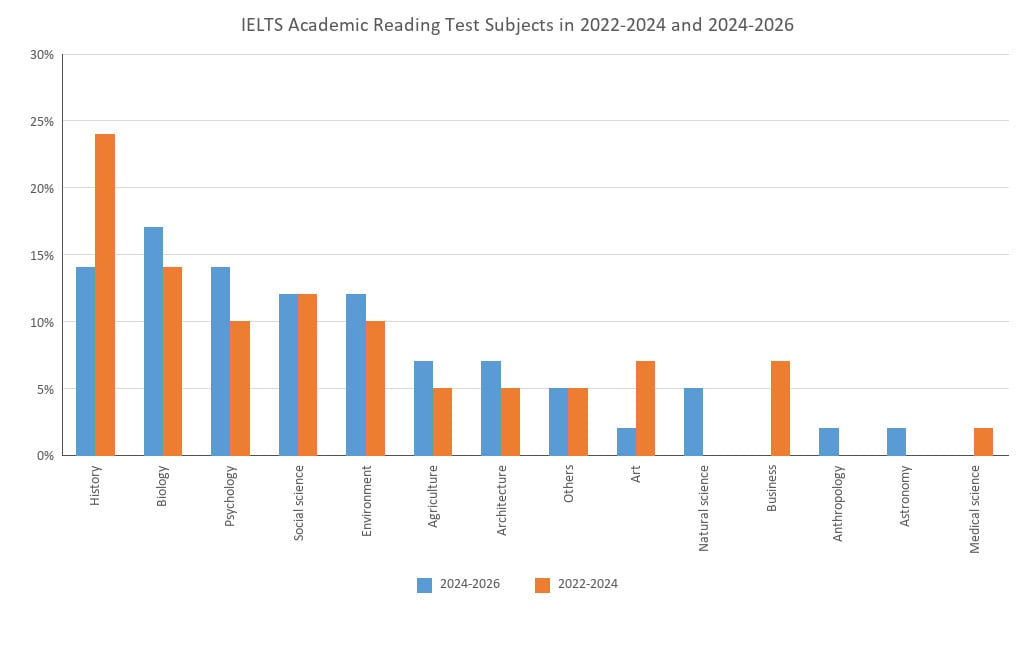
Karena tren ini, kami memastikan tes latihan reading IELTS kami mencakup topik-topik tersebut. Kami juga telah menambahkan sampel reading dari topik-topik yang jarang digunakan, untuk berjaga-jaga. Sangat penting Anda mempersiapkan diri untuk semua situasi, karena Anda tidak akan pernah tahu topik reading IELTS apa yang akan Anda dapatkan.
Bagaimana Skor Reading IELTS Anda Dihitung
Setiap pertanyaan reading IELTS bernilai 1 poin, sehingga Anda dapat memperoleh skor "mentah" hingga 40 poin. Kemudian, skor mentah Anda akan dikonversi menjadi skor band. Tabel di bawah ini dapat memberi Anda gambaran umum tentang bagaimana skor mentah reading IELTS dikonversi menjadi skor band untuk setiap tes.
Skor General Reading IELTS VS Skor Academic Reading IELTS
| Skor Mentah: Academic | Skor Band: Academic | Skor Mentah: General | Skor Band: General |
|---|---|---|---|
| 39-40 | 9 | 40 | 9 |
| 37-38 | 8.5 | 39 | 8.5 |
| 35-36 | 8 | 37-38 | 8 |
| 33-34 | 7.5 | 36 | 7.5 |
| 30-32 | 7 | 34-35 | 7 |
| 27-29 | 6.5 | 32-33 | 6.5 |
| 23-26 | 6 | 30-31 | 6 |
| 19-22 | 5.5 | 27-29 | 5.5 |
| 15-18 | 5 | 23-26 | 5 |
| 13-14 | 4.5 | 19-22 | 4.5 |
| 10-12 | 4 | 15-18 | 4 |
| 8-9 | 3.5 | 12-14 | 3.5 |
| 6-7 | 3 | 9-11 | 3 |
| 4-5 | 2.5 | 6-8 | 2.5 |
| 1-3 | 2 | 1-5 | 2 |
Namun, perlu diingat bahwa setiap versi tes reading IELTS sedikit berbeda dan skor yang dibutuhkan untuk mencapai band tertentu berubah tergantung pada bagaimana seluruh peserta yang mengikuti tes tersebut tampil pada hari itu. Oleh karena itu, jumlah jawaban benar yang dibutuhkan untuk memperoleh skor band akan sedikit berbeda dari satu tes ke tes lainnya, tetapi secara umum Anda harus berupaya untuk memperoleh sekitar 30 dari 40 jika ingin mendapat skor band 7.
Hal lain yang ingin kami ingatkan adalah bahwa pertanyaan tersulit dan pertanyaan termudah memiliki bobot yang sama terhadap skor reading akhir Anda, jadi pastikan Anda tidak kehilangan poin yang lebih mudah karena terjebak pada pertanyaan yang lebih sulit. Berikutnya kita akan membahas beberapa tips dan strategi reading IELTS tentang cara menjawab setiap pertanyaan tes reading.
Tips Reading IELTS - Cara Menjawab 11 Jenis Pertanyaan Reading
Terdapat 11 jenis pertanyaan yang berbeda pada tes reading dan semuanya memerlukan strategi yang berbeda.
Setiap jenis punya contoh dan jawaban di panduan jenis soal IELTS Reading.
- Jenis Pertanyaan 1 – Matching Information
- Jenis Pertanyaan 2 – Matching Headings
- Jenis Pertanyaan 3 – Matching Features
- Jenis Pertanyaan 4 – Identifying Information
- Jenis Pertanyaan 5 – Identifying Writer's Views/claims
- Jenis Pertanyaan 6 – Multiple Choice
- Jenis Pertanyaan 7 – Matching Sentence Endings
- Jenis Pertanyaan 8 – Sentence Completion
- Jenis Pertanyaan 9 – Summary, Note, Table, Flow-chart Completion
- Jenis Pertanyaan 10 – Diagram Label Completion
- Jenis Pertanyaan 11 – Short Answer Questions
- Bagaimana Tren Membantu Anda Mempersiapkan Tes Reading IELTS
Bagaimana Tren Membantu Anda Mempersiapkan Tes Reading IELTS
Jenis soal membaca yang dianggap paling sulit oleh pelajar kami
Pelajar BestMyTest telah menjawab satu juta soal Membaca Akademik dan 600.000 soal Membaca Pelatihan Umum dalam tes latihan kami. Persentase menunjukkan seberapa sering setiap jenis soal dijawab dengan benar.
| Jenis soal | Akademik | Pelatihan Umum |
|---|---|---|
| Mencocokkan informasi | 34% | 72% |
| Benar / Salah / Tidak Disebutkan | 39% | 60% |
| Pilihan ganda | 43% | 48% |
| Mencocokkan karakteristik | 48% | 74% |
| Melengkapi kalimat | 49% | 75% |
| Mencocokkan judul | 53% | 40% |
| Ya / Tidak / Tidak Disebutkan | 55% | 57% |
| Melengkapi ringkasan | 59% | 46% |
| Jawaban singkat | 54% | 75% |
- Dalam Membaca Akademik dua jenis soal dengan hasil terendah adalah mencocokkan informasi dan Benar/Salah/Tidak Disebutkan, keduanya di bawah 40%. Keduanya mengharuskan Anda menemukan gagasan yang diparafrasakan, bukan kata kunci yang sama.
- Dalam Pelatihan Umum situasinya berbalik: mencocokkan judul adalah jenis soal dengan hasil terendah, yaitu 40%, sedangkan jenis soal yang meminta Anda menemukan informasi dijawab dengan benar tiga dari empat kali karena teksnya lebih pendek dan maknanya lebih lugas.
- Soal pada bacaan Akademik rata-rata dijawab dengan benar sebanyak 46%, sedangkan soal pada bacaan Pelatihan Umum sebanyak 59%. Separuh dari upaya pengerjaan soal bacaan Akademik memperoleh nilai 40% atau kurang.
- Dari 43.711 tes latihan membaca lengkap yang dikerjakan oleh 38.534 pelajar, skor band rata-rata adalah 5.4. 36% mencapai band 6.0 dan 14% mencapai band 7.0.
- Anda tetap harus mempersiapkan diri untuk setiap jenis soal, tetapi jika waktu Anda terbatas, tabel ini menunjukkan jenis soal yang paling bermanfaat untuk diprioritaskan.
Angka-angka ini berasal dari data tes latihan dan ulasan BestMyTest hingga Oktober 2026. Persentase jenis soal merupakan tingkat jawaban benar dari seluruh upaya pengerjaan; angka untuk kriteria merupakan skor dari tutor atau AI sesuai label yang tertera. Terakhir diperbarui 5 Oktober 2026.
Berikutnya kita akan membahas tips dan strategi reading IELTS yang diperlukan untuk skor reading yang tinggi.
Tips Reading IELTS - Cara Meningkatkan Skor Band Reading Anda
Sebagian besar peserta gagal pada bagian reading karena tiga alasan berikut
- Kecepatan membaca yang lambat
- Kosakata yang minim
- Sedikit atau tidak ada persiapan
Meningkatkan kecepatan membaca Anda
Pertama, mari kita selesaikan hal yang sudah jelas. Untuk meningkatkan kecepatan membaca Anda, Anda perlu benar-benar berlatih membaca dan melakukannya secara konsisten.
Sekarang mari kita lihat strategi yang kurang jelas yang akan membantu Anda memahami makna dari potongan kalimat yang panjang. Mulailah dengan membedah kalimat. Lakukan ini dengan mencari subjek dan kata kerja kalimat tersebut. Menemukan subjek dan kata kerja akan membantu Anda memahami makna kalimat. Salah satu alasan mengapa bacaan akademik bisa sulit dipahami adalah karena mereka menggabungkan rangkaian gagasan untuk membentuk kalimat majemuk yang panjang. Hal ini menghasilkan potongan kalimat besar yang lebih sulit untuk diserap, jadi menggunakan subjek dan kata kerja sebagai panduan Anda untuk memahami seluruh potongan adalah alat hebat yang dapat Anda gunakan selama ujian reading IELTS.
Meningkatkan kosakata Anda
Banyak orang berpikir menjawab pertanyaan reading sesederhana memindai paragraf untuk kata kunci dan informasi... Sayangnya, tidak sesederhana itu. Pertanyaan reading biasanya diparafrasakan, artinya, kata-kata telah diubah untuk menggunakan sinonim dari kata-kata pada bacaan reading IELTS. Hal ini dilakukan untuk meningkatkan kesulitan, jika tidak, tes akan terlalu mudah. Karena itu, Anda harus meningkatkan kosakata Anda agar mengetahui banyak sinonim yang berbeda dari sebuah kata.
Saat Anda mempersiapkan diri untuk tes reading dan Anda menemukan kata yang tidak Anda ketahui, biasakan untuk berhenti dan mencarinya, atau setidaknya menuliskannya dan mencarinya nanti. Memang sedikit melelahkan, tetapi sangat efektif. Tujuan Anda seharusnya, tetapi tidak terbatas pada, mempelajari 15 hingga 20 kata akademis baru setiap hari.
Mengetahui jenis pertanyaan mana jawabannya berurutan atau tidak
Penting untuk mengetahui bahwa untuk beberapa jenis pertanyaan, jawabannya biasanya (hampir selalu) dalam urutan yang sama dengan bacaan reading IELTS. Untuk jenis pertanyaan lain, jawabannya jarang ditemukan dalam urutan yang sama dengan bacaannya. Kami telah membuat tabel untuk jenis pertanyaan yang mengikuti urutan tersebut dan yang tidak. Mohon diingat.
| Jawaban biasanya (hampir selalu) dalam urutan yang sama dengan bacaan | Jawaban jarang ditemukan dalam urutan yang sama dengan bacaan. |
|---|---|
|
|
Menemukan strategi reading terbaik untuk Anda
Tantangan terbesar yang dihadapi sebagian besar orang dalam ujian reading IELTS adalah menyelesaikan semua pertanyaan reading sebelum waktu habis. Pada bagian berikut, Anda akan mempelajari tiga strategi dan terserah Anda untuk menentukan mana yang paling cocok untuk Anda. Anda dapat melakukannya menggunakan latihan reading gratis kami.
3 Strategi Reading IELTS
Strategi 1: Membaca seluruh bacaan kemudian menjawab pertanyaan.
Pertama-tama, ini bukan strategi yang sesungguhnya. Ini adalah sesuatu yang dilakukan orang ketika mereka tidak mempersiapkan diri dengan baik untuk ujian reading. Namun, kami memasukkannya sebagai strategi karena, secara teknis, jika Anda dapat menyimpan informasi dari bacaan pada bacaan pertama dan mampu menjawab pertanyaan, maka Anda tidak akan memerlukan strategi 2.
Strategi ini, jika Anda tidak memiliki memori yang lebih baik dari rata-rata, tidak efisien. Anda akan kehabisan waktu sebelum dapat menjawab semua pertanyaan. Banyak orang membuat kesalahan ini. Namun, ada beberapa pertanyaan yang tidak memerlukan banyak usaha dan akan diuntungkan dari strategi ini seperti Jika pertanyaan adalah jawaban "Yes" atau "No", maka Anda akan dapat membaca dengan cepat dan menemukan jawaban dengan cepat, tetapi tidak cukup banyak jenis pertanyaan ini, jadi tidak disarankan menggunakan strategi ini kecuali Anda dapat mengatasinya.
Strategi 2: Membaca pertanyaan terlebih dahulu, membaca dengan tujuan dan membuat catatan, lalu menjawab pertanyaan dengan bijak
Ini adalah strategi yang kami rekomendasikan. Strategi ini akan membantu Anda mendapatkan skor reading IELTS yang lebih tinggi. Anggap ini sebagai peta yang jelas tentang cara umum mendekati ujian:
Salah satu kesalahan paling umum yang dilakukan kandidat saat
mendekati ujian reading adalah membaca setiap kata pada bacaan reading IELTS. Meskipun Anda dapat
berlatih untuk ujian dengan membaca demi kesenangan, "membaca buta" (membaca tanpa pemahaman
apa pertanyaan akan ditanyakan) tidak akan menguntungkan Anda dalam ujian. Sebaliknya, hal itu akan merugikan
peluang Anda untuk mengelola waktu secara efektif dan mendapatkan skor terbaik.
Alasan utama untuk membaca pertanyaan terlebih dahulu adalah karena jenis pertanyaan dapat menentukan apa
yang Anda baca dalam bacaan atau cara Anda membacanya. Misalnya, beberapa jenis pertanyaan akan memerlukan
teknik "skimming", sementara yang lain mungkin memerlukan teknik "scanning".
Penting untuk mengerjakan sekumpulan pertanyaan dengan jenis pertanyaan yang sama.
Anda perlu menentukan jenis pertanyaan mana yang ingin Anda kerjakan terlebih dahulu.
Strategi yang baik adalah memulai dengan jenis pertanyaan yang lebih mudah dan beralih ke jenis pertanyaan yang lebih sulit kemudian.
Jenis pertanyaan termudah adalah yang menghabiskan lebih sedikit waktu membaca.
Misalnya, jenis pertanyaan Matching Heading termasuk yang lebih mudah karena Anda
hanya perlu menemukan heading yang paling menggambarkan ide pokok suatu paragraf.
Contoh jenis pertanyaan yang sulit adalah Identifying Information. Untuk jenis pertanyaan ini,
Anda perlu membaca setiap paragraf untuk mengetahui apakah setiap pernyataan adalah TRUE, FALSE, atau NOT GIVEN menurut bacaan.
Berikut adalah tabel yang mencantumkan tingkat kesulitan untuk setiap jenis pertanyaan. Gunakan tabel ini sebagai referensi saat memilih jenis pertanyaan
mana yang ingin Anda kerjakan terlebih dahulu.
| Tingkat kesulitan | Jenis Pertanyaan |
|---|---|
| Mudah | Match Headings Short answer |
| Sedang |
Matching Sentence Endings Matching Features Multiple choice Sentence Completion Diagram Label, Summary, Note, Table, Flow-Chart Completion |
| Sulit |
Match Information Identifying Information (TRUE/FALSE/NOT GIVEN) Identifying Viewer's claims (YES/NO/NOT GIVEN) |
Setelah Anda membaca pertanyaan dari teks IELTS, Anda akan dapat membaca dengan tujuan. Apa artinya ini? Misalnya, jika Anda menemui pertanyaan yang memuat tahun "1896", Anda dapat mencatat di mana tahun ini muncul dalam teks, dan menggunakannya untuk menjawab pertanyaan tersebut nanti.
Ada dua teknik membaca yang akan membantu Anda tetap fokus saat membaca dengan tujuan. Yang pertama, skimming, paling baik didefinisikan sebagai membaca cepat untuk mendapatkan "gist", atau gagasan umum, dari sebuah bacaan. Dengan teknik ini, Anda tidak berhenti untuk kata-kata yang tidak dikenal atau mencari detail spesifik. Teknik kedua, scanning, paling baik didefinisikan sebagai membaca untuk informasi spesifik. Dengan teknik ini, Anda tidak membaca untuk gagasan umum, melainkan informasi spesifik. Perhatikan bagaimana masing-masing teknik ini memiliki tujuan spesifik dalam pikiran. Hal ini akan membantu Anda menemukan informasi lebih cepat.
Saat Anda membaca dengan tujuan, Anda juga harus membuat catatan di bagian tepi bacaan, menempatkan bintang di sebelah informasi penting, atau menggarisbawahi hal-hal yang Anda yakini akan membantu Anda menjawab berbagai pertanyaan. Hal ini akan memudahkan Anda meninjau kembali ketika Anda ditanyakan hal-hal tertentu dalam pertanyaan. Pilihlah sistem pencatatan apa pun yang tepat untuk Anda—pastikan saja Anda melakukannya!
Setelah Anda membaca pertanyaan, membaca bacaan, dan telah membuat catatan yang sesuai, Anda seharusnya sudah menemukan bagian teks yang perlu Anda baca dengan saksama. Kemudian, cukup baca dengan saksama dan berpikir kritis untuk menentukan jawaban yang benar.
Strategi 3: Skimming, mencatat, & jenis pertanyaan.
Ini adalah strategi lain yang digunakan oleh banyak peserta tes IELTS. Strategi ini akan membantu Anda mendapatkan skor reading yang lebih tinggi. Strategi ini terdiri dari 4 langkah:
- Lakukan skimming setiap paragraf untuk mendapatkan gagasan umum dari setiap paragraf. Ide pokok suatu paragraf biasanya ditemukan dalam beberapa kalimat pertama, jadi fokuskan sedikit lebih banyak pada kalimat-kalimat tersebut. Kalimat-kalimat berikutnya dapat dibaca cepat dengan menggarisbawahi nama/kata/frasa yang menonjol.
- Setelah melakukan skimming pada setiap paragraf, tulislah catatan singkat (2-5 kata) di sebelah setiap paragraf dengan tebakan terbaik Anda tentang ide pokok paragraf tersebut.
- Selanjutnya, jawablah sekumpulan pertanyaan dengan jenis pertanyaan yang sama.
- Terakhir, menjawab sekumpulan pertanyaan secara efisien dan benar.
Penting bagi Anda untuk tidak menghabiskan lebih dari 3-5 menit pada Langkah 1 dan 2. Menghabiskan terlalu banyak waktu pada langkah-langkah ini akan membuang banyak waktu dan Anda akan kehabisan waktu.
Langkah 1 & 2Tujuannya di sini adalah menyiapkan metode efisien untuk menemukan jawaban dalam bacaan. Dengan menuliskan gagasan umum dari setiap paragraf, Anda akan tahu paragraf mana yang berisi jawaban untuk setiap pertanyaan. Hal ini akan menghemat banyak waktu karena jika Anda tidak menuliskannya, kemungkinan Anda perlu melakukan skimming pada setiap paragraf untuk mengetahui gagasan umum yang sesuai dengan pertanyaan, kemudian Anda perlu melakukan scanning secara cermat pada paragraf untuk mencari jawaban. Dengan mencatat ide pokok setiap paragraf, Anda dapat melewati langkah pertama membaca cepat setiap paragraf dan langsung melakukan scanning untuk mencari jawaban.
Langkah 3
Setelah Anda melakukan skimming pada teks secara menyeluruh dan menuliskan beberapa catatan, Anda siap untuk Langkah 3.
Pada langkah ini, Anda perlu menentukan jenis pertanyaan mana yang ingin Anda kerjakan terlebih dahulu.
Strategi yang baik adalah memulai dengan jenis pertanyaan yang lebih mudah dan beralih ke jenis pertanyaan yang lebih sulit kemudian.
Jenis pertanyaan termudah adalah yang menghabiskan lebih sedikit waktu membaca.
Misalnya, jenis pertanyaan Matching Heading termasuk yang lebih mudah karena Anda
hanya perlu menemukan heading yang paling menggambarkan ide pokok suatu paragraf, jadi secara teknis Anda hanya memerlukan Langkah 1 dan 2 untuk menjawab jenis pertanyaan ini.
Contoh jenis pertanyaan yang sulit adalah Identifying Information. Untuk jenis pertanyaan ini,
Anda perlu membaca setiap paragraf untuk mengetahui apakah setiap pernyataan adalah TRUE, FALSE, atau NOT GIVEN menurut bacaan.
Berikut adalah tabel yang mencantumkan tingkat kesulitan untuk setiap jenis pertanyaan. Gunakan tabel ini sebagai referensi saat memilih jenis pertanyaan mana yang ingin Anda kerjakan terlebih dahulu.
| Tingkat kesulitan | Jenis Pertanyaan |
|---|---|
| Mudah | Match Headings Short answer |
| Sedang |
Matching Sentence Endings Matching Features Multiple choice Sentence Completion Diagram Label, Summary, Note, Table, Flow-Chart Completion |
| Sulit |
Match Information Identifying Information (TRUE/FALSE/NOT GIVEN) Identifying Viewer's claims (YES/NO/NOT GIVEN) |
Sekarang setelah Anda mengetahui set pertanyaan mana yang akan Anda jawab terlebih dahulu, saatnya benar-benar menjawabnya :( Jangan khawatir! Meskipun setiap jenis pertanyaan berbeda, strategi untuk menjawabnya dengan benar berlaku untuk semuanya. Prinsip dasarnya sederhana, cukup ikuti langkah-langkah berikut:
- Bacalah pertanyaan dengan saksama dan kenali kata kunci penting.
- Temukan paragraf yang berisi informasi yang diperlukan untuk menjawab pertanyaan. (Mudah-mudahan Anda sudah memiliki gagasan umum yang ditulis untuk setiap paragraf, sehingga Anda dapat dengan mudah menemukannya.)
- Lakukan scanning paragraf untuk kata kunci penting (Kemungkinan besar mereka adalah sinonim!) hingga Anda menemukan bagian teks yang perlu Anda baca dengan saksama.
- Terakhir, baca dengan saksama dan berpikir kritis untuk menentukan jawaban yang benar.
Unduh Gratis PDF Sampel Reading IELTS dengan Jawaban
Di bawah ini adalah beberapa sampel reading gratis dari British Council (pembuat ujian IELTS). Cobalah untuk menjawab pertanyaan-pertanyaan tersebut dan lihat seberapa baik hasil Anda!