
Dalam panduan ini, Anda akan mengikuti tes listening IELTS gratis dan mendapatkan analisis skor listening IELTS yang lengkap. Anda akan berlatih dengan lebih dari 125 tes latihan listening IELTS, pelajaran, tips, serta penjelasan jawaban berbentuk video. Dengan mengikuti rencana belajar yang dipersonalisasi dari kami, Anda akan mencapai band score listening IELTS yang Anda targetkan.
Dapatkan analisis skor IELTS listening gratis dan rencana belajar yang dipersonalisasi setelah menyelesaikan tes latihan IELTS listening gratis.
play_circle_outline Mulai Tes Latihan IELTS ListeningDi bawah ini adalah daftar lengkap soal IELTS listening kami beserta jawabannya. Catatan: tautan berwarna merah adalah soal listening kami yang paling populer dan direkomendasikan berdasarkan penilaian siswa kami, dan Anda dapat berlatih secara gratis kapan pun Anda mau.
Soal Latihan Tes IELTS Listening Bagian 1 1 - 59
A conversation between two people in an everyday situation
Soal Latihan Tes IELTS Listening Bagian 2 1 - 75
A talk by one speaker about an everyday topic
Soal Latihan Tes IELTS Listening Bagian 3 1 - 65
A conversation between up to four people about studies or training
Soal Latihan Tes IELTS Listening Bagian 4 1 - 62
A talk by one speaker on an academic subject
Panduan Tes Latihan IELTS Listening
Bagian selanjutnya dari panduan ini akan mengajari Anda segala sesuatu tentang tes IELTS listening. Anda akan mempelajari bagaimana skor listening dihitung, belajar bagaimana menjawab setiap jenis pertanyaan listening dengan sukses untuk meningkatkan skor band IELTS listening Anda, dan mempelajari proses 3 langkah teruji kami yang membantu Anda belajar tes IELTS listening secara online.
Daftar Isi
Info Tes IELTS Listening
Tes IELTS Listening dibagi menjadi 4 bagian. Di setiap bagian, Anda akan mendengarkan satu atau lebih penutur asli bahasa Inggris kemudian menjawab sekitar 10 pertanyaan yang berkaitan dengan apa yang baru saja Anda dengar. Keseluruhan bagian IELTS listening berisi total 40 pertanyaan. Secara umum, rekaman listening dimulai lebih mudah dan menjadi lebih sulit seiring kemajuan ujian. Setiap rekaman hanya didengar satu kali dan mencakup berbagai aksen, termasuk British, Australian, New Zealand, American, dan Canadian.
- Section 1 – percakapan antara dua orang dalam konteks sosial sehari-hari. Misalnya, Anda mungkin mendengar percakapan tentang konfirmasi detail untuk pemesanan, atau melakukan pemesanan melalui telepon.
- Section 2 – sebuah monolog dalam konteks sosial sehari-hari. Misalnya, Anda mungkin mendengar pidato tentang fasilitas lokal, atau seseorang yang memberikan petunjuk arah, atau menyajikan informasi dasar tentang sebuah acara.
- Section 3 – percakapan antara hingga empat orang dalam konteks pendidikan atau pelatihan. Misalnya, Anda mungkin mendengar seorang tutor universitas dan seorang mahasiswa membahas tugas, atau beberapa mahasiswa membahas sesuatu dari kelas.
- Section 4 – sebuah monolog tentang subjek akademik. Misalnya, Anda akan mendengar kuliah universitas dari seorang profesor. Ini adalah rekaman tersulit dalam ujian Listening bagi sebagian besar siswa.
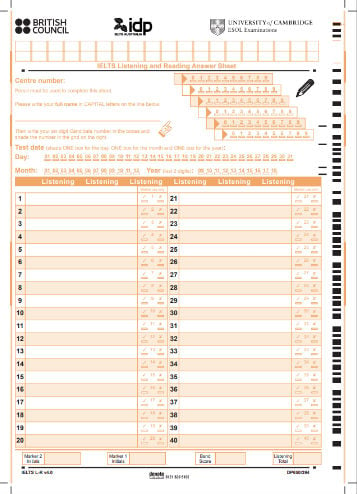
Tes IELTS Listening berlangsung sekitar 40 menit. Anda akan menghabiskan 30 menit untuk mendengarkan rekaman dan menjawab pertanyaan. Anda akan diberi buku pertanyaan dan lembar jawaban. Buku pertanyaan adalah tempat Anda akan melihat semua pertanyaan yang perlu Anda jawab. Lembar jawaban adalah tempat Anda akan menulis jawaban akhir untuk dinilai.
Anda dapat melihat PDF lembar jawaban IELTS listening resmi di sini atau cukup lihat gambar di bawah :)
Di akhir bagian listening, Anda diberi waktu 10 menit untuk memindahkan jawaban dari Buku Pertanyaan ke Lembar Jawaban Anda.
PENTING!
Kesalahan ejaan dan tata bahasa yang salah ditandai sebagai SALAH, jadi gunakan 10 menit tersebut untuk memeriksa kembali ejaan dan tata bahasa Anda.
Menghitung Skor IELTS Listening
Pada bagian Listening, setiap pertanyaan bernilai 1 poin, sehingga Anda bisa mendapatkan skor "mentah" hingga 40 poin. Kemudian, skor mentah Anda akan dikonversi menjadi skor band. Ingat! Anda tidak kehilangan poin untuk jawaban yang salah. Tabel di bawah ini dapat memberi Anda gambaran umum tentang bagaimana skor mentah dikonversi menjadi skor band.
| Skor mentah | Skor band |
|---|---|
| 39-40 | 9 |
| 37-38 | 8.5 |
| 35-36 | 8 |
| 32-34 | 7.5 |
| 30-31 | 7 |
| 26-29 | 6.5 |
| 23-25 | 6 |
| 18-22 | 5.5 |
| 16-17 | 5 |
| 13-15 | 4.5 |
| 11-12 | 4 |
Karena setiap versi IELTS sedikit berbeda, skor mentah yang diperlukan untuk mencapai skor band tertentu berbeda tergantung pada bagaimana semua orang yang mengikuti tes itu tampil pada hari itu. Jadi, jumlah jawaban benar yang diperlukan untuk mendapatkan skor band akan sedikit berbeda dari tes ke tes, tetapi secara umum Anda harus mengincar sekitar 30 dari 40 jika Anda ingin mendapatkan skor band 7.
Seperti disebutkan di atas, setiap bagian menjadi semakin sulit seiring kemajuan Anda dalam tes IELTS listening. Namun, setiap pertanyaan bernilai poin yang sama. Oleh karena itu, pastikan Anda tidak kehilangan poin yang lebih mudah karena tersangkut pada pertanyaan yang sulit.
Unduhan PDF Contoh IELTS Listening Gratis dengan Jawaban
Berikut adalah beberapa contoh IELTS listening gratis dalam format PDF dengan jawaban dari British Council (pembuat ujian IELTS). Di bawah tautan, Anda juga bisa mengerjakan tes IELTS listening dengan audio dan jawaban gratis dari BestMyTest. Tes ini berisi keempat section, dan setiap section menampilkan audio script beserta jawabannya. Cobalah menjawab pertanyaan dan lihat seberapa baik Anda mengerjakannya!
- IELTS Listening Practice Test 1 - pertanyaan (Contoh Online)
- IELTS Listening Practice Test 1 - jawaban (PDF)
- IELTS Listening Practice Test 1 - lembar jawaban (PDF)
Dengarkan rekaman dan jawab pertanyaan 1 sampai 10. Jawaban dan audio script ada di kotak di bawah pertanyaan.
Questions 1-10
Complete the notes below.
Write ONE WORD AND/OR A NUMBER for each answer.
This can provide the carer with:
• time for other duties
• a 1
Assessment of aunt's needs
This may involve discussing:
• how much 2 is spent caring
Daily tasks discussed:
• help with dressing
• helping her take a 3
• shopping
• helping with meals
• managing 4
• any parts of caring that are particularly hard, e.g.
• loss of 5
• 6 her
• avoiding a 7
Types of support that may be provided for carers
• transport costs, e.g. cost of a 8
• vehicle-related costs, e.g. fuel and 9
• help with housework
• support to lower 10
-
spellcheck Jawaban
1. Break
Break is correct because this detail is stated in the recording at the point where the question is answered.2. Time
Time is correct because this detail is stated in the recording at the point where the question is answered.3. Shower
Shower is correct because this detail is stated in the recording at the point where the question is answered.4. Money
Money is correct because this detail is stated in the recording at the point where the question is answered.5. Memory
Memory is correct because this detail is stated in the recording at the point where the question is answered.6. Lifting
Lifting is correct because this detail is stated in the recording at the point where the question is answered.7. Fall
Fall is correct because this detail is stated in the recording at the point where the question is answered.8. Minicab
Minicab is correct because this detail is stated in the recording at the point where the question is answered.9. Parking
Parking is correct because this detail is stated in the recording at the point where the question is answered.10. Anxiety
Anxiety is correct because this detail is stated in the recording at the point where the question is answered.
Audio ScriptNora: It's really good to see you, Marcus. Since I had to give up work, I feel I'm losing touch with my friends and colleagues.
Marcus: We really miss you in the office. We were all so sorry you had to leave. But you must be relieved to have more time to look after your aunt. How is she?
Nora: Well, she's very cheerful, but she needs a lot of help.
Marcus: Have you tried to get any support from the local council?
Nora: No. I didn't know I could.
Marcus: Yes. But for different kinds of practical support, they realise that carers sometimes need time for all the other responsibilities they have, apart from the person they're caring for, and also that they sometimes need a break.
Nora: Absolutely. OK, so tell me more, how do I go about getting this support?
Marcus: Well, you'd have to have an assessment of your aunt's needs. That means someone would come round and talk to you about the situation and what you need. So for a start, they'd want to know the amount of time you spend looking after your aunt every day.
Nora: OK.
Marcus: Then they'll probably ask you what sorts of tasks you do for your aunt during the day. Things like if she needs help with getting dressed, for example.
Nora: Right. I help her with that. And also I help her get into the shower in the morning.
Marcus: Yes. That sort of thing. They'll probably ask you if you do the shopping for her, and help her at meal times, and whether she can cope using money.
Nora: Yes. That's becoming a bit of a problem. She used to be very good at it, but not anymore.
Before you hear the rest of the conversation, you have some time to look at questions 5 to 10. [20 seconds] Now listen, and answer questions 5 to 10.Marcus: And be ready to tell them about anything you find particularly difficult about caring for your aunt.
Nora: So recently I've noticed she started to have quite bad problems with her memory. If I wasn't there, I think she'd forget to eat, for example. And often she doesn't seem quite sure what day it is.
Marcus: Yes. Tell them about that. And are there any physical difficulties you have caring for her? Lifting her, for example.
Nora: Yes. She's quite heavy, and I'm afraid of hurting my back. I'd be in real trouble if that happened.
Marcus: They can give you advice about that, and also about how to avoid the possibility of your aunt having a fall.
Nora: Great. So, once they've done this assessment, if I'm eligible, what happens next?
Marcus: Well, they might support you financially. So they might help you with travel costs, like if you have to get a minicab to take your aunt for an appointment, for example.
Nora: I usually drive her myself, actually. So could I claim for the petrol?
Marcus: You could. And you can claim for the parking, too.
Nora: Oh, right.
Marcus: And if you need help with the housework, they can arrange for someone to come along once or twice a week. And one other thing. I hope you don't mind me saying this, but it's important you look after yourself. And it seems to me you're dealing with quite a bit of anxiety.
Nora: I am, yes.
Marcus: Well, tell the council, because they may be able to give you some advice on how to minimise it.
Nora: Really? Though, actually, I feel so much better having talked to you. I'll get in touch with the council straight away. Now, shall we go for coffee, or something?
Dengarkan rekaman dan jawab pertanyaan 11 sampai 20. Jawaban dan audio script ada di kotak di bawah pertanyaan.
Questions 11-14
Choose the correct letter, A, B or C.
11. Who began turning the unused Whitfield site into a planted space?
- city council officials.
- nearby residents.
- a gardening charity.
12. What was Lillian Hartley trying to achieve through public campaigning?
- preventing a housing sale
- blocking army exercises
- winning maintenance funding
13. Why was the park rejected as a place for troop exercises?
- council permission was refused.
- too little usable space.
- a better site was chosen.
14. How does the speaker describe the latest redesign plans?
- 2013 plan used unchanged.
- 2013 plan revised pre-work.
- 2015 plan finished in 2016.
Questions 15-20
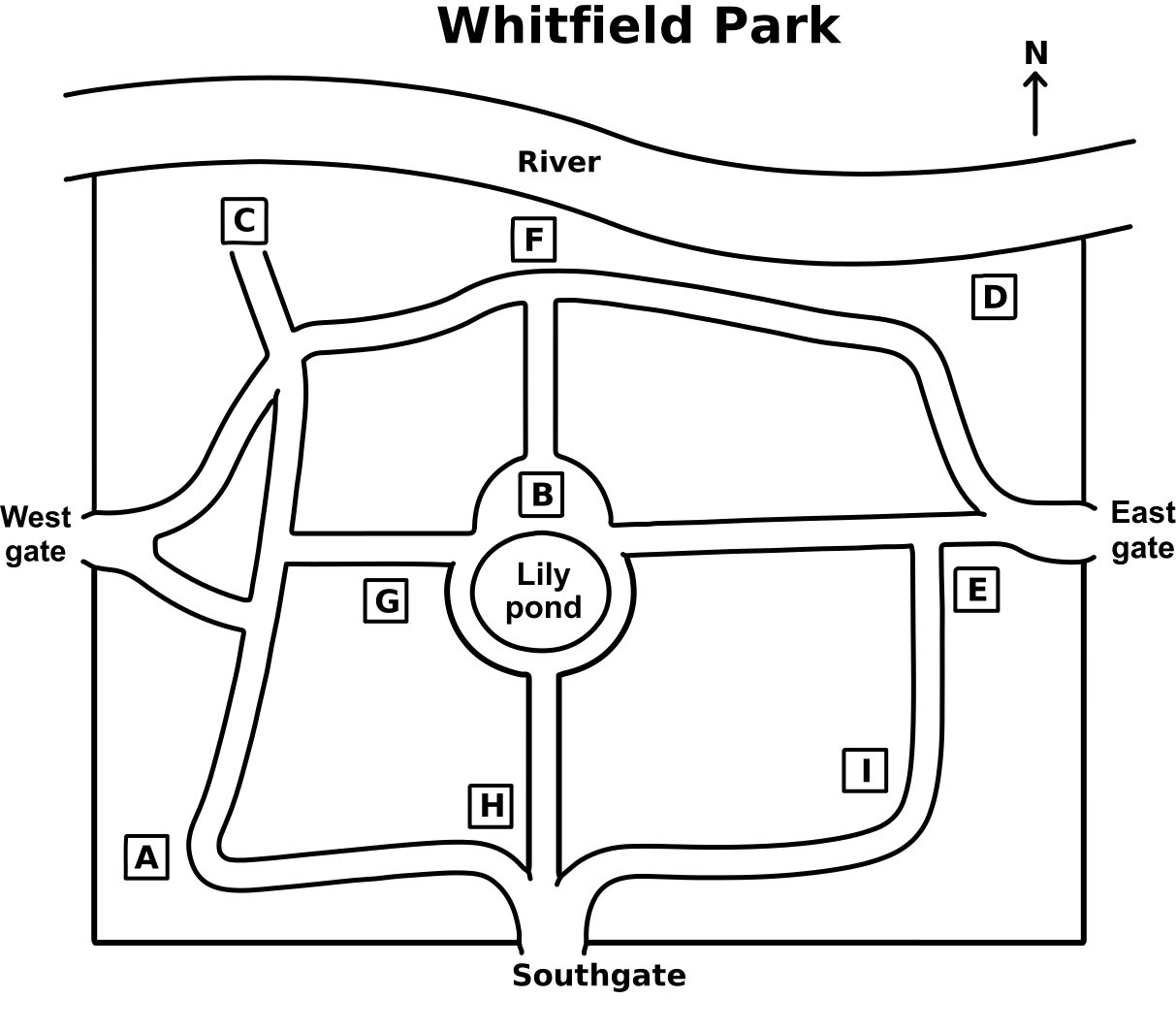
Label the plan of Whitfield Park below.
Write the correct letter, A-I, next to questions 15-20.
- statue of Lillian Hartley
- wooden sculptures
- playground
- maze
- tennis courts
- fitness area
-
spellcheck Jawaban
11. B
(A) is incorrect. The council took ownership later.(B) is correct. The initial planting was done by residents from nearby streets.
(C) is incorrect. The recording does not support this option: a gardening charity.
12. A
(A) is correct. Hartley organised public pressure so the council would keep the land as a park rather than sell it for housing.(B) is incorrect. The recording does not support this option: blocking army exercises.
(C) is incorrect. The recording does not support this option: winning maintenance funding.
13. B
(A) is incorrect. The recording does not support this option: council permission was refused.(B) is correct. , after inspection, the army concluded that the park was too small for practical use.
(C) is incorrect. The recording does not support this option: a better site was chosen.
14. B
(A) is incorrect. The recording does not support this option: 2013 plan used unchanged.(B) is correct. The plans dated from 2013 but were revised in 2015 before work began.
(C) is incorrect. The recording does not support this option: 2015 plan finished in 2016.
15. B
The correct answer is B because the statue of Lillian Hartley is now immediately north of the lily pond near the centre of the park, and that position is labelled B.16. D
The correct answer is D because the wooden sculptures are on the riverbank where the path from the East Gate makes a sharp bend, which corresponds to D.17. F
The correct answer is F because the playground is between the river and the path from the lily pond to the river, and that location is marked F.18. C
The correct answer is C because the maze is found by entering from the West Gate, walking north, and turning left, which places it at C.19. A
The correct answer is A because the tennis courts remain in the southern corner where the perimeter path makes a right-angled bend, labelled A.20. G
The correct answer is G because the fitness area is beside the lily pond on the same side as the West Gate, matching G on the plan.
Audio ScriptI'm delighted this evening to introduce our guest speaker, Sarah Holloway, who is going to talk to us about the recent transformation of Whitfield Park. Over to you, Sarah. Thank you very much. I'm sure you all know Whitfield Park well, it has been one of the city's landmarks for well over a century, and the city council has been responsible for it for most of that time. What perhaps fewer of you will know is how the park actually began.
Unlike many city centre parks, which started life as the private gardens of a large house, Whitfield was originally just an unused patch of waste ground. The first flowers there were actually planted by a small group of local residents who lived in the surrounding streets. They began work on the site in 1892. At that point nobody was entirely sure who legally owned the land, and it was a full twenty years later before the city council finally took it into public ownership. Some of you will have seen the statue near one of the gates. That figure is Lillian Hartley, who played a really important role in the early history of the park.
Once the council legally owned the land, its first instinct was to sell it off as building plots for housing. A great many local residents, however, wanted the park to stay open as a place where everyone could enjoy fresh air and green space, bear in mind that this is a very densely built up residential district. Lillian Hartley was at the heart of that campaign, and it was she who organised the petitions and the public demonstrations which, in the end, persuaded the council to drop the sale and keep the land as a park.
Soon afterwards, in 1914, the First World War broke out, and most of the park was dug up and used to grow vegetables, which were sold to local residents. At one point the army did look into taking over the park as a site for troop exercises. They actually wrote to the city council about it, but when they inspected it they concluded that the park was simply too small to be of any practical use to them, so the idea was dropped. The only military activity in the park during the war was the occasional public meeting held on a small area of grass that had been kept clear of vegetable plots.
After the war, the park was largely returned to the way it had been before 1914, and from then on it remained almost unchanged for decades. New plans for transforming the park were drawn up several times over the years; the most recent version dates from 2013, but those plans were then revised in 2015, well before any actual work had got under way. Work on the ground finally began in 2016 and was completed, on schedule, last year.
Before you hear the rest of the talk, you have some time to look at questions 15 to 20. [20 seconds] Now listen and answer questions 15 to 20.All right, I'd like to describe some of the more important changes that have been made, and one or two things that have deliberately been left as they were. If you take a quick look at the map you've been handed, you'll see the familiar outline of Whitfield Park. The river forms the northern boundary, and there is a gate in each of the three other walls.
From there, follow the path up towards the river and the enlarged children's playground sits between that path and the river itself. If you keep your eye on the riverbank, over towards the East Gate side, the new wooden sculptures are at the point where the path coming up from that gate makes a sharp bend.
Back near the West Gate side of the park, there is a maze, a circular pattern of paths separated by low hedges. Head in from the West Gate, walk north towards the river, and then turn left to find it. Close to the same central lily pond, on the side facing the West Gate, you'll also find the new outdoor fitness area.
Down in the southern corner, where the perimeter path makes that distinct right angled bend, the tennis courts are still in their familiar position, though we have now doubled them from four to eight. Now, since you are all keen gardeners, I'm sure you'll want to hear about the plants that have been chosen for the new beds.
Dengarkan rekaman dan jawab pertanyaan 21 sampai 30. Jawaban dan audio script ada di kotak di bawah pertanyaan.
Questions 21-25
Choose the correct letter, A, B or C.
21. Nina and Owen were surprised to learn that coastal cities
- are home to just under half of all people.
- account for many of the largest cities.
- are expanding at double the rate of inland cities.
22. According to Owen, building coastal cities near to rivers
- can carry contamination back towards urban areas.
- can leave too little land for farming upstream.
- can cause factories to damage rural scenery.
23. What mistake was made when building water drainage channels in Port Selby in the 1950s?
- The system did not include enough channels.
- The builders selected the wrong construction materials.
- The design failed to anticipate rising sea levels.
24. What do Nina and Owen think that the authorities in Port Selby should do immediately?
- take measures to restore coastal ecosystems
- pay for a new flood prevention system
- stop disposing of waste materials into the ocean
25. What do they agree should be the priority for international action?
- greater coordination of activities
- more sharing of information
- agreement on shared policies
Questions 26-30
What decision do the students make about each of the following parts of their presentation?
Write the correct letter, A-G, next to questions 26-30.
- use visuals
- keep it short
- involve other students
- check the information is accurate
- provide a handout
- focus on one example
- do online research
- Historical background
- Geographical factors
- Past mistakes
- Future risks
- International implications
-
spellcheck Jawaban
21. B
(A) is incorrect. The recording does not support this option: are home to just under half of all people.(B) is correct. Nina says most of the biggest cities are built by the sea.
(C) is incorrect. The recording does not support this option: are expanding at double the rate of inland cities.
22. A
(A) is correct. Owen says pollutants from inland agriculture and industry travel down rivers to cities.(B) is incorrect. The recording does not support this option: can leave too little land for farming upstream.
(C) is incorrect. The recording does not support this option: can cause factories to damage rural scenery.
23. C
(A) is incorrect. The recording does not support this option: The system did not include enough channels.(B) is incorrect. The recording does not support this option: The builders selected the wrong construction materials.
(C) is correct. Port Selby's drainage channels were built without allowing for global warming and rising sea levels.
24. B
(A) is incorrect. The recording does not support this option: take measures to restore coastal ecosystems.(B) is correct. Nina says they need money to replace the drainage channels for flood protection now.
(C) is incorrect. The recording does not support this option: stop disposing of waste materials into the ocean.
25. A
(A) is correct. They say coastal cities must act together internationally.(B) is incorrect. The recording does not support this option: more sharing of information.
(C) is incorrect. The recording does not support this option: agreement on shared policies.
26. B
B is correct because they decide not to spend too long on historical background, so they will keep it short.27. A
A is correct because they decide to use slides with maps showing geographical factors.28. F
F is correct because they choose the Meriton case study as the basis for past mistakes, focusing on one example.29. G
G is correct because they need to look at websites for future risks, so online research is required.30. C
C is correct because they plan to ask audience members from different places, involving other students.
Audio ScriptTutor: OK, so what I'd like you to do now is to talk to your partner about your presentations on environmental planning. You should have done most of the reading now, so I'd like you to share your ideas and talk about the structure of your presentation and what you need to do next.
Nina: OK, Owen, I'm glad we chose quite a specific topic: coastal cities. It made it much easier to find relevant information.
Owen: Yeah, and cities are growing so quickly. I mean, we know that more than half the world's population lives in cities now.
Nina: Yeah, though that's all cities, not just coastal ones. But most of the biggest cities are actually built by the sea. I'd not realised that before.
Owen: Nor me. And what's more, a lot of them are built at places where rivers come out into the sea. But apparently this can be a problem.
Nina: Why?
Owen: Well, as the city expands, agriculture and industry tend to spread further inland along the rivers. And so agriculture moves even further inland up the river. That's not necessarily a problem, except it means more and more pollutants are discharged into the rivers.
Nina: That's a serious problem.
Owen: Right.
Nina: Did you read that article about Port Selby on the south coast?
Owen: No.
Nina: Well, apparently back in the 1950s, they built channels to drain away the water in case of flooding.
Owen: Sounds sensible.
Nina: Yeah, they spent quite a lot of money on them. But what they didn't take into account was global warming. So they built the drainage channels too close to sea level. And now sea levels are rising, they're more or less useless. If there's a lot of rain, the water can't run away. There's nowhere for it to go.
Owen: So they did not help much in the end.
Nina: So what are the authorities doing about it now?
Owen: I don't know. I did read that they're aiming to stop disposing of waste water into the ocean over the next 10 years. But that won't help with flood prevention now, will it?
Nina: No, really, they just need to find the money for something to replace the drainage channels in order to protect against flooding now. But in the long term, they need to consider the whole ecosystem.
Owen: Right.
Nina: Really though, coastal cities can't deal with their problems on their own, can they? I mean, they've got to start acting together at an international level instead of just doing their own thing.
Owen: Absolutely. The thing is, everyone knows what the problems are and environmental planners have a pretty good idea of what we should be doing about them. So they should be able to work together to some extent.
Nina: But it's going to be a long time before countries come to a decision on what principles they're prepared to abide by.
Owen: Yeah, if they ever do.
Before you hear the rest of the conversation, you have some time to look at questions 26 to 30. [20 seconds] Now listen and answer questions 26 to 30.Nina: So I think we've probably got enough for our presentation. It's only 15 minutes.
Owen: OK, so I suppose we'll begin with some general historical background about why coastal cities were established. But we don't want to spend too long on that. The other students will already know a bit about it.
Nina: It's all to do with communications and so on.
Owen: Yes, we should mention some geographical factors, things like wetlands and river estuaries and coastal erosion and so on.
Nina: We could have some maps of different cities with these features marked.
Owen: On a handout, you mean, or some slides everyone can see.
Nina: Yeah, that'd be better.
Owen: It'd be good to go into past mistakes in a bit more detail. Did you read that case study of the problems there were in Meriton with flooding a few years ago?
Nina: Yes, we could use that as the basis for that part of the talk. I don't think the other students will have read it, but they'll remember hearing about the flooding at the time.
Owen: Hmm, OK. So that's probably enough background. So then we'll go on to talk about what actions have been taken to deal with the problems of coastal cities.
Nina: OK, what else do we need to talk about? Maybe something on future risks looking more at the long term if populations continue to grow?
Owen: Yeah, we'll need to do a bit of work there. I haven't got much information, have you?
Nina: No, we'll need to look at some websites. Shouldn't take too long.
Owen: OK. And I think we should end by talking about international implications. Maybe we could ask people in the audience. We've got people from quite a lot of different places.
Nina: That'd be interesting if we have time, yes. So now should we go on?
Dengarkan rekaman dan jawab pertanyaan 31 sampai 40. Jawaban dan audio script ada di kotak di bawah pertanyaan.
Questions 31-36
What point does the lecturer make about each item?
Write the correct letter, A-K, next to questions 31-36.
- changes drainage
- protects animals
- increases nutrients
- kills germs
- affects many species
- creates dense shade
- alters the soil
- supports farming
- reduces competition
- attracts bell-miners
- helps recovery
- Eucalyptus woodland
- Damage to eucalyptus woodland
- Oil from eucalyptus leaves
- Lime used in construction
- Direct iron supply
- Moderate bushfires
Questions 37-40
Complete the notes below.
Write ONE WORD ONLY for each answer.
Bell-miner associated dieback:
• The process starts with insects feeding on eucalyptus 37
• A sweet liquid containing 38 attracts bell-miners
Fire patterns:
• If fires happen too often, 39 becomes the main vegetation
• When fires are almost absent, thick growth gives bell-miners protected 40 sites
-
spellcheck Jawaban
31. B
B is correct because eucalyptus woodland provides nesting places and shelter for birds, bats and small mammals.32. E
E is correct because damage to eucalyptus woodland affects a wider community of species, not only the trees themselves.33. D
D is correct because oil from eucalyptus leaves is used in disinfectant, where it can kill certain germs.34. G
G is correct because lime from road construction was washed into the soil and interfered with tree roots.35. K
K is correct because affected trees recovered surprisingly quickly when iron was supplied directly.36. I
I is correct because occasional fire removes fast-growing competitors that would otherwise use water needed by eucalyptus trees.37. leaves
The correct answer is leaves. The lecturer says the process begins when insects settle on eucalyptus leaves and feed on them.38. sugar
The correct answer is sugar. The lecturer says the insects produce a sweet liquid containing sugar, which attracts bell-miners.39. grass
The correct answer is grass. The lecturer says grass tends to dominate afterwards if fires occur too often.40. nesting
The correct answer is nesting. The lecturer says dense growth creates protected nesting sites for bell-miners when fire is suppressed.
Audio ScriptGood morning. Today I want to focus on the eucalyptus tree, one of the best known features of the Australian landscape. Many people call it a gum tree, but the name eucalyptus actually covers hundreds of related species, from small scrubby trees to very tall forest giants.
Now, eucalyptus trees are important in several ways. Ecologically, they provide nesting places and shelter for birds, bats and small mammals. Their flowers also produce nectar, which is an important food source for insects and birds. So when eucalyptus woodland is damaged, the effect is felt across a much wider community of species.
As for their value to people, the trees are also useful. Oil from eucalyptus leaves has long been used in cleaning products, and one common use is in disinfectant, because the oil can kill certain germs. Eucalyptus timber is also used in building and fencing, although that is not really the main focus of today's lecture.
So, these trees can live for centuries, and some individuals survive for four hundred years or more. That is why researchers became concerned when large numbers began dying much earlier than expected in different parts of Australia.
Now, one disease that attracted attention was Mundulla Yellows. The leaves of affected trees slowly turned yellow and then, over time, the whole tree declined. For years the cause was unclear. Eventually, researchers discovered that lime, or calcium hydroxide, had been used in road construction nearby. Rain washed the lime into the surrounding soil, where it interfered with the roots of eucalyptus trees. The trees were still surrounded by nutrients, but they could no longer absorb the iron they needed for healthy growth. When iron was supplied directly to affected trees, they recovered surprisingly quickly.
However, Mundulla Yellows affected only a limited number of places. A much wider problem on the east coast was Bell miner associated dieback. Now, bell miners are small native birds, but they are not the direct cause of the damage. The process begins when insects settle on eucalyptus leaves and feed on them. While feeding, these insects produce a sweet liquid containing sugar. Bell miners are attracted to that liquid, and they aggressively chase away other birds and insects that might otherwise reduce the insect population. As a result, the insects multiply, the leaves are badly damaged, and the trees gradually lose their ability to survive.
But some scientists think fire history is also part of the explanation. An influential theory, first proposed by the ecologist William Jackson, links the type of vegetation in a region to the frequency of bushfires. If fires occur too often, grass tends to dominate the area afterwards. If fires occur at moderate intervals, eucalyptus forest is more likely to persist. This is because occasional fire removes fast growing competitors which would otherwise take up the water eucalyptus trees need. And it also helps maintain the soil by preventing dense undergrowth from changing the soil structure and removing nutrients.
At the other extreme, if fires are almost completely suppressed, a different ecosystem can develop. Scientists sometimes call this dry rainforest. Now, the name sounds contradictory, because we usually associate rainforest with wet tropical conditions. But in this case it means a dense, shaded vegetation system with relatively few species. It can create excellent conditions for bell miners, because the thick growth gives them protected nesting sites while excluding many of the species that would normally compete with them.
What this tells us is that before European settlement, Aboriginal communities used controlled burning over long periods, and this probably created a more balanced pattern of vegetation. Since European settlement, fire has often been suppressed, roads and farms have altered drainage, and some local ecosystems have shifted away from eucalyptus woodland. The decline of eucalyptus trees, then, is not caused by one single factor. It is the result of disease, insects, birds, soil chemistry and fire management interacting with one another.

Completion - Part 1
Learn how to answer these questions in a step-by-step interactive exercise
Completion - Part 1
Bagian kosong bisa meminta waktu atau frekuensi. Pembicara biasanya menyebut periode yang sama dengan kata-kata lain, jadi cocokkan maknanya dengan bagian kosong, jangan menunggu kata-kata yang tertulis di halaman.
Lalu periksa batas kata sebelum Anda mengirim jawaban. Baca ulang seluruh baris dengan jawaban Anda di bagian kosong, lalu hapus kata yang sudah ada di baris itu. Jawaban yang maknanya benar tetapi terlalu panjang tidak mendapat nilai.
Klik putar untuk mendengarkan audio
Catatan memakai kata kerja sederhana seperti must provide atau need to bring. Pembicara jarang mengucapkan kata kerja itu dan justru memakai sinonim atau menggambarkan tindakannya, jadi dengarkan apa yang sebenarnya diwajibkan.
Pembicara sering menyebutkan item tambahan lebih dulu lalu mencoretnya. Jika Anda melewatkan satu bagian kosong, tinggalkan dan lanjutkan ke bagian berikutnya, karena jawaban mengikuti urutan rekaman dan satu bagian kosong yang terlewat bisa membuat Anda kehilangan jawaban-jawaban sesudahnya.
Klik putar untuk mendengarkan audio
Bagaimana hasil Anda menjawab contoh pertanyaan IELTS listening di atas? Apakah Anda menemukan beberapa pertanyaan yang sulit? Jika ya, akan bermanfaat bagi Anda untuk melihat lebih dekat semua 6 jenis tugas IELTS listening. Semakin baik Anda memahami jenis tugas, semakin sedikit usaha yang Anda perlukan untuk mencari tahu apa yang perlu Anda lakukan dan semakin banyak waktu yang Anda miliki untuk mencari tahu jawabannya.
6 Jenis Tugas IELTS Listening
Ada 6 jenis pertanyaan yang berbeda dalam tes IELTS listening. Penting bagi Anda untuk berlatih setiap jenis tugas untuk mempelajari cara terbaik menangani masing-masing untuk skor IELTS listening yang tinggi.
Jenis soal menyimak yang dianggap paling sulit oleh pelajar kami
Berikut temuan dari 2.22 juta jawaban IELTS Listening pelajar BestMyTest. Tabel di bawah ini menunjukkan persentase setiap jenis soal yang dijawab dengan benar oleh pelajar kami, sehingga Anda bisa langsung melihat di mana poin hilang.
| Jenis soal | Jawaban benar |
|---|---|
| Note completion | 33% |
| Table completion | 34% |
| Sentence completion | 45% |
| Short answer | 48% |
| Multiple choice | 50% |
| Multiple selection | 52% |
| Plan, map, diagram labelling | 55% |
| Form completion | 73% |
| Matching | 85% |
Soal melengkapi isian menjadi sumber kehilangan poin. Di antara soal melengkapi isian, Note completion dijawab dengan benar 33% dari waktu, sementara Form completion, yang menggunakan keterampilan yang sama dengan tata letak berbeda, mencapai 73%. Setiap soal melengkapi isian meminta Anda menulis kata yang Anda dengar, jadi ejaan, bentuk kata, dan batas jumlah kata semuanya dihitung, dan semua itu bisa Anda latih.
Dari 61.104 tes latihan menyimak lengkap yang dikerjakan oleh 54.523 pelajar, skor band rata-rata adalah 5.6. Sebanyak 41% tes mencapai band 6.0, dan 12% mencapai band 7.0.
Pada masing-masing bagian menyimak, 31% percobaan memperoleh skor 40% atau kurang, dan 30% memperoleh skor 80% atau lebih. Bagian 3 dan 4 adalah bagian akademik tes ini, jadi latihlah keduanya secara terpisah dan juga di dalam tes lengkap.
Meskipun setiap jenis pertanyaan listening terlihat berbeda, pendekatan dasar untuk masing-masing adalah sama. Nanti di posting ini, kami akan menunjukkan kepada Anda strategi dasar untuk menangani semua 6 jenis pertanyaan. Setiap jenis punya contoh audio dan jawaban di panduan jenis soal IELTS Listening.
3 langkah untuk Persiapan Tes IELTS Listening Online yang Efektif
Meskipun setiap jenis pertanyaan (tugas) IELTS listening berbeda, pendekatan dasar untuk masing-masing adalah sama. Anda dapat menangani semua jenis tugas dengan menggunakan satu strategi langkah demi langkah yang sederhana. Berikut adalah tiga langkah yang kami rekomendasikan untuk Anda gunakan dalam pendekatan terhadap jenis pertanyaan Listening:
- Periksa pertanyaan dengan cermat untuk menemukan informasi kunci
- Prediksi jawaban potensial sebelum mendengarkan
- Ikuti alur untuk mencocokkan pertanyaan dengan konten saat mereka mendengarkan
Langkah 1: Periksa Pertanyaan
Pada bagian IELTS Listening, Anda akan diberi waktu persiapan singkat (30-40 detik) sebelum rekaman dimulai. Ini adalah kesempatan Anda untuk melihat pertanyaan yang perlu Anda jawab, yang merupakan inti dari langkah pertama dalam strategi ini. Daripada menggunakan waktu ini untuk beristirahat, atau memeriksa jawaban Anda, Anda akan fokus untuk mempelajari sebanyak mungkin tentang pertanyaan yang akan datang. Mengambil langkah ini penting untuk menghindari kesalahan multitasking saat mendengarkan pembicara dan mencoba membaca pertanyaan untuk pertama kalinya.
Ketika waktu persiapan Anda dimulai, pertama gunakan waktu ini sebaik mungkin dengan memeriksa pertanyaan untuk mengetahui lebih banyak tentangnya. Ini adalah beberapa informasi yang harus Anda cari saat memeriksa setiap pertanyaan IELTS Listening:
- Jenis pertanyaan apa ini?
- Seperti apa jawabannya nanti? (contoh: tanggal, angka, nama)
- Apa frasa dan kata yang paling penting, atau kata kunci, dalam pertanyaan?
Salah satu contoh bisa berupa jenis pertanyaan Note Completion, seperti ini:
Complete the notes below.
Write NO MORE THAN THREE WORDS for each answer.
Pertama, Anda dapat menggarisbawahi beberapa kata kunci dalam pertanyaan.
Two reasons for the new approach to pricing are changes in (27) ______ and (28) _________ programs.
Dalam contoh ini, mendengarkan frasa kunci "two reasons" yang sudah Anda garis bawahi memungkinkan Anda
untuk mulai memperhatikan dengan saksama pada saat yang tepat. Berikut adalah bagian audio script yang mengungkapkan jawabannya:
Mark: Well, there seem to be two basic reasons. Firstly, because the law has changed recently to allow companies to behave like this. In the past, they weren't allowed to change the prices of the tickets. And secondly, we now have computer programs that do the calculations so that prices can be changed very quickly and accurately.
Setelah memeriksa pertanyaan, Anda akan tahu bahwa "the law" dan "computer" adalah jawaban yang benar di sini berdasarkan beberapa kata kunci dan mengetahui jenis pertanyaan.
Langkah 2: Prediksi Jawaban Potensial
Langkah kedua dalam strategi untuk sukses pada bagian IELTS Listening sangat erat kaitannya dengan langkah pertama. Faktanya, Anda harus mencoba untuk menyelesaikan kedua langkah ini dalam waktu persiapan yang sama 20 detik sebelum rekaman dimulai. Meskipun ini mungkin tampak seperti tugas yang sulit untuk dilakukan dalam waktu yang sangat singkat, ingatlah bahwa langkah-langkah ini sebenarnya terkait satu sama lain.
Untuk memprediksi jawaban potensial untuk pertanyaan Listening, Anda perlu terlebih dahulu menyelesaikan langkah pertama dengan memeriksa pertanyaan secara cermat. Pada titik ini, Anda harus tahu jenis pertanyaan apa yang sedang Anda lihat, seperti apa jawaban potensialnya, serta kata kunci mana yang akan membantu dalam menemukan jawaban dengan cepat. Untuk memprediksi jawaban, Anda akan menggabungkan semua informasi ini dan menebak jenis jawaban yang Anda harapkan untuk didengar.
Mari kita tinjau kembali pertanyaan contoh Note Completion yang sama dari atas.
Two reasons for the new approach to pricing are changes in (27) and (28) programs.
Hanya dengan melihat tata bahasa dari kalimat ini memungkinkan Anda mengidentifikasi jenis kata yang akan menjadi jawabannya. Dalam kasus ini, preposisi "in" mendahului kedua jawaban potensial. Secara tata bahasa, hanya kata benda atau frasa kata benda yang dapat digunakan dengan cara ini dalam frasa preposisi. Tidak hanya Anda dapat memprediksi, dengan benar, bahwa jawabannya akan berupa kata benda atau frasa kata benda, tetapi juga mungkin untuk memprediksi bahwa jawabannya bisa terkait dengan kebijakan atau pemerintah (law), dan kata yang dapat muncul dengan programs (computer) berdasarkan konteks.
Meskipun mustahil untuk menebak jawaban yang persis benar hanya berdasarkan prediksi, dengan mencoba membayangkan apa jawabannya, Anda lebih cenderung mendengarkan informasi yang relevan sambil mengabaikan informasi yang tidak relevan. Memprediksi jawaban potensial sebelum rekaman dimulai akan menyiapkan telinga Anda, membuat Anda satu langkah lebih dekat ke jawaban yang benar.
Sekarang, coba gabungkan Langkah 1 (periksa pertanyaan) dan Langkah 2 (prediksi jawaban potensial) dalam pertanyaan contoh multiple choice yang lebih sulit.
Choose the correct letter, A, B, C or D.
- are for weekend shows
- are booked well in advance
- are non-refundable
- are booked for groups
Meskipun tidak ada cara untuk mengetahui jawaban pertanyaan ini dengan pasti, Anda masih dapat menggunakan informasi yang ditemukan dalam pertanyaan-pertanyaan ini untuk memprediksi jawaban potensial dan menargetkan pendengaran Anda. Misalnya, pertanyaan 24 menyangkut alasan mengapa harga tiket teater paling rendah, jadi Anda akan ingin mendengarkan dengan saksama setiap alasan yang disebutkan. Perlu diingat, ada kemungkinan lebih dari satu yang akan disebutkan. Lihat skrip di bawah ini untuk melihat bagaimana prediksi dapat membantu Anda menghilangkan jawaban yang salah.
Perhatikan bagaimana tiga dari kemungkinan jawaban disebutkan, "booked for groups", "are for weekend shows" dan "are non-refundable." Namun, jawaban yang benar adalah C "are non-refundable" karena disebutkan sebagai lebih murah secara terpisah dari dua lainnya, yang hanya disebutkan bersama-sama.
Langkah 3: Ikuti Alur
Setelah rekaman dimulai dan bagian listening sebenarnya dari tes dimulai, Anda harus mengikuti alur untuk menyelesaikan langkah ketiga dari strategi bagian IELTS Listening ini. Mengikuti alur mengharuskan Anda untuk fokus dengan cermat pada apa yang Anda dengar, sambil pada saat yang sama melacak pertanyaan mana yang sedang dibahas oleh konten tersebut.
Pertanyaan-pertanyaan pada bagian ujian IELTS Listening biasanya akan muncul secara berurutan di mana jawabannya dapat ditemukan dalam konten rekaman. Ini memberi Anda keuntungan dalam tes, karena artinya setelah Anda mendengar jawaban untuk satu pertanyaan, Anda akan segera mengalihkan perhatian Anda ke pertanyaan berikutnya secara berurutan. Jika Anda dapat mengikuti alur dengan sukses dengan mencocokkan konteks dari pertanyaan dengan apa yang Anda dengar dalam rekaman, Anda akan tetap berada di jalur yang benar dan menghindari kehilangan informasi penting yang diperlukan untuk menjawab setiap pertanyaan.
Melakukan ini lebih mudah diucapkan daripada dilakukan. Anda perlu melakukan multitasking dengan mendengarkan sekaligus tetap memperhatikan pertanyaan berikutnya. Jika Anda memang melewatkan jawaban dari sebuah pertanyaan, Anda akan tahu ketika Anda mendengar jawaban dari pertanyaan berikutnya. Meskipun ini bisa membingungkan dan bahkan membuat frustrasi, melewatkan satu jawaban dan menyadarinya masih lebih baik daripada benar-benar tersesat dalam konten dan melewatkan lebih banyak jawaban. Dalam skenario melewatkan suatu pertanyaan, sebaiknya Anda meninggalkannya saja, dan lanjut ke yang berikutnya. Pada akhirnya, Anda harus menebak yang paling tepat tentang pertanyaan yang Anda lewatkan. Namun, sisi baiknya, ada kemungkinan bahwa mendengarkan rekaman secara keseluruhan dapat memberi Anda petunjuk kontekstual lain dan memungkinkan Anda untuk menjawab pertanyaan yang Anda lewatkan dengan lebih akurat.
Sumber Daya Gratis Latihan IELTS Listening
Anda memerlukan keterampilan listening yang kuat untuk mendapatkan skor IELTS listening dengan band tinggi. Karena itu, penting bagi Anda untuk berlatih secara konsisten setiap hari sampai hari tes.
Di bawah ini adalah beberapa sumber daya yang dapat Anda gunakan untuk melatih dan mempertahankan keterampilan listening Anda setiap hari.
- YouTube - https://www.youtube.com
- BBC Learning English - http://www.bbc.co.uk/learningenglish
- TED - https://www.ted.com/
- BBC radio - https://www.bbc.co.uk/worldserviceradio
- ABC news in Australia - https://www.abc.net.au/listen/live/news
Angka di halaman ini berasal dari data performa pelajar IELTS BestMyTest, yaitu catatan latihan IELTS di BestMyTest sampai 10/2026. Cara setiap angka diukur dijelaskan di halaman tersebut. Terakhir diperbarui: 15/10/2026.