Last updated: October 19, 2026
An IELTS Speaking prediction is a list of the topics you are most likely to meet in the current test period, based on what recent candidates report. This guide sets out the expected topic areas for September–December 2026 in all three parts of the Speaking test, shows how the mix of topics has shifted since 2025, and explains how to prepare so that you are ready even when your exact question isn’t on any list.
About these predictions: they are based on third-party collections of topics reported by IELTS candidates and on our own analysis of those topics. IELTS does not publish its Speaking questions, so no prediction can guarantee what you will be asked.
If you’re looking for free IELTS Speaking practice, then click the button below to answer real Speaking questions and get a free AI score.
play_circle_outline Start Free IELTS Speaking PracticeTable Of Contents
- How IELTS Speaking Predictions Work
- IELTS Speaking Prediction September–December 2026 at a Glance
- Part 1 Prediction: Topics to Prepare
- Part 2 Prediction: Cue Card Topic Areas
- Part 3 Prediction: Discussion Themes
- How IELTS Speaking Topics Changed from 2025 to 2026
- How to Prepare for Predicted Topics Without Memorizing
- How Our Learners’ Answers Grow Across the Three Parts
- Practise Predicted Topics with BestMyTest
- All IELTS Speaking Practice Questions
- Frequently Asked Questions About IELTS Speaking Prediction 2026
How IELTS Speaking Predictions Work
After their tests, many candidates share the Speaking questions they were asked. Preparation websites collect these reports and group them by period, usually January–April, May–August, and September–December. When the same topics are reported again and again within a period, they become “predicted” topics.
That makes predictions useful for one thing: knowing which topic areas are common right now. They are not a list of guaranteed questions. Topics often carry over between periods, the exact wording changes from test to test, and the examiner can choose from a large bank of questions.
IELTS Speaking Prediction September–December 2026 at a Glance
Part | Expected topic areas | How to prepare |
|---|---|---|
Part 1 (4–5 minutes) | Work or study, hometown, home, plus everyday topics such as free time, food, technology, travel, and the weather | Short, natural answers with a reason and an example. See our IELTS Speaking Part 1 questions. |
Part 2 (cue card) | People, places, experiences and events, objects, technology, and media | A bank of flexible personal stories you can adapt. See our IELTS cue cards 2026. |
Part 3 (discussion) | Broader questions linked to your Part 2 topic: society, education, work, technology, and the environment | Opinions with reasons and examples beyond your own life |
Part 1 Prediction: Topics to Prepare
Part 1 is the most predictable part of the test. It almost always starts with one of three topics, then moves to one or two everyday subjects.
- Opening topics: work or study, hometown, and home or accommodation.
- Everyday topics expected this period: daily routine, free time, friends and family, food, music, films, technology and phones, travel, clothes, weather, sport, and reading.
Every one of these, with four or five practice questions and sample answers, is on our IELTS Speaking Part 1 questions page.
Part 2 Prediction: Cue Card Topic Areas
Recent reports for September–December 2026 cluster into four topic areas. Prepare at least one story for each area, and you will have material for almost any cue card.
People
Examples of recently reported cue cards:
- Describe an older person you admire
- Describe a person who is good at making things by hand
- Describe a person who overcame a difficult challenge
See all of them, with “You should say” prompts and ideas, in the people cue cards.
Places
Examples of recently reported cue cards:
- Describe a city you would like to visit again
- Describe a noisy place you have visited
- Describe a natural place in your city
See all of them, with “You should say” prompts and ideas, in the places cue cards.
Experiences and events
Examples of recently reported cue cards:
- Describe an important decision you changed
- Describe a time you worked successfully in a team
- Describe a time you helped someone
See all of them, with “You should say” prompts and ideas, in the experiences and events cue cards.
Objects, technology, and media
Examples of recently reported cue cards:
- Describe an app you regularly use
- Describe a book you found exciting
- Describe an interesting piece of local news
See all of them, with “You should say” prompts and ideas, in the objects, technology, and media cue cards.
Part 3 Prediction: Discussion Themes
Part 3 questions grow out of your Part 2 topic, so the Part 3 themes follow the same four areas. Expect questions that ask you to compare, explain causes, or predict the future:
Part 2 area | Likely Part 3 themes |
|---|---|
People | Role models, generations learning from each other, and what makes people successful or happy |
Places | City life, noise and pollution, public spaces, and protecting nature in cities |
Experiences and events | Decision-making, teamwork at school and work, helping others, and customer service |
Objects, technology, and media | Technology in daily life, reading habits, news and social media, and consumer culture |
Part 3 rewards developed opinions: answer the question, explain why, and support it with an example from society, not only from your own life.
How IELTS Speaking Topics Changed from 2025 to 2026
We grouped recently reported Part 2 and Part 3 topics into seven categories and compared 2025 with 2026.
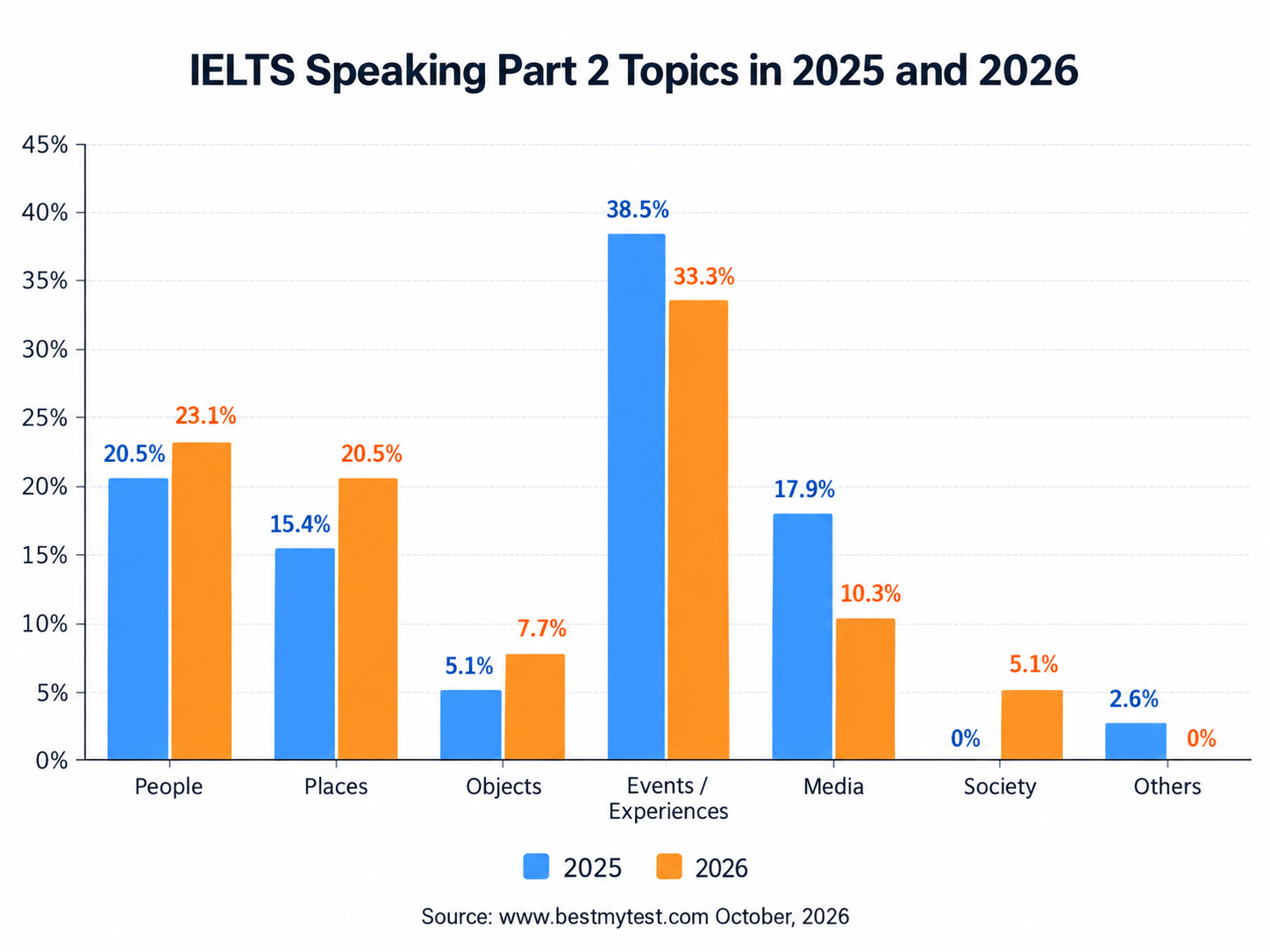
- Events and experiences is still the largest category: 38.5% of topics in 2025 and 33.3% in 2026.
- People and places together made up 43.6% of the 2026 topics, so describing someone you know or somewhere you have been is very likely.
- Objects, media, and society appear less often, but still come up, so don’t skip them.
The prediction for the rest of 2026 follows the same pattern: personal experiences, people, and places first. For more on the Speaking test and how each part is scored, see our IELTS Speaking test guide.
How to Prepare for Predicted Topics Without Memorizing
The best use of a prediction list is not to memorize answers to it, but to build a small story bank: six to eight real experiences that you can adapt to many cue cards. Each story covers several topic areas at once:
Story from your life | Cue cards it can answer |
|---|---|
A grandparent or older relative who taught you something | An older person you admire; a person who overcame a challenge; a time someone helped you |
A trip to a city you loved | A city you would like to visit again; a noisy place; an enjoyable evening with friends |
A change of plan, such as a new course or job | An important decision you changed; a personal achievement; a time you saved money |
A group project at school or work | A time you worked in a team; a time you helped someone; a successful person you know |
An app, book, or device you use every day | An app you use; something you cannot live without; a gift for a friend |
For each story, note the background, what happened, one specific detail, and how you felt. Then practise telling it for two minutes in different directions. Add topic vocabulary for each area, and you will be ready for predicted topics and new ones alike.
How Our Learners’ Answers Grow Across the Three Parts
Each part of the Speaking test asks for a different length of answer. The chart shows how long our learners actually speak in each part. In Part 3, where predicted themes turn into abstract questions, grammar was the lowest criterion most often, in 84% of answers.

Practise Predicted Topics with BestMyTest
Knowing the topics is half the job. The other half is answering them out loud under test timing. Our free practice covers all three parts, and every recording gets an instant AI score on fluency, vocabulary, grammar, and pronunciation:
- IELTS Speaking Part 1 practice: short questions about you and everyday topics.
- IELTS Speaking Part 2 practice: a cue card with one minute to prepare and two minutes to speak.
- IELTS Speaking Part 3 practice: discussion questions that build on Part 2.


Part 3 is where predicted themes become hardest, because the questions are abstract. This AI Tutor exercise walks you through a real Part 3 question from our bank, step by step:

Task Achievement — IELTS Speaking 3
Learn how to answer this question in a step-by-step interactive exercise
Task Achievement — IELTS Speaking 3
Langkah pertama dalam menjawab soal IELTS Speaking Part 3 adalah mengenali pola pertanyaannya. Begitu Anda mengenali polanya, Anda bisa langsung memakai struktur jawaban yang sesuai di kepala Anda.
Dengan begitu, Anda tahu jelas apa yang harus dikatakan selanjutnya, sehingga Anda bisa mengembangkan jawaban dengan lancar dan tidak macet. Daripada mencoba merencanakan seluruh jawaban sebelum berbicara, cukup ikuti strukturnya selangkah demi selangkah.
Pada langkah ini, Anda akan mempelajari 8 pola pertanyaan IELTS Speaking Part 3 yang umum beserta struktur jawaban untuk masing-masing pola. Klik setiap tab pola untuk mempelajari cara kerjanya.
Mari kita kerjakan Pertanyaan 1.
Pertama, kenali pola pertanyaannya. Tanyakan pada diri Anda: Apa yang diminta pertanyaan ini dari saya? Begitu Anda mengenali polanya, gunakan struktur jawaban yang sesuai untuk memandu jawaban Anda.
Untuk pertanyaan ini, polanya adalah Opinion / View, jadi ikuti struktur ini:
Answer → Reason → Explain → Example → Result → Second Point or Contrast → Conclusion
Saat berbicara, gunakan pengisi jeda terkontrol seperti Well, Actually, For example, What I mean by that is, dan So overall. Frasa-frasa ini dapat membuat jawaban Anda terdengar lebih lancar dan memberi Anda sedikit waktu tambahan untuk berpikir jika Anda tiba-tiba lupa apa yang harus dikatakan selanjutnya. Gunakan secara wajar, jangan di setiap kalimat. Berikut daftar pengisi jeda terkontrol.
Do you think job satisfaction is more important than your salary when choosing a job?
Mari kita kerjakan Pertanyaan 2.
Pertama, kenali pola pertanyaannya. Tanyakan pada diri Anda: Apa yang diminta pertanyaan ini dari saya? Begitu Anda mengenali polanya, gunakan struktur jawaban yang sesuai untuk memandu jawaban Anda.
Untuk pertanyaan ini, polanya adalah Descriptive / Types, jadi ikuti struktur ini:
Main Type → Explain → Example → Second Type → Explain or Compare → Overall View
Saat berbicara, gunakan pengisi jeda terkontrol seperti Well, Actually, For example, What I mean by that is, dan So overall. Frasa-frasa ini dapat membuat jawaban Anda terdengar lebih lancar dan memberi Anda sedikit waktu tambahan untuk berpikir jika Anda tiba-tiba lupa apa yang harus dikatakan selanjutnya. Gunakan secara wajar, jangan di setiap kalimat. Berikut daftar pengisi jeda terkontrol.
What skills do you think are needed to get a good job these days?
Mari kita kerjakan Pertanyaan 3.
Pertama, kenali pola pertanyaannya. Tanyakan pada diri Anda: Apa yang diminta pertanyaan ini dari saya? Begitu Anda mengenali polanya, gunakan struktur jawaban yang sesuai untuk memandu jawaban Anda.
Untuk pertanyaan ini, polanya adalah Opinion / View, jadi ikuti struktur ini:
Answer → Reason → Explain → Example → Result → Second Point or Contrast → Conclusion
Saat berbicara, gunakan pengisi jeda terkontrol seperti Well, Actually, For example, What I mean by that is, dan So overall. Frasa-frasa ini dapat membuat jawaban Anda terdengar lebih lancar dan memberi Anda sedikit waktu tambahan untuk berpikir jika Anda tiba-tiba lupa apa yang harus dikatakan selanjutnya. Gunakan secara wajar, jangan di setiap kalimat. Berikut daftar pengisi jeda terkontrol.
Do you think that women should be able to do the same jobs as men?
Mari kita kerjakan Pertanyaan 4.
Pertama, kenali pola pertanyaannya. Tanyakan pada diri Anda: Apa yang diminta pertanyaan ini dari saya? Begitu Anda mengenali polanya, gunakan struktur jawaban yang sesuai untuk memandu jawaban Anda.
Untuk pertanyaan ini, polanya adalah Compare / Contrast, jadi ikuti struktur ini:
Main Difference → Explain → Example → Second Difference → Contrast → Overall Comparison
Saat berbicara, gunakan pengisi jeda terkontrol seperti Well, Actually, For example, What I mean by that is, dan So overall. Frasa-frasa ini dapat membuat jawaban Anda terdengar lebih lancar dan memberi Anda sedikit waktu tambahan untuk berpikir jika Anda tiba-tiba lupa apa yang harus dikatakan selanjutnya. Gunakan secara wajar, jangan di setiap kalimat. Berikut daftar pengisi jeda terkontrol.
What’s the difference between white collar and blue collar jobs?
Mari kita kerjakan Pertanyaan 5.
Pertama, kenali pola pertanyaannya. Tanyakan pada diri Anda: Apa yang diminta pertanyaan ini dari saya? Begitu Anda mengenali polanya, gunakan struktur jawaban yang sesuai untuk memandu jawaban Anda.
Untuk pertanyaan ini, polanya adalah Descriptive / Types, jadi ikuti struktur ini:
Main Type → Explain → Example → Second Type → Explain or Compare → Overall View
Saat berbicara, gunakan pengisi jeda terkontrol seperti Well, Actually, For example, What I mean by that is, dan So overall. Frasa-frasa ini dapat membuat jawaban Anda terdengar lebih lancar dan memberi Anda sedikit waktu tambahan untuk berpikir jika Anda tiba-tiba lupa apa yang harus dikatakan selanjutnya. Gunakan secara wajar, jangan di setiap kalimat. Berikut daftar pengisi jeda terkontrol.
What jobs do you think are most valuable to society?
For a detailed review of your recordings, see our IELTS speaking review guide.
All IELTS Speaking Practice Questions
The best way to prepare for predicted topics is to answer real questions out loud. Every Speaking practice in our question bank is listed below by part. Open any set to record your answers and get an instant AI score.
IELTS Speaking Part 1 Practice
IELTS Speaking Part 2 Cue Card Practice
IELTS Speaking Part 3 Practice
Frequently Asked Questions About IELTS Speaking Prediction 2026
helpAre IELTS Speaking predictions accurate?expand_moreexpand_less
Predictions are based on topics that candidates report after their tests, so they show which topic areas are common in a period. They cannot tell you your exact questions, because IELTS does not publish its question bank.
helpWhen do IELTS Speaking topics change?expand_moreexpand_less
Preparation websites usually group reported topics into January–April, May–August, and September–December. Many topics carry over from one period to the next, and IELTS does not announce official change dates.
helpShould I memorize answers to predicted IELTS Speaking topics?expand_moreexpand_less
No. Prepare a bank of flexible stories and topic vocabulary instead. Memorized answers sound unnatural and often do not fit the exact question you receive.
helpWhat are the most common IELTS Speaking Part 2 topics in 2026?expand_moreexpand_less
In the 2026 topics we analysed, events and experiences was the largest category, followed by people and places. Together, people and places made up 43.6% of the topics.
helpHow should I prepare if my topic is not on the prediction list?expand_moreexpand_less
Use the same method: answer directly, give a reason, and add a personal example. If you have practised flexible stories about people, places, and experiences, you can adapt them to most new topics.
The figures on this page come from the BestMyTest IELTS learner performance data, our records of IELTS practice on BestMyTest up to October 2026. That page explains how we measure each figure. Last updated 15 October 2026.