The Writing Task 1 of the IELTS Academic test requires you to write a summary of at least 150 words in response to a particular graph (bar, line or pie graph), table, chart, or process (how something works, how something is done).
This task tests your ability to select and report the main features,
to describe and compare data, identify significance and trends in factual information, or describe a process.
- - You should spend about 20 minutes on this task.
- - Write in a formal style
- - Write at least 150 words
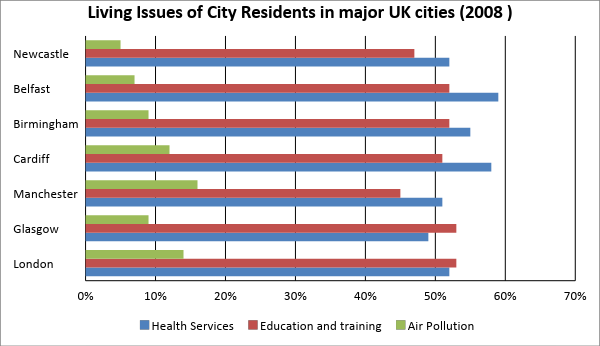
The chart below gives some of the most reported issues among people living in UK cities in 2008 (%).
Summarise the information by selecting and reporting the main features, and make comparisons where relevant.
Write at least 150 words.
Keywords In The Practice
Related Words
No Vocabulary Linked To Practice
Get your essay scored with grammar corrections and a detailed score report.
assignment
Get premium writing review
Sample Premium Writing Review
Score Summary
AI Review
Criteria Feedback
Strengths
- The essay answers both parts of the question.
- The main cause is clear and stays relevant to the topic.
- The effect on society is stated clearly and linked to the cause.
- The writer adds a practical idea that fits the topic.
The essay clearly focuses on why ex-prisoners commit crimes again. In the first body paragraph, the cause is explained through phrases like “social prejudice” and “rejection that criminals naturally suffer.” This directly answers the question about causes.
The effect on society is also given in a direct way. The line “the increase of violence rates” shows a clear social result of repeat crime. This keeps the writing connected to the task, because the question asks about the effect on society, not only the effect on the criminal.
The essay also gives a useful response idea. The sentence about “public policies” and helping companies hire ex-prisoners supports the discussion well. It is not the main task, but it still fits the topic and shows the writer understands the problem.
The personal example at the end also supports the point that reintegration can work. It helps make the cause and effect discussion more real, even though it is not very fully developed.
Weaknesses- The causes are explained in a narrow way, with only one main reason developed.
- The effects on society are present, but not fully explored.
- Some parts move away from the cause-effect focus.
- The ending does not fully summarize the main ideas.
Most of the essay builds around one main cause only: rejection after prison. This is relevant, but the task asks about “causes,” so the response would be stronger with another clear cause, such as poor education, weak support after release, or contact with old criminal groups. A simple added sentence could be: “Another cause is the lack of training and support after release, so many people feel they have no legal way to start again.”
The social effect is mentioned, but it stays brief. “Increase of violence rates” is a valid effect, but the essay could explain more results for society, such as fear in communities, pressure on police, or more public spending. For example: “This can make neighborhoods less safe and force the government to spend more money on prisons and policing.”
The paragraph about government action is sensible, but it shifts a little from the main job of this essay. The task mainly asks for causes and effects. One or two lines are fine, but more space should go to developing the required answers.
The final paragraph is a personal story, but it works more like an extra example than a strong conclusion. A clearer ending could restate both parts of the answer. For example: “In short, rejection after prison can push people back into crime, and this harms society by increasing danger and social costs.”
Exercises for Improvement- Practice planning two causes and two effects before writing.
- Write one short conclusion that repeats your main cause and main effect.
- Do a task-focus exercise with only cause and effect sentences.
Before writing, make a quick table with two columns: causes and effects. For this topic, write two ideas in each column. This will help you answer both parts more fully.
Practice writing 2-sentence conclusions. Sentence one should restate the causes. Sentence two should restate the effects on society. Keep it short and direct.
Take this topic and write only six sentences: one introduction, two cause sentences, two effect sentences, and one conclusion. This helps you stay focused on exactly what the task asks.
Grammatical Range and Accuracy
Strengths
- The essay uses a mix of simple and complex sentence forms.
- Most sentences are clear and easy to understand.
- The writer shows control of linking grammar such as clauses of reason and result.
- Verb forms are often used correctly.
The writing includes longer sentence patterns, not only short basic ones. For example, “once released from prison, usually go back to crime, as they come through enormous obstacles” uses a time phrase and a reason clause. This shows some range.
The essay also uses cause and result grammar in useful ways. The sentence “The rejection that criminals naturally suffer... causes them to seek opportunities” is grammatically strong for this task type, because it clearly connects cause and effect.
There is also good use of relative and added information. In “individuals who served a prison sentence,” the phrase “who served a prison sentence” is used correctly to define the group. This helps the writing sound more precise.
Verb forms are mostly controlled well. Sentences like “he managed to return to the workforce and has become an excellent professional” are understandable and mostly accurate.
Weaknesses- Some preposition and word-form errors make sentences less natural.
- There are grammar mistakes with articles, plurals, and sentence form.
- A few sentences are overlong and become harder to control.
- There are some errors in the final paragraph with tense use.
Several grammar problems come from fixed phrases and prepositions. For example, “reintegrated to society” is less accurate than “reintegrated into society.” Also, “difficulty to be professionally reallocated” would be better as “difficulty finding work” or “difficulty being employed.” These errors do not block meaning, but they reduce accuracy.
There are also small article and form problems. “Does not have easy solution” should be “does not have an easy solution.” “Government should create” would sound more complete as “The government should create.” These are common grammar points in IELTS.
Some long sentences carry too many ideas. For example, the sentence starting with “The immediate effect of this reality is that...” is understandable, but it becomes heavy and harder to control. Shorter sentences would reduce errors. A clearer version could be: “This situation pushes many ex-prisoners back into crime. As a result, violence in society may increase.”
In the last paragraph, “he had also become a good citizen” does not match the time flow well with the other verbs. A better version would be: “he also became a good citizen” or “he has also become a good citizen.” This would keep the tense pattern clearer.
Exercises for Improvement- Practice common preposition patterns after key words.
- Rewrite long sentences into two shorter ones.
- Do editing drills for articles and verb tenses.
Make a list of useful phrases for this topic, such as “reintegrate into society,” “return to crime,” and “be released from prison.” Write each one three times in a new sentence. This will improve grammar with prepositions.
Take two long sentences from your essay and split each one into two shorter sentences. Check if the meaning stays clear. This will help you control accuracy better under test conditions.
Do a short correction exercise with articles and tenses. For example, change “Government should create public policies” to “The government should create public policies.” Then change “he had also become” to “he also became.”
Lexical Resource (Vocabulary)
Strengths
- The essay uses topic vocabulary related to crime and reintegration.
- There is some variety in word choice.
- The writer attempts less common vocabulary to explain the issue.
- Vocabulary often helps show cause and effect clearly.
The essay uses many words that fit the topic well, such as “recidivism,” “offenders,” “released from prison,” and “crime underworld.” These words are relevant to the question and help the response sound focused.
There is also some variety in how the writer refers to the same group. The essay uses “criminals,” “offenders,” and “individuals who served a prison sentence.” This avoids too much repetition and shows a fair vocabulary range.
The writing also uses words for social problems and feelings, such as “social prejudice,” “rejected,” and “raise awareness.” These choices help explain why former prisoners may return to crime.
In several places, vocabulary supports the cause-effect pattern well. For example, “causes them to seek opportunities” and “encouraging the return to crime” clearly show the relationship between ideas.
Weaknesses- Some word choices are awkward or not natural in English.
- A few words are used correctly in meaning, but the collocation is weak.
- There are spelling mistakes.
- Some phrases are too formal or heavy, which reduces clarity.
At times, the writer chooses a word that is understandable but not natural. For example, “professionally reallocated” is not a normal way to talk about getting work. “Find a job” or “return to the workforce” would fit better here.
There are also weak word pairings. “Come through enormous obstacles” is not the best collocation in this sentence. A more natural choice would be “face enormous obstacles.” Also, “apply for job offers” should be “apply for jobs.” These changes would make the vocabulary more accurate.
Some spelling mistakes reduce the quality of vocabulary use. Examples include “environenments,” “sytem,” and “violance.” These mistakes do not stop understanding, but they lower the overall control of word use.
A few phrases are too heavy and make the meaning less direct. “Penitentiary system” is acceptable, but “prison system” would be clearer and more natural in this essay. Clear and accurate vocabulary often works better than very formal wording.
Exercises for Improvement- Build a topic word bank with natural collocations.
- Do a spelling review with words from your own essay.
- Practice replacing heavy phrases with clearer ones.
Make a vocabulary table for this topic. In one column, write nouns like “crime,” “prison,” and “prejudice.” In the next column, add natural partners like “commit a crime,” “be sent to prison,” and “face prejudice.” This will improve your collocations.
Copy the misspelled words from your essay and write each one correctly five times: “environments,” “system,” and “violence.” Then use each word in a new sentence.
Take formal phrases from your essay and rewrite them in simpler English. For example, change “professionally reallocated” to “find work,” and change “penitentiary system” to “prison system.” This will make your vocabulary clearer and more natural.
Coherence & Cohesion
Strengths
- The essay has a clear paragraph structure.
- Main ideas usually follow a logical order.
- Linking words are used to show addition, result, and contrast.
- Most sentences connect clearly to the topic of repeat crime.
The writing is divided into clear parts. The first paragraph introduces the issue. The second paragraph explains causes. The third paragraph moves to effects and possible action. The last paragraph gives an example. This makes the essay easy to follow overall.
The ideas also move in a logical direction. The writer starts with the problem of reintegration, then explains rejection and job difficulty, and then shows the result for society. This order supports a cause-effect essay well.
Linking words help the flow in several places. The essay uses “Furthermore,” “Besides,” “because of,” “consequently,” and “On top of that.” These words show how ideas are connected and guide the reader through the discussion.
Reference words also help cohesion. For example, “this reality” and “such individuals” point back to earlier ideas, so the writer does not repeat the same nouns too often.
Weaknesses- Some paragraphing choices are not fully effective for this task.
- A few linking choices feel forced or slightly unclear.
- The final paragraph is not a strong conclusion.
- Some sentences carry too many ideas, so the flow becomes heavy.
The essay is organized, but the third paragraph mixes effect and solution together. Since the task asks for causes and effects, it would be clearer to keep one body paragraph for causes and one body paragraph only for effects. Then the final paragraph could give a short conclusion.
Some connectors are used, but not always in the best way. For example, “Besides offering them means of survival, there are psychological effects” is a little awkward as a link. The reader must stop and work out the connection. A simpler link would be: “This group gives them money, and it also gives them a feeling of acceptance.”
The last paragraph feels like an extra example, not a full ending. After reading it, the essay stops without a clear final summary of the main cause and the main effect. This weakens the overall shape of the response.
A few sentences are too packed with ideas. For example, the long sentence about “the general prejudice towards those who came from the penitentiary system” includes cause, result, and comment together. Splitting it would improve the flow. For example: “Society often judges former prisoners. This can push them back into crime and increase violence.”
Exercises for Improvement- Practice making a simple four-paragraph plan before writing.
- Rewrite one mixed paragraph into a single clear purpose.
- Practice short conclusions with two summary sentences.
Before writing, note four paragraph jobs: introduction, causes, effects, conclusion. Then put only matching ideas in each part. This will make your essay shape clearer.
Take your third paragraph and separate the effect from the solution. Write one version with only effects. This exercise will help you keep paragraph focus.
Write three short conclusions for this same topic. Each one should have only two sentences. Sentence one should summarize the causes. Sentence two should summarize the effects on society.
Grammar Corrections
The rejection that criminals naturally suffer when trying to be reinserted in society and to apply for job offers causes them to seek opportunities in the same environments where they felt at ease prior to their imprisonment, the crime underworld. Besides offering them means of survival, there are psychological effects in such environenments, given that their previous criminal partners tend to welcome them better than does society in general.
The immediate effect of this reality is that, because of the general prejudice towards those who came from the penitentiary sytem, society involuntarily ends up encouraging the return to crime and, consequently, the increase of violance rates. It is however a problem that does not have easy solution. Government should create public policies aiming at stimulating companies to hire such individuals and engage in campaigns to raise awareness among people not to reject them previously.
Personally, some years ago I knew a person who had served a four-year period in jail and, after his release, he managed to return to the workforce and has become an excellent professional. On top of that, he had also become a good citizen and started a family. Today, he is fully reintegrated to society.
The rejection that criminals naturally suffer when trying to be reinserted in society and to apply for job offers causes them to seek opportunities in the same environments where they felt at ease prior to their imprisonment, the crime underworld. Besides offering them means of survival, there are psychological effects in such environenments, environments, given that their previous criminal partners tend to welcome them better than does society in general.
The immediate effect of this reality is that, because of the general prejudice towards those who came from the penitentiary sytem, system, society involuntarily ends up encouraging the return to crime and, consequently, the increase of violance violence rates. It is however is, however, a problem that does not have an easy solution. Government should create public policies aiming at stimulating companies to hire such individuals and engage in campaigns to raise awareness among people not to reject them previously.
Personally, some years ago I knew a person who had served a four-year period in jail and, after his release, he managed to return to the workforce and has become an excellent professional. On top of that, he had also become a good citizen and started a family. Today, he is fully reintegrated to society.
Improvement Suggestions
The rejection that former criminals naturally suffer often experience when trying to be reinserted in rejoin society and to apply for job offers causes jobs leads many of them to seek opportunities in the same environments where they felt at ease prior to their imprisonment, accepted before prison: the crime criminal underworld. Besides offering them a means of survival, there these environments also have a psychological impact, since their former criminal associates are psychological effects in such environments, given that their previous criminal partners tend to welcome them better usually more welcoming than does society in general. at large.
The immediate effect of this reality is that, because of the general widespread prejudice towards those against people who came from have been through the penitentiary prison system, society involuntarily ends up encouraging the unintentionally encourages their return to crime and, consequently, the increase of violence rates. It is, in violence. This is not, however, a problem that does not have an easy solution. Government can be easily solved. The government should create public policies aiming at stimulating to encourage companies to hire such these individuals and engage in launch campaigns to raise awareness among people not to reject them previously. and reduce prejudice against them.
Personally, some years ago I knew a person who had served a four-year period four years in jail prison and, after his release, he managed to return to the workforce and has become an excellent professional. On top of that, he had He also become became a good citizen and started a family. Today, he is fully reintegrated to into society.
Vocabulary Improvement

Writing Quality of Supporting Ideas
Strengthen each idea with an explanation, an example, or specific details.

Task Achievement — Task 2
Improve your ability to write an essay that fully answers the question.
Sentence Variety
Rewrite a few sentences of your response using different sentence structures.

English Grammar: Conjunctive Adverbs
We noticed you might need more practice using conjunctive adverbs in your writing.
English Grammar: Articles
We noticed you might need more practice using articles in your writing.

Writing Coherence
Improve your ability to organize ideas so your writing is easy to follow.
cancel Grammar Correction
| Solution | Explanation |
|---|---|
| environments, | Spelling correction: the word should be "environments," not "environenments,". |
cancel Grammar Correction
| Solution | Explanation |
|---|---|
| system, | The word "sytem" is misspelled. The correct spelling is "system," which makes the sentence grammatically correct. |
cancel Grammar Correction
| Solution | Explanation |
|---|---|
| violence | The word is misspelled. The correct spelling is “violence.” |
cancel Grammar Correction
| Solution | Explanation |
|---|---|
| is, however, | A comma is needed after “however” because it is a conjunctive adverb used to interrupt the sentence. |
cancel Grammar Correction
| Solution | Explanation |
|---|---|
| an | The article “an” was added to make the phrase grammatically correct before a vowel sound. |
cancel Improvement Suggestion
| Solution | Explanation |
|---|---|
| serious | "Serious" is more natural here because it describes the problem in a formal and appropriate way. "Worrying" is understandable, but "serious" better fits academic essay style. |
cancel Improvement Suggestion
| Solution | Explanation |
|---|---|
| in the reintegration of former | This replacement makes the phrase more precise and formal. The original wording is awkward, while the new one clearly refers to the process of former criminals returning to society. |
cancel Improvement Suggestion
| Solution | Explanation |
|---|---|
| into | The correct preposition is "into" when referring to movement or return to a group or place. "Reintegrated into society" is the natural expression. |
cancel Improvement Suggestion
| Solution | Explanation |
|---|---|
| This phrase is removed to make the sentence more direct and grammatically smoother. The idea is already expressed by the surrounding words, so it is unnecessary. |
cancel Improvement Suggestion
| Solution | Explanation |
|---|---|
| A | This change removes an unnecessary introductory phrase and makes the sentence more concise. Starting directly with "A" is more natural and less repetitive. |
cancel Improvement Suggestion
| Solution | Explanation |
|---|---|
| return | "Return" is a simpler and more formal verb choice here. It avoids repetition and sounds more appropriate in an academic context. |
cancel Improvement Suggestion
| Solution | Explanation |
|---|---|
| crime because | "Because" gives a clearer cause-and-effect relationship than "as" in this sentence. It makes the reason for their behavior easier to understand. |
cancel Improvement Suggestion
| Solution | Explanation |
|---|---|
| face major | "Face major" is the correct and more natural expression in this context. The original phrase is not idiomatic in English. |
cancel Improvement Suggestion
| Solution | Explanation |
|---|---|
| being | This change fixes the grammatical structure of the sentence. "Being" fits the construction better than "be normally." |
cancel Improvement Suggestion
| Solution | Explanation |
|---|---|
| In addition, people | "In addition, people" sounds more natural and less formal than "Furthermore, individuals." It also improves readability while keeping the meaning. |
cancel Improvement Suggestion
| Solution | Explanation |
|---|---|
| have | The verb "have" is needed to make the sentence grammatically complete. Without it, the sentence lacks a proper verb phrase. |
cancel Improvement Suggestion
| Solution | Explanation |
|---|---|
| This article is unnecessary in the expression and makes the phrase less natural. Removing it improves grammar and fluency. |
cancel Improvement Suggestion
| Solution | Explanation |
|---|---|
| sentences often | The singular noun is replaced with a plural structure that better matches the idea being discussed. "Sentences often" also helps the sentence flow more naturally. |
cancel Improvement Suggestion
| Solution | Explanation |
|---|---|
| great | "Great" is a more suitable adjective here because it conveys a stronger and more natural meaning. The original phrase is awkward and less idiomatic. |
cancel Improvement Suggestion
| Solution | Explanation |
|---|---|
| finding employment | "Finding employment" is the correct and natural phrase to describe getting a job. "Professionally reallocated" is unnatural in English and does not fit the context well. |
cancel Improvement Suggestion
| Solution | Explanation |
|---|---|
| former | "Former" is needed to specify that the sentence refers to people who used to be offenders, making the phrase more precise and natural. |
cancel Improvement Suggestion
| Solution | Explanation |
|---|---|
| often experience | "Often experience" sounds more appropriate here because it describes a common result without suggesting that the rejection is an inherent or natural trait of the criminals themselves. |
cancel Improvement Suggestion
| Solution | Explanation |
|---|---|
| rejoin | "Rejoin" is a shorter, more natural verb in English for returning to society, while "be reinserted in" is awkward and unnatural. |
cancel Improvement Suggestion
| Solution | Explanation |
|---|---|
| This word is unnecessary in the structure, so removing it improves grammatical flow. |
cancel Improvement Suggestion
| Solution | Explanation |
|---|---|
| jobs leads many of | This correction improves the sentence structure by making the cause-and-effect relationship clearer and more grammatical. |
cancel Improvement Suggestion
| Solution | Explanation |
|---|---|
| accepted before prison: | This change makes the idea clearer and more direct, replacing an awkward expression with a more natural phrase. |
cancel Improvement Suggestion
| Solution | Explanation |
|---|---|
| criminal | "Criminal" is the correct adjective here because it modifies "underworld" properly. |
cancel Improvement Suggestion
| Solution | Explanation |
|---|---|
| a | The article "a" is needed before "criminal underworld" to make the noun phrase grammatically complete. |
cancel Improvement Suggestion
| Solution | Explanation |
|---|---|
| these environments also have a psychological impact, since their former criminal associates | This replacement clarifies the meaning by stating directly that these environments affect them psychologically and explains why they are drawn back to them. |
cancel Improvement Suggestion
| Solution | Explanation |
|---|---|
| usually more welcoming | The phrase is simplified and made more natural by using a comparative expression that fits better in context. |
cancel Improvement Suggestion
| Solution | Explanation |
|---|---|
| This word is unnecessary and disrupts the grammatical structure of the sentence, so it should be removed. |
cancel Improvement Suggestion
| Solution | Explanation |
|---|---|
| at large. | "At large" is the correct expression here to refer to society as a whole. |
cancel Improvement Suggestion
| Solution | Explanation |
|---|---|
| widespread | "Widespread" is a stronger and more accurate adjective for describing prejudice affecting many people. |
cancel Improvement Suggestion
| Solution | Explanation |
|---|---|
| against people | "Against people" is more natural in this context and better conveys the idea of prejudice directed at former prisoners. |
cancel Improvement Suggestion
| Solution | Explanation |
|---|---|
| have been through | "Have been through" is a more natural way to refer to experiences such as serving a prison sentence. |
cancel Improvement Suggestion
| Solution | Explanation |
|---|---|
| prison | “Prison” is the more natural and common word in English in this context, while “penitentiary” sounds more formal and less natural here. |
cancel Improvement Suggestion
| Solution | Explanation |
|---|---|
| unintentionally encourages their | This revision uses a more direct and natural expression. “Unintentionally encourages” is clearer and more concise than “involuntarily ends up encouraging the.” |
cancel Improvement Suggestion
| Solution | Explanation |
|---|---|
| in violence. This is not, | “Increase of violence rates” is awkward in English, so “in violence” sounds more natural. The added contrast also improves the flow of the sentence. |
cancel Improvement Suggestion
| Solution | Explanation |
|---|---|
| can be easily solved. The government | This makes the sentence more grammatical and natural by using the correct subject and a clearer passive structure. |
cancel Improvement Suggestion
| Solution | Explanation |
|---|---|
| to encourage | “To encourage” is simpler and more idiomatic than “aiming at stimulating” in this context. |
cancel Improvement Suggestion
| Solution | Explanation |
|---|---|
| these | “These” is more appropriate because it refers directly to the individuals being discussed, while “such” is less precise here. |
cancel Improvement Suggestion
| Solution | Explanation |
|---|---|
| launch | “Launch” is a better verb for starting a campaign, whereas “engage in” is too general and less natural. |
cancel Improvement Suggestion
| Solution | Explanation |
|---|---|
| and reduce prejudice against them. | This revision expresses the idea more clearly and naturally, focusing on lowering prejudice instead of the awkward phrase “not to reject them previously.” |
cancel Improvement Suggestion
| Solution | Explanation |
|---|---|
| four years | “Four years” is more concise and natural than “a four-year period.” |
cancel Improvement Suggestion
| Solution | Explanation |
|---|---|
| prison | “Prison” is the more standard term in this context, especially when referring to serving a sentence. |
cancel Improvement Suggestion
| Solution | Explanation |
|---|---|
| The word is unnecessary here and removing it avoids repetition and improves sentence flow. |
cancel Improvement Suggestion
| Solution | Explanation |
|---|---|
| This word is unnecessary in the phrase and removing it corrects the tense and makes the sentence smoother. |
cancel Improvement Suggestion
| Solution | Explanation |
|---|---|
| He | The phrase is simplified to make the sentence more direct and avoid an awkward transition. |
cancel Improvement Suggestion
| Solution | Explanation |
|---|---|
| became | The past tense “became” is needed because the sentence describes a completed action in the past. |
cancel Improvement Suggestion
| Solution | Explanation |
|---|---|
| into | “Into” is the correct preposition with “reintegrated,” making the phrase grammatically correct. |
Criteria Score Reports
Task Response 6/9
• presents a relevant position although the conclusions may become unclear or repetitive
• presents relevant main ideas but some may be inadequately developed/unclear
| Score | General Report |
|---|---|
| 9 | • fully addresses all parts of the task • presents a fully developed position in answer to the question with relevant, fully extended and well supported ideas |
| 8 | • sufficiently addresses all parts of the task • presents a well-developed response to the question with relevant, extended and supported ideas |
| 7 | • addresses all parts of the task • presents a clear position throughout the response • presents, extends and supports main ideas, but there may be a tendency to overgeneralise and/or supporting ideas may lack focus |
| 6 | • addresses all parts of the task although some parts may be more fully covered than others • presents a relevant position although the conclusions may become unclear or repetitive • presents relevant main ideas but some may be inadequately developed/unclear |
| 5 | • addresses the task only partially; the format may be inappropriate in places • expresses a position but the development is not always clear and there may be no conclusions drawn • presents some main ideas but these are limited and not sufficiently developed; there may be irrelevant detail |
| 4 | • responds to the task only in a minimal way or the answer is tangential; the format may be inappropriate • presents a position but this is unclear • presents some main ideas but these are difficult to identify and may be repetitive, irrelevant or not well supported |
| 3 | • does not adequately address any part of the task • does not express a clear position • presents few ideas, which are largely undeveloped or irrelevant |
| 2 | • barely responds to the task • does not express a position • may attempt to present one or two ideas but there is no development |
| 1 | • answer is completely unrelated to the task |
| 0 | • does not attend • does not attempt the task in any way • writes a totally memorised response |
Grammatical Range and Accuracy 6/9
• makes some errors in grammar and punctuation but they rarely reduce
communication
| Score | General Report |
|---|---|
| 9 | • uses a wide range of structures with full flexibility and accuracy; rare minor errors occur only as ‘slips’ |
| 8 | • uses a wide range of structures • the majority of sentences are error-free • makes only very occasional errors or inappropriacies |
| 7 | • uses a variety of complex structures • produces frequent error-free sentences • has good control of grammar and punctuation but may make a few errors |
| 6 | • uses a mix of simple and complex sentence forms • makes some errors in grammar and punctuation but they rarely reduce communication |
| 5 | • uses only a limited range of structures • attempts complex sentences but these tend to be less accurate than simple sentences • may make frequent grammatical errors and punctuation may be faulty; errors can cause some difficulty for the reader |
| 4 | • uses only a very limited range of structures with only rare use of subordinate clauses • some structures are accurate but errors predominate, and punctuation is often faulty |
| 3 | • attempts sentence forms but errors in grammar and punctuation predominate and distort the meaning |
| 2 | • cannot use sentence forms except in memorised phrases |
| 1 | • cannot use sentence forms at all |
| 0 | • does not attend • does not attempt the task in any way • writes a totally memorised response |
Lexical Resource (Vocabulary) 6/9
• attempts to use less common vocabulary but with some inaccuracy
• makes some errors in spelling and/or word formation, but they
do not impede communication
| Score | General Report |
|---|---|
| 9 | • uses a wide range of vocabulary with very natural and sophisticated control of lexical features; rare minor errors occur only as ‘slips |
| 8 | • uses a wide range of vocabulary • fluently and flexibly to convey precise meanings • skilfully uses uncommon lexical items but there may be occasional inaccuracies in word choice and collocation • produces rare errors in spelling and/or word formation |
| 7 | • uses a sufficient range of vocabulary to allow some flexibility and precision • uses less common lexical items with some awareness of style and collocation • may produce occasional errors in word choice, spelling and/or word formation |
| 6 | • uses an adequate range of vocabulary for the task • attempts to use less common vocabulary but with some inaccuracy • makes some errors in spelling and/or word formation, but they do not impede communication |
| 5 | • uses a limited range of vocabulary, but this is minimally adequate for the task • may make noticeable errors in spelling and/or word formation that may cause some difficulty for the reader |
| 4 | • uses only basic vocabulary which may be used repetitively or which may be inappropriate for the task • has limited control of word formation and/or spelling; errors may cause strain for the reader |
| 3 | • uses only a very limited range of words and expressions with very limited control of word formation and/or spelling • errors may severely distort the message |
| 2 | • uses an extremely limited range of vocabulary; essentially no control of word formation and/or spelling |
| 1 | • can only use a few isolated words |
| 0 | • does not attend • does not attempt the task in any way • writes a totally memorised response |
Coherence & Cohesion 6/9
• uses cohesive devices effectively, but cohesion within and/or between sentences may be faulty or mechanical
• may not always use referencing clearly
or appropriately
uses paragraphing, but not always
logically
| Score | General Report |
|---|---|
| 9 | • uses cohesion in such a way that it attracts no attention • skilfully manages paragraphing |
| 8 | • sequences information and ideas logically • manages all aspects of cohesion well • uses paragraphing sufficiently and appropriately |
| 7 | • logically organises information and ideas; there is clear progression throughout • uses a range of cohesive devices appropriately although there may be some under-/over-use presents a clear central topic within each paragraph |
| 6 | • arranges information and ideas coherently and there is a clear overall progression • uses cohesive devices effectively, but cohesion within and/or between sentences may be faulty or mechanical • may not always use referencing clearly or appropriately uses paragraphing, but not always logically |
| 5 | • presents information with some organisation but there may be a lack of overall progression • makes inadequate, inaccurate or over use of cohesive devices • may be repetitive because of lack of referencing and substitution • may not write in paragraphs, or paragraphing may be inadequate |
| 4 | • presents information and ideas but these are not arranged coherently and there is no clear progression in the response • uses some basic cohesive devices but these may be inaccurate or repetitive • may not write in paragraphs or their use may be confusing |
| 3 | • does not organise ideas logically • may use a very limited range of cohesive devices, and those used may not indicate a logical relationship between ideas |
| 2 | • has very little control of organisational features |
| 1 | • fails to communicate any message |
| 0 | • does not attend • does not attempt the task in any way • writes a totally memorised response |
Create an account to request a review.
The chart below gives some of the most reported issues among people living in UK cities in 2008 (%).
Summarise the information by selecting and reporting the main features, and make comparisons where relevant.
Write at least 150 words.
This feature is only available to our premium members.
Upgrade and gain access to up to 50 AI grammar corrections.
Sample Grammar Corrections
The professor explain that the Chevalier rich in assets, but poor in the cash, while he lived in Switzerland and had to occasionally borrow funds while waiting for its assets to selling. Accordingly, to the professor, being low on cash fund is not same as being financially poors. However, in reading someone who borrowing large of amounts of money could not be wealth, therefore the Chevalier must have lied his wealthy life in Switzerland.
The skepticism regards the reliability of the recorded conversations with Voltaire is challenging by the professor as well. She explains that, due to habit of recording each conversation with Voltaire immediately afterward, the Chevalier was able to recall those discussions in detail even after several years had passing.
Finally, the professor refute the idea briber was how the Chevalier got out of prison. She point out that because even the other prisoners who had better resources were unable to successfully bribe their way out of prison it was very unlikely that bribery was how he escaped. Also, she notes the existences of government papers recording repair work done to the Chevalier's prison cell ceiling as strong evidence that his escaping from the prison was accurately recorded.
The professor explain explains that the Chevalier was rich in assets, but poor in the cash, while he lived in Switzerland and had to occasionally borrow funds while waiting for its his assets to selling. Accordingly, sell. According to the professor, being low on cash fund funds is not the same as being financially poors. poor. However, in reading the reading, someone who borrowing borrows large of amounts of money could not be wealth, wealthy, therefore the Chevalier must have lied about his wealthy life in Switzerland.
The skepticism regards regarding the reliability of the recorded conversations with Voltaire is challenging challenged by the professor as well. She explains that, due to the habit of recording each conversation with Voltaire immediately afterward, the Chevalier was able to recall those discussions in detail even after several years had passing. passed.
Finally, the professor refute refutes the idea briber that bribery was how the Chevalier got out of prison. She point points out that because even the other prisoners who had better resources were unable to successfully bribe their way out of prison prison, it was very unlikely that bribery was how he escaped. Also, she notes the existences existence of government papers recording repair work done to the Chevalier's prison cell ceiling as strong evidence that his escaping escape from the prison was accurately recorded.
The professor explains that the Chevalier was rich in assets, but poor in cash, while he lived in Switzerland and had to occasionally borrow funds while waiting for his assets to sell. According to the professor, being low on cash funds is not the same as being financially poor. However, in the reading, someone who borrows large amounts of money could not be wealthy, therefore the Chevalier must have lied about his wealthy life in Switzerland.
The skepticism regarding the reliability of the recorded conversations with Voltaire is challenged by the professor as well. She explains that, due to the habit of recording each conversation with Voltaire immediately afterward, the Chevalier was able to recall those discussions in detail even after several years had passed.
Finally, the professor refutes the idea that bribery was how the Chevalier got out of prison. She points out that because even the other prisoners who had better resources were unable to successfully bribe their way out of prison, it was very unlikely that bribery was how he escaped. Also, she notes the existence of government papers recording repair work done to the Chevalier's prison cell ceiling as strong evidence that his escape from the prison was accurately recorded.
cancel Grammar Correction
| Solution | Explanation |
|---|---|
| doubts | The plural form 'doubts' is needed here because there are multiple uncertainties being discussed. |
cancel Grammar Correction
| Solution | Explanation |
|---|---|
| written | The correct past participle of 'write' is 'written'. |
cancel Grammar Correction
| Solution | Explanation |
|---|---|
| reading, | A comma is needed after 'reading' to separate the two independent clauses. |
cancel Grammar Correction
| Solution | Explanation |
|---|---|
| clarifies | The third person singular form 'clarifies' is needed to agree with the singular subject 'professor'. |
cancel Grammar Correction
| Solution | Explanation |
|---|---|
| explains | The third person singular form 'explains' is needed to agree with the singular subject 'professor'. |
cancel Grammar Correction
| Solution | Explanation |
|---|---|
| was | The verb 'was' is needed to form the past continuous tense. |
cancel Grammar Correction
| Solution | Explanation |
|---|---|
| The article 'the' is not needed before 'assets'. |
cancel Grammar Correction
| Solution | Explanation |
|---|---|
| his | The possessive pronoun 'his' is needed to refer back to 'the Chevalier'. |
cancel Grammar Correction
| Solution | Explanation |
|---|---|
| sell. According | The verb 'sell' is needed here, and 'According' should start a new sentence. |
cancel Grammar Correction
| Solution | Explanation |
|---|---|
| funds | The plural form 'funds' is needed here because it refers to money in general. |
cancel Grammar Correction
| Solution | Explanation |
|---|---|
| the | The article 'the' is needed before 'Chevalier'. |
cancel Grammar Correction
| Solution | Explanation |
|---|---|
| poor. | The correct adjective form is 'poor'. |
cancel Grammar Correction
| Solution | Explanation |
|---|---|
| the reading, | The article 'the' is needed before 'reading', and a comma is needed to separate the two independent clauses. |
cancel Grammar Correction
| Solution | Explanation |
|---|---|
| borrows | The present simple tense 'borrows' is needed to describe a general situation. |
cancel Grammar Correction
| Solution | Explanation |
|---|---|
| The preposition 'of' is not needed here. |
cancel Grammar Correction
| Solution | Explanation |
|---|---|
| wealthy, | The adjective 'wealthy' is needed to describe 'the Chevalier'. |
cancel Grammar Correction
| Solution | Explanation |
|---|---|
| about | The preposition 'about' is needed to introduce the topic of the sentence. |
cancel Grammar Correction
| Solution | Explanation |
|---|---|
| regarding | The preposition 'regarding' is needed to introduce the topic of the sentence. |
cancel Grammar Correction
| Solution | Explanation |
|---|---|
| challenged | The past participle 'challenged' is needed to form the passive voice. |
cancel Grammar Correction
| Solution | Explanation |
|---|---|
| the | The article 'the' is needed before 'Chevalier'. |
cancel Grammar Correction
| Solution | Explanation |
|---|---|
| passed. | The past participle 'passed' is needed to form the past perfect tense. |
cancel Grammar Correction
| Solution | Explanation |
|---|---|
| refutes | The third person singular form 'refutes' is needed to agree with the singular subject 'professor'. |
cancel Grammar Correction
| Solution | Explanation |
|---|---|
| that bribery | The noun 'bribery' is needed to refer to the act of giving bribes. |
cancel Grammar Correction
| Solution | Explanation |
|---|---|
| points | The third person singular form 'points' is needed to agree with the singular subject 'she'. |
cancel Grammar Correction
| Solution | Explanation |
|---|---|
| prison, | A comma is needed after 'prison' to separate the two independent clauses. |
cancel Grammar Correction
| Solution | Explanation |
|---|---|
| existence | The singular form 'existence' is needed because it refers to one specific thing. |
cancel Grammar Correction
| Solution | Explanation |
|---|---|
| escape | The noun 'escape' is needed to refer to the act of escaping. |
No Essay Found :(
Please submit your essay
before requesting a writing review.
writing LessonsCompleted: 0 / 101
Answer explanation starts at 33:32