
In deze gids leg je een gratis IELTS-luistertoets af en krijg je een volledige IELTS-luisterscore-analyse. Je bereidt je voor met meer dan 125 IELTS-luisteroefentests, lessen, tips en video-uitleg van antwoorden. Door ons gepersonaliseerde studieplan te volgen, behaal je je gewenste IELTS Listening-bandscore.
Ontvang een gratis analyse van je IELTS Listening-score en een persoonlijk studieplan nadat je een gratis IELTS Listening-oefentoets hebt voltooid.
play_circle_outline Start IELTS Listening-oefentoetsHieronder staat onze volledige lijst met IELTS Listening-vragen en antwoorden. Opmerking: de rode links zijn onze populairste en meest aanbevolen Listening-vragen volgens onze leerlingen, en je kunt ze gratis oefenen wanneer je maar wilt.
IELTS Luisteren – Oefentestvragen sectie 1 1 - 59
A conversation between two people in an everyday situation
IELTS Luisteren – Oefentestvragen sectie 2 1 - 75
A talk by one speaker about an everyday topic
IELTS Luisteren – Oefentestvragen sectie 3 1 - 65
A conversation between up to four people about studies or training
IELTS Luisteren – Oefentestvragen sectie 4 1 - 62
A talk by one speaker on an academic subject
IELTS Listening-oefentestgids
De rest van deze gids leert je alles over de IELTS Listening-toets. Je leert hoe de Listening-score wordt berekend, hoe je elk vraagtype succesvol kunt beantwoorden om je IELTS Listening-bandscore te verbeteren, en je leert ons beproefde 3-stappenproces om je te helpen online te oefenen voor IELTS Listening-tests.
Inhoudsopgave
Informatie over de IELTS Listening-toets
De IELTS Listening-toets is verdeeld in 4 secties. In elke sectie luister je naar een of meer Engelstalige sprekers en beantwoord je ongeveer 10 vragen die betrekking hebben op wat je net hebt gehoord. De gehele IELTS Listening-sectie bevat 40 vragen in totaal. Over het algemeen beginnen de luisteropnames eenvoudiger en worden ze moeilijker naarmate je verder komt in het examen. Elke opname is slechts één keer te horen en bevat een reeks accenten, waaronder Brits, Australisch, Nieuw-Zeelands, Amerikaans en Canadees.
- Sectie 1 – een gesprek tussen twee personen in een alledaagse sociale context. Je hoort bijvoorbeeld een gesprek over het bevestigen van details voor een reservering, of het plaatsen van een bestelling via de telefoon.
- Sectie 2 – een monoloog in een alledaagse sociale context. Je hoort bijvoorbeeld een toespraak over lokale voorzieningen, iemand die de weg uitlegt, of die basisinformatie over een evenement geeft.
- Sectie 3 – een gesprek tussen maximaal vier personen in een onderwijs- of trainingscontext. Je hoort bijvoorbeeld een universiteitsdocent en een student die een opdracht bespreken, of een paar studenten die iets uit de les bespreken.
- Sectie 4 – een monoloog over een academisch onderwerp. Je hoort bijvoorbeeld een universiteitscollege van een professor. Voor de meeste cursisten is dit de moeilijkste opname van de Listening-toets.
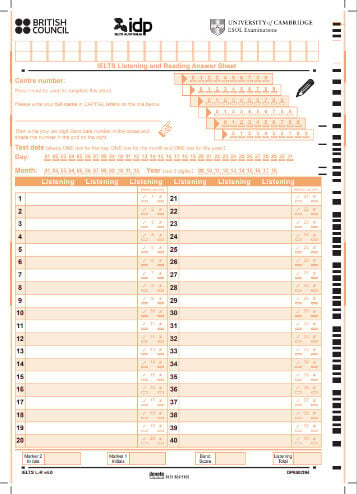
De IELTS Listening-toets duurt ongeveer 40 minuten. Je besteedt 30 minuten aan het luisteren naar opnames en het beantwoorden van vragen. Je krijgt een vragenboekje en een antwoordblad. In het vragenboekje zie je alle vragen die je moet beantwoorden. Op het antwoordblad schrijf je je definitieve antwoorden voor beoordeling.
Je kunt de officiële IELTS Listening-antwoordblad-pdf hier bekijken of gewoon naar de afbeelding hieronder kijken :)
Aan het einde van de Listening-sectie krijg je 10 minuten om de antwoorden van je vragenboekje over te brengen naar je antwoordblad.
BELANGRIJK!
Spelfouten en onjuiste grammatica worden als FOUT gemarkeerd, dus gebruik de 10 minuten om je spelling en grammatica nogmaals te controleren.
Berekening van de IELTS Listening-score
In de Listening-sectie is elke vraag 1 punt waard, dus je kunt een "ruwe" score van maximaal 40 punten behalen. Je ruwe score wordt vervolgens omgezet in je bandscore. Onthoud! Je verliest geen punten voor onjuiste antwoorden. De onderstaande tabel geeft je een algemeen idee van hoe ruwe scores worden omgezet in bandscores.
| Ruwe scores | Bandscores |
|---|---|
| 39-40 | 9 |
| 37-38 | 8.5 |
| 35-36 | 8 |
| 32-34 | 7.5 |
| 30-31 | 7 |
| 26-29 | 6.5 |
| 23-25 | 6 |
| 18-22 | 5.5 |
| 16-17 | 5 |
| 13-15 | 4.5 |
| 11-12 | 4 |
Omdat elke versie van het IELTS iets anders is, verschilt de ruwe score die nodig is om een bepaalde bandscore te behalen, afhankelijk van hoe iedereen die de toets die dag heeft afgelegd, heeft gepresteerd. Het aantal correcte antwoorden dat nodig is om een bandscore te behalen, varieert daarom enigszins van toets tot toets, maar in het algemeen moet je streven naar ongeveer 30 van de 40 als je een bandscore van 7 wilt behalen.
Zoals hierboven vermeld, worden de secties moeilijker en moeilijker naarmate je verder komt in de IELTS Listening-toets. Elke vraag is echter evenveel punten waard. Zorg er daarom voor dat je geen makkelijke punten misloopt doordat je vastloopt op moeilijke vragen.
Gratis IELTS Listening-voorbeeld pdf-download met antwoorden
Hier zijn enkele gratis IELTS Listening-voorbeelden in pdf-formaat met antwoorden van de British Council (de makers van het IELTS-examen). Onder de links kun je ook gratis een IELTS Listening-test met audio en antwoorden van BestMyTest maken. De test heeft alle vier de onderdelen, en bij elk onderdeel zie je het audioscript met de antwoorden. Probeer de vragen te beantwoorden en kijk hoe je het doet!
- IELTS Listening-oefentest 1 - vragen (online voorbeelden)
- IELTS Listening-oefentest 1 - antwoorden (pdf)
- IELTS Listening-oefentest 1 - antwoordblad (pdf)
Listen to the recording and answer questions 1 to 10. The answers and the audio script are in the box below the questions.
Questions 1-10
Complete the notes below.
Write ONE WORD AND/OR A NUMBER for each answer.
This can provide the carer with:
• time for other duties
• a 1
Assessment of aunt's needs
This may involve discussing:
• how much 2 is spent caring
Daily tasks discussed:
• help with dressing
• helping her take a 3
• shopping
• helping with meals
• managing 4
• any parts of caring that are particularly hard, e.g.
• loss of 5
• 6 her
• avoiding a 7
Types of support that may be provided for carers
• transport costs, e.g. cost of a 8
• vehicle-related costs, e.g. fuel and 9
• help with housework
• support to lower 10
-
spellcheck Antwoorden
1. Break
Break is correct because this detail is stated in the recording at the point where the question is answered.2. Time
Time is correct because this detail is stated in the recording at the point where the question is answered.3. Shower
Shower is correct because this detail is stated in the recording at the point where the question is answered.4. Money
Money is correct because this detail is stated in the recording at the point where the question is answered.5. Memory
Memory is correct because this detail is stated in the recording at the point where the question is answered.6. Lifting
Lifting is correct because this detail is stated in the recording at the point where the question is answered.7. Fall
Fall is correct because this detail is stated in the recording at the point where the question is answered.8. Minicab
Minicab is correct because this detail is stated in the recording at the point where the question is answered.9. Parking
Parking is correct because this detail is stated in the recording at the point where the question is answered.10. Anxiety
Anxiety is correct because this detail is stated in the recording at the point where the question is answered.
Audio ScriptNora: It's really good to see you, Marcus. Since I had to give up work, I feel I'm losing touch with my friends and colleagues.
Marcus: We really miss you in the office. We were all so sorry you had to leave. But you must be relieved to have more time to look after your aunt. How is she?
Nora: Well, she's very cheerful, but she needs a lot of help.
Marcus: Have you tried to get any support from the local council?
Nora: No. I didn't know I could.
Marcus: Yes. But for different kinds of practical support, they realise that carers sometimes need time for all the other responsibilities they have, apart from the person they're caring for, and also that they sometimes need a break.
Nora: Absolutely. OK, so tell me more, how do I go about getting this support?
Marcus: Well, you'd have to have an assessment of your aunt's needs. That means someone would come round and talk to you about the situation and what you need. So for a start, they'd want to know the amount of time you spend looking after your aunt every day.
Nora: OK.
Marcus: Then they'll probably ask you what sorts of tasks you do for your aunt during the day. Things like if she needs help with getting dressed, for example.
Nora: Right. I help her with that. And also I help her get into the shower in the morning.
Marcus: Yes. That sort of thing. They'll probably ask you if you do the shopping for her, and help her at meal times, and whether she can cope using money.
Nora: Yes. That's becoming a bit of a problem. She used to be very good at it, but not anymore.
Before you hear the rest of the conversation, you have some time to look at questions 5 to 10. [20 seconds] Now listen, and answer questions 5 to 10.Marcus: And be ready to tell them about anything you find particularly difficult about caring for your aunt.
Nora: So recently I've noticed she started to have quite bad problems with her memory. If I wasn't there, I think she'd forget to eat, for example. And often she doesn't seem quite sure what day it is.
Marcus: Yes. Tell them about that. And are there any physical difficulties you have caring for her? Lifting her, for example.
Nora: Yes. She's quite heavy, and I'm afraid of hurting my back. I'd be in real trouble if that happened.
Marcus: They can give you advice about that, and also about how to avoid the possibility of your aunt having a fall.
Nora: Great. So, once they've done this assessment, if I'm eligible, what happens next?
Marcus: Well, they might support you financially. So they might help you with travel costs, like if you have to get a minicab to take your aunt for an appointment, for example.
Nora: I usually drive her myself, actually. So could I claim for the petrol?
Marcus: You could. And you can claim for the parking, too.
Nora: Oh, right.
Marcus: And if you need help with the housework, they can arrange for someone to come along once or twice a week. And one other thing. I hope you don't mind me saying this, but it's important you look after yourself. And it seems to me you're dealing with quite a bit of anxiety.
Nora: I am, yes.
Marcus: Well, tell the council, because they may be able to give you some advice on how to minimise it.
Nora: Really? Though, actually, I feel so much better having talked to you. I'll get in touch with the council straight away. Now, shall we go for coffee, or something?
Listen to the recording and answer questions 11 to 20. The answers and the audio script are in the box below the questions.
Questions 11-14
Choose the correct letter, A, B or C.
11. Who began turning the unused Whitfield site into a planted space?
- city council officials.
- nearby residents.
- a gardening charity.
12. What was Lillian Hartley trying to achieve through public campaigning?
- preventing a housing sale
- blocking army exercises
- winning maintenance funding
13. Why was the park rejected as a place for troop exercises?
- council permission was refused.
- too little usable space.
- a better site was chosen.
14. How does the speaker describe the latest redesign plans?
- 2013 plan used unchanged.
- 2013 plan revised pre-work.
- 2015 plan finished in 2016.
Questions 15-20
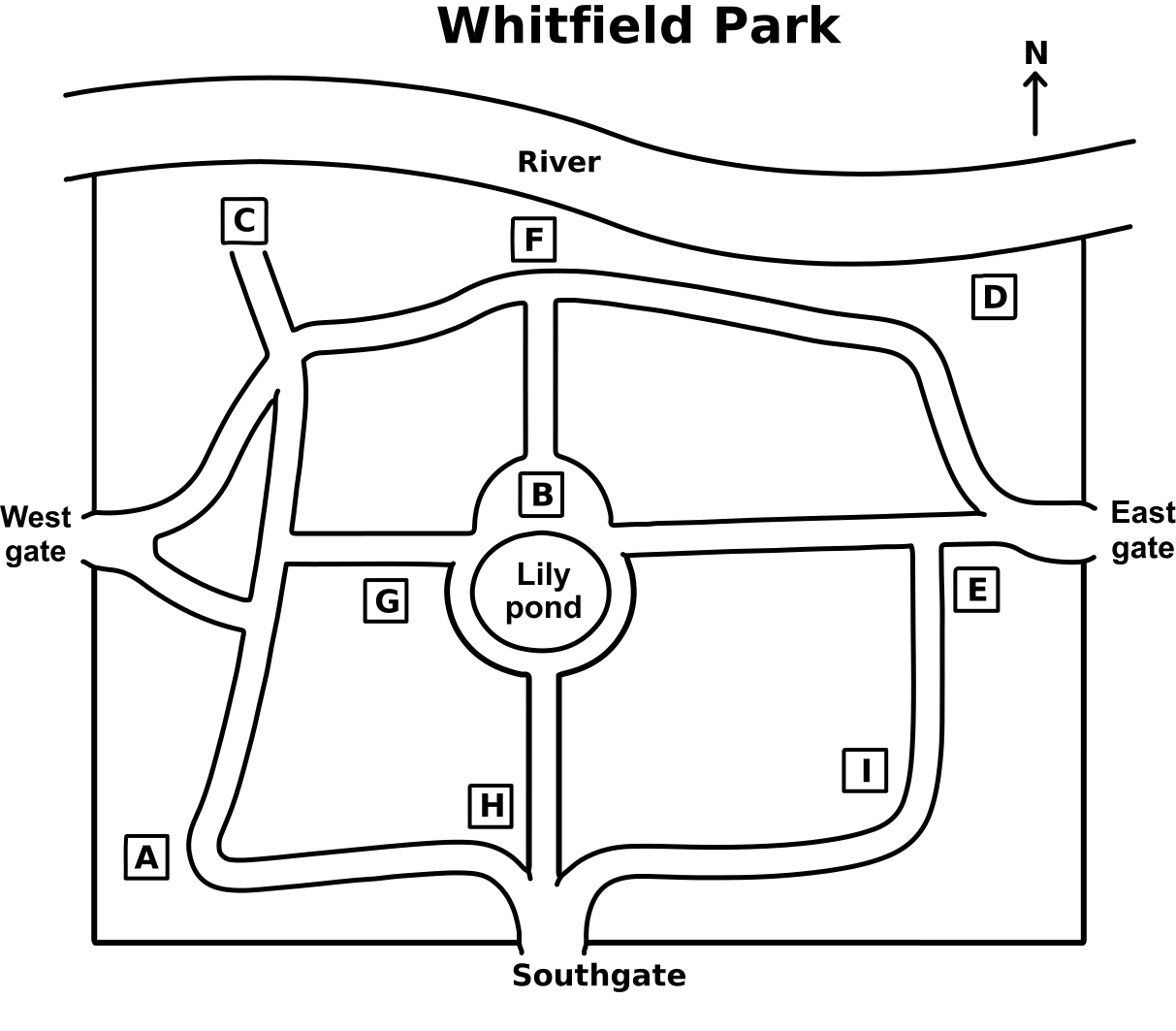
Label the plan of Whitfield Park below.
Write the correct letter, A-I, next to questions 15-20.
- statue of Lillian Hartley
- wooden sculptures
- playground
- maze
- tennis courts
- fitness area
-
spellcheck Antwoorden
11. B
(A) is incorrect. The council took ownership later.(B) is correct. The initial planting was done by residents from nearby streets.
(C) is incorrect. The recording does not support this option: a gardening charity.
12. A
(A) is correct. Hartley organised public pressure so the council would keep the land as a park rather than sell it for housing.(B) is incorrect. The recording does not support this option: blocking army exercises.
(C) is incorrect. The recording does not support this option: winning maintenance funding.
13. B
(A) is incorrect. The recording does not support this option: council permission was refused.(B) is correct. , after inspection, the army concluded that the park was too small for practical use.
(C) is incorrect. The recording does not support this option: a better site was chosen.
14. B
(A) is incorrect. The recording does not support this option: 2013 plan used unchanged.(B) is correct. The plans dated from 2013 but were revised in 2015 before work began.
(C) is incorrect. The recording does not support this option: 2015 plan finished in 2016.
15. B
The correct answer is B because the statue of Lillian Hartley is now immediately north of the lily pond near the centre of the park, and that position is labelled B.16. D
The correct answer is D because the wooden sculptures are on the riverbank where the path from the East Gate makes a sharp bend, which corresponds to D.17. F
The correct answer is F because the playground is between the river and the path from the lily pond to the river, and that location is marked F.18. C
The correct answer is C because the maze is found by entering from the West Gate, walking north, and turning left, which places it at C.19. A
The correct answer is A because the tennis courts remain in the southern corner where the perimeter path makes a right-angled bend, labelled A.20. G
The correct answer is G because the fitness area is beside the lily pond on the same side as the West Gate, matching G on the plan.
Audio ScriptI'm delighted this evening to introduce our guest speaker, Sarah Holloway, who is going to talk to us about the recent transformation of Whitfield Park. Over to you, Sarah. Thank you very much. I'm sure you all know Whitfield Park well, it has been one of the city's landmarks for well over a century, and the city council has been responsible for it for most of that time. What perhaps fewer of you will know is how the park actually began.
Unlike many city centre parks, which started life as the private gardens of a large house, Whitfield was originally just an unused patch of waste ground. The first flowers there were actually planted by a small group of local residents who lived in the surrounding streets. They began work on the site in 1892. At that point nobody was entirely sure who legally owned the land, and it was a full twenty years later before the city council finally took it into public ownership. Some of you will have seen the statue near one of the gates. That figure is Lillian Hartley, who played a really important role in the early history of the park.
Once the council legally owned the land, its first instinct was to sell it off as building plots for housing. A great many local residents, however, wanted the park to stay open as a place where everyone could enjoy fresh air and green space, bear in mind that this is a very densely built up residential district. Lillian Hartley was at the heart of that campaign, and it was she who organised the petitions and the public demonstrations which, in the end, persuaded the council to drop the sale and keep the land as a park.
Soon afterwards, in 1914, the First World War broke out, and most of the park was dug up and used to grow vegetables, which were sold to local residents. At one point the army did look into taking over the park as a site for troop exercises. They actually wrote to the city council about it, but when they inspected it they concluded that the park was simply too small to be of any practical use to them, so the idea was dropped. The only military activity in the park during the war was the occasional public meeting held on a small area of grass that had been kept clear of vegetable plots.
After the war, the park was largely returned to the way it had been before 1914, and from then on it remained almost unchanged for decades. New plans for transforming the park were drawn up several times over the years; the most recent version dates from 2013, but those plans were then revised in 2015, well before any actual work had got under way. Work on the ground finally began in 2016 and was completed, on schedule, last year.
Before you hear the rest of the talk, you have some time to look at questions 15 to 20. [20 seconds] Now listen and answer questions 15 to 20.All right, I'd like to describe some of the more important changes that have been made, and one or two things that have deliberately been left as they were. If you take a quick look at the map you've been handed, you'll see the familiar outline of Whitfield Park. The river forms the northern boundary, and there is a gate in each of the three other walls.
From there, follow the path up towards the river and the enlarged children's playground sits between that path and the river itself. If you keep your eye on the riverbank, over towards the East Gate side, the new wooden sculptures are at the point where the path coming up from that gate makes a sharp bend.
Back near the West Gate side of the park, there is a maze, a circular pattern of paths separated by low hedges. Head in from the West Gate, walk north towards the river, and then turn left to find it. Close to the same central lily pond, on the side facing the West Gate, you'll also find the new outdoor fitness area.
Down in the southern corner, where the perimeter path makes that distinct right angled bend, the tennis courts are still in their familiar position, though we have now doubled them from four to eight. Now, since you are all keen gardeners, I'm sure you'll want to hear about the plants that have been chosen for the new beds.
Listen to the recording and answer questions 21 to 30. The answers and the audio script are in the box below the questions.
Questions 21-25
Choose the correct letter, A, B or C.
21. Nina and Owen were surprised to learn that coastal cities
- are home to just under half of all people.
- account for many of the largest cities.
- are expanding at double the rate of inland cities.
22. According to Owen, building coastal cities near to rivers
- can carry contamination back towards urban areas.
- can leave too little land for farming upstream.
- can cause factories to damage rural scenery.
23. What mistake was made when building water drainage channels in Port Selby in the 1950s?
- The system did not include enough channels.
- The builders selected the wrong construction materials.
- The design failed to anticipate rising sea levels.
24. What do Nina and Owen think that the authorities in Port Selby should do immediately?
- take measures to restore coastal ecosystems
- pay for a new flood prevention system
- stop disposing of waste materials into the ocean
25. What do they agree should be the priority for international action?
- greater coordination of activities
- more sharing of information
- agreement on shared policies
Questions 26-30
What decision do the students make about each of the following parts of their presentation?
Write the correct letter, A-G, next to questions 26-30.
- use visuals
- keep it short
- involve other students
- check the information is accurate
- provide a handout
- focus on one example
- do online research
- Historical background
- Geographical factors
- Past mistakes
- Future risks
- International implications
-
spellcheck Antwoorden
21. B
(A) is incorrect. The recording does not support this option: are home to just under half of all people.(B) is correct. Nina says most of the biggest cities are built by the sea.
(C) is incorrect. The recording does not support this option: are expanding at double the rate of inland cities.
22. A
(A) is correct. Owen says pollutants from inland agriculture and industry travel down rivers to cities.(B) is incorrect. The recording does not support this option: can leave too little land for farming upstream.
(C) is incorrect. The recording does not support this option: can cause factories to damage rural scenery.
23. C
(A) is incorrect. The recording does not support this option: The system did not include enough channels.(B) is incorrect. The recording does not support this option: The builders selected the wrong construction materials.
(C) is correct. Port Selby's drainage channels were built without allowing for global warming and rising sea levels.
24. B
(A) is incorrect. The recording does not support this option: take measures to restore coastal ecosystems.(B) is correct. Nina says they need money to replace the drainage channels for flood protection now.
(C) is incorrect. The recording does not support this option: stop disposing of waste materials into the ocean.
25. A
(A) is correct. They say coastal cities must act together internationally.(B) is incorrect. The recording does not support this option: more sharing of information.
(C) is incorrect. The recording does not support this option: agreement on shared policies.
26. B
B is correct because they decide not to spend too long on historical background, so they will keep it short.27. A
A is correct because they decide to use slides with maps showing geographical factors.28. F
F is correct because they choose the Meriton case study as the basis for past mistakes, focusing on one example.29. G
G is correct because they need to look at websites for future risks, so online research is required.30. C
C is correct because they plan to ask audience members from different places, involving other students.
Audio ScriptTutor: OK, so what I'd like you to do now is to talk to your partner about your presentations on environmental planning. You should have done most of the reading now, so I'd like you to share your ideas and talk about the structure of your presentation and what you need to do next.
Nina: OK, Owen, I'm glad we chose quite a specific topic: coastal cities. It made it much easier to find relevant information.
Owen: Yeah, and cities are growing so quickly. I mean, we know that more than half the world's population lives in cities now.
Nina: Yeah, though that's all cities, not just coastal ones. But most of the biggest cities are actually built by the sea. I'd not realised that before.
Owen: Nor me. And what's more, a lot of them are built at places where rivers come out into the sea. But apparently this can be a problem.
Nina: Why?
Owen: Well, as the city expands, agriculture and industry tend to spread further inland along the rivers. And so agriculture moves even further inland up the river. That's not necessarily a problem, except it means more and more pollutants are discharged into the rivers.
Nina: That's a serious problem.
Owen: Right.
Nina: Did you read that article about Port Selby on the south coast?
Owen: No.
Nina: Well, apparently back in the 1950s, they built channels to drain away the water in case of flooding.
Owen: Sounds sensible.
Nina: Yeah, they spent quite a lot of money on them. But what they didn't take into account was global warming. So they built the drainage channels too close to sea level. And now sea levels are rising, they're more or less useless. If there's a lot of rain, the water can't run away. There's nowhere for it to go.
Owen: So they did not help much in the end.
Nina: So what are the authorities doing about it now?
Owen: I don't know. I did read that they're aiming to stop disposing of waste water into the ocean over the next 10 years. But that won't help with flood prevention now, will it?
Nina: No, really, they just need to find the money for something to replace the drainage channels in order to protect against flooding now. But in the long term, they need to consider the whole ecosystem.
Owen: Right.
Nina: Really though, coastal cities can't deal with their problems on their own, can they? I mean, they've got to start acting together at an international level instead of just doing their own thing.
Owen: Absolutely. The thing is, everyone knows what the problems are and environmental planners have a pretty good idea of what we should be doing about them. So they should be able to work together to some extent.
Nina: But it's going to be a long time before countries come to a decision on what principles they're prepared to abide by.
Owen: Yeah, if they ever do.
Before you hear the rest of the conversation, you have some time to look at questions 26 to 30. [20 seconds] Now listen and answer questions 26 to 30.Nina: So I think we've probably got enough for our presentation. It's only 15 minutes.
Owen: OK, so I suppose we'll begin with some general historical background about why coastal cities were established. But we don't want to spend too long on that. The other students will already know a bit about it.
Nina: It's all to do with communications and so on.
Owen: Yes, we should mention some geographical factors, things like wetlands and river estuaries and coastal erosion and so on.
Nina: We could have some maps of different cities with these features marked.
Owen: On a handout, you mean, or some slides everyone can see.
Nina: Yeah, that'd be better.
Owen: It'd be good to go into past mistakes in a bit more detail. Did you read that case study of the problems there were in Meriton with flooding a few years ago?
Nina: Yes, we could use that as the basis for that part of the talk. I don't think the other students will have read it, but they'll remember hearing about the flooding at the time.
Owen: Hmm, OK. So that's probably enough background. So then we'll go on to talk about what actions have been taken to deal with the problems of coastal cities.
Nina: OK, what else do we need to talk about? Maybe something on future risks looking more at the long term if populations continue to grow?
Owen: Yeah, we'll need to do a bit of work there. I haven't got much information, have you?
Nina: No, we'll need to look at some websites. Shouldn't take too long.
Owen: OK. And I think we should end by talking about international implications. Maybe we could ask people in the audience. We've got people from quite a lot of different places.
Nina: That'd be interesting if we have time, yes. So now should we go on?
Listen to the recording and answer questions 31 to 40. The answers and the audio script are in the box below the questions.
Questions 31-36
What point does the lecturer make about each item?
Write the correct letter, A-K, next to questions 31-36.
- changes drainage
- protects animals
- increases nutrients
- kills germs
- affects many species
- creates dense shade
- alters the soil
- supports farming
- reduces competition
- attracts bell-miners
- helps recovery
- Eucalyptus woodland
- Damage to eucalyptus woodland
- Oil from eucalyptus leaves
- Lime used in construction
- Direct iron supply
- Moderate bushfires
Questions 37-40
Complete the notes below.
Write ONE WORD ONLY for each answer.
Bell-miner associated dieback:
• The process starts with insects feeding on eucalyptus 37
• A sweet liquid containing 38 attracts bell-miners
Fire patterns:
• If fires happen too often, 39 becomes the main vegetation
• When fires are almost absent, thick growth gives bell-miners protected 40 sites
-
spellcheck Antwoorden
31. B
B is correct because eucalyptus woodland provides nesting places and shelter for birds, bats and small mammals.32. E
E is correct because damage to eucalyptus woodland affects a wider community of species, not only the trees themselves.33. D
D is correct because oil from eucalyptus leaves is used in disinfectant, where it can kill certain germs.34. G
G is correct because lime from road construction was washed into the soil and interfered with tree roots.35. K
K is correct because affected trees recovered surprisingly quickly when iron was supplied directly.36. I
I is correct because occasional fire removes fast-growing competitors that would otherwise use water needed by eucalyptus trees.37. leaves
The correct answer is leaves. The lecturer says the process begins when insects settle on eucalyptus leaves and feed on them.38. sugar
The correct answer is sugar. The lecturer says the insects produce a sweet liquid containing sugar, which attracts bell-miners.39. grass
The correct answer is grass. The lecturer says grass tends to dominate afterwards if fires occur too often.40. nesting
The correct answer is nesting. The lecturer says dense growth creates protected nesting sites for bell-miners when fire is suppressed.
Audio ScriptGood morning. Today I want to focus on the eucalyptus tree, one of the best known features of the Australian landscape. Many people call it a gum tree, but the name eucalyptus actually covers hundreds of related species, from small scrubby trees to very tall forest giants.
Now, eucalyptus trees are important in several ways. Ecologically, they provide nesting places and shelter for birds, bats and small mammals. Their flowers also produce nectar, which is an important food source for insects and birds. So when eucalyptus woodland is damaged, the effect is felt across a much wider community of species.
As for their value to people, the trees are also useful. Oil from eucalyptus leaves has long been used in cleaning products, and one common use is in disinfectant, because the oil can kill certain germs. Eucalyptus timber is also used in building and fencing, although that is not really the main focus of today's lecture.
So, these trees can live for centuries, and some individuals survive for four hundred years or more. That is why researchers became concerned when large numbers began dying much earlier than expected in different parts of Australia.
Now, one disease that attracted attention was Mundulla Yellows. The leaves of affected trees slowly turned yellow and then, over time, the whole tree declined. For years the cause was unclear. Eventually, researchers discovered that lime, or calcium hydroxide, had been used in road construction nearby. Rain washed the lime into the surrounding soil, where it interfered with the roots of eucalyptus trees. The trees were still surrounded by nutrients, but they could no longer absorb the iron they needed for healthy growth. When iron was supplied directly to affected trees, they recovered surprisingly quickly.
However, Mundulla Yellows affected only a limited number of places. A much wider problem on the east coast was Bell miner associated dieback. Now, bell miners are small native birds, but they are not the direct cause of the damage. The process begins when insects settle on eucalyptus leaves and feed on them. While feeding, these insects produce a sweet liquid containing sugar. Bell miners are attracted to that liquid, and they aggressively chase away other birds and insects that might otherwise reduce the insect population. As a result, the insects multiply, the leaves are badly damaged, and the trees gradually lose their ability to survive.
But some scientists think fire history is also part of the explanation. An influential theory, first proposed by the ecologist William Jackson, links the type of vegetation in a region to the frequency of bushfires. If fires occur too often, grass tends to dominate the area afterwards. If fires occur at moderate intervals, eucalyptus forest is more likely to persist. This is because occasional fire removes fast growing competitors which would otherwise take up the water eucalyptus trees need. And it also helps maintain the soil by preventing dense undergrowth from changing the soil structure and removing nutrients.
At the other extreme, if fires are almost completely suppressed, a different ecosystem can develop. Scientists sometimes call this dry rainforest. Now, the name sounds contradictory, because we usually associate rainforest with wet tropical conditions. But in this case it means a dense, shaded vegetation system with relatively few species. It can create excellent conditions for bell miners, because the thick growth gives them protected nesting sites while excluding many of the species that would normally compete with them.
What this tells us is that before European settlement, Aboriginal communities used controlled burning over long periods, and this probably created a more balanced pattern of vegetation. Since European settlement, fire has often been suppressed, roads and farms have altered drainage, and some local ecosystems have shifted away from eucalyptus woodland. The decline of eucalyptus trees, then, is not caused by one single factor. It is the result of disease, insects, birds, soil chemistry and fire management interacting with one another.

Completion - Part 1
Learn how to answer these questions in a step-by-step interactive exercise
Completion - Part 1
Een open plek kan om een tijd of een frequentie vragen. De spreker noemt dezelfde periode meestal met andere woorden, dus koppel de betekenis aan de open plek in plaats van te wachten op de formulering die op de pagina staat.
Controleer daarna de woordlimiet voordat je je antwoord indient. Lees de hele regel terug met je antwoord in de open plek en haal elk woord weg dat al in de regel staat. Een antwoord dat qua betekenis klopt maar te lang is, levert niets op.
Klik op afspelen om naar de audio te luisteren
Aantekeningen gebruiken een eenvoudig werkwoord zoals must provide of need to bring. De spreker zegt dat werkwoord zelden en gebruikt in plaats daarvan een synoniem of beschrijft de handeling, dus luister naar wat er echt vereist is.
Sprekers noemen vaak eerst extra items en sluiten die daarna uit. Mis je een open plek, laat die dan open en ga door naar de volgende, want de antwoorden volgen de volgorde van de opname en een gemiste open plek kan je ook de plekken daarna kosten.
Klik op afspelen om naar de audio te luisteren
Hoe heb je het gedaan met het beantwoorden van de bovenstaande IELTS Listening-voorbeeldvragen? Vond je sommige vragen moeilijk? Als dat zo was, kan het je helpen om alle 6 IELTS Listening-taaktypen nader te bekijken. Hoe beter je een taaktype begrijpt, hoe minder moeite het je kost om uit te zoeken wat je moet doen, en hoe meer tijd je hebt om het antwoord te vinden.
De 6 IELTS Listening-taaktypen
Er zijn 6 verschillende soorten vragen op de IELTS Listening-toets. Het is belangrijk dat je elk taaktype oefent om te leren wat de beste manier is om elk type aan te pakken voor een hoge IELTS Listening-score.
Welke soorten luisteropgaven onze cursisten het moeilijkst vinden
Dit laten 2.22 miljoen IELTS Listening-antwoorden van BestMyTest-cursisten zien. De tabel hieronder geeft per type opgave het percentage dat onze cursisten goed beantwoordden. Zo zie je meteen waar de punten verloren gaan.
| Type opgave | Correct |
|---|---|
| Note completion | 33% |
| Table completion | 34% |
| Sentence completion | 45% |
| Short answer | 48% |
| Multiple choice | 50% |
| Multiple selection | 52% |
| Plan, map, diagram labelling | 55% |
| Form completion | 73% |
| Matching | 85% |
- Bij aanvulopgaven gaan punten verloren. Bij de aanvulopgaven wordt Note completion in 33% van de gevallen goed beantwoord, terwijl Form completion, dat dezelfde vaardigheid in een andere opmaak vraagt, 73% haalt. Bij elke aanvulopgave schrijf je een woord op dat je hoort. Spelling, woordvorm en de woordlimiet tellen dus allemaal mee, en dat kun je allemaal oefenen.
- Bij 61.104 volledige luisteroefentoetsen van 54.523 cursisten was de gemiddelde bandscore 5.6. 41% van de toetsen haalde bandscore 6.0 en 12% haalde bandscore 7.0.
- Bij afzonderlijke luisteronderdelen scoorde 31% van de pogingen 40% of minder, en 30% scoorde 80% of meer. Onderdeel 3 en 4 zijn de academische delen van de toets. Oefen ze dus apart en ook in volledige toetsen.
Hoewel elk Listening-vraagtype er anders uitziet, is de basisaanpak van elk type hetzelfde. Verderop in dit artikel laten we je de basisstrategie zien om alle 6 vraagtypen aan te pakken. Elk type heeft een audiofragment en een antwoord in de gids over IELTS Listening-vraagtypes.
3 stappen voor effectieve online voorbereiding op de IELTS Listening-toets
Hoewel elk IELTS Listening-vraag- (taak-)type anders is, is de basisaanpak van elk type hetzelfde. Je kunt alle taaktypen aanpakken met één eenvoudige, stapsgewijze strategie. Hier zijn de drie stappen die we aanbevelen om Listening-vraagtypen aan te pakken:
- Bestudeer vragen nauwkeurig om belangrijke informatie te vinden
- Voorspel mogelijke antwoorden vóór het luisteren
- Volg mee om vragen te koppelen aan de inhoud terwijl je luistert
Stap 1: Bestudeer vragen
In de IELTS Listening-sectie krijg je een korte voorbereidingstijd (30-40 seconden) voordat de opname begint. Dit is jouw kans om de vragen te bekijken die je moet beantwoorden, en daar gaat de eerste stap in deze strategie precies over. In plaats van deze tijd te gebruiken om een pauze te nemen of je antwoorden te controleren, ga je je richten op het zoveel mogelijk leren over de aankomende vragen. Deze stap is belangrijk om de fout te voorkomen dat je multitaskt door tegelijk naar de spreker te luisteren en de vragen voor het eerst te lezen.
Wanneer je voorbereidingstijd begint, maak dan zo goed mogelijk gebruik van deze tijd door de vragen te bestuderen om er meer over te weten te komen. Dit zijn enkele van de stukken informatie waar je naar moet zoeken bij het bestuderen van elk van de IELTS Listening-vragen:
- Wat voor soort vraag is dit?
- Hoe zal het antwoord eruitzien? (bijvoorbeeld: een datum, een nummer, een naam)
- Wat zijn de belangrijkste zinsneden en woorden, of trefwoorden, in de vragen?
Een voorbeeld kan een vraagtype Notitieaanvulling zijn, zoals dit:
Complete the notes below.
Write NO MORE THAN THREE WORDS for each answer.
Eerst kun je enkele trefwoorden in de vraag onderstrepen.
Two reasons for the new approach to pricing are changes in (27) ______ and (28) _________ programs.
In dit voorbeeld zorgt het luisteren naar de sleutelzin "two reasons", die je al had onderstreept, ervoor dat je
op het juiste moment goed begint op te letten. Hier is het deel van het audioscript dat het antwoord onthult:
Mark: Well, there seem to be two basic reasons. Firstly, because the law has changed recently to allow companies to behave like this. In the past, they weren't allowed to change the prices of the tickets. And secondly, we now have computer programs that do the calculations so that prices can be changed very quickly and accurately.
Nadat je de vragen had bestudeerd, zou je weten dat "the law" en "computer" hier het juiste antwoord waren op basis van enkele trefwoorden en kennis van het vraagtype.
Stap 2: Voorspel mogelijke antwoorden
De tweede stap in deze strategie om te slagen op de IELTS Listening-sectie is sterk verbonden met de eerste. Je moet zelfs proberen om beide stappen binnen dezelfde voorbereidingstijd van 20 seconden te voltooien voordat de opname begint. Hoewel dit een moeilijke taak lijkt om in zo'n korte tijd uit te voeren, vergeet niet dat deze stappen feitelijk met elkaar verbonden zijn.
Om mogelijke antwoorden op de Listening-vragen te voorspellen, moet je eerst stap één hebben voltooid door de vragen nauwkeurig te bestuderen. Op dit punt zou je moeten weten naar welk soort vraag je kijkt, hoe potentiële antwoorden eruit zullen zien, en welke trefwoorden je helpen om de antwoorden snel te vinden. Om antwoorden te voorspellen, combineer je al deze informatie en doe je een gok over wat voor soort antwoord je verwacht te horen.
Laten we hetzelfde voorbeeld van de Notitieaanvulling van hierboven opnieuw bekijken.
Two reasons for the new approach to pricing are changes in (27) and (28) programs.
Alleen al door naar de grammatica van deze zin te kijken, kun je identificeren welke woordsoort het antwoord zal zijn. In dit geval gaat het voorzetsel "in" vooraf aan beide potentiële antwoorden. Grammaticaal gezien kunnen alleen zelfstandige naamwoorden of zelfstandig-naamwoordgroepen op deze manier worden gebruikt in voorzetselgroepen. Je kunt niet alleen correct voorspellen dat het antwoord een zelfstandig naamwoord of zelfstandig-naamwoordgroep zal zijn, maar het zou ook mogelijk zijn om te voorspellen dat het antwoord iets te maken zou kunnen hebben met beleid of overheid (law), en een woord dat kan voorkomen met programs (computer) op basis van de context.
Hoewel het onmogelijk is om het exacte juiste antwoord alleen op basis van voorspellingen te raden, ben je door te proberen je voor te stellen wat het antwoord zou kunnen zijn, beter in staat om naar relevante informatie te luisteren en irrelevante informatie te negeren. Mogelijke antwoorden voorspellen voordat de opname begint, bereidt je oor voor en brengt je een stap dichter bij het juiste antwoord.
Probeer nu Stap 1 (vragen bestuderen) en Stap 2 (mogelijke antwoorden voorspellen) samen te brengen in een moeilijker meerkeuzevoorbeeld.
Choose the correct letter, A, B, C or D.
- are for weekend shows
- are booked well in advance
- are non-refundable
- are booked for groups
Hoewel er geen manier is om de antwoorden op deze vragen met zekerheid te kennen, kun je nog steeds de informatie uit deze vragen gebruiken om mogelijke antwoorden te voorspellen en je luisteren te richten. Vraag 24 betreft bijvoorbeeld de reden waarom theaterkaartjes het laagst zijn, dus je wilt goed luisteren naar een van die genoemde redenen. Houd er rekening mee dat het mogelijk is dat er meer dan één wordt genoemd. Bekijk het script hieronder om te zien hoe voorspellen je kan helpen onjuiste antwoorden te elimineren.
Merk op dat drie van de potentiële antwoorden worden genoemd: "booked for groups", "are for weekend shows" en "are non-refundable". Het juiste antwoord is echter C "are non-refundable", omdat dit afzonderlijk wordt genoemd als goedkoper dan de andere twee, die simpelweg samen worden vermeld.
Stap 3: Volg mee
Zodra de opname start en het eigenlijke luistergedeelte van de toets begint, moet je meevolgen om stap drie van deze IELTS Listening-sectie-strategie te voltooien. Meevolgen vereist dat je je nauwkeurig concentreert op wat je hoort, terwijl je tegelijkertijd bijhoudt op welke vraag de inhoud betrekking kan hebben.
De vragen op de IELTS Listening-examensectie verschijnen meestal in de volgorde waarin de antwoorden in de inhoud van de opname te vinden zijn. Dit geeft je een voordeel in de toets, want het betekent dat zodra je het antwoord op één vraag hebt gehoord, je je aandacht onmiddellijk op de volgende vraag op volgorde richt. Als je succesvol kunt meevolgen door de context van de vragen te koppelen aan wat je in de opname hoort, blijf je op koers en voorkom je dat je belangrijke informatie mist die nodig is om elk van de vragen te beantwoorden.
Dit is echter makkelijker gezegd dan gedaan. Je moet multitasken door te luisteren terwijl je tegelijkertijd je oog op de volgende vraag houdt. Als je inderdaad het antwoord op een vraag mist, weet je dat wanneer je het antwoord op een latere vraag hoort. Hoewel dit verwarrend en zelfs frustrerend kan zijn, is één antwoord missen en je daarvan bewust zijn nog altijd beter dan helemaal verloren raken in de inhoud en nog meer antwoorden missen. In het geval van een gemiste vraag laat je deze gewoon liggen en ga je verder met de volgende. Aan het einde moet je je beste gok doen over de vraag die je hebt gemist. Aan de positieve kant is het echter mogelijk dat het luisteren naar de gehele opname je andere contextuele aanwijzingen biedt waarmee je elke gemiste vraag nauwkeuriger kunt beantwoorden.
Gratis bronnen voor IELTS Listening-oefening
Je hebt sterke luistervaardigheden nodig om een hoge bandscore voor IELTS Listening te behalen. Daarom is het belangrijk dat je consequent elke dag traint tot aan de toetsdag.
Hieronder vind je enkele bronnen die je kunt gebruiken om je luistervaardigheden dagelijks te trainen en te onderhouden.
- YouTube - https://www.youtube.com
- BBC Learning English - http://www.bbc.co.uk/learningenglish
- TED - https://www.ted.com/
- BBC radio - https://www.bbc.co.uk/worldserviceradio
- ABC news in Australia - https://www.abc.net.au/listen/live/news
De cijfers op deze pagina komen uit de BestMyTest IELTS-gegevens over de prestaties van cursisten, onze gegevens over IELTS-oefeningen op BestMyTest tot en met oktober 2026. Op die pagina leggen we uit hoe we elk cijfer meten. Laatst bijgewerkt op 15 oktober 2026.