In deze gids kun je beginnen met je IELTS-leesoefening door een gratis IELTS-leestoets af te leggen. Er zijn echter twee versies van de toets: IELTS general reading en IELTS academic reading. Je leert welke versie geschikt is voor jou en hoe je elk type leesvraag aanpakt met behulp van ons IELTS-leesmateriaal.
Ontvang een gratis analyse van je IELTS Reading-score en een persoonlijk studieplan nadat je een gratis IELTS Reading-oefentoets hebt voltooid.
| IELTS General Reading Test | IELTS Academic Reading Test |
|---|---|
Hieronder staat onze volledige lijst met IELTS Reading-vragen en antwoorden. Opmerking: de rode links zijn onze populairste en meest aanbevolen Reading-vragen volgens onze leerlingen, en je kunt ze gratis oefenen wanneer je maar wilt.
Oefenvragen voor General IELTS Reading 1 - 135
Short everyday texts, workplace texts, and one longer passage
Oefenvragen voor Academic IELTS Reading 1 - 171
Three long passages from books, journals, magazines, and newspapers
IELTS Reading-oefentestgids
De rest van deze gids leert je alles over de IELTS Reading-toets, voor zowel de General Training- als de Academic Reading-toets. Je leert hoe de Reading-score wordt berekend, hoe je elk Reading-vraagtype succesvol kunt beantwoorden, hoe je je leesvaardigheid kunt verbeteren met IELTS-tekstmateriaal, en hoe je onze 3 strategieën beheerst voor je succes met IELTS Reading-oefening.
Inhoudsopgave
- Informatie over de IELTS Reading-toets
- IELTS Reading voorbeeldvragen
- Informatie over de IELTS General Reading-toets
- Informatie over de IELTS Academic Reading-toets
- IELTS Reading-scoreberekenaar
- Hoe alle 11 IELTS Reading-vraagtypen te beantwoorden
- Hoe je IELTS Reading-bandscore verbetert
- 3 IELTS Reading-strategieën
- Gratis IELTS Reading-oefentest pdf-download met antwoorden
Informatie over de IELTS Reading-toets
De IELTS Reading-toets bestaat uit 3 secties en in totaal 40 vragen. Over het algemeen beantwoord je 12-14 vragen per sectie en krijg je precies 60 minuten om je Reading-examen af te ronden. Elke sectie bevat 1-3 teksten, afhankelijk van welke toets je aflegt. Als je weet welke toets je aflegt, kun je de volgende paar secties overslaan. Zo niet, dan is het belangrijk om over elke toets te leren en hoe je je erop kunt voorbereiden.
Welke IELTS Reading-toets is geschikt voor mij?
De IELTS Reading-toets heeft twee versies: IELTS General Reading en IELTS Academic Reading. Je legt General Reading af als je wilt migreren of je wilt inschrijven voor middelbaar onderwijs. Je legt Academic Reading af als je hoger onderwijs zoekt. Het grootste verschil tussen General Reading en Academic Reading is de moeilijkheidsgraad van de IELTS-leesteksten. Zoals de naam al doet vermoeden, gebruikt de Academic-toets IELTS-leesmateriaal uit academische bronnen, terwijl de General-toets materiaal uit het dagelijks leven gebruikt.
Beide toetsen bevatten 3 secties, 40 vragen en 11 vraagtypen. Je kunt over elke sectie in detail lezen voor beide toetsen in de onderstaande tabel.
| Sectie | IELTS Academic Reading-toets | IELTS General Reading-toets |
|---|---|---|
| 1 | Eén lange academische tekst die varieert van beschrijvend en feitelijk tot betogend en analytisch. De tekst is
afkomstig uit boeken, tijdschriften, magazines en kranten. 12-14 vragen |
Twee of drie korte feitelijke teksten.
De onderwerpen zijn relevant voor het dagelijks leven in een Engelstalig land.
12-14 vragen |
| 2 | Eén lange academische tekst die varieert van beschrijvend en feitelijk tot betogend en analytisch. De tekst is
afkomstig uit boeken, tijdschriften, magazines en kranten. 10-14 vragen |
Twee korte feitelijke teksten met de focus op werkgerelateerde onderwerpen (bijv. solliciteren naar banen, bedrijfsbeleid, salaris en arbeidsvoorwaarden).
12-14 vragen |
| 3 | Eén lange academische tekst die varieert van beschrijvend en feitelijk tot betogend en analytisch. De tekst is
afkomstig uit boeken, tijdschriften, magazines en kranten. 12-14 vragen |
Eén langere, complexere tekst over een onderwerp van algemeen belang.
De teksten zijn authentiek en zijn afkomstig uit mededelingen, advertenties, bedrijfshandboeken, boeken, magazines en kranten.
12-14 vragen |
Nu je vertrouwd bent met de structuur van de IELTS Reading-toets en zowel IELTS General Reading als IELTS Academic Reading, is het tijd om te leren of je beter de papieren toets of de computertoets kunt afleggen.
IELTS Paper-Based Test (PBT) vs. IELTS Computer-Based Test (CBT)
In de PBT krijg je een vragenboekje en een antwoordblad. In het vragenboekje zie je alle vragen die je moet beantwoorden. Op het antwoordblad schrijf je je definitieve antwoorden voor beoordeling. Je kunt het officiële IELTS-antwoordblad-pdf hier bekijken
Let op: In tegenstelling tot bij de IELTS Listening-toets, krijg je geen extra tijd om je antwoorden van het boekje naar het antwoordblad over te brengen, dus zorg ervoor dat je elke IELTS Reading-toetsvraag op het antwoordblad invult terwijl je ze beantwoordt.
In de CBT beantwoord je vragen op de computer. Je teksten staan aan de linkerkant en je vragen aan de rechterkant. Je kunt ook tekst markeren en bedieningsfuncties gebruiken om antwoorden te kopiëren en te plakken. Voor meer informatie over de PBT en de CBT, bekijk De gids voor de IELTS computertoets.
Je kunt elke versie op elk gewenst moment oefenen met onze gratis IELTS Reading-oefentest. Je kunt links naar al ons IELTS Reading-materiaal bovenaan de pagina vinden.
IELTS Reading voorbeeldvragen
Hier zijn twee gratis IELTS Academic Reading-oefeningen. Maak ze eerst zelf en open daarna de antwoorden om te controleren. De gids over IELTS Reading-vraagtypes legt elk type uit en geeft meer voorbeeldvragen.
Match each item with the period of time it best corresponds with
NB You may use any letter more than once.
- The Palaeolithic era
- The Bronze age
- The Iron age
- The Medieval era
- The Mesolithic age
- Roman times
-
spellcheck Answers1. FALSE
2. FALSE
3. NOT GIVEN
4. FALSE
5. TRUE
6. FALSE
7. FALSE
8. TRUE
9. FALSE
10. F
11. C
12. A
13. B
14. D
The climate in Britain has been arctic for the last several million years, punctuated by relatively warm timespans, or interglacials of thousands of years, one of which we are in as of now. Since the last glaciation, British woodland history is considered quite short in terms of geological time spans, and is also closely related to the human civilization developing.
At the peak of the last glaciation (100,000 – 12,000 BC), the majority of Britain would have had no trees. Birch and willow scrub may have grown along the lower reaches of the ice, with pine in some areas. It’s possible that remnants of pre-glacial flora were sheltered along the western bays of Great Britain and Ireland’s coasts, but as far as the southern parts of England, the ice kept any land barren. Information regarding the development of Britain’s flora following glaciation can be found by studying the deposits of pollen and seed in peat, as well as by the use of radiocarbon dating. Tundra and moorland followed the retreating ice, which lead to phases of different tree species spreading from the south. First came birch, aspen and sallow, followed by pine and hazel continuing to spread north as of 8500 BC, replacing birch to make it less commonly found for the next few thousand years. Oak and alder came after pine, then lime, elm, beech, and maple, all spreading northwards one after the other. From the moment lime arrived, in about 7300, to about 4500 BC the climate remained stable for a length of time known as the Atlantic Period, a time in which numerous species grew to form a series of wildwood or wilderness types.
What did the wilderness or wildwood look like, before man started interfering with it? One theory holds that Britain and Western Europe in Palaeolithic times was covered from coast to coast in a wildwood of continuous trees. However, a modern theory proposed by Francis Vera holds that Western Europe wilderness was a combination of grassland, scrub, and clusters or groves of trees. It was not a dense, impassable wildwood, but instead, an area similar to a park, kept up by wild herbivores eating the plants and grass. Throughout earlier interglacial periods, this may also have been the case in Britain, as creatures of the Palaeolithic era needed to roam large areas of grassland to survive. A variety of grassland plants continued to live there in the last interglacial, as according to pollen records. However, since the last glaciation, the bison, elk and other large herbivores which persisted on mainland Europe were extinct in Britain, so Vera’s theory may not apply so well to Britain.
Meanwhile, throughout the period since it’s spread northwards after the last glaciation, the sustained growth of oak in Britain demonstrates that the wildwood was not as continual as once believed. Oak is a pioneer species, which requires vacant space to generate more of itself. Grazing animals are also present to keep areas open, so Oak regenerates in the thorny brush as a protective measure from their grazing. Archaeological evidence indicates that red deer, who graze on grass as well as browse from trees, were essential to the economy in Mesolithic Britain, with people utilizing them for meat, skins, antlers and bones.
As the Mesolithic (10,000-3000 BC) era ended, evidence of the beginnings of agriculture emerges. Agricultural weeds, such as plantain and stinging nettle, were also increasing in number. Nearly all the wildwood was cut down as the population increased rapidly. However, the falling elm population around 4,000 BC all across Europe has been attributed not to the clearing of trees, but to what’s referred to as Elm disease.
Throughout the Bronze Age (2400-750 BC), people were cutting down trees more than ever before, until the prevalence of the practice “coppicing” peaked, likely at some point during the early Iron Age. Oliver Rackham (1990) theorizes that nearly 50% of land throughout England was no longer wildwood by 500 BC. The regrowth from a stump grows more readily than the original tree, and Neolithic man had discovered this practice, known as coppicing. Much of the remaining woods were maintained by way of this method during the Bronze Age.
The Celtic peoples living in the Iron Age were able to master woodworking as an artform. Today, Celtic woodworking can be seen in houses, boats, wheels and other artifacts of the time. Coppicing as a means to manage woodland was of massive importance throughout two millennia that followed. Buildings, roads, fences, carts, and the fuel for heating, cooking, metalworking and pottery were all made possible due to wood materials gained from the vital practice of coppicing.
A clear divide has existed between wooded and non-wooded regions of Britain since the time of the Romans. As evidenced by The Domesday Book (1086), all the wood in England had an economic value and was the property of either an individual or community owner. Woods were the territories, or ‘exclaves’ of communities who lived some miles away. Even though it had to be transported over long distances, the materials which woodlands produced were of obvious value, and their ownership was long before established. Merely around 15% of land in England was represented by woodland or wood- pasture in the year 1086.
English woodlands produced mostly underwood used as fuel along with other things, with small oaks being used to construct buildings. The average wood-framed houses of the Medieval era mostly used oaks shorter than 18” in diameter. Longer pieces of timber were hard to come by, and kept only for elaborate buildings intended for the Church. Imported boards of thin oak or wainscot from Central Europe were brought in for the purpose of domestic building. Woodland cover was as low as 15% in 1086, and continued to decline from as a result of an ever- growing population to 10% by 1350. This stopped suddenly with the plague of the Black Death of 1349 wiping out some of the human population. Woods which had persisted up to 1350 mostly prospered over the next 500 years.
Match each description with the correct psychologist
NB You may use any letter more than once.
- Clark Hull
- Howard and Tracy Kendler
- Michael Cole and colleagues
- Simon Hewson
-
spellcheck Answers1. D
2. C
3. D
4. A
5. C
6. B
7. C
8. D
9. TRUE
10. FALSE
11. TRUE
12. FALSE
Could it be that the very essence of reasoning itself is found in the way we behave? Clark Hull, an acclaimed American psychologist, theorized that it was, describing that reasoning is achieved by the way two “behavior segments” are combined in new ways to achieve goals. Howard and Tracey Kendler, who were two of Hull’s followers, used Hull’s principle ideas to design a reasoning test for children. In this test, children needed to learn how to use a machine in a two-step process. The children learned each of the two steps individually, with the first being to correctly choose and press one of two buttons, and the second to place a marble into a small opening. If both steps were completed successfully, a toy would be released as rewards to the children.
From this test, the Kendlers learned that although the children were able to learn each step, they were not able to “integrate” the two tasks without intervention. In other words, the children could not successfully perform the first step, pushing the button, and then proceed to the second step, inserting the marble into the hole, by themselves. This failure to independently integrate the steps led the Kendlers to believe that children of this age were not able to use deductive reasoning.
According the the work of psychologist and professor Michael Cole and his associates, some adults from specific African tribes are also unable to successfully complete the Kendlers' two-step test of deductive reasoning. However, this finding remains questionable in light of the findings of a similar test to the Kenders’, which revealed that the African tribes people were, in fact, able to complete the test.
In this test, Cole substituted a locked box for the machine with the buttons, and then used two matchboxes of different colors. One of the matchboxes held a key for the locked box. Just like with the Kendlers’ test, Cole’s test also involved two behavior segments, these being to first open the right match-box to get the key, and second to use the key to open the box. However, Cole’s test differs quite a bit psychologically. Instead of subjects being presented with a strange machine, they are given familiar objects in a simpler context. Cole found the difficulty of 'integration' was greatly reduced here.
It seems that the same truth which Cole discovered can be extended to explain the deductive reasoning skills of young children. Psychologist Simon Hewson believes that perhaps the task’s difficulty is not in inferential processes themselves, but is instead tied to confusing features of the test apparatus, such as the button machine, as well as the context of the procedure being tested. When these factors are adjusted in order to prevent the inferential nature of the problem being affected, five-year-old children are able to successfully complete these tests as well as college students did in the Kendlers' test.
Hewson made two essential changes to the test in order to build on this idea. First, he replaced the button-pressing mechanism with drawers that a child could slide open and shut. This removed confusion on what to do with the original button apparatus from the first stage of training. Secondly, Hewson made sure that children understood that there was nothing special or magical about the marble which was used to successfully complete the second step of the task and get the reward.
This is important because a child cannot easily comprehend a mechanism in which a marble put into a hole can open a little door. It would then be safe to say that the child will not assume that different marbles of identical size could be used the same way. But, to solve the problem, this assumption must be made. Hewson clearly demonstrated the functional equivalence of different marbles to the children by playing a 'swapping game.” Hewson's two modifications to the experiment led to a rise in success rates from 30 percent to 90 percent for five-year old children and from 35 percent to 72.5 per cent for four-year-olds. Strangely enough for three-year olds, Hewson’s changes did not lead to any improvement, and instead there was a slight drop in performance from the change. Hewson's experiments showed that children faced with the Kendler apparatus experienced difficulty not related to reasoning, but to the nature of the tasks themselves, and that difficulty cannot be taken as proof that they are incapable of deductive reasoning.
General IELTS Reading-toets
In de General-toets zijn de IELTS-leesteksten afkomstig uit boeken, magazines, kranten, mededelingen, advertenties, bedrijfshandboeken en richtlijnen uit materiaal dat je dagelijks tegenkomt in een Engelstalige omgeving. Net als bij de Academic Reading-toets zijn er 3 secties, maar bij een IELTS General Reading-toets is elke sectie een beetje anders.
Introductievideo IELTS General Reading
-
Sectie 1: Bevat twee of drie korte teksten of meerdere kortere teksten
Deze sectie heet Social Survival en bevat teksten die relevant zijn voor het basale taalgebruik in het Engels, met opdrachten die voornamelijk gaan over het opzoeken en verstrekken van algemene feitelijke informatie, bijvoorbeeld mededelingen, advertenties en dienstregelingen. -
Sectie 2: Bestaat uit twee teksten
Deze sectie heet Workplace Survival en richt zich op de werkomgeving, bijvoorbeeld functieomschrijvingen, contracten en materialen voor personeelsontwikkeling en training. -
Sectie 3: Eén lange tekst
Deze sectie heet General Reading en omvat het lezen van meer uitgebreid proza met een complexere structuur. De nadruk ligt op beschrijvende en instructieve in plaats van argumentatieve teksten.
Ik hoop dat je je niet te overweldigd voelt. De Reading-toets is niet zo moeilijk als het lijkt. Zolang je onze IELTS Reading-tips volgt en gebruikmaakt van onze gratis IELTS Reading-oefenvragen, ben je klaar om elke leestekst aan te kunnen en je gewenste IELTS Reading-score te behalen. Trouwens, de Academic Reading-toets wordt iets anders beoordeeld dan de General Reading-toets. Vervolgens nemen we de Reading-bandscore door en hoe deze wordt berekend.
Academic IELTS Reading-toets
In de Academic-toets zijn de IELTS-leesteksten afkomstig uit boeken, tijdschriften, magazines en kranten uit academische bronnen die geschikt zouden zijn voor universiteitsstudenten. Elke tekst is lang, ongeveer 6 - 10 paragrafen, kan zijn geschreven in verschillende stijlen zoals narratief of beschrijvend, en bestrijkt een breed scala aan academische onderwerpen zoals antropologie, geschiedenis, wetenschap, biologie, kunst, onderwijs, taalkunde, etc. De teksten bevatten soms technische termen of zelfs visueel materiaal zoals diagrammen en grafieken. Je kunt deze onderwerpen en meer oefenen met onze IELTS Reading-oefentestvragen.
Introductievideo IELTS Academic Reading
Welke academische onderwerpen komen het meest voor in de officiële IELTS Academic Reading-toets?
In 2022-2024 en 2024-2026 was het meest voorkomende academische leesonderwerp geschiedenis. Daarna kwam biologie, gevolgd door psychologie en sociale wetenschappen, waaronder cultuur, onderwijs, taalkunde en sociologie.
De onderstaande grafiek toont verschillende vakken die zijn getoetst in IELTS Academic Reading-toetsen in 2022-2024 en 2024-2026.
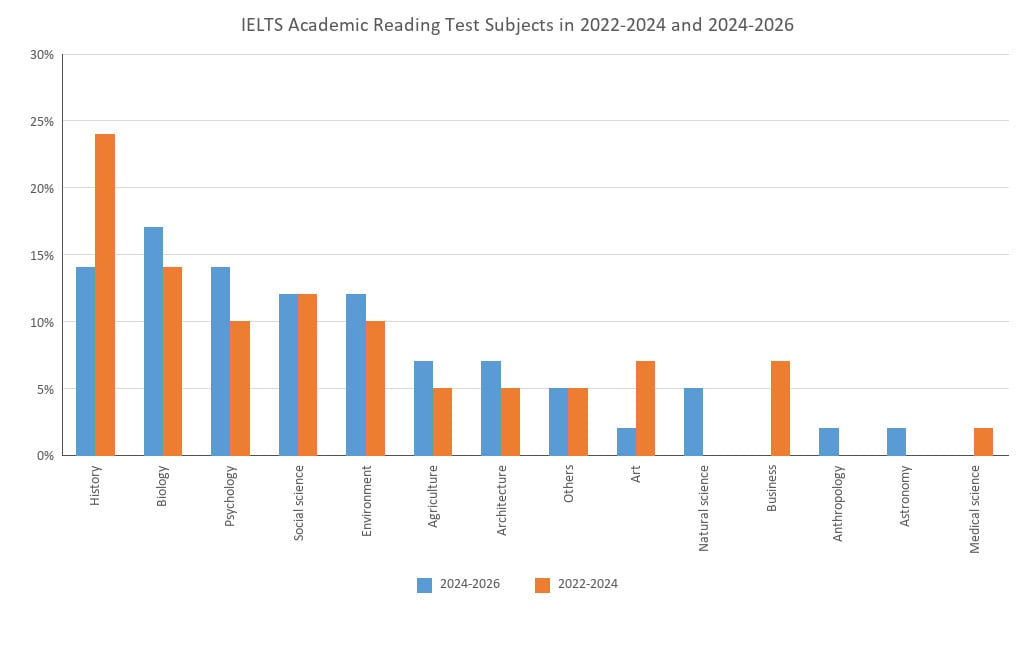
Vanwege deze trends hebben we ervoor gezorgd dat onze IELTS Reading-oefentests deze onderwerpen behandelen. We hebben ook leesvoorbeelden uit minder gebruikte onderwerpen toegevoegd, voor het geval dat. Het is belangrijk dat je je voorbereidt op alle situaties, want je weet nooit welk IELTS Reading-onderwerp je krijgt.
Hoe je IELTS Reading-score wordt berekend
Elke IELTS Reading-vraag is 1 punt waard, dus je kunt een "ruwe" score van maximaal 40 punten behalen. Vervolgens wordt je ruwe score omgezet in je bandscore. De onderstaande tabellen geven je een algemeen idee van hoe ruwe IELTS Reading-scores worden omgezet in bandscores voor elke toets.
IELTS General Reading-score vs. IELTS Academic Reading-score
| Ruwe scores: Academic | Bandscores: Academic | Ruwe scores: General | Bandscores: General |
|---|---|---|---|
| 39-40 | 9 | 40 | 9 |
| 37-38 | 8.5 | 39 | 8.5 |
| 35-36 | 8 | 37-38 | 8 |
| 33-34 | 7.5 | 36 | 7.5 |
| 30-32 | 7 | 34-35 | 7 |
| 27-29 | 6.5 | 32-33 | 6.5 |
| 23-26 | 6 | 30-31 | 6 |
| 19-22 | 5.5 | 27-29 | 5.5 |
| 15-18 | 5 | 23-26 | 5 |
| 13-14 | 4.5 | 19-22 | 4.5 |
| 10-12 | 4 | 15-18 | 4 |
| 8-9 | 3.5 | 12-14 | 3.5 |
| 6-7 | 3 | 9-11 | 3 |
| 4-5 | 2.5 | 6-8 | 2.5 |
| 1-3 | 2 | 1-5 | 2 |
Houd er echter rekening mee dat elke versie van de IELTS Reading-toets iets anders is en de score die nodig is om een bepaalde band te behalen, varieert afhankelijk van hoe iedereen die de toets die dag heeft afgelegd, heeft gepresteerd. Het aantal correcte antwoorden dat nodig is om een bandscore te behalen, zal daarom enigszins verschillen van toets tot toets, maar in het algemeen moet je streven naar ongeveer 30 van de 40 als je een bandscore 7 wilt behalen.
Iets anders waar we je aan willen herinneren, is dat de moeilijkste vragen en de gemakkelijkste vragen evenveel meetellen voor je uiteindelijke Reading-score, dus zorg ervoor dat je geen makkelijke punten verliest door vast te lopen op moeilijkere vragen. Vervolgens behandelen we enkele IELTS Reading-tips en strategieën om elke Reading-toetsvraag te beantwoorden.
IELTS Reading-tips - Hoe de 11 Reading-vraagtypen te beantwoorden
Er zijn 11 verschillende vraagtypen op de Reading-toets en alle vereisen een andere strategie.
Elk type heeft een voorbeeld en een antwoord in de gids over IELTS Reading-vraagtypes.
- Vraagtype 1 – Matching Information
- Vraagtype 2 – Matching Headings
- Vraagtype 3 – Matching Features
- Vraagtype 4 – Identifying Information
- Vraagtype 5 – Identifying Writer's Views/Claims
- Vraagtype 6 – Multiple Choice
- Vraagtype 7 – Matching Sentence Endings
- Vraagtype 8 – Sentence Completion
- Vraagtype 9 – Summary, Note, Table, Flow-chart Completion
- Vraagtype 10 – Diagram Label Completion
- Vraagtype 11 – Short Answer Questions
- Hoe trends je helpen je voor te bereiden op de IELTS Reading-toets
Hoe trends je helpen je voor te bereiden op de IELTS Reading-toets
Welke vraagtypen bij leesvaardigheid onze cursisten het moeilijkst vinden
BestMyTest-cursisten hebben in onze oefentoetsen een miljoen vragen voor Academic Reading en 600.000 vragen voor General Training Reading beantwoord. Het percentage geeft aan hoe vaak elk vraagtype correct werd beantwoord.
| Vraagtype | Academic | General Training |
|---|---|---|
| Informatie koppelen | 34% | 72% |
| Waar / Onwaar / Niet vermeld | 39% | 60% |
| Meerkeuze | 43% | 48% |
| Kenmerken koppelen | 48% | 74% |
| Zinnen aanvullen | 49% | 75% |
| Kopjes koppelen | 53% | 40% |
| Ja / Nee / Niet vermeld | 55% | 57% |
| Samenvatting aanvullen | 59% | 46% |
| Kort antwoord | 54% | 75% |
- Bij Academic Reading zijn de twee vraagtypen met de laagste scores informatie koppelen en Waar/Onwaar/Niet vermeld, beide onder 40%. Bij beide moet je een geparafraseerd idee terugvinden in plaats van een overeenkomend trefwoord.
- Bij General Training is het beeld omgekeerd: kopjes koppelen heeft met 40% de laagste score, terwijl vraagtypen waarbij je informatie moet opzoeken in drie van de vier gevallen correct worden beantwoord, omdat de teksten korter en letterlijker zijn.
- Vragen bij Academic-teksten worden gemiddeld voor 46% correct beantwoord en vragen bij General Training-teksten voor 59%. Bij de helft van de pogingen om vragen bij een Academic-tekst te beantwoorden, is de score 40% of lager.
- Bij 43.711 volledige oefentoetsen voor leesvaardigheid, gemaakt door 38.534 cursisten, was de gemiddelde bandscore 5.4. 36% behaalde een bandscore van 6.0 en 14% behaalde een bandscore van 7.0.
- Je moet je nog steeds op elk vraagtype voorbereiden, maar als je weinig tijd hebt, laat de tabel zien waar je tijd het meeste oplevert.
De cijfers zijn afkomstig uit gegevens van BestMyTest-oefentoetsen en beoordelingen tot en met oktober 2026. De percentages per vraagtype geven het aandeel correcte antwoorden over alle pogingen weer; de cijfers per criterium zijn scores van docenten of AI, zoals aangegeven. Laatst bijgewerkt op 5 oktober 2026.
Vervolgens behandelen we IELTS Reading-tips en strategieën die nodig zijn voor een hoge Reading-score.
IELTS Reading-tips - Hoe je Reading-bandscore te verbeteren
De meeste cursisten zakken voor de Reading-sectie om de volgende drie redenen
- Trage leessnelheid
- Beperkte woordenschat
- Weinig of geen voorbereiding
Je leessnelheid verbeteren
Laten we eerst de voor de hand liggende uit de weg ruimen. Om je leessnelheid te verbeteren, moet je daadwerkelijk oefenen met lezen en dat consequent doen.
Laten we nu kijken naar een minder voor de hand liggende strategie die je zal helpen de betekenis van grote stukken zinnen te begrijpen. Begin met het ontleden van de zin. Doe dit door het onderwerp en het werkwoord van de zin te zoeken. Het vinden van het onderwerp en het werkwoord helpt je de betekenis van de zin te begrijpen. Een reden waarom academische leesteksten moeilijk te begrijpen kunnen zijn, is omdat ze reeksen ideeën samenvoegen tot lange samengestelde zinnen. Dit produceert grote stukken zinnen die moeilijker te begrijpen zijn, dus het gebruik van het onderwerp en werkwoord als gids om de hele brok te begrijpen, is een geweldig hulpmiddel dat je tijdens je IELTS Reading-examen kunt gebruiken.
Je woordenschat verbeteren
Veel mensen denken dat het beantwoorden van leesvragen zo eenvoudig is als de paragraaf scannen op trefwoorden en informatie... Helaas is het niet zo eenvoudig. Leesvragen zijn meestal geparafraseerd, wat betekent dat de woorden zijn veranderd om synoniemen van woorden uit de IELTS-leestekst te gebruiken. Dit wordt gedaan om de moeilijkheidsgraad te verhogen, anders zou de toets te eenvoudig zijn. Daarom moet je je woordenschat verbeteren om de vele verschillende synoniemen van een woord te kennen.
Terwijl je je voorbereidt op de Reading-toets en je een woord tegenkomt dat je niet kent, maak er een gewoonte van om ofwel te stoppen en het op te zoeken of het in elk geval op te schrijven en het later op te zoeken. Het is een beetje vermoeiend, maar het is uiterst effectief. Je doel zou moeten zijn, maar is niet beperkt tot, het bestuderen van 15 tot 20 nieuwe academische woorden per dag.
Weten in welke vraagtypen antwoorden in/buiten de volgorde staan
Het is belangrijk om te weten dat voor sommige vraagtypen de antwoorden meestal (bijna altijd) in dezelfde volgorde staan als de IELTS-leestekst. Voor andere vraagtypen staan antwoorden zelden ooit in dezelfde volgorde als de leestekst. We hebben een tabel ingevuld voor de vraagtypen die deze regel volgen en degene die dat niet doen. Houd hier rekening mee.
| Antwoorden staan meestal (bijna altijd) in dezelfde volgorde als de tekst | Antwoorden staan zelden ooit in dezelfde volgorde als de tekst. |
|---|---|
|
|
De beste leesstrategie voor jou vinden
De grootste uitdaging waar de meeste mensen tijdens het IELTS Reading-examen mee te maken hebben, is het voltooien van alle leesvragen voordat de tijd om is. In de volgende sectie leer je drie strategieën en is het aan jou om te bepalen welke het beste bij je past. Dat doe je met behulp van onze gratis leesoefeningen.
3 IELTS Reading-strategieën
Strategie 1: De hele tekst lezen en daarna de vragen beantwoorden.
Dit is allereerst niet echt een strategie. Het is iets wat mensen doen wanneer ze zich niet goed voorbereiden op het Reading-examen. We hebben het echter als strategie opgenomen, omdat als je de informatie uit de tekst tijdens je eerste keer lezen kunt onthouden en de vragen kunt beantwoorden, je technisch gezien strategie 2 niet nodig hebt.
Deze strategie is, als je geen beter dan gemiddeld geheugen hebt, inefficiënt. Je zult uiteindelijk geen tijd meer hebben voordat je alle vragen kunt beantwoorden. Veel mensen maken deze fout. Er zijn echter sommige vragen die niet veel inspanning vereisen en die zullen profiteren van deze strategie, zoals Als de vraag een "Yes" of "No"-antwoord is, dan kun je snel scannen en het antwoord snel vinden, maar er zijn niet genoeg van deze vraagtypen, dus het is niet aan te raden om deze strategie te gebruiken tenzij je het aankunt.
Strategie 2: Lees eerst de vragen, lees met een doel en maak aantekeningen, en beantwoord vervolgens de vragen verstandig
Dit is onze aanbevolen strategie. Het zal je helpen een hogere IELTS Reading-score te behalen. Zie dit als een duidelijke kaart van hoe je het examen in het algemeen moet aanpakken:
Een van de meest voorkomende fouten die kandidaten maken bij het
aanpakken van het Reading-examen is het lezen van elk woord van de IELTS-leesteksten. Hoewel je voor het examen kunt
oefenen door voor je plezier te lezen, zal "blind lezen" (lezen zonder enig idee van
wat de vragen zullen vragen) je geen plezier doen tijdens het examen. In plaats daarvan zal het je
kansen schaden om je tijd effectief te beheren en de beste score te behalen.
De belangrijkste reden om eerst de vragen te lezen, is omdat het type vraag kan bepalen wat
je in de tekst leest of hoe je het leest. Bijvoorbeeld, sommige vraagtypen vereisen de
techniek van "skimmen", terwijl andere de techniek van "scannen" vereisen.
Het is belangrijk om een set vragen aan te pakken die van hetzelfde vraagtype zijn.
Je moet bepalen welk vraagtype je als eerste wilt aanpakken.
Een goede strategie zou zijn om te beginnen met het eenvoudigere vraagtype en later over te gaan op moeilijkere vraagtypen.
De gemakkelijkste vraagtypen zijn die waarbij je minder tijd besteedt aan lezen.
Het Matching Heading-vraagtype is bijvoorbeeld een eenvoudiger type, omdat je
alleen de kop hoeft te vinden die het beste de hoofdgedachte van een paragraaf beschrijft.
Een voorbeeld van een moeilijk vraagtype is Identifying Information. Voor dit vraagtype
moet je elke paragraaf lezen om uit te zoeken of elke uitspraak TRUE, FALSE of NOT GIVEN is volgens de tekst.
Hier is een tabel die de moeilijkheidsgraden van elk vraagtype weergeeft. Gebruik deze tabel als referentie wanneer je kiest welk vraagtype
je als eerste wilt aanpakken.
| Moeilijkheidsgraad | Vraagtype |
|---|---|
| Eenvoudig | Match Headings Short Answer |
| Gemiddeld |
Matching Sentence Endings Matching Features Multiple Choice Sentence Completion Diagram Label, Summary, Note, Table, Flow-Chart Completion |
| Moeilijk |
Match Information Identifying Information (TRUE/FALSE/NOT GIVEN) Identifying Viewer's Claims (YES/NO/NOT GIVEN) |
Nadat je de vragen uit de IELTS-tekst hebt gelezen, kun je met een doel lezen. Wat betekent dit? Bijvoorbeeld, als je een vraag tegenkomt die het jaar "1896" bevat, kun je een aantekening maken van wanneer dit jaar in de tekst voorkomt en het later gebruiken om de vraag te beantwoorden.
Er zijn twee leestechnieken die je zullen helpen op koers te blijven met lezen voor een doel. De eerste, skimmen, kan het best worden gedefinieerd als snel lezen om de "essentie" of algemene gedachte van een tekst te krijgen. Met deze techniek stop je niet voor onbekende woorden of zoek je niet naar specifieke details. De tweede techniek, scannen, kan het best worden gedefinieerd als lezen voor specifieke informatie. Met deze techniek lees je niet voor de algemene essentie, maar voor specifieke informatie. Merk op hoe elk van deze technieken een specifiek doel voor ogen heeft. Dit zal je helpen informatie sneller te vinden.
Terwijl je leest met een doel, moet je ook aantekeningen maken in de marges van de tekst, door sterren naast belangrijke informatie te plaatsen of dingen te onderstrepen waarvan je denkt dat ze je zullen helpen de verschillende vragen te beantwoorden. Dit maakt het gemakkelijker voor je om terug te kijken wanneer je bepaalde dingen in de vragen wordt gevraagd. Kies welk aantekeningensysteem ook bij je past — zorg er gewoon voor dat je het doet!
Nadat je de vragen hebt gelezen, de tekst hebt gelezen en eventuele relevante aantekeningen hebt gemaakt, zou je het deel van de tekst hebben gevonden waar je zorgvuldig moet lezen. Lees vervolgens gewoon zorgvuldig en denk kritisch om het juiste antwoord te bepalen.
Strategie 3: Skimmen, aantekeningen maken en vraagtypen.
Dit is een andere strategie die door veel IELTS-kandidaten wordt gebruikt. Het zal je helpen een hogere Reading-score te behalen. De strategie bestaat uit 4 stappen:
- Skim elke paragraaf om het algemene idee van elke paragraaf te krijgen. De hoofdgedachte van een paragraaf is meestal te vinden in de eerste paar zinnen, dus richt je iets meer op die zinnen. De volgende zinnen kunnen snel worden geskimd, terwijl je namen/woorden/zinsneden onderstreept die opvallen.
- Schrijf na het skimmen van elke paragraaf korte aantekeningen (2-5 woorden) naast elke paragraaf met je beste schatting over de hoofdgedachte van die paragraaf.
- Beantwoord vervolgens een set vragen die van hetzelfde vraagtype zijn.
- Tot slot, beantwoord een set vragen efficiënt en correct.
Het is belangrijk dat je niet meer dan 3-5 minuten besteedt aan stappen 1 en 2. Te veel tijd aan deze stappen besteden zal te veel tijd verspillen en je zult er uiteindelijk geen meer hebben.
Stappen 1 en 2Het doel hier is om een efficiënte methode op te zetten om antwoorden in de tekst te vinden. Door de algemene gedachte van elke paragraaf op te schrijven, weet je welke paragraaf het antwoord op elke vraag bevat. Dit zal je veel tijd besparen, want als je het niet had opgeschreven, zou je waarschijnlijk elke paragraaf moeten skimmen voor de algemene gedachte van de vraag, en dan zou je de paragraaf zorgvuldig moeten scannen op het antwoord. Door de hoofdgedachte van elke paragraaf op te schrijven, kun je de eerste stap van het skimmen van elke paragraaf overslaan en beginnen met scannen voor het antwoord.
Stap 3
Nadat je de tekst grondig hebt geskimd en enkele aantekeningen hebt gemaakt, ben je klaar voor stap 3.
In deze stap moet je bepalen welk vraagtype je als eerste wilt aanpakken.
Een goede strategie zou zijn om te beginnen met het eenvoudigere vraagtype en later over te gaan op moeilijkere vraagtypen.
De gemakkelijkste vraagtypen zijn die waarbij je minder tijd besteedt aan lezen.
Het Matching Heading-vraagtype is bijvoorbeeld een eenvoudiger type, omdat je
alleen de kop hoeft te vinden die het beste de hoofdgedachte van een paragraaf beschrijft, dus technisch gezien heb je alleen stap 1 en 2 nodig om dit vraagtype te beantwoorden.
Een voorbeeld van een moeilijk vraagtype is Identifying Information. Voor dit vraagtype
moet je elke paragraaf lezen om uit te zoeken of elke uitspraak TRUE, FALSE of NOT GIVEN is volgens de tekst.
Hier is een tabel die de moeilijkheidsgraden van elk vraagtype weergeeft. Gebruik deze tabel als referentie wanneer je kiest welk vraagtype je als eerste wilt aanpakken.
| Moeilijkheidsgraad | Vraagtype |
|---|---|
| Eenvoudig | Match Headings Short Answer |
| Gemiddeld |
Matching Sentence Endings Matching Features Multiple Choice Sentence Completion Diagram Label, Summary, Note, Table, Flow-Chart Completion |
| Moeilijk |
Match Information Identifying Information (TRUE/FALSE/NOT GIVEN) Identifying Viewer's Claims (YES/NO/NOT GIVEN) |
Nu je hebt uitgezocht welke set vragen je als eerste gaat beantwoorden, is het tijd om ze daadwerkelijk te beantwoorden :( Maak je geen zorgen! Hoewel elk vraagtype anders is, geldt de strategie om ze correct te beantwoorden voor allemaal. Het basisprincipe is eenvoudig, volg gewoon de onderstaande stappen:
- Lees de vraag zorgvuldig en identificeer belangrijke trefwoorden.
- Vind de paragraaf die de informatie bevat die nodig is om de vraag te beantwoorden. (Hopelijk heb je de algemene gedachten al voor elke paragraaf opgeschreven, zodat je dit gemakkelijk kunt achterhalen.)
- Scan de paragraaf op de belangrijke trefwoorden (het zijn waarschijnlijk synoniemen!) tot je het deel van de tekst vindt waar je zorgvuldig moet lezen.
- Lees ten slotte zorgvuldig en denk kritisch om het juiste antwoord te bepalen.
Gratis IELTS Reading-voorbeeld pdf-downloads met antwoorden
Hieronder vind je enkele gratis Reading-voorbeelden van de British Council (de makers van het IELTS-examen). Probeer de vragen te beantwoorden en kijk hoe je het doet!